




Abstract
The US Department of Transportation requires metropolitan planning organizations (MPOs) to consider social equity in their plans and projects in accordance with civil rights–related laws. In this paper, we suggest four interpretations of directives’ distributional standards in relation to accessibility. Employing this framework, we review the equity assessments of regional plans of the ten largest MPOs in the United States. Against our expectations, we find that MPOs tend to employ relatively strong distributional standards, albeit never explicitly. We argue that more explicit guidance regarding standards would improve the fairness and consistency of planning practice.
Introduction
Planners have long grappled with the fairness of planning processes, plans, and outcomes (Fainstein 2010). 1 Transportation planning is no exception. The incorporation of equity concerns into transportation planning in the United States dates back at least to the Civil Rights Movement and the later passage of the Civil Rights Act in 1964 (Bullard, Johnson, and Torres 2004; Sanchez, Brenman, and Stolz 2008). Current federal guidelines require the analysis and mitigation of equity impacts of transportation plans. They address three main concerns: participation of groups traditionally marginalized in transportation planning processes, exposure to the externalities of transportation systems, and distribution of the costs and benefits of transportation investments and policies (Department of the Transportation of the United States [DOT] 1970, 2012; Federal Highway Administration of the United States [FHWA] 2012; FHWA and Federal Transit Administration of the United States [FTA] 1999; FTA 2012a, 2012b). While each of these concerns is important, in this paper, we will focus on fairness in the distribution of one particular type of benefit, namely, accessibility, within the regional planning process.2,3
As we will discuss, federal regulations and guidance have fallen short of explicitly defining equity standards for the assessment of accessibility patterns resulting from transportation interventions. Stated more simply: The regulations do not help regions answer the question “What is a fair plan?” Indeed, the language of the federal guidelines can be interpreted in multiple ways, thereby leaving the definition of these fairness standards to transportation planning authorities (Lowe 2014).
The consequence is that each and every metropolitan planning organization (MPO) has to grapple with the issue without any clear formal guidance. This issue has become more pressing in recent years as the call for explicit equity analyses, also regarding accessibility, has become increasingly vocal (Karner and Niemeier 2013). This lack of clarity calls for a rigorous conversation about the possible interpretations of regulations and the standards that are currently employed by planning organizations as a basis for the improvement of practice and possible future clarification of guidelines. Other fields, like housing or education, which also need to deal with equity assessments during the planning or budgeting process, may also benefit from a more rigorous and explicit discussion of the interpretations of fairness in civil rights regulations. Against this background, the goal of our paper is twofold: first, to identify possible standards for an equitable distribution of accessibility based on an interpretation of the relevant federal guidelines and second, to assess which of these standards has been employed by MPOs as part of the equity analysis of their regional transportation plans (RTPs).
The paper is organized as follows. We start our argument in the following section with an explicit defense of our focus on the benefit of accessibility. We continue with a brief literature review illustrating how our concerns fit within the existing work on equity planning in transportation. We then briefly describe the regional planning process in the United States, led by MPOs, and review the legal requirements for incorporating equity in transportation planning. We focus on long-range transportation plans proposing capital investments (roads, bus lanes, rail projects, HOT lanes, etc.) given the potentially large impact of these plans on accessibility levels across population groups in a metropolitan area. Then, based on different interpretations of civil rights legislation, we distinguish four normative standards, each with a different implication for practice and thus for distributional outcomes. Here, it is important to note that we do not aim to develop these standards based on philosophical reasoning. In contrast to the emerging body of literature that follows this path (e.g., Beyazit 2011; Hananel and Berechman 2016; Martens 2017; Pereira, Schwanen, and Banister 2017; Van Wee 2011), we base our arguments directly on an interpretation of the federal civil rights and environmental justice (EJ) directives.
Next, we turn to practice and analyze the distributional analyses carried out by the ten largest MPOs as part of developing a regional transportation plan. We have selected these MPOs because we expect them to have conducted the most advanced equity analyses in light of their greater planning capacity and more vigorous engagement with civil society organizations in comparison to smaller MPOs (cf. Proffitt et al. 2017). Our sample is thus not representative of all US MPOs but very likely skewed toward the more elaborate and sophisticated equity analyses. Based on their equity analyses or equivalents, we assess the way in which accessibility is being defined and the normative standards that are used to assess the fairness of its distribution. We end the paper with a call for a more explicit and systematic debate about the normative standards used in transportation planning practice, arguing that other countries may well learn from US practice.
Before proceeding, we need to make a short note on terminology. Except in a few places, we will refer to historically marginalized communities, those experiencing transportation disadvantage or environmental burdens (mostly low-income and minority communities)—the populations being addressed by planning for transportation equity—as communities of concern, borrowing the term from Metropolitan Transportation Commission (MTC; 2013). There is no universally used terminology; some agencies and scholars use the term environmental justice communities, while others use the term protected classes. 4 These definitions and labels often overlap. For reasons of clarity only, we will generally use a single terminology in the remainder of the paper.
Why Address Accessibility in Equity Analyses?
In line with the literature, we define accessibility in this paper as the ease with which a person can reach a range of destinations from a given location in space (see e.g., Farrington and Farrington 2005; Hansen 1959). There is a large body of literature describing and analyzing the often large disparities in accessibility between different groups as distinguished along lines of income, ethnicity, gender, and mode availability (e.g., Grengs, Levine, and Shen 2010; Helling 1998; Hess 2005; Kawabata and Shen 2006; Kwok and Yeh 2004; Wachs and Kumagai 1973). These disparities are one of the reasons why academics and advocates have been calling on transportation decision makers for at least two decades to replace the traditional concern about (potential) mobility with a focus on accessibility (Cervero 1997, 2001; Handy 2005; Proffitt et al. 2017). This is in itself an important reason to address accessibility, but in what follows, we suggest three additional reasons why the implications of regional transportation plans for persons’ accessibility levels is of particular importance from the perspective of equity.
Accessibility, broadly defined previously, refers to a potential, namely, the potential to access a range of activities within a predefined effort in terms of time, money, comfort, and so on. We acknowledge that there are multiple ways of measuring accessibility and that no single measure can adequately capture accessibility as experienced by a range of persons (Páez, Scott, and Morency 2012). This is so because persons differ in how they value the many dimensions related to transport, ranging from travel costs and travel time up to safety, as well as the destinations themselves, which in turn may translate into quite distinct travel and activity patterns between and within population groups, even when they live in the same area and have access to comparable transportation modes (e.g., Shen 2000; Weinstein and Sciara 2006). It is thus impossible to design a single accessibility measure that can capture the situation of all people adequately. The consequence is that any accessibility measure can only give an approximation of the specific benefits bestowed to any particular member of a community. Yet, we argue, these approximations do provide insight and can be used to compare accessibility levels across persons or population groups.
We argue that the measurement of accessibility is crucial as part of the equity assessment of regional transportation plans for at least three reasons. First, accessibility is of special importance to people because it is a precondition for participating in life-enhancing opportunities such as employment, education, health care, and social networks (Lucas 2012; Martens and Golub 2012), the increasing potential of virtual access notwithstanding (Carter and Grieco 2000).
Second, and related, we argue that persons do not only have a fundamental interest in the ease with which they can reach the activities in which they are engaged at a particular point in time but also in the scope of possibilities at their disposal. For instance, it would be a mistake to analyze the situation of a person based on the ease with which he can reach his current network of friends because their places of residence as well as the composition of the network may change over time. Likewise, it would be a failure to be only concerned about the ease with which a person can reach his or her current job as persons (have to) change jobs regularly over a lifetime. Indeed, a large body of literature underscores that employment outcomes are shaped by levels of accessibility (e.g., Helling 1998; Hu 2017). The notion of accessibility provides a powerful indication of a person’s potential to respond to changes in circumstances or proactively change one’s life plan.
Third, people cannot acquire accessibility directly (e.g., through the market) but are dependent on (government) investments in transportation infrastructure and services, even when they are using so-called private means of transportation like a car or a bicycle. Given this dependence, analyzing how government plans work out for different individuals is of the utmost importance.
Taken together, these arguments suggest that accessibility, understood as the ease with which a person can reach a range of destinations irrespective of actual use, should be an important dimension of the equity assessment of a regional transportation plan. While any accessibility measure will always only deliver a proxy of persons’ actual situation, it avoids other drawbacks related to alternative indicators of the benefits generated by transportation investments: ease of travel, ease of movement, level of actual activity participation, and satisfaction from travel. We address the limitations of these alternative indicators briefly here.
Ease of travel refers to the ease with which people can access the activities in which they are actually engaged (or which a travel demand model predicts that people will carry out at some point in the future). The ease of travel so understood and as captured by, for instance, observed travel times or, in a comparative sense, (expected) travel time savings, is limited for a number of reasons. As argued previously, such a measure would not provide any information on persons’ ability to actively give direction to their lives. Furthermore, it would de facto ignore the situation of persons who hardly travel at all because of a poorly functioning transport system. Their situation would simply go unobserved if measures regarding ease of travel would be employed (Martens 2006; Nordbakke and Schwanen 2015; Sheppard 1995).
The measurement of the ease of movement, for instance measured in terms of the area that can be traversed within a given time and money budget, is also problematic because persons are not interested in the ease of movement per se but rather in reaching destinations. The ease of movement does not capture this latter concern; excellent opportunities for movement do not necessarily imply a high possibility to engage in activities (Martens 2012). Likewise, difficulties in movement, for instance due to congestion, do not automatically translate into a low possibility for activity participation (Levine, Merlin, and Grengs 2017).
The third option, the measurement of actual out-of-home activity participation, also has its problems, especially because activity participation is in part a result of preferences and constraints (Pereira, et al. 2017). Absent additional evidence, low levels of activity participation can indicate either. Actual activity participation is thus unsuitable as an equity indicator. Satisfaction from travel, the final alternative for accessibility measurement, is also flawed for a number of reasons. Like ease of travel, it fails to acknowledge the constraints that may actually prevent people from traveling. Furthermore, it is well known that satisfaction depends as much on expectations as the quality of the product or service being delivered (see Cardozo 1965 and a range of subsequent studies). The result of measuring satisfaction may thus be that policy attention is diverted to persons with high expectations regarding the ease of travel rather than persons who have learned to accept a poor level of service.
Given the limitations of these possible indicators of transportation-related benefits, we contend that accessibility is a particularly suitable index if decision makers are interested in the benefits generated by transportation investments even while acknowledging its drawbacks. In line with Pyrialakou, Gkritza, and Frickera (2016), we argue that accessibility measures should at least be part of the set of indicators employed to assess the equitable distribution of the benefits generated by transportation plans.
This conclusion still leaves undefined what kind of measures should be employed to determine persons’ accessibility levels. There is no right answer here. As already mentioned, different persons will be interested in accessibility to quite different destinations, derive different benefits from each destination, and assign quite different weights to travel time, cost, and effort. The search for a “perfect” accessibility measure is therefore illusory (Martens 2017). The best approach is probably the use of multiple accessibility measures. What is essential is that these measures provide insight into the range of destinations available to an individual. This implies that well-known cumulative opportunity or gravity-based measures are particularly suited for equity analyses (see Geurs and Van Wee 2004; Handy and Niemeier 1997; Páez et al. 2010, 2012), although some conceptualizations of utility-based measures may also be appropriate (Dong et al. 2006; Nahmias-Biran and Shiftan 2016; Niemeier 1997).
Note finally that many other types of measures, such as quantity and quality of infrastructure, travel time savings, or travel speeds, are also often presented as accessibility measures in both the literature and transportation planning practice. While they do capture a dimension of the transportation system affecting accessibility, they do not directly provide insight into accessibility as understood here. In our analysis of MPOs’ plans, we will include all measures and indicators that capture some dimension of the transportation system that affects accessibility, even if they relate to the quality of the infrastructure or (forecasted) actual travel only, as few MPOs have actually employed accessibility measures that capture the range of available destinations (see also Proffitt et al. 2017). This enables a broader assessment of the underlying equity considerations than an analysis limited to “proper” accessibility measures alone.
Existing Literature on the Practice of Equity Analysis
While significant streams of research have addressed questions regarding equity of both transportation planning outcomes and the planning process (e.g., Bullard et al. 2004; Golub and Martens 2014; Lucas 2012; Sanchez and Brenman 2008), fewer have focused specifically on the practice of equity analysis within the context of (regional) transportation planning. The studies that have addressed this issue all differ from our focus on equity standards derived from the federal regulations and guidelines and observed in regional transportation plans.
Two older nonacademic reviews did explore the federal regulations and guidelines and concluded that they indeed lacked clear definitions of equity, but these reviews did not evaluate what standards were being used in practice (Cambridge Systematics 2002; Forkenbrock and Sheeley 2004). Sanchez and Wolf (2005; see also Sanchez 2006) conducted a survey among fifty MPOs, analyzing MPO voting structures, staff time and budget dedicated to civil rights issues, and the use of specific language regarding equity, environmental justice, and civil rights in official MPO transportation plans and documents. They found that most MPOs addressed civil rights issues in their RTPs, typically relating to a plan’s goals and objectives and public participation or in discussions about regional demographic trends. In addition, nearly one in four MPOs had produced a planning document specific to environmental justice or civil rights issues. They did not explore, however, the normative standards employed by the surveyed MPOs.
A more recent review (Manaugh, Badami, and El-Geneidy 2015) does explore the equity goals and objectives explicated in eighteen long-range transportation plans in the United States and Canada but primarily assesses how equity compared to other planning goals, like reducing environmental impacts, and how a balance was struck between competing goals. The authors found that equity measures employed varied greatly among the cases, but they did not explore the actual equity standards underlying these measures. Several articles by Alex Karner and colleagues also address the practice of equity analysis but focus more on analysis techniques than the definition of normative standards and their adoption by planning organizations. For instance, in his analysis of the equity analyses conducted by eight smaller jurisdictions in central California, Karner (2016) primarily focuses on the way jurisdictions defined communities of concern and measured impacts of their plans. Like the study by Manaugh et al. (2015), Karner showed that analyses techniques varied greatly and rarely included rigorous accessibility measures. Three other papers co-authored by Karner delve into different aspects of the equity analysis methodology, especially techniques for the definition of communities of concern and the role of activity-based modeling in improving the accuracy of the measures employed in accessibility analyses (Karner and London 2014; Karner and Niemeier 2013; Rowangould, Karner, and London 2016). Finally, Lowe (2014) has explored how intergovernmental context can impact rail proposals that serve communities of concern through a study of regional transportation planning in Boston and Miami. She finds that other government agencies strongly determine the projects within MPO plans, thereby also shaping possible equity outcomes. At the same time, she shows that advocates may be successful in leveraging federal rules to request extensive equity analyses of the regional plan. While none of these studies focus significantly on normative issues, we see these research efforts as very much in concert with our effort here to illuminate the specific normative standards being employed in these same planning practices.
The Regional Transportation Planning Process
Before we explore the federal requirements and guidelines concerning equity in regional planning, we introduce here some background on the metropolitan planning process and the long-term regional plan. As stipulated in federal regulations, one of the main functions of MPOs is to develop a long-range regional transportation plan that gives guidance to actual interventions in the transportation system. The long-range plan covers a planning period of at least twenty years 5 and should be based on “the current and projected transportation demand of persons and goods in the metropolitan planning area over the period of the transportation plan” 6 as well as reasonable estimates of financial resources available over the plan period. The overall plan is typically broken into modal-specific plans exploring more closely possible investments in public transit, highways, local roads and arterials, and so on. The plan is to be updated every four to five years. 7 Importantly, all projects requiring federal funding must appear in the regional plan.
The MPO planning cycle must meet a variety of federal (and state) requirements, including civil rights regulations pertaining to both the conduct of the planning process and substance of the plan contents. These latter requirements are the main focus of this paper, and we explore them in more detail in the next section.
Before proceeding, we should acknowledge some of the limitations of the regional planning process. Even though plans are considered legal documents indicating intentions for investment (Marcantonio et al. 2017), are required by federal law, and have been subject to substantial legal and administrative enforcement (indicating their importance), the actual implementation of plans may vary greatly across time and space. One important factor is the complex constellation of regional governance and interjurisdictional dynamics within which MPOs have to operate, which limits and sometimes even subordinates MPOs to more powerful forces (Barbour and Deakin 2012; Goldman and Wachs 2003; Lowe 2014; Wolf and Beth Farquhar 2005). These conditions may shape the content of regional plans as well as their implementation on the ground once approved. Therefore, we are not claiming here that fairer plans will always improve equity on the ground. We are concerned here with how the plans themselves become more fair, based on the understanding that fair plans are a necessary but not sufficient ingredient for a transition to more equitable transportation systems.
Federal Regulations Addressing Transportation Equity in Regional Planning
The adoption of the Civil Rights Act of 1964 was a landmark event in the struggle against discriminatory practices across a range of domains such as education, housing, and employment. Title VI of the Act 8 explicitly mentions a concern for the distribution of benefits from government programs and policies, reading: “No person in the United States shall, on the ground of race, color, or national origin, be excluded from participation in, be denied the benefits of, or be subjected to discrimination under any program or activity receiving Federal financial assistance.” Guidance for implementing Title VI in the practice of transportation planning was provided by subsequent regulations and rulings (see Appendix A.1 for a complete list of civil rights–related transportation directives). The first regulation, the Department of Transportation (DOT, 1970) Title VI regulation (49 CFR part 21), contains some clarification regarding the notion of benefits: “A recipient [of DOT assistance], in determining the types of services, financial aid, other benefits, or facilities which will be provided under any such program . . . may not . . . utilize criteria or methods of administration which have the effect of subjecting persons to discrimination” (DOT 1970, Sec. 21.5(2)). Some additional guidance on how to interpret “benefits” is provided in Appendix C, presenting examples for aviation, highway planning, and urban mass transportation. For example, the order requires urban mass transportation operators to avoid discrimination “with regard to the routing, scheduling, or quality of service of transportation service furnished as a part of the project. . . . Frequency of service . . . and location of routes may not be determined on the basis of race, color, or national origin” (DOT 1970, Appendix C-a(3)iii). In contrast to later guidelines, the regulation explicitly requires agencies to take affirmative action where “prior discriminatory practice” has denied legally protected classes the benefits from such DOT assistance. 9
Environmental justice guidelines complement Title VI standards (Sanchez et al. 2008). EJ guidelines stem from the Executive Order 12898, titled “Federal Actions to Address Environmental Justice in Minority Populations and Low-Income Populations” (hereafter EJ Order), which was adopted in 1994. The order effectively expanded the definition of “protected classes” of the Civil Rights Act to include low-income populations, which is an essential dimension when addressing accessibility. According to the order, “Each Federal agency shall make achieving environmental justice part of its mission by identifying and addressing, as appropriate, disproportionately high and adverse human health or environmental effects of its programs, policies, and activities on minority populations and low-income populations.” While this statement clearly resonates with concerns for disproportionate burdens, it does not address the question of benefits. Later in the order, in Section 2-2, benefits are mentioned: “Each Federal agency shall conduct its programs . . . in a manner that ensures that such programs . . . do not have the effect of . . . denying persons (including populations) the benefits of . . . such programs . . . because of their race, color, or national origin.” However, the order does not elaborate what constitutes a denial of benefits.
Following the EJ Order, the US Department of Transportation adopted Order 5610.2, “Department of Transportation Actions to Address Environmental Justice in Minority Populations and Low-Income Populations,” in 1997, updated in 2012 (US DOT 2012). While the departmental order is primarily focused on burdens generated by a “project, program, policy or activity,” the definition of “adverse impacts” in Appendix 1 (section f) includes “the denial of, reduction in, or significant delay in the receipt of, benefits of DOT programs, policies, or activities.”
To clarify how the requirements of Title VI and EJ apply to MPO planning, FHWA and FTA jointly issued a “Memorandum on Implementing Title VI Requirements in Metropolitan and Statewide Planning” in 1999 (FHWA and FTA 1999). The memorandum clarifies that “While Title VI and EJ concerns have most often been raised during project development, it is important to recognize that the law also applies equally to the processes and products of planning” (FHWA and FTA 1999, 2; italics added). Therefore, MPOs, when developing a long-range transportation plan, must incorporate an “analytical process . . . to assess the benefit and impact distributions of the investments included in the plan . . . and the regional benefits and burdens of transportation system investments for different socio-economic groups” (FHWA and FTA 1999, 4). While this language of the memo is strong, it offers no specific guidance on how such an assessment should be conducted.
Similarly, the 2012 FTA Title VI Circular, following the 1999 memorandum, requires that an MPO “in its regional transportation planning capacity” submits to the FTA and the state “[a]n analysis of impacts . . . that identifies any disparate impacts on the basis of race, color, or national origin” (FTA 2012a Chap. V-2). Still, no specific analysis approach or equity standard is required or recommended in the guidance.
This brief overview of Title VI and EJ regulations leads to several diverging observations. First, federal directives do require MPOs and related authorities to address the distribution of benefits in their assessment of transportation plans, policies, and projects. Second, while the directives provide some guidance regarding the type of benefits that should be subject to analysis, none explicitly require an assessment of accessibility. Third, the directives do not provide guidelines that can help agencies develop explicit standards to assess the distribution of accessibility benefits from projects or plans. While we focus here on these distributional standards, we urge the interested reader to consult the recent law review by Marcantonio et al. (2017) for a much broader treatment of the potential of these equity analyses for regional plans, concluded by a proposal to strengthen these practices.
Deriving Normative Standards from Title VI
For now, we can conclude that in spite of the requirements for equity analyses and a focus on transportation benefits in both Title VI and EJ guidelines, a clear definition of fairness in the distribution of accessibility is still lacking. Here, we aim to make headway in this respect by returning to the original text of Title VI: “No person . . . shall, on the ground of race, color, or national origin, . . . be denied the benefits of . . . any program or activity receiving Federal financial assistance.” The possible implications for the assessment of accessibility depend on the interpretation of the phrase be denied the benefits of. We present four possibilities, resulting in four normative standards for assessing transportation plans, each with a different implication for practice.
Explicit Nondiscrimination
From the most basic understanding of Title VI, planning actions that do not intentionally discriminate are just. This purely legal or punitive approach, sometimes referred to as a “perpetrator’s perspective” (Freeman 1990, 1411), directs the attention to the actions of agencies rather than the recipients of benefits to find and end discriminatory practice by those agencies. Disparate impacts are allowed as long as they do not result from a program or policy explicitly and knowingly targeting or denying benefits to particular groups. “Race-neutral” practices, such as the siting of transportation facilities in the least expensive locations or spending regional transportation funds in the most congested areas, are not problematic from this perspective even if they lead to disparate impacts. This interpretation thus focuses entirely on the acts of an agency and ignores outcomes (Pulido, Sidawi, and Vos 1996) and is largely in line with more recent court rulings, such as regarding the allocation of funds between bus and rail (National Academies of Sciences, Engineering, and Medicine 2008; Thomas 2011).
Pareto–Plus Improvement
Moving beyond a purely punitive interpretation, we could postulate that Title VI implies that justice is done if every group receives at least some benefits from investment programs or activities so that no group is “denied the benefits” of a policy or program. This is also one of the ways in which the term disparate impact is often interpreted: “Disparate impacts occur when transportation services are delivered in ways that create benefits for some users but not for others” (Transportation Research Board 2011, 12). This interpretation builds on the classic Pareto-improvement criterion, where a policy or investment program is deemed to be socially beneficial (efficient or welfare improving) if it improves the situation of at least one individual while not making any other individual worse off (Williamson 2010). Improvement, in the Pareto perspective, thus can be achieved even if particular groups do not benefit at all from a program—as long as they are not made worse off and even if all of the benefits accrue to a small group. The language of Title VI seems to go further than Pareto, however, as it suggests that zero benefits for particular groups would imply a “denial of benefits” and is thus prohibited. Hence, our second interpretation implies a stricter Pareto criterion, or “Pareto-plus” criterion, demanding some positive and nontrivial benefits for all groups even though this may imply that a few groups receive most of the benefits.
Proportional Equity
A third, stronger interpretation of Title VI would build on the concept of proportionality, which has been applied particularly in the assessment of burdens from transportation projects (Schweitzer and Stephenson 2007; Schweitzer and Valenzuela 2004). For instance, as discussed previously, the EJ Order requires that agencies identify and avoid “disproportionately high and adverse” effects on communities of concern. In the academic literature, the criterion of proportionality has often been used as the standard to assess the fairness of the location of various locally unwanted land uses (Bullard et al. 2004; Mohl 1993; Schweitzer and Valenzuela 2004).
The distributive principle of proportionality is clearly stronger than the Pareto-plus interpretation. Translated to benefits, the phrase be denied the benefits of may be interpreted to imply that each group is to receive a level of benefits that is roughly in line with the average improvement across the entire population, with deviations from the ideal of perfect equality acceptable as long as these remain within reasonable boundaries. Take, as an example, the case in which a regional plan leads to an average accessibility increase of 20,000 jobs in peak hours for each member of the population. 10 In that case, changes in accessibility may be considered to remain within “reasonable boundaries” if they fall within the range of, for example, 10,000 to 30,000 jobs, while changes of −10,000 or +60,000 jobs might be considered clearly disproportional.
Restorative Justice
While a proportional equity approach may appear to be the most progressive approach to distributive justice, one can go further by addressing the historical process that created current inequalities. If one group has been systematically denied benefits in the past compared to other groups, it may not be enough to offer all groups proportional benefits now and in the future. It can be argued that social justice requires society to make up for past deficiencies, thereby placing the Civil Rights Act of 1964 in its historical context. The Act was not only intended to avoid discrimination in new federal policies but also to correct past wrongs—taking affirmative actions towards restorative justice. This interpretation is reflected in countless environmental restoration processes and prevalent within (environmental) justice thought and practice (Cole and Foster 2000; Kuehn 2000). While the consequences of this interpretation are more far reaching than the proportionality argument, it actually logically follows from that argument: If fairness requires a proportionate distribution of burdens or benefits in the here and now, it can hardly be argued that an existing disproportionate distribution resulting from past policies is fair. So interpreted, proportionality thus requires plans to remedy existing disproportionality.
Translated to particular transportation investment programs, this interpretation suggests that Title VI calls for a correction, or equalization, of existing differences—not just moving forward more equally. Indeed, the original 1970 DOT regulation includes a strong equalization interpretation of Title VI by suggesting that agencies should take affirmative action to remove the effects of past discrimination (see note 9).
This restorative interpretation represents a “victims’ perspective” as an alternative to the “perpetrator’s perspective.” The victims’ perspective appreciates the cumulative weight of historical practices in creating present-day distributional problems and emphasizes the need for correction of these past wrongs through ongoing practice (Freeman 1990). Race-neutral practices, such as the siting of transportation facilities in the least expensive locations, which are acceptable from the perpetrator’s perspective, become problematic from the victims’ perspective. If it is found that past discrimination produced the distribution of particular population groups living in lower-cost locations, an openly corrective approach would be called for to protect these populations from further harm and correct the damages already incurred (see e.g., Kuehn 2000). Note that the concept of corrective justice has clear precedents in the planning and transportation literature (e.g., Beatley 1984; Handy 2003; Lucy 1981; Talen 1998; Toulmin 1988).
An Equity Ladder
We can see how these four interpretations create a ladder of equity standards (see Table 1), which when applied as a guideline for practice, would require increasingly strengthened action toward reducing existing inequalities in accessibility levels by MPOs. The lowest rung bans overt discrimination with no attention to outcomes and may implicitly provide a legal mark of approval for practices that increase inequality. The Pareto–Plus Improvement interpretation would also not guarantee a reduction and may actually imply a further growth in existing inequalities. Better off communities could receive a bulk of the benefits, as they did in the past. The “proportionality” interpretation would mean that while benefits do accrue to communities of concern, it is by no means guaranteed that these communities will experience similar accessibility levels as other communities over time. Indeed, the “latitude” allowed by the proportionality standard still leaves room for a limited bias in favor of communities that are already well off and certainly for a maintenance of the status quo. The last, restorative or “equalization” interpretation, would imply a disproportionate distribution of benefits in favor of communities of concern, resulting in an equalization over time of accessibility levels. While we have found no literature arguing for the application of a purely Pareto standard in the assessment of benefits, we have included this standard in the ladder for reasons of clarity.
A Ladder of Justice Standards Based on Interpretations of Title VI-Related Guidelines.
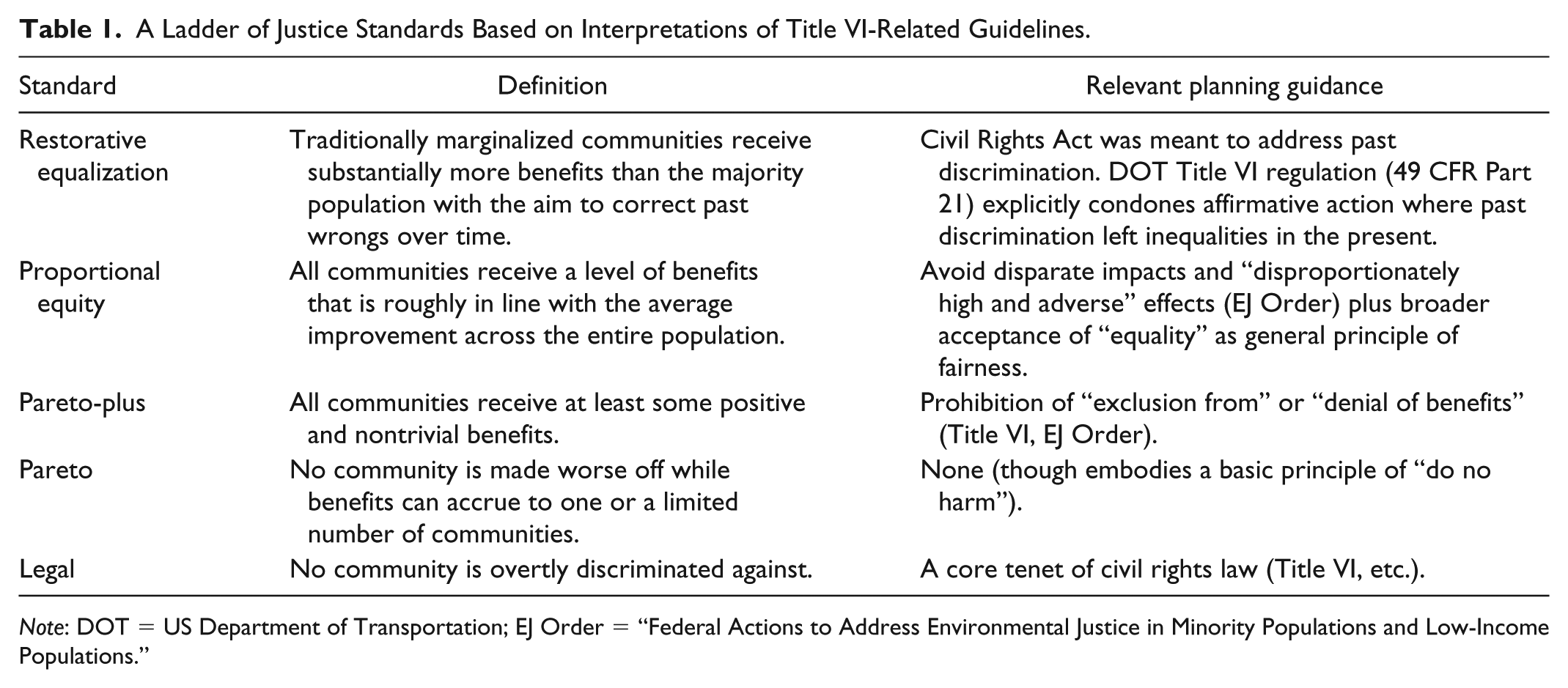
Note: DOT = US Department of Transportation; EJ Order = “Federal Actions to Address Environmental Justice in Minority Populations and Low-Income Populations.”
Note that this ladder is by no means universal. It depends on the type of burden or benefit under consideration and whether the four interpretations of Title VI can be ordered in an identical “ascending” way. For instance, it is not at all clear whether equalization would be a meaningful interpretation in relation to air or noise pollution.
The four key rungs of the ladder have all been defended in one (legal) context or another in relation to Title VI. Indeed, based on legal jurisprudence alone, it is impossible to identify the “proper” interpretation of Title VI and related regulations. This resonates with the philosophical literature: While justice is more than a matter of opinion or preference (Taylor 1992), it is also not a matter that can be resolved solely based on arguments. Opinions do play a role in debates about justice, although we would argue that such debates should rely (more) on systematic and philosophically informed reasoning. Looking at the four possible interpretations, we tend to endorse an equalization approach, first because of the vast accessibility disparities across population groups and their resulting detrimental impacts on people’s life opportunities and social cohesion and second, because of the intuitive appeal of the equalization argument in its historical and legal context (see previous). Yet, we admit that pragmatic arguments, for instance regarding political feasibility, may well call for the adoption of a less far-reaching equity standard in practice.
Justice Standards in the Practice of Regional Transportation Planning
In this section, we analyze the ten largest MPOs for their measurement and evaluation of the equity impacts of their regional transportation plan. While only a small sample, the ten largest MPOs account for around 25 percent of the total population of the United States. Perhaps more important, we expect these MPOs to represent the state of the art given their size, related planning capacity of the organizations, and history of community interest in these issues (e.g., Los Angeles) that have often pushed planning organizations to improve their practices (Marcantonio et al. 2017). We have limited ourselves to plans published by the year 2014 and used publicly available documents and other sources addressing the equity impacts as part of an RTP process. Some sources were published as a chapter of an RTP, some were published as separate appendices or memos, and some consisted of web pages highlighting analyses results. We deliberately limited the analysis to publicly available sources given the importance of transparency for the topic under consideration. Based on the identified sources (listed in Table 2), we recorded the kind of benefit being analyzed, the populations and scenarios being compared (timepoints, build, no-build, base cases, etc.), and any normative standard being employed, either explicitly or implicitly (see Appendix A.2 for a complete overview of the results).
Overview of Studied Metropolitan Planning Organizations, Regional Transportation Plans, and Equity-Related Documents (Ordered by Population Size).
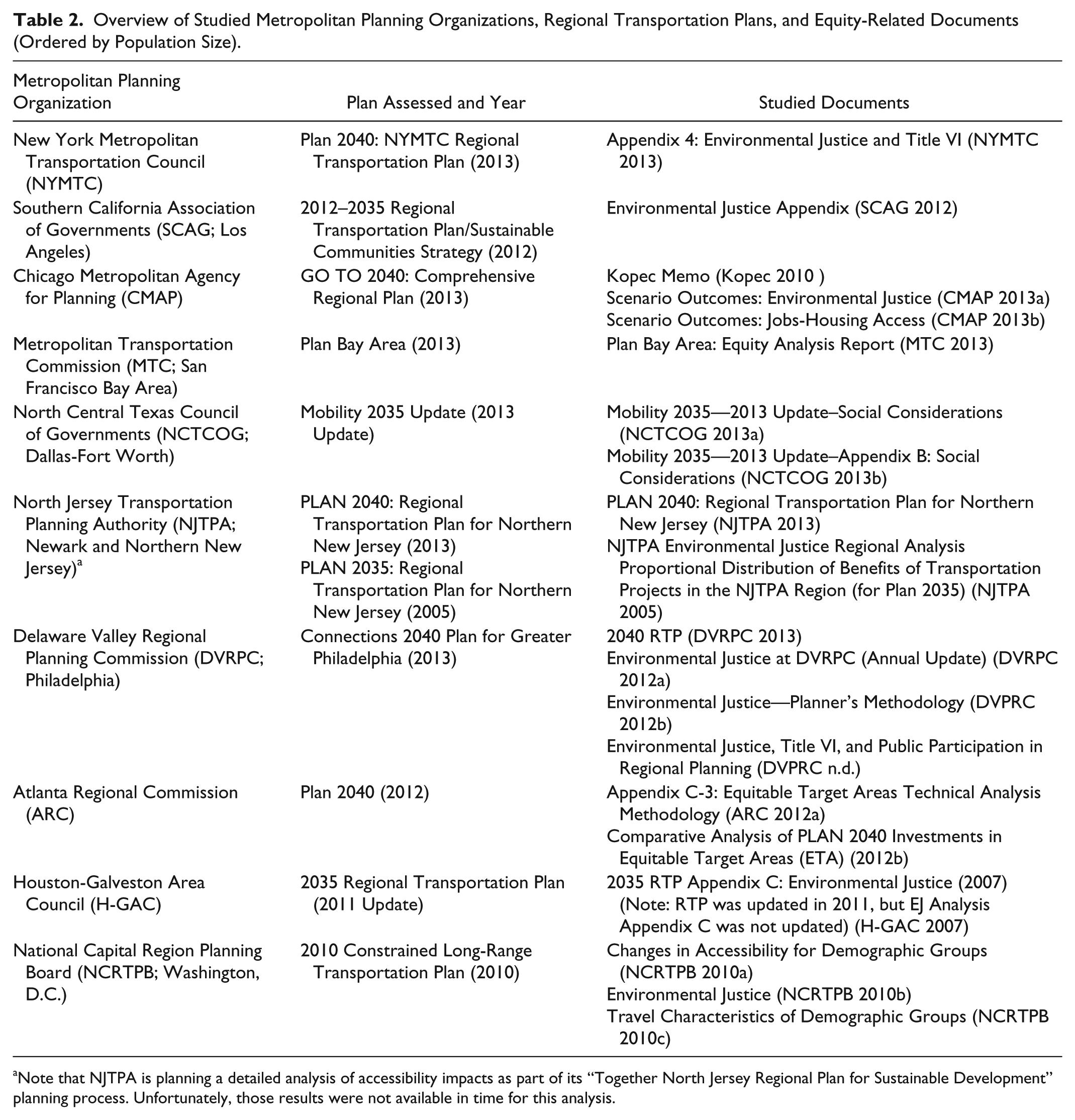
Note that NJTPA is planning a detailed analysis of accessibility impacts as part of its “Together North Jersey Regional Plan for Sustainable Development” planning process. Unfortunately, those results were not available in time for this analysis.
All ten MPOs had an up-to-date regional transportation plan in 2014, and all have performed some equity-related analysis. This is encouraging as agencies have sometimes been reluctant to carry out equity analysis or share the results (Forkenbrock and Sheeley 2004). Three of the ten MPOs only carried out an equity mapping exercise, without relating this explicitly to the accessibility benefits generated by interventions proposed in the regional plan. The New York MPO 11 did analyze existing population trends and travel patterns of communities of concern but did not conduct an assessment of the distributive impacts on accessibility of the proposed plan, suggesting in the appendix that “more detailed analysis and assessment of impacts [will be] conducted by NYMTC members in the development and implementation of each project” (NYMTC 2013, 4-4). Similarly, the Newark and Philadelphia MPOs did not carry out equity analyses of accessibility benefits for their RTP, though they included some mapping analyses of communities of concern. 12 The other seven MPOs did conduct some analyses of the distribution of accessibility benefits resulting from the RTP. In what follows we will focus on the analyses of these seven MPOs. 13 Table 3 summarizes our analysis.
Brief Summary of Equity Analyses of Accessibility Benefits for Selected Metropolitan Planning Organizations (Ordered by Population Size).
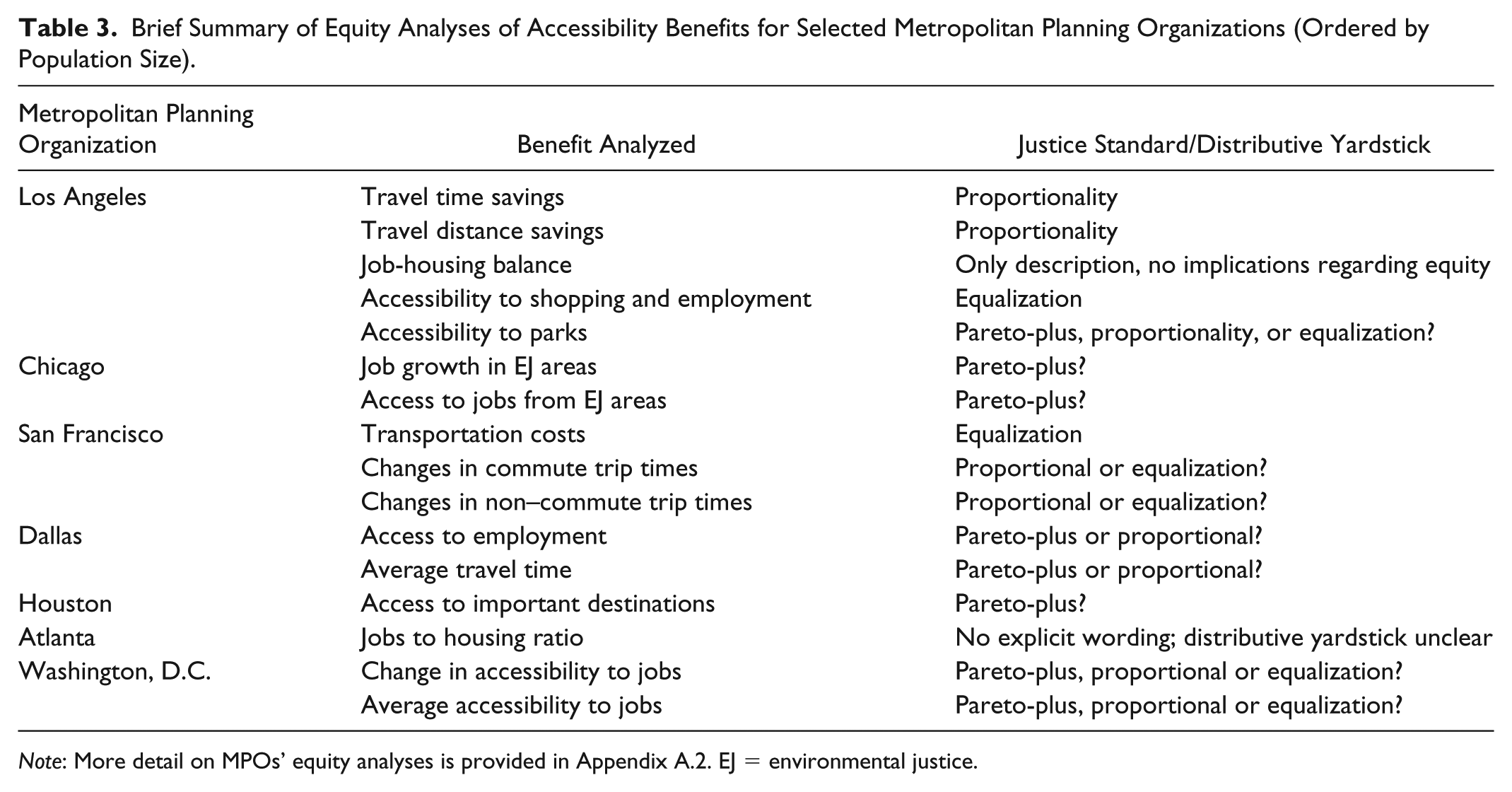
Note: More detail on MPOs’ equity analyses is provided in Appendix A.2. EJ = environmental justice.
The lack of clear federal guidance regarding the assessment of the distribution of benefits is directly reflected in the wide variety of equity analyses carried out by the MPOs. The Los Angeles (LA) and San Francisco MPOs have produced voluminous reports with sophisticated analyses covering a wide range of equity concerns. Others, like the Houston, Chicago, and Atlanta MPOs, have presented only minimal analyses of accessibility impacts. The assessments also differ substantially in terms of quality of presentation, with no MPO providing explicit reasons for carrying out particular analyses and some MPOs explaining very little or none of the technical details of the analyses. Perhaps most striking is the fact that none of the assessments allow for a straightforward interpretation of the results.
We now turn to the distributive standards used in the equity analyses. Perhaps the most important finding is that no MPO unambiguously states which normative standard is used to assess the fairness of the proposed RTP. A second key finding is that all seven MPOs analyze distributional patterns, clearly suggesting that none merely sticks to the legal interpretation of Title VI. Indeed, some MPOs state this explicitly. The LA MPO starts its EJ chapter stating that “Title VI not only bars intentional discrimination, but also unjustified disparate impact discrimination” (Southern California Association of Governments [SCAG] 2012, 1). The Philadelphia MPO, which did not carry out any equity analysis of accessibility for its RTP, explicitly warns in a public presentation about Title VI that “a neutral policy or practice may have a disparate impact on protected groups” (Delaware Valley Regional Planning Commission [DVRPC] n.d., 10). The Chicago MPO goes even further by stating that “in designing policies and making investments, it is important to take actions that do not perpetuate these inequities, and to correct them if possible” (Chicago Metropolitan Agency for Planning [CMAP] 2013b, 48).
While explicit normative standards are lacking in the studied documents, in a number of cases, it is possible to determine which standards are implicitly used, either through the language used or type of analyses carried out. Regarding the analyses, the employment of a Pareto-plus standard requires only an analysis of the accessibility increments reaped by communities of concern; an analysis of the benefits accruing to other groups is not necessary. The use of a proportionality standard does require a comparison of the accessibility increments between groups. For the use of an equalization standard, even more advanced analyses are necessary as an assessment of the accessibility increments produced by transportation investments is no longer sufficient. To employ the equalization standard, a comparison of overall accessibility levels between communities of concern and the remainder of the population is necessary, in the ideal case including a comparison of the situation before and after the implementation of the plan and for a future situation with and without the proposed transportation investments. In our final assessment of the equity analyses in Table 2, we have only drawn conclusions if both the language and the analyses in the studied documents clearly reflect a particular distributive standard. In all other cases, we could not draw a definitive conclusion (signaled by “?” in Table 2).
The contents of the RTPs of five MPOs remains unrevealing with respect to the specific standards being employed. This includes the Washington, D.C., Dallas, Houston, Chicago, and Atlanta MPO. For instance, the analysis conducted by the Washington, D.C., MPO (National Capital Region Planning Board [NCRTPB] 2010c) uses language that could be related to the Pareto-plus (“Significant gains and minimal losses in accessibility will be realized by all groups”), proportional (“These data suggest that the changes in auto accessibility due to the 2010 CLRP do not have disproportionate, adverse impacts on minority or transportation disadvantaged groups”), or equalization perspective (“All minority and disadvantaged groups will experience greater gains than the general population”). These quotes, each reflecting a different equity standard, all follow one another in a brief text on the official RTP website, which ends with the concluding statement that “the benefits and burdens of the plan appear to be fairly distributed” (NCRTPB 2010c). The use of multiple standards suggests, at best, uncertainty or disagreement regarding the most appropriate equity analysis or worse, an opportunistic use of different standards to draw favorable conclusions regarding the regional plan.
The Dallas MPO seems to have used, implicitly, a comparable mixture of equity standards. The MPO compares a “build” and a “no-build” scenario with regard to changes in the number of accessible jobs for communities of concern and other areas. They show that communities of concern have substantially higher job accessibility in both scenarios (by car and transit, separately) but also that while all groups reap some benefits, non–communities of concern benefit much more from RTP investments than protected classes (North Central Texas Council of Governments [NCTCOG] 2013b, B.23-B.26). Based on these results, the Dallas MPO concludes that “roadway and transit recommendations do not have disparate impacts on protected populations” (NCTCOG 2013a, 3.16). While the systematic comparison of accessibility increments across population classes suggests the employment of a proportionality standard, the conclusion seems to imply the implicit use of a Pareto-plus standard.
The analyses carried out by the Chicago MPO, in turn, seem to point at a Pareto-type evaluation. The MPO analyzed job growth in and job access from EJ areas, showing how communities of concern experience improvement in both indicators for most investment scenarios (Chicago Metropolitan Agency for Planning [CMAP] 2013a). However, the document lacks any explicit language confirming that the MPO indeed has applied a Pareto-plus standard.
The LA and San Francisco MPOs are more explicit regarding the equity standards used in the equity assessments. The LA MPO uses a proportionality standard in the assessment of mobility-related benefits like travel time savings and travel distance savings, as evidenced by the formulations in the EJ Appendix to the RTP: “Share of travel time savings by income group is generally consistent with each group’s mode usage” and “Share of travel time savings and person-mile benefits by ethnic groups are also very balanced, and in line with each ethnic group’s use of the transportation system” (SCAG 2012, 4, 59). 14 In contrast, an equalization standard is implicitly used in the analysis of job and shopping accessibility, as suggested by the positive framing of a number of its conclusions, such as the response to the finding that a number of communities of concern currently have below average accessibility: “Through the implementation of recommended strategies . . . , the elderly, non-Hispanic Native Americans and non-Hispanic others will experience much better improvements than the average population in both job and shopping opportunities” (SCAG 2012, 5, 65). As is the case for the other MPOs, the motivations for employing two fundamentally different equity standards remains unclear.
A comparable conclusion applies to the San Francisco MPO. For this MPO, the goal of the equity analysis is to assess whether the project “has a beneficial impact on communities of concern” and “whether communities of concern receive similar or greater benefit compared to the remainder of the region” (MTC 2013, 3, 2-23). The former is in line with a Pareto-plus standard, while the latter assessment suggests that proportionality is used as the minimum standard for fairness while improvements exceeding proportionality are acceptable if they benefit communities of concern (i.e., equalization standard). The MPO makes a distinction between a Title VI, an EJ, and an equity analysis. The Title VI analysis does not directly address accessibility-related benefits; the latter two analyses do. The EJ analysis aims to assess whether the plan has “an adverse effect on EJ populations” and, if it does, whether these effects “are disproportionally high.” The equity analysis in turn aims to determine whether (1) there is “an existing regional disparity between communities of concern and the remainder of the region,” (2) the draft plan “reduces any existing regional disparity,” and (3) the draft plan performs better than other alternatives (MTC 2013, 12; italics added). The equity analysis was carried out because “Regional Equity Working Group members and other stakeholders felt strongly that Plan Bay Area should aim to reduce any existing disparities between communities of concern and the remainder of the region” (MTC 2013, ES-10; italics in original). This is clearly a call for the use of an equalization standard, but this standard is not employed by the MPO in its analyses. In these analyses, two “technical performance measures” are employed that relate to accessibility: average commute time and average non–commute time. The results of the EJ analyses are subsequently formulated in terms of a proportionality standard. For instance, the report concludes that “communities of concern see a slightly smaller reduction in commute time relative to the remainder of the region” (MTC 2013, 4-30). This finding seems to be at odds with the stakeholders’ request that the RTP reduce existing disparities. Perhaps for this reason, the report continues by suggesting that this finding may in part “reflect some trips shifting from autos to generally slower modes” among minority populations and continues to observe that “to the extent that trips shifted from autos to transit, walking, and biking are less expensive, cost-savings benefits of those trips shifted may outweigh the negligible increase in travel time for residents of communities of concern” (MTC 2013, 4-30). This observation is subsequently supported by an analysis of transportation affordability, which shows a somewhat stronger reduction in transportation costs for communities of concern than for the reminder of the population. We conclude that while the San Francisco MPO is perhaps the most explicit about the appropriate equity standards, it also seems to employ the standards in an opportunistic way.
Conclusions and Discussion
In this paper, we have developed a taxonomy of possible normative standards to assess the fairness of regional transportation plans based on various interpretations of Title VI of the Civil Rights Act. We have found that all ten of the selected MPOs go beyond the basic “legal” interpretation of Title VI prohibiting overt discrimination. Some MPOs even explicitly reject that basic legal interpretation, and seven MPOs have conducted analyses of distributional patterns, implying a rejection of the legal interpretation. Beyond this broad agreement between MPOs’ positions, their selection of distributive standards appears to be haphazard at best. Some MPOs appear to use differing standards for different ways of measuring accessibility in a seemingly random fashion. In other cases, it seems that MPOs are using a standard that matches the results of the equity analyses rather than consistently employing one standard to assess the RTP. Since federal directives provide no guidance to assist MPOs to select and define normative standards, this seemingly opportunistic use of equity standards is perhaps not surprising.
Still, for a number of reasons, we would have expected MPOs to adopt a less “progressive” stand. The outright rejections of the legal interpretation of Title VI are especially remarkable, in particular in light of a number of court rulings stating that “official action will not be held unconstitutional solely because it results in a racially disproportionate impact” (National Academies of Sciences, Engineering, and Medicine 2008). Furthermore, even if MPOs reject the legal reading, we would have expected them to at best adopt a proportionality approach for a number of reasons. First, the proportionality approach is often used in assessing the distribution of burdens, and some MPOs may thus have experience in applying this standard (Forkenbrock and Schweitzer 1999). Second, a proportionality approach relieves MPOs of the burden to relate to the vast disparities in accessibility inherited from the past, some of which they may have caused themselves. And third, the approach would not require MPOs to explicitly defend a substantial deviation from a roughly equal (i.e., proportional) distribution of accessibility improvements. Since the standard of equality has strong intuitive appeal and is indeed perceived by philosophers as the default equity criterion (Kolm 1996), any deviation from proportionality would require MPOs to develop an explicit normative standpoint. Against this background, it is at least remarkable that some MPOs are using the language of the restorative approach to equity, certainly if one takes the possible implications for future plans into account (see the following).
One question that looms throughout this analysis is the effect of the results of the equity analyses. Based on our analysis, it is not possible to assess to what extent the distributional analyses have actually been used to shape the RTPs. It may have been that earlier “draft” versions of the RTPs were subject to equity analyses and that plans were adjusted based on early results. If that would be the case, we would indeed see the fruits of equity regulations in the practice of transportation planning (see Lowe 2014). The wording of the MPO documents, however, seems to suggest that projects, or scenarios of projects, are often assembled into the RTPs, with equity analyses performed as an afterthought (see Sanchez and Wolf 2005, and the evidence provided in Nelson et al. 2004). This might explain the lack of explicit equity standards and often ambiguous assessment of the analyses’ results in the MPO documents, with the employment of equity standards in line with the analyses’ results. It would require an in-depth analysis of the planning processes to substantiate such a claim. Yet, even if equity analyses have only been conducted as an afterthought, they may still represent the beginning of a change. The need to conduct an equity analysis may well shape the content of the scenarios being considered. 15 Furthermore, drawing on current experiences, MPOs may be more willing to conduct equity analyses regarding accessibility in an early stage in the preparation of the next RTP. Citizens and advocacy groups in turn may use the results of the available equity analyses as a benchmark to scrutinize and possibly challenge MPOs’ investment priorities and press for better and more meaningful equity analyses in future planning efforts (see again, Lowe 2014).
We must concede that justice is only one of many demands being placed on regional transportation plans and policies. Transportation planning agencies will have to address a multitude of concerns in the planning process. Yet, equity concerns are increasingly on the agenda of planning agencies, in the United States and elsewhere (The World Bank 2005). Inclusion of these considerations in the transportation planning process will require an understanding of the equity impacts of alternative policies and plans. Such an understanding is not possible without an explicit definition of an equity standard before conducting an equity analysis. This is increasingly recognized, as evidenced by recent FTA guidelines pertaining to analyzing the fairness of transit service and fare changes (FTA 2012a, 2012b). And while such guidelines may not guarantee compliance or effectiveness (see e.g., Karner and Golub 2015), we argue that an explicit and transparent equity standard is simply part-and-parcel of good governance practice (see also Manaugh et al. 2015). Furthermore, we anticipate that this argument for attention to explicit standards can add to the much broader proposal to improve equity analyses for regional planning developed by Marcantonio et al. (2017). We hope that the analysis provided here, while based on US legislation and practice, can contribute to the necessary public debate about the possible interpretations of fairness in the transportation domain in the United States and beyond.
Footnotes
Appendix
Summary of Equity Analyses of Accessibility Benefits for Selected Metropolitan Planning Organizations (Ordered By Population Size).
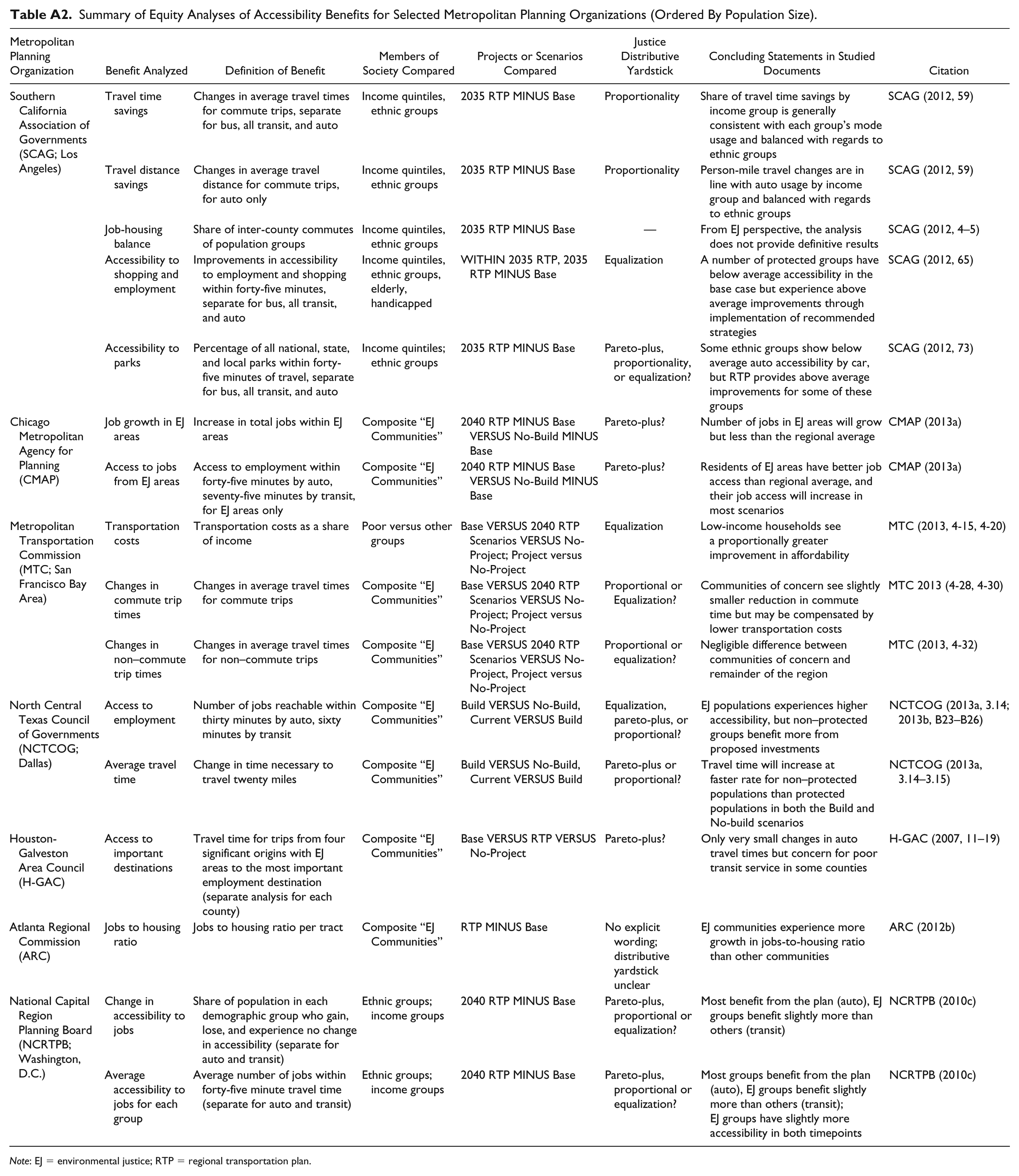
| Metropolitan Planning Organization | Benefit Analyzed | Definition of Benefit | Members of Society Compared | Projects or Scenarios Compared | Justice Distributive Yardstick | Concluding Statements in Studied Documents | Citation |
|---|---|---|---|---|---|---|---|
| Southern California Association of Governments (SCAG; Los Angeles) | Travel time savings | Changes in average travel times for commute trips, separate for bus, all transit, and auto | Income quintiles, ethnic groups | 2035 RTP MINUS Base | Proportionality | Share of travel time savings by income group is generally consistent with each group’s mode usage and balanced with regards to ethnic groups | SCAG (2012, 59) |
| Travel distance savings | Changes in average travel distance for commute trips, for auto only | Income quintiles, ethnic groups | 2035 RTP MINUS Base | Proportionality | Person-mile travel changes are in line with auto usage by income group and balanced with regards to ethnic groups | SCAG (2012, 59) | |
| Job-housing balance | Share of inter-county commutes of population groups | Income quintiles, ethnic groups | 2035 RTP MINUS Base | — | From EJ perspective, the analysis does not provide definitive results | SCAG (2012, 4–5) | |
| Accessibility to shopping and employment | Improvements in accessibility to employment and shopping within forty-five minutes, separate for bus, all transit, and auto | Income quintiles, ethnic groups, elderly, handicapped | WITHIN 2035 RTP, 2035 RTP MINUS Base | Equalization | A number of protected groups have below average accessibility in the base case but experience above average improvements through implementation of recommended strategies | SCAG (2012, 65) | |
| Accessibility to parks | Percentage of all national, state, and local parks within forty-five minutes of travel, separate for bus, all transit, and auto | Income quintiles; ethnic groups | 2035 RTP MINUS Base | Pareto-plus, proportionality, or equalization? | Some ethnic groups show below average auto accessibility by car, but RTP provides above average improvements for some of these groups | SCAG (2012, 73) | |
| Chicago Metropolitan Agency for Planning (CMAP) | Job growth in EJ areas | Increase in total jobs within EJ areas | Composite “EJ Communities” | 2040 RTP MINUS Base VERSUS No-Build MINUS Base | Pareto-plus? | Number of jobs in EJ areas will grow but less than the regional average | CMAP (2013a) |
| Access to jobs from EJ areas | Access to employment within forty-five minutes by auto, seventy-five minutes by transit, for EJ areas only | Composite “EJ Communities” | 2040 RTP MINUS Base VERSUS No-Build MINUS Base | Pareto-plus? | Residents of EJ areas have better job access than regional average, and their job access will increase in most scenarios | CMAP (2013a) | |
| Metropolitan Transportation Commission (MTC; San Francisco Bay Area) | Transportation costs | Transportation costs as a share of income | Poor versus other groups | Base VERSUS 2040 RTP Scenarios VERSUS No-Project; Project versus No-Project | Equalization | Low-income households see a proportionally greater improvement in affordability | MTC (2013, 4-15, 4-20) |
| Changes in commute trip times | Changes in average travel times for commute trips | Composite “EJ Communities” | Base VERSUS 2040 RTP Scenarios VERSUS No-Project; Project versus No-Project | Proportional or Equalization? | Communities of concern see slightly smaller reduction in commute time but may be compensated by lower transportation costs | MTC 2013 (4-28, 4-30) | |
| Changes in non–commute trip times | Changes in average travel times for non–commute trips | Composite “EJ Communities” | Base VERSUS 2040 RTP Scenarios VERSUS No-Project, Project versus No-Project | Proportional or equalization? | Negligible difference between communities of concern and remainder of the region | MTC (2013, 4-32) | |
| North Central Texas Council of Governments (NCTCOG; Dallas) | Access to employment | Number of jobs reachable within thirty minutes by auto, sixty minutes by transit | Composite “EJ Communities” | Build VERSUS No-Build, Current VERSUS Build | Equalization, pareto-plus, or proportional? | EJ populations experiences higher accessibility, but non–protected groups benefit more from proposed investments | NCTCOG (2013a, 3.14; 2013b, B23–B26) |
| Average travel time | Change in time necessary to travel twenty miles | Composite “EJ Communities” | Build VERSUS No-Build, Current VERSUS Build | Pareto-plus or proportional? | Travel time will increase at faster rate for non–protected populations than protected populations in both the Build and No-build scenarios | NCTCOG (2013a, 3.14–3.15) | |
| Houston-Galveston Area Council (H-GAC) | Access to important destinations | Travel time for trips from four significant origins with EJ areas to the most important employment destination (separate analysis for each county) | Composite “EJ Communities” | Base VERSUS RTP VERSUS No-Project | Pareto-plus? | Only very small changes in auto travel times but concern for poor transit service in some counties | H-GAC (2007, 11–19) |
| Atlanta Regional Commission (ARC) | Jobs to housing ratio | Jobs to housing ratio per tract | Composite “EJ Communities” | RTP MINUS Base | No explicit wording; distributive yardstick unclear | EJ communities experience more growth in jobs-to-housing ratio than other communities | ARC (2012b) |
| National Capital Region Planning Board (NCRTPB; Washington, D.C.) | Change in accessibility to jobs | Share of population in each demographic group who gain, lose, and experience no change in accessibility (separate for auto and transit) | Ethnic groups; income groups | 2040 RTP MINUS Base | Pareto-plus, proportional or equalization? | Most benefit from the plan (auto), EJ groups benefit slightly more than others (transit) | NCRTPB (2010c) |
| Average accessibility to jobs for each group | Average number of jobs within forty-five minute travel time (separate for auto and transit) | Ethnic groups; income groups | 2040 RTP MINUS Base | Pareto-plus, proportional or equalization? | Most groups benefit from the plan (auto), EJ groups benefit slightly more than others (transit); EJ groups have slightly more accessibility in both timepoints | NCRTPB (2010c) |
Note: EJ = environmental justice; RTP = regional transportation plan.
Acknowledgements
We would like to thank the three anonymous reviewers and the managing editor for their valuable comments, which have helped us to substantially improve the paper.
Authors’ Note
An earlier version of this paper was presented at the Annual Conference of the Transportation Research Board.
Declaration of Conflicting Interests
The author(s) declared no potential conflicts of interest with respect to the research, authorship, and/or publication of this article.
Funding
The author(s) received no financial support for the research, authorship, and/or publication of this article.