




Abstract
Even with expected changes in fuel, transportation will produce significant greenhouse gas emissions long into the future. We conduct the first evaluation of the performance of metropolitan planning organizations (MPOs) in planning and implementing strategies for emission reduction. By coding regional transportation plans in three U.S. states, we find a reasonably high level of plan conformance: MPOs that express commitment to climate change mitigation channel more funding toward projects that reduce emissions. However, most MPOs have not started planning to address climate change, leading us to conclude that current practice has not redirected MPOs’ traditional emphasis on automobile-based transportation.
Introduction
The transportation sector is now the leading source of U.S. greenhouse gas (GHG) emissions, yet most of the research attention has focused on fuels and technology as a means of reduction rather than travel. Even with expected changes in fuel, transportation will produce a significant portion of U.S. GHGs long into the future (U.S. Energy Information Administration 2020). Finding ways to integrate climate change mitigation into the demand side of the transportation sector requires examining not only travel behavior, which has long been the focus of research, but also transportation planning and project prioritization.
Our research focuses on the contributions of metropolitan transportation planning and project implementation in addressing the challenges of climate change. Most transportation planning occurs within 405 metropolitan planning organizations (MPOs), which channel the demands of diverse local constituencies into long-term plans and short-term funded project lists that shape a region’s infrastructure. The traditional emphasis by MPOs on automobiles and congestion management has contributed to high rates of growth over time in vehicle miles traveled (VMT) and on-road GHG emissions (Hanson and Giuliano 2004; U.S. Department of Transportation/Federal Highway Administration 2020; U.S. Environmental Protection Agency 2020). The forces contributing to passenger travel decisions are hotly debated; unknown is the extent to which local transportation investment can contribute to VMT reduction by limiting expansion in road capacity, adding modal options, or influencing land use in ways that reduce trip lengths.
Prior research has examined MPOs’ efforts to integrate climate change considerations into planning (Barbour and Deakin 2012; Juhola and Westerhoff 2011; Mason and Fragkias 2018; Niemeier, Grattet, and Beamish 2015), but not the translation of planning goals into infrastructure changes that reduce VMT and GHG emissions. This is the task we take on in this research. Informed by work in the land use planning literature (Berke et al. 2006; Laurian et al. 2004; Lyles, Berke, and Smith 2015), we develop a methodology for evaluating the conformance of transportation infrastructure outcomes with goals and policies articulated by MPOs in their transportation plans. Through detailed coding of transportation plans in three states, we measure both the expressed commitment of MPOs to GHG reduction in their transportation planning, as well as their actual performance in funding projects that would achieve such reductions. We find a reasonably high level of conformance: those MPOs that express commitment to climate change mitigation tend to channel more funding toward projects that reduce reliance on single-occupancy vehicle (SOV) travel. However, many MPOs have not taken on the challenge of climate change, leading us to conclude that current transportation planning is only weakly effective in redirecting MPOs’ traditional emphasis on automobile-based transportation.
Local Climate Policy
In the United States, a long period of inaction by the federal government has left subnational governments with the role of policy leadership on climate change (Rabe 2004). Scholars have dedicated considerable attention to the efforts of municipal governments in this area (Bassett and Shandas 2010; Bulkeley 2010; Hughes 2019; Sharp, Daley, and Lynch 2010; Wheeler 2008). More than 1,000 cities have made commitments reduce their emissions and pursue other climate protection goals. Despite good intentions, climate planning activities may be more symbolic than substantive, because municipalities have had limited success in carrying out the commitments they make (Krause, Feiock, and Hawkins 2014). Localities vary widely in their ability to take meaningful action: they differ in their responsibilities over local government functions, they often are constrained by their positions in labor and housing markets, and they have unequal financial resources because of disparities across city tax bases (Hawkins et al. 2015; Mullin 2014). Fragmentation of local governance also gives rise to coordination problems that pose additional challenges for mitigation planning and may create discrepancies between municipal boundaries and patterns of GHG-producing activity (Dierwechter 2010; Feiock 2013).
Regions, having more demographic and economic diversity within their boundaries than is typically found within individual cities, play an important role in coordinating local activities. Regional governing institutions have often been used to address collective action problems and reduce inequalities across jurisdictions (Miller et al. 2018). MPOs’ governing structures offer the opportunity for representatives of cities, counties, and transit agencies within a region to develop and share strategies for addressing climate change, coordinate policy action, make credible commitments to one another, and monitor and hold one another accountable for policy actions. Such venues make collective action for resource management more likely (Ostrom 2010).
Regional agencies are not completely unconstrained when addressing climate change. On the practical side, regional governments are composed of local political actors who may not share long-term expectations and priorities around transportation projects and related environmental issues such as air quality (Handy 2008). These actors also can have widely varying planning styles that interfere with collaboration (Innes and Gruber 2005). Moreover, representatives from member governments and agencies have incentive to advocate for projects and policies that benefit their own communities (Gerber and Gibson 2009). While regional governments can perform well in allocating shared responsibilities such as affordable housing, climate change is not a localized condition, so defining a community’s fair share can be problematic (Barbour and Deakin 2012; Goldman and Deakin 2000). Perhaps more profoundly, regional planning agencies are called upon to address or balance tensions in the “planner’s triangle”: the economy, equity, and the environment (Campbell 1996). Facing immediate economic and social equity demands, it can be difficult for planners to dedicate attention to a more remote issue like climate change. Finally, constituencies organizing for transportation policy reform often confront institutional and power structures that fail to respond to the new demands (Beamish, Grattet, and Niemeier 2017; Weir, Rongerude, and Ansell 2008).
Our focus on regional transportation planning offers a unique opportunity to study subnational climate efforts where responsibilities and policy outputs are comparable and measurable. States vary in the functions they assign to local governments and the discretion they allow in local decision making. Special districts, joint powers agreements, and other institutional and collaborative arrangements create further variation in the tasks that each municipal government performs. Because local government activities are not directly comparable, research attention to municipal climate action often has focused on stated policy commitments or the development of climate action plans—efforts that may have important symbolic value but lack the substantive impact of binding constraints or resource allocations (Sharp, Daley, and Lynch 2010). By contrast, MPOs all have the same federally defined responsibilities in transportation planning and are similarly empowered to address climate change through their activities. They are responsible not only for creating regional transportation plans but also for allocating funds to particular projects, allowing us to evaluate consistency between planning goals and concrete funding actions.
Regional Transportation Planning
The 1973 Federal Aid Highway Act authorized creation of MPOs to carry out regional planning activities for transportation. By definition, any urbanized area with more than 50,000 people must be part of an MPO, and an MPO can include more than one urbanized area. MPOs are charged with establishing a metropolitan planning process that is a “cooperative, continuous, and comprehensive framework for making transportation investment decisions in metropolitan areas” (23 CFR Part 450). The current legislation (the Fixing America’s Surface Transportation [FAST] Act) also mandates that planning processes be performance-based.
MPOs are the heart of regional transportation governance; they are responsible for transportation planning and have the authority to allocate federal and state transportation funds (Sciara 2017). MPOs develop long range transportation plans (LRTPs), which identify the necessary infrastructure to support a region’s future growth, and they prioritize projects using two- to four-year fiscally constrained transportation improvement programs (TIPs). LRTPs signal the region’s goals, which often encompass not just transportation, but also air quality, housing, equity, and economic development aims, and they identify the projects that buttress regional goals and policies. The TIPs prioritize and schedule the implementation of projects listed in the LRTP. A region’s LRTP and subsequent TIPs characterize not only how a transportation system will manifest, but also how the system will connect to the region’s population centers. Because MPOs play the central role in regional transportation planning and implementation, they must be the focus of any effort to achieve more flexible, integrated, and sustainable transportation systems.
As the hubs for surface transportation planning activity, MPOs can play a critical role in reducing GHG emissions from the transportation sector. Recent modeling conducted in the Albuquerque, New Mexico metropolitan area indicates that it is possible to achieve deep GHG emission reductions through ambitious transportation planning strategies (Tayarani et al. 2018). In a 2010 report to Congress, the U.S. Department of Transportation highlighted transportation planning and investment as a key strategy for reducing sectoral emissions and presented options for the federal government to promote MPO efforts through technical assistance, regulations, or funding incentives (U.S. Department of Transportation 2010). Currently, the federal government neither mandates nor provides resources for MPOs to direct planning efforts toward GHG reduction, yet some MPOs have incorporated climate change mitigation language into their planning documents (ICF International 2008). Little is known, however, about the extent to which this planning language is reflected in regional funding priorities.
Climate Planning and Implementation in Transportation
Our research separates the concept of climate planning from measurable climate performance in achieving GHG reductions. Misalignment between planning language and outputs in the form of prioritized projects is quite plausible (Handy 2008). Although federal law dictates that funded projects must be consistent with a region’s LRTP, few mechanisms are in place to ensure consistency with stated goals. Because climate change is not part of the federal mandate on MPOs, state and federal authorities do not scrutinize consistency of climate change language with planning outcomes, other than criteria pollutants where applicable.
In examining the relationship between planning language and decision making on the projects that get prioritized, we contribute to a growing literature about plan implementation: the translation of plans into enforced policies, and ultimately the effectiveness of those policies in producing desired outcomes (Berke et al. 2006; Brody and Highfield 2005; Laurian et al. 2004; Talen 1996a, 1996b). Lyles, Berke, and Smith (2015) propose a distinction among three types of plan implementation: plan conformance that indicates the degree to which policies proposed in a plan are carried out, plan influence to indicate a process-oriented use of the plan in decision making situations, and plan performance that captures the degree to which a plan influences outcomes. Consistent with the predominant approach in the literature on U.S.-based planning, our work evaluates plan conformance, or the consistency between goals expressed in LRTPs and the prioritized project lists on those long-range plans.
By placing our research at the MPO level, we minimize many of the methodological challenges that arise in plan conformance research. In local land use planning, it is difficult to determine the proper time frame for evaluation, because comprehensive plans are intended to guide development over the long term (Alexander and Faludi 1989; Brody and Highfield 2005). Identifying causal relationships also poses a challenge because of the many complex interactions that contribute to plan implementation (Talen 1996b). In the MPO context, the planners are also the implementers; the MPO defines transportation system goals and objectives but also makes project-level funding decisions, and it performs these functions within the same planning cycle.
Although the MPO exercises formal control over both planning and project selection, prior research offers reason to expect less than perfect conformance. MPO governing structures vary widely, reflecting different—and sometimes delicate—balances in representation and voting privileges among political actors and stakeholders (Gerber, Henry, and Lubell 2013; Kramer, Carroll, and Karimi 2017; Lewis and Sprague 1997; Nelson et al. 2004). Even after long participatory processes to develop visions and long-range plans, TIPs often end up as wish lists of projects demanded by member local governments and state transportation agencies (Innes and Gruber 2005; Sciara 2017). Local elected officials who serve on MPO boards have an incentive to deliver projects that will benefit their own geographic constituencies, and regional agencies often lack the political power to override decisions made in other policy arenas (Weir, Rongerude, and Ansell 2008). The structure of a governing board gives more weight to some of these interests over others in developing project lists (Bond and Kramer 2010; Gerber and Gibson 2009). Low levels of staffing and expertise can limit MPOs’ ability to pursue new priorities (Deyle and Wiedenman 2014; Gerber and Gibson 2009; Goetz, Dempsey, and Larson 2002; Mason and Fragkias 2018; Sciara 2017; U.S. Government Accountability Office [U.S. GAO] 2009).
Table 1 highlights the range of possible relationships that might exist between climate planning and measurable implementation metrics in transportation project selection. For MPOs, incorporating language about GHG reductions or shifts away from automobile-dominated infrastructure into a long-range plan is a low-cost way to address climate change through regional transportation policy. Broad policy language may allow MPOs to respond to state-defined goals or to political pressure from local stakeholders without making firm commitments to implement the language with the force of funding allocations. Where MPOs have strong language supporting GHG reductions in their plans but fail to implement that language in funding allocations, we argue that their actions are only symbolic (Edelman 1964).
Climate Planning and Implementation.
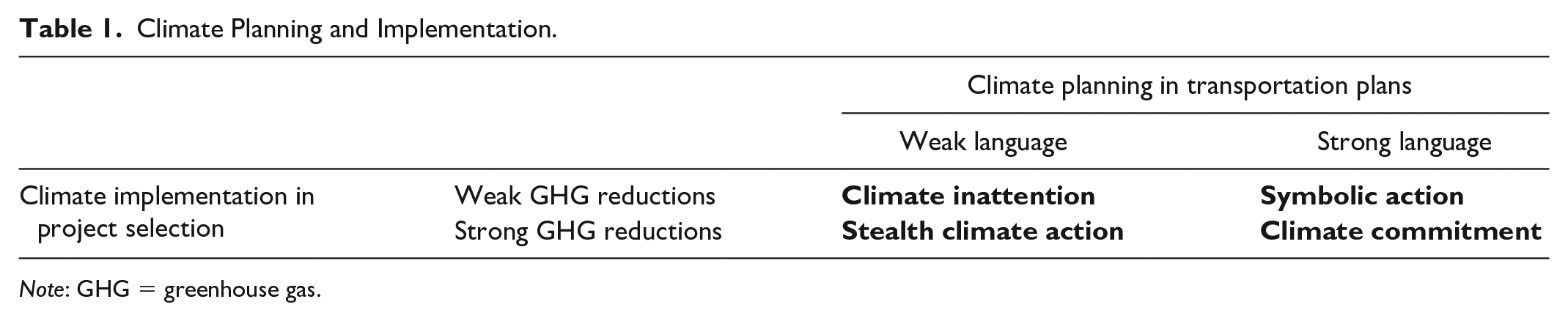
Note: GHG = greenhouse gas.
Conversely, weak language in policy goals may mask a commitment to climate change mitigation that is evident in project implementation. This misalignment between language and outcomes may result from MPOs pursuing projects that advance GHG emission reduction goals for reasons other than climate change, or from MPO decision makers concealing climate change policy that would not receive broad support in their political setting. Whichever the reason, we designate this blend of strong climate performance and weak climate language—a combination we expect to be rare—as stealth climate action. Of course, project allocations may correspond to planning language, either in patterns of climate inaction or climate commitment. Our research is unique in that it explicitly incorporates project scoping into the analysis as an outcome. Through detailed coding of transportation plans and funded projects, we assess how plans match performance in MPOs’ climate change efforts.
Methods
Our assessment of conformance in MPO climate mitigation planning is based on systematic content analysis of transportation plans and funded transportation projects for six MPOs in three states. The documents we coded were the LRTPs and TIPs current as of 2015. The three states (California, Florida, and North Carolina) vary in public attitudes about climate change and the partisanship of their political leadership (Howe et al. 2015), but they have many other similarities. All of the states manage large urban roadway systems: California with nearly 480,000 lane miles, Florida with 280,000 lane miles, and North Carolina with 225,000 lane miles. The urban bus systems in all three states are mature, serving larger metropolitan areas (Rall et al. 2011).
Our research proceeded in two stages. To characterize MPOs’ activity in climate change mitigation planning, we coded the planning language in LRTPs for all MPOs in the three states, using methods described below. To measure the implementation of climate planning in project selection, we focused on a pair of MPOs in each state: Fresno and the San Francisco Bay Area, California; Ocala and Gainesville, Florida; and Charlotte and Durham, North Carolina. MPOs were selected to represent variation in climate change planning—one MPO in each state using strong language as compared to the state’s other MPOs, and the other using weak language. Among the MPOs with relatively low and high climate planning scores, we selected MPOs in more populous regions, on the assumption that these agencies would be better positioned to implement their planning language.
The MPOs that were early adopters of climate change policies have already been identified in previous research. Our interest lies in understanding the extent to which climate change planning has spread beyond these innovators and in measuring the impacts on project outcomes. Our purposive selection process was not designed to produce a representative sample of all MPOs, but instead to emphasize those with the staffing and organizational capacity to reach beyond the minimum requirements of transportation planning. MPOs vary widely in responsibilities, funding and staffing resources, and the level of support they receive from state transportation agencies. Many report that they lack the resources and authority needed to carry out required transportation planning activities (U.S. GAO 2009). We sought to depict a broad view of regional transportation planning while overrepresenting those MPOs with capacity and support to integrate locally defined goals into their planning processes. In our first-stage selection, we included the universe of MPOs within a set of states in order to focus on variation at the MPO, rather than the state, level. The selection of three large states with numerous MPOs guarantees breadth of regional characteristics but with overrepresentation of large metropolitan areas. Our second-stage selection was designed to focus on MPOs that are most likely to exhibit planning conformance, especially where climate planning is underway. Thus, our design depicts the most favorable circumstances for climate planning and implementation, and results should be interpreted as overestimates of activity occurring across the universe of transportation planning agencies.
Climate Planning in Transportation Plans
Our data on planning language is drawn from published LRTPs. Looking across LRTPs for all MPOs in the three states, we developed a set of coding rules to measure climate change emphasis that could be applied to the diverse formats and structures of different plans. We focused our efforts on coding the goals and objectives sections that appeared in nearly every LRTP. Although regional goals sometimes closely aligned with goals articulated in state or federal transportation plans, we found that in nearly all cases, MPOs crafted goals that, at least to some extent, distinguish regionally defined priorities. A coding unit consisted of an individual goal or objective.
We used an iterative process to build our coding scheme. (The full codebook is available as Appendix A in online supplementary material.) The authors initially outlined a set of concepts and keywords that demonstrated emphasis on climate change and another set that did not. Working with a team of PhD, master’s, and undergraduate students at Duke University, we developed a more complex coding system to capture different levels of climate change planning specificity. Coders recoded one another’s plans as the codebook developed, and any inconsistencies were resolved through discussion and codebook clarification. Additional students at Duke and at Florida State University who were not part of this preceding effort then carried out the coding for all plans in all three states, finding very few inconsistencies with earlier coding. We used NVivo software to extract content from LRTPs but interpreted and coded variables by hand.
We developed a three-tiered system for coding attention to climate change in the goals and objectives of regional transportation plans. Level 1 indicates specific mention of climate change or global warming mitigation or GHG emissions reduction. Items were coded for Level 2 if they specifically addressed reducing fuel or energy use or VMT. Level 3 encompasses any planning language directed toward shifting people out of SOVs into alternative modes that reduce fuel use or VMT. We relied on prior transportation research to distinguish between strategies demonstrated to produce reductions in VMT (e.g., expanding transit service, shifting lanes from single-occupancy to high-occupancy vehicles, adding rail service, improving jobs-housing balance) and those for which evidence is mixed and therefore do not get counted under our coding framework (e.g., managing demand, promoting compact development, increasing capacity for park-n-ride). Overall, our codebook included forty-nine keywords or concepts that counted as climate change language. Each goal, objective, or performance measure could be coded under more than one level, although such double-coding was uncommon.
Climate Impacts of Prioritized Transportation Projects
Data on the expected climate change impacts of transportation projects identified in the fiscally constrained transportation plan come from the project lists included in published LRTPs for two MPOs in each of the three states. A coding unit consisted of an individual project. The number of projects identified in each MPO was influenced by the degree to which projects were delineated and the scale of the projects. In total, projects identified in the LRTPs ranged from 28 (Gainesville) to more than 1,100 (San Francisco Bay Area).
We divided projects into categories: single-occupancy, high-occupancy, and non-motorized, and then we assessed potential climate effects by evaluating whether or not a transportation project increased capacity. We used added single-occupancy roadway capacity to identify the general direction of GHG impacts from an MPO’s transportation investment. Added SOV capacity is fundamentally linked to additional VMT; as VMT increases, so will GHGs. Projects identified as SOV but not increasing capacity include activities such as pavement rehabilitation or resurfacing projects. Projects that add non-roadway capacity do not necessarily reduce VMT from SOVs, but they are far less likely to result in increased GHGs. These kinds of projects include transit, rail, shuttle services, bicycle and pedestrian facilities, and conversion of SOV to high-occupancy vehicle lanes. Consistent with our measurement of planning language, we have developed a detailed codebook of project types and their relationship to expanding SOV capacity (available as Appendix B in online supplementary material).
Results
Figure 1 reports on the level of climate planning underway for all MPOs in the three states we examined. (We were unable to reach two MPOs in North Carolina to obtain their LRTPs, and a third LRTP did not include overriding goals and objectives that could be coded.) For each LRTP, we calculated the percentage of stated goals and objectives that addressed three levels of climate planning: specific mention of climate change or GHG emissions (Level 1), specific mention of VMT or fuel use reductions (Level 2), and language oriented toward shifting people from SOVs to alternative, less fuel-intensive modes (Level 3). We graph climate planning emphasis within each state as box plots, where the box indicates the interquartile range (marking the 25th percentile, median, and 75th percentile values) of plan percentages, the whiskers show 1.5 times the interquartile range, and circles indicate outlier values.
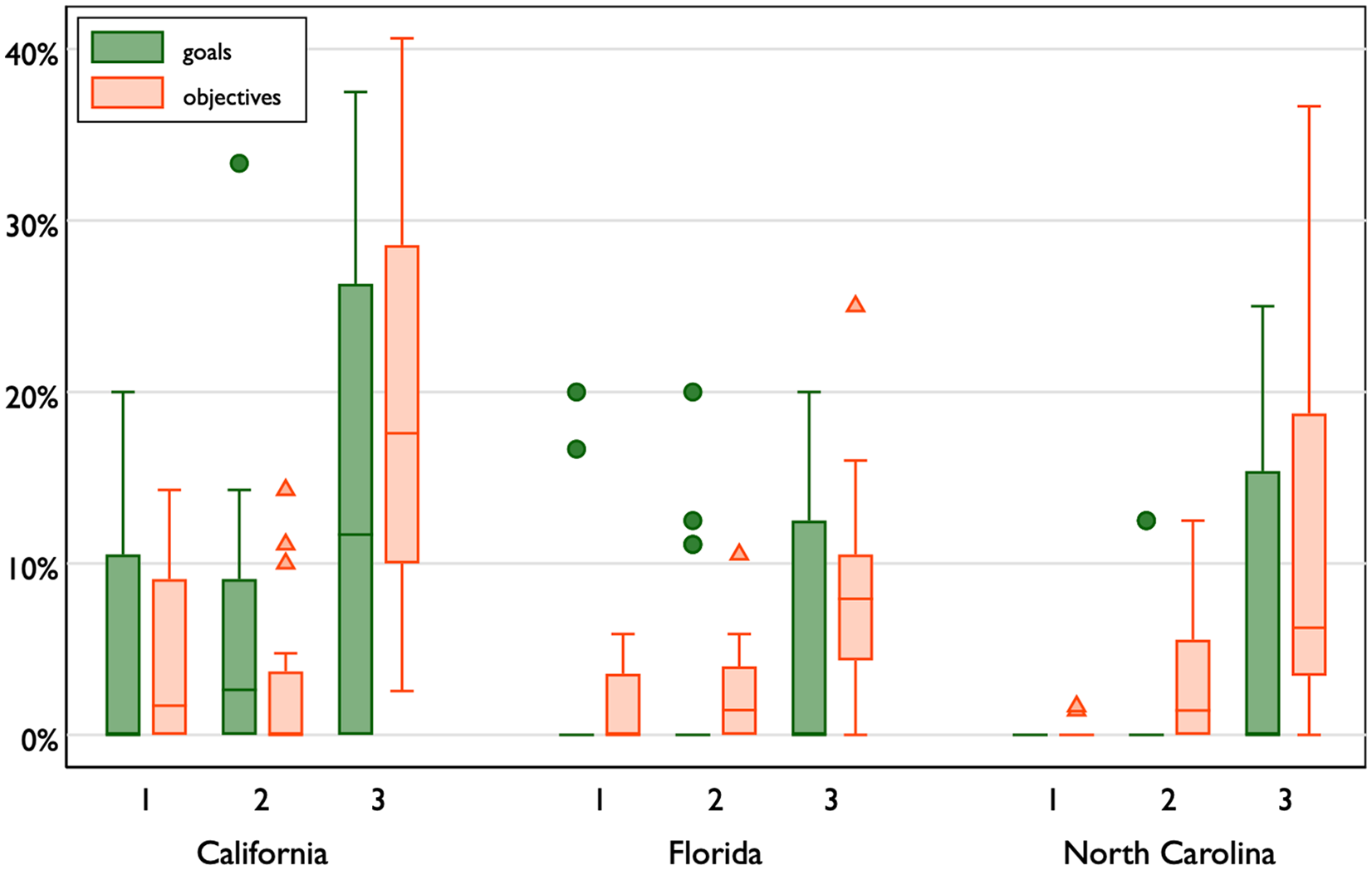
Climate planning across three coding levels.
Overall, MPOs are dedicating little attention to climate change in regional transportation planning. Only ten out of fifty-eight plans we examined included climate mitigation or GHG reductions (Level 1) among planning goals, and less than half included these among their longer lists of objectives. Mentioning fuel use or VMT reductions (Level 2) was somewhat more common, yet still only 15 plans included these among their goals, and just over half among objectives. In the great majority of cases, these Level 1 or Level 2 climate planning considerations appeared as only one of a longer list of goals or objectives, accounting for the low percentages displayed in Figure 1. Where climate mitigation is most evident is in ambitions for expanding facilities and use of alternatives to SOVs (Level 3), including transit, ridesharing, and bicycle and pedestrian travel for transportation (not for recreation). All but five LRTPs included some form of modal shift among their listed transportation objectives. Still, the emphasis on automobile alternatives is low. Less than half of MPOs include SOV alternatives among their overriding goals, and the median percentage of objectives focused on modal shift is only 10 percent. Even this low level may overstate overall planning commitment, because some plans included objectives for every transportation mode. Two of the fifty-eight plans we coded included no goal or objective promoting climate mitigation as reflected by any of our coding levels.
Climate change planning varies substantially across states: for all three coding levels, MPOs in California demonstrated higher levels of commitment to climate planning than MPOs in the other two states. This difference is not surprising; California has the nation’s most aggressive climate policies overall, and state legislation (SB 375) enacted in 2008 required each MPO to set a regional GHG emissions target and include in its LRTP a “sustainable communities strategy” for meeting the target. The LRTPs that we coded were the first to fall under the requirements of SB 375. Although the goals and objectives identified in plans fell outside the law’s mandates, the target-setting process prodded regional transportation agencies to begin to integrate climate considerations into planning processes (Barbour and Deakin 2012). As Figure 1 shows, however, many agencies still gave low priority to climate change even with this prodding. Only about half of California plans mentioned climate change or GHG reductions among their overriding goals (eight out of eighteen plans) or objectives (eleven out of eighteen plans).
To assess plan conformance, we selected two MPOs from each state that exhibited large differences in planning language. As shown in the left panel of Figure 2, no stated goals or objectives referenced climate change, GHG reduction, or VMT reduction (Levels 1 and 2) in Charlotte, Ocala, or Fresno. In these three regions, only one or two out of dozens of specific objectives emphasized fuel-reducing transportation modes (Level 3). In contrast, Durham, Gainesville, and the Bay Area put substantially more emphasis on climate planning. All included all three levels of climate planning language among stated objectives and included at least one of the levels among their overarching goals. The proportion of their goals and objectives that focused on climate change also was on the high end among the broader set of MPOs represented in Figure 1.
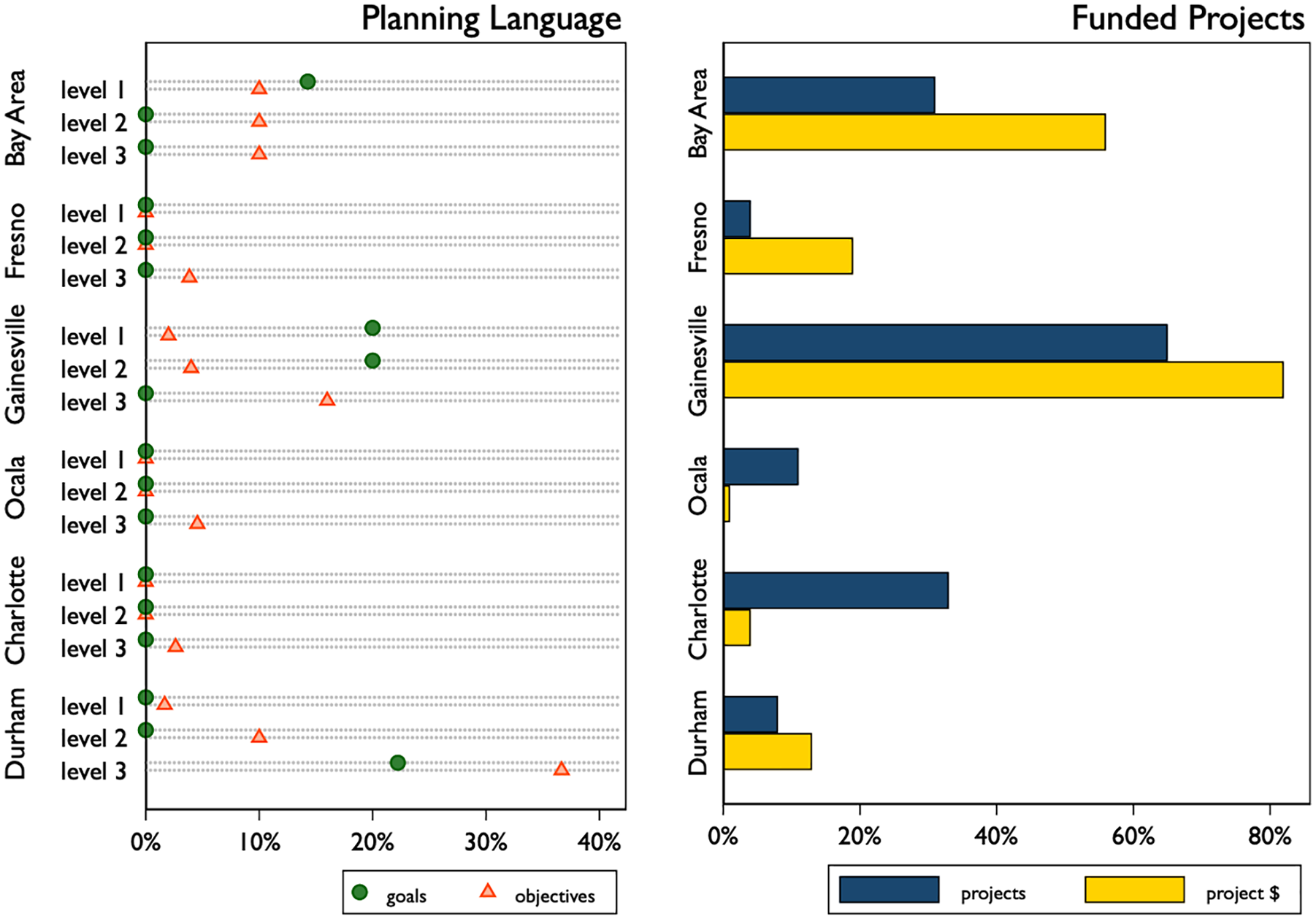
Climate planning and performance by six regional transportation agencies.
The right panel of Figure 2 illustrates the priority given to projects that provide an alternative to SOVs in our six cases. The blue bars indicate the percentage of a plan’s total added capacity projects that focused on high-occupancy modes, such as transit or ridesharing, or bicycle and pedestrian travel; the yellow bars show percentage of total dollars spent on these projects. Even more than in climate planning, wide variation in climate implementation is evident: the percentage of added capacity projects that involved these modes ranges from 4 to 65 percent, and as a percentage of project spending the range is 1 to 82 percent.
To what extent did planning efforts guide transportation project selection? Table 2 displays the results. Across the six MPOs, the majority have consistency between enumeration of climate-oriented goals and propensity to fund the types of projects that would move toward those goals; the correlation between percentage of objectives coded under Level 3 and percentage of funds going to SOV alternatives is small but positive. Nonetheless, a gap exists between planning and implementation.
Climate Planning and Implementation in Six Case MPOs.
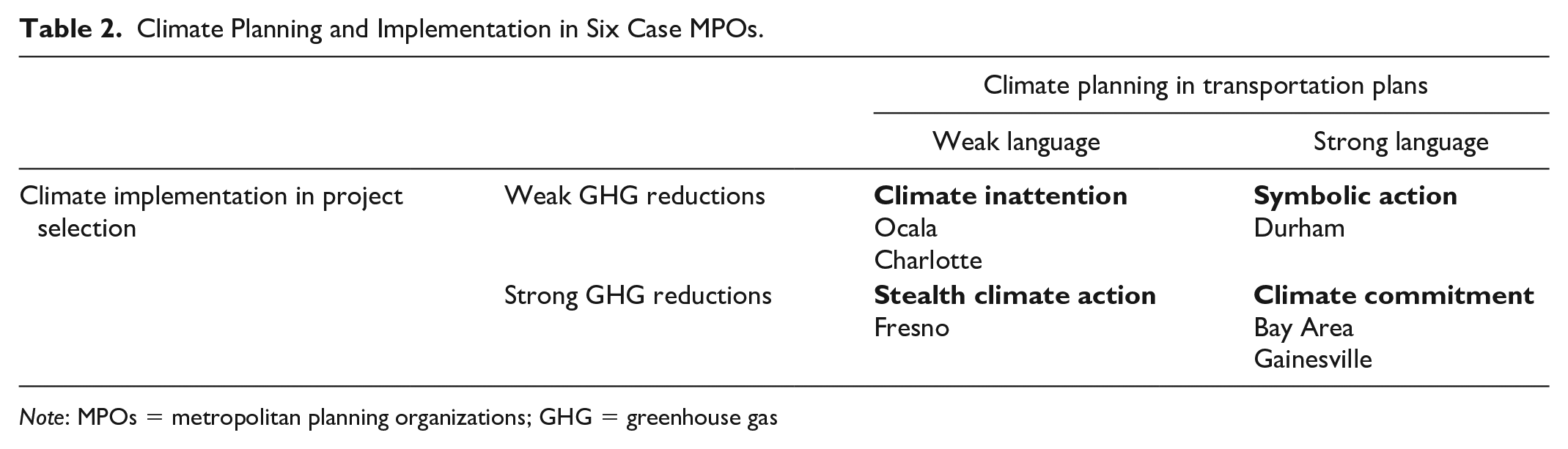
Note: MPOs = metropolitan planning organizations; GHG = greenhouse gas
In two states, climate planning was clearly associated with higher levels of non-SOV project funding. In California, the Metropolitan Transportation Commission (MTC) in the Bay Area clearly identified climate protection in the form of reduced carbon dioxide emissions as its leading performance target, and 10 percent of its stated objectives fell within each of the three coding levels for climate change planning language—a fairly high level of commitment even among California MPOs. One might expect bolder language considering the strong climate commitment that exists among the Bay Area population (Baldassare et al. 2018), but previous work shows that MTC planning has focused more on managing congestion than reducing it (Handy 2008; Manaugh, Badami, and El-Geneidy 2015). Here, however, MTC seems to be delivering even more in climate performance than indicated by its planning language. Nearly a third of funded projects adding new capacity were dedicated to high-occupancy modes of travel, and these projects made up well over half of total project spending. Turning to the Central Valley of California, the Fresno Council of Governments gave almost no attention to modal shift in its plan, and the overwhelming majority of funded projects were directed to road infrastructure. Yet because nearly one of every five dollars spent went to alternative modes, mostly directed toward funding the proposed introduction of a new bus rapid transit system in the region, we characterize the region as engaging in stealth climate action beyond the level of commitment indicated in planning language.
In Florida, implementation also seems to reflect planning goals. Negligible funding for non-SOV modes by the Ocala/Marion Transportation Planning Organization is consistent with the MPO’s planning language. The Gainesville Metropolitan Transportation Planning Organization articulates substantial emphasis on climate change planning across all three of our coding levels, and the types of projects recommended for funding are heavily geared toward transit and bus rapid transit. In fact, Gainesville’s performance in dedicating funds to emissions-reducing projects reaches well beyond its planning language.
In contrast, we do not see strong evidence in our North Carolina cases for conformance between climate planning and implementation. The Charlotte Regional Transportation Planning Organization dedicated almost no attention in its planning language to climate-related goals or objectives that would reduce VMT, and its funding allocations in project spending are consistent in that they reflect emphasis on single-occupancy modes. However, in looking at the distribution of projects, the agency funded a considerable number of small-dollar projects that were fuel-reducing (e.g., adding turn lanes to reduce delays at intersections). In fact, in project numbers, Charlotte exhibited much more commitment to climate mitigation than did Durham.
Durham is the strongest example of planning non-conformance in our data. The Durham-Chapel Hill-Carrboro MPO indicates substantial climate ambition in its planning language: it is the only North Carolina MPO explicitly addressing GHG reductions among its objectives, and a relatively high percentage of goals and objectives address modal shifts. Yet in funding allocations, the great majority of projects and project dollars were oriented toward auto travel, despite articulation of climate planning goals as prevalently as in Gainesville.
In-depth, case-based research is needed to identify the mechanisms enabling MPOs to implement the priorities expressed in their transportation plans. Prior research suggests that staffing, governance structure, and local political context have important influence on MPO activities, but we also expect some of the conditions promoting climate performance to be context-specific. Funding emphasis on transportation alternatives to SOVs may even precede climate change orientation in planning. In Gainesville, for example, current transit investment helps to build on a bus system that experienced dramatic expansion and ridership growth during the 1990s as consequence of a partnership with the University of Florida, which had been experiencing space constraints that limited parking availability on campus (Yoh, Haas, and Taylor 2003). The transit system’s success then helped guide later land use and annexation decisions (Lundquist 2004). Longitudinal analysis of the region’s transportation plans could help reveal the order between climate planning language and funding prioritization. In Durham, the challenge of coordinating among MPOs and land use agencies within a broader region may be a constraint on climate implementation (Schneider 2001). Although Durham and its neighboring MPO in Raleigh (the Capital Area Metropolitan Planning Organization) jointly publish their LRTPs in an effort to coordinate planning for their common region, their distinct visions are apparent in their climate planning language; the priority that Durham gives to modal shifts in its language is not evident in the Raleigh LRTP. The regional model for transportation planning may not live up to its potential if governance is fragmented across MPOs.
Discussion
The transportation sector in the United States has been slow to take up the task of climate mitigation. Even as technological change and regulatory requirements have produced improvements in the fuel economy of passenger vehicles, other developments such as the uptake of autonomous vehicles carry the risk of increasing GHG emissions in surface transportation (Greenblatt and Shaheen 2015). Seriously taking on the task of decarbonization requires attention to personal mobility and creation of regional transportation systems that provide alternatives to single-passenger vehicles.
Our research takes an initial look at MPOs’ performance in addressing this challenge. Key to our approach is the distinction we draw between MPOs’ stated goals, as measured in transportation planning documents, and meaningful policy outputs that are observed in regional funding priorities. Overall, we find only modest evidence of progress in the climate planning underway at regional transportation agencies in three U.S. states. The majority of transportation plans are not setting reductions in GHG emissions or fuel use as overarching goals, and there is little emphasis on alternatives to automobile use. Even in California, where a state mandate exists for GHG reduction targets, MPOs have been slow to take up the challenge.
However, in quantifying climate commitment in the actual policy output of funded projects, we find evidence of substantial conformity between plans and output. Among the six plans we studied, three exhibited climate inattention—weak planning implemented with weak GHG reductions in project funding. Two more demonstrated climate commitment—funding decisions consistent with moderate to strong levels of climate planning. One of these two climate-attentive MPOs displayed a degree of stealth climate action, dedicating even more funds to fuel-reducing projects than would be expected based on the language in the plan. We observed only one instance of clear nonconformity, in the symbolic action taken by the Durham MPO where strong climate planning language was not backed by funding allocations.
Even the modest evidence that we find for MPO efforts to address climate change almost certainly overstates the levels of climate planning and implementation occurring among regional transportation agencies nationwide. Our results cannot be generalized to reflect accurately the climate activities of all MPOs. By focusing on large states and high-capacity MPOs within them, we depict a best-case scenario for the expression and demonstration of climate commitment. The many smaller MPOs struggling to meet minimum planning requirements are unlikely to invest in finding ways to express and act upon an ambitious new goal that challenges historical transportation practice.
In transforming planning goals into funding priorities, MPOs face constraints that include the composition of the region’s built infrastructure, legacy commitments to projects already underway, requirements for equity in the geographic distribution of funding, and the incentives for decision makers to favor projects supported by subregional constituencies. These constraints can limit MPOs’ ambitions to depart from planning as usual or interfere with the execution of those ambitions in project implementation. How these constraints operate within the cases we studied is outside the scope of our research. MPO structure and funding, local political preferences, and a region’s existing transportation and land use patterns all are likely to play a role in shaping climate planning and implementation. But in developing a set of tools for examining how planning goals translate to actual engineering projects, we help move beyond evaluation based only on expressed goals and open up opportunities to identify how MPOs can motivate meaningful emission reductions.
Supplemental Material
online_supp_A_MullinFeiockNiemeier – Supplemental material for Climate Planning and Implementation in Metropolitan Transportation Governance
Supplemental material, online_supp_A_MullinFeiockNiemeier for Climate Planning and Implementation in Metropolitan Transportation Governance by Megan Mullin, Richard C. Feiock and Deb Niemeier in Journal of Planning Education and Research
Supplemental Material
online_supp_B_MullinFeiockNiemeier – Supplemental material for Climate Planning and Implementation in Metropolitan Transportation Governance
Supplemental material, online_supp_B_MullinFeiockNiemeier for Climate Planning and Implementation in Metropolitan Transportation Governance by Megan Mullin, Richard C. Feiock and Deb Niemeier in Journal of Planning Education and Research
Footnotes
Acknowledgements
We thank Emily Pechar, Elena Kazarov, Madeleine Roberts, Chandra Christmas-Rouse, William Swann, and Jonathan Lubin for valuable research assistance.
Declaration of Conflicting Interests
The author(s) declared no potential conflicts of interest with respect to the research, authorship, and/or publication of this article.
Funding
The author(s) disclosed receipt of the following financial support for the research, authorship, and/or publication of this article: This research was supported by a seed grant from the Nicholas School of the Environment at Duke University.

Supplemental Material
Supplemental material for this article is available online.
Author Biographies
References
Supplementary Material
Please find the following supplemental material available below.
For Open Access articles published under a Creative Commons License, all supplemental material carries the same license as the article it is associated with.
For non-Open Access articles published, all supplemental material carries a non-exclusive license, and permission requests for re-use of supplemental material or any part of supplemental material shall be sent directly to the copyright owner as specified in the copyright notice associated with the article.
