




Abstract
This paper applies the logic of commitment problems to deliver insights about the 2022 Russian invasion of Ukraine. In the canonical crisis bargaining framework, an anticipated power shift can cause bargaining failure. Bargaining breaks down in this context because a declining state reasons that fighting in the present from a strong position is preferable to negotiating in the future from a weaker position. I argue that this logic is relevant for understanding both Ukrainian and Russian decisionmaking in the lead-up to the invasion. The commitment problem logic also provides insight into the role of NATO in the conflict, highlighting flaws in existing arguments that the Russian invasion was “provoked” by NATO.
Introduction
Over the last three decades, the study of international conflict has largely framed war as the result of bargaining failure. This approach has proven fruitful both theoretically and empirically, cutting through the complexity of coercive diplomacy to identify a few underlying causes of bargaining failure and war. This piece focuses on one such mechanism: the shifting-power commitment problem. A shifting-power commitment problem may occur when a state anticipates that it will be weaker in the future than it is today. If this shift in power is sufficiently large and rapid, then the state may conclude that fighting today from a position of strength is better than negotiating tomorrow from a position of weakness. War results, in spite of the existence of negotiated settlements that all parties would prefer to fighting in the present. This logic, articulated in its general form in both Fearon (1995) and Powell (2006), has illuminated a number of topics in the study of international conflict. Its application has shed light on a diverse set of topics including, but not limited to nuclear arming (Bas and Coe, 2016; Debs and Monteiro, 2014; Spaniel, 2019), sovereign debt Krainin et al. (2022), and alliance politics (Benson and Smith, 2022b). 1
In this piece, I argue that the logic of shifting-power commitment problems can also be applied to deliver useful insights into the ongoing war in Ukraine. Importantly, application of this logic calls into question a prominent perspective which points to the eastward expansion of NATO, and the “threat” it poses to Putin's regime, as a root cause of the conflict. Although this piece rejects the notion that NATO's expansion posed a threat to Putin's regime, I argue that the shadow of future NATO expansion to include Ukraine is probably relevant for explaining the conflict. In particular, I argue that while NATO did not represent a direct threat to Putin's regime, it did represent a threat to his aggressive revisionist goals, as Ukrainian membership would have foreclosed the possibility of future coercion. Further, pre-membership coordination with NATO also represented a significant potential shift in Ukraine's ability to resist Russian aggression. As such, the logic of shifting-power commitment problems clarifies the role of Ukraine's recent accelerated turn toward the West in the ongoing conflict.
The remainder of the article proceeds as follows. First, I recount the logic of commitment problems, delivering three implications that are relevant for understanding the ongoing war. The first implication is a well known one: large, rapid shifts in the distribution of military power can cause war owing to bargaining failure. The second implication outlines a second commitment issue: if the power shift is sufficiently large, then a rising state cannot credibly commit to forgo increasing its power, even if it knows pursuit of such a power shift carries a risk of war. The third and final implication ties the commitment problem logic to alliance politics, demonstrating that even shifts in military power that are purely defensive may trigger preventive war from a revisionist adversary. With these implications in place, I turn to apply them to the war in Ukraine. The resulting analysis delivers insights into the difficulty of Ukraine's position on the eve of war, clarifies the role of NATO in the conflict, and generates a critique of existing policy analyses. The final section concludes.
Commitment problems as a cause of war
Since at least Schelling (1960), conflict has often been conceptualized as the result of failed bargaining. Viewed through this lens, war is a puzzling outcome of negotiations. Given that any settlement that could be reached through fighting could also be agreed to peacefully, why would states choose to pay these costs and fight rather than agree to a peaceful resolution? This “inefficiency puzzle of war” is the driving question of the crisis bargaining literature. Although proximate causes of bargaining failure abound, nearly three decades of literature on crisis bargaining points to two underlying explanations for bargaining failure: asymmetric information and commitment problems. 2 While the companion pieces in this special issue address asymmetric information and non-unitary-actor explanations for bargaining failure, our present focus is on applying the logic of commitment problems to understand the Russian invasion of Ukraine.
Although the logic is well established in the literature, it is useful to reproduce it here with an eye toward tracing specific implications that are relevant for understanding the war in Ukraine. We derive three implications. First, we recount the classic logic of shifting-power commitment problems, showing how a sufficiently large and rapid power shift can cause war. Second, we consider another commitment issue, showing that a rising state may not be able to commit to forgo a large power shift, even if pursuit of such a shift may entail a risk of war. Finally, we consider the role of third parties, showing that even purely defensive alliances may induce commitment problems that can cause war. To deliver these implications, we adopt a general approach.
Rather than tracing out a specific game form and analyzing it, we consider a more general version of the interaction in order to highlight some key aspects of the commitment problem logic that hold across a variety of game forms. More specifically, we leave the precise bargaining protocol unspecified, taking a “game-free” approach as in Banks (1990), Fey and Ramsay (2011), and Fey and Kenkel (2021). While this previous work uses tools from the mechanism design literature to analyze general properties of crisis bargaining games under asymmetric information, the present analysis focuses on a complete-information setting. As such, Powell's (2006) analysis of general conditions for inefficiency in shifting-power models is closest to the present discussion. Below we describe the class of games that we are interested in.
Consider an interaction in which two states, denoted State 1 and State 2, bargain repeatedly over a disputed issue. Players receive per-period payoffs discounted by a common discount factor
Although these ingredients are stark, they allow us to draw some general lessons about the logic of commitment problems that do not rely on a specific bargaining protocol or ordering of moves. Thus, this analysis is in the vein of Powell (2006), who presents a general inefficiency condition for models with shifting power. Although we begin by deriving a similar condition, we augment the analysis of Powell by considering a number of additional implications of the theory of commitment problems that are relevant for understanding the ongoing war in Ukraine. In particular, we draw relevant implications from the commitment-problem logic to understand endogenous power shifts, the role of third-party security guarantors, and how a shift in purely defensive military capability may lead to commitment problem-driven war.
First, we specify what exactly constitutes the “commitment problem” in our general framework, and why this problem leads to war. Recall that a commitment problem is present when one or more actors cannot credibly commit to a given course of action. The classic, shifting-power commitment problem revolves around the settlements that the players can commit to accept, given the distribution of power. As Powell (1999) notes, in crisis bargaining models the distribution of benefits in bargaining reflects the distribution of military power. When faced with a potential settlement in the present, states compare the payoff of accepting this settlement with the payoff of rejecting it and starting a war. This is a key feature of international politics that has been noted since at least Waltz (1979)—under anarchy, states can always resort to force in order to achieve their objectives. This implies that states cannot be forced to accept settlements that are worse for them than the expected outcome of war. This is what Fey and Ramsay (2011) call the “voluntary agreements” assumption in crisis bargaining models—that the players are always able to pursue a strategy that guarantees that they will receive at least their war payoff, regardless of the strategy chosen by their opponents.
To make this notion more precise, fix an arbitrary period t in which State 1 is weak and let
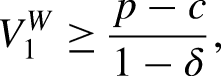
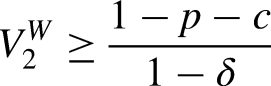
This is the central commitment issue: states cannot commit to accept negotiated settlements that render them worse than their expected payoff of war. However, this fact does not immediately imply that war will occur. How does this inability to commit to accept aggressive demands cause the namesake commitment problem that leads to war? A state that anticipates becoming weaker views the future as bleak, with its ability to extract concessions in negotiations diminished. Consequently, there may be a temptation to “lock in” a favorable payoff by fighting from a position of strength, even if it comes with the drawback of a costly war.
This is precisely how the shifting-power commitment problem leads to war: fighting from a position of strength today may be better than negotiating from a position of weakness tomorrow. We can trace this logic within the general dynamic bargaining framework developed above. Consider arbitrary periods t and
First, we can use the previous analysis to place an upper bound on State 2's payoff of peaceful negotiation. Recall that, starting in period

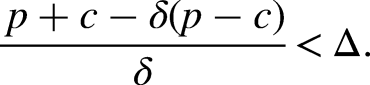
This is the shifting-power commitment problem in action. If State 1 were able to commit to accept aggressive demands after the point at which it becomes strong, then there would be no incentive for State 2 to attack. However, in anticipation of a power shift occurring, State 2 knows that it will no longer be able to push State 1 around as it could before the power shift. Consequently, State 2 launches a preventive war to stop the power shift from happening, “locking in” a favorable distribution of benefits even though this entails paying the costs of war.
Although the size of the power shift is an important factor it is not the only one that determines when a commitment problem will cause war. The speed with which the power shift is expected to arrive is also crucial. Indeed, Powell (2006) argues that these two conditions apply across a wide variety of strategic settings. To see this within the confines of our general model of dynamic bargaining, we can parameterize the speed of the power shift as follows. Building on the framework laid out earlier, suppose that instead of occurring immediately, if a power shift has not occurred previously, then it happens at the beginning of a given period with probability r. 6 With this, we can extend the previous analysis in a straightforward way.
As before, we will place an upper bound on the payoff of State 2 to negotiating in an arbitrary period t in which the power shift has not occurred. Fix an arbitrary period t in which the power shift has not occurred. To maximize State 2's payoff of negotiating, suppose that in every pre-shift period, State 2 receives the entirety of the stakes. Combining this with our analysis previously that in equilibrium,


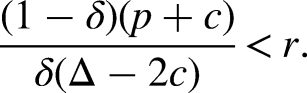
This is the classic logic of shifting-power commitment problems. A state that anticipated growing weaker in the future knows that its opponent is unable to commit to honor settlements made when it was in a position of strength. Anticipating this, it attacks to arrest the power shift and preserve its strength. Although this entails paying the cost of war, such an action can be fully rational if the size of the power shift is sufficiently large, thus the inability to commit to a settlement once the distribution of power changes causes war in this framework.
This implication, especially when applied to power shifts driven primarily by the anticipation of a new military alliance as in this study, deserves some brief discussion. Importantly, Benson and Smith (2022b) emphasize the importance of delay in an alliance's implementation as the key factor connecting alliances to war. This seemingly presents a tension with implication 1's requirement that a power shift be sufficiently rapid. However, this tension can be resolved by clarifying precisely what constitutes a “delay” in this context. Consistent with Benson and Smith's arguments, delay simply requires that the target of an alliance has a chance to anticipate and react to an alliance before it is fully brought into force. Consequently, even power shifts that are rapid—playing out over a matter of mere days as is sometimes the case with rapidly negotiated alliances—can be subject to this type of delay. 7 All that is required is that the state targeted by the alliance perceives that their “window of opportunity” is closing, and this window may be quite short in practice. Accordingly, the requirement of delay does not necessarily imply that a power shift is unlikely to materialize in the near future.
However, the inability to commit to accept proposals is only one source of commitment problem in this model. In fact, in the strategic context at hand, there are not one but two ways in which an inability to commit to a future course of action causes conflict. In the analysis that follows, we will show that State 1's inability to commit against actions that would shift the balance of power can also be a source of conflict. To do this, we utilize the framework developed above, considering whether State 1 would rather maintain the status quo balance of power, or initiate an attempt to grow stronger—which comes with a risk of inefficient war.
Continuing to build on the framework developed above, suppose that before the beginning of the interaction, State 1 can choose to commit to the current distribution of power or not.
8
If State 1 commits to no power shift, then the game is played with
Given this setup, we can compare State 1's best possible payoff from choosing to remain weak, forgoing the power shift, to the payoff of pursuing a risky power shift that may result in war. First, following the logic outlined previously, note that if the distribution of power is fixed across time, then the best possible equilibrium payoff for State 1 is

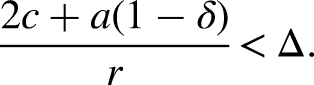
However, it is important to acknowledge the limits and scope conditions of this logic to make sure that it can be appropriately applied to the case at hand. For example, Debs and Monteiro (2014) show that, if an endogenous power shift is transparent and able to be observed by an opponent, war owing to commitment problems can be avoided. Indeed, the logic of Debs and Monteiro highlights the important role that imperfect information—the inability to perfectly observe an opponent's actions—plays in the commitment problem story. In their model, preventive war only occurs if an endogenous arming decision cannot be perfectly observed. How does this scope condition relate to the general commitment problem framework studied here?
In the context of infinite-horizon models of crisis bargaining, war is typically avoided through a logic similar to the well-known “folk theorem” (e.g. Fudenberg and Maskin, 2009). Under this logic, players use history-dependent strategies, with preventive war serving as a punishment that deters an attempt to initiate a power shift. 10 Anticipating this punishment, a potential rising state chooses to forgo an otherwise war-provoking power shift in favor of a negotiated settlement. Importantly, this logic requires that a power shift be observable, so that an opponent can effectively use their punishment strategy to deter military investment. In the framework studied above, such a strategy is not always available, as the power shift is modeled as occurring probabilistically at the beginning of a period. Similar to the case of unobservable investment studied by Debs and Monteiro (2014), this precludes history-dependent “deals” to prevent alliance formation because, for sufficiently high power shifts, the temptation to form an alliance quickly, implementing it before the opponent can react, is too tempting. This is the risk–reward tradeoff mentioned above. We believe that this modeling approach accurately reflects the process of alliance implementation, as alliance negotiations often occur in secret, and even publicly known negotiations are often accompanied by secret talks. In principle, there is nothing stopping potential alliance partners from secretly negotiating the terms of an alliance and then announcing it abruptly in public. From a strategic perspective, this has the same property as secret arming: an adversary cannot anticipate and react to it, and therefore credible deals to avoid alliance are difficult to maintain. As such, we believe that the application to alliances is appropriate given this important scope condition for the logic of preventive war.
Before we apply the commitment-problem logic to the Ukraine war, we derive a final implication. Third parties have played an important role in this conflict, with their influence predating the 2022 Russian invasion and even the 2014 Russian annexation of Crimea and war in the Donbas. Accordingly, we now investigate the role of third parties in the commitment problem framework developed above. As described above, Benson and Smith (2022b) argue that alliance formation and expansion may induce a shifting-power commitment problem. Alliances aggregate immense sums of military power. NATO, for example, unites the forces of 31 member states, including three nuclear-equipped states. Beyond the raw capabilities brought to bear, peacetime coordination and specialization among allies further enhance the effective power shift from alliance formation, introducing complementarities in warfighting capability. As such, there is a deep connection between the logic of alliance-induced power shifts and power shifts induced by other forces such as economic trends or arming.
However, as we discuss in more detail in the following section, NATO is a defensive alliance. This is an important detail that introduces a complication when applying the logic of commitment problems to the case at hand. In the typical commitment problem logic, the beneficiary of a power shift uses its newfound power to extract additional concessions from its adversary in coercive bargaining. This is inconsistent with the role of a defensive alliance such as NATO, which only requires allies to support one another if an enemy is the initiator of coercive bargaining or war. This raises a question for applying the commitment problem logic: can a shift in military power that is purely defensive cause a commitment problem and war?
To address this question, we can draw on our general commitment problem framework as follows. For a more detailed analysis of the connection between defensive alliances and power shifts, including a full equilibrium analysis of a specific game form, see Benson and Smith (2022b). As before, we focus on the most interesting case in which the size of the power shift is sufficiently large to cause war if State 2 does choose to initiate coercive bargaining. To represent that the power shift from an alliance will benefit State 1 only if it is attacked, suppose that the interaction begins with a status quo division of the disputed issue and that State 2's per-period payoff for the status quo division is q.
We will now compare the best possible payoff of peaceful negotiation to the payoff of a preventive war by State 2. To represent a defensive alliance, suppose that if State 2 initiates coercive bargaining, the worst outcome from State 2's perspective is maintenance of the status quo. This assumption is unrealistically strong, but it serves to assure that any incentive for war arises purely from State 2's incentive to attack rather than a fear by State 2 that an alliance will be used to extract additional concessions from coercive bargaining. Under this assumption, coercive bargaining results in one of two outcomes. With probability r, an alliance is implemented before a new deal can occur and State 2 is stuck with the status quo. With probability

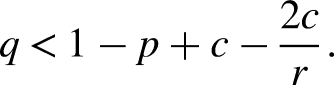
It is striking that a shift in purely defensive military capability can lead to a commitment problem and war. However, the logic has a simple intuition. At the outset of the interaction, State 2 knows that it can revise the status quo favorably, as State 1 prefers a revision that improves State 2's share to a war. However, once a defensive alliance comes into force this is no longer true. With the aid of allies, State 1 is no longer willing to accept a revision to the status quo, preferring a fight. This creates an incentive for State 2 to attack before the alliance can come into force, as negotiation carries a risk that State 1 is able to solidify an alliance which would deter any coercive attempt. Importantly, here the commitment problem does not cause war by threatening to extract concessions from State 2. Rather, it causes war by foreclosing State 2's future coercive options. In this way, it is State 2's expansionist goals—and the realization that war in the short term is the best way to achieve them—that causes war.
Commitment problems and the war in Ukraine
Shifting power
To apply the logic of shifting-power commitment problems to the Ukraine war, we begin by arguing that the case is consistent with our first, most basic implication of the commitment-problem framework. This solidifies the connection between our model and the case, and allows us to apply the strategic logic of the commitment-problem framework to understand the strategic dynamics at play (Goemans and Spaniel, 2016; Lorentzen et al., 2017). Recall that implication 1 states that a sufficiently large and rapid shift in power can cause war. In this section, we argue that Ukraine was set to experience such a power shift. Although many factors both domestic and international contributed to an anticipated increase in Ukrainian military power, we focus on the role of NATO. 11
We focus on the role of NATO for two reasons. First, Ukraine's relationship with NATO, including both the potential for membership as well as pre-membership activities such as joint military training and equipment provision, represent the largest source of a potential increase in Ukrainian military power. NATO aggregates the military power of 31 countries, including three nuclear powers. As such, coverage by the NATO security umbrella represents a massive shift in effective military power. Importantly, alliance-induced power shifts have previously been connected to the logic of commitment problems (Benson and Smith, 2022b). Second, a focus on NATO is appropriate given that our goal is to apply the logic of commitment problems to understand the Russian invasion of Ukraine. Although NATO does not explicitly name Russia as a target, it is widely understood that a primary role of NATO is to deter Russian aggression directed toward member states. To wit, Lord Hastings Lionel Ismay, NATO's first secretary general, quipped that NATO's purpose was to “keep the Soviet Union out, the Americans in, and the Germans down” (NATO, n.d.).
Before considering the Ukraine–NATO relationship, it is worth noting that an alliance-induced power shift owing to potential NATO membership plausibly fits the criteria of implication 1. Recall that a power shift must be sufficiently large and rapid in order to cause war. In terms of the size of the power shift, NATO membership would result in an immense shift in defensive military power for Ukraine. The power-aggregating role of alliances is well known, 12 and NATO aggregates the military might of 31 member states, including three nuclear-equipped states. In this light, there are few sources of shifting power as dramatic as NATO membership, and the Article 5 commitment that comes with it, which is often considered the “gold standard” of contemporary deterrent alliance commitments. The timeline of Ukraine's NATO membership, however, is in question. In spite of this, as discussed above, what is important is the relative magnitude of the power shift, compared with the speed of its arrival. Given the immense size of the power shift that would result from NATO membership, even a drawn out membership timeline probably satisfies the theoretical conditions for power-shift driven war. This is illustrated by the way in which potential NATO membership for Ukraine has clearly weighed heavily on the minds of Russian decisionmakers since at least the 2008 Bucharest summit. As both Smith (n.d.) and Schram (2021) have argued, the threat of a potential power shift owing to NATO membership has driven Russian behavior not only in the case of Ukraine, but in Georgia as well. As such, we view it as reasonable to proceed, applying the logic of the commitment-problem framework. We now trace the development of Ukraine's orientation toward NATO to demonstrate that Ukraine's political development, particularly in the post-Euromaidan period, set it on a course to enjoy a significant increase in military power.
The Ukraine–NATO relationship first grew in fits and starts, as Ukrainian domestic politics swung back and forth between alignment with Russia in the East and NATO, the EU and the US in the West. Indeed, Ukrainian domestic politics over the last two decades can largely be characterized along the East–West continuum. After regaining its independence following the dissolution of the Soviet Union, Ukraine established a relationship with NATO relatively quickly. In 1992, Ukraine formally joined the North Atlantic Cooperation Council. This organization, a precursor to today's Euro-Atlantic Partnership Council, provided an organized forum for states outside of the NATO umbrella to consult with the alliance. Ukraine's participation in this forum led it to be the first of the former Soviet states to join NATO's Partnership for Peace program in 1994. In contrast to the multilateral nature of the North Atlantic Cooperation Council, Partnership for Peace membership focused on fostering bilateral relationships, allowing Ukraine to tailor its interaction with NATO along a variety of political and military dimensions.
This cooperation continued over the next decade, with Ukraine slowly growing closer to NATO. The relationship deteriorated briefly in 2002 owing to a revelation that then-President Leonid Kuchma had approved a transfer of Ukrainian weapons to Sadaam Hussein. However, after a relatively brief period of tension, Ukraine contributed troops to the 2003 US-led invasion of Iraq. Although this did not immediately mend the relationship, it set Ukraine back on a path toward a favorable orientation toward NATO and the West.
This path of positive relations accelerated in the wake of the 2004 Orange Revolution, which saw Viktor Yushchenko replace Kuchma as President. This development was notable in the course of Ukraine–NATO relations, as Yuschenko supported Ukrainian accession to NATO. Although Yuschenko pushed for closer ties between Ukraine and NATO, his efforts were undercut by countervailing pro-Russian political forces within Ukraine. In fact, anti-NATO sentiment was a driving force behind a shutdown of the Ukrainian parliament from early January to late March of 2008. This shutdown was reflective of broader patterns of public opinion in Ukraine. According to Gallup polling, the Ukrainian public was quite skeptical of NATO membership at this time, with 40% of Ukrainian citizens identifying NATO as a “threat” and a mere 17% perceiving NATO as a provider of protection for Ukraine (Ray, 2010).
In 2010, Viktor Yanukovych achieved victory in the Ukrainian presidential election, further reducing the possibility of NATO membership for Ukraine. 13 Yanukovych continued on this course until February 2014, when the Euromaidan protests led him to flee the country, relinquishing his office and ushering in a new era of Ukrainian relations with NATO and the EU. These protests were driven by Yanukovych's refusal to sign a cooperation agreement with the EU, instead choosing closer ties with Russia. This decision came in the wake of political and economic pressure from Russia, and immediately sparked widespread protests. This development was obviously contrary to Russian interests, as the nature of the protests meant that Yanukovych's replacement would almost certainly be more favorable to NATO membership. This was indeed the case. Despite initial attempts to diffuse tension with Russia, new President Petro Poroshenko set Ukraine back on a path to NATO membership, renouncing Ukraine's non-aligned status in December 2014. Responding to this, a NATO spokesperson went on record following the vote, saying that “Our door is open and Ukraine will become a member of NATO if it so requests and fulfils the standards and adheres to the necessary principles”. 14
Consistent with domestic political trends at the elite level, Ukrainian public opinion has also steadily trended in favor of NATO membership over time. A 2008 poll conducted just prior to that year's NATO summit in Bucharest revealed that only 30% of Ukrainians viewed NATO membership as an important foreign policy priority. 15 However, this pattern in public opinion changed concurrently with other developments in Ukrainian domestic politics over the next decade. A 2019 poll, conducted prior to the passing of a constitutional amendment that would enshrine NATO membership as an explicit goal, recorded that 53% of Ukrainians supported pursuit of NATO membership. 16 Importantly, Euromaidan and the political developments that followed significantly increased the possibility of Ukraine's future membership in NATO, at least in the eyes of Moscow (Schram, 2021: 303). Russia's 2014 de-facto annexation of Donetsk and Luhansk also served to shift public opinion through two channels. First, public opinion in Ukraine reacted negatively to the Russian attack on these regions, with pro-NATO sentiment increasing in the years following Russia's first expansionist move. Second, the annexation effectively undermined the political influence of relatively pro-Russian regions in Ukraine by preventing those in the annexed regions from participating in Ukrainian elections. In sum, these trends point toward a significant Westward, pro-NATO turn in Ukrainian public opinion over the relevant time period leading up to the 2022 invasion.
Although formal NATO membership for Ukraine faced a number of significant roadblocks, closer ties with NATO in the wake of Euromaidan situated Ukraine as a rising military power. A focus on formal membership misses the significant pre-membership cooperation and coordination that occurs between NATO and potential members. Importantly, this pre-membership cooperation carries significant military benefits. The case of Ukraine is no exception. Since Ukraine's independence in the mid-1990s, NATO has provided it with significant military assistance. This assistance has come in the form of material transfers of arms and equipment, as well as training and advising. 17 NATO has cooperated with Ukraine to improve their military performance across a variety of dimensions. Perhaps most notable was the restructuring of Ukraine's military leadership away from a top-down command chain inherited from the Soviet era to a modern, decentralized decision-making process that significantly improved the Ukrainian military's battlefield flexibility (Blackwell, 2022). This assistance has been cited as significant, having a real and positive impact on Ukraine's ability to mount an effective resistance to the 2022 Russian invasion (Chinchilla, 2022). Importantly for our purposes, this improvement in military capability was realized prior to the 2022 invasion (Zagorodnyuk et al., 2021). In sum, these measures resulted in a significant increase in Ukraine's military power, even in the absence of a formal security commitment from NATO.
This study is not the first to point out Ukraine's status as a rising power. The idea that Ukraine's power, and more importantly, its ability to resist Russian aggression, was growing over time has been advanced by other scholars as well. For example, Schram (2021) argues that Euromaidan, and in particular its consequential reordering of Ukrainian domestic politics in a Westward-leaning direction, positioned Ukraine as a rising power vis-à-vis Russia. Others have argued that Ukraine's turn to the West following Euromaidan can be interpreted as a non-formalized, but effective alliance that increased its defensive, political and economic influence on the world stage (Minakov, 2023). Therefore, the case of Ukraine is consistent with the main premise of the shifting-power commitment problem framework: prior to the Russian invasion, Ukraine was set on a path that would eventually bring about a significant and positive shift in its ability to resist Russian aggression.
Can Ukraine commit to neutrality?
We now apply the second implication of the commitment-problem framework to our case at hand. As our theoretical analysis demonstrated, a shift in military power leads to war as a result of not one, but two commitment problems. As discussed in the previous section, the first issue is that a state that grows more powerful cannot commit to accept aggressive demands in the future. However, this logic simply raises a new question. Given that a shift in power is the root cause of war in this context, should the rising state not simply take steps to limit its military growth so as not to trigger a preventive attack? This is an important question, and the notion of endogenous power shifts has been extensively studied in the literature (Debs and Monteiro, 2014; Spaniel, 2019; Krainin and Wiseman, 2016; Benson and Smith, 2022b). As discussed above, if the power shift is sufficiently large, then a rising state may still have an incentive to pursue aggresssive arming, even if this arming carries a risk of provoking a declining state into a preventive war.
The key issue is a lack of commitment. If a rising state is unable to take some action to prevent itself from pursuing a favorable shift in military power, then it cannot credibly commit to forgo pursuit of a favorable power shift if given the opportunity. This second, subtle commitment problem is present in the Ukraine–Russia relationship. In the remainder of this section, we discuss this commitment problem in the context of Ukraine's political development since 2005, when President Viktor Yuschenko made NATO membership a policy priority. In tracing this history, we focus on the incentives and behavior of both Ukraine and NATO. In particular, we make two points. First, we provide evidence that Ukraine took concrete steps that undermined the credibility of any subsequent commitment to forgo the pursuit of NATO membership. Second, we provide evidence that although NATO placed some barriers on Ukraine's ability to join in the short-term, its longstanding “open door” policy also rendered any long-term commitment to keep Ukraine out of the alliance null.
As discussed in the previous section, Ukrainian domestic politics has trended Westward over the last decade. Although there have been some setbacks, Ukrainian public opinion on NATO has trended positively over time, with a majority of Ukrainians identifying NATO membership as an important priority in the lead-up to the 2022 Russian invasion. Responding to these trends, Ukrainian leaders have sought to make NATO membership an explicit policy goal. Following the backlash against then-President Viktor Yanukovych's rejection of the EU–Ukraine Association agreement and the subsequent Euromaidan protests, the Ukrainian parliament voted with an overwhelming majority to abandon Ukraine's previous “non-bloc” status. Importantly, the referendum emphasized the importance of “achieving the criteria required to attain (NATO) membership”.
18
The passing of this referendum clearly illustrates that Ukraine's sights were set on NATO membership. On 19 February 2019, President Poroshenko signed into law a constitutional amendment that enshrined pursuit of NATO membership as an explicit responsibility of the Ukrainian government. The text of the amendment is clear, requiring that: The President of Ukraine is a guarantor of the implementation of the strategic course of the state for gaining full-fledged membership of Ukraine in the European Union and the North Atlantic Treaty Organization. (Article 102)
This constitutional amendment exacerbated well-known commitment problems stemming from leader turnover. As Wolford (2012, 2018) argues, elections may undermine the long-term credibility of promises made by leaders of democratic states. Although an incumbent may be able to credibly commit to a course of action in the short term, they are typically unable to constrain the actions of future officeholders. Consequently, an adversary may wish to fight in the present against an incumbent rather than face a more obstinate leader in the future. Given Ukraine's domestic political trends toward a more Westward orientation since 2014, commitment to neutrality is unlikely to be viewed by Russia as credible. As an example of this, in a last-ditch attempt to end the 2022 war through a negotiated settlement during its first month, President Zelensky proposed the idea of Ukrainian neutrality. 19 Ultimately, this proposal was not taken seriously by Putin. The logic of commitment outlined above provides a compelling explanation for this. Anticipating that such a commitment lacked credibility in light of Ukraine's ongoing Westward turn, Putin rejected this proposal and launched his attack.
Ukrainian domestic political trends are only one source of commitment difficulty. Another major obstacle to Ukraine's ability to establish a credible commitment to remain neutral is NATO's “open-door policy”. The importance of the open-door policy in the context of Ukraine predates the 2022 Russian invasion, as well as the 2014 annexation of Crimea by a significant margin. NATO made this policy explicit in 1992 following the breakup of the Soviet Union, with then-Secretary General Manfred Worner stating that “the doors to NATO are open” to former Soviet states that wished to join the alliance. 20 The open-door policy is also relevant for the Ukraine–NATO relationship. In particular, following the April 2008 NATO summit in Bucharest, the open-door policy was explicitly invoked in the context of potential Ukrainian membership. 21 In the days leading up to the invasion, reversing NATO's open-door policy was a key demand of Putin's. Clearly, NATO's unwillingness to revise its open door policy undercuts the credibility of any promise by Ukraine to remain outside the alliance. As such, the second credibility issue discussed in Implication 2 of the commitment problem is at play here, and sheds light on the strategic dynamics that led to the ongoing war.
Why NATO did not provoke Russia
We now turn to apply the final implication of the commitment problem framework. Much has been written about the role of NATO in the Ukraine war. This topic has been a matter of fierce and ongoing debate among academics and policymakers alike. Most of this debate has centered around the question of whether NATO's eastward expansion provoked Russia into war. In applying the implications of the commitment-problem, we push back against arguments such as the one made by Mearsheimer (2014) that place blame on NATO for the crisis. To preview the argument, we reject the premise that NATO represents a threat to Russia, and consequently disagree with arguments that NATO is responsible for the conflict in Ukraine. However, this does not imply that the NATO question is entirely irrelevant for understanding Putin's motivations. Importantly, in applying the commitment-problem logic, we expose some logical flaws in existing policy recommendations focused on avoiding war by committing Ukraine to a course of neutrality.
In the remainder of this section, we first point out the flaws in existing arguments which portray NATO as responsible for the conflict in Ukraine. With these flaws illustrated, we then apply our theory to the situation to explain the role of NATO. Our argument aims to introduce nuance into the debate over NATO's role in the crisis. On the one hand, we argue that it is unreasonable to assign blame to NATO for the start of the war. On the other hand, we argue that NATO was not irrelevant; the NATO-induced power shifts discussed previously probably influenced Russian incentives and behavior leading up to the crisis. Specifically, we apply Implication 3 to argue that NATO membership would have foreclosed future opportunities for Russia to meddle in Ukraine's domestic affairs. Anticipating this, Putin took action to prevent Russia's hold on Ukraine from declining.
Perhaps the most prominent voice arguing for a role of NATO in inciting Russian hostility toward Ukraine is Mearsheimer (2014). Although others have made similar arguments, we will focus on Mearsheimer's version as it has received the most attention from scholars, policymakers and commentators alike. In spite of the attention that this argument has received, it suffers from some fundamental flaws. Writing about the 2014 Russian invasion of Crimea, Mearsheimer advances the bold claim that “the United States and its European allies share most of the responsibility for the crisis”. He goes on to single out Ukraine's aspirations to join the Atlantic alliance, stating that the “the taproot of the trouble is NATO enlargement” (2014: 1). Mearsheimer has continued to advance this argument in the context of the 2022 Russian invasion of Ukraine.
What, in Mearsheimer's view, is the role of NATO in this war? Mearsheimer is very clear on this point, arguing that NATO expansion to include former Soviet states has threatened Russia's core interests, essentially forcing Putin's hand into the use of force to block further eastward expansion of the alliance.
However, this argument has some serious flaws. First and perhaps most importantly, Mearsheimer's understanding of the constellation of interests at play is inconsistent with both the historical record and a long tradition of empirical research in international relations. A core tenet of Mearsheimer's argument is that it is not Russia, but rather the West, that has revisionist aims. This can be clearly seen in his writing on the subject. For example, he has argued that “When Russian leaders look at Western social engineering in Ukraine, they worry that their country might be next” (2014: 4). This argument suggests that Putin perceives NATO as an existential threat to the Russian regime. Under this framing, if NATO were allowed to expand to include Ukraine, then Russia would be directly under threat, with Ukraine and the West potentially moving in to take aggressive action that would threaten the sovereignty and, ultimately, existence of Russia as a state.
In this story, NATO is the aggressor and Putin's action represents a last-ditch attempt at self-preservation, with Russia's survival at stake. However, there is little concrete evidence to support this bold proposition. In framing the problem this way, Mearsheimer puts the cart before the horse. In reality, the bulk of evidence suggests that Russia is the aggressor in this situation, aiming to assert its will—through force if necessary—on a neighboring state. Putin cares about NATO expansion not because NATO is a threat to Russia, but because NATO will prevent him from acting as the aggressor in the future, effectively closing the door on his imperialist ambitions. NATO is not a threat to Putin's regime, but it is a threat to Putin's plans to meddle in Ukraine.
A primary reason that it is implausible that NATO truly represents an existential threat to Putin is the fact that NATO is a purely defensive alliance. Throughout its 74 year existence, NATO's focus has been neither offensive nor revisionist. Rather, NATO was carefully designed at its inception to limit the obligation of members to purely defensive military action. This is most famously embodied in the principle of collective defense, formalized in Article V of the NATO treaty. This article explicitly states that an attack on one of the members is to be considered an attack on all members. Thus, NATO's main obligation is purely defensive in nature, and therefore does not pose an offensive threat to Russia. This idea is supported by an important line of empirical scholarship in international relations, which finds that defensive alliances are associated with peace rather than war (Leeds, 2003; Johnson and Leeds, 2011). Furthermore, the case of Ukraine's hypothetical membership in NATO—a relatively minor military power joining a powerful defensive alliance—is the subset of alliance most associated with peace (Benson, 2011).
In objection to this, one might point to NATO's involvement in both the Yugoslav and Libyan civil wars. However, neither of these cases provides compelling evidence that NATO might be on the path toward revisionist action aimed at Putin's regime. In each case, NATO's direct military involvement was not proactive or offensive in nature. In the case of the Yugoslav civil war, NATO's 1999 bombing campaign only began after the breakdown of a 1998 ceasefire that had been brokered by NATO. In Libya, NATO's involvement was the result of a United Nations Security Council Resolution that aimed to establish a cease-fire and no-fly zone in the conflict. Therefore, neither of these examples of NATO military action can be reasonably understood as giving precedent for aggressive, proactive and revisionist action designed to topple Putin's regime.
Building on this point, it is clear that no current member of NATO wishes to engage in aggression toward Russia. Notably, this is evidenced by the reluctance of France and Germany to speed Ukraine's accession for fear of antagonizing Russia. Clearly, NATO is not looking for a fight. Rather, the bulk of the evidence points to Ukraine's desire for NATO membership as a product of their need for a defensive bulwark against Russian action. Indeed, NATO has long recognized that expansion may trigger the typical logic of the security dilemma—even defensive actions may be misperceived as offensive in nature. NATO has repeatedly taken action to limit this kind of misperception. For example, following Russia's 2014 annexation of Crimea, NATO placed tripwire forces in Eastern Europe, but intentionally limited the number of troops to avoid giving Russia the impression that the troops would be used offensively.
Given this, it is reasonable to interpret Putin's public statements that NATO is an existential threat as disingenuous. Rather than being a true reflection of his perception that Ukrainian NATO membership for Ukraine would threaten the existence of his regime, these statements are better explained as propaganda, justifying Putin's desire to dominate Ukraine and bring it back into the Russian sphere of influence. While we believe that this interpretation is reasonable, it comes with an important caveat. Given the known informational pathologies of personalist regimes such as Putin's, it is not currently possible to rule out that Putin holds a genuine belief that NATO represents an existential threat to his grip on power. This possibility, and the lessons drawn from it, are explored in the İdrisoğlu and Spaniel (2023) piece in this symposium on information problems. Given this, we leave informational considerations aside for the moment, continuing to follow the implications of the commitment-problem logic below.
What does this imply about the role of NATO in the ongoing conflict? It is tempting to conclude that the specter of potential NATO membership is entirely irrelevant to an understanding of Russian motivations for war with Ukraine. However, we believe that this goes too far. Yet this raises a new question. If Russia was not threatened directly by NATO, then how could NATO membership for Ukraine have been a driving factor in Putin's decision to invade?
Following Implication 3 of our commitment-problem framework, the answer lies in Putin's eventual goals. Clearly Putin wants to bring Ukraine back into the Russian sphere of influence. However, he correctly realizes that NATO membership for Ukraine would effectively shut the door on this aspiration. As long as Ukraine remains outside of the NATO security umbrella, Putin is free to throw Russia's military weight around, intimidating Ukraine and even using force to prevent it from growing closer to the West. However, just as the NATO member states are loath to enter directly into a confrontation with Russia, Putin is equally loath to do anything that might be perceived as an attack on a NATO member state. This logic matches that of our theoretical argument, drawing a connection between alliances, shifting-power commitment problems, and war. NATO's role in the conflict was not in threatening the Russian regime's existence, but rather in threatening its future ability to impose its will on weaker, less militarily capable states. Anticipating that NATO cannot commit to leave Ukraine on the outside forever, Putin calculated that costly action to arrest Ukraine's rise was preferable to bargaining in the future with a strengthened Ukraine.
Mearsheimer, and those who argue similarly, fail to understand the fact that there is a commitment problem at play here. The failure to recognize the deep commitment problem that drives this dispute is illustrated by Mearsheimer's key policy recommendation. Writing in 2014, Mearsheimer recommended that the US and its allies should “abandon their plan to westernize Ukraine and instead aim to make it a neutral buffer between NATO and Russia” (Mearsheimer, 2014). Continuing, Mearsheimer suggests that “To achieve this end, the United States and its allies should publicly rule out NATO's expansion to both Georgia and Ukraine”.
This policy recommendation raises an important question: what action could the US and its NATO allies take to render such a commitment credible? In the anarchic world of international relations, there can be no guarantor of such a commitment. This is striking, as an acknowledgment of the fundamentally anarchic nature of international politics is a core tenet of the approach taken by Mearsheimer and other “realist” scholars. This critique is in line with previous work, which has pointed out issues with the logical validity of realist analysis and policy recommendations (Wagner, 2010). As discussed in the previous section, Ukraine's inability to commit to forgoing eventual NATO membership is an important friction that prevents peaceful resolution of the dispute. As such, the policy recommendation provided by Mearsheimer's analysis is suspect.
To be clear, the preceding analysis is far from the last word on this topic. Indeed, little is known about the details of Putin's decisionmaking on the eve of the invasion. Consequently, it is difficult to ascribe the invasion to a single causal mechanism. Nevertheless, application of the commitment-problem logic has shed light on Russia's animosity toward Ukraine over the last decade, up to and including the 2022 invasion. The insights provided by this framework helped to expose some flaws in prominent explanations for the war, particularly those that place blame for the invasion on NATO's eastward expansion. Given this insight, we believe that application of this logic has been useful, although a conclusive analysis of the causes of the war will probably not be possible for some time to come. Future work should aim to update the analysis in this piece as well as the companion pieces on uncertainty and unitary actor explanations in light of new revelations about the relevant decision makers and the calculus they used in the days leading up to the invasion.
Conclusion
By applying the commitment problem logic to the ongoing war in Ukraine, we have gained valuable insights into the dynamics that led to this crisis. We have argued that a commitment problem played an important role in triggering the invasion. When a state anticipates a future power shift that could weaken its bargaining position, the resulting commitment problem may cause war. Bargaining can break down as the declining state opts for immediate military action, believing that it is preferable to fight from a position of strength rather than negotiate from a weaker stance in the future. Importantly, we tied this logic to Putin's calculations on the eve of the invasion. As Putin anticipated that Ukraine may one day become a member of NATO, he probably believed that his future bargaining power would diminish. Fearing a future in which NATO would prevent him from asserting his will over Ukraine through the use of force, Putin may have deemed a present military campaign the most advantageous choice.
Looking to the future, the application of this logic also provides a grounded framework with which to speculate about the likely course of the war. War termination is an important topic that has been widely studied (see, e.g. Reiter, 2010; Slantchev, 2003; Goemans, 2000) and although war termination is not the main focus of this article, the commitment problem's logic can still be used to deliver insights about the likely duration of the war. 22 An unfortunate implication of the commitment problem logic is that the war is unlikely to end until either Russia or Ukraine achieves a fairly decisive victory. This is consistent with Wolford's (2019) description of preventive war; such wars are pursued because they “solve” the underlying commitment problem. Applying this to the Russian invasion of Ukraine implies that Russia will not stop until ukraine's Westward turn is reversed, and its path not only to NATO, but to EU membership and friendship with the West is reversed and halted for good. Although many unknowns remain about the logic of key decisionmakers in both Russia and Ukraine, this is consistent with the length of the conflict, which has persisted even though fighting has largely settled into a territorial stalemate at the time of writing. As Powell (2006) notes, the logic of commitment problems can be more readily applied to lengthy wars, in which information about battlefield effectiveness has probably been resolved through informative fighting (Slantchev, 2003).
In conclusion, the 2022 Russian invasion of Ukraine serves as a compelling case study illustrating the relevance of commitment problems in crisis diplomacy. Applying this logic clarified the nature of NATO and the West's role in the crisis. In doing so, the present analysis has also cast doubt upon previous analyses that have sought to place blame on NATO for the conflict. Finally, this perspective generated a critique of previous policy recommendations, highlighting the futility of commitments to keep Ukraine neutral in the long term. In sum, and as the other papers in this collection attest, applying the logic of crisis bargaining generally, and shifting-power commitment problems specifically, provides useful insights into this ongoing conflict.
Footnotes
Acknowledgements
I am grateful to Brett Benson, Sasha de Vogel, Alexandre Debs, Peter Schram, William Spaniel, Jess Sun, Fran Smith, Jeff Smith, and Will Smith for helpful comments and conversations.
Funding
The author received no financial support for the research, authorship, and/or publication of this article.
