




Abstract
Multilateral treaties are essential for the effectiveness of global disarmament efforts. Ratification delays have deep repercussions on international cooperation for disarmament. Yet what determines their duration? In this paper, we offer the first comprehensive study of multilateral disarmament treaty ratification, covering the period between 1976 and 2020. We test the effects of treaty legalization and a country's security situation on the ratification duration. States are slower to join treaties with a high degree of obligation, but faster to join treaties with high degrees of precision and delegation. Engagement in inter-state rivalries slows down ratification. In contrast, we find only statistically weak evidence that alliance embeddedness accelerates it.
Introduction
Multilateral treaties have become a major tool for advancing various international agendas. International relations scholars agree that the universalization of multilateral agreements is important for the normative cascade. Therefore, the relevance of studying ratification goes beyond the assessment of individual states’ foreign policy preferences (Finnemore and Sikkink, 1998). One area where multilateral treaties are of key importance is disarmament. However, for international disarmament treaties to be effective, states must ratify them. Only at that point are they binding upon states. As opposed to many trade or investment treaties, pro-disarmament treaties often lack provisional application provisions, and therefore are binding upon states only after ratification.
In principle, states should ratify treaties that they sign because states should be signing treaties in good faith, with the goal to be bound by them. Yet treaty ratification can become hostage to a number of considerations: the nature of the treaty itself (Koremenos, 2005, 2016; Kreps, 2018); the regime type (Brender, 2018); domestic politics (Kreps et al., 2018; Miller, 1984); or the dilemmas related to current or future conflicts (Kydd, 2000; Levine and Smith, 2000; Müller, 2000). As authors have argued in other areas of global governance, states often sign treaties because they want to signal their support but ratify only once they are ready to be committed (Hugh-Jones et al., 2018). Indonesia, for instance, signed the Convention on Cluster Munitions, but never ratified it and keeps an active stockpile of cluster munitions (Landmine & Cluster Munition Monitor, 2022). Egypt participated in the negotiation of the Chemical Weapons Convention, but refused to ratify it owing to regional security concerns (Shoham, 1998).
The delay in ratification of multilateral treaties is an important element for studying commitment to multilateral cooperation because it provides insights into the complex dynamics and considerations that states navigate when deciding to commit formally to international agreements. Understanding the reasons behind delays in the ratification process sheds light on the underlying factors influencing a country's commitment to participating in multilateral cooperation.
Despite the importance of multilateral cooperation for disarmament and the relevance of treaty ratification in such effort, we know comparatively little about the ratification dynamics of multilateral disarmament treaties. In this paper, we fill this gap by conducting the first ever comprehensive analysis of the duration of the ratification process by states of a number of the global disarmament treaties deposited in the United Nations Treaty Collection (UNTC) between 1970 and 2020.
Therefore, our paper extends the existing scholarship on disarmament treaty ratification, which focuses on determinants of commitment to the treaties (Brender, 2018; Klomp and Beeres, 2022). Rather than looking at “who ratifies and why”, we look at “why some countries take longer to ratify”. This focus also makes our work different from the work of Kreps (2018), who studies whether the nuclear arms control treaties came into fruition rather than how quickly they became ratified. Similarly, we expand on Karlas (2023b) as his work does not differentiate between signature and ratification, thereby lowering the bar for the commitment. Our work also builds on the existing work of state commitment to international treaties, such as that by Simmons and Danner (2010), by looking at multiple treaties and taking their institutional features seriously.
We focus on two possible types of explanations for delay in the ratification of multilateral disarmament treaties on two levels: those having to do with the treaty itself (the degree of legalization) and those having to do with the country ratifying (alliance embeddedness and the security situation of the country). We find that treaty legalization has mixed effects: a higher degree of obligation makes states slower to ratify, but higher degrees of precision and delegation speed up ratification. We also find that state security situation matters: the more rivalries countries are involved in, the slower they are at ratifying. In contrast, we find some, but statistically weak, evidence that the higher number of allies a country has, the faster it is to ratify.
Literature review
One of the most important principles of international law is that states join multilateral treaties in good faith, with an interest in complying with them (Abbott et al., 2000). That does not mean that states are not strategic in signing the treaties—in contrast, scholars have argued that states commit to international treaties because they might be driven both by the logic of consequences (Schimmelfennig, 2001) and by the logic of appropriateness (Finnemore, 1996; Goodliffe and Hawkins, 2006).
Joining international treaties, in practice, consists of signature and ratification. When it comes to disarmament treaties in particular, existing scholarship on the ratification of international disarmament treaties has focused on two main questions—what makes some treaties more likely to be ratified, and what makes some states more likely to ratify disarmament treaties. 1
In the former stream, Kreps (2018) has looked at how the institutional features of nuclear arms control treaties make some of them be ratified faster. In short, Kreps’ argument is that the more credible and future-proof treaties are, the less likely they are to attract a large number of parties. A consistent body of scholarship looking at individual international treaties confirms that states jealously guard their sovereignty when it comes to arms control treaties. For example, the work on the Non-Proliferation Treaty (NPT) shows that, during the treaty negotiations, states were already concerned about the possible long-term commitment and treaty oversight (Shaker, 1980), as well as its enforcement over a long period of time (Koremenos, 2001). Drawing on constructivist insights, it has been argued that social pressure and negotiation pressure sometimes create incentives for states to construct weak international institutions “for show” (Mantilla, 2023), while interest heterogeneity can lead to purposeful ambiguity within regimes (Hansen, 2015). Similarly, other scholars have argued that even in the absence of great powers, states sometimes create international treaties to push for particular norms and then influence the states outside the treaty (Bower, 2015, 2017) or even to protect themselves from the very same great powers (Egel, 2022).
When it comes to the second question, existing scholarship has looked at both individual countries and at broader, comprehensive views. In the latter stream, scholars have looked at the importance of wealth and regime type (Brender, 2018), legal culture (Klomp and Beeres, 2022), and regional diffusion dynamics (Mathy, 2023) for ratification. In the former stream, scholars have focused predominantly on cases from the USA. Erickson (2015) argued, for instance, that the Obama administration shifted its views and supported and later ratified the Arms Trade Treaty in order to repair its reputation after the decline of the global image of the US after the Bush administration years. Focusing on the interaction between the President and the Senate, scholars have examined the partisan aspects of arms control ratification (DeLaet and Scott, 2006; Kreps et al., 2018). Böller (2022) delves into the impact of growing polarization in the US Senate on the decline of the arms control agenda. Seo (2015) finds similar findings when it comes to the Agreed Framework between the US and North Korea. The study of legalization of US–Canadian informal defense agreements show that increased partisan polarization leads to lower legalization of such agreements (Kimball, 2017). Fuhrmann and Early (2008) go even further and argue that we need to understand the psychology of individual leaders, through the lens of prospect theory, to explain joining arms control agreements. Drawing on constructivist insights, existing work has shown how civil society actions can encourage states to ratify international treaties even though they might be originally opposed to such treaties (Petrova, 2016).
Yet while the work on disarmament agreements is copious, there is only limited work on multilateral treaties, with the bulk of scholarship focusing on bilateral treaties (such as the US–Russian arms control agreements). One possible exception is the recent work on inhumane conventional weapons, which focused on domestic politics and regional dynamics as determinants of ratification (Karlas, 2023a). However, none of the existing papers focuses on the delay between signature and ratification.
Such delay in itself is puzzling. Strictly legally speaking, states should be signing the treaties that they want to abide by. Consequently, much of the international relations scholarship on signing treaties takes joining treaties as a signaling device—and hence, ratification should be swift if states want to signal their commitment (Baccini and Koenig-Archibugi, 2014; Bernauer et al., 2010; Büthe and Milner, 2008; Hugh-Jones et al., 2018). However, ratification is often anything but swift. Some scholars who study commitment to international treaties even see signature as a potential source of analytical bias, as it indicates which states want to comply with the treaty, even if their commitment becomes legally binding only upon ratification (Von Stein, 2005).
The gap in the study of ratification delay is all the more surprising given the existing study of ratification in other areas of international policy. The existing work looks at the ratification delay in areas as diverse as trade (Büthe and Milner, 2008; Schneider and Urpelainen, 2013), labor rights (Baccini and Koenig-Archibugi, 2014; Boockmann, 2006), human rights (Hafner-Burton et al., 2008), investment (Haftel and Thompson, 2013), and the environment (Böhmelt and Butkutė, 2018; Neumayer, 2002a, 2002b; Yamagata et al., 2017). These works often find strong support for an argument that states ratify treaties (faster) if such treaties respond to their domestic demands (Baccini and Koenig-Archibugi, 2014; Boockmann, 2006; Büthe and Milner, 2008), while tougher treaty demands often inhibit ratification (Böhmelt and Butkutė, 2018).
Yet, disarmament is missing. This is doubly important given the absence of preliminary application in disarmament treaties. Our paper fills this gap.
Theoretical argument
While there might be numerous idiosyncratic factors explaining the particularities of the ratification duration in a particular country or a particular treaty, we look at rational institutionalism and realism as two theories which guide understanding of why states wish to be bound by multilateral treaties. Treaty-level factors explain which treaties come into being and which do not (Kreps, 2018). However, they also influence the willingness of states to be bound by the treaties.
While states can sign the treaties based on aspirations or support for the broad idea which the treaties represent, ratification solidifies their commitment. Delays in ratification, as observed in various studies about the NPT, can be linked to uncertainty about treaty factors and the regional security situation, impacting how states perceive the binding nature of treaties (Endicott, 1977; Fey et al., 2014; Nuti, 2017).
Treaty legalization
Treaty legalization matters for the speed of ratification because the legalization determines how stringent the treaty is, which is what states care about.
As rationalist institutionalists argued, institutions vary in their level of legalization, and this variation can be captured along three dimensions: obligation, precision, and delegation (Abbott et al., 2000). Obligation refers to the degree to which actors “are bound by a rule or commitment or by a set of rules or commitments”. Precision refers to the degree to which rules “unambiguously define the conduct they require, authorize, or proscribe”. Delegation means that “third parties have been granted authority to implement, interpret, and apply the rules” (all citations from Abbott et al., 2000: 401). Treaty legalization helps states to deal with the uncertainty of the future, but also locks them into the status-quo (Koremenos, 2001). As Kreps (2018) in her study of institutionalization of arms control agreements stipulates, high legalization can be theoretically useful, since it can assure adversaries that they will not be exploited by their counterparts. While this consideration matters for whether a treaty comes into being, it also matters for whether the treaty attracts ratifications.
However, building on Fearon (1998), Kreps ultimately argues that legalization is too much of a barrier against an uncertain future for states. Because the costs of non-compliance are potentially catastrophic (Müller, 2000; Onderco, 2017; Oye, 1985), states are reluctant to commit to such treaties which could force them into compliance. Indeed, such a view is in line with the view advanced elsewhere in the legalization literature, which argues that, in the security field, uncertainty weighs heavily against preference for institutionalization (Koremenos, 2005).
When applied to the study of disarmament treaties in general, we may hypothesize that all elements of legalization have a potential to slow down the treaty ratification process. Obligation ties the hands of states and hence makes states more concerned about being cheated on (receiving the sucker's pay-off, in the language of game theory). Precision decreases the wiggle room of states and constrains the options available to them. Delegation creates independent authorities which may subsequently inspect or verify the compliance of states, further restricting their freedom of action.
At the same time, these elements might also make commitment easier, and hence speed up ratification. The higher the degree of legalization, the more trust the states might have that the other parties will not cheat on their commitments. This is because the commitments are higher, but also clearer, and there is often a higher ability to oversee compliance. In more complete contracts, the cost of reneging is reputationally higher (Mitchell & Hansel, 2017 in Kreps, 2018), and therefore states would be less concerned about potential cheating by other states, a key consideration in arms control agreements. A higher degree of obligation could increase the payoffs from cooperation. A higher degree of treaty precision would make states more certain about the scope of their commitment and make it clearer to them what exactly they are committing to. Finally, delegation could persuade states that other parties would indeed follow-up on their commitments as it establishes an independent ability to monitor compliance. We often see these arguments present in discussions about disarmament treaties as well—for instance, in the debate about the merits and demerits of the Treaty on the Prohibition of Nuclear Weapons (TPNW), states often point to the institutional features of a treaty in deciding whether to ratify it or not (EDA, 2018; Ministry of Foreign Affairs, 2019).
Security environment
The security environment comes into play in the decision-making of states on whether to ratify the treaties in two forms—on one hand, factors which would deter states from ratifying such treaties (rivalries), and on the other hand factors which would make states more comfortable to commit to multilateral treaties (alliances).
Inter-state rivalries
States involved in ongoing disputes or wars have a high demand for armament. They are therefore less likely to join disarmament agreements, as that would limit their ability to face their adversaries. States in general are reluctant to sign treaties when commitment is costly (Goodliffe and Hawkins, 2006), and this reluctance is even higher for disarmament treaties (Erickson and Way, 2011). The practical effect of states signing arms control and disarmament treaties is that their own ability to fight wars becomes limited (Schelling and Halperin, 1961). States involved in disputes with other countries have more demand for both conventional (Erickson and Way, 2011) and non-conventional weaponry (Debs and Monteiro, 2016; Sagan, 1996). Most of the rivalries are regional, and therefore reflect regional security dynamics. However, regional security dynamics also translate into ratification patterns. For instance, ratification of weapons of mass destruction (WMD) treaties also has strong regional dynamics (Karlas, 2023b; Mathy, 2023).
Multilateral disarmament treaties have major implications for inter-state conflict and rivalries. States with external threats are more likely to take a longer time to ratify disarmament treaties. Such countries would be concerned that signing disarmament treaties could compromise their defense in case of future conflicts, given that countries which have a long-term rivalry are more likely to wage wars on one another (Lemke and Reed, 2001; Vasquez and Leskiw, 2001). Hence, states are willing to ratify international treaties only if signing such agreements is not going to immediately limit their ability to fight. States facing security threats will be less likely to take such a step (Fearon, 1995). The reverse argument has been made by scholars in the past too. For example, states are less willing to be bound by arms control and disarmament treaties if their rivalry with other countries intensifies (Neuneck, 2019). Proposals for nuclear disarmament, for example, often argue that transformation of the security environment would be needed for its achievement (Gibbons, 2019). Advocates also underline that for nuclear disarmament to happen, the officials in states relying on nuclear weapons “need to shift away from longstanding official narratives of national security” toward a narrative which privileges humanitarian concerns over security (Philippe and Mian, 2022: 7). While a similar argument has been made for particular treaties, such as the NPT, it has not been articulated in a more generalized form.
Alliance embeddedness
We also expect the degree to which states are embedded in alliances to influence their willingness to sign disarmament treaties. As realist scholars argue, states have fundamentally two ways to balance: internally, through armaments, and externally, through alliances (Schweller, 1997, 1998). One of the corollaries of this argument is that states can sometimes trade off internal balancing vis-à-vis external balancing. European countries have, for example, long avoided investing in defense and security because they felt strongly protected by the Atlantic alliance (Kunz and Saltzman, 2012).
While this argument has not been made explicitly for disarmament treaties in the past, it has been made implicitly for nuclear nonproliferation. Gavin (2015) argues that one of the ways in which the USA inhibited the nuclear weapons programs of third parties was to extend nuclear alliances to states. A similar argument was made by other scholars who explicitly linked conventional defense and alliance commitments to support for nuclear nonproliferation initiatives (Coe and Vaynman, 2015; Gibbons, 2022). Alliances provide states with direct security benefits, which in turn ameliorate their security concerns (Horovitz, 2015). We hypothesize, therefore, that states that are well embedded in alliances are more likely to join disarmament treaties. Compared with countries without alliance embedding, these countries are less worried about being left vulnerable in case of conflict because they can rely on their allies for help. In contrast, countries that are not embedded in alliances have to rely on internal balancing, on armaments, that is. For these reasons, they are also less likely to join disarmament treaties.
Data
We test our hypotheses over a series of multilateral disarmament treaties contained in the UNTC website. 2 In total, Chapter XXVI of the UNTC provides information on 13 disarmament treaties. This list is shorter than the list of treaties which the UN Office of Disarmament Affairs lists on its website, which also contains treaties which are not strictly focused on disarmament such as the Antarctic Treaty. We select the UN Treaty Collection, as treaties deposited with the UN Secretary General are less likely to suffer from bias introduced by potential unrelated political tensions. For instance, treaties deposited with state governments cannot be ratified if a depositary government does not recognize the ratifying government.
The Convention on the Prohibition of Military or Any Other Hostile Use of Environmental Modification Techniques (ENMOD) was the first disarmament treaty deposited with the UN Secretary General. It was a conscious choice by the parties because of the negative experience of the first NPT Review Conference where the three depositaries (the USA, USSR, and UK) “railroaded” the conference through the rules of procedure (Juda, 1978).
The list of disarmament treaties deposited in the UNTC includes six conventions, three treaties, three protocols, and one amendment. In our analysis, we do not consider the Amendment to Article 1 of the Convention on Prohibitions and Restrictions on the Use of Certain Conventional Weapons (CCW, 2001) as amendments do not follow the same ratification procedure as the other types of treaties. We also exclude the Central African Convention for the Control of Small Arms and Light Weapons (2010) as it is the only regional treaty in the list. The fact of having in the dataset a treaty that, by design, cannot be signed and ratified by certain countries would introduce a bias in the analysis. With the exception of the ENMOD and the CCW, all other treaties were adopted after the end of the Cold War. Notably, eight out of 11 treaties were ratified by more than a half of UN members. 3
Treaty ratification
As already suggested, in this paper we seek to investigate the determinants of the duration of the ratification process of disarmament treaties. Generally speaking, the process starts with the treaty's signature and terminates with the ratification itself. The signature corresponds to the moment when a participant state signs a treaty, regardless of whether this occurs before or after the entry into force of the treaty. Ratification corresponds instead to the moment when a country ratifies a treaty. It is worth pointing out that ratification is not an outcome to be taken for granted: states sometimes do not ratify treaties that they have previously signed. The reason could be twofold. First, a state may change its mind about committing to a specific treaty. For instance, the USA joined the Comprehensive Nuclear-Test-Ban Treaty (CTBT) in 1996 but has not ratified it yet. Second, the treaty could be so recent that states have not had enough time to ratify it. For example, it is possible that some of the states that have not yet ratified the TPNW (entered into force in January 2021) at the moment of writing, such as Brazil or Ghana, will do it. The proportion of states not ratifying one of the aforementioned treaties is around 7.5%.
We consider ratification as equivalent to accession, that is “the act whereby a state accepts the offer or the opportunity to become party of a treaty already negotiated and signed by other states” (Dag Hammarskjöld Library, 2022). When a country accedes to a treaty, we calculate the period starting from the moment when the treaty is open for signature to the moment when the country accedes to it. We also include cases in which a country accedes to a treaty already entered into force before a country's emergence in the international system. In this scenario, we calculate the ratification period as the interval between the moment in which the state enters the system to the moment of accession to the treaty.
To approximate the duration of the ratification process, we adopt a country-treaty-year unit of analysis. 4 Therefore, for instance, the case of Italy signing the CTBT in 1996 and ratifying it in 1999 accounts for four observations in our dataset, one for every year in this timespan, including the one when the treaty was signed. The case of late Japanese accession to the 1976 ENMOD in 1982 accounts for seven observations. Finally, Estonia's accession in 2000 to the CCW, adopted in 1980, accounts for 10 observations, one for each year since 1991, the year of the country's entry into the international system. The occurrence of ratification is captured by a dichotomous variable taking value 1 in the years in which the event occurs and 0 in the other years. If a country fails to ratify a treaty, all the observations take value 0 until the last time point considered in this dataset, i.e. the year 2022. 5 In event history analysis, this way of structuring the data is called counting process formulation (Andersen and Gill, 1982). It is primarily designed to deal with time-varying covariates, i.e. independent variables that change leading up to an event (Box-Steffensmeier and Jones, 2004). Indeed, this is an issue in our case since country-level characteristics, such as the number of inter-state rivalries and alliances, can change across the years.
Independent variables
As suggested, our independent variables of interest in explaining commitment to multilateral disarmament treaties are, on the one hand, the degree of the legalization of the treaties and, on the other hand, a country's security situation.
We employ and adapt Kreps’s (2018:135) scheme in order to measure treaty legalization. We examined the treaties included in our dataset, assessing the presence of a series of characteristics associated with its extent of obligation, precision, and delegation. Table 1 summarizes such features. We code 1 if any of these categories was present and 0 otherwise. The coding was validated consulting a group of experts on these treaties. We then summed each of these dichotomous variables by its associated categories, producing three count variables capturing the obligation, precision, and delegation of the treaties respectively. 6
Treaty legalization.
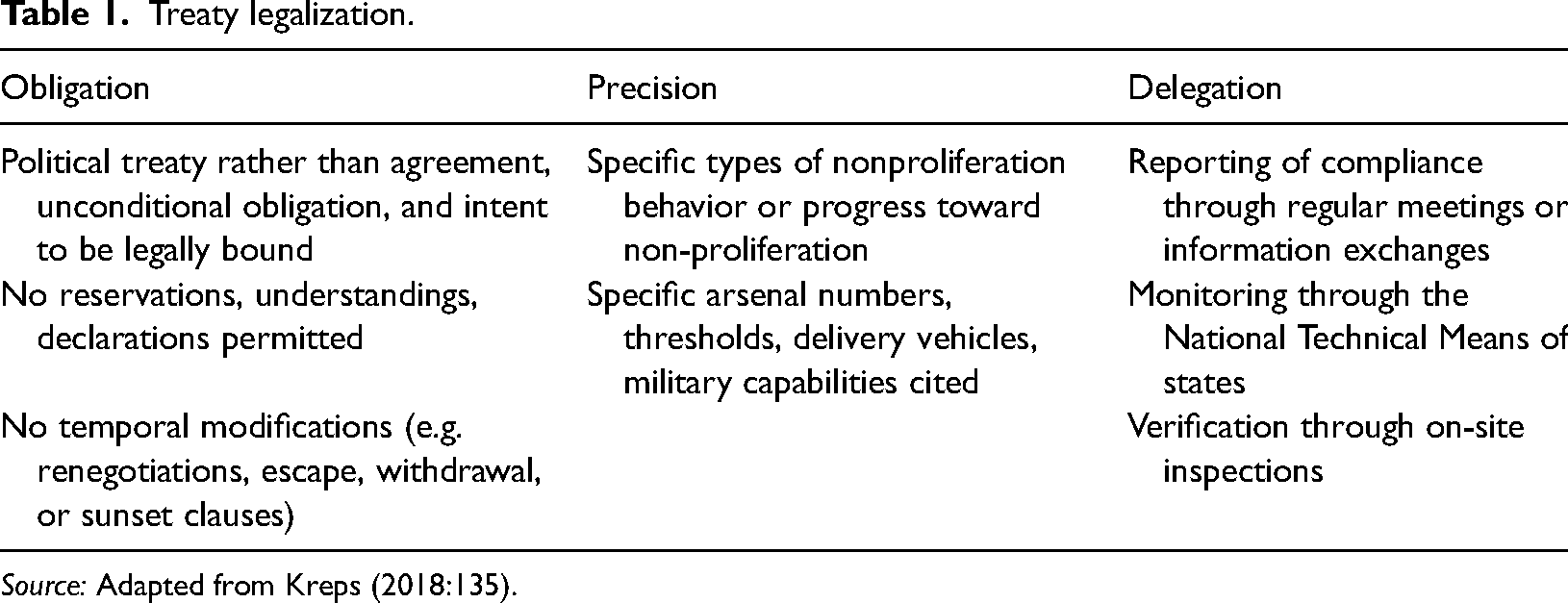
Source: Adapted from Kreps (2018:135).
As we have already suggested, we employ two indicators to measure the security situation of states: involvement in inter-state rivalries and alliances. To grasp the country's involvement in inter-state rivalries, we rely on the latest version of the “peace data” to measure involvement in inter-state rivalries (Diehl et al., 2021). This dataset offers information on peaceful and hostile relationships in relevant dyads of states between 1900 and 2020. A major advantage of the peace data compared with other datasets on inter-state conflict, such as the Militarized Interstate Dispute dataset, consists in taking into account not just single events but also the broader sets of interactions that occur between states. As a consequence, it arguably grasps inter-state relationships more effectively. Since we are interested in hostile relationships, we focused only on the categories of serious and lesser rivalries. We then elaborated a count variable of the number of rivalries a state is involved in during a given year.
We instead use data contained in the Alliance Treaty Obligation Project to gauge the involvement of states in alliances (Leeds et al., 2002). The Project provides extensive data on military alliance agreements and their content between 1815 and 2018. We extracted from the country-year level dataset a variable counting the total number of alliances a country is a member of in a given year and matched it with our data. We are aware that the number of alliances measures only the quantity of the alliance and not its quality, i.e. its extent of institutionalization. However, Leeds and Anac (2005) point out that more formal alliances, and those ones with higher levels of peace time coordination, are not more reliable when invoked during war. Therefore, we consider the number of alliances as sufficient to test our hypothesis.
Control variables
We control for the effect of ratification procedure, other treaty-level and state-level attributes, period, and external pressure. As far as ratification procedures are concerned, we control for accession, that is, joining an international treaty after it has come into force and when the two-step process is no longer possible. On one hand, we should therefore expect accessions to be associated with lower commitment. However, as we said, we also consider cases in which a state accedes to an existing treaty after its emergence in the system. In such cases, accession can be associated with shorter ratification duration.
With regards to treaty-level characteristics, we first distinguish the two protocols from all the other treaties. States should be faster to ratify protocols that build on already existing treaty commitments. This link builds on a simple institutionalist logic. We also control for treaties addressing weapons of mass destruction. Weapons of mass destruction are subject to various normative taboos—there are taboos against the use of nuclear weapons (Tannenwald, 1999, 2002), chemical weapons (Price and Tannenwald, 1996), and biological weapons (Guillemin, 2004; Tucker, 2002).
With regard to state-level characteristics, we first control for regime type, relying on the Polity V measure of the level of democracy. Second, we control for major power as a reflection of the realist considerations that the more powerful states are less likely to be willing to be bound by international organizations (Mearsheimer, 1994). We consider as major powers all the countries holding a permanent seat in the UN Security Council. Moreover, we check for the effect of a country's material capabilities by looking at its gross domestic product (GDP) in constant dollars, using World Bank data and transforming the variable to its natural logarithm to reduce the skewness. We expect countries with larger material capabilities to be more reluctant to commit to disarmament treaties. Third, we control for the military expenditure of states as share of GDP. We crossed data on GDP from the World Bank with data on military expenditure from the National Material Capabilities dataset to obtain such variable. We expect countries that invest relatively more on defense to be slower at ratifying treaties, as militaries might be concerned about constraining their freedom of action (Kreps, 2018). In addition, we control for parliamentary involvement in treaty ratification. Countries where the legislature has a veto power on the approval of a treaty should be slower at committing to multilateral disarmament treaties. This dichotomous variable corresponds to the “lgtreaty” variable, contained in the Comparative Constitutions Project (Elkins and Ginsburg, 2022).
We also control for the participation of states in the treaty negotiation process. As existing constructivist work underlines, the negotiation process is conducive to the emergence of social pressure that encourages states to participate in treaties. Social pressure mechanisms linked to negotiation were found in platforms as diverse as conventional arms control (Mantilla, 2023), anti-personnel mines (Bower, 2015; Price, 1998) and cluster munitions (Petrova, 2016).
In addition, we control for post-Cold War years through a dichotomous variable. We expect states to ratify disarmament treaties faster after 1989. In fact, during the Cold War, much of the international cooperation was seen through the prism of rivalry between the East and the West, which tamed the cooperation between the camps (Lupu, 2016; Russett, 1966; Soo Yeon and Russett, 1996; Voeten, 2000).
Finally, we control for the impact of external factors in the ratification process and for potential dependencies across observations, through a variable measuring the ratio between the total number of ratifications of one of our disarmament treaties in a given year and the number of states present in the system, multiplied by 100. Various scholars find that states are more likely to ratify treaties when their peers have already done so, because of either a sense of moral obligation or competition dynamics (Bernauer et al., 2010; Goodliffe and Hawkins, 2006). 7
We established 2020 as the last data point, extending the values of variables related to alliances, regime type, and military capabilities, in an attempt to cover as many years as possible and not exclude the TPNW, adopted in 2017, from the analysis. Missing values in state-level variables also led to the removal of a number of observations in the analysis. Notably, the Polity V dataset covers only countries with more than 500,000 inhabitants. 8
Empirical analysis
As already suggested, we employ event history analysis as a method to test our hypotheses. Event history models allow the researcher to investigate the timing of political change (Box-Steffensmeier and Jones, 2004). In other words, not only do these models permit us to explain the likelihood of observing an event but also the duration of the process associated with the event. For this reason, event history analysis appears as a particularly fitting method to examine ratification in multilateral disarmament treaties. Among the various event history models, we rely on the Weibull model for the estimation. 9 This model is parametric as it assumes a monotonic relationship between time and the likelihood that the event under study occurs: the likelihood of observing the event either increases or decreases over time (Box-Steffensmeier and Jones, 2004). In our case, we have strong reasons to believe that a relationship between the probability of observing treaty ratification and the duration of the process leading to it exists. In fact, although a certain amount of time is required for a state to ratify a treaty, longer periods are usually evidence of lack of commitment. To sum up, the more time passes from the moment of signature, the less likely it is that treaty ratification will be observed. 10
Table 2 shows the results of the Weibull models, with robust standard error for each country–treaty cluster, assessing the determinants of the ratification duration of multilateral disarmament treaties in 161 countries between 1976 and 2020. 11 In the models, we present the hazard ratios instead of the coefficients for each independent variable. Hazard ratios are the exponential of coefficients and should be interpreted in the following way: a value higher than 1 means that the independent variable has a positive effect (higher likelihood of ratification, shorter ratification process) and a value lower than 1 means that the effect is instead negative (lower likelihood of ratification, longer ratification process). Model 1 tests for the impact of the treaty-level variables; Model 2 assesses the effect of the security of states context; and Model 3 serves to test the effect of treaty legalization controlling for the security situation of states, and vice versa.
Determinants of duration of ratification process of multilateral disarmament treaties (1976–2020).
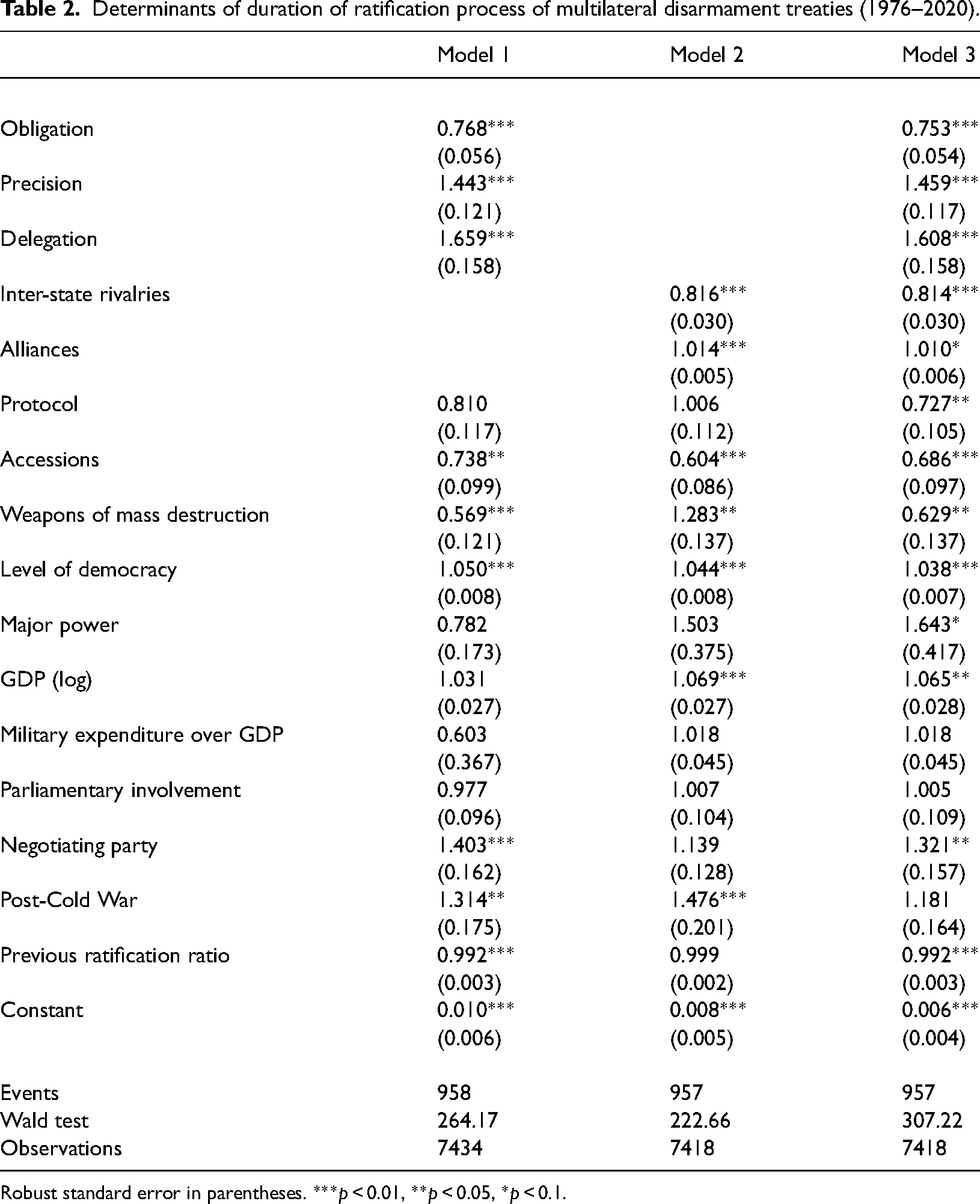
Robust standard error in parentheses. ***p < 0.01, **p < 0.05, *p < 0.1.
Model 1 indicates that the extent of the legalization of a treaty has a mixed impact on the duration of the ratification process by states. On the one hand, in line with Kreps (2018) and H1a, treaties with a higher level of obligation, that are more binding for countries, take significantly more time to ratify. To be precise, each increase of one point in our measure of obligation level corresponds to a decrease of 23.2% likelihood of ratification on average. However, contradicting Kreps (2018) and confirming H2b and H3b, the levels of precision and delegation of treaties have an opposite effect on the commitment of states in our sample, significantly reducing the ratification delay by countries. A one-point increase in the level of precision of the treaty provokes a 44.3% increase in the probability of ratification by states. The same size of increase in the scale of delegation, measuring the involvement of third parties in the implementation, interpretation, and application of the rules, is associated on average with a larger augmentation in the ratification likelihood, reaching almost 66%.
These findings indicate that treaties with higher degrees of precision and delegation most likely assure states about the obligations that they need to undertake, and also assure that the compliance with the treaties will be monitored by an independent third party. In a way, our findings fit with the expectations from the rationalist institutionalist literatures about the design of international treaties. However, the adverse effect of obligation on ratification duration underlines that states are, fundamentally, concerned about the commitments they make under international law, and making strongly binding commitments has adverse effects on the willingness of states to ratify treaties. In many ways, this finding confirms existing scholarship on the ratification of particular treaties, such as the NPT, which has found similar considerations at play (Way and Sasikumar, 2004).
Figure 1 shows the average predicted delay in ratification for different levels of treaty obligation, precision, and delegation. 12 States take on average 5.5 years to ratify a treaty that does not present any of the considered obligation requirements. As the number of obligation requirements increases, the average ratification delay increases as well: treaties with the maximum level of obligation require on average 9.8 years for states to ratify them. As just suggested, treaty precision and delegation instead shorten the duration of the ratification process. Treaties containing no precision requirements take on average 10.2 years to be ratified by countries. In contrast, treaties with the highest level of precision take 6.1 years. The size of the effect is much larger for the level of delegation. While at the lowest level of delegation the average ratification duration is 11.5 years, this decreases to 4.4 at the maximum level of delegation.
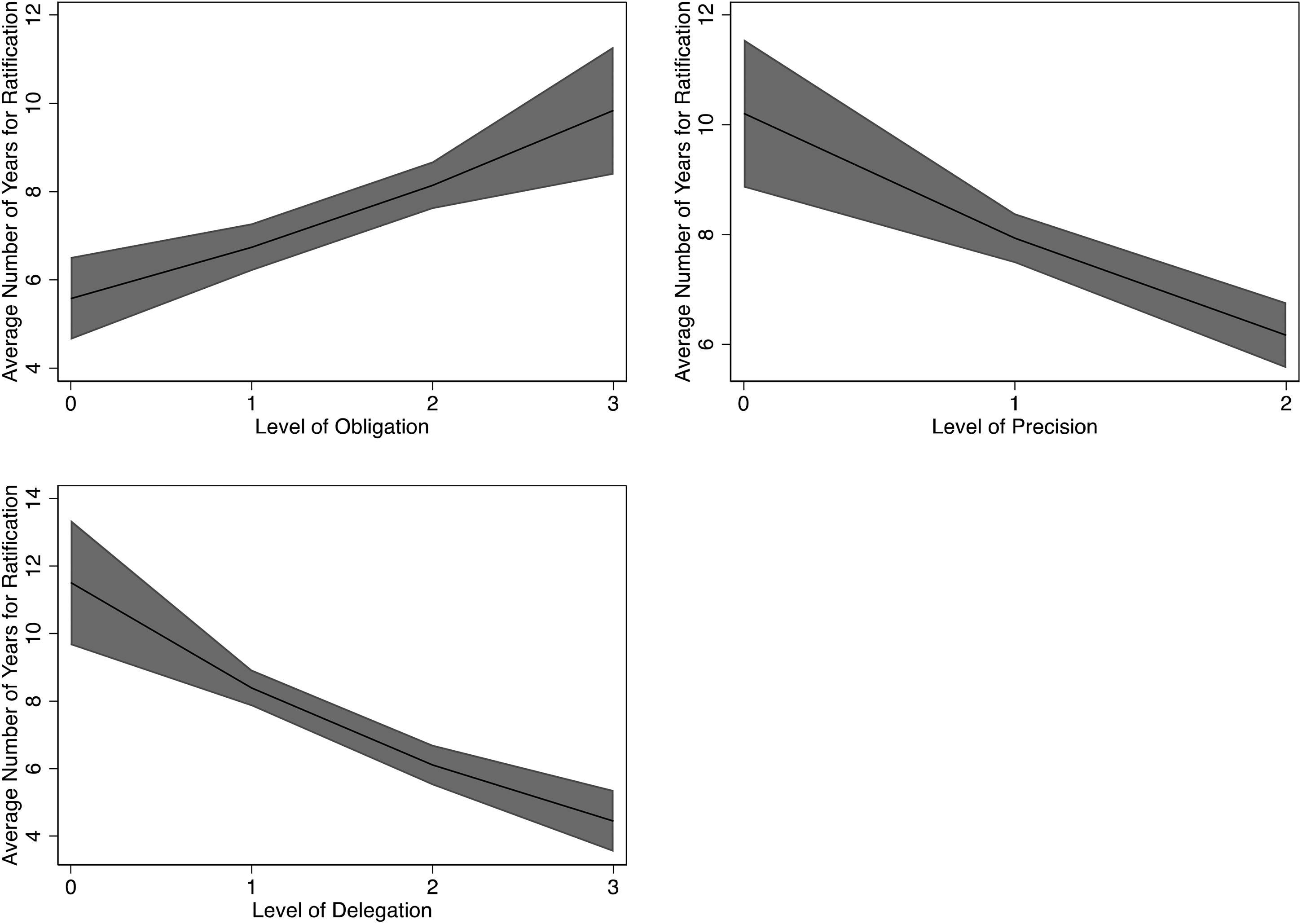
Predicted average ratification delay at different levels of obligation, precision, and delegation (95%, CI).
Model 2 suggests that states that have a more precarious security situation tend to be significantly slower at ratifying multilateral disarmament treaties. In line with H4, countries involved in a higher number of inter-state rivalries take more time to commit to these treaties. For each inter-state rivalry in which a state is involved, the ratification likelihood decreases by 19.4%. Moreover, as expected by H5, we also find that the more embedded in alliances countries are, the faster they are at ratifying treaties. Each additional alliance agreement accounts for an increase of 1.4% in the likelihood of ratification. However, the effect of alliances statistically weakens in the full model, and also disappears in some of the robustness checks. Our findings therefore provide only a weak confirmation of the findings from previous scholarship which argued that alliances provide states with immediate security benefits (Horovitz, 2015; Johnson and Leeds, 2011). To sum up, states with more hostile relationships and fewer alliances with other states tend to be less committed to multilateral disarmament treaties.
Model 3 shows that treaty legalization has a significant impact on the duration of the ratification process, even controlling for the security situation of states and vice versa. The size of the effect of our independent variables is very similar compared with Models 1 and 2. There is just a drop in the significance of the impact of number of alliances. We can infer that the effect of alliance on the likelihood of the ratification by states is sensitive to treaty legalization.
Figure 2 describes changes in the average ratification delay as the number of inter-state rivalries and alliances increases respectively. The effect of inter-state rivalries on the commitment of states to multilateral disarmament treaties is particularly strong: while states with no rivalries in a given year take on average 6.5 years to ratify a treaty, states with five rivalries take 13 years—twice the time basically. The Netherlands is an example of a country that for most of the years considered in our analysis had no rivalries with any country and has also been a fast ratifier of disarmament treaties. In fact, Dutch governments took 3 years to ratify the CTBT and the Convention on Cluster Munitions. Contrarily, at least until 2003, the USA was always involved in more than 10 rivalries and has not been always very quick at ratifying disarmament treaties. For instance, the USA took 13 years to ratify the CCW.
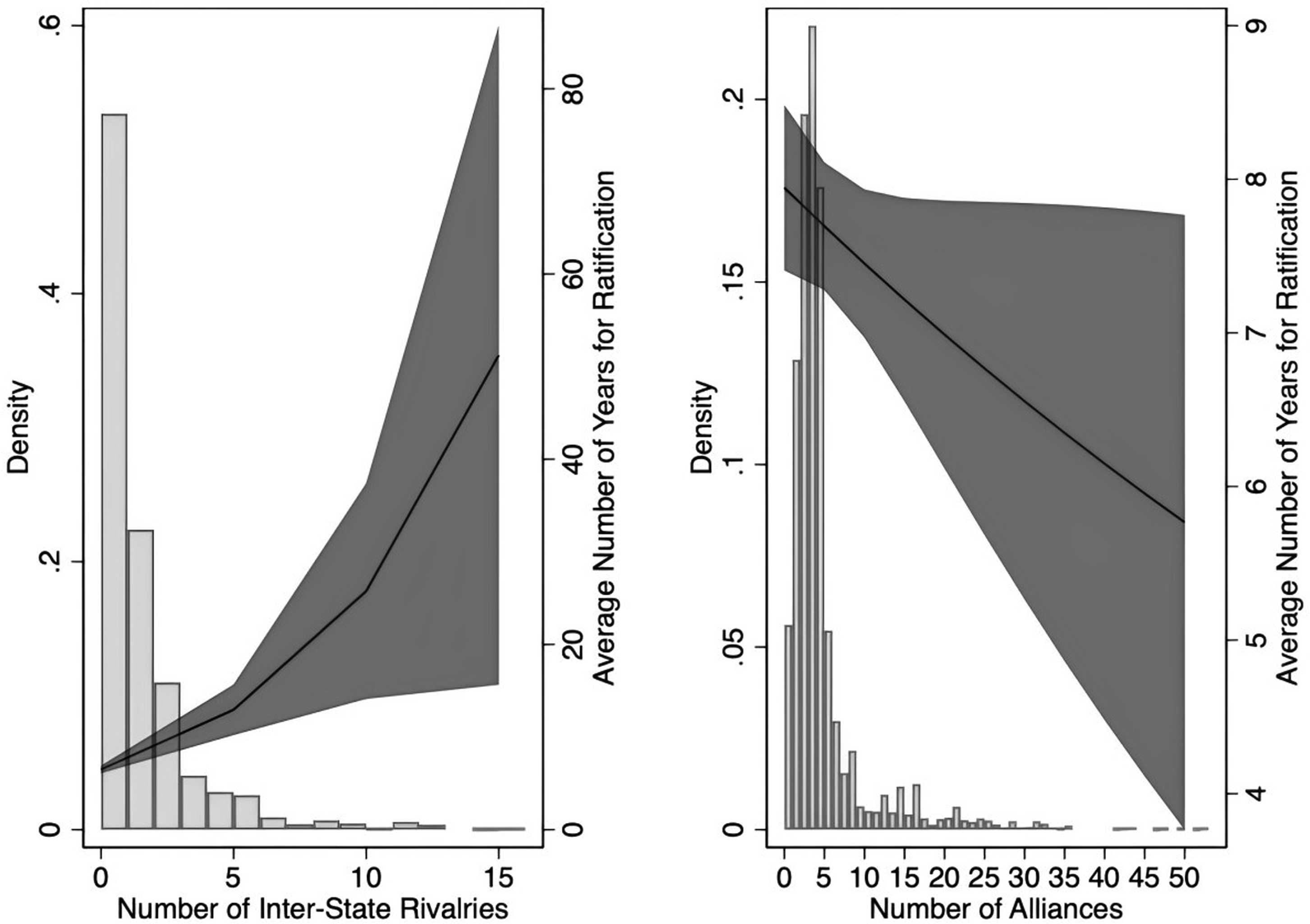
Predicted average ratification delay by number of inter-state rivalries and alliances (95% CI)—frequency distributions.
As noted, the number of alliances impacts the commitment of states in the opposite way: states with more allies will be faster at ratifying treaties. While countries with no alliances require on average 8 years to ratify one of these disarmament treaties, those with 30 alliances require on average 6.5 years. This effect is, however, only weakly statistically significant when controlling for the properties of the treaty itself. A couple of concrete examples further highlight the impact of alliances on commitment to disarmament treaties. In the 1980s and 1990s, Uganda, a country plagued by civil wars and high political instability, was not part of any alliance agreement. It took 15 years to accede to the CCW and 8 years to ratify the Convention on Chemical Weapons. Since the 1990s, France has instead been involved in more than 30 alliance agreements per year. In this period, French governments took only 2 years to ratify the Convention on Chemical Weapons and the same amount of time to ratify the CTBT.
A few control variables have a significant impact on the duration of the ratification process of multilateral disarmament treaties. First, accessions to such treaties lead to longer ratification processes. This result may be due to the fact that eight out of 10 treaties considered in the analysis were signed after the end of the Cold War. As a consequence, the cases of countries acceding to a treaty right after their entrance into the system were limited and could not compensate for accession delays. Furthermore, more democratic countries are considerably faster to commit to multilateral disarmament treaties than less democratic ones. A one-point increase in the Polity V scale increases on average the ratification likelihood by around 5% across models. This finding puts into perspective much of the scholarship on the ratification of arms control treaties developed in the USA, which focused on domestic-induced delays (Böller, 2022; Kreps et al., 2018). Our findings do not undermine these earlier works, but they underline that democracies are nevertheless faster ratifiers. Wealthier countries are also significantly faster at ratifying treaties. In addition, Models 1 and 3 indicate that negotiating parties are significantly faster at ratifying multilateral treaties. Finally, as expected, it seems that the end of the Cold War has brought an increase in commitment to multilateral disarmament treaties. In contrast, we do not find any statistically significant effect of military expenditure or parliamentary involvement. Similarly, treaties dealing with WMD do not show slower ratification. Interestingly, external pressure measured as previous ratification do not consistently increase the likelihood of ratification by a state.
Qualitative illustration: TPNW
To provide more evidence of our findings, we further test the impact of our main independent variables on the ratification of the TPNW. The TPNW is the most recent treaty, and it has faced a curious combination of political headwinds. For instance, while the treaty borrows the humanitarian narrative from other disarmament treaties (Bolton & Minor, 2016), it has been opposed by the states possessing nuclear weapons, their friends and allies. Because of its highly contentious and politicized nature, the TPNW presents a hard case, fitting what Jack Levy called the Sinatra inference—if the theory can make it here, it can make it anywhere (Levy, 2002).
The TPNW was adopted in 2017 by the UN General Assembly after a contentious and fractious process in which no nuclear weapons possessors and only one country covered by a nuclear alliance took part (Gibbons, 2018). The treaty was initially one of the fastest ones in terms of gathering support, but over time, the pace of ratification slowed down (Onderco, 2020). Despite a fairly low threshold (only 50 ratifications), it took the treaty more than 3 years to enter into force in January 2021. At the end of 2020, the last year covered in our quantitative analysis, 47 countries ratified the treaty. 13
The simple descriptive statistics from this treaty confirm our findings. The TPNW is a treaty with a high degree of obligation—it bans states from stationing, developing, possessing or using nuclear weapons. However, the treaty's precision is not very high (it leaves many aspects to be determined later), and the level of delegation is also fairly low. The low degree of delegation and precision occupied state parties during the first Meeting of State Parties in Vienna in June 2022, when states aimed at further specifying many treaty-related details (Acheson, 2022). In fact, the treaty's low level of precision and delegation is often cited as a reason why states have not joined the treaty. Very often, such complaints are stated as the lack of verification mechanisms, and have been cited in national studies conducted in Switzerland and Sweden (Ministry of Foreign Affairs, 2019; Swiss Federal Department of Foreign Affairs, 2018).
When it comes to the country-level factors, out of the 47 ratifiers in 2020, only seven had an ongoing inter-state rivalry: Venezuela, Cuba, Belize, Guyana, Thailand, Vietnam, and Malaysia. Many of those rivalries are either regional (with countries which do not possess nuclear weapons) or with superpowers (Venezuela). Only two of the ratifiers had no alliances (Palau and Vanuatu), and three had one alliance (Samoa, San Marino, and Mexico), further strengthening our argument. In contrast, Kazakhstan with its 25 allies was lightning fast in ratifying the TPNW—it took Kazakhstan only 545 days, compared with 4687 days it takes Kazakhstan to ratify disarmament treaties on average. 14 The real outliers in the case of the TPNW are the countries with numerous allies, such as the NATO countries, who would normally be fast ratifiers. These countries remain outside the treaty, which can be explained by a rather peculiar situation in which this treaty goes directly against one of the main pillars of the alliance—reliance on nuclear deterrence (NATO, 2022). This was not the case with other disarmament treaties, where disarmament did not run contrary to the alliance's doctrine.
The TPNW undercuts our argument elsewhere as well. While our statistical model finds that states are in general slower to ratify WMD-related treaties, all but five ratifiers committed to TPNW faster than an average treaty (the exceptions are Fiji, Malawi, Mongolia, Nigeria, and Peru). However, this exception can be explained by the fact that the TPNW requires little from the current ratifiers, and they do not need to take any concrete action in any immediate future.
While these findings underscore the uniqueness of the TPNW as a case, they also illustrate the robustness of our analysis.
Conclusion
In our paper, we looked at the determinants associated with the length of the period between the signature and ratification of multilateral disarmament treaties. Because multilateral treaties are a major tool for advancing international agendas, and because the treaties are binding upon states when they ratify them, the delay between signature and ratification is salient for international relations scholarship. We tested two specific sets of hypotheses—those related to the treaty and those related to the states. Our findings indicate that a higher degree of obligation leads to slower ratification, but higher degrees of precision and delegation lead to a faster ratification process.
In this way, our findings contradict somewhat the work of Kreps (2018) by finding that precision and delegation reduce ratification delay. One possible explanation might be that there are different dynamics at play in treaty design and treaty ratification. Also, Kreps's sample focused exclusively on nuclear treaties, which might explain different considerations that might apply to other types of treaties.
Our work is the first to focus on the ratification of multilateral disarmament treaties comprehensively. For this reason, the findings are important for further advancement of the international relations scholarship on treaty ratification as well as on multilateral disarmament approaches. While scholars have previously answered questions on what makes states commit to disarmament treaties (Brender, 2018; Klomp and Beeres, 2022), our paper looks at the manner in which they do so. We also connect to the scholarship on the ratification of international arms control treaties, which have often focused on US cases (Böller, 2022; Fuhrmann and Early, 2008; Kimball, 2017; Seo, 2015).
We find that disarmament treaties with a high degree of obligation make states reluctant to join. This might be understandably related to the fact that states are consciously considering whether they should join such treaties, or what it would take to be compliant in good faith. However, the finding that precision and delegation lead to shorter ratification delays is welcome news as it indicates that treaties where the institutional factor is higher are more likely to be successful and quickly attract members. Such findings have direct policy relevance for the practitioners of multilateral disarmament diplomacy.
Our findings which show that disarmament treaties are ratified slower by states at war or in rivalry with other states are disappointing for real-world policy. On one hand, this finding is understandable because countries in conflicts or at war probably have other priorities than joining international treaties. On the other hand, however, disarmament treaties could in such a situation help the most by alleviating the situation or decreasing tensions, yet the countries that need them most are the least likely to ratify them. We also find some evidence that alliances increase the likelihood of ratifying disarmament treaties. Even if the statistical significance of these findings weakens as the model becomes fuller, it goes in the same direction as the findings from the earlier scholarship that argues that military alliances increase cooperative behavior in international relations (Fordham, 2010; Haim, 2016; Long and Leeds, 2006). Taken together, our findings underscore that the security situation that states are facing drives their behavior with regard to disarmament treaties.
Further scholarship could look at how within-state factors beyond regime type, such as partisanship or government composition, constrain or permit states from ratifying treaties. Such scholarship would, however, require focus on a smaller sample of (mostly democratic) states. Furthermore, future scholarship might want to expand the sample of treaties and look also at those that are not deposited with the UN Secretary General, or look at both multilateral and bilateral treaties. Last but not least, our small case illustration indicates that numerous treaty-specific idiosyncrasies might influence treaty ratification speed. Individual case studies focused on particular treaties, using qualitative and archival work, can help us to understand ratification dynamics in even more detail.
Replication data
Appendices, replication code and data are available from the supplementary materials section of the paper on the CMPS website.
Supplemental Material
sj-pdf-1-cmp-10.1177_07388942241243259 - Supplemental material for Treaty legalization, security interests, and ratification of multilateral disarmament treaties
Supplemental material, sj-pdf-1-cmp-10.1177_07388942241243259 for Treaty legalization, security interests, and ratification of multilateral disarmament treaties by Michal Onderco and Valerio Vignoli in Conflict Management and Peace Science
Supplemental Material
sj-zip-2-cmp-10.1177_07388942241243259 - Supplemental material for Treaty legalization, security interests, and ratification of multilateral disarmament treaties
Supplemental material, sj-zip-2-cmp-10.1177_07388942241243259 for Treaty legalization, security interests, and ratification of multilateral disarmament treaties by Michal Onderco and Valerio Vignoli in Conflict Management and Peace Science
Footnotes
Acknowledgements
We are grateful to the CMPS editors and the two excellent reviewers for their helpful suggestions. We thank Paul Diehl for sharing data with us, and Femke Verburg and Mahmoud Javadi for their research assistance. Andrey Baklitsky, Oriol Costa, Bonnie Docherty, Jennifer Erickson, Louis Maresca, Pavel Podvig, Laura Rockwood, Frank Sauer, Jean-Pascal Zanders, Markus Haverland, and Geske Dijkstra all provided helpful comments. We also thank the participants in our panel at the 2022 ISA Annual Conference and 2022 NIG Conference, and especially our discussants Cornelia Baciu and Yf Reykers respectively, for their insightful suggestions which helped us to make the paper better. All mistakes remain our own.
Declaration of conflicting interest
The authors declared no potential conflicts of interest with respect to the research, authorship, and/or publication of this article.
Funding
The authors received no financial support for the research, authorship, and/or publication of this article.

Supplemental material
Supplemental material for this article is available online.
Notes
References
Supplementary Material
Please find the following supplemental material available below.
For Open Access articles published under a Creative Commons License, all supplemental material carries the same license as the article it is associated with.
For non-Open Access articles published, all supplemental material carries a non-exclusive license, and permission requests for re-use of supplemental material or any part of supplemental material shall be sent directly to the copyright owner as specified in the copyright notice associated with the article.
