




Abstract
Immigrants have a substantial impact on US foreign policy: doubling the proportion of the American voters who were born in a country yields a 4% increase in the probability that the United States will intervene in a crisis involving that country. This result is significant at the 1% level. Moreover, the immigrants’ level of education and income do not affect this result. Apart from unemployment and real gross domestic product growth, other quantifiable domestic and international variables, from presidential approval to trade dependency and defense pacts, do not have a statistically significant impact on American intervention.
Introduction
In 1998 the United States intervened in the Ethiopian–Eritrean crisis to try to broker a peace agreement between the two warring states. A border dispute had set the neighbors against each other, resulting in approximately 100,000 deaths (Pettersson et al., 2021) and causing at least 400,000 people to flee their homes (Dagne, 2000). Yet while the conflict had substantial repercussions for the people in those countries, it was unlikely to affect the wider world. The United States did little trade with the countries involved and did not have alliances with either of them. Although one could attempt to make the case that the Horn of Africa was a geostrategic region and the conflict could spill over into neighboring countries, when testifying before Congress on why the United States should become involved, the first thing that came to then Assistant Secretary of State for African Affairs Susan Rice's mind was that the war had caused the Ethiopian government to allow air travel between Addis Abba and Khartoum—hardly a compelling national security dilemma for the United States (US Congress, 1999).
Nonetheless, many of the approximately 30,000 American voters who were born in the two countries involved felt passionately about the matter. 1 They called their members of Congress, wrote letters to the editor and marched in the streets. They travelled to Washington to bend ears and twist arms (The Economist, 2000). And they succeeded. The American government intervened and on 12 December 2000 the American Secretary of State signed her name to a peace agreement, alongside that of the Eritrean President and Ethiopian Prime Minister (Bell and Badanjak, 2019).
American interventions in international crises are not uncommon. Since the end of the Second World War, the United States has intervened in 200 international crises (Brecher and Wilkenfeld, 1997; Brecher et al., 2020) with actions that ranged from words to warfare. Interventions in crises where the United States was not a primary belligerent have had staggering costs in terms of blood and treasure. Over 116,000 Americans gave their lives in the First World War, over 36,000 in Korea, and over 58,000 in Vietnam (Blum and DeBruyne, 2020), while civilian deaths in these conflicts are estimated in the millions (Cumings, 2011; Lewy, 1978). Calculations of the pecuniary cost of the conflicts are hotly debated but total at least a trillion dollars (Daggett, 2008). Furthermore, conflicts often escalate unpredictably into crisis and even war (Braumoeller, 2019). American interventions that appeared initially innocuous, such as participating in the multinational peacekeeping mission for Lebanon, can quickly turn deadly.
Conversely, American intervention has also been critical to its allies. Americans’ sacrifice in Europe helped win the First World War, while American efforts in Korea kept millions of South Koreans out of Kim Il Sung's clutches. According to the International Crisis Behavior (ICB) Project, when America did intervene, its actions contributed to ending the crisis in 46% of cases. In 8% of cases, American actions were the single most important factor in ending the crisis (Brecher and Wilkenfeld, 1997; Brecher et al., 2020). Meanwhile, American isolationism, often exacerbated by xenophobia, sidelined the world's most powerful military for the first two years of the Second World War, allowing fascism to advance over Europe, Africa and Asia. In subsequent decades it caused the White House to turn a blind eye to easily arrestable genocides, such as Rwanda.
American intervention plays a pivotal role in international crises, with attendant consequences for international security and human rights. Yet a critical cause of American intervention, immigrants, has been overlooked (Rubenzer and Redd, 2010). 2 This paper asks what effect immigrants have on American intervention in international crises. As it demonstrates, doubling the proportion of the American electorate who were born in a country in crisis increases the probability that the United States government will intervene in a crisis involving that country by 4.027%. The result is significant at the 1% level. 3
Effect of immigrants on American intervention.
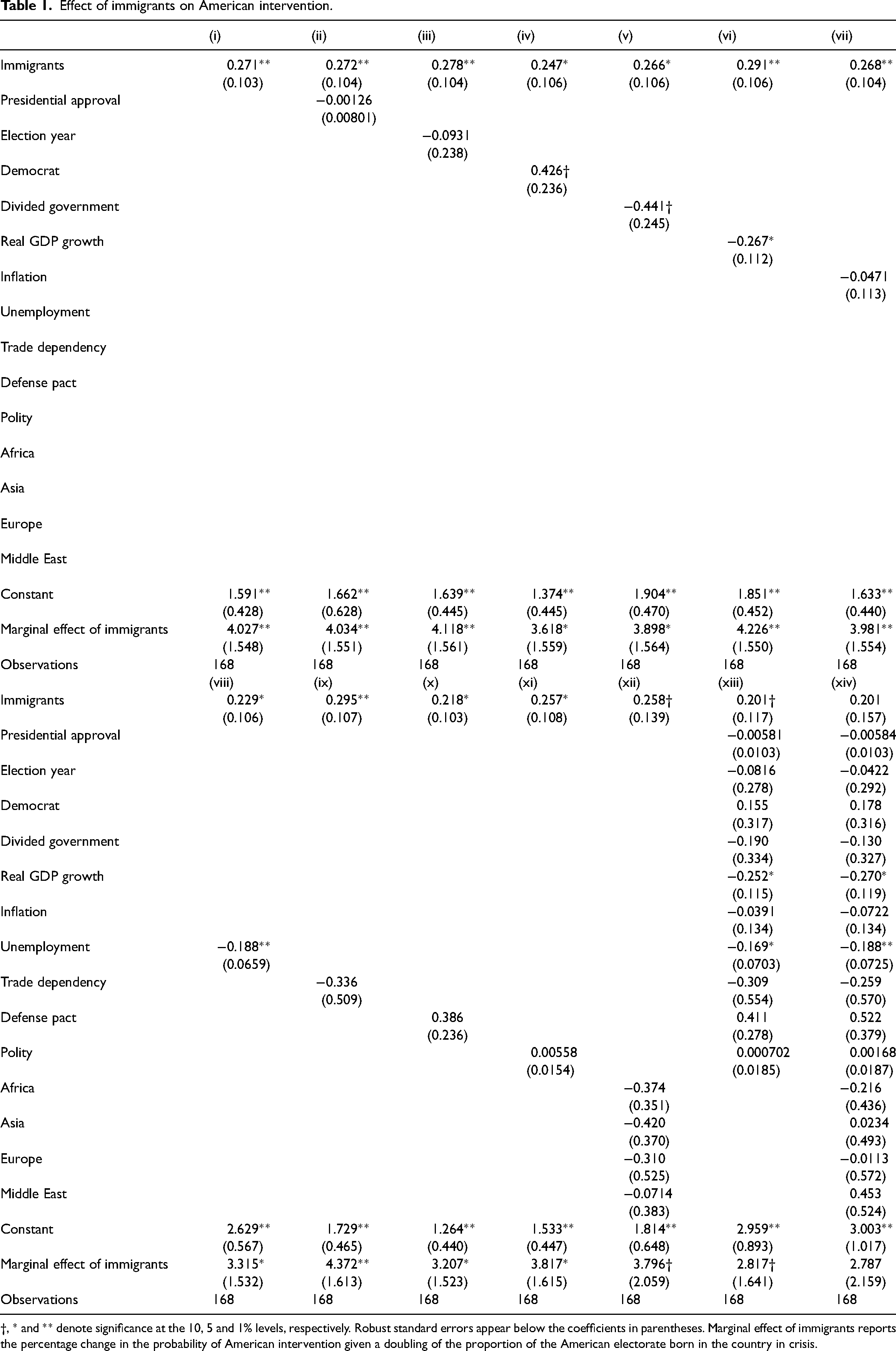
†, * and ** denote significance at the 10, 5 and 1% levels, respectively. Robust standard errors appear below the coefficients in parentheses. Marginal effect of immigrants reports the percentage change in the probability of American intervention given a doubling of the proportion of the American electorate born in the country in crisis.
Apart from unemployment and real gross domestic product (GDP) growth, first-generation immigrants are the only statistically significant variable in the forthcoming data analysis. Other quantifiable domestic and international factors—from presidential approval, president's political party, divided government, election year, inflation, to trade dependence, defense pacts, and Polity scores—are statistically insignificant at the 5% level.
The effect of immigrants on American intervention is not moderated by the immigrants’ level of education or income. Statistically speaking, an additional erudite and well-remunerated immigrant has the same impact as a less educated and poorly paid one.
The results show the importance of immigrants on American foreign policy making and confirm that the findings of the case-study literature are not due to selectively focusing on a few well-known cases but generalize to all crises. The results demonstrate that domestic factors in general, and the demographics variables in particular, drive foreign policy. This is in keeping with the work of Barnhart et al. (2020) who show that women's suffrage is a cause of peace between democracies, and Bermeo and LeBlang (2015), who show that immigrants direct the pattern of foreign aid distribution. It also fits into the broader literature on demographics and political violence, including the effects of age (Urdal, 2006), religion (Fox and Sandal, 2011) and marital status (Hudson and den Boer, 2002; Kustra, 2019).
The results also contrast with other studies on the importance of income and education on political lobbying. For instance, Page et al. (2013) examine the political activity of the wealthiest Americans and show that not only are they much more interested in politics than most citizens, but some of them are even on a first-name basis with key White House staffers. They further note that where the policy preferences of the wealthy diverge from those of the general population, the wealthy tend to get their way, suggesting that money does drive politics. Similarly, Brady et al. (1995) explain that more educated voters are more likely to possess the civic skills, from being an eloquent writer to being an efficient organizer, that citizens need to effectively lobby their government. Conversely, this papers’ regressions show that there is no difference between the lobbying of those with above average income or education. A vote is a vote is a vote, regardless of the voter's income or education, and America's elected leaders will be more likely to approve an intervention where an immigrant group has more votes.
Theory
Lobbying by immigrant/ethnic groups has had substantial effects on American foreign policy. Indian-Americans obtained a nuclear technology transfer agreement despite concerns that this could further the Indian nuclear weapons program (Kirk, 2008). Ukrainian-Americans caused the United States to recognize newly independent Soviet republics (Shain, 1994) and Polish-Americans later secured American support for enlarging NATO to include Eastern Europe (Asmus, 2004). Greek-Americans prevented the sale of arms to Greece's arch rival, Turkey (Watanabe, 1984), and Armenian-Americans caused the American government to recognize the Armenian genocide over Turkish objections (McCormick, 2012). Haitian-Americans lobbied for American intervention to restore Jean-Bertrand Aristide to power (Laguerre, 2006) and Cuban-American pressure sustained economic sanctions against the Castro regime for over half a century (Haney and Vanderbush, 1999), although we should add that these groups’ lobbying efforts were not the sole reason for these policy concessions.
However, because there is no large N quantitative test of immigrants’ influence on American intervention (Rubenzer, 2008), 4 whether to interpret the preceding examples as idiosyncratic or evidence of an underlying effect is disputed. Glazer and Moynihan (1975, p. 23–24) say that “the ethnic composition [of the United States] is the single most important determinant of American foreign policy.” 5 Smith (2000), Ambrosio (2002), Shain and Barth (2003), Newhouse (2009) and Milner and Tingley (2015) are more circumspect, but all agree that immigrant groups play an important role in American foreign policy. Conversely, Garrett (1978) and Jacobs and Page (2005) argue that foreign policy is made by experts insulated from the public's wishes, so the desires of voters, native born or immigrants, do not play a role. Lindsay (2004) says that the influence of immigrants is exaggerated. Moore (2002) calls the examples used to support arguments that immigrants are influential unrepresentative and says that, apart from Cuban-Americans, no immigrant group has been able to successfully influence American foreign policy.
Instead, scholars of international crises call upon other domestic and international factors to explain what causes the United States to intervene abroad, although they frequently find these variables to be insignificant. Potter (2013) reports that Republican presidents are more likely to intervene. Other political variables such as presidential approval (DeRouen, 2000; Howell and Pevehouse, 2005; Potter 2013), whether the president's party also controls Congress (Gowa, 1998) and whether it is a presidential-election year (DeRouen, 2000; Gowa 1998; Howell and Pevehouse, 2005) do not have a statistically significant effect. 6 DeRouen (2000) and Howell and Pevehouse (2005) find that higher unemployment increases the probability of intervention, while Potter (2013) finds that higher unemployment decreases the probability. Conversely, Potter (2013) finds that higher inflation increases the chances of intervention, while Fordham (2008) finds that inflation decreases it. Gross domestic product growth (Fordham, 2008; Gowa, 1998) and trade with the country (or countries) involved (Fordham, 2008) have been found to be insignificant. Similarly, alliances with the United States (Fordham, 2008) and Polity scores (Fordham, 2008) have been considered, although the latter was not significant. Fordham (2008) uses international crises as the unit of observation while the other studies consider the total number of American interventions within a given time period, i.e. three months or one year, potentially explaining the different results. In short, while many variables have been considered, no variable has been shown to have a consistent and statistically significant effect across studies, heightening the importance of finding a factor that can explain this critical foreign-policy decision.
If immigrants do play a role, how does their influence compare with these variables? How much does an increase in the number of immigrants in the United States increase the probability that the American government will intervene? How does this magnitude compare with a change in unemployment or inflation, whether Democrats or Republicans control the White House, or whether the United States has a defense pact with the country involved? And does this effect depend on their education and their income?
To investigate these questions, this paper will follow the basic model of immigrant influence. Its assumptions are parsimonious and empirically grounded. Assumption 1 is that many immigrants care about their country of birth. They may be in favor of or against the government there, but they are not indifferent. Assumption 2 is that the American government responds to the desires of American voters and that as more voters support a particular policy, the odds of its being implemented increase (Rubenzer and Redd, 2010). 7
Assumptions 1 and 2 imply that as an immigrant group's share of the American electorate increases so too does the probability that the American government caters to its demands and intervenes in international crises involving the immigrants’ country of birth.
(or countries) involved in an international crisis increase the probability that the United States intervenes in the crisis.
In order to affect foreign policy, immigrants form committees, write letters, distribute pamphlets, stage demonstrations, make campaign contributions and enlist lobbying firms in order to gain the attention of the politicians who oversee America's international relations (Sheffer, 2014). Immigrant groups who are better educated should possess greater civic skills including the ability to organize for a common cause, articulate their positions, and understand and influence the political system, thereby making them more influential (Paul and Paul, 2009). Higher-income immigrant groups should be able to spend more on organizing themselves, diffusing their message and contributing to political campaigns, thereby making them more influential (Smith, 2000). 8
(or countries) involved in the international crisis are, the greater the probability is that the United States will intervene in the crisis.
(or countries) involved in the international crisis are, the greater the probability is that the United States will intervene in the crisis.
Data
The unit of analysis is the international crisis. The ICB Project defines a foreign policy crisis actor as a state within which the leadership perceives a threat to its basic values, along with a finite time for responding and an increased likelihood of armed hostilities (Brecher and Wilkenfeld, 1997; Brecher et al., 2020). Examples of international crises include the Soviet blockade of Berlin, the Israel raid to free hostages held by the Popular Front for the Liberation of Palestine at Entebbe airport, and Vietnam's invasion of Cambodia. The states whose leadership perceive the threat are the primary actors in the crisis case, and they often seek to involve the United States in the conflict. For each international crisis, the dependent variable, US intervention, is coded as 1 if the ICB Project lists the United States as active in the crisis and 0 if it is not involved or neutral. Cases where the United States is a primary actor in the crisis are excluded since the United States cannot intervene in a crisis in which it is already a party. The ICB defines intervention as any substantive involvement in the crisis from political activity, including statements by senior officials, imposing economic sanctions, providing economic or military aid to using armed force. This paper does not attempt to distinguish between subtle levels of involvement, both because there are too few observations for such a fine-grained statistical analysis and because it presumes that the immigrants understand that the proverbial cry of “Send in the Marines” is neither an appropriate or effective response to all, or even most, cases and that often a more measured response is preferable.
For each crisis, public census microdata (Ruggles et al., 2020) on age, citizenship and place of birth for over 43 million Americans are used to calculate the independent variable: the proportion of the American electorate born in each crisis actor. 9 A person is counted as a member of the electorate if he or she is a US citizen at or above the voting age (21 for census years 1940–1970; 18 for census years 1980 and onward). Census data are available decennially from 1940 to 2010 10 and come from the long-form census which was given to 1 or 5% of respondents, depending on the census. For crises that take place in a non-census year, data from the previous census are used to calculate the immigrant groups’ proportion of the American electorate, and its proportion of highly educated and highly paid members. In the case of crises that include multiple countries, the immigrant groups are added together. This means that as more countries become involved, the proportion of the American electorate born in those countries will increase. As a robustness check, the proportion of the American electorate born in the countries involved divided by the number of countries involved is also considered. 11 These results are reported in Online Appendix Tables 4 and 5. To address skewness, the log of the proportion of the American electorate born in the country/countries involved is used.
The proportion of highly educated immigrants born in a given country for a given census is defined as the proportion who are at or above the 75th percentile of years of education of the American public. Since the 75th percentile is an arbitrary threshold, the paper also calculates thresholds of the 50th and 90th percentiles and reports these results in Online Appendix Tables 2 and 3. The proportion of highly paid immigrants is similarly calculated: the proportion of immigrants from a given country who are members of the labor force, and whose wages are at or above the 75th percentile of wages of the American labor force in that census. Again, thresholds of the 50th and 90th percentiles are also calculated. In cases which have multiple crisis actors, the average of the immigrant groups’ highly paid/educated metrics is used, with each immigrant group’s share weighted by its proportion of the American electorate. This paper then computes an interaction term of the proportion of the American electorate born in the country in crisis multiplied by proportion of the immigrants who are highly educated. If being highly educated increased one's ability to influence policy, then each highly educated member of the immigrant group should count for more than a non-highly educated member would and this would be reflected by a positive and statistically significant coefficient on this variable. Similarly, an interaction of the proportion of the American electorate born in the country and high income allows this paper to test whether having a high income has an additional effect. 12
Education and income have both increased substantially in the seven decades that this study considers. To address this, the metrics consider education and wages relative to others in that census. Women have made tremendous progress in terms of education and wages over the period under study. This progress has been uneven between immigrant groups, but that does not necessarily mean that women from groups with greater gender inequality have been politically passive. To correct for this factor, additional male-only education and income data are calculated on the assumption that women in these groups are just as capable as their male peers even if the census does not record it that way.
The regressions include numerous control variables. Domestic political considerations, such as dummy variables for whether the president is a Democrat or a Republican, which party controls the White House, whether the White House and both chambers of Congress are controlled by the same party, and whether the crisis takes place before ballots are cast during a presidential election year, are coded from CQ Almanac (CQ Press, 2020). Again, the crisis trigger date is used as the coding date. Presidential approval ratings come from Gallup polls compiled by the Roper Center for Public Opinion Research (2021). The first poll in the month the crisis begins is used. If there are two presidents in that month, the first poll for the person who is president when the crisis begins is used.
Real GDP growth is calculated as the change in real GDP as reported by the US Bureau of Economic Analysis (2021). Inflation data is calculated as the change in the consumer price index (urban consumers, all items) reported by the US Bureau of Labor Statistics (2021a). Unemployment is the U-3 measure of labor underutilization as reported by the US Bureau of Labor Statistics (2021b). Real GDP is calculated quarterly and inflation and unemployment monthly. In order to avert a crisis influencing these figures, the time period immediately before the crises trigger is used. Trade dependence is defined as the sum of imports and exports from the country or countries in crisis to the United States divided by American GDP. Trade data are taken from the Correlates of War International Trade dataset (Barbieri et al., 2009) and GDP data are taken from the US Bureau of Economic Analysis (2021). Again, to prevent endogeneity, this data is lagged by one year. Defense pact is a dummy which takes a value of 1 if the United States has a defense pact with any of the countries in crisis as of the trigger date. This is coded from the Correlates of War Interstate Alliance dataset (Gibler, 2009). Polity 2 data come from the Polity V project (Marshall and Gurr, 2020). Since the United States may be more likely to intervene in a crisis involving a fellow democracy, in the cases of crises involving multiple countries, the highest (most democratic) Polity 2 score is used. Geographic dummy variables are coded from the location data in the ICB dataset. Of course, other factors, such as a desire to uphold international norms or to prevent genocide or crimes against humanity under the doctrine of responsibility to protect, may also cause the United States to intervene. Such factors are more difficult to quantify and therefore cannot be included as control variables.
In total there are 168 crises in the sample, ranging from 1946 to 2012. Of these the United States intervened in 117. Summary statistics for the variables are presented in Online Appendix Table 1.
Results
Since the dependent variable is binary, the regressions will employ a probit model. 13 As the results of the probits reported in Table 1 show, the proportion of the American electorate born in a country (or countries) in crisis has a positive and statistically significant impact on whether the United States intervenes in the crisis. Without controls, doubling the proportion of the American electorate born in a country in crisis—an increase of approximately 30,000 voters at the mean—increases the probability that the American government intervenes by 4.027% (column i). 14 The result is significant at the 1% level.
Effect of immigrants’ education and wages on American intervention.
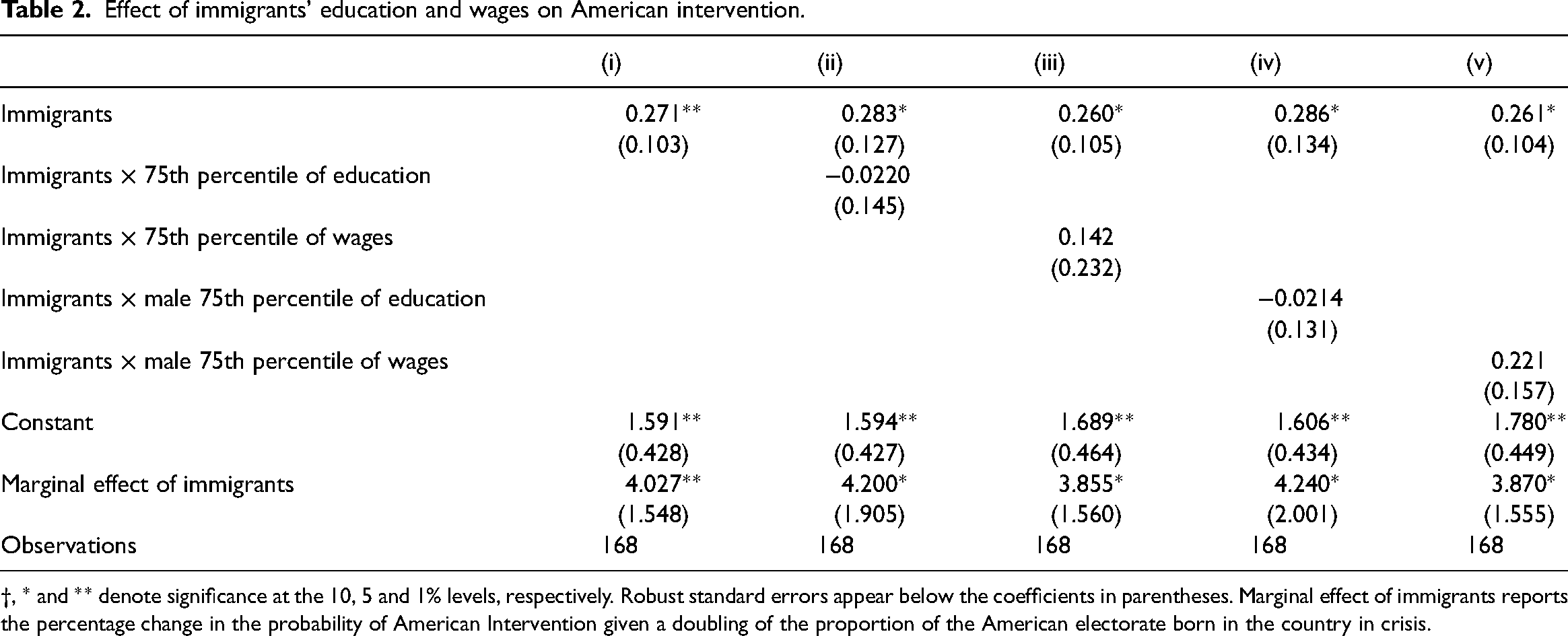
†, * and ** denote significance at the 10, 5 and 1% levels, respectively. Robust standard errors appear below the coefficients in parentheses. Marginal effect of immigrants reports the percentage change in the probability of American Intervention given a doubling of the proportion of the American electorate born in the country in crisis.
Including control variables from presidential approval to Polity scores does not substantially change this result (columns ii–xi). The marginal effect ranges between 3.207 and 4.372% and the result is always significant at the 5% level. Only two of the 10 previously studied covariates—real GDP growth (column vi, p-value 0.018) and the unemployment rate (column viii, p-value 0.004)—are significant at the 5% level. A 1 percentage point increase in real GDP growth lowers the probability of intervention by 12.87% while a 1 percentage point increase in the unemployment rate lowers the probability of intervention by 9.02%. These results appear to be at variance with one another and with 10 random covariates it is plausible that one will be spuriously significant at the 5% level. Given the higher p-value on real GDP growth and the fact that previous scholars (Fordham 2008 and Gowa 1998) found it to be insignificant, it may be suggested that the result is spurious and that only immigrants and the unemployment rate influence whether the United States intervenes. Such a result would run contrary to the diversionary theory of conflict, which argues that governments engage in conflict to divert attention from domestic troubles, particularly when an election is on the horizon (Levy 1989). Instead, it would suggest that the United States is more willing to intervene when unemployment is low and that the electoral calendar does not influence intervention decisions.
Column xii includes geographic dummies for the region where the crisis took place. Including these dummies does not substantially change the marginal effect of first-generation immigrants: doubling the number of first-generation immigrants yields a 3.796% increase in the probability that America intervenes, well within the range of the marginal effect when other covariates are included; however, the standard error has increased and the p-value on the coefficient is 0.064. An F-test on the four geographic dummies show that they are jointly insignificant with a p-value of 0.669. Including numerous irrelevant variables can lower the statistical significance of relevant ones while not affecting the marginal effect of the relevant variables, and that is what has occurred here. When all the control variables except the geographic dummies are included in the regression (column xiii), the effect of doubling the proportion of first-generation immigrants on the probability of American intervention declines slightly to 2.817 and is significant at the 10% level. Of the control variables, only real GDP growth and unemployment are significant, both at the 5% level. Including all the control variables including the geographic dummies causes the effect of first-generation immigrants to be statistically insignificant at the 10% level. Again, of the control variables, only real GDP growth and unemployment are significant. The marginal effect of doubling the proportion of first-generation immigrants on the probability of intervention is essentially the same as when geographic dummies are not included, 2.787 vs. 2.817%; however, when geographic dummies are included the standard error increases substantially. This suggests that the reason for the statistical insignificance is including too many irrelevant variables. Online Appendix Table 6 reruns the regressions in Table 1 using a logit. The results are substantially unchanged.
Table 2 considers whether immigrants’ influence on American intervention is mediated by its members’ level of education and income. The results in Table 1 have already shown that the proportion of immigrant voters has an impact. The question here is: does an additional well-educated or high-income immigrant voter have a greater effect than an additional poorly educated or low-income immigrant voter? Column i reports the results when the proportion of the American electorate born in the country is the only independent variable. In this case doubling the proportion of immigrants increases the probability that the American government intervenes by 4.027% and the result is significant at the 1% level. Including education, wages, male education or male wages (columns ii–v, respectively) does not change this result. In all cases the marginal effect of a doubling of the proportion of immigrants lies between 3.885 and 4.240%, and the result is always significant at the 5% level. The income and education of the immigrants do not affect the probability of intervention. None of education, wages, male education or male wages has a statistically significant effect on American intervention in a crisis.
To ensure that these results are robust to the threshold used for classifying an individual as highly educated or high-income, Online Appendix Tables 2 and 3 report results using the 50th and 90th percentiles as thresholds, respectively. Online Appendix Table 7 reruns the regressions in Table 2 using a logit. In all of these tables, the results are substantively unchanged.
The theory tested in this paper is based on the idea that, as the number of voters from a country increases, the probability that American politicians heed those voters’ demands and intervened in crises involving their countries of birth does too. Of course, crises involving more countries will, by default, have a greater number of immigrants living in the United States. Online Appendix Tables 4 and 5 rerun the regressions presented in Tables 1 and 2, respectively, but divide the proportion of the electorate born in the countries in crisis by the number of countries involved to correct for the possibility that crises involving more countries will be more likely to attract American intervention. While the coefficients differ slightly the substantive results are unchanged from the equivalent regression which do not divide by the number of countries in crisis: (i) an increase in proportion of the American electorate born in the country/countries involved increases the probability of American intervention into the crisis (Online Appendix Table 4); and (ii) the immigrants’ levels of education and income have no impact on intervention (Online Appendix Table 5).
How can these results be reconciled with the idea of immigrants as drivers of American foreign policy? Taken together these results show that immigrants’ sheer numbers are strongly connected to intervention and that their levels of education and income are irrelevant. According to Paul and Paul, “most ethnic organizations are mass based organizations and their primary resource is not money but people” (2009, p. 93). Kopchick et al. (2022) find that lobbying efforts are uncorrelated with almost all attributes of diasporas except whether they are concentrated in a single American state. Provided that their votes are contingent upon American intervention, politicians will heed their demands regardless of their wealth or education. As former Senate Majority Leader Mitch McConnell said regarding promoting the restoration of democracy in Burma: I guarantee you, if there were a bunch of Burmese-American citizens, we would have been bouncing off the walls six years ago over this. But there are not [many] Burmese-American citizens. We have a lot of Jewish-Americans who are interested in Israel, a lot of Armenian-Americans who are interested in Armenia, and a lot of Ukrainian-Americans who are interested in Ukraine. Boy, when we hear from them, we get real interested. But you take some isolated country that did not have the [same] immigration pattern to this country and somehow we act like it does not exist. (United States Congress, 1996, p. S8811)
Conclusion
The results above demonstrate the statistical and substantive importance of immigrants on American foreign policy making, and that examples of their influence are not sui generis but rather indicative of pattern. They also show that the income and education of these immigrants do not affect their political influence, contributing to our understanding of which characteristics of voters affect their ability to influence public policy. More broadly, the results show the importance of ideational factors in international relations compared with materialistic ones (Baum and Potter, 2015; Bertucci, Hayes and James, 2018).
There remain important avenues for future research. For instance, this paper focused on the United States, because as the preeminent power in the world its decisions to intervene are so consequential and because data on its demographics and interventions are readily available. However, the study could be expanded to consider whether immigrants had influence on foreign policy of other countries, and how their ability to affect policy is moderated by different domestic political structures.
Supplemental Material
sj-pdf-1-cmp-10.1177_07388942241234559 - Supplemental material for The importance of immigrants on American intervention in international crises
Supplemental material, sj-pdf-1-cmp-10.1177_07388942241234559 for The importance of immigrants on American intervention in international crises by Tyler Kustra and Patrick James in Conflict Management and Peace Science
Supplemental Material
sj-zip-2-cmp-10.1177_07388942241234559 - Supplemental material for The importance of immigrants on American intervention in international crises
Supplemental material, sj-zip-2-cmp-10.1177_07388942241234559 for The importance of immigrants on American intervention in international crises by Tyler Kustra and Patrick James in Conflict Management and Peace Science
Footnotes
Acknowledgment
Thanks are due to the reviewers and editors, Morris Levy, Nadejda Marinova, James Strickland and the participants at the 2022 Midwest Political Science Association conference for their useful comments. Thanks are also due to Ludovica Girelli for her work as a research assistant on this project.
Funding
The authors received no financial support for the research, authorship, and/or publication of this article.

Supplemental material
Supplemental material for this article is available online.
Notes
References
Supplementary Material
Please find the following supplemental material available below.
For Open Access articles published under a Creative Commons License, all supplemental material carries the same license as the article it is associated with.
For non-Open Access articles published, all supplemental material carries a non-exclusive license, and permission requests for re-use of supplemental material or any part of supplemental material shall be sent directly to the copyright owner as specified in the copyright notice associated with the article.
