




Abstract
How does how intervener airpower affect civil war parties’ ability to take and hold territory? I argue that airpower can have both short- and long-term effects on an actor's ability to take and hold territory, by reducing its ability to effectively fight its adversary. Using novel, disaggregated data, I conduct a quantitative within-case study of 2011 NATO-led intervention in Libya. I find that the NATO air campaign made the Libyan government less likely to capture territory in the short term, and that airstrikes reduced its ability to capture territory in the long term.
Introduction
Modern airpower constitutes an integral part of the strategies employed by states and organizations intervening in civil wars fought beyond their borders. Recent interventions in Syria, Iraq, Libya and Afghanistan reaffirm that intervening actors put substantial confidence in the ability of aerial force to achieve desired political and strategic goals. Many prospective interveners have both the necessary capabilities—an advanced Air Force—and the strategic rationale—airpower is comparatively cheap and safe to employ—for using aerial force to coerce a civil war actor (Meilinger, 2003; Sullivan and Karreth, 2015; Allen and Martinez Machain, 2018; Saunders and Souva, 2020). At the same time, airpower cannot forcefully seize tangible objectives, and it is ill-suited for conveying high levels of resolve (Meilinger, 2003; Post, 2019). This constitutes a potential obstacle for airpower-reliant interventions, since highly capable interveners struggle when they engage in competitions of resolve over coercive goals against weaker adversaries (Sullivan, 2007). Even though Allen and Martinez Machain (2019) argue that there is a general need to explore the specific ways in which airpower contributes to political outcomes, it is particularly relevant to do so in the context of foreign airpower employed during a civil war.
This paper seeks to explain how intervener airpower affects civil war parties’ ability to take and hold territory. Multiple cross-case studies have shown that airpower contributes to an actor's ability to reach its political goals in interstate war (Pape, 1996; Horowitz and Reiter, 2001; Allen and Martinez Machain, 2019), and I build on a growing body of research that complements these studies by exploring the within-conflict effects of aerial force (Allen and Vincent, 2011; Kocher et al., 2011). While a substantial share of civil wars are fought conventionally (Kalyvas and Balcells, 2010), most systematic micro-level studies of airpower explore how it affects within-conflict dynamics, such as local control and levels of violence, in irregular civil wars and insurgencies (Kocher et al., 2011; Johnston and Sarbahi, 2016; Newton and Tucker, 2022). Since airpower can provide the kinds of conventional external support known to affect the outcomes of civil wars in general (cf. Sullivan and Karreth, 2015; Jones, 2017), it is necessary to further explore the ways in which aerial force contributes to the battlefield dynamics of a conventional civil war. Drawing on existing airpower and intervention research, I argue that airstrikes has both short- and long-term effects on a civil war actor's power to target and power to resist its domestic adversary in battle, which affect its ability to defend and capture territory.
Using novel data on the 2011 civil war and NATO intervention in Libya, I conduct a quantitative within-case study in order to assess how Operation Unified Protector affected the Libyan government's ability to defend and capture towns and villages from the National Transitional Council (NTC) rebel coalition. I find that the air campaign affected the Libyan government's war effort in two main ways. First, in districts where high numbers of targets were hit by coalition airstrikes during a given day, the Libyan government was more likely to lose towns and villages to the NTC. Coalition airstrikes thus had a short-term effect on the government's defensive operations by creating weak points in its defenses that rebel forces could exploit to gain territory. Second, I find tentative evidence that the Libyan government was less likely to capture towns or villages in districts where higher numbers of targets were hit by airstrikes over time. This suggest that the air campaign had a negative long-term effect on the government's ability to move and coordinate the assets required for offensive action. The air campaign thus had a short-term effect on the government's ability to resist, and a long-term effect on its power to target, the rebels.
Through this analysis, I make two main contributions. First, I introduce a novel, disaggregated dataset that spans the entire duration of the 2011 civil war and air campaign in Libya. This case exhibits both the expected macro-level correlation between conventional military intervention and rebel victory (Gent, 2008; Jones, 2017), and that between aerial targeting of military assets and victory (Pape, 1996; Allen, 2007). As such, it enables me to outline and test two plausible pathways through which both military intervention and airpower contribute to the battlefield dynamics of a civil war. While not previously subjected to systematic within-case study, multiple analyses have assessed the impact of Operation Unified Protector, forwarding it as a potential model for future “aerial interventions” (Mueller, 2015a). The systematic analysis conducted here does not contradict existing assessments of the air campaign in Libya, but nuances the specific ways in which NATO airpower contributed to reducing the Libyan government's capability to fight the rebels. Second, existing micro-level studies have provided a plethora of insights regarding how aerial force does—or does not—affect irregular wars and insurgencies. I complement the existing insights by expanding the analysis to a conventional civil war context.
This article proceeds as follows. First, I outline existing knowledge about how military intervention and airpower can affect conflict dynamics. Building on this, I argue that it is necessary to further explore the link between intervener aerial force and the civil war parties’ ability to reach their intermediary goals, particularly the ability to defend and capture territory. Having formulated a set of hypotheses on how airpower contributes to change in territorial control, I present a within-case research design based on novel, disaggregated data on the 2011 civil war in Libya. I then proceed with a systematic analysis in order to assess the effects of NATO denial on the Libyan government's ability to defend and capture territory.
Airpower and military intervention
Studies of military intervention emphasize how third party military action facilitates conflict termination by providing military materiel and troops, thereby altering their mutual balance of capabilities and bargaining positions (Balch-Lindsay et al., 2008; Gent, 2008). Different intervention strategies have different effects, but particularly external provision of conventional military capabilities can make a substantial contribution to a civil war actor's war effort by allowing it to reach important battlefield objectives (Sullivan and Karreth, 2015; Jones, 2017; Roberts, 2019). Similarly, airpower contributes to the achievement of various political goals by inflicting costs, reducing uncertainty, and revealing information about relative capabilities and resolve (Pape, 1996, 1997; Horowitz and Reiter, 2001; Allen, 2007; Martinez Machain, 2015; Allen and Martinez Machain, 2019; Post, 2019; Saunders and Souva, 2020). Even though punishment against civilians or other “counter-value” targets is generally ineffective, cross-case evidence shows that denial strategies—which seek to “thwart the [adversary's] military strategy” by striking its military equipment and troops—can contribute to successful coercion of the adversary during conventional war (Pape, 1996: 69; Horowitz and Reiter, 2001; Allen, 2007; Allen and Martinez Machain, 2019). Denial strategies thus serve the same purpose as what Jones (2017) label “direct conventional” military intervention, which can facilitate both rebel and government victory at different stages of a civil war by “degrading the capabilities of the opposing forces” (Jones, 2017: 55). As such, intervener airpower can provide a form of military support known to make substantive contributions to a civil war actor's battlefield performance.
Airpower is an attractive strategic option because employing it carries comparatively low costs and risks to the coercing actor, as it is possible to avoid putting “boots on the ground” (Pape, 1996; Meilinger, 2003). Intervening actors also tend to have high levels of conventional military capabilities in general (Sullivan and Karreth, 2015: 273), as well as a relative advantage in capabilities compared to the civil war actor they take military action against (Gent, 2007: 1090). This is crucial, as there is a relatively strong positive correlation between high state capability, and qualitatively and quantitatively capable Air Force (Saunders and Souva, 2020: 745–746). Relatedly, Allen and Martinez Machain (2018) show that airpower-dependent operations are more often employed by strong actors against weaker adversaries. Many interveners will thus have both the ability and strategic rationale for employing aerial force.
However, airpower cannot forcefully seize tangible objectives, and it has low intrinsic ability to convey high levels of resolve (Meilinger, 2003; Post, 2019). This could potentially reduce the utility of airpower as a mean of intervention, since Sullivan (2007) finds that strong interveners tend to be unsuccessful when they seek coercive goals against weaker adversaries. In short, strong interveners benefit from contests that rely on the use of brute force, rather than the more ambiguous battles of resolve associated with coercion (Sullivan, 2007). Furthermore, there is disagreement as to whether airpower can be effective in situations characterized by guerilla warfare and other irregular tactics, which are often associated with civil wars and insurgencies (Pape, 1996; Peck, 2007; Lyall, 2013; Newton and Tucker, 2022). Many intrastate conflicts are nevertheless fought using conventional means and tactics. In fact, half of the civil wars that began after the end of the Cold War were conventional, characterized by direct military confrontation and the use of heavy weapons (Kalyvas and Balcells, 2010; Biddle, 2021). Even though the inherent characteristics of airpower may limit its utility as a mean of intervention, many civil wars exhibit characteristics where evidence from interstate wars suggests that airpower can be effectively employed. Allen and Martinez Machain (2019: 555) argue that there is a general need to further explore the mechanisms through which airpower contributes to political outcomes, and this is particularly relevant in intervention contexts.
A growing body of studies seeks to complement the macro-level literature on airpower by disentangling the micro-level, within conflict dynamics of aerial force (Allen and Vincent, 2011; Kocher et al., 2011). Incidentally, these studies focus on intrastate conflict contexts, and find that aerial force both increase (Lyall, 2013; Tucker, 2021; Gartzke and Walsh, 2022) and decrease (Johnston and Sarbahi, 2016; Newton and Tucker, 2022) the frequency of violent attacks conducted by irregular and insurgent armed groups in Afghanistan, Pakistan, Iraq, Somalia and Yemen. Furthermore, Kocher et al. (2011) find that the United States’ use of punishment against civilians in South Vietnam increased the ability of FNL insurgents to achieve local territorial control. Adopting a somewhat different focus, Allen and Vincent (2011) analyze how different NATO targeting strategies affected the Serbian government's propensity to make conciliatory statements during the 1999 intervention in the Kosovo War. Existing micro-level studies have thus provided crucial insights regarding how airpower systematically affects dynamics within irregular conflicts and insurgencies. Given the relative prevalence of conventionally fought civil wars, further analysis is therefore needed to establish how and in what ways aerial force operates in such contexts. Below, I draw on exiting knowledge about military interventions, as well as macro- and micro-level studies of airpower, to outline two ways in which intervener aerial force can affect the battlefield dynamics of a conventional civil war.
Power to target, power to resist, and intervener airpower
The type of military support provided by an intervener matters. Conventionally fought civil wars are characterized by relatively resource intensive “head-to-head” combat, which often includes set battles, defensive lines and even siege-like fighting for control over inhabited settlements (Kalyvas and Balcells, 2010: 419; Lockyer, 2010: 93; Sullivan and Karreth, 2015: 272–273). Importantly, actors that seek to win a civil war cannot completely avoid conventional means and tactics if they seek to forcefully control a state (Sullivan and Karreth, 2015: 273). Studies of military intervention have shown that external actors can make decisive contributions to a civil war by committing their own conventional forces, especially those forces used to directly degrade the military capabilities of either conflict party (Sullivan and Karreth, 2015; Jones, 2017). In particular, Roberts (2019: 363) argues that interveners can enhance an actor's “capacity to offensively target” its adversary, and its “capacity to defensively resist” the adversary's attacks. The power to target and the power to resist constitutes two central—but not “necessarily covarying”—aspects of civil war, which facilitate rebel or government victory (Cunningham et al., 2009: 575). Crucially, modern aircraft can inflict considerable damage against both attacking and defending forces if the coercing actor has an advantage in relative capabilities compared with the targeted actor (Biddle, 2004: 74). While focusing on irregular conflict contexts, Newton and Tucker (2022) also demonstrate that airstrikes can have different short- and long-term effects on a civil war actor's battlefield performance. It is therefore necessary to outline the specific pathways along which an intervener’s use of aerial force affects the targeted actor's power to resist, and its power to target, its adversary.
In war, the ability to resist and target the adversary in individual battles rarely leads directly to the attainment of political goals. On the battlefield, the main objective is to achieve victory over the adversary in one or more separate battles (Smith, 2005; Herberg-Rothe, 2014). Such victories are achieved by destroying the adversary's forces as quickly and widely as possible, while minimizing one's own losses (Biddle, 2004: 6). Being hit by airstrikes will diminish this combat effectiveness, reducing the power to target and resist. Battles are however “noisy” and there are ambiguous sources of information (Slantchev, 2003). Individual victories must therefore be strung together in order to attain various intermediary goals, which are crucial steps that link fighting to the achievement of political objectives (Smith, 2005: 132–133; Herberg-Rothe, 2014: 904). Similarly, Kocher et al. (2011) argue that it is more appropriate to analyze the effects of aerial bombing on the targeted actor's immediate objectives, rather than its ability to conduct violent attacks (cf. Johnston and Sarbahi, 2016; Newton and Tucker, 2022). The absence of fighting can indicate that either party successfully defeated the other, making immediate objectives more accurate indicators of success (Kocher et al., 2011). Emphasis should therefore be placed on the ways in which airpower prevents the targeted actor from reaching its intermediary goals.
Capturing and controlling territory are crucial intermediary goals in many civil wars. Holding important parts of a state has intrinsic value, but controlling territory also provides access to vital resources and shelter, and serves as a salient signal of strength to one's adversaries (Smith and Stam, 2004: 788; Buhaug et al., 2009; Cunningham et al., 2009; Kocher et al., 2011; Sullivan and Karreth, 2015). 1 As such, even if actors can distort and deny information about poor performance in individual battles (cf. Slantchev, 2003), loss of control over towns, villages, or entire districts comprises substantive setbacks and markers of diminishing relative power. For example, Kocher et al. (2011) are able to properly gage the effects of US airstrikes against civilians in South Vietnam by showing how they enabled the FNL to expand its local control over hamlets and villages. Furthermore, preventing an actor from taking and holding territory is a core aspect of direct-conventional intervention (Jones, 2017: 55). As shown in Figure 1, seizing or defending territory constitutes a salient link between individual battles and political goals sought by the primary conflict parties. If intervener airpower successfully degrades an actor's power to target its adversary in battle, it should contribute to diminishing its ability to take territory. Similarly, reducing the targeted actor's power to resist should make it less likely to hold territory.
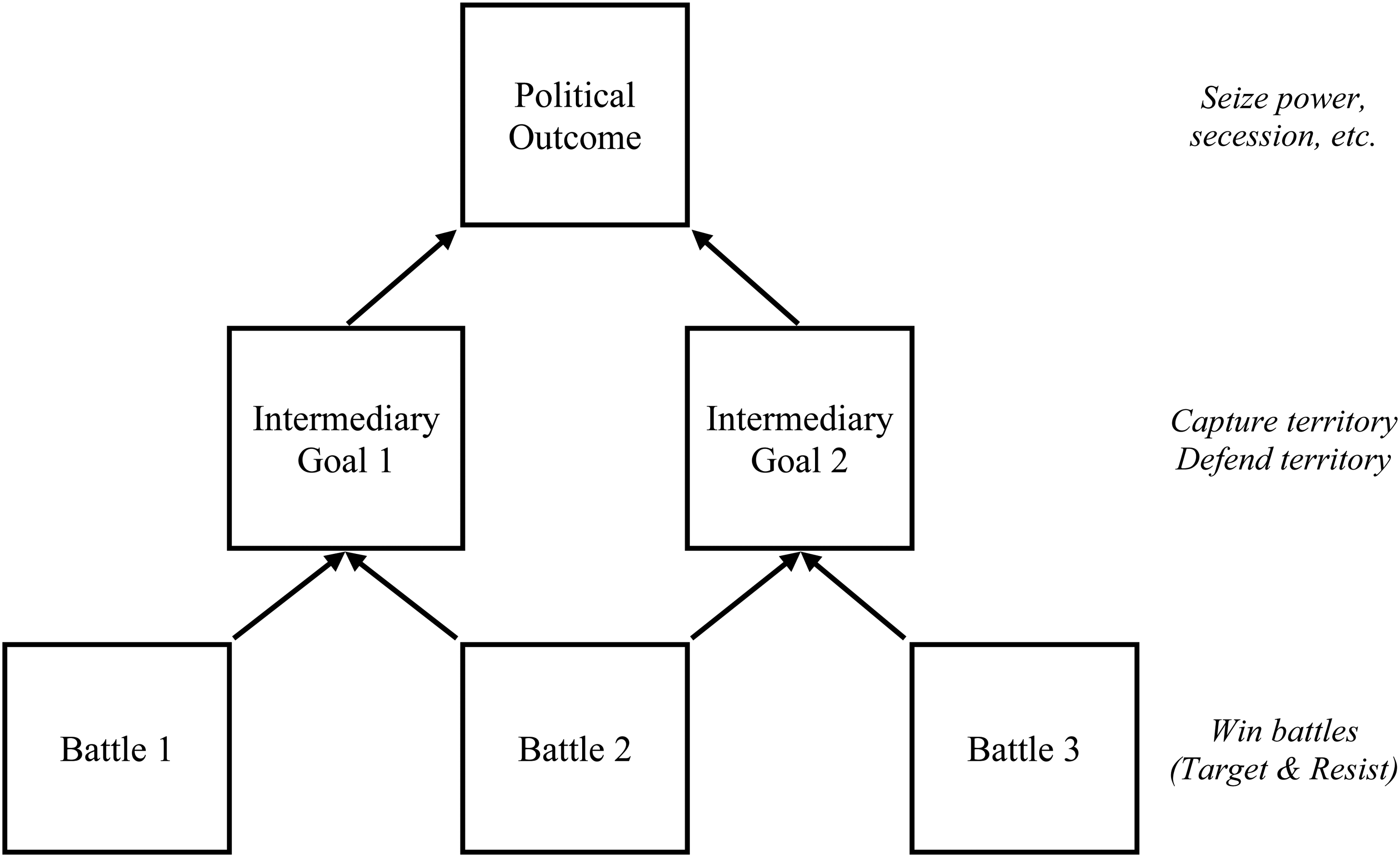
Battles, intermediary goals, and political outcomes.
As summarized in Figure 2, I argue that intervener airpower can contribute to changes in territorial control along two distinct pathways. Firstly, airstrikes can have a short-term effect where they immediately weaken the targeted actor's forces at crucial points on the battlefield, making it less able to resist and target its adversary. During conventional fighting, the “guiding principle is to deploy the maximum amount of force at a decisive point” (Lockyer, 2010: 93). In order to maximize its ability to apply force, an actor must concentrate its forces (Butler and Gates, 2009: 333; Biddle, 2021). Newton and Tucker (2022: 22) argue that airstrikes can have a short-term, localized effect on conflict dynamics. Based on insights from interstate conflicts, airpower can be used to achieve such short-term effects through direct attack—or close air support—that entails the use of airstrikes against troops and equipment at decisive points on a battlefield. In conventional conflicts, direct attack can be used selectively to “create holes or to stop initial penetrations in a front,” or non-selectively in preparation for both offensive and defensive action (Pape, 1996: 78; Martinez Machain, 2015: 544). As such, when targets are hit by airstrikes in a specific location, this immediately reduces the targeted actor's ability to apply maximum force in that area. This makes it less able to either overcome the adversary's defensive positions, or stop the adversary's attacking forces from overcoming its own defenses. In the short-term, airstrikes can thus blunt an ongoing attack or destroy a crucial point of defense, reducing an actor's ability to defend and capture territory:
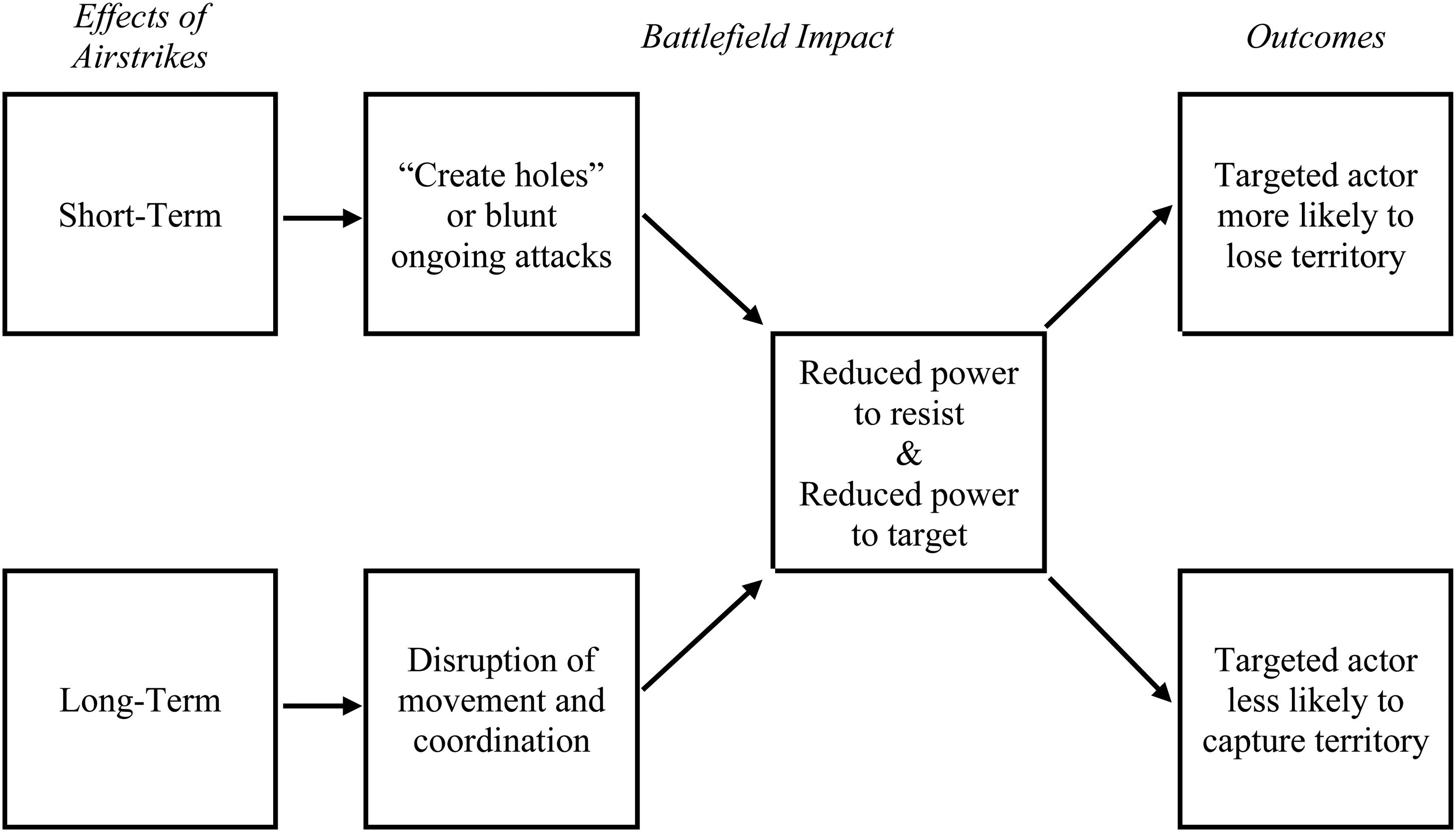
Summary of pathways.
Second, intervener airpower can have a long-term effect on an actor by disrupting and wearing down its forces through repeated strikes, diminishing its power to resist and target its adversary. As in interstate conflicts, conventional force employment in civil war requires actors to maintain relatively sizeable fighting units (Butler and Gates, 2009; Lockyer, 2010). These units must also be moved and concentrated in the most crucial contested areas, emphasizing the need to advance into areas held by the adversary (Lockyer, 2010: 101). As argued by Newton and Tucker (2022: 22), airstrikes can also have a long-term, cumulative effect on a civil war actor's war effort. Even though airstrikes have a short-term impact, repeated targeting of a contested area should have an additional cumulative effect that inhibits an actor from effectively assembling and moving sufficiently large forces. Existing knowledge from interstate conflicts suggest that interdiction can destroy logistics and support networks, disrupting the movement and coordination of forces throughout a theater (Pape, 1996: 77). This includes selective targeting of communications, important infrastructure, and sources of troops and materiel to create temporary windows of opportunity. When used non-selectively, interdiction targets combat troops and causes the attrition of troops and materiel in transit, as well as destroying vehicles transporting troops and supplies (Martinez Machain, 2015: 544).
2
As argued by Pape (1996: 77), interdiction disrupts not only the rapid and timely movement of forces needed when concentrating for an attack, but also the flexibility required to gather enough assets for successful defense. Being continuously targeted over a period of time will thus have a negative effect on the targeted actor's ability to effectively assemble, coordinate, and resupply sizeable forces in a contested area. Even though conventional civil wars may lack the scale and logistical complexity necessary for a full-scale interdiction campaign, airstrikes can thus have an additional long-term effect that make the targeted actor less likely to capture and defend territory:
Case selection and research design
In order to test the hypotheses laid out above, I conduct a quantitative within-case study of the 2011 civil war in Libya, and the NATO-led Operation Unified Protector. Unlike most other cases used to assess the micro-level dynamics of airpower, the 2011 Libyan Civil War was fought in a largely conventional way, characterized by a series of relatively cohesive offensives and counter-offensives along the Libyan coast (Balcells and Kalyvas, 2014: 1391; Chivvis, 2015). The Libyan government forces—particularly its “elite” paramilitary brigades—employed conventional means and tactics, and made frequent use of infantry, tanks, armored vehicles, and massed barrel and rocket artillery against the rebels. As the resistance against the government coalesced, the rebels adopted similar tactics (Bell and Witter, 2011a). While the government forces adopted some non-conventional tactics, accounts from NTC members testify that massed firepower and concentrations of heavy weapons were used against them late into the conflict (Wehrey, 2015: 58, 66). As such, the Libyan case is suitable for testing the hypotheses laid out above.
Even though the 2011 intervention Libya has not previously been subjected to systematic, within-case study, there are a substantial number of analyses that cover NATO's conduct of the air campaign from organizational, political, and military perspectives (Daalder and Stavridis, 2012; Gaub, 2013; Greenleaf, 2013; Mueller, 2015a). While the main mandate of the air campaign was protection of civilians and the establishment of a no-fly zone, NATO airpower was instrumental not only in preventing NTC defeat, but also in facilitating its eventual—and initially somewhat unexpected—victory over Gaddafi (Barry, 2011; Barrie, 2012; Wehrey, 2015, Mueller, 2015b: 376). Furthermore, Operation Unified Protector was not a “shock and awe” campaign intended to paralyze the Libyan government, but an effort to “level the playing field” for the rebels, often through dynamic targeting on the battlefield (Greenleaf, 2013: 46; Chivvis, 2015: 29; Mueller, 2015b). NATO air support took the form of both close air support and interdiction (Wehrey, 2015). Even though the war was won by the NTC forces on the ground (Gaub, 2013; Mueller, 2015b), NATO made a substantive contribution to this outcome by striking important military targets, and through attrition of regime forces (Barry, 2011: 7; Chivvis, 2012: 82).
The existing assessments imply that the 2011 Libyan conflict and Operation Unified Protector constitute a viable pathway case from both an empirical and theoretical perspective. In short, pathway cases are suitable for testing hypothesis about causal mechanisms where cross-case analysis has already established a covariational pattern (Gerring, 2008). Firstly, since the overall assessment is that NATO helped the NTC topple Gaddafi's regime by striking its forces on the battlefield, the case displays the expected correlation between direct-conventional foreign intervention and rebel victory (cf. Jones, 2017). Furthermore, since the air campaign targeted Gaddafi's armed forces—and not counter-value targets—the case also exhibits the expected correlation between denial and political-level success (Pape, 1996; Horowitz and Reiter, 2001; Allen and Martinez Machain, 2019). Lastly, NATO's “extreme” strategic approach to rely predominantly on airpower implies that the case can provide insights regarding the viability of future aerial interventions (Mueller, 2015a: 6; 2015b: 373). Operation Allied Force is thus appropriate for exploring the specific ways in which airpower systematically affects the within-conflict dynamics of a conventional civil war.
Data
I utilize a novel time-series, cross-sectional dataset on the 2011 civil war in Libya, where each individual observation corresponds to a “district-day.” There is one observation for each of Libya's 22 districts (shabiyah), for each day from 15 February to 23 October 2011 (n = 5522). Data on the air campaign are coded from NATO's “Daily Briefs,” which are official open-access operational updates published daily for the duration of Operation Unified Protector. These briefs provide information about types and numbers of key targets hit by airstrikes each day, and an approximate geographical location of each strike. 3 For example, on 5 July, NATO struck two armored vehicles and four tanks in the vicinity of Gharyan, and one tank, one command and control center, and one artillery piece in the vicinity of Misrata. In the dataset, this corresponds to six targets hit in Jabal al Gharbi district, and three targets hit in Misrata district. The briefs are detailed enough to attribute airstrikes to a specific district-day, but since only key targets are reported, it may not provide full description of all coalition bombing activity. The NATO briefs have also been supplemented by operational updates from United States’, French, and British authorities, as well as media reports collected using a standardized search string in the online news archive Factiva. These sources were primarily used to supplement data in the initial phase of the intervention (19 March to 11 April). As shown in Figure 3, the geographical distribution of NATO's bombing activities was relatively uneven, focusing on the areas along Libya's coast.
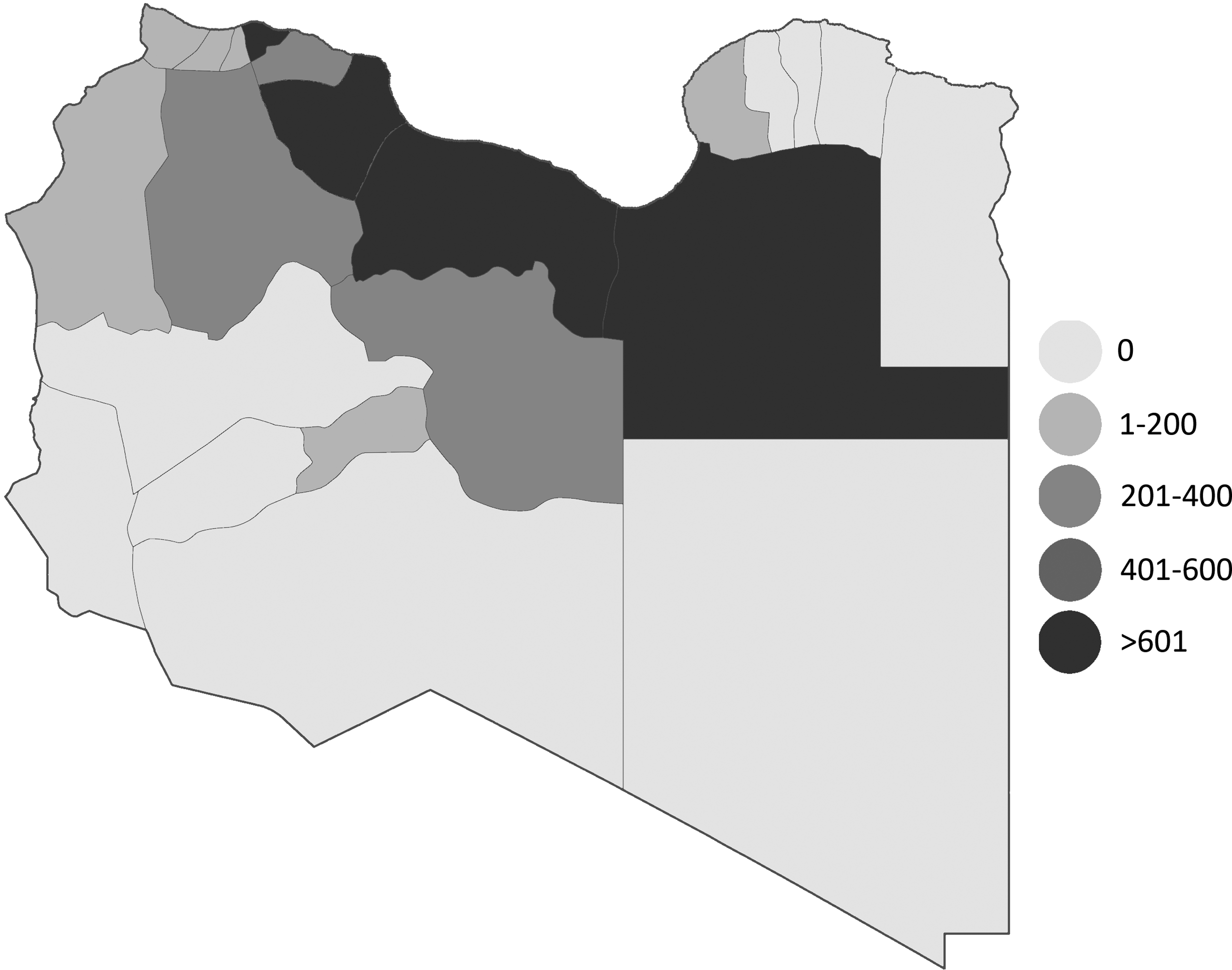
Total number of targets hit by district.
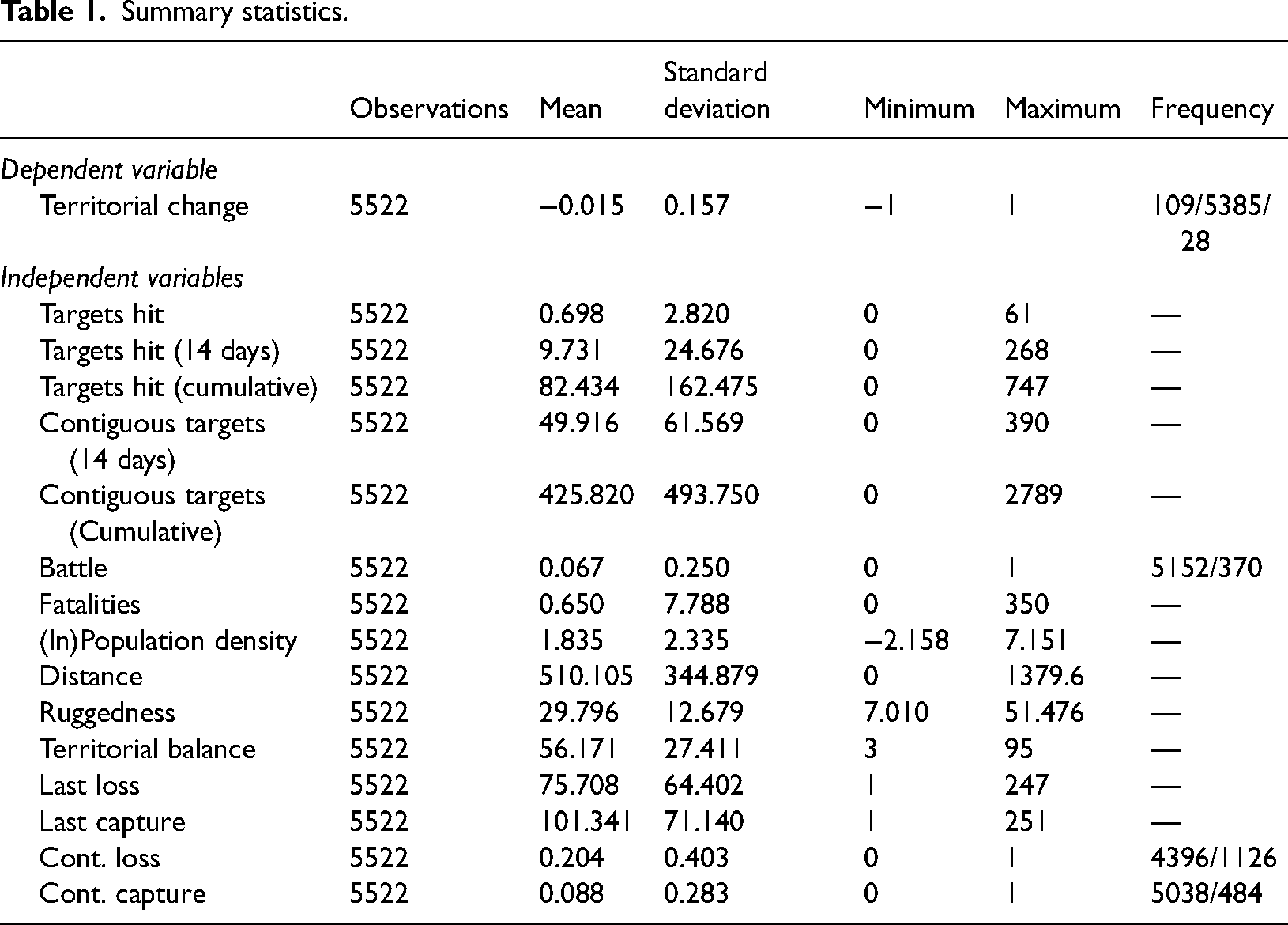
The dataset also contains information on change in territorial control at the district-day level, represented by the loss and capture of villages and towns by government forces. While towns and villages are not the only relevant territory civil war actors may fight over, they are usually well known to the belligerents and easily identified. The data were primarily coded from media reports using a standardized search string in Factiva, supplemented by various secondary sources such as the Africa Research Bulletin. As a general rule, self-reported territorial loss was accepted without independent verification. In contrast, the self-reported capture of territory required additional verification by a third party, other contextual information, or some secondary source. For example, the NTC repeatedly claimed to have captured the town Brega before the actual government withdrawal on 20 August. The government capturing a settlement also required confirmation that it had been previously lost to the NTC. The widely reported government recapture of Kufrah on 28 April was, for example, included after confirmation that it had been lost to the NTC in late February. The dataset does not cover the status of all inhabited settlements in Libya, but it identifies 95 individual villages and towns involved in 137 events of territorial change across 5522 district-days. As shown in Figure 4, the Libyan government's relative territorial control declined throughout the civil war; this is reflected in the government (re)capturing territory (28 events) being less common that it losing territory (109 events). While the frequency of territorial change was quite low at the district-day level, this still corresponds to roughly one instance of territorial change every two days, given that the conflict lasted 251 days (see Table 1 below).
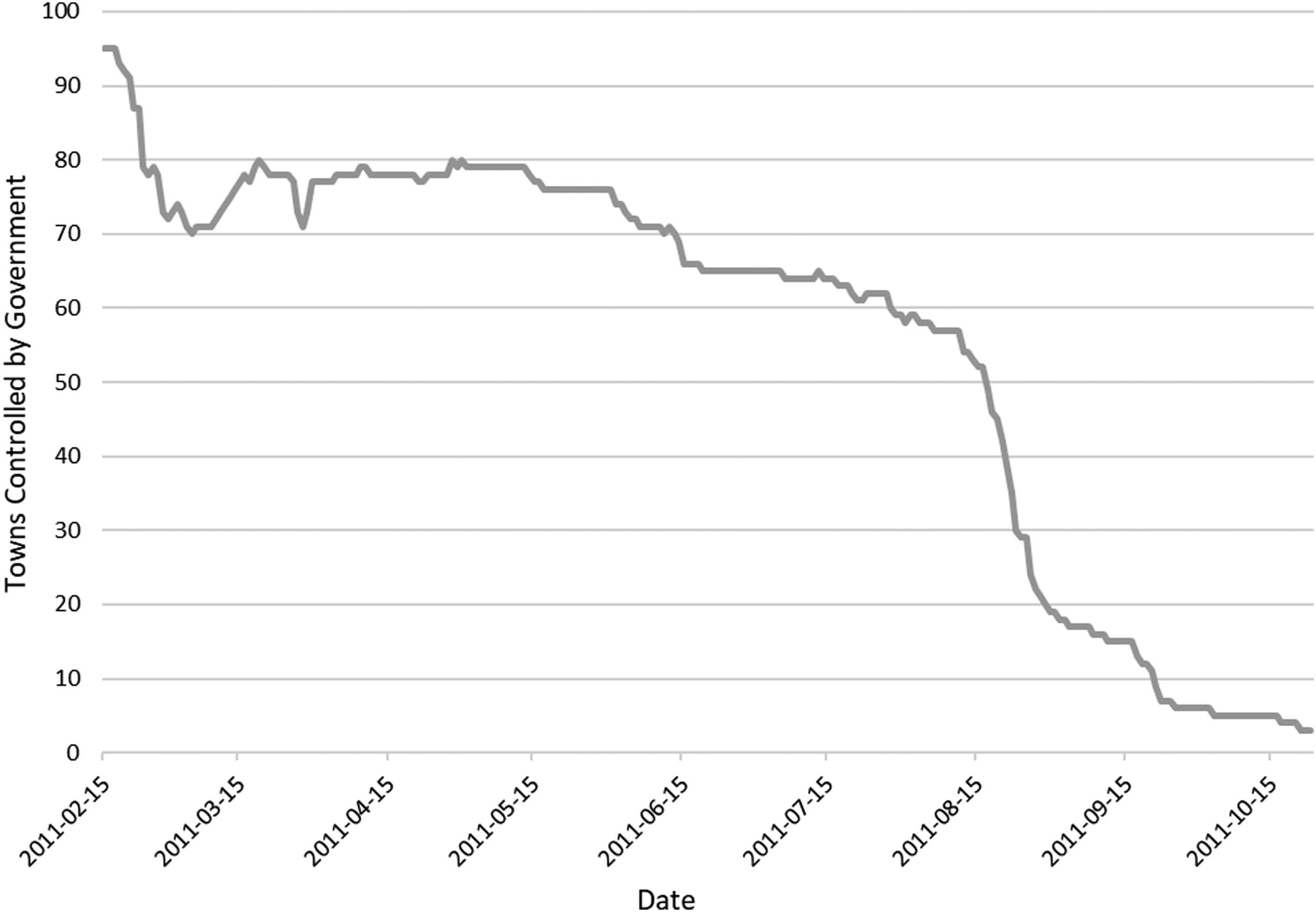
Relative number of towns and villages controlled by the Libyan government.
Summary statistics.
Dependent Variable
Territorial change. The dependent variable captures instances of territory changing hands between the Libyan government and the NTC rebels. The variable can take three different values: government lost territory (−1), no change in territorial control (0), or government captured territory (1) on any given district-day. The variable is coded “−1” if the regime lost one or more towns in a district on any given day, and “1” if the regime captured one or more towns in a district on any given day. If the regime neither lost nor captured territory, this variable is coded “0.”
Independent variables
Targets hit. In order to capture the short-term effect of coalition airstrikes, include a variable that measures the number of individual targets hit by airstrikes on any given district-day. A “target” represents, for example, a tank, artillery piece, communications node, or ammunition depot. It is important to note that this is based largely on information provided by NATO, and may therefore be subject to reporting inaccuracies. 4 Furthermore, a target being hit does not necessarily mean that it was destroyed. I therefore assume that a target hit by an airstrike will result in reduced combat effectiveness. I operationalize the long-term effect of the airstrikes through a variable that measures the cumulative number of targets hit in a district over the preceding 14 days. Even though the long-term effect is cumulative in character, it is necessary to consider that airstrike patterns fluctuate, giving the targeted actor a chance to recover after a period of intense targeting. The 14 day cutoff takes into account that equipment can be replaced over time, thereby accounting for a potentially transient component of the long-term effect. 5 However, since any temporal cutoff point is inherently arbitrary, I also include an alternative operationalization that measures the cumulative number of targets hit in each district for the entire duration of the conflict. Since the long-term effect of airstrikes may be affected the target's ability to move assets from adjacent areas to replace lost equipment, two variables measure the number of targets hit over the preceding 14 days and cumulatively in each districts’ contiguous districts.
Control variables
Battle. Occurrence of battle should not only precede change in territorial control, but also affect airstrike patterns if the purpose is to affect ongoing fighting (recall Pape, 1996; Smith, 2005; Herberg-Rothe, 2014). I account for this using a binary variable, which denotes whether (1) or not (0) there was fighting between the Libyan government and rebel forces during a district day. “Battle” constitutes any state-based event involving the government and the NTC in the Uppsala Conflict Data Program (UCDP) Georeferenced Event Dataset version 20.1 with at least one fatality (Sundberg and Melander, 2013), and all Armed Conflict Location and Event Data (ACLED) battle-events between government and opposition forces (Raleigh et al., 2010). I also include a measure of battle intensity, which is operationalized as the number of fatalities reported by UCDP Georeferenced Event Dataset, with missing values supplemented by data from ACLED.
Geographical factors. Geographical factors influence both the conduct of civil war, and the use of airpower (Biddle, 2004; Buhaug et al., 2009; Shaver et al., 2019). I therefore include variables that measure the logged population density in each district, as well as the mean terrain ruggedness of each district based data compiled by Shaver et al. (2019). I also measure the distance between each district capital and Tripoli; after the NTC capture of Tripoli on 26 August, the distance variable instead measures the distance between each district capital and Sirte, Gaddafi's major stronghold.
Relative power and battlefield diffusion. Since a core function of military intervention is to bolster the conventional capabilities of the supported actors (Sullivan and Karreth, 2015), interveners should scale down their support to conserve their resources as the supported actor gains the upper hand. Higher levels of relative strength should also spur further territorial gains. I account for this using the relative territorial balance between the primary actors, measured as the number of towns and villages—those contested during the civil war, 95 in total—controlled by government each day at the state level. Furthermore, while focusing on troop surrenders, Lehmann and Zhukov (2019) find that negative events can “cascade” through sequences of battles. This suggests that previous territorial change could beget further change. I account for such effects by including variables that measure the number of days since both the most recent government territorial loss and capture in each district. I also include two binary variables denoting whether or not the government captured or lost territory in contiguous districts during the preceding three days.
Analytical method
I utilize multinomial logistic regression to test the hypotheses laid out above. This is appropriate because changes in territorial control—from the targeted actor's perspective—constitute outcomes of different strategic processes. Losing territory arises from failed resistance, while capturing territory is the result of a successful targeting. 6 Furthermore, airstrikes are not conducted randomly. In Libya, airstrike patterns were affected by NTC requests for support and the coalition's rules of engagement, but also conditions on the ground such as geography. It is therefore possible that changing territorial control may have affected the airstrike patterns, rather than the other way around. 7 I address potential endogeneity in two main ways. First, I alleviate potential simultaneity problems by providing brief qualitative examples in order to corroborate any observed correlations between targets hit by air-strikes and changes in territorial control. This supplementary qualitative evidence is only used to illustrate the time order of events, and to mitigate concerns regarding reverse causality. Second, in order to mitigate potential issues caused by omitted variables, I have—as outlined above—included a set of theoretically relevant control variables that may have conditioned both airstrike patterns and changes in territorial control.
The 2011 Libyan civil war and operation unified protector
The 2011 civil war emerged from a surging protest movement against Libya's long-standing ruler Colonel Muammar Gaddafi. The protests in Libya was part of a wider popular uprising that had swept Middle East and North Africa during late 2010 and early 2011, and was motivated by a wide range of local and political grievances. As the unrest spread throughout the country, the Gaddafi regime employed increasingly violent means to quell the protests. By late February 2011, anti-regime protesters and local militias seized control over multiple towns and cities, including Benghazi, Zawiya, and Misrata. The Libyan government responded by initiating a major counteroffensive that included extensive use of heavy weapons, often with little regard for civilian harm. The various factions opposing Gaddafi—which included local and regional militias, and defected regime troops—nominally coalesced into an umbrella organization, the NTC. The various rebel factions continued to operate in mostly independent ways, but the NTC's overarching goal was to topple Gaddafi and install a new government. Despite efforts to organize the resistance against Gaddafi, the rebel forces were unable to hold back the government's offensives. By mid March, the NTC was on the verge of defeat in most parts of Libya, which triggered an international response. The United Nations Security Council passed Resolution 1973 on 17 March, mandating the use of force to protect civilians and establish a no-fly zone over Libya. On 19 March, a NATO-led coalition initiated an aerial intervention in accordance with this resolution, which later became Operation Unified Protector. 8 Following months of intense ground combat and NATO airstrikes, the NTC gradually pushed back the regime's forces and achieved victory on 23 October, following the killing of Gaddafi and the capture of his hometown Sirte.
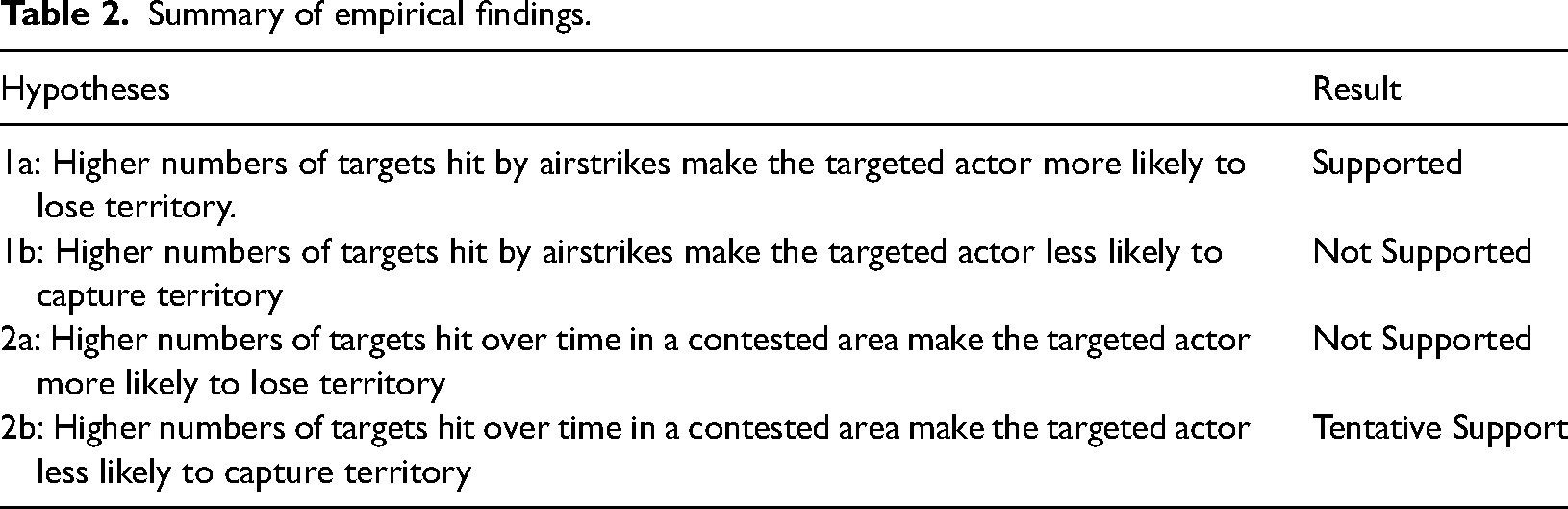
As summarized in Table 2, the following empirical analysis suggests two plausible ways through which Operation Unified Protector contributed to the Libyan government losing, and failing to capture, territory. First, NATO airstrikes had a short-term effect, where higher numbers of targets hit by airstrikes on any given day increased the likelihood of the Libyan government losing territory to the rebels in a district. Second, there is tentative evidence of a long-term effect, as the government was less likely to capture territory in districts with higher numbers of targets hit over time. The air campaign thus had a short-term effect on the government's ability to resist the rebels, and a long-term effect on its power to target the rebels. In contrast, I find no short-term effect on its power to target, or long-term effect on its power to resist, the NTC.
Summary of empirical findings.
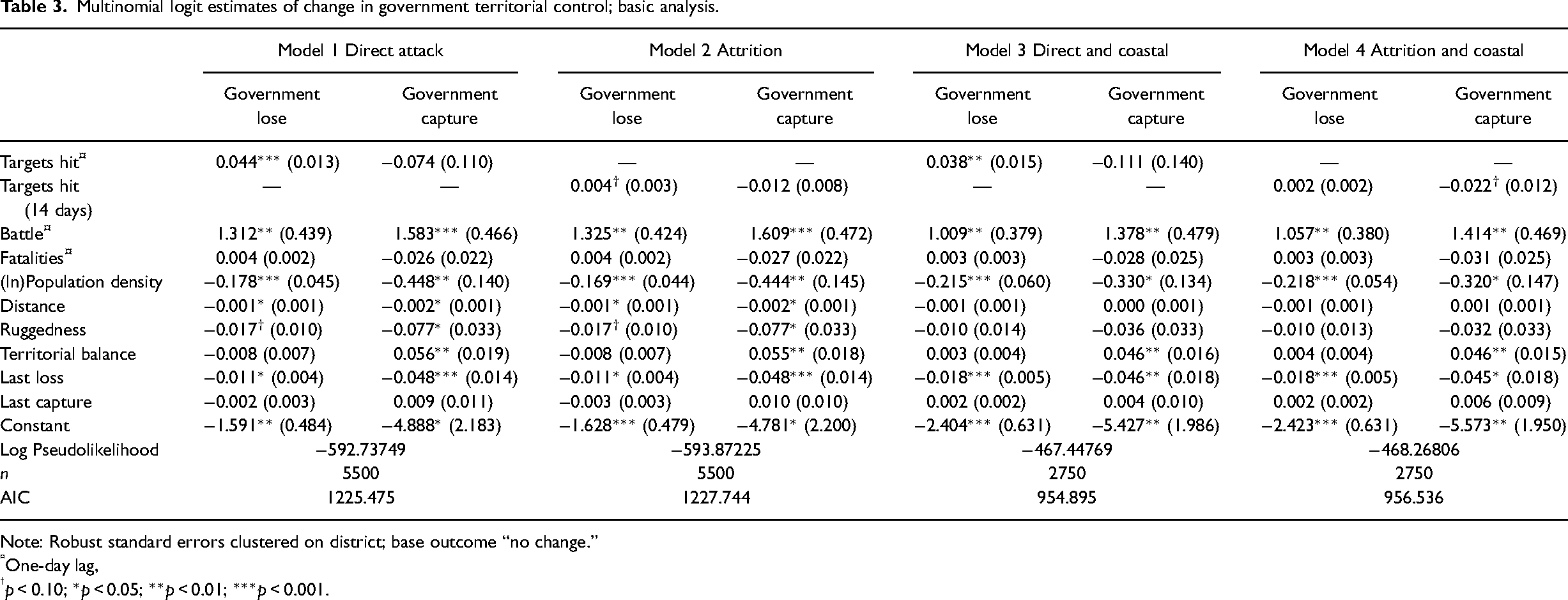
The initial analysis explores the effects of the air campaign without accounting for airstrikes and territorial change in contiguous districts (see Table 3). I turn first to Hypotheses 1a and 1b, which stipulate that airstrikes have a short-term effect on the targeted actor's likelihood of losing and capturing territory. As shown in Model 1, the number of targets hit had a significant, positive short-term effect on the Libyan government's likelihood of losing territory to the NTC. However, it is not possible to discern any effect of targets hit on the government's ability to capture territory. Even though most parts of Libya were in some way touched by the 2011 war, its northern coastal districts were the focal point of the fighting. Wehrey (2015: 44, 48) concludes that there were “three critical fronts: the east, Misrata, and the Nafusa Mountains,” covering an area in northern Libya from Benghazi to the Tunisian border. In order to account for these geographical variations, I employ a spatial sub-sample that includes only the three critical fronts identified by Wehrey (2015). 9 As shown in Model 3, the short-term effect of targets hit on the government's likelihood of losing territory remains significant, but it still has no discernable effect on the government's ability to capture territory. The initial analysis thus suggests that coalition airstrikes reduced the government's power to resist the rebel forces in the short term, which is supported by situational account of the fighting. For example, a rebel offensive along the Gulf of Sidrah successfully advanced through areas where substantive amounts of government heavy equipment had been recently destroyed by coalition airstrikes (Bell and Witter, 2011b: 13–14). In another illustrative example from Western Libya, Misratan militias would advance against government positions—such as during the attack on Dafniyah—after preparatory strikes by both NATO attack helicopters and attack aircraft (Wehrey, 2015: 64, 66).
Multinomial logit estimates of change in government territorial control; basic analysis.
Note: Robust standard errors clustered on district; base outcome “no change.”
One-day lag,
p < 0.10; *p < 0.05; **p < 0.01; ***p < 0.001.
According to Hypotheses 2a and 2b, a higher number of targets hit over time should make the targeted actor more likely to lose territory, and less likely to capture territory. Model 2 shows that more targets hit over the preceding 14 days had a positive effect on the likelihood of the government losing territory that falls just short of being significant (p < 0.10), but no effect on its likelihood of capturing territory. In contrast, restricting the geographical sample instead shows a long-term effect of the air campaign on the government's likelihood of capturing territory that narrowly fails to achieve statistical significance (p < 0.10, see Model 4). The initial analysis does not provide any conclusive insights regarding whether the air campaign had any long-term effects on the Libyan government's ability to take or hold territory.
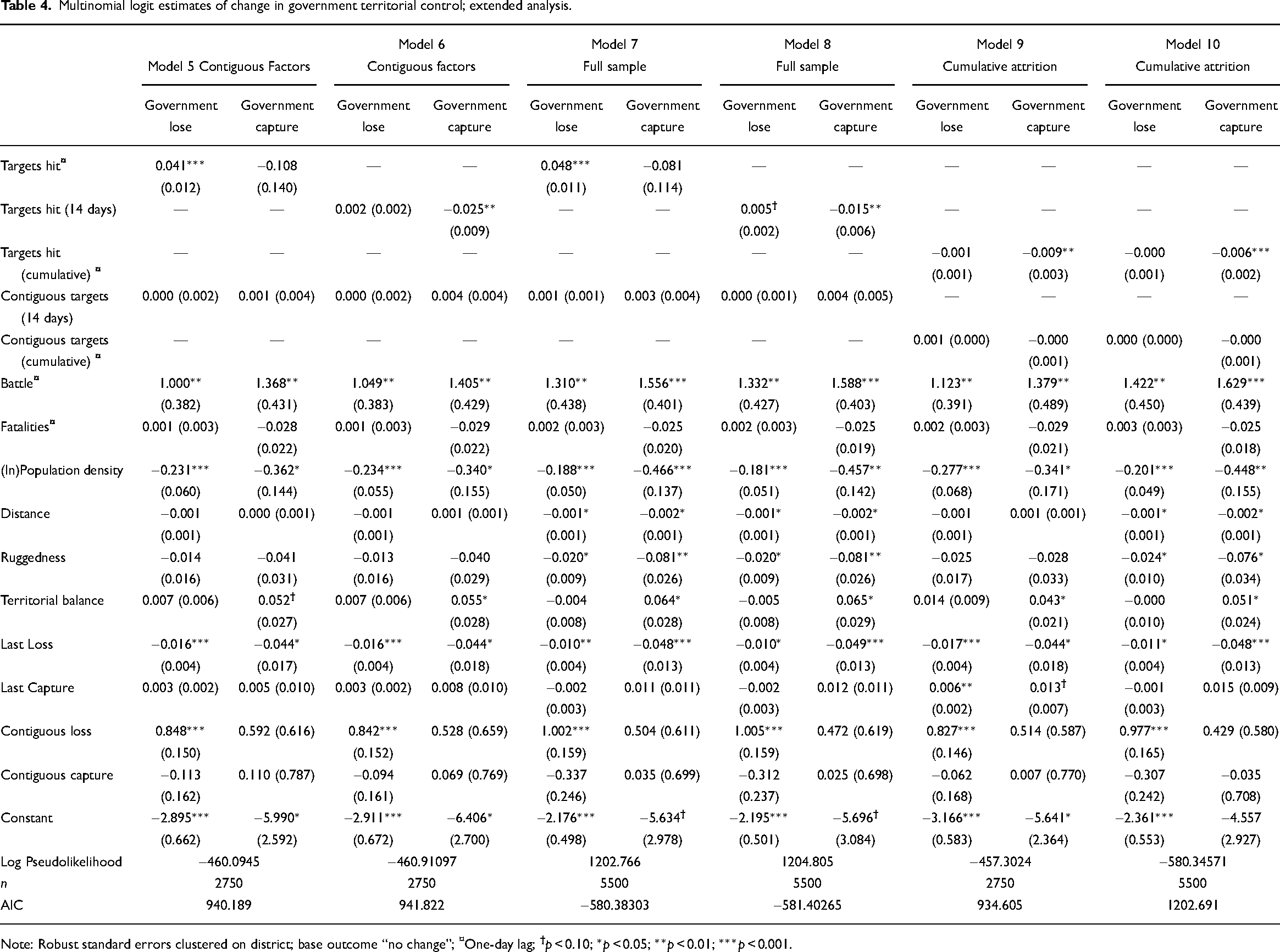
In Table 4, the results of an extended analysis that includes factors in contiguous districts are reported. The positive short-term effect of targets hit on the government's likelihood of losing territory remains significant when controlling for targets hit over time and territorial loss in neighboring districts (Model 5), and when the full model applied to the complete geographical sample (see Model 7). Again, this is consistent with multiple situational accounts of how airstrikes “[paved] the way for rebel victories” (Mueller, 2015b: 377; Wehrey, 2015: 52, 63). For example, in late March, the NTC overran Ajdabiyah “after a series of debilitating NATO airstrikes destroyed at least four [government] T-72 tanks and an artillery piece” (Bell and Witter, 2011b: 13). In contrast, despite having recently captured multiple towns in the Nafusa Mountains, lack of air support prevented the NTC from successfully conducting an offensive into the Coastal Plain west of Tripoli (Wehrey, 2015: 54). However, a later—successful—rebel push against Tripoli in this area was conducted concurrently with heavy NATO airstrikes (Chivvis, 2015: 39). This short-term effect also holds up for a number of robustness checks. For example, measuring the number of significant strikes 10 —rather than individual targets hit—does not alter the findings presented here (see Online Appendix). Coalition airstrikes thus made it more difficult for the Libyan government to resist rebel attack in the short term. Hypothesis 1a is thereby supported.
Multinomial logit estimates of change in government territorial control; extended analysis.
Note: Robust standard errors clustered on district; base outcome “no change”; ¤One-day lag;
In contrast, there was no systematic short-term effect of targets hit on the government's likelihood of capturing territory (see Models 5 and 7). While, for example, rebel fighters in Misrata were on at least one occasion able to hold their defenses because of timely coalition air strikes (see Wehrey, 2015: 52), there is no evidence of a systematic short-term effect on the government's power to target the rebels. Consequently, I can reject Hypothesis 1b. In Libya, the short-term effect of airstrikes thus primarily reduced the government's ability to hold on to towns and villages. Even in NTC's final push to take Sirte in October, NATO airstrikes were used to break regime positions “that the rebels were not able to overcome alone” (Mueller, 2015b: 377). As such, a higher frequency of coalition airstrikes made a substantive short-term contribution by undermining the government's power to resist the rebels.
Turning instead to a more detailed examination of Hypotheses 2a and 2b, there is no conclusive evidence that Gaddafi's forces were more likely to lose territory in areas with higher numbers of targets hit over time. When the geographical subsample is applied, there was no long-term effect on the government's likelihood of losing territory when controlling for contiguous factors (see Models 6). When using the full geographical sample in Model 8, higher numbers of targets hit over the past 14 days has a positive effect on the government's likelihood of losing territory that narrowly fails to achieve significance (p < 0.10). 11 In Model 9 and 10, I employ the alternative cumulative measure of targets hit in a district for the entire duration of the conflict, which does not have an effect on the government's likelihood of capturing territory. As such, Hypothesis 2a is not supported.
In line with Hypothesis 2b, the extended analysis shows that higher numbers of targets hit over the preceding 14 days had a negative effect on the government's ability to capture territory, when controlling for attrition and territorial loss in contiguous districts (see Model 6). This long-term effect remains significant when the full geographical sample is used (Model 8). Employing the alternative, cumulative measure of targets hit also shows this negative effect, irrespective of the geographical sample employed (Models 9 and 10). While Chivvis (2012: 82) conclude that attrition was a key contribution of NATO's air campaign in general, the results presented here suggest that the effect of sustained air attack was particularly detrimental to the Libyan government's ability to (re)capture territory. The government's “siege” against rebel-held Misrata in April and May exemplifies this effect. Wehrey (2015: 66–67) concludes that “airpower proved essential to limiting the effectiveness of loyalist artillery barrages, [and] preventing loyalist reinforcements from flowing into the city.” Furthermore, “airstrikes prevented the regime from massing the forces and heavy weaponry required for sustained and coordinated attacks,” which “sapped” the resources committed by the government to take Misrata (Bell and Witter, 2011b: 25). In contrast, a sweeping government counter-offensive against rebel forces in the eastern Cyrenaica region in late March was conducted through an area almost untouched by coalition airstrikes (Bell and Witter, 2011b: 14). In sum, continuous strikes against regime assets in contested areas reduced the government's ability to target the NTC and capture territory.
It is not surprising that this long-term effect is revealed by the extended analysis. Wearing down an actor also entails limiting its ability to replenish lost equipment, something made more difficult by concurrent airstrikes in adjacent areas. 12 Again, accounts from Misrata illustrates this. Wehrey (2015: 52), citing a NTC commander in Misrata, shows that NATO airstrikes prevented the influx of reinforcements from Zliten, Sirte, and Sebha, which are all located in other districts. In short, successfully preventing effective assembly, coordination, and resupply of forces in one area by striking many targets over time is contingent on preventing new resources being moved into that area. It should be noted that the long-term effect on the government's ability to recapture territory is somewhat sensitive to model specification. For example, substituting the number of targets hit for the number of significant strikes over the past 14 days does not yield any significant results irrespective of model specification. Measuring the number of targets hit over the preceding 21 or 28 days yields significant results, while a 7 day measure does not (see Online Appendix). The mixed findings on the long-term effects of coalition airstrikes is somewhat surprising, since the “attrition of regime forces, logistics, command and control and infrastructure by NATO attacks” has been described as the “principal factor” behind the rebel's victory (Barry, 2011: 7). Consequently, either the support provided by aerial attrition has been previously overstated, or the present analysis fails to fully capture this effect. As such, while Hypothesis 2b is supported, it should be seen as a tentative finding given the relative inconsistency of the effect.
As shown in Figure 5, the marginal effects underpin the assessment of Hypotheses 1a and 2b. The short-term effect of targets hit on the likelihood of the government losing territory remains distinguishable from zero—albeit with large confidence intervals for higher numbers of targets hit—while the substantive long-term effect on the likelihood of the government capturing territory is not significant for higher numbers of targets hit over the preceding 14 days. Using Model 5 as a baseline, increasing the short-term number of targets hit from the minimum zero to the maximum 61 increases the likelihood of the government losing territory from 1.8 to 18.9%, if the other variables in the model are held constant. Likewise, increasing the number of targets hit from zero to 10, 15, or 20 targets hit increases the likelihood to 2.8, 3.4, and 4.1% respectively. While the percentages are small in absolute terms, these marginal effects imply that a situation with the coalition hitting 15 targets would make the government almost twice as likely to lose territory to the NTC the following day, compared with a scenario with no targets hit.
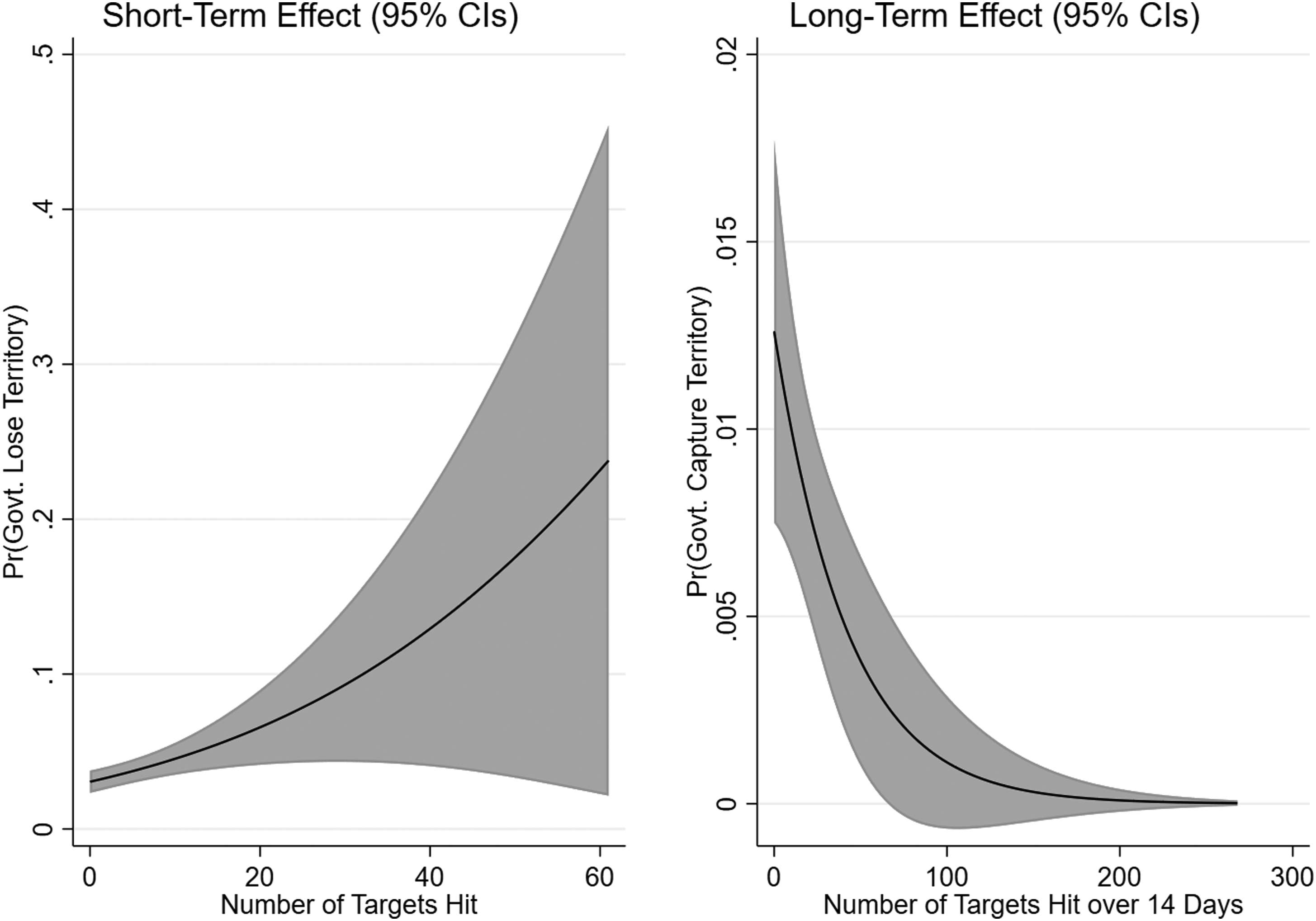
Marginal effects; short- and long-term impact of targets hit.
Existing research has also shown that denial strategies are most effective when successfully coordinated with attacking or defending ground forces (Pape, 1996; Martinez Machain, 2015). While the statistical results are not reported here, I am unable to find any significant interaction effects between the short- and long-term measures of targets hit, and battles between the Libyan government and the NTC (see Online Appendix). This lack of a synergistic effect could be explained by the often insufficient coordination between NATO and the NTC (Chivvis, 2012: 74; Wehrey, 2015). However, it is also possible that successful interaction is contingent on more intangible factors than the presence of battle, such as rebel tactical skill.
To summarize, higher numbers of targets hit by NATO airstrikes made the Libyan government more likely to lose territory, but did not affect its likelihood of recapturing territory, in the short term. In contrast, higher numbers of targets hit over time did not have an effect on the government's defensive efforts, but Gaddafi's forces were less likely to (re)capture territory in areas continuously targeted by airstrikes. This long-term effect was observable also when employing a cumulative measure of the number of targets hit. Existing “lessons learned” from Libya suggest that NATO airpower contributed to reducing both the government's offensive power, and its ability defend itself against NTC attacks, eventually contributing to rebel victory (recall Daalder and Stavridis, 2012; Chivvis, 2012; Mueller, 2015b). Even though it was the NTC that won the war on the ground (Gaub, 2013; Mueller, 2015b), the present analysis corroborates NATO's contribution by showing that airstrikes correlated with the Gaddafi regime's inability to reach important intermediary goals—seizing and holding territory—that would have facilitated its retention of government power. The present analysis suggests two plausible pathways through which this was achieved, where the effect of NATO airpower on the government's power to target was mainly longer term, and the effect on its power to resist the NTC was mainly short term in character.
NATO airpower in Libya thus broadly performed in expected ways based on knowledge from interstate conflict. Pape (1996: 77–78) notes that close air support is more effective when fighting is static, and that interdiction is more effective during fluid fighting. While the present findings are not directly analogous to this static–fluid divide, it is nevertheless interesting that coalition airstrikes had a short-term effect on the Libyan government's defensive—presumably more static—operations, and that higher numbers of targets hit over time inhibited its offensive operations, which probably entail more mobile action. The results presented here thus show that existing understanding of how airpower can affect conventional fighting derived from interstate conflicts to an extent applies to civil war contexts. Furthermore, the findings presented here reaffirm Newton and Tucker’s (2022) argument that we should distinguish between the short- and long-term within-conflict effects of airpower.
It is necessary to consider both the inherent limitations, and potential generalizability, of the results presented here. Primarily, it is not possible to rule out a short-term effect on the government's power to target the rebels, or a long-term effect on its power to resist, as such contributions may have hinged on non-systematic effects and factors that are difficult to capture with the methods employed here. For example, the destruction of a large government armored force outside Benghazi—a crucial target of the government's counteroffensive—on 19–20 March is believed to have prevented a complete rebel collapse (Barrie, 2012: 57; Chivvis, 2012: 72; Mueller, 2015b). These kinds of pivotal battlefield events are important, but challenging to capture through systematic analysis. Furthermore, the conditions in Libya strongly favored successful NATO military action. Several observers conclude that Gaddafi's forces were weak and ill-equipped to handle modern air attack, and that the terrain in northern Libya was conductive to a successful bombing campaign (Barry, 2011; Mueller 2015b: 375, 289–290). While the Libyan government troops were able to somewhat alter their tactics to cope with the coalition airstrikes (cf. Barry, 2011; Wehrey, 2015), a militarily more adept actor may be less vulnerable to systematic air attack. Lastly, while intervener airpower can contribute to changes in territorial control in contexts where such objectives are pursued, it is important to point out that territorial control can be relatively unimportant in other civil war contexts.
Nevertheless, an airpower-dependent intervention can diminish the ability of a government to effectively fight a rebel organization using conventional means, particularly if it relies on heavy weapons and massed firepower. As mentioned above, both state and non-state actors make extensive use of conventional means and tactics during intrastate conflicts (recall Kalyvas and Balcells, 2010; Biddle, 2021). Intervener airpower should therefore be able to reduce the combat effectiveness of non-state actors as well, as long as they utilize the heavy weaponry and tactics associated with conventional force employment. Relevant recent examples could include the Islamic State in Syria and Iraq at the height of its power, major Syrian rebel factions, and the “Libyan Arab Army”. In more general terms, my findings provide a set of pathways through which the use of aerial force systematically affects the within-conflict dynamics of a conventionally fought civil conflict, providing a plausible assessment of how it can contribute to various political-level outcomes (recall Allen and Martinez Machain, 2019). Furthermore, Mueller (2015a) argues that Unified Protector could constitute a model for future aerial interventions, given its almost exclusive focus on the use of airpower. By analyzing the 2011 intervention in Libya, I not only complement existing micro-level of studies that have mainly studied irregular conflict contexts, but I also provide additional insights that may inform on the viability of airpower as a mean of intervention.
Conclusion
In this paper, I have combined insights from the broader study of military interventions, and macro- and micro-level studies of airpower to improve our understanding of how intervener airpower affects civil war parties’ ability to take and hold territory. The 2011 NATO intervention in Libya has undergone considerable scrutiny, and by introducing a novel disaggregated dataset, I have been able to provide a systematic within-case analysis of how foreign aerial force contributed to the rebels’ victory against Muammar Gaddafi. I find that NATO airstrikes had a short-term effect, making the Libyan government more likely to lose territory to the NTC rebels. Furthermore, I find tentative evidence that Gaddafi's forces were less likely to capture territory in areas where higher numbers of target had been hit by airstrikes over time, which suggests a distinct long-term effect. Recent efforts have been directed toward understanding the micro-level dynamics of air campaigns against various non-state actors in irregular conflict contexts, but this paper has focused on how aerial intervention may affect an actor fighting in a more conventional manner. The 2011 intervention in Libya thus tells us that modern airpower can help a nascent rebellion to strike back against a government army relying on conventional weapons and tactics, especially if it can operate with impunity in an essentially uncontested airspace. Simply put, denial can achieve what it is designed to achieve, which is the destruction and disruption of a relatively cohesive fighting force. However, just because airpower constitutes a comparatively cheap and available means to a prospective intervener, it may not always work. We should therefore carefully assess whether its primary strengths are useful in specific conflict contexts, particularly whether it can realistically disrupt an actor's ability to reach those intermediary goals that will facilitate its political objectives.
Supplemental Material
sj-docx-1-cmp-10.1177_07388942231173613 - Supplemental material for Airpower and territorial control: Unpacking the NATO intervention in Libya
Supplemental material, sj-docx-1-cmp-10.1177_07388942231173613 for Airpower and territorial control: Unpacking the NATO intervention in Libya by Emil Petersson in Conflict Management and Peace Science
Supplemental Material
sj-docx-2-cmp-10.1177_07388942231173613 - Supplemental material for Airpower and territorial control: Unpacking the NATO intervention in Libya
Supplemental material, sj-docx-2-cmp-10.1177_07388942231173613 for Airpower and territorial control: Unpacking the NATO intervention in Libya by Emil Petersson in Conflict Management and Peace Science
Supplemental Material
sj-do-3-cmp-10.1177_07388942231173613 - Supplemental material for Airpower and territorial control: Unpacking the NATO intervention in Libya
Supplemental material, sj-do-3-cmp-10.1177_07388942231173613 for Airpower and territorial control: Unpacking the NATO intervention in Libya by Emil Petersson in Conflict Management and Peace Science
Supplemental Material
sj-dta-4-cmp-10.1177_07388942231173613 - Supplemental material for Airpower and territorial control: Unpacking the NATO intervention in Libya
Supplemental material, sj-dta-4-cmp-10.1177_07388942231173613 for Airpower and territorial control: Unpacking the NATO intervention in Libya by Emil Petersson in Conflict Management and Peace Science
Footnotes
Author's note
A previous version of this paper was presented at the biennial Peace Research in Sweden (PRIS) conference, Uppsala University/Zoom, 15–16 October 2020.
Declaration of conflicting interests
The author declared no potential conflicts of interest with respect to the research, authorship, and/or publication of this article.
Funding
The author received no financial support for the research, authorship, and/or publication of this article.

Supplemental material
Supplemental material for this article is available online.
Notes
References
Supplementary Material
Please find the following supplemental material available below.
For Open Access articles published under a Creative Commons License, all supplemental material carries the same license as the article it is associated with.
For non-Open Access articles published, all supplemental material carries a non-exclusive license, and permission requests for re-use of supplemental material or any part of supplemental material shall be sent directly to the copyright owner as specified in the copyright notice associated with the article.
