




Abstract
Since 2001, there has been a dramatic increase in the amount of US military aid flowing to foreign governments. What is the impact of this aid on human security? Drawing on recent research on the principal–agent relationship between state leaders and security sector actors, I develop a theory of the impact of security assistance on the use of deadly force against civilians. Using methods to account for the endogeneity of aid allocations, I find that the impact of security assistance on state violence varies based on the type of assistance provided and the institutional environment in the recipient state.
Over the past two decades, there has been a dramatic increase in the amount of US military aid flowing to foreign governments. According to data collected by the Security Assistance Monitor, spending on security assistance—US State and Defense Department programs to arm, equip, train, organize, finance, advise, educate, and/or assist the security forces and security sector institutions of a foreign country—increased by more than 300% between 2001 and 2011, from US$5.7 billion annually to over US$24 billion. 1 Between 2002 and 2019, US$300 billion in US security assistance flowed to foreign governments and at least one million foreign nationals received US military training. 2
The United States uses security assistance to advance a variety of foreign policy goals, including improving the ability of foreign militaries to conduct joint operations with American forces, securing access in strategically important regions, and deterring strategic rivals. After the terrorist attacks of 9/11, a core objective of most new funding for security assistance to low- and middle-income countries became countering the spread of terrorism while avoiding the costs and risks of engaging American troops in ground combat. Section 1206 Train and Equip Authority, Coalition Support Funds, the Counterterrorism Partnerships Fund, and related programs under Department of Defense authority proliferated as the US attempted to bolster the capabilities of security forces in fragile states (Isacson and Kinosian, 2017). In East Africa, for example, Kenya became one of the largest recipients of US military training, weapons, and equipment because of its strategic location in the Horn of Africa and its willingness to fight al-Shabaab in Somalia. The presence of Islamic opposition groups made the Philippines another frontline state in the global war on terror. Between 2015 and 2020, the Philippines received almost half a billion dollars in US security assistance and the US provided training for thousands of Filipino soldiers and police officers (Center for International Policy, 2021).
What is the impact of this aid on human security in recipient states? After taking office in 2016, Philippine President Rodrigo Duterte began employing the country's security forces in a brutal “war on drugs” that took the lives of thousands of civilians, primarily among the urban poor. In 2020, the International Criminal Court concluded there was a “reasonable basis to believe” that Filipino forces had committed crimes against humanity (O’Grady, 2020). Kenyan security forces were also frequently accused of engaging in torture, extrajudicial killings, mass arrests, and forced disappearances—particularly targeting Muslim and Somali communities (Human Rights Watch, 2016; Kirechu, 2016; Ali and Mirodan, 2015). A 2017 Amnesty International report documents at least 122 civilians tortured and executed by Kenyan security forces in that year alone (Burchard and Burgess, 2018).
Are egregious human rights violations by US-trained and equipped security forces the norm, or are these examples outliers? Does American military aid increase the risk of civilian harm? Or, as some recent studies suggest, can US military engagement with foreign security forces promote improved respect for human rights? Until very recently, there have been few systematic attempts to evaluate the effects of security sector assistance. Those studies that do exist draw contradictory conclusions about the impacts of military aid, some providing evidence that arms transfers, military aid, or military training have detrimental impacts on the security of civilians in recipient states (Blanton, 1999; McCoy, 2005; Sandholtz, 2016; Sullivan et al., 2020), while others find that security assistance actually reduces state-sponsored human rights violations (Jadoon, 2018; Darden, 2019).
The results of this study suggest that the impact of security assistance on state violence against civilians varies based on the type of assistance provided and the institutional environment in the recipient state. There is strong evidence that “lethal” aid—military equipment, weapons, military training, and combat assistance—increases extrajudicial killings by security forces in states without effective institutions to constrain executive authority. In contrast, non-lethal security sector assistance—a broad category that includes professional military education for officers, defense institution-building, and disarmament initiatives—can mitigate the effects of lethal assistance so that, on average, total security assistance is unrelated to civilian harm. The exception is states in which the ruling regime has manipulated the structure of its security forces to ensure loyalty to the leadership. While, in the average state, non-lethal aid has a dampening effect on state violence and total security assistance has no effect, all types of security aid increase civilian targeting in states with fragmented internal security forces.
This study makes several contributions to the foreign aid and state repression literatures. To date, much of the research into the relationship between foreign security assistance and state repression has failed to incorporate advancements in our understanding of the drivers of state repression. Drawing on recent research on the principal–agent relationship between state leaders and security sector actors, I develop a theory of the impact of security assistance on the use of deadly force against civilians. I argue that foreign security assistance and, in particular, aid in the form of military materials, combat skills training, and direct assistance in combat, is likely to increase the incidence of civilian targeting by state security forces by providing (1) goods and services a leader can use to incentivize compliance with repressive orders, (2) increased capacity to forcibly respond to civilian threats to the regime, and (3) evidence that a foreign patron is invested in regime stability. By raising security agents’ expectation that the regime will survive to compensate them and shield them from sanctions, and providing the tools and skills to effectively repress dissent with force, foreign security assistance increases the likelihood that agents will comply with orders to use deadly force to counter opposition arising from the population.
To test this argument, I use newly available data on US security assistance and government documents to code US military aid amounts in distinct categories. While most studies have used aggregate military aid or arms transfers measures when evaluating the effects of security assistance, these measures fail to capture salient distinctions within the wide range of goods and services the United States provides under security assistance authorities. I then build a cross-sectional time-series dataset of low and middle-income countries from 2002 to 2019 to analyze the relationship between variations in the amount and type of aid provided to a state, recipient state institutions, and changes in the prevalence of state violence. Utilizing both fixed-effects regression and Heckman selection models, and controlling for a range of confounding factors, I find strong support for hypotheses predicting that the impact of security assistance varies with the lethality of the aid provided and the institutional environment in the recipient state.
Security cooperation and human rights: evidence from the academic literature
A large, diverse body of literature explores the effects of economic aid on a range of outcomes including economic growth, poverty, human rights conditions, and political violence. A much smaller number of studies attempt to isolate the impact of military aid. Table 1 summarizes results from eight studies that include quantitative analyses of the effects of security assistance on the human rights practices of government-affiliated forces. To my knowledge, these are the only large-N, cross-national studies of the relationship between security aid (including arms transfers) and state repression published in the academic literature over the past 30 years. The results are mixed, some studies finding evidence that arms transfers, military aid, or military training have detrimental impacts on the security of civilians in recipient states (Blanton, 1999; McCoy, 2005; Sandholtz, 2016; Sullivan et al., 2020), while others find security assistance reduces state-sponsored human rights violations (Jadoon, 2018; Darden, 2019). Two studies suggest that the effect of security cooperation is conditional on either the type of assistance (Omelicheva et al., 2017) or the strategic value of the recipient country (Bell et al., 2016).
Quantitative analyses of the effects of security assistance on human rights.
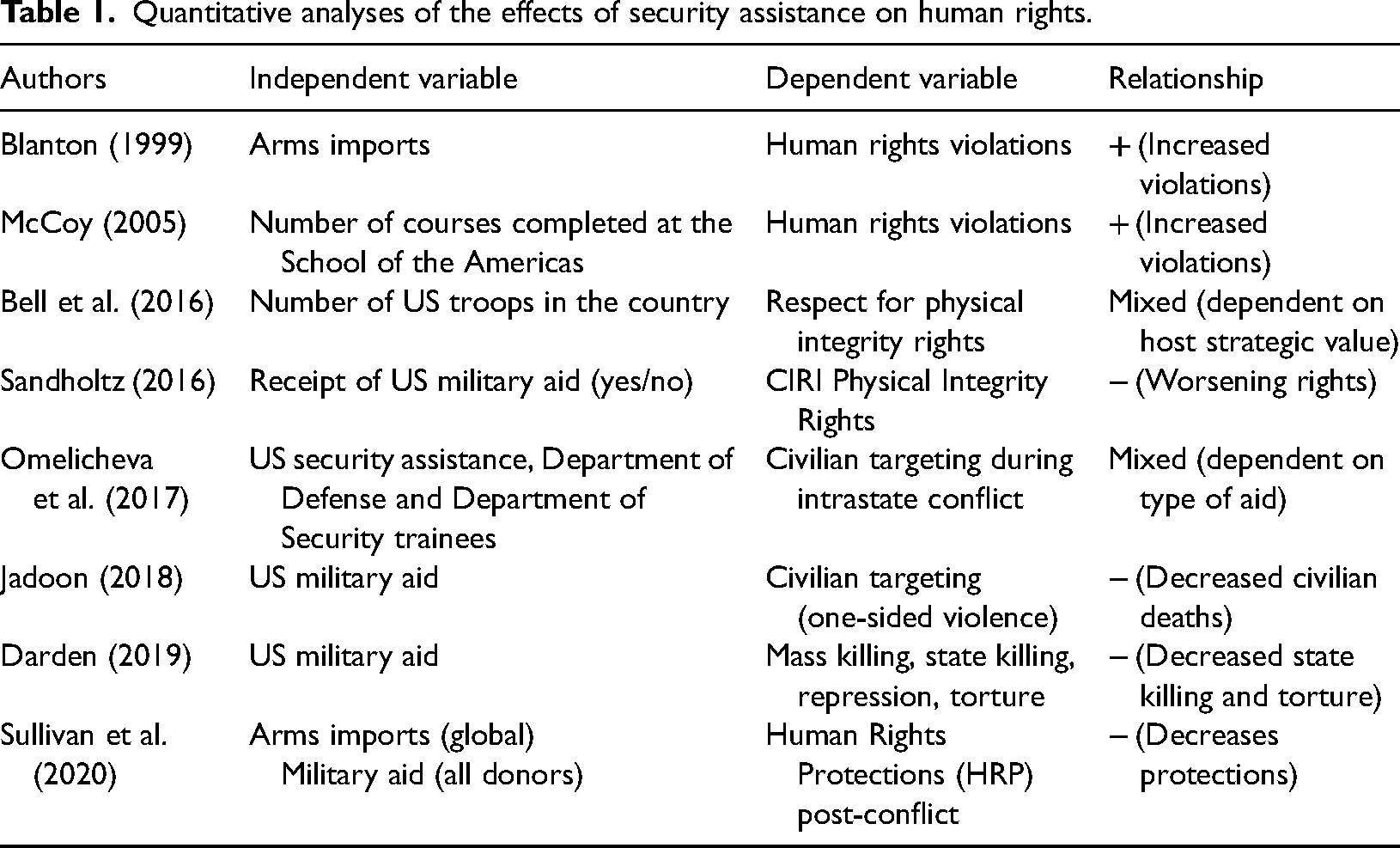
Because the type of security assistance under investigation, the dependent variable, and the spatial–temporal scope vary from study to study, it is difficult to form a summative judgment about the impact of military aid on civilian harm. Blanton (1999) finds a positive correlation between the volume of military equipment a state imports and personal integrity rights abuses in 91 developing countries during the Cold War. Arms transfers to post-conflict countries are also associated with human rights abuses in Sullivan et al. (2020). Focusing more specifically on security assistance provided by the United States, Sandholtz (2016) links receipt of US military aid to increases in physical integrity rights violations, while McCoy (2005) finds that recipients of military training at the School of the Americas in Fort Benning, Georgia were more likely to commit human rights abuses the more courses they completed.
In contrast, recent analyses by both Jadoon (2018) and Darden (2019) provide evidence that aggregate US military aid significantly reduces civilian targeting by state security forces. Bell et al. (2016) also find evidence of a negative relationship between state violence and US security assistance in their investigation of the effects of US troops stationed abroad in peacetime. Their analysis suggests that these troop deployments had no effect on respect for physical integrity rights during the Cold War. Post-Cold war, the number of US troops stationed in a country was associated with higher respect for physical integrity rights when US security interests in the host state were low. Troops stationed in states with high security salience for the US had no effect. Finally, Omelicheva et al. (2017) explore the effects of many different US security cooperation programs on atrocities against civilians by state security forces during intrastate conflicts. The results are complicated. The total amount of US military assistance is negatively correlated with civilian deaths, while the total number of personnel that receive US military training is positively correlated with civilian casualties. Some individual programs, like the International Military Education and Training program, appear to reduce civilian targeting, while others, including Foreign Military Sales and the Combating Terrorism Fellowship Program, are associated with increases in atrocities.
In addition to contradictory empirical evidence, there is little coherence in the theoretical arguments presented in the literature. While a number of scholars expect military aid and arms transfers to increase human rights violations by increasing state capacity for violent coercion (Blanton, 1999; Sullivan et al., 2020; Darden, 2019; Craft and Smaldone, 2002), others focus on how US security assistance and engagement with foreign forces can positively impact the human rights practices of foreign forces through socialization. Bell et al. (2016) and Omelicheva et al. (2017) argue that US military education and training promote respect for non-combatant immunity, the rule of law, and civilian authority over the military by exposing foreign troops to American values. Although they find that some types of US security aid increase civilian harm, Omelicheva et al. (2017: 142) conclude that “security assistance programs that feature military education, training, and exchange are effective at inducing positive human rights developments in states that are recipients of the US military aid by reducing civilian deaths by the hands of the military in times of political conflict”. Atkinson (2014) and Ruby and Gibler (2010) make similar arguments about norm transference through socialization in their investigations of the relationship between exposure to US military education and democratization. Both find evidence for a link between US professional military education and the spread of democratic values.
In general, research on the relationship between military aid and human rights conditions in recipient states is largely disconnected from the literature on state repression and, in particular, recent advances in our understanding of the processes driving the use of force against civilians. In the next two sections, I draw on recent developments in the state repression literature to develop a theory explaining how foreign security assistance could interact with the dynamics of civil–military relations to increase the incidence of state violence targeting civilians.
Theory: security assistance, security forces with agency, and state violence
While early scholarship on repression focused almost exclusively on the costs and benefits of employing repression for leaders, recent advances acknowledge the agency of the security sector—the military, police, and other security forces that must implement orders to forcibly repress dissent (Bell et al., 2021; DeMeritt, 2016). Assuming that leaders have incentives to call on the state's security forces to contain civilian mobilizations that threaten their hold on power, this literature asks when security forces are likely to comply with orders to use coercive force (Albrecht and Ohl, 2016; Poe, 2004; Tyson, 2018; DeMeritt, 2015; Dragu and Lupu, 2018; Frugé, 2019). This scholarship has advanced our understanding of state violence by incorporating what scholars of protest movements have long recognized: security agents sometimes shirk orders to use force against civilians (Stephan and Chenoweth, 2008; Pion-Berlin et al., 2014). As Geddes et al. (2018: 158) observe, “autocratic regimes fall to unarmed popular opposition when generals refuse to use troops to repress demonstrators”. In fact, according to Pion-Berlin and Trinkunas (2010: 395), in recent decades, “quartering—remaining confined to the barracks—and refusing to take sides” has been a “dominant strategy” for Latin American militaries ordered to suppress mass civilian uprisings.
Why do security forces shirk or defect when ordered to use force against the civilian population? At the individual level, soldiers may experience moral conflict about victimizing civilians (Manekin, 2017), or be constrained by fear that violations of norms and laws governing the treatment of non-combatants will be punished if there is a regime transition (Dragu and Lupu, 2018; Pion-Berlin et al., 2014; Pion-Berlin and Trinkunas, 2010). As DeMeritt (2015: 432) notes, security agents “become war criminals when they obey the order to kill civilians. If they expect to be punished as such, they are unlikely to obey”. While institutions of accountability such as independent judiciaries are typically weak in non-democratic states, agents of state violence can still face sanctions if the ruling regime is replaced. Targeting civilians can also harm the military's institutional interests, weakening cohesion, discipline and morale within the ranks, and undermining the military's legitimacy domestically and internationally (Anderson et al., 2002; Bellin, 2012). In their multinational study investigating why militaries disobey orders to suppress civilian uprisings, Pion-Berlin et al. (2014) find that military disobedience can stem from a host of factors, including a stronger affiliation with the public than with the governing regime, rejection of their role in internal public order, and even material grievances.
For leaders of non-democratic regimes, incentivizing compliance with orders to suppress challenges to the regime, and preventing defection during mass uprisings, is critical to survival (Geddes et al., 2018; Bellin, 2012; Albrecht and Ohl, 2016; McLauchlin, 2010). Several recent theories of the principal–agent relationship between leaders and state security forces converge on a set of conditions under which security agents will implement a repressive order from the ruling regime. First, security agents will be more likely to comply with orders to forcibly repress civilian challenges to the regime when the leader sufficiently compensates them for the costs of using force against civilians (Tyson, 2018). Second, whether or not security forces obey orders to repress popular dissent is dependent on what Dragu and Lupu (2018) call the “logic of expectations”. Security agents must believe that the incumbent leader will survive whatever challenges they face (McLauchlin, 2010). Otherwise, security agents will not be compensated and may instead face sanctions for targeting civilians (Tyson, 2018). Finally, expectations about regime stability are at least partially endogenous— the regime can only survive if the collective repressive effort is sufficient (Dragu and Lupu, 2018; Tyson, 2018). Security agents’ estimates of the probability that the incumbent will survive in office will be higher when they believe that state security forces have the capacity to repress popular threats to the regime, and trust that enough of their fellow agents are willing to comply with orders to use force to realize that capacity (Dragu and Lupu, 2018). 3
Foreign security assistance and state violence
Foreign security assistance can increase a leader's ability to satisfy all three of the conditions that make security agent compliance with orders to use repressive force more likely. To offset the costs of using force against civilians, leaders can use foreign security assistance to compensate security agents for complying with orders to violently repress civilian opposition to the regime. Foreign funds, weapons, military equipment, and training can all be used to buy the loyalty of military elites and reward security forces for repressing popular dissent. In Uganda, for example, US$2 billion a year in aid from the United States and other Western donors enables Uganda's president, Yoweri Museveni, to buy the loyalty of military generals with big budgets and high-tech military equipment (Bareebe, 2020; Khisa, 2020). Although a leader could use domestic tax revenue, other types of aid, or natural resource rents to compensate security agents, foreign security assistance has distinct advantages over these sources. In addition to their considerable tactical and strategic value to military units, advanced weapons systems, military planes, high-tech gear, and specialized training have exceptional value to military elites as symbols of prestige. The Nigerian military, for instance, has been eager to procure flashy, sophisticated A-29 Super Tucano aircraft and AH-1Z attack helicopters—even though they are likely to be of little utility in countering the extremist threats that plague the country (Matfess, 2017).
Compensation is necessary, but not sufficient, to induce compliance among security agents. As McLauchlin (2010: 334) observes, “an incentives strategy relies on a continuous, self-fulfilling prophecy by soldiers that the regime is likely to survive”. At the same time, Tyson (2018: 1303) demonstrates that an incumbent can use repression to stay in power only if “repression is severe enough that civilian groups can no longer facilitate regime change”. Here again, foreign security assistance can be useful. Military aid can increase the military's capacity to repress dissent—expanding the reach of a state's security forces as well as the intensity with which security forces can respond to social unrest (Sullivan et al., 2020; Peksen, 2012; Darden, 2019). By increasing the severity and scope of state repressive capacity, military aid can make it more difficult for civilian opposition groups to overcome collective action problems and mount an organized campaign sufficient to precipitate the collapse of the regime (Boutton, 2019; Ritter, 2014; Stravers and Kurd, 2020; Shadmehr, 2014). When security agents are more confident they have the capacity to defend the regime from popular threats, their expectation of regime survival, and willingness to comply with repressive orders, should also increase. Finally, in addition to the direct effect of security force capacity-building on the ability of security agents to suppress civilian dissent, providing substantial military aid to a regime signals the foreign patron's support for the survival of the regime (Tolstrup et al., 2019), further increasing confidence in regime survival among the state's security forces.
In sum, I argue that foreign military aid is likely to increase the incidence of civilian targeting by state security forces by providing (1) goods and services a leader can use to reward loyalty and incentivize compliance with repressive orders, (2) increased capacity to forcibly respond to civilian threats to the regime, and (3) evidence that a foreign patron is invested in regime stability. By raising security agents’ expectation that the regime will survive to compensate them and shield them from sanctions, and providing the tools and skills to effectively repress dissent with force, foreign security assistance should increase the likelihood that agents will comply with orders to use deadly force to counter opposition arising from the population. If this argument is correct, I expect to observe a positive correlation between the amount of foreign security assistance a state receives and extrajudicial killings by state security forces.
Moreover, “lethal” aid—weapons systems, ammunition, combat training, and combat assistance—should have a more significant effect on the use of force against civilians than “non-lethal” security aid. While any type of security assistance could signal a foreign patron's support for the ruling regime, lethal aid is a stronger signal that the foreign patron is committed to regime survival. In addition, American weapons, military equipment, and military training are likely to be particularly valuable as remuneration to military officers and security force units. Finally, material aid and combat training can directly increase the capacity of military and paramilitary units to forcibly repress civilian threats to the regime. 4 I therefore expect these types of security assistance to have a greater impact on state violence than non-lethal aid like demining operations, human rights and rule of law training, and other humanitarian and institution-building services provided through US security assistance authorities.
Next, I draw two conditional expectations from the theoretical argument: lethal aid will be less likely to fuel extrajudicial killings in states with more constrained executives, and more likely to increase state violence when host state security forces have been manipulated to ensure loyalty to the incumbent leader.
While even democratic regimes are known to engage in repression when confronted with domestic threats to social order and political control (Hill and Jones, 2014; Valentino, 2014), foreign security assistance is less likely to increase state violence when states have effective institutions to constrain executive authority. Institutional constraints like legislative oversight reduce the ability of incumbents to order state security forces to use force against civilians (Colaresi and Carey, 2008; Davenport, 2007). Legislative and judicial constraints on executive authority should also reduce a leader's ability to use foreign security assistance to buy the loyalty of security agents. At the same time, both leaders and security agents should have a greater fear of facing sanctions for extrajudicial killing when a state has independent courts and a legislature capable of exercising oversight over the executive branch and the military. As a result, although lethal aid would still increase the capacity of security forces to repress dissent, legislative and judicial checks and balances should prevent the use of this capacity against the population.
In contrast to its consequences in states with effective constraining institutions, foreign security assistance may be more likely to increase state violence when a leader has manipulated the structure of the state's security apparatus to ensure greater loyalty and compliance. Providing military elites and other security agents with selective benefits is one tactic leaders use to incentivize loyalty. Leaders can gain even greater control over their security forces by counterbalancing—creating overlapping and competing security institutions (Escribà-Folch et al., 2020; De Bruin, 2020a; Quinlivan, 1999; Horowitz, 1985). The prevalence of this strategy as a coup-proofing measure among non-democratic and transitioning regimes is well established in the literature and there are several reasons to expect foreign security assistance to have more harmful effects in states in which the ruling regime has manipulated the structure of its security forces to guard against coups.
First, the existence of a security apparatus manipulated in this way suggests a context in which civilian control over the military is not institutionalized and the ruling party has reason to fear that state security forces could pose a threat to the regime—whether by defection in the face of a popular uprising, shirking orders to repress challenges from the citizenry, or attempting a coup. In this context, foreign security assistance could be especially valuable to a leader's ability to buy loyalty and compensate security agents for compliance with orders to suppress challenges to the regime. An institutional environment in which the loyalty and subordination of state security forces is tenuous is also a setting in which security assistance that signals a foreign patron's support for the incumbent could be especially impactful on security agents’ expectation that the regime will survive to provide compensation and shield them from sanctions. In addition, when the state security apparatus has been manipulated so that there are multiple competing security forces with differing command structures, a leader can channel foreign security assistance to her most loyal security force units (Biddle, 2017; Savage and Caverley, 2017). Any given amount of security assistance can be a more substantial reward when targeted to presidential guards and other specialized units. At the same time, providing lethal aid to specialized, auxiliary, and elite units creates a higher risk of civilian harm because loyalty to a regime often means less fealty to the broader population and these units are frequently more willing to forcibly repress dissent than a state's regular army (Escribà-Folch et al., 2020; Kedo and Goodman, 2015; Biddle, 2017).
I therefore expect foreign security assistance, and lethal aid in particular, to be more likely to increase extrajudicial killing in recipients states with fragmented (counterbalanced) internal security forces.
Research design
Dataset
To test these hypotheses, I create a panel dataset of low- and middle-income countries from 2002 to 2019. The unit of analysis is the country-year. The dataset excludes high-income countries (those whose GDP per capita is above US$20,500 in 2010 constant US dollars), members of the NATO alliance, states that did not exist in 2002 (e.g. South Sudan), and countries with populations below 200,000. This leaves 123 countries observed annually between 2002 and 2019. Afghanistan and Iraq are excluded from the primary analyses because they are outliers in terms of the extraordinary amount of US aid provided and the sustained US military engagement in these countries throughout the period under investigation. Models including these countries, and models with additional control variables, are reported in the Online Appendix.
Key independent variables
My key independent variables measure the average amount of security assistance a country received from the United States over the past three years in five different categories. To create the original variables I use in this analysis, I draw on data provided by the Security Assistance Monitor (SAM). 5 SAM's interactive database compiles all publicly available data on US weapons sales; US military training, equipment, supplies, and services provided as aid to foreign country security sectors (including military forces, police, state militia, and defense ministries); and US development and humanitarian aid since 2001. The security sector aid data are available aggregated into total amounts in US$ by recipient country and year, as well as disaggregated into separate line items within country-years. The number of line items listed for each country-year varies from one to over 200. Each line item lists the amount spent, the specific security assistance funding authority that provided the funding (e.g. Section 1004 Counter-Drug Assistance), a brief description of the activity or items funded (e.g. “Export Control and Related Border Security Assistance”, “Military Equipment, Night Vision Devices, & Close Quarter Combat Equipment”, “Combating Terrorism Senior Executive Seminar”), and the source of the information (e.g. a Department of State Bureau of Political–Military Affairs report on “Foreign Military Training and DoD Engagement Activities of Interest”). Working with research assistants, I used the funding authority and activity or item descriptions, as well as additional information provided in the primary source materials, to code how much of the security assistance a country received each year was (1) material aid (e.g. weapons, vehicles, ammunition, gear), (2) military training (training in, for example, military tactics, combat operations, use of weapons or equipment), (3) combat assistance (US troops conducting combat operations, accompanying indigenous security forces, or providing long-range firepower, air support, or other direct assistance to indigenous troops engaged in combat operations), (4) comprehensive capacity building, and (5) non-lethal aid (e.g. educational courses, law enforcement, defense institution-building, non-proliferation, disaster assistance, human rights training, etc.). We coded security assistance as “comprehensive capacity building” when funding was allocated for broad efforts to build the capacity of a security force unit. To be coded “comprehensive”, a line item allocation to an identified security force (e.g. the Afghan National Army) or unit had to be described as including aid from at least two of the previous categories (e.g. equipment and training, or weapons and combat assistance). I do not use this category of aid in the main analysis because it is likely to significantly underestimate the amount dedicated to these efforts. Instead, I create an additional variable, Train & Equip, by combining aid amounts coded as material, training, combat assistance, and comprehensive. Coding rules and additional details about security assistance programs are provided in the Online Appendix.
To create the variables I use in the analyses, I generate log-transformed three-year backward-moving averages of the amount of aid provided in each category. To create the measure of military training a country received, for example, I take the natural log of the average amount of security assistance the country received as “military training” over the prior three years.
Dependent variable: human rights violations
I use a measure of extrajudicial killing from the Cingranelli and Richards (CIRI) Human Rights Dataset (Cingranelli and Richards, 2010)—updated through 2017 by the CIRIGHTS Data project (Cingranelli, Filippov, and Mark, 2018)—to create my dependent variable. According to the authors, “Extrajudicial killings are killings by government officials without due process of law” (p. 410). Although all measures are imperfect, I select this indicator, rather than other commonly used indices of human rights violations, because the CIRI measurement scheme emphasizes government practices, rather than human rights conditions more broadly. In addition, CIRI provides disaggregated measures of specific types of rights violations, allowing me to focus on a violation more likely to be perpetrated by the full range of state security forces—from the police to the national armed forces—than abuses like torture or political imprisonment, which tend to be the purview of local police, pro-government militia, and other smaller, more localized security forces. Finally, it is important for my analysis that the CIRI measure captures “deliberate, illegal, and excessive use of lethal force” by state agents and explicitly excludes combat deaths (p. 410, fn 18). To facilitate interpretation of the results, I normalize and flip the CIRI measure so that it varies from 0 to 1, with 1 representing the highest frequency of extrajudicial killing and 0 representing no reported killings.
Moderating factors
To test Hypothesis 3, I create a dichotomous indicator of constraints on executive authority over the past three years using the judicial constraints on the executive and legislative constraints on the executive indices from the Varieties of Democracy Project (Coppedge et al., 2021). I code states as 1 on the dummy variable Constrained Executive if both the legislative and judicial constraints variables are in the 75th percentile or above for countries in my sample over the past three years, and 0 otherwise. The executive is coded as constrained in approximately 37% of the country-years in my analyses. To test Hypothesis 4, I use a variable from the State Security Forces dataset (De Bruin, 2020b) indicating that the regime employed interior troops as counterweights. Interior troop counterweights are units tasked with providing internal security that are organized and supervised outside the chain of command for the national police or regular armed forces of the state. Because the State Security Forces dataset is coded for a random sample of countries between 1960 and 2010, this variable is only available for 60 of the states and 838 of the country-years in my sample.
Confounding factors
Determination of the impact of US security assistance on levels of state violence is complicated by the fact that security assistance is not randomly assigned. Recipients of US military aid may, for example, be more likely to face serious security threats from transnational terrorist groups or armed opposition movements. They may also be new or transitional regimes with weak institutions, low levels of government revenue, and exceptional social or demographic pressures. If these factors increase both US security assistance and state repression, any observed correlation between human rights violations and US aid may be spurious.
I employ two estimation strategies to isolate the impact of security assistance from potentially confounding factors. First, I estimate fixed-effects models that hold constant all of the time-invariant attributes of the states in the dataset. These models also include control variables for time-varying factors that could affect the amounts and types of security assistance a state receives from the United States and its propensity to engage in human rights violations. These include:
population and GDP per capita (World Bank, 2016); Internal armed conflict onset in the past three years as indicated by the UCDP Dyadic Dataset version 19.1 (Pettersson et al., 2019); The Global Terrorism Impact (gti) index of the impact of domestic and international terrorist incidents in the state.
6
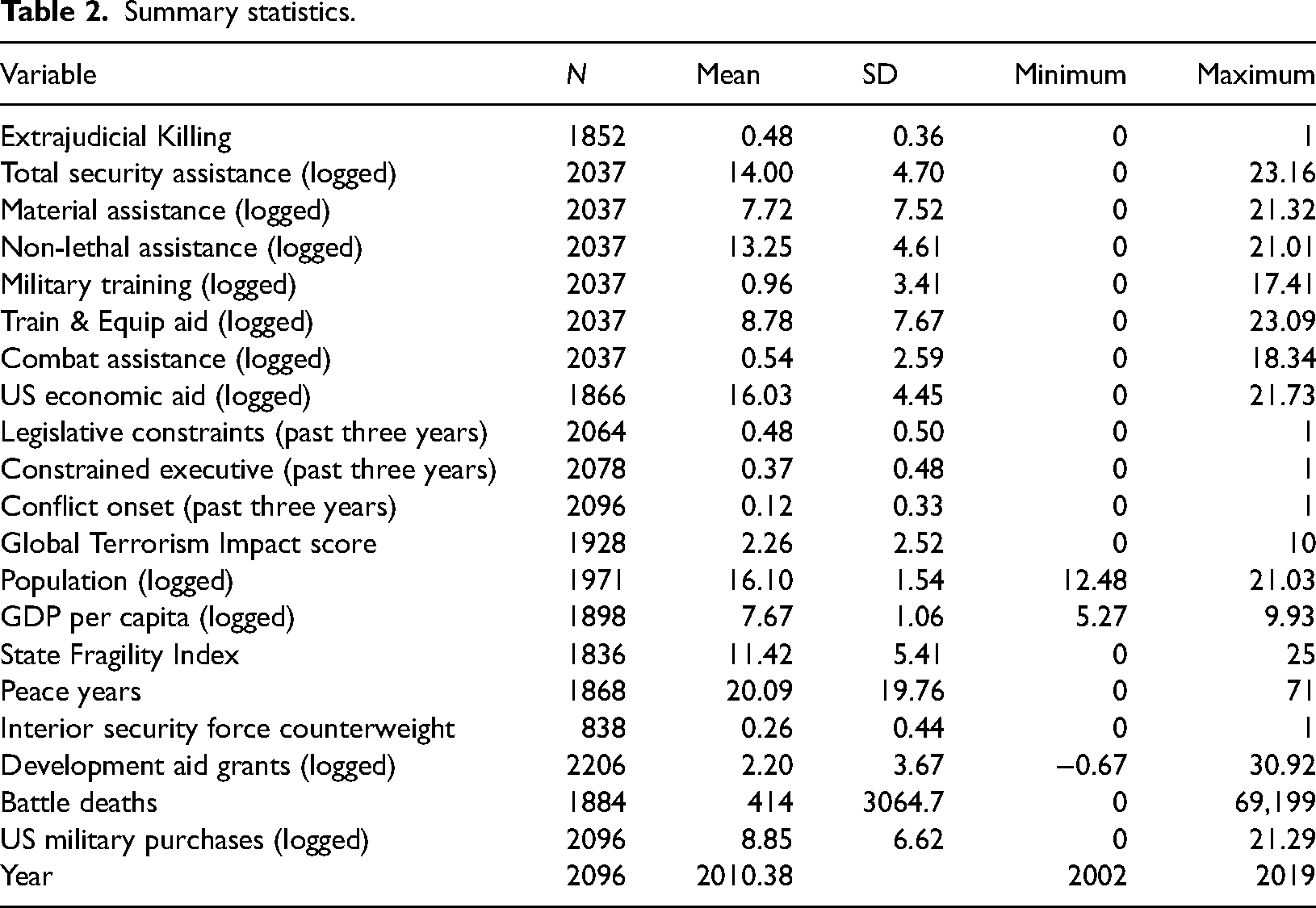
Table 2 displays summary statistics for the dataset.
Summary statistics.
My second strategy for isolating the causal impact of security assistance is to use Heckman selection models to further reduce the possibility that the results are spurious due to selection bias. In each of these models, the first stage estimates the likelihood that a country will receive US Train & Equip assistance with a probit model while the second stage estimates fixed-effects regression models for those states that received this type of assistance.
Results
Table 3 displays results from estimating fixed-effects regression models of state violence in 110 low- and middle-income countries between 2002 and 2017. In these models, I examine how variation in the amount of security assistance a country receives over time affects the pervasiveness of extrajudicial killings by government-affiliated forces. US security assistance is measured as the average amount of aid provided, in log-transformed US$, over the prior three years. Model 1 tests the impact of the total amount allocated for all security assistance programs. Model 2 disaggregates security assistance into material aid, military training, combat assistance, and non-lethal aid. Model 3 estimates the effect of aid categorized as non-lethal and the combined effects of all Train & Equip (T&E) aid. Model 4 adds interactions between Executive Constraints and the measures of T&E and non-lethal assistance. Model 5 includes interactions between lethal and non-lethal aid amounts and a dichotomous indicator that the regime employed interior troops as counterweights in year t − 4. All five models control for the state's population, GDP per capita, Global Terrorism Index score, and armed conflict onset in the past three years. To account for heteroskedasticity, models are estimated with robust standard errors clustered on the state.
Impact of US security assistance on extrajudicial killing, 2002 − 2017.
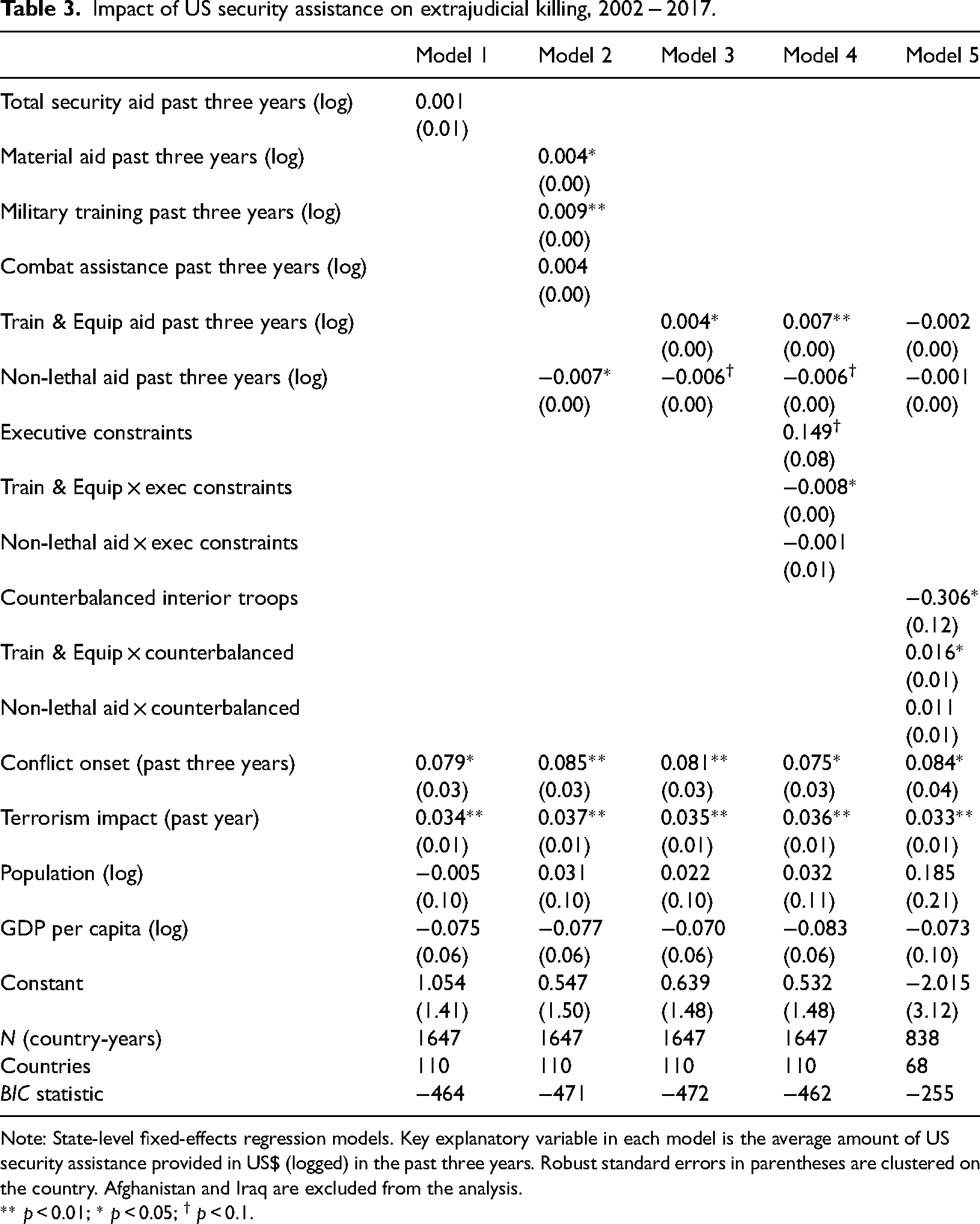
Note: State-level fixed-effects regression models. Key explanatory variable in each model is the average amount of US security assistance provided in US$ (logged) in the past three years. Robust standard errors in parentheses are clustered on the country. Afghanistan and Iraq are excluded from the analysis.
** p < 0.01; * p < 0.05; † p < 0.1.
The correlation between total security assistance and extrajudicial killing is not statistically significant in Model 1. When security assistance is disaggregated into distinct types in Model 2, increases in material aid and training are both associated with increases in extrajudicial killings by state security forces. Combat assistance is also positively correlated with extrajudicial killings, but the estimated coefficient is not statistically significant. 7 In contrast to the three measures of “lethal” aid, non-lethal aid is negatively correlated with extrajudicial killings. In Model 3, the coefficient on T&E, which aggregates all material aid, training, and combat assistance, is positive and statistically significant. Increasing T&E assistance by 1 standard deviation (SD) above a state's average T&E aid allocation increases extrajudicial killing by 0.03 on a scale that runs from 0 to 1. Increasing the amount of non-lethal security assistance provided to a state reduces the frequency of extrajudicial killing, although the coefficient is only significant at the 0.1 level.
To my knowledge, this is the first study to differentiate between lethal and non-lethal security assistance in this way, but the results are consistent with prior research that finds lower rates of civilian targeting and greater respect for democratic norms in response to US military education programs and peacetime troop presence (Omelicheva et al., 2017; Atkinson, 2014; Ruby and Gibler, 2010; Bell et al., 2016).
At the same time, disaggregating security assistance reveals that, in contrast to military education, combat training is associated with significant increases in state violence, even after accounting for the effects of material transfers of weapons and military equipment. This finding is more consistent with research by McCoy (2005), which finds that recipients of military training at the School of the Americas were more likely to commit human rights abuses the more courses they completed, and with results from the Omelicheva et al. (2017) study linking the number of personnel that receive US military training to the probability that state military forces will commit atrocities against civilians during intrastate conflict. Importantly, the results of this analysis provide broader evidence of the potential impact of US military training because they are not limited to a specific training program or to countries with ongoing armed conflicts.
The final two fixed effects models test whether the consequences of security assistance are conditioned by institutional constraints on executive authority, or by fragmentation of internal security forces. Because it is difficult to interpret interaction effects from the coefficients alone, Figure 1 plots the average marginal effects of a one unit increase in lethal or non-lethal security assistance as executive constraints and internal security force consolidation vary. In Model 4, increases in T&E aid only increase state violence in states that lack judicial or legislative constraints on the executive. The impact of non-lethal assistance does not vary across regime types. Model 5 shows that, in stark contrast to its impact in states with executive constraints, the impact of lethal aid is magnified if a state's security sector includes interior security “counterweights”. Strikingly, non-lethal aid is also positively correlated with extrajudicial killing in states with fragmented interior security forces, although the coefficient falls just short of standard statistical significance at p = 0.07.
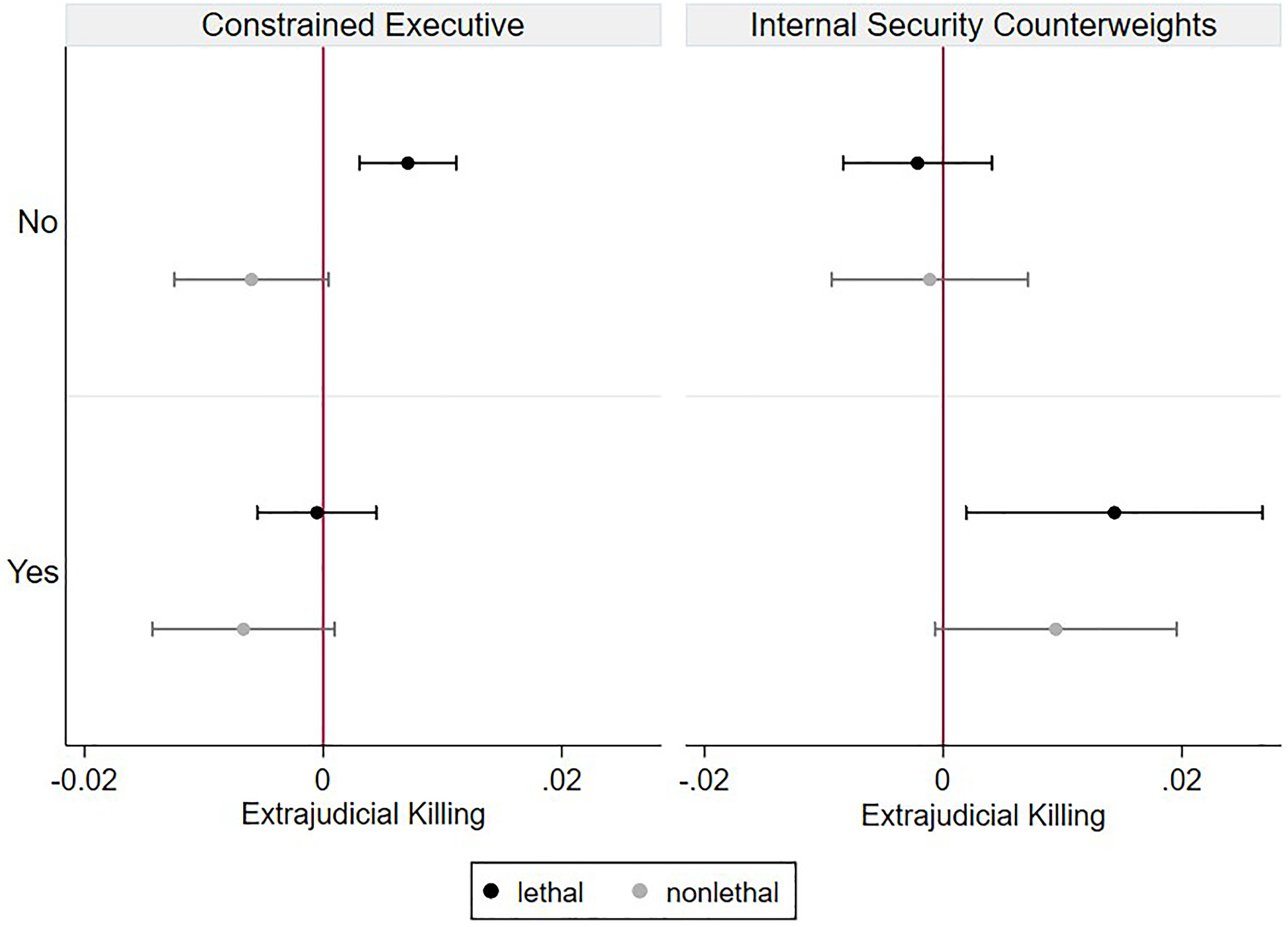
Marginal effect of an increase in Train & Equip or non-lethal security assistance as constraints on executive authority and internal security force consolidation vary.
It is difficult to gauge the substantive significance of these results from the size of the coefficients. Following the advice of Mummolo and Peterson (2018) for interpreting fixed effects regression results, I use each independent variable's within-country SD to calculate the average change in the extrajudicial killing scale as that variable deviates from its mean in the recipient country. Using estimates from Model 4, if T&E assistance increased by 1 SD over time, a state without constraints on executive authority would experience a 0.03 point increase in its score on the extrajudicial killing scale. A 1 SD increase in non-lethal aid would decrease extrajudicial killing by 0.02 for both constrained and unconstrained executive countries, but the effect is only statistically significant at the 0.1 level. For comparison, a 1 SD increase in the terrorism impact index (which varies from 0 to 9.3 in the sample) increases the extrajudicial killing scale by 0.04. If an armed conflict has begun in the past three years, extrajudicial killing is expected to be higher by 0.06. Turning to Model 5, a 1 SD increase in T&E assistance over time is expected to increase extrajudicial killings by 0.05 in states with internal security counterweights. When the effects of lethal and non-lethal aid are combined, total security assistance is positively correlated with extrajudicial killing in states with fragmented internal security forces; increasing total security assistance by 1 SD increases extrajudicial killing by 0.04 (p < 0.01).
Robustness checks
In the models above, I hold time-invariant differences between states constant with state fixed effects and control for several time-varying factors likely to increase both security assistance and state violence. As a robustness check, I repeat the analyses using Heckman selection models to further reduce the possibility that the results are spurious owing to selection bias. In each of these models, the first stage estimates the likelihood that a country will receive T&E assistance with a probit model while the second stage re-estimates the fixed-effects regression models in Table 3 for those states that received this type of assistance. The selection equation includes a dummy variable indicating that the state had a defense pact with the United States (Leeds et al., 2002); the state's population, GDP per capita, level of democracy, and Global Terrorism Impact score; and an indicator of internal armed conflict onset. The residuals from this equation are used to control for possible selection bias in the second stage equation.
The results for the Heckman selection models are displayed in Table 4. Several of the variables in the selection equation are highly correlated with T&E assistance, including alliance ties with the United States ( + ), armed conflict onset (−), and a state's Polity score ( + ). However, none of the rho statistics are statistically significant, which indicates that the selection and outcome equations are not related and the results reported in Table 3 are unbiased. Moreover, the second stage estimation results are largely consistent with the results reported in Table 3 even though modeling the selection process significantly reduces the number of observations in the second stage of the model. The only notable exception is Model 5b. In this model, the coefficient on T&E assistance is no longer statistically significant, even for states with counterbalanced security forces. This is most likely due to the fact that the second stage equation is estimated on a sample of only 59 states. As in the results reported in Table 3, when lethal and non-lethal aid are combined, total security assistance has a positive and statistically significant effect on extrajudicial killing in states with interior troops counterweights.
Heckman selection models: impact of security assistance on extrajudicial killing.
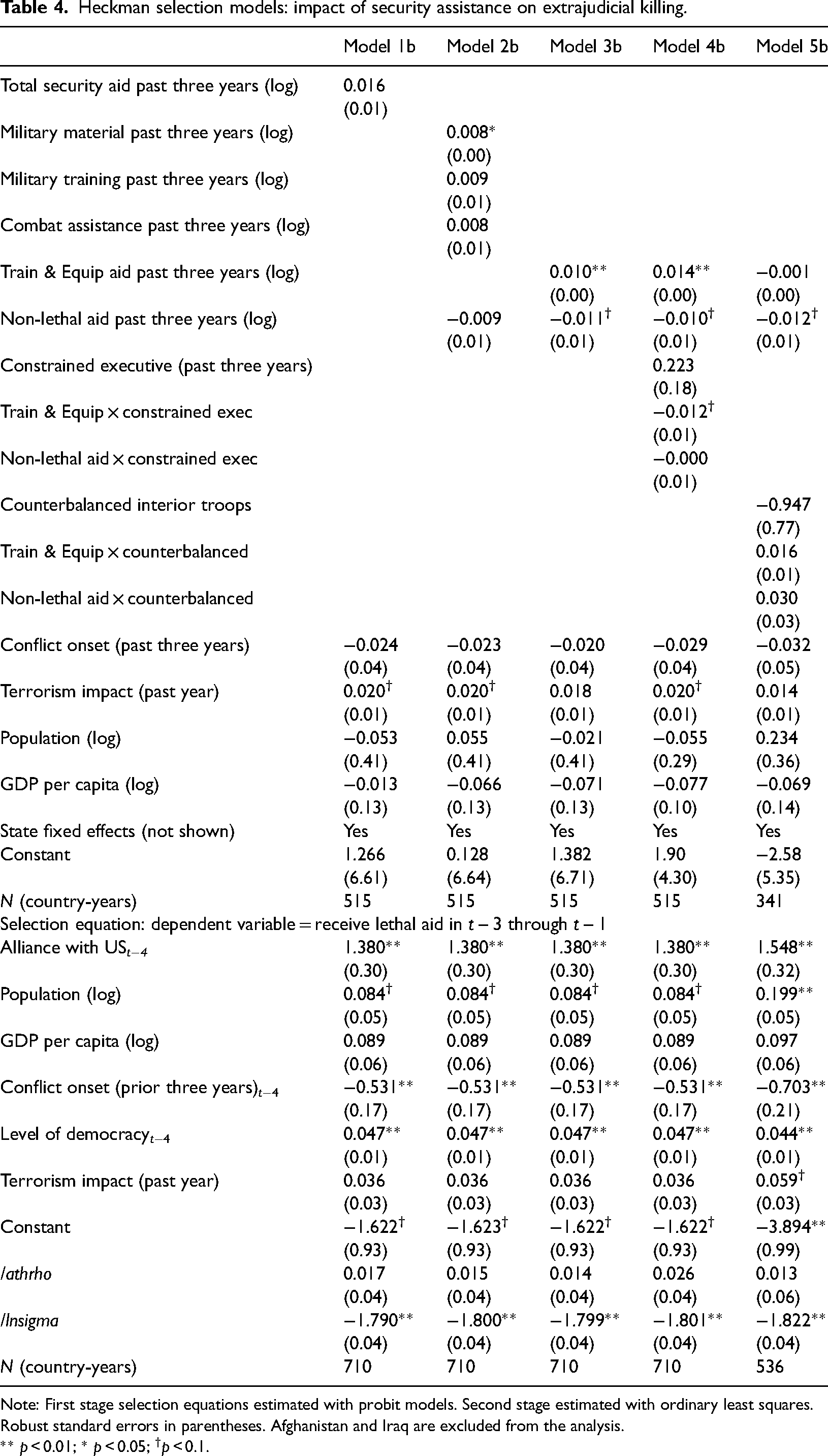
Note: First stage selection equations estimated with probit models. Second stage estimated with ordinary least squares. Robust standard errors in parentheses. Afghanistan and Iraq are excluded from the analysis.
** p < 0.01; * p < 0.05; †p < 0.1.
Additional robustness checks are reported in the Online Appendix. The results reported in Table 3 are robust to the use of Coarsened Exact Matching to reduce the imbalance between treatment (T&E aid recipients) and control (no T&E aid) groups. Additional alternative model specifications include a control for the amount of US economic aid provided to each country and exclude measures of conflict onset and terrorism impact—which could introduce post-treatment bias. I also test whether the results are sensitive to including observations for Afghanistan and Iraq. Finally, I estimate models substituting a five-year moving average, or the amount of aid provided in the previous year, for the three-year moving average. All of the results are consistent with those reported in the body of the paper.
Conclusion
The United States has long been one the world's largest military aid donors. Over the past two decades, it has provided military equipment, training, and a broad range of other security sector assistance to more than two-thirds of the sovereign states in the world. However, countries like Russia, China, and France also provide significant military assistance to low- and middle-income countries. Ideally, I would test my hypotheses with data on security assistance provided by all foreign donors because the theory is generalizable to other major providers of lethal aid. Unfortunately, detailed data at the level of disaggregation I would need is not available for other countries. While collecting these data and expanding the scope of this analysis will be important for future research, measuring only the amount of US security assistance a state receives should provide a hard test for the argument.
Unlike China, Russia, or Iran, the US has laws intended to prevent the provision of military aid to recipients who may use the aid to commit human rights abuses, and Congress does occasionally suspend or prohibit the provision of lethal aid in response to severe and persistent violations. During the Cold War, containing the Soviet Union and the spread of communism frequently overrode the importance of promoting democratic norms and human rights. As a 2006 RAND Corporation report observes, “government repression was unfortunate but sometimes inevitable in countries dealing with subversive elements” (Jones et al., 2006: 15). In more recent decades, promotion of democratic norms and respect for human rights are among the most frequently stated goals of US security assistance (US Department of Defense and State, 2015; US Department of State Bureau of Political-Military Affairs, 2001; US Government Accountability Office, 2011). Title 10 of the US Code, which grants the Department of Defense authorization to train and equip foreign security forces, requires that every assistance program include human rights training. US military doctrine instructs trainers and advisers on the ground in fragile and conflict-affected states to emphasize respect for human rights, not just because it is mandated by law, but because mistreatment of civilians by security forces is counterproductive to the mission of countering violent extremists and strengthening internal defense (Batson, 2011; Johnson, 2014; United States Department of the Army, 2006, 2020). And sections of both the Foreign Assistance Act and Title 10 of the US Code, collectively known as the Leahy Law provisions, prohibit the US departments of State and Defense from providing assistance to any foreign security force unit that has committed a gross violation of human rights. 8
The combination of legal constraints, Congressional oversight, and evolving military doctrine should bias against finding that security assistance from the US is associated with increases in extrajudicial killings. If the US suspends aid to states committing atrocities, or leaders fear that it might, we are less likely to see a correlation between lethal aid and extrajudicial killings. If increases in security assistance from the US are associated with increases in state violence despite legal provisions and Congressional oversight, aid from donors with less concern about human rights violations could have even more adverse effects. As Jonathan Caverley has observed, “the U.S. military–industrial complex may appear to be a collection of rent-seeking, war-profiteering, influence-peddling, threat-inflating sociopaths until you look at nearly every other country's version” (Caverley 2018).
The effects of military aid in recipient countries have only recently attracted serious attention in academia. As a result, despite the significant sums committed to foreign security assistance, we know relatively little about the effects of training and equipping military forces on human security in recipient states. By disaggregating US security assistance into qualitatively distinct categories and testing whether the impact of aid is conditioned by political and military institutional arrangements in target countries, the results of this study bring new evidence to important academic and policy debates about the impacts of military aid on human security. Separating “non-lethal” aid—a broad category encompassing professional military education, non-proliferation, law enforcement, and a variety of other types of assistance—from “lethal” aid—which includes material aid, direct combat assistance, and combat training—reveals divergent effects on state violence. While increasing lethal aid significantly raises the risk of civilian harm at the hands of state security forces, non-lethal security assistance has a dampening effect on extrajudicial killing in states with a unified internal security sector.
The results of this analysis also highlight the importance of institutional arrangements in the states receiving foreign security assistance. In states with legislative and judicial constraints on the executive, neither lethal nor non-lethal assistance has any impact on extrajudicial killing. Although lethal aid could still increase the capacity of security forces to repress dissent in these countries, constraining institutions appear to mitigate against the use of coercive capacity to target civilians (Colaresi and Carey, 2008; Davenport, 2007). In contrast, security assistance has more deadly consequences in states in which when a leader has manipulated the structure of its security forces to ensure loyalty to the ruling regime. In states with interior troop counterweights, both lethal and non-lethal aid increases the frequency of extrajudicial killing by state security forces.
Supplemental Material
sj-docx-1-cmp-10.1177_07388942231155161 - Supplemental material for Lethal aid and human security: The effects of US security assistance on civilian harm in low- and middle-income countries
Supplemental material, sj-docx-1-cmp-10.1177_07388942231155161 for Lethal aid and human security: The effects of US security assistance on civilian harm in low- and middle-income countries by Patricia L. Sullivan in Conflict Management and Peace Science
Supplemental Material
sj-dta-2-cmp-10.1177_07388942231155161 - Supplemental material for Lethal aid and human security: The effects of US security assistance on civilian harm in low- and middle-income countries
Supplemental material, sj-dta-2-cmp-10.1177_07388942231155161 for Lethal aid and human security: The effects of US security assistance on civilian harm in low- and middle-income countries by Patricia L. Sullivan in Conflict Management and Peace Science
Supplemental Material
sj-do-3-cmp-10.1177_07388942231155161 - Supplemental material for Lethal aid and human security: The effects of US security assistance on civilian harm in low- and middle-income countries
Supplemental material, sj-do-3-cmp-10.1177_07388942231155161 for Lethal aid and human security: The effects of US security assistance on civilian harm in low- and middle-income countries by Patricia L. Sullivan in Conflict Management and Peace Science
Supplemental Material
sj-xls-4-cmp-10.1177_07388942231155161 - Supplemental material for Lethal aid and human security: The effects of US security assistance on civilian harm in low- and middle-income countries
Supplemental material, sj-xls-4-cmp-10.1177_07388942231155161 for Lethal aid and human security: The effects of US security assistance on civilian harm in low- and middle-income countries by Patricia L. Sullivan in Conflict Management and Peace Science
Footnotes
Acknowledgments
My thanks to the research assistants who collected and coded data for this project, Abhik Pramanik, Jared DellaMaestra, Sam Pritchard, Stephanie Jeselson, and Collins Alexander. This article was greatly improved by helpful feedback from Theodore McLauchlin, Renanah Miles Joyce, Rachel Tecott, Lee Seymour, and anonymous reviewers for CMPS.
Funding
The author(s) disclosed receipt of the following financial support for the research, authorship, and/or publication of this article: This work was supported by the Carnegie Corporation of New York (grant number D 15126).

Supplemental material
Supplemental material for this article is available online.
Notes
References
Supplementary Material
Please find the following supplemental material available below.
For Open Access articles published under a Creative Commons License, all supplemental material carries the same license as the article it is associated with.
For non-Open Access articles published, all supplemental material carries a non-exclusive license, and permission requests for re-use of supplemental material or any part of supplemental material shall be sent directly to the copyright owner as specified in the copyright notice associated with the article.
