




Abstract
Election violence is common in many developing countries and has potentially detrimental implications for democratic consolidation. Drawing on political psychology, we argue that citizens’ fear of campaign violence undermines support for democracy while increasing support for autocracy. Using individual-level survey data from 21 electoral democracies in Sub-Saharan Africa, we find robust support for our argument. Citizens fearing campaign violence are less likely to support democracy and multi-party competition, more likely to favor a return to autocracy, and less likely to turn out to vote. Our findings have important implications for democratic survival and provide further impetus for reducing electoral violence.
Introduction
With the end of the Cold War, autocratic regimes gave way to multiparty elections across the world, including many Sub-Saharan African countries. Yet few of these political openings led to liberal democracy, and concerns about democratic backsliding have intensified in recent years. 1 While virtually all countries hold elections today, their quality and integrity vary widely. Election-related violence accompanies about a quarter of national elections worldwide (Birch and Muchlinski, 2017; Hafner-Burton et al., 2014). For example, in Africa between 1990 and 2008, generalized killing and repressive violence directly linked to elections occurred in 20% of national elections, with an additional 38% of national elections experiencing violent harassment (Straus and Taylor, 2012: 23). Similarly, approximately half of African citizens fear election violence, and about 16% of people fear election violence a lot. 2 Yet although fear of election violence is common in many developing countries, we still know surprisingly little about its effects on attitudes and behavior. 3
What are the consequences of fearing election violence for citizens’ political attitudes and participation? In particular, do these fears influence public support for democracy and autocracy? 4 Most of the existing literature has focused on consequences for turnout or turnout intention. While the majority of studies find negative effects of violence on turnout (Bratton, 2008; Collier and Vicente, 2014; Condra et al., 2018; Gutierrez-Romero and LeBas, 2020; Ley, 2018), others find positive effects (Burchard, 2015: 14; Travaglianti, 2014: chapter 6), or no relationship (Bekoe and Burchard, 2017; Burchard, 2020; Travaglianti, 2014: chapter 7). Studies on other attitudes are sparse, but generally establish negative effects, concluding that violence can reduce support for democracy (Burchard, 2015), political knowledge (Söderström, 2018), dissent (Young, 2020), as well as trust and social capital (Dercon and Gutierrez-Romero, 2012; Höglund and Piyarathne, 2009).
Building on research on emotions in political psychology, we argue that fearing election violence is detrimental to democratic survival, contributes to increased support for autocracy, and reduces turnout. Fear of campaign violence increases risk perceptions and risk aversion, leading people to reconsider the value of democracy, alternative forms of government, and democratic participation. While campaign violence harms some citizens directly, it has much broader psychological effects by instilling fear in citizens and creating a climate of insecurity and distrust. We argue that citizens fearful of violence become risk averse and less supportive of electoral competition and democracy, viewing elections as risky endeavors ripe with intimidation, threats, and the use of force. When democratic competition triggers conflict rather than serving as a peaceful means of selecting leaders, public support for it in the citizenry decreases. In addition to lower support for democracy, people fearing violence become more willing to return to previous autocratic regimes, i.e. regimes without competitive elections, where such conflict triggers are absent. Fearing election violence thus lowers citizens’ opinions about the value of competition as well as their appreciation for democracy relative to non-competitive forms of government.
Using individual-level survey data from three Afrobarometer rounds covering 21 electoral democracies in Africa, our analysis focuses on within-country comparisons of individuals who differ in fear of campaign violence, but are similar with regard to a number of potential socio-economic and political confounders. We document that fearing election violence is significantly associated with lower public support for democracy and elections, higher support for returning to the previous autocratic regime, and lower turnout. First, we find robust and consistent evidence showing that fearing campaign violence reduces citizens’ satisfaction with democracy. Exploring which institutional features of democracy are affected, we find that the negative attitudinal effect is not just limited to the competition features of democracy. Second, fearing election violence is significantly associated with a boost in citizens’ preference for autocratic forms of government, such as single-party, personalist, and military rule. However, we do not find any differential effects of fear across age groups. Finally, we establish that those fearing violence are less likely to turn out to vote. Overall, our analyses support the argument that election violence reduces support for democracy and generates growing support for a return to autocracy.
We advance prior research in three ways. First, we make theoretical and empirical contributions to work on election violence and political violence. Grounding our argument in psychology and neuroscience research on emotions, we focus on fear of pre-election violence as one plausible channel through which violence reduces support for democratic attitudes and behavior. We center our argument on fear of violence rather than direct exposure because violence could affect attitudes through a variety of instrumental or emotional responses with divergent effects on support for democracy and turnout. Experience with violence can make citizens fearful and lead them to withdraw from the democratic process, as we argue here, yet some individuals might respond to violence with anger or indignation, which could lead them to become more—and not less—involved in politics (Costalli and Ruggeri, 2015). 5 Conflating the range of possible responses to violence is one plausible reason why the literature on the consequences of violence has produced mixed findings. 6 Methodologically, we advance prior work with a better empirical strategy and greater geographic scope. Other statistical analyses rely on aggregate data (Bekoe and Burchard, 2017; Hafner-Burton et al., 2018), single countries (Bratton, 2008; Condra et al., 2018; Gutierrez-Romero, 2014; Gutierrez-Romero and LeBas, 2020; Travaglianti, 2014), or bivariate correlations in a global sample (Norris, 2014: 129). Only a few studies have examined the individual-level effects of election violence for several African countries (Burchard, 2015, 2020; Söderström, 2018), but these remain limited to analyzing a single round of Afrobarometer data and focus on a more limited set of outcomes. We analyze a range of countries in one region (Africa) and focus on average individual-level effects within countries by employing country and survey-round fixed effects, while controlling for a broad set of potential confounders. We replicate results by comparing individuals in the same sub-national districts with district fixed effects. Finally, we establish the robustness of our results through placebo regressions, sensitivity analyses, matching, and a validation exercise demonstrating that exposure to campaign violence correlates with greater fear of campaign violence. While our research design is observational and does not permit us to make claims about causality, a key benefit is considerable external validity, and robustness tests address many potential threats to inference. 7
Second, we contribute to the literature on democratic breakdown and autocratization. If election violence impairs democratization, then the existing literature on democratization and consolidation has an important blindspot. We argue that fear of violence increases people’s risk perceptions and reduces their support for democracy, and present evidence consistent with these expectations. We also provide novel insights into the effect of fear of violence on support for autocracy, which has not been examined in prior work. We find that citizens fearful of violence not only become less supportive of democracy, but also increase their support of autocratic forms of government, which is critical for gauging the potential consequences of violence for democratic breakdown. Research on democratic breakdown has long noted that low democratic satisfaction reduces the public’s willingness to defend democracy against power-grabbing politicians, suggesting that public attitudes about democracy are important for democratic survival and democratization (Norris, 2011: 231–235; Svolik, 2013). We show that fear of campaign violence reduces public support for democracy and makes a return to autocracy more appealing. These findings are especially important in light of growing global concerns about democratic backsliding.
Third, we contribute to research on electoral competition and the question of whether competition is good or bad for democracy. Elections can provide peaceful conflict resolution (Fearon, 2011; Przeworski, 1991) but can also lead to democratic breakdown if competing parties have similar popular support (Chacon et al., 2011) or if contenders challenge election results (Przeworski, 2005). We contribute to this literature by examining one aspect of electoral competition—fear of campaign violence. Our analyses suggest that fearing campaign violence is bad for democracy because it lowers support for democracy and some of its features, such as multi-party competition or the rule of law.
Argument
We argue that fearing campaign violence has substantial and detrimental consequences: it reduces attitudinal and behavioral support for democracy and boosts support for autocracy. Our emotion-based argument draws on insights from psychology and neuroscience in linking fear to attitudes and political behavior. Rather than focusing on how direct exposure to violence affects outcomes, which could lead to a variety of psychological responses, we center our argument on fear as one plausible and common emotional response. Prior work has shown that exposure to political violence heightens fear (Chipman et al., 2011; Young, 2019), but can also lead to a range of other emotional responses, including anger (Zeitzoff, 2014), shame (Barber et al., 2016), and exclusionary attitudes (Canetti-Nisim et al., 2009).
Emotions are chemical and neural responses to deal with specific events (Damasio, 1994; Frijda, 1994). According to cognitive appraisal theory (Lazarus, 1991), which posits that emotions are determined by cognitive appraisals of the state of the world in relation to an individual’s goals, fear is an emotion that is common in situations characterized by low certainty, low pleasantness, low control, and high anticipated effort (Lerner and Keltner, 2000). Faced with such a situation, fear is often (but not exclusively) an instrumental response, enabling an individual to manage a threat (Petersen, 2002: 19–20). 8 Theory in psychology highlights how emotions such as fear affect attitudes and behavior. Lerner and Keltner’s (2000, 2001) appraisal tendency theory argues that emotions are not only induced by cognitive appraisals, but that an individual’s emotional state also influences his or her perception of other information to reinforce an appropriate response. In other words, fear, as an emotional response to violence, affects an individual’s attitudes, views, and behavior.
Consistent with this body of theory, research on emotion-guided reasoning (Marcus et al., 2000) has shown that some emotions—in particular, fear—can make individuals change previously held beliefs and behavior. When feeling threatened, people stop relying on habitual evaluations. Dangers and threats motivate people to re-assess their attitudes, which can lead them to alter their judgment about issues, events, and institutions. In particular, there is considerable empirical evidence in psychology, economics, and political science that fear influences risk perceptions and risk aversion. Experimental evidence shows that fear increases perceptions of risks (Johnson and Tversky, 1983; Lerner and Keltner, 2000; Lerner et al., 2003; Young, 2019) and risk aversion (Cohen et al., 2015; Gusio et al., 2018; Young, 2019). Hence, fear of violence as one particular type of fear may affect people’s attitudes and behavior through its implications for risk perceptions and risk aversion. We discuss below how such fears have detrimental effects on attitudes toward democracy, autocracy, and political behavior.
We begin by discussing how fear of pre-electoral violence affects attitudes. Campaign violence, i.e. the use of violence prior to election day, is generally used to shape turnout and vote choice and thus election outcomes (Straus and Taylor, 2012: 20; Wilkinson and Haid, 2009). While such violence may physically prevent some people from voting, violence is effective primarily through its psychological effects on a much larger set of citizens, particularly through instilling fear and creating a general climate of intimidation and distrust (Bratton, 2008; Höglund and Piyarathne, 2009). Hence, in elections with intimidation, threats, and the use of force, people become fearful of democratic processes rather than viewing them as a peaceful means of selecting representatives. Citizens afraid of violence should therefore express lower support for elections and democracy. In addition to re-evaluating the value of democracy, those fearing violence may view democratic governance as risky precisely because it failed to protect them from such violence (Höglund and Piyarathne, 2009: 299–300). In consequence, we expect that fear of election violence reduces citizens’ attitudinal support for democracy as a form of government.
Beyond reducing citizens’ support for democracy, does fear of electoral violence also affect citizens’ attitudes toward autocracy? We argue that fear of campaign violence also strengthens support for autocracy, an important—perhaps the most important—implication that to date has not been examined. Citizens who fear intimidation, harassment, and violence in elections may reasonably prefer political systems they view as potentially less risky, such as non-competitive regimes or those with no elections at all. People afraid of campaign violence will perceive the holding of regular competitive elections as riskier and the chances of the incumbent party—generally the perpetrator of violence in the Sub-Saharan African context 9 —leaving office peacefully as lower (Aldama et al., 2019), so that autocratic government forms without competitive elections (e.g. one-party, personalist, or military rule) become relatively more attractive. 10 Rather than comparing their current regime with abstract notions of autocracy, we expect that citizens compare their democratic experience with previous autocratic regimes in their own country. Since most electoral democracies in Sub-Saharan Africa have transitioned in the early 1990s, citizens are either able to draw on their own memories and lived experiences or on what is transmitted through education or public memories. We therefore expect that fearful individuals become more supportive of their country’s past autocratic form of government, compared to individuals not fearing election violence. 11
In addition to attitudes, we examine how fear affects political behavior, in particular electoral turnout. If fear of electoral violence increases an individual’s risk perception of voting, then they might for instrumental reasons disengage from electoral politics and any election-related activities, including polling (Valentino et al., 2011). Similarly, if fear affects risk perceptions and incumbents are generally the main perpetrators, it should influence citizens’ beliefs of how likely it is that the incumbent regime will accept electoral defeat (Aldama et al., 2019: 108–110). The less likely a citizen thinks it is that the incumbent party will be defeated and resign, the less reason she has to engage in the risky activity of voting, especially if she supports the opposition. Moreover, fear might also influence citizens’ beliefs about how likely it is that other citizens will turn out to vote (Aldama et al., 2019: 110–114; Höglund and Piyarathne, 2009: 299). Given that in the Sub-Saharan African context incumbents are the main perpetrators and turnout under the secret ballot is more easily observed than vote choice, opposition supporters and non-partisans should be least likely to vote, especially if others are also expected to abstain, which increases their risk of standing out at the poll.
Finally, Aldama et al. (2019: 114–118) show that if fear increases risk aversion, then the effects on participation in risky actions are ambiguous. In general, the effect of fear is to reduce voter mobilization through increased pessimism and greater risk perception; however, in rare cases, in particular when the regime is unpopular and citizens think they have little to lose, fear can actually have a mobilizing effect through a so-called “nothing-to-lose-effect.” Overall, theory suggests a negative effect, but there are specific circumstances in which an increase in fear can result in mobilization against perpetrators.
The empirical literature on election violence on turnout largely supports this theoretical prediction: the majority of empirical studies point toward electoral violence reducing turnout (e.g. Birch, 2010; Bratton, 2008: 626; Condra et al., 2018; Höglund and Piyarathne, 2009: 299; Klopp and Kamungi, 2008: 15), and only a few studies find null or turnout-increasing effects (e.g. Bekoe and Burchard, 2017; Burchard, 2015, 2020; Hafner-Burton et al., 2014; LeBas, 2006; Travaglianti, 2014). Hence, although there is the potential for a backlash effect in very specific circumstances, we expect that fear of campaign violence reduces a citizen’s willingness to vote, leading to our third and final hypothesis.
Research design
We assess our hypotheses empirically using survey data from Sub-Saharan African countries, many of which regularly experience violence during elections.
Data and measurements
All variables come from waves 4–6 of the Afrobarometer survey. 12 These nationally standardized questionnaires measure a host of characteristics among a random sample of between 1200 and 2400 individuals per country. Surveys were conducted in 2008–2009 (round 4), 2011–2013 (round 5), and 2014–2015 (round 6). The questionnaires survey individuals’ fear of campaign violence, attitudes toward democracy, autocratic governments, and various institutional elements of democracy, whether a respondent voted in the last election, and a large battery of socio-economic and political control variables. 13 The Afrobarometer surveys offer the longest time series on the key variables of interest across a broad set of countries, providing the ideal testing ground for our hypotheses.
We limit our sample to electoral democracies to ensure that survey measurements for our main outcomes (e.g. satisfaction with or the extent of democracy) are reasonable. It is not meaningful to interpret survey questions about satisfaction with democracy for citizens living in autocracies. Thus our sample consists of the 21 out of the 38 African countries covered by survey waves 4–6 which Freedom House classified as electoral democracies at the time of the survey. 14 Electoral democracies are countries that have: (a) a competitive, multiparty political system; (b) universal adult suffrage for all citizens; (c) regularly contested elections conducted in conditions of ballot secrecy, reasonable ballot security, and the absence of massive voter fraud, and that yield results that are representative of the public will; and (d) significant public access of major political parties to the electorate through the media and through generally open political campaigning (Freedom House, 2008). 15
Explanatory variable
Our key explanatory variable Fear of Campaign Violence is based on the following survey question: “During election campaigns in this country, how much do you personally fear becoming a victim of political intimidation or violence?” Responses are ordinally scaled and range from “not at all” (0) to “a lot” (3). This means that all analyses are limited to fearing pre-electoral (as opposed to election day or post-electoral) violence. Among the regional barometers, Afrobarometer is the only one that consistently asks how much respondents fear campaign violence across survey waves. 16
Outcome variables
We consider two categories of outcomes: measures of attitudinal and (self-reported) behavioral support for democracy as well as indicators of support for the past autocratic form of government. Attitudinal support for democracy is measured in four ways. First, we measure whether a respondent Prefers Democracy to all other forms of government. The measure is coded dichotomously, where a value of 1 indicates that a respondent prefers democracy over all other forms of government and 0 otherwise. The second measure records an individual’s self-assessment of the country’s current Extent of Democracy. This is a four-point index ranging from 1 (i.e. undemocratic) to 4 (i.e. fully democratic). Our third attitudinal measure is Satisfaction with Democracy. Responses are measured ordinally on a five-point index ranging from 0 (i.e. my country is not a democracy) to 4 (i.e. very satisfied). Our final attitudinal measure, Trust in Political Institutions, combines how much respondents trust the president with how much they trust parliament into a seven-point index, ranging from 0 (i.e. trust not at all) to 6 (i.e. trust a lot). Our behavioral measure of support for democracy is based on self-reported Turnout in the most recent national election, where a value of 1 indicates that a respondent has cast a ballot.
To measure attitudinal support for autocracy, we combine regime classification data with survey responses to measure support for the previous form of autocratic government. Hypothesis 2 posits that respondents fearing violence are more supportive of the type of autocratic regime in power before their country experienced a transition to electoral democracy. Creating this measure requires identifying the type of autocratic regime in each country in our sample and combining this information with respondent’s support for this particular type of regime. First, we identify each country’s most recent past autocratic regime using the classification of Geddes et al. (2014). Of the 21 countries in this study, 10 were previously classified as single party regimes, eight were previously classified as personalist, and one was previously classified as a military regime. 17 Second, depending on the country’s type of autocratic regime, we use Afrobarometer data to code the extent to which a respondent approves of Single-Party Rule, Personalist Rule, or Military Rule on a five-point scale ranging from 1 (i.e. strongly disapprove) to 5 (i.e. strongly approve). For example, for respondents in Kenya, a former single-party regime, the measure indicates respondents’ support for single-party rule. In addition to estimating separate models for each of the three past autocratic regime types separately, we also combine these measures to capture support for the Past Autocratic Government across the three types, estimating a pooled model.
In order to facilitate presentation, interpretation, and comparability of our results, we recode all indices to the 0–1 interval, such that 0 equals the lowest and 1 equals the highest category. All reported effects are based on our rescaled outcomes.
Control variables
We control for socio-economic and political characteristics. The set of socio-economic controls includes the respondent’s Age and Age2, whether a respondent is Male, and lives in a Rural area, a Poverty Index, as well as Education and Employment Status fixed effects.
The list of political controls includes a series of partisanship indicators, including whether an individual prior to the most recent election felt close to a political party of the ruling coalition (Incumbent Partisan) or the opposition (Opposition Partisan), or is Non-Partisan (based on survey partisanship questions and the African Elections Database). Opposition Partisan serves as the baseline. We also control for respondents’Community Membership status and Community Meeting Attendance, Interest in Public Affairs, and the frequency with which respondents read the Newspaper, listen to the Radio, or watch TV.
Estimation strategy
To estimate the relationship between Fear of Campaign Violence and the various outcomes at the individual level, we estimate the following statistical model:

where the subscript i stands for individual, β1 is our parameter of interest, γXi denotes the set of individual controls, δ stands for survey round fixed effects, α stands for country fixed effects, and εi is the idiosyncratic error. The model is estimated using ordinary least squares (OLS), which are as good as nonlinear models at estimating marginal effects (Angrist and Pischke, 2008; Beck, 2015) and, importantly, allow us to include country fixed effects to control for time-invariant country-specific factors without risking incidental variable bias and sacrificing sample size and interpretability of coefficient estimates. Standard errors are clustered at the village level to account for the dependency of individuals within villages. 18
Our empirical identification strategy relies on the inclusion of survey round and country fixed effects and a rich set of controls. Hence, our estimates derive from averaging across individuals who differ in their fear of campaign violence within survey rounds and countries, conditional on socio-economic and political controls.
Results
We present our main results graphically; regression tables are available in Online Appendix B. We begin by discussing the effect of fear on attitudinal support for democracy.
Does fear of campaign violence lower support for democracy?
Figure 1 presents the coefficient estimates and their 95% confidence intervals of fears of violence for three different sets of control variables on our four democratic attitudinal outcomes and turnout. The dashed line indicates 0.
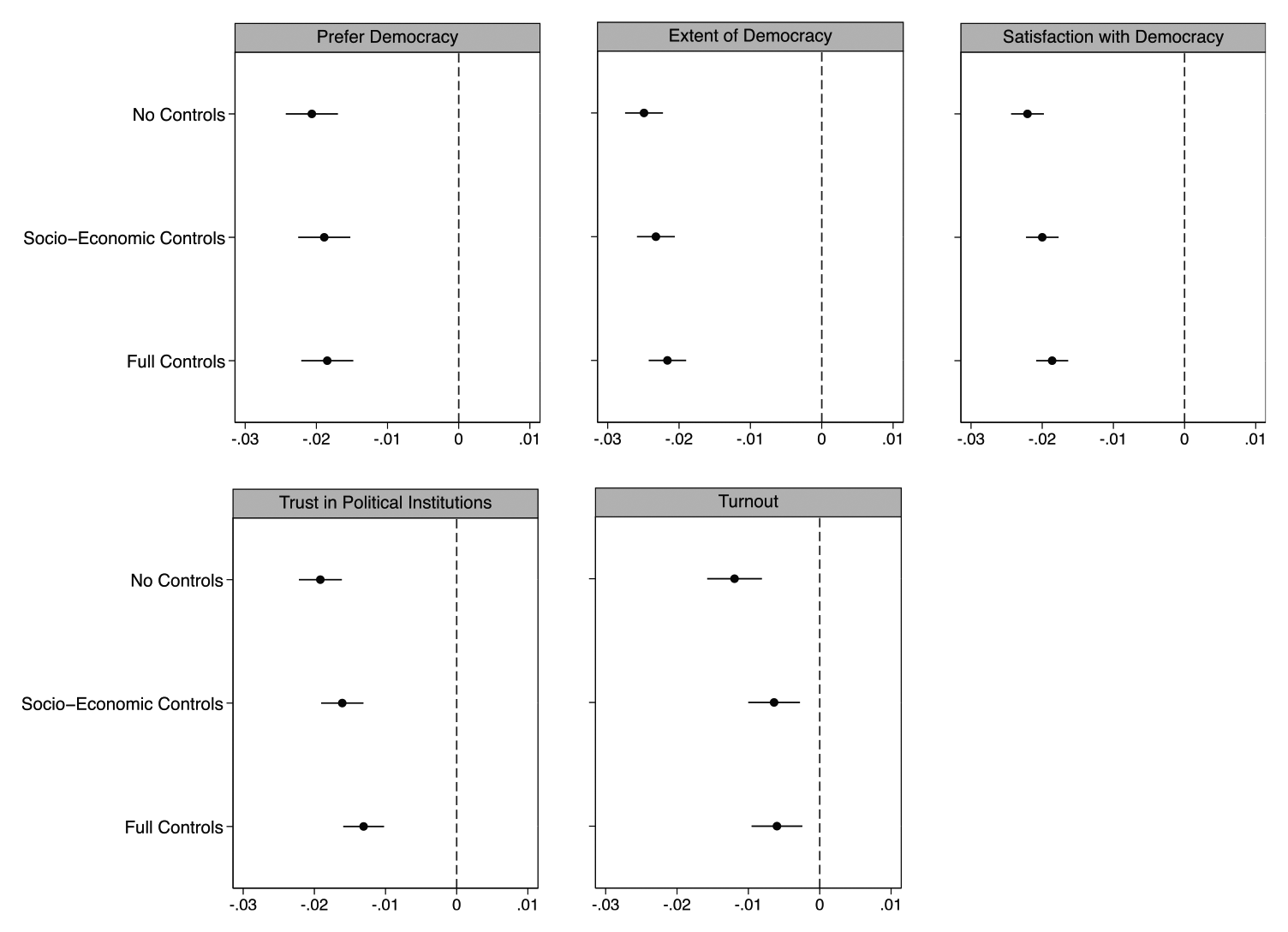
Effect of fear of campaign violence on attitudinal and behavioral support for democracy.
Figure 1 shows that fear of campaign violence has a consistent and statistically significant negative association with all democratic attitudinal outcomes, independent of the set of controls included in the statistical model. This suggests that fear of pre-electoral violence is consistently negatively correlated with measures of attitudinal support for democracy.
These effects are substantively meaningful. Compared with an individual who does not fear campaign violence at all, an otherwise similar person fearing pre-electoral victimization a lot is 5.4% (4.8%; 6%) 19 less likely to prefer democracy over all other forms of government, which is equivalent to a 13% shift in the outcome’s standard deviation. The identical cross-individual comparison results in a decrease of 0.066 (0.063; 0.069) points on the index of perceived democratic extent and a decrease of 0.057 (0.054; 0.060) points on the satisfaction with democracy index, which roughly equals a quarter of a point on either index or almost a 23% shift in either outcomes’ standard deviation. Finally, the same comparison suggests a decrease of 0.039 (0.036; 0.042) points on the trust index in political institutions, which roughly equals a quarter of a point on the index or a 12% change in terms of the outcome’s standard deviation.
While our argument suggests that the reduced support for democracy is due to fears of electoral competition, it is unclear to what extent the attitudinal change is limited to electoral features of democracy. We perform an exploratory analysis on its impact on support for various specific institutional features of democracy. Existing theory does not provide much guidance on whether fear should affect support for the electoral dimensions of democracy or undermine support for democracy more broadly, but this is a question of great policy importance. If fear undermines support for electoral features of democracy, such as support for elections and multiparty competition, the consequences—while still worrisome—may be limited. If the effect of fearing campaign violence extends to non-electoral features of democracy, such as accountability of the government to parliament or accountability of the president to the rule of law, the consequences of fearing election violence are even more concerning. The Afrobarometer survey asks respondents about their support for eight distinct institutional features of democracy: Elections, Multiple Parties, Rule of Law, Parliamentary Accountability, Parliamentary Primacy, Opposition Criticism, Media Criticism, and presidential Term Limits. Support is measured by the degree to which respondents support leadership selection through elections, the presence of multiple political parties, parliamentary accountability, the criticism of government through opposition parties and the media, parliamentary primacy in policy making, presidential respect for law and courts, and the constitutional limitation of presidential terms. The exact wording of questions is in Online Appendix Table A.II. Responses are coded on a six-point scale, ranging from 0 (i.e. very strongly disagree) to 5 (i.e. very strongly agree). As with all other outcome measures we have recoded it to range between 0 and 1.
Figure 2 shows the coefficient estimates and their 95% confidence intervals of fearing campaign violence for three different sets of control variables on eight different institutional elements of democracy. The dashed line indicates 0.
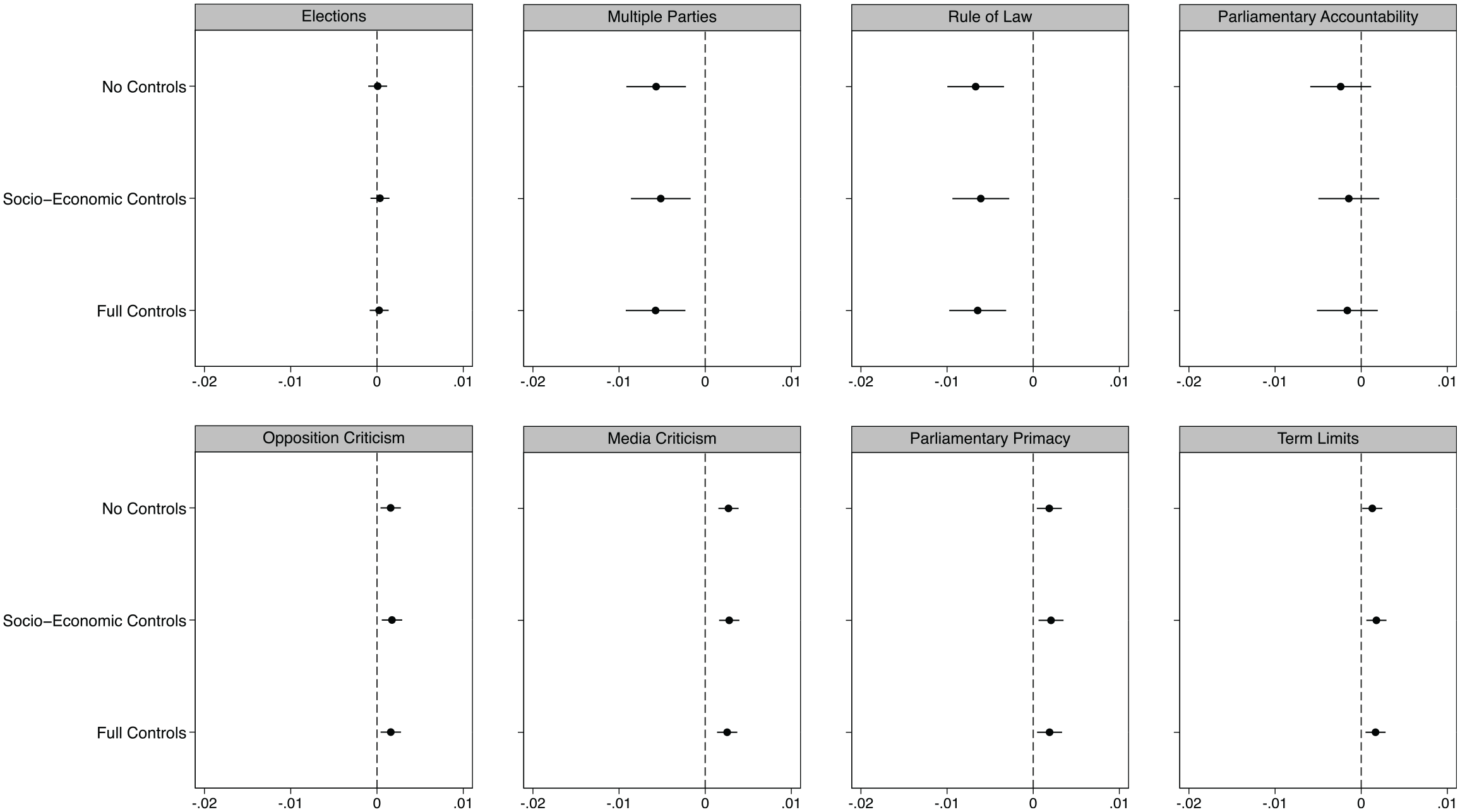
Effect of fear of campaign violence on support for institutional features of democracy.
The results suggest that fear of election violence does not result in a wholesale rejection of democracy. Fearing violence is not significantly associated with support for elections or parliamentary accountability of the government, but with support for multiple political parties, which respondents might plausibly link to election violence. There is also a negative correlation with support for the rule of law, which is more puzzling and possibly related to perceived and/or actual corruption of law enforcement and the judiciary. However, there is also a positive association with support for opposition and media scrutiny, parliamentary primacy, and term limits, suggesting support for some sort of government accountability. Overall, these results suggest that fear of campaign violence is not consistently linked to all institutional features of democracy. Lower levels of support for and satisfaction with democracy overall should not be equated with a wholesale rejection of democratic governance. We proceed to examining the effect of fear on support for non-democracy.
Does fear of campaign violence raise support for the past autocratic form of government?
Figure 3 presents the coefficient estimates and 95% confidence intervals of pre-electoral violence for three different sets of control variables on support for the past autocratic form of government. The top row presents the results from the subsamples of countries that used to have single-party or personalist rule and the bottom row presents the result of countries with previous military rule and then for all 21 countries, combining the subsamples. The dashed line indicates 0.
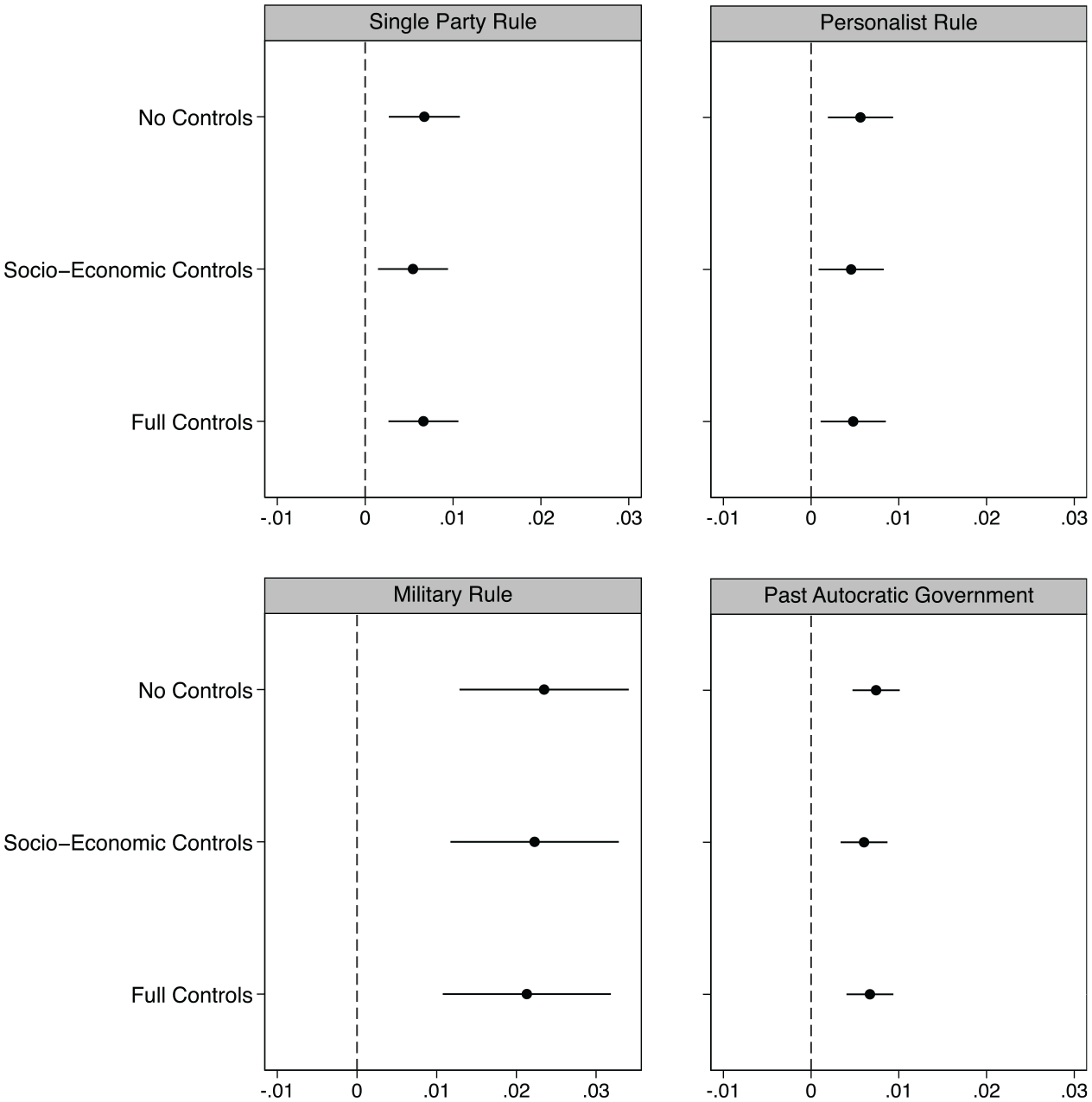
Effect of fear of campaign violence on support for autocratic government forms.
The results indicate that fear of campaign violence is significantly associated with increased support for a country’s past form of autocratic government. A citizen very fearful of campaign violence is on average 0.021 (0.018; 0.024) points more supportive of autocracy, which is about a tenth of a point change on the autocratic government support index or roughly a 7% change on the outcome’s standard deviation. The magnitude of this correlation is fairly stable across regime-specific outcomes, be it a single-party, personalist, or military rule. 20 In substantive terms, the association is much smaller than the democratic attitude affect sizes: they are only between half and one-third in size. This suggests that disaffection with democracy does not translate in a one-to-one fashion into support for past autocratic government forms.
An important question for policy is where in society this support for a return to autocratic forms of government comes from. In particular, does fear of election violence trigger feelings of nostalgia among the elderly or a desire for governmental change among younger citizens? Although our theoretical framework does not offer any guidance in this respect, we investigate in an exploratory analysis whether this positive association varies significantly across age groups. We group respondents into three age categories: those younger than 30, those between 30 and 50, and those older than 50 years of age. The idea behind this categorization is that most countries in the sample transitioned to democracy in the 1990s. Thus, respondents older than 50 at the time of the interview have first-hand experience of life under autocracy whereas respondents younger than 30 have only experienced electoral democracy. We then interact each category with our measure of fearing campaign violence and re-run the three models depicted in the lower right panel of Figure 3. The baseline category is the oldest group of people (i.e. those older than 50 years). The results are presented in Table 1.
Support for past autocratic government by age group.
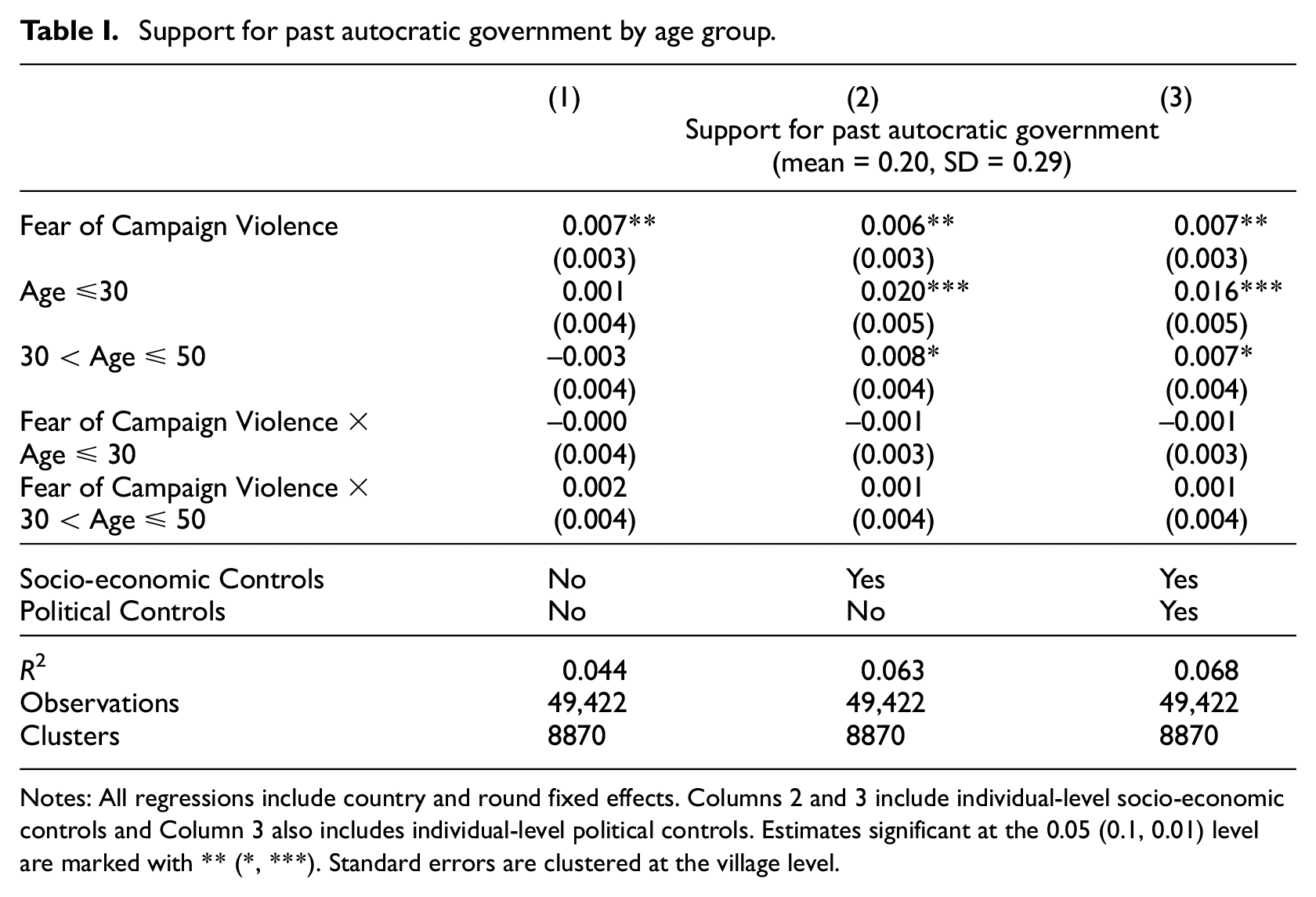
Notes: All regressions include country and round fixed effects. Columns 2 and 3 include individual-level socio-economic controls and Column 3 also includes individual-level political controls. Estimates significant at the 0.05 (0.1, 0.01) level are marked with ** (*, ***). Standard errors are clustered at the village level.
The regression table provides two interesting insights. First, age seems to be negatively correlated with support for a return to the previous autocratic form of government. The oldest cohort is least and the youngest cohort most likely to support a return to autocracy.
On average respondents younger than 30 years are 0.016 (0.011; 0.021) points more likely to support a return to autocracy, which is equivalent to a 5.5% change in the outcome’s standard deviation. Substantively, the age association is pretty small, but does point toward one potential basis of support for the return to autocracy.
Second, fear of campaign violence does not seem to be differentially correlated with autocratic support across age groups. The coefficient estimates of the two interaction terms of the fear of campaign violence and age cohorts are small and statistically insignificant. We now turn to behavioral effects by examining how fearing campaign violence influences turnout.
Does fear of campaign violence lower turnout?
Results for turnout are shown in the fifth panel in Figure 1. Our estimations suggest that citizens fearing campaign violence a lot are on average 1.8% (1.2%; 2.4%) less likely to turn out than fearless citizens. This is equivalent to roughly a 4% change in terms of the outcome’s standard deviation in turnout, which is lower than most attitudinal correlations discussed above. There are two reasons we can think of for why the effect is smaller than on attitudes: first, because attitudes may be easier to change than behavior; and second, because violence can have a mobilizing effect on turnout in some (albeit rare cases), as mentioned in our theoretical section. Although case studies (e.g. Bratton, 2008; Laakso, 2007) suggest that electoral violence in Sub-Saharan Africa is more often used to lower turnout of certain groups, our measure of fearing campaign violence is broader in scope so that it might also capture related behavior, such as threats intended to compel targets to turn out and cast their vote for a specific candidate or party rather than abstain.
To further investigate our findings on turnout, we examine whether intuitions on partisan targeting in prior work are supported. For these analyses, we interact fear with partisanship. The results are shown in Online Appendix Table C.IX and graphically depicted in Online Appendix Figure C.IV. The constituent term for the fear measure is negative and weakly significant in models 1 and 3. The interaction term—indicating the differential effect of fear for incumbent partisans—is negative and significant in models 1 and 2, and insignificant in model 3. Appendix Figure C.IV shows that fearing campaign violence affects incumbents’ and non-incumbents’ turnout alike, meaning that it has no differential effect on incumbents. It also shows that incumbent supporters who fear campaign violence a bit or somewhat are less likely to turn out than fearless incumbent supporters.
Robustness
We assess the robustness of our main results in three main ways. We start by assessing the sensitivity of our results owing to omitted variables and our choice of functional form. Thereafter, we implement a placebo test, allowing us to assess the degree to which our findings depend on the election specific nature of the fear. Finally, we address concerns regarding the basis of respondents’ fear of election violence, showing that citizens’ fear of violence is robustly associated with exposure to election violence.
Sensitivity analysis
Despite controlling for all time-invariant country differences and a rich set of individual controls accounting for most potential confounders suggested in the existing literature, we cannot rule out that the reported associations are spurious, i.e. that there are omitted variables correlated with both our independent and dependent variables that might account for the significant associations reported above. We apply Oster’s (2019) coefficient stability test to get a sense of the likelihood that our results are due to selection on unobservables. Estimation details and results are noted in Online Appendix Table C.I. The identified sets reported in Online Appendix Table C.I are quite narrow and none include 0, suggesting that our results are quite robust to omitted variable bias. In fact, for all of our main outcomes
To further assess the robustness of our results to subnational contextual factors, we replicate our main analyses using districts rather than country fixed effects. Districts might be a more appropriate spatial control, as they are more closely related to electoral units and important units for the administration of public goods, such as education and health services. By using districts fixed effects we hold constant all district-specific time-invariant differences across individuals, such as geography and local culture, general quality of public service provision, type of local political representation, and to some extent persistent local electoral differences. The results are shown in Online Appendix Table C.II. The coefficient estimates remain qualitatively unchanged and change little in quantitative terms.
Another concern relates to common support, i.e. the extent to which we have enough individuals with similar values on socio-economic and political controls in each country that differ with regard to fear of campaign violence. If common support is lacking, then our findings might be driven by outliers or depend on our choice of regressions functional form. To ensure common support we use coarsened exact matching (Diamond and Sekhon, 2013; King and Nielsen, 2019). Coarsened exact matching matches on variable ranges/strata and is thus better at reducing imbalance than other matching options such as propensity score matching (King and Nielsen, 2019). We match on all of our 12 socio-economic and political covariates plus the country and round. This generates a pruned dataset and weights for each observation that is retained. Diagnostics show that this procedure achieves high balance. 21 Using the matched dataset, we then replicate our main models. The results are shown in Online Appendix Table C.III. The coefficients remain qualitatively similar and mostly statistically significant. 22 This suggests that our results are not driven by outliers or our choice of functional form.
Next, we examine if our results are driven by a few countries, i.e. we assess heterogeneity across countries. First, we check for heterogeneity in estimated results. We replicate the main analyses with controls, but estimate them for each country separately. Results in Online Appendix Figure C.I indicate that many or all countries support each outcome variable; they are not driven by a small handful of countries. For satisfaction with democracy, 100% of countries’ estimated coefficients on fear are negative and 90% are negative and significant. For extent of democracy and trust in political institutions, 95% of estimated coefficients on fear are negative (and 81 and 57% are negative and significant, respectively). For preference for democracy, 86% of countries’ estimated coefficients on fear are negative (and 57% significant). Only the turnout estimates have somewhat weaker support, with 76% of countries’ estimated coefficients on fear negative (and 33% significant). This is consistent with weaker support for turnout in other specifications. Some countries (Mauritania, Nigeria) have larger coefficients, but results are robust for a large number of countries across outcomes. Second, we check heterogeneity in fear. As illustrated in Online Appendix Figure C.II, fear varies widely, from 14 to 68%. Interestingly, the countries noted above are on the lower end of that distribution; that is, results are not driven by countries with particularly high levels of fear.
Finally, we address social desirability concerns in three ways. First, respondents who believe that the government conducts the survey may report less campaign violence fear and more democratic satisfaction (a negative relationship, as we find above). By controlling for the perceived survey sponsor in the regression, we seek to account for potential misreporting which is an alternative explanation for the same empirical finding. Specifically, we include a binary measure indicating whether respondents thought the government sent the interviewer to conduct the survey (1) rather than some other actor or agency (0). The results are provided in Online Appendix Table C.IV. As expected, respondents believing that the government conducts the survey report higher extent of and satisfaction with democracy, higher institutional trust, and higher turnout. Including this control does not affect the size of the estimates for democratic attitudes and behavior; the main effect estimates remain negative and statistically significant. Second, respondents may respond to fear differently if they believe that the government is conducting the survey. To check this possibility, we replicate the main analyses by interacting perceived survey sponsor with fear of campaign violence. The results in Appendix Table C.V show that only three of 15 interactions are significant, which are those in the models predicting satisfaction with democracy. They are only weakly significant (two at the 90% confidence level) and the estimated coefficients on the interaction are small. We conclude from these analyses that social desirability may be a partial explanation behind the satisfaction results but not the other four outcomes. Third, respondents who fear violence may be less likely to answer questions about democracy and turnout. To assess this, we construct a dependent binary variable Answer, coded 1 when respondents answered all of these questions about our five main outcomes variables and 0 if respondents did not answer one or more of these questions. We run binary and multivariate regressions (with all controls). Results in Online Appendix Table C.VI indicate that fearing campaign violence does not change the probability of answering survey questions related to democracy and turnout.
Placebo regressions
Our argument relies on the election-specific nature of fearing violence. We assume that respondents can distinguish between different types of fear and update their attitudes and behavior according to their different causes and associations, i.e. who commits the violence, when, where, and to what effect. Election violence is usually organized by political contenders around election time, especially in contested areas. In contrast, other types of violence such as street crime are not usually committed by politicians, are not seasonal around elections, and do not usually vary with local partisanship. We contend that people are aware of the source of their suffering. Citizens should link election violence to elections and political competition, while they should attribute street crime to poverty and inequality. If this reasoning is correct, then fear of crime should have a much weaker association with attitudinal and behavioral support for democracy. It may have effects on satisfaction with the incumbent government for (not) improving poverty levels, but fear of crime should not influence satisfaction with regime types. To assess the extent to which our main results might be driven by non-election-specific fear, we replace Fear of Campaign Violence with Fear of Crime. Fear of Crime is measured by the answer to the survey question: “Over the past year, how often, if ever, have you or any in your family feared crime in your own home?” Answers are coded on a five-point scale ranging from “never” (0) to “always” (4). We re-scale this placebo variable to the 0–3 range to ease comparability with our main independent variable.
The results of these placebo regression are presented in Online Appendix Table C.VII. Fear of crime is not significantly associated with support for any form of autocratic government and unrelated to citizens’ preference for democracy. It is negatively associated with turnout and other attitudinal measures of democracy, but the effect size is smaller for all those four outcomes. Overall, the consistency in the main results and larger effect size compared with the placebo results suggests that our main results are in fact due to an election-specific fear of victimization rather than some general reaction to fear of violence.
Validating fear of campaign violence
Our empirical results support the argument that fear of campaign violence has detrimental effects on attitudes and democratic behavior. As we discuss in our theoretical section, we examine fear as one of several psychological responses to actual exposure to violence. However, we do expect that fear is a common response to violence and therefore anticipate that fear correlates with exposure to actual election violence. We empirically examine whether events of violence on the ground are linked to greater fear of violence in two separate robustness tests. For both tests, we use event data on election violence from the Electoral Contention and Violence (ECAV) data (Daxecker et al., 2019) and correlate them with citizens’ fear of violence from Afrobarometer, making sure that exposure precedes the measurement of citizens’ fears. We measure exposure to violence based on second-order administrative units, or districts. Districts as subnational administrative units are small enough that it is plausible to expect that respondents experienced or heard about incidents of violence. To establish these correlations, we identify the election preceding Afrobarometer rounds 4 and 5 in each country in our sample and examine reported violence in this election. 23 It seems reasonable to expect that citizens asked about fear of campaign violence would draw on their experiences in the most recent elections held in their country. For both robustness tests, we spatially join data using respondents’ coordinates from the Afrobarometer surveys with geocoded event data from ECAV in Arcmap. 24 For the spatial join, we only include events and respondents whose location is recorded at the level of the district or more precisely.
The first robustness test simply correlates district-level fear of violence and actual election violence by counting the number of ECAV events preceding the survey and the number of Afrobarometer respondents fearing violence in each district. Online Appendix Figure C.III presents a scatterplot of both variables. The correlation between actual violent events and fear of violence is positive (corr = 0.49, p < 0.05), confirming that districts with more violent events also have more respondents fearing violence.
The second robustness test inferentially assesses whether citizens in the proximity of violence report being more fearful. Having identified respondents exposed to election violence in their districts before each round in the spatial join described above, we merge this variable into our main dataset. This variable is a dummy coded 1 for respondents who were exposed to election violence in their district, and 0 otherwise. We then estimate whether those exposed are more fearful of campaign violence. Results are presented in Online Appendix Table C.VIII Panel A. The coefficients for the exposure variable are positive and significant in all models, showing that those in the proximity of violence are more fearful. We next examine whether this effect is subject to partisan dynamics. We would expect that opposition partisans and non-partisans have a stronger response to exposure to violence because they should be more at risk of being targeted with violence happening in their district (von Borzyskowski and Kuhn, 2020; Rauschenbach and Paula, 2019). Conversely, incumbent partisans should be less likely to become fearful. We therefore interact the exposure to events dummy variable with a variable identifying incumbent partisans. We expect that the effect of exposure is weaker for incumbent partisans compared with opposition voters or non-partisans. Online Appendix Table C.VIII Panel B shows support for this expectation. The coefficient for the exposure variable indicates the effect for opposition partisans and non-partisans and it is positive and statistically significant. Incumbent partisans are generally less fearful than opposition and non-partisans, but those living in districts with recorded election violence events are even less fearful, which is consistent with previous research indicating that in Sub-Saharan Africa incumbents are the main perpetrator targeting opposition and non-partisans (von Borzyskowski and Kuhn, 2020; Rauschenbach and Paula, 2019; Straus and Taylor, 2012).
In sum, while our research design does not allow for a causal interpretation of the coefficient estimates, it does in conjunction with the checks above indicate that our reported estimates represent robust associations to a variety of alternative specifications and confirm that they are the result of election-specific fear of violence.
Conclusion
How does fear of election violence influence political attitudes and participation? Research on election violence has largely focused on its causes, paying less attention to its consequences. This scarcity of knowledge is surprising because election violence plays a key role in both the democratization and the political violence literature, and because electoral violence has potentially important implications for democratic survival, breakdown, and regime transitions. To shed light on these issues, we examine the consequences of fearing election violence on citizens’ attitudes toward democracy and autocracy as well as their political participation. First, does fear of violence weaken support for democracy and participation in democratic politics? And if so, does it lead to a blanket rejection of democracy generally or does it only undermine specific institutional features of democracy? Second, does fearing election violence also change support for autocratic regimes? And if so, why?
Building on insights from political psychology, we argue that fear of campaign violence undermines support for democracy and increases support for returning to the previous autocratic form of government. Compared with non-anxious people, anxious people are more motivated to re-consider and change their attitudes and behavior. When citizens come to associate elections with the threat and use of force, it diminishes their support for electoral competition and democracy more broadly. Moreover, this dwindling support for democracy translates into increased support for autocratic forms of government.
Our empirical analyses provide support for this argument. We use individual-level survey data for 21 electoral democracies in Africa and document that fearing campaign violence is associated with lower popular support for democracy and higher support for returning to autocracy. More specifically, our results suggest that fearing electoral violence is detrimental to an individual’s preference for and satisfaction with democracy, an individual’s perception of the extent of democracy in the country and an individual’s trust in political institutions and electoral participation. Further, we find that the detrimental effects of election violence are not limited to directly related features of democracy (such as multiparty competition) but also extend to unrelated features of democracies, such as parliamentary primacy and rule of law. This is worrisome, as it suggests that election violence can make individuals reject democracy more broadly rather than just those features of democracy directly linked to election violence. Further, our finding that individuals fearing violence are less likely to turn out is in line with many previous single-country studies but different from the two previous cross-national analyses on this issue (Burchard, 2015, 2020). These findings should provide further impetus for reducing electoral violence and intimidation (Birch and Muchlinski, 2018).
Finally, our analysis suggests that fearing election violence is associated with a boost in support for autocracy. Individuals fearing campaign violence are more willing to return to the previous autocratic regime in their country, be it single-party or personalist rule. Hence, results are consistent with the argument that election violence can make citizens become disillusioned with democracy and support autocracy.
Our findings have important implications for research on democratic consolidation, which seems to have an important blindspot. While focused on the role of institutions and accountability, election violence has so far been neglected as an important correlate of democratic breakdown. Citizens fearful of violence are less supportive of democracy, which can hinder democratic deepening and in fact reverse democratic gains from the past. From the perspective of incumbents—who are the major perpetrators—using election violence in political competition seems to generate a double win: it can help increase their chances of winning in this election and also increase public support for power concentration in the executive by instilling fear in citizens. It is little surprise, then, that electoral violence has become a rather frequent feature of elections in developing countries.
Research Data
sj-zip-1-cmp-10.1177_07388942211026319 – Supplemental material for Fear of campaign violence and support for democracy and autocracy
Supplemental material, sj-zip-1-cmp-10.1177_07388942211026319 for Fear of campaign violence and support for democracy and autocracy by Inken von Borzyskowski, Ursula Daxecker and Patrick M. Kuhn in Conflict Management and Peace Science
Supplemental Material
sj-pdf-2-cmp-10.1177_07388942211026319 – Supplemental material for Fear of campaign violence and support for democracy and autocracy
Supplemental material, sj-pdf-2-cmp-10.1177_07388942211026319 for Fear of campaign violence and support for democracy and autocracy by Inken von Borzyskowski, Ursula Daxecker and Patrick M. Kuhn in Conflict Management and Peace Science
Supplemental Material
sj-zip-3-cmp-10.1177_07388942211026319 – Supplemental material for Fear of campaign violence and support for democracy and autocracy
Supplemental material, sj-zip-3-cmp-10.1177_07388942211026319 for Fear of campaign violence and support for democracy and autocracy by Inken von Borzyskowski, Ursula Daxecker and Patrick M. Kuhn in Conflict Management and Peace Science
Footnotes
Acknowledgements
We thank Alessandro Nai, Annerose Nisser, Chris Fariss, Isabel Mares, Mascha Rauschenbach, Pippa Norris, Sarah Birch, Sharlina Hussain-Morgan, three anonymous reviewers, and the editor for helpful comments.
Author note
Previous versions of this article were presented at the 2016 Southern Political Science Association, 2017 American Political Science Association, 2017 and 2018 European Political Science Association, and 2019 Electoral Integrity Project meetings.
Funding
The authors received no financial support for the research, authorship, and/or publication of this article.

Supplemental material
Notes
References
Supplementary Material
Please find the following supplemental material available below.
For Open Access articles published under a Creative Commons License, all supplemental material carries the same license as the article it is associated with.
For non-Open Access articles published, all supplemental material carries a non-exclusive license, and permission requests for re-use of supplemental material or any part of supplemental material shall be sent directly to the copyright owner as specified in the copyright notice associated with the article.
