




Abstract
This paper introduces the new dataset of Political Agreements in Internal Conflicts (PAIC) and presents its first application. PAIC captures the institutional provisions in political agreements concluded between 1989 and 2016. It provides information on 91 variables, along five dimensions: power sharing, transitional justice, cultural institutions, territorial self-governance and international assistance. First, the paper presents the data collection and coding procedures. Then it replicates Hartzell’s and Hoddie’s (2007, Crafting Peace, The Pennsylvania State University Press) seminal study on the relationship between power sharing and negotiated agreements, showing the long-term importance of a previously overlooked realm: commissions.
Keywords
Introduction
In 2018, 84 countries experienced internal violent conflicts, leading to over 76,000 casualties (Uppsala Conflict Data Program, n.d.). For decades, researchers and policy makers have worked on potential solutions to end and prevent intra-state violence. Political agreements, defined as negotiated, written and publicly available accords between two or more parties which seek to end political violence within a state through institutional reform, are crucial to build peace and to avoid conflict recurrence. Yet many questions remain on the content of political agreements, on what factors determine their design, and on the extent to which different political agreements help to foster peace. Whilst qualitative work is valuable in highlighting the varieties and nuances in such agreements, critics point out the limited generalizability of the findings qualitative research generates.
We set out to address this criticism and fill a crucial gap in the literature by creating the dataset of Political Agreements in Internal Conflict (PAIC), an instrument combining the granular detail essential to qualitative research with the breadth of cases required for quantitative approaches. Owing to its unprecedented level of detail, PAIC facilitates the systematic and rigorous selection of case studies for future qualitative investigation of peace processes and political transitions and allows for the testing of hypotheses with quantitative methods. By mapping mechanisms and instruments that were never coded previously on such a large scale (such as cultural reforms and commissions), it allows for large-scale comparative studies of previously overlooked provisions with traditional dimensions, such as power sharing and transitional justice. By pushing beyond many existing datasets’ focus on peace agreements between a government and a rebel group, PAIC also speaks more broadly to qualitative studies of constitutional design.
We defined the population of agreements in PAIC according to four criteria, to ensure that the dataset could best help answer questions about what factors determine the design of political agreements, what provisions are typically included and the extent to which different provisions help to foster peace. To be included in PAIC, agreements need to be: intra-state (i.e. aim to end or prevent violence within a state); substantial (i.e. prescribe reforms to domestic public institutions); written and publicly available on the UN Peacemaker Peace Agreements Database (Mediation Support Unit, 2018); and agreed by multiple parties. We then sampled all agreements on the UN Peacemaker Peace Agreement Database that fulfilled these criteria. As a result, PAIC includes the full population of political agreements that fulfil the four selection criteria: 286 political agreements concluded between 1989 and 2016 throughout the world.
PAIC contains observations on 91 variables at the level of each political agreement, along five dimensions: power sharing, transitional justice, cultural institutions, territorial self-governance and international assistance. The choice of these five core dimensions of political agreements reflects – and aims to address – the ongoing debate among scholars about policy options along the continuum between conflict termination and conflict transformation. Conflict termination typically relies on power sharing, international assistance and territorial self-governance to get antagonistic forces to the negotiating table and finalize a political agreement ending direct violence (Hartzel and Hoddie, 2003, 2007, 2019; Mattes and Savun, 2009; McGarry and O’Leary, 2008a, 2009, 2013). Conflict transformation also requires transitional justice processes and cultural reforms (Baker and Obradovic-Wochnik, 2016; Bell, 2009; Kirshner, 2018; Loyle and Apple, 2017). It is our contention that both approaches are essential to the management of violent intra-state conflicts and so variables speaking to both approaches should be included in datasets.
These observations are complemented by standard identifying variables including Correlates of War country code (The Correlates of War Project, n.d.), Gleditsch and Ward country codes (Gleditsch and Ward, 1999), ISO 3 three-digit country number (International Organization for Standardization, n.d.), UCDP (old and new) conflict IDs (Uppsala Conflict Data Program, n.d.) and battle deaths (Allansson et al., 2017; Gleditsch et al., 2002; and UCDP/PRIO Armed Conflict Dataset Codebook, n.d.). These identifying variables make our dataset easy to use for researchers as users can merge a variety of other data sources into the PAIC dataset. PAIC also includes identifying variables that allow examination of 5 or 10 year periods after the signature of a political agreement, at a cross-section, or at time-series cross-sectional analysis. We provide Excel and Stata data files and the codebook online, allowing users to import the data into SPSS and R. We make do-files available online to replicate this study.
This article first explains the rationale for creating the PAIC dataset. Second, we unpack the definition of concepts, operationalization and coding of the PAIC variables, also presenting some descriptive statistics. Third, by replicating one of the most influential works in the academic debate on power sharing (Hartzell and Hoddie’s 2007 seminal Crafting Peace), this article provides an example of how PAIC can be used to test and expand on existing theories about the relationship between specific institutional designs (power sharing) and the sustainability of negotiated settlements (length of peace after an agreement).
Why a new dataset?
The PAIC dataset provides a fine-grained coding of five sets of provisions to inform both quantitative and qualitative investigations of negotiated agreements aiming to end intra-state conflicts. This complements existing datasets of peace agreements (such as the PA-X Peace Agreements Database, Peace Accords Matrix, and UCDP Peace Agreements Dataset) in three main respects.
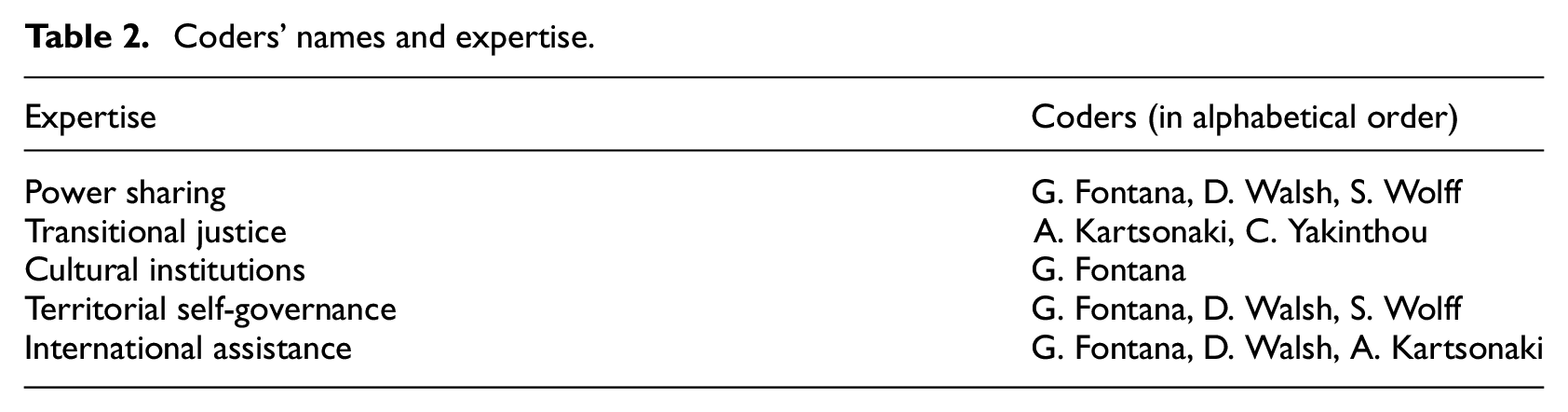
First, PAIC offers an unprecedented level of detail in its coding, responding to calls for deeper and more detailed coding of peace agreements (Staniland, 2017). The coding was carried out by a team of scholars with substantial expertise and practical experience of the design of peace agreements (see Table 2 for their names and expertise). The definition of concepts reflects the cutting-edge debates and common understandings in five overlapping research fields: power sharing, transitional justice, cultural institutions, territorial self-governance and international assistance The disaggregation of each concept facilitates qualitative investigations by identifying fine-grained differences among provisions and allows researchers to ensure that comparisons are valid and that divergent provisions are not being treated as similar. It is in line with cutting-edge studies of political violence (Petterson et al., 2019; Raleigh et al., 2010) and of broader political processes (Coppedge et al., 2019) and reflects the expectation that different provisions respond to different conditions and lead to different outcomes in a peace process. Indeed, the PAIC dataset captures the level of commitment to specific clauses by differentiating between ‘prescriptive’ and ‘enabling’ provisions. Provisions are coded as ‘prescriptive’ when they specify deadlines (e.g. for the creation of a Truth and Reconciliation Commission), verifiable pathways to implementation (e.g. for decentralization) or specific outcomes (e.g. legislative or executive representation for specific groups). They are coded as ‘enabling’ when they express intent without mapping implementation or prescribing a specific outcome (e.g. a general commitment to broad representativeness in a national government or parliament). We also distinguish between representation and participation in power sharing institutions, emphasizing the difference between who makes decisions and where (e.g. ethnic group representatives in a legislative body) and how decisions are made (e.g. by a concurrent majority vote). As a consequence, PAIC is the only dataset that allows scholars to distinguish systematically between corporate and liberal varieties of power sharing.
Second, PAIC’s fine-grained and comprehensive coding extends to mechanisms and instruments that were never coded previously on such a large scale. For example, existing datasets overlook cultural provisions, such as the reform of education systems, museums, sport and symbols and emblems. Moreover, PAIC includes a fine-grained coding of commissions, which does not appear in any existing dataset, despite their relevance to the resilience of peace agreements (see the Application section below). Its holistic and granular approach to transitional justice also allows us to understand the extent to which provisions are being combined, diluted or integrated. One particularly interesting consequence of this coding for the literature is the provision of data to identify hybrid mechanisms for transitional justice beyond the strictly judicial provisions. PAIC also gives us a unique insight into the combination of power sharing and transitional justice provisions in political agreements: two important aspects that increasingly co-exist in peace agreements today, but whose compatibility remains contested (Levin 2006).
Finally, the universe of cases in PAIC differs from existing datasets, which largely focus only on peace agreements between a government and a rebel group. As such, it speaks to recent calls for moving beyond the conventional dyadic definition of civil conflicts (inter alia related to thresholds for battle-related-deaths) and towards a theory-informed selection of cases (Sambanis and Schulhofer-Wohl, 2019). As further explained below, PAIC includes highly relevant examples of constitutional design for conflict management which are often employed as typical cases by qualitative scholars such as Kenya’s 2008 agreement or Lebanon’s 1989 Taif Agreement (e.g. Cheeseman and Tendi, 2010; Zahar, 2005). This further encourages a dialogue across methodological research cultures and promotes more mixed-method studies of peace processes.
Population, concepts and measurement
Population
We define political agreements as negotiated, written and publicly available accords between two or more parties which seek to end political violence within a state through institutional reform. 1 This definition guides the four criteria for selecting our population of political agreements:
Intra-state agreements, i.e. agreements whose purpose is to end or prevent violence in intra-state disputes (thus excluding purely regional or international agreements).
Substantial agreements, i.e. agreements that prescribe reforms to domestic public institutions (thus excluding simple pre-negotiation, procedural, and ceasefire agreements).
Written and publicly available agreements, i.e. included in the UN Peacemaker Peace Agreements Database (Mediation Support Unit, 2018), which also ensures maximum transparency and replicability.
Agreements between multiple parties, i.e. not unilateral declarations of one party only.
Applying these criteria ensures that our units of analysis (political agreements) are comparable and that our population is accessible for everyone who wants to replicate our selection procedure and coding. As Figure 1 visually summarizes, the four criteria above generated a population of political agreements which overlaps but also substantially differs from existing datasets.
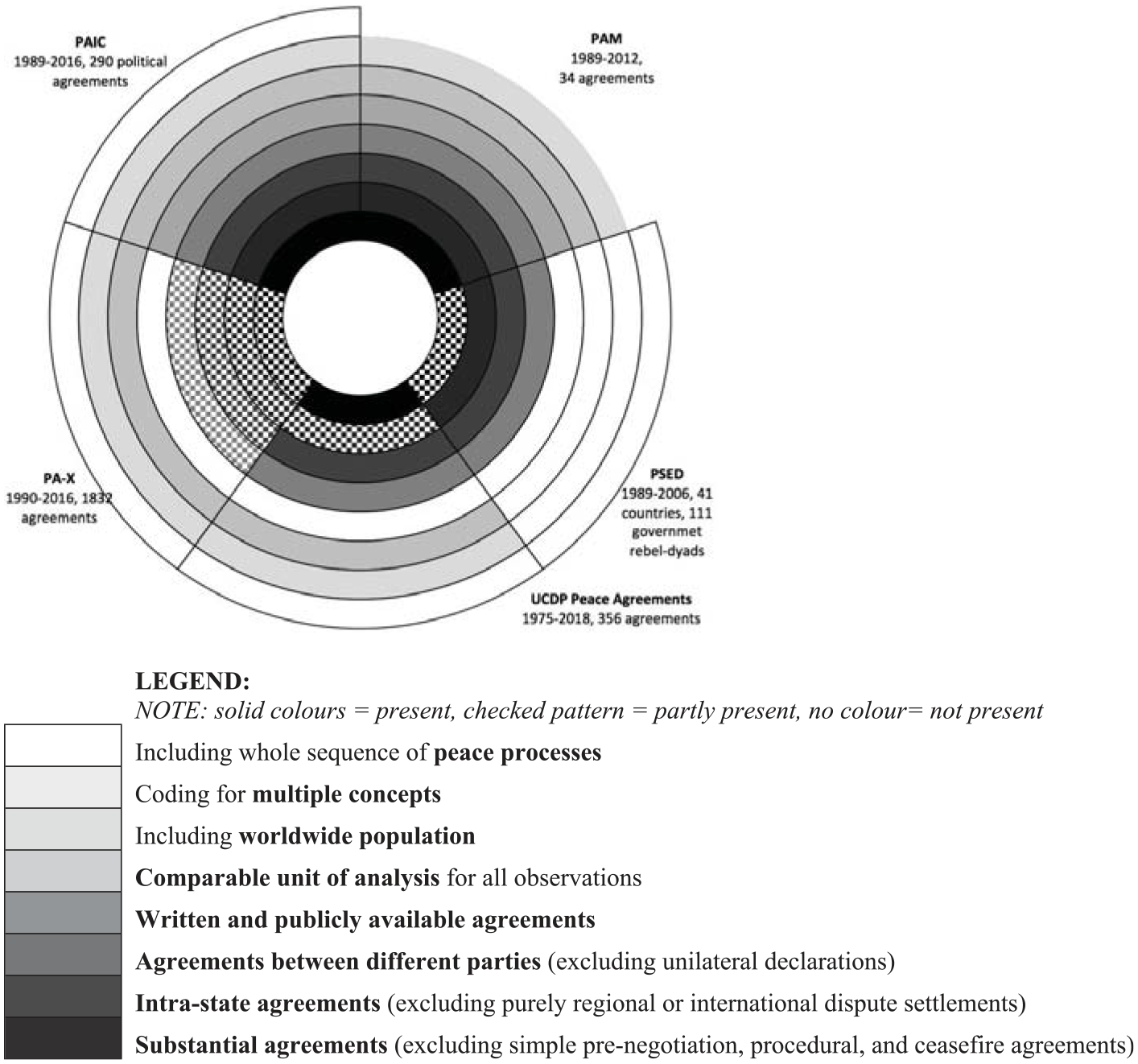
Population of peace agreements datasets compared.
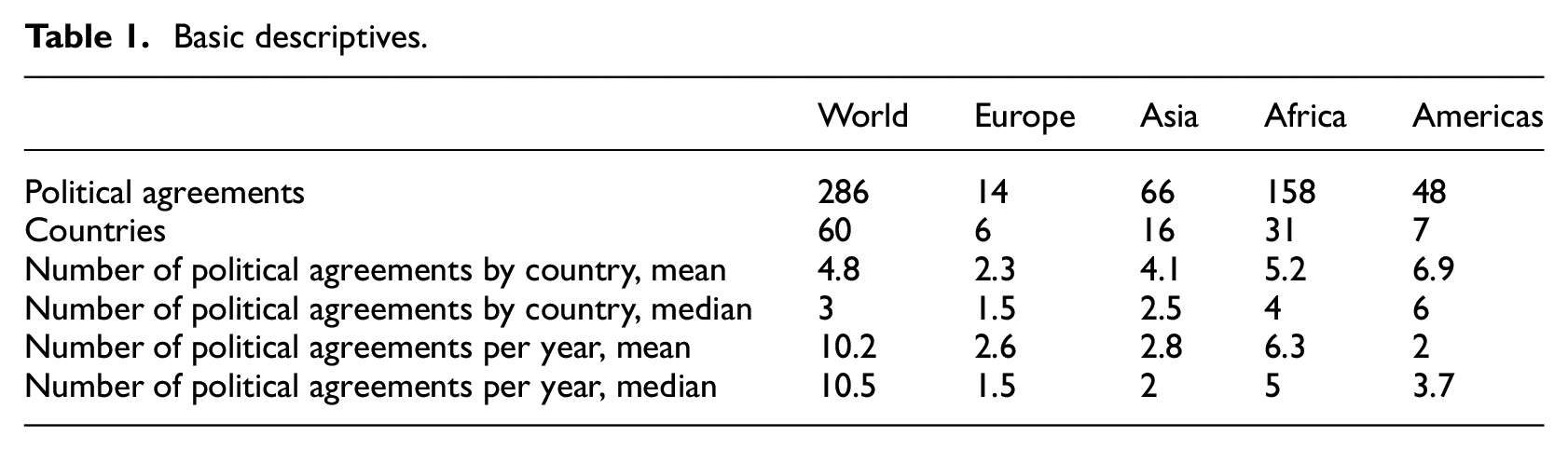
Applied to agreements concluded between 1989 and 2016 to capture the increase in intra-state conflicts (Pettersson & Wallensteen, 2015) and in negotiated settlements of conflicts (as defined by Kreutz, 2010) in this period, this selection generated a population of 286 political agreements. Table 1 includes some basic descriptive statistics for the PAIC dataset. In PAIC, each agreement is identified by a unique ID, alongside its state and UCDP conflict ID (old and new) in order to allow cross-referencing with other existing datasets (Allansson et al., 2017), aggregation along the desired level (individual polity, specific conflict) and selection of specific cases (e.g. those agreements tackling low-level conflicts, cf. Sambanis and Schulhofer-Wohl, 2019). Twenty-nine political agreements could not be linked with an existing UCDP conflict ID because they address instances of diffused political violence or rebel–rebel violence rather than a rebel–government confrontation; 2 coups and political confrontations; 3 conflicts resulting in less than 25 documented battle-related deaths per year since 1989; 4 or multiple conflicts in the case of Myanmar’s 2015 Nationwide Ceasefire Agreement between the Government of the Republic of the Union of Myanmar and the Ethnic Armed Organizations. In other words, they relate to what Staniland (2017) would term ‘armed politics’.
Basic descriptives.
The inclusion of these additional 29 cases will be particularly useful to qualitative scholars for two reasons. First, scholars who focus on these cases will now be able to evaluate how they relate to other cases in terms of agreement content. Second, scholars working on other cases can now clearly compare and contrast the provisions in agreements they study with additional empirically important cases. In both instances this increases the ability of scholars to produce generalizable analysis and findings. However, we recognize that scholars using large-scale statistical models may face a challenge when integrating these cases into their modelling as their exclusion from UCDP datasets limits access to contextual variables related to these cases.
Concepts and measurement
The dataset is structured around five overarching concepts: power sharing, transitional justice, cultural institutions, territorial self-governance and international assistance. Concepts are disaggregated owing to the expectation that different provisions reflect different conditions and lead to different outcomes in a peace process. As mentioned, the fine-grained coding is intended to facilitate valid comparison by quantitative and qualitative scholars. Figure 2 summarizes the data structure visually.
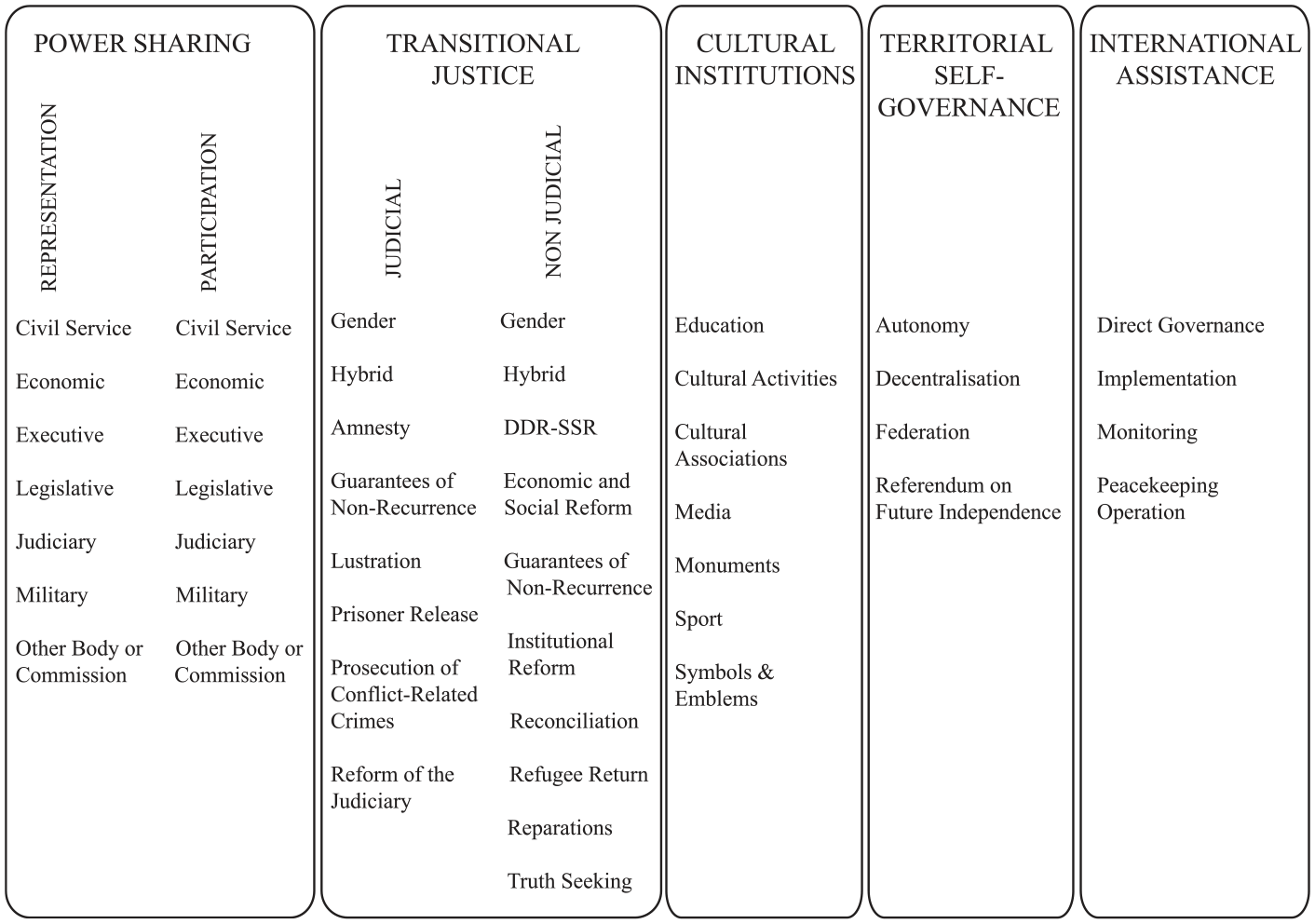
PAIC data structure.
In line with the established literature, we see political agreements as ‘packages’ of institutions (e.g. Belmont et al., 2002). The process of translating such interlocked concepts into their most fine-grained and measurable components, while ensuring the relevance and rigour of each variable, was iterative. Specifically, we followed Adcock and Collier’s (2001) framework for measurement validity to move from the five background concepts (power sharing, transitional justice, cultural institutions, territorial self-governance and international assistance) to measured indicators for the 286 political agreements.
The process of developing the concepts for inclusion in the dataset, and associated codebook, involved four stages:
Five main categories were identified from the literature as central to efforts to manage, resolve or transform intra-state conflict through institutional means (power sharing, transitional justice, cultural institutions, territorial self-governance and international assistance, details outlined further below for each dimension).
Each concept was disaggregated to reflect the different types of meaningfully distinct provisions included in agreements.
Indicators for concepts were identified relying on the cutting-edge debates in the current literature.
Each concept was further disaggregated between ‘prescriptive’ and ‘enabling’ provisions. ‘Prescriptive’ provisions specify deadlines, verifiable pathways to implementation or specific outcomes. ‘Enabling’ provisions express intent without mapping implementation or prescribing a specific outcome.
All coding decisions were made with reference to the codebook and based exclusively on the integral text of the political agreements, as available on the UN Peacemaker database (Mediation Support Unit, 2018) to ensure replicability and transparency.
Figure 2 illustrates this process for the power sharing dimension in the PAIC dataset. For clarity, we can describe how a specific provision would be coded at each stage of the process. For example, Lebanon’s Taif agreement is a landmark case for scholars of power sharing, but is not included in the UCDP Peace Agreements dataset (Petterson et al., 2019) or in PSED (Ottmann and Vüllers, 2015). The provision in Lebanon’s Taif agreement that ‘the number of members of the Chamber of Deputies shall be increased to 108, shared equally between Christians and Muslims’ (Taif Accords, 1989: 2) is clearly an instance of one of the five main concepts – power sharing. PAIC’s fine-grained coding captures the details of this provision (based on debates within the power sharing literature, discussed below) as ‘power sharing – legislature – representation’. The inclusion of details (number of deputies) makes this provision ‘prescriptive’. Even where they include the Lebanese case, existing datasets typically code only for power-sharing provisions in government (cf. Joshi and Darby, 2013; Joshi et al, 2015), the military and economic realms (cf. PA-X, 2018). PAIC differs from them, also identifying power sharing in the civil service, judiciary and commissions. For example, in the Taif agreement, the provision to ‘Abolish the sectarian representation base and rely on capability and specialization in public jobs, the judiciary, the military, security, public, and joint institutions, and in the independent agencies … excluding the top-level jobs and equivalent jobs which shall be shared equally by Christians and Muslims’ (Taif Accords, 1989: 5) is coded as ‘power sharing – civil service/judiciary/military – representation – prescriptive’.
Following the four steps above, we carried out a sample coding of 10 agreements in which all coders coded all 10 agreements across the full range of variables. With this initial coding, we aimed to verify the utility of our codebook and establish the existing degree of inter-coder reliability. To check our intercoder reliability, we ran coding comparisons using NVivo 11. We achieved a kappa co-efficient of 0.91, indicating excellent agreement between coders. Confronted with the empirical evidence in the agreements, we further refined and expanded our coding nodes to reflect the nuances of different provisions, thus generating the final version of the codebook. Maximizing individual coder expertise, we coded in teams of two coders for most of the five concepts, ensuring that experts of power sharing coded power-sharing provisions, transitional justice experts coded transitional justice provisions, etc. (see Table 2 for details). Initial coding was carried out in NVivo 11.
Coders’ names and expertise.
We then transferred our qualitative coding into a binary coding on an Excel spreadsheet. All variables are coded 1 if they are present in the political agreement – 0 otherwise. When looking at Cronbach’s α we find that power sharing has a Cronbach’s α of 0.81, transitional justice a Cronbach’s α of 0.81, cultural reforms a Cronbach’s α of 0.69, territorial self-governance a Cronbach’s α of 0.33 and international assistance a Cronbach’s α of 0.61 (where values between 0.7 and 0.95 are generally accepted; Tavakol and Dennick, 2011: 54). The low score for territorial self-governance may be caused by the rather simple coding scheme (autonomy, decentralization, federation and referendum on future independence). The lack of consistency of the variables we coded in less depth corroborates the value of in-depth coding. Future iterations of the dataset will look further into the measurement of territorial self-governance and international assistance.
Finally, we added further standard control variables (see below). We also employed a research assistant to check coding across a random selection of 10% of agreements to ensure the reliability of our measurements and of our codebook.
Power sharing
The conceptualization and operationalization of the power sharing variable draws on the extensive debate between proponents of consociational power sharing (e.g. Lijphart, 1977, 2002; McGarry and O’Leary, 2008a, b) and proponents of centripetal power sharing (e.g. Horowitz, 2003, 2008; Reilly, 2001, 2012). Despite extensive disagreements over what constitutes power sharing (Binningsbø, 2013; Horowitz, 2014; Sambanis and Schulhofer-Wohl, 2019; Strøm et al., 2017), both schools of thought focus on two core dimensions of the concept. First, they consider power sharing as reflecting the representation of groups (who makes decisions and where). For example, the Washington Agreement for Bosnia and Herzegovina entrenches power sharing inter alia by providing for representation of the three constituent peoples across public institutions, including the judiciary: There shall be a Supreme Court, which shall have selective appellate jurisdiction from the courts of the cantons and such jurisdiction as specified in the Constitution and in legislation. The members of the Court shall be nominated by the President and elected by the Legislature, and shall consist of an equal number of judges from each of the constituent peoples. (Washington Agreement, 1994: 6)
Scholars also show that power sharing stems from participation of relevant groups in decision making (through rules on how decisions are made). For example, the Washington agreement clearly states that ‘Decisions of the Government that concern the vital interest of any of the constituent peoples shall require consensus’ (Washington Agreement, 1994: 6). The dimensions of representation and participation may be expressed in a number of fields (e.g. political, military, economic, judiciary) with important implications for the stability of the settlement (Bormann et al., 2019; Hartzell and Hoddie, 2007; McCrudden and O’Leary, 2013; Schneckener, 2002). We drew on these theoretical debates to conceptualize and operationalize power sharing, as graphically illustrated in Figure 3. 5 In doing so, we offered a crucial contribution to existing data on the content of peace agreements: before PAIC, datasets only identified political, military and economic power sharing (cf. Joshi and Darby, 2013; Joshi et al., 2015; Ottmann and Vüllers, 2015; PA-X, 2018).
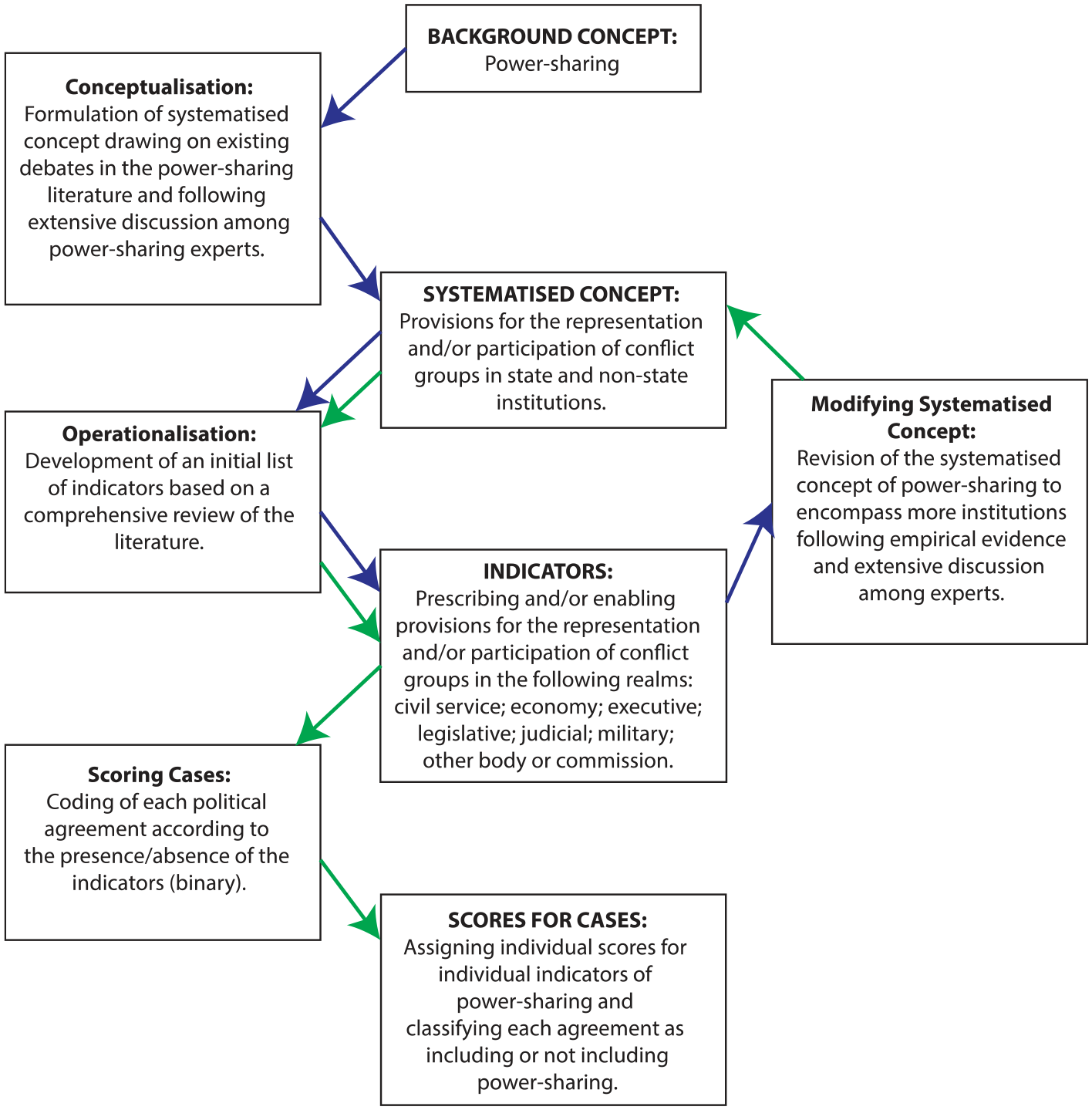
Power sharing from concept to measurement (cf. Adcock and Collier, 2001).
The PAIC codebook explains in extensive detail the operationalization of each fine-grained indicator for power sharing. For example, legislative power sharing is coded as 1 when a political agreement includes the indicators summarized in Table 3. Additional indicators refer to power sharing in the executive, judiciary, civil service, economy, military and other bodies and commissions.
Operationalization of power sharing in the legislature. For the whole range of dimensions of power sharing, please see the codebook.
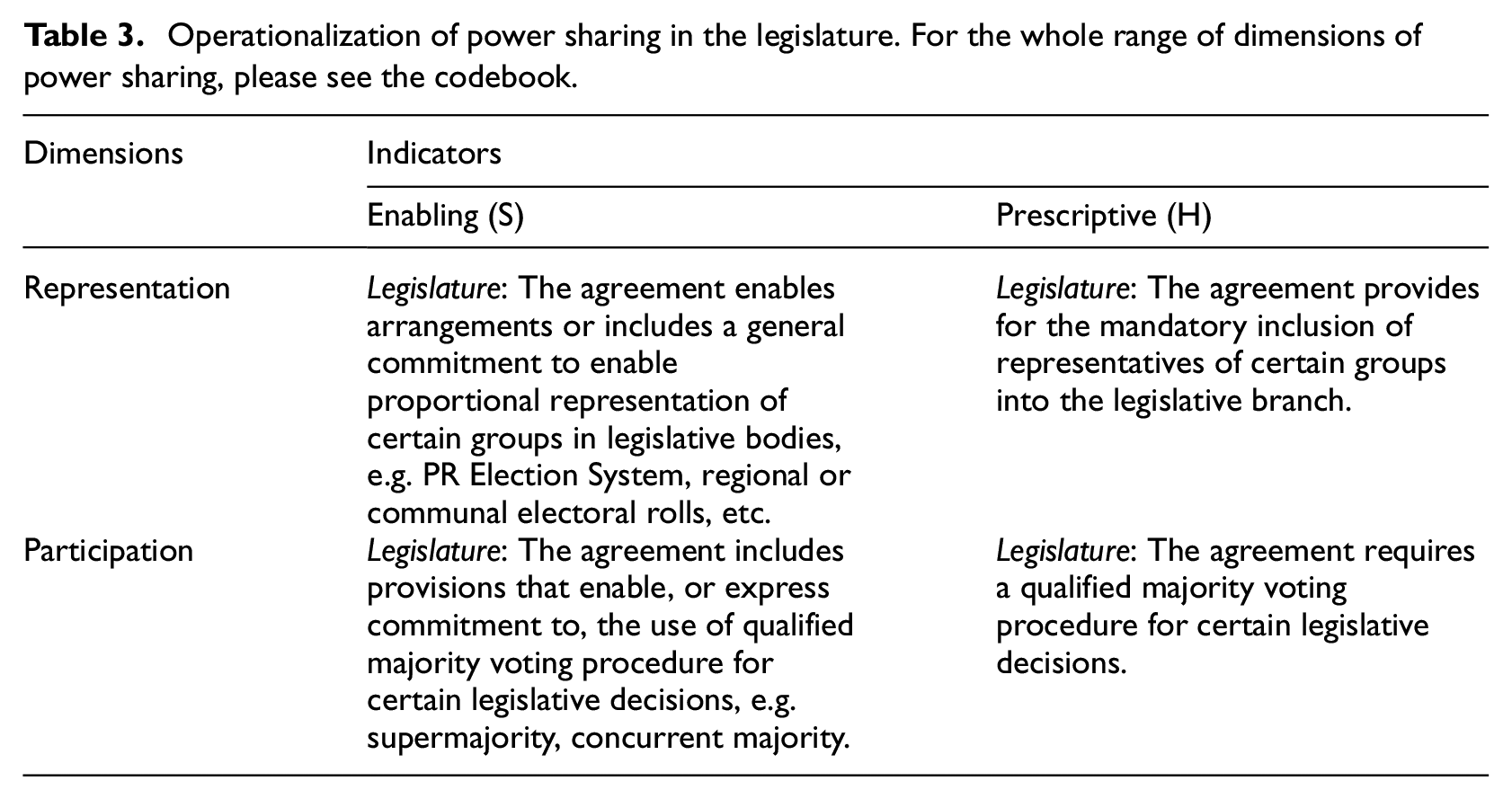
We find that two-thirds of political agreements (67%) include some form of power sharing. Measures ensuring the representation of politically relevant groups in state institutions are more frequent than provisions on participation in decision-making: 66% of agreements specify who makes decisions, but only 17% of agreements consider rules of decision-making.
In an important contribution to the existing literature we find that power sharing embedded in other bodies and commissions occurs far more frequently than in the core legislative (e.g. parliament), executive (e.g. cabinet), military, economic or judicial institutions (e.g. courts). For example, Burundi’s Arusha accords establish power sharing inter alia through rules for the representation of previously warring groups in commissions: The Ceasefire Commission shall consist of representatives of the Government, the combatants of the political parties and movements, the United Nations, the Organization of African Unity and the Regional Peace Initiative for Burundi. (Arusha Peace and Reconciliation Agreement for Burundi, 2000: 72)
The same accord also maps the participation of all groups in decision-making: ‘The Ceasefire Commission shall take its decisions by consensus’ (Arusha Peace and Reconciliation Agreement for Burundi, 2000: 72). This suggests an important role for a previously overlooked institution (commissions) in sustaining peace agreements, as the Application section below confirms.
Transitional justice
The United Nations sees transitional justice as comprising ‘the full range of processes and mechanisms associated with a society’s attempts to come to terms with a legacy of large-scale past abuses, in order to ensure accountability, serve justice and achieve reconciliation. These may include both judicial and non-judicial mechanisms, with differing levels of international assistance (or none at all) and individual prosecutions, reparations, truth-seeking, institutional reform, vetting and dismissals, or a combination thereof’ (United Nations Security Council, 2004). Following this definition, we code transitional justice along two parsimonious dimensions of ‘judicial’ and ‘non-judicial’, broken down into 19 specific mechanisms: lustration, guarantees of non-recurrence, prisoner release, amnesty, prosecution of conflict-related crimes, judiciary reform, disarmament, demobilization and reintegration (DDR), security sector reform (SSR), economic and social reform, gender, institutional reform, reconciliation, refugee return, reparations, gender, hybrid and truth-seeking. We operate with a broad definition of transitional justice to include issues usually at the boundaries of the field, such as DDR, SSR and particular aspects of refugee return (see also Grodsky, 2009). 6
This extensive coding enables us to concretely engage with debates around the impact of holistic approaches to transitional justice in post-conflict societies (Arthur, 2009; Nickson and Braithwaite, 2014; Ramji-Nogales, 2001; Sharp, 2014; Yakinthou and Croeser, 2016). It is particularly important to note in this context that we coded on an inclusive basis to identify all transitional justice provisions. This enables other researchers to examine whether there are competing provisions or provisions that reflect competing interests. Choosing to code approaches such as prosecutions and amnesty horizontally (without a value judgement as to whether they may be internally competing) makes it possible to identify clashing provisions when reviewing the dataset.
The conceptualization and operationalization of transitional justice provisions is described extensively in the codebook. As an illustrative example, a political agreement is coded as including (judicial) prosecution of conflict-related crimes if it expresses intent to prosecute conflict-related crimes or refers to a general prohibition of amnesty. For example, the Central African Republic’s 2015 Republican Pact for Peace, National Reconciliation and Reconstruction provides for the introduction of a constitutional provision ruling out the possibility of amnesty for crimes against humanity, war crimes and crimes of genocide committed in the Central African Republic. (Republican Pact for Peace, National Reconciliation and Reconstruction, 2015: 3)
Conversely, an agreement includes a non-judicial provision for truth-seeking if it expresses intent to establish a truth and/or reconciliation commission or another non-judicial body that gives space to victims and marginalized groups of the population that suffered conflict-related violence. Truth seeking may also refer to other fact-finding bodies, documentation efforts related to atrocities and other efforts to seek information about atrocities committed during or as part of the conflict. For example, El Salvador’s 1991 agreements establishes a Commission on the Truth: The Commission shall have the task of investigating serious acts of violence that have occurred since 1980 and whose impact on society urgently demands that the public should know the truth. (Mexico Agreement, 1991: 5)
Over two-thirds of the political agreements in the PAIC dataset include provisions for transitional justice (69%). Non-judicial provisions are more frequent than their judicial counterparts (64% of agreements containing the former and 46% of agreements containing the latter). We find that provisions usually considered to be at the boundaries of the field are frequently employed to address legacies of widespread abuse, through reparations (37%), disarmament, demobilization and reintegration or security sector reform (DDR − SSR, 35.6%) and refugee return (28%). We also find that, contrary to the widespread turn in the last decade towards questioning their legality as human rights norms have evolved (Laplante, 2009), amnesties remain common in existing political agreements, and are far more frequent than provisions for truth seeking (27% compared with 13% of agreements).
Cultural institutions
In his seminal works, Johan Galtung identified three types of violence: direct violence (what we commonly identify as war or violent conflict); structural violence (the social hierarchies and injustices which often underpin direct conflict); and cultural violence, encompassing those aspects of culture, the symbolic sphere of our existence […] that can be used to justify or legitimise direct or structural violence. (Galtung, 1990: 291)
In affirming that ‘entire cultures can hardly be classified as violent’, Galtung (1990: 191) nonetheless suggests specific aspects of selected ‘cultures’ that may underpin conflict (religion, ideology, language, art, empirical science, formal science and cosmology). We take this logic a step further in coding the mechanisms and institutions through which such aspects of culture may be expressed, reproduced and even transformed following a political agreement.
The PAIC dataset intends to be a first step in a broader research agenda examining the relationship between these cultural expressions of violence and sustainable peace, as no existing dataset codes systematically for all these institutions on such a large scale. In an iterative process based on fine-grained and comprehensive coding of the political agreements in the PAIC dataset, we identify seven instruments for cultural reform: cultural activities, cultural associations, education, monuments, sport, symbols and the media. For example, a political agreement addresses the media if it includes reforms of the communication media and/or of their political function with or without deadlines or specifications. In Colombia’s 2016 Final Agreement for the Termination of the Conflict and Construction of a Stable and Lasting Peace, the government and FARC commit to establishing ‘Broadcasters for coexistence and reconciliation’, specifying further that 20 stations will be established in FM, of public interest, class ‘C’, in the areas most affected by the conflict … will be assigned to Radio Televisión Nacional de Colombia – RTVC, with the aim of teaching the contents and informing about the progress of the implementation of the Final Agreement. For 2 years, the Joint Communications Committee, composed of delegates from the National Government and the FARC-EP in transit to civilian life, will define, by mutual agreement, the contents of pedagogy and its production. The stations may operate 24 hours a day. (Final Agreement for the Termination of the Conflict and Construction of a Stable and Lasting Peace, 2016)
An overview of the PAIC dataset shows that cultural reforms are a moderately common feature of intra-state political agreements, with 40% of agreements charting reforms of cultural institutions. Thus, it is surprising that so little attention has been paid to their long-term impact on the resilience and success of war-to-peace transitions. Reflecting both their salience during conflict and widespread international attention paid to them, education and the media are the most common targets of reform in the aftermath of violent conflict (with 29 and 21% of agreements addressing them, respectively).
Territorial self-governance
Territorial self-governance establishes the legally entrenched power of territorially delimited entities within the internationally recognized boundaries of existing states to exercise public policy functions independently of other sources of authority in this state, but subject to its overall legal order (Wolff, 2013: 32). A vigorous debate has been ongoing within the civil conflict literature between scholars arguing that the dispersion of power through territorial self-governance arrangements mitigates conflict by affording identity groups a degree of recognition, control and security, and those who maintain that such arrangements aggravate conflict by accentuating differences and providing rebels with greater opportunities to challenge the state, and potentially secede (Bormann et al., 2019; Cederman et al., 2015; Elkins and Sides, 2007; Horowitz, 1985; McGarry, 2007; Meadwell, 2009; Nordlinger, 1972; Vogt et al., 2015).
These arguments revolve around the extent of the powers enjoyed by distinct levels of government as well as the foundation of the legitimate exercise of these powers. Typically, existing peace agreements datasets code territorial self-governance as general instances of ‘decentralization/federalism’ (Joshi and Darby, 2013; Joshi et al., 2015). However, in order to more precisely capture how different types of territorial self-governance reflect different approaches to territorial state construction, symmetry and asymmetry of self-governance provisions, and their legal entrenchment, PAIC distinguishes between federation, autonomy and decentralization, and adds a fourth category of ‘referendum’ mapping a path to independence. Other studies simply include territorial provisions as instances of ‘territorial power sharing’ (cf. Ottmann and Vüllers, 2015; PA-X. 2018). However, there is some debate as to whether territorial self-governance, especially in the absence of federation or similar shared-rule provisions, is more accurately seen as power dividing or power dispersion rather than power sharing. PAIC’s separate coding focuses on the dispersion of power. However, scholars interested in territorial power sharing can easily re-integrate, into their operationalization of power sharing, some or all the elements of territorial self-governance coded in PAIC.
The codebook describes the operationalization of each category of territorial self-governance. By way of example, an agreement includes federation if it establishes structures with distinct and exclusive competences for a federal government and lower-level constituent entities which are entrenched in the constitution and cannot be unilaterally altered by either side (McGarry and O’Leary, 2013). For example, Somalia’s 2004 Transitional Federal Charter, states that The Somali Republic shall comprise of: (a) The Transitional Federal Government. (b) State Governments (two or more regions federate, based on their free will) (c) Regional Administrations (d) District administrations. (The Charter then details the specific responsibilities of each level of government; Transitional Federal Charter, 2004: 4)
Therefore, it is coded as ‘Territorial self-governance – federation – prescriptive’.
Basic descriptive statistics for the PAIC dataset show that territorial self-governance remains rare, with only 23% of political agreements including provisions for the allocation of an independent public policy role to a sub-state geographic unit. By providing additional fine-grained data on the application of territorial self-governance worldwide, PAIC shows that decentralization is the most common category (with 10% of agreements including provisions for decentralization). Only 2% of the agreements in PAIC include provisions for an independence referendum, confirming the sui generis nature of these provisions.
International assistance
International assistance is a practice frequently enshrined in political agreements in internal conflicts, with international organizations, third-party states and high-profile individuals acting in a wide range of roles from the earliest stages of a peace process (e.g. by mediating initial ceasefires), to the implementation of agreements (e.g. by administrating elections and verifying their results), to the peace-building stage (e.g. by repairing and constructing physical infrastructure). Existing scholarship notes the increase in such involvement immediately after the end of the Cold War and the challenges that international actors face during these interventions (Jarstad and Sisk, 2008; Paris and Sisk, 2009; Stedman et al., 2002). Moreover, it has long been recognized that third-party involvement significantly differs in terms of its ‘depth’ (Bercovitch and Houston, 2000; Touval and Zartman, 1985). Building on this work, we coded international assistance into four central categories: monitoring, implementation, direct governance and peace-keeping operations. This definition is considerably broader than that employed in many existing datasets and in quantitative studies, which often focus on UN peacekeeping and military interventions, their impact and variations over time (Fortna, 2008; Howard and Stark, 2018; Joshi and Darby, 2013; Joshi et al., 2015; Paris, 2003; PA-X, 2018; Sambanis and Schulhofer-Wohl, 2007). Thus, PAIC provides a vital insight into certain types of international interventions. Scholars focused on peace-keeping operations will be able to use PAIC to ascertain and analyse when and where provisions for such operations are included in peace agreements. However, international actors have also been assigned important roles in agreements beyond peacekeeping, and PAIC also captures these cases, thus allowing for the comparative analysis of the wider range of roles third-party actors assume. For example, PAIC captures instances of involvement of influential non-military actors, such as the Catholic church and Amnesty International, in Colombia’s 1991 Final Agreement between the National Government and the Popular Liberation Army: To obtain the presence of institutions which are neither governmental nor international democratic entities in the act of surrendering weapons, it is agreed that the national government and the EPL will offer invitations to the UN, Amnesty International, the Church and some international entities. (Final Agreement between the National Government and the Popular Liberation Army, 1991: 5)
The codebook explains the conceptualization and operationalization of each level of involvement. An agreement includes monitoring if it provides for the international community generally or a specific third party to monitor or verify the implementation of either the agreement broadly or of a specific element within the agreement. For example, Angola’s 1994 Lusaka Protocol states that the ‘Overall supervision, control and verification of the re-established ceasefire will be the responsibility of the United Nations’ (Lusaka Protocol, 1994: 9). Similarly, Chad’s 2009 Peace Agreement between the Government of the Republic of Chad and the National Movement establishes that ‘The Great Socialist People’s Libyan Arab Republic is responsible for the application of this Agreement’ (Peace Agreement between the Government of the Republic of Chad and the National Movement, 2009: 3).
We find that international assistance is a common feature of intra-state political agreements, with 65% of agreements including a role for international actors and we can also observe an overall slight decline in international involvement (Figures A6–A9 in the Online Appendix) as already suggested by Howard and Stark (2018). Third parties are mostly charged with implementation assistance (in 50% of agreements), followed by a monitoring role (in 45% of agreements). Only 1% of agreements include provisions for direct governance by the international community.
Using the data
Eberwein (2017) suggests that datasets are interesting in three respects: to provide data on policy development, to evaluate past performance and to inform new policies. In addition, the PAIC dataset is particularly suitable for helping theory building by allowing for rigorous selection of case studies for nuanced and rich qualitative investigations of statistically significant effects or to test hypotheses generated by in-depth qualitative work against the whole population of political agreements. Moreover, as we demonstrate below, PAIC is also useful to reassess existing findings and theories against expanded and more fine-grained data.
To allow for easy use of PAIC for quantitative as well as qualitative scholars, we added a substantial amount of standard identifying variables including Correlates of War country code (The Correlates of War Project, n.d.), Gleditsch and Ward country codes (Gleditsch and Ward, 1999), ISO 3 three-digit country number (International Organization for Standardization, n.d.), UCDP conflict IDs (the old conflict id as well as the new version; The Uppsala Conflict Data Program, n.d.) and battle deaths (Allansson et al., 2017; Gleditsch et al., 2002; UCDP/PRIO Armed Conflict Dataset Codebook, n.d.). Control variables and dependent variables are included for up to 10 years after the conclusion of a political agreement. As a result, the dataset can be used for cross-sectional as well as for time-series cross-sectional analysis.
This dataset has three main limitations. First, our dataset only focuses on internal conflicts. However, internal armed conflict has been the dominant form of violent conflict in recent decades, and deserves special attention (Eberwein, 2008). A focus on internal conflicts is crucial to inform debates on institutional design in the context of the termination and transformation of internal conflicts. Second, this dataset only presents the ‘promises’ of political agreements (Ottmann and Vüllers, 2015), and does not trace their implementation. This is in line with most other large peace agreement datasets (Language of Peace, 2019; Petterson et al., 2019; PA-X, 2018). PAIC’s coding of prescriptive and enabling provisions indicates the extent of commitment to implementation of their different components. Moreover, the inclusion of state and UCDP conflict IDs for each political agreement allows for cross-referencing with other existing datasets which code for implementation of a selected number of political agreements (e.g. Joshi and Quinn, 2017; Ottmann and Vüllers, 2015; and partially Strøm et al., 2017). Finally, new projects born out of the PAIC dataset and focusing on a smaller selection of agreements code for implementation. This is in line with other existing datasets coding for implementation, which typically focus on fewer than 45 countries (e.g. Joshi and Quinn, 2017; Ottmann and Vüllers, 2015).
Application
This section will evaluate how the PAIC dataset can be used to replicate existing quantitative studies, demonstrating its rigour, usefulness and validity vis-à-vis current datasets. The number of peace agreement datasets has expanded over the past decade, with several databases partly overlapping with PAIC (Druckman and Wagner, 2017; Högbladh, 2011; Joshi et al., 2017; Joshi and Darby, 2013; PA-X, 2018). Many of these datasets have been employed to test broad hypotheses, including the hypothesis that the inclusion of (several) power sharing provisions improves the chances of success of a peace agreement (Hartzell and Hoddie 2007; Jarstad and Nilsson, 2008; Mattes and Savun, 2009; Mukherjee, 2006; Norris, 2008; Ottmann and Vüllers, 2015; Walter, 2002).
To illustrate the unique contribution of the PAIC dataset to this broad academic debate, we decided to replicate a widely accepted empirical finding in conflict studies: Hartzell and Hoddie’s Crafting Peace (2007). We chose to replicate this seminal work for two reasons. First, several members of our team have a keen interest in power sharing. Hartzell and Hoddie (2007) evaluate the impact of power sharing on war-to-peace transitions by focusing on the relationship between power sharing provisions in peace agreements (rather than their implementation) and the non-occurrence of violence in the aftermath of the peace agreement. Second, despite an increasing number of datasets and burgeoning research on power sharing, Hartzell and Hoddie’s 2007 findings remain a fundamental part of the orthodoxy regarding the long-term impact of power sharing and are routinely cited by both qualitative and quantitative scholars (for example, Bormann et al., 2019; Cederman et al., 2015; McCrudden and O’Leary, 2013). Hence, most readers of this manuscript would be familiar with their writings and a replication of Crafting Peace can illustrate well the usefulness and novelty of the PAIC dataset.
Like Hartzell and Hoddie (2007: 78, table 7 replicates their results), we look at the five years after the conclusion of an agreement and estimate the risk of resumption of violent conflict. Hartzell and Hoddie’s dataset partly corresponds to the PAIC dataset, but PAIC includes a larger number of cases and focuses on the post-Cold War period only. Therefore, for the purpose of replication, we used the same statistical model (Cox proportional hazard model) and control variables (Table A3 of the Online Appendix). As the PAIC dataset only includes agreements concluded after 1989, we do not account for structure of the international system (coded as a binary indicator of Cold War and post-Cold War in Hartzell and Hoddie, 2007) because it is unnecessary.
Our main independent variable (the inclusion of power sharing provisions in a political agreement) is measured through the relevant variable in PAIC, leading to a finer-grained measure of power sharing. PAIC accounts for six dimensions of power sharing: political, economic, military, judiciary, civil service and other body or commissions (see also the Online Appendix). In contrast to Hartzell and Hoddie (2007), we do not include territorial power sharing in our independent variable because territorial self-governance (in the form of dispersion of power to the subnational level) is not indicative of co-decision-making by the conflict parties, which is the core feature of power sharing (see also the operationalization of territorial self-governance above). 7 PAIC captures provisions that afford representatives of self-governing units a voice in central government institutions through power-sharing variables. 8
To illustrate the usefulness of our dataset in general, we only use the control variables from Hartzell and Hoddie 2007 as a baseline comparison model for the statistical models (Model 1, Table 4).
Replicating Hartzell and Hoddie 2007 using PAIC data.
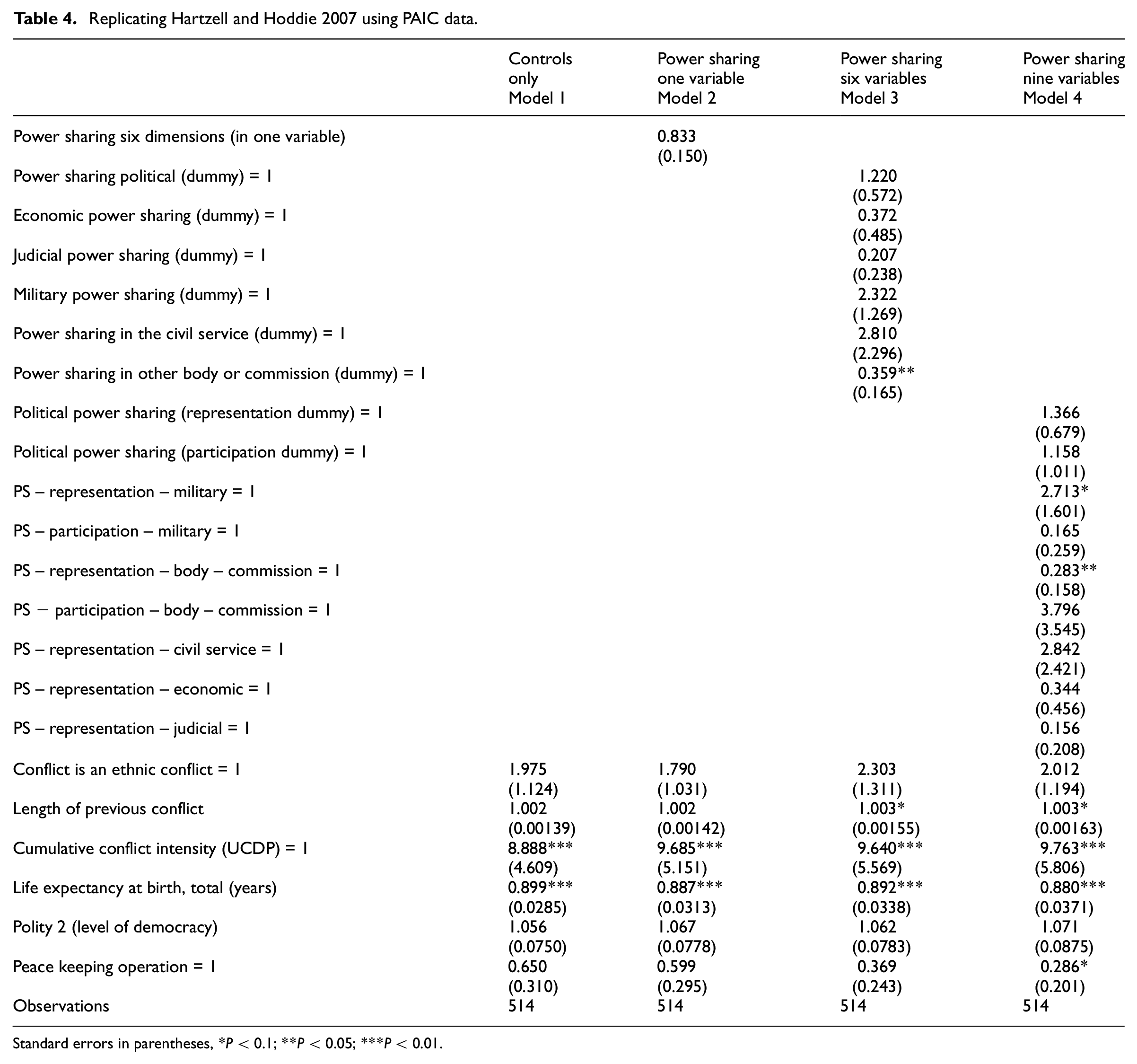
Standard errors in parentheses, *P < 0.1; **P < 0.05; ***P < 0.01.
The second model uses a cumulative variable of all six dimensions of power sharing, ranging from 0 to 6 (Model 2 in Table 4). This is the closest model to Hartzell and Hoddie’s (2007) study. On the one hand, our model points to a similar relationship between a cumulative power sharing variable and the likelihood of peace to fail (i.e. the likelihood of conflict to recur). However, this effect is not significant. In other words, our data does not provide statistically significant evidence that more power sharing is necessarily better for resolving intra-state violent conflict.
However, the results change when we split the power sharing variable into six individual dummy dimensions (Model 3 of Table 4), reflecting the six dimensions in the PAIC dataset: political, economic, military, judiciary, civil service and other body or commissions. Model 3 reveals a significant positive effect of power sharing in other bodies or commissions, with this provision increasing the likelihood of lasting peace after a political agreement. When we employ even finer-grained variables, breaking down power sharing into provisions for determining who sits on other bodies or commissions (representation) and provisions for mapping rules of decision-making (participation), our evidence suggests that the representation of politically relevant groups in other bodies or commissions is crucial to increasing the length of a post-agreement period of peace (Model 4 in Table 4). Yet the empirical evidence, as always with regression analysis, does not allow us to make a causal claim.
Figure 4 shows two survival functions based on Model 4 where one survival function shows the likelihood of survival of peace if a political agreement does not include any power-sharing provisions (dashed line) in comparison with the likelihood of survival of a political agreement including only a specific type of power sharing: representation in other body or commission (continuous line). It is apparent that provisions to include representatives of politically relevant groups in other bodies or commissions crucially increase the length of a peace spell. 9 Indeed, political agreements providing for the representation of politically relevant groups in other bodies or commissions are 8% more likely to survive than agreements that do not include any power sharing dimensions. This finding does not depend on survival analysis, but we find similar evidence when we look at a logit estimation on the recurrence of conflict after the signing of a political agreement (see Table A1 in the Online Appendix).
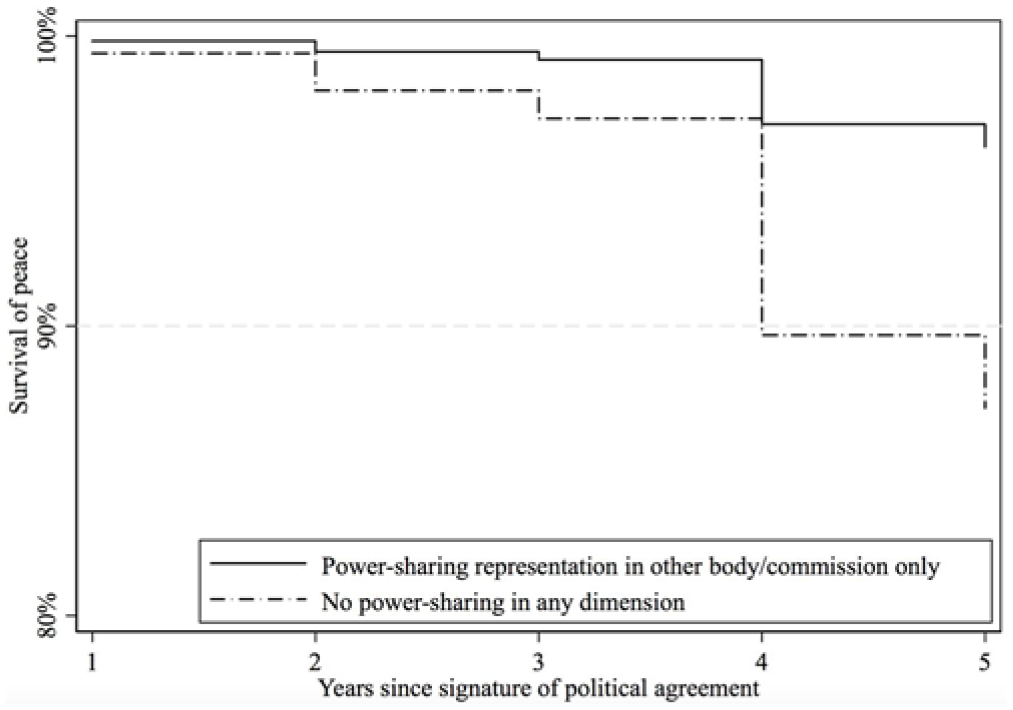
Effect of power sharing representation and participation on the survival of peace. Six power-sharing dimensions in nine dummy variables divided into participation and representation for each dimension (political, economic, judicial, military, civil service, and other body or commission) for Model 4 in Table 4.
Further research will be necessary to fully establish the causal mechanisms which underlie the statistical relationship between power sharing in commissions and peace. At this juncture we can make some early suggestions based on the logic behind the delegation of governance tasks to these bodies (see Walsh, 2014, 2017, 2018). Frequently both sequencing and mandates provide that independent commissions are among the first institutions established in the aftermath of a peace accord, increasing the likelihood that power sharing provisions in this arena are implemented. In line with Jarstad and Nilson (2008), this may account for their greater impact.
Moreover, the ‘credibility hypothesis’, developed to explain the creation of independent commissions in non-conflict environments, argues that ‘political sovereigns are willing to delegate important powers to independent groups to increase the credibility of their policy commitments’ (Majone, 2001). In the post-conflict context, even where a political agreement has resolved the core issues which led to conflict, conflict parties may still have different preferences with regard to a wide range of policies. In this environment, the delegation of powers to an independent body can overcome logjams which could become sources of renewed violence.
Furthermore, a ‘delegation hypothesis’ proposes that if certain tasks are delegated to commissions, this could lower the political cost of making decisions that may be unpopular with important constituencies of the conflict parties while being beneficial to wider society. Delegation allows political leaders to place the ‘blame’ for such decisions on the commissions, whose composition often extends beyond political leaders to technical experts and representatives of civil society. This can insulate political leaders from accusations of sell-out based on their willingness to compromise, protect them against electoral out-bidding by more hard-line politicians, and prevent more extreme political leaders from gaining power (Walsh, 2014).
Finally, our finding regarding the importance of power sharing in commissions also highlights the broader importance of inclusion in successful war-to-peace transitions and the continuing efforts required in implementing and operating political agreements and the institutions they create to end violence. Commissions afford a critical opportunity to depoliticize the search for solutions to politically and emotionally charged problems and to include representatives from other segments of society not directly connected to the immediate conflict parties in a wider peace process from which they might otherwise be excluded. In this sense, the value of commissions may also lie in their ability to facilitate sequencing in peace processes and in gradually broadening and entrenching coalitions of support that can work as a critical backstop against conflict recurrence. The non-confrontational nature of these bodies may also make it more likely that they will embed power-sharing practices, as outlined in Bormann et al (2019). These and other causal mechanisms need to be investigated further in qualitative work, but they point to the importance of sustained international assistance beyond the conclusion of an agreement. Most importantly, mediators need to be aware of the options that commissions present, the need to make them representative and the fact that they may require long-term international assistance to be effective.
Conclusion
This article presented the PAIC dataset, which relies on expert and fine-grained coding of 286 political agreements aiming to manage or ameliorate violent conflict between 1989 and 2016. Owing to its innovative approach and its empirical relevance, we expect the PAIC dataset to open up opportunities for novel research agendas in three main respects.
First, the PAIC dataset includes new information about phenomena of high empirical relevance: cultural reform, territorial self-governance and power sharing in commissions. Therefore, it will allow scholars to investigate hitherto overlooked provisions of peace settlements and the conditions under which they occur. For example, Fontana is exploring the contextual factors leading to the adoption of specific cultural provisions in a political settlement. She is also analysing the relationship between cultural reforms and sustainable peacebuilding in conflict-affected societies (Fontana, 2017, 2019). Walsh is building on the finding that power sharing in commissions may contribute decisively to the resilience of a pact, by examining the setup and impact of independent commissions in and after peace processes worldwide (Walsh, 2017, 2018).
Second, PAIC’s fine-grained and comprehensive qualitative coding encourages mixed methods investigation by facilitating the systematic and rigorous selection of case studies and allowing for the testing of qualitative and quantitative research questions with unprecedented precision. Indeed, by allowing for the aggregation of data at the polity and conflict level, PAIC contributes to critical research agendas laid out, inter alia, by Sambanis and Schulhofer-Wohl (2019). Moreover, by including accords addressing instances of ‘armed politics’ (Staniland, 2017) PAIC may be employed to shed light on the end of armed orders worldwide. Finally, by combining breadth with depth of data, PAIC could result in studies combining statistical models on PAIC with qualitative case-based investigations, as well as in research employing qualitative comparative analysis of PAIC combined with qualitative case-focused comparisons. Neudorfer et al.’s (2020) analysis of the effect of territorial self-governance, and Fontana and Masiero’s (2020) exploration of the impact of cultural reform on intra-state agreements are examples of studies employing statistical models on PAIC and qualitative case-based investigations. Fontana et al. (2020) combine qualitative comparative analysis of PAIC with qualitative case-focused comparisons to investigate the significance of provisions for education reform and transitional justice.
Third, we expect that PAIC and the research based on its nuanced data will enable scholars to offer context-specific policy recommendations that inform future peace negotiations and agreement design. For example, team members are currently examining the conditions for civil war recurrence drawing on a selected number of agreements in PAIC and, inter alia, coding for their implementation (Fontana et al., 2020b). PAIC would also allow investigation of peace processes as a series of agreements and better understanding of the relationship between agreements, international assistance, and what constitutes ‘continuity’ (Sambanis and Schulhofer-Wohl, 2019: 1548, see also Staniland, 2017: 461). This effort could engage a variety of practitioners and policymakers in the search for best practices to attain sustainable peace, justice, and democracy.
Supplemental Material
sj-do-2-cmp-10.1177_0738894220944123 – Supplemental material for The dataset of Political Agreements in Internal Conflicts (PAIC)
Supplemental material, sj-do-2-cmp-10.1177_0738894220944123 for The dataset of Political Agreements in Internal Conflicts (PAIC) by Giuditta Fontana, Argyro Kartsonaki, Natascha S Neudorfer, Dawn Walsh, Stefan Wolff and Christalla Yakinthou in Conflict Management and Peace Science
Supplemental Material
sj-docx-1-cmp-10.1177_0738894220944123 – Supplemental material for The dataset of Political Agreements in Internal Conflicts (PAIC)
Supplemental material, sj-docx-1-cmp-10.1177_0738894220944123 for The dataset of Political Agreements in Internal Conflicts (PAIC) by Giuditta Fontana, Argyro Kartsonaki, Natascha S Neudorfer, Dawn Walsh, Stefan Wolff and Christalla Yakinthou in Conflict Management and Peace Science
Supplemental Material
sj-pdf-4-cmp-10.1177_0738894220944123 – Supplemental material for The dataset of Political Agreements in Internal Conflicts (PAIC)
Supplemental material, sj-pdf-4-cmp-10.1177_0738894220944123 for The dataset of Political Agreements in Internal Conflicts (PAIC) by Giuditta Fontana, Argyro Kartsonaki, Natascha S Neudorfer, Dawn Walsh, Stefan Wolff and Christalla Yakinthou in Conflict Management and Peace Science
Supplemental Material
sj-xlsx-3-cmp-10.1177_0738894220944123 – Supplemental material for The dataset of Political Agreements in Internal Conflicts (PAIC)
Supplemental material, sj-xlsx-3-cmp-10.1177_0738894220944123 for The dataset of Political Agreements in Internal Conflicts (PAIC) by Giuditta Fontana, Argyro Kartsonaki, Natascha S Neudorfer, Dawn Walsh, Stefan Wolff and Christalla Yakinthou in Conflict Management and Peace Science
Footnotes
Funding
The authors received no financial support for the research, authorship, and/or publication of this article.

Supplemental material
Notes
References
Supplementary Material
Please find the following supplemental material available below.
For Open Access articles published under a Creative Commons License, all supplemental material carries the same license as the article it is associated with.
For non-Open Access articles published, all supplemental material carries a non-exclusive license, and permission requests for re-use of supplemental material or any part of supplemental material shall be sent directly to the copyright owner as specified in the copyright notice associated with the article.
