




Abstract
The inclusion of conflict parties in independent commissions through power-sharing has been found to reduce the reoccurrence of conflict. Yet, the theoretical and empirical literature explaining why independent commissions include power-sharing is very limited. Previous publications have focused on in-depth case studies that explain how power-sharing prevents conflict recurrence in specific post-conflict societies but do not provide a general argument or widescale testing beyond individual case studies. This article provides a new systematic, general theoretical argument and novel empirical testing that explains why there is power-sharing on some commissions but not others. We argue that conflict parties adopt power-sharing provisions in independent commissions because doing so allows them to overcome significant credible commitments problems that are inherent to the ending of intrastate conflict. Using a new and comprehensive dataset, Independent Commissions in Post-Conflict Societies, which includes information on 580 commissions (1990–2016), this article applies a combination of decision trees and regression analysis to test our hypotheses. The findings indicate that power-sharing is adopted where credible commitment problems are acute and show that commissions working on political or security issues and those with monitoring or verification roles, or that work on the implementation of peace agreements, are more likely to include power-sharing arrangements.
Introduction
Independent commissions are commonly established in post-conflict societies through peace agreements. These institutions are not directly elected but are mandated by a peace agreement to carry out a range of important peacebuilding tasks. These tasks include monitoring ceasefires, verifying demobilization and disarmament, and administering transitional justice. For instance, independent commissions facilitated police reforms in the Philippines and Northern Ireland and were instrumental in administrating post-agreement elections in Liberia and Sudan. Despite their prevalence, a general argument and large-N testing of why and when commissions include power-sharing arrangements have not yet been developed. This is particularly striking given that power-sharing in independent commissions has been found to significantly reduce the risk of conflict reoccurrence in a large-N analysis (Fontana et al., 2021) and in case studies (Walsh & Doyle, 2018). This article makes a fundamental contribution in providing theoretical reasoning and quantitative empirical testing, examining why some commissions include power-sharing provisions and others do not.
Based on a bargaining model of peace negotiations, we outline how the vulnerability of conflict groups and the ability of commissions to overcome commitment problems will make it more likely that power-sharing provisions are included in some commissions. Drawing on previous literature on credible commitments in peace negotiations, with a focus on the role of power-sharing and research on delegation to non-majoritarian commission-type institutions in non-conflict contexts, we show that power-sharing provisions will be included in the rules for a commission when there is a high level of vulnerability associated with a policy area (e.g. political or security) or task the commission is working on (e.g. monitoring or verification). By doing so, this article is the first to provide a systematic, generalizable argument as to why some commissions have power-sharing and others do not. This is vital given our emerging understanding that power-sharing in commissions has the potential to prevent conflict reoccurrence (Fontana et al., 2021).
Power-sharing is one of the most extensively studied conflict management mechanisms. Traditionally, power-sharing scholars focus on executive and legislative power-sharing (e.g. Hartzell & Hoddie, 2019). The literature has begun to address this shortcoming by considering territorial, military, and economic power-sharing (e.g. Hall, 2019 or Hartzell, 2019). Furthermore, a number of studies of power-sharing have disaggregated the different strands in order to assess in which sectors power-sharing is most successful in contributing to peace (e.g. Hartzell & Hoddie, 2003, 2007; Jarstad & Nilsson, 2008; DeRouen et al., 2009). However, even these studies, which aim to address the effect of power-sharing across a range of sectors, neglect its role in independent commissions. The seriousness of this neglect is underscored by the fact that power-sharing on independent commissions was the only form of power-sharing most associated with the non-reoccurrence of violence (Fontana et al., 2021).
In order to substantively develop our understanding of why power-sharing is used in some commissions but not others, this article uses a new dataset, Independent Commission in Post-Conflict Societies (ICPCS), which provides a comprehensive overview by coding for the presence of these institutions in over 580 peace agreements. We also make a discrete and important methodological contribution to the peace and conflict literature by showing how scholars can combine the use of machine learning as best subset selection (see Becker et al., 2017) and regression analysis to identify variables that play a role in predicting a certain outcome, in this case, power-sharing arrangements in commissions. This technique could also be used for other research questions in peace and conflict studies.
This article first introduces the independent commission as a discrete institution. We define what ‘independent commissions’ are, noting two key characteristics. We then underline the already established importance of power-sharing on commissions – which highlights the necessity of understanding when provisions for power-sharing are adopted. Following this, we combine existing literature on the credible commitment problems in peace negotiations and research on why commission-type institutions are established in the non-conflict context to develop testable hypotheses predicting when commissions are more likely to include power-sharing provisions. Next, we test these hypotheses by using a decision tree machine learning applications and regression analysis looking at 580 commissions in 59 countries from 1990 to 2016. Our analysis finds robust empirical results that commissions working on political or security issues, with a monitoring/verification role, or working directly on the implementation of peace agreements are associated with a higher likelihood of having power-sharing arrangements. Who mediated the peace agreement seems to be less important and does not show robust empirical results. The effect of country-level conditions such as democracy, economic development, or the severity of the previous conflict also does not reach conventional levels of significance in the majority of cases.
What are independent commissions and how do we know power-sharing provisions matter?
The use of independent commission-type institutions is not limited to post-conflict contexts. Similar institutions are a popular tool of governance in North America and across Europe. There are a wide variety of such institutions including regulatory authorities, public service providers, and oversight bodies. They share two essential characteristics. First, independent commission-type institutions exercise some form of public authority. They regulate or adjudicate, they make decisions on social benefits, licenses, fines, subsidies, or permits, or they audit and control other public institutions (Bovens & Schillemans, 2020). Second, they are not traditional ministries or municipal departments – they exist outside the typical bureaucratic framework of ministry or departmental control. A formal definition of such bodies notes that they:
but
are
While in non-post-conflict contexts independent commissions often fulfill a regulatory role (e.g. energy regulators), in post-conflict contexts, independent commissions fulfill a wider range of functions (Walsh, 2020). This is reflective of the breadth of activities needed to support peacebuilding, including monitoring/verification and assisting in the implementation of either specific aspects of or the entire peace accord and administration (see below). The range of activities, across policy domains, that have been delegated to independent commissions in peace agreements underscores their importance as a peacebuilding tool. They can be purposely designed, including composition and rules for decisionmaking, to overcome specific difficulties in peace processes. Delegating difficult tasks to these institutions can facilitate progress in the wider peacebuilding process.
Much of the research on independent commissions in the non-post-conflict context is focused on the level of independence (e.g. Maggetti, 2007; Hanratty & Koop, 2012, 2013; Belling, 2019). However, the insulation of such institutions from traditional democratic accountability does raise concerns as to the legitimacy of their decisions. The issue of legitimacy takes on additional significance in post-conflict societies. The previous, real or perceived, exclusion of a group or groups from power is often a root cause of conflict, and demands to correct any such inclusion are often central to rebels’ exigencies. In such a context, in order for the work of independent commissions to be viewed as legitimate, independent commissions need to be perceived to be taking the needs of different groups into consideration (Walsh, 2020). Many issues independent commissions in post-conflict societies are dealing with are profoundly sensitive, with decisions having the potential to be viewed as ‘wins’ for one conflict party or another. This may result in provisions that include individuals seen to represent different conflict groups as members of commissions (Walsh, 2020).
Fontana et al. (2021) established that the creation of commissions that include power-sharing provisions is associated with a lower likelihood of a return to violence. Given this link between power-sharing in commissions and the non-reoccurrence of violence, it is essential that we develop an understanding of when such power-sharing in commissions occurs. This article directly addresses this question, examining why there are power-sharing provisions in some commissions but not others. Furthermore, Fontana et al.’s (2021) finding is supported if we look at examples of the use of commissions in Northern Ireland. The Independent Commission on Policing (ICP), with a power-sharing arrangement, and the Independent International Commission on Decommissioning (IICD), without a power-sharing arrangement, were both established to carry out important tasks necessary to build peace in Northern Ireland. On the ICP, the inclusion of Maurice Hayes and Peter Smith created a perception that both main conflict communities were represented. 1 This local representation of two communities allowed the ICP to push back against criticisms of its work arguing that both communities’ needs were considered. Conversely, despite the involvement of high-profile international actors in the IICD, a lack of power-sharing from local communities meant the IICD suffered credibility as a result of not having members seen to represent local interests from the two main conflict communities.
While both issues of policing reform and the disarmament of non-state groups were eventually relatively successfully concluded, there was a sharp difference as to how these issues impacted the wider peace process. The lack of power-sharing on the IICD led to lower levels of trust in its work, especially among sections of the unionist community, and the issue of the decommissioning of non-state actors’ weapons repeatedly led to the suspension of the political institutions. Conversely, while police reform was also a highly sensitive area for many unionists and the IPC’s recommendations were criticized, the apparently balanced nature of the commission was cited to refute these criticisms and the reforms did not directly lead to the suspension or collapse of the political institutions. This example clearly illustrates why power-sharing provisions might be important in allowing commissions to successfully fulfill their mandates, further highlighting the need to understand when these useful provisions are adopted.
Credible commitments, power-sharing, and commissions
So, why might conflict parties adopt power-sharing arrangements in independent commissions? We propose that conflict parties view power-sharing in commissions as a way to overcome commitment problems. A relatively small amount of research exists that focuses on the question of why power-sharing is adopted in some cases but not others (recent exceptions include Keil & McCulloch, 2021). This is particularly important given the so-called ‘adoptability problem’ (Horowitz, 2014). Furthermore, where such research does exist, it tends to focus on the adoption of political power-sharing or a wider consociational system 2 rather than examining why power-sharing provisions are adopted in a specific institution within a country. Given the lack of theoretical and empirical research on power-sharing in independent commissions, we draw together two different strands of literature that are relevant to the development of our argument that outlines why power-sharing provisions are adopted for some commissions.
First, we draw on existing research on commitment problems and how they prevent conflict parties in intrastate conflicts from reaching and implementing peace agreements, focusing on how these dynamics may encourage the adoption of power-sharing in commissions. Second, we also consider the current scholarship on delegation to non-majoritarian institutions in non-conflict contexts. Both of these bodies of research focus on the ability of institutional design to overcome commitment problems, albeit in different circumstances.
Rationalist explanations for war and conflict have long highlighted the role of credible commitment problems. Fearon (1995) was at the forefront of developing our understanding of the role of credible commitment problems in conflict. He argued that war can occur when ‘rationally led states may be unable to arrange a settlement that both would prefer to war due to commitment problems, situations in which mutually preferable bargains are unattainable because one or more states would have an incentive to renege on the terms’ (Fearon, 1995: 381). Applying this logic to intrastate conflict, Walter (2002) contended that in order to negotiate and successfully implement a peace agreement conflict parties must not only find terms acceptable to all sides to ameliorate the issues which led to the outbreak of war but also design ‘credible guarantees’, a task which Walter argued is even more difficult than resolving the initial issues (Walter, 2002).
Parties to intrastate wars face an even higher hurdle than individual states in trying to overcome credible commitment problems to end conflict due to the extreme vulnerability that they face as they begin to demobilize and cede control of territory captured during the conflict. Furthermore, all sides are aware of this vulnerability and of the potentially devastating consequences for their group should the other side renege and use their vulnerability against them (Walter, 2002). As Hartzell & Hoodie (2003: 319) outlined, power-sharing can provide a route through this vulnerability: Former combatants require assurances that no single group will be able to use the power of the state to secure what they failed to win on the battlefield, and perhaps threaten the very survival of rivals. Institutional choice in this environment is driven by the need to protect the interests of all signatories to the agreement. Power sharing serves as the mechanism that offers this protection by guaranteeing all groups a share of state power. By dividing and balancing power among rival groups, power-sharing institutions minimize the danger.
Parties are likely to view access to power through an independent commission as one piece in the puzzle to protect their political, security, economic, or cultural interests. Where the need to overcome commitment problems (Glassmyer & Sambanis, 2008) is greatest, the likelihood that power-sharing provisions are included for a commission is greatest. If a commission works in an area or carries out a mandate where the consequences are particularly grave for one conflict party if the other party reneges on their peace agreement obligations, it is more likely the parties will agree to power-sharing on that commission. Research that distinguishes between different types of power-sharing, usually political, military, economic, and territorial, 3 can provide some initial insights. Given the aforementioned discussion of credible commitments, and the argument that power-sharing helps to overcome this challenge, we can expect parties to adopt power-sharing in the sectors where their vulnerability is most acute. Across a range of relevant datasets, we see that political power-sharing is the most common type of power-sharing adopted (Hartzell & Hoddie 2003; Bell & Badanjak, 2019). Mattes & Savun (2009: 754) set out why political power-sharing is important, particularly to rebel groups, arguing that ‘being able to participate in political life empowers both groups and hence reduces grievances and fears of exploitation by the opponent group’. While Mattes & Savun (2009) is somewhat disputed by Jarstad & Nilsson (2008), their logic explains why conflict parties, especially rebel groups, would press for the inclusion of power-sharing arrangements in commissions that deal with political or governance issues.
The next most common type of power-sharing found in many datasets is military power-sharing (Hartzell & Hoddie, 2003; Bell & Badanjak, 2019). This is unsurprising if we look at the impact that such provisions can have in a peacebuilding context. Military power-sharing ‘may counter the concern rebels have of government renegotiation after disarmament via capacity for self-defense and prevention of unilateral use of the military against them. Second, military integration offers economic stability by providing employment to the rebels’ (DeRouen et al., 2009: 370). The ability of military power-sharing to provide rebels with important reassurances regarding security and financial wellbeing, without the degree of surrendering control associated with political power-sharing, such as allowing for mutual vetoes, may also make it an attractive option for governments.
Economic power-sharing is less common than its political or military equivalents (Hartzell & Hoddie, 2003; Bell & Badanjak, 2019). This does not necessarily indicate that it is insignificant. It may work in conjunction with other forms of power-sharing to improve a previously marginalized group’s position. For example, Hartzell & Hoddie (2003) argued that the increased access to resources economic power-sharing can provide may increase a group’s ability to compete in elections. Furthermore, Hartzell (2019) noted that it may be particularly important in the short term for helping to enhance group security. As such, this would mean that securing power-sharing on commissions that work in economic areas is important to ensure that challenges around credible commitments are alleviated in the immediate post-agreement environment. Overall, we predict the power-sharing arrangements are most likely in commissions that work on political/governance, security, and economic issues, rather than commissions that work on other policy areas (e.g. social issues). Taken together this existing research leads us to predict that:
Hypothesis 1: Commissions that work on policy areas with high potential for the exploitation of post-agreement vulnerability (political, security, economic) will have a higher likelihood to include provisions for power-sharing.
The delegation of tasks from executives and legislatures to non-majoritarian institutions, such as independent commissions, is widespread in non-conflict contexts. There are a number of logics behind their creation. Commissions enable the principals (i.e. the executive or/and legislators with existing power) to do one or more of the following: (1) overcome commitment problems, (2) overcome technical complexity, or (3) lower the cost of decisionmaking (Pollack, 2002; Elgie & McMenamin, 2005). While all three of these logics can apply in the post-conflict environment, the need to overcome credible commitment problems, which is already highlighted as key in the bargaining literature, is fundamental. Furthermore, the general literature on commission-type institutions in other contexts found the need to establish such institutions to overcome credible commitment problems to be particularly high in times of political volatility (Bovens & Schillemans, 2020) – a situation that exists in post-peace agreement contexts. The need for credible commitments to counter the acute vulnerability innate to peace processes will likely be very important due to dire consequences that can occur if enemies renege and deeper levels of distrust arise. These dynamics ensure that independent commissions are frequently asked to monitor or verify and assist in agreement implementation, as well as be tasked with more administrative duties, albeit in a sensitive political environment (Walsh, 2020).
Commissions can be tasked with monitoring or verifying the operation of the peace agreement, in its entirety, or specific elements of the accord. One would expect that where a commission’s mandate includes tasks more directly related to overcoming vulnerability, such as monitoring or verification, power-sharing is more likely. The significance of this vulnerability and the role played by monitoring and verification commissions in overcoming it would lead us to expect that:
Hypothesis 2: Commissions that monitor or verify the operation of the peace agreement will be more likely to include provisions for power-sharing.
Given the inherent vulnerability associated with the implementation phase of a peace process, there is an acute need for both groups to feel that they have input into the implementation process. This goes beyond the issue of monitoring or verification discussed earlier. As Bekoe (2003) argued, there is a gap between the concessions promised in peace agreements and the smaller steps needed to realize those provisions. In this way, the implementation period is often an extension of the initial negotiations. As such, conflict parties will be eager to ensure that they are included in commissions with an implementation role. This would lead us to expect that:
Hypothesis 3: Commissions that implement the peace agreement will be more likely to include provisions for power-sharing.
Alternative explanations
Previous power-sharing
The choice of a specific institutional design for an independent commission may be affected by institutional design choices included in previous peace agreements reached to ameliorate conflicts in a specific state. The previous use of power-sharing arrangements in a country, particularly in another commission, may affect the likelihood of rules establishing a commission including provisions for power-sharing. It signals both a tradition of political leaders cooperating and the acceptability of power-sharing as a principle by which to structure politics. A history of elite accommodation has long been considered a factor that positively impacts the adoption of power-sharing (e.g. Daalder, 1974; Lijphart, 1977; Pappalardo, 1981).
Furthermore, key power-sharing cases such as Burundi and Northern Ireland show that the collapse or failure of previous power-sharing arrangements does not necessarily dissuade conflict parties from adopting such institutions again (e.g. Horowitz, 2002). Instead, such previous experience can be used to adapt power-sharing arrangements. This would lead us to expect that:
Hypothesis 4: Where there have been previous power-sharing provisions in a commission in a state, it is more likely that the rules to establish a commission will include power-sharing provisions.
International involvement
Despite the importance of local conflict parties’ preferences in the adoption of power-sharing, much of the literature recognizes the role of international involvement in peace negotiations. International actors who are involved as mediators tend to favor power-sharing as a tool that can manage conflict. McCulloch & McEvoy (2018: 467) argued ‘more than 20 years of international practice suggests that power sharing is becoming the dominant approach favoured by third-party mediators for building state capacity and legitimacy in deeply divided societies’. This is in contrast to the limited role traditional power-sharing scholarship saw for external actors. Lijphart initially only saw external forces as contributing to the adoption of power-sharing where external threats encourage internal elites or leaders from different groups to cooperate to protect themselves from these threats (Lijphart, 1977).
While this research tends to focus on the broad adoption of power-sharing, rather than explaining the adoption of power-sharing in a particular institution, which is the aim of this article, examining this literature will allow for the development of hypotheses as to the relationship between international involvement and the inclusion of power-sharing provisions for commissions. This would lead us to expect that:
Hypothesis 5: Where there has been international involvement in the mediation of a peace agreement that establishes a commission, that commission is more likely to include power-sharing provisions.
Research design
To test our hypothesis we use the new ICPCS dataset. Despite the widespread inclusion of independent commissions in peace accords, and the evidence that they are useful in supporting peace, there was previously no dataset that captures the nature of these commissions across a range of variables but the new ICPCS does so. The creation of such a dataset is a vital step in allowing scholars to develop a deeper understanding of these institutions, including why some contain power-sharing provisions. The following section briefly outlines the collection process of the dataset.
The dataset was created to provide a nuanced picture of the provisions for independent commissions included in peace agreements. In order to determine where independent commissions have been established in peace agreements, all intrastate peace agreements included in the United Nations (UN) Peacemaker database and reached between the years 1990 and 2016 were examined. This UN Peacemaker database was used due to its comprehensive nature (Fontana et al., 2021). The public nature of the database also aids replicability and allows other researchers to update the data as new agreements are reached should they wish to do so.
The dataset
The dataset – ICPCS – contains 580 independent commissions established in agreements reached between 1999 and 2016. The stipulations for establishing the commissions were coded in relation to five broad themes – composition, decisionmaking rules, task, policy area, and international involvement. A number of variables were coded for each thematic area in order to provide a fine-grained overview of the commissions. For example, under composition, provisions for power-sharing among conflict parties or groups were coded but provisions for the inclusion of members from other groups and organizations were also coded, including, for example, coding of provisions to include women. All variables present in the text were coded for, and there was no assumption that different variables were mutually exclusive. The coding was carried out using NVIVO12 by Walsh who is the leading scholar on independent commissions in post-conflict contexts. Coding across approximately 10% of the peace agreement (60) was replicated by a research assistant using the codebook and there was high consistency in intercoder reliability. 4
Dependent variable
We measure power-sharing in a commission as either present or absent (i.e. 0=absence and 1=present). 5 One could argue that there are different forms of power-sharing in an independent commission. A general commitment to include conflict parties on commission (PSMEMGEN) and a specific stipulation (e.g. specific numbers or equal numbers) for inclusion of conflict parties on commission (PSMEMSPEC). However, as our argument does not distinguish between general and specific commitments to power-sharing, we measure any form of power-sharing in a commission versus no power-sharing.
Explanatory variables
To test our hypotheses, we need variables that measure five broad areas: the general content of peace agreements, who was involved in the negotiation process, information about the commission, post-conflict situation in a country, and the previous conflict conditions. We highlight here the operationalization of variables that are specifically relevant for our hypothesis testing and the full list of all 35 variables is provided in the Online Appendix.
For the policy area the commission is working in (i.e. political, military, economic, other areas) we used the following variable: Does the commission work in politics or governance (POLGOV), in security policy (SECUR), in economic policy (ECONOMIC), from the ICPCS dataset. To measure who was involved in the negotiation of the peace agreement and how this affects power-sharing arrangements, we included variables that measure the presence of an actor – external to the state where the intrastate conflict occurred. First, we captured if any other actor was involved, a third party (THIRD_PARTY), and we also captured if a prominent individual (INDIVIDUAL) was involved in the negotiations, the involvement of an international non-governmental organization (INGO), an interstate organization (ISO), another state (STATE), or the UN (UN). Whether a commission is monitoring or the verifying implementation of a peace agreement was measured using the MONITVER variable from ICPCS, which asks the question: Does the commission supervise or verify conformity with the whole or specific parts of the peace agreement? As for implementation, we used the question: Does the commission work on the implementation of the peace agreement (IMPLEM)? Further, we use the variable that measures previous power-sharing: Was there a stipulation for PS on a commission in a previous agreement in the country (PREVPSCOM)?
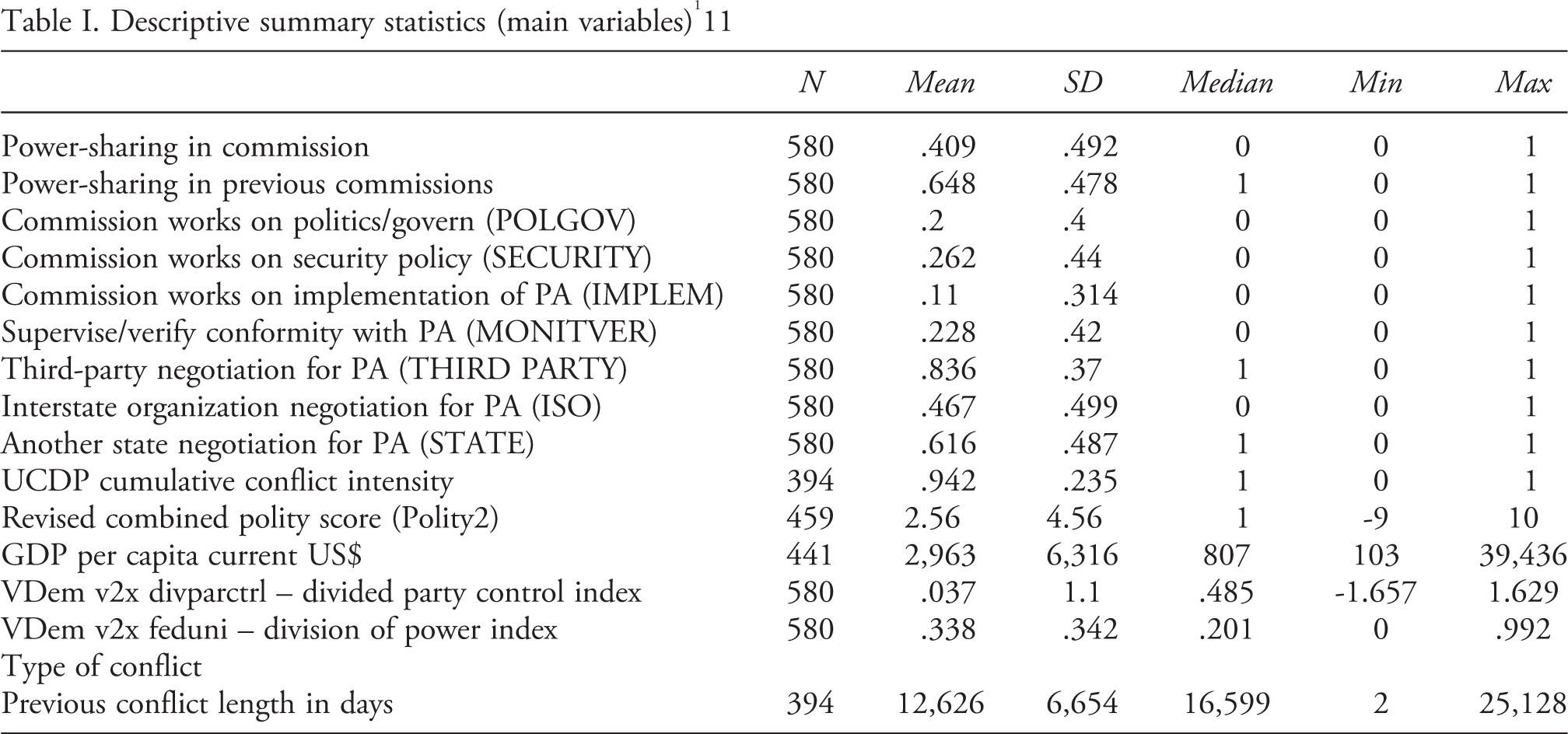
To our knowledge, this is the first article focused on power-sharing in independent commissions using a large-N study, and there are no widely accepted standard control variables that we can automatically include in our empirical analysis. Hence, we are drawing from case study research (Walsh, 2015; Walsh & Doyle, 2018), quantitative conflict research (Hartzell & Hoddie, 2007; Neudorfer et al., 2022), our own logical reasoning, as well as the fieldwork experience of Walsh. Table I provides an overview of the descriptive analysis of the variables included in the regression analysis. 6 Of the commissions in our analysis, 41% have a power-sharing arrangement, 20% work on political issues, 26% on security, and 23% monitor conformity with peace agreement commitments. Only 11% of commissions focus on implementation. Overall, there is a sufficient number of commissions with power-sharing arrangements, as well as diversity around the policy areas and tasks the commissions are given, to run a quantitative analysis.
Methodological approach: Machine learning and regression analysis
Owing to a lack of previous quantitative research findings on this topic, we employed a two-stage approach to the quantitative analysis. Faced with the choice of what variables to include in any quantitative analysis, scholars have different options, ranging from looking at previous publications and their use of variables, to logical theoretical thinking, or quantitative methods. When using quantitative methods to pick variables, there are two broad sets of variable selection techniques outlined by Guyon & Elisseeff (2003): individual selection of variables based on the ranking of variables or subset selection of variables based on wrapping or embedding of variables. We chose to use the embedding of variables in the form of decision trees of the possible variables selection methods proposed by Guyon & Elisseeff (2003). Essentially, the machine learning stage is the best subset selection method (see Becker et al., 2017), where we select the variables that best explain the choice of power-sharing in an independent commission. The machine learning part is stage one of our analysis. We ran a decision tree analysis that is part of the machine learning family and is also known as classification and regression trees (CART) (James et al., 2013). In the second stage, we then use the chosen variables to run a traditional logit/probit regression on unseen data to test for the strength of the relationship. Short explanations of the machine learning approach and the reasons for choosing this approach are outlined in the following paragraphs (and a longer version is included in the Online Appendix).
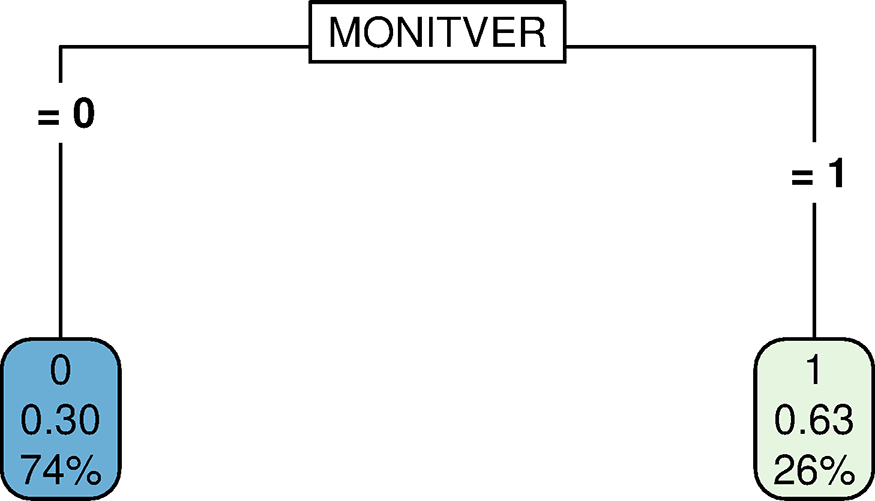
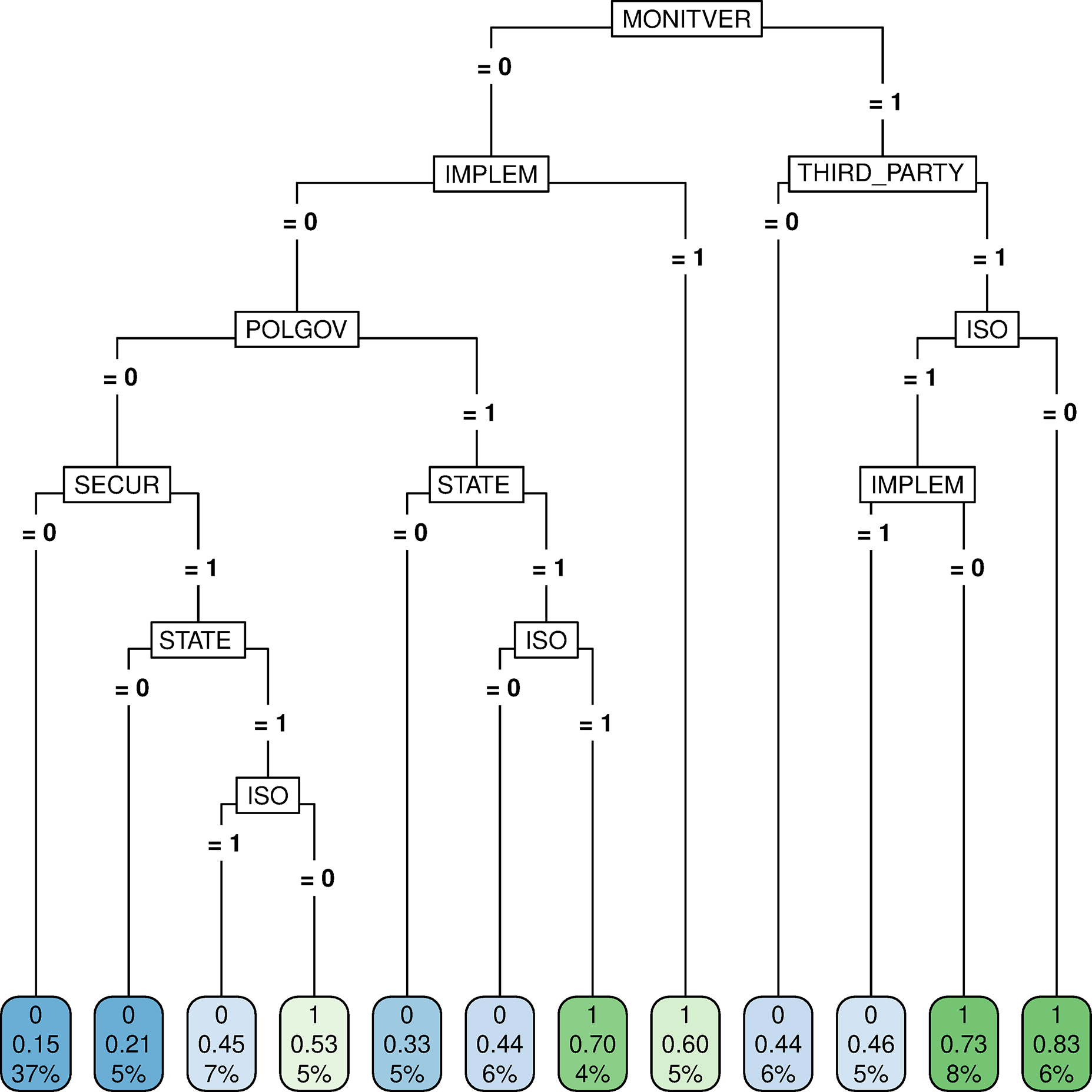
As it is customary, we randomly split the data, 348 observations, we reserved for the machine learning part into a training – 80% of observations – and testing – 20% of observations – dataset. We used the rpart and rpart.plot package in R to run a set of different regression trees. The first one determined the best number of splits (i.e. Figure 1). We ran multiple trees to test the robustness of the identified variables. The second one (the medium tree) had at least ten observations in the final bucket/bin 7 (i.e. Figure 2). The third one (the small tree) had at least 15 observations in the final bucket/bin (i.e. Figure A.1 in the Online Appendix).
The tree figures always included the short variable name, the the the the
For instance, in Figure 1 the decision tree identifies that commissions that are established to monitor or verify have a 0.63 probability to have a commission with power-sharing arrangements. There are 26% of the observations that fall into that trunk of tree. A commission that does not monitor or verify has a probability of only 0.30 to include a power-sharing arrangement and is therefore predicted to have no power-sharing arrangement. Some 74% of the observations fall into that trunk of the tree. Although these relationships are not deterministic, they give us an indication that monitoring or verification affects whether commissions have power-sharing arrangements or not.
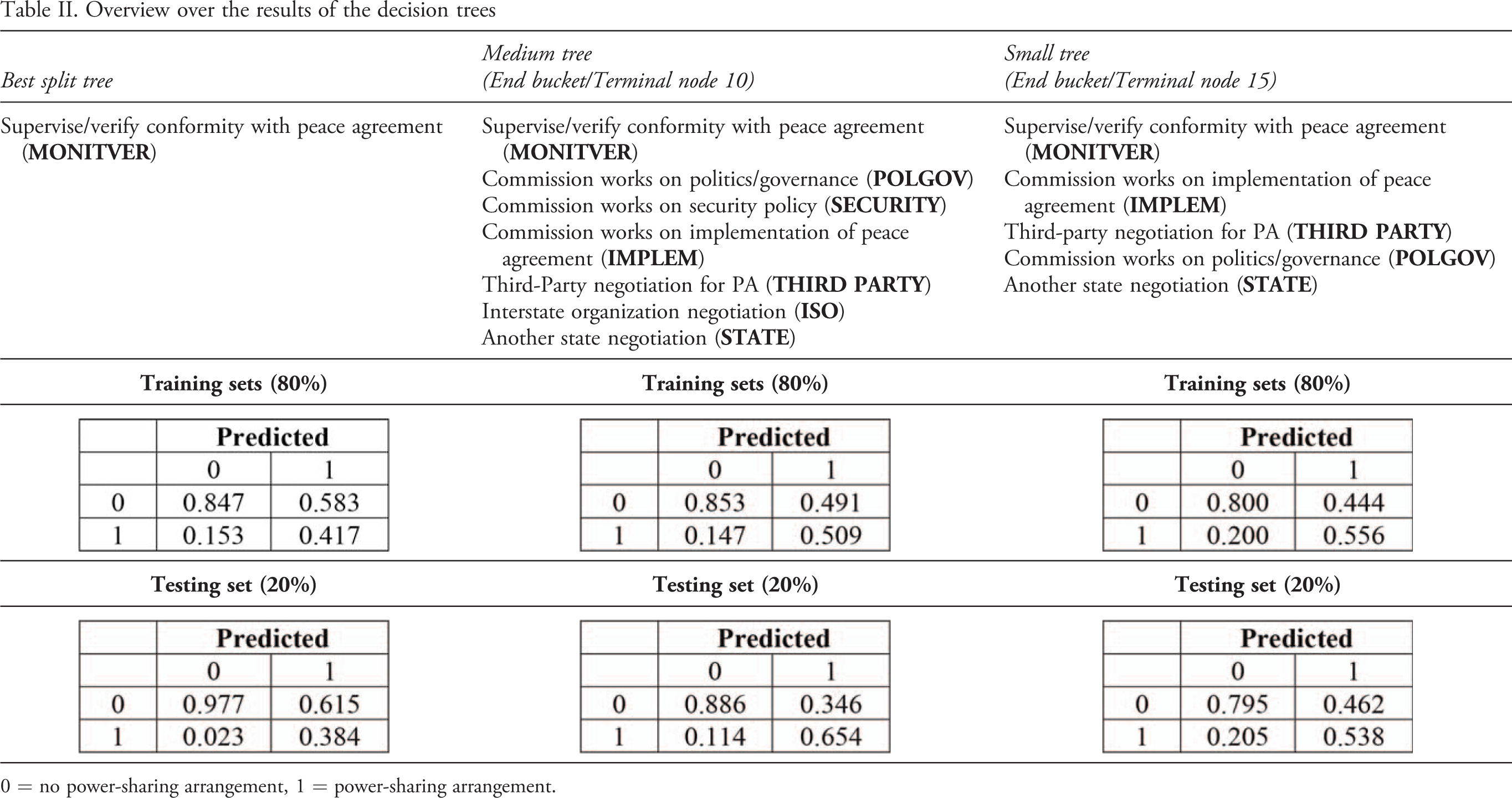
Although the best tree in Figure 1 was supposed to give us the ‘best’/ideal number of splits, we saw that the predictive accuracy for the presence of power-sharing is the lowest in this decision tree. The highest correctly predicted power-sharing observations were delivered through the small and medium tree and the variables identified by this tree are used for the regression analysis.
As the decision tree analysis only provides information on whether a variable plays a role in determining power-sharing arrangement, the regression analysis outlined the strength of the effect of one variable controlling for the other variables. As it is common standard practice now in political science and in line with the suggestions of Neumayer & Plümper (2017), we ran several different models to show the robustness of our findings.
The dimension reduction procedure identified the seven (medium tree), five (small tree), and one (best number of splits tree) variables as crucial to determining whether an independent commission includes power-sharing arrangements or not (Table II). Of those, the most important ones were: Does the commission supervise or verify conformity with the whole or specific parts of the peace agreement ( Does the commission work in politics or governance ( Does the commission work in security policy area ( Was another state (external to the state where the intrastate conflict occurred) involved in the negotiation of the peace agreement which established the commission ( Was any third party (external to the state where the intrastate conflict occurred) involved in the negotiation of the peace agreement which established the commission ( Was an interstate organization involved in the negotiation of the peace agreement which established the commission ( Does the commission work on the implementation of the peace agreement (
Empirical results
Our hypotheses predicted that the policy area the commission works in Hypothesis 1, its role in monitoring or verification in Hypothesis 2, its role in the implementation of the peace agreement in Hypothesis 3, previous power-sharing arrangements in commissions in Hypothesis 4, and the involvement of international actors in Hypothesis 5 affect whether a commission has power-sharing arrangements. Previous power-sharing in a commission (Hypothesis 4) was not identified by the decision tree and seems to play a subordinated role in comparison with other variables in determining whether power-sharing arrangements were present in an independent commission.
Besides the main variables of interest identified through the decision tree analysis, we include standard control variables that are regularly used in civil war and peacebuilding literature. As is well-established practice in political science research, particularly in the civil conflict and civil war literature, we included one variable that measures political institutions (polity2) as used by seminal writings such as Hartzel & Hoddie (2007), economic conditions (GPD per capita) as used by nearly all conflict scholars (Neudorfer & Theuerkauf, 2014), and the severity of the previous conflict (UCDP) as used by Hartzel & Hoddie (2007) 8 into the analysis independent of the outcome of the first stage as economic and political conditions in a country could always play a role in the decisionmaking in a post-conflict society. However, we also ran estimations without those variables.
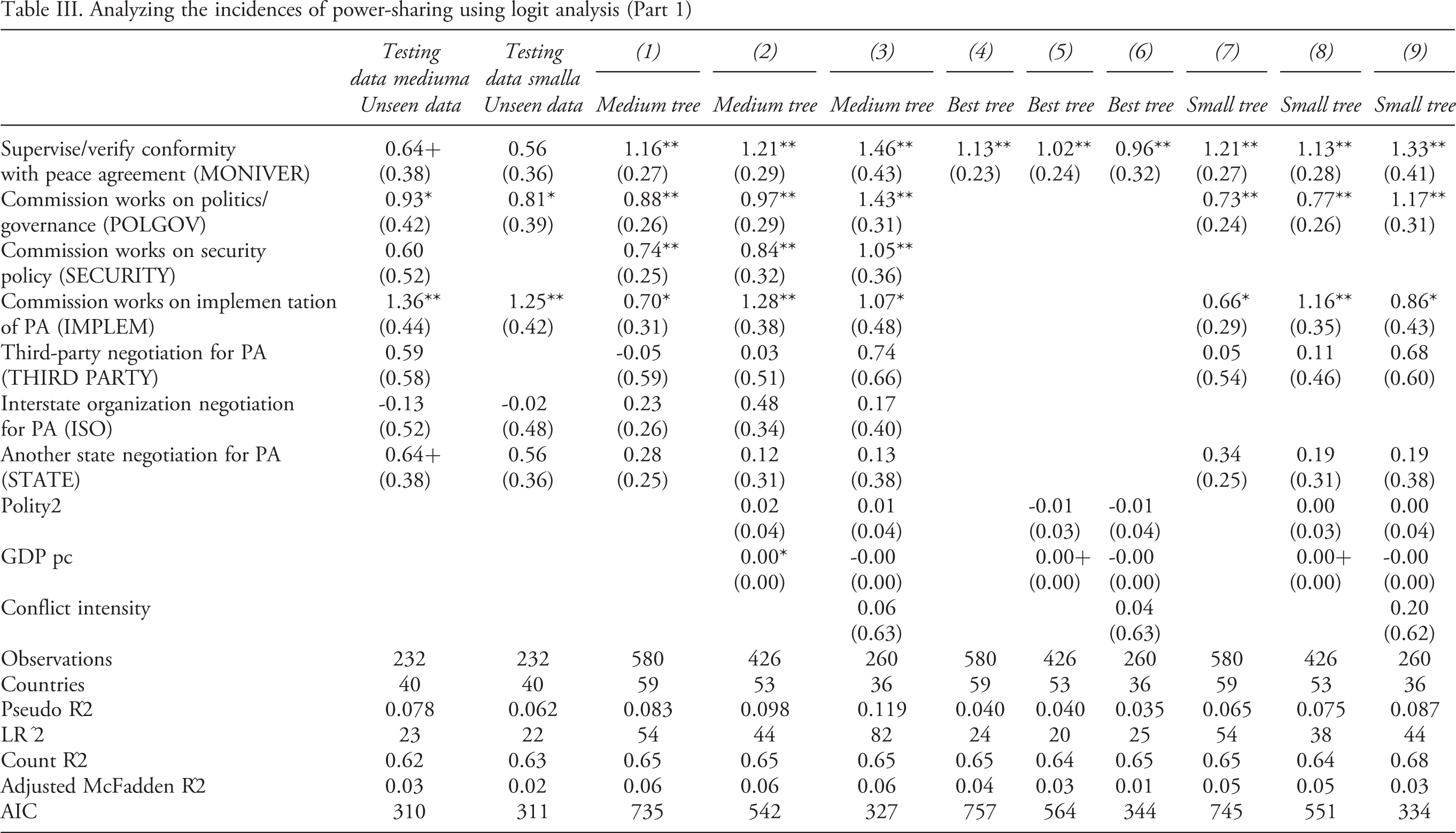
Overall, all logit regression models (Table III) were good at correctly predicting power-sharing arrangements in commissions, between 62% and 68% correctly predicted the absence and presence of power-sharing arrangements. Hence, the regression performed after the machine learning part reached similar or even higher levels of accurate predictions of power-sharing arrangements in independent commissions.
The empirical results were also somewhat surprising. Although the involvement of any third party, another state, and interstate organization played a role in the negotiation process, Hypothesis 5 was (continuously) identified by the decision tree analysis to play a role in determining power-sharing, the variables never reach conventional significance levels. If we had not run the decision tree analysis, we would have not put enough weight on the importance of external actors participating in negotiations. Future research should look into the causal mechanism of how external actors play a role in encouraging or discouraging power-sharing in independent commissions.
Descriptive summary statistics (main variables) 11
The results of testing whether commissions that work on the implementation of a peace agreement included power-sharing (
A striking and somewhat surprising finding was that variables that measure the post-conflict context in a society, in the form of wealth (
Overall, the strongest and most robust empirical results were that if a commission works on a political or governance policy, on monitoring or verification, or on the implementation of the peace agreement, the commission has a substantially higher likelihood of having a power-sharing arrangement.
Further robustness tests are included in the Online Appendix. For reference purposes, the original models for the regression analysis based on a small and medium tree selection are provided as Model 1 and Model 7 in Table A.2. Alternative to polity2 we operationalize the overall power-sharing conditions in a country using two more specific VDem variables that measure power-sharing more directly, namely, the ‘Division of power index (D)’ (v2x_feduni) 9 and the ‘Divided party control index (D) (v2x_divparctrl)’ 10 by Coppedge et al. (2022) and Pemstein et al. (2022). Conflict length could be another important contextual factor leading to more or less power-sharing in a country. We measure conflict length in days and conflict type using UCDP/PRIO data
Tree with the best number of splits 12
Medium tree (end bucket 10 observations) 13
(Gleditsch et al., 2002; Petterson & Öberg, 2020). In all cases of a different set of control variables, the results remain robust (see Table A.I in the Online Appendix). The marginal effects get less strong (e.g. going down to 20% from 30% for commissions working in the area of politics) when including some of the control variables, particularly for the VDem party control but remain still relatively strong. As our hypothesis never predicted the exact strength but only the direction of the relationship, the results do not contradict our findings but provide further empirical support for our conclusions.
Overview over the results of the decision trees
0 = no power-sharing arrangement, 1 = power-sharing arrangement.
Analyzing the incidences of power-sharing using logit analysis (Part 1)
Analyzing the incidences of power-sharing using logit analysis (Part 2)
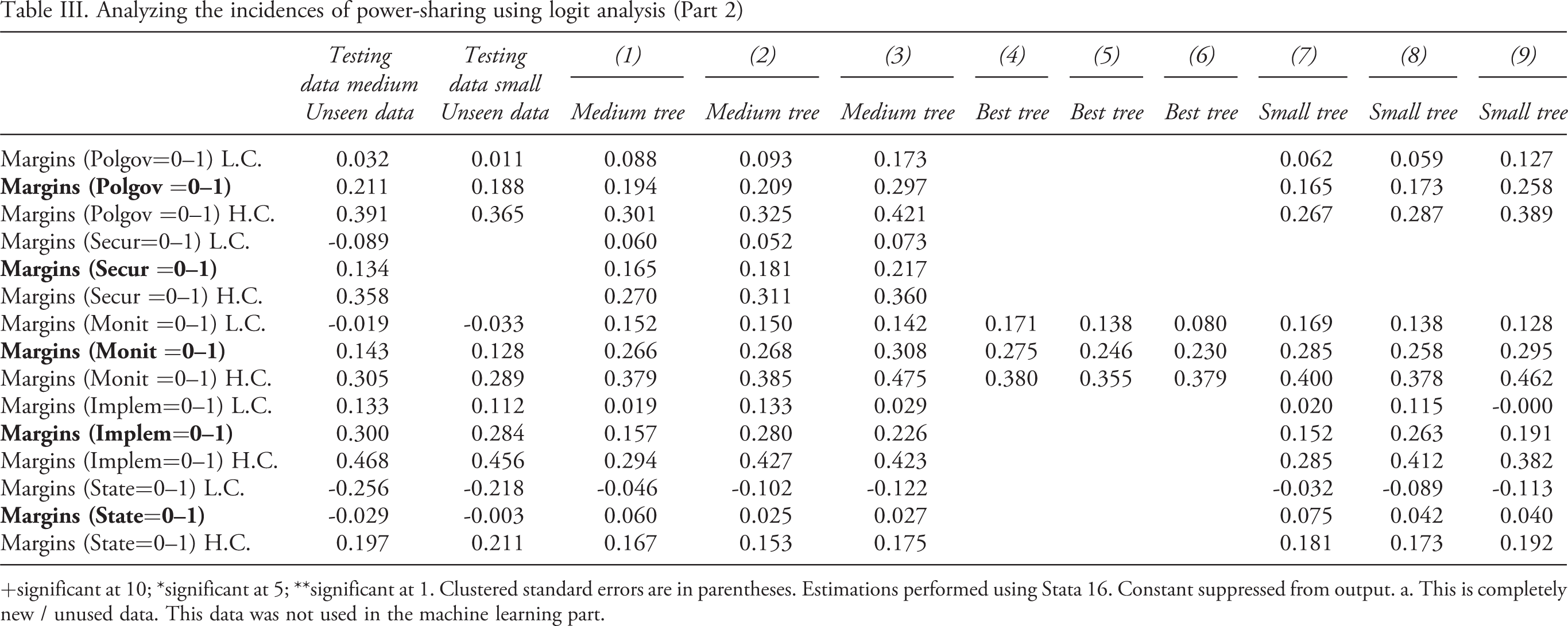
+significant at 10; *significant at 5; **significant at 1. Clustered standard errors are in parentheses. Estimations performed using Stata 16. Constant suppressed from output. a. This is completely new / unused data. This data was not used in the machine learning part.
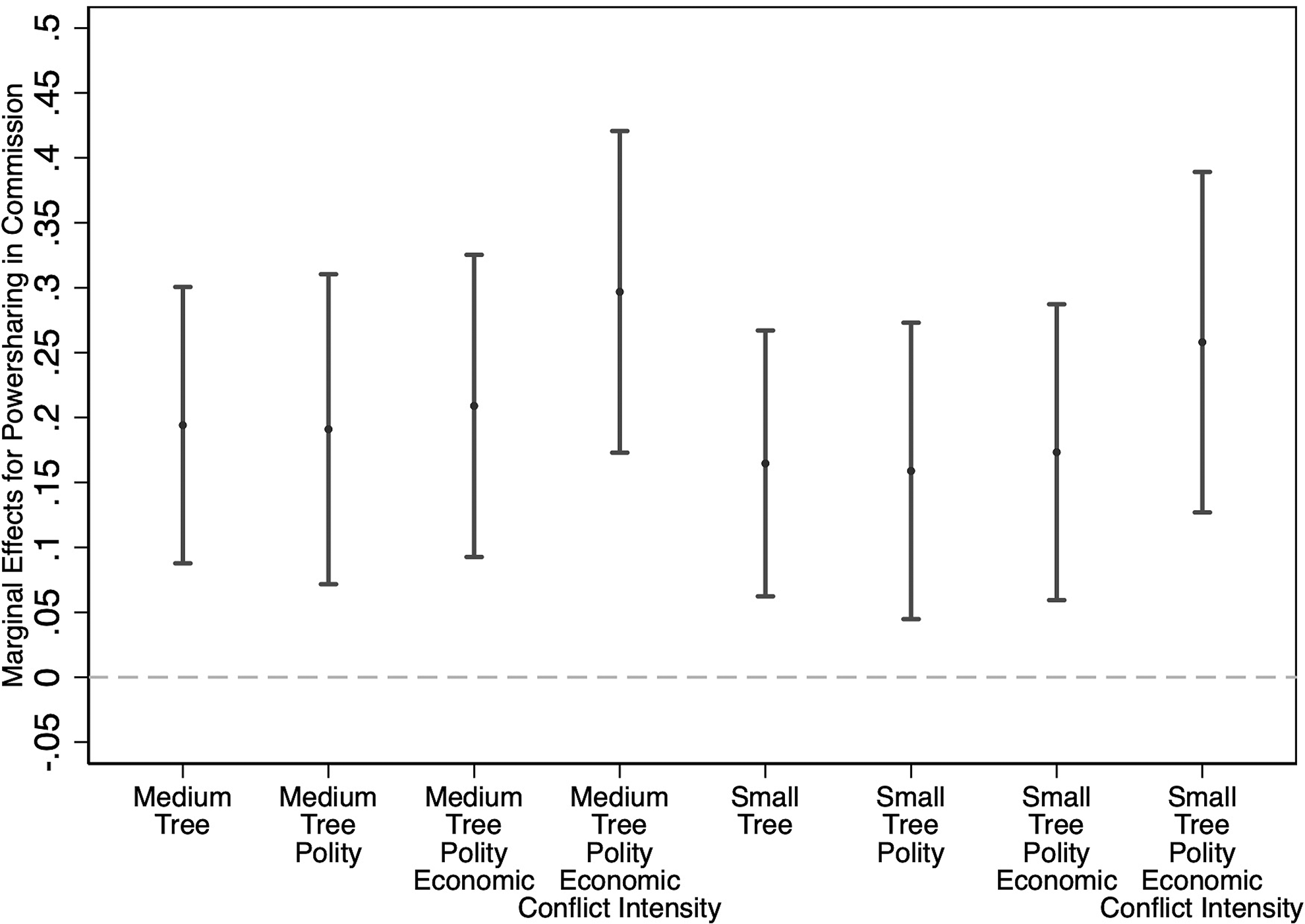
Marginal effects for a commission on political issues (POLGOV) on the likelihood of an independent commission having a power-sharing arrangement
Conclusion
Power-sharing in independent commissions is shown to contribute to the non-recurrence of violence after a conflict. Thus, establishing under what conditions such power-sharing is built into the design of independent commissions is vital to developing our understanding of both power-sharing and commissions as conflict management tools.
In this article, we have theoretically argued and empirically shown that some factors are more successful than others in predicting whether there are provisions for power-sharing in independent commissions. The factors that are particularly successful are: whether a commission works on political or governance policy, or on monitoring or verifying, or directly on the implementation of peace agreements. The factors that are less successful but still important are: the involvement of other states, interstate organizations, or any third parties in the negotiation of the peace agreement, and whether a commission works on security policy. Of less importance in determining whether there are power-sharing provisions are GPD, democracy, and conflict intensity.
The role of policy area and commission task in predicting the presence of power-sharing rules is largely in line with our hypotheses. Policy areas associated with high levels of vulnerability and so acute credible commitment problems, including political/governance and security, are vital areas for conflict parties to have input in order to protect their interests and they require rules for power-sharing on such commissions. However, the lack of relevance of economic policy is somewhat surprising as this is also an important policy area. This could be explained by the fact that existing research tends to see economic power-sharing as important in conjunction with other forms of power-sharing. Also, many of the commissions working on the economy were not involved in activities that would lead directly to wealth sharing between the groups, as is typically associated with economic power-sharing, but rather they fulfilled regulatory functions and/or prepared plans for economic development.
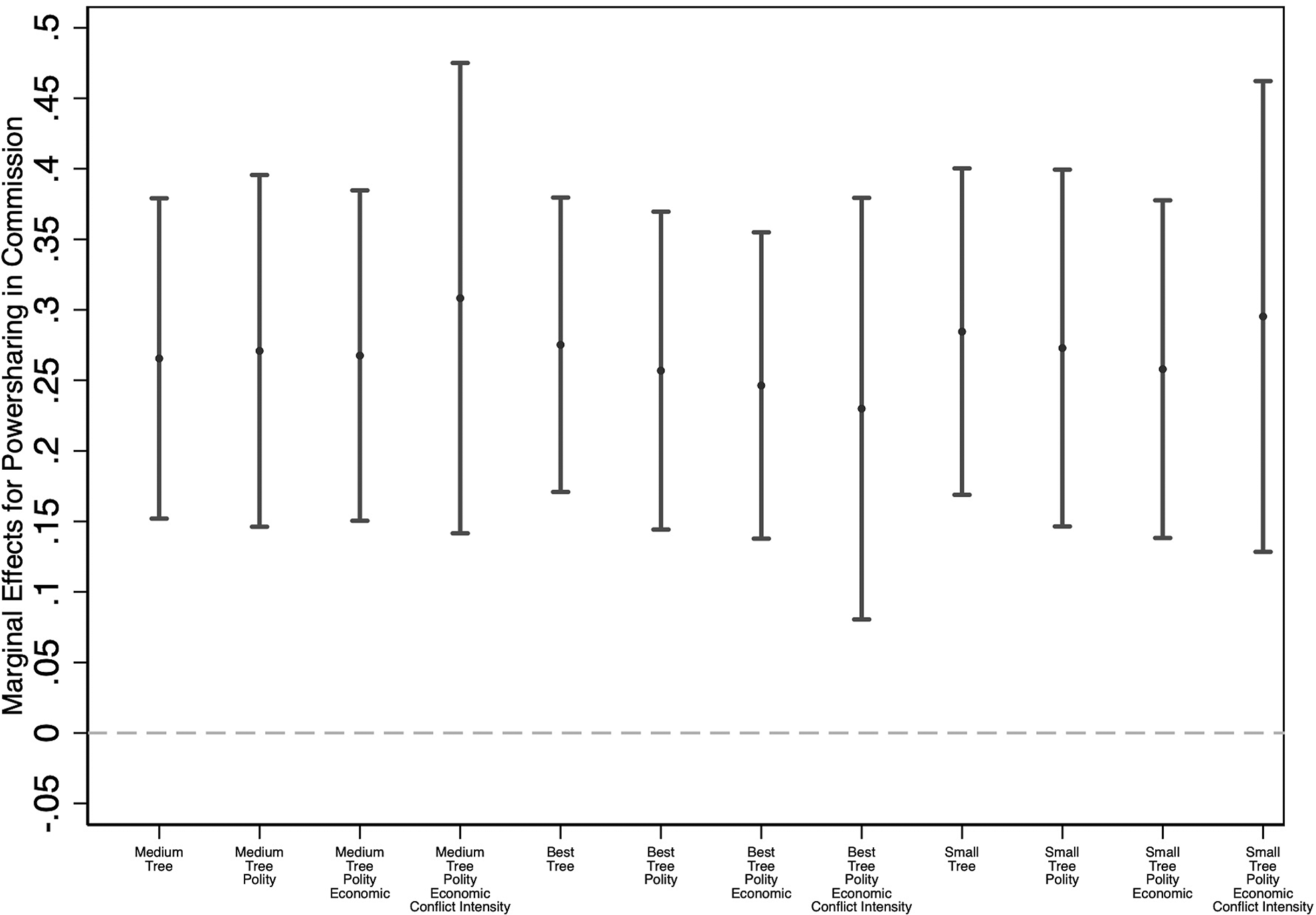
Marginal effects for monitoring of peace agreement (MONIT) on the likelihood of an independent commission having a power-sharing arrangement
Similarly, where commissions are tasked with monitoring or verification duties, power-sharing is more likely. This is in line with our hypothesis and underlines the importance of the different conflict groups being involved in such activities to ensure the work is trusted. The effect of implementation duties in increasing the likelihood that there are rules for power-sharing on a commission is also in line with our hypothesis and it may be explained by the significance of the gap between the principles agreed in a peace accord and the actual reforms needed to implement these principles. If conflict parties see implementation commissions as venues for continued negotiations, it is logical that they would ensure power-sharing principles are applied so they are included in these continuing negotiations. By providing theories as to the relationship between these policy areas and tasks and the empirical evidence to test these hypotheses, we have fundamentally expanded our understanding of power-sharing on independent commissions. Future research should develop this understanding further in a number of ways. It could explore the findings that are contrary to our hypotheses regarding the inclusion of power-sharing on commissions working on economic policy. Further research could also examine more deeply the role of mediation in determining whether power-sharing is included on commissions.
Footnotes
Replication data

Acknowledgements
We would like to thank the editor and two anonymous reviewers for comments on earlier versions of this article. This manuscript has been presented at the International Studies Association and the Arbeitskreis für Konfliktforschung. We thank the participants for their helpful comments on our manuscript, and in particular, we would like to thank Constantin Ruhe and Julia Leib.
Funding
The authors received financial support for the research, authorship, and/or publication of this article: We gratefully acknowledge the support of the Irish Research Council.