




Abstract
Little is known about how transitions in the government of mediators affect conflict dynamics and resolution. To address this shortcoming, we study executive turnovers of mediators during ongoing interventions in civil war. Mediation effectiveness is largely driven by (trustworthy) information provision and sharing. Changes in mediators’ leaderships have the potential to undermine this, lowering mediation performance. Using data on civil conflicts in 1946–2017, we find robust support for this argument. This research sheds light on a previously neglected factor in conflict resolution that is of particular interest to practitioners and policymakers.
Introduction
International mediation remains one of the most commonly chosen instruments for managing and resolving disputes among states and non-state actors. The United Nations (2017: 1) consistently treats mediation as an “important tool for conflict prevention, management, and resolution.” In internal armed conflicts (Gleditsch et al., 2002; Pettersson and Eck, 2018), which this research focuses on, more than a quarter (N = 72) of all domestic disputes in the post-Second World War period (N = 285) saw at least some form of third-party management, while several of the most recent mediation attempts on Syria (e.g. Astana talks in 2018), Ukraine (e.g. France and Germany in 2019), and Libya (Berlin conference in 2020) further support the claim that mediation is frequently relied on for addressing wars peacefully.
One of the most comprehensive definitions of international mediation is given by Bercovitch (1997: 130), who sees it as “a process of conflict management, related to but distinct from the parties’ own negotiations, where those in conflict seek the assistance of, or accept an offer of help from, an outsider (whether an individual, an organization, a group, or a state) to change their perceptions or behavior, and to do so without resorting to physical force or invoking the authority of law” (see also Beardsley, 2011; Keels and Greig, 2019; Lee and Greig, 2019; Wilkenfeld et al., 2019). When mediation helps in addressing the underlying causes of a conflict, settling a dispute, and shortening as well as ending a war, it is usually perceived as an effective approach. However, particularly civil wars constitute a major challenge to mediation (United Nations, 2017) with only a minority of third-party attempts being effective to the extent that a civil conflict terminated owing to the efforts of the mediator.
We contribute to the debate about the forces that shape the success or failure of international mediation by examining how leadership transitions in mediating parties affect the duration of civil conflicts, our measure of mediation effectiveness. Several works have studied leader changes over the course of conflicts, interested in learning how these may affect dispute dynamics, peace processes, and the chances for peace (see, e.g. Lutmar and Terris, 2016, 2019; Ryckman and Maves Braithwaite, 2020; Uzonyi and Wells, 2016). However, these contributions largely focused on the belligerents as such and before third-party interventions took place without acknowledging that mediation efforts may also experience a change in the third party’s executive during an intervention. For instance, consider the crisis in Ukraine and the French mediation: originally led by François Hollande, Emmanuel Macron assumed presidential office and thus responsibility for the mediation effort in 2017. Our research is about cases like this where mediating governments saw a change in leadership during their intervention in domestic warfare.
We develop a theoretical argument that extends existing studies on leadership changes in conflict, peace processes, and mediation effectiveness. As indicated, though, our focus is on mediators once an intervention took place, thus departing from earlier works that concentrate on the disputants before a possible mediation. Initially, we assume that problems of information and information asymmetries can make managing and resolving civil conflict difficult (Greig and Regan, 2008; Keels and Greig, 2019; Walter, 2009). Uncertainty about factors that have given rise to a dispute and now characterize fighting dynamics complicates identifying a common ground necessary for fruitful negotiations; and even if an agreement is reached, combatants have an incentive to defect, especially in civil conflicts (Walter, 2009). Mediation can, in principle, overcome such hurdles as it allows for information provision and sharing. However, as we contend, changes in the leadership of a mediator during an intervention may require that (trustworthy) information channels have to be re-established as the third party is essentially a new actor who has not interacted with the belligerents before. Ultimately, this is likely to lower mediation effectiveness and, hence, prolong disputes. We test our theoretical expectation using quantitative data on civil conflict and mediation between 1946 and 2017. With dispute duration as a measure of conflict-management effectiveness and while accounting for the likely non-random assignment of mediation (see Böhmelt, 2010; Gartner and Bercovitch, 2006), we find strong support for our argument. While mediation as such can be an effective instrument to settle civil conflict, transitions in a mediator’s leadership are likely to be an important, and previously unknown, hurdle. Our estimates suggest that conflicts with mediator leader changes are up to twice as long as mediated conflicts without such transitions. Several robustness checks and additional analyses lend additional evidence to this conclusion.
This article makes several important contributions to the literature on mediation and conflict resolution. First, we identify a previously unknown, but from a practitioner’s perspective particularly relevant, factor that shapes mediation effectiveness in significant and substantive ways. The understanding of the drivers behind mediation performance remains incomplete, but our work helps add more knowledge to this. Mediator leadership changes are especially crucial for policymakers and the belligerents: one implication of this article is that mediating parties that just saw such transitions may, in turn, not be the most effective actors. Second, Wolford (2012: 519) analyzes treaties between states and concludes that “most state-centric research assumes that international agreements are robust to changes in leadership.” But we do not know whether peace processes and negotiations in the context of international mediation are equally robust to executive leader transitions. Finally, and derived from the previous point, we also make a key theoretical contribution: while some may have suggested that leader transitions help to overcome deadlocks in peace processes, we theoretically argue and show that leadership changes in the mediator can have the opposite effect. This adds to the existing literature focusing on disputants before interventions take place, also by underlining the need to specify and disaggregate leader turnovers as, depending on which actor we are interested in and when leader transitions take place, diverse influences on conflicts, dispute dynamics, and peace processes emerge.
Mediator leader changes and mediation effectiveness
A central assumption of our argument is that conflict is characterized by uncertainty: the fighting parties lack information and are uncertain about many factors pertaining to the outbreak of the dispute. This uncertainty may well persist long into the conflict as such, which makes it difficult for the combatants to fully evaluate their situation—most importantly, the costs and benefits of continuing with fighting activities (e.g. Beardsley, 2008, 2011; Blainey, 1988; Fearon, 1995). As a result, Regan and Aydin (2006: 740) argue that “the key to successfully solving disputes, therefore, is to reduce the asymmetry of information about capabilities and incentives.” Many studies argue here that international mediation might address this and, in fact, lowers uncertainty.
That is, mediation can efficiently and effectively provide information to the opposing parties that they would have been unable to obtain if the third party had not intervened (Beardsley, 2008, 2011; Kydd, 2003, 2006; Rauchhaus, 2006; Regan and Aydin, 2006; Regan and Stam, 2000; Smith and Stam, 2003; Svensson, 2007, 2009). For example, third parties pool information about the preferences, positions, or interests of the belligerents, and then disseminate it to the actors. They keep communication lines between the antagonists open and provide alternative views on issues or identify sets of mutually acceptable agreements (Beardsley, 2011: 36ff; Beber, 2012: 401f). In the words of Regan and Stam (2000: 244), mediators shed light on the “adversaries’ positions, potential compromises, and the costs of continued conflict” (see also Beardsley, 2008: 725f), thus lowering uncertainty and allowing the fighting parties to have a more accurate idea of whether or not prolonged war is the costlier strategy to pursue.
We subscribe to these arguments and concur with Regan and Aydin (2006: 740) in that “outside interventions can provide a more objective view of conditions and possible outcomes of the conflict, which helps adversaries to update their beliefs about the likely outcomes. Absent an outside intervention, the information held by the warring parties is at best asymmetrical, and neither side has a unilateral incentive to honestly convey its military capabilities, expectations of victory or defeat, or the value of a settlement that it would accept for the fear of exploitation by its adversary.” Information provision is thus the crucial aspect of international mediation that can turn a conflictive situation into a more cooperative setup. With the assistance of mediators, belligerents may realize that the costs of continued fighting are too high, and that agreeing on the peaceful resolution of their dispute is the more beneficial avenue (see Beardsley, 2008). We claim, however, that an executive leadership change in a mediating state can pose significant challenges to the efficient and effective transmission of information (see also Dorussen and Ward, 2008; Greig and Diehl, 2006: 363ff). We develop our argument in three steps. First, we focus on cases where leaders are directly involved in the mediation process. Second, we outline a claim when executives are not leading mediation negotiations, but ministers or career diplomats. And, third, we assume the perspective of the combatants and show how a leadership transition in the mediator’s executive affects their views and behavior.
First, leaders of third parties are often the crucial actors in mediation talks. Most prominently, consider the negotiations leading to the Camp David Accords that directly involved US President Jimmy Carter mediating between Egyptian President Anwar Sadat and Israeli Prime Minister Menachem Begin. Replacing the mediator’s leader in such a situation is likely to slow down the negotiations and an information-provision advantage of the third party may no longer be given. That is, “once a mediator gets involved in a negotiation, she typically spends considerable effort learning about the dispute and the parties involved” (Kydd, 2003: 600, 2006; see also Powell, 2004). A turnover in the executive initially causes a break in the transmission of information and one has to gather new information, partly even from intermediary sources, about the conflict, its causes, and the fighting parties. Hence, it is generally challenging for a mediator to send a believable signal to the adversaries, but mediator leader transitions further complicate this. Fey and Ramsay (2010) claim as well that providing information is not an easy task and potentially much more difficult for a third party that just entered a conflict; in turn, the failure of a mediator in collecting adequate information adversely affects mediation outcomes.
Leadership continuation over the course of an active mediation intervention does not interrupt information provision and the trust established among the mediator and the fighting parties persists. Eventually, there is no added risk that strongly established, mutually accepted norms between the third party and the opponents have yet to be determined and that uncertainty is not decreased. Greig and Regan (2008: 765) also emphasize that “the probability of success increases to the extent that the same mediator participates in subsequent mediations.” As a result, more efficient and effective information provision is more plausibly given when a mediating leader is not exchanged over the course of an active mediation process, which should be linked to a higher level of effectiveness. Consider the case of Norway in Sri Lanka, 2000–2001. A new government was formed under the leadership of Jens Stoltenberg on 17 March 2000—during an already ongoing mediation effort (since 1997). While initial Norwegian mediation under the previous prime minister Kjell M. Bondevik in January–February 2000 is seen as “effective” according to DeRouen et al. (2011), an intervention immediately after the leadership transition (October 2000 to June 2001) is not. Bondevik personally began working on facilitating the peace process in Sri Lanka as early as 1990 during his tenure as foreign minister (Sørbø et al., 2011: 29; see also Follerås, 2002), whereas Stoltenberg had no such previous involvement and familiarity with the conflict. It is thus not entirely implausible to trace the ineffectiveness of the second intervention back to the change in the mediator executive.
Second, although a mediating country experiences a transition in its leadership, the president or prime minister may not have been directly involved in the negotiations. Yet the effect of governmental change on the effectiveness of mediation is likely to mirror our first scenario. On the one hand, the foreign minister or senior staff members such as career diplomats in a state’s bureaucracy are also frequently exchanged with a new executive leader (see, e.g. Boyne et al., 2010; Petrovsky et al., 2017; Villadsen, 2012). In other words, the individual with whom the belligerents negotiated before, established trust with, and received information from is replaced due to a leader turnover in the mediator’s government. This is likely to induce the same interruption of (trustworthy) information provision as outlined above, and it requires that information-provision channels have to be rebuilt in a potentially slow and cumbersome process.
On the other hand, obstacles probably exist even if the senior staff in the diplomatic service of a state is not replaced. New leaders may have a different political orientation and then differ from their predecessors in beliefs, ideologies, and perceptions (Croco, 2011; McGillivray and Stam, 2004; Saunders, 2009: 129ff; Walker, 1983: 181ff; Wolford, 2007: 774), which are likely to be imposed on and affect the performance of career diplomats as well—even if they have served under the former head of government. Hence, new leaders could rely on a different political orientation, which then alters the way the diplomatic corps works, including how a mediation process is approached. For example, Norway experienced another executive turnover in 2001, which we believe also affected the intervention in Sri Lanka yet again: Vidar Helgesen assumed office as Deputy Minister for Foreign Affairs of Norway and Jan Petersen became the new Foreign Minister under Prime Minister Bondevik, who formed his cabinet in October 2001. The Norwegian peace envoy Erik Solheim was not replaced over the course of this transition, though, but became somewhat less involved as, in particular, Petersen was “initially quite skeptical about the continued Norwegian role in Sri Lanka” (Sørbø et al., 2011: 35; see also Bullion, 2001; Höglund and Svensson, 2002).
Third, assuming the perspective of the belligerents, how does a leadership change in a mediator affect their views and behavior? Those actors negotiating on behalf of the combatants, regardless of whether these may be executive leaders, ministers, or diplomats, rely on cognitive structures to order and prioritize incoming information (Tetlock and McGuire, 1985). Such structures shape what leaders see in the world, but, as these are rather stable, new incoming information from newly appointed leaders or negotiators of the third party could be discounted (Pickering, 2002: 318). Dealing with the same third party is generally likely to weigh more heavily than having to negotiate with different individuals after a leadership transition in the mediator’s government (see also Huth and Russett, 1984; Jervis, 1976; Leng, 1983; Levite et al., 1992; Levy, 1994; Pickering, 2002; Reiter, 1996). In turn, this ultimately induces new mediations to be likely to fail. Coming back to the Norwegian leadership turnover of 2001, “the changes damage[d] Norway’s relationship with both parties [the belligerents]. It … [took] months to reestablish rapport with Anton Balasingham [chief negotiator for the Tamil Tigers] and the standoff with [Chandrika] Kumaratunga [President of Sri Lanka] … [remained] a challenge in the coming years” (Sørbø et al., 2011: 34).
In sum, all three mechanisms suggest that a leadership transition in a mediator’s executive will lower the performance of third-party peaceful intervention. New mediators might not be able to transmit information as efficiently or effectively, but uninterrupted mediation efforts are likely to be able to ensure just that.
Research design
Data, dependent variable, and methodology
We test our theoretical expectation by analyzing a unique dataset that combines the UCDP Armed Conflict data (Gleditsch et al., 2002; Pettersson and Eck, 2018) with the Civil Wars Mediation Dataset (DeRouen et al., 2011). 1 To this end, we focus on mediation and mediation effectiveness in civil wars between 1946 and 2017, while the conflict-year is the unit of analysis (N = 2330). 2 This approach ensures that we have cases of both mediated and unmediated conflict-years and do not analyze mediation cases only.
For our dependent variable, mediation effectiveness, we follow common approaches in the literature and operationalize this via duration (e.g. Balch-Lindsay et al., 2008; Brandt et al., 2008; Regan and Stam, 2000). Specifically, we focus on the time elapsed from a mediation attempt (if any) to the end of a conflict. The goal of any genuine third-party mediation intervention is to lower hostilities, ease tensions, and eventually, to end fighting. This makes conflict duration an obvious choice, and a valid as well as reliable measure to capture effectiveness. Our core claim is that longer conflicts are, all else equal, worse than shorter disputes, especially from a mediator perspective—and thus tied to mediation ineffectiveness. Conflict start and end dates are derived from the UCDP Conflict Termination dataset (Kreutz 2010). The duration of conflicts is recorded from their original start year, which addresses left-censoring. For right-censoring, which affects about 18.6% of our observations, we flag conflicts that do not terminate in the period of observation for the models. Mediation (if any) dates are taken from the Civil Wars Mediation dataset (DeRouen et al., 2011). Our final dependent variable thus captures the duration until conflict termination, conditional on whether a mediator leadership change took place or not.
Given this dependent variable, we employ duration models. Initially, we rely on Cox Proportional-Hazards models that leave the functional form of the baseline hazard unspecified (see Box-Steffensmeier and Jones, 2004). Schoenfeld residuals assess whether the proportional-hazards assumption is violated (see Box-Steffensmeier and Zorn, 2001) and we cluster the standard errors at the conflict level, since observations from the same dispute are not independent from each other. A shortcoming of these initial models is that we do not take into account potential selection effects: mediation does not randomly occur, but is systematically assigned according to supply and demand (e.g. Greig, 2005; see also Beardsley, 2008; Böhmelt, 2010; Crescenzi et al., 2011; Gartner and Bercovitch, 2006). In our context, this may imply that factors contributing to longer conflict durations are also linked to the chances of mediation occurring in the first place. Failing to model this could bias our results (see Boehmke et al., 2006; Shannon et al., 2010). We thus also employ the Duration-Selection estimator developed by Boehmke et al. (2006) in our final estimation. This two-stage estimator models the outcome, conflict duration, after explicitly accounting for selection into the sample, i.e. mediation onset, in the first stage. For the estimator’s first equation, we include a variable on the time elapsed (in years) since the last mediation occurrence and cubic splines to control for temporal dependency (Beck et al., 1998). We also use these variables to meet the exclusion-restriction requirement, which is then based on the assumption that time since the last mediation is likely to influence the likelihood of its emergence, but not the outcome of such third-party interventions. Finally, note that the Duration-Selection estimator requires the functional form of the baseline hazard to be specified. We opt for a flat baseline hazard and use an exponential duration model accordingly (Box-Steffensmeier and Jones, 2004). 3
Explanatory variables: mediator leadership change and controls
For our main explanatory variable, Mediator Leader Change, we combine information from the Civil Wars Mediation data (DeRouen et al., 2011) with the Change in Source of Leader Support (CHISOLS) data by Mattes et al. (2016). We first use the most recent version of the Civil Wars Mediation data to identify the incidence of third-part mediation in intrastate warfare and who the mediating parties were. 4 We observe 251 instances of mediation in our sample of which 130 involved more than one and up to 11 mediators. We then match these data with information on leader changes in mediating countries’ governments from the CHISOLS data (Mattes et al., 2016), which rely on Goemans et al. (2009) to determine leaders and leadership changes. 5 We eventually create a dummy indicating whether any of the countries involved in a mediation effort experienced a change of leadership during an ongoing mediation effort or not. 6 The final binary variable thus takes a value of 1 for conflict-years and subsequent ones after mediation took place and any mediator experienced a leadership change. 7 This operationalization assumes that mediator leadership changes have a lasting effect on the third-party intervention and conflict dynamics by impeding mediators’ ability to engage in (trustworthy) information provision and sharing for the rest of the peace process. Mediation efforts’ effectiveness is likely to be permanently limited after a leadership change. Generally, re-establishing a relationship with all belligerents that is sufficient to mediate effectively should be a slow process. What is more, there is no guarantee that this proves ultimately successful. Therefore, mediator leadership changes can result in a permanent fracturing of the information-provision channels between one or more of the belligerents and the mediator. This, in turn, leads to the conflict enduring. Hence, we use a carry-over coding for the main explanatory variable. In our data, 219 out of 2330 observations receive a value of 1 (9.40%). Note that more than one mediation effort can occur over the course of a conflict and we update our core variable accordingly over its duration (conflict-years).
We also control for a number of potentially confounding variables. 8 In selecting these variables, we follow the existing literature on mediation onset and effectiveness in intrastate conflict (Wallensteen and Svensson, 2014; see also Keels and Greig, 2019; Lee and Greig, 2019). First, the Cox models include a binary variable indicating whether a conflict has seen mediation or not. Mediation should make conflict termination more likely, thus decreasing duration, and is a precondition for mediator leadership changes. The variable receives the value of 1 in the first and all subsequent years in which mediation may have affected conflict termination. In the Duration-Selection models, this variable is used as the dependent variable of the selection equation.
In terms of conflict characteristics, we control for dispute intensity, which we capture with a dichotomous item on whether a conflict has reached 1000 or more battle-related deaths over its course (1) or not (0). More difficult, i.e. more intense conflicts, tend to attract mediation more strongly both from a demand and supply perspective (Bakaki et al., 2016; Böhmelt, 2016; DeRouen et al., 2011), and they pose higher costs to both belligerents, thus affecting termination in turn (see, e.g. Balch-Lindsay et al., 2008; Brandt et al., 2008; Cunningham, 2010; Regan and Stam, 2000).
Conflicts involving militarily more capable rebels are expected to be shorter (Cunningham et al., 2009), but may be more likely to attract mediation (Clayton, 2013). Groups with a political wing similarly fight in shorter conflicts (Cunningham et al., 2009), while their struggle is potentially seen as more legitimate, which raises the chances of third-party mediation. Moreover, more actors being involved in a dispute prolongs conflicts (Cunningham, 2006) and, mirroring the rationale behind more difficult cases, is positively associated with the onset of mediation. To control for these mechanisms, we incorporate the logged number of rebel combatants, a variable on the existence of legal political wings for rebel organizations, and the number of groups involved from the Non-State Actor dataset (Cunningham et al., 2009, 2013). As these data are dyadic, we sum the number of rebel combatants and average the existence of a legal political wing over all dyads per conflict.
Finally, we account for conflict countries’ economic strength, population, and regime type. GDP per capita and population are both log-transformed and taken from Gleditsch (2002). For the form of government, we rely on the Polity IV dataset and, specifically, its polity2 score (Marshall et al., 2018). All three variables have been widely shown to affect the dynamics of intrastate conflict (e.g. Collier et al., 2004), but also influence whether mediation is accepted or not (e.g. Greig, 2005). The descriptive statistics of the dependent and all independent variables are reported in the Online Appendix (Table A.1).
Empirical findings
We begin by estimating a naïve model (Model 1) that merely considers the impact of mediation on the duration of civil conflict—possible selection effects are ignored here and we also do not account for leadership changes of mediators. Model 2 adds Mediator Leader Change to the estimation, but we omit any control variables to show that our main effects are not driven by the inclusion or exclusion of these covariates. For Model 3, we add the controls again. 9 Model 4 constitutes our preferred main specification as we employ the two-stage Duration-Selection model, which accounts for both the non-random assignment of mediation and mediation leader transitions. We report non-exponentiated coefficients in Models 1–3 and the outcome stage of Model 4, which describe how our explanatory variables shape the hazard rate of conflict termination: positive coefficients indicate that an item shortens dispute duration, while negative ones stand for a prolonging effect. In the selection stage of Model 4, binary-outcome variable coefficients are reported as in, e.g. logistic regression. In contrast to the latter, though, the errors in the selection part of the Boehmke et al. (2006) estimator are exponentially distributed.
Models 1–3 support the claim that mediation can be an effective conflict management and resolution technique: the coefficient of Mediation is positive and statistically significant at the 1% level, suggesting that conflicts tend to be shorter when mediation is employed. Exponentiating this coefficient in Model 1, for instance, leads to its hazard ratio of 2.609, which indicates that conflicts with mediation are 161% quicker at terminating than disputes without third-party mediation. This effect is substantially higher in Model 3 that additionally incorporates Mediator Leader Change. The coefficient of Mediation now demonstrates that mediated conflicts end 326% faster than unmediated ones.
Most importantly for our theoretical argument, though, consider the effect of Mediator Leader Change: its associated coefficient is statistically significantly different from 0—and, as argued by us, negatively signed in all models. Adding or dropping controls does not affect the substance of this finding. This implies that leadership changes in a mediator government decrease the hazard rate and, thus, are linked to longer conflict durations. Substantially, the hazard ratio of Mediator Leader Change is
The left panel of Figure 1 provides a more intuitive interpretation of these results by graphing conflicts’ survivor functions, i.e. their probability of enduring until a given time point in time t. We distinguish between mediation efforts with and without mediator leadership changes. Whereas cases pertaining to the latter have about a 15% probability of running for at least 20 years, this probability is, all else being equal, at around 35% for mediated cases with leadership transitions during the third-party intervention. Mediator leadership turnovers are thus associated with substantially longer conflicts—and decreased mediation effectiveness.
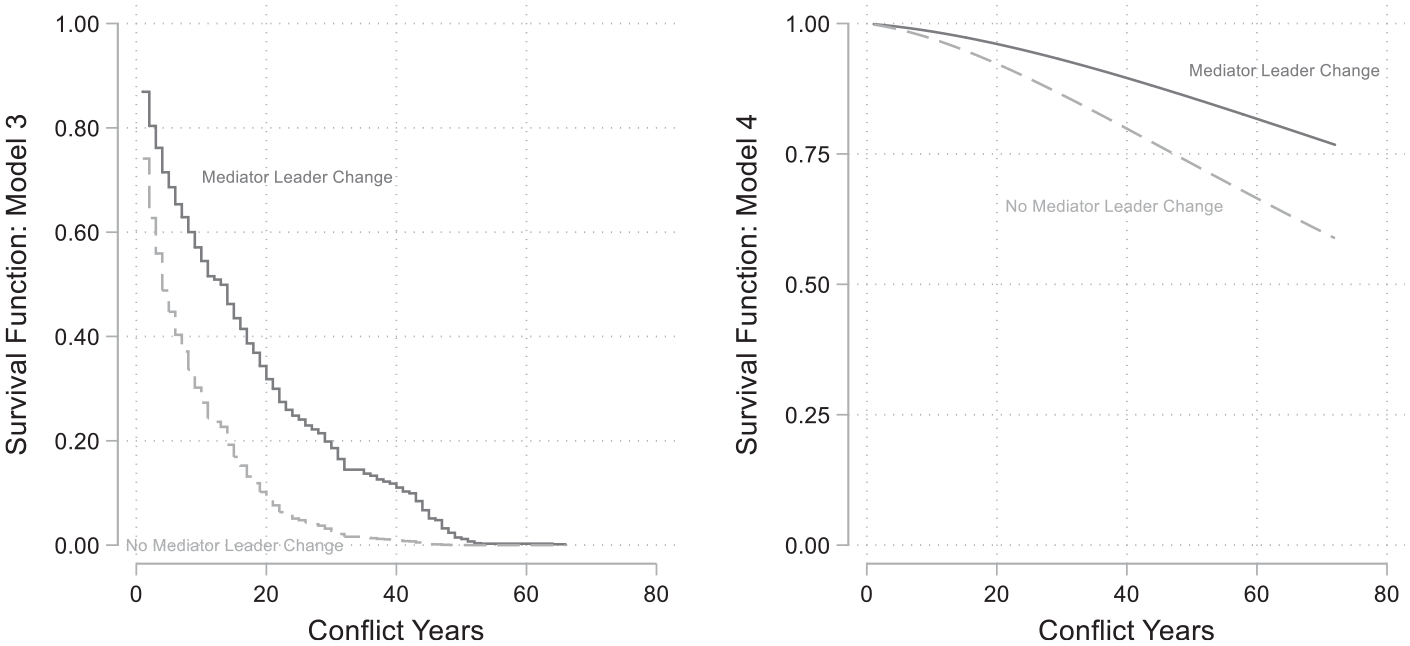
Survivor function estimates.
However, Models 1–3 neglect that mediation is not randomly distributed over civil conflicts. Model 4 accounts for this selection effect by first modeling mediation occurrence in the first stage before incorporating this when estimating conflict duration in the second stage. The first stage’s specification follows earlier research on mediation onset, i.e. that there are supply and demand factors that make it more or less likely that third-party interventions occur (e.g. Crescenzi et al., 2011). First, note the ρ parameter, which is an estimate of the correlation of the error terms in the two stages: it is negative if unobserved features that increase the likelihood of selection (i.e. mediation) decrease the probability of more effective outcomes. In our case, the significant estimate of ρ indicates that the Duration-Selection model fits the data better than independent estimates of the selection and outcome equations—or the Cox models as such. Moreover, ρ is positive, which implies that unobserved features that make interventions more likely also induce more effective outcomes. Model 4 shows that, even when accounting for the non-random assignment of mediation, Mediator Leader Change is linked to lower mediation effectiveness. The variable (in the outcome equation of Model 4) is again negatively signed and significant at the 5% level. Mediated conflicts terminate about 38% more slowly when there is a leadership change in any of the mediating governments. The right panel in Figure 1 provides the more substantive interpretation of this by graphing the survivor functions depending on whether mediators experienced a leadership change or not. Disputes with mediation efforts that saw a leader transition during the intervention are more likely to survive until t than third-party intervention cases without a leader change. The estimates are statistically different from each other.
Table 1 also includes several interesting results regarding control variables and the items used in Model 4’s selection stage. For example, more intense conflicts are more likely to receive mediation, but also tend to last longer. Conflicts with a higher number of rebel groups similarly have longer durations, as do conflicts with stronger rebels. This last finding is especially interesting as it is in direct contrast to earlier results that stronger rebels fight in shorter conflicts. Finally, mediation becomes more likely when rebels are stronger and when the conflict country is more democratic, but less likely when rebel organizations have a legal political wing. This may suggest that such organizations are better able to enter negotiations with the opponent’s government and third-party mediation is not necessary.
The effectiveness of international mediation in civil conflicts.
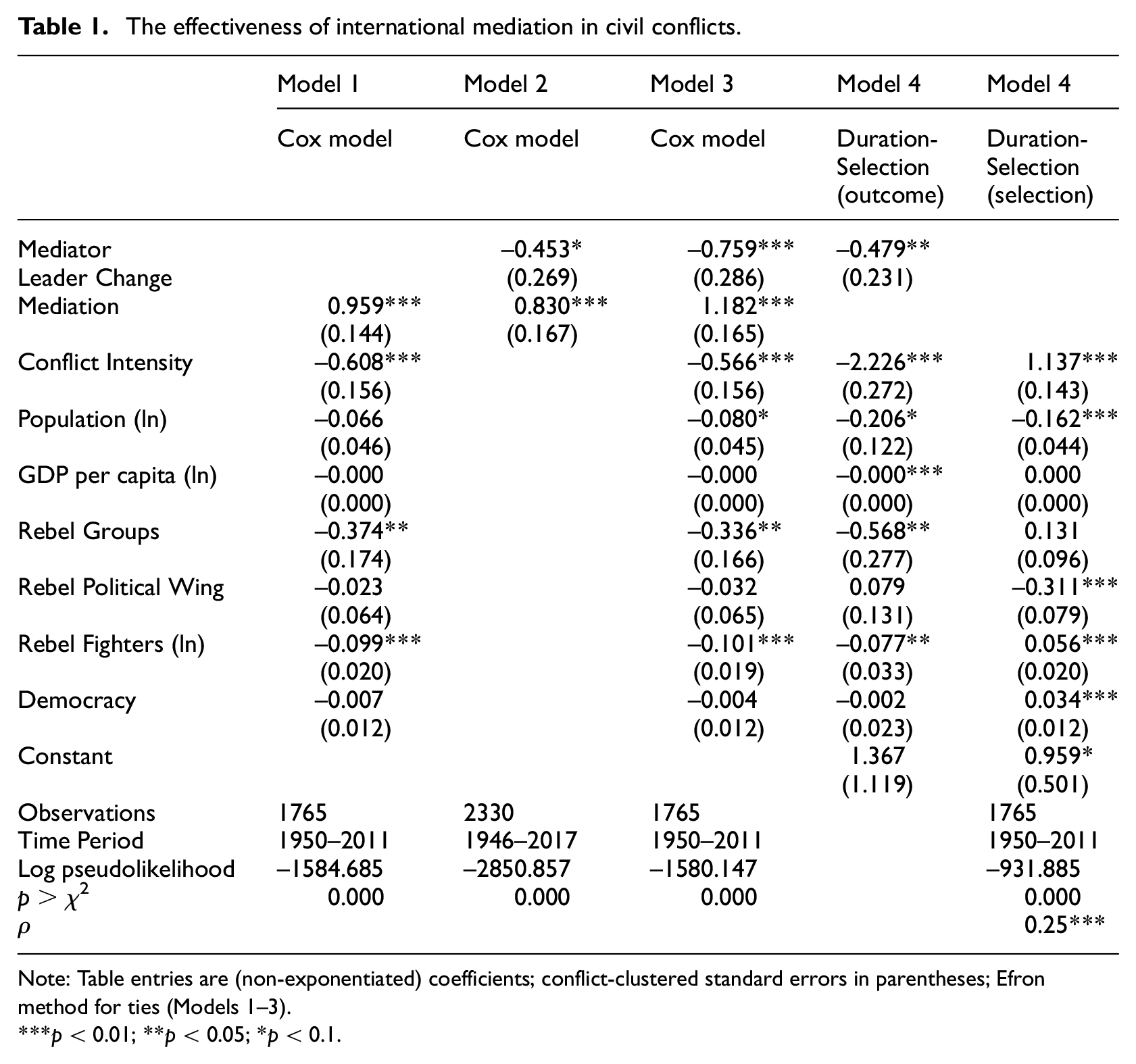
Note: Table entries are (non-exponentiated) coefficients; conflict-clustered standard errors in parentheses; Efron method for ties (Models 1–3).
p < 0.01; **p < 0.05; *p < 0.1.
To summarize, we find consistent support for our theoretical expectation that mediator leadership changes decrease the effectiveness of mediation attempts in armed intrastate conflicts. Operationalizing mediation effectiveness via conflict duration, we find that mediated conflicts where mediators experienced such a change lasted almost twice as long as conflicts where the mediation effort did not experience leader transitions. This is the case even when accounting for the underlying selection problem that characterizes third-party mediation. To further examine the robustness of this result, we implemented a series of changes in model specifications and operationalizations. All additional analyses are thoroughly discussed in the Online Appendix. Here, we provide a brief overview of them. Specifically, in the Online Appendix, we examine time-varying covariates and employ Stratified Cox Proportional-Hazards models with conflict-varying baseline hazards (Table A.2). These tests examine the core assumption of Cox models more thoroughly and this enables us to vary the underlying baseline hazards over conflict types. In Table A.3 of the Online Appendix, we employ different functional forms (Weibull and log-normal models) for the second stage of the selection model. In Table A.4, we examine to what extent the negative effect of mediator leadership changes depends on time as we restrict the sample to conflicts that have, at maximum, endured for six years, i.e. less than 30% of our initial sample. To examine temporal dynamics as well, Table A.5 in the Online Appendix interacts Mediator Leader Change with time since that change. The results indicate that the negative effect of such a transition on mediation effectiveness may attenuate with time. As a last analysis to explore temporal dynamics, we vary the number of years that a mediator leadership transition is carried over to and use a decay function. The findings in Table A.6 provide further evidence that the effect of mediator leader change on mediation effectiveness somewhat weakens with time.
We also changed the operationalization of the main dependent variable. One alternative is using an item coded based on the outcomes of mediation efforts as reported in the original Civil War Mediations data. This alternative outcome variable is a binary item taking the value of 1 if a mediation effort results in a partial or full settlement (0 otherwise). In line with main results, Mediator Leader Change has a negative and statistically significant effect on this alternative measure of mediation effectiveness. We also use this setup, presented in Table A.8 of the Online Appendix, to test whether our results are driven by not distinguishing between different mediation rounds. Mediation may occur in several rounds and these may differ in their types and participants. Overall, though, the results provide further evidence in line with the claim that mediator leader changes decrease mediation effectiveness. Furthermore, we employ data on battle-related deaths as an alternative indicator capturing conflict intensity (Table A.9), examine Cold-War influences (Table A.11) and examine a curvilinear regime-type effect as autocracies and democracies may both be less likely to accept mediation and fight shorter armed conflicts than anocracies (Table A.10). We do not find much empirical evidence for the latter, however.
Moreover, Table A.12 reports findings from models that take into account the number of mediators (Böhmelt, 2011). For our purposes, this is particularly relevant as one may expect that the probability of a Mediator Leader Change occurring increases as the number of mediators is raised, whereas its negative effect on mediation effectiveness may actually decrease because not all mediators should be affected by it at the same time. However, a leadership transition in one of the participants in larger mediation coalitions may also result in coordination issues inside the coalition. That is, mediators would need to re-establish trust and information channels not only with the conflict parties, but also with the other parties to the coalition effort. We would thus expect that Mediator Leader Change decreases mediation effectiveness even when accounting for the number of mediators. The results for Mediator Leader Change are substantively identical to those from the main specifications, indicating that it has a conflict-prolonging effect. The main constituent term is negatively signed and statistically significant in all models while its interactions terms with the mediator number are insignificant, emphasizing that its impact is not moderated by how many separate countries participate in a mediation effort. In line with earlier findings, our results demonstrate that the number of mediators has a nonlinear effect on mediation effectiveness at least once we account for the non-random assignment of mediation. This result is substantively interesting as previous work on this is on interstate disputes, not intrastate wars.
In Table A.13, we examine leader changes in the government fighting an intrastate conflict, while Table A.14 summarizes models with the issue type of the conflict to identify the selection part of two-stage models. In Table A.15, we examine whether mediator characteristics, namely their regime type and winning coalition size, moderate the effect of mediator leader change on mediation effectiveness. One may expect that the theoretical mechanisms mostly affect countries that are more democratic and have larger winning coalitions as leader changes should induce more substantive policy shifts there. The results show that the effect of mediator leader change becomes more negative as mediators’polity2 score and winning coalition size increase. For the sake of comparison, this estimated negative effect is approximately as strong as in the Duration-Selection model presented in the main analysis when mediators’ average polity2 score is 1 or their average winning coalition size is 0.456. This is the case for at least 70% of mediation cases in our sample. This is an important finding and underscores a key condition on the developed theoretical arguments. Finally, in Table A.16, we employ the number of mediator leadership changes a conflict has experienced up to and including the conflict-year under observation as an alternative independent variable.
Conclusion
Leadership turnovers influence conflict dynamics and peace processes in important and substantive ways—the case of international mediation in civil wars is unlikely to be an exception here. We show that changes in the executive of a mediator are unlikely to be helpful for third-party interventions. In fact, our arguments suggest and the findings support the notion that leadership turnovers actually lower mediation effectiveness by prolonging conflict durations.
The implications of our work are straightforward. Mediators with a turnover in their leadership are unlikely to be the most effective third parties. By implication, international organizations may be less prone to changes in their leadership and, hence, the mediation approach, which could make them ex-ante attractive options as third-party mediators. The contribution of this research to the academic literature can be derived from these policy implications: we not only uncovered the influence of a previously overlooked determinant in the mediation research, but also linked this to the more general literature on leadership turnovers and conflict dynamics. What is more, despite our focus on mediation effectiveness, there are obvious and important consequences for the research on mediation onset.
Namely, several avenues for future research follow from this study. First, we treated leadership changes in mediation coalitions the same as turnovers in single-party mediation. Future work may want to disaggregate the former and focus more specifically than we could have done on the dynamics there as previous work points to several differences between single-party and multi-party mediation (Böhmelt, 2012). Second, the lack of coding of mediation in interstate disputes prevents us from testing our theory in that context. In principle, however, the mechanisms we outline should apply to both civil wars and interstate conflicts. Although it will require additional data-collection efforts, further studies may see it an effort worth making and examine the impact of mediator leader changes on interstate-war durations.
Finally, it may be an effort worth making to take into account the characteristics of the mediator country as, e.g. regime type and state capacity could be moderating factors. 10 Similarly, future work could try to collect data on leader features and examine more thoroughly what characteristics of leader transitions may make it more difficult for mediation attempts to be effective. For example, it might be the case that a leader is replaced by someone who was also deeply involved in previous mediation attempts, e.g. along the lines of the former Norwegian Prime Minister Bondevik, who began getting involved in the Sri Lankan peace process already when foreign minister (Sørbø et al., 2011), thus potentially inducing the third-party intervention to continue more smoothly than our general argument may suggest. Moreover, our theory notwithstanding, some new leaders might be seen as more trustworthy than their predecessors by some (or all) of the belligerents in a conflict. The differences in the perceptions of the parties in the Israeli–Palestinian conflict are an example of this that might shape mediation performance. It could also be that a (current) mediator is less interested in the promotion of peace, which leads to the outcome that a change of leadership actually improves mediation effectiveness. RezaeeDaryakenari and Thies (2018) argue here that mediators might intentionally derail mediation, so there are characteristics that lead to interesting scope conditions of our argument. We currently lack sufficiently high-quality data to analyze such characteristics, but future work may address this shortcoming and then further improve our understanding of leadership change and mediation effectiveness.
Supplemental Material
2_Appendix – Supplemental material for How mediator leadership transitions influence mediation effectiveness
Supplemental material, 2_Appendix for How mediator leadership transitions influence mediation effectiveness by Marius Mehrl and Tobias Böhmelt in Conflict Management and Peace Science
Research Data
CMPS_Replication for How mediator leadership transitions influence mediation effectiveness
CMPS_Replication for How mediator leadership transitions influence mediation effectiveness by Marius Mehrl and Tobias Böhmelt in Conflict Management and Peace Science
Footnotes

References
Supplementary Material
Please find the following supplemental material available below.
For Open Access articles published under a Creative Commons License, all supplemental material carries the same license as the article it is associated with.
For non-Open Access articles published, all supplemental material carries a non-exclusive license, and permission requests for re-use of supplemental material or any part of supplemental material shall be sent directly to the copyright owner as specified in the copyright notice associated with the article.
