




Abstract
How do wartime legacies affect repression after the conflict ends? Irregular forces support the government in many civil wars. We argue that if this link continues after the war, respect for human rights declines. As “tried and tested” agents they are less likely to shirk when given the order to repress. Governments might also keep the militias as a “fall-back option”, which results in more repression. Analyzing data from 1981 to 2014 shows that pro-government militias that were inherited from the previous conflict are consistently associated with worse repression, but newly created ones are not. Wartime pro-government militias target a broader spectrum of the population and are linked to worse state violence. New militias usually supplement wartime ones and use violence primarily against political opponents. This study highlights the detrimental impact of war legacies.
Introduction
Countries emerging from civil war are often caught in a conflict trap (e.g. Derouen and Bercovitch, 2008; Hartzell et al., 2001; Walter, 2015). Even without a return to full-blown conflict, postwar societies face adverse conditions. 1 In the aftermath of civil war, countries struggle with economic recovery (e.g. Collier et al., 2008; Serneels and Verpoorten, 2013) and development (Gates et al., 2012; Iqbal, 2006). The legacy of war affects political participation (Bellows and Miguel, 2009; Blattman, 2009) and attitudes (Grosjean, 2014; Grossman et al., 2015; Lupu and Peisakhin, 2017), but we know little about drivers of state-sponsored repression after the conflict ends.
We contribute to the research agenda that aims to understand the legacies of armed conflict. Postwar governments often cannot rely on well-functioning institutions to regulate societal or political conflict (e.g. Hartzell and Hoddie, 2015; Joshi, 2010). At the same time, pressure on limited resources and the struggle for political influence foster tensions (e.g. Keels and Nichols, 2018). Under these difficult conditions governments often resort to violence to maintain control. The question is less which countries do or do not protect basic rights to physical integrity, but rather to what extent they are violated. How can we explain variations in state-sponsored repression in post-conflict societies?
To answer this question, we argue that government strategies that are applied during the civil war and that are carried over into the postwar period help us understand such variation. We suggest that if governments collaborate and support irregular armed groups during the war and do not sever this link after the war is terminated, then torture, disappearances and killings are likely to be more common compared with a scenario without such government-supported wartime militias. We concentrate on the impact of pro-government militias (PGMs) because they are a common feature of intra-state armed conflicts (Carey et al., 2013; Carey and Mitchell, 2016; Jentzsch et al., 2015) and associated with repression (Alvarez, 2006; Campbell and Brenner, 2002; Mitchell et al., 2014; Kirschke, 2000; Koren, 2017). We follow Carey et al. (2013) in defining PGMs as armed groups that are not part of the regular security forces but have a link to the government (Carey et al., 2013). 2 This link can consist of personnel overlap (e.g. because the leader of the PGM has an official status within a state institution), institutional connections (e.g. because the militia is trained by the military or the militia is an armed wing of a governing political party) or direct support (e.g. because the government provides the group with weapons or payment). These groups have distinct tasks that separate them from regular security forces. For some groups this link is more formalized, while the government has a more tenuous authority over others. The former have been classified as semi-official PGMs, while the latter are usually characterized as informal militias, vigilantes or death squads. 3
Research on PGMs usually focuses on their behavior during civil wars (e.g. Estancona et al., 2019; Jentzsch et al., 2015; Koren, 2017). We know little about why they might continue in the postwar period and how they influence human rights violations during that time. We bring together characteristics of the civil war and the postwar period, as they might affect postwar dynamics differently (Uzonyi and Hanania, 2017).
Why would governments continue their collaboration with irregular armed groups and why would this foster repression in the postwar period? Strategic advantages for the government, as well as the trust and experience developed during the preceding conflict, the difficulties of disarming militias and the personal motivation of militiamen heighten the risk of postwar state-sponsored repression. We test our argument on a global sample of episodes of peace between 1981 and 2014 that follow an armed conflict. During this time the risks of repression and relapse into armed conflict are particularly high (e.g. Wallensteen, 2015). We assess the militias’ impact on repression in the short- (five years) and medium-term (10 years) postwar periods. 4
Our results emphasize the detrimental legacies of conflict. Only PGMs that were inherited from the preceding conflict are systematically linked to worse human rights violations after the war. New militias more commonly focus on the opposition compared with war-time groups, without consistently affecting overall levels of repression.
This study has important policy implications. First, understanding drivers of postwar repression is crucial to reduce the risk of conflict re-escalation as repression directly affects the stability of peace, especially in weak states (Keels and Nichols, 2018; Rost, 2011; Young, 2013). Second, by focusing on how the government treats fundamental rights to physical security we assess the quality of postwar peace as experienced by the population. It complements research on how international actors affect security (Kathman and Wood, 2016; Murdie and Davis, 2010) and how war changes the economy and society more broadly. Third, by identifying the trajectory of militias during and after civil wars, we trace the strategies of these actors in postwar societies. Beyond the detrimental impact of wartime militias, our results show that repression does not seem to be pre-determined by the characteristics or the type of termination of the preceding war.
Repression in postwar societies
Research on state-sponsored repression has shown that physical integrity rights are at particular risk during civil wars (e.g. Poe et al., 1999; Zanger, 2000). Hill and Jones (2014) emphasize the predictive power of civil war for explaining physical integrity rights violations. Poe et al. (2006) use civil wars to assess the future risk of state-sponsored violence. However, we know little about the trajectory of human rights after such conflicts have come to an end. Once the fighting between the government and rebel groups has ceased, security and stability continue to be volatile. Unlike after wars between states, civil war societies have to learn to peacefully live with their former enemies, sometimes in the same village. This makes post-conflict peace a delicate task. Under such difficult conditions the government must create and maintain order and stability. Leaders in post-conflict societies are often insecure in their position and worry about being overthrown by their own military or by popular revolt. Being sensitive to real or imagined threats makes leaders more prone to repress (Poe, 2004). The scarcity of economic resources after civil wars (Collier et al., 2008; Flores and Nooruddin, 2009) puts further strain on human rights. Leaders might want to prevent any potential or real threat by closely controlling society and by deterring or punishing those deemed to jeopardize the fragile postwar peace.
While postwar conditions provide plenty of incentives for state-sponsored repression, they also provide the opportunity due to a lack of strong and independent political institutions that can hold the executive to account. Political institutions intended to check the power of the executive and its armed forces are sometimes non-existent or without real power and influence (e.g. Joshi and Mason, 2011; Nilsson, 2012) and take time to consolidate (Fortna and Huang, 2012; Joshi, 2010). It is not surprising that postwar societies are on average more repressive than those without a conflict history. 5 How can we explain varying degrees of repression in postwar countries? How can we identify countries that are most at risk of severe and widespread human rights violations? We argue that the type of wartime alliances a government maintains in the postwar period provides important insights to these questions.
Pro-government militias in postwar societies
The relationship between the state and militias can vary by how formalized the link is, by what section of society the groups draw from (Carey and Mitchell, 2017) and by how the government interacts with these groups (Staniland, 2015). These characteristics can provide insights into the motivation of the government and the militias and how they affect ordinary citizens. The reasons why governments continue to support and collaborate with irregular armed groups, even when circumstances change, also provide valuable insights into the benefits both sides expect from this connection and how this shapes respect for basic human rights. The reasons behind the continuance of an alliance with wartime militias probably differ from those for creating new linkages. In the next section we outline five mechanisms for why we expect wartime PGMs to be associated with increased postwar repression. The first two mechanisms apply to both wartime militias and those newly created in the postwar period, while the last three are specific to PGMs that were inherited from the previous conflict.
Wartime militias and postwar repression
During civil wars many governments collaborate with irregular armed forces (Carey et al., 2013; Carey and Mitchell, 2016; Jentzsch et al., 2015). After the conflict ends, governments often continue their wartime alliances. This continuation is partly due to policy inertia as practices tend to linger on (Pierson, 2000), and the termination of a conflict does not automatically translate into the disarmament of all armed parties. The availability of light weapons continues to threaten the safety of civilians (Kathman and Wood, 2016). Disarming militias is particularly challenging as they are rarely included in peace deals or disarmament programs. We argue that the incentives of the government and of militia members to continue this alliance lead to detrimental effects for human rights.
First, governments continue to rely on their wartime agents because they provide strategic benefits. Acemoglu et al. (2012:, 7) argue that “nonstate armed actors can persist in part because they can be in a symbiotic relationship with specific politicians holding power” (emphasis in the original). For example, paramilitaries can help deliver votes, as in Colombia (Acemoglu et al., 2012). Because militiamen act under government protection, they can employ unorthodox and violent methods to deliver votes and extract information. More generally, PGMs can help to create or maintain peace by intimidating the population into behaving in the way desired by the leader. The local knowledge that militias often possess provides governments with an additional strategic advantage. During civil wars PGMs are valued for their insights into insurgents (Clayton and Thomson, 2016; Hughes and Tripodi, 2009; Peic, 2014); after the conflict their local knowledge enables them to identify and target groups that could pose a threat to the government. Finally, owing to their acting outside the formal state apparatus, PGMs provide the government with plausible deniability for the violence they commit (e.g. Alvarez, 2006; Carey et al., 2015; Mitchell, 2004). This plausible deniability does not require the local community to be oblivious to the link between the government and the armed group, but the tenuous nature of the link makes it difficult to prove beyond doubt that the government ordered the violence. Avoiding accountability for violence is particularly beneficial in postwar periods when governments are under international scrutiny and dependent on foreign assistance. These strategic reasons for maintaining the wartime links probably result in higher levels of state-sponsored violence, as governments have reasons to use them as a tool for violence.
Second, legacy militias have economic benefits for the government. Maintaining links with irregular armed groups is cheaper than training, housing and monitoring regular forces. While militiamen are occasionally paid by the government, receive training and weapons from the military, they require fewer resources than regular forces. In the aftermath of war, which is usually characterized by financial constraints, governments have an economic incentive to continue their collaboration with militias—which facilitates higher levels of repression. By continuing to support these groups after the armed conflict, the government signals that it rates these benefits higher than centralizing, integrating and fully controlling all agents of violence.
The third mechanism linking legacy militias to higher levels of repression draws on the longer-term nature of the relationship and the trust that might have developed during the war. Wartime militias will have previously proven loyal when ordered to commit acts of violence. This loyalty is important—and cannot be taken for granted. Agents of the state do not automatically follow orders to kill or torture civilians (Mitchell, 2004; DeMeritt, 2015). In the postwar context, agents have a strong incentive to shirk orders to repress because during that period international actors often pay closer attention to human rights conditions. Following orders carries risks for the perpetrators. A government as principal needs to assess the risk of orders being ignored. If armed agents shirk commands to kill, “the government may (appear to have) lost its coercive monopoly” (DeMeritt, 2015: 432). This would have devastating consequences for a postwar government. A government likely appreciates being able to rely on “tried and tested” agents that have proven their loyalty before. Legacy militias might resist the urge to shirk when under the scrutiny of the international community in the postwar period. Therefore, governments might continue to support and collaborate with their wartime agents because they have more faith in these actors following orders even if this means violating internationally recognized human rights.
Fourth, wartime militiamen might be personally motivated to stay connected to the government to implement repression in the postwar period. They might want to spoil the peace and re-initiate the conflict for ideological and/or economic reasons. Members of wartime militias could be particularly committed to the cause of the war (Steinert et al., 2019). They might object to the peace agreement and be ideologically motivated to continue harming those perceived as opponents. Being driven by wartime goals, they might continue to attack former rebels even after the conclusion of the armed conflict, contributing to higher levels of repression. Beyond the ideological motivation to keep fighting for the goals that drove the preceding conflict, legacy militias might commit atrocities in the post-conflict era for personal gain without fear of repercussions from the state. As they have probably encountered significant levels of violence, they are probably desensitized toward using violence against non-combatants. Their threshold for violating physical integrity rights might be lower than for other individuals. As they continue to enjoy protection by the government, they can use excessive violence for their own personal benefit. 6
Finally, the government could simply tolerate their wartime PGMs, even if it does not expect them to deliver immediate benefits. Effectively disarming them is not only extremely difficult, but by alienating them, for example by declaring them illegal, the government risks that these forces turn against it. The militia could fight the government or bolster the forces of (former) rebel groups. Governments might also want to keep their options of using these groups in the future if circumstances change. Governments that tolerate the continued existence of these groups instead of actively disarming or distancing themselves from them are likely to have a more “lenient” attitude toward human rights in general. While the first four mechanisms suggest that wartime PGMs carry out acts of state-sponsored repression, the last mechanism hints at the general repressive propensity of the government.
In short, we expect that the reasons why governments and militias continue their wartime alliance lead to higher levels of state-sponsored violations of physical integrity rights in the postwar period.
New militias and postwar repression
Governments might align with new militias in the postwar period to achieve the same strategic and economic benefits as they expect from continuing their alliance with wartime groups. New PGMs can also provide valuable local knowledge and plausible deniability for violence; just like inherited PGMs they require fewer resources—an important bonus in an economically constrained postwar environment.
New groups also offer specific benefits. Postwar governments might create new PGMs if they do not trust their security forces. For example, in the Republic of Congo, President Lissoubas came to power after disputed elections during an armed conflict in 1993. He was faced by two rivals who each had their own militia: former President Sassou-Nguesso was associated with the Cobras and former Prime Minister Bernard Kolelas with the Ninjas. Since President Lissoubas did not fully trust the military, he created his own militias soon after the peace agreement, the Aubevillois and the Zoulous. All militias were linked to extensive human rights abuses in the postwar period. 7
In other cases, political parties might align with or create armed groups to help suppress opposition members or simply to intimidate the population. After the ceasefire between the government and the National Forces of Liberation rebels in Burundi in 2008, the government supported the armed youth wing of the ruling party, the Imbonerakure. Since then they have been intimidating and harassing the opposition, contributing to the deteriorating human rights situation in the post-conflict period. 8 In other cases, rebel groups turn into pro-government militias if the insurgents become part of the post-conflict government, such as the Young Communist League (YCL) in Nepal. The YCL was the youth wing of the Maoist rebel group and continued as armed groups after the Maoists joined the government in 2008, attacking political opponents. 9 New militias may therefore lead to higher levels of state-sponsored violence in postwar periods compared with cases without such groups.
Data and research design
We investigated repression in the short (five years) and medium term (10 years) after a civil conflict between a government and an armed opposition that resulted in at least 25 battle deaths, using the UCDP/PRIO Armed Conflict Dataset (Gleditsch et al., 2002; Melander, 2009). The unit of analysis is the country-year within the five- or 10-year window after the conclusion of an armed conflict. Only observations without fighting in any part of the country or with any rebel group enter our sample to avoid repression being driven by continued fighting in one part of the country while a conflict with another rebel group has ended. A post-conflict period starts when the preceding conflict ends with a settlement or a victory by the government, or when the fighting has ceased for at least two consecutive years (cf. Doyle and Sambanis, 2000). Whenever a country experiences renewed conflict above the 25 battle deaths threshold, the country exits our sample as it is then in a state of armed conflict again. We do not analyze the duration of peace, but investigate how pro-government militias affect repression over a short (up to 5 years) and medium (up to 10 years) time period after an armed conflict has ended. Our sample consists of conflicts that ended in or after 1981, when data on PGMs become available, and we identify the post-conflict periods until 2014. 10
State-sponsored repression
We measure state-sponsored repression with the Political Terror Scale (PTS) (Wood and Gibney, 2010). 11 This scale ranges from 1 to 5, where PTS Level 1 represents no repression, while higher levels indicate that physical violations are more severe and extend to the wider population. For our multivariate analysis, we collapse the dependent variable repression into three categories, “non or limited”, “extensive” and “widespread” murders, disappearances, torture and political imprisonment. We merge the lower and upper end of the PTS scale with their adjacent categories owing to the rare occurrence of the two extremes in post-conflict periods. As a standard-based measure, the three levels of state-sponsored repression represent substantively different scenarios in terms of the types and extent of human rights violations that are carried out or sanctioned by the state. 12
Figure 1 maps state-sponsored repression in post-conflict societies. It plots the average level of physical integrity rights violations for up to five years of peace after an internal armed conflict. It includes the most recent return to peace for countries that had terminated a conflict since 1981. Some 30% of post-conflict countries between 1981 and 2014 experienced no or limited repression, 44% had extended and 26% suffered widespread or indiscriminate state-sanctioned repression. Countries in a postwar peace had generally worse human rights than those at peace without a recent conflict. 13
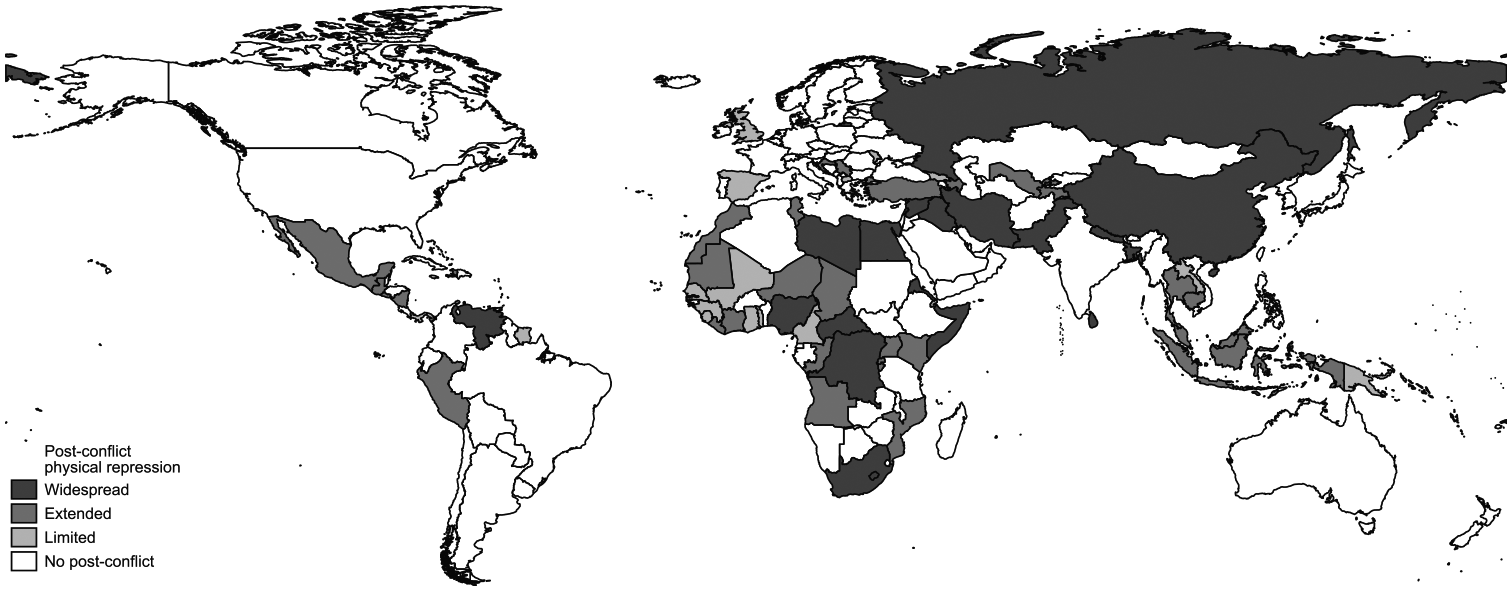
Post-conflict countries and levels of physical integrity rights violations 1981–2014.
Pro-government militias in postwar societies
Our key explanatory variables are pro-government militias in the postwar period that already existed during the preceding conflict (PGM inherited from conflict) and that were newly created after the armed conflict (PGM new to post-conflict). We use the Pro-Government Militias Database (PGMD) 1.1.-2017 to identify PGMs (Carey et al., 2013; Carey, 2017) and extend the coding to 2014, using the coding rules from the PGMD codebook. We identify whether a PGM was present in the postwar period and whether this group already existed during the preceding conflict or was created only after the conflict. Figure 2a graphs the proportion of postwar countries with such inherited wartime PGMs and shows that they were present in almost half of all post-conflict episodes in the first postwar year. 14 This proportion steadily declines over time to 24% of post-conflict episodes a decade later.
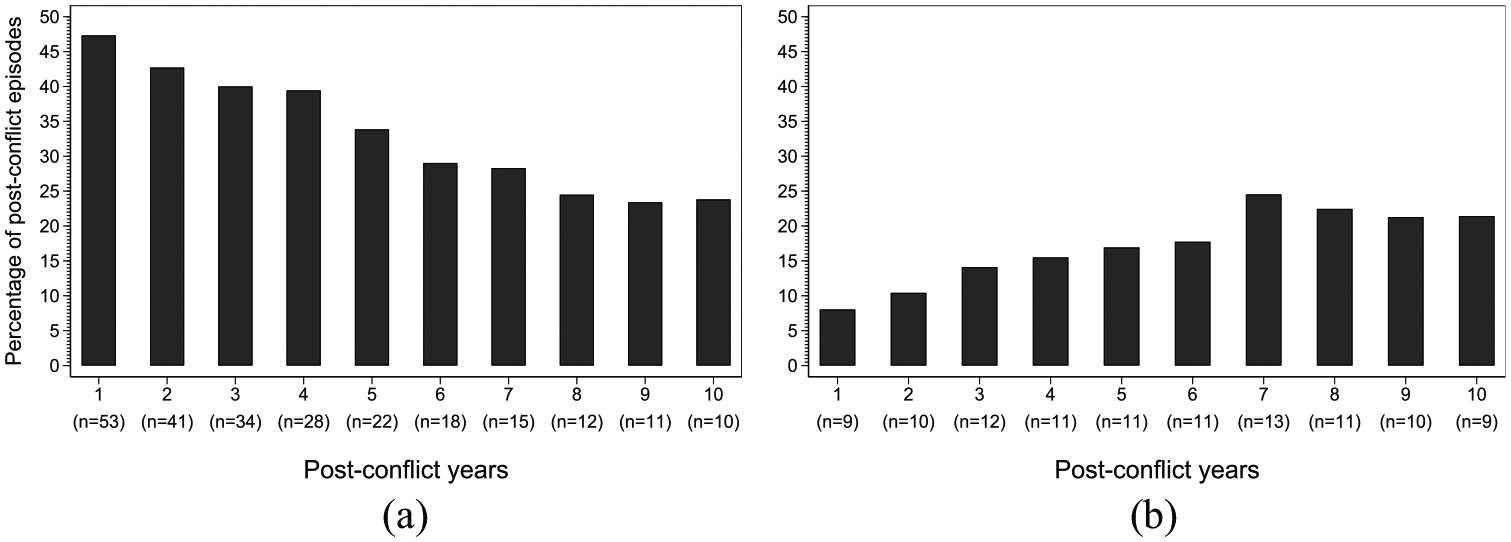
Proportion of post-conflict episodes with inherited PGMs and new PGMs. (a) PGMs inherited from conflict. (b) New post-conflict PGMs.
Figure 2b shows the share of post-conflict episodes with new PGMs. In contrast to the declining share of countries hosting wartime PGMs, the share of countries with new PGMs increases, although at lower levels and staying below about one-quarter of post-conflict episodes. 15 For the regression analysis we aggregate the information by country-year to generate a count variable for the number of PGMs in each post-conflict country-year. 16
Control variables
The nature of the preceding conflict and how it terminated could explain variation in postwar repression. Particularly long lasting and violent civil wars create an environment in which state repression is perceived to be commonplace and in which state actors continue to use violence in the post-conflict period (Bateson, 2017). We capture the duration of the previous conflict with civil warduration and whether it was particularly violent by coding civil warintensity“1” if more than 1000 battle deaths occurred during the last year of fighting, using data from Gleditsch et al. (2002). We expect that longer conflicts and more violent ones are correlated with higher levels of postwar repression.
How a civil war ended may offer another explanation for varying respect for physical integrity rights (e.g. Hartzell and Hoddie, 2003; Mason et al., 2011). To test whether the outcome of the conflict shapes human rights, we account for government victory and settlement, using faded intensity as baseline category (Kreutz, 2010). Table A1.4.1 in the Online Appendix shows how common these termination types are and how often we find militias under these conditions. Most conflicts end with a settlement between the government and the rebel group(s) (N = 50, 40%). In 38 cases (31%) the conflict came to an end because the number of battle deaths dropped below 25 for at least two consecutive years. About one-fifth (N = 24) of post-conflict episodes emerged from a government victory. Only a small minority ended with a rebel victory (N = 12, 10%). As a rebel victory complicates whether the pro-government militias are inherited or new groups, and because they make up such a small proportion of our sample, we excluded them from our analyses. 17
Excluding rebel victories, irrespective of how the conflict ended, about 60% of post-conflict episodes see at least one PGM. This finding counters the potential argument that militias are more closely associated with certain types of conflict termination. Among those episodes with at least one PGM, the distribution of new and old militias varies slightly depending on the nature of the conflict termination. Table A1.4.2 shows the percentages of post-conflict episodes for new and inherited PGMs, given that we observe at least one militia. After a government victory the share of wartime militias is particularly low (38%), while just over half of episodes following a low intensity termination have a PGM. After defeating the opposition, the government might feel slightly more comfortable relying solely on its formal security apparatus. It is not surprising that without a clear and formalized end to the conflict, as is the case for low-intensity terminations, the government is more likely to retain its irregular wartime allies so it can use them should the fighting intensify again. New PGMs are less common across all termination types, but most often found after a government victory (38%). During negotiated settlements it is probably difficult to get away with establishing a link to an irregular armed group.
We also control for possible confounders that may influence postwar repression and that might be linked to PGMs. Research on conflict termination and conflict recurrence highlights the importance of peacekeeping operations (PKO) (Fortna, 2004; Toft, 2009; Walter, 2002). Kathman and Wood (2016) show that UN peacekeeping missions reduce violence against civilians in post-conflict societies. Hence they might also reduce the overall level of state-sponsored repression. We test for the impact of PKOs on repression with a dichotomous variable on PKOs from Mullenbach (2013).
The government’s ability to engage in repression might be influenced by how constrained the executive is and by how repressively it acted in the past (Blankenship, 2018; Colaresi and Carey, 2008). We use executive constraints from the Polity score’s component “xconst” to control for institutional limitations on post-conflict governments. It captures constraints on the executive without being influenced by state-sponsored violence (Vreeland, 2008). We include a lagged dependent variable as levels of repression change only slowly within countries (Carey, 2010; Poe et al., 1999). Constraints on the executive should be associated with less repression, while higher levels of state violence in the previous year should lead to higher levels of repression in the current year. A change in government can increase repression in post-conflict by enforcing different policies to deal with the re-stabilization of the country. We control for government change using information from Goemans et al. (2009) and Hyde and Marinov (2012). This binary variable is lagged by one year to include government changes that occurred during the last year of conflict. We control for free media with a dummy variable from Whitten-Woodring and Van Belle (2017). If journalists can freely report about the government’s actions, it should act with more restraint, resulting in lower levels of repression. We account for economic development with GDP per capita and the size of the population as both are important predictors of state physical violence (e.g. Hill and Jones, 2014; Poe et al., 1999). These variables are logged and taken from Gleditsch (2002). Table A1.1 in the Online Appendix shows all summary statistics.
Methodology
To assess whether wartime and new PGMs aggravate repression in post-conflict societies, we use an ordered logit model as the distance between the three categories of our dependent variable (limited, extended, and widespread state repression) cannot be assumed to be equal (Long and Freese, 2014). 18 Since the errors may vary systematically by country, we report robust standard errors clustered by country. We use cubic polynomials of the time since the post-conflict period started (peace years) to account for temporal dependence (Carter and Signorino, 2010).
Multivariate results
Our empirical analyses focus on post-conflict episodes of peace between 1981 and 2014. Our sample includes a maximum of 112 post-conflict episodes across 68 countries. The unit of analysis is the country-year. Table 1 presents the results from the ordered logit estimations on the three categorical outcomes of repression. We constrain our sample to the period of five (Models 1–3) and 10 (Models 4–6) years after the conflict. Of the total number of countries that started a post-conflict period after 1981, 84% (58 countries) reach at least five years of consecutive post-conflict peace, 60% (41 countries) do so for at least 10 years. Models 1 and 4 analyze the impact of our main explanatory variables on the level of physical integrity rights while controlling for characteristics of the post-conflict period. Models 2–3 and 5–6 add control factors related to the preceding conflict, which may mediate this effect. These measures do not contribute explanatory power to the models, as the models have higher values for the Akaike Information Criterion. Overall the models predict about 70% of outcomes correctly.
Order logit estimations for the level of human rights violations in post-conflict societies.
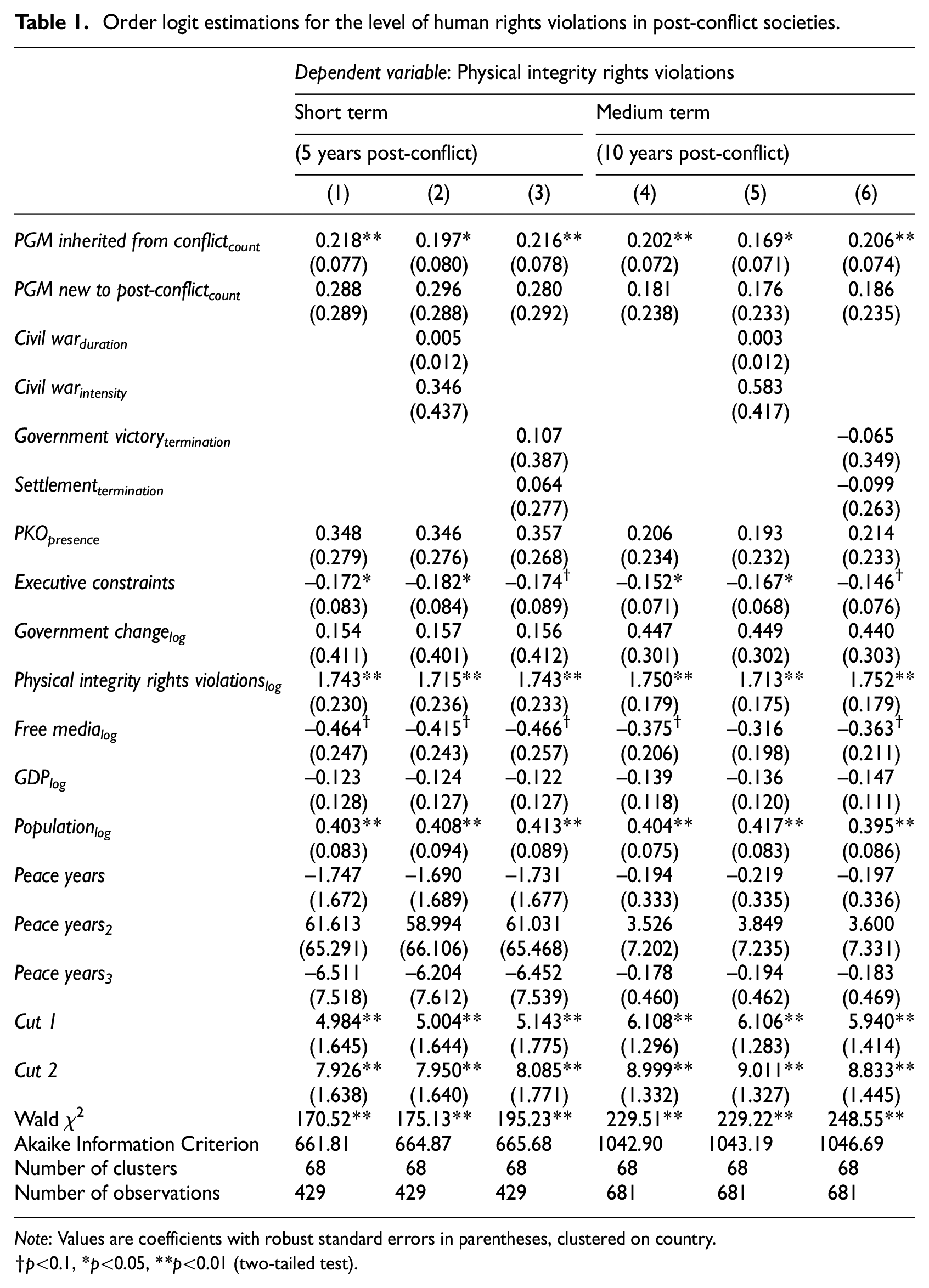
Note: Values are coefficients with robust standard errors in parentheses, clustered on country.
p<0.1, *p<0.05, **p<0.01 (two-tailed test).
Before discussing our main findings, we briefly present the results from the control variables. Attributes of the preceding war do not seem to systematically influence postwar repression. Conflicts that lasted longer and that caused extensive casualties are not systematically linked to postwar repression. Civil warduration and civil warintensity fail to reach conventional levels of statistical significance. Different types of conflict termination also do not seem to have a distinct impact on postwar repression; neither gov. victorytermination nor settlementtermination reach meaningful levels of statistical significance. Mason et al. (2011) expect that after victory the government is less dependent on winning hearts and minds but is more concerned about rooting out any last pockets of resistance, which should increase repression. Our results suggest that the impact of a government victory on repression is at least not distinguishable from cases where the conflict ends due to low casualty numbers. 19
Factors that generally increase repression also seem to contribute to repression in postwar societies. Executive constraints, prior levels of physical integrity rights violations and population are systematically related to repression. Restrictions on executive authority have a negative and statistically significant impact on post-conflict repression. Executives that are accountable to and constrained by other branches are less likely to engage in extended physical integrity rights violations in post-conflict environments. Population has a positive and statistically significant effect on state-sponsored repression (Poe and Tate, 1994; Poe et al., 1999). The lagged dependent variable does not “wash out” the effect of our key explanatory variables despite the static nature of the repression measure and the short time period of our sample.
Post-conflict characteristics fail to reach conventional levels of statistical significance. Estimates for peacekeeping operations suggest no consistent effect of these forces on state-sponsored violence. 20 The negative coefficient for free media suggests that it might reduce repression, but it fails to reach meaningful levels of statistical significance across all models. During the five or 10 years after an armed conflict, media freedom does not consistently help to protect physical integrity rights. 21 GDP also has a negative sign as expected, although it also fails to reach conventional levels of statistical significance. This might be due to limited variation of economic development in post-conflict countries.
The results provide strong evidence for the expectation that wartime inherited PGMs are linked to higher levels of repression, but only weak evidence for a similar impact of new ones. The variable PGM inherited from conflict has a positive and statistically significant impact on state repression across all models. This is consistent with the finding that PGMs are related to a higher level of atrocities during counterinsurgencies (Kowalewski, 1992; Lyall 2010) and generally (Mitchell et al., 2014). The legacy of irregular armed groups that are aligned with the government and are carried over from the preceding conflict deteriorates the human rights condition compared with postwar scenario without such militias.
The variable PGM new to post-conflict produces consistently positive coefficients but fails to reach meaningful levels of statistical significance. This might be because they are relatively uncommon during the postwar period, as shown in Figure 2b. While the goal of this study is not to explain the emergence or resilience of these groups, a look at the circumstances under which they appear in the postwar period might provide some suggestions for the lack of support for a systematic link between them and postwar repression. In most cases (68%), governments create them alongside wartime PGMs. New militias operate alone in fewer instances (32%). In none of our cases did a country discard a wartime PGM and then align with or create a new one. New PGMs seem to supplement rather than substitute existing militias. Governments extend an already familiar strategy, rather than creating a new type of alliance. This complementary logic between old and new militias might explain the lack of impact new groups have on repression.
Governments seem to use wartime militias for repressive campaigns, which increases postwar levels of repression but which are not exacerbated by new ones. In addition to the small number of new PGMs and them mostly being used in conjunction with inherited groups, the different impact between these two types of PGMs could also suggest that the characteristics that are specific to the legacy militias and do not apply to new groups are responsible for their impact on repression. We have argued that governments might continue their alliance with their “tried and tested” partners because of the special relationship that developed during the conflict. During this earlier collaboration the PGM could have proven to be a reliable actor and probably carried out government commands even at personal risks to the agents. Furthermore, members of wartime militias are more likely than members of new ones to have extensive experience in the use of violence, which makes their tolerance threshold for committing atrocities probably lower, and to be strongly motivated by the causes of war, which might make them pursue perceived opponents even after the end of the conflict. These differences probably play an important role when explaining how irregular armed groups affect postwar repression.
The substantive impact of wartime PGMs
To better understand the substantive impact of inherited PGMs on physical integrity rights violations, we estimate the change in the predicted probabilities of repression for average post-conflict cases. The simulations are based on Model 1 in Table 1. 22 We focus on countries that managed to avoid a relapse into civil conflict for at least five years to avoid the risk that the effect is driven by countries that have militias and extremely short peace spans. 23 Figure 3 shows the changes in the predicted probabilities for each value of repression comparing a post-conflict country without and with inherited pro-government militias. We simulate the change from none to one, two and three PGMs as these are the most frequent values in the dataset. Other control variables are held at their mean (continuous variables) or mode (categorical variables). The results show that, when a government continues to collaborate with wartime militias, the country is significantly less likely to experience only limited forms of repression compared with a similar country without such PGMs (by −4.11, −7.8 and −11% for each simulated change).
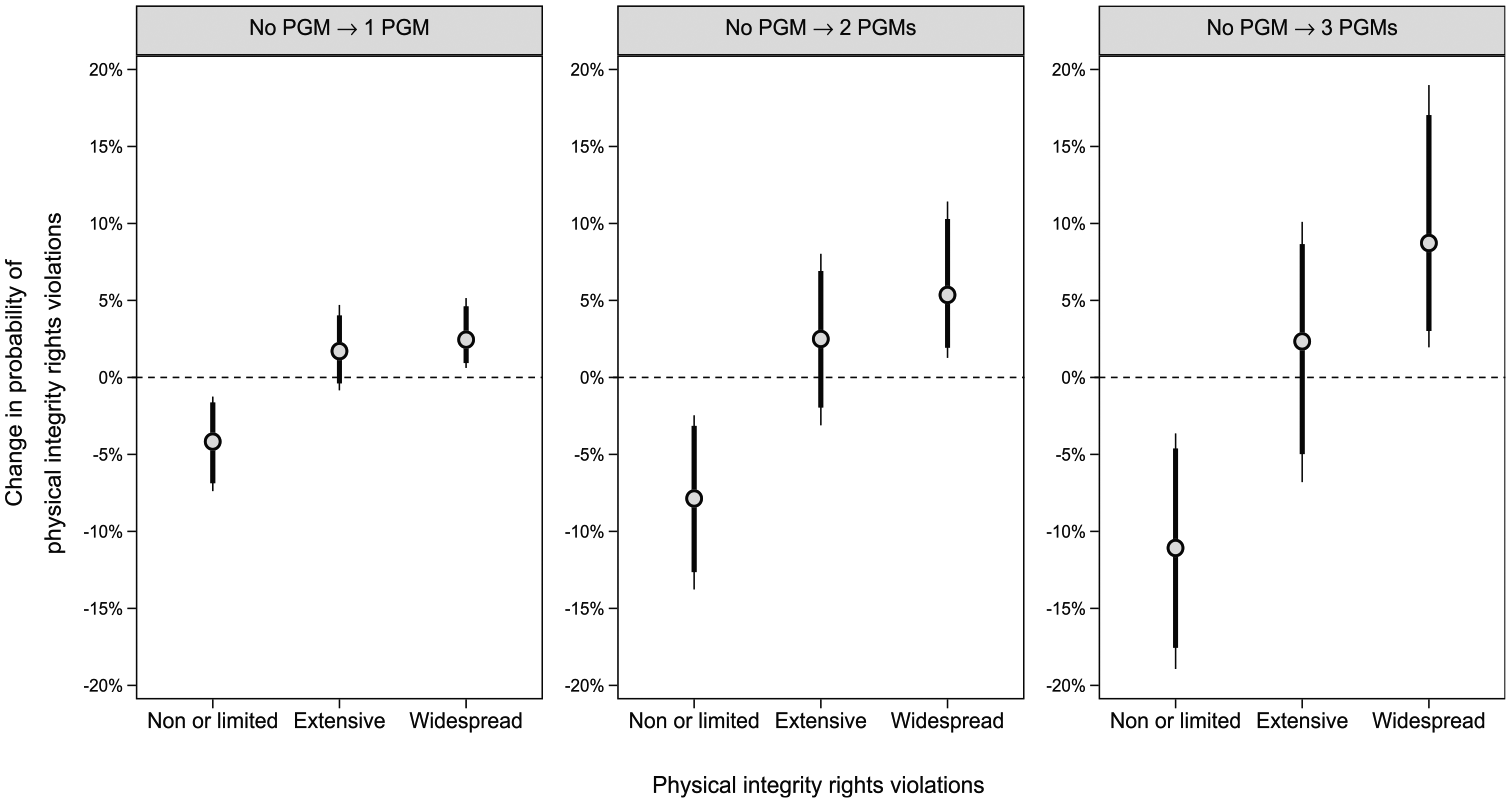
Substantive effect of conflict inherited pro-government militias on repression in the fifth year of post-conflict peace.
PGMs that linger on from the preceding conflict are associated with a substantively higher risk of extensive and widespread political imprisonment and torture, increasing the risk of widespread repression (2.4, 5.3 and 8.7% for each simulated change). Figure 3 highlights the delicate situation of post-conflict societies. The termination of an armed confrontation between the government and rebels is no guarantor of security and meaningful peace when governments continue to support or tolerate their wartime allies. While the prospects of large-scale human rights violations decline if countries manage to avoid a renewed intra-state war for at least five or 10 years, collaborating with militias reduces the prospects of respecting the right to physical integrity in post-conflict societies. 24
The profile of victims of wartime and new PGMs
We argued that the government might rely on their experienced and trusted wartime agents to spread violence after the conclusion of the civil war. They might use them for strategically beneficial violence at low cost or they might tolerate their violent behavior, which could be driven by personal goals or conviction. To shed some light on these mechanisms, we show descriptive evidence on whom these militias are reported to target in the postwar period.
If the government continues to rely on PGMs for strategic reasons, they are likely to target the opposition to deter any threats from known enemies. Attacking members of the political opposition is also consistent with the argument that militiamen are driven by the wartime goals. 25 If the government has lost control over them, but tolerates their violent behavior to not alienate them, they will be more likely to target ordinary civilians.
Using information from the PGMD, we identify for each PGM whether it targeted (1) exclusively civilians, (2) exclusively members of the armed or unarmed opposition, (3) both groups simultaneously or (4) only other types of victims, or (5) whether there are no reports on the group victimizing anybody in the post-conflict period. As the information provided by the PGMD is time-invariant, using the sources of these database we check for each wartime PGMs whether the militia targeted a particular group after and not (only) during the conflict. 26
Figure 4 shows the percentage of wartime and new PGMs that intimidate particular sections in the post-conflict society. 27 New and old militias show a different target pattern. Most noticeable is that over half of pro-government militias that were newly formed after the conflict target members of the opposition, including (former) rebels, without attacking ordinary civilians. An additional 20% target civilians as well as the opposition. Hence, about three-quarters of government militias that are new to the postwar era terrorize the opposition. Examples include the Bangladesh Chhatra League, who targeted supporters of opposing youth leagues, or several village defense committees in southern Thailand that were supposed to fight Communist insurgents after the civil war subsided in 1982, and the southwestern militias in Côte d’Ivoire that President Gbagbo created after the 2002–2004 civil war to intimidate the opposition. Governments seem to generate new armed groups in the postwar period for specific strategic reasons.
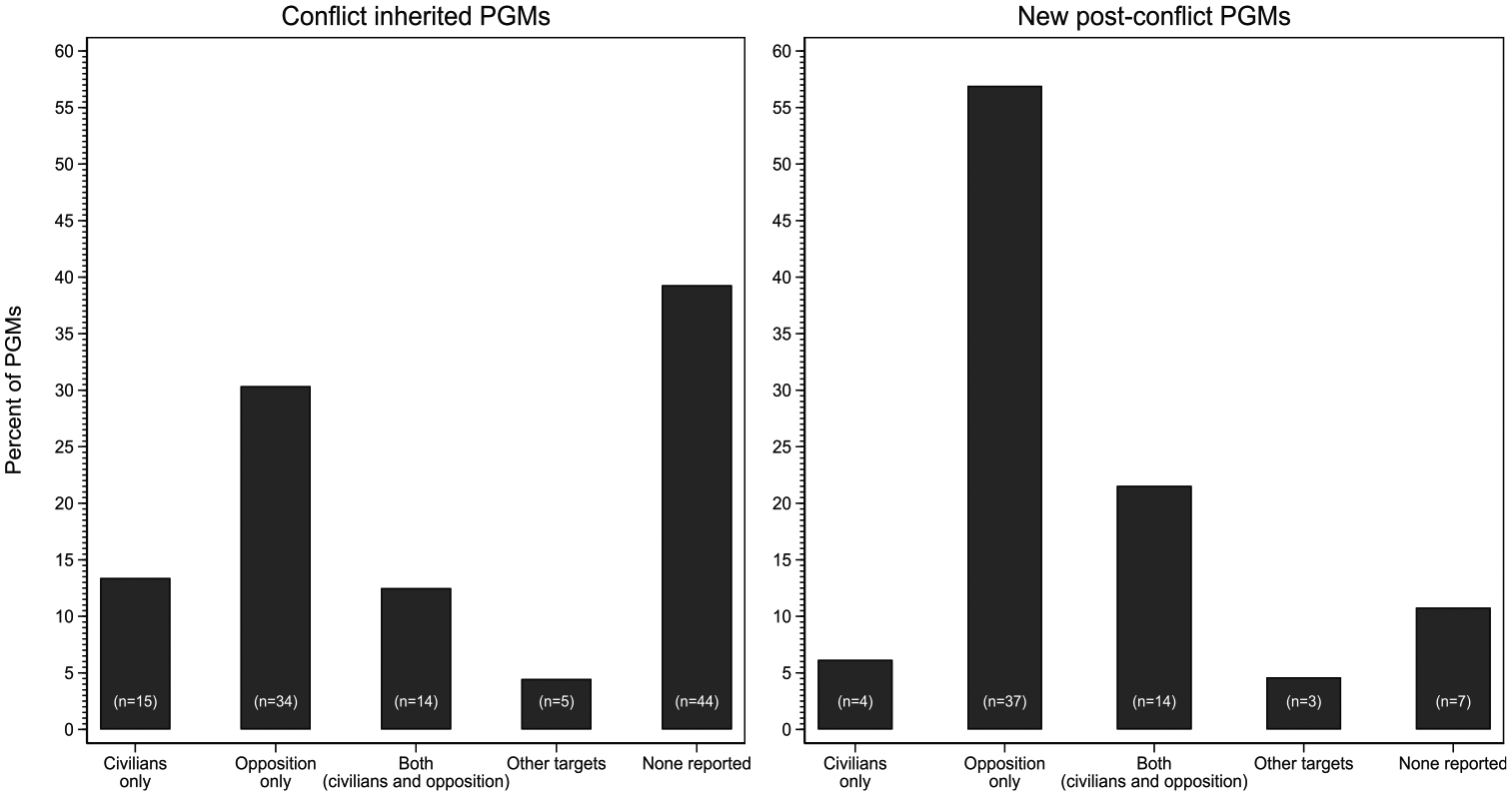
Distribution of target types by pro-government militias.
How does this information square with the lack of statistically significant impact of new PGMs on postwar repression? In part this could be due to the low number of new PGMs. Most likely it is due to the very different data-generating processes that are behind the data on PGM targets and the data on repression. The PGMD codes a particular target on the group level based on news sources, where one report on one instance is sufficient to trigger the coding. The PTS, our source for repression, uses Amnesty International and State Department Human Rights Reports to identify the overall level of respect for physical integrity rights. 28 Therefore, the coding of repression requires more systematic and general evidence, while coding targets of PGMs only requires the reporting of specific and possibly singular events, which might not reflect the wider level of repression as captured by the PTS. The attacks of new PGMs are likely to be below the level that would trigger the PTS to identify worse human rights records. This could be due to the small number of PGMs and/or their isolated attacks on the opposition and civilians.
About 60% of wartime militias use violence against civilians and/or the opposition. Since the multivariate results suggest that they systematically affect postwar repression, they probably attack civilians and oppositions in large numbers and with such violence that it shapes overall levels of repression. 29 For almost 40% of militias that survived the end of the civil war, there are no reports of them targeting anybody. 30 Often these groups seem to have ceased their activities with the end of the war but were not disbanded until a few years later, such as several groups in Nigeria between 2005 and 2008. In many cases governments seem to be content with these groups remaining dormant, possibly to be re-activated if circumstances change. The large proportion of militias without identifiable targets during the observed time period is also in line with our argument that the government’s failure to terminate these groups hints at a more laissez-faire attitude toward human rights generally, which points to more repression not just directly perpetrated by the militia but also by regular security forces.
Robustness checks and alternative explanations
We conduct several robustness checks for which we briefly discuss the results. First, we re-estimate our analyses with an alternative dependent variable to ensure that the results are not artifacts of a particular measure. We replace the PTS with the latent measure of respect for physical integrity rights from Fariss (2014), where higher values reflect better respect for human rights. Results from the ordinary least squares regressions—given the continuous nature of this alternative dependent variable—validate our findings. We also use this estimation technique to replicate our analysis on the five-point Political Terror Scale. This dependent variable may be considered as a continuous outcome given the consecutive values of the scale (Ferrer-i Carbonell and Frijters, 2004). We include regional fixed effects to account for possible regional trends. We found no substantive changes to our main results (see Table A2.1 in the Online Appendix).
Second, governments that anticipate a re-escalation of tensions might be more likely to maintain their links to irregular armed groups or create new ones, and at the same time implement repressive policies. Our results could then be an artifact of very short spells of peace sandwiched between episodes of war. Then the findings should only hold for short-lived peace episodes. To address this possibility, we re-estimate Model 4 from Table 1. Each iteration systematically excludes all country-years from post-conflict episodes that last a maximum of 1 year, up to 2, 3, 4 or 5 years (see Table A3.1). The substantive results remain unchanged. Wartime militias continue to have a positive and statistically significant impact on repression even when we exclude short peace episodes. 31 Militias that survive the end of the armed conflict and contribute to repression without driving the country into another civil war often extend their purpose from tackling former rebels to contributing to general “law enforcement activities”, terrorizing civilians and/or criminals. Examples include the Rangers and the Village Defence Volunteers in Thailand, Rela in Malaysia and the Civilian Defense Patrols in Guatemala. 32
To check whether our results are driven by countries that manage to avoid a re-escalation of conflict for a very long time, we exclude those with peace episodes of one decade or longer (see Table A3.1). The coefficient for new militias is now positive and statistically significant. Only a small share of governments tie new links with irregular armed groups in the postwar period, but if they do, repression seems to increase in those countries that revert back to war within a decade. Future work might want to investigate the conditions under which these new groups trigger (new) armed conflicts.
Third, to avoid countries with a particularly large group of PGMs driving the results, we replicate our main analysis with the log of the counts. While the majority of post-conflict countries have no or few PGMs, some have more than six (e.g. Ghana, Indonesia and the former Yugoslavia). The substantive results again remain unchanged (see Table A4.1).
Fourth, the dynamics of the militia groups on repression might be driven by how formal their connection to the government is. We replace conflict-inherited and new militias with a measure for informal and semi-official PGMs (see Table A5.2). Groups with an informal link are consistently associated with higher levels of state-sponsored repression, while those with a formalized link are consistently not. Similar to the effect of PGMs on human rights in general, informal groups are driving the effect on repression (Mitchell et al., 2014). Governments might be able to better control semi-official PGMs and prevent repression. However, semi-official PGMs might also serve a different purpose, for example preventing a coup-d’état (Carey and Mitchell, 2016), which would not necessarily affect general levels of physical integrity rights violations. In the Online Appendix we show how war legacy PGMs and new PGMs are connected to the government. For both types an informal link is more common, slightly more so for the new groups. That the majority of new groups have an informal link to the government fits the picture that they are used to repress opponents while keeping obscure the government’s involvement.
Fifth, we check the robustness of our findings against including additional control variables that might affect post-conflict repression and the presence of pro-government militias. Based on Model 1 in Table 1, we include indicators for the onset of pro-government militias in the previous year, the Cold War, whether the militia was a former rebel group and for military expenditure. A new militia might use excessive violence only as soon as it becomes aligned with the government. It would then increase the overall level of state-sponsored repression only early on. Controlling for the Cold War allows us to capture potentially different dynamics of observing PGMs and repression during this period (Kalyvas and Balcells, 2010). Rebel groups that turn into pro-government militias, either because some forces switch sides or because the rebels join the government, might have a particularly devastating effect on post-conflict human rights. High military expenditure can reduce the necessity to use cheaper PGMs, while simultaneously affecting repression. Across all specifications, our results remain stable (see Table A5.3).
Finally, we include the small number of postwar peace episodes in the sample where a rebel victory terminated the conflict. Again, our findings continue to hold (see Table A5.4).
Conclusion
Countries that emerge from civil war face enormous difficulties in re-establishing security and political institutions. In volatile post-conflict societies, governments are keen to contain dissent and to strengthen their hold on power. Governments are also motivated to minimize international attention at a time when outside actors look more closely at their internal affairs. Despite the volatility and the potential risks to human rights in postwar societies, we have only limited understanding of what affects state-sponsored repression during these times.
We zoom in on the role of pro-government militias, which are common in intra-state armed conflicts. Our data have highlighted that, in most cases where a government had used a militia during the civil war, this relationship carried on in the postwar period. This makes a systematic analysis of whether and how these groups affect security and peace after the war even more important. Our results have consistently shown that wartime government militias are linked to more extensive state-sponsored repression in postwar societies, compared with cases without such irregular forces. Members of wartime militias likely have been perpetrators of human rights violations during the conflict, which makes them suitable agents for implementing repression in the postwar period. They might also be personally motivated by the grievances and divisions that fueled the conflict and hence continue repressing those perceived as the enemy, even after the conclusion of the war. A failure to disarm or fully integrate irregular militias also hints at a somewhat “lenient attitude” of the government toward protecting basic human rights, which is reflected in worse repression.
The impact of newly formed alliances between the government and irregular armed groups on postwar repression is less clear. The lack of a strong link could be due to the comparatively few instances where governments newly align with irregular armed groups in postwar settings. New groups seem to concentrate more on assaulting the opposition, which does not seem to translate into a systematically higher general level of state-sponsored violence.
While an in-depth investigation of a government’s motivation to align with new groups in the postwar period is beyond the scope of this study, our data provide initial insights. New PGMs usually operate alongside wartime-inherited ones. They seem to supplement but never substitute for old groups. They usually appear when the government won the preceding civil war. Future research might investigate whether groups that are newly created in the postwar environment increase the risk of a re-escalation of conflict, just as wartime PGMs increase the risk of renewed war (Steinert et al., 2019).
Characteristics of the conflict and how it ended do not seem to have a clear impact on postwar repression. This should present an optimistic note for policymakers, as the recent conflict does not determine subsequent respect for physical integrity rights. Wide-ranging disarmament programs that incorporate and “neutralize” pro-government militias could be an important step toward establishing peace, security and the protection of physical integrity rights in volatile postwar societies—irrespective of the conflict history.
Our results emphasize the need to incorporate irregular government-aligned forces in the peace process, disarmament and re-integration programs. Systematically and effectively dismantling these irregular forces should form an important part of peace negotiations. Otherwise the legacy of PGMs continues to affect the quality of peace. We have only taken one step toward improving our understanding of the varying quality of post-conflict peace and the role pro-government militias play. More research is needed to provide insights into the logic behind creating new militias, but also whether locally recruited civil defense forces are better equipped to protect postwar communities from crime, or whether ethnically recruited groups are particularly difficult to dissolve and more violent toward out-groups. Given the “stickiness” of wartime militias, more work is needed on how militia groups can be effectively disarmed and dissolved after armed conflict in order to protect the basic human rights in post-conflict societies.
Supplemental Material
CMP899006_revised_Online_Appendix – Supplemental material for The legacy of war: The effect of militias on postwar repression
Supplemental material, CMP899006_revised_Online_Appendix for The legacy of war: The effect of militias on postwar repression by Sabine C Carey and Belén González in Conflict Management and Peace Science
Footnotes
Acknowledgements
We thank participants at the workshops “Tactics in conflict” at the University of Konstanz in 2017 and “Micro-level perspectives on peace” at the University of Birmingham in 2018, and are particularly grateful to Kristin Bakke, Scott Gates, Christian Glaessel, Elizabeth Nugent, Katrin Paula, Gerald Schneider, Reed Wood and the three anonymous reviewers for their valuable feedback.
Funding
The authors disclosed receipt of the following financial support for the research, authorship, and/or publication of this article. This work was supported by the European Research Council under the European Union’s Seventh Framework Programme (FP7/2007-2013)/ERC grant agreement no. 336019.

Supplemental material
Notes
References
Supplementary Material
Please find the following supplemental material available below.
For Open Access articles published under a Creative Commons License, all supplemental material carries the same license as the article it is associated with.
For non-Open Access articles published, all supplemental material carries a non-exclusive license, and permission requests for re-use of supplemental material or any part of supplemental material shall be sent directly to the copyright owner as specified in the copyright notice associated with the article.
