




Abstract
This umbrella review provides a thorough synthesis of evidence on the impact of virtual reality on three domains of learning (cognitive, affective, and psychomotor), informed by Bloom’s Taxonomy. Content analysis was applied to 93 articles comprising 70 systematic reviews, 17 systematic reviews and meta-analyses, and 6 meta-analyses, extracted from three databases (i.e., Web of Science, Scopus, and IEEE Xplore). The results indicated that affective learning in VR was most widely reported, followed by cognitive and psychomotor domains of learning. In the cognitive domain, VR showed more consistent benefits, especially for knowledge acquisition and higher-order cognitive skills (e.g., problem-solving, intellectual skills), although a few meta-analyses reported non-significant effects. Across the affective domain, findings were mixed but generally suggested VR could improve self-efficacy, self-confidence, and satisfaction, while evidence for various affective outcomes remained highly inconsistent. For the psychomotor domain, VR often enhanced motor, procedural, and safety-related skills, but results specifically for complex clinical skills were inconclusive. Future research should advance theory through exploring why and how VR influences learning while strengthening research designs and standardized measurements to determine under what conditions VR produces reliable improvements.
Keywords
Background
Virtual Reality (VR) technology is the use of computer-generated virtual or alternative environments to create the illusion that the user is physically present, or has a level of presence, in a real or imagined space (Greengard, 2019). VR has found increasing applications in games, research laboratories, and industry environments that involve using headsets, audio immersions, haptic gloves, and other sensory apparatuses to create ultrarealistic sensations – a level of convergence that has drastically changed encounters between people through tele-presence or tele-existence (Greengard, 2019). This technology has been applied in a variety of fields over the past two decades, ranging from business, architecture, engineering, and manufacturing, to media, tourism, and medical science, among others (e.g., Davila Delgado et al., 2020; Guttentag, 2010; Tang et al., 2021). Aside from its entertainment, industrial, and commercial value, VR has been explored in education (Beck, 2019; Coban et al., 2022; Radianti et al., 2020; Villena-Taranilla et al., 2022).
The past few decades have seen a plethora of studies on how VR can be effectively integrated into educational practices to enhance teaching and learning (e.g., Celik & Yesilyurt, 2013; Zawacki-Richter & Latchem, 2018). These studies primarily focus on how VR influences cognitive learning, such as knowledge retention (e.g., Albus et al., 2021; Parong & Mayer, 2021); behavioral learning, which includes the acquisition of various skills (e.g., Çakiroğlu & Gökoğlu, 2019a, 2019b); and affective learning outcomes, which measure changes in attitudes, emotions, and motivation towards learning (e.g., Cheng et al., 2023; Tsivitanidou et al., 2021). Given the growing outputs of VR in various aspects of learning, scholars have accordingly conducted a variety of reviews, such as scoping review, systematic review, narrative review, and meta-analysis on various subjects, to reflect on the impact of VR (e.g., Rojas-Sánchez et al., 2023). The rapidly expanding research of VR in education has given rise to its varied uses and findings spread across various studies (e.g., Beck, 2019; Jensen & Konradsen, 2018; McGovern et al., 2020).
With a growing number of reviews and meta-analyses addressing the impact of VR on various learning outcomes, an umbrella review is necessary to synthesize these studies. An umbrella review, also called an “overview of reviews”, is a type of review that synthesizes evidence from multiple systematic reviews and/or meta-analyses on a specific topic (Belbasis et al., 2022; Fusar-Poli & Radua, 2018). Although umbrella reviews have limited access to primary data and must contend with overlapping primary studies, they remain highly valuable in the context of VR for learning (Fernandez et al., 2025). First, an umbrella review provides a high-level overview of the aspects of VR that have been studied, where findings converge or conflict, and which domains are well-reviewed or under-reviewed. It functions as an evidence map rather than a re-analysis of individual studies (Hartling et al., 2012; Sanders et al., 2023). Second, it contrasts and synthesizes the conclusions of multiple reviews, highlighting both the consistencies and the discrepancies in the evidence (Sanders et al., 2023; Smith et al., 2011). For educators and policymakers facing a rapidly expanding, fragmented VR literature, an umbrella review offers a single, decision-relevant overview of the current state of the evidence and priorities for future research (Fernandez et al., 2025).
An up-to-date search for umbrella reviews on VR was conducted across three databases (Web of Science, Scopus, and IEEE Xplore), yielding 60 initial records. After screening, 9 umbrella reviews on VR were identified. However, these studies are concentrated on specific topics, including physical, mental, and psychological wellbeing (Bachelard et al., 2024; Yu et al., 2023, 2024) and clinical practices (Hu et al., 2023; Mangone et al., 2022; Rooney et al., 2025; Samaratunga et al., 2021; Tene et al., 2024; Voinescu et al., 2021). However, no umbrella review has been undertaken to synthesize the broader trends and impacts of VR on various learning outcomes. The present umbrella review aims to address the existing research gaps by pooling evidence from systematic reviews and meta-analyses. By reviewing both systematic reviews and meta-analyses (Aromataris et al., 2015), this umbrella review seeks to provide a more structured understanding of how VR is applied in education and its effectiveness in achieving various learning outcomes. The insights gained will help educators and policymakers design effective policies and guidelines to incorporate VR to drive learning.
The Cognitive Affective Model of Immersive Learning (CAMIL)
The increasing integration of immersive technologies into educational settings has prompted extensive research into the mechanisms underpinning their impact on learning. In response to the complexity of these mechanisms, Makransky and Petersen (2021) introduced the Cognitive Affective Model of Immersive Learning (CAMIL), which offers a comprehensive framework for understanding how immersive environments affect learning outcomes (Makransky & Petersen, 2021). CAMIL provides a holistic view of how immersive technologies shape the learning experience, while offering a valuable foundation for interpreting empirical findings and guiding the design of effective VR-based educational interventions.
According to CAMIL, immersive environments impact learners through the interplay of cognitive and affective processes, shaped by core technological affordances such as immersion, presence, and interactivity. These mechanisms are proposed to directly and indirectly influence learning outcomes, including cognitive (e.g., knowledge acquisition), affective (e.g., motivation, attitudes), and behavioral aspects. As suggested by the CAMIL, VR can influence learning through both cognitive and affective pathways. Cognitive processes, such as attention, memory, and problem-solving, are often enhanced in immersive settings (Makransky & Mayer, 2022; Mayer et al., 2023). This is attributed to increased sensory input and the activation of spatial cognition via realistic simulations. Simultaneously, affective components, such as motivation, self-efficacy, and enjoyment, play a pivotal role in sustaining learning activities (Bailenson, 2018; Makransky & Mayer, 2022; Parong & Mayer, 2021). These dimensions are not separate: high affective engagement can reinforce cognitive processes, while effective cognitive engagement can elevate affective experiences (Makransky & Petersen, 2021). Specifically, factors such as level of immersion, control, and representational fidelity can influence how learners experience these affective states (Klingenberg et al., 2024; Mayer et al., 2023).
Research has employed the CAMIL framework to examine various educational contexts, such as science education (e.g., Apandi et al., 2023; Botkin & Trespalacios, 2025), medical training (e.g., Jensen & Konradsen, 2018), and various subject domains (e.g., Zhong et al., 2026). Findings support the idea that immersive VR can increase motivation, sense of presence, and memory retention compared to conventional methods, especially in complex or experiential tasks. At the same time, the existing literature has pointed out the limitations in immersive learning environments (Bailenson, 2018; Zhong et al., 2026). For instance, cognitive overload may occur if immersive features are poorly aligned with learning objectives (Makransky et al., 2019). The novelty effect, where initial exposure to immersive technology temporarily boosts motivation, can confound long-term outcome assessments (Parong & Mayer, 2021). Recent studies extend CAMIL by proposing that individual differences (e.g., age, gender, and prior VR experience) or self-regulation skills influence how learners engage with immersive environments (Kojić et al., 2023; Liu et al., 2023).
Bloom’s Taxonomy of Learning Domains
This review applies Bloom’s Taxonomy of Learning Domains to structure and clarify how learning is conceptualized in VR environments. Bloom et al. (1956) classified educational objectives into three domains: cognitive, psychomotor, and affective. This triadic framework provides a coherent structure for organizing empirical findings, allowing for identifying which aspects of learning can be fostered by VR and which show consistent and conflicting. This framework can thus help educators and researchers systematically capture the multifaceted learning that occurs in VR settings.
The cognitive domain captures learning grounded in mental processes, which involve information processing, understanding, application, problem-solving, and research (Bloom et al., 1956). In Bloom’s original framework, cognitive processes are organized into six levels, including knowledge, comprehension, application, analysis, synthesis, and evaluation (Bloom et al., 1956). In response to the critique that the initial framework might focus too much on categorizing outcomes rather than on learners’ progression from one level to another, Anderson and Krathwohl (2001) revised the taxonomy, adding additional features and greater distinctions to support better learning, teaching, and assessment. The adapted model outlines cognitive learning into “remember, understand, apply, analyze, evaluate, create” to represent increasing complexity, from the simple recall of facts to the ability to evaluate information and create new products or ideas. According to Sanchez et al. (2000), VR’s support for cognitive learning can be observed across three primary types of visualization in virtual environments: (1) realistic simulation, (2) information visualization, and (3) knowledge visualization. Realistic simulation involves the visualization of things, objects, activities, scenarios, or persons, which enables learners to experience and interact with lifelike environments (Sanchez et al., 2000), thereby fostering cognitive processes like perception and spatial reasoning and aid memory formation and knowledge transfer (Klingenberg et al., 2024). The visualization of information leverages virtual environments to present text, documents, and data in interactive and organized formats (Sanchez et al., 2000). Learners can explore, organize, and retrieve information more efficiently, which enhances attention and comprehension and encourages the development of cognitive maps that help users understand and remember the structure of information landscapes (Korkut & Surer, 2023). Knowledge visualization focuses on making abstract or unseen phenomena visible, such as scientific concepts or hidden data patterns (Sanchez et al., 2000). This type of visualization facilitates pattern recognition and supports conceptual understanding. For instance, learners can explore and manipulate complex models such as molecular structures in virtual environments (Grab et al., 2023; Pires et al., 2021).
The affective domain addresses learning outcomes related to evolving interests, attitudes, and value orientations, as well as nurturing a sense of appreciation and adequate emotional or social adjustment (Bloom et al., 1956). Krathwohl et al. (1964) extended Bloom’s work by proposing a taxonomy of affective objectives, organized into five hierarchical categories: receiving, responding, valuing, organization, and characterization by a value or value complex. Through this developmental sequence, values shift from being merely recognized from the outside to being personally internalized. Learners begin with awareness and willingness to pay attention, move on to active engagement and valuing, and eventually assimilate these values into a coherent value system that guides their behavior. The explicit affective outcomes, such as motivation, enjoyment, attitudes, interests, and emotions, have been a major focus of educators and researchers (e.g., Barz et al., 2024; Pekrun, 2006). These affective outcomes influence how learners approach tasks, the depth of their information processing, and their persistence in learning over time (Camacho-Morles et al., 2021; Fryer et al., 2025). VR can influence affective variables by fostering a heightened sense of presence and immersion, the subjective “feeling of being there” in the virtual environment (Ariya et al., 2025). Research has suggested that VR could enhance motivation, enjoyment, and interest (e.g., Huang et al., 2021). Nonetheless, affective outcomes are sensitive to many interacting factors. Highly stimulating or emotionally charged scenarios in VR might pose affective risks, therefore distracting students from core learning objectives (Makransky & Lilleholt, 2018).
The psychomotor domain refers to physical and motor skills, including the coordination of movements, manipulation of tools, and execution of procedures (Bloom et al., 1956). While Bloom and his original team did not fully elaborate on a psychomotor taxonomy, subsequent scholars proposed structured classifications for this domain. Dave (1970) proposed a similar hierarchy focusing on imitation, manipulation, precision, articulation, and naturalization. Simpson (1972) identified seven psychomotor levels, including perception, set, guided response, mechanism, complex overt response, adaptation, and origination, which describe a progression that starts with basic sensory detection and readiness, moves through guided performance and rising proficiency, and ultimately leads to the skill of adapting and creating new movement patterns. Likewise, Sawyer et al. (2015) proposed a six-step evidence-based pedagogical framework for procedural skill training: Learn, See, Practice, Prove, Do, and Maintain. Based on previous literature, the psychomotor domain includes not just motor movements, but also sophisticated procedural competencies, proficiency with instruments and technologies, and the use of perceptual information to guide skilled behaviour. Such skills are well supported by VR, which provides a safe environment for repeated practice of tasks that are otherwise dangerous, complex, or resource-intensive (Fahl et al., 2023). Empirical evidence has suggested that VR-based practice could improve task-specific metrics (e.g., time to completion, accuracy, error rates, Gallagher & Satava, 2002), particularly in domains such as surgical training and procedural medicine, and could lead to better far skill transfer to real-world contexts that differ from the training context (Fitton et al., 2024). Notably, the acquisition of psychomotor skills was often associated with the degree of sensorimotor fidelity in terms of how closely virtual actions resemble real-world actions. Lower-fidelity VR enhanced aspects of procedural performance, such as identifying decision points and grasping the overall sequence of steps, whereas high-fidelity VR was generally more effective for transferring fine motor skills but often requires higher costs and technical demands even though their relative effectiveness remains contested (Munshi et al., 2015).
Research Questions
The overarching aim of this umbrella review is to understand the learning outcomes linked to VR environments. Informed by Bloom’s three domains of learning (Bloom et al., 1956), the following questions were developed to frame the current review and guide the literature search, data extraction, and analysis.
Methods
Search Procedures
This umbrella review was conducted to synthesize and identify the impact of VR on learning (Grant & Booth, 2009). This review was guided by the best practice standards of the Preferred Reporting of Items for Systematic Reviews and Meta-analyses (PRISMA) Statement (Page et al., 2021). To guarantee transparent and unbiased reporting, a review protocol was pre-registered in the Open Science Framework Database prior to the start of this review (https://osf.io/s4w2n/files/sjyxc). The review protocol encompassed four broad research questions, which were later expanded into six specific questions. Three questions are presented in a companion paper to explore the constraints and recommendations of integrating VR in educational settings; the remaining three research questions, addressed in this paper, focus on the learning outcomes of VR. Dividing the research questions across two papers allows for a more focused, in-depth exploration of each topic. Although the databases were largely shared, this paper addresses different research questions, employs distinct analytic frameworks and synthesis methods, and reaches different conclusions. Figure 1 summarizes the search (identification), screening, and eligibility steps for the current paper. PRISMA flowchart for the selection process of the studies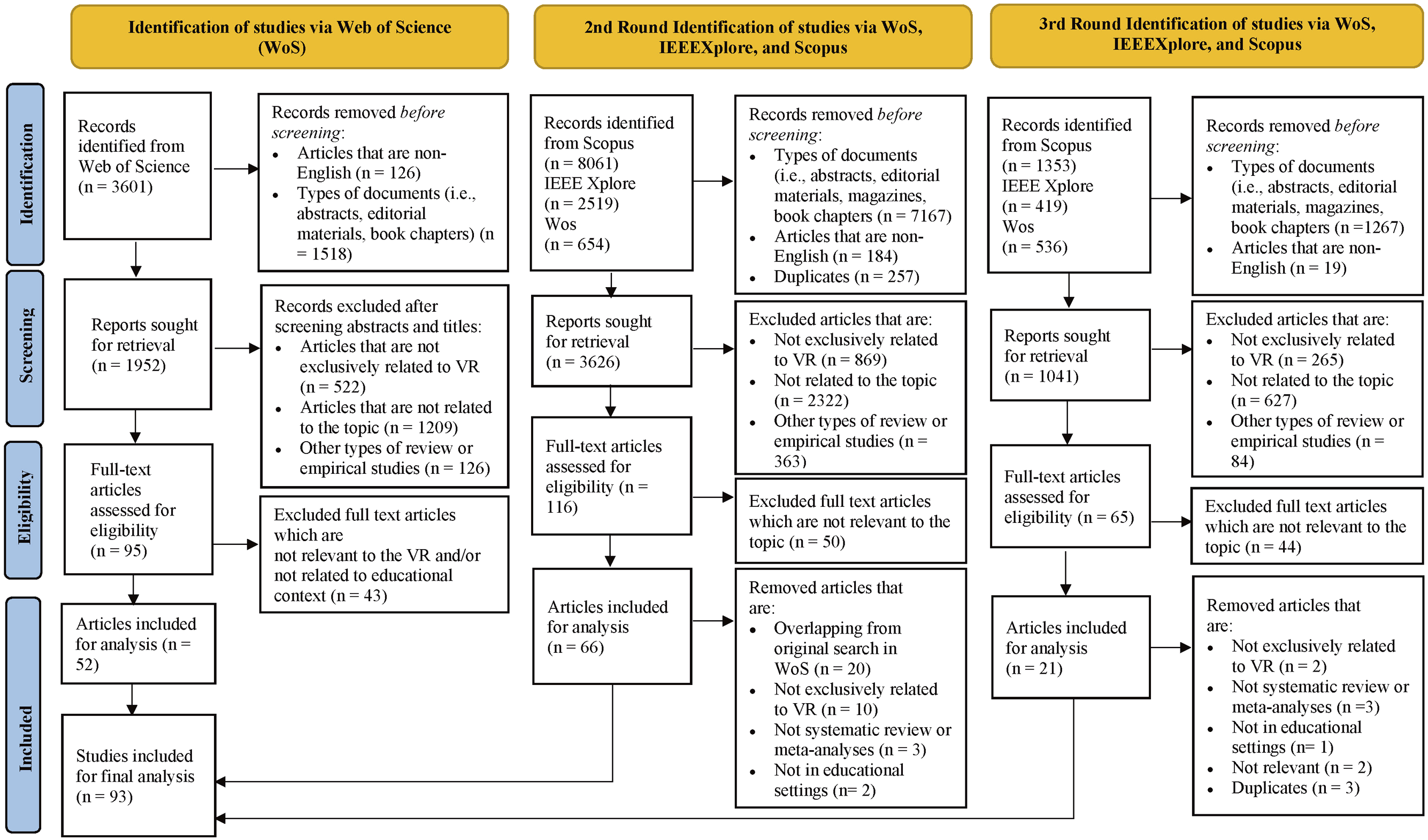
Study Search
The search was conducted in two phases. The initial systematic search was conducted on 8 June 2024 exclusively using the Web of Science. The search strings used for the study are as follows:
(“Virtual Reality” OR “VR” OR “Virtual Environment*” OR “Computer-Simulated Reality” OR “Virtual World” OR”3D Virtual Space”) AND (“Education” OR “Learning” OR “Teaching” OR “Training” OR “e-Learning”) AND (“Systematic Review” OR “Meta-Analysis” OR “Review”).
The search criteria were applied to titles, abstracts, keywords, and Keywords Plus (specified in the Web of Science). A total of 3601 results were identified in the initial search. To further reduce the number of articles to a manageable level, the search string was refined to limit results to studies published in educational fields, yielding a total of 1957 results. The identified articles were then transferred into Endnote 20.6, a reference management software, to eliminate duplicates. After duplicates were removed, 1952 records/articles were submitted for further title and abstract screening. After two rounds of screening, 95 studies remained. The records that met the eligibility criteria were further scrutinized through full-text reviews, resulting in 52 articles for analysis.
To ensure a more comprehensive review, a supplementary search was conducted in additional databases Scopus and IEEE Xplore on 29 April 2025. These databases were selected for their strong coverage of interdisciplinary research. Concurrently, the original search in Web of Science was updated to include the available data. The effort identified 31 additional studies.
Given the rapid pace of publications in technology-enhanced learning, particularly in VR, a third update across all three databases was conducted on 6 December 2025 to capture studies published since 29 April 2025. As a result, 10 studies were included for final analysis. The search methodology, including terms and inclusion/exclusion criteria, was consistently applied across all databases (Figure 1). Altogether, 93 articles, including those from the previous search, were incorporated into the final interpretation.
Study Selection and Eligibility Criteria
In designing this review study, we developed inclusion criteria to capture as comprehensive and relevant studies as possible while also considering time constraints. Studies were included if they met the following criteria: (1) only review studies and/or meta-analyses were included; (2) Studies should have been published in English; (3) studies should be published in peer-reviewed journals (not limited to educational research journals); (4) studies needed to focus on educational outcomes of VR; and (5) studies should have been conducted in educational settings which explicitly defined as studies in which VR was used with an explicit learning objective in formal education (i.e., schools, universities, or continuing education).
We followed clear exclusion criteria to maintain the research’s focus and relevance. For this study, the exclusion criteria include: (1) studies that focused on other forms of technologies not involving VR; (2) non-peer-reviewed articles, including white papers, commentary, conference abstract, and opinion pieces, to maintain a high standard of scientific rigor; (3) studies not available in English, due to language constraints of the research team; (4) research focusing on non-human-related outcomes; (5) primary studies; and (6) studies that examined the use of VR in non-educational contexts, including commercial settings and clinical settings (e.g., hospitals, physical rehabilitation centers). Additionally, duplicates and studies with incomplete data were excluded to ensure the integrity and completeness of the analysis. These criteria helped streamline the selection process, minimize bias, and enhance the overall reliability of the review findings. Two authors independently screened the titles and abstracts for potential inclusion using EndNote 20.6. Full-text articles were retrieved for all titles that met the inclusion criteria. Discrepancies between reviewers were resolved through discussion and consultation with a third reviewer to reach an agreement.
Data Extraction and Analysis
The process of data extraction, categorization, and quantification was thoroughly documented to ensure transparency and replicability. First, we developed a detailed coding manual that outlined clear definitions, categories, and criteria for data extraction, ensuring that all team members followed the same guidelines. Following this, we piloted the coding process on a subset of the data to identify potential ambiguities, refining the framework as needed to enhance clarity and usability. The coding framework included journal bibliometric information (i.e., author, year, journal, review type), methodologies (i.e., databases, quality assessment), educational levels, subjects, and learning outcomes.
Following the framework, data extraction was carried out by three coders independently in a structured and organized manner. Three team members independently coded 10 articles randomly selected from the data samples. Each piece of the article was systematically reviewed, categorized, and documented according to the predefined criteria. Content analysis was applied to systematically quantify and summarize the study. To ensure consistency and reliability in the current review, inter-rater reliability (IRR) checks were conducted using Jamovi Version 2.3.28. The overall agreement percentage on these codes among the raters was recorded at 97% (Kappa = .80; z = 19.68, p < .001; Fleiss et al., 1981). This indicated substantial agreement among the raters. However, given that the level of variable complexity might influence coder agreements, IRR was calculated separately in this umbrella review. Trivial (simple) variables are easier for coders to extract and interpret. These codes included references, authors, year of publication, title of articles, journal name, type of review, research questions, review guideline, period of research, databases extracted, types of articles included, number of articles, quality assessments performed, inter-rater reliability conducted, educational levels, and subjects covered in the selected articles. The results indicated that the ratings by the three coders across the articles were perfectly consistent (100% agreement). In contrast, interpretative (complex) variables, such as learning outcomes, involve judgment and multidimensional categorization. We created a table to record the choices of the three coders for each article and mark whether they agree or disagree. The agreement for learning outcomes was 90% (Kappa = .83; z = 4.45, p < .001). The results indicated high overall agreement among the coders. The remaining discrepancies were resolved through team discussions to ensure that the final categorization was both rigorous and accurate.
During the revision process, we introduced Bloom’s taxonomy as a framework for classifying learning outcomes. This involved regrouping certain outcomes into broader categories. We carefully reviewed and discussed each outcome to ensure that our classification was both conceptually sound and consistent with the taxonomy. Through this collaborative process, we reached consensus on the revised categorization, which we believe provides greater clarity and coherence in reporting and interpreting the results.
Results
With growing adoption of VR in education, a steady rise in the number of reviews was observed (Figure 2). The findings are organized in two sections: (1) key features of the included studies and (2) reported effectiveness of VR for various learning outcomes. The number of published reviews and meta-analyses over years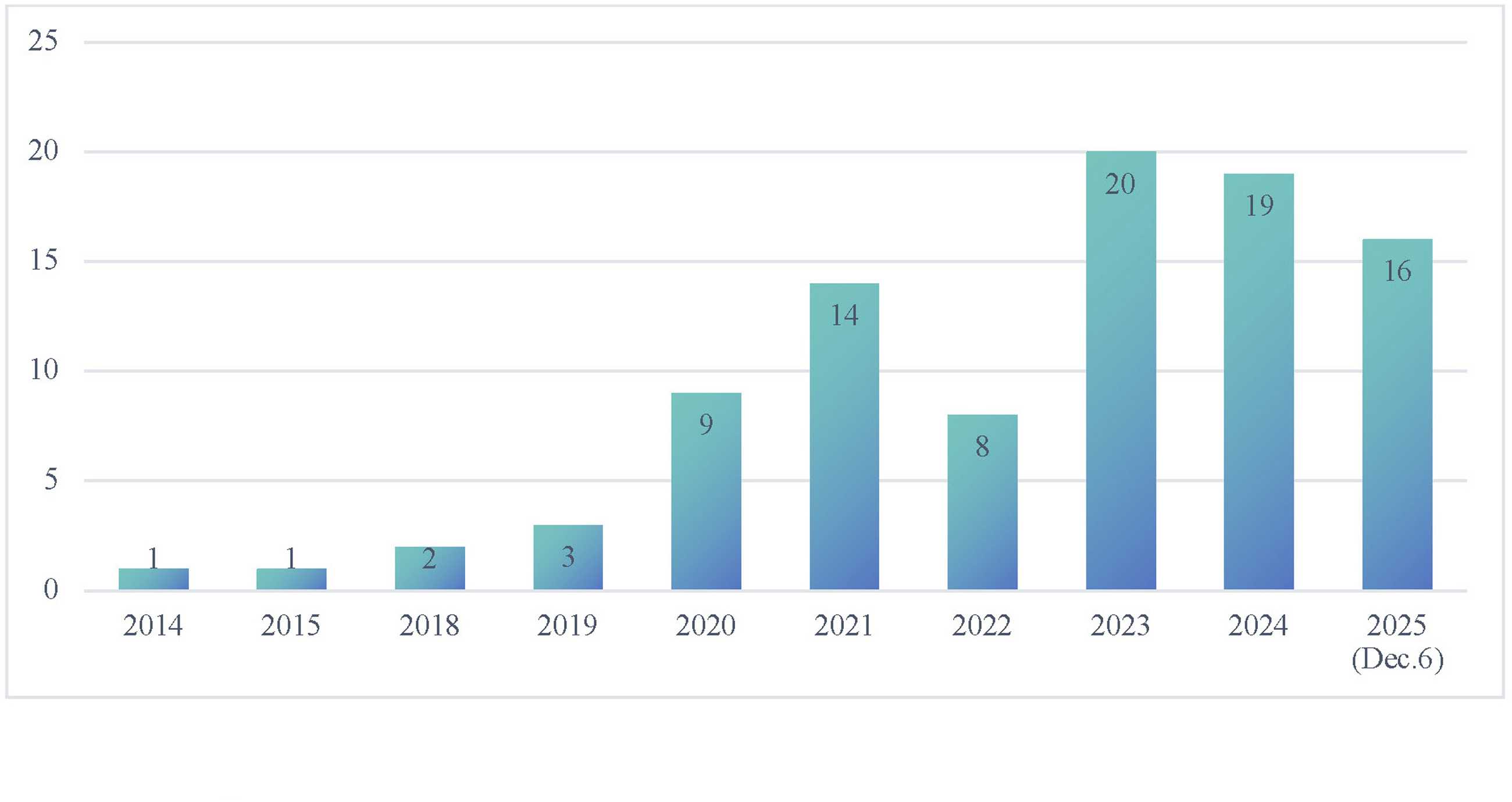
RQ1. What are the Key Characteristics of the Included Studies?
This umbrella review included 93 articles: 70 were systematic reviews, 17 were a combination of systematic reviews and meta-analyses, and 6 were purely meta-analyses. Of the included reviews, 80 studies (86.02%) utilized frameworks such as PRISMA, Cochrane Review recommendations, PICOS (Population, Intervention, Comparison, Outcome, and Study designs), or the Joanna Briggs Institute (JBI) guideline for conducting reviews, whereas 13 studies (13.98%) did not indicate using any specific guidelines. Additionally, 21 reviews reported interrater reliability, demonstrating good consistency in their coded results, whereas the remaining reviews did not. We also found that 50 reviews reported conducting quality assessments. Quality assessment refers to the included systematic reviews and meta-analyses themselves, not the original primary studies. Tools used for this review assessment mainly included Medical Education Research Study Quality Instrument (MERSQI; e.g., Hamilton et al., 2021; Jensen & Konradsen, 2018), Grading of Recommendations Assessment, Development, and Evaluation tool (GRADE; Liu et al., 2023), and Cochrane Collaboration Risk of Bias Tool (Woon et al., 2021).
Moreover, the number of studies examined in each review ranged from 4 to 219. The databases used for the reviews included ACM Digital Library, Directory of Open Access Journals, Google Scholar, IEEE Xplore, Science Direct, Springer Link, Taylor & Francis, Mary Ann Liebert, Scopus, Wiley, Web of Science, PubMed, Cumulative Index to Nursing and Allied Health Literature, EMBASE, PsycINFO, ProQuest, Nursing & Allied Health Database, JSTOR, Scopus, ESCBO, and ERIC, which can be accessed via the link (https://osf.io/s4w2n/files/sjyxc).
Educational Levels and Subjects of the Included Studies
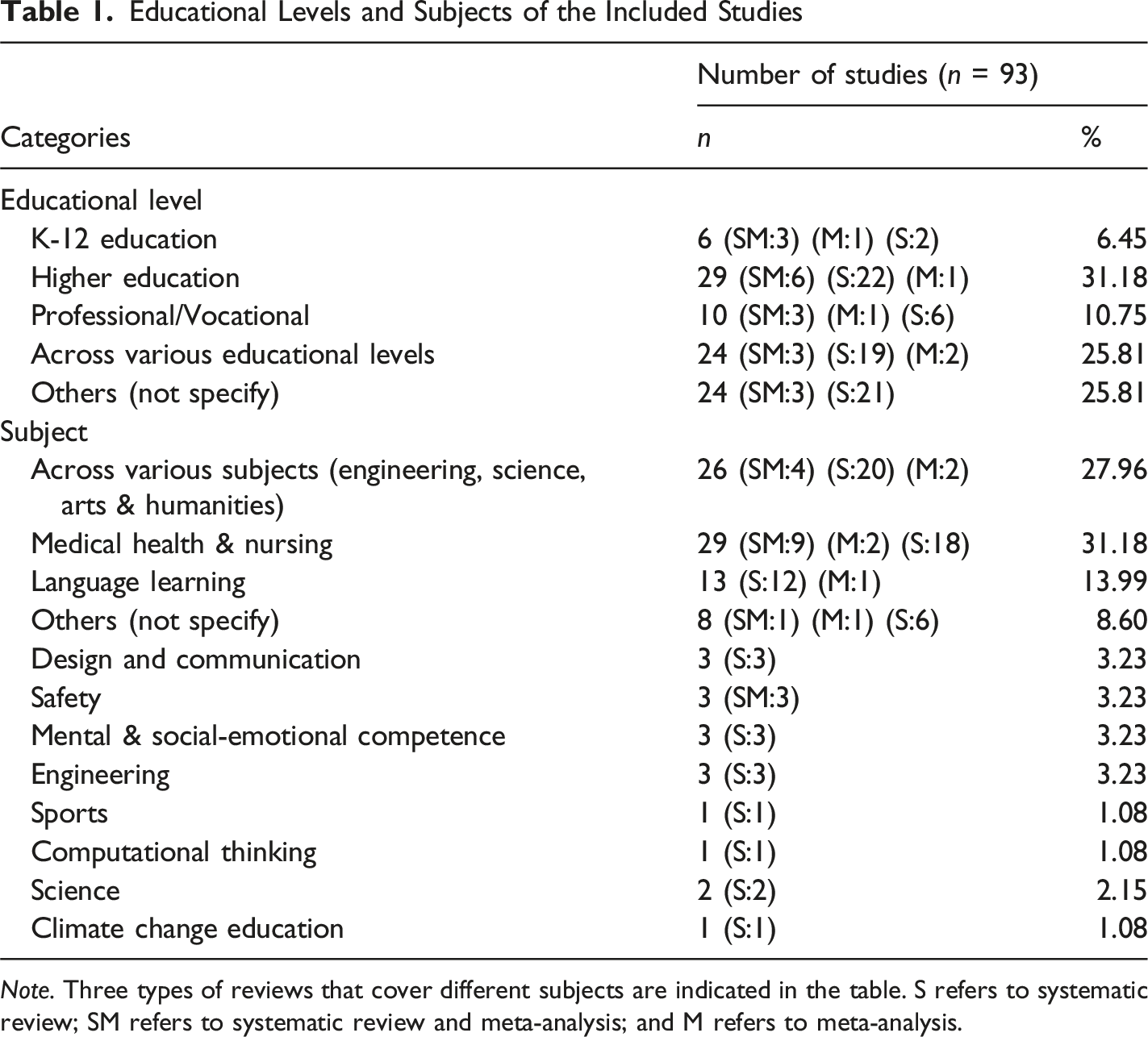
Note. Three types of reviews that cover different subjects are indicated in the table. S refers to systematic review; SM refers to systematic review and meta-analysis; and M refers to meta-analysis.
RQ2. How Do Learning Outcomes Supported by VR Distribute Across the Cognitive, Affective, and Psychomotor Domains?
Frequency of Educational Outcomes Addressed in the Included Review Studies (n = 87)
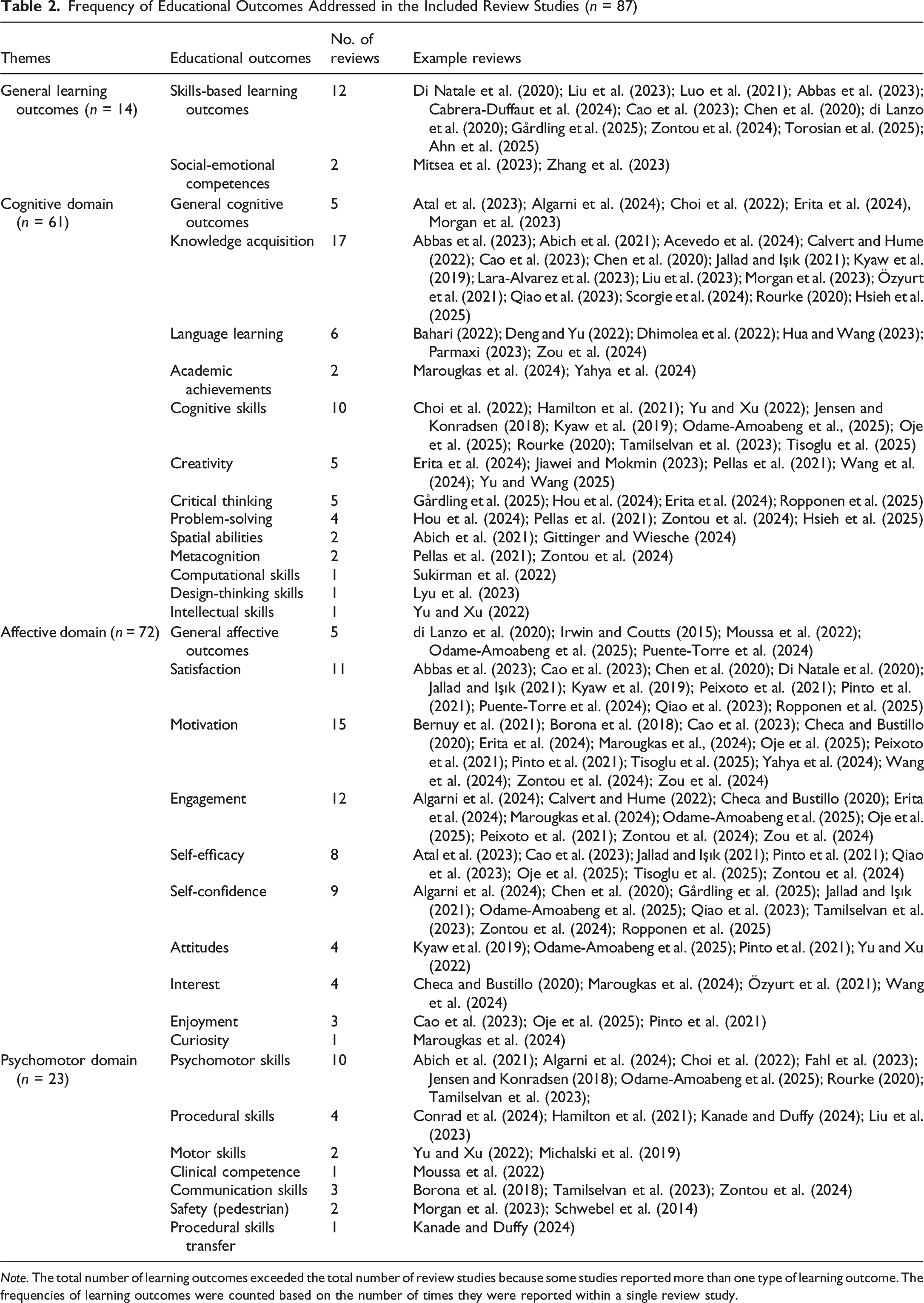
Note. The total number of learning outcomes exceeded the total number of review studies because some studies reported more than one type of learning outcome. The frequencies of learning outcomes were counted based on the number of times they were reported within a single review study.
Guided by Bloom’s Taxonomy, the findings were grouped into (1) cognitive outcomes, (2) affective outcomes, and (4) psychomotor outcomes (Table 2). It should be noted that studies that did not specify whether the effect was primarily cognitive, affective, or psychomotor, or that addressed multiple aspects across these domains, were placed into an additional category (“general learning outcomes”) for clarity and to avoid forcing them into an inappropriate domain. Of the 14 reviews categorized under General Learning Outcomes, two addressed social-emotional competencies covering elements of both cognitive and psychomotor learning, while twelve reviews focused on a broad spectrum of skills-based outcomes.
Cognitive Domain
A total of 61 reviews reported that VR was linked to diverse cognitive outcomes. According to Bloom’s taxonomy, the cognitive domain of learning in VR environments involves a range of dimensions, including basic knowledge acquisition and recall, comprehension of complex concepts, application of learned principles in simulated tasks, analytical problem-solving, synthesis and integration of information from multiple sources, and higher-order cognitive skills such as critical thinking. Among these outcomes, knowledge was most often investigated, with 17 reviews focusing on the impact of VR on knowledge acquisition. Abbas et al. (2023) reviewed nine empirical studies on emergency education and found that VR interventions led to an increased gain in knowledge in six studies through various forms of pre- and post-knowledge testing (e.g., multiple-choice questionnaire, written tests). Cognitive skills (e.g., reasoning, synthesizing, decision-making), along with creativity, critical thinking, and problem-solving, were extensively explored. Additionally, language learning, which primarily involves mental processes related to language knowledge and thinking, was examined across various reviews, with 6 reporting beneficial effects on overall language skills. Nevertheless, results differed when breaking down the language components. Deng and Yu (2022) reported that VR had a favorable impact on learning pronunciation, listening, and speaking. However, their studies yielded varied outcomes for vocabulary learning and for reading and writing skills. Within the category of cognitive outcomes, the remaining reviews addressed spatial skills, metacognition, computational skills, and design-thinking skills, reflecting the linkages of VR to broader skills.
Affective Domain
The impact of VR on the affective domain of learning was observed across 72 review studies. These outcomes were related to engagement, motivation (e.g., self-efficacy, interest), emotions (e.g., enjoyment), and attitudes (satisfaction). The review studies generally reported that using VR in training and learning could boost these outcomes (e.g., Peixoto et al., 2021; Pinto et al., 2021). For instance, Di Natale et al. (2020) found that 15 of the 18 studies in their review focused on the motivational outcomes of VR use for learning. Ten articles revealed positive motivational outcomes, whereas five studies indicated no effects. The positive outcomes might be associated with the immersive nature of VR, which can create a novel learning environment that makes learning more enjoyable, thereby reducing the perceived effort required (Di Natale et al., 2020). However, the observed nonsignificant differences in satisfaction between the immersive VR and control groups might stem from the use of different self-report measures (Di Natale et al., 2020).
Psychomotor Domain
The psychomotor domain of learning in VR environments was least accounted for, with 23 reviews that broadly examined motor skills, procedural skills, behavioral change, or skill transfer. For example, Choi et al. (2022) nine studies on VR in nursing education were reviewed, of which four evaluated participants’ psychomotor skills. The findings of these studies suggested that immersive VR interventions effectively enhanced skills such as IV catheter insertion, urinary catheterization, basic life support, and needlestick safety. Morgan et al. (2023) reviewed 20 studies and reported that half demonstrated a positive impact of VR safety interventions on child pedestrian behavior. Similarly, Schwebel et al. (2014) reviewed 19 articles (covering 25 studies) on VR-based behavioral interventions for children’s pedestrian safety. The findings indicated that individualized or small-group training strategies were effective, whereas other intervention types often yielded mixed results, frequently due to insufficient empirical evidence.
RQ3. What is the Impact of VR on Cognitive, Affective, and Psychomotor Domains of Learning?
Statistical Findings Regarding the Impact of VR on Educational Outcomes Reported in Meta-Analyses (n = 23)
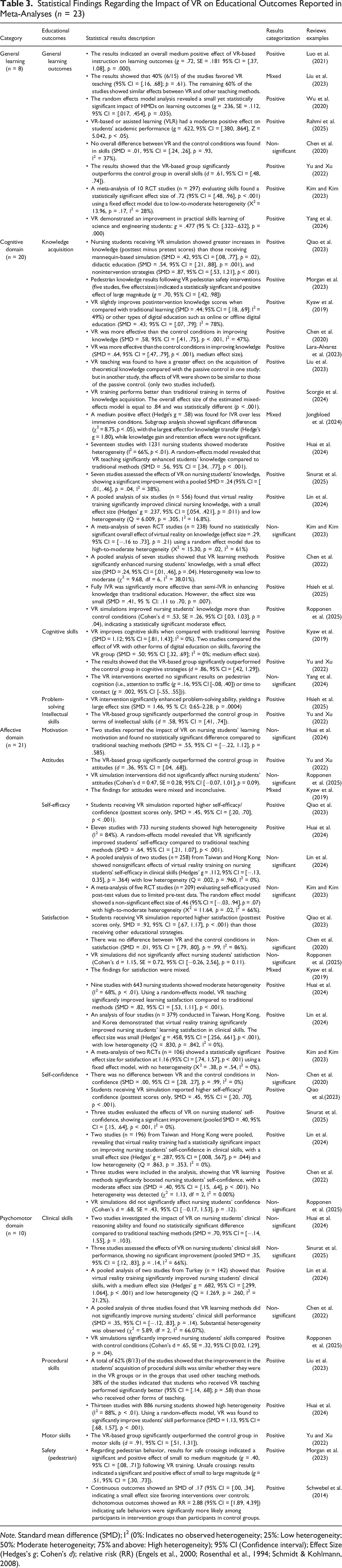
Note. Standard mean difference (SMD); I2 (0%: Indicates no observed heterogeneity; 25%: Low heterogeneity; 50%: Moderate heterogeneity; 75% and above: High heterogeneity); 95% CI (Confidence interval); Effect Size (Hedges’s g; Cohen’s d); relative risk (RR) (Engels et al., 2000; Rosenthal et al., 1994; Schmidt & Kohlmann, 2008).
VR tends to improve cognitive outcomes, especially knowledge and cognitive skills, though results vary by subdomain and context. Multiple meta-analyses in healthcare or nursing education (e.g., Qiao et al., 2023; Ropponen et al., 2025) showed small-to-large positive effects of VR on knowledge compared with traditional or other digital methods. One meta-analysis (Kim & Kim, 2023) found a nonsignificant overall effect on knowledge, with high heterogeneity. These findings demonstrated strong overall evidence that VR improved knowledge. In terms of cognitive skills, problem-solving, and intellectual skills (Hsieh et al., 2025; Kyaw et al., 2019), this evidence points to substantial benefits of VR for higher-order cognitive skills, at least in the contexts studied.
The impact of VR on the affective domain of learning (n = 21) showed mixed findings, with generally positive effects on some affective outcomes (attitudes, self-efficacy, satisfaction, and self-confidence), but several meta-analyses showed non-significant results and substantial heterogeneity. Huai et al. (2024) found no significant difference in learning motivation between VR and traditional methods for nursing students. One review study (Yu & Xu, 2022) showed significantly more positive attitudes with VR (d = .36). Other reviews (Kyaw et al., 2019; Ropponen et al., 2025) reported non-significant or mixed findings. Evidence for the effectiveness of VR in attitude improvement is inconclusive. Likewise, several nursing meta-analyses (Huai et al., 2024; Qiao et al., 2023) reported significant positive effects on self-efficacy, whereas other meta-analyses (Kim & Kim, 2023; Lin et al., 2024) showed non-significant effects, often with high heterogeneity. There was a similar trend toward improved self-efficacy and satisfaction in VR learning settings, but not consistent across all contexts, with some evidence being heterogeneous and partly mixed.
VR interventions in the psychomotor domain generally show positive effects on procedural, motor, and safety-related skills. Meta-analytic evidence supports a significant positive effect of VR on procedural skills, with large effect sizes but high heterogeneity (Huai et al., 2024). Yu and Xu (2022) found large positive effects on motor skills (d = .91). In pedestrian safety, VR interventions yielded small-to-medium positive effects on safe behaviors and reductions in unsafe crossings (Morgan et al., 2023; Schwebel et al., 2014). However, the impact of VR on nursing students’ clinical skills was mixed. Several meta-analyses reported no significant improvement in clinical reasoning or skill performance compared to traditional methods (Chen et al., 2022; Huai et al., 2024; Sinurat et al., 2025), while other meta-analyses reported significant positive effects, with VR training yielding medium effect sizes and improved skills (Lin et al., 2024; Ropponen et al., 2025).
Some of the included reviews provided explanations for varied effects of VR on certain educational outcomes. For example. Zhang et al.(2023) suggested that the inconclusive results of VR in educational contexts might be due to variations in instructional tasks. Specifically, their review found that high-level cognitive tasks (e.g., problem-solving) were associated with significant negative outcomes on social-emotional competencies, whereas social and mixed tasks produced significant positive outcomes, with the largest effect observed for social tasks. In contrast, tasks involving low-level cognitive efforts, such as memorization, comprehension, and simple application of social knowledge or psychomotor activities (e.g., following others’ instructions to perform certain actions), did not significantly impact social-emotional outcomes. Zhang et al. (2023) proposed that VR-based high-level cognitive tasks may impose excessive cognitive load on students, thereby reducing students’ learning outcomes (i.e., social and emotional competence). Moreover, discipline might be a significant moderator in the effectiveness of VR learning environments. Positive outcomes were prominent in basic science, social science, and engineering, whereas they were less significant in language, health, and medicine (Luo et al., 2021). In addition, significant variability in effectiveness may be closely related to the level of immersion in VR interventions. Furthermore, the variability in effect sizes was significantly related to instructional design characteristics of VR interventions, including pedagogy, scaffolding strategies, and assessment formats (Luo et al., 2021).
Discussion
The findings from the included reviews were systematically synthesized, with particular focus on the impact of VR across three domains of learning: cognitive, affective, and psychomotor. In terms of cognitive outcomes, VR shows consistent benefits, particularly for acquiring knowledge and developing higher-order thinking skills, despite that some meta-analyses reported mixed or negligible effects. The use of VR for supporting cognitive learning is grounded in the theory of embodied cognition (Lakoff et al., 1999; Wilson, 2002). VR can enhance cognitive learning by immersing students in visual representations of complex or abstract concepts, allowing them to experience realistic scenarios and actively manipulate virtual objects and environments (Makransky & Petersen, 2021; Wickens & Baker, 1995). Our reasoning and conceptualization are fundamentally shaped by our bodies and sensorimotor experiences. Our mind does not function in isolation; rather, bodily experiences provide the essential structure for most of our thoughts (Klingenberg et al., 2024; Sanchez et al., 2000). Previous literature has consistently indicated that VR yielded better results in tasks that relied on spatial or 3D comprehension or required active exploration (e.g., Chen et al., 2021; Wu et al., 2024). VR often outperformed other media-based learning conditions (e.g., tablets, games) in higher-order cognitive skills, such as problem-solving (Araiza-Alba et al., 2021). However, some mixed or negligible effects suggested that cognitive benefits depended largely on how VR instruction was designed with respect to learners’ cognitive load (Sweller, 2011). Given that individuals’ working memory is limited, VR instructions that include too many immersive and visually complex features might risk overloading learners with extraneous load, ultimately hindering learning (Mayer et al., 2023; Parong & Mayer, 2021). Therefore, cognitive outcomes in VR are often associated with how learners process the information within VR settings. Using strategies such as signaling, scaffolds, and incremental increase in task complexity can facilitate greater learning outcomes (e.g., Albus et al., 2021; Bacca-Acosta et al., 2022).
Affective learning outcomes in VR environments are inconclusive overall. It might be due to differences in learner motivation, novelty effects, and increased cognitive load when engaging with VR environments. VR may enhance self-efficacy, self-confidence, and satisfaction, whereas its effects on motivation and attitudes are largely inconsistent. These intriguing findings suggest that multiple variables can affect affective learning outcomes in VR environments. The improvements of various affective outcomes are closely linked to the immersive and interactive nature of VR, which provides learners with immediate feedback and opportunities for active experimentation (Makransky & Mayer, 2022). However, immersion and embodiment do not guarantee affective benefits for all learners or contexts (Klingenberg et al., 2024). Affective outcomes might depend on how well the VR experience aligns with learners’ needs, goals, and interests (Mayer et al., 2023; Parong & Mayer, 2021). Factors such as the novelty effect, the ease of use, and individual variability can affect affective learning outcomes (Fryer et al., 2017; Parong & Mayer, 2021).
In terms of psychomotor learning, VR consistently leads to gains in motor, procedural, and safety skills, yet its impact on complex clinical skills is not always reliable. VR’s consistent effectiveness in improving motor and procedural skills can be explained by its core affordances (Makransky & Petersen, 2021; Zhong et al., 2026). Take procedural tasks, for instance, which consist of carrying out a series of ordered steps aimed at accomplishing a goal, and are usually assessed based on speed, precision, and efficiency (Rodríguez et al., 2012). VR environments often provide immersive, interactive, and highly realistic experiences that are particularly well-suited to supporting psychomotor skill acquisition (e.g., surgical simulation, procedural training). The ability to practice complex tasks in a safe, controlled, and repeatable virtual setting often leads to clearer and more significant skill improvements in these domains compared to affective outcomes. Specifically, VR promotes active, iterative practice, enabling learners to develop and perfect their skills without the real-world limitations related to availability, safety, time, or cost (Morélot et al., 2021). Moreover, VR offers repeated, hands-on practice in a safe and controlled setting, allowing for mistakes without real-world consequences, which is particularly important in safety-critical domains (Stefan et al., 2023). Meanwhile, VR provides enhanced sensory input, such as visual, auditory, and haptic feedback, to reinforce the learning process (Oagaz, 2022; Rodríguez et al., 2012). This real-time, multimodal feedback allows learners to correct errors and refine techniques, further contributing to skill mastery (Morélot et al., 2021). VR’s reliability decreases for complex clinical skills (e.g., multi-step procedures, clinical decision making involving nuanced judgment). On the other hand, it should be acknowledged that complex tasks can overwhelm learners if the VR environment does not adequately scaffold learning processes (Makransky & Petersen, 2021). Excessive realism or interface complexity can increase cognitive load, therefore distracting learners from core learning goals (Makransky & Petersen, 2021).
Differences in learner motivation, novelty effects, and increased cognitive load may contribute to the variability of effect sizes observed in VR learning outcomes. These factors can influence learners’ emotions, engagement, and attitudes, leading to less consistent affective outcomes compared to the more robust effects typically seen in psychomotor domains. In addition, VR affordances might operate through multiple, interconnected channels. Features such as immersion, interactivity, and real-time feedback can jointly influence not only cognitive and psychomotor learning but also motivation and emotional responses. For instance, Wu et al. (2025) conducted a 2 × 2 quasi-experimental factorial study with 149 undergraduate students and found that integrating VR technology with EEG vibrotactile feedback significantly enhanced creativity performance and attention, particularly among students with higher spatial ability, while also reducing cognitive load. This outcome points to a dynamic interaction between affective and cognitive variables, with greater engagement translating into enhanced attention and skill development.
Implications
The findings of this umbrella review offer practical implications for educational stakeholders, including policymakers, educators, practitioners, and researchers.
Policymakers
In light of the relatively consistent benefits of VR for knowledge acquisition and higher-order cognitive skills, policymakers could consider supporting the integration of VR technologies in subjects and curricula where these outcomes are prioritized. For instance, policymakers are advised to allocate funding for the procurement of VR equipment and software and provide professional development opportunities for teachers to effectively incorporate VR into their instructional practices to explore and promote specific aspects of cognitive learning.
VR shows potential to enhance students’ affective learning outcomes, such as motivation, self-efficacy, self-confidence, and satisfaction, but the evidence was mixed. Policymakers should encourage further research and pilot programs to better understand the conditions under which VR most effectively supports affective learning. Given the limited resources available in many schools and universities, it is essential to conduct cost-effectiveness analyses to determine whether alternative strategies (e.g., Zhong et al., 2024; 2025a, 2025b) are more efficient than VR in improving affective outcomes.
Moreover, the findings suggest that VR is consistently effective in enhancing motor, procedural, and safety-related skills, making it a promising tool for vocational training, STEM education, and health professions. Policymakers might prioritize VR integration in these areas, while remaining cautious about its use for more complex clinical skills where the evidence is less consistent.
Educators and Practitioners
The findings indicate the relatively consistent benefits of VR for cognitive learning despite a few meta-analyses reported mixed or nonsignificant results. Teachers are encouraged to implement VR interventions to promote the acquisition of knowledge and higher-level cognitive skills. However, the varied and sometimes nonsignificant results suggest that teachers must remain mindful of contextual and implementation factors when using VR in education. For instance, it is important for teachers to evaluate students’ baseline knowledge and skills before integrating VR, enabling them to adapt VR activities to students’ starting levels to avoid cognitive overload or disengagement (e.g., Albus et al., 2021). In the same vein, teachers need to address distractions in VR environments (Zhang et al., 2023) and keep students oriented towards the key learning objectives by, for instance, limiting VR session durations (e.g., 15–20 min) and breaking down complex tasks into manageable steps (Kourtesis et al., 2019).
The findings suggest that VR has inconclusive effects on affective learning outcomes and clinical skills. While integrating VR in the classroom, teachers should focus on tasks that are suitable for immersive, interactive learning and should avoid topics that can be effectively taught through simpler methods (Chu et al., 2023). Teachers need to evaluate students’ readiness for VR technologies by providing them with orientation sessions to familiarize themselves with VR technology before starting lessons (Ho, 2017). Furthermore, teachers should design VR activities that are relevant to their everyday experiences and provide necessary support in learning process. Scaffolds such as feedback (Wang et al., 2024) and instructional strategies like gamification (e.g., providing awards and allowing student to customize their avatars; Lampropoulos & Kinshuk, 2024) can be integrated into in VR learning environments to ensure that students remain motivated and engaged cognitively.
The findings provide a solid rationale for teachers to integrate VR for promoting areas that require procedural, motor, or safety skills, such as medical procedures, lab experiments, or technical tasks. For instance, with VR enhancing feelings of safety, teachers can use it to simulate high-risk scenarios (e.g., complex medical or chemical experiments, sports training, or electrical repairs), allowing students to practice and develop skills without being exposed to real-world injuries and consequences.
Researchers
Several future research opportunities are recommended based on this umbrella review. VR has consistently shown a positive impact on knowledge acquisition, higher-order thinking abilities, and motor and procedural skills. It remains unknown whether the skills acquired in VR settings are transferable to real-world contexts (Zhong et al., 2026). To fill this gap, longitudinal studies are needed to examine the long-term retention and transfer of skills and knowledge acquired through VR into real-world settings, particularly in the psychomotor and cognitive domains. Experimental studies can be carried out to assess whether improvements observed immediately after VR interventions persist over time. For instance, it is worthwhile to investigate the extent to which procedural skills developed in simulated clinical VR environments can be transferred to similar real-life settings.
The results of this study also prompt researchers to investigate which learner characteristics (e.g., age, prior experience) and instructional design features (e.g., level of immersion, type of feedback) moderate the effectiveness of VR across cognitive, affective, and psychomotor domains. Subgroup analyses can be conducted to identify for whom and under what conditions VR is most effective. In particular, given the inconclusive results of VR on affective outcomes, more studies are needed to investigate the mechanisms by which VR influences outcomes such as motivation, self-efficacy, and satisfaction. This requires advancing theory while developing and validating more robust measures for affective outcomes in VR-based learning. For instance, it would be worthwhile to assess whether VR maintains learner motivation when novelty effects diminish. Various measures are recommended to assess VR’s effectiveness on affective outcomes by incorporating physiological metrics (Mitsea et al., 2023; Zhang et al., 2023), along with visual analytics and machine learning techniques (suggested by Bahari, 2022; Zahabi & Abdul Razak, 2020; Zhong, Fryer, et al., 2025, Zhong, Lian, et al., 2025). Physiological metrics, such as heart rate, eye tracking, and brain activity, provide objective data to measure user motivation and emotional responses in VR environments (Ahmadi et al., 2023; Halbig & Latoschik, 2021).
Furthermore, there is an urgent need for comparative research. Since the effects of VR on learning outcomes can be influenced by multiple variables, it is important to evaluate VR alongside other innovative educational tools, such as AR and simulation-based learning, to assess their respective strengths and weaknesses across various educational fields to find cost-effective solutions to achieving optimal learning outcomes (e.g., Zhong et al., 2025, 2026). In addition, qualitative research can shed light on the reasons behind VR’s mixed effectiveness for certain learning outcomes, such as complex clinical skills, and help identify instructional strategies that could improve its impact.
Limitations
Despite the rich insights gained from this umbrella review, the findings should be interpreted in light of several limitations. First, these findings should be interpreted cautiously, given the inherent limitations of the umbrella review. Umbrella reviews inherently lack the ability to directly evaluate the specific characteristics and differences of primary studies. We did not conduct a statistical assessment of heterogeneity across the included meta-analyses, nor did we formally examine its impact on our synthesis. This decision was made because, as an umbrella review, our focus was on summarizing and qualitatively synthesizing the findings from existing reviews rather than re-analyzing or pooling their effect sizes. In other words, the main aim of this review is to provide a broad, high-level overview of the research on the impact of VR integration on various learning outcomes. The included meta-analyses varied widely in scope, populations, interventions, and outcome measures, making direct statistical comparisons or aggregations potentially inappropriate. As a result, we relied on the reported findings and interpretations from each meta-analysis as standalone units of evidence. This approach allows us to capture broad trends and themes across the literature. However, the inclusion of multiple reviews covering similar topics might raise the possibility of overlapping primary studies, which might lead to redundancy and may influence the overall synthesis. Therefore, the findings should be interpreted with an awareness of potential variability across the underlying reviews.
Second, it should be acknowledged that heterogeneity arising from variations in research design, sample characteristics, and intervention types might influence the consistency and generalizability of overall conclusions. In the current review, although the majority of included reviews (86.02%) reported following established frameworks such as PRISMA, Cochrane, PICOS, or JBI guidelines, a notable proportion (13.98%) did not disclose adherence to any formal review standards. This variability might affect the methodological rigor and comparability of the included evidence. Only 21 reviews explicitly reported interrater reliability, indicating consistency in coding procedures. The remaining studies did not provide this information, limiting our ability to assess the reliability of their data extraction and synthesis processes. Future research would benefit from more consistent reporting standards, comprehensive quality assessments (including at the level of primary studies), and transparent documentation of data extraction and synthesis procedures.
In addition, this review included only studies written in English, thereby potentially limiting the diversity of perspectives and cultural contexts. Future research could broaden language inclusion to gain a more comprehensive understanding. Furthermore, this umbrella review exclusively concentrated on synthesizing reviews and meta-analyses on the use of VR in educational contexts. The specific focus on educational settings may miss insights from the existing literature on the use of VR in other industrial or commercial contexts (e.g., engineering and business). The results might differ if the context extended beyond educational settings. It is advisable that future review studies be expanded to include a broader range of sectors.
Conclusion
A total of 93 reviews were analyzed to explore the impact of VR on various learning outcomes. Overall, the findings indicate that VR holds considerable promise across multiple learning domains, but its effects are not consistent. In the cognitive domain, VR demonstrates more consistent benefits, particularly for knowledge acquisition and higher-order cognitive skills, though some analyses still reported non-significant effects. In the affective domain, VR can enhance self-efficacy, self-confidence, and satisfaction, while evidence for its impact on affective learning outcomes remains inconclusive. In the psychomotor domain, VR frequently improves motor, procedural, and safety-related skills, but its effectiveness for complex clinical skills and clinical reasoning appears inconsistent. These findings suggest a pressing need to develop or better integrate learning theories and frameworks for the design and deployment of VR, while strengthening methodologies for assessing VR effectiveness in diverse educational settings.
Footnotes

Author Contributions
Funding
The authors received no financial support for the research, authorship, and/or publication of this article.
Declaration of Conflicting Interests
The authors declared no potential conflicts of interest with respect to the research, authorship, and/or publication of this article.
Data Availability Statement
The datasets used and/or analyzed during the current study are available from the corresponding author on reasonable request.