




Abstract
Written answers to open-ended questions can have a higher long-term effect on learning than multiple-choice questions. However, it is critical that teachers immediately review the answers, and ask to redo those that are incoherent. This can be a difficult task and can be time-consuming for teachers. A possible solution is to automate the detection of incoherent answers. One option is to automate the review with Large Language Models (LLM). They have a powerful discursive ability that can be used to explain decisions. In this paper, we analyze the responses of fourth graders in mathematics using three LLMs: GPT-3, BLOOM, and YOU. We used them with zero, one, two, three and four shots. We compared their performance with the results of various classifiers trained with Machine Learning (ML). We found that LLMs perform worse than MLs in detecting incoherent answers. The difficulty seems to reside in recursive questions that contain both questions and answers, and in responses from students with typical fourth-grader misspellings. Upon closer examination, we have found that the ChatGPT model faces the same challenges.
Keywords
Introduction
Written answers to open-ended questions could have a higher long-term effect on learning than multiple-choice questions. They help improve predictions of long-term learning as measured by end-of-year standardized tests (Urrutia & Araya, 2022). They challenge students to think critically, apply their knowledge, and explain their thinking. They are a type of desired difficulty. Initially, writing can complicate learning, but experimental studies have found that it improves retention and comprehension in the long term (Bicer et al., 2013). Some meta-analysis shows a significant positive effect size on student achievement of .42 SD (Bicer et al., 2018).
In addition, being able to not only solve math problems but also explain the solving process in writing is becoming an increasingly important skill in the mathematics curriculum. For example, the Common Core State Standards (CCSS) (National Governors, 2010) highlights the importance of writing and the need for coherent, well-constructed arguments. CCSS and other curriculum frameworks are highlighting the importance of combining language and mathematics to develop students’ argumentative skills and ensure they are successful in their mathematics studies. The Task Force on Conceptualizing Elementary Mathematical Writing (Casa et al., 2016) emphasizes the importance of language in mathematics lessons. In Germany, language competencies in mathematics lessons are gaining more attention (Ruwisch et al., 2014).
However, the complex thinking required when explaining the reasoning behind a mathematical problem is a big challenge for fourth graders. In order to provide an effective written argument, students have to be able to explain their understanding of the problem, their strategy for solving the problem, and their results. Fourth-graders are still developing their math skills and may not have the language skills needed to explain their thoughts and reasoning. They struggle to identify and explain the evidence and reasoning behind their problem-solving strategies.
Writing is a complex process. Therefore, it is very helpful that the teacher is aware in real time of what their students are writing. In this way the teacher can give them timely and real-time feedback. It is also very important to detect students with misbehaviors and who may be writing answers that are incoherent. This is different from incorrect answers. Incoherent answers denote a negative attitude. Most probably, the student does not want to answer. Incoherent responses are answers that teachers label as such. They can be a doodle, an expression of discomfort, sentences that do not answer the question, etc. They represent negative attitudes. The teacher has to detect these negative attitudes early. Thus, teachers could immediately review the answers, and ask to redo those that are incoherent. Therefore, it is important that the teacher detect this situation and try to control it. However, with 20 or more fourth-graders in the classroom, it is very demanding that the teacher review all answers and send feedback in real-time to each student. This is a difficult task and can be time-consuming. A solution is to automate the detection of incoherent answers. This, in principle, is possible if students are writing on an online platform. Moreover, if students are writing comments to peers in a peer-review activity, it is also helpful that the teacher review the comments. It is crucial to prevent negative attitudes from spreading. They can spread the moods to other students and hinder the climate and management of the class. This review also takes time and is very demanding for the teacher.
The detection of incoherent responses is also a very prominent factor for the development of chats that are intelligent interactive tutors. If the chat cannot detect incoherent responses, then its performance as a tutor will be severely limited. In our experience, with typical responses from fourth-graders from hundreds of vulnerable schools, about 20% of the responses are incoherent. They reveal a possible negative attitude of the student. This is different from incorrect answers. An intelligent tutor’s strategy for incoherent answers should be different from that for incorrect answers.
In order to automate the detection of incoherent answers, there are two possibilities. One possibility is to automate the review with LLM. Another possibility is to automate with Machine Learning (ML) (Urrutia & Araya, 2023). Since ML requires extensive training, it is interesting to explore the use of LLM.
LLMs do not require training since they are pre-trained using a huge corpus such as all internet web pages. Companies like Microsoft and Google do the pretraining. Therefore, LLMs already come with a powerful knowledge of the world, and then they can classify answers. LLMs have demonstrated several characteristics of sophisticated cognitive processes.
For example, they have incredible writing and summarizing skills. This ability is very powerful and can be used to explain decisions of Machine Learning classifiers. They also have social reasoning skills. In this regard, they are equivalent to 9-years old. ChatGPT passes the Theory of Mind (ToM) tests for 9-year-old students (Kosinski, 2023). This means that ChatGPT can “guess” what is going on in another person’s mind based on available text information. Additionally, Binz & Schulz, (2022) tested GPT-3 and found it performs reasonably well on several tests on decision-making, information search, deliberation, and causal reasoning tasks. Furthermore, Schwitzgebel et al. (2023) found that when faced with complex philosophical questions, it can be very difficult to distinguish answers written by a fine-tuned GPT-3 model that emulates an author from those answers written by the emulated philosopher. This recognition task is difficult even for professional philosophers who are specialists in the emulated author. 25 experts on the author´s work succeeded only 51% of the time, and 302 philosophy blog readers has a similar success rate. 98 ordinary research participants did much worse.
However, LLMs reasoning abilities are still limited. For example, when asked to consider the request: “If my hand is closed then I have a coin. What can be concluded if I do not actually have a coin?” OpenAI playground incorrectly responds: “If you really don’t have a coin, then you can conclude that the original statement is not correct.” LLMs, such as OpenAI playground, also do not pass the Wason Selection task. This is a classic abstract reasoning test. It is a difficult test, that less than 25% of human adults do it correctly. However, there are non-abstract versions. One interesting version is a social contract formulation (Cosmides & Tooby, 1992). This version is much easier for humans than the abstract one and it is also easier than other non-abstract versions.
Imagine that you have to enforce the following law: “If a person is drinking beer, then he must be over 20 years old”. In addition, imagine that there are four people sitting at a table in a bar. Person 1 is drinking beer. Person 2 is drinking coke. Person 3 is 25 years old. Person 4 is 16 years old. Indicate only those persons you need to check information to see if any of these people is breaking the law. The answer of OpenAI playground is wrong: Person 1 and Person 3.
In contrast to the abstract version, 75% of human subjects answer correctly the social contract formulation (Cosmides & Tooby, 1992). Even though the logic is the same in both formulations, people unconsciously and effortlessly use a different reasoning mechanism to solve it. It is a mechanism of completely different nature: a cheater detection one (Cosmides & Tooby, 1992).
According to Huang & Chang, (2022) it is still unclear to what extent LLMs can do true reasoning. Bang et al., (2023) found that ChatGPT is 64.33% accurate on average in 10 different reasoning tasks. They conclude that it is an unreliable reasoner. Similarly, Mialon et al., (2023) concludes that meaningful augmentations in fully self-supervised Language Models (LMs) is still an open research question. Frieder et al., (2023) tested the ChatGPT’s mathematical abilities. They found that the capabilities are significantly below those of an average mathematics graduate student. Furthermore, specialized LLMs trained on math papers, like Minerva, make mistakes with big numbers (Castelvecchi, 2023).
In this paper, our research questions are: • How do LLMs fare in detecting incoherent fourth-graders responses to typical math word problems? • How does the incoherence detection performance of LLMs compare to that of ML classifiers?
The objective of these two questions is to understand the potential of the new technology of LLMs in detecting inconsistent answers. This is of great interest for formative and summative assessments done in real time on technology platforms with open questions.
To address these questions it is important to analyze how LLMs do it by reviewing answers to typical questions posed by teachers. These should not be invented questions for a research study. That is, we need to use a representative sample of word problems that teachers have actually already placed in their fourth grade classes. In addition, to ensure representativeness, we need, on the one hand, to have a variety of teachers. Therefore, we have to make sure that we have questions posted by several different teachers. On the other hand, we have to measure the performance of LLMs in reviewing the actual answers of all the fourth graders of those teachers. Teachers may have different ways of asking questions, but examining thousands of questions in Urrutia and Araya (2023) we found that there are 6 types of questions. The LLM model will classify the response regardless of the teacher’s style, but takes the question as input. Given the excellent discursive capacity of LLMs, it is very interesting to investigate how well they detect incoherent responses and the explanations they provide.
Related Work
First, we consider the use of ML to detect incoherent written math answers to open-ended questions. There is an extensive literature in Automated Short Answer Grading (ASAG). Wang et al., (2021) found that automated scoring systems with simple hand-feature extraction can accurately assess the coherence of written responses to open-ended questions. The study revealed that a training sample of 800 or more human-scored student responses per question was necessary to construct accurate scoring models. However, this requirement of hundreds of responses labeled per question makes it not practical for most classrooms.
In contrast, in Urrutia and Araya, (2023) we analyzed fourth graders’ written answers to open-ended questions by fourth-graders. In this case, there were between 20 and 60 answers per question. We tested the classifier in a completely different set of questions and students. Using Machine Learning, we trained question and answer classifiers. We found that the classifier achieves 79.15% F1-score for incoherent detection. Moreover, in Urrutia and Araya, (2022) we found that the classifiers help improve predictions of end-of-year national standardized tests results.
Second, let’s consider the use of LLM. There is an increasing number of studies on the impact and opportunities of using LLMs in education (Zhai, 2022; Kasneci et al., 2023). For example, Jalil et al., (2023) analyzes the performance of ChatGPT when solving common questions in a dataset that contains questions from a well-known software-testing book. They found it can provide correct answers in 44% of the cases, and partially correct in 57% of the cases. McNichols et al., (2023) study the use of the LLM GPT-2 for the task of classifying mathematical errors in open-ended questions in middle school algebra. They introduce it as they believe that one advantage of using an LLM-based method is the flexibility of the input. However, the performance is not as good as the best model, which they got with BERT.
Kasneci, et al., (2023) examined opportunities for elementary school students, middle and high school students, university students, group and remote learning, learners with disabilities and professional training. They conclude that despite certain difficulties and challenges these models offer many opportunities to enhance students’ learning experience and support the work of teachers. For example, they suggest that LLMs can be used to generate custom practice problems based on skill levels, create AI-based assistants based on age and maturity, and strategies to promote critical thinking. The latter, critical thinking, is directly related to writing arguments and explanations that is the focus of this article.
A common type of word problems in elementary school mathematics are those that require several steps of reasoning. It is therefore important to look at those capabilities of the LLMs.
According to Kojima et al., (2023) the performance of LLMs is intuitive. Moreover, single-step reasoning tasks are excellent using task-specific few-shot or zero-shot prompting (Liu et al., 2023). This means entering only instruction to the LLM with few typical examples or with zero examples. These are tasks that cognitive psychologists identify as system-1 mental procedures (Stanovich et al., 2020; Stanovich et al., 2016), However, in cognitively more sophisticated tasks the performance is much lower. These tasks require system-2 capabilities. They may require the inhibition of system-1 mental procedures, and several other processes. For example, seeking various points of view before concluding, and weighing the advantages and disadvantages before deciding.
Rae et al., (2021) studies the performance of a Gopher, a LLM with up to 280 billion parameters. They conclude that the performance is weak on tasks requiring multi-step reasoning like in math and logical reasoning. Moreover, they conclude that in certain math and logical reasoning tasks, it is unlikely that more parameters will improve performance.
To overcome this difficulty, there are recent attempts to improve reasoning performance of LLMs using prompt engineering. Prompt-based learning modifies the original input using a template into a text string message that has some empty spaces, and then the LM fills in the empty information to get a final string (Liu et al., 2023). With it, the user obtains the result. Selecting the appropriate indications is very important. The idea is to manipulate the behavior of the model so that the pre-trained LLM itself predicts the desired outcome. Sometimes, there is no need for additional task-specific training.
Another option is the use of Chains of Thought (CoT). Kojima et al., (2023) use it to solve elementary math word problems. This is the case where the user presents a word problem but it can easily confuse ChatGPT. The CoT strategy is to tell ChatGPT to do it step-by-step, and then use the response to ask to extract the numerical result. Kojima et al., (2023) found that CoT strategy generates a significant performance improvement.
In the word problems that teachers have been giving fourth graders over the years, a large proportion are questions that contain within themselves a question. In addition, the question also contains a character that gives an answer. Therefore, the student’s problem is to comment on the character’s answer. The student has to decide if it is correct or incorrect, and give a written explanation. Thus, there is not only a multi-step reasoning problem but also one of recursion. This means, a constituent that contains a constituent of the same kind (Pinker & Jackendoff (2005)). The student must comment on a character’s answer to a mathematical question that already requires multi-step reasoning. Additionally, in the peer review stage, each student must also comment on the comments that a classmate gave to one of those problems. That is, there is a recursion of even higher order.
Therefore, we believe that our paper is the first research on the use of LLMs to analyze this type of students’ answers. Since these are very common types of word problems, we need to support the teacher by automating the online review of incoherence in students’ written answers to this type of open questions. This is particularly important for elementary school students who are just beginning to argue in written form. In the classroom environment, it is necessary to determine immediately the coherence of the answers. This allows the teacher to control negative attitudes and request students to redo incoherent answers. This is important for the classroom climate.
In this paper, we compare the performance of LLMs with ML classifiers in a reasonably big number of real world fourth graders' written responses to open-ended math questions.
Materials and Methods
The materials employed in this study consist of questions and answers generated through the ConectaIdeas online platform (Araya & Diaz, 2020; Araya et al., 2015, 2019). The questions are spontaneously created by teachers and are subsequently answered by fourth-grade students during weekly math exercise sessions, which typically last 90 minutes (Urrutia & Araya, 2023). The platform asks open questions and closed questions, such as essay questions and multiple-choice questions, respectively. We only use open-ended questions, which provide unstructured written text responses.
In contrast to other Educational Data Mining (EDM) tasks, such as ASAG, this study focuses on identifying incoherence in responses to open-ended questions (Urrutia & Araya, 2023). The detection of incoherence in the open-ended responses is achieved through the application of Generative Pre-trained Transformers (GPT), which is a novel family of Natural Language Processing (NLP) techniques.
Our methodology involves collecting human-generated question-answer pairs, using various GPT models and prompting strategies to develop classifiers, and subsequently assessing their performance on a test set in comparison with ML models. Figure 1 illustrates this process. Overview of Materials and Methods. Note. Four LLMs and Prompting Strategies. The LLMs are evaluated using zero, one, or few-shots.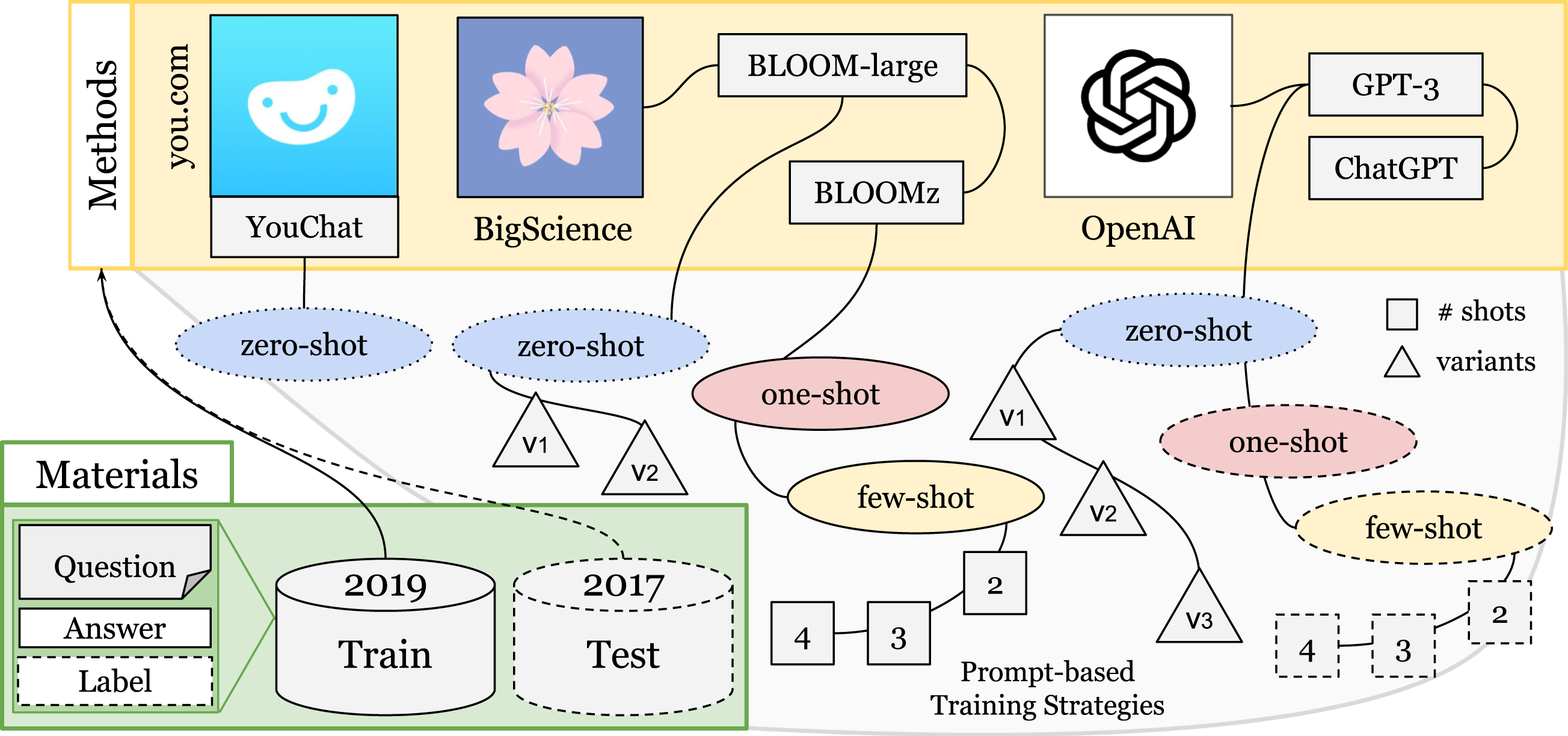
In Figure 1, below are located the materials consisting of databases of pairs of questions and answers from 2017 and 2019. Above are different LLMs: YouChat, BigScience with two LLMs, OpenAI also with two LLMs. The curves connect the LLMs with the ellipses indicating the strategy used. Strategies range from zero shots to multiple shots, indicated by the numbers in the squares. The triangles indicate the variants of prompt used.
Materials
The dataset comprises responses to open-ended questions during 90 minutes fourth grade sessions in 2017 and 2019. All the question-answer pairs were posed by 12 teachers, answered by 974 fourth graders, and then labeled by 10 teachers. Only 2 teachers were in the two groups. The questions varied in nature, with some being conceptual, while others revolved around specific situations and characters. Moreover, certain questions were explicitly designed to elicit explanations.
On the ConectaIdeas platform, teachers posed six types of open-ended questions (Urrutia & Araya, 2023). Q1-questions involve calculating a quantity without providing an explanation or justification for the answer. Q2-questions, require both calculation of a quantity and a written explanation or justification. Q3-questions introduce characters and statements, and may involve deciding who is right or evaluating the correctness of a character’s statement. In both cases, the question demands a justification. Q4-questions ask for a comparison of two quantities, with the task of identifying which quantity is greater or explaining why quantities are equal or different. Q5-questions require to write a problem asking content-related questions. Finally, Q0-questions are those that do not fit into any of the previous categories.
The linguistic characteristics of students' responses are influenced by the type of question. Depending on the question, students may need to provide integers, decimals, fractions, character names, explanations, or a simple “yes” or “no” response. The study identifies two types of incoherent answers (Urrutia & Araya, 2023). The first type of incoherence is question-independent incoherent answers. This includes responses that contain emoticons, laughter, curse words, phonemic errors, missing letters, consonant substitutions, and repeated words. The second type of incoherence are question-dependent incoherent answers. This occurs when the question is crucial in determining whether the answer is coherent or not. For instance, answering “no” to a type Q1 question may be considered incoherent.
Distribution of Questions and Answers of the Sample of the 2017 Data (Test Set) by Question Type.
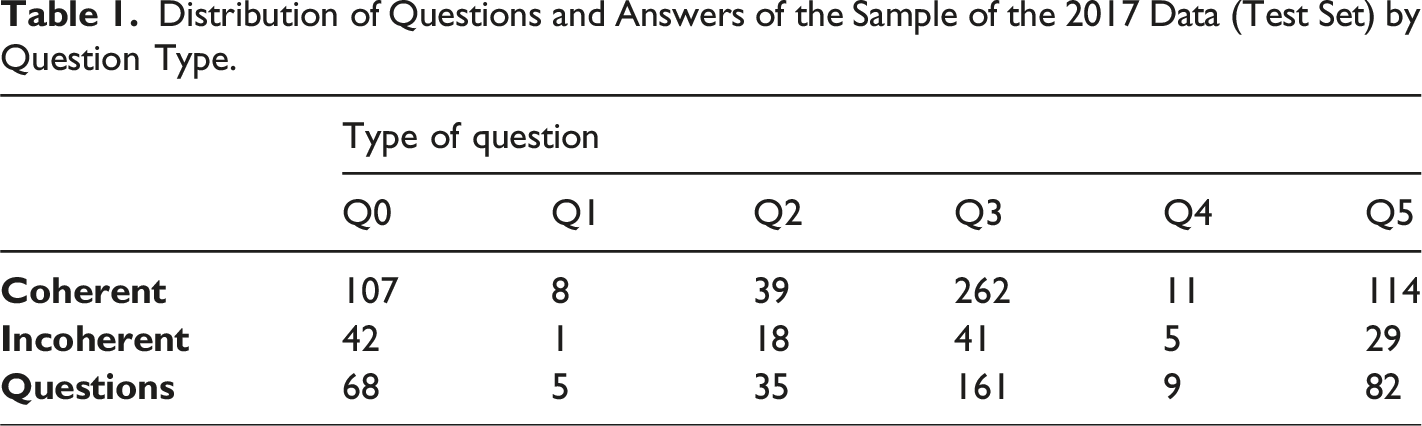
In the present work we added the label of presence of spelling errors in all the answers of the year 2017. In addition, we manually classified all questions according to the six question types. This addition of new labels will later allow us to perform a detailed study of the predictive performance of the GPT model by question type and whether the answer has child misspelling or not.
Methodology
Objective and Experiments
The main goal of this study is to evaluate the effectiveness of GPT models in detecting incoherences in open-ended responses. Given the popularity of GPT models in NLP and text generation, it is important to determine their suitability in identifying incoherent answers from fourth-grade students. To accomplish this, it is essential to select appropriate GPT models that support the language of the dataset. Therefore, we will assess a few GPT models that meet our selection criteria and evaluate them using various prompting strategies, including zero-, one-, and few-shot learning (Liu et al., 2023).
Additionally, we will employ ML models to gain insights into the challenges faced by GPT models. To comprehensively evaluate the GPT models, we will leverage ChatGPT to examine their performance intricacies and assess their ability to explain their predictions. Our study will focus on identifying the key obstacles associated with GPT models' ability to identify incoherences in fourth-grade students’ open-ended math responses.
Task Description
The input to the models is a question-answer pair. The question is a text written on the platform by the teacher. Typically, it is 18–42 words. Usually it describes a situation and asks to explain a procedure. The answer is a text written by a student. The average length is 12 words and the standard deviation is 29 words.
To automatically detect incoherence in answers to open-ended questions, we will use both the question and the answer. By “incoherence,” we mean answers that contain irrelevant or unrelated information, lack coherence, or fail to address the question being asked. It’s important to note that not all incorrect answers are incoherent, and incoherence can take various forms.
Incoherence can manifest itself in several ways, such as the presence of illegible text, emoticons, or laughter, but it’s not limited to these examples. For instance, answers with random letters or the presence of cursed-words are also indicators of incoherence. Figure 2 shows examples of answers to open-ended questions with their respective classifications. Examples of answers to open-ended questions. Note. Examples with their respective label for the answer, Coherent or Incoherent; and their respective label for the question, from Q0 to Q5. Translated from Spanish.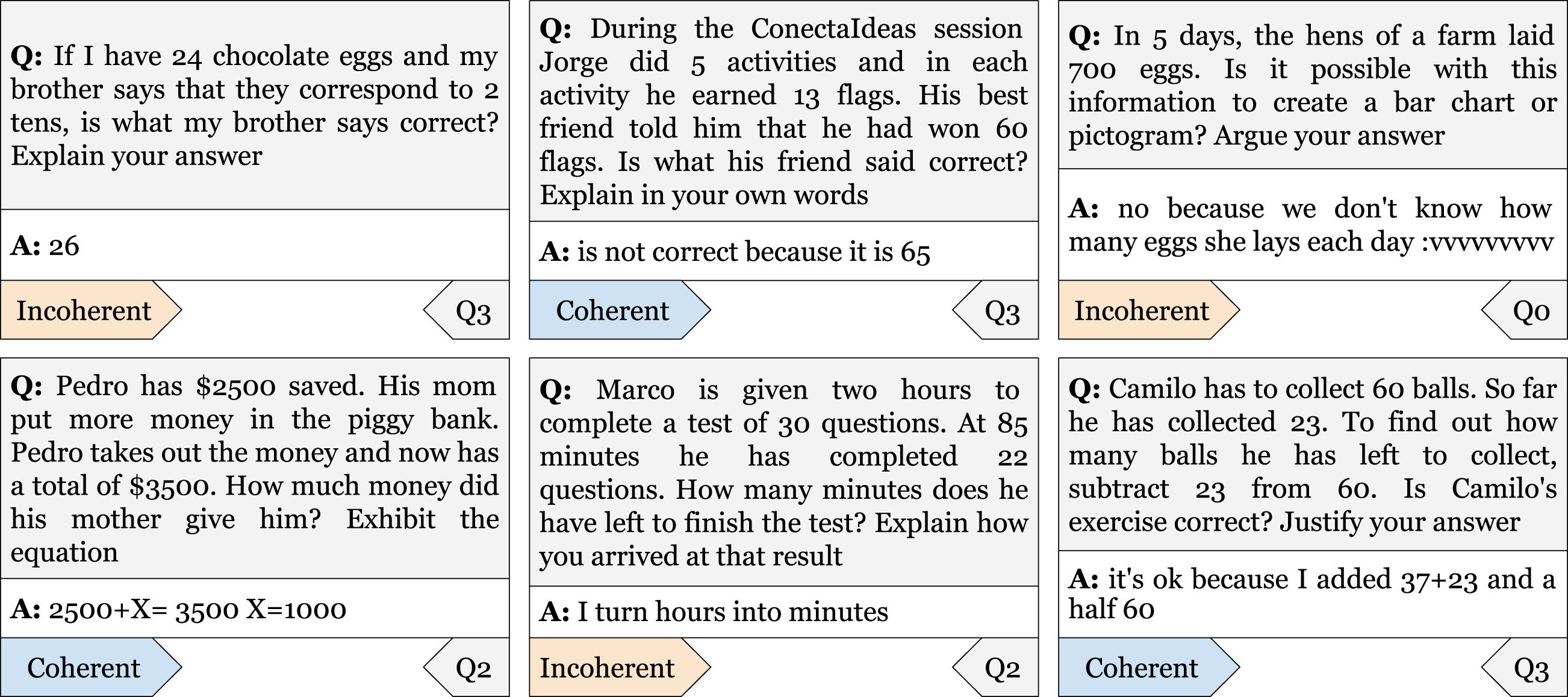
To identify incoherent answers, we will use a binary task with labels “Coherent” and “Incoherent”. Our first work Urrutia and Araya (2023) suggests that incoherence is highly dependent on the type of question being asked. For example, answers to question type Q1 are not coherent if they do not have appropriate numerical representations. While answers to question type Q2 will be coherent if they have numbers and an explanation of the mathematical expression.
Step-By-Step Route
Comparative Table of Characteristics.
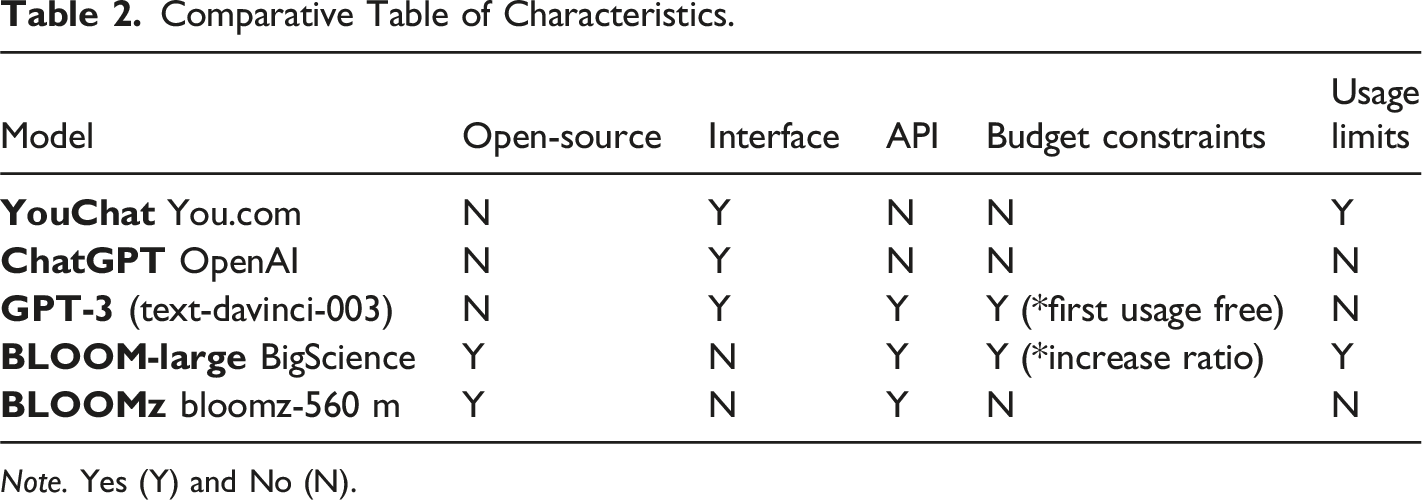
Note. Yes (Y) and No (N).
Our methodology involves using the YouChat model as the baseline model for the GPT models, with the zero-shot strategy. YouChat is a GPT model that is adjusted to be conversational and is free. We found that it performs well in classifying responses according to coherence with only one task description, and it is based on GPT-3.5. Additionally, the YouChat model’s features enable us to study the best way to make prompts. Although the YouChat model has no API to perform a simple task and its inference time on the entire test set is considerably time-consuming compared to other GPT models, we decided to study it using only the zero-shot strategy due to its unique features.
We only used the ChatGPT model on a small subset of the test data due to the lack of API support at the time of writing. Despite the high demand for the model, it is available free of charge, and OpenAI has provided documentation and tutorials for its use. However, the pre-trained weights and model-specific source code are not currently available in a public repository on GitHub. Hence, the only way to use the model is through the interface.
The BLOOMz model is a small version of the BLOOM model that can be downloaded and performed locally. This model is trained to be used with prompting, unlike the original BLOOM model, and supports Spanish language. Moreover, it is open-source, making it an ideal model to use with various strategies. However, we decided not to use Petals, a version of BLOOM that allows simple inference, due to computational and memory resource limitations. In addition, it is necessary to pay to increase the inference rate, making it not feasible for our study. On the other hand, the GPT-3 model is paid but offers a free and reasonable first period for testing two experiments. As a result, it is the basis for several other GPT models such as ChatGPT.
We will follow the following steps in our study: First, we will use YouChat to study the incoherence detection task’s prompting. Second, we will use it with the zero-shot strategy as the baseline model of the GPT models. Third, we will use BLOOM-large with only the zero-shot strategy. Fourth, we will study the GPT-3 and BLOOMz models with the one- and few-shot strategies. Fifth, we will test the GPT-3 model with the zero-shot strategy. Finally, we will use ChatGPT to study the shortcomings and challenges of the GPT models.
Evaluation
We adopted a specific data split strategy for the training and testing of our ML classifiers. Specifically, we utilized the 2019 dataset for training purposes and the 2017 dataset for testing. This approach was motivated by the desire to assess the model’s performance in a real-world scenario, where it is exposed to a different set of students and questions. Additionally, by using a dataset from a different year, we could evaluate the model’s generalizability and capacity to perform well on novel data.
The performance of the ML classifiers was evaluated using a data splitting strategy, where the dataset was divided into training and test sets. The model’s performance was compared against two baseline models, a rule-based unsupervised model and XGBoost + Mix, and two ML models previously trained by Urrutia and Araya (2023), a general XGBoost model, and BETO-mt, a deep learning model based on the Spanish version of BERT (Devlin et al., 2018), called BETO (Cañete, J. et al., 2020). The evaluation approach utilized three metrics beyond traditional accuracy measurement: Precision (Prec.), Recall (Rec.), and F1-score (F1). The test set consisted of 541 coherent pairs and 136 incoherent pairs, and the size of the test set was determined based on the available data.
For consistency with previous work, we will use Prec., Rec. and F1. We discarded the use of accuracy, since the classification of incoherence presents an imbalance of incoherent responses. In the training data, incoherent responses represent 13% of the total responses. Therefore, a model that always predicts Coherent, will have an accuracy of ∼90%.
Prec. is defined as the proportion of the number of correctly predicted incoherent answers to the total number of predicted incoherent answers. It is calculated using the formula:
Rec. refers to the proportion of incoherent answers that are correctly predicted as incoherent to the total number of incoherent answers. The formula for Recall is:
F1 is a measure that combines Precision and Recall into a single metric. It is calculated as the harmonic mean of Precision and Recall, given by the formula:
In addition to Prec., Rec. and F1, we also keep track of the Support (Supp.), which represents the number of occurrences of each specific class in the true responses.
Results
GPT Models’ Performance
Comparison of Performance Between GPT and ML Models on the Test Set for the Incoherent (Positive) Class.
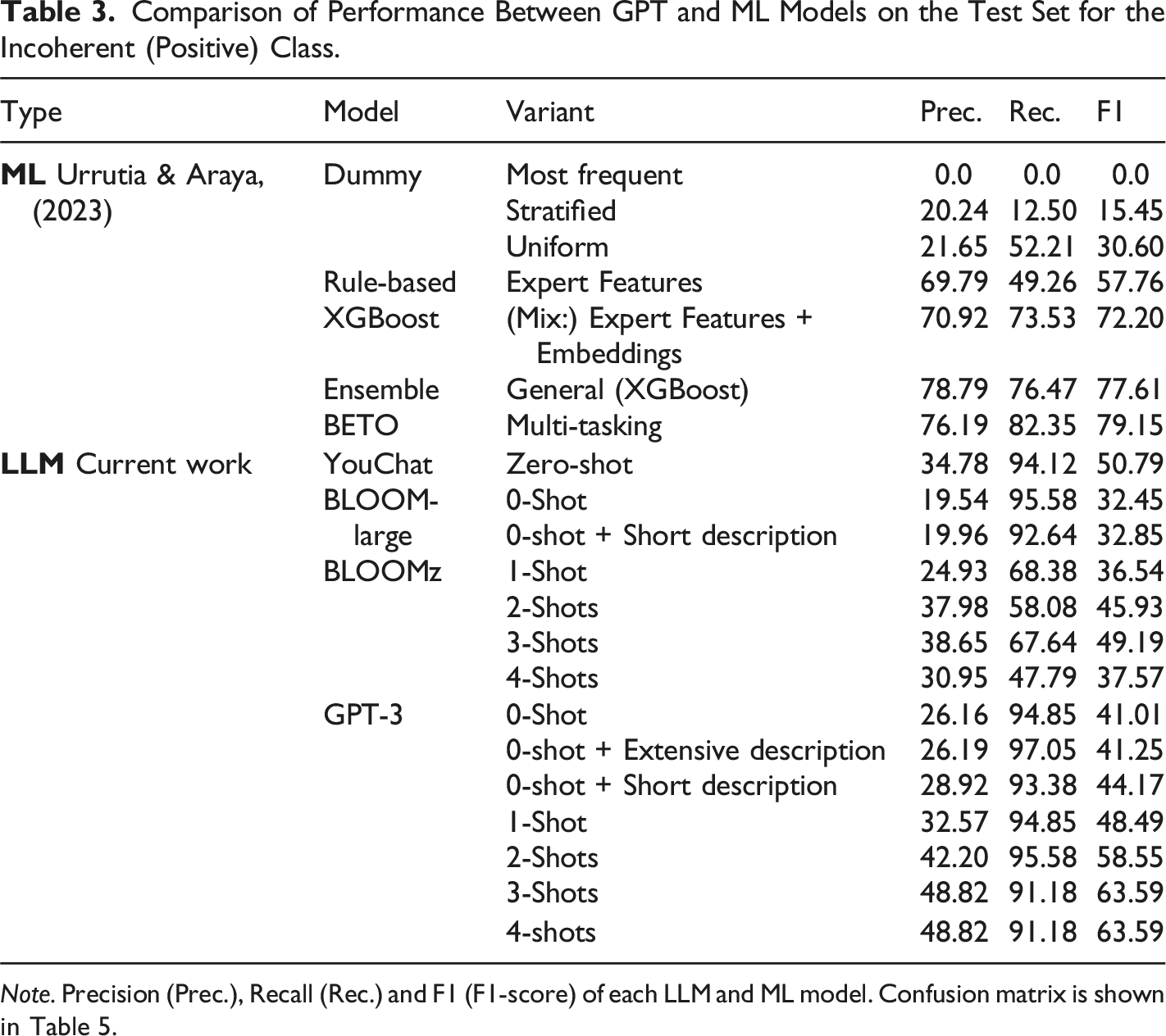
Note. Precision (Prec.), Recall (Rec.) and F1 (F1-score) of each LLM and ML model. Confusion matrix is shown in Table 5.
YouChat
For our baseline, we evaluate the performance of four models for incoherence prediction: one strong model named YouChat, and three dummy models, including the Most frequent, Uniform, and Stratified classifiers (Urrutia & Araya, 2023). The dummy models do not consider the question-answer pairs and predict the class randomly. As reported in Urrutia and Araya (2023), the Most frequent classifier predicts only the majority class, resulting in low performance. The Stratified classifier predicts fewer answers as incoherent, resulting in lower precision than recall. The Uniform model achieves a better F1-score of 30% on the test set, and is used as a baseline for evaluating the performance of GPT models.
Table 3 shows that the YouChat model with the zero-shot strategy outperforms the best dummy model, achieving a 50% F1-score in the incoherent class and a 70% F1-score in the coherent class. However, the YouChat model fails to outperform any of the ML models, which are trained with thousands of examples to accurately detect incoherence (Urrutia & Araya, 2023). The YouChat model is only introduced with a brief task description, and it is not trained to detect other features that may mislead the incoherence detection. This preliminary result suggests the need for further study on how to contextualize the models with key examples on coherence and incoherence in answers to open-ended questions. This means providing some shots.
BLOOM
We evaluate the performance of the BLOOM model, consisting of the BLOOM-large and BLOOMz versions, using various prompting strategies. For the BLOOM-large model, we consider two zero-shot variants, the first including only a task description and prompt, and the second containing two additional key instructions related to correctness and recursion. We evaluate the BLOOMz model with prompting strategies that include task description, instructions, and examples from the training set, with one-shot and few-shot strategies (two to four examples) tested.
Table 3 shows that the BLOOM-large model with the zero-shot variants performed poorly, achieving similar or worse performance than the random uniform model for both coherence and incoherence prediction. However, incorporating the two key instructions improved performance slightly. The BLOOMz model with the few-shot strategy, using three shots, achieved the best performance, with an F1-score of 49.19%, slightly lower than the 50% F1-score obtained with YouChat. The performance was lower than that of all ML models, suggesting that incorporating examples in the prompt helps to some extent, but the choice of appropriate examples and prompts may also be crucial. Further research is needed to explore the use of in-sample shots (i.e. examples in the test set) and additional information for incoherence detection.
GPT-3
We analyze the performance of the GPT-3 model, using three training strategies: zero-, one-, and few-shot. The one-shot and few-shot strategies are examined with two to four shots, using in-sample shots, which are examples that are in the same set where we will test the model. In contrast, we study the zero-shot strategy with three variants, including the same variant as those used with the YouChat and BLOOM models. The second zero-shot variant involves a task description with two key instructions (correctness and recursion) and extra information from the incoherence detection task, and the third variant is the same as the second but without the extra information.
The GPT-3 model with the three variants of the zero-shot strategy performs considerably better than the BLOOM model, but not as well as the YouChat model. Incorporating more details in the task description improves the model’s performance, but these additional details should be moderated. However, when we use the one-shot and few-shot strategies with the GPT-3 model, we obtain more encouraging results. Specifically, when we use three shots, the model outperforms the unsupervised rule-based ML model, achieving a 63.59% F1-score for incoherence prediction and 85.27% for coherence prediction. Although the GPT-3 model outperforms the YouChat and BLOOM models, it cannot outperform other ML models. Increasing the number of shots considerably improves the performance of the model, but the improvement is marginal when going from three to four shots.
The GPT-3 model with the few-shots strategy outperforms the YouChat and BLOOM models, in all their variants, but this result may be due to the fact that the shots used belong to the test set. The comparison of the three GPT models reveals that using generative models with zero-, one-, and few-shot strategies is not enough to compete against supervised ML models trained with thousands of examples. However, since prompts are a key part of GPTs model training, and the study only used a few prompts to evaluate the performance of these models, this conclusion may be equivocal. Future research will investigate what is happening with these models that are uncompetitive to refine the prompting and select more appropriate examples.
Challenges Encountered
We evaluated the performance of the GPT-3 model with a few-shot strategy in predicting incoherence in answers to open-ended questions. Despite achieving an F1-score of 63.59%, the GPT-3 model failed to outperform the best ML model reported in Urrutia and Araya (2023). Urrutia and Araya (2023) found that the best ML model was the Spanish version of BERT called BETO-mt, which achieved higher precision in classifying coherent and incoherent answers. To determine why the GPT-3 model underperformed, we conducted further experiments and identified two challenges: Recursivity and Kids’ Misspelling.
Table 2 indicates that the GPT-3 model had a high recall of 91.18%, but low precision of 48.82%, which was significantly lower than the precision of the BETO-mt model (76.19%). These findings suggest that the GPT-3 model is more likely to classify coherent answers as incoherent, resulting in a large number of false positives. While the BETO-mt model had slightly lower recall with respect to GPT-3 recall. Also, BETO-mt model achieved higher precision, suggesting it is less likely to make errors when classifying coherent answers as incoherent. Our study highlights the challenges associated with using generative language models like GPT-3 for predicting incoherence in open-ended answers and the potential benefits of using task-specific models like BETO-mt.
Recursivity
Predictive Performance of GPT-3 Model and BETO-mt Model.
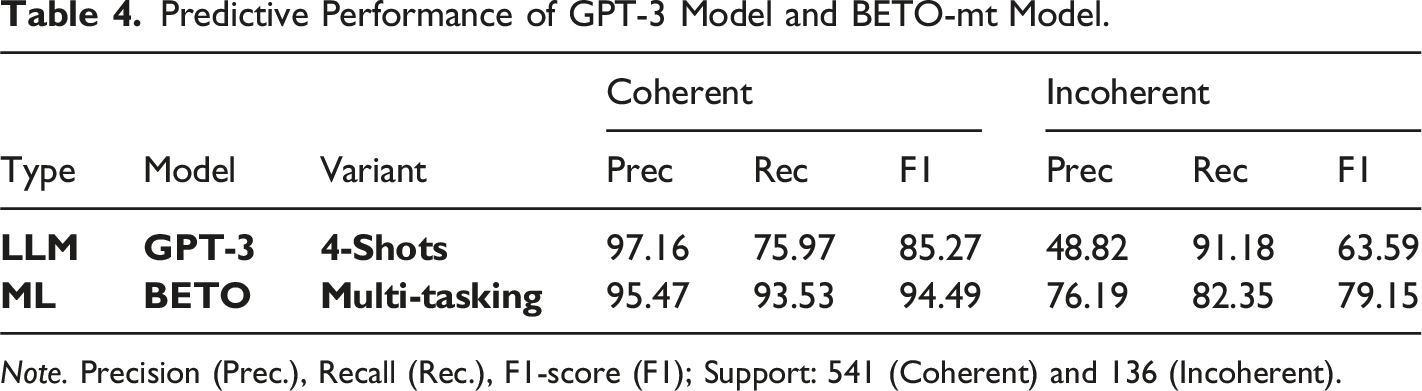
Note. Precision (Prec.), Recall (Rec.), F1-score (F1); Support: 541 (Coherent) and 136 (Incoherent).
We compared the precision, solely in the incoherent class, between the GPT-3 model and the BETO-mt model. We will measure the precision of each model for each question type to assess the impact of question recursion on the predictive performance of the models. Since we have different precisions for each model, we will denote the precision of the GPT-3 model with the subscript LLM and the precision of the BETO-mt model with ML. Additionally, to measure precision for each question type, we will use the subscript
In effect,
For simplicity, we report the difference in precisions as a 2 × 2 matrix (Figure 3). The matrix is designed such that below the diagonal of the matrix, we display the differences in precision of the GPT-3 model for responses to different question types. On the diagonal, we show the differences in precision between the GPT-3 and BETO-mt models for responses to the same question type. Above the diagonal, we display the differences in precision of the BETO-mt model for responses to different question types. Specifically: Precision Differences for the Incoherent Class for each Question Type. Note. Difference of Precision: (Diagonal) between GPT-3 and BETO-mt; (Under diagonal) of GPT-3; and (Over diagonal) of BETO-mt.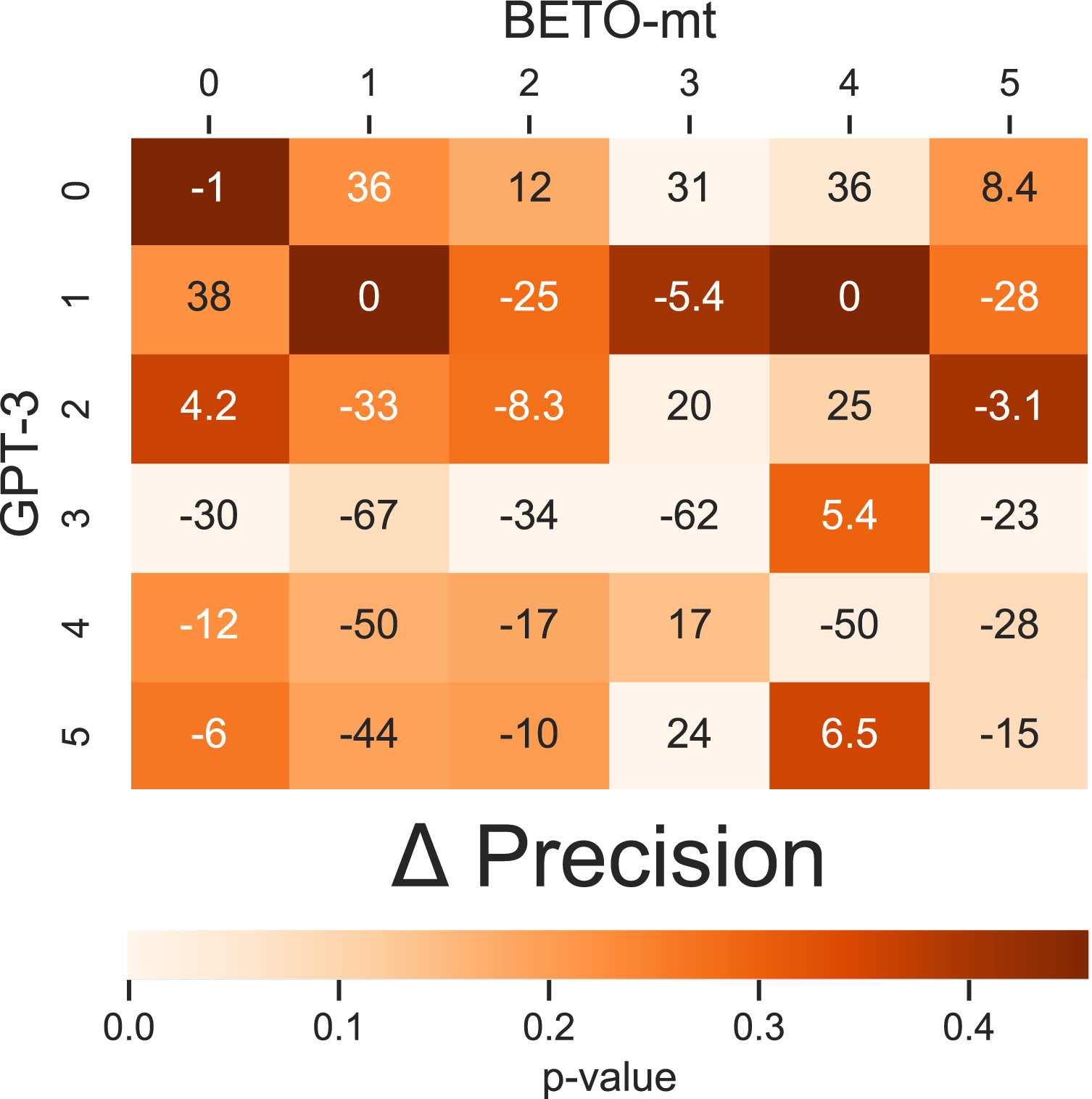
Recursivity poses a significant challenge for the GPT-3 model, as demonstrated by our precision comparison with the BETO-mt model in Figure 3. While the BETO-mt model achieved a precision of 94.6% for recursive questions, the GPT-3 model struggled significantly with a precision of 32%. This precision is 62 percentage points lower than the BETO-mt model precision for Type Q3 questions. Moreover, the GPT-3 model performed worse on Q3-type questions than on other types of questions, except for Q2 and Q0 types, while the BETO-mt model demonstrated consistent precision across question types.
Overall, the lower performance of the GPT-3 model in type Q3 questions can be attributed primarily to the presence of recursivity in the open-ended questions. However, it is important to note that while the BETO-mt model exhibited higher precision, it was not perfect, and errors were observed even in type Q3 questions.
We encountered a challenge with the GPT model’s ability to detect incoherence in open-ended questions of type Q3. To address this, we utilized the ChatGPT model, which is a similar architecture to GPT-3 but with fewer parameters and adjusted for natural language conversations with humans. Specifically, we focused on studying the behavior of ChatGPT on question-answer pairs with Recursivity, for which the GPT-3 model failed. Among the numerous examples we examined with the ChatGPT model, we present two relevant examples that highlight the difficulty of Recursivity.
In Example 1, a farmer needs to distribute 35 corn in seven trucks and prefers to ask a worker what amount to put in each truck. The worker suggests four corn per truck, but the correct answer is five corn per truck. The student correctly identifies the worker’s answer as incorrect and justifies their answer by explaining that five corn in seven trucks equals 35 corn. However, when asked if the student’s answer is coherent with the question, the ChatGPT model incorrectly identifies the answer as incoherent and provides a meaningless explanation. This may be due to the model confusing the student’s answer with the worker’s answer or the open-ended question with the question within it.
In Example 2, two friends buy different amounts of elastic, and a friend helps them calculate the total amount purchased. The friend suggests they bought 3 m of elastic, but the correct answer is 3.32 cm. The student identifies the friend’s answer as incorrect and explains that the correct amount is 3.32 cm. However, the ChatGPT model again identifies the answer as incoherent and provides an irrelevant explanation that fails to determine if the answer is coherent or not. The model may be confusing the coherence of the student’s answer with the coherence of the friend’s answer.
Our study highlights that Recursivity, the challenge of distinguishing between the open-ended question and the question within it, causes the ChatGPT model to fail to predict the coherence of the student’s answer. We suggest studying this limitation in future applications of NLP.
Upon discovering the ambiguity produced by the original question, we recognized the necessity for a clear and unambiguous design of the prompt to prevent potential errors in the GPT-3 model’s responses. To address this, we conducted an additional experiment utilizing a zero-shot prompt specifically tailored to Q3 type questions. This prompt design includes separate sections for the question and answer, with the answer labeled as “Felipe’s answer” to differentiate it from the open-ended question’s response. To minimize confusion, we asked the model three yes/no queries: (1) to evaluate the accuracy of the answer to the open-ended question, (2) to evaluate the accuracy of Felipe’s answer (i.e., the student’s response), and (3) to assess the coherence of Felipe’s answer with the open-ended question.
We compared the performance of GPT-3 with the new prompt zero-shot specific to Q3 question type responses. To do this, we studied the old prompt from the best general-purpose GPT-3 (i.e., a prompt i.e. used to classify responses to questions of any type) against the new prompt for specific purposes. We report the confusion matrix for both versions of the GPT-3 model, as well as the precision and recall for both classification classes (Coherent and Incoherent). Additionally, we report the distribution of predictions along with their relative error compared to the distribution of ground truth labels, also known as the Classification Error Rate (CER).
Indeed, the relative error of the label distribution in the incoherent class is given by Comparison of GPT-3 Model Results for Question Type Q3. Note. (Left) GPT-3 with 4 shots. (Right) GPT-3 with new three-question zero-shot prompt.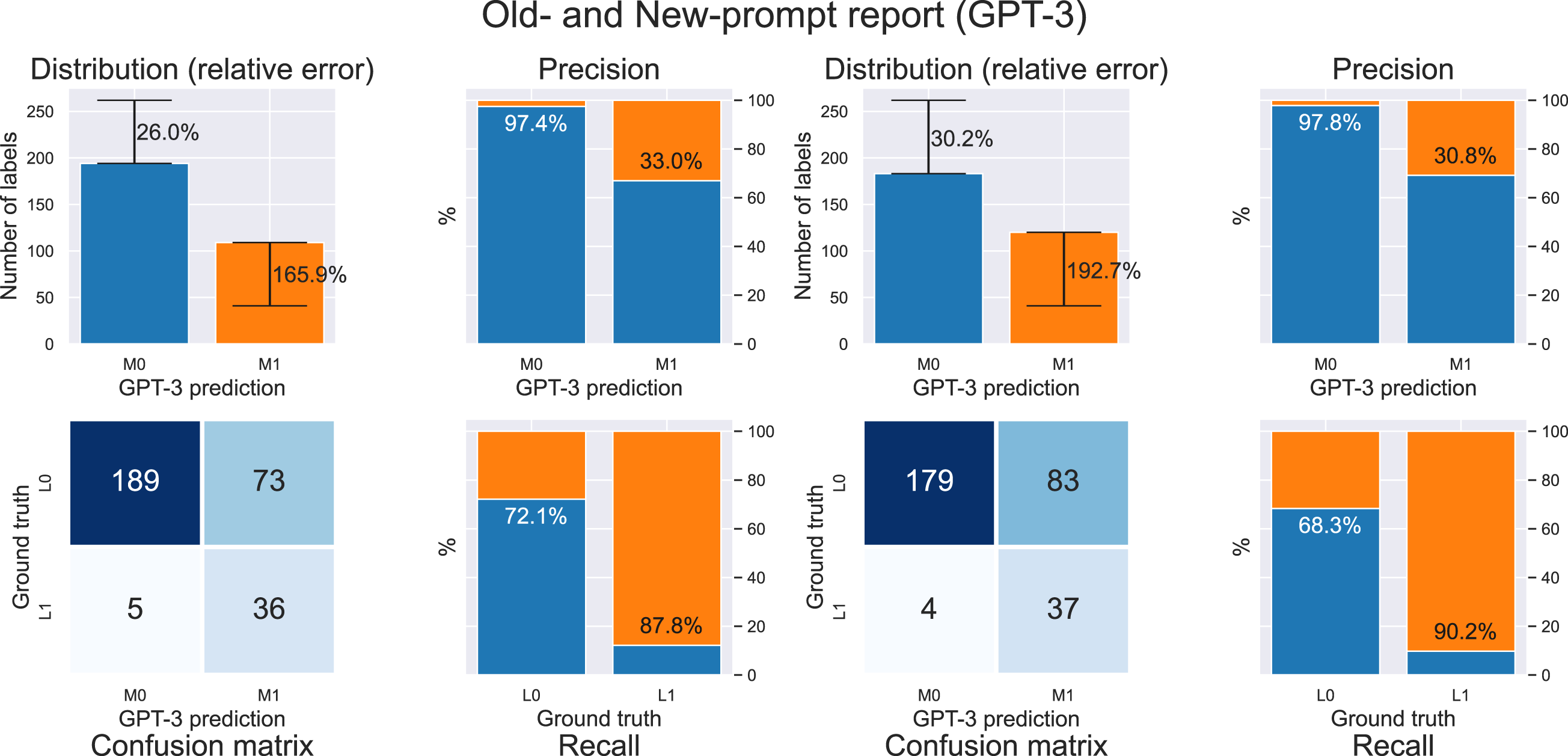
Figure 4 shows the performance of two strategies of the GPT-3 model in the recursive questions, cataloged as Q3. On the left we use the 4 shot strategy, while on the right the strategy with three-question but zero-shot. We used 303 question-answer pairs. In the figure on the left below is the confusion matrix. Of those 303 question-answer pairs, GPT-3 was correct in classifying 189 pairs as coherent and was correct in classifying incoherent in 36 question-answer pairs. GPT-3 was wrong in 73 pairs of answer questions where the answer was consistent, and was wrong in 5 pairs where the answer was incoherent. The colors of the graphs correspond to the ground truth. Blue corresponds to question-answer pairs in which GPT-3 predicted that the answer is coherent (194 pairs) and orange to cases in which it predicted incoherent (109 pairs). Those numbers are plotted as the heights of the bars in the top left chart labeled Distribution. In short, GPT-3 was wrong in 78 answers out of a total of 303. The percentages in the label distribution graph correspond to the relative error, also known as the CER. Meanwhile, the percentages in the precision and recall graphs represent class-wise precision and recall, respectively. The percentage of hits when it predicted coherent is 97.4%, and the percentage of hits when it predicted incoherent is 33.0%. This is indicated on the graph labeled Precision. Finally, of the 262 pairs for which the response is coherent, GPT-3 was correct in 72.1%, and of the 41 pairs with an incoherent response, GPT-3 was correct in 87.8%.
Despite this improved prompt design, as shown in Figure 4, the GPT-3 model’s performance did not improve and, in fact, worsened. This suggests that the problem with Recursivity may stem from an internal feature rather than solely from prompt design. Thus, addressing Recursivity may require a more fundamental rethinking of the GPT-3 model. Furthermore, additional challenges could arise when analyzing recursive structures in other contexts, such as peer reviews where the model has to interpret comments from classmates on the student’s response. It is also possible that the phrasing of the recursion statement may require revision to improve the performance of the GPT-3 model. Such efforts could have the complementary goal of enhancing the performance of the best ML models.
Kids’ Misspelling
Fourth-grade students frequently make spelling errors, such as omitting punctuations, when answering open-ended questions in writing. However, these spelling errors differ from those of adults, as children tend to glue words together, break words into smaller units, or write words based on how they sound. In addition, students may use non-standard notations to write mathematical expressions. These types of childish misspellings occur frequently in responses to all open-ended questions. Responses with numerous spelling errors that differ significantly from adult misspelling can complicate analysis. Nevertheless, teachers do not consider responses with at least one spelling error as incoherent since such misspellings are common in children’s writing. Consequently, responses with spelling errors are not necessarily incoherent or incorrect.
We compare the precision, specifically in the incoherent class, of the GPT-3 model between responses without misspellings and responses with misspellings. It should be noted that this classification of responses defines a partition of the test set, i.e., those with/without misspellings. We will measure the model’s precision for each type of response in order to evaluate the impact of misspellings on the model’s predictive performance. Since we have different precisions of the model for each partition, we will denote the precision of the GPT-3 model in responses with misspellings as
Indeed,
To simplify, we present the differences in precisions as a 2 × 2 matrix (Figure 5). The matrix is designed in such a way that below the diagonal, we show the differences in precision of the GPT-3 model for responses with misspellings for different question types. On the diagonal, we show the differences in precision of the GPT-3 model between responses with and without misspellings but for the same question type. Above the diagonal, we show the differences in precision of the GPT-3 model for responses without misspellings to different question types. Specifically, Precision Differences for Incoherent Class with and without Misspellings, by Question Type. Note. Difference of Precision of GPT-3: (Diagonal) between answers with and without misspellings; (Under diagonal) in answers with misspellings; and (Over diagonal) in answers without misspellings.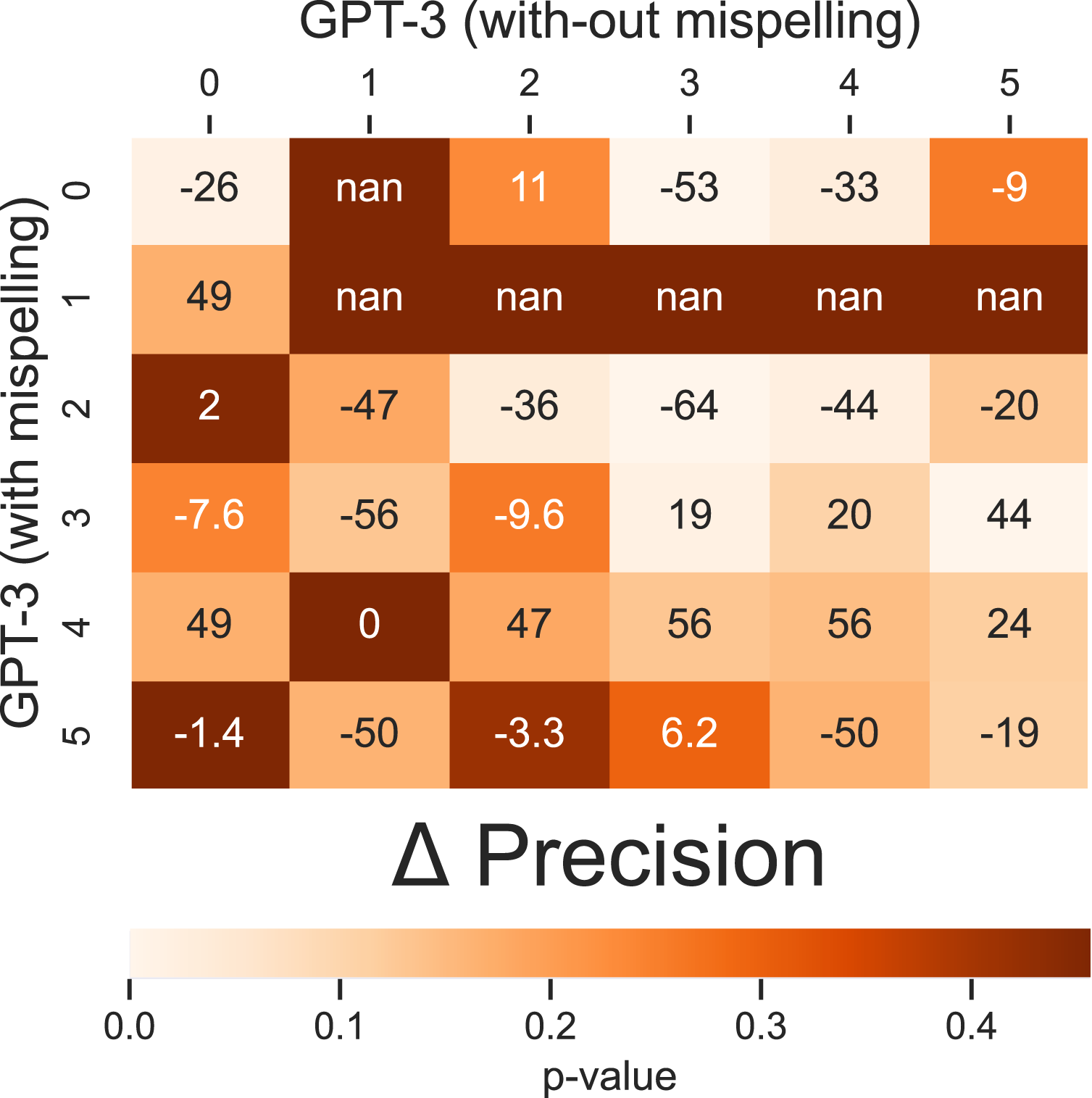
In Figure 5, we compute the precision for each type of question for GPT3. This means, we compute the proportions of answers correctly classified as incoherent by GPT3 over all incoherent answers to this type of questions. We present a comparison of the precision obtained with the GPT-3 model under two conditions: responses with spelling errors and those without spelling errors.
We estimated the precision for each type of question to gain a better understanding of the effect of child spelling on each question type. Our results show that the GPT-3 model performs significantly better on responses without child spelling errors, except for questions type Q1 and Q4, which have few responses, where no statistically significant difference is observed. Conversely, for question type Q3, the effect of child spelling on precision is the opposite. However, we conclude that the problem in question type Q3 is not solely due to spelling errors but is related to recursion. Our findings demonstrate that child misspelling has a significant negative effect on the precision of the GPT-3 model for incoherence prediction.
Example 3 involves an open-ended knowledge question about tens, in which the student answers correctly but with a spelling error where two words are pasted together. Despite this error, teachers consider the answer coherent and correct. However, the ChatGPT model predicts the response as incoherent and nonsensical due to the spelling error. Additionally, the model provides an explanation that the pasted word is insufficient to answer the question, despite the information provided being the key to answering it.
Our results show that both models struggle with child spelling errors and that there is a limitation in their training domain. These findings suggest the need for further research to improve the models' ability to handle child spelling errors in open-ended questions.
Discussion
The use of supervised learning has been the prevailing method in artificial intelligence (AI), particularly in ML and NLP (Liu, P. et al., 2023). However, recent developments have led to a shift away from hand-crafted features in favor of deep learning models that rely on learned and sometimes unsupervised representations (Haller, S. et al., 2022). This new approach involves designing a model with a fixed architecture that is pre-trained on large amounts of unstructured textual data using non-supervised tasks (Devlin, J. et al., 2018). The pre-trained LM is then fine-tuned for a specific task by updating its parameters based on the objective function. Urrutia and Araya (2023) have explored a range of models, from ML models with hand-crafted features to fine-tuned LMs, for detecting incoherent answers to open-ended questions. The study found that models fine-tuned with BERT using a multi-task strategy outperformed traditional NLP models. However, a new paradigm has emerged in recent years that involves adapting LLMs using “prompting.”
In our current study, we investigate the performance of GPT LLMs in this emerging paradigm and present preliminary results. Our research questions were: (1) How do LMs perform in detecting incoherent answers to typical math word problems among fourth-grade students? and (2) How does the performance of LMs compare to that of ML classifiers? We tested four different LLMs and found that they performed worse than the ML models, which had been trained on thousands of examples. In contrast, the LLMs were not specifically trained for this task and were only given a maximum of four examples. We also found that recursive questions posed the greatest difficulty for the GPT models. Another challenge was posed by the common misspellings among fourth-grade children.
We developed a specific prompt design for binary text classification using GPT models. Our prompt engineering approach involved manually creating intuitive templates through human inspection. Since the selection of prompts has a significant impact on results, we acknowledge that exploring alternative strategies can improve results. For example, we could use automated template learning, such as Prompt mining and Gradient-based search, proposed by Liu et al., (2023). Additionally, we could try methods that directly prompt the embedding space of the model, such as Prefix Tuning.
In our study, we map the output sentence of the LM to two labels, “coherent” and “incoherent,” based on the presence of certain keywords in the output to create an effective predictive model. However, manual output mapping may result in suboptimal performance with LMs. Therefore, we are interested in exploring other strategies such as Prune-then-Search to find a better mapping, as well as continuous search for the answer space. Furthermore, we could explore in future research a new family of prompting methods based on multi-prompt learning, such as Prompt Ensembling (Liu et al., 2023).
To the best of our knowledge our results on the use of LLMs in detecting incoherent answers to open questions are new. However, we can compare our results with similar question-answer tasks in EDM that score student answers. One such task is ASAG, which has gained significant attention in education due to the growing number of both online and face-to-face students (Haller et al., 2022). According to Haller et al., (2022), recent advancements in NLP and ML have greatly influenced ASAG. For instance, Sung et al., (2019) demonstrated the efficacy of transformer-based pre-training on the SemEval-2013 benchmark dataset, resulting in an improvement of up to 10% in macro-average-F1 over state-of-the-art ML models.
Although large transformer-based LMs have shown promising results in solving ASAG tasks, they do not always outperform traditional models in specific domains. For instance, Gaddipati et al., (2020) evaluated the performance of four LLMs on the Mohler dataset and found poor results for GPT-2, GPT-1, and BERT. In fact, they reported that a traditional NLP approach using bag-of-words and term frequency-inverse document frequency outperformed GPT-2. While there is evidence of both positive and negative results with the new language architectures, including GPTs in EDM, there is currently no research on predicting incoherence in response to open-ended questions from fourth-grade students on an online mathematics platform. Our findings also suggest that LLMs have limitations in outperforming traditional ML models, such as General XGBoost model and BETO-mt, in predicting incoherence.
Our analysis on the performance of LLM models suggests that inferior performance may not be due to prompting, but rather an intrinsic limitation of the models. One such limitation is the ability to comprehend language, which is an important feature of LMs studied within NLP and natural language understanding (NLU). One of the canonical tasks in NLU is natural language inference (NLI) (Williams, A. et al., 2020). In NLI, a “premise” is given and the task involves figuring out if a “hypothesis” is true (entailment), false (contradiction), or uncertain (neutral). For example, given the premise “Juliet has 25 cookies and gives 5 to her friend,” possible hypotheses are “Juliet has 20 cookies left” (entailment), “Juliet does not give cookies to her friend” (contradiction), and “Amanda has 5 cars” (neutral) (authors accessed on http://nlpprogress.com/english/natural_language_inference.html, March, 2023).
The generation of a diverse and competitive set to study NLI from pre-existing annotated datasets is a challenging task. To address this challenge, Demszky et al., (2018) proposed a new method to automatically derive NLI datasets from large-scale QA datasets. This approach suggests that any open-ended question-answer pair can be transformed into an example of NLI. Additionally, we propose that determining the incoherence in answers to open-ended questions is a sub-task of NLI. Verifying the incoherence of an answer (hypothesis) to an open-ended question (premise) is equivalent to verifying that the answer is coherent if it satisfies entailment or contradiction, and incoherent if it satisfies neutral.
In our experiments with LLM for incoherence detection, we observed that GPT models perform worse than ML models. Now this is not surprising, if we consider that incoherence detection is a sub-task of NLI. In fact, recent research by Brown et al., (2020) shows that GPT-3 does not perform significantly better than a model that randomly predicts on the ANLI dataset (Nie et al., 2019).
The limitations of GPT models may be similar to those observed in poor performance on NLI datasets. However, at the same time, our experiments indicate that GPT models face the greatest difficulty in questions that involve recursion. Interestingly, this feature is not exclusive to language but also observed in Computer Vision (CV).
Recursion is a significant challenge in various domains of AI, particularly in image classification. ML models often struggle with the classification of recursive images. For instance, Bongard problems (BPs) are a class of pattern recognition problems in the field of CV. They were initially introduced to evaluate human-level cognition for visual pure-intelligence pattern recognition (Bongard, M. M., 1970). Recursion is a key feature specific to BPs (e.g. BP No. 70), analogous to the feature present in Q3 type questions. In CV, the challenge of recursion is not limited to branches. Other shapes or patterns can exhibit recursion.
The complexity of recursion in visual patterns can be transferred to the shape of the object (e.g. BP No. 71) or a concept of numerosity (Depeweg et al., 2018; Youssef et al., 2022). However, addressing recursion in language remains unsolved. It is unclear how to modify the existing prompts to improve the ability of LLMs to predict incoherence in recursive questions. Nonetheless, knowledge transfer from visual reasoning could simplify the task of handling recursion in language and enhance the performance of LLMs. For instance, Huang, S. et al., (2023) illustrate that multimodal-LLMs can benefit from knowledge transfer across language modalities and multimodal input. In conclusion, the challenge of recursion in AI remains a significant issue, and further research is needed to develop effective solutions.
On the other hand, the prevalence of spelling errors in the answers of fourth graders poses a challenge, as does the recursive nature of the questions. The occurrence of writing errors is a well-established phenomenon observed in both adults and K-12 students (Connors& Lunsford, 1988). These errors manifest in various forms, ranging from simple spelling errors to incorrect capitalization. The frequency and types of spelling mistakes vary widely, with some being more common than others. Moreover, the prevalence of particular spelling errors may differ between native and non-native speakers of a language (Flor & Futagi, 2012). Generally, misspellings are the most frequently occurring type of error (Connors & Lunsford, 1988), such as the misuse of diacritical marks or the omission of letters within words.
Spell-checking systems are available today to correct writing errors automatically, including misspellings. Despite their availability, these systems have limitations in accurately detecting and correcting errors (Ha & Nelm, 2016). Studies, such as Ha & Nehm (2016), have evaluated how automated computerized scoring systems can be affected by spelling errors in open-ended assessments. The type of misspelling significantly impacts the performance of automatic systems in detecting errors. This issue is crucial because erroneous feedback to students may result from systems that make mistakes. Therefore, it is important to ensure the accuracy and effectiveness of automatic systems to provide appropriate feedback to students.
At present, few comprehensive studies have examined the impact of misspellings in fourth-grade students’ open-ended responses on an online mathematics platform on automatic systems. Similarly, there is a lack of research on the impact of children’s idiosyncratic spelling errors on automatic incoherence prediction. Our study suggests that misspellings by fourth-grade students have a negative and significant effect on automatic incoherence prediction when using LLMs such as GPT-3. We propose that this negative impact is primarily due to the fact that the training domain of LLMs captures text written by fourth graders to a lesser extent, or not at all, including the typical spelling mistakes made by students.
Conclusion
Written argumentation is one of the basic skills in the mathematics curriculum. It helps students develop analytical and critical thinking skills, helps students learn to construct rigorous and logical arguments, and helps them develop communication skills. It is a basic tool for communicating their mathematical reasoning in an organized and effective manner. Moreover, its importance is increasing, as the automation of simpler processes will continue to advance in the coming years (Araya, 2021).
Written answers to open-ended questions could have a great effect on students’ long-term learning. However, in order to ensure that we can harness the full power of open-ended questions, it is critical that the teacher immediately review the answers, and ask to redo those that are incoherent. Accessing real-time information of students’ written explanations allows teachers to detect any negative attitudes and to give feedback to students who may be writing answers that are not only inaccurate but also incoherent. This is different from incorrect answers, as incoherent answers indicate students may not be engaged in the task and having negative attitudes.
However, real-time reviewing written responses to open-ended questions is very challenging. It can be very difficult for a teacher to provide real-time feedback to all their students in the classroom. It is a time-consuming and demanding task. Automating the detection of incoherent answers can help reduce the time it takes for the teacher to review. It is also important for teachers to review the peer reviews of their students' written responses, as this can provide valuable insight.
Moreover, an incoherence detector is a key component for the design of personalized intelligent tutors. They have to identify incoherent responses from students, and immediately ask to redo. It also has to inform the teacher of this early alert of negative attitudes. In our experience, 20% of responses from fourth-graders from vulnerable schools can be incoherent. This is different from incorrect answers. They could reveal a negative attitude from the student. Therefore, the strategy for handling incoherent answers is usually different from incorrect answers. With the correct detection of incoherent responses, intelligent tutors can provide a better learning experience for students.
Even though the performance in LLM is not very good in detecting incoherent responses, given its excellent discursive capacity, we propose to use it in a system that detects incoherence with ML but delivers the explanations through an LLM. They could constitute a powerful combination that supports the teacher explaining why the answer is incoherent. This combination could be very powerful to include as a conversational agent in an intelligent tutoring system. It could explain to the student why the answer is incoherent.
For example, consider the question: “Marco is given 2 hours to complete a test of 30 questions. At 85 minutes he has completed 22 questions. How many minutes does he have left to finish the test? Explain how you arrived at that result.”; and an answer like the following, “I turn hours into minutes.” Traditional ML will probably estimate that it is an incoherent answer. If we put the question and answer back to the LLM, and tell it to explain in 50 words why it is an incoherent answer, the LLM says: “The given answer is incoherent because it does not provide the actual calculation or explanation required to determine the number of minutes Marco has left to finish the test. It only mentions converting hours into minutes, but does not provide any further information or calculation to arrive at the result.” (generated by ChatGPT). This shows us how LLMs can add explainability and give teachers explanations of answer scores that they can easily understand and see if they make sense.
The real-time detection of incoherent answers and early and timely warning to the teacher, who receives 30 or more short answers per question, is a highly significant problem in the classroom. With this help, the teacher can then automatically receive categorized responses, focus on them, and decide on the spot whether to accept them or request to redo them. This is not only important to assess students but above all to prevent the spread of careless or misbehavior. Something like this propagates easily, since in these courses there is the implementation of the peer review strategy. In this strategy, the teacher or the platform randomly assigns which student reviews the response of a classmate. They do this in the same session, seconds after the teacher receives all the answers. The peer review strategy can be very powerful, but if distorted by bad students’ behavior, it can become a disaster.
The first contribution of this work is an advance in the early and opportune detection of incoherent answers. It is not determining if the answer is correct or incorrect, as much of the literature studies. Continuing with a more dialogical pedagogy, the strategy is not to tell the student about correctness. On the contrary, the idea is to promote the reflection of each student, and promote a collective reflection. For this reason, students share their responses with their peers. However, it is important to detect and filter incoherent responses. From what we have reviewed, this is one of the first papers devoted to this problem. Similar works in the literature are with multiple-choice questions. There is a long literature on detecting when a student has inappropriate behavior in those cases. The literature calls this problematic undesired behavior as gaming the system. For example, this happens when the student responds randomly, or does it very quickly, or the student immediately looks for all help before reading carefully and making attempts to reflect. However, for written answers to open questions, and in particular with elementary school students, we are not aware of similar studies.
A second contribution, and particular to this paper and not to previous ones that we have done, is to take advantage of the recent irruption of generative models, such as ChatGPT, also called LLMs. On the one hand, LLMs can help avoid the training required with traditional Machine Learning systems. This is already very important, because it frees up time and resources. In addition, it makes it more flexible, since it does not require a previous history with tens of thousands of questions and their answers. The model could in principle be used in other contents. On the other hand, a second benefit of the LLMs is the discursive capacity of the LLMs that allow giving the teacher an explanation. To the best of our knowledge in this area, this is a first attempt to timely detect incoherent responses in written responses to open-ended questions answered by elementary school students using LLMs. This is a practical problem. Its solution is critical to move beyond the multiple-choice questions that today dominate formative and summative assessments. Its solution is critical to implement an active teaching strategy with collective reflection through peer review.
Supplemental Material
Supplemental Material - Who's the Best Detective? Large Language Models vs. Traditional Machine Learning in Detecting Incoherent Fourth Grade Math Answers
Supplemental Material for Who’s the Best Detective? LLMs vs. MLs in Detecting Incoherent Fourth Grade Math Answers by Felipe Urrutia, and Roberto Araya in Journal of Educational Computing Research
Footnotes
Acknowledgments
Support from ANID/PIA/Basal Funds for Centers of Excellence FB0003 is gratefully acknowledged.
Authors’ Contributions
Conceptualization, R.A. and F.U.; methodology, R.A. and F.U.; software, F.U.; validation, R.A. and F.U.; formal analysis, R.A. and F.U.; investigation, R.A. and F.U.; resources, R.A.; data curation, F.U.; writing—original draft preparation, F.U.; writing—review and editing, R.A. and F.U.; visualization, F.U.; supervision, R.A.; project administration, R.A.; funding acquisition, R.A. All authors have read and agreed to the published version of the manuscript.
Declaration of Conflicting Interests
The author(s) declared the following potential conflicts of interest with respect to the research, authorship, and/or publication of this article: The author declares no conflicts of interest. The funder had no role in the design of the study; in the collection, analyses, or interpretation of data; in the writing of the manuscript; or in the decision to publish the results.
Funding
The author(s) disclosed receipt of the following financial support for the research, authorship, and/or publication of this article: This work was supported by the Chilean National Agency for Research and Development (ANID), grant number ANID/PIA/Basal Funds for Centers of Excellence FB0003.
Ethical Approval
Ethical review and approval were waived for this study, due to it being a class session during school time. The activity was revised and authorized by the respective teachers.
Informed Consent
Student consent was waived due to authorization from teachers. Given that there are no patients but only students in a normal session in their schools, within school hours, and using a platform that records their responses anonymously, the teachers authorized the use of anonymized information.

Supplemental Material
Supplemental material for this article is available online.
Author Biographies
References
Supplementary Material
Please find the following supplemental material available below.
For Open Access articles published under a Creative Commons License, all supplemental material carries the same license as the article it is associated with.
For non-Open Access articles published, all supplemental material carries a non-exclusive license, and permission requests for re-use of supplemental material or any part of supplemental material shall be sent directly to the copyright owner as specified in the copyright notice associated with the article.
