




Abstract
The Covid-19 crisis changed the educational landscape. In Sweden, as in many other countries, school leaders, teachers, and students faced a completely new situation, as teaching would immediately be conducted remotely. It offered an opportunity to continue teaching in a crisis, while giving rise to new questions and dilemmas. This study aims to explore aspects of interaction in the virtual classroom. The context is four high schools in Sweden. Data includes a teacher survey and ten workshops with teachers and school leaders. The interaction order framework is used as an analytic lens. The results draw a multifaceted picture of interaction that involves both increased and reduced contact with, and control over, the students and their activities. Some students find a place in the virtual classroom that they previously lacked, while others “disappear behind the screen.” Contributions include unpacking the complex role of interaction in the virtual classroom and providing implications for teachers and school leaders.
Introduction
In light of the outbreak of the global Covid-19 pandemic, the digitalization of education has become more relevant than ever. In Sweden, as in many other countries, high school administrators, teachers, and students were told by the authorities that teaching would immediately be conducted exclusively at a distance (Swedish Government, 2020). Thus, during spring 2020, thousands of students received their education exclusively online, which challenges established practice (Willermark & Pareto, 2020). Even though the digitalization of school has been on the political agenda for decades (Willermark, 2018a), teachers faced a completely new situation with new conditions for conducting teaching. This study examines teachers’ experiences of quickly switching to teaching in a virtual classroom. That refers to an educational setting where teaching and learning activities are conducted “in the cloud” using information technology (Pareto & Willermark, 2018; Willermark & Pareto, 2020). Integrating technology in teaching has proven to be a complex process, bringing increased complexity to the teaching profession (Erstad & Hauge, 2011; Koehler & Mishra, 2005; Willermark & Pareto, 2013). The digitalization of school brings new activities and behaviors to the teaching and learning situation (Ott et al., 2018; Tallvid, 2015; Willermark, 2018a; Willermark et al., 2016). More than that, it challenges traditional definitions of a situation and the way teachers and students are expected to interact (Lindroth, 2015; Lindroth et al., 2015; Willermark, 2020). In this study, teachers and school leaders faced a completely new situation that they immediately had to deal with, without special preparations. Thus, the situation required action-oriented rather than reflective and well-prepared approaches. At the end of the spring term, school leaders and teachers started an evaluation process of the distance education focusing on opportunities, challenges, and lessons learned. A recurring dilemma that was addressed in the evaluation process relates to interaction. The aim of this study is to explore aspects of interaction in the virtual classroom. It includes examining different perspectives on interaction, both from teachers and school leaders. The research question is as follows: What characterizes interaction in the virtual classroom?
Related Research
Worldwide, various stakeholders such as policy makers, educators, technology producers and the surrounding society express different hopes and expectations concerning what digitalization of school can lead to. The arguments are of a socio-economic, democratic, and pedagogical nature (e.g., Ferrari, 2012; Ilomäki et al., 2016; Selwyn, 2017; Willermark, 2018b). Thus, the digitalization of society and school does not merely support (or in the worst case inhibit) learning. It transforms how we learn and how we come to interpret teaching and learning (Billett, 2006; Säljö, 2010; Willermark, 2018b). However, the outcome of technology usage in education is unclear. The introduction of technology in teaching has been reported to have a positive effect on students’ engagement, motivation, and achievements, as well as on teachers’ teaching methods (e.g., Apiola et al., 2011; Bebell & Kay, 2010; Cristia et al., 2017; Keengwe et al., 2012; Martino, 2010). However, many studies also report how technology use has negative effects by causing additional distraction and hinders the learning environment (Bate et al., 2012; Islam & Grönlund, 2016). Educational technology has been described as an “intellectual and social amplifier” which can help make good schools better but increases problems at low achievement schools (Islam & Grönlund, 2016; Warschauer, 2006). The results emphasize the importance of conscious and informed use of technology in an educational context. To make sure technology use improves schools on a large scale, many scholars have highlighted the need for active leadership and concrete support actions at the local school (Dexter, 2008; Islam & Grönlund, 2016; Kafyulilo et al., 2016; Willermark, 2018a). The digitalization of schools affords new teaching and learning activities, with new ways of interacting and communicating and new behaviors (Ott et al., 2018; Tallvid, 2015; Willermark, 2018a; Willermark et al., 2016). This study can be seen as an extreme case of digitalization of teaching practice as technology became a prerequisite for being able to conduct teaching at all.
In contrast to high schools, most higher education institutions have devised ways of providing distance education. It has become a common element for individuals with higher education needs (Rodríguez-Ardura & Meseguer-Artola, 2016). Thus, within the context of higher education, there are many studies examining e-learning and perspectives of interactivity. For example, the effects of interactivity have examined the links between interactivity and positive attitudes and satisfaction (Lyons et al., 2012), or assessed the impact of interactivity on e-learning quality and effectiveness (Blasco-Arcas et al., 2013; Wang et al., 2011). However, in primary and secondary school, distance education is not a mainstream element, although there are examples of such initiatives. For example, Willermark and Pareto (2020) reported on a three-year school development project in Nordic primary school. In the project, teachers and researchers from three Nordic countries collaborated to develop novel, on-line teaching for a Nordic Virtual Classroom, During the project, teachers were challenged in their current teaching practices and experienced a variety of problems and difficulties, which were both of a technical and pedagogical nature. However, at the end of the project teachers had adopted the new thinking and acting, and taken advantage of opportunities offered by teaching in the virtual classroom. The project shows similarities with the situation faced by teachers in this study. However, in the previous study teachers’ participation in the project was voluntary. Participation in the project involved a lot of support and preparations, and teaching in the virtual classroom only represented a part of teachers' teaching practice. In the present study, school administrators and teachers immediately had to redirect the teaching to a full-scale virtual classroom without wide-ranging support.
Theoretical Perspective
The interaction order is an appropriate framework for analyzing interaction within a given situation, in this case, the interaction of teachers and students in virtual classrooms. The framework of interaction order was developed by Goffman (1963) with the purpose to display how the interaction within a situation emerges from the situation itself. Goffman suggests that a situation has its own order, which is co-constructed by the actors’ present. As we interact in social settings, we are constantly engaged in the process of “impression management,” where we try to present ourselves and behave in a way that will prevent the embarrassment of ourselves or others (Lindroth, 2015). This is primarily done by each person that is part of the interaction, working to ensure that all parties have the same “definition of the situation,” meaning that everyone understands what is meant to happen in a certain context. According to Goffman, the expected activity of a particular situation constitutes the “dominant involvement.” Taking a church as an example, we expect different activities from weddings, baptisms, and funerals, even though the physical location is the same. The dominant involvement is the activity that persons within the situation are expected to relate to. It is simply supposed to be the group’s main focus. Usually, the situation’s “dominant involvement” is equal to the individual’s “main involvement” (Wasson, 2006). The main involvement is the involvement on which the individual is focusing most of her attention, which typically is the dominant involvement of the situation. Still, individuals engage in “subordinate involvements.” For example, while waiting for the bus you can start knitting or check the social media feed on your smartphone. In this case, the knitting or smartphone becomes the subordinate involvement to which the person can direct her attention while waiting.
Goffman uses the term “involvement shields” to describe barriers of perception that hinder others from noticing what is going on “behind the scenes.” For example, on the train, travelers can pretend to read the newspaper, and thus avoid taking notice of acquaintances who are sitting nearby. Headphones, smartphones, and laptops are contemporary examples of artifacts that can be used effectively to shield a person from those nearby, at a restaurant, lecture hall, or meeting room. However, “subordinate involvements” can be a threat to the individual’s focus on the dominant involvement (Lindroth, 2015; Wasson, 2006). There is always a possibility of turning the subordinate involvement into the individual’s main involvement, which is then detached from the dominant involvement of the situation. A subordinate involvement can therefore take the form of a main involvement for that person (or group of persons) and will compete with the dominant involvement of the situation. For example, during lectures that students consider irrelevant or boring, a quick look at notifications on the computer can easily lead to online shopping or browsing a news site. Thus, while the laptop can be an excellent artefact for student-focused activities, it is also a tool for a wide variety of chores. It creates uncertainty in the situation and the interaction as for persons on the other side of the screen, it is hard to tell what is going on (Lindroth, 2015). These phenomena have hardly arisen as a consequence of digitalization. Goffman developed the interaction order framework, for the analysis of face-to-face interactions among members of a group. However, it has been used to explore mediated situations as well. The framework has been applied to explore the interaction among virtual teams in a corporate workplace (Wasson, 2006), children’s engagement in virtual worlds (Marsh, 2011) as well as student interaction in higher education (Jones, 2004; Lindroth, 2015; Willermark, 2020). Wasson (2006) uses Goffman’s writings to develop an analytical framework that accommodates the new possibilities and constraints afforded to participants in virtual meetings. Marsh (2011) applies the interaction order framework to analyze young children´s literacy practices in a virtual world and to explore interaction order online. Jones (2004) used Goffman’s foundations to explore students’ use of chat and instant messaging in higher education and pointed out that “traditional sociolinguistic conceptualizations of the terms of interaction and the contexts in which it takes place may need to be radically rethought in light of new communication technologies” (Jones, 2004, p.21). Similarly, Lindroth (2015) used interaction order in an ethnographic study to explore the laptop’s role in higher education. He argues that the laptop introduces an “interpretative flexibility” that allows a greater variety of behaviors relative to the dominant involvement. Thus, since the laptop is considered a work-related resource, while the activity as such is hidden, it opens interpretative flexibility that protects deviant behavior relative to the dominant involvement of a situation. It can also be used to conceal an improper involvement and give the impression of proper ones (Lindroth, 2015). This relates to the concept of mutual monitoring, to theorize the ways people monitor one another. However, in a recent study Willermark (2020) explored university students' interaction with each other during computer-supported collaborative learning in an Active Learning Classroom. The framework of interaction order and the concept of “involvement” and “mutual monitoring” is used as an analytic lens to examine student collaboration. The results show that the classroom arrangement including the technology set-up played an important role in students’ collaboration, causing transparency in activities and makes it more difficult for students to become passive. Willermark (2020) suggests the concept of “interaction disclosure” to shed light on the mechanisms that also condition students’ engagement when interacting with collaborative technology. The theoretical perspectives discussed above are used to analyze the transformative situation that a sudden transition to distance education entailed, which raised questions about the meaning of interaction in the virtual classroom.
Method
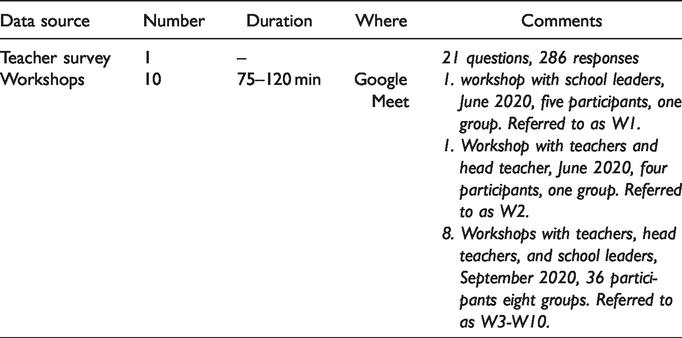
The empirical case is a region in Sweden, including four high schools and their teachers and school leaders (see Table 1). A mixed-method approach was applied, including a teacher survey and ten workshops with teachers and school leaders to explore their experiences of teaching in the light of a pandemic.
Overview of Data.
Empirical Case
On Tuesday 17 March 2020, the Swedish government announced that high schools and universities would be run exclusively at a distance, starting the following day. The message was based on recommendations from the Swedish Public Health Agency. At the press conference, the authority announced that they assessed that pupils and students who are affected by the decision are mature enough to take responsibility for their education even when it is conducted from home (Swedish Government, 2020). On 29 May 2020 the Minister of Education announced that as of 15 June 2020, the schools would reopen. In all four schools in this study, the school administrators recommended that teachers keep working from their regular workplace for two weeks. This was initially to be able to find support from their school leaders and teacher colleagues. Teachers used a variety of technologies to cope with the situation, including itslearning, a learning management system that generally constituted the basis for communication distribution of other teaching and learning materials together with Google Meet for activities such as videoconference and chat. Besides, teachers also reported additional ways of interacting with students including phone calls and texting. Thus, teachers used different approaches including synchronous and asynchronous communication, and modified or refined their approaches during the period. The teachers were given extensive freedom of action to handle the teaching situation. There were few centrally determined rules that specifically dealt with the teaching in the virtual classroom and issues such as whether students should have cameras and microphones turned on during synchronous lessons or not. In close connection with the schools re-opening, the data collection was carried out to explore teachers' and school leaders’ experiences from quickly switching to distance education.
Data
The empirical data consists of a teacher survey and ten workshops with teachers and school leaders. The purpose of the two data sources was complementary. Through the survey, many teachers were able to report their personal experience of teaching in an unusual situation. Through the workshops, both teachers and school leaders had the opportunity to deepen and discuss their experiences and reflect different perspectives (Bryman, 2015).
Teacher Survey
A teacher survey was distributed to all teachers working in the four schools, at the school’s initiative. Based on a list of active teachers from the municipality’s IT department, the survey was distributed to a total of 408 teachers. According to the IT department, the list is continuously updated, yet may include staff who recently quit. Furthermore, it includes teachers who are on sick leave or other leave. This means that the survey is distributed to a wider group of teachers than the target group (i.e., teachers who worked at one of the four schools during the distance education). However, the requirements for participation were specified in the letter. A reminder was sent specifically to 136 teachers who had not “clicked” on the link a few days after the distribution. A total of 303 began to answer the survey and of these 286 completed the survey. The survey was designed with free text answers. This was to provide open and nuanced exploration of teachers’ experiences, without anticipating the answers (Bryman, 2015). It included three background questions, including which school the teachers taught at, what high school programs the teacher mainly teaches, and who is their school leader. Additionally, the questionnaire included 18 questions where teachers were asked to tell about their experiences, such as which teaching elements work better and worse remotely, how teachers perceive that student motivation for learning has been affected, and how teachers assess that distance education has affected the opportunities for interaction and student learning.
Workshops
The workshops were carried out at the schools’ initiative. The author of the paper was invited to participate and contribute to the discussion and analysis as a researcher with a focus on IT and learning. In connection with, and before, Workshop 2-10 (hereafter W1-W10), the researcher gave a lecture on the topic “Distance and Digitization: consequences for teachers and teaching” (for teachers and school leaders) where current themes are discussed based on previous research. Due to the restrictions to reduce the spread of Covid-19, the workshops were carried out online using Google Meet (the schools chose the communication tool). All workshops lasted from 70 to 120 minutes. In addition to the researcher’s field notes, each workshop group had a designated secretary who took notes during the workshop. The respective workshop is presented in more detail below:
W1 was conducted with school leaders and centered around the following issues: How has the distance education period affected our approach to running school and education? What have we learned about teachers’ experiences of distance education? What opportunities and challenges are there? What does this learning mean for us as school leaders? What leadership actions does the new knowledge lead to? W2 was conducted with teachers and centered around the following issues: What are the opportunities and challenges for students' learning with distance learning in your subject? What have we done during the distance period that we did not know we could do? How has the distance period affected your view of your work, teaching, and your way of working? W3 to 10 were conducted with school leaders and head teachers and was more focused on implications for the future. All groups addressed the issue “What does a skilled teacher do in the distance classroom?” Then the groups discussed different issues according to: W3 – How and where should we work in the future? W4 – Who fits in the school of the future? Or how do we organize the school so that everyone fits in? W5 – What happens to the view of knowledge and education in a (continued) virtual classroom? W6 – What happens to the school's role in providing structure in the future, concerning student autonomy, working environment, and interaction? W7 – Where are we headed with our collegial learning? W8 – What do we take with us regarding collegial meetings at a distance? W9 – When time and space no longer frame teaching, what happens to the concepts of teaching, attendance/absence, and guaranteed teaching time; are they in renegotiation? W10 – Are we approaching new ways of conducting teaching or is it the renaissance of teacher-centered teaching?
The issues were deliberately pointed to facilitate discussions among the participants.
Ethics
To guide the work, the research ethical principles for humanistic and social science research from the Swedish Research Council have been applied (Vetenskapsrådet, 2002). These principles include the information requirement, the consent requirement, the confidentiality requirement, and the use requirement. In practice, participants are informed of the purpose of the study and that it is voluntary to participate. Furthermore, anonymization has been applied to avoid revealing the identity of the participants. Finally, the material has not been used for commercial or other non-scientific purposes.
Analysis
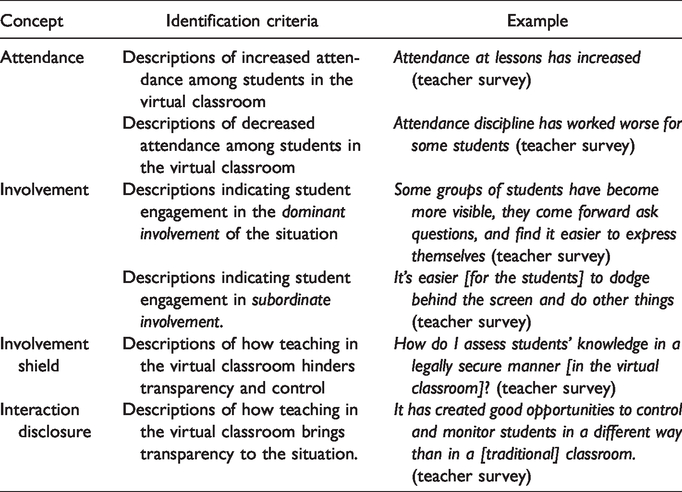
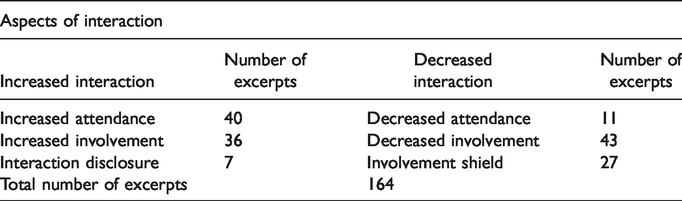
Both in the survey and in the workshops, much attention was paid to different aspects of interaction. The theoretical perspective was not determined in advance but was based on an initial inductive analysis of the data where central and recurring themes were identified (Bryman, 2015). In this analysis interaction emerged as an important and recurring element raising questions and reflections among teachers and school leaders. After this initial analysis, the interaction order was chosen as an analytical framework to analyze interaction within virtual classrooms. Therefore, the researcher collected expressions from the two different data sources related to interaction in a broad sense. This included questions, statements, and reflections which in some way related to interaction such as attendance; communication, socializing, collaboration, and rules. The survey was analyzed in its entirety and issues linked to interaction were identified. Thereafter, all identified excerpts were re-read and categorized according to central concepts of interaction order including “involvement shield,” “interaction disclosure,” and “involvement.” In addition, the concept of attendance, which can be seen as a prerequisite for interaction, was identified as important (see Table 2). Thereafter the excerpts were divided into categories indicating increased or decreased interaction when teaching in the virtual classroom. To get an idea of the occurrence of excerpts related to interaction in the survey, the number of excerpts from the survey is given in Table 3. The analysis of the workshops did not focus on the number, but on capturing teachers’ and school leaders’ in-depth narratives and gaining a more qualitative understanding of how interaction played a role in the virtual classroom.
Categorization of Concepts.
Categorization of Interaction in Teacher Survey.
Results and Analysis
A total of 164 excerpts related to interaction were identified in the survey (see Table 3). Of these, 83 excerpts were categorized as generating increased interaction while 81 excerpts were categorized as generating decreased interaction.
Increased Interaction
Three categories were identified as bringing increased interaction in the virtual classroom in terms of generating increased attendance, increased involvement and by offering interaction disclosure, which is elaborated below.
Increased Attendance
Attendance can be seen as a prerequisite for interaction. In 40 cases, teachers report increased student attendance in the virtual classroom compared to the traditional classroom. Teachers describe an overall increase, as illustrated by: “There is a higher degree of attendance among students” (teacher survey). More specifically, teachers report an increased attendance among students who usually do not come to school, also referred to as “hemmasittare,” a Swedish term for students with a history of long-term truancy who spend most of their time in their homes. A total of 19 excerpts address the possibility of reaching these students in the virtual classroom, as illustrated by: “I experience that distance education has been of great benefit to ‘hemmasittare’ regardless of the teaching activity since there is no pressure to get to [the physical] school” (teacher survey) or “In that class, there are students who previously had poor attendance at school and who now increased their attendance and activity” (teacher survey). This issue was also addressed during the workshop with school leaders. School leaders discussed the opportunities to reach these students that otherwise do not come to school. More specifically, the discussion centered around how to continue to offer solutions to these students even after the crisis situation that the pandemic entails, as illustrated by: Richard: We have reached students to whom we have not previously been able to offer instruction … [since students do not show up in the traditional school] we struggle with high absenteeism, sick leave, parents who keep students at home … and we have been bad at offering teaching in the meantime [in the process of finding a long-term solution]. On the other hand, we must ensure that teachers do not work twice as hard (WP1, school leader).
Increased Involvement
There are different examples of students’ increased engagement in the main involvement of the situation (Goffman, 1963), i.e., the teaching and learning activities in the virtual classroom rather than in subordinate involvement, as illustrated by; “Previously tired students who lay on the bench, those who have difficulty concentrating and who thought it was possible to play with a deck of cards during the lesson, have disappeared. This was since I discovered how I can work with Meet [Google Meet] both in the whole class and small groups. Now all students have been forced to get started and work in a more focused way than might have been the case in the traditional classroom” (teacher survey). Furthermore, teachers report that students get clearer contours and show more engagement in the virtual classroom, as illustrated by: “Students with communication apprehension dare more behind the computer screen than in a classroom” (teacher survey) or “I see a pattern in that some students, who have not been so verbally active before, have come forward and ‘dare’ a little more on [Google] Meet. Maybe it feels a little less stressful to talk online, instead of in the classroom where everyone is watching, as one student put it” (teacher survey). Aspects of increased interaction among some students are also discussed among teachers and school leaders. More specifically, they reflect upon their insight that some students perform better in the virtual classroom as illustrated by: “Our conclusion: we have gained an increased awareness that the teaching format probably affects both student and teacher identity and that we therefore need to adjust to that so that everyone reaches their potential, regardless of format” (Group reflection notes, WP4). Teaching and learning in the virtual classroom brings new activities and behaviors (Ott et al., 2018; Tallvid, 2015; Willermark, 2018a; Willermark et al., 2016), and challenges traditional definitions of a situation and the way teachers and students are expected to interact (Lindroth, 2015; Lindroth et al., 2015; Willermark, 2020).
Interaction Disclosure
Increased involvement is tightly linked to “interaction disclosure” (Willermark, 2020) in the virtual classroom. Teachers describe how they perceive an increased knowledge of student activity and performance and that teaching in the virtual classroom makes it more difficult for students to hide or remain passive in the situation, as illustrated by: “The virtual classroom has created good opportunities to follow and monitor students, in a different way than in a [traditional] classroom” (teacher survey) or “They need to be more involved. They cannot ‘fly under the radar’ as easily as before” (teacher survey). These aspects of teaching in the virtual classroom were also discussed in the focus groups, as illustrated by: “The students become more individual … this has been a way to see them invisible” (Anna, WP1). The examples highlight different ways in which the teachers can ensure that everyone has the same “definition of the situation” and engage in the dominant involvement of the situation (Goffman, 1963). Teachers’ increased monitoring over student activity and performance can be linked to new ways of conducting teaching. For example, by expanding the interaction one-on-one or organizing students in small student groups, the individual emerges from the class. Depending on the instructional design, the set-up can facilitate transparency as the very use of (shared) technology not only supports collaboration, but also mutual surveillance among students and teacher/student (Goffman, 1963). In this case, the technology acts as an “interaction disclosure” (Willermark, 2020) by bringing transparency to a situation and inhibits the possibility for subordinating. It facilitates identifying, challenging, and questioning activities that do not seem to belong to the dominant involvement of the situation (Lindroth, 2015).
Decreased Interactivity
Three categories were identified as bringing decreased interaction in the virtual classroom in terms of generating decreased attendance, decreased involvement, and by offering involvement shields, which is discussed below.
Decreased Attendance
A small number of excerpts (11) report a lower degree of student attendance in the virtual classroom. Excerpts address that students with previous low attendance reinforce that pattern in the digital classroom, as illustrated by: “There is a group of students who have previously been absent and who have made themselves even more invisible” (teacher survey) or “Those who previously suffer from ‘wobbly presence’ now show an even higher degree of absence” (teacher survey). The aspect of increased absenteeism as an effect of the virtual classroom was not focused on in the workshops, perhaps because the phenomenon of increased absenteeism was not widespread.
Decreased Involvement
There are different examples of decreased involvement among the students in the virtual classroom, both in the survey and in the workshops. Many teachers describe the lack of contact with students. Teachers describe how students do not use cameras during synchronous lectures and difficulties interacting with the students at all, as illustrated by: “The students became worse at using the webcam over time [despite being told to turn it on] which makes it difficult to keep up the dynamics and discussions” (teacher survey) or “Many students do not want their cameras on, not even the microphone” (teacher survey). This caused frustration among teachers, making it hard to tell if students are “really there” and whether they are keeping up, as illustrated by: “As a teacher, you have less control and you do now know whether the students only logged in and do not participate in the lesson” (Group reflection notes, WP10) or “You lack the feeling of how they [students] perceive something and how to act, when you do not see them” (Andrea, teacher WP2) or “The ‘invisible’ signs of whether students understand or not have deteriorated” (Group reflection notes, WP5). Teachers describe a lack of important aspects of interaction with and among the students and also express uncertainty as to whether all parties have the same “definition of the situation” and engage in the dominant involvement of the situation (Goffman, 1963). This also relates to the idea that the technology-mediated situation affords a more liberal view of involvement that can affect the interaction order and broaden the acceptance of subordinate involvement (Lindroth, 2012). Different reasons that students do not want to turn on the web camera are discussed, including: students simply do not participate, they just log in; students experiencing discomfort to show themselves in general; or that students do not want to show their homes to their classmates. WP7 discusses a situation where a student did not want to turn on the camera due to sitting in the staircase. Their reflection notes state the following: “Values issues were discussed among the colleagues: students who do not want to use the camera because they do not want to show off their homes, should everyone have to show up in front of the camera.” Furthermore, there are also examples related to lack of a suitable study environment, as illustrated by; “A student submitted an exam that was completely blank… she had to take care of a screaming baby instead of doing her school work” (Niklas, teacher WP2). Teachers testify to reduced interaction due to lack of feedback in a broad sense, through missing facial expressions and small gestures as well as through questions and reflections from the students in the teaching situation. This raises questions about student engagement in the main involvement of the situation (Goffman, 1963; Wasson, 2006).
Involvement Shields
Decreased involvement is tightly linked to involvement shields in the virtual classroom. Without using those exact words, teachers describe how teaching in the virtual classroom means that “involvement shields” hinder them from noticing what is going on behind the computer screen (Lindroth, 2015; Wasson, 2006). This is particularly apparent in relation to examinations. Teachers describe how they perceive problems of monitoring as illustrated by: “It is difficult to get the same control when teaching takes place via the computer. Is it the student who solved the tasks or did the student get help?” (teacher survey). Aspects of monitoring and examinations were also discussed in the workshops with school leaders. They discuss how they received signals of widespread cheating occurring in the virtual classroom and how it has progressed over time, as illustrated by: “The initial exams that were carried out matched the expected results, but after a month there were advanced methods for cheating” (Annika, school leader WP1). The phenomenon of cheating on tests has hardly arisen in the virtual classroom, but the technology-mediated situation enabled new forms of cheating, where involvement shields constitute an important tool. Not being in the same physical room at the same time allows for different actions in the test situation. It also gives rise to suspicion and uncertainty about how the examinations should be conducted and how test results should be treated. School leaders also discussed aspects of cheating, although from a different perspective. They argued that examinations have received too much focus among teachers and discussed whether teachers may give too many exams in the virtual classroom, as illustrated by: “I am surprised that teachers have such a great need to collect assessment materials all the time… it signals an uncertainty to assess students that they have had for several years. They should become better at trusting themselves. It has drawn my attention to the fact that we need to discuss this… to make the teachers believe in their own judgment” (Erika, school leader WP1). The new situation not only raises questions about teaching in the virtual classroom, but broader pedagogical and instructional questions about teaching and learning in general.
Discussion
When time and space no longer frame the teaching situation, the activity of teaching and learning is being renegotiated. Since the situation in the virtual classroom differs from teaching in a “traditional” classroom it is not possible to transfer either the instructional design or established social norms and actions straight off. The new situation does not allow it. Instead we see numerous examples of changed interactions. The experience of affected interaction is general, yet regarding how it is affected, diametrically different perspectives are portrayed. There are about as many statements that testify to increased and decreased interaction as a result of teaching in the virtual classroom, which can have several explanations. First, teachers may experience increased interaction in some respects and decreased interaction in other respects. For example, a teacher can report increased presence among the students and at the same time indicate a reduced involvement in the dominant situation in the virtual classroom. Second, the conditions for teaching in the virtual classroom differ among the teachers. Factors such as the number of students, the group composition, whether the teacher had developed a relationship with the class before the transition to teaching in the virtual classroom, and the subject, condition the teacher's possibilities of action. For example, there are various challenges when it comes to teaching math or language versus teaching practical-aesthetic subjects in the virtual classroom. Third, teachers’ different experiences must be understood based on the teacher’s instructional design which favors or hinders interaction. Some teachers describe how the new context has benefited them and how they have been able to develop and refine their previous working methods. Others describe a very stressful period, which meant a heavier workload with poorer results. The effects should not be understood as a given consequence of teaching in the virtual classroom, rather a consequence of the instructional design in the virtual classroom.
It is well established that technology usage per se does not lead to qualitative differences in teaching (Burroughs et al., 2019; Islam & Grönlund, 2016; Willermark, 2018a; Willermark & Pareto, 2020). Previous studies from virtual classrooms show that teachers who have a higher digital competence can focus more on the didactic issues, as they are not busy dealing with technical issues, such as what technology is available and its affordances (Willermark & Pareto, 2020). For teachers with more technological knowledge, it is easier to focus on didactic questions such as how to teach and learning activities that suit the virtual classroom and maintain interaction. It can involve small adjustments in the interaction, such as addressing each student at some point during a synchronous lesson or having short but frequent reconciliations to establish contact. It can also involve choosing technological tools that afford monitoring and formative assessment, as for example using interactive shared documents, where the teacher continuously can review and comment on the students’ texts. It can also be linked to flipped classroom–inspired approaches, to provide students with web-based lectures or reading materials as preparation and devote the lesson to laboratory work, specialization, analysis or individual adaptation (Milman, 2012; Willermark, 2018a).
Implications for Theory
This study contributes to theory by the application of the interaction order framework in mediated situations, in this case by shedding light on interaction in virtual classrooms. It illustrates the multifaceted ways that technology can operate both as an “interaction shield” as well as an “interaction disclosure” and how the characteristics of the virtual classrooms can bring both increased and decreased interaction compered to “traditional classrooms.”
Implications for Practice
From this study, two implications for teachers are proposed. First, when teaching in a virtual classroom it is crucial to design for interactivity. It is about creating instructional designs that adapt to the virtual classroom characteristics. As discussed previously, this can be done in many different ways, which include both small adjustments in the interaction to teaching approaches based on IT use in combination with more interaction between teachers and students. In the end, it’s about making active choices to increase interaction with students. Second, there are insights to gain from the virtual classroom to make use of when teaching in the “traditional classroom.” As teachers reported that students who are shy or suffer from anxiety about speaking in public reached more of their potential in the virtual classroom, digital qualities from the virtual classroom can also be used to benefit these students in the “traditional classroom.”
With regard to school leaders, three implications are proposed. First, the fact that many teachers feel insufficiently prepared to use digital technology in teaching highlights the need for support in case a similar situation arises. It is therefore important to organize for knowledge sharing and exchange of ideas and working methods among colleagues in a structured way. Second, it is important to take a school-wide responsibility for issues of legal certainty, integrity and personal data law, which becomes especially critical when teaching in the virtual classroom. Third, the fact that students with a history of long-term truancy participated in the virtual classroom, raises the question about possibilities to offer distance education to these students while searching for a long-term solution.
Limitations and Future Work
As for the empirical results gained in this study, they are specific in many aspects. The study takes place in, and is bound to, a Swedish high school context reflecting the perspective of school leaders and teachers, yet lacking student perspectives on interaction in the virtual classroom. Furthermore, the study is based on limited data, which makes it difficult to generalize the results of individual studies (Yin, 2017). However, in qualitative studies the central question is not whether the results are generalizable to a larger population, but how well it succeeds in generating theory based on the results, referred to as “theoretical generalization” (Mitchell, 1983) or “analytical generalization” (Yin, 2009). Thus, the empirical results of this study should be understood as potentially generalizable to theory rather than population. Therefore, it is not statistical criteria but the explanatory power of theoretical reasoning that becomes relevant when assessing the results. The position of this paper is that the results from this study have broader theoretical implications than to explain this specific study, as it explicates aspects of interaction in a virtual classroom. Such knowledge of how different aspects of interaction come into play and how the beneficial effects of the virtual classroom can be cultivated is considered to have relevance beyond this specific study.
Conclusion
This study shows how teaching in the virtual classroom influences interaction in fundamental but not unambiguous ways. The results draw a multifaceted picture of interaction that involves both increased and reduced interaction with students and their activities. Contributions include unpacking the complex role of interaction in the virtual classroom and providing implications to teachers and school leaders.
Supplemental Material
sj-pdf-1-jec-10.1177_0735633120988530 - Supplemental material for Who’s There? Characterizing Interaction in Virtual Classrooms
Supplemental material, sj-pdf-1-jec-10.1177_0735633120988530 for Who’s There? Characterizing Interaction in Virtual Classrooms by Sara Willermark in Journal of Educational Computing Research
Footnotes
Declaration of Conflicting Interests
The author declared no potential conflicts of interest with respect to the research, authorship, and/or publication of this article.
Funding
The author received no financial support for the research, authorship, and/or publication of this article.

Author Biography
References
Supplementary Material
Please find the following supplemental material available below.
For Open Access articles published under a Creative Commons License, all supplemental material carries the same license as the article it is associated with.
For non-Open Access articles published, all supplemental material carries a non-exclusive license, and permission requests for re-use of supplemental material or any part of supplemental material shall be sent directly to the copyright owner as specified in the copyright notice associated with the article.
