




Abstract
Approximately 80%–90% of all fire-related fatalities take place in residential occupancies. The risk groups are well known, but the effectiveness of different measures has been less investigated. In this article, fire investigations from 144 unintentional fatal residential fires have been systematically analyzed and technical measures that would have been effective in preventing each fatality have been identified. The result shows that, generally, a thermally activated suppression system (e.g. sprinkler) has the highest potential effectiveness (68%) followed by a detector-activated system in bedroom and living room (59%) or smoke alarm (37%). For smokers with home care, however, the potential effectiveness of a thermally activated suppression system and home smoke alarm was significantly lower (31% and 14%, respectively). This indicates that different measures are effective for different groups. In one-fifth of the cases, the victim could have evacuated but chose not to do so, primarily to attempt to extinguish the fire.
Introduction
Every year fire kills about 450 people in the United Kingdom, 100 people in Sweden, and over 3000 people in the United States, and in most western countries, the number of fire deaths per year and 100,000 population ranges from 0.5 to 1.5. 1 In many parts of the developed world, the number of fire deaths has slowly been decreasing during at least the last 50 years.2,3 However, this decrease seems to slow down over time. Comparing with trends from other accident types, 4 it is likely to have reached a plateau where increased efforts are needed to further decrease the mortality rate toward the zero-fatality vision adopted by the Swedish authorities in 2010. 5 Furthermore, preventive actions such as regulations, information, and education efforts currently implemented to achieve this reduction are costly and therefore there is a need to scientifically evaluate the effectiveness of these preventive measures. Furthermore, in Sweden 6 and other countries, the use of home care as an alternative to institutional care is expanding, and since elderly people generally have a lower ability to evacuate in case of fire, it is important to analyze how the fire safety of those individuals can be improved. 7
There are studies in the literature that analyze the socio-economical and demographic status of fire victims.2,8 These studies have contributed to an understanding about the risk groups in relation to fire, and it is now widely known that the elderly, the physically and mentally challenged, and people with drug and alcohol abuse suffer from a substantially increased risk of dying in fire. 8 Such studies, conducted from a statistical and public health perspective, have greatly improved knowledge about which groups that needs to be targeted for fire prevention interventions. However, this perspective lacks the ability to identify what safety measures are appropriate. These are instead identified through in-depth investigations of single events where the generalizability to other similar events is unclear. Consequently, the potential effectiveness of the measures to reduce the risk in society in general is not obvious. This study will partly fill this gap through a systematic meta-analysis of many in-depth fire investigations of lethal residential fires in order to determine how the fatalities could have been prevented. The focus on residential fires is chosen since about 80%–90% of all fire-related fatalities in Sweden occur in people’s homes. 9
This article has a threefold aim. The first aim is to analyze all investigated, unintentional, fatal fires in Swedish residential buildings between 2011 and 2014 (in total 144 cases) and to find how they could have been prevented by appropriate measures. The second aim is to discuss these possible technical measures in relation to previous research. Finally, the results will be used to formulate a strategy to reduce the number of fatalities in the future. This adds to the knowledge on how fires can be prevented based on real fires, an approach which have been identified as an underdeveloped area of fire research. 10
Method
The method is based on event/MTO analysis that has been developed by Rollenhagen 11 primarily in cooperation with the Swedish nuclear industry. The method is based on the “Human Performance Enhancement System” 12 which in turn is based on an event chain together with barriers that could have stopped the progression between events. The barriers are classified as either missing or broken. For each barrier or event, a series of “why” questions are asked to identify root causes. This last step is, however, not used in this study since it would be difficult to use in a meta-analysis. Also, the study does not discriminate between missing and faulty barriers as, for example, whether a smoke alarm was missing or not working in a specific fire does not influence the possibility of a working smoke alarm to prevent that fatality.
In its original form, the chain of events is very detailed and therefore varies from accident to accident. To facilitate a meta-analysis, a simplified event chain that is common to all investigated residential fire deaths is proposed. Furthermore, to increase the reliability of the method, a checklist of potential barriers is developed inductively as the cases are analyzed. When all cases have been analyzed, a reanalysis of the cases is conducted based on the complete checklist of barriers so that all barriers are assessed for each case.
The resulting standardized event chain for the studied fires includes the following five steps:
Heat;
Ignition of first object;
Fire growth;
Evacuation initiated;
Evacuation complete.
The aim of the method is to identify the barriers that could have prevented the negative progression from 1 to 3. In the remaining two steps (from 3 to 4 and from 4 to 5), the event chain is beneficial for the outcome (the consequence is mitigated through evacuation) and therefore barriers that prevented the progression (such as a locked door that prevents evacuation) are sought. The response by rescue services and paramedics or aid from neighbors is not included in the model since it is very difficult to assess the potential effectiveness of earlier intervention based on the available data. This will, however, be analyzed by the authors in a future study using a similar approach, but other data.
If the fire becomes lethal at a certain step, no barriers are included that would limit further fire spread since they will not prevent the lethal outcome (e.g. a fire barrier if the fatality takes place in the compartment of fire origin). The barriers are identified based on an interpretation of the available reports as described below. The percentages in Figure 2 are the number of cases where each barrier would have been effective in preventing the fatality divided by the total number of fire fatalities (after corrections described in section “Missing data analysis”) were the effectiveness was not coded as unknown. The confidence interval is the confidence interval for the population proportion (see, for example, Fleming and Nellis 13 ).
Since not all fires have been investigated, a statistical missing data analysis has been performed. Furthermore, since the coding is based on an interpretation by the researcher, an intercoder agreement study has also been performed. Details about these analyses can be found in the following chapter.
Data
The main source of data was the full fire investigation reports from the fire department and/or police. The investigation is complemented by autopsy reports and a form submitted to the Swedish Civil Contingencies Agency after all fatal fires.
The cases included in this study are all unintentional lethal fires in residential buildings that occurred between 2011 and 2014 in Sweden and that have been investigated by either the police or the fire department. The police investigates all fires where there are reasons to suspect criminal intent. The fires investigated by the fire departments are based on policies developed by the local municipalities and therefore differs around the country. The investigations by the police often focus on the cause of the fire while investigations by the rescue services, commonly, also include the effect of fire preventive measures and the rescue operations. The investigation reports and other data were obtained from the Swedish Civil Contingencies Agency (MSB) and were connected with a secrecy agreement regulating storage and stated that the data had to be destroyed within a certain time.
These 144 cases constitute 55% of the 261 unintentional lethal fires in residential buildings during this period (the remaining 45% was not investigated by neither the police nor the fire department). The definition of a lethal fire is based on the definition used by the Swedish authorities which includes all fatalities directly related to fire that takes place within 30 days from the fire. The National Board of Forensic Medicine (that performs all autopsies) determines whether the fatality is directly related to the fire or not.
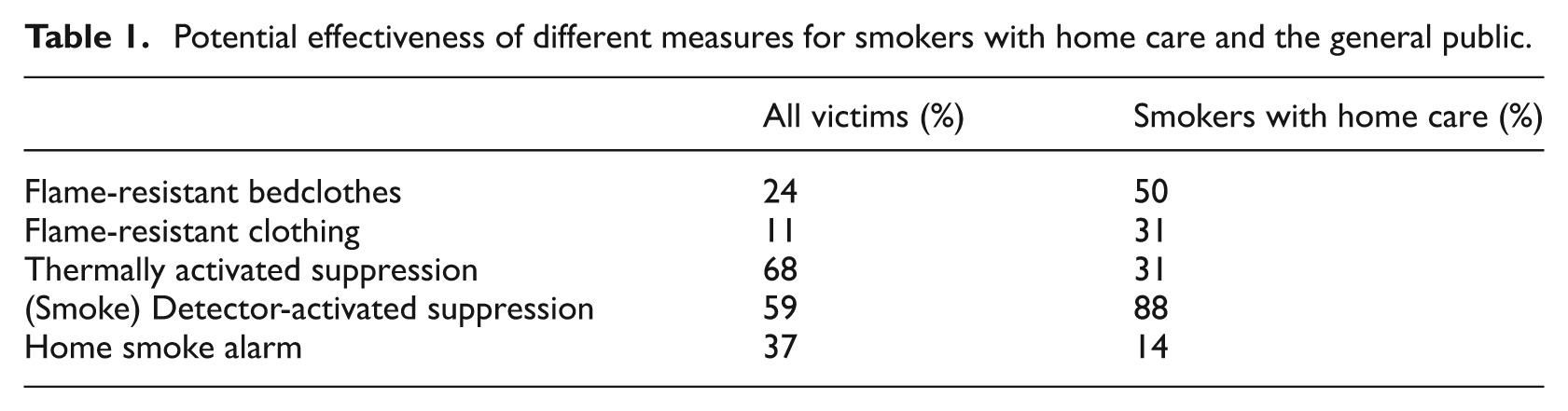
For some of the analysis, information on the use of home care and smoking was needed. The former was based on the fact whether it was explicitly mentioned in the investigation (common since it gives a time reference and an important source of data) or whether it was possible to determine from cues in the report of the condition of the victim before the fire (e.g. in wheelchair or bedridden). Judgment of whether a victim was a smoker or not was only needed for people with home care. Where the investigation report did not state whether the victim was a smoker or not and the fire was not smoking related, it was assumed that the victim was a non-smoker. This results in that a few smokers with home care who died of other causes were excluded from the analysis. To estimate the error, the cases that were judged to be a non-smoker was given a likelihood of being a smoker based on the fraction of smokers in that specific age and sex group obtained from a national survey of smoking habits in 2014 in Sweden. 14 This only had a small effect on the percentages in Table 1 (average 1.7% and maximum 3%) which showed that the result is not very sensitive to this assumption. The reason is that among the individuals that were coded as non-smokers, only 1.8 persons are expected to be smokers based on the survey results.
Potential effectiveness of different measures for smokers with home care and the general public.
It is known that investigators tend to be biased toward common and expected causes of fires while performing an investigation. 15 This might affect the result, but generally less compared to statistical analysis. This is due to the fact that the arguments for the cause of the fire, together with pictures of the fire scene, were assessed by the researcher to judge whether it was credible. Also, many of the barriers are not dependent on the cause of the fire but rather the fire development, for example, the potential effectiveness of a thermally activated suppression system is primarily dependent on the victim’s location in relation to where the fire started. The reason that it started in that specific place does not effect. Therefore, the set of potentially effective barriers are not totally dependent on that the cause of the fire was correct.
Missing data analysis
To investigate whether the sample of cases is representative for the total number of lethal fires, the included cases are compared with the total number of lethal fires from 2011 to 2014 (261 cases). This is done with analysis of variance (ANOVA) 16 where the dependent variable is selected as a dummy variable which is set to “1” for included cases and “0” otherwise. No interaction effects were investigated.
A number of different factors were investigated including fire properties (cause, room and item of origin, and extent of fire), geographical information (county and type of municipality, for example, urban), and temporal (month, day of week). Cases with values labeled as “unknown” were excluded from the analysis of that variable.
The results showed that the only variable that had a significant effect on the likelihood that the fire would be investigated is the cause of fire (sig 0.021). For all but two causes the likelihood was about the same (81%–86%). The two with lower likelihood were related to smoking (60%) and cooking fires (69%). This might lead to an underestimation on the potential effectiveness of barriers connected to these types of fires.
The number of cooking fires in the material is relatively few (seven cases) and therefore the 10%–15% lower likelihood of them being investigated will have a limited effect on the probabilities in Figure 2. However, the 20%–25% lower likelihood of smoking-related fires to be investigated will have a more significant effect. Since the number of smoking-related fires is quite high in the sample (38 cases), it can be expected that these are representative for smoking-related fires in general. Therefore, the probabilities in Figure 2 are corrected to correspond to the addition an additional 15 smoking-related fires to the sample that corresponds to an increase in the investigation frequency from 60% to 82.5%. This assumes that the potential effectiveness of the different barriers for the 38 investigated smoking-related fires was representative of all smoking-related fires. As an example, sprinklers had 38% probability of being effective against smoking-related fires among the 38 investigated cases. Based on this, each of the 15 added cases was given a 38% probability of sprinklers being effective. This affects the total effectiveness of each barrier for the full sample of 144 cases. This approach is judged to be reasonable given the relatively high number of cases. However, the uncertainty introduced by this assumption is not carried into the confidence interval in Figure 2. This could have been performed by a Monte Carlo technique, but the contribution of such analysis was judged to be limited. It is, however, a possibility that the investigated cases of smoking-related fires are different in some way from the non-investigated. This is very difficult to investigate since very little information is available on the non-investigated smoking-related fires. The 15 added cases are, however, only about 10% of the total sample size and therefore an upper bound of the effect (if one measure is effective for all (or none) of the investigated and none (or all) of the non-investigated) is 10% of the percentages in Figure 2. This is not negligible, but it falls within the confidence interval for all barriers.
Intercoder reliability
The coding of qualitative data is always fallible to subjective judgments and therefore it is critical to assess the extent of this effect to investigate the quality of the data. Therefore, a random subsample of five cases (3.5% of the total number of cases) was given to an independent researcher who coded them based on the final set of identified barriers. This entails to 115 point-wise comparisons (5 cases times 23 barriers). No test of the identification of barriers is conducted since the identification of additional barriers will not bias the analysis. The two researchers were of similar background, and this might lead to more similar judgments compared to two raters with different backgrounds, but this was not investigated further.
The level of agreement was assessed using the concept of multi-item within-group intercoder reliability, rWGj.17,18 Using a three-level scale (not effective, unknown, effective) and a bimodal benchmark distribution, the inter-rater agreement was found to be 0.84 and that is considered a strong agreement. 19 Only in 3% of the 115 coded instances, one researcher did judge a barrier to be effective and the other not.
Inductive saturation of identified barriers
Since the barriers are identified inductively as the cases are analyzed, it is important to evaluate inductive saturation. In this context, this corresponds to the likelihood of more barriers being identified should more cases have been included. As can be seen in Figure 1, almost all barriers were identified among the first 30 analyzed cases and therefore it is unlikely that more barriers would have been identified if more cases had been included. Even if more barriers would have been identified, they would be linked to a very specific type of fire and therefore have a low potential effectiveness.
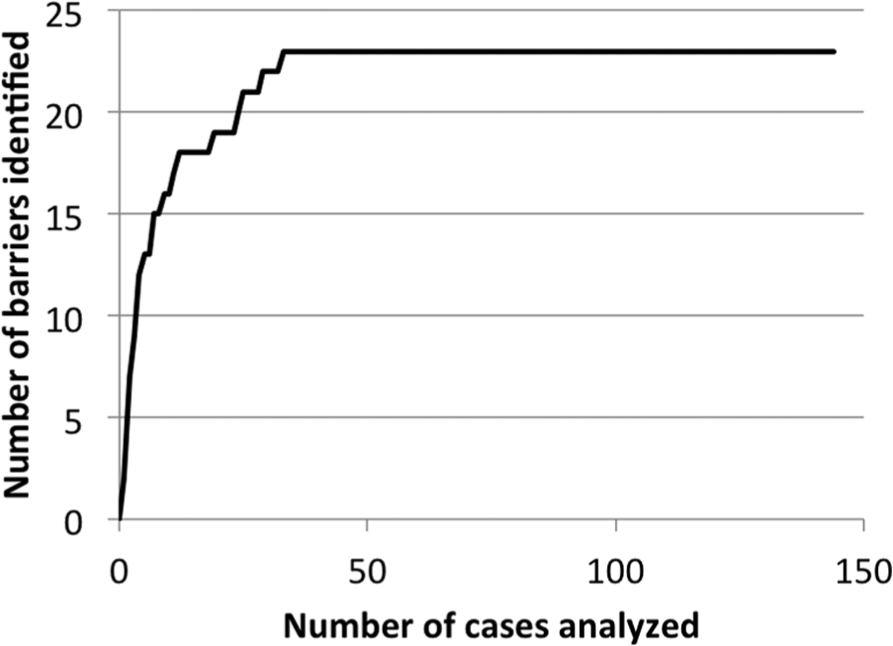
Number of barriers identified after a certain number of cases are analyzed.
Results
In Figure 2, the potential effectiveness of the different barriers can be found. The potential effectiveness is defined as the fraction of fatalities that could have been prevented if a barrier that could have prevented the negative progression (steps 1–3) had been in place. With barriers that prevented the positive progression (steps 4–5), the percentage is the fraction of fatalities that could have been prevented if the (unwanted) barrier had been removed (e.g. a locked door).
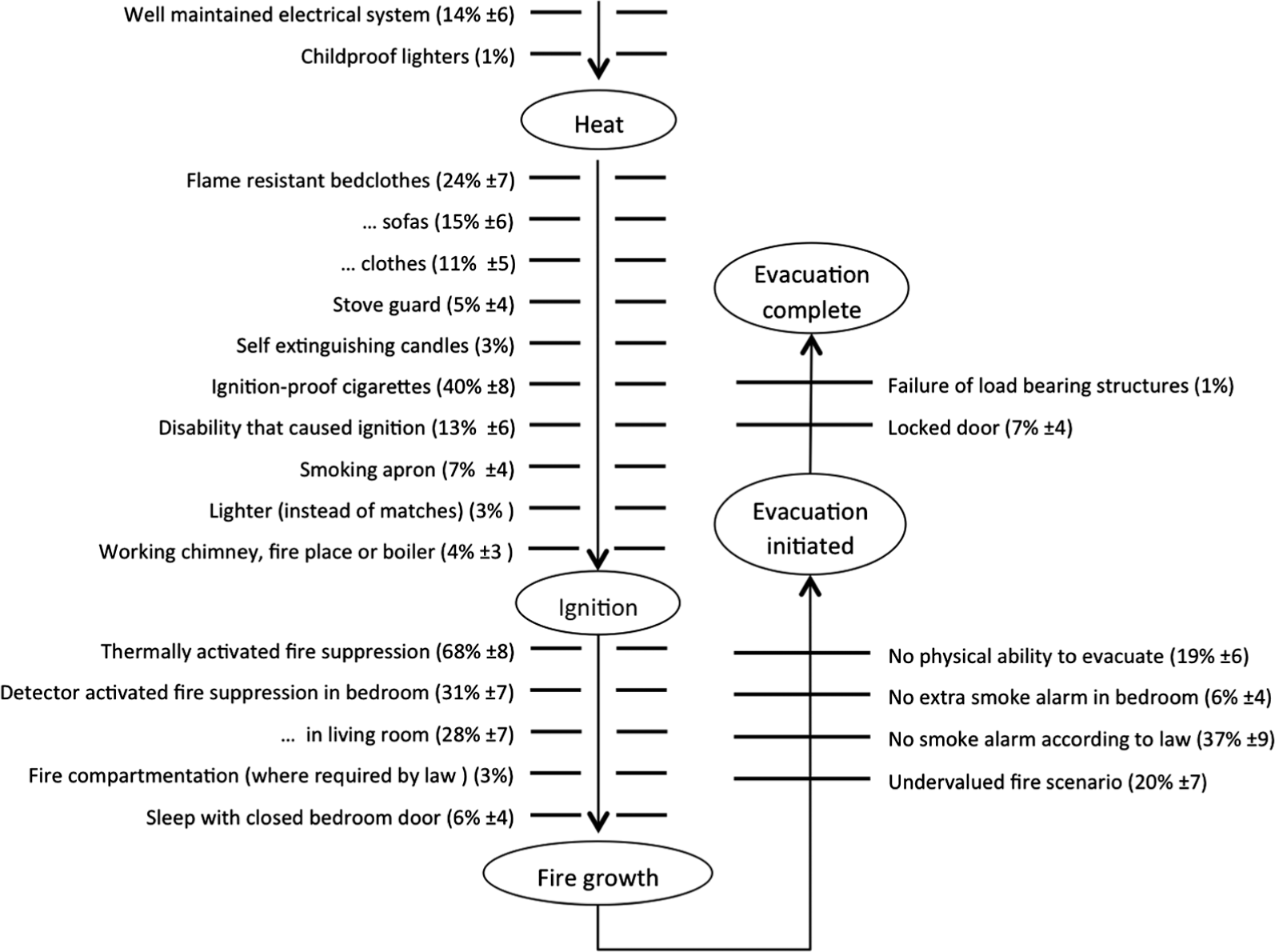
A standardized fatal fire scenario, with barriers that could have prevented the negative progression (steps 1–3) or that did prevent the positive progression (steps 4–5).The percentages are potential effectiveness, that is, assuming 100% reliability of each barrier. The percentage is complemented with a 95% CI.
The results in Figure 2 are for all the studied types of events and victims. However, the potential effectiveness is very different for different population groups. If only smokers who receive regular home care are included, the result will be quite different as can be seen in Table 1. The main reason for the changes is that smokers with home care tend to be intimate with the source of ignition and less able to evacuate even if notified by a smoke alarm.
This implies that different sets of strategies should be employed for different population groups since a barrier that is very effective for one group in society could provide very little value to another.
For the group of people who did not receive home care, the potential effectiveness of smoke alarms increased from 37% to 45%. For a vast majority of cases (about 95%) where a smoke alarm was judged to be ineffective, this was based on that there was either a working smoke alarm installed or that the victim was awake and close to the fire. In the remaining cases, the victim was unable to evacuate even if awake due to disability.
One barrier that might have been expected to be identified in the analysis is the fire extinguisher. However, people who are able to collect and use a fire extinguisher are likely to be able to evacuate and would therefore not appear among the fire fatalities investigated. Even if the fire would block the main entrance, there should always be an alternative way out that could be used by the victim. This is also in accordance with studies that have been unable to find a significant effect on life safety of fire extinguisher (even if they concluded that they are usually cost effective due to reduced property damage). 20
It should be noted that the analysis is based on fatalities that have occurred with the current situation when it comes to the presence and reliability of different barriers. If this would change drastically in the future (e.g. the percentage of houses with working smoke alarm would increase significantly from 75% 21 ), this would make some scenarios less common. This would affect the potential effectiveness of the different barriers and therefore a new analysis would be needed.
Barriers that could have prevented unwanted heat generation
In 14% of the cases, a malfunction of the electrical system has initiated the fire. Of these, about 40% were failures in the fixed electrical system and 60% were failures in consumer products. These are malfunctions of the products and systems as such and not faulty use of the products. This is a well-known source of ignition, but there are reasons to believe that this risk will decrease in the future. This is primarily due to two factors. The first is the increasing use of ground fault interrupters that is likely to reduce the risk of electric arcs and fault currents. 22 The other is the general trend of consumer products becoming more energy efficient. 23 The heat generation in faulty contacts is limited to one-fourth of the applied load 24 and therefore the risk of fire is substantially less from, for example, a light-emitting diode (LED) light compared to a traditional light. This positive trend can be seen in statistics were the number of electrically related fires have decreased with 29% in absolute numbers, and 19% as the proportion of total number of fires, in residential occupancies in Sweden between 1998 and 2014. 9 There is, however, a chance that new risks, such as low-quality adapters and others, will partly negate this effect.
Barriers that could have prevented the ignition of the first object
Upholstered furniture is a well-known and important risk in homes. When upholstered furniture was the item first ignited, the most common source of ignition was cigarettes (72% of the studied cases), but there are also cases of candles (10%) and electrical products (18%). It is common to assume that ignition protection of these materials necessitates the addition of flame retardants to the materials or addition of an inter-liner. This is, however, not always the case. The simple substitution of the common cotton material with a synthetic material (such as polyester) has shown to decrease the risk of ignition from a cigarette from 43%–86% down to 2%–5%. 25 This has been verified by independent research programs.25,26 It is also evidence that the high ignition propensity of cotton and other cellulosic fabrics is almost entirely due to the presence of alkali metal ions in the material. 27 Since the concentration of alkali metal ions reduces when the fabric is washed, well-washed fabrics do not show a propensity to ignition from cigarettes. 27 Cover fabrics of upholstered furniture are, however, rarely washed (in contrast to clothes that are discussed below). No study that analyzes if worn and dirty cover fabrics, which is a more relevant factor for upholstered furniture, would have a higher or lower ignitability compared to new fabrics has been identified in the literature survey.
It should, however, be noted that the consequences of a flaming ignition source might be increased by this substitution since the fabric would retract from the heat and thus exposing the foam. The data, however, indicate that a smoldering ignition source is more common and therefore the substitution can be justified for the investigated cases. However, more data are needed to verify that this is generally true.
It is also clear that it is not enough to provide ignition protection of the mattress or sofa alone since in at least one case the mattress did fulfill the criteria for flame-retardant mattress (according to NT Fire 037:1988 28 ). However, this did not prevent the fatality since there was plenty of fuel available in the form of bedclothes, quilt, and pillow. This indicates that the entire setting must be assessed and not only the mattress.
When it comes to ignition protection of clothes, a flaming source of ignition is more common (38% of the cases, all related to candles), but also for flaming ignition the use of synthetic materials will generally result in a substantially reduced risk. The risk of ignition is substantially lower for most synthetic fabrics since it tends to melt away from the flame instead of igniting29,30 unless it is mixed with cotton fibers that prevent this retraction from the flame. 29 Also if a fire occurs, the damage is generally lower for synthetic materials compared to cotton. 31 This has led to that the substitution of cotton by synthetic fabrics is an accepted injury prevention strategy by, for example, the World Health Organization. 32 Interestingly, this is contradictory to what is commonly taught in many fire safety classes, at least in Sweden. 33
As previously mentioned, cigarettes are the most common source of ignition of both upholstered furniture and clothes. An alternative to providing ignition protection of the fuel is to modify the cigarette to prevent it from being a potent ignition source. Many countries have pursued this path over the last decade following the initiative in New York in 2004 (e.g. the European Union in 2011). Unfortunately, the focus has been on self-extinguishment despite that research (even performed before the introduction of this legislation) had shown that this was unlikely to achieve the aim of reduced ignition propensity. 34 The limited effect on ignition of self-extinguishing cigarettes has recently been verified by independent research bodies.35,36
Since the criteria of self-extinguishment have proven not to be an effective path to reducing the ignition propensity of cigarettes, it is important to assess other possible paths to reduce the ignition propensity. A detailed review of this topic is beyond the scope of this article and the readers are referred to other sources, for example, Gann et al. 37 However, there are a number of potential steps that can be taken such as lower packing density, smaller diameter, and the removal of citrates from the paper (that increases the burn rates). 38 The introduction of e-cigarettes is also a promising route to reduce the number of smokers and therefore also the number of smoking-related fatalities in the future.
Many of the well-known ignition sources such as stoves, chimneys, and candles are responsible for a surprisingly small fraction of the number of fatalities which points out the important fact that fatal fires are not average fires but generally have different causes. This is also clear from public health research where it is known that families with children have the highest risk of being subjected to a fire, but the risk of them dying in a fire is substantially smaller than many other groups such as elderly and disabled. 39 It should be noted that this is based on the current prevalence of preventive measures. It is possible that currently implemented measures play an important role in that fires become non-fatal so it is not possible to draw the conclusion that any currently implemented measure should be removed based on this study as avoided fatalities will not appear in the analyzed data.
Barriers that could have prevented further fire growth
Thermally activated suppression systems (e.g. fire sprinklers) have the greatest potential effectiveness in preventing fatalities of all barriers. However, it has proven not to be effective for preventing fatalities in the object of first ignition, even for flaming ignition, since the fire will be too large when the sprinkler activates. 40 Dying in the object (e.g. bed) of first ignition is very common for many of the high-risk groups (e.g. elderly, disabled, alcoholics) and therefore thermally activated systems are not as effective for these groups.
A more suitable option for directed actions against high-risk groups is detector-activated suppression systems in bedroom and living room that could potentially save 88% of the people in these groups. Different options for suppression media exist, but since smoke detector-activated systems are usually more prone to false activation, a system based on water mist might be a good option since it minimizes the damage and cleaning. 41 There are systems based on this design in both Sweden 42 and the United Kingdom. 43
Research has shown that a closed bedroom door could result in significantly longer times until untenable conditions arise in the bedroom if the fire started outside the bedroom and the victim is in the bedroom. 44 Sleeping with closed bedroom door could potentially have saved 6% of the victims. This is based on the fact that the fire was quite small when extinguished by the fire department and therefore it is likely that the conditions in the bedroom would have been tenable had the door been closed. It is, however, important that people who sleep with closed bedroom door have a smoke alarm installed in the bedroom as about the same number of victims are killed since the closed bedroom door prevented the activation of a smoke alarm in adjacent room.
There are a few cases (3%) where an adequate fire compartmentation could have prevented fatalities. The number is based on where fire barriers are required by the Swedish building code which are primarily around apartments, stairwell, and between house and garage. This shows that a great majority of the fatalities happens in the compartment of fire origin.
Barriers that prevented the initiation of evacuation
One interesting finding is that in 20% of the cases, the victim had the opportunity to evacuate but chose not to do so. Behind this figure are a number of cases where the occupant tries to extinguish the fire instead of evacuating (82% of the cases), tried to save other residents or pets (9%), or called the fire department before evacuating (9%). The likely reason behind this is that people are unable to apprehend the exponential growth of the fire and therefore overestimate the available time. Previous research has shown that people have significant difficulties in extrapolating fire scenarios. 45
Smoke alarms are quite effective in reducing the number of fatalities, but they are not effective in all fires. In several cases, the victim has not been able to evacuate due to disabilities and then a smoke alarm would only result in that the victim, instead of dying in their sleep, will wake up without any ability to save himself or herself. It is also known that it is common that people sleep over a fire alarm, especially if intoxicated, receiving sleeping pills 46 or suffering from hearing impairment. 47 There is also a risk of the victim being overcome by carbon monoxide before the smoke alarm activates. This statement can be supported based on the analyzed cases. In at least 31 cases, the victim had a working smoke alarm, but did not wake up (or at least did not leave the bed). This problem can, however, be reduced by such simple measures such as reducing the tone frequency 46 or wave shape. 48
Barriers that prevented the completion of evacuation
One interesting factor that prevented the completion of evacuation in 7% of the cases was a locked door. In these cases, the victim had been able to reach the door to the outside, but had not been able to open it. This is usually due to a night lock that needs to be opened by a key. Therefore, it would be beneficial to inform people not to lock their night lock or outlaw doors that need a key to be opened from inside.
Possible measures to reduce mortality rates
A number of potential barriers that could have prevented the 144 fatalities studied has been identified and analyzed in this article. Based on these, there are a number of different strategies that could be pursued to reduce the mortality rate with regard to residential fires. The development of a fire safety strategy is a complex process that involves many actors in society and the appropriate design depends on many factors. In this chapter, one path is presented, but there are a large number of other paths that could be pursued based on the discussion above and other sources.
One recommendation is to see the population as, from a fire safety perspective, constituted by two main groups for which different strategies are needed. The first group is the most vulnerable (e.g. elderly, disabled) and the second is the general public. This division is important since the set of effective measures are very different between the groups.
For the first group, the installation of detector-activated suppression systems or ignition protection of clothes and bedclothes should be promoted. Since it might be difficult to reach all people in the risk groups, a first line of action could be to focus on those who receive home care (and are therefore known by the municipality and receive regular visits). By implementing one of the proposed measures (detector-activated suppression or ignition protection) one could reduce the risk by 80%–85% within this group and reduce the number of fire-related fatalities in society by about 14% (both measures are about as effective).
For the other group, the general public, there should be a continued focus on promoting smoke alarms. Public safety officials should, however, also increase the pressure on manufacturers to develop more effective signals. One should also consider enforcing smoke alarms that do not require batteries and maybe even connected detectors, which have proven effective in some scenarios. 49
The division of the population into two groups is quite crude since they are still inhomogeneous with differences in abilities and needs. Therefore, more refined groups might be needed. This will be investigated in a future paper.
There should also be efforts put into educating people into verifying a safe egress route before attempting to extinguish the fire since for 20% of the fatalities, the victim had the opportunity to evacuate but chose not to do so until it was too late.
Conclusion and future research
Investigations of 144 fatal fires were systematically analyzed and 23 barriers that could have prevented the fatalities in one or more cases were identified. Of these barriers, a thermally activated suppression system was found to have the highest potential effectiveness (68%) followed by a detector-activated system in bedroom and living room (59%) or smoke alarm (37%). However, it was shown that the potential effectiveness varies significantly between different population groups, for example, the potential effectiveness of a thermally activated system was reduced from 68% to 31% for smokers with home care. The potential effectiveness of detector-based suppression in bedroom and living room increased from 59% to 88%. In future studies, the characteristics of a population group that affect the set of effective barriers should be identified through statistical analysis.
Since the installation of a detector-based suppression system is promising for high-risk groups, simple and effective products for this application should be developed. Since they live in ordinary houses and apartments, it would be beneficial if the system would be portable so it could be moved where it is needed for the moment.
In a large proportion of the cases (20%), the victim had the opportunity to evacuate but chose not to. This might be due to the inability of people to apprehend the exponential growth of the fire. 45 If education or other measures could be used to affect this, decision making should be analyzed in future research.
Footnotes
Declaration of conflicting interests
The author(s) declared no potential conflicts of interest with respect to the research, authorship, and/or publication of this article.
Funding
Financial support from the Swedish Civil Contingencies Agency (MSB), grant number 2013-2657, is greatfully acknowledged.