



Abstract
By reframing fear as a strategic resource in HRM, this study explores how public sector organizations can support employees while maintaining operational effectiveness. Efforts to enhance service delivery through efficiency, targets, and accountability create tensions between professional values and corporate imperatives, leading to disengagement. While managers may use fear to align individuals with corporate values, employees can mobilize it as concertive resistance against identity regulation. Setting our study in the UK Probation Service, we reveal how employees’ strategic use of fear challenges managerial control, resisting the divisions imposed by identity regulation and identity threat. Rather than portraying employees as passive subjects of managerialism, we position them as active contributors to reducing the structural, instead of the interpersonal, imbalance between them and managers. Recognizing resistance as integral to public management allows HRM frameworks to foster a resilient, engaged workforce, addressing those complexities in an evolving public sector.
Keywords
Introduction
Public sector reforms increasingly implement HR practices emphasizing efficiency, targets, and accountability. While intended to improve service delivery, these shifts also generate tensions between professional values and corporate imperatives, often leading to employee disengagement, depersonalization and resistance (Denhardt, & Denhardt, 2000; Fuenzalida et al., 2024; Palermo et al., 2010; Tummers, 2011). Research shows that such reforms do more than reorganize work; they regulate how professionals are expected to understand their roles and identities. HR practices associated with New Public Management—such as performance measurement and accountability—operate as mechanisms of identity regulation, aligning professional selves with managerial logics (Courpasson & Clegg, 2006; Thomas & Davies, 2005). Rather than producing simple compliance, these controls frequently provoke subtle, fragmented resistance as employees seek to protect professional meaning and autonomy (Alcadipani et al., 2018).
In these reform contexts, managerial attempts to align professionals with performance-oriented and corporate imperatives often extend to the emotional framing of change, with fear used to signal threats, reinforce managerial interpretations, and promote compliance. Research has documented fear’s role as a managerial tool in contexts of intensified accountability and identity regulation under changing public regimes (Glassner, 1999; Lebel, 2016; Leventhal et al., 1965; Peters et al., 2012). We propose that employees might also use it as a “tool” to resist pressures and challenge any identity regulation attempt. Thus, we explore how public sector employees use fear to resist identity regulation and managerial control. Specifically, our research question is: How do public sector employees use fear appraisals against management for safeguarding their professional identity?
While traditionally recognized as a tool for managerial control and compliance (Ashkanasy & Dorris, 2017; Ashkanasy & Humphrey, 2011; Barsade, 2002; Elfenbein, 2007; Fineman, 1993, 2001; Raelin, 2010), fear’s appropriation by employees has received limited attention—especially in public sector contexts, where tensions between efficiency and vocational values persist. The interplay between managers’ fear-eliciting actions and employees’ resistance contributes to the debate on creating emancipatory spaces within workplaces (Ashforth & Schinoff, 2016; Courpasson et al., 2016; Harding et al., 2017; Harvey et al., 2016; Mumby et al., 2017; Slay & Smith, 2010).
Change management research in public administration emphasizes communication, participation, and leadership behaviors in shaping how reforms are interpreted and implemented (Fernandez & Rainey, 2006; Oreg et al., 2018). However, it remains unclear how employees strategically mobilize fear appraisals in public settings, not as withdrawal, but as a boundary-making resource to defend professional identity. Research on HR and performance management shows that target-driven regimes can erode discretion, generate emotional strain, and challenge professional norms (Hood, 2011; Van der Voet, 2016), yet it has not examined how fear triggered by these systems may be appropriated by employees to assert vocational commitments and contest managerial identity regulation, with consequences for performance and rule compliance (Borry & Henderson, 2020). This matters for HRM and Public Administration (PA) because identity threats shape adjustment, organizational identification, social isolation, retention and nonconformance to company rules (Ashforth & Schinoff, 2016; Borry & Henderson, 2020, Brown, 2017; Petriglieri, 2011). These dynamics are especially salient in the public sector, where professional identity is tied to service, vocation, and the public interest (Penning DeVries et al., 2020; Perry & Wise, 1990), and where performance-based reforms intensify identity tensions (Tidmarsh, 2023).
In the process, we shed light on actors’ performative use of fear by looking at how UK Probation Service employees strategically mobilize it as concertive resistance (Zanin & Bisel, 2019). Our perspective highlights the relational nature of control and resistance (Zanin & Bisel, 2019), the interdependence of actors in public sector contexts (Gilligan, 2011; Penning de Vries et al., 2020), and aims to shift from a psychological perspective of fear as an emotion, to one that links it to the control-resistance dyad as a resource that can be used by both managers and employees in the context of reform implementation policies.
We provide insights into how organizations can shape those and workforce management to better support employees, while maintaining operational effectiveness. We shift from the psychologization of HR that portrays employees as “passive victims” of managerialism (Godard, 2013) to that of employees being “active informers” of more effective practices aimed at reducing the structural, rather than interpersonal, imbalance between employees and managers (Budd, 2020; Kaufman, 2020). Fear-based control is only effective if employees accept the appraisal behind the fear-inducing event. We define “appraisal” as an individual’s interpretation of a fear-inducing event and its implications. We show that employees’ performative use of fear—by which we mean the strategic emotional expression aimed at identity preservation - extends beyond managerial control, reflecting a stance of “resistance to self-silencing and to the divisions” (Card, 2014, p. 393) created by identity regulation and identity threat (Alvesson & Willmott, 2002; Harding et al., 2017; Knights and Clarke, 2017; Petriglieri, 2011; Verlinden et al., 2022). By this “resistance,” we mean employees’ refusal to suppress their professional voice and reject the artificial divisions imposed by identity regulation—particularly those reducing professional values to target-driven outputs.
Resistance
Resistance is shaped by how actors interpret domination dynamics in their work setting (Alcadipani et al., 2018; Courpasson et al., 2016; Gabriel, 1999, 2008; Mumby et al., 2017), with fear and collusion sustaining these dynamics. Fear often leads individuals to withdraw (Ashforth & Mael, 1989) or remain silent (Morrison & Milliken, 2000), reinforcing existing power structures. In this context, “concertive” resistance refers to a collective process where employees counter managerial influence without overt talk or leadership communication (Zanin & Bisel, 2019). Brown and Humphreys (2006) synthesize strategies of resistance to managerial identity imposition aimed at limiting employees’ “impulse toward self-definition” (Dworkin, 1987, p. 60). They highlight how discourse constructs physical, emotional, and symbolic spaces that actors can claim as their own (Collinson, 2003; Fleming & Sewell, 2002; Jermier et al., 1994) for resisting identity changes. Interpretations of resistance are eclectic and varied (Alcadipani et al., 2018; Bardon et al., 2017; Harvey et al., 2016; Mumby et al., 2017; Sambajee, 2015; Wieslander, 2019), beyond the binary distinction between hidden and public (Courpasson et al., 2016). Resistance is shaped by its context, whether political, economic, or cultural (Mumby et al., 2017). At its core is a struggle over meanings: managerial discourses promoting “participatory work cultures, “meaningful work,” identity management, enterprise selves, and the integration of work and life” (Mumby et al., 2017, p. 1159), and projectification (Jalocha, 2023), and employees’ ones asserting autonomy. The pervasiveness of work - by which we refer to how work-related expectations and values extend beyond the formal workplace - leading to the “corporate capture” of individuals’ private spheres, like emotions, sexuality, and leisure (Mumby et al., 2017) exacerbates the shapes of resistance. The latter can unfold as individual, hidden (individual infrapolitics) or public (insubordination), and collective hidden (collective infrapolitics) or public (insurrection). It can be analyzed in relation to six characteristics: power, its contradictory and multiple nature, situational dynamics, diverse theoretical framings, expressions at individual and collective levels, and the complex autonomy-responsibility relationship. When uncoordinated and latent, resistance is difficult to address. Gilligan’s (2011) concept of resistance emphasizes disassociating from pressures that compel individuals to silence their voice and emerges when actors reject consent and conformity that sustain domination structures (Davidovitz & Cohen, 2021; Dworkin, 1987; Gilligan, 2011; Gilligan & Snider, 2018; Grant, 2006). Pressures rooted in corporate attempts to normalize behaviors through cultural hegemony require individuals to challenge social enforcement and cultural sanctions. Essential for resistance is breaking away from normalized values such as performance orientation, competition, and accountability and the mechanisms that sustain them (Costa et al., 2014; Duarte et al., 2018; Gabriel, 1999). Resistance is a challenge to these frames of normalization (Gilligan, 2011) and actors can appropriate and reconstruct unregulated spaces as sites for resistance (Courpasson et al., 2016). Mapping such spaces alone does not fully explain employees’ responses to identity regulation. Thus, we look at how public sector employees (Mastracci, 2021) use fear appraisals to counter managerial control (Connelly & Turner, 2018). The erosion of professional autonomy under government public sector reforms has intensified the tension between discretion and control (Palermo et al., 2010; Taylor & Kelly, 2006). This tension underpins the structural imbalance we explore, where managerial strategies challenge vocational identities and provoke resistant responses grounded in ethical and professional self-concept. As Lipsky (2010) argues, street-level bureaucrats often respond to organizational pressures by exercising discretion and developing informal coping strategies. In this light, fear-based resistance may be seen as a relational defence mechanism through which public servants protect their vocational identity against structurally imposed constraints. Tummers et al. (2015) conceptualize resistance as one of several coping strategies used by public servants to manage perceived threats to their professional values. We adopt an ethics of care perspective (Gilligan, 1982) which places interpersonal relationships at the center of moral action. It assumes human interdependence, recognizing that decisions and actions can have unintended consequences for others, and emphasizes safeguarding the interests of all involved (Gilligan, 1982). This approach is critical for resolving the ethical and moral dilemmas that public sector employees face particularly where effective performance requires more than simple procedural compliance (Tangen & Briah, 2018).
Fear, Identity and the Performative Use of Emotions
Focusing on fear beyond the psychological angle, we draw on literature discussing what “emotions do” (van Kleef, 2009, 2017; van Kleef et al., 2012) and how individuals adopt an instrumental approach in their “talk about emotions” (Connelly & Turner, 2018). Emotions are key in self-definition, enabling individuals to establish themselves as “prototypical members of their collectives (their social identities)” (Ashforth & Schinoff, 2016, p. 116). They act as social influence, generating affective reactions and conveying information. Emotional expressions are foundational to emotional contagion (Barsade, 2002)—crucial for identity construction and sharing in the workplace and influential during periods of change in power and control dynamics (Cornelissen et al., 2013; Turner & Stets, 2006). Employees sharing emotional experiences create an emotional climate (Reichers & Schneider, 1990) defined as “personal displays of emotions leading to a shared perception of those emotions among organizational members” (Ashkanasy & Nicholson, 2003, p. 26). Fear, specifically, has been theorized both as a response to danger (Leventhal et al., 1965; Ruiter et al., 2004) and as a socially constructed mechanism to protect against other fears, or even fear itself (Critcher, 2011; Glassner, 1999; Schuermans & De Maesschalck, 2010). Within organizations, fear is framed in three ways: as a reaction to uncertainty caused by changes in organizational identity and roles (Weick & Quinn, 1999); as a managerial tool to enforce compliance or silence (Morrison & Milliken, 2000); and as a mechanism for aligning employees with superimposed social, professional, or organizational identities (Brown, 2017; Chreim, 2006; Duarte et al., 2018; Kärreman & Alvesson, 2004; Peters et al., 2012). In each instance, fear fosters discomfort and guilt when employees deviate from management’s expectations (Giles, 2016). While the literature often frames fear as passive and negative, Lebel (2016) offers an alternative perspective, suggesting it can act as a force that energizes employees toward constructive action. However, Lebel links this proactivity solely to organizational goals, arguing that fear prepares employees to protect themselves from undesirable outcomes (p. 193). We contend that fear can be used more strategically, beyond compliance. For instance, openly expressing fear of management or its leadership style can disrupt corporate identity and serve as a form of resistance. The influence of fear on identity alignment highlights the need to illustrate how identity work unfolds, and the role of emotions in this process. Identity is a dynamic, contested construct continuously shaped by individuals (Ashforth & Humphrey, 1995; Ashforth et al., 2008; Ashforth & Schinoff, 2016). Whether social, professional, or personal, its construction is driven by a desire to move closer to “desired selves” and avoid “feared selves” (Bardon et al., 2017; Harding et al., 2017; Harvey et al., 2016; Slay & Smith, 2010). This process reflects internal motives such as self-enhancement, self-continuity, and uncertainty reduction, as well as external motives like self-knowledge, self-presentation, and self-verification. The interplay between these motives shapes identity work individually and collectively. Through dramatic presentations of experience, actors repair breaches between identity states and enact desired identities. Their emotions reveal agreement or disagreement with identity discourses (Cascón-Pereira & Hallier, 2012; Kessler & Hollbach, 2005) and their patterns of emotion are linked to identity enactment (Heise, 1977). Positive emotional appeals reflect alignment between one’s sense of self and workplace identity (Harquail, 1998). We argue that how individuals talk about emotions at work can reinforce or disrupt the social function of those emotions. The performative use of emotion through narratives that may not match a person’s true emotional state (Sambajee, 2015) can address tensions between imposed and desired identities. Sharing these narratives allows actors to steer away from feared selves, creating space for alternative identity expressions and resistance.
Research Context
We conducted our empirical study in a regional branch of the UK National Probation Service (RPS). Existing research suggests that employees in other UK public sector settings often struggle to mobilize fear as a constructive form of resistance. In healthcare, fear frequently manifests as moral distress or emotional withdrawal rather than strategic engagement with managerial authority (Mastracci, 2021; Martin & Learmonth, 2012). Similarly, in education, teachers experiencing fear of inspection or performance scrutiny may internalize blame or disengage from reform processes, rather than openly resisting (Perryman, 2009). Local government staff affected by austerity measures have expressed fear through cynicism or resignation, with limited capacity to channel it into collective critique or organizational feedback (Clarke & Newman, 2012). These patterns highlight the relative invisibility or suppression of fear as a resistance mechanism in much of the public sector.
Since 2001, the service has undergone continuous changes, causing tensions within the organization and across the broader criminal justice sector. Reporting to the Criminal Justice Body of England and Wales, the service supervises offenders in the community to ensure compliance with court orders. Rooted in a rehabilitative ethos, its focus has shifted towards risk management, performance, and control (Tidmarsh, 2023). Over recent decades, government guidelines and standardized services transformed probation from a vocation-driven to a performance-driven entity (Fitzgibbon, 2016; Mair, 2016; Sparrow et al., 2002). This shift reflects broader public administration trends emphasizing performance, competition, and accountability (Cabral & Santos, 2016; Zaman et al., 2020). During the 2010–2015 period, market principles were introduced into criminal justice policy, promoting competition through initiatives such as payment by results for rehabilitation programs (Fox et al., 2016). The 2014 Transforming Rehabilitation (TR) reforms marked a significant shift in probation’s structure. Services were split between the publicly managed National Probation Service and 21 privately run Community Rehabilitation Companies (CRCs). Intended to foster innovation and professional discretion, these reforms instead caused fragmentation and systemic underfunding (Millings et al., 2025a). Growing criticism led to the Ministry of Justice renationalizing probation services in 2021, consolidating them into 12 regional probation units (Millings et al., 2025b). Despite unification, the service faces ongoing challenges, including high workloads, staff shortages, and difficulties in implementing new practices (Tidmarsh, 2022). Tangen and Briah (2018) argue that reforms over the past 30 years have shifted probation from a rehabilitative model to a more punitive one, reducing the independence of the service and aligning it with the prison service—an institution “suffering a crisis of recruitment and retention” (p. 146). How these changes have affected staff identity remains underexplored. The repositioning of probation as a “symbolic adjunct to the prison service” (Tangen & Briah, 2018, p. 147) and the emphasis on performance raise critical questions about how organizational changes impact employees’ identities. The UK Probation Service offers a particularly rich context for this research due to its systemic disruption, high emotional labor, and strong vocational identity. Having undergone privatization, partial fragmentation, and renationalization, the service organizational disruption affects not only structural arrangements but also the values and identities of those within it (Sparrow et al., 2002). As a frontline public service, probation work is deeply rooted in rehabilitative and relational goals, which often clash with managerial reforms centered on risk, performance, and targets. These conditions create a context in which identity regulation becomes acute and emotionally charged, making the possibility of fear a particularly salient and familiar lens through which to examine employee resistance. Thus, the probation context enables us to explore how fear-based responses are used not only to oppose managerialism, but to actively defend professional integrity in the face of imposed organizational change. The RPS Managing Directors reorganized the agency to optimize resources and align operations with performance targets. Key changes included consolidating offender management and business development teams, outsourcing support services to external agencies under the principle of “contestability,” and closing two branches. These changes reshaped the organizational structure and altered staff roles, increasing pressure to meet performance indicators based on offenders’ compliance—despite the inherent difficulties in enforcing compliance when offenders miss required weekly meetings. The split between the National Probation Service and CRCs created a two-tier system that still affects the service post-renationalization. High-profile cases handled by the RPS draw media attention, further amplifying performance pressures on staff. The post-unification period shows operational vulnerability and missed opportunities for practice learning (Millings et al., 2025a). Phillips (2023) emphasizes that procedural justice and legitimacy are crucial for restoring trust in the service, particularly under scrutiny from His Majesty’s Inspectorate of Probation. The probation service’s journey from partial privatization to unification highlights the complexities of balancing control, care, and professional identity.
Methods
In focusing on how RPS employees experienced organizational change and performance pressure within their unique context (Hammersley & Atkinson, 1994), we used ethnography, emphasizing the richness and specificity of participants’ lived experiences and how they collectively shared their stories (Polkinghorne, 1995). The ethnographic design combined structured observations, semi-structured interviews, and analysis of internal documents. Triangulation was achieved by cross-referencing participant accounts with observed behaviors and documentary evidence, which helped mitigate the limitations of any single data source.
Data Collection and Methodology
We triangulated date to ensure robustness, comparing it across multiple sources. We combined participant and non-participant observation (e.g., during meetings, informal gatherings, and colleague interactions), official documents, and 45 semi-structured interviews. This combination allowed us to “detect” narratives and to understand them as they were shared and enacted in behaviors outside formal interviews. Fieldwork unfolded over 12 months. We remained reflexively engaged with our role in the research process (Johnson & Duberley, 2003) and flexibly adapted to different research situations, maintaining a balance between full involvement and objective observation (Eder & Corsaro, 1999). By “reflexively engaged,” we mean that the first author—who conducted the data collection—maintained an ongoing awareness of their positionality and its potential influence on the research process, recognizing that meaning is co-constructed between researcher and participant. Throughout the fieldwork, the first author kept analytic logs to reflect on how their presence may have shaped participants’ behaviors, emotions, and disclosures. Being “flexibly adapted to different research situations” refers to the first author’s ability to shift roles depending on context: adopting a more detached stance during formal observations (e.g., team meetings), and a participatory role in more informal, liminal spaces such as corridor conversations or “grapevine” gatherings. This flexibility enabled access to richer, more nuanced narratives that may not have surfaced through formal interviews alone. These dual roles enhanced our understanding of how fear and resistance were embedded in everyday interactions and allowed us, as a research team, to later analyze these moments in relation to wider organizational processes and identity dynamics (Johnson & Duberley, 2003). The data collection was conducted solely by the first author over a period of 12 months, through sustained ethnographic engagement with the organization. This allowed for the development of trust and observational depth across formal and informal settings. Both authors were involved in the data analysis process. After initial coding of fieldnotes and interview transcripts by the first author, the co-author independently reviewed the data to validate initial concepts. The authors then engaged in iterative discussion to refine the framework and ensure analytical rigor. This collaborative process allowed for a balance between immersive, context-sensitive interpretation and critical distance in the development of the findings. The sample was constructed through snowball and convenience sampling. It included staff, middle managers, senior managers, and board members (see Table 1). All participants were assigned pseudonyms.
Interview Sequence Number, Pseudonym, Role Covered in the RPS, Age Range, and Gender.
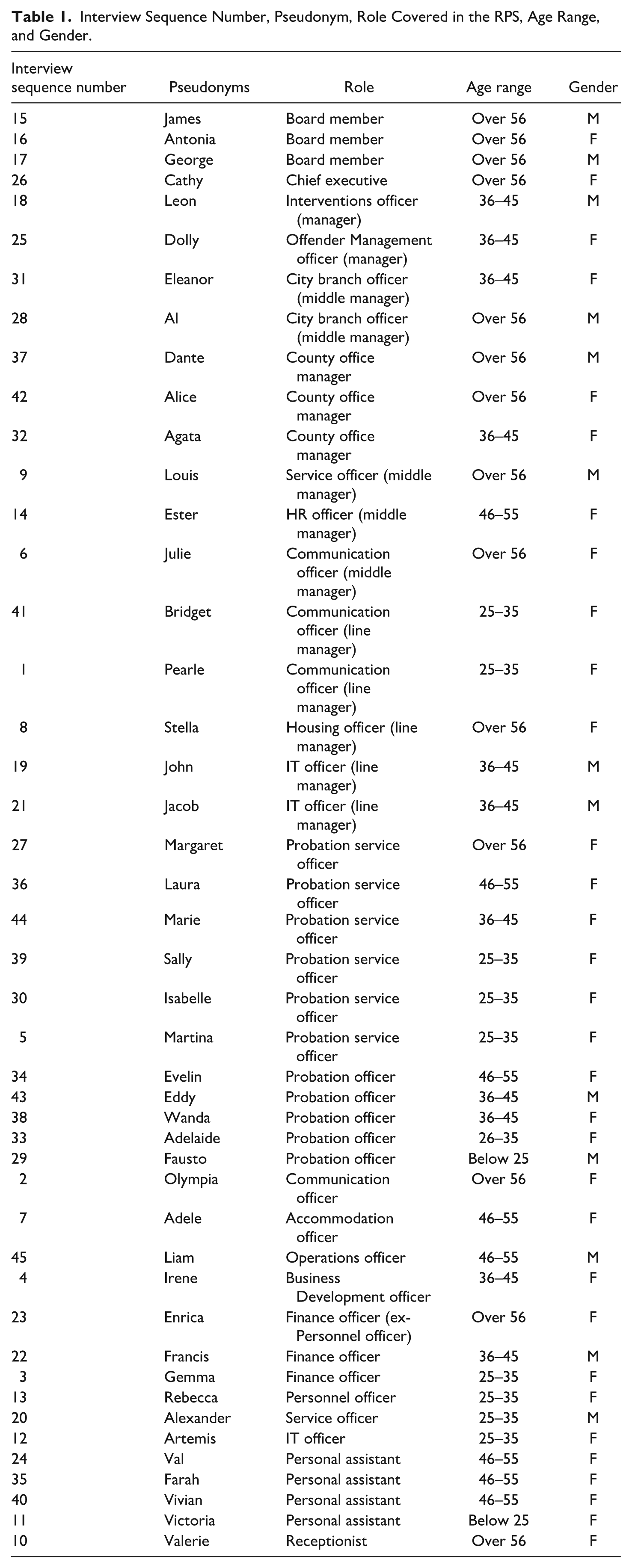
Most interviewees aged 56 and older began their careers as probation officers, having witnessed the service’s transformation over the years. All interviews were recorded and fully transcribed. Data analysis followed Fielding’s (2008) stages of ethnographic analysis (e.g., reviewing field notes, transcripts, identifying patterns, themes, marking-up data, constructing an analytical outline). We analyzed the data with attention to the organizational roles of participants, using role identifiers during coding to capture how fear and resistance were differently expressed and interpreted across hierarchical levels. Our unit of analysis was the individual and their narrated episode (e.g. incident, meeting, or decision) rather than isolated utterances. To address the comparative and multi-level dimensions of the study, we systematically differentiated data sources by organizational role (e.g. staff, middle management, senior management, and board) and treated these roles as analytically distinct, yet, relational vantage points on the same organizational processes. Each narrated episode (e.g., incident, meeting, or decision) was coded with role identifiers, allowing us to trace how fear was appraised, articulated, socialized and mobilized at different organizational levels. We conducted constant comparisons both within roles (to identify shared framings and variations among similarly positioned actors) and between roles (to examine how interpretations of fear and resistance diverged across hierarchical levels). Here we are provide a hint of the findings—which will be illustrated in the discussion section of this paper - for methodological clarity. Our approach enabled us to specify what each level contributed to the overall picture: staff and middle managers primarily revealed how fear was experienced and mobilized as a response to identity threats, whereas senior managers and Board members illuminated how fear was framed discursively in relation to performance management and control. We then compared these role-specific framings to identify points of convergence and divergence—such as identity protection versus performance rationales—and linked them to broader organizational narratives. Although tenure was not a predefined coding category, we attended to it analytically as a contextual attribute shaping participants’ alignment with, or resistance to, dominant discourses. Together, these comparisons allowed us to treat resistance as a multi-level, relational phenomenon, connecting individual sense-making to organizational and institutional narratives, rather than analyzing accounts in isolation.
Data Analysis Process
Analysis involved three iterative phases. We focused on understanding actors’ predominant logics and how the fear appraisal was constructed and used in their context. We manually coded the data using an inductive, bottom-up approach (Syed & Nelson, 2015). We developed a coding manual, repeatedly read transcripts and listened to the recordings. Preliminary categories generated from the data were iteratively applied back to ensure accuracy and refinement. Coding, reducing, and refining continued until we were satisfied with the final coding scheme.
Phase 1: Identifying Initial Concepts
We began by identifying dominant themes related to control and resistance: “structural change,” “service provision technologies,” “surveillance technologies,” “managerial attempts to change values,” “role expectations,” “identity,” and “fear.” These themes reflected interviewees’ predominant logics and guided their beliefs and behaviors (Reay & Jones, 2015).
Phase 2: Clustering Themes into Categories
In the second phase, we re-arranged initial themes into broader categories to reveal the contrasting discourses between management and staff, uncoordinated resistance to change, and strategies of identity protection. This stage exposed the tension between imposed managerial narratives and employees’ responses to maintain autonomy.
Phase 3: Focusing on Fear as a Boundary-Making Resource
In the final phase, we captured how fear appraisals became a key boundary-making resource, creating sharp divisions between managers and staff. This shared sense of fear played a primary role in collective resistance and identity protection strategies. Figure 1 illustrates the main concepts, themes, and dimensions identified through our coding process. It visually maps the trajectory from coded empirical data to conceptual insight. The left-hand column lists first-order concepts that emerged inductively from interviews, fieldnotes, and observations. These were clustered into second-order interpretive categories (center column) reflecting how employees experienced, contested, or reproduced organizational control. The two rightmost spheres represent overarching domains that crystallized from this coding: a “climate of fear” shaped by dominant managerial discourses and behaviors, and “concertive resistance” enacted through both collective and individual infrapolitics. The structure highlights how fear was mobilized by employees as a boundary-making and identity-protective resource.
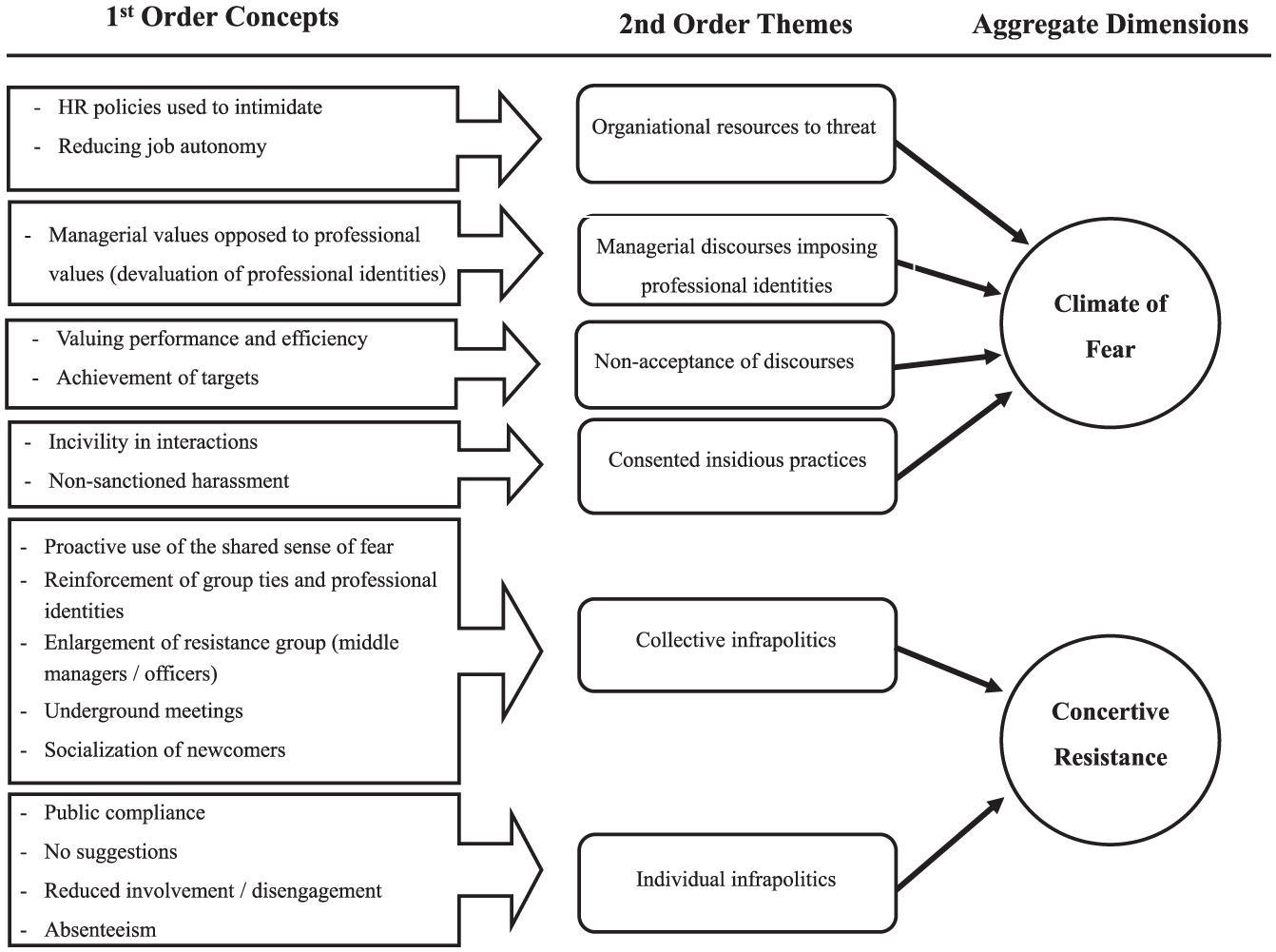
Concepts and categories.
We continued analysis iteration until we reached saturation, identifying no new interpretations of the phenomenon we set out to understand. This process ensured a deep and comprehensive understanding of how employees use fear to resist managerial control and protect their professional identities.
Findings
Our findings highlight three key aspects: the antagonistic discourses between senior managers and staff in making sense of organizational change; staff’s shared experience of a climate of fear; and how that shared fear is used to frame professional identity in opposition to senior managers’ expectations. With the exception of senior managers, participants positioned themselves in opposition to fear-based tactics. These findings are relevant to the Public Sector context, where organizational change is often top-down, rapid, and ideologically framed. The prominence of identity-protective resistance underscores the fragile balance between managerialism and vocational integrity in public service roles. The collective appropriation of fear in this context reveals how resistance operates not only against managerial practices but also as a defence of the public good.
Antagonistic Discourses of Service and Professional Identity
Managerial accounts supported the need for higher accountability in the public sector and a greater focus on performance and efficiency:
I think that what the probation service needed was to be made accountable after all we spend taxpayers’ money, don’t we? As a taxpayer, I would like to think that police for example spend my money wisely work. I think that Probation should account and evidence the work it does by recording. [Leon, Senior manager— “It’s important to me to try and read and understand and know how to respond to whatever happens and actually to do that is to focus on performance and efficiency. [Cathy, Chief Executive—
Senior managers supported a shift in terms of the roles of middle managers and officers, with greater focus on operational tasks and target achievement:
People should carry out their work; they are expected to achieve the targets. It’s not for them to decide on organizational matters. Some people don’t have this clear, some people don’t feel comfortable with it but the truth is that. . . well, there is an operational level and then there is a managerial level. [Dolly, Senior manager— Really what they [employees] should do is to focus on the day job and not get too depressed with other things. They have to achieve their share of targets. [Cathy, Chief Executive—
Senior managers seemed adamant about staff needing to focus on their jobs and on target achievement; these were aspects tied to the RPS mission or strategy that belonged to their realm of responsibility (extract 3). They did not show much care for individuals’ feelings (extract 4). Officers and middle managers enhanced the limitations of the managerial perspective based on performance and monetary values in the service (extracts 5 and 7). Staff portrayed themselves as “guardians” of the vocational side of the RPS mission (“rehabilitating people,” “helping others,” “being interested in people”—extracts 5, 6 and 7) and of the way their work should be managed:
They [senior managers] tell us what has to be done. . . people are afraid of them. Probation has a mission in society; this mission is about rehabilitating people. . . we don’t punish them, that’s what the prison does. I’ve been working here for years and this is what we are, this is what we stand for. You can improve performance but up to a certain point. You can keep on using fear but if you want to go passed that point then you need to engage with people, you need to communicate, you need to bring them in and work as a team, that’s the way things work. [Francis, finance officer— I’ve been in probation for many years and I used to be trusted as a professional. . .emh. . . I had a good share of discretion in carrying out my job. . . but with the culture of fear that we have now, people don’t put forward suggestions. Now it seems that all decisions, even the silliest ones. . . well, everything has to be agreed with them. Being relational and interested in people was a driver. . . emh, being diplomatic. . . but now those values don’t inspire senior managers. Now our orientation is value for money. Even if we work in teams each one of us should be thinking of achieving their own targets. . . this doesn’t make any sense, it’s not who we are. [Louis, middle manager — Because of this climate of fear, the sickness record is really bad! They don’t realise it. People that work in this service are here because they want to help others, they know that they can make a difference. . . managers should understand that we cannot turn into a profit organisation and forget who we are, what we stand for. [Dante, county office manager—
The emergence of an opposing staff discourse was closely tied to a shared sense of fear, described by participants as a “culture of fear” and a “climate of fear,” reflected in phrases like “people are afraid.” This shared experience was accompanied by the devaluation of professional identities, with several officers and middle managers repeatedly stressing that they were forgetting “who we are, what we stand for” (extracts 5, 6, and 7, and echoed in many interviews). When discussing the culture of fear associated with organizational change in the RPS, staff highlighted the loss of decision-making power and a shift in core values. Extracts illustrate the incongruence between how staff perceive their professional identity and how senior managers seek to redefine it, revealing a conflict between vocation and value for money. Extracts suggest that staff encountered an identity challenge as they struggled to reconcile the imposed organizational identity with their own self-categorization (Ashforth & Schinoff, 2016). A sense of undesired selves surfaces, particularly in statements like, “even if we work in teams, each one of us should be thinking of achieving their own targets. . . this doesn’t make any sense, it’s not who we are” (extract 6). This challenge arises from the clash between their desired selves and the superimposed professional identities triggered by a loss of discretion (extracts 3 and 4). The destabilization of self-enhancement and self-presentation indicates that both internal and external identity motives were affected by management’s decisions. Hints of resistance emerge in the discourses we presented (extracts 5, 6, and 7). Although the resistance is collective in nature, it manifests through individualized behavioral responses rather than coordinated actions—what Gabriel (1999) and Grant (2006) describe as individual responses to domination or what Mumby et al. (2017) call individual infrapolitics. Such responses include avoiding suggestions and withholding opinions (extracts 6 and 9), focusing on individual targets at the expense of teamwork (extract 6), and taking sick leave (extract 7). Resistance is evident as staff refuse to disown the voice that “stands up for what they actually feel, think, desire, and believe in” (Gilligan & Snider, 2018, p. 40). The tension between the senior managers’ discourse and the staff’s counter-discourse led us to explore the emergence of this climate of fear and its implications for identity and resistance.
Staff’s Shared Sense of the Presence of a Climate of Ear in the Workplace
Interviewees illustrated a pervasive climate of fear that disrupted their work and strained relationships with senior management. Most were openly critical, attributing this fear not to abstract change-related uncertainty but to deliberate actions by specific newly appointed senior managers, who were in charge of the organizational change and whom they held responsible for creating this oppressive environment:
With the change, they [senior managers] introduced a culture of fear! I’m a manager in this organisation and I can’t even decide if someone has to work for extra hours. . . I have to ask for permission. If a member of staff is on leave, I can’t even decide to get a temp to carry out the job if I need one. I have to ask a director [senior manager] every time that there is anything. [Eleanor, middle manager— Liam told me that meetings became regular in his job and that he attends at least two a day. He also said that senior managers use meetings to check on people and see up to what point they’re achieving the targets. He said that being in a meeting with them increases pressure since they keep on stressing on targets. [
Five key factors contributed to the emergence of a shared sense of fear in the RPS. First, senior managers’ decision to reduce staff autonomy was central. Extract 8 highlights the tighter managerial control imposed to restrict middle managers’ autonomy, as reflected in extract 6. Eleanor’s account of losing decision-making power illustrates how this change disrupted her identity motives of self-enhancement and self-presentation, prompting her to reassess her job engagement (Turner & Stets, 2006). Second, frequent performance-monitoring meetings increased pressure and reinforced control dynamics (fieldnote 1). These meetings became a tool for distinguishing between those who complied with targets and those who did not, adding to the climate of control. Third, an unwelcoming environment for dissent further entrenched the climate of fear (extract 9). Open criticism discouraged alternative perspectives and suppressed dialogue, silencing critical voices. Fourth, senior managers fostered job insecurity and limited career advancement for those who failed to align with new organizational values (extracts 9 and 11). This perceived threat heightened anxiety and amplified fear. Finally, some senior managers’ use of incivility and harassment significantly contributed to the shared sense of fear. Unlike vague references to "senior managers" (extracts 8 and 9), some staff explicitly named individuals responsible for serious misconduct (extracts 10 and 11, fieldnote 2), accusing them of specific misconduct.
People don’t express their opinions anymore because they’re scared of the criticism that comes from senior managers and the possible consequences for their jobs. . . they are rude, they hurt people’s feelings, they don’t care . . . people are scared of the consequences of being critical. . . they don’t know what can happen to them, to their job. [Alice, County office manager— He said that Adolfo wrote a list of the ten female staff members at headquarters whom he planned to get intimate with. He said that they’re all blonds because he likes blondes. He also said that everyone noticed that the new communication officer that he hired is blonde, too. Jacob [IT Line manager] continued saying that some of the girls on the list were worried because of what happened to Tania and to Pervinca. He said that Adolfo targeted Pervinca who one day ran out of his office and left the building and her job because she was sexually harassed. [
The next extract illustrates the struggle between old and new values that results from existing practices, leading to the shared experience of fear:
Everybody is scared because there is a feeling that you shouldn’t raise your head over the parapet too much. . . the consequences can be really serious. I wanted to apply for a higher position and Adolf [senior manager in charge of her area] told me that I couldn’t apply because I belonged to the old school and they [senior management team] wanted to break with the old school. Would you believe that? Because of this climate of fear people don’t want to be seen in a bad way. [Julie, communication officer manager
The parapet metaphor illustrates the risk faced by those who stand out—a cautionary image of the consequences of raising one’s head too high. This suggests that senior management holds responsibility for the clash between old and new values, contradicting Lebel’s (2016) view that fear triggers proactive behavior by encouraging personal responsibility. Actors attributed responsibility to senior managers while distancing themselves from accountability for workplace outcomes. This attribution reinforced social boundaries, creating an “us vs. them” divide rooted in a shared experience of fear. The values central to staff’s professional identity were challenged by the imposition of new ones aimed at promoting a “preferred” identity. Resistance emerged as staff refused to accommodate pressures from these new relational dynamics. This response aligns with Gilligan’s (1982) ethics of care, which highlights human interdependence and the need to safeguard individuals’ interests within relational decisions.
Concertive Resistance and the Mobilization of a Shared Sense of Fear to Frame Staff’s Professional Identity
The attribution of responsibility for the climate of fear to senior managers created a clear boundary between two groups—those promoting fear and those facing its consequences. This opposition reinforced the social identities of both groups. Staff strengthened these boundaries by affirming their professional identity and undermining the character of senior managers. They also reframed their group dynamic, fostering greater inclusivity between middle managers and officers than in the past. Finally, staff solidified their collective identity through rituals outside the workplace, distinguishing insiders from outsiders.
Senior managers don’t have a clue of what our job is about. They are never alone in a room with an offender, trying to reason with him, trying to keep calm if he makes fun of you, if he abuses you verbally. All they do is talk about compliance. . . really? Why don’t they leave the comfort and safety of their office and go explain compliance to offenders? I’ll tell you what. . . they’d be scared. [Eddy, probation officer— All they (senior managers) care about is performing and raising the performance level. I think it’s because it’s all money that will end in their pockets. If we improve as a service they will get the bonus, not the rest of us. [Dante, County Office Manager— In their view often we’re seen as a sausage factory, they think that we are involved in making sausages. . . but we do professional work. . . you have to be trained to this job. . . we are qualified people and that’s why we have to be trusted, we have to be able to make decisions, and our feedback has to be taken in consideration. [Evelin, Probation officer— . . .before middle managers were seen closer to managers but now we all feel the same, we’re in this together. [Julie, middle manager—
The above extracts highlight staff opposition to the logic of profit and factory-like management (extracts 2, 7, 12, and 13), while emphasizing their strong connection to their professional identity and their perception of senior managers devaluing their roles (extracts 3 and 4). Staff portrayed themselves as brave when facing offenders (extract 11), highly trained professionals (extract 13), trustworthy, and skilled in building relationships with offenders (extracts 5, 6, and 13). In contrast, senior managers were described as authoritarian (extracts 5, 8), rude (extract 9), unwilling to confront offenders (extract 11), selfish in pursuing personal interests (extract 12), and narrow-minded in their understanding of managing professionals (extract 11). A notable shift in identity was observed among middle managers, who had previously identified with management but now framed themselves as part of the staff group (extract 14). The shared sense of fear and contrasting identities became a “social glue,” reinforced through rituals outside the organization. The first author was invited to one of the regular informal gatherings known as “underground network meetings” or grapevine meetings—hidden practices held off-site. These gatherings were systematic, aimed at reinforcing divisions between the “good ones” and “the others” (fieldnote 3). Participants openly expressed dissent against management practices. The meetings were triggered by critical decisions made by senior managers, such as office closures, staff transfers, or restrictions on hiring temporary staff without senior management approval. Held spontaneously but regularly after work in pubs, they had no formal agendas. However, the discussion topics were well understood, as meetings occurred soon after critical decisions circulated throughout the organization. Below are excerpts from the first author’s field notes describing one such meeting:
Al approached me in the corridor and, whispering, invited me to attend the ‘underground network event’ this evening. He said: “all the ‘good ones’ will be there” so I asked him what he meant and he said “the ones that are the grapevine, the ones that keep the old values alive. [
The secrecy surrounding the invitation as well as the power of the words Al used for explaining what the network event was portrayed a sense of exclusiveness. The humanization of the grapevine—“the ones that are the grapevine, the ones that keep the old values alive”—brought us back to the notion of being by doing (Ashforth & Schinoff, 2016). It also expressed the opposition to the new values by suggesting the existence of individuals who (seemed to be in charge of) hold(ing) onto the old ones.
Eighteen people were at the ‘underground network event’ tonight. Three of them from headquarters, two from X city branch and the rest were from the Y city branch. All of them were very welcoming and it looked like they had no problems criticising Cathy, the Chief Executive, and the 3 senior managers in her team with me around. The main conversation topic was the closure of the Z city branch office. Most of the people there talked about how terrible the closure would be for those working in that particular office. Upon reflection, it seems to me that the event was all about getting together and feeling good about telling personal stories. Most of those stories were about conversations with senior managers that did not go well, senior managers’ decisions to “ruin people’s existence”, senior managers’ impositions of a new vision and values, and senior managers lack of understanding of what being probation staff meant. People seemed relieved and felt supported by the group after criticising senior managers. Some of the expressions that recurred frequently, in a choral way, when someone told their story were ‘yeah’, ‘good point’, ‘you’re absolutely right’, ‘we’re all together in this’. [
The stories shared during hidden network meetings helped participants repair the breaches caused by shifts in power dynamics and evolving conditions that affected their status and roles (fieldnote 4). These narratives frequently condemned senior managers (e.g. harassment detailed in fieldnote 2) and criticized the new vision and values imposed by leadership. These stories reflect individuals’ need for consistency with their identity motives (Drawing on Turner & Stets, 2006). Such hidden meetings acted as micro-foundations for structuring relationships among actors (Collinson, 2003). Participants strongly affirmed their collective identity, rooted in their desired professional selves and in stark contrast to the superimposed identities promoted by management. This juxtaposition shows that management’s sensebreaking attempts (Ashforth & Schinoff, 2016; Gabriel, 1999) did not erode their professional identity. We found little evidence of withdrawal or fear-related disengagement (Frijda et al., 1989). Instead, voicing fear encouraged a shared response to imposed values that clashed with participants’ beliefs. The following field notes from a conversation with a newer recruit illustrate this collective reaction:
He [Liam] said that these colleagues [older, working in the RPS for many years] were saying how senior managers created a culture of fear. He said that he did not really feel scared. He said that he could not stand the fact that senior managers came around, every day, with a new idea, totally different from the previous ones, that meant changing the way work was done and starting all over again. [Liam, operation officer—
In addressing the mismatch between the old and the new (Ashforth & Schinoff, 2016; Gioia & Chittipeddi, 1991), we argue that actors did not passively accept the pre-packaged meaning of working in a competitive, target-driven, and accountability-focused organization. They committed to their desired selves, aligning with identity states linked to a volunteering or vocational ethos. Behaviors such as absenteeism, withholding suggestions, reduced teamwork, and sarcasm towards managers reflect collective rather than individual hidden resistance (Fleming & Sewell, 2002; Gabriel, 1999), aligning with collective infrapolitics (Mumby et al., 2017). These behaviors, shared and normalized through conversation, are neither condemned nor isolated, allowing newer recruits to adopt this professional identity interpretation. Resistance behaviors emerge even without felt fear or explicit recognition of a climate of fear (extracts 15 and 16).
I’ve been working for the service for six months and I like my job. People are nice but I can’t understand why they are so concerned and bothered with managers [senior managers]. I really don’t care about them, they’re so distant from my. . . emh. . . niche. Another thing is that people talk about this culture of fear. . . why is that? I don’t feel it, anyway I go with the flow, I like my colleagues and I like being part of the group. [Isabelle, probation service officer— I talk to many colleagues at work especially those who have been working in the Service for many years. . . they keep on saying how senior managers created a culture of fear. I don’t really see this, I don’t really feel scared. I often stick to that script because it makes me feel included in the group, it makes me feel I’m on the employees’ side not on the managers’ side. I can’t stand top managers because they’re full of crap. . .I can’t stand the fact that they tell me how to do my job, they don’t know what my job is about. [Alexander, service officer—
Sharing the discourse of fear allowed staff to position themselves against the “oppressors” and their managerial approach. For newcomers, opposing this climate became essential for socialization. Ignoring the “widespread presence of fear” risked marginalization and lower status within the group. This shared discourse legitimized resistance to the organization’s focus on value for money, performance, and targets. It reinforced collective identity, a shared sense of belonging that contrasted with senior management. By socializing this, staff strengthened their self-assertive voice and resisted separating thoughts from emotions closely tied to their identity as probation officers.
Discussion
Building on research showing that New Public Management inspired HR practices function as mechanisms of identity regulation rather than neutral controls (Courpasson & Clegg, 2006; Thomas & Davies, 2005), our findings demonstrate that such practices often provoke resistance aimed at protecting professional meaning and autonomy, rather than simple compliance. Consistent with Alcadipani et al. (2018), this resistance is subtle and embedded in everyday sense-making, yet our study extends this work by showing how fear appraisals are mobilized as a collective, discursive form of identity defence in public institutions. When performance and accountability regimes are experienced as threats to vocational integrity, fear becomes a boundary-setting resource through which employees contest managerial logics while reaffirming public service values. These findings suggest that HR practices fostering supervisor support, recognizing emotional labor, and ensuring procedural justice in performance management can reframe fear-based resistance as constructive voice, addressing the identity-related dynamics that shape engagement and organizational outcomes in public service contexts. More specifically, findings suggest that managers’ setting of rigid performance targets contribute to a perceived erosion of professional discretion, pushing employees to resist organizational changes. Employees expressed a shared sense of fear in response to managerial reforms, which has created a climate of distrust and disengagement. This fear manifested in resistance strategies that, while uncoordinated, shaped their culture and behavior. While we agree that fear can prepare individuals for proactive behavior towards organizational goals, we contend that its role is more complex. Managers’ use of fear to instill a sense of threat aimed at improving performance can succeed, but only if employees accept the appraisal underlying the fear-inducing event.
By overcoming the psychologization of fear, we illustrate the strategic importance of recognizing and addressing resistance to foster a more effective and committed workforce. Previous research has explored the impact of emotions on aligning self and social identity at work (Harquail, 1998), on shaping actors’ inclination to agree or disagree with identity discourses (Cascón-Pereira & Hallier, 2012; Kessler & Hollbach, 2005), and on identity enactment (Heise, 1977). We understand resistance as individuals’ refusal to disown their voice and to dissociate from their own beliefs (Gilligan, 1982, 2011; Gilligan & Snider, 2018). Our findings (1) illustrate the forms of boundary-making acts that define the implicit and concerted nature of resistance; (2) show what resisting voices reveal about the traditionally dichotomized “us vs. them” battle over identity regulation; and (3) explore how the performative use of fear is radicalized to protect something perceived to be under threat—such as professional identity.
Boundary-Making Acts in Resistance
Our first contribution expands the understanding of concertive resistance and its connection to the specific manifestations of domination embedded in managerial approaches in the public sector (Alcadipani et al., 2018). Identity regulation practices that undermine vocational motivations can diminish job satisfaction, compounding recruitment and retention challenges. HRM practices and managers’ behaviors must address these concerns by fostering a workplace culture that values professional expertise alongside managerial imperatives. Once employees recognize the oppressive nature of the domination structure, they can break the dynamics that sustain it. While fear typically supports “processes of institutional reproduction and stability” (Gill & Burrow, 2017, p. 459), our findings show that this process can also sustain employee-driven dynamics. This shift can be overlooked when the focus remains on the struggle between superimposed and desired identities, rather than on the nuanced boundary-making acts through which these identities persist. We articulate how a shared emotion can discursively perpetuate actors’ desired identities, shedding light on resistance as a parallel process to institutional reproduction and stability. This reveals how the specific manifestations of domination create discursive spaces that allow employees to resist collectively—albeit in an uncoordinated way (Zanin & Bisel, 2019). By acknowledging fear-based resistance as a signal of misalignment, HRM can implement identity-sensitive leadership training, emphasize managers’ accountability during change processes, and identify measures that balance organizational imperatives with employees’ professional identities, ensuring that they feel valued and empowered.
Resistance to Identity Regulation
Our second contribution deepens the understanding of resistance to identity regulation. We observe that when actors reject consent and complicity, they express more than a discordant voice (Gilligan, 2011): they assert their wish to be part of the identity relationship. This contested relationship, characterized by top-down identity regulation and bottom-up resistance, reflects a desire for mutual engagement. However, the incongruence between employees’ professional identity and managerial expectations fosters disillusionment and disengagement. Resistance, in this light, is both a protest and an effort to repair the fractured relationship (Gilligan & Snider, 2018; Zanin & Bisel, 2019). The emotional appeal of fear resonates with both sides of this relationship. Rather than simply raising objections, employees use fear to express their desire to renegotiate the relationship and restore connection. It is crucial to “hear the hope in the protest” (Gilligan & Snider, 2018, p. 86). In dissent, there is a longing for reconnection and a desire to preserve the relationship. The voices that challenge the relationship are also those that want it to endure. HRM practices should prioritize participatory decision-making, open dialogue, and practices validating employees’ professional values. Recognizing resistance as a legitimate expression of concern rather than defiance can help mitigate the negative consequences of identity regulation.
Radicalized Performative Use of Fear for Positive Outcomes
Our third contribution focuses on how employees strategically use negative emotion appraisals to achieve positive outcomes for themselves. While existing literature highlights the role of emotions in promoting organizational conformity (Ashkanasy & Dorris, 2017; Barsade, 2015), we show that emotion appraisals can be stripped of their “feeling connotation” and shared collectively as cognitive tools. Emotions, in this context, become discursive objects that shape identity work. Emotional climates do not rely solely on feelings and moods but also emerge from actors’ discussions, social exchanges, and the collective interpretation of emotional material. In concertive resistance, the appropriation of fear-related discourses had a dual effect. First, it acted as a resource for setting boundaries, strengthening ties within the “us” group and socializing newcomers. This shifted the ownership of fear from managers to employees. Second, it allowed employees to resist a superimposed professional identity while protecting their own understanding of what their identity was. This shift highlights a hidden, uncoordinated form of collective resistance, collective infrapolitics (Mumby et al., 2017). By acknowledging the presence of fear and stripping it of its typical outcomes (e.g. withdrawal or freezing in place) employees used its appraisals for identity work. Lebel (2016) recognizes the role of fear as an emotion in producing positive outcomes for organizations, but our findings reveal that fear as a resource can promote proactivity towards employees’ collective interests. Gill and Burrow (2017) argue that fear can motivate “institutional work aimed at the reproduction of an institution” (p. 459). While management may use fear to align employees with organizational values, the inherently flexible nature of identity makes these resources available to all actors, not just managers. Beyond its potential to encourage proactivity, fear becomes a resource for appropriation and resistance. Where a sharp juxtaposition between superimposed and desired identities exists, one might expect to find equally distinct and opposing resources. However, we demonstrate that fear’s performative aspects extend beyond managerial control, revealing the complexity of identity struggles. By fostering engagement and responsiveness, managers can convert dissent into actionable insights that enhance organizational effectiveness and workforce morale. Encouraging employees to articulate their concerns strengthens collective identity and highlights the importance of professional integrity within public sector workplaces.
Conclusion
We reframe fear-based resistance as an HRM concern offering insights to mitigate its negative effects on engagement, retention, and on overall organizational performance. Viewing it as a resource within the control-resistance dyad used by both managers and employees offers insights into supporting employees while ensuring operational effectiveness. We challenge the view of employees as “passive victims” of managerialism, favoring that of “active informers” of managerial practices who can help address structural, rather than interpersonal, power imbalances. For senior managers, policymakers, and HR professionals, this resistance underscores the relevance of practices and behaviors recognizing identity-based concerns rather than dismissing them as defiance. Turnover and disengagement stem from employees’ perception that managerial priorities override vocational values, affecting recruitment and retention efforts. Perceptions of identity breaches further exacerbate dissatisfaction, leading to increased stress, absenteeism, and a reluctance to engage with organizational objectives. By balancing control and autonomy in managers’ behaviors implementing HRM practices, and recognizing resistance as engagement, managers can prevent resistance driven by identity conflicts and help employees navigate managerial transitions without alienation. Public sector organizations should further explore adaptive strategies integrating workforce perspectives into decision-making. HRM practices should focus on fostering participatory decision-making and ensuring that employees’ voices are acknowledged. Instead of suppressing resistance, structured dialogue mechanisms should be implemented to encourage constructive feedback and engagement. By admitting identity regulation’s role in shaping resistance, managers’ behaviors and HRM frameworks can foster a resilient and engaged workforce. Recognizing resistance as a dynamic element of public management can be essential in addressing the complexities of workforce management in a shifting public sector.
Our findings directly respond to the gaps outlined in the introduction by demonstrating that fear is not solely a managerial instrument or an unintended consequence of reform, as often assumed in research on public sector change (Fernandez & Rainey, 2006; Oreg et al., 2018), but a resource that employees actively mobilize when identity regulation and performance regimes threaten their professional integrity. Whereas prior work has largely conceptualized fear as a mechanism used by organizations to enforce compliance (Glassner, 1999; Lebel, 2016; Peters et al., 2012), our results show that employees appropriate fear discursively to construct boundaries and reaffirm vocational commitments, illuminating the overlooked role of emotional appraisals in shaping how reforms are interpreted and enacted. This demonstrates how fear can reshape sense-making, solidarity, and resistance during reform implementation—dimensions that existing change management research has not fully theorized. Likewise, debates on performance management have shown how target-driven systems erode discretion and strain professional norms (Hood, 2011; Van der Voet, 2016) but have not considered how fear generated by such regimes can be converted into identity-protective resistance that influences rule compliance and engagement (Borry & Henderson, 2020). By showing that fear can be radicalized into a tool for sustaining desired identities and resisting superimposed ones (Gill & Burrow, 2017; Mumby et al., 2017), our findings add depth to theories of identity regulation and resistance (Ashforth & Schinoff, 2016; Brown, 2017; Petriglieri, 2011). In doing so, we demonstrate that emotional climates and identity threats jointly shape the trajectory and legitimacy of reforms. These insights reinforce the need for HRM strategies that anticipate identity disruptions, value employees’ vocational commitments, and utilize participatory and relational approaches to reform implementation that reduce fear-induced misalignment while supporting more resilient and engaged workforces.
Footnotes
Declaration of Conflicting Interests
The authors declared no potential conflicts of interest with respect to the research, authorship, and/or publication of this article.
Funding
The authors received no financial support for the research, authorship, and/or publication of this article.
