




Abstract
The creation of inclusive workplaces in which individuals can thrive constitutes an important goal for many organizations. Despite recognition of this fact, persistent adverse workplace experiences, such as sexual harassment, threaten to relegate inclusion to mere rhetoric. While previous research has identified several outcomes of sexual harassment, we examine the relationship between sexual harassment and employee engagement, a strong driver for improved service delivery, organizational performance, and employee motivation. Building on the job demands-resources model, we consider three moderators that may influence this relationship: gender, perceived supervisory support, and the gender equity climate. The results indicate that sexual harassment has a negative relationship with employee engagement, but that this relationship differs between male and female employees. However, we found no significant moderating effects of perceived supervisory support and gender equity climate. The article ends with a discussion of the findings and implications for theory and practice.
Keywords
Creating diverse and inclusive workplaces remains an important goal for many organizations. While progress has been achieved on many fronts, simple diversity is not enough without workplace inclusion (Nishii, 2013; Sabharwal, 2014). Although diversity rhetoric receives much attention, issues such as workplace abuse, incivility, adverse treatment, and sexual harassment (SH) prevent inclusion, leading scholars to call for understanding its impact and prevention (Battaglio & Hall, 2018; Chawla et al., 2021). SH, defined as “unwelcome sexual advances, requests for sexual favors, and other verbal or physical harassment” (EEOC, n.d.), is an identity-based threat that increases the salience of group membership, leading to exclusion.
In this article, we ask: to what extent does SH dampen employee engagement, and does this relationship depend on gender, supervisory support, and gender equity climate? We focus on employee engagement for two reasons. First, employee engagement has emerged as an important construct for public sectors across the world, with multiple central governments using it as part of their performance management agenda (Hameduddin & Fernandez, 2019; Organisation for Economic Co-Operation and Development [OECD], 2016), along with growing public sector engagement studies (e.g., Borst et al., 2020; Hameduddin, 2021; Vigoda-Gadot et al., 2013). Second, evidence has linked engagement to individual and organizational performance (Christian et al., 2011; Hameduddin & Fernandez, 2019). Focusing on engagement can thus show how SH hurts employee motivation and performance and add to evidence on the inclusion/exclusion—performance link (Sabharwal, 2014).
The theoretical and practical contributions of this article are threefold. First, we extend the job-demands resources (JD-R) framework by examining supervisory support and gender equity climate as job resources—two seldom addressed constructs in relation to both employee engagement and SH. 1 These are important oversights: gender equity climate influences how women experience their workplaces and thus links to their job performance, and supervisory support plays a mitigating role in SH occurrence (King et al., 2010; Yu & Lee, 2019).
Second, we extend research on employee engagement by considering a seldom-addressed (negative) antecedent, that is, SH. Because many organizations have moved away from work satisfaction surveys (OECD, 2016), and in light of previously established significant relationships between SH and job satisfaction (Willness et al., 2007), assessing how adverse and discriminatory treatment may dampen engagement remains an important task (Jiang et al., 2015).
Last, instead of relying solely on an overall measure of SH, we analyze SH sub-dimensions, that is, gender harassment, unwanted sexual attention, and sexual coercion (Fitzgerald et al., 1997), shedding light on the nature of SH behaviors and how men and women experience them, and policies to mitigate SH.
Literature Review
Employee Engagement
We define employee engagement as an individual’s full self-expression in their work role performance, an active and energetic state drawing on physical, cognitive, and emotional energies (Kahn, 1990; Rich et al., 2010). As theorized using person-role theory and the job characteristics model (Hackman & Oldham, 1980), engagement reflects an individual’s choice to either bring their personal energies to their work roles or leave them out (Kahn, 1990).
Though Kahn’s (1990) work was foundational, other conceptualizations include engagement as an antipode of job burnout (Schaufeli et al., 2002), and Levitats et al.’s (2019) overarching engagement construct includes social responsibility, work engagement, and organizational citizenship behaviors (Levitats & Vigoda-Gadot, 2020; Levitats et al., 2019). Notwithstanding these distinctions, we characterize engagement as psychological presence in work role performance, where individuals bring their preferred self and devote emotional, cognitive, and physical energies to task performance (Kahn, 1990; Rich et al., 2010). This links employee engagement to performance, and how adverse workplace experiences may dampen it.
Unlike job satisfaction, job involvement, and organizational commitment, engagement represents a holistic approach to motivation. While job satisfaction follows positive emotional responses to workplace appraisals (Weiss, 2002), job involvement results from psychological identification based on whether work cognitively satisfies self-identification needs (Brown, 1996; Kanungo, 1979; Lawler & Hall, 1970). Employee engagement combines these fragmented attitudes into a connected whole more proximal to job performance (Christian et al., 2011; Harter et al., 2002; Rich et al., 2010).
Importantly, while we know a great deal about the positive antecedents of employee engagement, for example, job design, leadership (Bailey et al., 2017), there is mixed evidence on adverse workplace antecedents. Cogin and Fish (2009) find that male SH targets exhibit lower engagement (although women face SH at higher rates), while Jiang et al. (2015) find that SH reduced only women’s engagement. Importantly, neither focused on moderators, and Cogin and Fish (2009) did not include demographic controls.
Sexual Harassment in the Workplace
Under U.S. federal law, a behavior constitutes SH when (1) a person of authority influences employment practices (e.g., hiring, promotion) in exchange for sexual demands (quid pro quo SH) or (2) that behavior is severe enough to affect an employee’s work performance through physical or psychological distress or create a hostile work environment. This can include negative comments about an employee’s gender or intrusive sexual questions (hostile work environment SH; Sexual Harassment, 1980; O’Leary-Kelly et al., 2000; Willness et al., 2007). SH can also be unwanted sex-related behaviors that are appraised as threatening or offensive to the target (Fitzgerald et al., 1997), including gender harassment, unwanted sexual attention, and sexual coercion. According to scholars, unwanted sexual attention and sexual coercion are motivated by wanting a “closer relationship with the target” (Stockdale et al., 1999, p. 643). Unwanted sexual attention does not require sexual cooperation and covers unreciprocated behaviors, that is, sexual touching, sexual looks, and intrusive letters. In contrast, sexual coercion includes behaviors that force targets to cooperate sexually in exchange for job-related benefits.
Unlike the others, gender harassment involves non-sexual behaviors or comments that are degrading or insulting toward a gender group (Fitzgerald et al., 1997; Leskinen et al., 2011), and is motivated by rejection of the target’s gender expression and incongruence with stereotypical gender role expectations (Stockdale et al., 1999, p. 643). It includes obscene gestures, derogatory gender-related comments, drawings, or posters that might be offensive to a gender group. To explain the relationship between sexual harassment and employee engagement, we develop a theoretical model based on the JD-R model, which categorizes job-related conditions as a job demand or a job resource (Demerouti et al., 2001; Levitats et al., 2019).
Theoretical Model
Based on ideas of job demand and control (Karasek, 1979), job burnout, and the transactional theory of stress (Crawford et al., 2010; Lazarus & Folkman, 1984), JD-R holds that job demands, which require significant mental and physical effort, lead to exhaustion and job burnout; conversely, job resources or social support (Van Yperen & Hagedoorn, 2003) can reduce the psychological costs of job demands and prevent burnout (Demerouti et al., 2001).
Past work has found a strong relationship between burnout and job demands; employee engagement is much more strongly linked to availability of job resources (Bakker, 2014; Schaufeli & Bakker, 2004). Job resources promote employee engagement through a motivational process, and to sustain engagement, increased job demands must be supplemented by increased levels of job resources. Conversely, job demands deplete resources, and increasing demands without commensurate increases in resources lead to reduced engagement, and even burnout (Tadić et al., 2015). However, since not all demands and resources are created equal (LePine et al., 2005), the emergence of employee engagement (and burnout) depend on whether resources are related to the task domain, and whether demands are seen as challenges that promote personal growth and learning or as hindrances that unnecessarily obstruct them (Crawford et al., 2010; LePine et al., 2005). Past work has suggested that hindrance demands reduce engagement, with a buffering role of job resources, while challenge demands increase engagement (Tadić et al., 2015). Based on this classification, SH would most likely be appraised as a hindrance demand: SH is an unwanted act, fostering exclusion in workgroups and leading to psychological distress, reduced efficacy, and a host of negative health outcomes, all of which shape its role as an undesirable job demand (Cogin & Fish, 2009; Jiang et al., 2015).
SH may also reduce personal resources available for task performance, thereby reducing engagement (Xanthopoulou et al., 2007): SH targets tend to experience anxiety and lower self-esteem, preventing them from accessing personal resources to sustain work performance and build meaningful work relationships (Willness et al., 2007). The lack of personal resources would therefore reduce the ability to buffer the negative effect of job demands.
H1: SH experiences will be negatively associated with employee engagement.
Although SH may be generally tied to reduced engagement, the strength of this relationship may depend on three factors: gender, perceived supervisory support, and gender equity climate. In this context, gender equity climate refers to perceptions about organizational equity in whose opinions count more, performance standards, and promotion opportunities (King et al., 2010). Relatedly, gender can influence how SH is appraised (Eaton & Bradley, 2008; Tamres et al., 2002), and the extent to which it is seen as a hindrance to task performance.
For example, when exposed to identical stressors, women tended to appraise stressors as more acute (Tamres et al., 2002), engaged in more coping behaviors, and were more likely to use emotion-focused coping strategies (Eaton & Bradley, 2008; Endler & Parker, 1990). Differences in coping may reflect women’s higher general exposure to stress (McDonough & Walters, 2001; Roxburgh, 1996; Tamres et al., 2002), and socialization processes (Hall et al., 2006) where certain stressors (such as SH) are gendered. In the JD-R model, past work shows that with increased job demands, women perceive lower levels of control and are more likely to face reduced job satisfaction (Fila et al., 2017), making job demands a hindrance to task performance.
Relatedly, research on SH outcomes as well as what counts as SH show gender-based differences (McDonald, 2012; O’Leary-Kelly et al., 2000; Rotundo et al., 2001). Although the gender differences highlighted above do not speak to the ability to cope with job demands per se, they point to the importance of considering gender as a potential moderator.
We expect that SH incidents pose greater threats to women: they often occupy a more vulnerable status, associated with low power and organizational resources, and are more likely to be SH targets (Fitzgerald et al., 1988; Uggen & Blackstone, 2004; Welsh, 1999), since SH “replicates and perpetuates a sexual hierarchy in which men possess and maintain their power by virtue of their ability to define women in terms of their sexuality” (Franke, 1997, p. 728). In the context of sex role spillover, that is, where gender roles in society spill into the workplace and create hostile gender norms (Kanter, 1977), women’s SH will more likely highlight power disparities and subordination, leading to self-esteem and performance loss (Tepper, 2007).
Gender harassment itself can be seen as the harasser’s desire to protect and promote their sex-based status (Berdahl, 2007; Uggen & Blackstone, 2004). Given their power, men are more likely to use gender harassment to protect their status and force conformity to male-dominant norms (Fitzgerald et al., 1997; Mansfield et al., 1991), especially when it manifests hegemonic masculinity in the workplace (Connell, 1992; MacKinnon, 1979; Martin, 2001).
Besides experiencing SH more frequently, women tend to suffer more severe and direct forms of SH (De Haas et al., 2009; Fitzgerald et al., 1988). Further, the gender power gap means that men have more resources to cope with SH (De Haas et al., 2009). Additionally, coping strategies are informed by the larger social context: seeking relief from SH may be associated with guilt/shame, disadvantaging women (Wasti & Cortina, 2002): Parker and Griffin (2002) found that their minority status meant that SH made women feel greater pressure to overperform to be accepted, leading to psychological distress, reduced resources, and reduced engagement.
Given their gender dominance, male targets may be less affected by harassing behaviors by female (e.g., perceive them as flattery) and male harassers (e.g., perceive them as acceptable within masculine culture; Magley, Waldo, et al., 1999; Parker & Griffin, 2002; Rotundo et al., 2001). Thus, gender-based power differences in the workplace pose higher hindrance demands on female SH targets than males, dampening their engagement to a greater extent.
H2: The negative relationship between SH and employee engagement will be stronger for women compared to men.
Perceived supervisory support and gender equity climate also act as job resources influencing the negative impact of SH on employee engagement. In this context, perceived supervisory support refers to the extent to which employees feel that their supervisor supports them and cares for their well-being, characterized by feedback and the general quality of the relationship (Jin & McDonald, 2017; Maertz et al., 2007). Leaders and supervisors have a clear role in communicating workplace ethics and shared behavioral norms, which may directly reduce the initial occurrence of SH (Sadler et al., 2018). Perceived supervisory support also clarifies work roles, helps employees cope with job demands and address conflicts (Murry et al., 2001).
With strong support and social exchange, the relationship between supervisors and subordinates can include trust, mutual respect, and understanding. In the presence of perceived supervisory support, individuals may reciprocate through felt obligations (Jin & McDonald, 2017; Maertz et al., 2007), increasing their work effort through the social exchange process, similar to the manner in which perceived organizational support influences outcomes (Eisenberger et al., 2002). In the case of coping with job demands and stressful events, the supportive actions of supervisors, that is, through voice and empathetic leadership behaviors, may help mitigate the negative workplace effects of SH. The absence of such support may exacerbate negative effects of SH and increase the likelihood that leadership failure may be blamed for the SH occurrence (Buchanan et al., 2014). Indeed, research has shown that social support can help buffer the experience of stress or strain (as a result of high demands and low control) by facilitating the coping process. For instance, Van Yperen and Hagedoorn (2003) find social support from supervisors and co-workers was effective in increasing intrinsic motivation amid high job demands. Based on this, when employees experience SH, perceived supervisory support may dampen the extent to which employee engagement is negatively affected. Perceived supervisory support thus acts as a crucial resource in the employment relationship.
H3: Perceived supervisory support will dampen the negative relationship between SH and employee engagement.
Given the moderating influence of gender in the workplace, it seems clear that gender roles, stereotypes, and gender subordination are a large part of SH behavior (Franke, 1997; Stockdale et al., 1999). Fitzgerald et al. (1997) found gender harassment and gender-based violence to be crucial components of SH, and Berdahl et al. (1996) found that men and women disagree about the label itself. Thus, the prevalence of SH is linked to both gender stereotypes and norms, and social structures that protect the power of the dominant gender group (Berdahl, 2007; Franke, 1997; Uggen & Blackstone, 2004). In this context, organizations and leaders play an important role in communicating and establishing norms and climates that allow individuals to safely engage and contribute. Climate refers to shared ideas about what constitutes acceptable workplace behavior (Stockdale et al., 1999), and research on gender/ethnic identities at work has found that inclusive climates reduce group conflict, improve group cohesion, and produce other desirable outcomes (Brimhall & Mor Barak, 2018; Mor Barak, 2017; Nishii, 2013).
With power structures that reduce discrimination (inviting diverse voices into information/decision-making), perceptions of acceptable behavior link actual equity to improved outcomes. Relatedly, scholars have put forth SH climates (Stockdale et al., 1999), ambient SH (Glomb et al., 1997), and gender equity climate to explain subjective workplace experiences. The latter refers to individual perceptions about organizational equity policies, whose opinions count more, performance standards, and promotion opportunities (King et al., 2010).
Although gender equity climate may predict a range of desirable individual outcomes, that is, through equity and organizational justice theories (Estrada et al., 2011; Rubino et al., 2018), it is especially important with SH. Social identity theory suggests that individuals may be more likely to conform to expected gender roles in situations where those identities become salient. Since SH is gendered, experiencing SH, or knowing of someone who has, may make individuals view themselves in primarily gendered schema (King et al., 2010). Thus, the presence of an equitable gender climate acts as an ambient resource that reflects whether gender groups receive equitable treatment. Conversely, past research has linked organizational climate toward SH or sexualized workplaces with SH proliferation (Glomb et al., 1997). Further, psychological climate literature suggests that organizations with healthy gender climates help individuals create meaning in the workplace, interpret events, and create norms of appropriate behavior (Parker et al., 2003; Smith-Crowe et al., 2003). With SH, a climate that treats men and women equitably and establishes supportive behavior as the norm may buffer negative fallout by helping targets interpret the event in less damaging ways, by reducing stress, self-blaming behaviors, and subsequent strain. Each would translate to either a reduction in job demands (challenge and hindrance) or a freeing up of personal resources for role performance.
H4: Gender equity climate will dampen the negative relationship between SH and employee engagement.
Methodology
Data
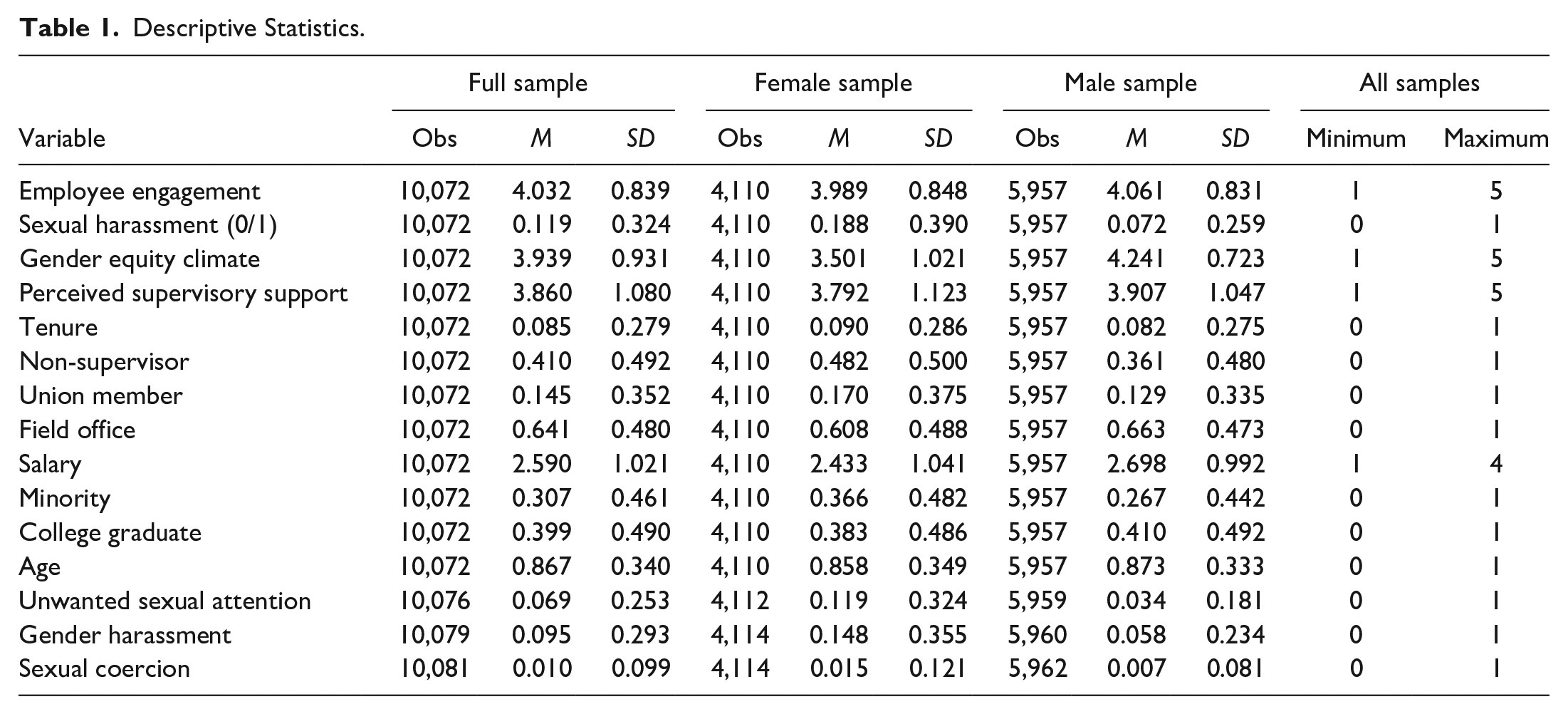
To test our hypotheses, we used data from Path 1 of the U.S. Merit Systems Protection Board’s (MSPB) 2016 Merit Principles Survey (MPS). This survey was administered online using a stratified random sampling method and included employees from 24 large U.S. federal agencies. A total of 37,452 surveys were distributed between July and September 2016, garnering 14,515 responses (response rate = 38.8%). Due to missing values, the sample was further reduced to 10,072 responses, 4,110 female and 5,957 male. Table 1 reports descriptive statistics of the variables described below, mirroring the full, female, and male samples used in the subsequent regressions, while Supplemental Appendix Table A1 shows their bi-variate correlations.
Descriptive Statistics.
Dependent Variable
The dependent variable, employee engagement, was constructed using three ordinal items on the survey instrument: “I have the opportunity to perform well at challenging work,” “The work I do is meaningful to me,” and “At my job, I am inspired to do my best work.” Each of these were rated on a Likert scale, where 1 represented “Strongly Disagree” and 5 represented “Strongly Agree.” To create a composite variable, we averaged response values across the items.
Given our reliance on a secondary data source, we were unable to locate a validated scale of employee engagement and thus had to develop it post hoc, as with previous work (e.g., Jin & McDonald, 2017; Ugaddan & Park, 2017). Our three-item measure closely resembles items from Rich et al.’s (2010) work engagement scale, and thus conforms to face validity and content-related validity criteria (Tharenou et al., 2007). For example, Rich et al.’s (2010) measures for physical engagement include “I try my hardest to perform well on my job” and “I strive as hard as I can to complete my job” (“I have the opportunity to perform well at challenging work”), which refers to investing intensely in difficult aspects of a work role. Second, emotional engagement, capturing core affect as a generalized pleasant and activated state toward a work role, was measured using “I am interested in my job” and “I feel positive about my job” (“The work I do is meaningful to me”). Lastly, among Rich et al.’s (2010) measures for cognitive engagement (reflecting attention, absorption, and inspiration) were “At work, my mind is focused on my job” and “At work, I am absorbed by my job” (“At my job, I am inspired to do my best work”). Although our item only captures the inspiration and absorption dimensions of cognitive engagement, it reflects a portion of the cognitive engagement domain.
Given their face validity and use of secondary data in public management research, similar items have been used in previous employee engagement research. For example, Ugaddan and Park (2017) use a four-item measure, which includes two of the three items we use (excluding physical engagement), along with “I feel highly motivated to do my work” and “I know what is expected of me on the job.” The former is not available in our data, while the latter—capturing role clarity—does not fully reflect Rich et al.’s (2010) engagement dimensions.
Since there are obvious limitations of our measure, and to avoid questionable research practices (Flake & Fried, 2020) we determined the criterion-related validity of our measure by comparing its prediction and outcomes compared to those of other engagement measures used in the published research (see Supplemental Appendix Tables A3 and A4), that is, through nomological and predictive validity (Markus & Borsboom, 2013). For example, Borst et al.’s (2020) meta-analysis found that engagement significantly predicted job satisfaction (β = .67) and turnover intention (β = −.44) at the α < .001 level, a result we found as well (β = .88 and −.51) at the α < .001 level. We found similar results in examining the predictors of engagement, with availability of resources (β = .377) and perceived supervisory support (β = .489) significantly predicting engagement at the α < .001 level, similar to Byrne et al. (2017) and Jin & McDonald’s (2017) findings.
Lastly, we conducted confirmatory factor analysis (CFA), and found all items loading onto a single overall factor, and the three items had sufficient scale reliability (α = .80).
Independent Variable and Moderators
The primary independent variable, SH, was dichotomous and captured using affirmative responses to a list of 11 actions committed by organizational members, similar to measures used by (Jackson & Newman, 2004; Newman et al., 2003). These actions varied in their severity and reflected those from existing validated SH scales such as the sexual experiences questionnaire (Fitzgerald et al., 1988), which included the dimensions of unwanted sexual attention, sexual coercion, and gender harassment. For example, one item captures whether the respondent experienced unwelcome communications and invasion of personal space, while another asks whether there was pressure for sexual favors and dates. Some actions represented blatant quid pro quo (e.g., offering preferential treatment in exchange for sexual favors) and unfair treatment based on sex/gender. Lastly, some signaled gender harassment, such as sexually oriented material or unwelcome sexual teasing, jokes, comments, or questions (see Supplemental Appendix Table A2).
Respondents to the survey were asked if they had experienced any of the 11 actions in the past 2 years, with three choices: (1) more than once, (2) once, or (3) never. For the purposes of the analysis, the first two categories were collapsed and coded as 1, while the third was coded as 0, creating a dichotomous measure of SH experience. Thus, the SH variable took on a value of 1 if individuals experienced any of the 11 behaviors, and 0 otherwise. We followed Tinkler and Zhao’s (2020) measurement approach to create the unwanted sexual attention, gender harassment, and sexual coercion variables. To establish the validity of each of these scales, a CFA found that all items loaded onto a single factor when considering the overall SH variable (11 variables). In addition, each of the sub-dimensions of SH (unwanted sexual attention, gender harassment, and sexual coercion) were factor analyzed in separate CFAs and loaded onto a single factor. Lastly, the scale had sufficient reliability (α = .82 for the overall scale; α = .70 for unwanted sexual attention; α = .72 for gender harassment; and α = .68 for sexual coercion).
Perceived supervisory support was measured using responses to three items on the survey similar to Jin and McDonald (2017): “Overall, I am satisfied with my supervisor,” “My supervisor provides constructive feedback on my performance,” and satisfaction with “working relationship with my supervisor.” The first two were rated on a standard Likert scale (1: “Strongly Disagree” and 5: “Strongly Agree”) while responses for the last item ranged from 1 (“Very Dissatisfied”) to 5 (“Very Satisfied”). To create a composite variable (α = .89), we averaged responses to the three items. Lastly, each of the items loaded onto a single factor in a CFA.
Gender equity climate was measured using responses to the following four items: (1) “In my organization, women and men are respected equally,” (2) “In my organization, the opinions and insights of women are often ignored or devalued,” (3) “In my organization, standards are higher for women than men,” and (4) “My organization is reluctant to promote women to supervisory or managerial positions.” In general, psychological climate refers to how individuals perceive their work environment, its structures, and its processes, which allows them to create meaning and develop expectations of behaviors (James et al., 1978; Parker et al., 2003). In the context of this study, gender equity can be seen in terms of distributional and process outcomes as they relate to gender status, that is, if one gender seems to be advantaged over others in how or whether workplace issues are decided. In this way, gender equity can be also seen as a form of organizational justice, consisting of distributional and procedural justice dimensions (Rubino et al., 2018). The four items used for gender equity climate represent whether men generally receive more respect compared to women, whether standards are higher for men versus women, and whether there are gender biases (favoring men) in promotion decisions. They also reflect King et al.’s (2010) measures of gender equity climate (e.g., “Women in my company have been prevented from attaining their full potential because of their gender,” “Men are often given opportunities instead of women because of their gender in my company”).
Each item was rated on a standard Likert scale (1: “Strongly Disagree” and 5: “Strongly Agree”). To create a composite variable (α = .89), items 2 to 4 were reverse-coded, and responses were averaged. Lastly, a CFA showed that the items loaded onto a single factor.
Control Variables
We controlled for demographic variables and job-related attitudes that may be related to the dependent variable including tenure >4 years, supervisory status (0/1), union membership (0/1), location, pay, 2 college graduate (0/1), minority (0/1), female (0/1), and age >40.
Model
The model included a one-way fixed effects regression and clustered standard errors. Following previous work on SH sex differences (e.g., Cogin & Fish, 2009; Jiang et al., 2015; Magley, Waldo, et al., 1999), we separated male and female sub-sample regressions.
Results
Table 1 shows the descriptive statistics of variables used, classified by full, female, and male sample. The results show that about 12% of the sample had experienced some form of SH in the past 2 years, with women (18.8%) reporting at more than 2.5 times the rate of men (7.2%). On average, gender harassment was the most widely reported form of SH (9.5%), again with women (14.8%) reporting 2.5 times the rate of men (5.8%). In all samples, unwanted sexual attention was the second most common form of SH (full sample: 6.9%; females: 11.9%; males: 3.4%), followed by sexual coercion (full sample: 1%; females: 1.5%; males: 0.7%).
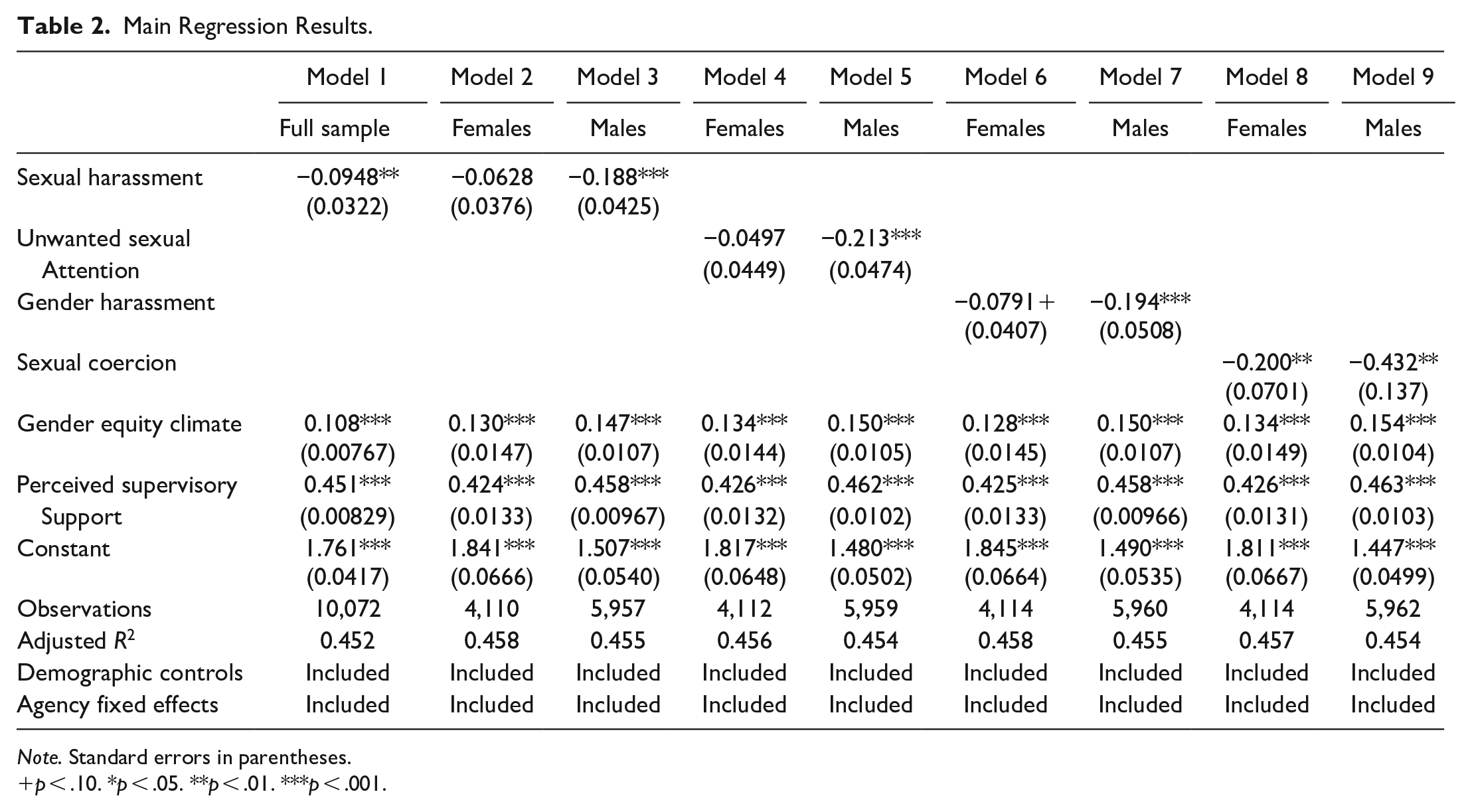
Table 2 presents the main regression results, while Table 3 shows results of including moderators. Model 1 consists of the full sample, while Models 2 to 9 show the effects of sexual harassment, unwanted sexual attention, gender harassment, and sexual coercion on the female and male sub-samples. The results show that SH is negative and significantly related with employee engagement (Model 1): experiencing SH is associated with a drop of 0.09 in employee engagement levels (on a 1–5 Likert scale), providing strong evidence for hypothesis 1.
Main Regression Results.
Note. Standard errors in parentheses.
p < .10. *p < .05. **p < .01. ***p < .001.
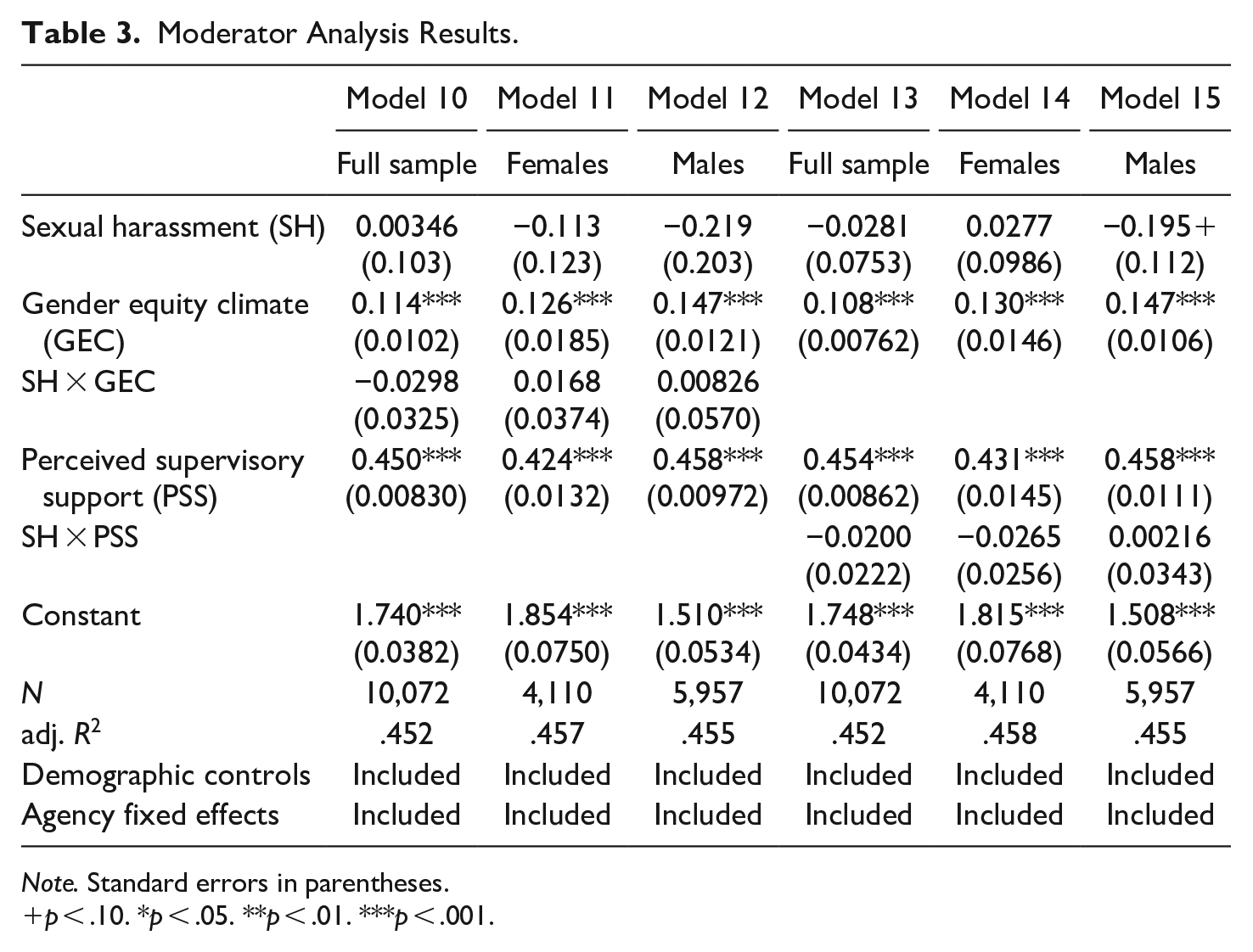
Moderator Analysis Results.
Note. Standard errors in parentheses.
p < .10. *p < .05. **p < .01. ***p < .001.
Across the overall SH variable and its three dimensions (except for sexual coercion), employee engagement was statistically significant only among males (Models 3, 5, 7, and 9), and was larger in magnitude compared to females, providing evidence against hypothesis 2. This suggests that, for males, experiencing SH is associated with a drop of 0.19 to 0.45 in employee engagement (on a 1–5 Likert Scale), equivalent to more than half a standard deviation drop.
Turning to the role of moderators, Models 10 to 15 (Table 3) include interaction terms for gender equity climate and perceived supervisory support on the full, female, and male sub-samples, respectively. The results show that neither gender equity climate nor perceived supervisory support were statistically significant moderators of the SH–employee engagement relationship. In other words, the relationship between SH and employee engagement did not depend on levels of gender equity climate or perceived supervisory support, providing evidence against hypotheses 3 and 4. In each of the moderator models, however, both gender equity climate and perceived supervisory support were statistically significant.
Together, the results show that SH is negatively associated with employee engagement, even while controlling for a range of variables, supporting hypothesis 1. Additionally, the statistical significance and magnitude of the relationship between SH and employee engagement differs by gender, but was only significant among males, thus rejecting hypothesis 2. Lastly, both moderators were statistically insignificant, leading to a rejection of hypotheses 3 and 4.
Given the theoretical rationale for moderators, we plotted marginal effects (ME) for each of these relationships (Supplemental Appendix Figures A1–A4), 3 and examined moderation in SH sub-dimensions among males and females (Supplemental Appendix Tables A5–A7). However, barring one exception, each of these additional analyses failed to find any significant moderating effects.
Discussion
Discussion of Findings
Although diversity and inclusion remain important goals for many organizations, issues such as SH block their path. SH constitutes an act of sex discrimination that seeks to perpetuate sexual hierarchies existing in society and reduces individuals to sexual objects (Franke, 1997; Stockdale et al., 1999). SH incidents create hostile work environments, which foster exclusion, even in the presence of workplace diversity. Given the adverse consequences and prevalence of SH, it is important to consider the extent to which it may influence individual and organizational motivation and performance. Although research has shown its negative effects on employees in general, the impact on engagement may resonate more in public organizations, where employees are often motivated by intrinsic rather than extrinsic drivers (Buelens & Van den Broeck, 2007), and where engagement links one to the larger community (Levitats & Vigoda-Gadot, 2020).
Given the strong links between employee engagement, motivation, and performance, we used the job-demands resource model to establish how SH may dampen employee engagement among male and female public employees. Additionally, we shed light on the extent to which the negative effects of SH can be mitigated, by including the moderating roles of gender, perceived supervisory support, and gender equity climate, all previously underexamined, especially as job and organizational resources. Our analysis suggests that experiencing SH reduces employee engagement levels, confirming previous findings based on a U.S. military sample (Jiang et al., 2015). Surprisingly, barring one exception, we found that SH and its different dimensions were negatively associated with employee engagement only in the male sub-sample, further supporting Cogin and Fish’s (2009) findings, but refuting Jiang et al.’s (2015). Compared to men, women reported 2.5 times the unwanted sexual attention and gender harassment (Table 1).
Although we presented a strong theoretical rationale for moderators as job resources, except for gender equity climate’s effect on the relationship between sexual coercion and employee engagement among females (Supplemental Appendix Table A7, Model 26), we found little support for our moderators. However, our results demonstrate that gender does matter, and in ways that may be counterintuitive. In particular, the engagement of women seems to be less affected by SH—possibly because they have dealt with it for longer and have both cognitive and social coping mechanisms. In addition, they may be better at expressing the correct emotions through emotional labor and performing work tasks in spite of hindrance job demands (Guy & Newman, 2004). Organizational and societal pressures, and their lower power status compared to that of men, could make women less likely to express their negative reactions to adverse treatment and force them to be more engaged in the workplace. Finally, women SH targets could be more likely to internalize their experiences and take them as commonplace occupational costs associated with their gender status, thus reducing the impact of their behavioral responses (Thacker, 1992).
Since the only significant moderating effect was found for gender equity climate and sexual coercion for women (Supplemental Appendix Table A7), this suggests that they may feel more comfortable expressing the toll of SH in an equitable climate, and less likely to use self-blame, non-disclosure, or silent suffering. Thus, personal resources available for job performance may be used to cope with job demands, reducing engagement. Since we do not test this relationship, we encourage further work to unpack the role of gender equity climate and adverse treatment. Given the depletion of personal resources used to deal with SH over time, we also encourage longitudinal studies to test how time and frequency affect the SH-engagement relationship.
Two possibilities may explain the lack of evidence for perceived supervisory support as a moderator. Although it may act as a job resource by setting acceptable ethics standards, communicating care, and expressing empathy, no amount of supervisory support may counteract the negative effects of SH. Subordinates may also blame SH on supervisors for their failure to provide a safe work environment, and violating the psychological contract.
Theoretical Contributions and Practical Implications
Several theoretical and practical contributions emerge from this study. First, we demonstrated a rarely seen negative antecedent of employee engagement (SH), thereby extending the job demands-resource model and allowing us to highlight the performance effects of SH. Thus, in contrast to work that examines job characteristics (e.g., autonomy, challenges, and job-person fit), working conditions (e.g., supportive leadership, recognition, and rewards), or personal characteristics (e.g., emotional intelligence and public service motivation) as antecedents of employee engagement, we demonstrate how adverse workplace experiences such as SH may act as job demands that negatively impact employee engagement. Further, we shed light on the employee engagement construct in the public sector, with employees uniquely motivated by public service values (Buelens & Van den Broeck, 2007), i.e., public organizations exist in different institutional contexts (Fletcher et al., 2020) that may themselves change the nature of employee engagement (see Levitats & Vigoda-Gadot, 2020).
Second, although SH remains a pervasive problem across organizations (Chawla et al., 2021), we highlight the potential role of personal and workplace characteristics in mitigating its effects. We found evidence that gender matters in predicting the strength of the SH-employee engagement relationship. This suggests that men and women appraise SH differently, such that there may be sex-differences in whether SH is considered a hindrance or challenge job demand. In addition, this indicates sex-differences in resources individuals bring to the workplace, mitigating the effects of job demands and shaping general sex-differences in baseline levels of employee engagement and reactions to work. Future work should seek to advance a gendered theory of engagement, especially regarding gendered differences in job demand appraisal.
Apart from gender, we found little evidence for the role of gender equity climate and perceived supervisory support. Thus, it is possible that traditionally theorized work-related factors used to predict positive outcomes, such as leadership and organizational climate, may not work in the same way when predicting the effects of negative issues such as SH. Thus, mitigating its ill effects may be a function of limiting the extent to which it occurs in the first place. Importantly, although anti-SH policies are a mainstay of modern organizations, what matters more is the larger organizational climate, gender equity (Glomb et al., 1997; King et al., 2010; Stockdale et al., 1999), and employee attributions of such policies (Nishii et al., 2008).
Lastly, this study highlights the importance of considering different SH dimensions. Although targeted men may demonstrate engagement losses, women endure SH behaviors at three times the rate; almost 19% of women in the sample experienced at least one SH behavior, with gender harassment being the most prevalent form. Given its opaque nature, public managers and leaders should target gender harassment by focusing on gender norms and climates.
Limitations and Suggestions for Future Research
A few limitations of this study should be noted. First, we did not consider the sex of the harasser, sacrificing granular complexity to the findings. Previous work shows differences in the prevalence and appraisal of same-sex SH (SSSH) and opposite-sex SH (Stockdale et al., 1999). SSSH may have higher repercussions for men, who may have a lower ability to cope, especially in hypermasculine environments (De Haas et al., 2009; Stockdale et al., 2004). Men motivated to maintain dominant status in organizations may also perceive more threats from SH behaviors. Thus, gender differences in the perpetrator-victim dyad remains an important research task.
Second, we did not differentiate consider the frequency of SH, but treated it as a dichotomous measure. This is important since repeated SH could produce adverse consequences, and engender unique coping strategies (Cortina & Wasti, 2005), or spiral into violence. Third, we did not identify the relationship between SH targets and perpetrators. Since SH itself is an expression of power and domination (MacKinnon, 1979), incorporating the power dynamic would provide further fine-grained results, that is, given the potential for quid pro quo, supervisory SH may hold different meaning compared to SH by co-workers.
Fourth, given the sensitive nature of SH and underreporting out of fear/stigma (Magley, Hulin et al., 1999), it is likely that our results present a small snapshot of the influence of SH on engagement. Thus, the rates of SH may be biased downward, and those that do choose to report may have higher levels of engagement, leading to range restriction. Although anonymity was assured, participation was voluntary, and the survey did not specifically target SH, we performed a missingness analysis, 4 but did not find any statistically significant differences between missing and non-missing observations. Thus, we are confident that missingness did not bias the results.
Fifth, since the secondary data we used did not have a validated employee engagement scale, we constructed a scale post hoc, by identifying items that matched Rich et al.’s (2010) measure based on face validity. Although our 3-item employee engagement measure loaded onto a single factor in a confirmatory factor analysis, showed sufficient criterion-related validity and scale reliability, we acknowledge this limitation. Rich et al.’s (2010) 18-item measure may have captured the domain of employee engagement more fully, affecting the eventual results of our analysis. We argue that the transparency of our approach does not constitute a Questionable Research Practice (Flake & Fried, 2020), while the use of our scale in previous work (e.g., Ugaddan & Park, 2017) and the use of post-hoc scales in other studies (Jin & McDonald, 2017) provides greater confidence. This limitation should be considered against the policy salience of sexual harassment and employee engagement, and lack of existing data that includes both constructs.
Sixth, the nature of our data precludes causal claims about the impact of SH on engagement. Also, since the (in)dependent variables were from the same sample, common method bias 5 is a concern, but Harman’s single factor test (Podsakoff et al., 2003) negated this, as a single factor failed to account for the variance of all variables used.
Conclusion
We began by noting that adverse workplace treatment, such as SH, goes against the goal of inclusive workplaces. This article sought to examine the relationship between SH and employee engagement—an important construct for leaders and managers as they seek to improve performance and motivate employees (Borst et al., 2020). To do so, we extended the job demands-resource model and considered the moderating roles of gender, perceived supervisory support, and gender equity climate. We showed how SH can dampen engagement, but only among males, even though females report SH at twice the rate, and we did not find evidence for the moderating roles of supervisory support and gender equity climate. We hope that our work spurs more research on the heterogenous effects of SH, and how it can be mitigated.
Supplemental Material
sj-docx-1-rop-10.1177_0734371X221095404 – Supplemental material for Sexual Harassment and Employee Engagement: Exploring the Roles of Gender, Perceived Supervisory Support, and Gender Equity Climate
Supplemental material, sj-docx-1-rop-10.1177_0734371X221095404 for Sexual Harassment and Employee Engagement: Exploring the Roles of Gender, Perceived Supervisory Support, and Gender Equity Climate by Taha Hameduddin and Hongseok Lee in Review of Public Personnel Administration
Footnotes
Declaration of Conflicting Interests
The author(s) declared no potential conflicts of interest with respect to the research, authorship, and/or publication of this article.
Funding
The author(s) disclosed receipt of the following financial support for the research, authorship, and/or publication of this article: This research was supported by the National University of Singapore (Tier 1 Ministry of Education Grant R-603-000-344-133).

Supplemental Material
Supplemental material for this article is available online.
Notes
Author Biographies
References
Supplementary Material
Please find the following supplemental material available below.
For Open Access articles published under a Creative Commons License, all supplemental material carries the same license as the article it is associated with.
For non-Open Access articles published, all supplemental material carries a non-exclusive license, and permission requests for re-use of supplemental material or any part of supplemental material shall be sent directly to the copyright owner as specified in the copyright notice associated with the article.
