




Abstract
During crisis management, public administrators typically adjust bureaucratic rules to become more flexible. In this paper, we go one step further, asking about the factors that explain rule-breaking behavior among public servants during crisis management. We report novel qualitative evidence and findings from a preregistered randomized quasi-experiment surveyed among 448 public servants in Germany. Our findings reveal that bureaucrats’ prosocial attitudes, whether the affected population is part of their in-group and higher levels of red tape affect significantly their willingness to engage in rule-breaking. Effects from decisive leadership are weak and conditional on other explanatory factors. These findings provide valuable insights for theory and practice in crisis and human resource management, demonstrating that organizations have limited leverage in influencing whether their employees engage in rule-breaking behavior, which is, in the main, conditional on individual factors and the characteristics of the crisis.
Introduction
When crises hit and uncertainty is high, administrative organizations face severe performance pressure and limited capacity to meet organizational goals. Furthermore, public officials and officers face conflicting demands from political elites, professional codes, personal values, and the needs of the affected parts of the population (Ansell & Boin, 2019; Thomann et al., 2018; Tummers et al., 2015). Bureaucratic discretion, pragmatism, flexibility, and creativity are behavioral traits often associated with effective crisis management and good performance in stressful situations (Ansell & Boin, 2019; Eckhard et al., 2021). One might go further and assert that these features might be insufficient and instead bureaucrats could find themselves compelled to resort to rule-breaking behavior, making risky decisions when faced with the prospect of worse alternatives. The following statement by a public manager during the 2015/2016 migration crisis in Germany
1
illustrates the underlying rationale: You are indeed walking on thin ice if you are building an accommodation right now. I told my staff, all legal regulations are gone, except fire safety. . .it is still better to circuit [. . .] building laws for a while rather than to have people camp in tents in the winter. (IfD, 2016, p. 50)
Such behavior stands in stark contrast to traditional rule-bound bureaucratic principles that apply during “regular” times (Borry & Henderson, 2019; Bozeman & Kingsley, 1998; DeHart-Davis, 2007). While formalization and abiding by rules are key traits of a Weberian administration that produces fair and transparent processes and protects the legitimacy of public service, in crisis management following the rules can potentially reduce the effectiveness of a response. Thus, in a crisis situation, rule-breaking might be necessary out of humanitarian concerns, prioritizing outcomes on human well-being over bureaucratic procedure (Borry & Reuter, 2022).
Following the literature, we expect a set of explanations to be relevant for the willingness of officials to engage in rule-breaking behavior (Borry & Henderson, 2019; Fleming, 2020; Morrison, 2006). Insights from research on prosocial rule-breaking and green and red tape, for example, emphasize factors such as formalization, rule-consistency, as well as expected punishment (Borry et al., 2018; DeHart-Davis, 2009; Fleming, 2020). However, while the prevailing research focuses on stress during regular times, this paper looks at rule-breaking as an adaptive strategy of bureaucrats to navigate crises, and therefore offers a distinct perspective. We draw on theories on red tape (Feeney, 2012; Kaufmann & Tummers, 2017), transformational leadership (Kim & Yoon, 2015; Wright et al., 2012), and client characteristics (Henderson, 2013; Maynard-Moody & Musheno, 2003) to derive explanations at the organizational, the environment and the individual level that influence bureaucrats’ propensity to employ rule-breaking behavior in crisis situations.
We test our hypotheses using a between-subject randomized quasi-experiment conducted among 448 public sector employees in Germany. We manipulate the crisis setting and organizational constraints using vignettes that differentiate between two types of crises, a migration crisis and a pandemic. In both types of crises, officials are acting under immense pressure. Evidence from studies on the 2015/2016 migration crisis in Germany and the COVID-19 pandemic show the persistent nature of the rule-breaking versus rule-abidance dilemma that administrations faced in periods of high pressure and uncertainty (Raffer & Kairies-Lamp, 2016; Schmidt, 2019). Our research design further includes complementary items to assess prosocial attitudes on the individual level of the bureaucrats which cannot be manipulated experimentally.
We find that higher levels of red tape and the proximity of the characteristics of the affected population increase the likelihood of rule-breaking among bureaucrats, while variation in leadership produced ambiguous results and seems to matter only under certain conditions. In addition, bureaucrats’ prosocial attitudes can also affect significantly their willingness to engage in rule-breaking.
These findings are relevant for research on both behavioral public administration and crisis management. There are limited studies on individual bureaucratic behavior in crisis management; to our best knowledge, there is no account of the conditions and factors which drive rule-breaking in crisis management. While a discourse on rule-breaking behavior at the individual level has emerged in the literature, it has not been systematically explored empirically, and in particular, not within the context of crises (Brockmann, 2017; Charbonneau et al., 2023; Feeney & DeHart-Davis, 2009; Weißmüller et al., 2022). Expanding such studies to crisis management is relevant, as the need of pragmatic and flexible solutions in stressful situations is well-documented in the literature (Ansell & Boin, 2019; Lenz & Eckhard, 2023). Overall, our findings indicate that public administrations have limited leverage on whether their employees engage in rule-breaking behavior during crisis management, which is mainly influenced by individual factors and characteristics of the crisis. The importance of prosocial attitudes as an explanatory factor further confirms a range of similar findings in the literature (Borry & Henderson, 2019; Fleming, 2020; Khan et al., 2022; Weißmüller et al., 2022), which we complement by including the crisis context as an additional scenario.
The remainder of this paper is structured as follows: We first discuss the role of rule-breaking behavior in crisis management. Second, we introduce the explanatory conditions increasing the likelihood of rule-breaking behavior in crisis situations and introduce our hypothesis. We then provide anecdotal evidence from background interviews and other studies, exemplifying our theoretical argument. Finally we explain our research design and data, present and discuss the results, and draw a conclusion.
Rule-Breaking as Coping with Uncertainty
The domain of crisis management has been extensively studied, revealing significant insights into the various administrative challenges that emerge during crises (Ansell et al., 2010; Boin & ‘t Hart, 2010; Peters et al., 2011). Crises present governments and their administrative apparatuses at different territorial levels with tensions between adhering to well-established laws, legal standards, and procedures on one hand, and the need to respond flexibly to unforeseen crises on the other (Lenz, 2024; Lenz & Eckhard, 2023; Stark, 2014).
While rules and rule-following structure decision-making and make procedures more reliable, decrease the risk of abuse and misconduct, and provide for transparency during crisis situations (Fleming, 2020), rule-adherence can hamper outcomes that align with organizational goals and the broader public interest. In such circumstances, the tension between adhering to rules and adapting to novel challenges becomes evident (Comfort & Wukich, 2013; Jung et al., 2018; Lenz & Eckhard, 2023; Nowell et al., 2018). As observed by multiple studies, administrations frequently respond to crises by transitioning from routine behavior to more adaptive and flexible approaches. Such flexible crisis management is characterized by an emphasis on creativity, flexibility, pragmatism, and improvisation (Ansell & Boin, 2019; Eckhard et al., 2021; Graf et al., 2024; Nowell et al., 2018; Webb & Chevreau, 2006). Notably, the most extreme manifestation of such improvisation is the selective application of rules, and in some cases even rule-breaking, all of which may become essential to ensure effective performance amid complexity and stress (Borry, 2017; Morrison, 2006).
Nonetheless, the exploration of micro-level dynamics within the organization or at the individual level that enable or obstruct flexible responses to crises remains an area underexplored in the existing literature. Directing attention toward this aspect holds promise in complementing existing studies, adding an individual perspective on street-level implementation and its relevance for organizational resilience (Bullock et al., 2019; Desmidt & Meyfroodt, 2024). To address this gap, this paper focuses on “unbureaucratic” behavior exhibited by street-level bureaucrats during crises. Precisely, we are exploring the propensity of bureaucrats to engage in rule-breaking behavior as a coping mechanism to face the urgency, uncertainty, and threat induced by crises (Bozeman & Kingsley, 1998; DeHart-Davis, 2007). By investigating such individual level dynamics, the study aims to shed light on impact of individual bureaucrats on organizational responses to crises and, ultimately, organizational resilience.
Although unexplored in the domain of crisis management, “rule-bending” or “rule-breaking” are topics that have found their way into the broader discourse within public administration literature (e.g., Borry, 2017; Charbonneau et al., 2023; Fleming, 2020; Weißmüller et al., 2022). Both terms are often used interchangeably (Borry, 2017; Borry et al., 2018; DeHart-Davis, 2007), indicating that rule-compliance is a rather binary concept where every violation is rule-breaking (Borry, 2017; Fleming, 2020; Veiga et al., 2004). In this paper we follow this understanding, while acknowledging that there are also more nuanced perspectives (e.g. Tummers et al., 2015). Furthermore, rule-breaking and -bending are associated with “creative coping,” or the behavioral coping of frontline workers in situations of stress and urgency (Ban, 1995; Fleming, 2020; Tummers et al., 2015), whereas others highlight that such creativity and entrepreneurship in response to environmental turbulence comes at the expense of personal risks (Borins, 2000; Morris & Jones, 1999).
Rule-breaking in crisis management may take many different forms in practice. Rule-breaking can be coined negatively when bureaucrats are seeking their personal advantage (Fleming & Bodkin, 2023). Conversely, there are also examples of situations where rule-breaking is aimed at establishing swiftly humane conditions for those affected by the crisis. In other words, humanity is a central concern during crises that potentially justifies certain behaviors from a human-rights centered perspective (Borry & Reuter, 2022). For example, when lengthy tendering provisions limited their possibilities to build new accommodation for incoming refugees, the aim of circumventing the rule was to address pressing humanitarian needs (Borry & Reuter, 2022; Hahlen & Kühn, 2016; Meyer, 2016; Raffer & Kairies-Lamp, 2016). Whatever the crisis-related motives are, it is important to note that public servants who bend or even break the rules may face disciplinary or legal consequences. Excessive rule-breaking is considered unlawful, irrespective of means. Crisis management, therefore, requires street-level bureaucrats who are willing to take personal risks for a greater public good. This points to a potential paradox, with individuals who may join the public service precisely to avoid job-related risks, and the demand to take such risks for a greater good invoked by crises. 2
Overall, this highlights that public officials face conflicting demands during a crisis: from political elites, professional codes, personal values, and the needs of the affected population. How bureaucrats respond to these kind of situations, and whether they are willing to deviate from the rules depends on a variety of influences, which we discuss next.
Explaining Variation in Rule-Breaking Among Public Servants
The conditions under which public employees are willing to break the rules, have been subject to several studies (Borry, 2017; Bozeman & Kingsley, 1998; Brockmann, 2017; Canales, 2011; Feeney & DeHart-Davis, 2009; Fleming, 2020; Fleming & Bodkin, 2023; Morrison, 2006). For this study, we conceptually differentiate facilitators of rule-breaking behavior at the organizational level, the environment, and the individual level.
Organization: Red-Tape and Leadership Constraints
Organizational explanations for individual rule-breaking behavior typically consider the organizational culture and the degree of internal formalization and hierarchy (DeHart-Davis, 2007; Feeney & DeHart-Davis, 2009; Turaga & Bozeman, 2005). One aspect that has been studied within this context is the creation and implementation of organizational rules. The primary concern is developing meaningful rules that enhance organizational efficiency and compliance. Green tape literature posits that well-designed, legitimate, and effectively communicated rules lead to better organizational outcomes, thereby promoting rule-following behaviors among employees. Central to this are rule clarity and consistency, which ensure that employees understand and adhere to established protocols (Borry et al., 2018; DeHart-Davis, 2009a, 2009b, 2017; Fleming, 2020; Piatak et al., 2022). Particularly, in the context of emergency planning, comprehensive planning and the development of effective protocols are essential. Well-crafted emergency plans can increase organizational preparedness and potentially enhance the effectiveness of crisis responses (Baker & Grant Ludwig, 2018; Staupe-Delgado & Kruke, 2018). However, crises rarely replicate in exactly the same manner, therefore, pre-conceived crisis plans can also constrain rather than promote effective management, potentially stifling creativity and the necessary flexibility (Aken & Fenema, 2014; Turaga & Bozeman, 2005; Webb & Chevreau, 2006).
And while rule formalization and consistency foster a compliant and efficient organizational environment, formalized rules can also be perceived as red tape—that is, an abundance of rules and formalization up to the point when it becomes pathological (Grimmelikhuijsen et al., 2017; Kaufmann & Tummers, 2017; Moon & Bretschneiber, 2002; Pandey & Marlowe, 2015). Therefore, when street-level bureaucrats perceive rules to have negative effects, particularly on clients, they may engage in prosocial rule breaking. DeHart-Davis (2007), for example, suggests that centralization and red tape lead to a rejection of rule-based behavior because individuals become unwilling to follow senseless, hindering and restrictive rules. Furthermore, research on public management supports the argument that less formal rules lead to more flexibility, a higher risk propensity (Diefenbach, 2009; Moon, 1999), and more entrepreneurship in public organizations (Audretsch et al., 2020; Kalkman & Groenewegen, 2019). Particularly in response to turbulence and crises, risk-taking has been observed as strategic coping mechanism by public managers (Dahling et al., 2012; Morris & Jones, 1999). Simultaneously, research has demonstrated that organizations in emergency contexts can eliminate red tape. This not only leads to increasingly consistent behavior but also reduces the stress experienced by administrators in such situations (Henderson, 2013).
We therefore expect that in a crisis context, the latter argument should prevail. In that sense, more excessive rules and formalization in an organization that clash with functional needs of solving a crisis should be associated with a higher propensity of bureaucrats to engage in rule-breaking behavior. Our first hypothesis therefore reads:
H1: Public servants who work in an environment with high levels of red tape are more likely to break the rules during crisis management.
A second organizational factor highlighted in the literature is leadership. Managerial influence on street-level bureaucrats has been examined with varying results across different occupations and organizational settings (Henderson & Pandey, 2013; May & Winter, 2009; Riccucci, 2006). Previous studies have shown ambiguous relations between the attitudes of senior management towards risk-taking and rule-breaking behavior, depending also on leadership styles (Fernandez, 2008; Khan et al., 2022; Vigoda-Gadot & Kapun, 2005). However, there is substantial evidence that in situations characterized by uncertainty and dynamic changes in the external environment, when prevailing policies and rule systems of organizations are insufficient for an effective response, administrators are likely to look to their leadership before engaging in risky behaviors. In such contexts, leadership behavior is considered a key situational factor for influencing rule-breaking (Khan et al., 2022; Salancik & Pfeffer, 1978; Vardaman et al., 2014; Wang & Shi, 2021).
Through decisive leadership, supervisors can clarify responsibilities, formulate goals and encourage creativity or rule-breaking among their employees. In situations where supervisors clearly position themselves toward organizational goals and assume responsibility for any behavior that conflicts with organizational rules, civil servants are more likely to respond accordingly (Bozeman & Kingsley, 1998; Fleming, 2020; Tummers & Bekkers, 2014). Self-interest can be overcome in such situations, when leaders emphasize the public value for the organization and its stakeholders (Trottier et al., 2008; Wright et al., 2012). Otherwise, if there is a lack support, breaking rules may be stressful for the employee (Henderson & Borry, 2023; Spicer, 2009).
We therefore expect that the clarification of agency goals by a leader will resolve much of the uncertainty among individual public servants who perceive a tension between formal bureaucratic rules and the functional needs of crisis management. The more a leader openly addresses such conflicting goals and establishes authority in solving the crisis and assumes responsibility for any potential legal ramifications, the more individual public servants are inclined to break the rules. Our second hypothesis therefore reads:
H2: Public servants who work in a context where the leader clearly sets goals and assumes responsibility for ambiguous decisions are more likely to break the rules during crisis management.
Environment: Characteristics of the Affected Population
In addition to organizational factors, it is plausible that environmental factors associated with crises also affect public servants’ behavior. A range of literature in public administration argues that certain client characteristics influence administrative decision-making (Henderson, 2013; Maynard-Moody & Musheno, 2003). Social identity theory holds that administrators tend to categorize clients into various social groups based on demographic characteristics such as race, ethnicity, and gender intersectionality, viewing their own group more positively (e.g., Assouline & Gilad, 2022; Keiser et al., 2004; Pettigrew & Tropp, 2006; Song et al., 2019; Tajfel & Turner, 2004). In a similar vein, representative bureaucracy theory suggests that officials actively represent those individuals belonging to their “own” demographic group, which is especially relevant for societal minority groups (Guul, 2018; Kennedy, 2014; Meier, 2019). In-group and out-group dynamics are thus relevant in public administrators’ social ordering and behavior (van Witteloostuijn et al., 2024; Zhao et al., 2021).
Particularly in crisis situations, group membership should be emphasized as individuals seek to reduce uncertainty and regain a sense of control and safety (Fritsche et al., 2011; Grieve & Hogg, 1999; Kruglanski et al., 2006). This reaction should lead public servants to prioritize established social bonds and in-group members. Indeed, studies in the field of social psychology have shown that exposure to threats increases individuals’ identification with social in-groups, ethnocentric tendencies, and in-group favoritism (Castano & Dechesne, 2005; Fritsche et al., 2011; Giannakakis & Fritsche, 2011). These findings underscore the relevance of intergroup conflict, particularly in crisis situations (Fritsche et al., 2011). Our third hypothesis thus reads:
H3: Public servants are less willing to break the rules in crisis situations when the affected population constitutes an outgroup.
Individual Level: Prosocial Attitudes
For the last explanatory dimension, we are moving toward individual-level attitudes. A recent study by Borry and Henderson (2019) on rule breaking in frontline healthcare found that it is not so much the characteristics of the clients but rather the prosocial attitude of the individual bureaucrats that make rule-breaking more likely. In this paper, we understand prosocial attitudes in a crisis-specific context as humanitarian concerns and attitudes that clearly prioritize human well-being (Borry & Reuter, 2022). Thus, humanitarian support, a citizen-centric approach, and the self-conception of bureaucrats as “citizen agents” (Maynard-Moody & Musheno, 2000) should explain rule-breaking behavior in crisis situations. Based on the idea of prosocial attitudes, authors have coined the concept of prosocial rule-breaking, which refers to intentional decisions to bend or avoid rules to alleviate the consequences for the citizen (Borry & Henderson, 2019; Dahling et al., 2012; Morrison, 2006; Weißmüller et al., 2022). As Morrison (2006, p. 6) put it, prosocial rule breaking refers to actions that are violations of “formal organizational policy, regulation, or prohibition with the primary intention of promoting the welfare of the organization or one of its stakeholders.” The motivation for prosocial rule breaking is not the self-interest of the public servant but his or her empathy with the client (Borry, 2017; Borry & Henderson, 2019; Henderson, 2013; Morrison, 2006; Schott et al., 2019). 3
We argue that crises are particularly likely to trigger prosocial attitudes and potentially also prosocial rule-breaking, as they involve situations in which affected communities are suffering consequences provoked by force majeure. It is plausible to expect that public officials develop sympathy and compassion towards affected groups and perceive pragmatic crisis relief as public value. Hence, we expect that bureaucrats who sympathize highly with crisis-affected groups are more likely to engage in non-bureaucratic behavior during the management of a crisis.
H4: The more prosocial attitudes public servants hold, the more likely will they engage in rule breaking.
Empirical Analysis
The core of the empirical analysis in this paper consists of factorial survey experiment among public servants. While the experimental design is not specifically restricted to a specific country context and should have broader applicability, it was implemented in Germany. The next section therefore provides background information on the case of administrative crisis management in Germany which we combine with qualitative anecdotal evidence to illustrate the mechanisms underlying our theory.
The Case of Administrative Crisis Management in Germany
During the past decade, Germany was hit by multiple crises-related events, including the financial crisis during the 2010s, the refugee crisis of 2015/2016 with its influx of over one million refugees and migrants in just 1 year, and, most recently, the COVID-19 pandemic. These crises transcended borders, involved a myriad of public sector services and necessitated cooperation within and between various organizations from the public and non-governmental sectors, placing a substantial strain on the German public administration (Bogumil et al., 2016; Eckhard et al., 2021; Kuhlmann & Franzke, 2022). In addition, these crises affected many countries in Europe and beyond, which is why we can consider Germany a typical case of crisis affectedness and crisis management (Gerring 2007).
In Fall 2019 and Summer 2020, we conducted background interviews with individuals who were involved in the management of the refugee crisis of 2015/2016 and in the COVID-19 pandemic and worked in different administrative agencies of 12 district-level local administrations (see Supplemental Appendix A1). In the decentralized federal structure of Germany a significant portion of crisis management competence is located on the local level, where also street-level bureaucrats play a pivotal role (Behnke & Eckhard, 2022; Kuhlmann, 2020; Kuipers et al., 2015). Our aim was to better understand individual decision-making during the crisis, including the tension between rules and functional crisis needs. Drawing on these interviews, as well as related evidence from the literature, we provide anecdotal evidence demonstrating the dynamics theorized above.
Beginning with the crisis pressure, several respondents confirmed that the crisis committees perceived the early pandemic as a high-level threat and that the urgency of the situation compelled them to adjust administrative proceedings. One person who was running a crisis response team said: “we left the legal formalities aside a bit, also regarding data protection and preliminary checks, and actually got ourselves a software called Epikur on recommendation” (Interview 1). In fact, several officials even admitted that they had to go beyond the mere adaptation of routines, even taking decisions that could in fact be illegal, to effectively address the crisis. One of them said: On the first day, we closed all schools and kindergartens. There was initially a lot of disapproval of how we could do that, leaving 33,000 students at home. [. . .] But, we didn’t seriously ponder whether the school closure was strictly legal. As I said, we simply sent 33,000 children onto the streets in a day, more or less. (Interview 6)
These real-world narratives underscore the delicate balance officials must navigate during an imminent crisis and from the interviews it became clear that positions varied on the extent to which they would be willing to divert from or even break administrative rules or laws. In trying to understand the underlying reasons, we found anecdotal evidence for each of the factors we hypothesized above.
Our first example reflects the crucial role of leaders who foster an environment where innovative problem-solving, even if involving rule-breaking, is not only accepted but considered necessary. The respondent who worked in a crisis committee, involved in the management of the refugee crisis in 2015/2016, acknowledged that rules had to be broken during the crisis response: “Maybe we sometimes awarded a contract without obtaining three quotes, as we should have done. Because there was local pressure at the time.” In explaining the underlying rationale, the official said that “we simply learned to take the short chain of command. It was possible with our boss. He knew firsthand what it’s like to work here” (Interview 9).
The second example on red tape emphasizes the impracticality of a regulation in the context of the COVID-19 pandemic, that foresaw that to trace the infection chains every community level health agency had to recruit a specific number of health workers per population size. The interviewee said that “[t]here are now regulations that state, for every 20,000 inhabitants, I believe, five people [contact tracing personnel] must be provided. That would mean for us . . . exactly, 42 people in our case [. . .]. Having 42 people sitting idle, not knowing whom to call for contact tracing [due to few infections], doesn’t make sense” (Interview 1). In this case, the health agency did not follow the regulation because the official did not see the need, which illustrates how officials can respond with rule-breaking behavior when a rigid bureaucratic procedures clashes with the unique demands of crisis scenarios on the ground.
The third and fourth example highlight the relevance of the dynamics surrounding official’s client identification and prosocial attitudes in association with their propensity to break bureaucratic rules. In one case, the interviewee worked as the director of a daycare facility for children which during the COVID-10 pandemic had to enforce a high number of infection-related regulations that implied no longer accepting all children into daycare. Instead, acceptance was based on their parents’ status as “system-relevant” workers. The official admitted that some centers bent the rules to enable continued daycare for as many families as possible: “Some daycare center leaders felt obligated to ensure care for children and families, even if it meant breaking certain rules” (Interview 7). The quote from the introduction further exemplifies the prosocial aspect of rule-breaking: In this case an official who worked in a crisis committee managing the refugee crisis said that “[. . .] it is still better to circuit building laws for a while rather than to have people camp in tents in the winter” (IfD, 2016, p. 50). This underscores the prioritization of well-being over rigid adherence to existing building regulations. Therefore, in certain crisis situations, the intrinsic motivation to fulfill a duty towards the society can override strict adherence to rules, pointing toward the importance of empathy and ethical considerations in bureaucratic decision-making during crises.
Experimental Study on Rule-Breaking in Crisis Management
To put this study’s hypotheses to a systematic test, we designed a factorial survey experiment that was implemented in Germany in the context of the third wave of a national panel survey on administrative crisis management that was administrated by the company YouGov in 2020/2021 (Lenz et al., 2021). YouGov maintains a web-panel of over 240,000 members in Germany, from which a sample of 2,625 was drawn for the panel survey. For the experiment, we selected only participants who were employed either in the public administration or the health and social sector, leaving us with a sub-sample of 448 public servants. This selection increases the external validity of our findings, while the experimental nature of the study, with randomized treatment allocation, increases internal validity.
We rely on a preregistered between-subject randomized vignette-based quasi-experiment for this study. 4 The respondents are presented with one hypothetical crisis scenario in which public officials need to decide on whether to follow the rules or engage in rule-breaking behavior (Figure 1). The scenario provides a concrete and detailed context, which is believed to improve respondents’ understanding of the questions and thus the validity of their answers (Wallander, 2009, pp. 505–506). For the experimental treatments, we manipulate the level of red tape (H1), leadership (H2), and client identity (H3) using a 2 × 2 × 2 design, totaling 8 vignettes. Each dimension is divided into a treatment condition, which is expected to increase rule-breaking propensity, and a control condition, where the hypothesized conditions for rule-breaking are not met. Each respondent saw one vignette with a randomized combination of factor levels, with only one condition per factor (see Figure 2).
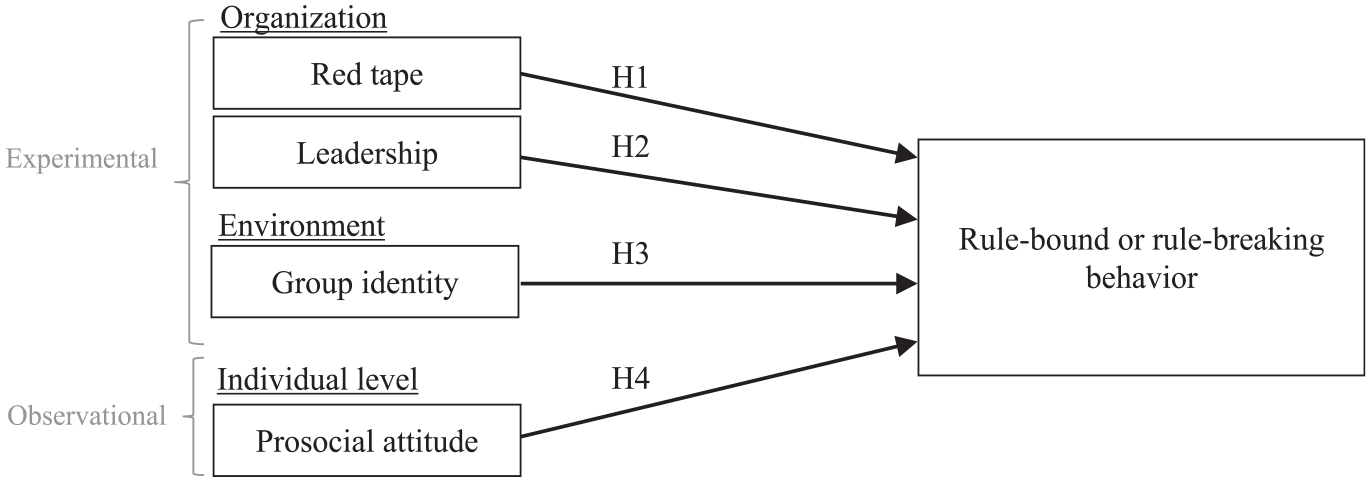
Research design.
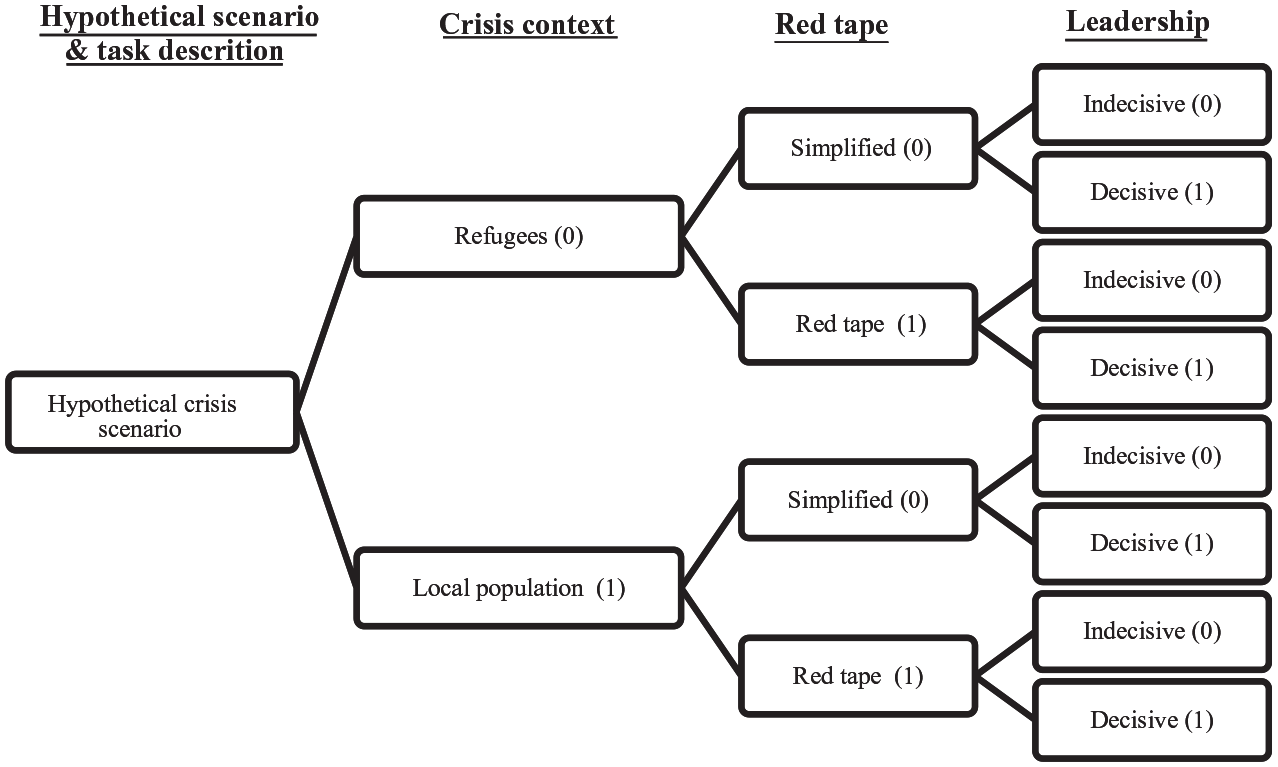
Vignette design.
For the level of red tape, the vignette provides basic information on the procurement ordinance, stating that the acquisition must be advertised publicly for 35 days and that any interested company can tender. The condition of reduced levels of red tape indicates that the effort involved in the procurement process is now reduced and the ordinance has been temporarily simplified. In the leadership treatment, both conditions clearly state the organizational goal to bring the situation under control as quickly as possible. However, we vary between evasive leadership and a leader who guarantees all staff members backing for their decisions. Finally, the affected population is manipulated by alternation between the local population and refugees as the affected group. We expect that public servants perceive the local population more as an in-group, whereas refugees coming from abroad should be perceived as an outgroup. 5
The fourth independent variable, prosocial attitudes of the bureaucrat (H4), refers to an individual characteristic that is very hard to manipulate in an experimental setting. After presenting the vignettes, we opted for a quasi-experimental approach by using an observational measure for prosocial attitudes instead of randomizing this variable (Figure 1) (Grant, 2008; Hattke & Kalucza, 2019). We use two items that capture both officials’ personal conviction regarding the impact of their work on the common good (1) and their perception of the administration’s role in aiding those in need (2) during a crisis, highlighting the “citizen agent” perspective (Maynard-Moody & Musheno, 2000). Both are measured on a Likert scale from 0 disagree to 5 fully agree. This dual focus enables us to encapsulate the holistic mindset of civil servants, extending beyond their immediate administrative roles (SupplementalAppendices A3, A4, and A17). 6
After reading the vignette, respondents were asked to take a decision regarding the procurement of crisis-related goods. They had to choose between a single offer they gained through contacts in a neighboring region or to adhere to procurement rules by first publishing a tender, collecting several offers and deciding subsequently (0—adherence; 1—rule-breaking) (dependent variable). Finally, we included a set of individual control variables to detect individual differences across age, gender, which have been shown to relate to different rule-breaking behaviors in the literature (Borry & Henderson, 2019; Portillo, 2012).
To ensure the reliability of the study, the survey included manipulation checks, as well as a limited amount of demographic information to check for successful randomization (Supplemental Appendices A14 and 15). First, the randomization process was effective. Each of the eight different vignettes was answered by about 57 respondents, CHI2 tests of independence and Wilcoxon signed-rank tests indicated no significant proportional differences between the overall sample and the vignette samples regarding gender, area of employment within the public sector, and age of the bureaucrats. The manipulation checks largely confirm the expected associations with significant correlations, except for the red tape dimension, where we expect insensitivity of the wording of the manipulation check item. 7 In addition, a partial correlation was observed between client identity and the leadership manipulation check, indication that our manipulations are not fully independent and why we included models with interactions.
Results
Figure 3 presents the descriptive results of the experimental manipulations (H1-H3) and observational variable (H4). To further detail the differences and enhance interpretability, we use OLS regression analysis (Gomila, 2021). 8 Table 1 includes three different models, the main model with all hypothesized factors (R2 = 0.21; F < 0.01), a control model (R2 = 0.22; F < 0.01) and an interaction model (R2 = 0.21; F < 0.01). Further interaction models as well as additional model specifications and logit models are reported in the Supplemental Appendix A6-9.
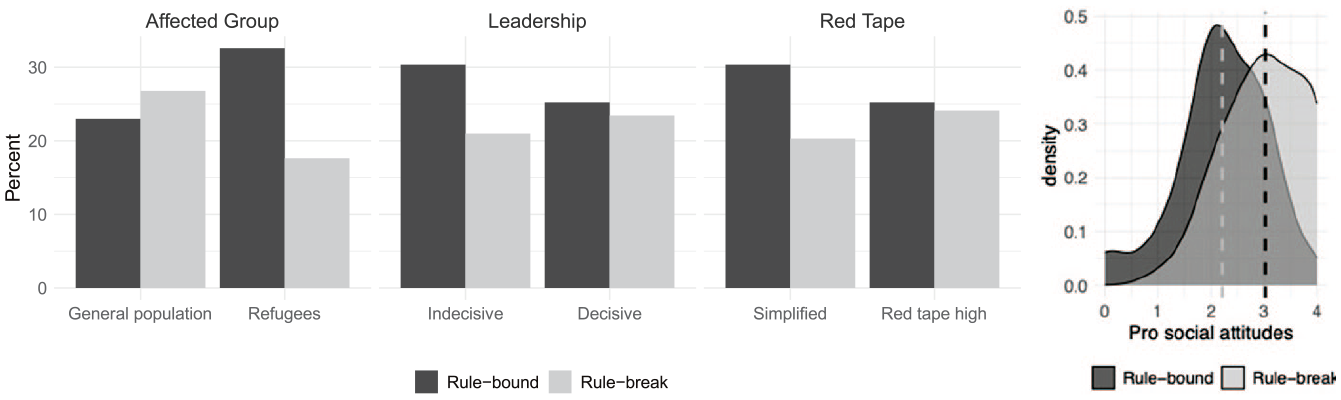
Descriptive depiction of differences in rule-breaking decisions.
Results of OLS Regression Analysis.
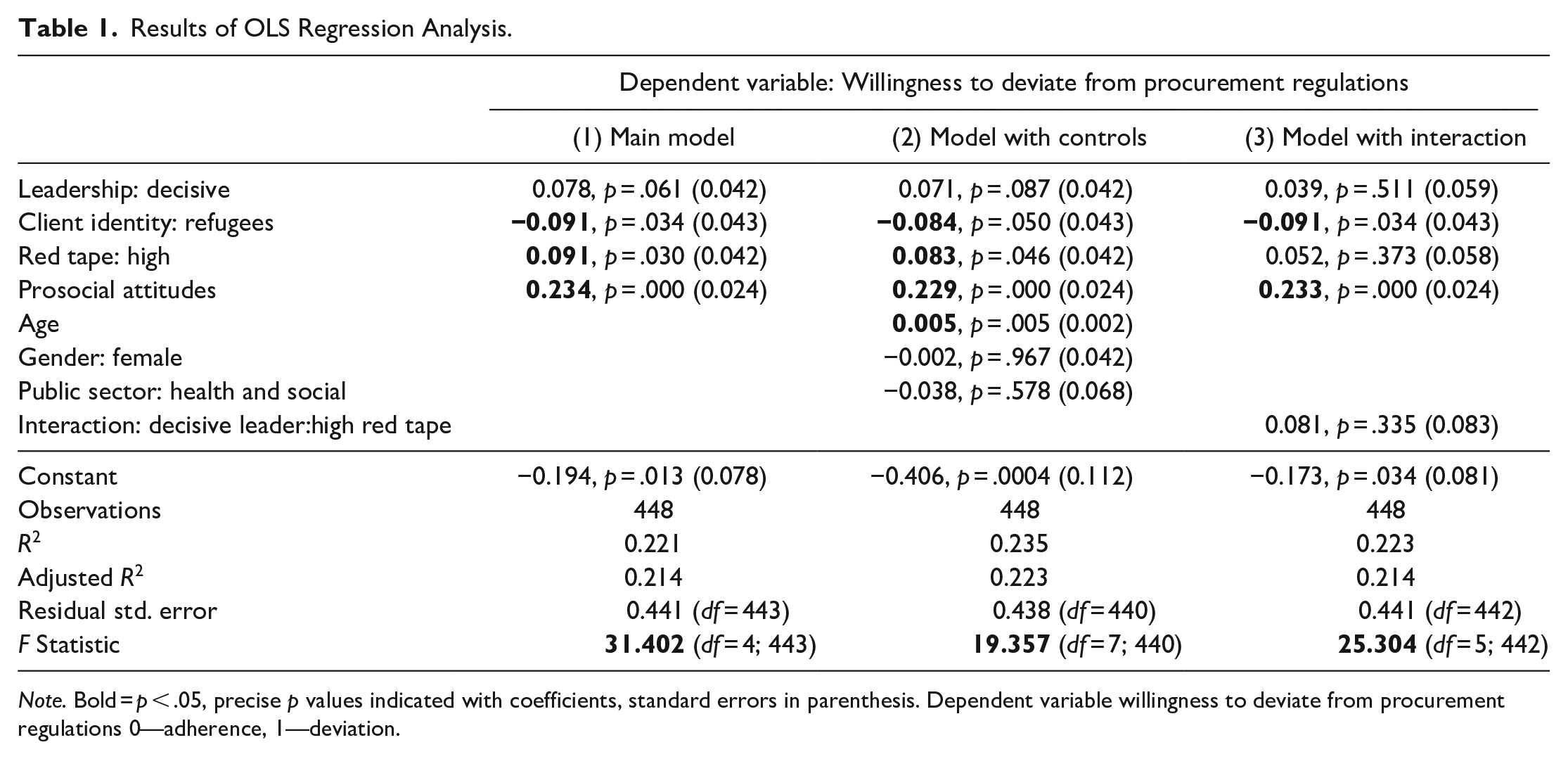
Note. Bold = p < .05, precise p values indicated with coefficients, standard errors in parenthesis. Dependent variable willingness to deviate from procurement regulations 0—adherence, 1—deviation.
Hypothesis Testing
To analyze how different hypothesized factors affect bureaucrats’ propensity to break rules, we first examine the main effects of the various treatments. The results indicate that the main effects for red tape, client identity, and prosocial attitudes are significant, whereas leadership does not yield significant results (Table 1). To further explore these differences, we employ coefficient plots for all manipulated factors and respondents’ prosocial attitudes, including two subset models: one refugee subset, which only includes respondents exposed to a vignette involving refugees as the affected population, and one local population subset, where respondents were exposed to a pandemic affecting the general population (Figure 4). 9
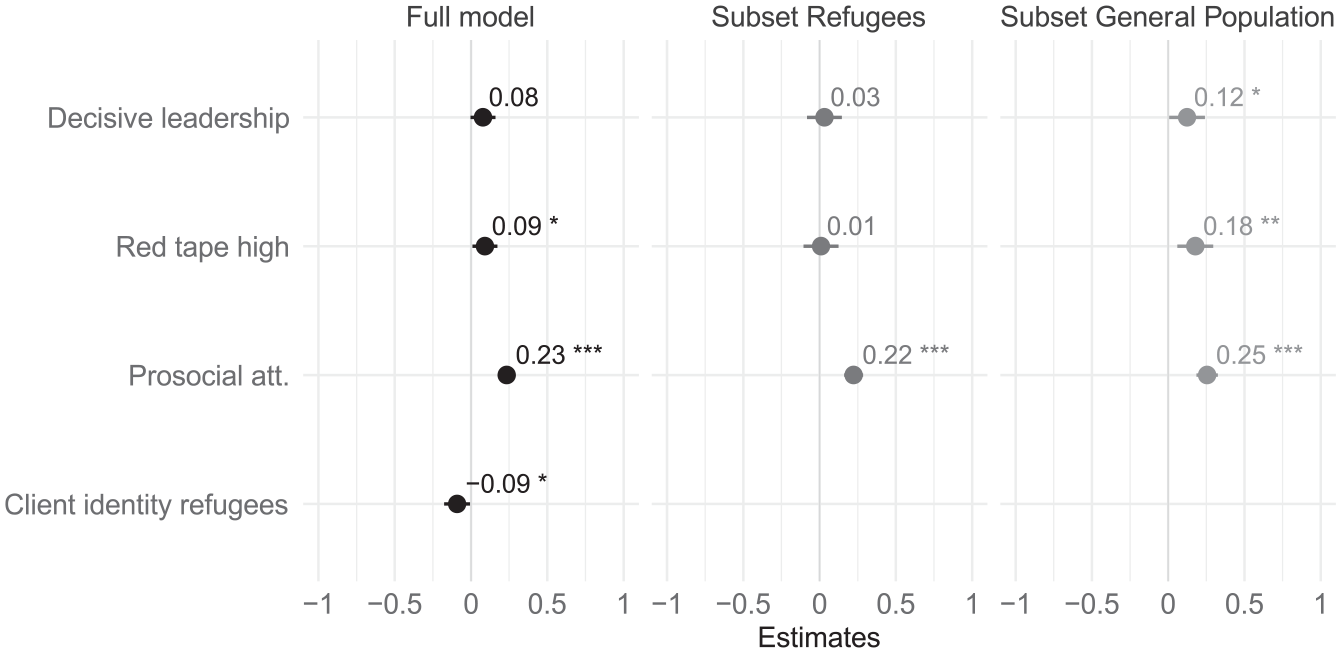
Coefficient plot for rule breaking willingness among bureaucrats.
Our first hypothesis theorized that high levels of red tape are likely to increase bureaucrats’ willingness to disregard existing rules. We find support for this hypothesis: when bureaucrats were exposed to vignettes featuring high levels of red tape, as opposed to facilitation in procurement regulations, they were overall 9% more willing to disregard the regulations (0.09, p < .03). This effect is particularly pronounced among bureaucrats confronted with a pandemic (0.18, p < .004), while it remained insignificant for the refugee subset (0.01, p < 0.87).
Second, we hypothesized that directional and responsible leadership would increase bureaucrats’ willingness to break the rules. However, this hypothesis is not sufficiently confirmed by our results in the full model. We find no significant differences in rule-breaking when a leader guarantees all staff members backing for their decisions versus evasive leadership. However, if we only look at the subset with the general population being the affected group, we do find a positive and significant effect (0.12, p < .04).
These different observations, depending on which type of crisis bureaucrats were exposed to, point towards our third expectation: we anticipated different reactions based on whether a perceived in-group or out-group is affected. We expected that officials tend to perceive refugees as an out-group, leading to a reduced likelihood of rule-breaking in this crisis context. Our results are in line with this expectation, as the willingness to deviate from procurement regulations decreases when refugees are affected compared to when the general population is affected (−0.09, p < .03), supporting H3.
Lastly, we theorized the relevance of bureaucrats’ prosocial attitudes. We expected that those public servants who perceive deviations from regulations during crises as beneficial to the public good and helpful to the affected population would be more likely to deviate from official regulations. For H4, we use an observational index measuring prosocial attitudes. Since this hypothesis is tested with observational data, we are cautious about making causal claims. The results do, however, show strong statistical evidence for the correlation (0.234, p < .00) with rule-breaking across the full sample and all subsets, supporting H4.
To account for confounders and improve the precision of our estimates, particularly in the context of this observational measure, we include several control variables (Table 1, control model) (Borry & Henderson, 2019; Portillo, 2012). The inclusion of controls does not significantly influence our results on the main effects. Only one control is significant: age, showing that with increasing age of the bureaucrat, there is a small increase in the likelihood of rule breaking.
Additional Analysis
In addition to our hypotheses, we conducted several additional analyses. We tested for interactions between our different independent variables. Apart from the differential effects associated with in-group versus out-group affectedness, as discussed earlier, the results did not reveal any significant interactions in this context (Supplemental Appendixes A11 and A12). We also tested for heterogeneous effects of gender and age and the explanatory variables (Supplemental Appendix A13). No significant heterogeneous effects were identified, except for age in relation to red tape. Specifically, under conditions of high red tape, older bureaucrats are more likely to engage in rule-breaking behavior compared to their younger counterparts.
Discussion
This paper investigates rule-breaking behavior among bureaucrats in the context of crisis management. The existing literature and anecdotal evidence from actual crisis events suggest that during situations of urgency and threat, bureaucrats engage in rule-breaking behavior to effectively address the crisis. This paper aims at theorizing the underlying individual-level dynamics, scrutinizing the role of red tape and leadership at the organizational level, the identification with affected populations as environmental characteristic of a crisis, and public servants’ prosocial attitudes.
We find significant evidence that increased levels of red tape lead to a greater willingness among bureaucrats to overlook existing regulations (H1), especially for older bureaucrats. Additionally, we find that when public servants show prosocial attitudes, they are more likely to disregard regulations (H4). Furthermore, with respect to the third hypothesis concerning whether the population affected by the crisis belongs to an in-group or out-group, the results indicate that bureaucrats are indeed less likely to engage in rule-breaking behavior when the affected population is part of an out-group, thereby confirming our expectations.
By contrast, our findings regarding the influence of leadership were inconclusive (H2). Although we anticipated that decisive leadership might encourage riskier behavior and more pragmatic crisis relief strategies, we only observe a significant leadership effect when the general population (in-group) is affected. This finding, in part, aligns with anecdotal evidence from our interviews and the public administration literature, emphasizing the pivotal role of leadership in crisis management responses (Fernandez, 2008; Fraher & Grint, 2016; Kapucu & Ustun, 2018; Vigoda-Gadot & Kapun, 2005). Nonetheless, our nuanced result underscores the variations in leadership impact across different crisis situations, pointing to the need for more fine-grained research designs to better understand the leadership effect.
The present study has a few limitations that need to be taken into consideration while interpreting the findings. First, although the experimental design employed in this study has many advantages, it also has some inherent limitations. Extrapolating from fixed and controlled experimental conditions to real-life situations is challenging. The relatively small sample size and the focus on a single country, further restrict generalizability. However, the use of a sample of public sector employees, as opposed to convenience or student samples, enhances the robustness of the findings. Furthermore, our research design does not fully address the multiple concepts associated with the various types of crises. We could not address issues such as crisis salience, threat levels, or risk perceptions associated with different types of crises. For example, previous research on COVID-19 risk perceptions also showed substantial variation in individuals’ risk perceptions, resulting in both over- and underestimation (Abel et al., 2021; Dryhurst et al., 2020), which can then in turn affect proclivity to invest in adaptive behavior (Desmidt & Meyfroodt, 2024).
Acknowledging these limitations, future research could extend the scope of these findings. One promising avenue would involve expanding the sample size and encompassing a broader range of demographic groups to enhance the generalizability of the results. In our study, we chose to focus on procurement regulations, specifically within the context of awarding contracts and concluding agreements. It is important to note that violating such laws can lead to disciplinary actions, dismissal, or even criminal charges. Future research is necessary to explore the distinctions between different laws and regulations, as well as the severity of rule-breaking in greater detail, as our current study does not allow us to differentiate between the consequences of different types of rule-breaking. Additionally, given the inconclusive nature of the findings related to leadership effects, future research of the relationship between leadership styles and bureaucrats’ rule-breaking tendencies during crisis management is necessary. Such investigation would contribute to a more comprehensive understanding of the phenomena and mechanisms under study.
Conclusion
With its findings, this paper contributes to our understanding of the conditions driving rule-breaking behavior in the context of crisis management. In doing so, it relates to studies that emphasize flexible, pragmatic solutions in crisis management on an organization level (Ansell & Boin, 2019; Jung et al., 2018; Lenz & Eckhard, 2023). However, it diverges by shifting the lens from organizational dynamics to the individual level. It thereby adds to the discourse on rule-breaking behavior in the literature (e.g., Borry & Henderson, 2019; Fleming, 2020; Khan et al., 2022; Weißmüller et al., 2022), by empirically exploring this phenomenon in a crisis context.
Our findings have important implications. First, our findings suggest that organizational factors have only limited impact on the willingness of public servants to break administrative rules in favor of a more effective crisis response. Instead, we observe a positive correlation between bureaucrats’ individual-level prosocial attitudes and their willingness to break rules, and a lesser likelihood of rule-breaking when the affected population is perceived as part of an out-group. Second, on an organizational level, our findings imply that reducing red tape would arguably relax the tension between bureaucratic constraints and the need for flexible decision-making during crises (Lenz, 2023; Stark, 2014; Stark & Taylor, 2014).
Our study also advances the literature on public human resource management by illustrating the nuanced role individual-level factors, such as prosocial attitudes, play in shaping employee behavior during crises. Whereas much of the existing literature focuses on standard recruitment, retention, and performance management practices (e.g., DeHart-Davis, 2007; Buurman et al., 2012), our findings emphasize the importance of fostering an organizational culture that supports ethical flexibility and adaptability. By demonstrating that prosocial attitudes correlate strongly with rule-breaking for public value, we highlight the potential of human resource management strategies to cultivate these traits through targeted training and support systems.
To conclude, this research provides valuable insights into street-level behavior in crisis management addressing the delicate balance between adhering to established protocols and deviation. It complements organizational perspectives on pragmatic and flexible crisis management, redirecting the focus on individual public servants and their willingness to break rule for effective crisis relief measures. Understanding how individual bureaucrats navigate crisis scenarios is critical for organizations to better prepare for the future and enhance their resilience. However, this study is just an initial stride towards comprehending individual-level dynamics and the pressures they face amid uncertainty and social impact during crises, thus prompting future research in this direction. By expanding our understanding, we can enhance the resilience and efficacy of crisis management initiatives, ultimately contributing to more agile responses and improved outcomes in forthcoming crises.
Supplemental Material
sj-docx-1-rop-10.1177_0734371X241311279 – Supplemental material for Unbureaucratic Behavior in Times of Crisis: Rule-Breaking by Public Administrators
Supplemental material, sj-docx-1-rop-10.1177_0734371X241311279 for Unbureaucratic Behavior in Times of Crisis: Rule-Breaking by Public Administrators by Alexa Lenz and Steffen Eckhard in Review of Public Personnel Administration
Footnotes
Acknowledgements
We would like to thank our colleagues at LMU Munich and Zeppelin University for their valuable discussions and support during the development of this paper. We are also grateful to the discussants and participants at the ECPR and EGPA conferences for their constructive feedback. Finally, we extend our appreciation to the editor and the anonymous reviewers for their thoughtful comments and suggestions, which have significantly improved this work.
Declaration of Conflicting Interests
The author(s) declared no potential conflicts of interest with respect to the research, authorship, and/or publication of this article.
Funding
The author(s) disclosed receipt of the following financial support for the research, authorship, and/or publication of this article: This article is a product of the InnoLok research project, funded by the German Federal Ministry of Education and Research (Grant number 01UP2228A).

Supplemental Material
Supplemental material for this article is available online.
Notes
Author Biographies
References
Supplementary Material
Please find the following supplemental material available below.
For Open Access articles published under a Creative Commons License, all supplemental material carries the same license as the article it is associated with.
For non-Open Access articles published, all supplemental material carries a non-exclusive license, and permission requests for re-use of supplemental material or any part of supplemental material shall be sent directly to the copyright owner as specified in the copyright notice associated with the article.
