




Abstract
Fostering diversity and inclusion (D&I) is a major challenge confronting the contemporary American administrative state. The asymmetric distribution of authority within U.S. federal agencies is critical for understanding employee perceptions of agency D&I efforts. Leveraging data from approximately 2.51 million U.S. federal employees across 105 agencies between 2010 and 2019, the statistical evidence demonstrates that authority differentials, reflected by the relative gender and racial balance of supervisory and non-supervisory personnel within U.S. federal agencies, predict employees’ evaluations of agency efforts at fostering D&I. Although these authority differentials have similar effects on employee D&I evaluations for both men and women, minority employees exhibit more sanguine assessments of agency D&I efforts than compared to non-minority colleagues predicated on such authority differentials. The statistical relationship between authority differentials and employees’ agency D&I evaluations is most pronounced for women minority employees, as well as for those holding supervisory positions.
Keywords
Fostering diversity and inclusion (D&I) within the U.S. federal civilian workforce is important to ensure equitable administrative governance. Frederickson (1971) asserts that representative democracy often fails to address systematic discrimination against disadvantaged minorities, emphasizing the importance of enhancing their political power and economic well-being for social equity. Social equity, identified as a key pillar of public administration alongside efficiency and effectiveness (Frederickson, 1990; see also Riccucci, 2009), is defined in this study as the fair and just treatment of the workforce in public organizations. The distinction between equality of opportunity and equality of outcome in discussing social equity is essential. While equality of opportunity ensures that all individuals, irrespective of their background, have access to the same opportunities, equality of outcome extends beyond equal access to opportunities, emphasizing the actual results or achievements that follow from those opportunities. However, equality of opportunity is often insufficient on its own to achieve true social equity due to existing structural and systemic barriers (Portillo et al., 2020; Riccucci & Riccardelli, 2015). These barriers can prevent marginalized groups from fully benefiting from the opportunities available to them. Therefore, we focus on authority differentials, an outcome-based measure, to investigate how these differentials impact employees’ evaluations of their organizations’ D&I efforts. Organizations that effectively promote and manage D&I yield tangible organizational benefits in various dimensions, such as lower levels of discrimination or bullying (e.g., Andrews & Ashworth, 2015), higher levels of job satisfaction (e.g., Pitts, 2009), better responsiveness to the public, and accountability (e.g., Riccucci et al., 2014; Theobald & Haider-Markel, 2009; U.S. Office of Personnel Management [OPM], n.d.). Because of the shifting demographic and cultural landscape in recent decades (OPM, 2018b; Rosenberg, 2008), addressing this challenge becomes an urgent matter if public organizations are to be effective at program service delivery for historically under-represented and marginalized populations.
In support of this aim, the Federal Equal Opportunity Recruitment Program (FEORP) within the U.S. Office of Personnel Management (OPM) advocates for creating a more diverse and inclusive federal workforce (OPM, 2018b). This objective is central to the OPM’s implementation plan, Guidance for Agency-Specific Diversity and Inclusion Strategic Plans, corresponding to Executive Order 13583 (Establishing a Coordinated Government-Wide Initiative to Promote Diversity and Inclusion in the Federal Workforce) issued by President Barack Obama on August 18, 2011. A primary goal of this initiative was “sustainability”—that is, institutionalizing diversity and inclusion with U.S. federal agencies (OPM, 2011, pp. 3–4). Sustainability relies on those holding authority positions within agencies to make both measurable and sustainable progress toward diversity and inclusion efforts, including through training, performance evaluation, and programmatic activities (OPM, 2011, p. 21). President Joseph R. Biden issued Executive Order 14035 on June 25, 2021, seeking to augment these prior efforts to improve D&I within the U.S. federal workforce.
This study analyzes how government agencies can facilitate D&I efforts, measured as the perceived commitment toward fostering D&I held by federal government employees. Because power is asymmetrically distributed within organizations between supervisory and non-supervisory personnel, we maintain that authority differentials, defined as the relative balance of supervisory positions to non-supervisory positions for historically disadvantaged groups (i.e., women or racial/ethnic minority personnel) relative to historically privileged groups (i.e., men or non-minority personnel), are critical for predicting federal employees’ D&I evaluations. 1 Data from 2,507,103 U.S. federal employees comprising 105 agencies from 2010 to 2019 reveal that federal employees’ view of authority differentials predicts their evaluations of the extent to which U.S. federal agencies foster D&I efforts. Analyzing data by respondent type reveals that men and women, regardless of hierarchical position status, exhibit similar statistical relationships about disadvantaged groups’ authority differentials. Conversely, minority federal employees’ perceptions of agency commitment to D&I are more strongly predicated on favorable authority differentials for minority employees compared to non-minority employee evaluations. Further, improving women personnel authority differentials yields both larger and more consistent beneficial statistical associations with D&I evaluations for men and women federal employees compared to minority and non-minority employee evaluations in the presence of improving minority personnel authority differentials. These differential findings comport with the fact that women enjoy both relatively higher overall and supervisory levels of representation within U.S. federal agencies compared to racial/ethnic minorities (OPM, 2018b; Partnership for Public Service & Hamilton, 2018), while also being cognizant of the greater obstacles that minority employees confront within the federal workforce (Davidson, 2018; Partnership for Public Service, 2021; Riccucci, 2009). More broadly, these statistical findings have implications for understanding how the distribution of authority within public agencies is critical for not only ensuring trust, but also enhancing the de facto legitimacy of governmental institutions (e.g., Mansbridge, 1998, 2015).
Fostering Diversity and Inclusion in Public Organizations
Fostering diversity and inclusion (D&I) within the U.S. federal civilian workforce requires sufficient representation of historically marginalized populations serving in supervisory administrative positions. This is a critical issue since workplace discriminatory behaviors are often underreported (U.S. Equal Employment Opportunity Commission [EEOC], 2016), and such behaviors can undermine fostering an organizational environment conducive to D&I efforts (Goldman et al., 2006; Schneider, 1991). Creating such an environment also has downstream consequences for promoting social equity in governing (e.g., Kelly & Newman, 2001; Naff, 1995; Riccucci & Van Ryzin, 2017). Representation in supervisory administrative positions is closely linked to opportunities for advancement, access to authority positions, and pay within the U.S. civilian federal government workforce (EEOC, 2020, p.11). Although women and minority employees within the U.S. federal government civilian workforce respectively constitute 43.4% and 37.7% of all employees, these employees occupy 33.8% and 21.2% of Senior Executive Service (SES) positions (OPM, 2018b, p. 2). As the U.S. federal government civilian workforce becomes increasingly diverse, fostering a diverse and inclusive workplace environment is crucial. Yet, these benefits are enhanced when agencies effectively manage diversity and promote inclusion (S. Choi & Rainey, 2010; OPM, 2011, 2018b; Sabharwal, 2014). Improving the distribution of authority within public agencies favoring women and minority employees also facilitates greater de facto legitimacy associated with democratic governance in purely representative terms (Mansbridge, 1998, pp. 650–652, 2015, p. 265).
Characterizing Authority Differentials Within Public Organizations: Power Distinctions Between Supervisory and Non-Supervisory Personnel
The distribution of authority within organizations is crucial for understanding both the formal and informal aspects of organizations (e.g., Presthus, 1960, p. 88). Due to the hierarchical nature of organizational structures, authority is distributed unevenly among supervisory and non-supervisory roles within organizations. Consequently, focusing on authority differentials between supervisory and non-supervisory personnel favoring disadvantaged group members may be critical for evaluating employees’ assessment of issues relating to social equity within public agencies. Authority differentials are simply the relative balance of supervisory positions to non-supervisory positions for disadvantaged group members (i.e., women or racial/ethnic minority personnel) vis-à-vis privileged group members (i.e., men or non-minority/Caucasian personnel).
Authority differentials presuppose two key features that occur within a wide array of organizations. First, members in high-status positions (supervisors) exercise power over those members serving in low-status (non-supervisory) positions (e.g., Emerson, 1962; Netemeyer et al., 2010). For instance, the U.S. Code of Law defines a supervisor as “an individual employed by an agency having authority in the interest of the agency to hire, direct, assign, promote, reward, transfer, furlough, layoff, recall, suspend, discipline, or remove employees, to adjust their grievances, or to effectively recommend such action” (5 U.S.C. 7103 (a)(10)). As a result, authority differentials can shape biases relating to the legitimacy of decisions made within the organization if authority is only distributed to a certain group (Tajfel & Turner, 1986). Authority differentials premised on this distinction between supervisors and non-supervisors affect social equity within organizations. Authority differentials affect women and minority employees in various ways, including the nature of leader-member exchanges (Jackson & Johnson, 2012) and influences on how supervisors treat their non-supervisory colleagues (Farmer & Aguinis, 2005). For example, a rising share of low-status disadvantaged group members affords high-status group members to wield power at the expense of low-status group members (Gwinn et al., 2013); with disadvantaged group members in non-supervisory positions being adversely affected in the workplace (Roscigno et al., 2009). Relative underrepresentation of disadvantaged group members in supervisory positions may also harm disadvantaged group employees in supervisory positions. Prior research on tokenism theory finds that individuals from underrepresented groups in managerial roles often face heightened stress and social isolation since they struggle to connect with the dominant group within their organizations (e.g., King et al., 2010; Lortie-Lussier & Rinfret, 2002; see also Kanter, 1977).
Because disadvantaged group members are generally underrepresented in higher, decision-making positions in public bureaucracies, most public administration studies focus on the descriptive representation of supervisors to investigate the level of equity within organizations and to emphasize the need to consider the ranks within organizations (e.g., Anestaki et al., 2019; Liang et al., 2020; Riccucci, 2009; Smith & Monaghan, 2013). However, a focus restricted to supervisory descriptive representation measures fails to account for the relative power distribution for disadvantaged group members vis-à-vis privileged group members within public organizations. This study seeks to understand when authority differentials, rooted in status-position differences, influence employees’ evaluations of the social equity climate within U.S. federal agencies.
Our core claim is a straightforward one. An organization’s effectiveness at fostering a diverse and inclusive environment—especially from the perspective of disadvantaged group members—necessitates improving authority differentials involving supervisory and non-supervisory personnel on behalf of disadvantaged group members. Applied to U.S. federal agencies, this means that the extent that women and minority personnel view their agency D&I efforts in a positive light is contingent upon the relative balance of authority each respective group holds within their agency. By extension, non-supervisory personnel are also part of the authority differential calculus since it captures the critical role of varying status-group positions within organizations. Although the overall minority composition of the civil service appears to mirror the U.S. population, minority employees are disproportionately under-represented in senior-level positions, and even more in career Senior Executive Service (SES) positions which represent the most impactful career executive positions within the U.S. federal bureaucracy (Lardy, 2021). It is thus critical to consider the extent that minority employees are over-represented in non-supervisory positions that lack authority. Measures of either overall (e.g., Lee, 2019) or supervisory proportions (e.g., Anestaki et al., 2019; Liang et al., 2020) of minority employees fail to properly account for the distribution of authority within public organizations since they cannot account for the relative extent that disadvantaged group members lack formal authority within organizations. Analysis of social equity within public organizations must consider the relative balance of authority premised on both high-status and low-status positions to offer accurate insight into this issue.
Based on the preceding discussion, the following baseline hypothesis is proposed relating to the importance of improved authority differentials for women and minority positions within federal agencies for contributing to a higher perceived agency commitment to D&I efforts.
H1: Baseline Authority Differential Hypothesis: The disadvantaged group / privileged group authority differential is positively associated with employee evaluations that their organization effectively fosters D&I in the workplace environment.
Social identity theory posits that individuals tend to define their place within an organizational or societal setting based on their group membership status (Tajfel & Turner, 1986). For instance, minority group members tend to be more sensitive to status and resource disparities between the groups than are majority groups (Dovidio et al., 2007). Because disadvantaged group members experience a history of exclusion and rejection, this produces a prominent concern regarding their own acceptance by privileged group members within organizations (Branscombe et al., 1999; Mendoza-Denton et al., 2002). Conversely, majority group members (e.g., men, non-minorities/Caucasians) enjoy their dominant values, and thus rarely experience the identity threat (Dovidio et al., 2007). This logic generates the next hypothesis predicting that disadvantaged group organizational members will be more sensitive/elastic to authority differentials than privileged group counterparts.
H2: Disadvantaged Group Premium Authority Differential Hypothesis: The disadvantaged group / privileged group authority differential is more positively associated with disadvantaged group employee evaluations vis-à-vis privileged group employee evaluations regarding their organization’s efforts at fostering D&I in the workplace environment.
Next, these authority differential hypotheses are analyzed at both the aggregate group level, as well as involving distinctions among alternative disadvantaged group versus privileged group D&I evaluations, and subsequently between supervisory and non-supervisory D&I evaluations.
Data and Empirical Strategy
Our empirical design leverages evaluations of agency D&I efforts from 2,507,103 U.S. federal employees spanning 105 agencies that comprise 88.61% of the U.S. federal civilian workforce covered by FEVS during a ten-year period. We pool observations across ten FEVS repeated cross-section survey waves (2010–2019) to increase statistical power and coverage, while also reducing idiosyncratic variation from a particular year’s FEVS cross-section, or repeated observations from an identical set of individuals through time. Our design is well suited for analyzing heterogeneous evaluations of agency D&I efforts by federal employees broken down by gender and race/ethnicity distinctions since the subjects are responding to the same authority differential within their agency for a given year.
Dependent Variable
Fostering D&I within U.S. federal agencies is measured based on federal employees’ Evaluations of Agency D&I Commitment as a latent factor score derived from Federal Employee Viewpoint Survey (FEVS) survey instruments for each year during the sample period (2010–2019). 2 This measure assesses organizations’ dedication to fostering diversity and their implementation of policies and practices aimed at promoting diversity (S. Choi & Rainey, 2014). The use of employees’ self-reported data in this study is necessary and crucial since their evaluations of agency D&I commitment can shape their attitudes and behaviors in the workplace. Perceptions often play a pivotal role in shaping individual behaviors, demonstrating their ability to exert influence distinct from objective realities and suggesting that reshaping individuals’ perceptions can be a useful strategy for inducing shifts in attitudes and behaviors (Clarkson et al., 2010; Jepsen & Rousseau, 2022).
Because all federal agencies are formally regulated in a uniform manner based on EEOC laws and policies, employees’ evaluations of agency D&I efforts can reflect informal aspects of organizations’ commitment to this issue. We measure employees’ latent evaluations of agency D&I efforts. The dependent variable of interest is a multiple-item latent measure that has been tested and validated in earlier public management research (e.g., S. Choi & Rainey, 2010, 2014; Pitts, 2009): (1) “Supervisors/team leaders in my work unit are committed to a workforce representative of all segments of society.”; (2) “Policies and programs promote diversity in the workplace (for example, recruiting minorities and women, training in awareness of diversity issues, mentoring).”; and (3) “Managers/supervisors/team leaders work well with employees of different backgrounds.” Based upon survey responses from employees within a given agency, this latent measure depicts employees’ perceived evaluations of agency D&I efforts. These indicators are estimated in a confirmatory factor analysis model for each annual FEVS survey wave to generate weighted factor score estimates of this latent concept. 3 Higher factor score estimate values indicate more favorable evaluations of agency D&I efforts.
Primary Covariates
Authority differentials are operationally defined as the relative balance of supervisory positions to non-supervisory positions for disadvantaged group members (i.e., women or racial and ethnic minority agency personnel) relative to privileged group members (i.e., men or non-minority/Caucasian agency personnel). This measure is computed as follows for each U.S. federal agency-year 4 :
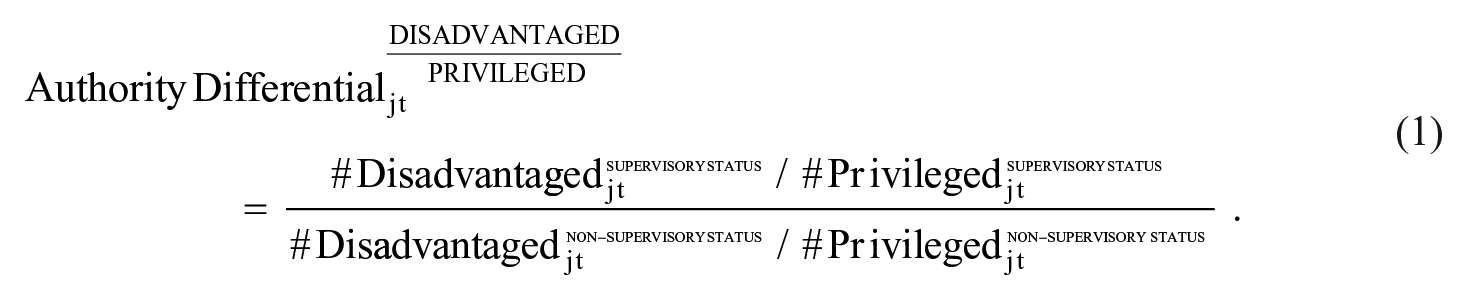
This authority differential measure (
Control Covariates
Overall Descriptive Representation variables are included to ensure that these characteristics are not confounding the authority differential effects of interest. 6 These measures are operationalized as the ratio of women to men total employees, as well as the ratio of minority to non-minority total employees, respectively. The statistical models also account for each respondent’s demographic information including gender, racial/ethnic minority, and supervisory status to control their effects on the evaluations of agency D&I efforts. The findings of previous research have shown that differences in the demographic characteristics significantly affect various types of workplace evaluations (e.g., S. Choi & Rainey, 2014). Gender variable is recorded as 1 for female respondents and 0 for male respondents. Minority variable is measured as 1 for racial/ethnic minority respondents and 0 for racial/ethnic non-minority respondents. Each covariate should be negatively associated with the evaluations of agency D&I efforts since historically marginalized social identity groups should display, on average, less confidence with respect to agency D&I efforts. Lastly, Supervisor variable is defined as 1 for supervisors and 0 for employees in non-supervisory positions. This covariate is expected to yield a positive coefficient, given that those in authority positions are more likely to have favorable agency D&I evaluations than those lacking authority by virtue of their position.
Agency Head Social Identity binary indicator variables are included to control for potential confounding effects attributable to the presence of disadvantaged group administrative leadership on employees’ evaluations of agency D&I efforts. Agency Head Social Identity variables based on gender (Agency Head Gender Identity) and racial/ethnic minority status (Agency Head Minority Identity) are defined as 1 if agency top official(s) serving most months within 12 months prior to FEVS (Federal Employee Viewpoint Survey) in this top position is a woman and racial/ethnic minority, and 0 otherwise. These covariates are hypothesized to exhibit a positive relationship with employee evaluations of agency D&I efforts since employee’s favorable perceptions of agency D&I efforts might be attributable to the presence of a female or racial/ethnic minority top administrative officials, independent of authority differentials between supervisory and non-supervisory personnel.
The statistical models also include covariates that might be correlated with employees’ perceived commitment of agency D&I efforts. Proportion of Professional Employees is simply the natural logarithm of the ratio of professional personnel to the total employees within an agency in a year. 7 Increases in this covariate should be associated with more favorable evaluations of agency D&I efforts since professionals who have more task-related skills and expertise in the workplace are more likely to feel included and respected in their organizations. Also, Organizational Size is measured as the natural logarithm of total agency employment (full-time and non-full-time) within an agency for a given year. This variable should yield a positive coefficient since larger federal agencies may have more resources (e.g., budget, personnel) to foster D&I within the workplace environment.
Empirical Strategy
The relationship between authority differentials and U.S. federal employee D&I evaluations is evaluated by estimating a series of ordinary least squares (OLS) regressions following a log-log elasticity functional form 8 :
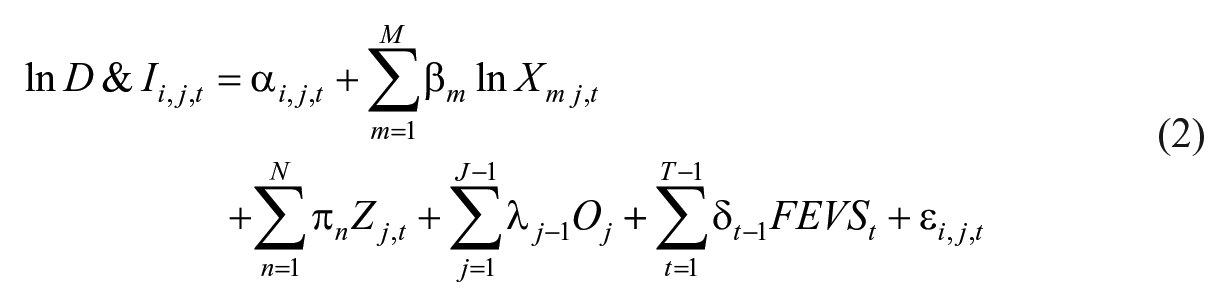
where ln D&I is a logged latent factor score measure of a federal agency employee’s (i) assessment of D&I management efforts within their organization (j) within a given year’s FEVS survey wave (t). The primary covariate vector of interest (Authority Differential) evaluating the gender or racial/ethnic composition of U.S. federal agencies is denoted by Xm and the corresponding parameter vector βm. π represents the parameter vector corresponding to the Zn set of control covariates described above, plus λj–1 and δt–1 represent the respective agency-level (Oj) and time-unit (FEVSt) effects to account for unobserved differences in the latent D&I survey responses that may arise both across U.S. federal agencies and through time based on different FEVS survey repeated cross-sections in each year, plus a residual disturbance term (εi,j,t).
The inclusion of both agency-level and FEVS survey wave unit effects ensures that the estimates reflect differences among employees within agencies for a given survey wave. This model specification ensures that the core relationships of interest are neither confounded by idiosyncratic differences unique to each agency (e.g., organizational cultures, varying hiring and promotion practices, different types of employee qualifications and skills) nor sampling and other temporal-based variations across different FEVS survey waves. This explicit unit effects approach to modeling groupwise heterogeneity is advantageous since it will yield both more conservative and less biased statistical estimates compared to estimating separate random effects (intercepts and/or slopes) for agencies and time/survey waves that may be confounded by both unobserved agency-level and sampling differences. All models are estimated with robust standard errors clustered by agency, which accounts for intra-agency unit dependence among survey respondents. Because authority differential measures are based on objective data that is generated from a different data source than the perception-based dependent variable, common source bias is not a concern here (Favero & Bullock, 2015).
Empirical Evidence
For purposes of brevity, only the regression elasticity (coefficient) estimates are reported involving the primary covariates evaluating the relationship between the gender and racial/ethnic composition of U.S. federal agencies and their employees’ evaluations of the former efforts at fostering D&I within the organizational environment. The full set of regression estimates appears in Table B2 and Table B3, located in the Supplemental Appendix (Appendix B). On average, all supervisor respondents offer more positive agency D&I evaluations compared to non-supervisory respondents. This is hardly surprising given the authority differential between these two classes of federal employees. Yet, neither the gender and race/ethnicity of the agency head nor the overall women and minority descriptive representation predict employee D&I evaluations. These null findings are hardly surprising. Although agency heads exert significant power and influence over policies and administrative direction, these transitory appointees have limited ability to shape workplace and work group dynamics for an overwhelming majority of individual employees within a federal agency. The null findings of overall women and minority descriptive representation support our study’s key premise: what matters for employee evaluations of their own agency’s efforts at fostering D&I is how authority is distributed within an organization based on gender and race, not simply a sheer relative volume of employees with these descriptive characteristics. The proportion of high-skilled professional employees is not correlated with employee D&I evaluations, while organizational size is often positively associated with employee assessments.
Baseline Models
Figure 1 displays the core set of elasticity estimates from four regression models of the form of Equation 2. In this and all subsequent graphs, women authority differential model estimates are denoted in orange symbols corresponding to point estimates, while the race/ethnicity Authority Differential model specifications are denoted in navy blue symbols. Models 1 and 2 evaluate the differential employee survey response regarding fostering D&I with respect to the authority differential measure denoted in Equation 1 predicated on gender and race/ethnicity of U.S. federal agency employees in the left panel of Figure 1. Model 1 reveals that a favorable gender power balance benefitting women is associated with fostering D&I within U.S. federal agencies consistent with H1 for men and women employee respondents alike. The standardized percentage change increase in the authority differential between women (men) in supervisory (non-supervisory) positions and men (women) in non-supervisory (supervisory) positions is associated with a 5.925% (0.152 × 38.864%) average rise in agency D&I efforts perceived by men employees. 9 The gender differential between men and women employees is statistically negligible since it is associated with a −0.006% (–0.00016 × 38.864%) drop in D&I evaluations. Yet, Model 2 (right panel of Figure 1) uncovers a sizable but statistically imprecise relationship is observed for non-minority employees in terms of their connection between the minority to non-minority authority differential (β elasticity estimate = .0522, p = .126), while this estimate is both greater and significantly more favorable for minority employees vis-à-vis non-minority employees (β elasticity estimate = .047, p = .005). H1 is supported only for minority employee D&I evaluations, and hence, is highly contingent upon a disadvantaged group premium (H2) based on minority federal employee respondents.
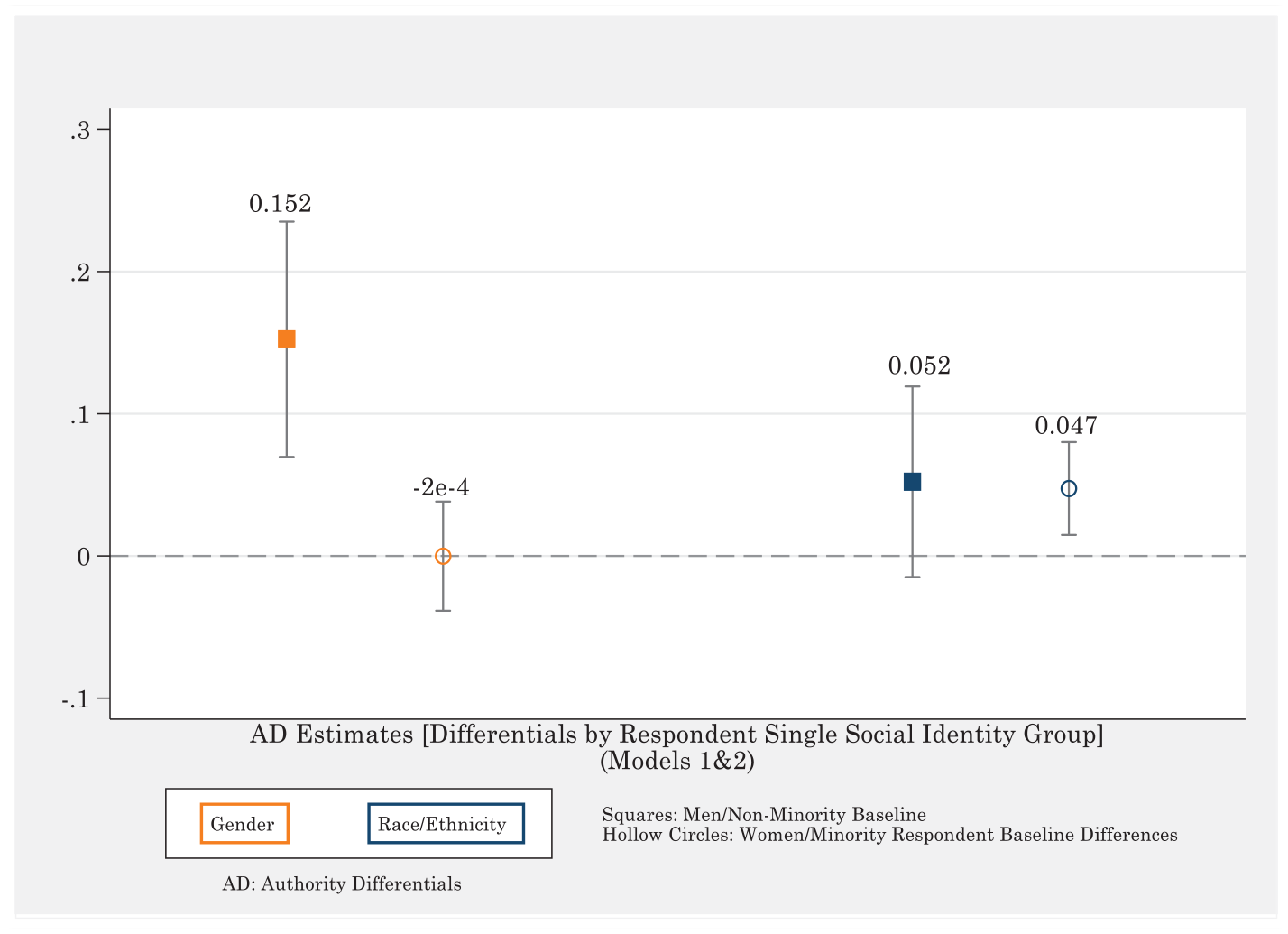
Relationship between authority differentials and D&I employee evaluations (by respondent single social identity group).
Taken together, these findings show clear, albeit conditional support for the importance of authority differentials for federal employees’ evaluations of agency D&I efforts. Homogenous responses to gender power balances arise between women and men federal agency employees when evaluating agency D&I efforts, while minority employees’ D&I evaluations respond more favorably to improving minority power balances than do non-minority employees. This differential response pattern might be attributable to the gap between women and minorities occupying positions holding greater authority within federal agencies (OPM, 2018b), coupled with minorities being disproportionately under-represented in senior-level positions (Lardy, 2021; H1: Baseline Authority Differential Hypothesis: Supported).
Figure 2 displays the authority differential estimates broken down into intersectionality classifications of Men/Non-Minority (Baseline), Non-Minority Women/Minority Men, and Minority Women respondents in the gender and race/ethnicity authority differential models (see Supplemental Table B2: Models 3 and 4), respectively. 10 Parsing respondents by gender into finer intersectional distinctions based on gender-race/ethnicity combinations suggests that improving the balance of power for women vis-à-vis men within federal agencies is associated with roughly identical D&I employee evaluations. The baseline estimate for men and non-minority men respondents are effectively identical to one another based on Models 1 and 3 (Model 1: βMen elasticity estimate = .152, p < .001; Model 3: βNon-Minority Men elasticity estimate = .153, p < .001) consistent with H1 per the left panel of Figure 2. Although the authority differential estimates for non-minority women and minority women neither differ from this baseline estimate (βNon-Minority Women elasticity estimate differential = −.003, p = .875; βMinority Women elasticity estimate differential = .012, p = .595) nor differ from one another (βMinority Women − βNon-Minority Women elasticity estimate differential = .015, p = .402). These uniform responses reject the Disadvantaged Group Premium Authority Differential Hypothesis (H2) since a consistent relationship is obtained between men and women federal employee evaluations of agency D&I efforts, as well as for intersectional groups comprised of minority women employees.
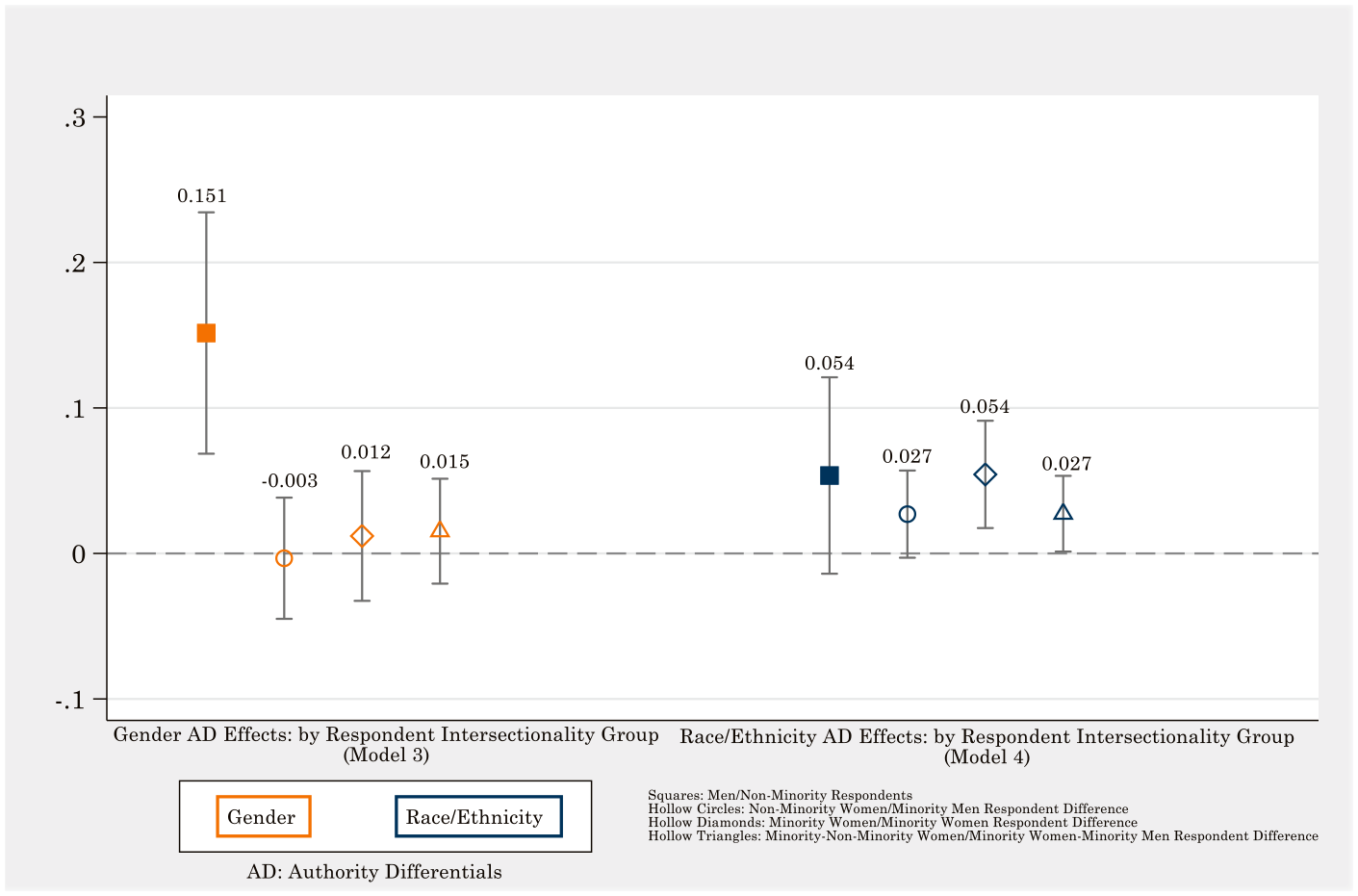
Relationship between authority differentials and D&I employee evaluations (by respondent intersectional social identity group).
The empirical patterns on the right panel of Figure 2 (Model 4) involving race/ethnicity status-group power imbalances reveal clear intersectionality differences consistent with the Disadvantaged Group Premium Authority Differential Hypothesis (H2). Non-minorities do not view improving authority differentials as contributing to improving agency D&I efforts (βNon-Minority Men elasticity estimate = .053, p = .119). However, minority men and minority women each have a significantly more sanguine view of how improving authority differentials favoring minority employees offers some improvement in agency D&I efforts compared to non-minority employees offer (βMinority Men elasticity estimate differential = .027, p = .077; βMinority Women elasticity estimate differential = .054, p = .004), with minority women employees making a stronger connection between authority differentials and fostering a diverse and inclusive agency environment than compared to minority men employees (βMinority Women − βMinority Men elasticity estimate differential = .027, p = .040). The standardized percentage change increase in this minority authority differential effect is associated with a modest 2.155% (0.054 × 39.655%), rise in minority women respondents’ D&I evaluations compared to the non-minority baseline effect. This is higher by a factor differential of 2.010 (2.155%/1.072%) compared to minority men respondents’ difference in relation to the non-minority baseline.
Both the numerical estimates and statistical inferences offer clear evidence of the importance associated with gender-based authority differentials for fostering D&I evaluations among federal employee respondents, regardless of gender or race/ethnicity. This evidence is consistent with H1. Although improving the minority authority differential is associated with improving D&I evaluations for only minority employees, these substantive effect sizes are considerably smaller compared to gender authority differential effects. These distinct effect sizes between gender and minority authority differentials cannot be attributed as an artifact due to dissimilar empirical distribution functions for each measure (MeanGender Authority Differential = 0.715, MeanMinority Authority Differential = 0.723; Standard DeviationGender Authority Differential = 0.133, Standard DeviationMinority Authority Differential = 0.145). This finding reflects a consensus among federal employees on the role of gender-based authority differentials with respect to improving D&I (H2: Disadvantaged Group Premium Authority Differential Hypothesis: Partially Supported).
Although these empirical findings are important for understanding how personnel composition can contribute to fostering diversity and inclusion within public organizations, it remains unclear whether these findings are driven by evaluations made by those agency employees holding supervisory authority or instead by non-supervisory agency personnel. Next, these issues are analyzed by estimating models that disaggregate these authority differential effects by both gender and racial/ethnic groups of respondents, and also by distinctions between non-supervisory versus supervisory agency personnel.
Authority Differential Effects Between Non-Supervisor and Supervisor Respondents
Now, we turn our attention to evaluating whether authority differential effects on employee D&I evaluations differ between non-supervisory and supervisory respondents. These authority differential estimates that distinguish between status-group position of employee respondents appear below in Figures 3 (non-supervisory respondents) and 4 (supervisory respondents), respectively. 11 The orange-colored set of point estimates once again reveals that gendered authority differential effects provide both consistent and statistically meaningful associations with agency employee D&I evaluations across both gender and intersectional respondent model specifications (Supplemental Table B3: Models 5 and 7). Moreover, these authority differential effects on employee D&I evaluations do not systematically vary by gender, race/ ethnicity, or the corresponding intersectional identity groups for both non-supervisory (Figure 3) and supervisory (Figure 4) personnel based on the modest and statistically indiscernible differential effects (see orange-colored point estimates displayed to the right of the baseline estimates for Men respondents in Figures 3 and 4). Interestingly, the baseline and various disadvantaged group respondents are noticeably higher for supervisors (e.g., βMen Supervisor elasticity estimate = .194/.193, p < .001/.001) than non-supervisors (βMen Non-Supervisor elasticity estimate = .137/.136, p = .003/.003). Those in supervisory positions view improving gendered authority differential as being more effective at fostering diversity and inclusion compared to those lacking such authority within federal agencies.
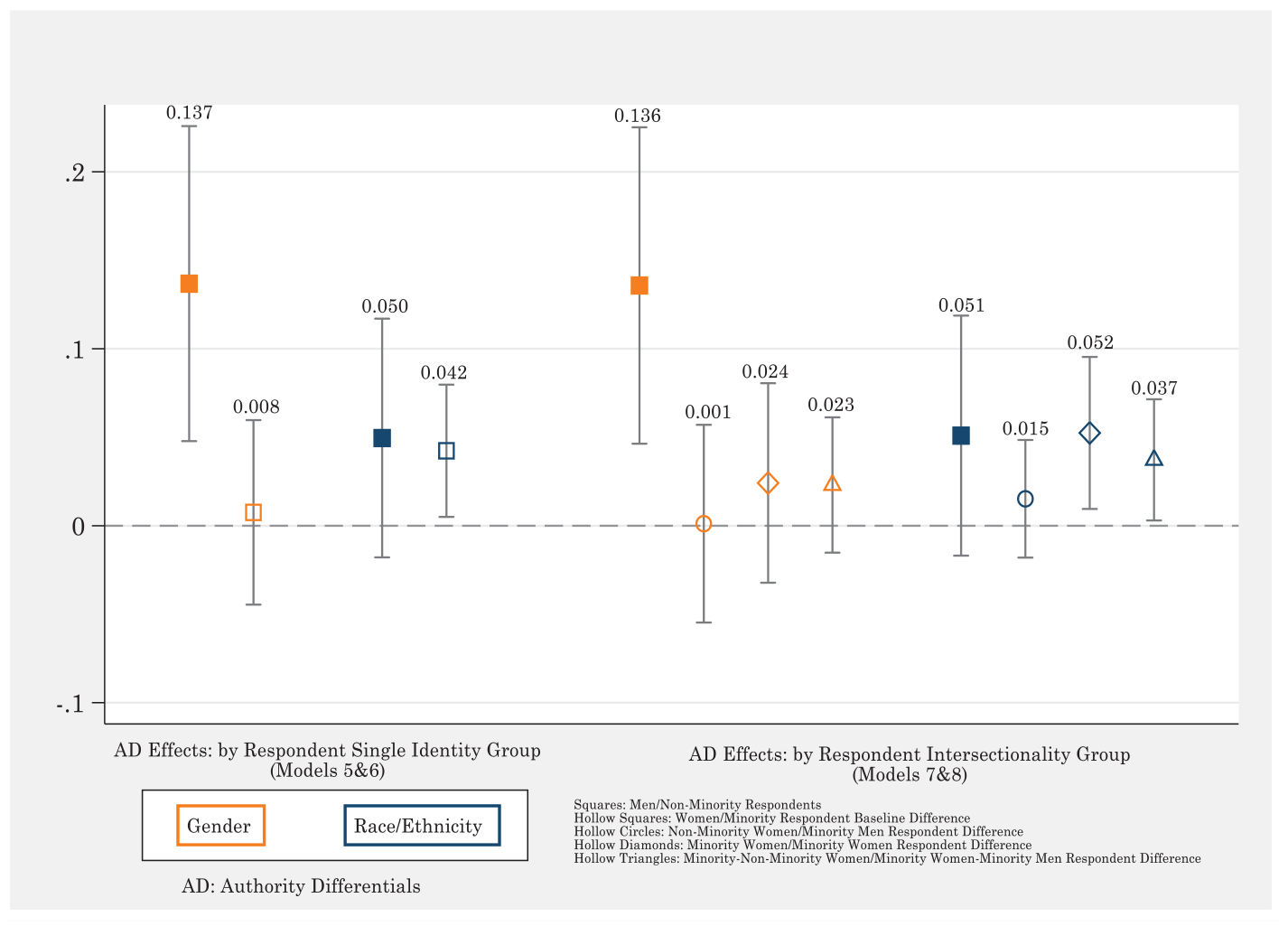
Relationship between authority differentials and D&I employee evaluations (non-supervisory respondents: single and intersectional social identity group).
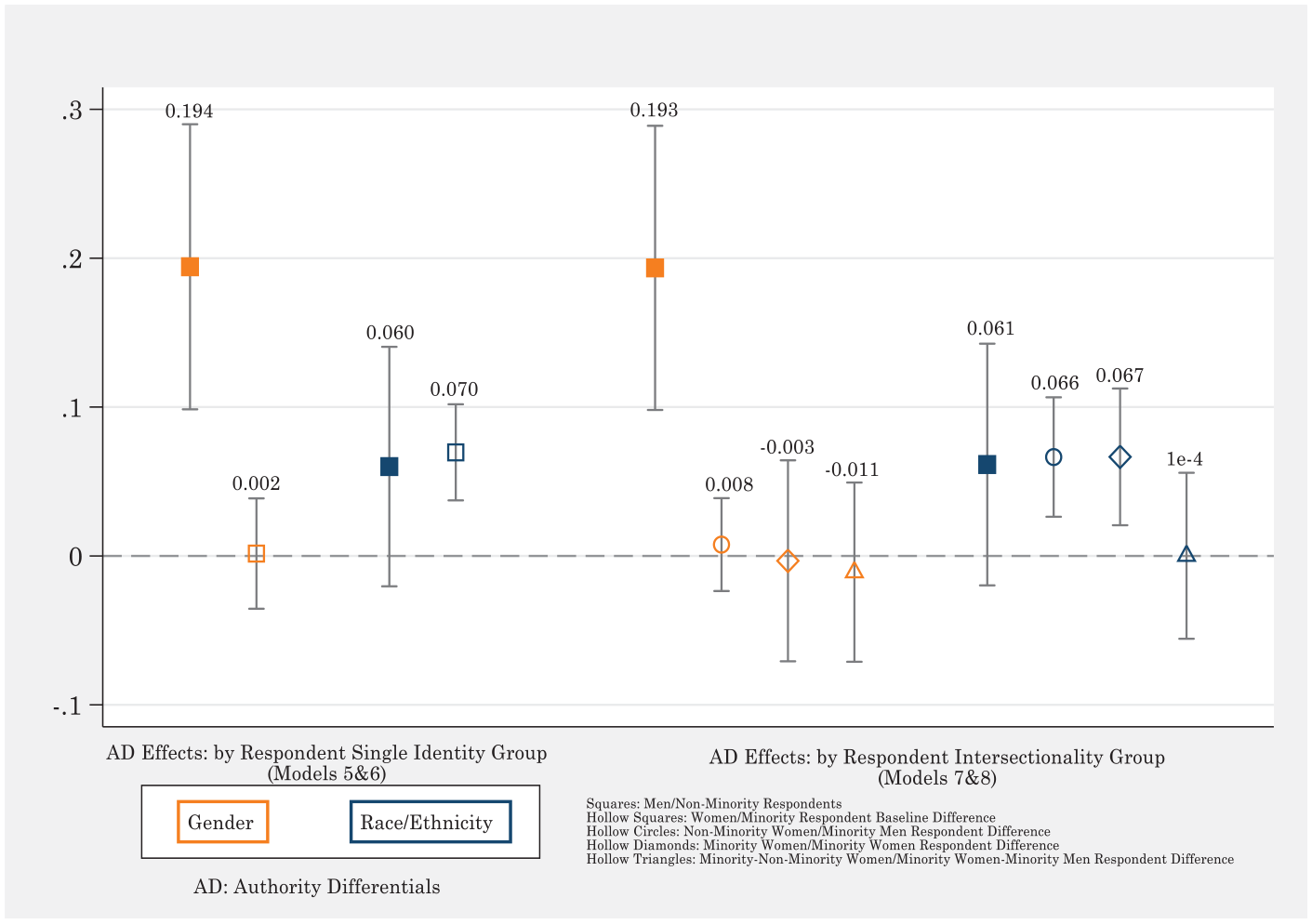
Relationship between authority differentials and D&I employee evaluations (supervisory respondents: single and intersectional social identity group).
In the left-hand panels of Figures 3 and 4 (Supplemental Table B3: Model 6), the navy blue-colored set of point estimates uncover statistically significant disadvantaged group premium for both minority non-supervisors (βMinority Non-Supervisor elasticity estimate differential = .042, p = .027) and supervisors (βMinority Supervisor elasticity estimate differential = .070, p < .001). These disadvantaged group premium differentials displayed in the left panel of Figures 3 and 4 (Supplemental Table B3: Model 6) represent a 1.669% (0.042 × 39.405%) and 2.866% (0.070 × 41.477%) standardized percentage change difference in the minority versus non-minority respondent authority differential relationship with respect to D&I evaluations, respectively. These authority differential effects observed between minority supervisory and non-supervisory personnel (see left panel of Figures 3 and 4) are notable, albeit estimated with some nontrivial imprecision (βMinority Supervisor − βMinority Non-Supervisor elasticity estimate differential = .027, p = .121). The intersectional respondent model estimates (Supplemental Table B3: Model 8) highlight a critical distinction between supervisory and non-supervisory respondents’ views of how minority authority differentials are associated with their D&I evaluations. In Figure 3 (right-hand panel), only minority women non-supervisors exhibit significantly larger minority authority differential effects compared to the non-minority non-supervisor baseline null effects (βMinority Women Non-Supervisor elasticity estimate differential = .052, p = .017) by a 2.066% (0.052 × 39.405%) standardized percentage change in the minority authority differential. Moreover, minority women non-supervisors exhibit marginally significant larger minority authority differential effects compared to minority men counterparts (βMinority Women Non-Supervisor – Minority Men Non-Supervisor elasticity estimate differential = .037, p = .033) – a 1.466% (0.037 × 39.405%) standardized percentage change effect. Yet, such intersectional group differences dissipate between minority women and minority men holding supervisory positions within U.S. federal agencies. Although Figure 4 reveals that both men and women minority supervisors clearly make a stronger connection between minority authority differentials within their agencies than non-minority supervisor colleagues (βMinority Men –Supervisor elasticity estimate differential = .066, p = .001; βMinority Women Supervisor elasticity estimate differential = .067, p = .005), albeit this difference is trivial (βMinority Women Non-Supervisor – Minority Men Non-Supervisor elasticity estimate differential = .0001, p = 0.997).
Summary of Ancillary and Sensitivity Analyses
The data are analyzed in a variety of additional ways reported in the Supplemental Appendix. Supplemental Appendix D employs an alternative, partial measure of authority differential that only incorporates the natural logarithm of the ratio of disadvantaged group supervisors to disadvantaged group non-supervisors, thus excising these proportions for privileged group (men and non-minorities) agency personnel incorporated into the measure characterized by Equation 1. Because these alternative authority differential measures purge the relative balance of agency positions held by men and non-minority employees, they lack a reference group, and hence, overstate the balance of power deficit experienced by women and minority federal agency employees. 12 As a result, these supplementary findings yield not only smaller authority differential estimates for all employees, but also more modest gender and racial/ethnic minority respondent differences associated compared to those reported in the manuscript.
In addition, both ancillary and sensitivity analyses of these data are undertaken to evaluate potential sources of heterogeneity associated with authority differential effects reported here (Supplemental Appendix F and H), as well as alternative explanations of these employee evaluations relating to fostering D&I within their federal agencies (Supplemental Appendix E, G, and I). The ancillary analyses of these data in Supplemental Appendix F reveal that the relationship between minority authority differentials and D&I evaluations is stronger during the Obama presidency compared to the Trump presidency. Such presidential differences are primarily the result of non-minority (and especially minority women) federal employee respondents serving in non-supervisory positions.
Ancillary analyses evaluating differential authority differential effects based on the gender and race/ethnicity of the top administrative official examine whether these conditions are associated with a positive salutary conditioning effect on the statistical relationship between authority differentials and employee D&I evaluations (see Supplemental Appendix H). Evidence consistent with these authority differential differentials predicated on a minority top agency official is observed for both minority employees (especially minority women employees), serving in non-supervisory agency positions. Oddly, women employees’ D&I evaluations are less anchored to gender authority differentials compared to those of men employees. One plausible explanation for these findings might be that women employees are more sensitive to multiple identities or self-schema than men, and thus the gender identity of women employees does not affect their organization’s D&I evaluations much (Fernandez et al., 2013, p. 117).
An alternative latent employee evaluation measure is employed as a dependent variable that taps into the broader concept of organizational justice. These results appearing in Supplemental Appendix E are substantively consistent with the reported findings, thus exhibiting convergent validity with our reported D&I measure. Sensitivity analyses reported in Supplemental Appendix G involving the omission of the supervisory descriptive representation control covariate, as well as extreme-valued “above parity” authority differential observations, produce statistical estimates and inferences that are substantively identical to those reported here. Statistical models accounting for contagion effects between social identity groups (see Supplemental Appendix I) yield authority differential estimates similar to those reported in the manuscript, except for the more conservative and imprecise elasticity estimate differential between minority women non-supervisor and minority men non-supervisor respondents. Finally, a series of differences in means tests rejects social desirability bias reflected by D&I employee evaluations insofar that disadvantaged group respondents (women and minority U.S. federal government employees) will naturally tend to have an equal, or perhaps more sanguine view of agency D&I efforts compared to privileged group respondents (men and non-minority U.S. federal government employees). Instead, the evidence suggests that disadvantaged group respondents have a noticeably more skeptical view of their agency’s D&I efforts compared to privileged group respondents, regardless of authority differentials, as well as whether they serve in either supervisory or non-supervisory positions (see Supplemental Appendix J).
Implications
Normative theories of representation applied to governance problems presume that sufficient numbers or proportions of disadvantaged group members are required to ensure that collective decisions reflect their group-based interests (e.g., Krislov, 1974; Mosher, 1968; Pitkin, 1967; cf. Guinier, 1994). Although this is a sensible approach for analyzing the relationship between citizens and government officials (e.g., Meier & Nicholson-Crotty, 2006; Nicholson-Crotty et al., 2016), it is not ideally suited for analyzing social equity within public organizations where power is asymmetrically distributed via hierarchies.
This study yields several insights into the study of diversity and human resource management within the field of public administration. First, it advances a comprehensive measure of the authority differentials within public sector organizations that encompasses both supervisory and non-supervisory positions. This feature is critical since this measure depicts the full distribution of formal power within public organizations. Past research either aggregates both types of positions (e.g., Andrews & Ashworth, 2015; H. Choi et al., 2018) or only focuses on supervisory positions (e.g., Riccucci, 2009; Smith & Monaghan, 2013) to depict the composition of public sector organizations based on gender or race/ethnicity. The measure of authority differentials employed in this study is used to explain employee evaluations regarding social equity within public sector organizations. This study has sought to elucidate the precise nature of how authority differentials affect employee sentiments regarding social equity within public sector organizations. Examining the authority differentials experienced by disadvantaged group members offers insight into the dynamics of the modern U.S. administrative state since it takes seriously the importance of power asymmetries within organizations affecting historically marginalized groups within American society. For example, Ashikali et al. (2021) highlight the importance of inclusive leadership in positively moderating the link between team diversity and an inclusive climate. Although leadership style is a critical ingredient for fostering a diverse and inclusive organizational environment, the findings from our study underscore that enhancing the legitimacy of historically marginalized groups working within public sector organizations requires a favorable distribution of authority for these groups. The importance of improving authority differentials as an organizational solution for addressing diversity and inclusion challenges within U.S. federal agencies is compatible with Jane Mansbridge’s (1998, 2015) admonition that effective conversion of descriptive representation into substantive (policy) representation requires that historically disadvantaged groups go merely beyond numbers, but more importantly, attain positions of authority within government for purposes of achieving de facto legitimacy associated with government decisions. This effect on legitimacy can further foster citizen cooperation and ultimately lead to the co-production of more effective policy outcomes (Riccucci & Van Ryzin, 2017). The present study further validates the role of strategic human resource management in accomplishing agency mission (e.g., Lim et al., 2017) by demonstrating how the relative distribution of authority within organizations through recruitment and promotion practices may shape employees’ perceptions of agency D&I effort. On a practical level, improving authority differentials in favor of women and minorities within the U.S. federal civilian workforce can serve as one critical element of a multi-faceted strategy designed to facilitate the meeting of workforce diversity goals laid out not only by both the U.S. Merit Systems Protection Board and U.S. Office of Personnel Management (OPM, 2011, 2018b; MSPB, 2011), but also codified in Executive Orders 13583 and 14035.
Unfortunately, certain issues remain beyond the scope of the present study. Since this study simply takes relative authority differentials “as given” to examine how these considerations shape employees’ views of agency D&I efforts, it is incapable of addressing the sources of these relative authority differentials, such as implicit discrimination within organizations or differences regarding employee qualifications, or organizational values related to an agency’s mission. Therefore, this study is limited insofar as it cannot distinguish between alternative rationales for the exercise of organizational authority—whether they are legitimate or illegitimate—reflected in our authority differential measures. Disentangling the sources of such authority is worthy of investigation in future research on this topic. Further, the scope conditions of this study are limited to addressing the role that these authority differentials play in shaping employee evaluations regarding how they view their agency’s efforts at fostering both a diverse and inclusive organizational environment. Also, this study focuses solely on a single mechanism, authority differentials, to demonstrate a systematic relationship between the gender, racial composition of authority differentials and employee evaluation of agency D&I efforts, while acknowledging that power dynamics in public organizations can be influenced by other factors, such as rule abidance or interpersonal relationships (e.g., Portillo & DeHart-Davis, 2009; Ragins & Sundstrom, 1989). Nonetheless, if women and minorities cannot attain formal positions of authority within public sector organizations, they are also more likely to be denied opportunities to access other means of power as well (Lewis, 2000).
Supplemental Material
sj-docx-1-rop-10.1177_0734371X241286176 – Supplemental material for Improving Social Equity Within Public Organizations: Authority Differentials as Reference Points for Fostering Diversity and Inclusion Within U.S. Federal Agencies
Supplemental material, sj-docx-1-rop-10.1177_0734371X241286176 for Improving Social Equity Within Public Organizations: Authority Differentials as Reference Points for Fostering Diversity and Inclusion Within U.S. Federal Agencies by George A. Krause and Jungyeon Park in Review of Public Personnel Administration
Footnotes
Acknowledgements
We thank Inkyu Kang, Hal G. Rainey, Rebecca Reid, Gregg Van Ryzin, Eva Witseman, and ROPPA reviewers for constructive feedback. All errors and omissions remain our own.
Author Note
Earlier versions of this paper were presented at the 2022 Public Management Research Conference, Phoenix, AZ, May 26–28, 2022; and 2022 Southern Political Science Association. Replication file materials for this article are located at both authors’ Harvard Dataverse page: George A. Krause Data Replication Materials Dataverse (https://doi.org/10.7910/DVN/MEUUUV), Jungyeon Park Data Replication Materials Dataverse ( ).
).
Declaration of Conflicting Interests
The author(s) declared no potential conflicts of interest with respect to the research, authorship, and/or publication of this article.
Funding
The author(s) received no financial support for the research, authorship, and/or publication of this article.
Supplemental material
Supplemental material for this article is available online.
Notes
Author Biographies
References
Supplementary Material
Please find the following supplemental material available below.
For Open Access articles published under a Creative Commons License, all supplemental material carries the same license as the article it is associated with.
For non-Open Access articles published, all supplemental material carries a non-exclusive license, and permission requests for re-use of supplemental material or any part of supplemental material shall be sent directly to the copyright owner as specified in the copyright notice associated with the article.
