




Abstract
Innovation is crucial for public organizations to adapt to changing circumstances. While successful innovation requires employees both to explore new ideas and to exploit current processes, such innovative work behavior is often bounded by constraints, both situational and personal. This study examines individual-level constraints on innovation by focusing on cognitive uncertainty as a personal state that may affect innovative work behavior. Using a quantitative daily diary study among public professionals in the Netherlands (n = 88 respondents and 369 diary entries), the analysis identifies a positive relationship between daily cognitive uncertainty experiences and daily employee innovative work behavior. However, this relationship is only present when employees perceive substantial support from their team leader. This support takes the form of ambidextrous leadership, which mirrors the duality of the innovation process and is shown to be most effective in stimulating innovative work behavior and in managing cognitive uncertainty in stimulating innovation.
Keywords
Introduction
Innovation is crucial for public organizations, as it is an important source of legitimacy (Verhoest et al., 2007) and it can contribute to improving the quality of public services (De Vries et al., 2016). Therefore, public administration scholars have paid significant attention to identifying the factors driving or constraining the innovative behavior of employees. Research has so far mainly focused on insufficient financial resources (Singla et al., 2018; Van der Voet, 2019), formalization and red tape (Jaskyte, 2011; Moon & Bretschneiber 2002), and organizational structure (Y. Kim, 2010; Walker, 2008) as the structural antecedents of public sector innovation. In addition, we know that leadership behavior and leader activities of both direct supervisors and top managers and politicians play an important role in stimulating innovative work behavior of employees (e.g., Demircioglu et al., 2023; Demircioglu & Van der Wal, 2022; Gullmark, 2021; S. Kim & Yoon, 2015).
However, literature on the individual-level antecedents of innovation is relatively still in its infancy (Bonesso et al., 2014; Rosing & Zacher, 2017; Zacher & Wilden, 2014). Based on a recent literature synthesis on public sector innovation capability (Gullmark & Clausen, 2023), we can conclude that public sector research on the individual-level antecedents of innovation mainly focuses on pro-active personality (Giebels et al., 2016; Suseno et al., 2020) or entrepreneurial orientation (Gullmark, 2021; Swann, 2017) of individuals. In addition, we know from the general management sciences that other individual characteristics such as professional competences and work attitudes impact innovative work behavior (Bonesso et al., 2014). However, as all innovations are essentially driven by people (Dimand et al., 2023), it is important for public human resource management (HRM) scholars and practitioners to gain a better understanding of how individual’s cognitive states relate to innovative work behavior. In addition, we currently know little about how antecedents at different levels interact in impacting innovative work behavior (Gullmark & Clausen, 2023).
This article therefore aims to increase our understanding of individual level constraints on innovation by focusing on cognitive uncertainty as a personal state that may affect innovative work behavior and examining to what extent leadership of frontline managers can impact this relationship, thereby showing how HRM practices matter for innovative work behavior. Cognitive uncertainty can be defined as “experiences of incomplete, unclear or conflicting information in the employee’s work” (Bernards, 2023, p. 3). Cognitive uncertainty abounds in the public sector and may be caused by ambiguous goals, task complexity, multiple stakeholders, and unpredictability in interactions with clients (Boyne, 2002; Hood, 1991; Lipsky, 1980). As such, it may profoundly influence public sector employees’ innovative work behaviors. Where previous research often emphasizes the detrimental effects of cognitive uncertainty through impeding rational decision-making and reducing employees’ motivation, effectiveness, and performance (Locke & Latham, 2013; March & Simon, 1958; Simon, 1976), we hypothesize that it may positively impact innovative work behavior, as it provides employees with the interpretative space needed for new and different ideas to emerge (see also: Brun & Sætre, 2009).
In addition, we expect that this relationship is profoundly influenced by the leadership behaviors of team leaders. Leadership is a key factor in supporting employees to manage their work context (Shamir & Howell, 1999) and, therefore, the relationship between cognitive uncertainty and innovative work behavior may depend on how cognitive uncertainty is managed by leaders. The research question of this study therefore is: How do daily cognitive uncertainty experiences and ambidextrous leadership of team leaders impact daily employee innovative work behavior?
By answering this question, this study contributes to the literature on public sector innovation and the HRM knowledge base in three different ways. First, this study extends the literature on public sector innovation, which to date has had limited attention to individual-level constraints on innovation as compared to structural antecedents (but for exceptions, see e.g. Giebels et al., 2016; Gullmark, 2021; Suseno et al., 2020; Swann, 2017). By showing that cognitive uncertainty as a personal state relates to higher levels of innovative work behavior, this paper contributes to a greater understanding of the HRM process as it shows how personal characteristics of employees impact their innovative work behavior.
Second, this study contributes to the HRM knowledge base by showing that the ambidextrous leadership of team leaders positively impacts employee innovative work behavior. Innovation is multifaceted and requires seemingly contradictory behaviors: the exploration of new and useful ideas and the exploitation of current processes (March, 1991). Ambidextrous leadership mirrors the duality of the innovation process by combining opening behaviors, aimed at exploring new ideas, and closing behaviors, aimed at exploiting current processes (Rosing et al., 2011; Zacher & Wilden, 2014). This is important, as these two processes are seen as synergistic as new ideas are needed to refine current processes and, for new ideas to become effective in the organization, they need to be turned into routines (Gebert et al., 2010; Zacher & Wilden, 2014). Despite much scholarly attention for the relationship between leadership and innovative work behavior, focusing for instance on transformational leadership (Günzel-Jensen et al., 2018; Hansen & Pihl-Thingvad, 2019; S. Kim & Yoon, 2015), charismatic leadership (Gullmark, 2021), inclusive leadership (Siyal et al., 2021), facilitative leadership (Jung & Lee, 2016), and supportive leadership (Demircioglu & Van der Wal, 2022), this duality has so far been mostly neglected in the literature on public sector innovation and HRM (notable exceptions being: Kousina & Voudouris, 2023; Kung et al., 2020; Tuan, 2017). From an HRM-perspective, this means that it is important to either select leaders who hold competences that enable them to simultaneously implement opposing action strategies or to train them in acquiring these competences.
Third, in the current literature on public sector innovation the interactions between different antecedents of innovative work behavior have been understudied (De Vries et al., 2016; Gullmark & Clausen, 2023). These interactions are, however, important as different types of antecedents of innovative work behavior may strengthen each other. For instance, Suseno et al. (2020) show that an individual factor (proactive personality) can strengthen the positive effect of organizational design (task characteristics) on innovative work behavior. This study contributes to the literature on public sector innovation by showing how ambidextrous leadership moderates the relationship between cognitive uncertainty and innovative work behavior. As such, it shows how different types of antecedents of the innovation process combine and strengthen each other.
The remainder of this article is structured as follows. It starts with conceptualizing innovative work behavior and presenting the theoretical case for the hypothesized relationship between cognitive uncertainty, ambidextrous leadership, and innovative work behavior. This is followed by the methodology and justification of the selected case. Subsequently, a multilevel regression analysis is used to test the hypotheses. In the final section, the findings are discussed and related to the existing literature, and the implications of our study for future research and for practice are highlighted.
Theory and Hypotheses
Innovative Work Behavior
While innovation is defined as “the adoption of an existing idea for the first time by a given organization” (De Vries et al., 2016, p. 152, based on Rogers, 2003), innovative work behavior refers to the behavior of individuals within a given organization. As such, it can be defined as “the intentional generation, promotion, and realization of new ideas within a work role, work group or organization, in order to benefit the role performance, the group or the organization” (Janssen, 2000, p. 348).
Both innovation and innovative work behavior require a combination of the exploration of new and useful ideas and the exploitation of current processes (March, 1991). It is important to combine exploration and exploitation since these two processes are expected to be synergistic: exploration provides input for exploitation by generating new and useful ideas that can be used to refine current processes, and exploitation ensures that the new and useful ideas generated through exploration become integrated in organizational processes (Zacher & Wilden, 2014). This combination of exploration and exploitation is not only important on the organizational level of innovation, both managers (Mom et al., 2007) and employees (Rosing & Zacher, 2017) need to combine these behaviors as well for organizations to innovate. Given these synergistic effects, this article does not hypothesize on explorative and exploitative behavior separately, but rather on their combination, labeled innovative work behavior (Gibson & Birkinshaw, 2004; He & Wong, 2004; Kobarg et al., 2017).
Cognitive Uncertainty and Innovative Work Behavior
Cognitive uncertainty can be conceptualized as experienced incomplete, unclear, or conflicting information in an employee’s work (Bernards et al., 2021). It is a much-studied concept in various literature streams including those on bureaucracy (Weber, 1922; Gajduschek, 2003), organizational behavior (March & Simon, 1958; Simon, 1976), and goal setting (Locke & Latham, 2013). Much of this literature emphasizes the detrimental effects of cognitive uncertainty through impeding rational decision-making and reducing employees’ motivation, effectiveness, and performance (Locke & Latham, 2013; March & Simon, 1958; Simon, 1976). However, the literature also points to potential benefits of cognitive uncertainty, especially regarding creative thinking and innovative work behavior (Griffin & Grote, 2020; Michel, 2007). As the public administration literature has, so far, not paid attention to cognitive uncertainty as an antecedent of innovative work behavior (De Vries et al., 2016; Gullmark & Clausen, 2023), literature from the fields of organizational science, change management, and entrepreneurship and business management is used to build the theoretical argument.
First, from the organizational science literature (Burns & Stalker, 1961; Michel, 2007) and the public administration literature on organizational structure (Y. Kim, 2010; Walker, 2008), one might expect cognitive uncertainty to be associated with higher levels of innovative work behavior. Scholars in organizational science were the first to show that, by inducing cognitive uncertainty, employees could be stimulated to innovate (Burns & Stalker, 1961). Here, cognitive uncertainty is the result of deliberately leaving situations open and ambiguous, such as by deregulation, decentralized decision-making, and abandoning clearly assigned roles for employees (Burns & Stalker, 1961). Subsequent research in a public sector context finds further support for the relationship between more organic ways of organizing, that embrace uncertainty, and innovative work behaviors (Y. Kim, 2010; Walker, 2008). Y. Kim (2010, p. 80) even shows that, of all organizational characteristics, structural flexibility has the strongest effect on promoting innovative behaviors in state governments. Flexible organizational structures allow for rather than suppress cognitive uncertainty in the form of open and ambiguous situations and thus provide employees with the interpretative space needed for new and different ideas to emerge (Brun & Sætre, 2009). This interpretive space does not provide strong cues for employees on how to act, thereby providing opportunities to deviate from current practices and adopt innovative work behaviors that give rise to new and creative ideas (Jensen, 2011).
Similarly, literature in the field of change management shows that managers can strategically use cognitive uncertainty to make people feel slightly uncomfortable to create change (Heifetz et al., 2009). This can also inform us on the relationship between cognitive uncertainty and innovative work behavior. Cognitive uncertainty from this perspective can be seen as provoking employees to abandon current practices and discover new approaches or experiment with new methods (Michel, 2007). Cognitive uncertainty over how to act in a given situation thus prevents cognitive stagnation: it forces employees to break through existing patterns of thinking and look beyond conventional ways of working and, as such, stimulates innovation (Lu et al., 2017). Here, innovation is seen as a way to cope with cognitive uncertainty: the cognitive uncertainty over what behaviors are expected or appropriate leads employees to experiment with new approaches.
This line of argument is also seen in the literature on entrepreneurship and business management. For instance, Alvarez et al. (2020) show, in the emerging king crab industry in the United States, how uncertainty, which they characterize as incomplete, unusable, or lacking knowledge, induces a trial-and-error approach in entrepreneurs. This trial-and-error approach involves experimenting with diverse ideas and a learning orientation and thus brings about innovation (Alvarez et al., 2020). Similar examples are found in Google’s chaos by design (Lashinsky, 2006) where employees are deliberately given very few information cues in order to induce cognitive uncertainty and stimulate innovation, and at Apple Computers (Walker, 2003) where hardware engineers, software engineers, industrial designers, and other technicians worked together with little or no information regarding what to do or how to do it and came up with radical innovations including the Apple iPod. Despite the entrepreneurial innovation context differing substantially from that of public sector innovation, because there is much less room for error in the public sector when working with vulnerable clients, these perspectives do suggest how the absence of clear information may lead to creative ideas and innovation. This argument combined with what is known from the organizational science and change management fields leads to the first hypothesis:
H1: Daily cognitive uncertainty experiences are positively associated with daily innovative work behavior.
The Role of Leadership
The focus of this study is on ambidextrous leadership since this mirrors the duality of the innovation process (Gebert et al., 2010). Ambidextrous leadership is expected to stimulate innovative work behavior by combining opening behaviors, aimed at stimulating the generation of new ideas, and closing behaviors, aimed at stimulating the refinement of current processes (Kousina & Voudouris, 2023; Rosing et al., 2011; Zacher & Wilden, 2014). Although it may seem paradoxical to combine seemingly opposing behaviors, it has been argued that the combination of opening and closing behaviors yields substantial complementary and synergistic effects that are not generated when either of these strategies are implemented alone (Gebert et al., 2010). The logic is that the generation of new ideas, stimulated by opening behaviors, provides impetus for the refinement of current processes and that this then, stimulated by closing behaviors, encourages the utilization of new and creative ideas (Zacher & Wilden, 2014). As such, ambidextrous leadership acknowledges the paradoxes and tensions that employees experience themselves when innovating (Kung et al., 2020) and it is thus expected to stimulate their innovative work behavior. This leads to the second hypothesis:
H2: Ambidextrous leadership of team leaders is positively associated with innovative work behavior.
Besides a direct effect on innovative work behavior, it can also be expected that ambidextrous leadership impacts the relationship between cognitive uncertainty and innovative work behavior. Leadership plays a key role in supporting employees to effectively manage the context of their work (Shamir & Howell, 1999). As such, it may have an important role in enhancing the daily relationship between cognitive uncertainty and innovative work behavior. Situational strength theory (Mischel, 1977) suggests that ambidextrous leadership is especially effective in stimulating innovative work behavior in situations where professionals experience high levels of cognitive uncertainty. These situations are considered psychologically weak, as they are unstructured and lack clear expectations regarding employees’ responses. They contrast with psychologically strong situations characterized by low levels of cognitive uncertainty, high structure, and consistent employees’ expectations regarding appropriate behavior. When there are few cues as to what constitutes appropriate or potentially effective behavior in psychologically weak situations, there is a greater opportunity for leadership: employees are more susceptible to leadership that provides guidance and direction for their behavior in such situations (Shamir & Howell, 1999). That is, with high levels of ambidextrous leadership, professionals are expected to innovate more, especially if experiencing high levels of cognitive uncertainty. This leads to the third hypothesis:
H3: Ambidextrous leadership positively moderates the relationship between daily cognitive uncertainty experiences and daily innovative work behavior.
The theoretical expectations are summarized in Figure 1. In this figure we use the concept innovative work behavior to refer to the combination of explorative and exploitative behavior and we use the concept ambidextrous leadership behavior to refer to the combination of leader opening and closing behavior.
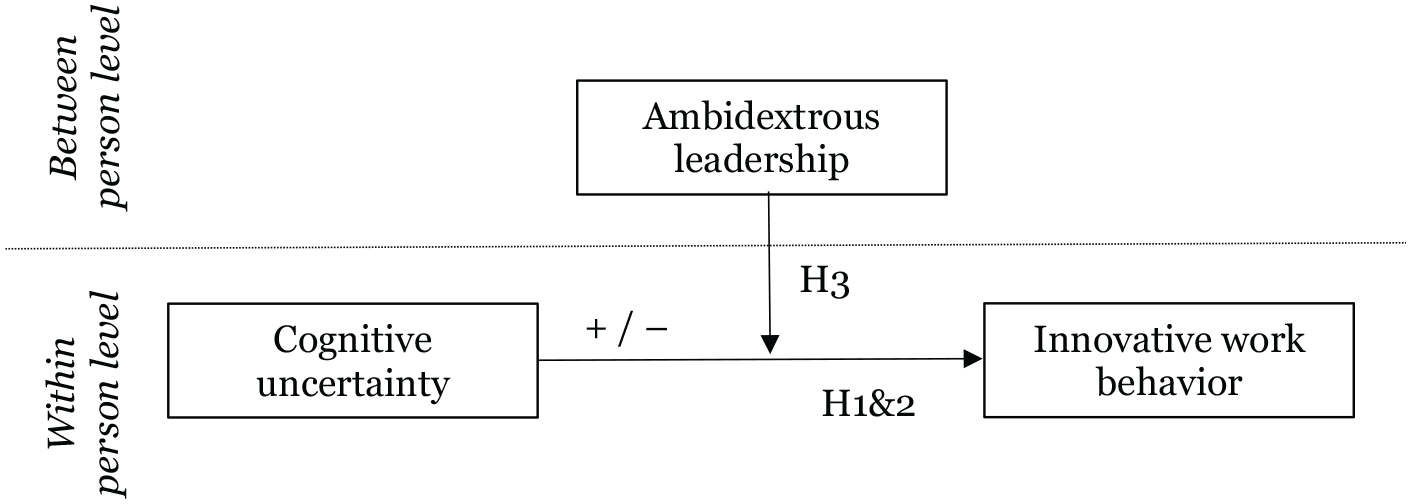
Theoretical expectations.
Methodology
Research Design
This study used a daily diary study design to collect data (Ohly et al., 2010). Respondents were asked to complete a daily questionnaire for a period of two weeks. The questionnaire was sent to the respondents towards the end of each working day at 3.30 pm and they were asked to complete this diary on the day it was sent to them. This method has several strengths over cross-sectional survey designs more commonplace in studies on innovative work behavior in the public sector. First, by involving longitudinal measurements, it allows a within-person approach by studying variation over time while controlling for individual differences. Further, a longitudinal analysis of diary data allows each participant to function as their own control (Bolger et al., 2003). As such, this method avoids possible confounders and thus is better able to isolate the relationship between cognitive uncertainty and innovative work behavior. Moreover, strong fluctuations over time are known to exist for both cognitive uncertainty experiences (Bernards et al., 2021) and innovative work behavior (Zacher & Wilden, 2014). A daily diary approach will be sensitive to such fluctuations and may reveal mechanisms that are missed when using aggregated measures. Second, diary studies have a high ecological validity since they study behavior in the natural context of the work. This enables strong connections to be made between behavior and context (Ohly et al., 2010). Third, since diary studies amount to quasi-real-time measurement of experiences, this method should minimize recall and rationalization biases. Thus, it should provide a more detailed understanding of the antecedents of innovative work behavior (Ohly et al., 2010).
Data
The diary study was conducted in November 2020 among professionals working in social support teams in a large Dutch municipality. These teams were introduced from 2015 onwards in response to a large-scale decentralization of social care, youth care, and income support. This decentralization was aimed at realizing innovative modes of integrated service delivery in case of cross-cutting problems (Jans et al., 2018). It is thus considered an ideal case for studying professionals’ innovative work behavior since innovation is an explicit goal of the legal framework within which the professionals work: they are encouraged to find innovative arrangements that consider the personal situation of clients (MvT Wmo, 2015, p. 30). This also translates to substantial discretion for professionals to come up with innovative solutions, as the legislator also states that service providers should do so by refraining from focusing on rules and organizational customs but instead by focusing on what clients really need (MvT Wmo, 2015, p. 30). In addition, this constitutes a rich case in terms of potential cognitive uncertainty due to the complexity of working with clients whose situations rarely perfectly fit organizational rules and procedures (Bernards et al., 2021; Lipsky, 1980). This case may thus be considered an extreme case, with expected high levels of both cognitive uncertainty and innovative work behavior. Such an extreme case allows researchers to obtain the “greatest possible amount of information on a given problem or phenomenon” (Flyvbjerg, 2006, p. 13). As such, this type of case is ideal for revealing information on theoretical mechanisms, such as in this study between cognitive uncertainty and innovative work behavior (Flyvbjerg, 2006).
In total, 169 professionals in 16 teams were approached to participate in the study. The purpose of the study was explained to the professionals in an online video as well as in an information sheet. At the start of the study, all respondents provided written informed consent. Participants were eligible to win one of five gift vouchers of 25 euros to stimulate participation in the study (Ohly et al., 2010). Subsequently, 90 out of 169 professionals participated in the diary study. This indicates, a response rate of 53.3% at the person level. For a diary study, it is also important to consider the response rate at the within-person level: the number of days in the two-week period that the participant actually submitted the diary. On average, respondents submitted 4.2 daily diaries over the study’s period of 2 weeks. Respondents worked on average 33 hours per week, indicating a within-person response rate of 50.9%. Both the number of observations and the response rates are consistent with previous studies using a diary method, in which typically between 40 and 120 respondents are included, completing daily questionnaires for a period of 5 to 10 days (Bernards et al., 2021; Ohly et al., 2010).
The respondents were on average a little over 38 years old, with the majority being female (almost 79%). This gender distribution is similar to that in the social work field in the Netherlands in general. The average employee in the sample had a little over 10 years of work experience.
Measures
Cognitive Uncertainty
Cognitive uncertainty was measured using a single item: “To what extent did you encounter difficult situations in your work today as a consequence of a lack of information, unclear, or conflicting information?” The answer options range from 1 “no difficult situations” to 10 “many difficult situations.” This measure has been validated in a diary study by Bernards et al. (2021).
Innovative Work Behavior
Innovative work behavior was measured using two scales, measuring exploration and exploitation respectively. The items were adapted from the scales of Lubatkin et al. (2006) for application in a diary study and contextualized to a social care setting. Example items include, for explorative behavior, “Today in my work, I used creative solutions to meet the specific needs of individual inhabitants” and, for exploitative behavior, “Today in my work, I was able to help inhabitants with cheaper solutions that are equally good.” Response categories ranged from 1 “not at all” to 10 “to a great extent.” The scales proved reliable with Cronbach’s alphas exceeding .7 and discriminant validity was established based on the Average Variance Extracted (AVE) values (Fornell & Larcker, 1981). A complete overview of AVEs and correlations can be found in Tables 1 and 2. Given the premise that the value of exploration and exploitation lies in their combination, innovative work behavior is operationalized as the product of explorative and exploitative behaviors (Gibson & Birkinshaw, 2004; He & Wong, 2004; Kobarg et al., 2017).
Descriptive Statistics, Reliability Measures, and Correlations at the Between-Person Level (n = 88).
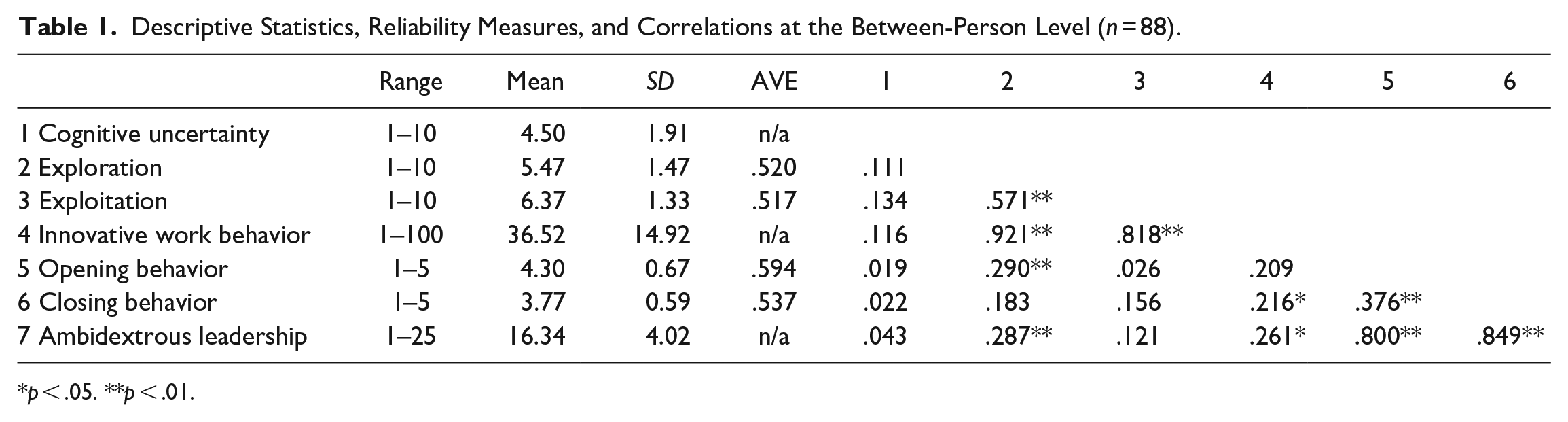
p < .05. **p < .01.
Descriptive Statistics, Variance Decomposition, and Correlations at the Within-Person Level (n = 369).
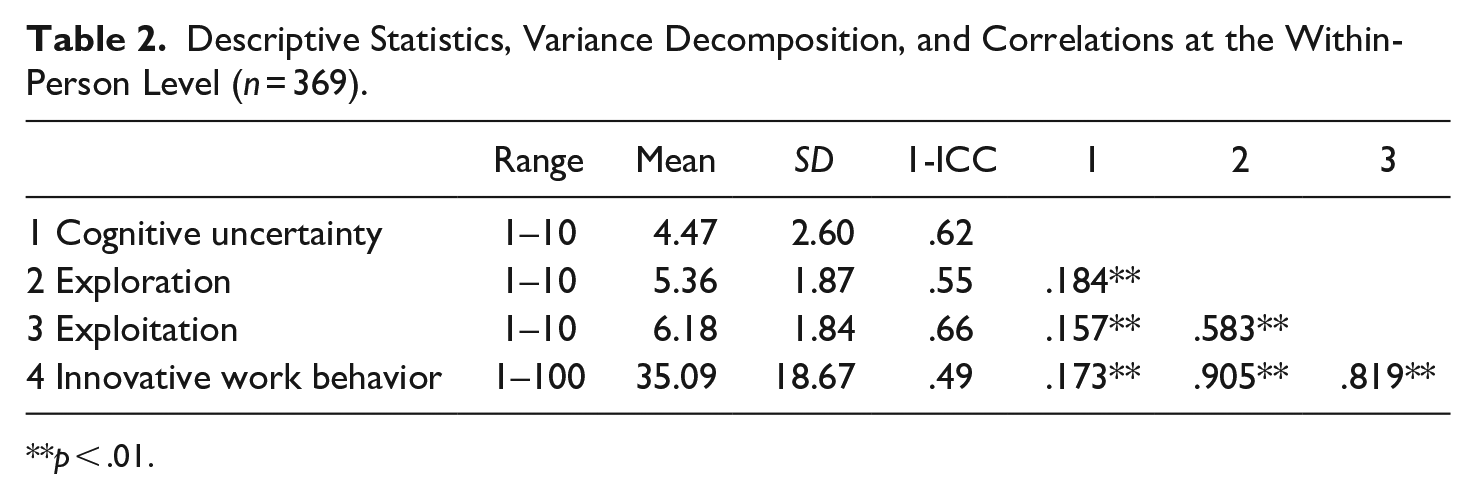
p < .01.
Ambidextrous Leadership
Ambidextrous leadership was measured using two 6-item scales based on Rosing et al. (2011). The scales measure a leader’s opening and closing behaviors respectively. Since the professionals in our study did not interact daily with their leader, ambidextrous leadership was measured only once, on the first day of participation in the study. Example items include, for opening behavior, “My leader encourages me to try different ideas” and, for closing behavior, “My leader establishes routines.” The scales had good reliability, and discriminant validity was established. As with innovative work behavior, ambidextrous leadership is operationalized as the product of opening and closing leadership behaviors (see also: Zacher & Wilden, 2014).
Controls
The respondents’ age, gender, and education level are measured as control variables. For reasons of parsimony, the control variables are not included in the analyses, as these are not statistically significant and they do not substantially change the estimates of the explanatory variables. An overview of all items used is included in Appendix 1.
Analytical Strategy
Multilevel modeling was adopted because the data have a hierarchical structure with days nested within persons (Hox et al., 2017). To determine whether a fixed-effects or a random-effects model is most appropriate, a Hausman test was performed. Given the fact that the Hausman test did not provide a significant result (χ2 = .01; p = .93), a random-effects model is used in the analysis (Cameron & Trivedi, 2009). The analysis was performed in Stata 15. Before this analysis, the data were visually examined for outliers and two cases with very low leader opening and closing behaviors were observed. Further analysis using the Mahalanobis distance with a cut-off point of p = .01 confirmed these two observations were statistical outliers (Goldammer et al., 2020). These respondents were removed from the dataset since even a small proportion of statistical outliers may significantly alter the results of subsequent statistical analyses (Goldammer et al., 2020). The final dataset upon which the analyses are based contains 88 respondents and 369 daily diaries. In addition, the predictor variables were centered on their grand means to be able to interpret interaction variables based on predictors measured on different scales (Hox et al., 2017).
Results
Table 1 provides an overview of the descriptive statistics at the between-person level and Table 2 outlines the descriptive statistics at the within-person level. For the concepts measured at the day level, we provide both the descriptive statistics based on the daily diaries (n = 369) and based on the personal average scores on these concepts (n = 88). These statistics indicate that employees on average experience moderate amounts of cognitive uncertainty (≈4.5 on a scale of 1–10), but that this varies considerably across days and between individuals (standard deviations 2.6 and 1.9 respectively). The team members were quite innovative, with scores for both exploration and exploitation behaviors approaching or exceeding the scale average of 5.5. In general, exploitative behavior (6.2) was slightly more prevalent than explorative behavior (5.4). Again, substantial standard deviations, of between 1.3 and 1.8, show that the variation between persons and across days is sizable. Finally, professionals experience substantial amounts of both opening and closing behaviors from their team leader, with the former somewhat more prevalent than the latter (4.3 and 3.7 respectively on a scale of 1–5). It is, furthermore, noteworthy that high correlations exist between innovative work behavior and exploration (.921, p = .000) and exploitation (.818, p = .000) and between ambidextrous leadership and leader opening (.800, p = .000) and closing (.849, p = .000) behavior. This is caused by the fact that innovative work behavior and ambidextrous leadership are product terms of respectively exploration and exploitation and of leader opening and closing behavior.
Table 2 further provides details of the variance decomposition by showing the intraclass correlation coefficient (ICC) values for the variables that are measured at the day-level. These are used to determine the variance that can be explained on the between-person and within-person (i.e. day) levels (Hox et al., 2017). The 1-ICC values indicate the variance on the within-person level and show that between 49 and 66% of the variance in cognitive uncertainty and innovative work behavior lies on the within-person level. This demonstrates the value of a multilevel approach that is sensitive to such variations since this variation on the within-person level would not be observed in standard analytical approaches such as regression analyses of cross-sectional data.
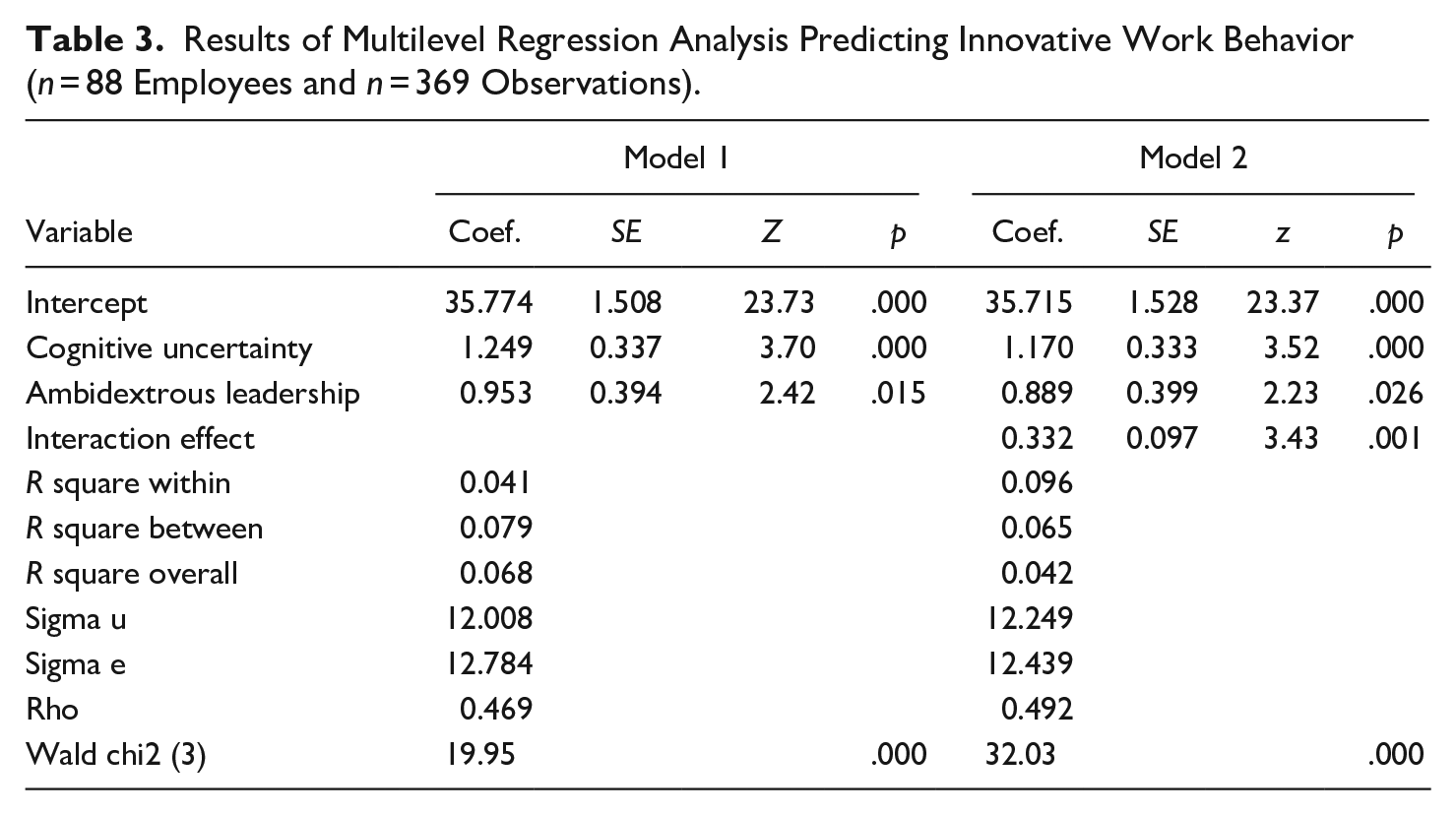
Table 3 shows the results of the multilevel regression analysis predicting innovative work behavior. Innovative work behavior is a multi-dimensional construct that is here operationalized by using the product term of employee explorative and exploitative behavior. Hypothesis 1 states that there is a positive relationship between cognitive uncertainty and innovative work behavior. The results confirm this hypothesis with a statistically significant positive relationship found between cognitive uncertainty and innovative work behavior (coefficient = 1.170, SE = 0.333, p = .000). Next, hypothesis 2 suggests a positive relationship between ambidextrous leadership and innovative work behavior. This hypothesis is also supported by the data (coefficient = 0.953, SE = 0.394, p = .015) and thus accepted. Finally, hypothesis 3 predicts that the positive relationship between cognitive uncertainty and innovative work behavior is strengthened by ambidextrous leadership. Ambidextrous leadership is operationalized by using the product term of leader opening and closing behaviors. This hypothesis was confirmed with a statistically significant, positive moderation effect of ambidextrous leadership (coefficient = 0.332, SE = 0.097, p = .001). This means that cognitive uncertainty is especially associated with higher levels of innovative work behavior under high levels of ambidextrous leadership. This moderation effect is visualized in Figure 2, showing the regression coefficients for those employees who experience high (i.e., above the median; coefficient = 1.907, SE = 0.470, p = .000) and low (i.e., below the median; coefficient = 0.122, SE = 0.469, p = .794) ambidextrous leadership.
Results of Multilevel Regression Analysis Predicting Innovative Work Behavior (n = 88 Employees and n = 369 Observations).
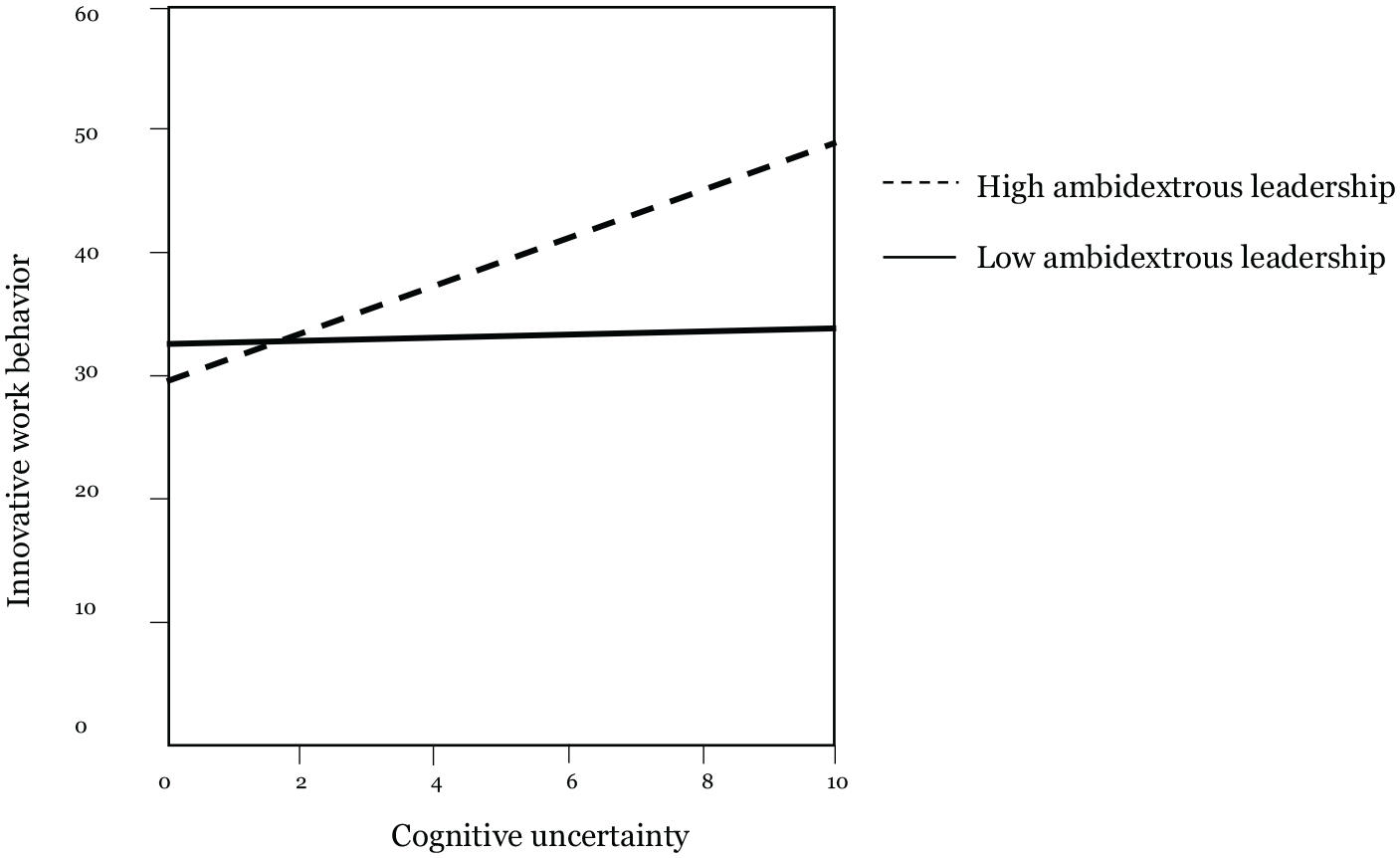
Moderating effect of ambidextrous leadership.
Appendix 2 shows the results of various robustness checks that we have performed using lagged variables of cognitive uncertainty and innovative work behavior and breaking up the multi-dimensional constructs of ambidextrous leadership behavior and employee innovative work behavior. The results of these supplementary checks contribute to showing the robustness of our findings.
Discussion and Conclusion
Research on constraints on innovation in the public sector has so far mostly focused on situational constraints such as insufficient resources, rules, and red tape (Jaskyte, 2011; Singla et al., 2018; Van der Voet, 2019). Cognitive uncertainty, although highly relevant as a constraint on the innovation process in a public-sector context (Bernards et al., 2021; Boyne, 2002), has received insufficient scholarly attention. By studying cognitive uncertainty as an individual-level constraint on innovative work behavior, our study adds to the body of literature on public sector innovation. In the discussion section below we reflect on our findings and their implications for theory and practice.
Implications for Theory
First, and confirming our first hypothesis, we show that cognitive uncertainty offers interpretive space to be innovative (Brun & Sætre, 2009) and, as such, leads to higher levels of innovative work behavior. This finding extends the HRM knowledge base and the literature on public sector innovation, which to date has had limited attention to individual-level constraints on innovation as compared to structural antecedents (but for exceptions, see e.g. Giebels et al., 2016; Gullmark, 2021; Suseno et al., 2020; Swann, 2017). It is important to highlight the positive effect of cognitive uncertainty on innovative work behavior given that much management research is grounded in the belief that an essential feature of management and organization is to lower cognitive uncertainty because reducing cognitive uncertainty enables more rational decision making (March & Simon, 1958) and may boost performance in terms of organizational goals by guiding employees (Locke & Latham, 2013). Moreover, in the public sector, reducing cognitive uncertainty also impacts on citizens and other stakeholders by ensuring precision, reliability, and accountability (Gajduschek, 2003). However, this study shows that cognitive uncertainty can boost innovative work behavior.
Second, our results show that this effect is determined by leadership: only when team leaders demonstrate substantial ambidextrous leadership does cognitive uncertainty lead to higher levels of innovative work behavior. As such, it informs the HRM literature by showing how HRM practices matter for innovative work behavior. By providing adequate leadership to teams of professionals, organizations can boost the innovative work behavior of employees. This research thus points at the importance of leadership in both steering employees to deviate from current practices and enabling them to do so by providing a supportive environment (see also: Bernards et al., 2023). This finding is especially relevant in a highly professionalized context given that professionals may have less need for leadership due to their specialized knowledge and strong norms that guide their behavior (Hersey & Blanchard, 1969). This finding may partially be attributed to the study’s context. Innovation in the social domain involves using discretion and diverging from routines in order to address clients’ needs, and sometimes also to restrict clients’ choices (Houtgraaf et al., 2023). As such, innovative solutions may be closely scrutinized by citizens. Further, such solutions are not always appreciated by managers who tend to focus on routines and control and often try to limit professional discretion (Lipsky, 1980). This study shows that there are benefits from public managers supporting professionals in making use of the interpretive space that cognitive uncertainty provides and acting as a shield against citizen scrutiny. As such, our study extends previous work on public sector innovation which has already extensively examined the importance of leadership in stimulating innovation (e.g. Demircioglu & Van der Wal, 2022; Gullmark, 2021; Günzel-Jensen et al., 2018; Hansen & Pihl-Thingvad, 2019; Jung & Lee, 2016; S. Kim & Yoon, 2015; Siyal et al., 2021) and adds to this research a focus on the importance of leadership under conditions of high levels of experienced cognitive uncertainty.
Third, and consistent with previous research from the general management literature (Gebert et al., 2010; Zacher & Wilden, 2014), this study endorses the importance of combining opening and closing behaviors in ambidextrous leadership. It shows that this combination of seemingly opposing strategies is positively associated with employees’ innovative work behavior and in managing cognitive uncertainty to stimulate innovation. This is an important addition to the literature on public sector innovation given that ambidextrous leadership has only been sparsely studied (notable exceptions being: Kung et al., 2020; Tuan, 2017). Further, ambidextrous leadership arguably fits the public-sector context especially well as it is crucial that public professionals not only focus on exploring new ways of working, but also refine current processes to maintain continuity of services for clients. As this study does not conclusively show that ambidextrous leadership is more effective than separately enacting opening or closing behaviors, future research that compares different leadership strategies in stimulating innovative work behavior is recommended.
Fourth and finally, this study offers a methodological contribution to the HRM knowledge base and the literature on public sector innovation by taking a microlevel perspective on employee innovative work behavior. By using a daily diary methodology, this study captures innovative work behavior as it unfolds in the work environment. This approach has shown its value by identifying that over 50% of the variance in daily innovative work behavior resides on the within-person level, indicating that innovative work behavior fluctuates strongly over the course of a working week. By being able to analyze this variance, a diary study enables a much greater understanding of the antecedents of real-time innovative work behavior than previous empirical work using aggregated measures (e.g. Demircioglu & Van der Wal, 2022; Hansen & Pihl-Thingvad, 2019; S. Kim & Yoon, 2015; Siyal et al., 2021). As such, more research using real-time measurements of respondents is strongly recommended to gain a more dynamic and nuanced view of innovative work behavior in organizations.
Implications for Practice
This study has important practical implications for the practice of public human resource management. First, the finding that cognitive uncertainty positively impacts innovative work behavior of employees nuances existing views that cognitive uncertainty is an impediment to rational decision-making and thus reduces employee effectiveness and performance (March & Simon, 1958; Simon, 1976). From an HRM-perspective, this means that public managers should carefully balance inducing and reducing cognitive uncertainty for their employees, as this may simultaneously reduce their effectiveness by hampering rational decision-making and increase their effectiveness by stimulating innovative work behavior.
Second, the finding that the effect of cognitive uncertainty on employee innovative work behavior is contingent on ambidextrous leadership has vital implications for public HRM. It indicates that team leaders play an important role in shaping the context of public professionals’ work by managing cognitive uncertainty. They can do so by simultaneously stimulating the generation of new ideas and the refinement of current processes. Combining opposing action strategies poses challenges for leaders as both leaders and followers tend to strive for consistency in leadership behaviors and organizational direction (Lord & Brown, 2001). These findings have important implications for two key aspects of the HRM process. First, HRM managers are recommended to provide leaders with coaching and workshops that are aimed at providing them with the necessary insights and to aid them in combining opening and closing strategies (Gebert et al., 2010). Second, these findings also inform the recruitment and selection criteria of future leaders: HRM managers could focus on selecting future leaders who hold competences that enable them to simultaneously implement opposing action strategies. These include a strong need for cognition (i.e., fulfillment from completing cognitively demanding tasks) and a weak need for cognitive closure (i.e., open to situations remaining ambiguous) (Gebert et al., 2010).
Limitations and Future Research Directions
Some limitations must be considered. First, in taking an individual perspective on innovation, this study assumed that optimal organizational-level outcomes would occur when all professionals were engaged in high levels of both the generation of new ideas (exploration) and the implementation of these ideas (exploitation). However, other ways of coordinating innovation are conceivable (Bonesso et al., 2014), such as a dual structure in which professionals in some departments engage mostly in exploration and in others are mainly occupied with exploitation, or a temporal separation of exploitation and exploration. Although our research shows that exploration and exploitation often go hand in hand in practice, and that both behaviors are equally impacted by cognitive uncertainty, future research could focus on other effective strategies for achieving innovation on the organizational level.
Second, this study uses self-report data on cognitive uncertainty and innovative work behavior and employee-report data on leadership behavior. This may raise concerns about common source bias. Common source bias arises because individual characteristics of respondents systematically influence the way in which respondents answer questions that are measured using the same method. While these concerns cannot be eliminated completely, the diary study research design of this study strongly reduces common source bias by isolating the relationships of interest from time-invariant, individual characteristics of respondents (Scollon et al., 2003). So, using a diary study research design, you as a researcher control for these individual characteristics of respondents by analyzing the within-person variance of the variables of interest. Nevertheless, future research using multi-source data should be considered. Since cognitive uncertainty is an inherently perceptual phenomenon (Bernards, 2023) and employee-report of leadership behavior is important to avoid self-rating bias (Jacobsen & Andersen, 2015), future research should aim for more objective indicators of innovative work behavior.
Third, the context of this study needs to be considered. This study took place in a professionalized social care setting in the Netherlands. The Netherlands had adopted new legislation in 2015 that specifically encouraged professionals to innovate and, in addition, gave professionals considerable freedom to do so (Bernards, 2023). This may impact the generalizability of our findings to different policy domains and countries, where this extent of encouragement to innovate may be lacking. For instance, when compared to a traditional, bureaucratic context, it may be easier for employees working in a professionalized context to make use of the interpretive space cognitive uncertainty provides and turn this into innovative work behavior.
Conclusion
In conclusion, this study has used a novel theoretical and methodological approach to study employees’ innovative work behavior. The results show that innovative work behavior varies greatly across days and is profoundly impacted by the context of the work: the more that employees experience cognitive uncertainty, the more they engage in innovative work behavior. Ambidextrous leadership strengthens this relationship and helps employees deal with the uncertain context of their work. These findings are relevant for public HRM scholars and practitioners by strengthening our understanding of how innovation comes about in the everyday practice in public organizations.
Footnotes
Appendices
Overview of Items.
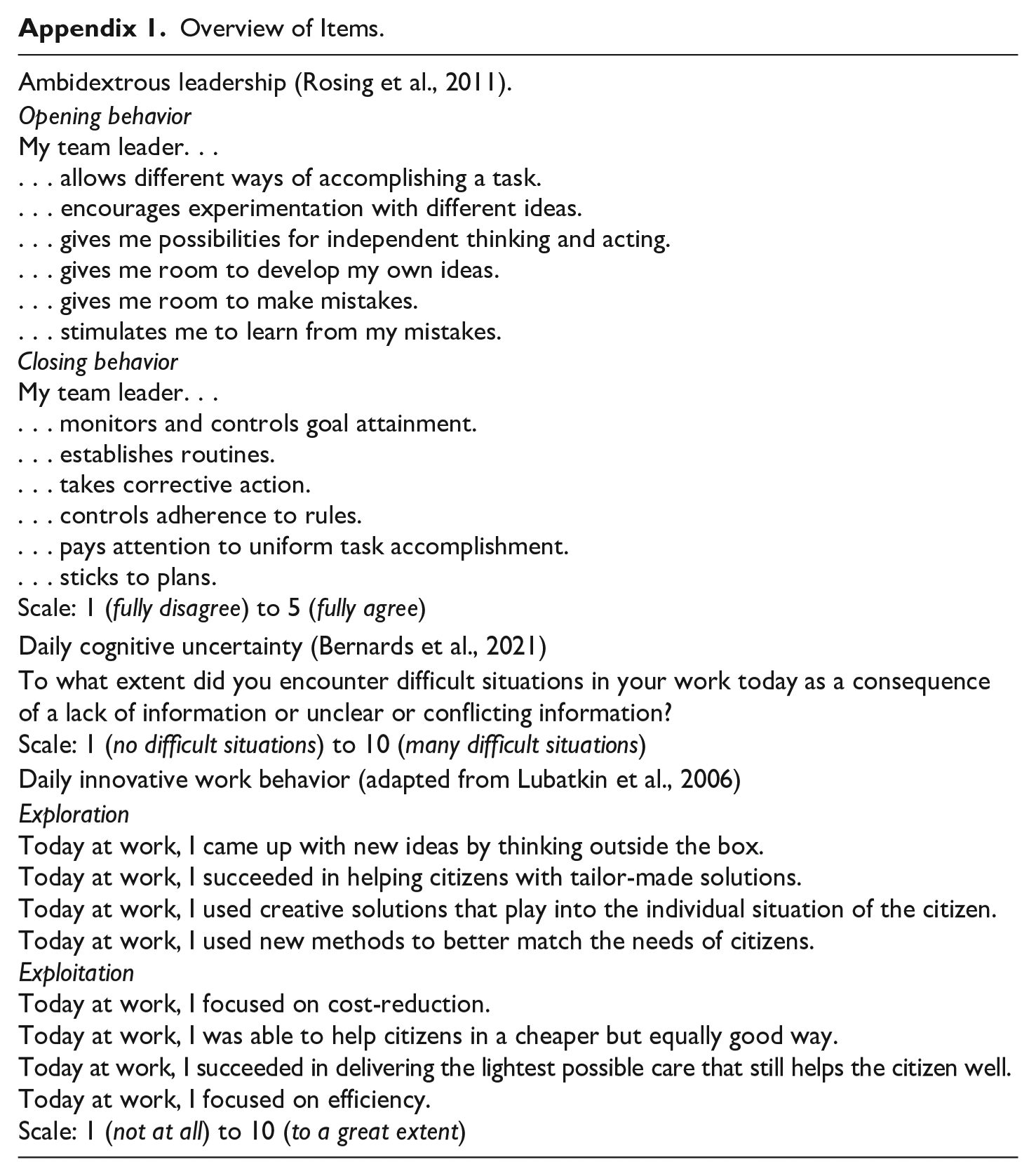
| Ambidextrous leadership (Rosing et al., 2011). |
| Opening behavior
My team leader. . . . . . allows different ways of accomplishing a task. . . . encourages experimentation with different ideas. . . . gives me possibilities for independent thinking and acting. . . . gives me room to develop my own ideas. . . . gives me room to make mistakes. . . . stimulates me to learn from my mistakes. Closing behavior My team leader. . . . . . monitors and controls goal attainment. . . . establishes routines. . . . takes corrective action. . . . controls adherence to rules. . . . pays attention to uniform task accomplishment. . . . sticks to plans. Scale: 1 (fully disagree) to 5 (fully agree) |
| Daily cognitive uncertainty (Bernards et al., 2021) |
| To what extent did you encounter difficult situations in your work today as a consequence of a lack of information or unclear or conflicting information? Scale: 1 (no difficult situations) to 10 (many difficult situations) |
| Daily innovative work behavior (adapted from Lubatkin et al., 2006) |
| Exploration
Today at work, I came up with new ideas by thinking outside the box. Today at work, I succeeded in helping citizens with tailor-made solutions. Today at work, I used creative solutions that play into the individual situation of the citizen. Today at work, I used new methods to better match the needs of citizens. Exploitation Today at work, I focused on cost-reduction. Today at work, I was able to help citizens in a cheaper but equally good way. Today at work, I succeeded in delivering the lightest possible care that still helps the citizen well. Today at work, I focused on efficiency. Scale: 1 (not at all) to 10 (to a great extent) |
Appendix 2. Robustness Checks
In addition to theoretical arguments concerning causality, the data allow supplementary statistical analyses to examine whether innovative work behavior does temporarily follow cognitive uncertainty. By using a cognitive uncertainty variable with a one-day lag, we could test the effect of cognitive uncertainty at T0 on innovative work behavior at T1. This test did not result in a significant relationship (coefficient = 0.021, SE = 0.488, p = .966) and so does not offer proof for the hypothesis that innovative work behavior temporarily follows cognitive uncertainty. Further, the data can also be used to examine possible reverse causality: does cognitive uncertainty in fact follow innovative work behavior? This was tested by regressing innovative work behavior at T0 on cognitive uncertainty at T1. Again, there was no significant result (coefficient = 0.015, SE = 0.010, p = .154) and so no evidence for reversed causality. Because both analyses with lagged variables require responses recorded on consecutive days, they are based on a smaller data set of 194 responses from 65 professionals.
This study uses multi-dimensional constructs for the moderating and dependent variables. As robustness checks, the results are reported of analyses in which we separate the two dimensions of leadership behavior and employee innovative work behavior.
First, the assumption underlying the benefits of ambidextrous leadership, that the combination of leader opening and closing behaviors (i.e. ambidextrous leadership) stimulates innovative work behavior of employees more than either of these behaviors enacted separately, can be tested. Here, we compare the regression coefficients of ambidextrous leadership with those of leader opening and closing behaviors separately. The results of these analyses are reported in Appendices 3 to 5. Standardized predictor variables are used to facilitate comparison between different leadership behaviors measured on different scales. The results show that the effect of ambidextrous leadership (coefficient = 3.366, SE = 1.509, p = .026) is indeed stronger than the separate effects of opening (coefficient = 3.140, SE = 1.531, p = .040) and closing behaviors (coefficient = 2.493, SE = 1.523, p = .102), with the effect of closing behavior alone not being significant. This difference is also present when examining the moderating effects: ambidextrous leadership (coefficient = 3.261, SE = 1.528, p = .001), opening behavior (coefficient = 2.281, SE = 0.925, p = .014), and closing behavior (coefficient = 2.817, SE = 0.915, p = .002). However, t-tests between the regression coefficients show that they are not significantly different from each other, with z-values ranging from 0.105 (p = .916) between the coefficients of the direct effects of ambidextrous and opening behaviors to 0.549 (p = .582) for the coefficients of the moderating effects of ambidextrous and opening behaviors. So, these results do not conclusively indicate that ambidextrous leadership is more effective in stimulating employee innovative work behavior than the separate enactment of opening or closing behaviors.
Second, separate analyses were run to examine the effects of cognitive uncertainty on employee explorative and exploitative behavior and to examine the moderating effect of leadership on these relationships. The results of these analyses are reported in Appendices 4 and 5. These analyses do not show that different factors explain the different dimensions of innovation. For both the relationships between cognitive uncertainty and explorative and exploitative behavior and for the relationship between cognitive uncertainty and the multi-dimensional construct of innovative work behavior we find positive coefficients and positive moderation coefficients of leadership. However, we do observe that the direct and moderating relationships of leadership remain insignificant for exploitative behavior, whereas the direct and moderating relationships between most of the studied leadership behaviors and explorative behavior and innovative work behavior are significant. Therefore, we can conclude that neither ambidextrous leadership nor the separate enactment of opening or closing behaviors is effective in stimulating exploitative behavior on its own.
Declaration of Conflicting Interests
The author declared no potential conflicts of interest with respect to the research, authorship, and/or publication of this article.
Funding
The author(s) disclosed receipt of the following financial support for the research, authorship, and/or publication of this article: This work was supported by the Municipality of The Hague, The Netherlands.
