



Abstract
While important insights have been provided into the role of HR managers in performing change in the workplace, still little is known about how HR managers themselves are shaped by change, in particular in relation to those changes triggered by radical or disruptive shock events and crisis situations, and in the public sector context. In this study, we aim to address this, using an exploratory qualitative interview study to explore how the serious and profound COVID-19 pandemic triggered boundary work among HR managers in public sector municipalities. Our findings illustrate that COVID-19 triggered HR managers to engage in boundary work in two main ways: either by defending their boundaries (through the two practices of counteracting dumping and counteracting shirking) or by expanding them (through the two practices of facilitating self-fulfillment and facilitating status-enhancement). We discuss how this variation is related to whether the HR managers experienced and made sense of the pandemic mainly as a threat—of being forced into unwanted responsibility—or if they experienced and made sense of it mainly as an opportunity to take advantage of the situation. In showing this, the study makes a number of important contributions to both theory and practice.
Keywords
Introduction
While the existing literature has provided important insights into how HR managers are involved in performing change in the workplace (e.g., Alfes et al., 2010, 2019; Brown et al., 2017), less is known about how HR managers themselves are shaped by change, particularly in relation to those changes triggered by so-called shock events or catastrophic stressors (e.g., financial crises, natural disasters, or terrorism) (Biron et al., 2021; Caligiuri et al., 2020; Figley & McCubbin, 2016). As with other professional and occupational groups facing these disruptive and highly uncertain situations, we would expect HR managers to also start to struggle in managing the situation and negotiating their boundaries, for example, constructing, defending, contesting, or expanding them (see e.g., Abbott, 1988; Branicki et al., 2022; Ibarra, 1999; Langley et al., 2019; Pratt et al., 2006). However, few empirical studies have been conducted and the extent to which this is the case in practice is unclear. Various calls have been made for in-depth qualitative research exploring how HR managers are shaped by change, particularly in the public sector (Baran et al., 2019; Brunetto & Beattie, 2020; Harney & Collings, 2021; Malik & Sanders, 2021).
In this study, we address this call for studies by using a qualitative interview study to explore how the serious and profound COVID-19 pandemic shaped HR managers in public sector municipalities. While adding to the list of shock events or catastrophic stressors (Caligiuri et al., 2020; Figley & McCubbin, 2016), COVID-19 also stands out in the way it is fundamentally a human event, placing HR managers in a central role (Berry et al., 2022; Chang et al., 2022; Collings, Nyberg, et al., 2021; Dirani et al., 2020; Hamouche, 2021). A focus on the public sector context is both theoretically interesting and important practically for several reasons. It is a context generally given little attention in the broader Human Resource Management (HRM) and change literature (Brunetto & Beattie, 2020; Knies et al., 2015; Ritz et al., 2012; Van der Voet et al., 2015); more importantly, public sector organizations are, in many countries, considered to have important economic and social roles in managing crisis situations, such as the COVID-19 pandemic (Mann, 2014; Schuster et al., 2020). The public sector is also traditionally thought of as conservative, bureaucratic, and difficult to change (Boyne, 2002; Christensen et al., 2007), and, given these factors, it is likely that its HR managers will demonstrate “stubborn traditionalism” (Boudreau & Lawler, 2014), resulting in their negotiation of boundaries during uncertain and disruptive situations being particularly evident and heightened (Kettl, 2006). We therefore ask: How did the COVID-19 pandemic trigger boundary work in practice among HR managers in public sector municipalities?
Our study revealed that the COVID-19 pandemic triggered HR managers to engage in boundary work in two main ways: either by defending their boundaries or expanding them. Defending boundaries was performed through the two practices of counteracting dumping (i.e., defending themselves from being handed-over undesirable work) and counteracting shirking (i.e., defending themselves from being assigned unwanted responsibility for sensitive issues). Expanding boundaries was performed through the two practices of facilitating self-fulfillment (i.e., broadening themselves to be and feel needed and important) and facilitating status-enhancement (i.e., broadening themselves to be in control of important and difficult questions). We discuss how this variation is related to whether the HR managers experienced and made sense of the pandemic mainly as a challenge, with the threat of being forced into unwanted responsibility, or if they experienced and made sense of it mainly as an opportunity to take advantage of the situation.
In showing this, the study contributes to the literature in two main ways. First, it advances understanding of the role of HR in relation to change in the workplace by focusing on how HR managers are shaped by change, in particular in relation to shock events and in the public sector context. By using the boundary work perspective, it sheds light on an important variation in how HR managers, in practice, either defend their boundaries or expand them, as triggered by COVID-19. Thus, the study answers the call for in-depth qualitative research exploring how HR managers are shaped by change (Baran et al., 2019; Brunetto & Beattie, 2020; Harney & Collings, 2021; Malik & Sanders, 2021). Second, it provides a theoretical and grounded explanation for how such a variation in boundary work among HR managers occurs. More specifically, the study stresses that how HR managers experience and make sense of change matters because these experiences serve as a foundation for how they engage in boundary work, and consequently for how they handle and manage the changing situation and craft their jobs, including consequences for collaborative relations. Thus, while the study stresses the largely disruptive and consequential nature of shock events, it also highlights the importance and performative nature of HR managers’ experiences, sensemaking, and self-initiated behaviors in practice (Christianson & Barton, 2021; Suddaby & Foster, 2017; Weick, 1995; Wrzesniewski & Dutton, 2001).
Theoretical Background
The literature on workplace change is vast, covering multiple contexts and levels of analysis (Morrison & Phelps, 1999; Pettigrew et al., 2001; Piderit, 2000), and while it is beyond the scope of this article to comprehensively review what is known and not known about such change (see e.g., Kuipers et al., 2014; Stouten et al., 2018 for reviews on workplace change in public and private organizations), it is important to acknowledge the different types of change. One common distinction is often made between episodic and continuous change (Weick & Quinn, 1999). Episodic change means distinct turning points or events occurring within an organization or triggered by external forces, while continuous change means ongoing small adjustments. Another distinction frequently drawn is that between radical and convergent change (Greenwood & Hinings, 1996). The former involves the bursting loose from an existing situation while the latter involves fine tuning an existing situation.
A particular and rather recent stream of the literature has focused on the role of HRM in relation to workplace change, with a common emphasis on the continuous and convergent types of change (Baran et al., 2019; Van der Voet et al., 2015). Many studies focus on how the HR function and HR managers can contribute to initiating as well as performing change. Brown et al. (2017), using multilevel data from 1,831 employees in 70 organizations, showed the importance of HR undertaking a strategic change role in order to make change cynicism among employees less likely to occur, and thus increasing the chances of a change initiative being successful. Alfes et al. (2010) studied the roles that HR plays in managing change and found four potential roles that HR managers can take, that is, change driver, change focused, HR focused, and responsive. These roles differed in terms of the two dimensions of process and content. In addition, Alfes et al. (2019) examined a UK police force to study HR’s role in facilitating workplace change, and concluded that HR managers play important change agent roles, contributing to successful change not only by influencing content and change implementation, but also by ensuring the context is change-ready. Other studies have instead focused on how HR managers persuade others to make change successful, for example, the study by Francis (2002), which examined the rhetoric and discursive resources used by HR managers within a manufacturing plant to shape workplace change.
Taken together, the extant research highlights the role of the HR function, and that of HR managers, in relation to performing workplace change as being particularly important and significant. However, while this stream of literature has provided important insights, and to some extent covered the different types of change, there is still an important limitation. Little is known about how HR managers themselves are shaped by change, and in particular in relation to episodic and radical changes often triggered by disruptive external forces or catastrophic stressors (Biron et al., 2021; Caligiuri et al., 2020; Figley & McCubbin, 2016). This is a major limitation because it is suggested that these disruptive changes and uncertain situations as compared to normative ones are more than likely to trigger professional and occupational groups, such as HR managers, to start to struggle in addressing and making sense of the situation and negotiating their work and role boundaries, which in turn has important implications for collaboration, a central feature of modern public management (Langley et al., 2019; Quick & Feldman, 2014). However, as few empirical studies have been conducted, various calls have been made for exploring how HR managers are shaped by change, particularly in the public sector (Baran et al., 2019; Brunetto & Beattie, 2020; Harney & Collings, 2021; Malik & Sanders, 2021). This is important to explore, especially given that the public sector context has traditionally been described as conservative, bureaucratic, and difficult to change (Boyne, 2002; Christensen et al., 2007). Furthermore, and as stressed by a notable exception focusing on HR managers’ views of change (see Baran et al., 2019), how HR managers experience and make sense of change in practice also serves as a foundation for how they manage the situation (Christianson & Barton, 2021). In this article, we aim to address this limitation by focusing on the COVID-19 pandemic, which can be seen as a trigger of both episodic and radical change, and which adds to the list of so-called shock events or catastrophic stressors (e.g., financial crises, natural disasters, and terrorism) (Caligiuri et al., 2020; Figley & McCubbin, 2016).
The boundary work perspective is particularly suitable for shedding light on this as it emphasizes the ongoing effort on a practice level, often triggered and made salient by some external threat (e.g., a crisis), through which groups and occupations purposefully work to influence their social boundaries (Langley et al., 2019). A recent development of the perspective, stemming from the large body of work on boundaries, has largely adopted a view of boundaries as dynamic rather than stable, and where the negotiations of these boundaries in practical work constitute boundary work (e.g., Glimmerveen et al., 2020; Langley & Tsoukas, 2017). In line with this dynamic and practice-based view on boundaries and boundary work, an increasing body of research is thus starting to, through in-depth qualitative methods, focus on how the work and roles of occupations and professions are negotiated during times of change, such as during crises or when new ways of working are required (Ibarra, 1999; Langley et al., 2019; Pratt et al., 2006).
A common finding in the literature is that when changes are associated with a high degree of uncertainty or a potential threat to one’s work and role, there is a high chance of occupational and professional groups protecting or defending their boundaries (Garud et al., 2014), which in turn often inhibits collaborative relations (Comeau-Vallée & Langley, 2020). The literature suggests the defending of boundaries is also likely to occur if a change becomes associated with the imposition of new roles or tasks that are considered to be of low-status and that may undermine actors’ expertise or add to their already busy workload (Abbott, 1988; Kellogg, 2014), or if the new roles or tasks are considered to be sensitive and morally contentious (Hughes, 1962). The literature also reveals that in contexts generally considered traditional, bureaucratic, and with well-defined and well-established roles, responsibilities, and ways of working, actors are more likely to be content with the status quo, and therefore tend to sustain and defend their boundaries (Abbott, 1988; Comeau-Vallée & Langley, 2020).
An additional and somewhat different finding in the literature is that individuals may not only defend their work and role boundaries, but they may also expand these. For example, individuals may start to undertake roles and tasks normally performed by other groups, and these substitutions thus imply negotiated boundary changes (Barrett et al., 2012; Liberati, 2017). The extent to which this is possible is related to what Pratt and Foreman (2000) call plasticity, which may vary depending on which occupation or profession is being considered. Greater plasticity means jurisdictional change and expansion of boundaries are less contested and more easily legitimized. The literature suggests the expanding of boundaries is more likely among lower-status actors or those in less central positions, as they tend to seek change or extend their domains and work practices to gain legitimacy, thus taking advantage of the changing situation (Abbott, 1988; Bucher et al., 2016; Comeau-Vallée & Langley, 2020).
A recent synthesis of the literature by Langley et al. (2019) helps us advance understanding of boundary work further, including what the different types of boundary work are—their triggers and consequences. They distinguished between three distinct but inter-related forms of boundary work: competitive, collaborative, and configurational. Competitive boundary work concerns how people defend and contest boundaries to achieve some kind of positive advantage, for example, when professions and occupations defend or maintain their jurisdictions. This is about protecting or restoring something (often well-established) that has been challenged, thus making the defending of boundaries a major mode of competitive boundary work. Collaborative boundary work describes how people negotiate, align, and downplay boundaries to get work done. This is about enabling new collaboration and coordination with others, thus making the downplaying and extending of boundaries major modes of competitive boundary work. Configurational boundary work relates to how people manipulate boundaries, bringing certain activities together while keeping others apart, all to enable effective collective action. This is about reconfiguring existing collaboration and competition, thus making the modes of arranging, buffering, and coalescing major modes of configurational boundary work.
In this article, we continue and build on the above-mentioned arguments to study how the COVID-19 pandemic triggered boundary work in practice among HR managers in public sector municipalities, thus advancing important knowledge of how HR managers are shaped by change.
Methods
Research Approach and Setting
To explore how the COVID-19 pandemic triggered boundary work in practice among HR managers in public sector municipalities, an exploratory qualitative interview study was considered appropriate. A qualitative study is especially relevant when the aim is to understand a phenomenon in depth and to capture its complexity (Yin, 2003). This method was also appropriate because much of the extant literature has focused on how HR managers are involved in performing change in the workplace, thus leaving the phenomenon of how HR managers themselves are shaped by change as a novel research area and a new field of inquiry (Eisenhardt & Graebner, 2007).
This research was designed to focus on HR managers and to explore their efforts and experiences in the studied setting. We focused on HR managers for a number of reasons. We know relatively little about them as a professional group compared to other professional groups in relation to workplace change, especially when it comes to how they are shaped by such change, and particularly in relation to those changes triggered by so-called shock events or catastrophic stressors (Adikaram et al., 2021; Baran et al., 2019; Brunetto & Beattie, 2020; Figley & McCubbin, 2016; Hamouche, 2021; Harney & Collings, 2021; Malik & Sanders, 2021). Furthermore, HR managers have often been described as having a significant and pressured role when it comes to the COVID-19 pandemic, as it is fundamentally a human shock event (Adikaram et al., 2021; Branicki et al., 2022; Carnevale & Hatak, 2020; Collings, Nyberg, et al., 2021: Collings, McMackin, et al., 2021; Dirani et al., 2020; Minbaeva & Navrbjerg, 2023; Nyberg et al., 2021).
We contacted the 50 largest municipalities in Sweden, 26 of which agreed to participate in this study. Swedish municipalities are highly self-governed and have both a high level of political autonomy and large amounts of resources. They are responsible for providing childcare, primary and secondary education, and elderly care for the entire population, as well as welfare provisions and public transport. Like many other public organizations, Swedish municipalities can be considered bureaucratic, rigid, and slow to deal with change (Boyne, 2002; Christensen et al., 2007). Furthermore, the municipalities typically have a well-defined and distinct demarcation of roles and responsibilities. Thus, given their high economic and social importance, as well as their reliance on traditional boundary arrangements, focusing on how the COVID-19 triggered boundary work among HR managers in public sector municipalities offers a particularly important and interesting case for understanding how HR managers are shaped by change.
Data Collection
We followed advice to include different data collection methods, such as in-depth interviews and documents (Silverman, 2011). In total, the first author conducted 26 interviews with senior HR managers 1 in different Swedish municipalities. We recruited interviewees through ‟purposeful sampling,” where people are selected based on their knowledge and position (Patton, 2002), and in order to optimize the possibility to learn from specific cases and their conditions. Thus, senior HR managers were purposively included because they are generally considered “knowledgeable persons” and are often part of the “dominant coalition” (Hambrick & Mason, 1984; Paauwe, 2004). The HR managers were contacted personally by direct email, where we emphasized the voluntary nature of their participation and promised them anonymity.
The interviews lasted 55 minutes on average, were conducted over Microsoft Teams (the interviewees’ preferred software, and a method chosen over face-to-face interviews due to travel and social distancing restrictions posed by the pandemic), and were all recorded and transcribed verbatim. The interviews were semi-structured and open-ended (Silverman, 2011) in order not to steer the interviewees, but rather allow them to talk freely about their work and experiences. We asked probing questions, and requested specific stories to illustrate their points. Thus, the interview questions were broad and addressed, for example, the interviewees’ general work situation (tasks and responsibility), their general thoughts about the COVID-19 pandemic and, more specifically, related to their work, and also their experiences of how it had affected their work and the HR occupation (for more details on the interview questions, see Supplemental Appendix A). We complemented the interviews with the collection of various documents (records from 2020 to 2022), such as reports, role descriptions, meeting minutes, and PowerPoint presentations.
Before we describe our data analysis, it is important to clarify our data source. In line with the boundary work literature, we emphasized the efforts of actors situated on one side of a boundary (Langley et al., 2019). Given that HR managers were the unit of analysis, our data limits access to only one group in a setting of multiple occupational groups. This can be seen as both a strength and a limitation: a strength in that it allowed us to avoid detracting from the main actor, that is, HR managers, and emphasizing the perspective of others too heavily, and a limitation in that it was not possible to obtain a range of perspectives. With this in mind, we suggest future research should consider this when deciding upon data sources and study designs.
Data Analysis
We followed an inductive three-step process similar to that described in the literature (Gioia et al., 2013), and which the data structure in Figure 1 illustrates. We used the software program Nvivo to conduct the analysis. Step One consisted of an in-depth and grounded analysis of the raw data (i.e., interview transcripts and organizational documents), through which we read each interview and document numerous times, highlighting phrases and sections related to the overall research aim of understanding how the serious and profound COVID-19 pandemic shaped HR managers’ work in public sector municipalities. Open coding allowed us to code the common words, terms, and phrases used by the respondents themselves and mentioned in documents, into first-order concepts. These concepts are in-vivo codes and largely reflect the views of the interviewees in their own words (Locke, 2011). One advantage with this approach is that the starting point is the strategic and managerial issues perceived in practice, rather than those stemming from theory. Although all the data were systematically coded, the interviews served as the primary source in our analysis and in the findings below (all direct quotes are interview data), with the documents providing contextual background and corroborating evidence.
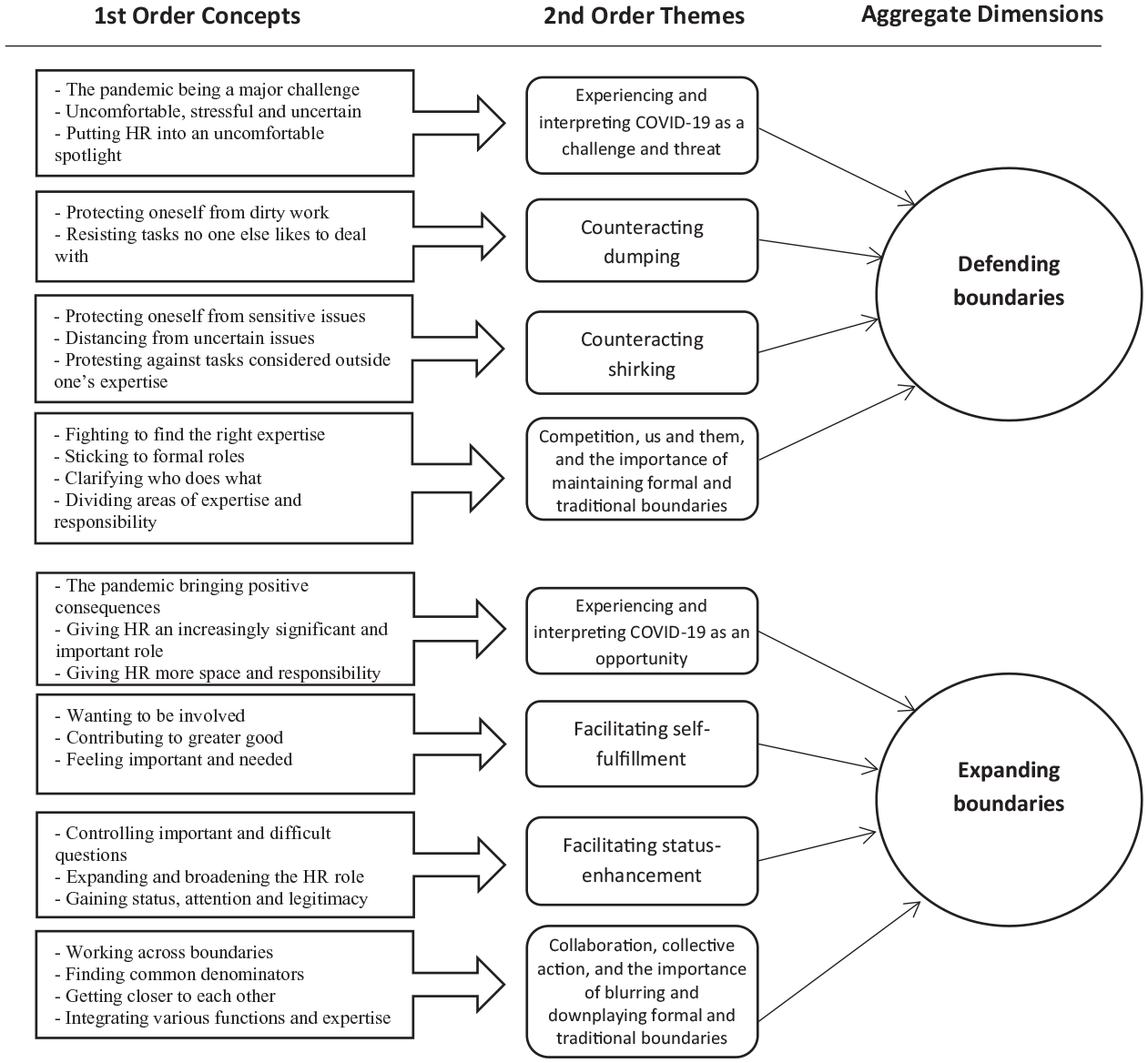
Data structure.
Step Two consisted of additional examining of first-order concepts to identify potential links among them. Using axial coding and going back and forth between the data and the literature (Strauss & Corbin, 1998) enabled us to cluster the first-order concepts in relation to their focus, and subsequently reduce them to second-order themes. These themes related to the experience and interpretation of COVID-19 as a challenge and threat, counteracting dumping, counteracting shirking, competition, and an “us and them” feeling, the experience and interpretation of COVID-19 as an opportunity, facilitating self-fulfillment, facilitating status-enhancement, and collaboration and collective action. Step Three consisted of a more frequent iteration between data and theory, which allowed us to generate two aggregate dimensions (i.e., defending boundaries and expanding boundaries) that represented a higher level of abstraction (Martin & Turner, 1986). Here, we used the literature on boundaries and boundary work (e.g., Comeau-Vallée & Langley, 2020; Gieryn, 1983; Langley et al., 2019) to form these theoretically rooted dimensions. The two types of boundary work emerged as mutually exclusive, and were roughly equally represented among the HR managers.
When the HR managers talked about their boundary work, they often mentioned and related it to operational managers (not part of this study), who were understood to be the actors situated on the other side of the boundary. Operational managers are typically responsible for their specific business area and make decisions concerning its daily deliveries, while HR managers are responsible for the entire municipality and make decisions on HRM-related issues.
We used several strategies to practice reflexivity during the analysis process. First, we continuously challenged our interpretations by considering alternative perspectives (Alvesson & Sköldberg, 2018). Second, to improve intra-rater reliability, a test-retest approach was used. The data were analyzed twice by the same researcher and re-sorted until there was complete agreement. Third, to help ensure the trustworthiness of our interpretations we also conducted “member checks” with our interviewees to gain confidence that the data structure was sensible to, and affirmed by, those living the phenomenon being studied. The dimensions identified here underpin our analysis of how the COVID-19 pandemic triggered boundary work in practice among HR managers in public sector municipalities.
Findings
Defending Boundaries
Several HR managers experienced the COVID-19 pandemic as something challenging and almost as a threat, not only in general but also specifically to their work. As one HR manager expressed, “the pandemic has been and continues to be a major challenge for our society but also for HR as an occupation” (HR manager 1). This experience of a major challenge to one’s work and occupation was related to how the pandemic was considered to be “all about people” (HR manager 2), and how this was “putting HR into an uncomfortable spotlight” (HR manager 3), which also seemed to trigger managers to defend their boundaries. This is illustrated by comments from two interviewees:
During these challenges and strains, it has been important to stick together and to be flexible, but just because the pandemic is about people does not mean we should do, and take responsibility for, everything. Instead we have fought for finding the right expertise, sticking to our formal roles and thus largely consolidating the boundaries of who does what. (HR manager 2) It has been incredibly uncomfortable, every day you didn’t know what would happen next. There were an incredible number of things that were unclear, and we didn’t know how they would be solved. Terribly stressful situation, I have not experienced anything near it before. I was almost fainting. One important way we dealt with this uncertainty was in how we tried to have clear dividing lines and clearly define who would do what and when. (HR manager 4)
One participant explained some of what these uncertain aspects could include, “. . . it has been very uncertain which operations we would need to close down and which could continue, and how to inventory the employees’ competence to cope with staffing in the event of massive redundancies” (HR manager 5). Another mentioned the question of “who would make up the crisis management team and who would be responsible for what” (HR manager 6), as uncertain but important issues. Together, these quotes highlight the challenges of the pandemic and the subsequent importance of defending boundaries of traditional and formal roles and responsibilities. When the HR managers described that they defended their boundaries, they often related to operational managers as the actors situated on the other side of their boundary. Traditionally, the boundaries between the tasks and jurisdictions of HR managers and operations managers are well-defined and distinctly demarcated. Put simply and broadly, HR managers work with HRM-related issues on a more collective level and aim to ensure that their respective municipalities remain consistent and are considered as one employer. Operational managers instead work with daily deliveries and are responsible for decisions on a more business-related and individual level.
Furthermore, when probing in more detail about how HR managers were defending their boundaries, two main practices were evident, namely, counteracting dumping, that is, protecting themselves from being handed what they referred to as “undesirable work,” and counteracting shirking, that is, protecting themselves from being assigned unwanted responsibility for what they called “sensitive issues.” The first practice was about HR managers being unwilling to take on what were perceived as non-prestigious or low-status work tasks that they considered other operational managers were trying to shed away.
We’re expected, and often asked, to take care of things that no one else likes to deal with, or things that became downgraded. It’s been frustrating to speak up, but we don’t have to do that [take care of their low-prioritized tasks]. (HR manager 4) There are those operations managers who have wanted us to do their dirty work, so they can focus on the fun stuff. And some [HR managers] may like to comply with the operations managers and solve their daily practical problems, but most of us are strategic and want to deal with developmental and strategic issues, being proud to achieve something strategic. So we’ve always said that you have to do it yourself. We can, at most, strengthen and support the operations managers. (HR manager 7)
Examples of tasks and responsibilities which the HR managers experienced as undesirable, and they believed the operational managers tried to hand over, included: scheduling, answering emails, and planning daily operations. One interviewee further exemplified, “. . . it has felt like we have been tasked with things that they have not really wanted to do or prioritize, e.g., they have tried to get us to develop specific routines for their operations, to administratively handle problematic employees who do not follow guidelines, or when employees are denied promotion” (HR manager 8). Here we can see the HR managers were not only unwilling to take on operations managers’ undesirable work, but also how they clearly communicated this to them and worked to differentiate themselves. The other practice of defending boundaries was about HR managers being hesitant to take on responsibility for what were perceived as sensitive and difficult issues, which were also often considered outside the HR managers’ area of expertise. As two participants explained:
During the pandemic, I have had to protest against some questions that HR has been landed with, and tell them [operational managers] that they are not our problems to solve. Someone else has to deal with them. They are operational issues and thus the responsibility of operations managers. Visors
2
for example, can’t be an HR issue but we can be involved and support or help with risk analysis from a work environment perspective. But whether we should have a visor or not is an extremely difficult and sensitive question and we can’t decide on that. This is not an HR issue. For a while, everything was an HR issue. And it threatens our profession in a way because we don’t have so many resources, so we can work around the clock with issues that are outside our area of expertise. (HR manager 9) There were many operations-related issues that managers and leaders found difficult and messy, and that they knew would involve conflict, where they didn’t want to make the decisions. Instead, they wanted us in HR to go in and make those decisions. It may have been proposed that this was within HR’s area of responsibility, but it was not. We can’t go in and decide these issues, which we have made clear, but we can support the managers when they do . . . It could be about deciding who could and had to work from home, or what equipment employees were allowed to take home. (HR manager 1)
Even though some issues were generally described as important and prestigious, the HR managers still clearly distanced themselves from them because they instilled a high degree of uncertainty, and the risk of negative consequences. Taken together, defending boundaries illustrates boundary work that is largely competitive in nature, meaning that the importance of maintaining differences in terms of traditional and formal roles and responsibilities contributes to an ‘us and them’ feeling. One HR manager commented, “I felt that I was challenged and sometimes even opposed; there was not much collaboration to speak of” (HR manager 7). Another similarly expressed, “They [operations managers] have an incredibly different approach, tradition, culture and way of acting, which has been strengthened now and has created an us and them feeling” (HR manager 5).
Expanding Boundaries
While some HR managers mainly experienced COVID-19 as something challenging and as a threat, others chose to emphasize and focus on it as mainly something positive for their work and as an opportunity to take advantage of the situation. As one HR manager described, “Of course it’s terrible with the pandemic and all the people who have died and been terribly ill. With all due respect and with that said, the pandemic has brought many positive things” (HR manager 10). This experience of and coping with the pandemic as bringing positive aspects was related to how the traditional, largely separated actors of HR managers and operations managers now “gathered around a table and just solved the problems” (HR manager 11), and where “HR was welcomed and given an increasingly significant and important role” (HR manager 12), which also seemed to trigger HR managers to engage in expanding their boundaries. This is illustrated by comments from two of the interviewees:
It was no longer so important to find out who had the formal responsibility or who had what formal title. Instead, we talked to each other about an issue and solved it together. The boundaries became like rubber bands, which meant we were no longer bureaucratizing ourselves or falling back on formal roles and structures as we have traditionally done. (HR manager 13) Crisis and disaster situations are so uncertain and difficult to plan for, and we have had to think and act differently. We have done this by finding effective forms of collaboration and have worked actively to integrate the various functions. The operations managers are no longer able to solve issues by themselves, but these big issues have needed our expertise, where we have really been given more space and responsibility. We from HR have also taken several initiatives for cross-boundary cooperation and coordination. (HR manager 14)
Thus, while some HR managers who experienced the pandemic mainly as a threat and a challenge engaged in defending their boundaries, those who found the pandemic mainly positive for their work situation engaged in expanding their boundaries. These contrasts and differences in boundary work were largely explained by how HR managers experienced and decided to manage the pandemic. Furthermore, when probing more deeply into how HR managers were expanding their boundaries, two main practices through which this occurred became evident, namely facilitating self-fulfillment and facilitating status-enhancement. The first practice was not about the HR managers expanding their boundaries as a way of trying to advance their positions or areas of responsibility, but rather to feel and make themselves needed and important. As one participant explained:
We started doing a lot of other things than we would normally do. For example, the protective clothing ran out and then we from HR had to roll up our sleeves and even sat down and glued aprons together with long sleeves. This is far from what we usually do. And what can explain this change? I think it’s a lot about us really wanting to be involved and contribute, and feel important and needed. (HR manager 15) I have broadened my role with a much clearer connection to operational issues. Of course, I have done a bit of my traditional assignments still, but mainly devoted myself to dealing with the pandemic through the engagement in healthcare issues (e.g., how to physically redesign workplaces to reduce the spread of infection), which are completely different to the things I normally do. And this, no doubt, has obviously been to contribute when needed. I feel proud to be able to contribute. (HR manager 12)
Here we can see how the HR managers expanded their boundaries to include such tasks that were far from their normal work tasks, and which were probably not being considered as traditional high-status tasks or as something desirable, but which contributed to their self-fulfillment. The other practice related to HR managers being a part of controlling important and difficult questions, which helped them to gain legitimacy and status vis-a-vis operation managers, and thus move beyond being partners to becoming players (Ulrich & Beatty, 2001). One interviewee described:
We have long struggled to strengthen the role and influence of the HR profession; during the crisis we had the opportunity to do so further, and in this we succeeded. The crisis came so quickly and has been so consequential that we were required to work in new ways, more across professions than is traditionally done in a municipality. It has also meant that I have expanded and broadened my role as HR manager and climbed the ladder in joining the management team and crisis management, where I have been needed and my expertise valued, and where I have taken an increasingly larger role and gained more attention. (HR manager 16)
Here, while stressing the prevalence and importance of working across traditional boundaries, the HR manager also emphasized how he has been more active in demonstrating his expertise and advancing his position, which ultimately meant an opportunity to expand boundaries in order to take advantage of the situation and increase HR’s role and legitimacy. Thus, expanding boundaries is reminiscent of playing a more strategic role in an effort to boost one’s own and the profession’s impact and status (Barney & Wright, 1998; Jackson et al., 2014).
Expanding boundaries was highly collaborative in nature, meaning that solving issues across traditional well-demarcated boundaries took primacy, as described by interviewees:
Previously, it has been very downspout-oriented with many issues in parallel and little coordination, but now it has been required that we gather together and have an open attitude to working across boundaries. So, rather than working with pure professional issues where you are proud and protective of your profession and just want to focus on it, there have been a lot of cross-cutting issues where HR’s role has been crucial. (HR manager 17) We’ve started to get much closer to each other, where we listen to each other’s conditions. It’s a giving and taking, finding a common denominator. A completely different mental attitude and openness to collaboration instead of competing. (HR manager 13)
This contributed to a strong sense of belonging and a collective mindset, which clearly differed from the defending of boundaries that instead was largely competitive in nature and thus contributed to an antagonistic relationship.
Discussion
We asked how the COVID-19 pandemic triggered boundary work in practice among HR managers in public sector municipalities. By adopting an exploratory qualitative interview study focusing on the phenomenon’s complexity and in-depth dynamics, our findings show nuances in the ways HR managers are triggered to engage in boundary work, and how their experiences of a changing situation (i.e. the COVID-19 pandemic) served as credible explanations for how this variation and ways of engaging in boundary work are emerging, and the implications for HRM research and practice.
To start, we found the pandemic triggered HR managers to either engage in defending or expanding their boundaries. Defending boundaries included the two practices of resisting dumping and resisting shirking, and illustrate boundary work that is focused on clearly reinforcing existing and traditional boundaries of responsibilities and tasks, rather than aimed at welcoming new tasks or responsibility. This finding supports previous work that has shown that acts of defensiveness and protectiveness are likely to emerge during situations of high uncertainty and when occupations and professions are experiencing a threat to their work and roles (Barley, 1986; Comeau-Vallée & Langley, 2020). Thus, as HR managers were largely defending their boundaries to sustain and achieve some benefit or to restore their traditional roles, this also illustrates competitive boundary work, which ultimately restricted the opportunities for one of the central features of modern public management, that is, collaborating across boundaries (Langley et al., 2019; Quick & Feldman, 2014). This finding also lends further support to arguments that public sector organizations are generally bureaucratic, traditional, and slow to adopt change; these public sector particularities serve as plausible explanations for why some HR managers in our study engaged in defending their boundaries and used the actions of relying on normative rules and formal procedures and regulations to externalize and enhance their claims (Boyne, 2002; Christensen et al., 2007).
Importantly, in addition to supporting previous work, we also extend the literature further by detailing and providing in-depth insights into what kind of work tasks are involved in the defending of boundaries. Previous research shows that it is mainly low-status tasks and so-called menial work that are involved in, and subject to, the defending of boundaries (Abbott, 1988; Kellogg, 2014). Our findings advance this point by empirically showing that even high-status tasks and those that have the potential to increase one’s influence and status can be involved in the defending of boundaries. In our case, to protect oneself from being assigned unwanted responsibility for issues that are sensitive and uncertain, or morally contentious (Hughes, 1962), HR managers had to demarcate and defend their boundaries, therefore also negating the opportunity to control potential high-status and prestigious tasks and responsibilities. These findings thus nuance and advance understanding of how HR managers are impacted by change and underscore the disruptive and consequential nature of shock events given their capacity to trigger and persuade professionals to defend their boundaries.
However, not all HR managers engaged in defending their boundaries; some expanded them. Expanding boundaries included the two practices of facilitating self-fulfillment and facilitating status-enhancement, and illustrate boundary work that is focused on clearly blurring and challenging existing and traditional boundaries of responsibilities and tasks, rather than reinforcing them. Thus, in contrast to what is generally assumed in conceptual arguments regarding how occupations and professions, particularly in bureaucratic and traditional organizations, for example, public organizations (Boyne, 2002; Christensen et al., 2007), defend their boundaries during uncertain situations and when their well-established disciplinary demarcations risk being in a state of flux, our findings highlight the opposite is also possible, that is, that boundaries are made flexible and open for change. This resonates with the processual view of boundaries, where these are seen to be in flux and continually becoming, and as contingent on human agency (Langley & Tsoukas, 2017).
An important factor that contributed to this finding was that the initial drive to expanding boundaries stemmed from how the HR managers started to experience the changing situation as requiring cross-boundary collaboration and coordination to accomplish certain tasks. This collaborative boundary work involved the development of new patterns of collaboration and was triggered by the fact that HR managers and operational managers could not achieve collective goals alone (Langley et al., 2019). Expanding boundaries as a way of mobilizing resources could also be explained on the basis that the HR managers had developed a common understanding of the situation, and how it made them work together and unite against COVID-19 as a ‘common enemy’. Another possible explanation is related to how the HR profession has traditionally been considered a semi-profession, which is relatively weak, with unclear content and areas of responsibility, and which is constantly striving to strengthen its status and legitimacy (Hodson & Sullivan, 2002; Sandholtz et al., 2019; Wright, 2008). Thus, with this great plasticity (Pratt & Foreman, 2000), we start to understand not only that HR managers’ expanding of boundaries was not questioned or hindered to a great extent, but also how it enabled them, as lower-status actors, to take advantage of opportunities, including increasing their profession’s status and legitimacy, as well as their own self-worth, when well-established disciplinary demarcations were in a state of flux (Abbott, 1988; Bucher et al., 2016; Comeau-Vallée & Langley, 2020). Thus, this finding further connects with the strategic HRM literature in which HR managers have been admonished for attempting to claim a seat at the strategic decision-making table (Barney & Wright, 1998; Jackson et al., 2014; Ulrich & Beatty, 2001). However, in contrast to other studies describing HR’s effort to shift to a strategic jurisdiction as a failure (e.g., Heizmann & Fox, 2019; Lawler, 2007; Sandholtz et al., 2019), the HR managers in our study who expanded their boundaries, largely succeeded in claiming a more strategic jurisdiction, and thus boosting their own and the profession’s impact and status.
Taken together, these findings have important implications for our understanding of how HR managers are impacted by change, by nuancing the consequential role and disruptive nature of shock events. More specifically, the findings highlight that change in the workplace and its triggers are not to be viewed as taken for granted, objective, or as existing by themselves with deterministic consequences, but rather as highly subject to individual interpretation, sensemaking, and self-initiated behaviors (Christianson & Barton, 2021; Suddaby & Foster, 2017; Weick, 1995), which in turn has consequences for how to deal with changing situations and crafting one’s job (Wrzesniewski & Dutton, 2001), including subsequent work and collaborative relations.
Contributions, Limitations, and Future Research
Despite the increased attention being paid to the experiences and perceptions of HR managers themselves in the public sector, and to how they are involved in performing change in the workplace (Alfes et al., 2010, 2019; Brown et al., 2017), there remains an important gap in knowledge around how HR managers themselves are shaped by change, particularly in relation to large-scale changes or shock events, and within the public sector (Baran et al., 2019; Brunetto & Beattie, 2020; Caligiuri et al., 2020; Harney & Collings, 2021; Malik & Sanders, 2021). By filling this gap, the current article makes two key contributions.
First, it advances understanding of how HR managers are involved in change, by focusing on the often-overlooked aspect of how they themselves are shaped by change. Furthermore, this is done in the context of shock events and in the public sector, both of which constitute a context that has received little attention in the extant literature. By using the boundary work perspective, it became possible to shed light on an important variation in how COVID-19 triggered HR managers, in practice, to engage in boundary work. They either defended or expanded their boundaries, which significantly differed in terms of being competitive or collaborative in nature. Thus, the study answers the call for in-depth qualitative research exploring how HR managers are shaped by change (Baran et al., 2019). Second, the study makes an important theoretical contribution by advancing the understanding of how such a variation in boundary work among HR managers occurs, and with what consequences. More specifically, the study stresses that how HR managers experience the changing situation matters because this serves as a foundation for how they handle and manage a changing situation and are triggered to engage in boundary work, which in turn has important consequences for collaborative relations, a central feature of modern public management (Quick & Feldman, 2014). Thus, while the study acknowledges the largely disruptive and consequential nature of shock events, it also highlights the importance of individual interpretation and sensemaking (Suddaby & Foster, 2017; Weick, 1995), and the performative nature of HR managers’ experiences of workplace change in practice.
This study also has practical implications. As shock events are often sudden, highly uncertain and with significant consequences, it is of major importance for organizations to build preparedness and agility in order to handle them. A first step in doing this is to become aware of and make visible how HR managers experience a specific change in the ways they do, as well as reflect on the boundary work that follows. This will contribute to increased awareness and the opportunity for planning around how reactions, experiences and subsequent boundary work affect the way in which changing situations are managed, with consequences for collaborative and cross-boundary relations. This study has limitations that offer potential avenues for future research. First, it is limited with regard to generalizability, and one important direction for future research could be studying HR managers’ boundary work in other national and organizational contexts. For example, we have only studied the Swedish public sector and only included HR managers in local municipalities; it is possible that the situation is different in other countries and among HR managers in other public organizations, such as in healthcare, education, and law enforcement. Furthermore, while we only found support in our data that HR managers were enacting either one or the other type of boundary work, it is possible that the two types of boundary work identified in our study could overlap among other managers and/or in other settings, something we urge future studies to focus on. In addition, we did not have the opportunity to account for the importance of other contextual influences. For example, we did not have access to empirical data regarding personality or care-giving responsibilities, factors that could conceivably affect boundary work among HR managers. We therefore urge future research to take this into account and include additional contextual and cultural factors to understand if and how these affect boundary work in practice.
Second, only HR managers were included in our study; although this was a deliberate choice, with clear benefits and in accordance with common praxis (see Langley et al., 2019), it could be important to include other actors (e.g., operations managers) for comparisons of boundary work. Since all boundaries exist in relation to others, defending and expanding one boundary may also involve and impact other actors. Thus, a fruitful direction for further research could be accounting for the actors situated on the other side of the boundary, to examine their experiences of the same situation and to compare stories.
Third, we studied COVID-19 and its impact on boundary work during a specific time period, and our data do not allow us to make interpretation to changes that happened in the aftermath of the submission. As the pandemic has been described as ongoing and processual (Langley, 2021), we therefore encourage future research to study our insights further in other phases or moments of the pandemic. Although derived in the context of a particular crisis, we suggest that the overall findings in our study have relevance to other crisis situations. For example, based on well-established literature (Langley et al., 2019), we can assume that perceptions of other crises as threats most likely trigger defensive boundary work, while perceptions of other crises as opportunities most likely trigger collaborative boundary work. There may, however, be some boundary conditions to the generality of the findings. For example, it is possible that other crises that are not considered to be fundamentally human ones, do not trigger boundary work among HR managers to the same extent and/or in the same way. We therefore urge future research to study our insights further in other crisis situations. In addition, future studies are encouraged to adopt a longitudinal research design to follow the consequences of shock events as they emerge over an extended period, as well as to be able to understand if disruptive contexts and triggered changes in boundary work persist, and how. A key issue for future studies is to draw a line between what could be first considered disruptive change and what is not, as well as what could be understood as sustainable change, and to substantiate such claims on the basis of empirical studies. Thus, these are all questions to be answered by future empirical research taking these aspects forward.
Taken together, we conclude that changes, in particular those triggered by radical or disruptive shock events, like the COVID-19 pandemic studied in this article, can shape HR managers in different ways, by triggering various types of boundary work that differ, whether they are largely competitive or collaborative in nature. We believe that this distinction and variation is closely linked to HR managers’ interpretation and sensemaking of a situation—as either a challenge laden with unwanted responsibilities or as an opportunity to leverage the situation to their advantage.
Supplemental Material
sj-docx-1-rop-10.1177_0734371X231214994 – Supplemental material for Defending and Expanding Boundaries: Exploring How COVID-19 Triggered Boundary Work Among HR Managers in the Public Sector
Supplemental material, sj-docx-1-rop-10.1177_0734371X231214994 for Defending and Expanding Boundaries: Exploring How COVID-19 Triggered Boundary Work Among HR Managers in the Public Sector by Daniel Tyskbo in Review of Public Personnel Administration
Footnotes
Declaration of Conflicting Interests
The author declared no potential conflicts of interest with respect to the research, authorship, and/or publication of this article.
Funding
The author disclosed receipt of the following financial support for the research, authorship, and/or publication of this article: The author gratefully acknowledges financial support by the Jan Wallander and Tom Hedelius foundation and the Knowledge Foundation.

Supplemental Material
Supplemental material for this article is available online.
Notes
Author Biography
References
Supplementary Material
Please find the following supplemental material available below.
For Open Access articles published under a Creative Commons License, all supplemental material carries the same license as the article it is associated with.
For non-Open Access articles published, all supplemental material carries a non-exclusive license, and permission requests for re-use of supplemental material or any part of supplemental material shall be sent directly to the copyright owner as specified in the copyright notice associated with the article.
