



Abstract
Public–private collaborations have the potential to effectively respond to extreme events. However, traditional public–private collaborations that are usually led by governmental actors often encounter significant difficulties in a crisis. Based on a case study of a public–private collaboration dealing with COVID-19 in China, we explore how a private actor emerges as a leader to initiate and manage a public–private collaboration in the crisis, and how stakeholders in this collaboration work together to effectively handle the crisis. The findings indicate critical characteristics and contingencies when a private actor leads the cross-sector collaboration to effectively cope with uncertainties and deliver public services in crisis time.
Introduction
Announced as a global pandemic by the World Health Organization, COVID-19 has relentlessly spread across the world as the largest public health crisis in this century. Crises, such as grand epidemics, are complex and require collaborations from different sectors to handle. Cross-sector collaborations can play a significant role in addressing crises or extreme events by capturing diverse experience, capability, resources, and knowledge of different sectors, sharing information, pooling resources, and coordinating recovery efforts during and after an emergency (Kapucu, 2006, 2012; Nohrstedt, 2016; Quayle et al., 2019).
Cross-sector collaborations could be defined as an arrangement in which public and private actors jointly deliver products and services based on sharing of risks, resources, costs, and benefits (Bryson et al., 2006). It is generally a product of government initiatives with complex contractual relationships between participants, and it is often mandated or facilitated by laws and governmental frameworks (Noran, 2011), implying that governmental leadership and political will play a leading role in creating, fostering, and enhancing cross-sector collaborations (Kapucu, 2012). In fact, it is the default and the routine strategy that a public agency or a governmental actor should initiate and lead cross-sector collaboration arrangement, starting from leading the initial planning and discussion, to negotiations of a set of issues (project definition, feasibility, risk analysis, cost sharing, etc.), and ending by the engagement of actors in executing formal cooperation agreements (Buffett & Eimicke, 2018; Koppenjan, 2005).
However, during a crisis time, cross-sector collaborations led by governmental actors may not be effective or efficient due to many intrinsic characteristics of a bureaucratic system, such as the complex values of accountability (Mulgan, 1997; Ryan & Walsh, 2004), transparency (Ball, 2009; Meijer, 2013), and public interest (Goodman & Lovemen, 1991; Ortiz & Buxbaum, 2008). Specifically, there are at least four issues when governmental actors lead cross-sector collaboration. First, dealing with crises requires very effective responses in a very short time, making the routine strategies of normal cross-sector collaboration formation and management inadequate and impractical. For example, due to complex institutional regulations and potential fragmentation among organizations and departments, the regular formation of public–private collaboration led by a governmental actor is a lengthy process, requiring a long time of planning and negotiation (Keers & van Fenema, 2018), a luxury beyond what crises can afford. Second, crises amplify the limited capability of governmental actors in building partnerships, integrating resource and knowledge, and managing cross-sector collaborations (Comfort, 2007; Waugh & Streib, 2006). For example, to engage appropriate collaborative partners, it is generally believed that a successful preselection of partners is critical when some key factors have to be identified, such as compatibility, capability, and commitment (Hagen, 2002). However, in emergency situations, governmental actors face significant difficulties to identify compatible, capable, and committed partners. Third, governmental actors are usually trapped by the institutional rigidity as reflected by the hierarchical command system and relatively stricter accountability requirements leading to limited coordination and communications, thus making cross-sector collaboration less flexible and less autonomous to handle crises (Comfort, 2007). Fourth, inconsistent goals between public and private partners are likely to hinder the usefulness of the partnership in dealing with emergency. Public and private organizations in cross-sector collaboration are likely to have different objectives (Klijn & Teisman, 2003). The primary goals of public partners in cross-sector collaboration are to promote public interests and optimize social objectives, yet the private partners may not necessarily have the same goals as they often aim either to expand their business interests or to enhance the development of their own business (Torchia et al., 2015). Different from cross-sector collaborations in regular situations, collaborations in crisis times should have a more specific and consistent goal: to deal with the crisis. In this regard, regular cross-sector collaborations formed prior to the crisis and led by governmental actors are insufficient, and some new cross-sector collaborations aiming to deal with crises are needed.
These four issues essentially reflect difficulties in dealing with uncertainties in a crisis in a very short time because uncertainties are basic characteristics of crises (Lu, 2017). Crises are characterized by institutional and strategic uncertainties flooded in a very short time (Koppenjan & Klijn, 2004), such as unknown involvement of stakeholders, unknown scope and duration of crisis impacts, organizational chaos, inaccurate information, lack of knowledge, mistrust, misunderstanding, fear of loss of power or control, limited coordination and communications, complexity of environment, and ambiguous boundaries of responsibility among different organizations, all of which will hinder partners to adopt the routine strategies to cooperate as they do in a regular institutional environment (Comfort, 2007; Lu, 2017; Moynihan, 2008; Ran & Qi, 2018; Rondinelli & London, 2003). Consequently, the routine strategies of cross-sector collaboration initiated and managed by a governmental actor tend to be ineffective and rarely work in times of emergency. These uncertainties, especially in the epidemic crisis period, provide a raison d’etre for a leader different from a governmental actor to initiate and manage cross-sector collaboration.
Leading a cross-sector collaboration denotes the general phenomenon of bringing partners together, guiding the cooperation, and ensuring all parties achieving their goals in crisis time (Gray & Purdy, 2018; Stadtler & Karakulak, 2020). This leading role is played by a certain organization that has unique professional resources to motivate public and private organizations, facilitate the formation of partnership, build trust among partners, design how the parties will interact, gain commitment to partnerships, and effectively manage the partnership. However, most literature on leading cross-sector collaboration has focused on a governmental actor or actors in nonemergency times (Bryson et al., 2006; Ran & Qi, 2019; Saban, 2015; Whetsell et al., 2020), thus subject to all the four issues we identified above.
In crisis time, it is very likely that a governmental actor might not be able to initiate and form a cross-sector collaboration, and cross-sector collaboration effectiveness is largely different from nonemergency time. In this essay, we will explore how a private actor emerges as a leader to facilitate and manage a cross-sector collaboration during crisis time, and how partners in this cross-sector collaboration work together to deal with the COVID-19 crisis in China.
Private sector often plays a crucial role in dealing with crises. For example, the “Cajun Navy,” as volunteer group comprising private boat owners, has provided immediate rescue and relief during natural disasters (Stone et al., 2021). Although the characteristics of the private sector, such as flexibility, innovation, and simpler accountability system, have always been noted by both scholars and practitioners in public administration, there are very limited studies on the circumstance when the characteristics of the private sector become its advantages in dealing with crises. It is yet unclear that given all we know about the characteristics of a private organization, why and under what conditions these characteristics of the private sector suddenly become the most effective tool in addressing wicked problems in a crisis? We argue that the idea of cross-sector collaboration approach to responding to pandemic crisis is not new (Moynihan, 2008), but a private organization mediating cross-sector collaboration formation and managing the cross-sector collaboration to effectively respond to a crisis is rarely discussed in literature. In this study, we observed that a public–private collaboration led by a private actor can help partners to deal with the institutional and strategic uncertainties in an emergency to deliver public service. In the emergency situation, a private actor emerges to lead a temporary cross-sector collaboration, breaks up the traditional and routine strategies (e.g., a tendering process) to lead the collaboration, and relies on nontraditional mechanisms to coordinate activities.
In the following sections, we will present a case study of how a private organization (Qianxun Spatial Intelligence Company) initiated and managed a cross-sector collaboration of drones to help deal with COVID-19 crisis in China. We then provide our observations on the characteristics of such novel cross-sector collaboration, discuss its theoretical contributions, and provide some practical guidance to public administrators handling crisis.
A Case of Public–Private Collaborations Led by Private Sector to Handle COVID-19 Crisis in China
Background: Drones Combating COVID-19 in China
COVID-19 outbreak has caused significant deaths and losses in China. Many policies have been implemented by Chinese governments to fight against the coronavirus, among which lockdown and stay-at-home order, wearing masks outside, and spraying mass disinfectant in all public areas (e.g., resident communities, shopping malls, and public transportation systems) have been considered as the major policies to effectively curb the fast spread of coronavirus.
Two issues emerged when implementing these policies: Given the easy spread of the virus, how to dispatch personnel to monitor and reinforce the lockdown/stay-at-home policy and wearing masks policy? How to effectively spray mass disinfectant in all public areas? An innovative solution was proposed—using drones equipped with infrared thermometers and remote cameras to patrol and monitor residents’ body temperature and whether they follow the wearing-masks and stay-at-home policy, and using drones to spray disinfectant to replace human sprayers.
Drones, or “unmanned aerial vehicle,” were initially developed for military purposes, but in the last decade, the use of drones in operations relevant to civilian and commercial areas became common around the world. They have been gradually used in many situations, such as crisis management, medical assistances, and agriculture and forestry management (Martinez-Heredia et al., 2018).
The use of drones can avoid close contacts between persons and provide a safer and more effective control mechanism for COVID-19. However, although local governments had great demands of using drones for epidemic prevention, they did not have clear knowledge about who have drones and what capacity the available drones have. On the contrary, drone owners (e.g., enterprises and individuals) did not know which local governments needed their help and participation. Thus, the drones’ demand–supply information and service-matching became urgent and difficult issues.
On February 10, 2020, Qianxun Spatial Intelligence Company (Qianxun) initiated a drone online exchange service with the goal to serve local governments and private drone owners by sharing and matching the demand and supply information about drones and coordinating matched pairs to complete emergency tasks. Qianxun is a world’s leading high-precision positioning service provider for users across China, and most drone owners in China subscribe their high-precision position service. Qianxun took three steps to initiate and manage the interactions between the private drone owners and the local governments. First, Qianxun tried to collect the drones’ supply–demand information by motivating drone suppliers (enterprises and individuals) and local governments to register in the platform. Qianxun then matched the supply (private drone owners) with demand sides (local governments). Subsequently, Qianxun convened matched pairs to negotiate task details and finish the contractual arrangements. To motivate and encourage more private drone owners to participate in the battle against COVID-19, Qianxun subsidized 12 million Chinese dollars (RMB) in total for drone owners. By doing these, Qianxun formed and led this public–private collaboration linking local governments and private drone owners in a very short time.
This public–private collaboration led by Qianxun was proven very successful and effective. Within 38 days from February 10, 2020 to March 18, 2020, 64 local governments and 262 private drone owners registered their demand and supply information in Qianxun. After considering the demand and supply information and restrictions (e.g., location and time), Qianxun successfully matched, initiated, and managed more than 20 collaborations during this period, all of which effectively finished their contractual tasks.
Data Collection and Analysis
Our data came from two sources. First, we collected 94 news articles about this collaboration published between February 10 when Qianxun initiated this online service and March 18, 2020. March 18 was the cut-off date for the news collection because the total confirmed new cases in China dropped to two digits (a total of 34 new cases in China) on that day, indicating a significant progress in virus control in China and less demand for the mission of this Qianxun’s online service. Qianxun’s story has been reported nationwide by many key state and local media, and we collected news reports from all the major news outlets and major news platforms in China. Specifically, we collected 39 news from mainstream media: China Central Television, People’s Daily, Sina News, Netease News, Ifeng News, Global Times, and The Paper. We also gathered 19 news from WeChat platform, 16 news from Online Learning Platform (xuexi.cn), 18 news from Weibo platform, and 2 news from Qianxun website. These time-embedded data are the primary basis of our analysis.
In addition, to enhance our interpretation of the data from the above media sources, we conducted 33 semi-structured interviews with key stakeholders of this public–private collaboration in March and November 2020, including two administrative units’ officers: Mr. Dong (Chairman of Weinan City Internet Association) and Mr. Wei (a government official who oversees the big data management in Weinan city); one manager from Qianxun: Ms. Chen (Head of the online service program and a manager in Qianxun); five local government officers (users); five managers of private drone owners; and 20 local citizens from Weinan and Shanghai. The interviews were centered on five basic themes: How was the online service program initiated by Qianxun? What difficulties have they had during the matching process? What difficulties have they had in managing the public–private collaboration? What results and social impacts were achieved by the drone service? What is the future plan for Qianxun in postepidemic era? Every interview lasted from 30 min to 1 hr, and all interviews were recorded and transcribed.
The qualitative data were analyzed using NVivo software following common prescriptions for inductive qualitative data analysis (Tracey & Phillips, 2016), which is a hybrid research strategy involving the construction of a theoretical framework from data and a systematic comparison of theory and empirical data (Villani et al., 2017). The unit of analysis of the texts is a sentence or a paragraph that contains a central thematic idea (Yin, 2011). There were three stages for the data analysis. In Stage 1, we read all news reports and interview transcripts and pinpointed key theoretical concepts (e.g., temporary, emergent, resource capacity, matching and managing capacity, consistent goals) as first-order codes. To increase the coding reliability and the trustworthiness of the findings, the first two authors independently read the materials and made notes about the key concepts. Based on Krippendorff’s alpha (α = .93), the level of agreement between the two coders was high and well above the threshold of .70 (Hayes & Krippendorff, 2007). For the conflicting codes, the coders exchanged their notes, and the third author was involved to discuss until agreement was reached. The objective at this stage was to identify the key categories of cross-sector collaboration interactions. Stage 2 involved going through the first-order codes and theorizing the first-order codes into higher-order themes by identifying initial relationships among them. These were second-order themes (e.g., time, capability, institutional flexibility, and consistent goals and trust). Stage 3 involved constructing a framework from the second-order themes to explain how the cross-sector collaboration was formed and managed. In Table 1, we present the resulting data structure and occurrence frequency of the encoded text (e.g., sentences and paragraphs).
Key Categories and Their Frequencies.

Characteristics of the Public–Private Collaboration Led by Private Sector in a Crisis
Emerged from our data are four major characteristics of the cross-sector collaboration led by a private organization in a crisis: consistent goals and trust, capability, institutional flexibility, and effectiveness in a very short time (see Figure 1). The effective initiation and function of this public–private collaboration start from the consistent goals of Qianxun as the leader, local governments, and private owners of drones, who all put trust in each other in the crisis time. Qianxun has the requisite capabilities and is able to motivate institutional flexibility to move the collaboration forward. This cross-sector collaboration demonstrates its effectiveness in a very short time to handle a crisis by swiftly matching demand sides and supply sides, and by effective interactions of key stakeholders in the collaboration led and coordinated by Qianxun.
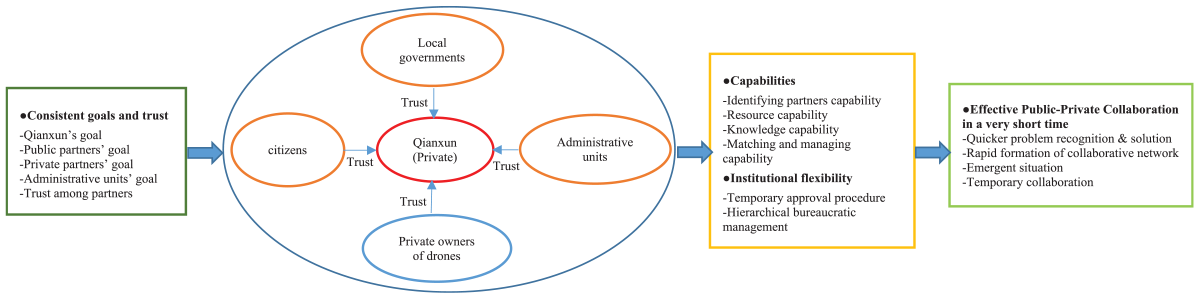
A model of public–private collaborations led by private sector for combating crises.
Consistent goals and trust
Competing values theory argues that there is an inherent conflict within public–private collaborations due to the very different goals pursued by public and private organizations (Gabler et al., 2017; Quinn & Rohrbaugh, 1983). In the period of viral epidemic outbreak, the epidemic has not only caused widespread damage but also shaped the diverse values, priorities, and bottom lines of all stakeholders. From our data, we found the key for the effective public–private collaboration is that all stakeholders in this cross-sector collaboration—Qianxun, local governments, private drone owners, administrative units to approve drone flights, and citizens—had the same consistent goal: to defeat virus and decrease infection risk. This same consistent goal overcame the institutional uncertainty and brought stakeholders together to fight against the common enemy. Qianxun, when leading this public–private collaboration, thus can help local governments by organizing and recruiting appropriate private partners whose focus was on the specific goal of dealing with the crisis, rather than pursuing benefits for their own business. For example, to reduce virus spreading in public space, the local government of Mozhang village in Weinan city, Shaanxi Province, wanted drones to spray disinfectants. However, they did not know how to find the drone resources. Meanwhile, a tech company (Lvsheng Agricultural Technology Ltd.) in Weinan city wanted to help to fight the COVID-19 epidemic but did not know where to put its drones. One interviewee from this company said “we want to contribute to the fight against the epidemic. Our drones may come in handy.” However, the information uncertainty hampered their actions. With the help of Weinan Electronic Network and Big Data Centre, the local government of Mozhang village registered the demand for spraying disinfectant on Qianxun’s online service platform. At the same time, the Lvsheng Agricultural Technology Company in Weinan city also registered its supply information on the online service platform. This shared goals between the Mozhang village and the Lvsheng Agricultural Technology Company brought them to the online platform initiated by Qianxun. Then, Qianxun swiftly matched them and coordinated them in planning and executing the disinfectant spraying tasks.
Commitment to the consistent goals between partners was also strengthened by Qianxun’s central role in trust-building during the processes of forming and managing the collaboration. Although we did not ask in our interviews about the trusting relationship between every stakeholder’s dyadic relationship, it is very striking that a high level of trust between Qianxun and other key stakeholders was surfaced from the news articles and mentioned by interviewees. For some stakeholders such as administrative units who are in charge of drone flight approval or drone owners who subscribed Qianxun’s high-precision positioning services, the trust in Qianxun already existed, and Qianxun can reinforce the trust by asking those stakeholders to recount instances in which they behaved trustworthily. For other stakeholders such as many local governments and citizens who had no previous experiences with Qianxun, the trust did not exist. Qianxun increased the level of trust by word-of-mouth and trial-and-error approaches that overcame the distrust and gradually reinforced local governments’ and citizen’s belief that Qianxun’s commitments will be fulfilled given the capacity and industrial reputation of Qianxun. One manager from Qianxun said, because of our (Qianxun) reputation and capability, many drone owners trust us and register the supply information on our online service platform. Besides, our drone online exchange service has been reported by many key state and local media, such as China Central Television, which attracted more drone owners and users to cooperate with us and brought trust from local citizens.
Capability
Our data revealed that Qianxun had unique capabilities to initiate and manage the cross-sector collaboration. First, Qianxun has the capability to identify stakeholders and select partners. Qianxun is the major high-precision positioning service provider in China; thus, it had a list of almost all drone owners in China, making it easy to reach out to the private drone owners on the mission of this new online service. Second, Qianxun owned abundant resources to facilitate and motivate collaboration. Qianxun compensated private drone owners 800 Chinese dollars (RMB) for each mission, and it prepared a total of 12 million Chinese dollars (RMB) for this public–private collaborative effort. Third, Qianxun has localized and specialized knowledge about drones. As the high precision positioning service for most drones in China, Qianxun has the knowledge of major drone owners and the capability of each drone registered in their system as well as the geo-space characteristics of each region in China. The Chief Executive Officer of Qianxun said that “relying on the high-accuracy positioning, navigation and timing services of BeiDou Navigation Satellite System, we can avoid all kinds of safety problems caused by inaccurate spraying.” 1 Moreover, the localized knowledge contributed to Qianxun’s thorough understanding of the approval process of drone flights and helped Qianxun make quick and sound judgment on how to match the supply–demand sides effectively. Fourth, Qianxun has the capability to match and manage the collaboration. One drone owner said “we buy drones products from Qianxun, which is a leader in the drone industry. We believe that Qianxun has the capacity to match the demands of local governments and our supply information.” Qianxun collected supply information (e.g., type of service, time, location, scale of drones, and past experience) from private drone owners and demand information (e.g., type of service, time, location, and whether having infected cases) from local governments, matched the information, and prioritized demands. Qianxun then convened demand sides and supply sides, negotiated contracts with exact steps and procedures in completing the mission with partners, and lobbied local governments to build a temporary approval framework to speed up administrative approval processes for drone flights.
Institutional flexibility
With the consistent goals and trust established between Qianxun and other stakeholders, Qianxun served as a change agent for institutional flexibility and was able to push and motivate local governments to break the hierarchical bureaucratic management and build a temporary approval framework for drone flights during the crisis. In routine time in China, an application for drone flight will need to be approved by Air Force, Civil Aviation Authority, Public Security Bureau, and other departments. The application process is complex, difficult, and time-consuming. However, under the crisis, Qianxun successfully convinced relevant approval authorities to break routine procedures and to demonstrate an institutional flexibility to process the flight application at an extremely rapid speed. By adopting temporary approval procedures, drone flight applications have been processed within 1 day during the crisis. Our interviewee, Mr. Wei recalled that the first government department to approve this mission of spraying disinfectant in Mozhang village was the Weinan Electronic Network and Big Data Centre. Then, Qianxun convinced other government departments to follow Weinan Electronic Network and Big Data Centre in reducing bureaucratic procedures and got the flight approved within one day, an unprecedented speed unheard of in normal times. The precondition of these approvals was that the drone owners have to obey relevant regulations and citizens’ privacy has to be protected.
An official in Civil Aviation Authority expressed a similar viewpoint, “after we received the drone flight application for combating the virus, we immediately investigated and studied its operational scenarios and risks and made an interim approval decision to expand its operation.” 2
Effectiveness in a very short time
Data suggested a very effective collaboration with evidence of all tasks finished successfully and the satisfaction of all stakeholders on the partnership. In the task for Mozhang village, Lvsheng Agricultural Technology Company used four drones to complete the mission of spraying disinfectant in less than 3 hr, covering an area of approximately 400,000 m2. A local citizen in Weinan city commented that “using drones to spray disinfectant is very fast, highly efficient, and excellent.” Several citizens in Shanghai also recalled that, “using drones to remind people to wear masks was necessary to protect everyone in the emergency situation.” Other interviewees also mentioned the privacy issues by drone monitoring, but they expressed their understanding of the use of this high-tech tool in emergency situations.
Our data indicated four reasons for this effective collaboration. First, private organizations such as Qianxun were quicker in recognizing problems and proposing solutions compared with governmental actors. When many local governments in China used a traditional way to spray disinfectants and patrol with a large number of labors, Qianxun immediately found that this labor-intensive solution was time-consuming and can increase risks of being infected among these labors. Then Qianxun quickly identified the demands of drones and initiated the online service to deal with the problems in an innovative way. Second, compared with normal cross-sector collaboration initiated and managed by governmental actors, this new public–private collaboration led by a private organization responded to the crisis swiftly. For example, the planning and execution of all tasks were completed by Qianxun within a day or two. Third, this public–private collaboration was an emerging and unplanned collaboration. Qianxun initiated the service to connect the demand sides with supply sides without a predesignated structure and careful planning. However, Qianxun led this collaboration to achieve unprecedented and complex spraying disinfectant and patrolling missions. Fourth, after completing each mission, the partnership was adjourned. Clearly, this partnership was designed for temporary and emergent public–private collaborations in unexpected circumstances for a specific public service delivery.
Discussion
Crisis such as the COVID-19 pandemic poses a significant challenge to public administration, not just for public officials who need to swiftly respond to uncertain and urgent situations, but for public administration scholars who struggle for more appropriate explorations of effective organizing under uncertainty. Public administration field has explored and proposed numerous theories on how to deal with environmental uncertainty characterized by complexity, ambiguity, dynamics, and munificence in general, but we are still short of the in-depth understanding of the effective collaborative efforts to handle the crisis. This case provides us at least three insights: How cross-sector collaborations led by private organizations have particular strengths in dealing with a crisis, how such collaborations enhance the resilience of an emergency management system in coping with a crisis, and what are the contingencies for such collaborations to be effective in handling crises.
Strengths of Private Organizations in Leading Cross-Sector Collaborations During Crisis
A crisis provides the most suitable conditions where some qualities of private actors function more effectively than public partners. Compared with public–private collaborations led by government agencies during crisis time, private organizations such as Qianxun have their unique strengths contributing to their success in leading cross-sector collaborations to cope with crises, including performance-oriented accountability system, stronger incentives to adopt innovative strategies, and more knowledge and information in a specific industry to handle a crisis.
First, as one of the most important issues in cross-sector collaborations in dealing with crises, accountability ensures effective collaborations (Koliba et al., 2011). Although accountability challenges exist in both private and public sectors, it is broadly acknowledged that accountability is more complex in public organizations than it is in private organizations (Mulgan, 1997; Parker & Gould, 1999; Ryan & Walsh, 2004; Sinclair, 1995). Governments have to make trade-offs between competing values in a crisis such as public safety versus economic development, individual freedom versus public interest, as well as transparency versus privacy (Yang, 2020). These competing values make government accountability system complex and ambiguous, in which different or even competing forms of accountability elements (e.g., from political realm to bureaucratic structure, and from fiscal compliance to performance requirement) need to be taken into account (Koliba et al., 2011; Ryan & Walsh, 2004). When a government agency plays the leading role in cross-sector collaborations, the variety of competing values and elements in the accountability system of the public sector can lead to more tensions and dysfunctional collaborations during crisis.
Different from governments who are required to deal with bureaucratic, legal, political, and professional accountability (Romzek & Dubnick, 1987), Qianxun as a private organization has a more flexible and clearer accountability system focusing on performance measures, which can help it take actions quicker to initiate cross-sector collaborations and coordinate different participants without being trapped into the dilemma of accountability tensions. For example, within Romzek and Dubnick’s typology, each accountability type emphasizes different principals/performance needs and the four types are quite often in opposition with one another. Bureaucratic accountability emphasizes hierarchical rules and supervisory control with goals aimed at efficiency, professional accountability delegates control to experts with goals aimed at effectiveness, political accountability is answerable to citizenry with goals aimed at responsiveness, and legal accountability delegates control to external regulatory authorities. The tradeoff of relying on one accountability type over another is linked to historic performance failures (i.e., the Challenger tragedy) and competing types of accountability present a paradox—meeting conflicting obligations is not possible and the costs of prioritizing one obligation over another may be costly. In our case, the crisis helped this public–private collaboration to prioritize the most important accountability—performance-oriented efficiency and effectiveness in controlling the spread of virus, without having to go through a tradeoff to handle inherent paradoxical nature of different accountability systems. What we observed from our November interviews was that after the short-term collaboration led by Qianxun completed its mission in dealing with a crisis, more accountability systems were kicked in for the regular process of public administration.
Interestingly, very few citizens expressed privacy concerns on the use of drone in monitoring and reinforcing the lockdown/stay-at-home policy and wearing masks policy in times of crisis because citizens shared the same goal with other key stakeholders that controlling the spread of the virus was the most important task under this crisis. Moreover, all the key stakeholders (Qianxun, local governments, private drone owners, and administrative units for drone flight approvals) have implemented protocols to protect privacy of local citizens and data storage.
In this study, using drones in a collaborative way to deal with the pandemic brought forth a potential valuable lesson on the ethical dilemma of privacy, trust, and security/public health. Drones might become an important tool in fighting the pandemic around the world. However, with the increasing use of drones during a public health crisis, ethical concerns related to citizen’s privacy, data protection, and the trusting relationship between citizens, governments, and private organizations also enter into the picture. Although discussing these issues in detail is beyond the scope of this article, we emphasize that the use of drones should be cautious due to ethical concerns. To decrease the potential risks associated with drone use, a legislative framework is needed to regulate the conduct of using drones during crisis time.
Second, adopting innovative strategies is critical for effective responses to crisis since traditional approaches are often insufficient or incapable of swiftly dealing with institutional and strategic uncertainties. When extreme events occur, governments tend to resort to predesignated structures and approaches dealing with emergencies while private organizations have more incentives and capabilities to adopt innovative strategies. The strong incentives and capabilities of private organizations emerge from their specific context in which they survive and develop—competitive market. To make more profits in a competitive market context, private organizations need to provide immediate feedback to different changing market signals, which enables them to cultivate more incentives to do things innovatively. By contrast, the institutional context of governments is relatively stable and hierarchical in which the daily operations of governments often follow routine procedures with less innovation. With few experiences in marketplaces and more complicated layers of bureaucracy, government agencies are more likely to take more cautious and conservative strategies rather than exploring and adopting innovative strategies to accomplish their missions (Horwitz, 2009).
Innovative strategies used by private organizations may be less important in normal situations as predesigned structures and routine approaches are often effective enough. However, when a crisis occurs, innovative strategies that the private sector has been accustomed to may work better in dealing with time pressure, uncertainty, and complexity in an emergency environment. Especially, when collaborative practices are used to handle an emergency, a private organization as a leader of the collaboration has more capability to promote useful innovative strategies in the collaboration to solve problems. In addition, because the collaboration partnership aiming to handle emergency is temporary and will likely end after the emergency, there are less concerns about potential problems caused by the adoption of innovative strategies during crises, such as higher cost and insufficient supervision over the innovative strategies. In our case, it is the strong incentives and capability to adopt innovative strategies amid the pandemic that make Qianxun plays a leading role in initiating and managing cross-sector collaborations rather than resorting to a predesigned structure and careful planning to achieve unprecedented and complex missions.
Third, daily operations in a particular industry also give private organizations more knowledge and information related to coordinating partnerships. Compared with governments, operating in a specific industry during normal business time helps private organizations acquire comprehensive and updated information regarding specific cost, products, and services in their industry that can be used immediately during a crisis (Horwitz, 2009). In our case, Qianxun, as the major high-precision positioning service provider in China, has a list of almost all drone players in China, making it easy to reach out to the private drone owners to form potential collaborations between these drone owners and local governments. In contrast, governments often fail to respond in a timely manner due to scanty and outdated information in a specific domain (Sobel & Leeson, 2007). In addition, Qianxun has more knowledge in managing their supply chains, optimizing their inventories, and navigating the bureaucratic processes of drone flight approval, all of which are valuable for coordinating the behavior of partners and the allocation of diverse resources to promote the effectiveness in handling crisis. When resources are limited during a crisis, private organizations can find more innovative ways of allocating resources where the demand is higher. By transferring their daily experience and lessons to crisis situations, private organizations are more capable than governments in leading a cross-sector collaboration to deliver certain services timely.
Resilience of Cross-Sector Collaborations Led by Private Organizations
Resilience is a critical dimension of the effectiveness of a system and is defined as the capability of a system to cope with, adapt to, and recover from adverse conditions and return to its original state (Allenby & Fink, 2005; Holling, 1973; Mallak, 1998). Building resilience requires a system to learn to live with uncertainties in changes, cultivating diversity to increase options and reduce risks, obtain more knowledge for learning and problem-solving, and create opportunities for self-organization (Berkes, 2007; Miao et al., 2013). Applied to emergency management, building resilience means improving “the capacity to adopt the existing resources and skills to new situations and operating conditions” (Comfort, 1999, p. 21), which often implies capabilities such as reducing the probability of a shock, buffering an emergency when it takes place, and recovering quickly after a crisis (Jung & Song, 2015). To enhance the resilience of the emergency management systems, it is crucial to promote collaborations across organizational boundaries (Stewart et al., 2009) because a network of organizations will be more likely to successfully manage the consequences of crises and swiftly deliver products and services in a crisis (Stewart et al., 2009).
The cross-sector collaboration led by private organizations has the advantages of enhancing the resilience of the collaborative network in terms of increasing both “hard” resilience (physical components such as resources and facilities) and “soft” resilience (nonphysical components such as abilities of coordination and collaboration) categorized by Miao et al. (2013). We found in this case that with its specific knowledge and information gained from the daily operations, Qianxun is more familiar with the physical resources in drone market so that it can quickly and accurately mobilize, allocate, and coordinate a variety of resources and facilities to handle the crisis. Once some resources and facilities are damaged or weakened, Qianxun can find replacements from different sources in a timely manner. In this way, the collaboration led by the private organization has more “hard” resilience to respond to a crisis. At the same time, as Qianxun prioritized accountability systems targeting at the most important goal under the crisis—to reduce the fast spread of the virus, in contrast to the complex and often paradoxical accountability systems of the different levels of governments, jurisdictions, and departments in public sector, Qianxun is capable of timely communications, effective coordination, and quick responses without dealing with the complexity of the competing accountability elements. Moreover, the stronger incentives to solve problems innovatively helped Qianxun initiate and manage the collaboration creatively and also helped Qianxun break up certain bureaucratic routines that inhibit rapid responses to a crisis. In view of these strengths, private organizations can make a cross-sector collaboration more resilient to withstand damages and better cope with uncertainties during a crisis.
Contingencies of Effective Collaborations Led by Private Organizations During Crisis
Despite the strengths of private organizations as a leading actor in enhancing the effectiveness of cross-sector collaborations in handling crises, we are not intended to claim that private actors are better or preferred leaders of all collaborations during crises. Instead, we noticed from the case how specific emergency situations can lend themselves to successful cross-sector collaboration when a set of contingencies are satisfied related to the type of missions accomplished by collaborations in a crisis, the characteristics of participants in the collaboration, and the institutional environment in which the collaborations operate.
Type of mission
Multiple missions have to be accomplished by public and private actors during a crisis due to the complexity and uncertainty in extreme events. It is almost impossible for a certain type of organization to lead collaborations more effectively than others in accomplishing all types of missions. If the missions are more specific, professional, and temporary in nature, private organizations in a specific industry might be more effective in initiating and managing collaborations to handle a crisis. In our case, the missions of collaborations are to reinforce the lockdown/stay-at-home policy and wearing masks policy and to spray mass disinfectant in public areas by using drones, which are specific, professional, and temporary. Qianxun has more specialized knowledge and experience in promoting the mission and coordinating the collaboration. We have seen other similar specific missions such as providing daily relief supplies to affect zones that can also be completed effectively by collaborations led by certain types of private organizations (e.g., capable grocery stores and supermarkets companies) located in those impact areas (Kampf, 2007; LeCavalier, 2016). These private organizations often have a mature supply chain and a better capability to adjust and provide the supplies in need during a disaster. These strengths that private organizations have can help them lead collaborations more effectively. In contrast, governments who lack these advantages need more time to carefully design and plan these collaborations, which cannot be afforded by a crisis.
Characteristics of participants in collaboration
The second contingency we noticed from the case is regarding participants, including the number of participants that can be included in collaborations to complete specific missions, participants’ capacity in having abundant resources to provide supplies or services, and the close relationship between the relevant private/nonprofit participants and the public sector.
First of all, the number of organizations that can participate in collaborations has to be large enough to ensure sufficient resources that can be used to respond to a crisis effectively. If certain industries are too new or too small to have enough actors, the public sector may be more capable to ensure sufficient resources in need. In our case, with the rapid development of China’s drone industry and market in recent years, a lot of affordable and accessible drone equipments can be provided by drone companies or private owners in civilian, commercial and professional areas. When extreme events occur, the mature drone industry in China has sufficient capability to form collaborations with other partners to effectively deliver services in need.
In addition to a large number of relevant participants, their capacity in providing abundant resources is also important for the collaboration to be effective. A capable private organization is able to initiate cross-sector collaborations to respond to a crisis, but if the relevant participants have poor potentials in obtaining abundant resources to provide supplies and services immediately, the collaborations cannot be effective as well. In our case, all of the 262 private drone owners registered in Qianxun are highly active and capable players in the drone industry, thus were able to swiftly engage in the negotiated tasks using their abundant resources. Moreover, we observed that it is necessary that a close relationship existed between private/nonprofit organizations and the public sector for the success of the collaboration. In our case, the reason that Qianxun was able to successfully convince relevant administrative units to break routine procedures in processing drone flight applications in an extremely rapid speed was due to its close relations with government agencies.
Institutional environment
All cross-sector collaborations are formed, operated, and managed in a certain institutional environment, which sets basic protocols, rules, and norms for stakeholders’ consensus and patterned behavior (Ansell & Gash, 2008; Lawrence et al., 2002; Phillips et al., 2000). The effectiveness of public–private collaborations led by private organizations in coping with crisis is contingent upon the protocols, rules, and norms in a specific institutional environment. When the institutional laws and regulations are rigid or repugnant for private organizations to lead cross-sector collaborations, it is more difficult for the private sector to initiate and manage collaborations effectively in a short time. In contrast, when the institutional environment is more tolerant and conducive for the private sector to be involved in public affairs, especially during crisis time, private organizations can play the leading role in cross-sector collaborations more effectively. In Qianxun’s case, although the regular application process for drone flights is complex, uneasy, and time-consuming, the success of Qianxun in convincing administrative units to break routine procedures under crisis demonstrates a sufficient level of institutional flexibility in the Chinese government in accepting private drone owners to be involved in emergency management, which is also a critical precondition for private organizations to lead cross-sector collaborations to cope with a crisis.
Certainly, due to the uncertainty in crisis and the complexity in collaborative governance, our data cannot exhaust all contingency factors that can influence the effectiveness of public–private collaborations led by private organizations in dealing with crisis, yet it is critical to have contingency thinking when policymakers try to take innovative strategies to diversify ways that new forms of collaboration could emerge.
Conclusion
Through an informative case on how a private actor emerged as a leader to initiate and manage a public–private collaboration to effectively cope with a crisis, we pinpointed four major characteristics of such a cross-sector collaboration: consistent goals and trust, capability, institutional flexibility, and effectiveness in a very short time. This case provides us some insights on how cross-sector collaborations led by a private organization can work effectively under certain contingencies to enhance the resilience of an emergency management system in coping with a crisis.
This study provides some insights regarding why and under what conditions the characteristics of private sector become the most effective tool in addressing wicked problems in a crisis. First, the dynamic environment of a crisis makes it imperative to take advantage of the characteristics of private sector in responding to the uncertainty and complexity during a crisis. It has been noted that nontraditional mechanisms and tools characterized by nonhierarchical structure and flexibility are required in actions amid a crisis (Kapucu & Garayev, 2011). The private sector is in general more flexibility with simpler accountability, which made them an ideal candidate to lead collaborative efforts during a crisis. Second, the leading role-played by a private organization in collaboration can give it more power in agenda setting, decision-making, and policy implementation during a crisis, which helps the private sector takes full advantage of its strengths to lead the collaboration in tackling a crisis. Comparatively, the subordinate role of a private organization in most collaborations led by a public agency may decrease its effectiveness in handling a crisis because the inflexibility and paradoxical accountability systems followed by the public sector hamper the effectiveness of the collaborative efforts in dealing with crisis. Third, the temporary nature of the collaboration between public and private organizations in a crisis can reduce the potential negative impacts of the characteristics of the private sector (e.g., lack of full range of accountability systems) because the potential negative impacts are temporary and can be controlled and will be eliminated if needed after the crisis.
The findings provide two contributions to the current understanding of collaborative governance for coping with crises. First, this study extends previous research on collaborative governance of the emergency management by applying a case study of a public–private collaboration led by a private actor. Previous studies have examined the emergency management collaboration led by government actors while our analysis of emergency management collaboration highlights the roles and strengths of private organizations in leading cross-sector collaborations during a crisis. It extends the typical focus on the public sector and the public agencies as leaders to cope with crises.
Second, this study formulates a framework of public–private collaborations led by private sector for combating crises and specifies its dynamics. Much of the literature on emergency management collaboration suggests that success occurs when there are trust, leadership, and management capacity (Mizrahi et al., 2019; Nohrstedt, 2018; Waugh & Streib, 2006). Few of them revealed that self-organizing and local autonomy provide flexibility and swiftness to effectively handle problems associated with environmental uncertainty within the tight constraints of general bureaucratic structure and existing rigid decision-making processes. We observe that the public–private collaborations led by private sector is an autonomous collaboration with localized knowledge and competency and can successfully deal with dynamic complexity in its immediate environment, especially capable of pushing and motivating institutional flexibility of the hierarchical bureaucratic management. Hence, our finding has enriched emergency management research by showing different scenarios of collaborative governance during a crisis.
Despite the specific context related to this study, the public–private collaboration led by a private actor and its characteristics revealed from this study is generalizable to many other emergency situations. Uncertainty is the major characteristic of all emergency contexts, which requires quick and effective responses different from regular situations. Thus, even though the institutional environments such as legal systems vary among countries, the priority amid emergency is the same—to promote quick and effective responses that private organizations are often capable of due to their common characteristics (e.g., flexibility, capacity of innovation, and simpler accountability systems) which would help them work well in dealing with emergencies. In this regard, the strengths of private sector in handling a crisis discussed in this essay are generalizable across different countries or geographic regions.
This study provides critical lessons for public administration practitioners as well. Facing uncertainties in a crisis, local governments and private actors in different sectors should be empowered with local autonomy and discretion to act to handle practical and emergent problems innovatively. We hope our efforts will inspire public administration scholars to explore the strengths of private actors in leading cross-sector collaborations during a crisis, reframe the role of nongovernmental actors in collaborative governance to enhance the resilience of emergency management systems, and rethink how to adopt a contingency perspective to tame uncertainties in crisis time.
Footnotes
Acknowledgements
We are thankful for their supports.
Declaration of Conflicting Interests
The author(s) declared no potential conflicts of interest with respect to the research, authorship, and/or publication of this article.
Funding
The author(s) disclosed receipt of the following financial support for the research, authorship, and/or publication of this article: The research presented here was supported by National Natural Science Foundation of China (71774023), Liaoning Revitalization Talents Program (XLYC1907024), Fundamental Research Funds for the Central Universities (DUT19RW209), and Liaoning Province Social Science Foundation (L19BGL003).
