



Abstract
In this article we raise the question whether servant leadership became more important for performance and work-life balance satisfaction during the COVID-19 pandemic. Two alternative hypotheses are formulated stating that on the one hand the impact of servant leadership may have increased during COVID-19 as servant leadership can help in dealing with a crisis. On the other hand, it may have become more difficult to express leadership behaviors when leaders and employees are physically distanced from one another. A longitudinal approach was taken to examine the role of servant leadership in relation to the performance and work-life balance satisfaction, comparing the situation before and during the pandemic. Panel data was collected in a Dutch government organization (N = 293). Results indicate that there was a decrease in the amount of servant leadership experienced by employees, however its impact remained in times where leaders and employees were confined to their homes.
Introduction
The COVID-19 pandemic has given special meaning to the concept of working from home. Rather than a possibility, as it was before the pandemic, it suddenly became the norm for many employees (especially in the public sector), including those who had not worked from home before because they did not want to or were not allowed to do so. Experiences during COVID-19 will likely have a lasting impact on work relations, the debate about working from home, and work-life balance issues. Many organizations, for instance, are reconsidering how they use their workspace after the pandemic. Should employees work from home more, or should they return to the office? What do these alternatives mean for leadership, employee performance, and work-life balance? The experiences and lessons learned during COVID-19 will be important in answering all these questions.
For public sector organizations this may be especially relevant since extensively working from home may affect the individual job performance of employees, which could in turn influence the quality of public services. Moreover, in their role as a model employer (Steijn & Knies, 2021), it is important that public sector organizations pay attention to employee well-being. Having a good balance between work and personal life is a factor of substance when it comes to well-being (Clark, 2000). Hence, examining ways in which public organizations can foster work-life balance satisfaction and performance (in the context of working from home) becomes very relevant, maybe even more so in times of crisis.
One crucial factor mentioned in the literature on employee well-being and performance is leadership. Leadership is thought to have a significant effect on employee performance, as argued in many theories on leadership (Bass, 1985; Van Wart, 2012) and demonstrated in various empirical studies (see Howell & Avolio, 1993; Keulemans & Groeneveld, 2020). The same can be said of the relationship between leadership and work-life outcomes (e.g., Coetzer et al., 2017; Haar et al., 2017; Tang et al., 2016). Leaders motivate people in organizations and, in particular, support and empower employees in their daily activities, as emphasized in recent leadership theories, for example, servant leadership (van Dierendonck, 2011; Van Wart, 2012). The COVID-19 outbreak, however, shook workplace situations to the core in most countries of the world (at least between early 2020 and mid-2022). Employees worked from home more than ever before, and we are still exploring the implications of this. One intriguing question, then, is whether leadership, especially supportive forms of leadership (e.g., servant leadership), became more important for employees’ performance and work-life balance during COVID-19, when many more people were working from home and remotely from one another (e.g., their colleagues) than before the pandemic.
Answering this question might improve how we deal with work situations in the future, which is likely to involve working from home to a greater extent (Centraal Bureau voor de Statistiek, 2021; Eurofound, 2022). How leaders can lead when employees work remotely is likely to become a more important issue in the future, making experiences during COVID-19 highly relevant. On the one hand, leadership may have become a more important factor in employee performance and work-life balance satisfaction during COVID-19 since having a leader’s support can help employees make better choices and cope more effectively with changing circumstances. On the other hand, it may have also become more difficult to express leadership because face-to-face meetings were limited or absent. Virtual leadership requires additional effort and skills (Bell et al., 2019). Employees may be less aware of leadership support when everyone is working from home, which could mean that supportive forms of leadership have a less pronounced relationship with performance and work-life balance satisfaction.
In this article, we focus on servant leadership as an example of supportive leadership and its influence on performance and work-life balance satisfaction. We compare the impact of servant leadership before the pandemic and during COVID-19 when many employees were forced to work (almost) entirely from home. Using longitudinal survey data gathered at three different points in time, we examine whether servant leadership became more important for performance and work-life balance satisfaction during COVID-19 than before the pandemic, when working remotely was much more limited. We aim to answer the following overarching research question: What was the impact of servant leadership on performance and work-life balance satisfaction before and during the COVID-19 pandemic and did the impact change over time?
In seeking to answer our research question, we first examine the relationship between servant leadership, performance, and work-life balance satisfaction at different timestamps. We then formulate two alternative hypotheses. The first is based on the literature on servant leadership. It suggests that forms of leadership that involve paying attention to and supporting employees had more impact on work-life balance satisfaction and performance during COVID-19. The second, alternative, hypothesis is that the strength of the relationship between these constructs decreased during COVID-19 because it is difficult to express servant leadership when leaders and employees work remotely from one another.
This article contributes to the literature by addressing the ongoing discussion about the effects of leadership on performance and work-life balance satisfaction. Previous research has well established a link between leadership and performance (e.g., Jacobsen & Bøgh Andersen, 2015; Schwarz et al., 2020). However, studies that address the relationship between servant leadership and performance have typically centered on organizational and team performance (Eva et al., 2019; Liden et al., 2014). In contrast, the empirical investigation of servant leadership and individual job performance, has been infrequent, with only a handful of studies exploring this association (e.g., Eva et al., 2019; Schwarz et al., 2016). By focusing on servant leadership and individual job performance over a longer period of time, this article provides empirical data that are fairly rare.
In addition, the article examines how an extreme situation, COVID-19, in which employees worked extensively from home, affected employees’ experience of servant leadership and what this means for the impact of leadership on performance and work-life balance satisfaction. We collected our data during the first lockdown in the Netherlands, giving us a unique setting that would be almost impossible to recreate (Stoker et al., 2022). Moreover, because we also gathered data at two different timestamps before the COVID-19 pandemic, we can use this longitudinal data to compare the findings of the first lockdown with the pre-COVID situation for the same employees.
Theoretical Framework
There is nearly a universal agreement that leadership matters within organizations’ work processes, decision-making, and interaction processes between organizations. Moreover, leaders make a difference in employee performance and well-being (see Howell & Avolio, 1993; Van Wart, 2012; Zehndorfer, 2014). There is, however, more controversy about which type of leadership is most effective. The literature on leadership is vast, and the number of leadership styles that have been identified is immense (see Van Wart, 2012; Zehndorfer, 2014). For example, transformational leadership, which aims to effectuate change and emphasizes inspiration and a charismatic form of leadership, has been dominant since the mid-eighties in the leadership literature (see Bass, 1985; Howell & Avolio, 1993). This leadership style has traditionally been contrasted with a more rational, transactional leadership style focused on setting targets for employees and rewarding them for achieving those targets.
Transformational leadership has recently drawn a significant amount of criticism due to its conceptional vagueness and flaws in its operationalization (see van Knippenberg & Sitkin, 2013). In the meantime, other leadership conceptualizations have emerged, aimed both at intra-organizational perspectives, for example, various perspectives on interpersonal leadership and leadership in complex (inter-organizational) collaborative processes in networks (see Ricard et al., 2017; Van Wart, 2012). Since we are interested in how leaders support employees, we turn to forms of interpersonal leadership, and especially servant leadership, to answer our research question.
Servant Leadership as the Empowerment of Employees
Several perspectives on what can be labeled interpersonal leadership have emerged. They focus on how leaders interact with their employees and how they succeed in supporting and motivating them (see Tummers & Knies, 2013; Van Wart, 2012). Some of these theories also stress the importance of the leader’s characteristics, such as authenticity and ethical behavior (see van Dierendonck, 2011; Van Wart, 2012). Compared to more transformational and charismatic perspectives on leadership (see Bass, 1985; Howell & Avolio, 1993), the leader in all these interpersonal leadership perspectives is less of an inspirational visionary who determines strategy and leads by offering inspirational futures. Instead, the leader in interpersonal leadership theories builds relationships with their employees and practices stewardship toward the organization and its employees (see Ricard et al., 2017; Van Wart, 2012).
One of the most prominent examples of interpersonal leadership theory is servant leadership, first introduced by Greenleaf (1977) and later conceptualized and operationalized in various studies (see Ehrhart, 2004; Miao et al., 2014; van Dierendonck, 2011). The literature identifies many characteristics of servant leadership, but the most important is that servant leaders empower their employees and foster their development. Other characteristics mentioned have to do with the leaders themselves and stress a certain humility, such as putting one’s accomplishments into perspective. The focus is also more specifically on stewardship, which means that leaders take responsibility for the whole organization (as opposed to their self-interest) (see Miao et al., 2014). Servant leadership is less top-down and more horizontal in nature than transformational, transactional, and other forms of leadership (van Dierendonck, 2011). It also gives the leader a less central role, focusing more on empowering employees by giving them autonomy in their work. Like transactional leadership, however, servant leadership also sees the leader as a role model, and like transformational leadership, it aims to provide direction and ensure that people know what is expected of them.
Servant Leadership and Performance
Given that servant leadership focuses more on supporting and empowering employees in their work and is more tuned to individual employees (see van Dierendonck, 2011) and thus more aligned with their personal situation, we expect that a high level of servant leadership is positively associated with performance. This notion is also in line with earlier empirical results (see, for instance, Miao et al., 2014). Previous research has examined the association between servant leadership and performance on different levels, encompassing employee, team, and organizational performance (Liden et al., 2008; Choudhary et al., 2013; Sousa & Van Dierendonck, 2016). However, a systemic review study conducted by Eva et al. (2019) demonstrated that empirical research specifically focusing on the relationship between servant leadership and individual job performance is rather scarce.
How can servant leadership affect individual job performance? Servant leaders and, more specifically, empowering behaviors can, for example, influence individual job performance by granting employees the autonomy to determine when they work and how they organize their work (Chiniara & Bentein, 2016). This allows them to work on times and in ways most effective for them, which in turn facilitates getting the work done in time. Empowering employees may also enable them to prioritize tasks according to their own judgment. In addition, these leaders leave employees the freedom and space to learn new skills and competences that can, for example, help them solve problems (Srivastava et al., 2006) and better allocate their efforts. All in all, servant leaders can establish a climate where there is room for input, reflection, learning, and development (van Dierendonck, 2011), paving the way for better performance.
We further expect to see a positive association between servant leadership and performance at each of the timestamps, encompassing both the pre-COVID situation and the situation during the pandemic. The situation during COVID-19, which we analyze at one of the timestamps, is naturally very different from normal circumstances in which most employees work at the office most of the time. In fact, the extreme circumstances during the pandemic are similar to what the literature refers to as working in virtual teams, with employees and leaders being separated spatially and having limited contact with one another (Eisenberg & Krishnan, 2018; Liao, 2017; O’Leary & Cummings, 2007). However, the resemblance is limited because, unlike virtual teams, the employees in the organization we studied do know one another reasonably well, having interacted at the office before being forced to work from home full time.
The literature on virtual teams heavily emphasizes leadership (Bell et al., 2019; Liao, 2017). Although some scholars emphasize task-related management activities that may be better suited to the transactional perspective on leadership, others place a heavy or even heavier emphasis on relational, servant-like leadership activities, such as facilitating transparency, collaboration, flexibility, empowering employees and caring for them (see, for instance, Eisenberg & Krishnan, 2018). This supports the idea that servant leadership was likely also very relevant during COVID-19 when employees worked entirely from home. This leads us to our first hypothesis:
H1 Servant leadership is positively associated with individual job performance at all timestamps.
Servant Leadership and Work-Life Balance
Several authors have examined servant leadership in relation to work-life outcomes (e.g., Haar et al., 2017; Tang et al., 2016). When it comes to the interaction between work and personal life, theory assumes individuals fulfill multiple roles across different life domains, such as the role of co-worker, manager, parent, family member, or friend. Consequently, roles from different life domains may be prone to conflict (Greenhaus & Beutell, 1985), but enrichment may also occur (Gatrell et al., 2013). However, this article focuses on work-life balance satisfaction rather than cross-domain interactions. Work-life balance satisfaction is defined as “an overall level of contentment resulting from an assessment of one’s degree of success at meeting work and family role demands” (Valcour, 2007, p. 1512). This assessment is predicated upon an individual’s expectations, needs, wishes, and experiences, but it can also be shaped by the social context (Wayne et al., 2017). Moreover, Valcour’s (2007) definition implies that there is no equal or optimal division regarding work-life balance, acknowledging that individuals may prioritize work, family, or dual-centric (Kossek & Lautsch, 2012).
Boundary management can help individuals to manage demands and desires across roles and life domains successfully, by either segmenting or integrating the roles (Kossek & Lautsch, 2012). Segregators prefer to keep roles separately, for example, by not working beyond working hours or only at the office. Family-centric individuals may prefer more segregation to avoid work creeping into the family domain. Integrators, on the other hand, prefer to integrate roles with flexible and permeable boundaries and check their e-mail in the evening or on weekends or take personal calls during working hours. Work-centric individuals may prefer this strategy because it allows them to always be available for work. Individuals with a dual-centric work-family identity may alternate between segregation and integration to prioritize demands and desires from both domains as needed (Kossek & Lautsch, 2012). Boundaries between roles can be enacted through spatial, temporal, and psychological borders. Separating the work and non-work domains has been posited as a means for managing the borders between these domains. Conversely, the integration of work and non-work roles is believed to facilitate smooth transitions between these roles or domains (Desrochers & Sargent, 2004). The increased intensity of working from home during the COVID-19 pandemic has led to more flexible and permeable boundaries and a push toward integration (Metselaar et al., 2023). The blurring of boundaries brought about by these phenomena may pose challenges for individuals who prefer a clear distinction between work and non-work roles. So far, research has shown that the ability to manage boundaries based on personal preferences positively relates to work-life balance satisfaction (Metselaar et al., 2023). Moreover, boundary management theory argues it is not so much the kind of strategy that employees apply that matters for achieving a satisfactory work-life balance since both strategies have advantages and disadvantages (Ashforth et al., 2000), but rather being able to act upon one’s preferred boundary strategy, highlighting the role of boundary management control (Kossek & Lautsch, 2012). Servant leaders can facilitate boundary control, which allows employees to use their preferred boundary management strategy.
In general, even more than in the case of performance, one would expect a positive relationship between a high level of servant leadership and a high level of work-life balance satisfaction, more so than for any other leadership style. After all, other styles that focus more on incentives (transactional leadership), inspiration (transformational leadership), and achieving goals might attain these aims at the expense of personal welfare since they devote more attention to reaching targets and creating a vision rather than to employees’ well-being, which is the explicit aim of servant leadership (van Dierendonck, 2011). Or, as Liden et al. formulate it: “servant leadership is based on the premise that leaders who are best able to motivate followers are those who focus least on satisfying their own personal needs and most on prioritizing the fulfillment of followers’ needs” (Liden et al., 2014, p. 1434). By taking a step back, a servant leader empowers employees to make their own decisions according to their needs and preferences, which in turn should improve well-being, personal growth, and autonomy among employees (Greenleaf, 1977; van Dierendonck, 2011).
In terms of work-life balance, a servant leader is likely to focus on how employees want to organize their work and personal life and how they, as a leader, can support them in doing so. By providing support in the workplace, servant leaders generate work-life resources for their employees (Russo et al., 2016), ultimately enhancing work-life balance satisfaction (Haar et al., 2017). This can help them in aligning demands from the work and non-work domain. Moreover, empowering employees gives them more autonomy to act upon their preferred boundary management strategy, which can help them achieve higher levels of work-life balance satisfaction even when they are forced to work from home (Metselaar et al., 2023). This factor is also emphasized in the literature on virtual leadership (see Eisenberg & Krishnan, 2018; Liao, 2017). The above leads us to hypothesis 2:
H2 Servant leadership is positively associated with work-life balance satisfaction at all timestamps.
Work-Life Balance as a Means for Better Performance
A satisfactory balance between work and personal life is likely to result in other beneficial outcomes, such as more motivation and less stress (Johari et al., 2018). Moreover, it has been argued that higher levels of work-life balance satisfaction can help employees focus on work when they are “at work” rather than feeling stressed about meeting demands from different life domains. A better focus means they deliver better performance (S. Kim, 2004). In line with this, empirical studies have shown that employees who are able to meet demands from different life domains demonstrate better performance (Metselaar et al., 2023). Hence, we propose that work-life balance satisfaction can also help enhance performance. This results in the following hypothesis:
H3 Work-life balance satisfaction is positively associated with performance at all timestamps.
The Impact of Servant Leadership Over Time—Before and During COVID-19
The way we lived and worked changed drastically during the COVID-19 pandemic. The lockdowns imposed to slow the spread of the virus created an extraordinary situation in which almost all employees in public organizations worked from home to an unparalleled extent (Stoker et al., 2022). This brings us to the most important question of this article: what was the impact of (servant) leadership during COVID-19? Using a longitudinal approach encompassing the results of questionnaires distributed prior to COVID (two measurements) and during a COVID-19 lockdown (one measurement), we can explore whether the impact of servant leadership increased during the COVID-19 pandemic.
We present four theoretical arguments as to why servant leadership becomes more important when employees are all working (almost) entirely from home. These arguments explain the impact on performance as well as work-life balance satisfaction. First, the COVID-19 measures led to changes in many employees’ daily work. They either had more or fewer tasks to carry out, or they had to find new ways to do their work from home (D. Anderson & Kelliher, 2020). Concerning changes in work demands, we expect servant leaders to step up to help employees maintain their performance, which is frequently noted in the literature as one of the main activities of servant leaders (see van Dierendonck, 2011). Second, Stoker et al. (2022) argue leaders need to delegate more when employees all work remotely, which is in line with the empowerment dimension of servant leadership. This may give employees more autonomy, possibly improving their performance and work-life balance satisfaction (Metselaar et al., 2023). Third, when the pandemic hit, leaders and employees had to depend on technology to connect and communicate with one another, with face-to-face interactions being limited by the need to work entirely from home. This likely reduced the number of informal and spontaneous interactions and could have resulted in feelings of social isolation and the absence of a sense of belonging, resulting in poorer performance and reduced work-life balance satisfaction (Beauregard et al., 2019). A leader can once again play an essential role in dealing with less rich communication and feelings of isolation by facilitating interactions (Liao, 2017; Moser & Axtell, 2013). Fourth, the COVID-19 measures tied employees to their homes in a broader sense. Not only were they obliged to work from home, but social-distancing rules meant that their personal lives were primarily confined to their homes. As a result, the boundaries between their work and personal lives were blurred significantly (Craig & Churchill, 2020), resulting in additional challenges to create a satisfactory work-life balance. Servant leadership can help employees to deal with these challenges because it is a leadership style attuned to their personal situation. Given these four arguments, we hypothesize the following:
H4a The impact of servant leadership on performance increased during COVID-19.
H4b The impact of servant leadership on work-life balance increased during COVID-19.
As mentioned before, the pandemic gave rise to an extreme situation because both employees and their leaders worked entirely from home. Leaders had to manage at arm’s length (Hill, 2020), making it more difficult to meet and see their employees. It is therefore possible that the beneficial behaviors described above are impossible for leaders to perform or achieve. Leaders may simply have not been able to “execute their role in the same way as they do in situations where they are in the same location as their employees” (Stoker et al., 2022, p. 209). The literature on virtual leadership tells us that leadership is more challenging when employees do not see one another every day in the office (see, e.g., Eisenberg & Krishnan, 2018). Previous research also shows that leaders can fall back on more directive forms of leadership during crisis situations to regain control in times of uncertainty (Gray & McNaughton, 2000; McGregor et al., 2010; Staw et al., 1981). This may result in them delegating less (Stoker et al., 2022). In this case, we would see both a decline in the perceived level of servant leadership and likely a decrease in the impact of servant leadership on performance and work-life balance satisfaction. We have therefore formulated two alternative hypotheses:
H5a The impact of servant leadership on performance decreased during COVID-19.
H5b The impact of servant leadership on work-life balance decreased during COVID-19.
Method
Procedure and Participants
This study was conducted at a government organization in the Netherlands. For 3 years in a row—2018, 2019, and 2020—a digital questionnaire was distributed to a sample of3,636,2,679, and2,765 employees, respectively. More specifically, invitations to complete the questionnaire were sent to employees working in one specific location that houses all the departments of the government organization in question. Heads of each department provided the e-mail addresses of employees with office jobs; employees who worked in the field were excluded.
The sample of respondents invited to participate differed across the timestamps. The specific location remained the core focus of data collection. However, due to organizational changes and shifts in the employee database, the list of e-mail addresses differed somewhat from year to year. In addition, some respondents completed the first questionnaire but not the second or third, or vice versa, meaning that we did not have data from these respondents for all three timestamps. Other respondents participated in only two of the three timestamps. The nonresponse was partly due to the fact that not everybody was invited to participate in each timestamp. Respondents who did not participate at all three timestamps were excluded from our panel. After three sequential measurements and deleting missing data, the sample consisted of 293 respondents who had answered all the questions in all three questionnaires. Hence, we were able to follow the same group of employees (almost 300 respondents) over the course of 3 years. 1
Measures
Various scales developed to measure servant leadership examine several dimensions (e.g., Liden et al., 2015; van Dierendonck, 2011). In this article, we focus specifically on empowerment. To measure this dimension of servant leadership, we used five items derived from van Dierendonck and Nuijten (2011). Items were measured on a five-point scale ranging from “strongly disagree” to “strongly agree.”
Perceived job performance was measured using three items taken from the performance scale (a five-point Likert scale) based on Koopmans et al. (2014). We focused on how employees perceive their own performance because objective or supervisor ratings were unavailable. It has been shown, however, that perceived performance is a reasonable alternative when objective measures are not available, with several studies finding a high correlation between perceived performance and objective measures (e.g., Dess & Robinson, 1984; McCracken et al., 2001). Moreover, our measure of individual job performance is applicable both before and during COVID-19, which makes it possible to compare these timestamps.
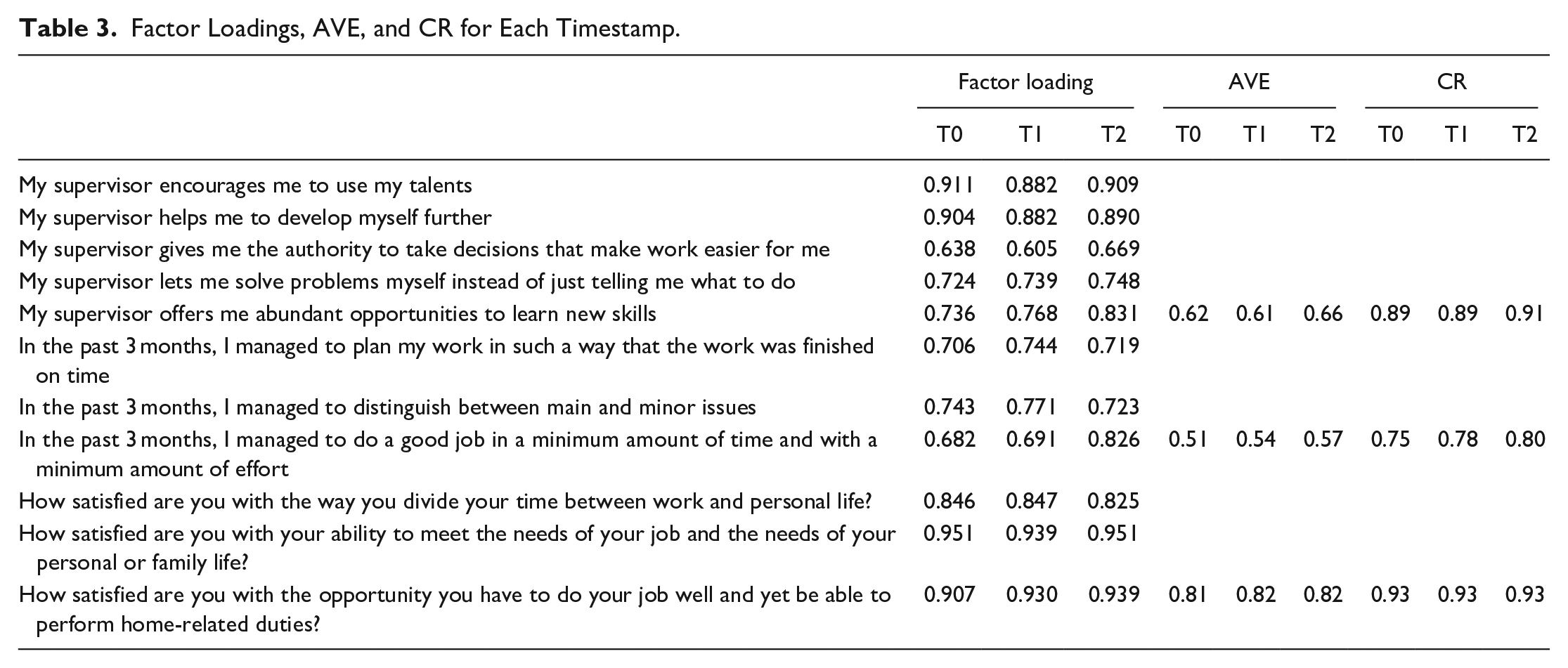
Work-life balance satisfaction was measured using the shortened three-item scale (Abendroth & Den Dulk, 2011) derived from the original five-item scale developed by Valcour (2007). Items were measured on a five-point scale ranging from “not at all satisfied” to “very satisfied.” All scaled items are listed in Table 3.
Control variables included gender, educational level (seven-point scale), and duration of employment (five categories). We also included childcare responsibilities as a control variable. Respondents were asked whether they were responsible for caring for children living at home (yes/no).
Common Source Bias
We are aware that using a questionnaire with perceptual items runs the risk of common source bias (CSB). In this article, however, we are interested in how employees perceive the presence of servant leadership behaviors (as expressed by their leader) and what this means for the way they, themselves, feel about their work-life balance and performance. Whether servant leadership and work-life balance satisfaction are present is, by nature, a question of perception. Since we are capturing employee perceptions, a questionnaire is an appropriate quantitative method (George & Pandey, 2017; Podsakoff et al., 2012). When it comes to performance, it is valuable to examine objective performance ratings in the context of servant leadership. In this article, however, we aim to examine how employees perceive their performance and whether they think they perform better when they perceive servant leadership behaviors from their leader. Moreover, it is especially hard to obtain objective performance measures in a public sector context. If these measures are available at all, the data may well be as flawed as self-reported data (George & Pandey, 2017). All in all, by using perceptual data from a single source, we accept the potential risk of common source bias.
Nonetheless, following Podsakoff et al. (2012), we have put remedies in place to limit this risk. First, the organization that is the subject of the study promoted it widely and encouraged employees to complete the questionnaire with care. Second, questions about the key variables were distributed across different pages, with different color shades being used to separate the items from one another. Third, each construct was measured using multiple items, and these scales showed acceptable reliability (Cronbach’s Alpha and composite reliability are above .7 at all timestamps) (see also George & Pandey, 2017).
Post-hoc tests were also used to check for the presence of CSB. An exploratory factor analysis (EFA) showed that the items for servant leadership, performance, and work-life balance satisfaction are clearly separated as they load on three different constructs. Subsequently, the confirmatory factor analysis (CFA) yielded a good model fit. Furthermore, we performed a Harman 1 factor analysis in SPSS for all three timestamps. The explained variance is below the threshold of 50% suggested by Fuller et al. (2016) for each timestamp. In addition, a common latent factor analysis was conducted in AMOS. The model yielded a common variance ranging between 23% and 25%, which is, again, below the threshold.
Results
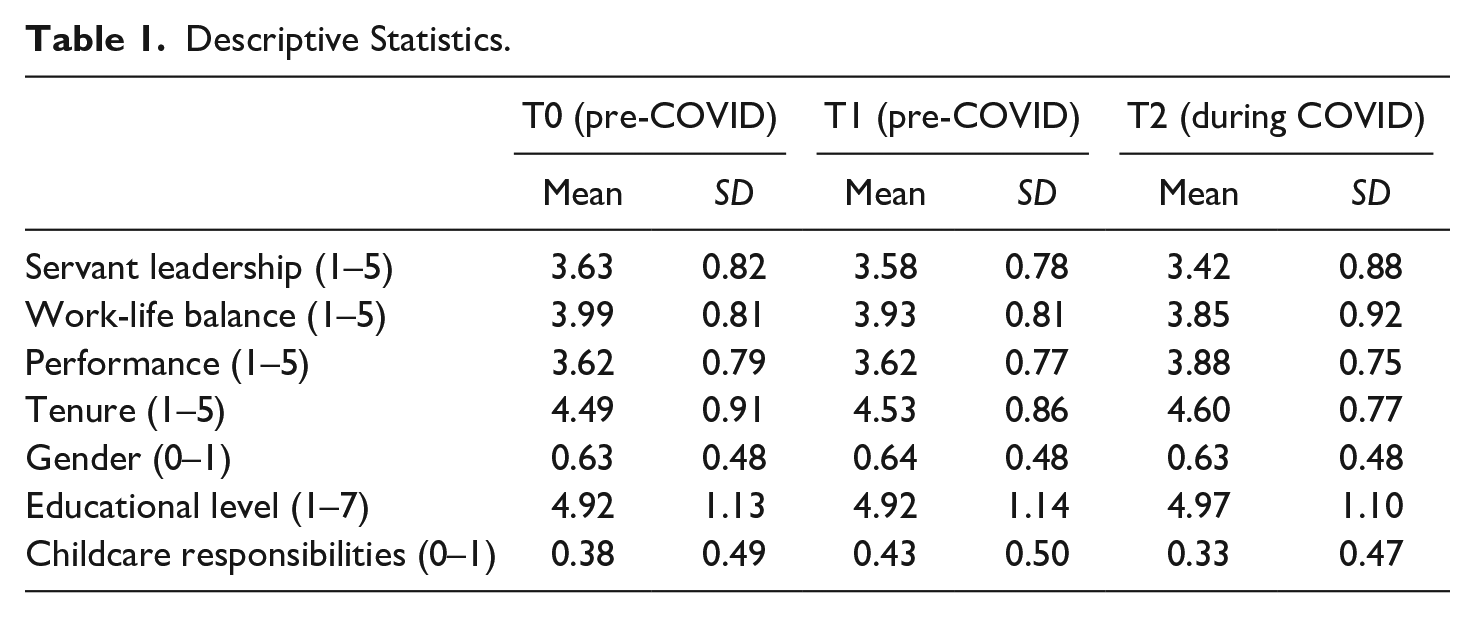
Descriptive statistics indicate that the average perceived amount of servant leadership decreased during the COVID-19 pandemic compared with the pre-COVID situation (see Table 1). Work-life balance satisfaction also declined during the first lockdown. Remarkably, the perceived performance score appears to have increased during COVID-19. We examine these differences in more detail in the following section.
Descriptive Statistics.
Paired Samples t-Test
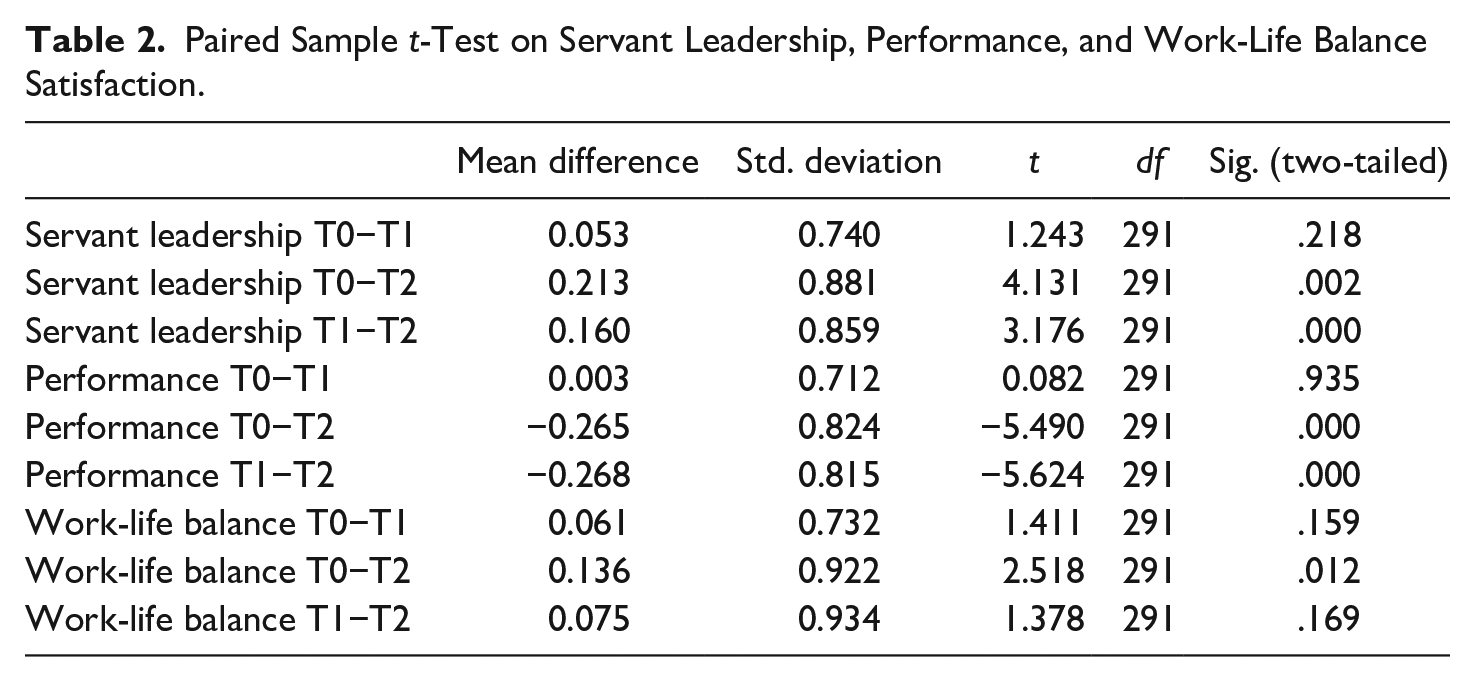
To better understand the impact of COVID-19, we conducted a paired sample t-test for each key variable, testing for statistical differences in the means of servant leadership, performance, and work-life balance satisfaction over time (see Table 2). The results reveal a significant mean difference in servant leadership at T2 compared with T0 and T1, indicating that respondents gave servant leadership significantly lower scores during COVID-19 (t = 4.131, df = 291, p < .001 for the difference between T0 and T2; t = 3.176, df = 291, p < .01 for the difference between T1 and T2). In addition, we see that there is a significant mean difference between performance before COVID-19 (T0 and T1) and during COVID-19 (T2). Remarkably, the mean for performance increased significantly during COVID-19 compared with the pre-COVID-19 situation (t = −5.490, df = 291, p < .001 for the difference between T0 and T2; t = −5.624, df = 291, p < .001 for the difference between T1 and T2), indicating that respondents were more optimistic about their performance during COVID-19. We did not find a significant mean difference between T1 and T2 for work-life balance satisfaction, but the mean at T2 is significantly lower than T0, indicating a downward movement (t = 2.518, df = 291, p < .01 for the difference between T0 and T2).
Paired Sample t-Test on Servant Leadership, Performance, and Work-Life Balance Satisfaction.
Structural Equation Modeling
Measurement Model
In our second analysis, examining the impact of servant leadership over time, we conducted structural equation modeling (SEM) in AMOS. The goal of this analysis was to see whether there is a relationship between our key variables and whether the strength of the relationship between servant leadership, on the one hand, and work-life balance satisfaction and performance, on the other hand, changes over time. We were especially interested in the potential differences between pre-COVID-19 and the situation during COVID-19.
In conducting SEM, we followed a two-step approach suggested by J. C. Anderson and Gerbing (1988). First, we assessed the measurement model by deploying CFA for each timestamp. Factor loadings, average variance extracted (AVE), and composite reliability (CR) are presented in Table 3. The overall fit measures of the measurement model, fitted to all timestamps simultaneously (Kline, 2004), yielded a reasonable fit with CMIN/DF = 3.20, TLI = 0.94, CFI = 0.96, and RMSEA = 0.050. Model comparisons furthermore indicated that there is no significant increase in the fit with constrained measurement weights as opposed to the unconstrained model (df = 16, CMIN = 6.57, p = .981). We can therefore assume factor loadings to be equal for the three timestamps.
Factor Loadings, AVE, and CR for Each Timestamp.
Structural Model
Second, for our structural model, we added control variables and causal paths between the variables to the model to test the presence of a relationship between the variables for each timestamp. The unconstrained model that resulted yielded an acceptable fit, with CMIN/DF = 2.47, TLI = 0.92, CFI = 0.95, and RMSEA = 0.041.
Hypothesis 1 states that servant leadership is associated with individual job performance. We found significant associations between servant leadership and individual job performance at T1 (β = .189, p < .01) and T2 (β = .255, p < .001), which is in line with Hypothesis 1. We did not, however, see a significant association between these variables in T0, meaning that we cannot confirm hypothesis 1 for T0. Hypothesis 2 states that servant leadership is positively associated with work-life balance satisfaction. For each timestamp, we found a significant, positive association between these two variables. We can thus confirm hypothesis 2 for all timestamps (β = .340, p < .001 for T0, β = .273, p < .001 for T1 and β = .300, p < .001 for T2). Finally, hypothesis 3 states that work-life balance satisfaction is positively associated with performance. Based on the results of our model, we can confirm hypothesis 3 for all timestamps (β = .567, p < .001 for T0, β = .482, p < .001 for T1 and β = .441, p < .001 for T2).
Exploring Differences Over Time
Third, we examined the relationship between servant leadership on the one hand and performance and work-life balance satisfaction on the other hand at different timestamps. We used multigroup analysis to identify any significant differences in the estimated parameters for each timestamp, following a strategy similar to that of T. G. Kim et al. (2011). In this analysis, time is the basis for each group.
Again, we were mainly interested in differences between pre-COVID-19 (T0 and T1) and during COVID-19 (T2), but differences between T0 and T1 were also examined. We compared the constrained models to the baseline model deployed in the previous step to test for significant differences in the strength of relationships between timestamps. Results revealed a significant decrease in the model’s fit compared with the unconstrained model when the structural weights are assumed to be equal. This means that the relationships (i.e., their strengths) differ between timestamps. To determine which structural weights differ between the timestamps, we applied the process of constraining each individual regression path. Doing so allowed us to determine any significant decrease in fit relative to the unconstrained model (results of the model comparisons are listed in Table 4). If there is a significant decrease in fit, we can assume that the specific parameter differs between groups (timestamps).
Model Comparisons.
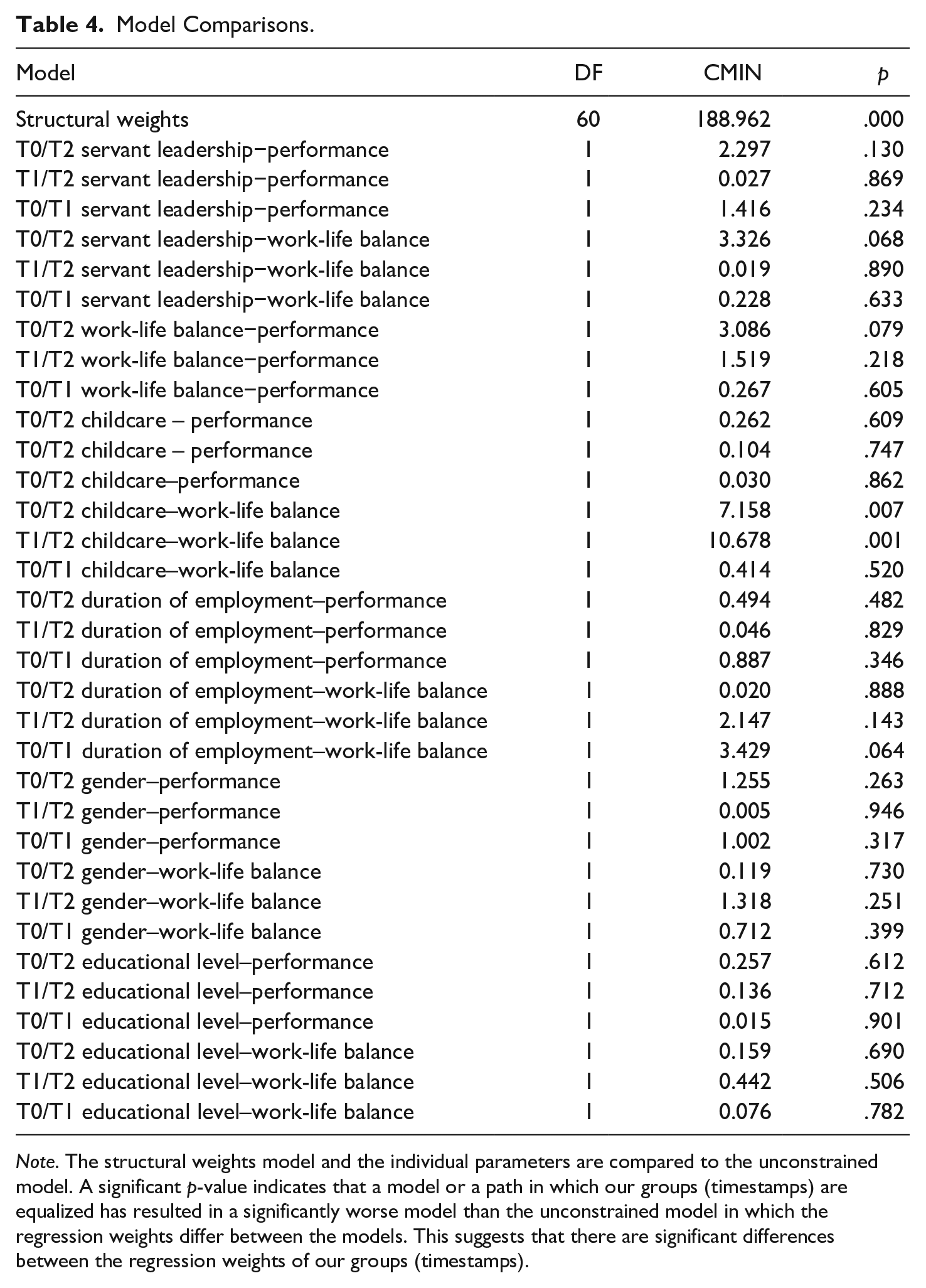
Note. The structural weights model and the individual parameters are compared to the unconstrained model. A significant p-value indicates that a model or a path in which our groups (timestamps) are equalized has resulted in a significantly worse model than the unconstrained model in which the regression weights differ between the models. This suggests that there are significant differences between the regression weights of our groups (timestamps).
The fourth hypothesis stated that the impact of servant leadership increased during COVID-19. However, the model comparison did not reveal a significant difference in the regression weights between our key variables. The regression weights between servant leadership and performance on the one hand and between servant leadership and work-life balance satisfaction on the other hand neither increased nor decreased significantly between timestamps, leading us to reject hypothesis 4. We did, however, find that the regression weights for childcare responsibilities on work-life balance satisfaction differed significantly between timestamps (see Table 4). There were no significant differences in the regression weights for the other control variables.
Discussion
Using longitudinal data from the same employees, derived at three timestamps, our aim was to answer the question of whether servant leadership became more important for employees’ performance and work-life balance satisfaction during COVID-19 compared to the pre-COVID situation.
Impact of Servant Leadership
In general, we could confirm our hypothesis that there is a significant relationship between servant leadership on the one hand and performance and work-life balance on the other. The exception was T0, where we did not find a significant relationship with performance. This indicates that servant leadership does matter, confirming earlier research on servant leadership (Coetzer et al., 2017; Haar et al., 2017; Howell & Avolio, 1993; Keulemans & Groeneveld, 2020). It also confirms that servant leadership is important in situations where employees do not have face-to-face contact, matching hypotheses in the virtual leadership literature (Eisenberg & Krishnan, 2018; Liao, 2017). That we could not find a significant relationship between servant leadership and performance in T0 as opposed to T1 and T2 may possibly be explained by the fact that at the time of T0, flexible working arrangements in their current form were fairly new for the public sector organization that is the subject of this study. Moreover, this public organization was traditionally characterized by hierarchy and as such more hierarchical and directive forms of leadership. Therefore, it is likely that either servant leadership behaviors had yet to be shaped, or its impact had yet to find its way toward improving employee performance. Contradictory, the relationship between servant leadership and work-life balance satisfaction might be more proximal.
COVID-19 and Its Consequences
Considering the impact of servant leadership over time, we could not find a stronger relationship between servant leadership and performance and work-life balance between the different timestamps. Hence, we had to reject our hypothesis that this relationship would become stronger during COVID-19. A striking finding is, however, that the scores on servant leadership are lower during the pandemic than before COVID-19. This seems to confirm the idea that it is difficult to perform leadership activities in COVID times. There may be limits to the degree of servant leadership leaders can express. In addition, a leader cannot solve every problem. During the COVID-19 pandemic, for example, social interactions were absent or reduced to a minimum. Leaders could facilitate some forms of interaction, but they were unable to fill the entire void created by the lockdown measures. A second explanation is that not all leadership activities are visible to employees, especially when the leader is working at a distance. A leader may be pressing buttons behind the scenes that are relevant but invisible to employees. This may subsequently result in employees giving lower scores for perceived servant leadership.
As stated above, t-test results showed that the degree of servant leadership decreases, which could in time lead to lower levels of performance and work-life balance satisfaction as the regression weights do not significantly differ between timestamps. Although the perceived presence of servant leadership decreased, the findings still show that servant leadership matters for performance and work-life balance satisfaction in a situation in which leaders and employees were confined to their homes. This highlights the importance of servant leadership and thus investing in it.
To elaborate on work-life balance, previous research has shown that working from home gives employees the opportunity to combine work and meet household and family demands (Gajendran & Harrison, 2007). Our results indicate that servant leadership was important for work-life balance satisfaction both when employees worked voluntarily from home one (T0) or one and a half days a week (T1) on average and when they were forced to work entirely from home (T2). Even though work-life balance satisfaction was compromised at T2 because home became the workplace, the significant relationship between servant leadership and work-life balance was maintained. It should be noted that at this timestamp, employees were not only obliged to work from home, but schools and childcare facilities were also closed, meaning that working parents had to work and care for children simultaneously. In addition, those employees who prefer to separate work and non-work roles had to find new routines to realize their preference for segmentation (Metselaar et al., 2023). Along with the decrease in the level of servant leadership, this may account for the lower levels of work-life balance satisfaction.
Our findings furthermore suggest that perceived performance was rated significantly higher during COVID-19 than before leaders and employees were forced to work entirely from home. Considering the reduction in the perceived presence of servant leadership, there may have been other factors contributing to these higher performance ratings. Employees may, for example, have resorted to standardized procedures that were already in place before the first lockdown. They may have also relied (more) heavily on routines developed earlier. In that case, the role of a leader may not be that pivotal. This, combined with a person’s sense of accomplishment for getting the work done during a public health and economic crisis, may explain the higher perceived performance ratings.
As a final reflection, a crisis such as the COVID-19 pandemic, in which leaders and employees work remotely from each other, may also require additional, co-existing forms of leadership and leadership activities (Stoker et al., 2022). One can, for example, imagine that it is more important in uncertain times to clarify what needs to be done (transactional leadership) and to provide specific forms of support. This reflects the theory on virtual leadership, which states that both task- and relationship-oriented leadership behaviors matter (Eisenberg & Krishnan, 2018; Liao, 2017). All in all, for leadership to have more impact on performance and work-life balance satisfaction in times of crisis, additional behaviors may be required. These behaviors should be aimed at employees individually as they face different challenges that are, to a great extent, unique to their circumstances at work and at home (Metselaar et al., 2023). Moreover, leaders are the ones who can ensure all employees are pulling in the same direction when they are physically distanced from one another (Liao, 2017).
Limitations
This study has various limitations. The first is that we measured only a specific dimension of servant leadership, namely empowerment. While this is indeed a limitation, we deliberately chose to measure a single dimension to avoid overloading the construct of servant leadership. Recent conceptualizations of servant leadership, for example, contain 24 items (see Miao et al., 2014) and have so many dimensions that the definition of what servant leadership is becoming confused, exposing the construct to the same criticism as transformational leadership (see van Knippenberg & Sitkin, 2013 for this criticism).
Second, our study is based on survey data. To really understand the processes and the impact of leadership at different timestamps, more in-depth, qualitative research is necessary. Qualitative in-depth interviews could, for instance, identify mechanisms that explain how leadership impacts perceived performance and work-life balance experiences in relation to other facts and conditions.
Third, data collection at T2 took place during a COVID-19 lockdown in the Netherlands (end of 2020). The timing may have affected the results, as people were still figuring out how to ensure continuity in their daily work and personal lives. This may also apply to leaders who need to find new ways of leading their employees virtually. As the pandemic unfolded, leaders may have become more visible because they acquired new skills, or they may have fallen off the radar entirely. In addition, as the pandemic lingered on, people may have found it more difficult to cope with the situation in terms of work-life balance satisfaction and in other ways. We need more research on this.
Future Research
Nevertheless, the present study has yielded valuable empirical insights through the utilization of longitudinal data collected from the same respondents over the span of 3 years. This is a relatively uncommon occurrence in research studies. However, several questions remain unanswered. One of the crucial questions pertains to the long-term effects of working from home or remote work. To obtain a comprehensive understanding of this issue, additional empirical data needs to be gathered over an extended period of time. An area of research that deserves further attention is the impact of increased remote working on the performance and innovation capacity of organizations. This inquiry is premised on the assumption that remote work leads to a rationalization of interactions among employees (see e.g., Yang et al., 2021), which may result in improved efficiency but may detract from opportunities for creative thinking and idea generation.
Circling back to servant leadership, our study showed that its relevance both theoretically and empirically, remains. For practitioners, it is crucial to invest in servant leadership and find new ways of expressing it. As hybrid forms of working are likely here to stay, servant leaders, for example, need to address preferences and needs related to boundary management in order to support employees in the achievement of a satisfactory work-life balance. Hence, future research should delve into ways leaders can enhance boundary management control and how this relates to work-life balance and performance. From a theoretical perspective, future research should also explore what kind of leadership strategies and behaviors are effective to still be able to identify employee needs and foster beneficial outcomes in the context of working from home.
Footnotes
Acknowledgement
Our gratitude goes to Dr. Robin Bouwman from Erasmus University Rotterdam for his excellent statistical support.
Declaration of Conflicting Interests
The author(s) declared no potential conflicts of interest with respect to the research, authorship, and/or publication of this article.
Funding
The author(s) disclosed receipt of the following financial support for the research, authorship, and/or publication of this article: This research (TPW) is financed by the ministry of Inner Affairs of The Netherlands.
