



Abstract
Enhanced communication technologies increasingly allow us to work anytime and anywhere. Many organizations have moved from traditional offices to flexible workplaces in which employees are allowed to vary their work hours and work at different locations both outside and inside the office. So far, findings are inconclusive regarding the effects of teleworking and few studies have examined its use by employees. Our study, which addresses the pre-COVID-19 context, is based on COR theory and explores how employees working in a Dutch public sector organization (N = 873) use teleworking and what the consequences of this are for individual perceived performance. With respect to teleworking, we focus on time spent working from home and time spent working elsewhere. To test hypotheses, we conducted SEM in AMOS using a two-step approach. Mediation analysis showed that the paths from teleworking to performance via autonomy and work-life balance satisfaction were significant for working from home.
Introduction
The rise of information and communication technologies (ICT) has made it increasingly possible to work anytime and anywhere. More and more organizations are allowing their employees time/spatial flexibility (Allen et al., 2015; Den Dulk et al., 2013; Eurofound and the International Labour Office [Eurofound & ILO], 2017). The COVID-19 outbreak has accelerated the trend toward working from home, but even before the pandemic, national governments and policymakers were encouraging time/spatial flexibility, such as teleworking and flexible work hours, in view of its benefits (Eurofound & ILO, 2017). For example, it is believed that time/spatial flexibility can improve employees’ work-life balance, well-being, and performance. However, the literature so far shows mixed results when it comes to time/spatial flexibility and its consequences (De Menezes & Kelliher, 2011; Kelliher & De Menezes, 2019). Despite the positive assumptions regarding flexibility, researchers have not been able to establish a clear link between time/spatial flexibility, performance, and other outcomes.
To some extent, the mixed findings may be the result of how this type of flexibility is defined and measured (Allen et al., 2015; De Menezes & Kelliher, 2011; Kelliher & De Menezes, 2019). Some studies, for example, focus on the mere availability of flexibility (Allen et al., 2013), but availability does not necessarily mean that employees actually make use of such arrangements (Kossek et al., 2006; Shockley & Allen, 2012). While there has been less research focusing on the actual use of time/spatial flexibility (Allen et al., 2013, 2015), recent studies highlight the relevance of exploring how and to what degree employees do make use of it, as this is likely to affect outcomes of utilization (Allen et al., 2015; Gajendran & Harrison, 2007).
In this article, we focus on the use of spatial flexibility and, more specifically, on teleworking. Teleworking is an arrangement in which work can be conducted at different locations with the aid of information and telecommunication technologies (Konradt et al., 2000), allowing employees to work at different places outside the office (e.g., at home, at a satellite office, on the train, or in a public space). As a form of spatial flexibility, teleworking furthermore cannot be separated entirely from flexibility in time. Discretion with respect to work location is likely to increase scheduling flexibility, for example, control over starting times and breaks, as employees are no longer subject to direct supervision (Gajendran & Harrison, 2007). Moreover, an increasing number of organizations are integrating flexibility into their office design, meaning that employees can also work in different places inside the office (e.g., open office areas or silent rooms; Wessels et al., 2019).
In this article, we examine the relationship between employee use of arrangements that allow them to work from home and elsewhere (e.g., at a satellite office or in a public space) and perceived performance. Research evidence suggests that the relationship between these forms of teleworking and performance is indirect and that employee outcomes such as autonomy and work-life balance satisfaction mediate this relationship (Kelliher & De Menezes, 2019). We therefore examine the role of autonomy and work-life balance satisfaction in the relationship between employee use of teleworking and performance by considering both working from home and working elsewhere. Basing our study on Hobfoll’s (1989) Conservation of Resources (COR) theory, we argue teleworking can be considered a resource that in turn leads to additional resources. The research question we aim to answer in this article is: what is the relationship between teleworking and perceived performance of employees and to what extent is this relationship mediated by autonomy and work-life balance satisfaction?
The study was conducted in a large government organization in the Netherlands. This organization can be classified as a people-processing organization, that is, mainly involved in applying the relevant legal frameworks and in which contact with clients is limited (Borst, 2018). The government organization is further characterized by a diverse workforce, including lower-educated workers, and there is in general little work pressure and overtime. All employees in this government organization have formal access to teleworking, although some jobs are more suitable for teleworking than others. The organization has also integrated spatial flexibility into most of its office design plans. Many employees no longer have their own desk and are expected to align their place of work (inside or outside the office) with the work activities they are currently undertaking.
In summary, the contribution of this article is fourfold. First, it examines actual use of teleworking by distinguishing between time spent working from home and time spent working elsewhere. Second, few studies have examined the variety of locations at which employees work outside their regular office in relation to performance (Allen et al., 2015; Gajendran & Harrison, 2007). It should also be noted that the COVID-19 pandemic has resulted in many more employees now working from home, highlighting the importance of examining the relationship between teleworking and performance. Third, there have been calls for more research into mediating factors that may play a role in this relationship (Allen et al., 2013, 2015; De Menezes & Kelliher, 2011; Kelliher & De Menezes, 2019). This article responds to these calls by considering the mediating role of autonomy and work-life balance satisfaction. Fourth, data for this study was collected at a government organization that employs a diverse workforce. So far, research on the outcomes of teleworking often focused on managers and high-status professionals working in the private sector who tended to work in high-performance, long-hours cultures (Mullan & Wajcman, 2019). The impact of working from home or working elsewhere may play out differently in a context where teleworking is a formal HR policy and where employees are not expected to do a lot of overtime.
In the next section, we use COR theory to develop a set of hypotheses concerning the relationship between teleworking, autonomy, work-life balance satisfaction, and performance. We then report on the methods and measures that we used. Next, we test our hypotheses using structural equation modeling (SEM) in AMOS. We conclude with a discussion and our conclusions.
Theoretical Framework
Teleworking Research in the Public Sector
In most countries, public organizations are taking the lead in the adoption of flexible working arrangements, such as teleworking, that allow employees to conduct (part of) their work at a remote location (Caillier, 2012; Den Dulk & Groeneveld, 2013). However, there are few studies that moved beyond the adoption of telework policies and looked at the utilization, or the outcomes of teleworking within a public sector context. Studies that do exist, show mixed findings (Kim et al., 2021). Bae and Kim (2016) found a positive relationship between (the adoption of) telework and job satisfaction. However, Caillier (2012) showed that teleworkers are not significantly more motivated than nonteleworkers. Caillier (2013) examined whether teleworkers are being held more accountable for results and receive more constructive feedback. No significant differences were found between teleworkers and non-teleworkers in general. Furthermore, De Vries et al. (2019) found that public servants experience greater professional isolation and less organizational commitment on the days they work from home. However, Kim et al. (2021) showed that result-based management and trust-building efforts from supervisors improve performance in organizations with teleworking arrangements. So far, studies on teleworking and the performance of public servants have been inconclusive. Our study aims to further examine this relationship, to shed a light on possible mechanisms that can explain the relationship between teleworking and performance.
Teleworking and Performance
When we look at the link between teleworking and performance, based on research in the private sector, we see that some studies found no or at best a negligible association between teleworking and performance (e.g., Kossek et al., 2006; Wood & De Menezes, 2007). Others found a positive association between the two constructs (e.g., Eaton, 2003; Gajendran et al., 2015; Martin & MacDonnell, 2012), whereas there are also studies that indicate a negative association (De Menezes & Kelliher, 2011). Previous studies are thus inconclusive about the relationship between teleworking and performance (Kelliher & De Menezes, 2019). The fact that research on the relationship between teleworking and performance leads to ambiguous findings may suggest that mediating factors play a role. A possible explanation is that teleworking only is beneficial for performance if the use of teleworking leads to additional resources, such as more autonomy and a better work-life balance (Gajendran & Harrison, 2007). Conservation of Resources (COR) theory can be used to explore this assumption, by considering teleworking a resource. The tenet of COR theory (Hobfoll, 1989) is that individuals seek to acquire and maintain resources. They do so, surrounded by both environmental and internal factors, meaning that they are nested within a certain context (Hobfoll et al., 2018). Resources are loosely defined as objects, personal characteristics, conditions, states, and other things that individuals value (Halbesleben et al., 2014; Hobfoll, 1989). In addition, Hobfoll (2001) distinguishes between a resource gain spiral and a resource loss spiral, meaning that resources can result in additional resources as well as the loss of resources can trigger the loss of additional resources.
In this article we examine whether teleworking positively relates to performance via a resource gain spiral.
When it comes to teleworking arrangements, we can distinguish between working from home and working elsewhere. The latter is the time spent working anywhere but at the regular office or at home, for example, in another office building, on the train, or in a public space. Both forms of utilization can be regarded as resources that help employees to perform in their work. Individual performance is about actions (and the quality of these actions) that are relevant for organizational goals (Koopmans et al., 2014) or job-related goals. For example, working from home allows employees to work undisturbed and to better concentrate on their work (Bailey & Kurland, 2002; Gajendran & Harrison, 2007). Working at another location outside the conventional office may save commuting time or allow employees to work closely with clients or other colleagues relevant for the tasks at hand (Wessels et al., 2019). These forms of teleworking can help employees to align their work activities with their needs and preferences. This, in turn, can result in more efficient and effective ways of working, enhancing performance (Bailey & Kurland, 2002). However, as stated earlier, research findings on the direct relationship between employee use of teleworking and employee performance are inconclusive, highlighting the necessity of examining mediating factors (Gajendran & Harrison, 2007; Kelliher & De Menezes, 2019). Based on the assumption that teleworking can lead to additional resources, we move beyond a direct relationship by focusing on mediators that may form a path from teleworking to performance.
Autonomy
The literature shows that autonomy may be an important mechanism in the relationship between teleworking and performance. Autonomy is defined as the amount of control or freedom an employee can exercise to schedule their work and to decide how to carry out their work activities (Hackman & Oldham, 1980). Based on COR theory, autonomy can be viewed as an additional resource arising from the use of teleworking. Empirical research repeatedly found a positive relationship between teleworking and autonomy (Gajendran & Harrison, 2007; Gajendran et al., 2015; Naotunna & Zhou, 2021). The increase in the sense of autonomy can especially be valuable in people processing organizations where a lot of tasks are highly standardized (Borst, 2018). Autonomy can, for example, mitigate the hindering effect of red tape in these organizations. Also, public employees do know best how to apply laws and regulations (Borst et al., 2020; Han & Hong, 2019). Moreover, a greater sense of autonomy can help employees in acting upon their deep values, goals, and interests, to better use their potential (Tummers et al., 2018).
It has been argued that teleworking gives employees more control over where they conduct their work (Kelliher & Anderson, 2008), but it is not self-evident that teleworking leads to more autonomy. In case employees are still being monitored, obliged to work certain hours, or restricted as to when (which days) and how often they can work outside the office, autonomy is less likely to increase. It is therefore important to consider which party is in control, the employee, or the employer (Kossek et al., 2006). When employees are free to decide when and where they work, teleworking can enhance their feelings of autonomy (Sewell & Taskin, 2015). More autonomy, in turn, means that employees can align the place of work to their individual preferences and choose the place that best fits specific work activities (Gajendran & Harrison, 2007). In addition, employees can also gain control over how they organize and conduct their work. Work (and the way in which it is conducted) is less subject to direct supervision from managers, which can foster a sense of autonomy among employees (Wood et al., 2020).
It has furthermore been argued that teleworking enhances autonomy over work hours, such as starting and finishing times and breaks. Work can, for example, also be conducted outside standard work hours, especially when the work activities are not tied to fixed hours during the day (Allen et al., 2015). Having control over work hours then makes it possible for employees to adjust these hours to their “peak time” (Thomas & Ganster, 1995). Based on COR theory, teleworking can therefore be regarded as a resource that in turn leads to additional resources, in this case (more) autonomy over how, where, and when work is carried out. Thus, we expect that the use of teleworking is associated with individual performance, through increased autonomy.
Consider, for example, employees being able to determine their own lunch times and coffee breaks as to optimize their situation for work. The way the work is organized can also be better tailored to personal preferences and needs (Bond & Flaxman, 2006), for example, the order in which work is done or the (additional) resources used to do it. In other words, it allows them to schedule their work more effectively (e.g., go to the office for meetings, answering e-mails in the train, working from home when tasks require concentration). Furthermore, employees can (to some extent) determine how best to allocate their time, energy, and other resources (Du et al., 2018). Thus, when teleworking leads to more autonomy for employees, they can decide for themselves where and when they work, allowing them to be more effective and productive at work, which enables them to perform better. Hence, it is not the use of teleworking as such that leads to better performance, but the autonomy, that is, obtained by teleworking allows employees to work more effectively (Gajendran et al., 2015). Hence, based on COR-theory, we expect that teleworking is associated with better performance when it leads to more autonomy, resulting in the following hypothesis:
H1 The use of teleworking is positively associated with perceived performance, through perceived autonomy
Work-Life Balance Satisfaction
The use of teleworking and the subsequent increase in autonomy can also result in more work-life balance satisfaction. Both men and women increasingly juggle different roles in different life domains. Employees increasingly combine these life domains, meaning that work-life balance has become more and more important over the years. The phenomenon work-life balance can be defined as “the overall contentment resulting from an assessment of one’s degree of success at meeting work and family role demands” (Valcour, 2007, p. 1512). The autonomy employees gain by utilizing teleworking allows them not only to work at times and places that are most productive, but also enables employees to adjust their work schedule to meet demands from other life domains (Gajendran & Harrison, 2007). From this perspective and based on COR theory, we can also argue that the autonomy over where, when, and how work is conducted, gained through teleworking, is a resource for combining different life domains appropriately, resulting in a better work-life balance. Tausig and Fenwick (2001) showed that employees who have autonomy with respect to how they organize their work experience a better balance between work and personal life. We therefore propose that the use of teleworking is positively associated with work-life balance satisfaction via autonomy.
The definition of work-life balance satisfaction implies that employees can achieve an acceptable combination of work and personal life (Thornthwaite, 2004). Abendroth and Den Dulk (2011) refer to a harmonious interface between different life domains in this context. Achieving a harmonious work-life balance (as a resource) can lead to other beneficial outcomes, such as increased motivation and less stress (Johari et al., 2018). Moreover, a good balance between work and personal life can help employees focus on work when they are at work, which in turn results in better performance (Kim, 2004). Empirical studies show that employees who are successful at meeting the demands in both domains demonstrate better performance (e.g., Bloom & Van Reenen, 2006; Harrington & Ladge, 2009; Johari et al., 2018). Hence, we propose that work-life balance satisfaction is positively associated with perceived performance. Together with our proposition above regarding the relationship between autonomy and work-life balance satisfaction and based on the reasoning derived from the resource gain spiral, this leads to hypothesis 2 (see Figure 1 for the theoretical model resulting from our two hypotheses).
H2 The use of teleworking is positively associated with perceived performance, through perceived autonomy and work-life balance satisfaction

Theoretical model of relationships among variables.
Data and Methods
Design
Data was collected in 2019 using a digital questionnaire to explore how the use of teleworking relates to the performance of employees in a Dutch government organization. The government organization has a large number of employees in different offices across the country. It has adopted time/spatial flexibility principles and most employees in our study work in a flexible office space in which they no longer have their own desk. On top of that, employees in our sample all have the option to telework.
Procedure and Participants
Employees were invited by e-mail to participate in a digital survey. Invitations were sent to a total sample of 2,695 employees working in the government organization. More specifically, employees of two different locations, both housing all departments of the government organization in question, were invited. E-mail addresses were provided by the heads of each department and were limited to addresses of employees with office jobs (excluding employees who work in the field). A total of 1,331 employees responded by completing at least part of the questionnaire (response rate = 49%). After cleaning the data and deleting missings listwise (to make the data suitable for AMOS), the sample consisted of 873 respondents. Respondents who were removed from the data, (1) did not complete the entire questionnaire, meaning that they did not provide information about all key variables, (2) had missings on background variables such as gender, age, and childcare responsibilities as these questions were not obligated to fill out, or (3) provided invalid answers such as implausible information about working from home and working elsewhere (i.e., the relative measure contained percentages higher than 100 or lower than 0).
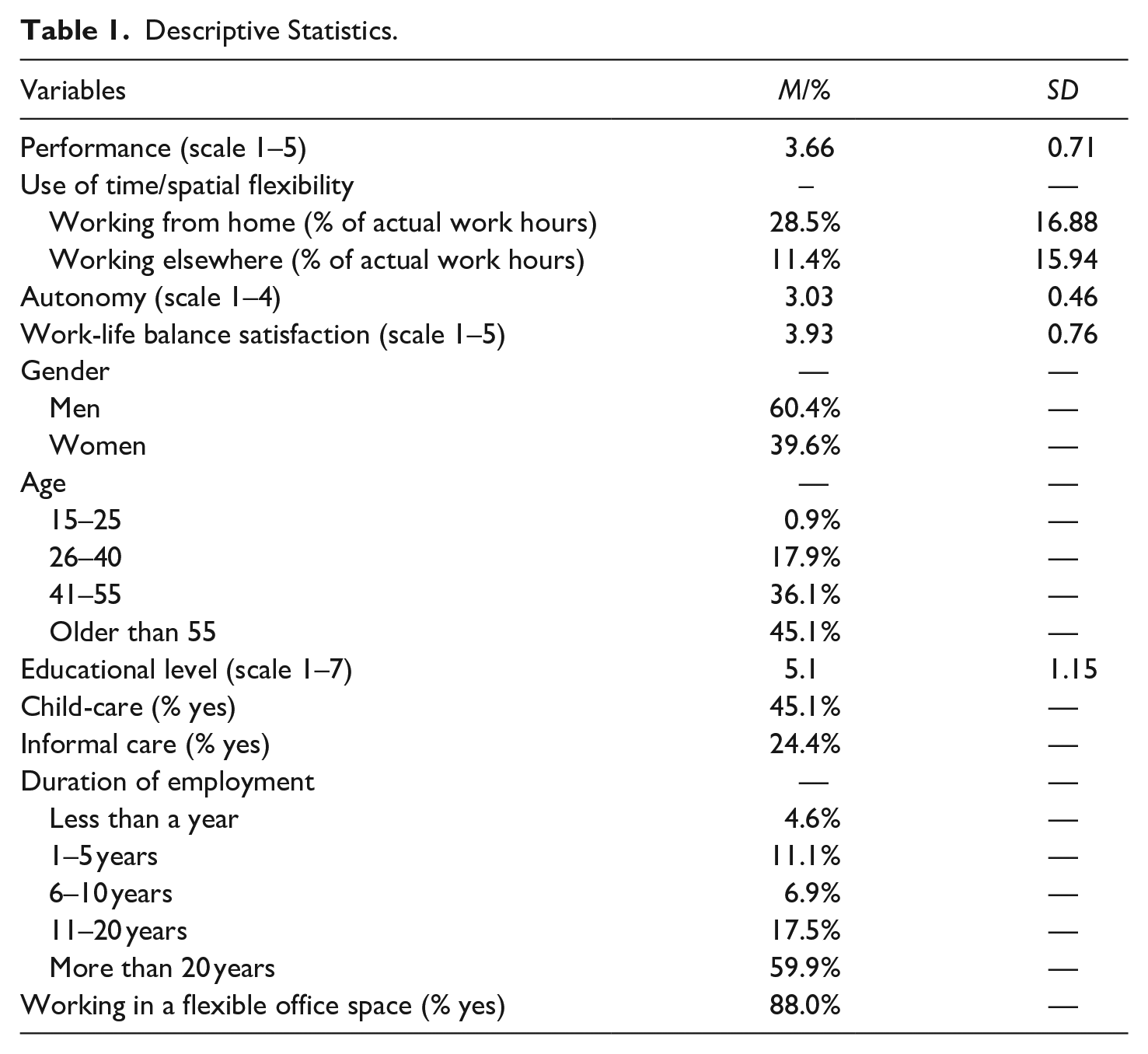
Regarding the remaining sample, about 60% are male, most are between 41 and 55 years of age or older than 55, and 78.5% are highly educated, although the sample also includes a substantial number of lower educated respondents. With respect to marital status, we found that most of the participants are married or living together. About 45% have child-care responsibilities for children living at home and about 24% provide informal care for family members or friends. When it comes to work-related characteristics, we found that most participants have worked at this public sector organization for more than 20 years (about 60%). On average, participants work about 35 contractual hours a week. Finally, most participants work in a flexible office space (88%). In terms of gender and age, these statistics are representative for the government organization under research (we do not have statistical information from the organization about the other characteristics).
Measures
Perceived performance was measured using three items of the performance scale (a 5-point Likert scale) based on Koopmans et al. (2014). These three items are: “in the past 3 months, I managed to plan my work in such a way that the work was finished on time,” “in the past 3 months, I managed to distinguish between main and minor issues,” and “in the past 3 months, I managed to perform my job well with a minimum amount of time and effort” (α = .71). We focused on perceived performance because objective or supervisor ratings were unavailable; it has been shown that perceived performance is a reasonable alternative when objective measures are not available, with several studies finding a high correlation between perceived performance and objective measures (e.g., Dess & Robinson, 1984; McCracken et al., 2001).
Use of teleworking was measured by making a distinction between working from home and working elsewhere. Working from home specifically refers to the hours an employee is working at home. Working elsewhere refers to the hours an employee is working anywhere but at home or at the office (e.g., on the train or in a coffee bar). To take employees’ contractual hours into account, we converted both items into a relative measure by dividing the “working from home” and “working elsewhere” hours respectively by the total number of work hours during the week.
Autonomy was measured using two items derived from Morgeson and Humphrey (2006) and Gorgievski et al. (2016). These two items are: “my job allows me to make a lot of decisions on my own” and “my job allows me to decide on the order in which things are done on the job.” We then added several items developed by the authors to create a better fit with the context of teleworking: “my job allows me to decide at what times I work” and “my job allows me to decide where I work at any time” (α = .72). We used a 4-point scale ranging from “never” to “always” for this variable.
Work-life balance satisfaction was measured using the shortened 3-item scale (Abendroth & Den Dulk, 2011) derived from the original 5-item scale developed by Valcour (2007): “how satisfied are you with the way you divide your time between work and personal life,” “how satisfied are you with your ability to meet the needs of your job and the needs of your personal or family life,” and “how satisfied are you with the opportunity you have to do your job well and yet be able to perform home-related duties” (α = .92). Items were measured on a 5-point scale.
Control variables included gender, age (four categories), educational level (7-point scale), child-care (yes/no), informal care (yes/no), duration of employment (five categories), and working in a flexible office space (yes/no). Childcare and informal care increase responsibilities in the life domain, which may influence work-balance satisfaction and the way teleworking is used. With respect to duration of employment, new employees may, for example, work at the office more regularly for visibility reasons or to get to know colleagues. Flexible office spaces may boost the use of flexible working arrangements in general, including teleworking, since this way of working is incorporated into the building design. Descriptive statistics are listed in Tables 1 and 2 shows correlations among variables. Most correlations between our key variables are significant in the hypothesized direction. There are, however, few significant correlations between working elsewhere and our other variables, making it unlikely that we will find working elsewhere to have any significant effect in our mediation analysis. Table 2 also shows a strong correlation between age and duration of employment. We therefore did not include duration of employment in our further analysis since age may be a more relevant variable in this study.
Descriptive Statistics.
Correlations Among Variables.
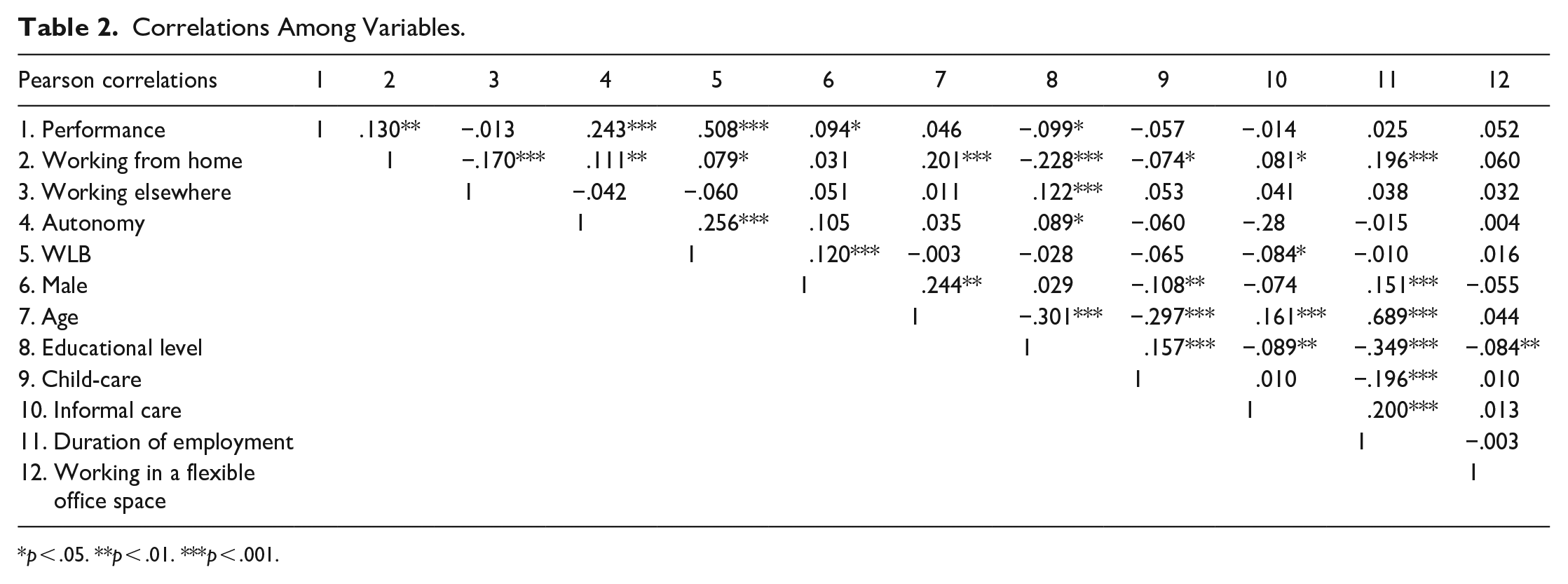
p < .05. **p < .01. ***p < .001.
Common source bias
This study may suffer from common source bias (CSB) because it relies on self-reported perceptual data (Favero & Bullock, 2015; Podsakoff et al., 2012). Despite such concerns we use these data because employee perceptions and experiences are our key interest. Also, drawing on the arguments regarding CSB presented by George and Pandey (2017) we argue that most variables in our study are perceptual by nature. Although performance is not perceptual by nature, we believe that it is meaningful to examine employees’ perception of their own performance. Moreover, objective measures of performance are hard to obtain, especially in public administration, and they may be as flawed as self-reported data. Also, previous studies have suggested that CSB may be less problematic than is often claimed (Spector, 2006). Research has shown, for instance, that there is not necessarily an upward bias between self-reported measures (Conway & Lance, 2010). Furthermore, we conducted a Harman-1 factor analysis, which showed no indication of inflated correlations in our data. The common method variance (CMV) score was about 25%, which is well below the threshold of 70% suggested by Fuller et al. (2016).
Results
We tested the hypotheses by conducting a Structural Equation Model (SEM) in AMOS using a two-step approach suggested by Anderson and Gerbing (1988). The first step consisted of performing confirmatory factor analysis (CFA) to test measurement reliability and validity. The second step was to test the structural model with latent variables.
The Measurement Model
CFA was used to examine the factor structure of the study’s constructs. The overall fit of the measurement model was tested using absolute and relative fit indices. A chi-square test is generally used to assess sample data in relation to implied population data. There are concerns about using the chi-square test, however, because its probability is sensitive to sample size (Jöreskog, 1993). In larger samples (such as in this research), the chi-square test almost always leads to the rejection of the model because the difference between the sample covariances and implied population covariances will produce a higher chi-square value as the sample size increases. As a result, alternative fit measures have been developed (Hu & Bentler, 1999), including the Goodness-of-Fit Index (GFI), the Tucker Lewis Index (TLI), and the Comparative Fit Index (CFI). The values for this model were 0.95 (GFI), 0.91 (TLI), and 0.94 (CFI). Based on these fit indices, we conclude that the model is a good fit.
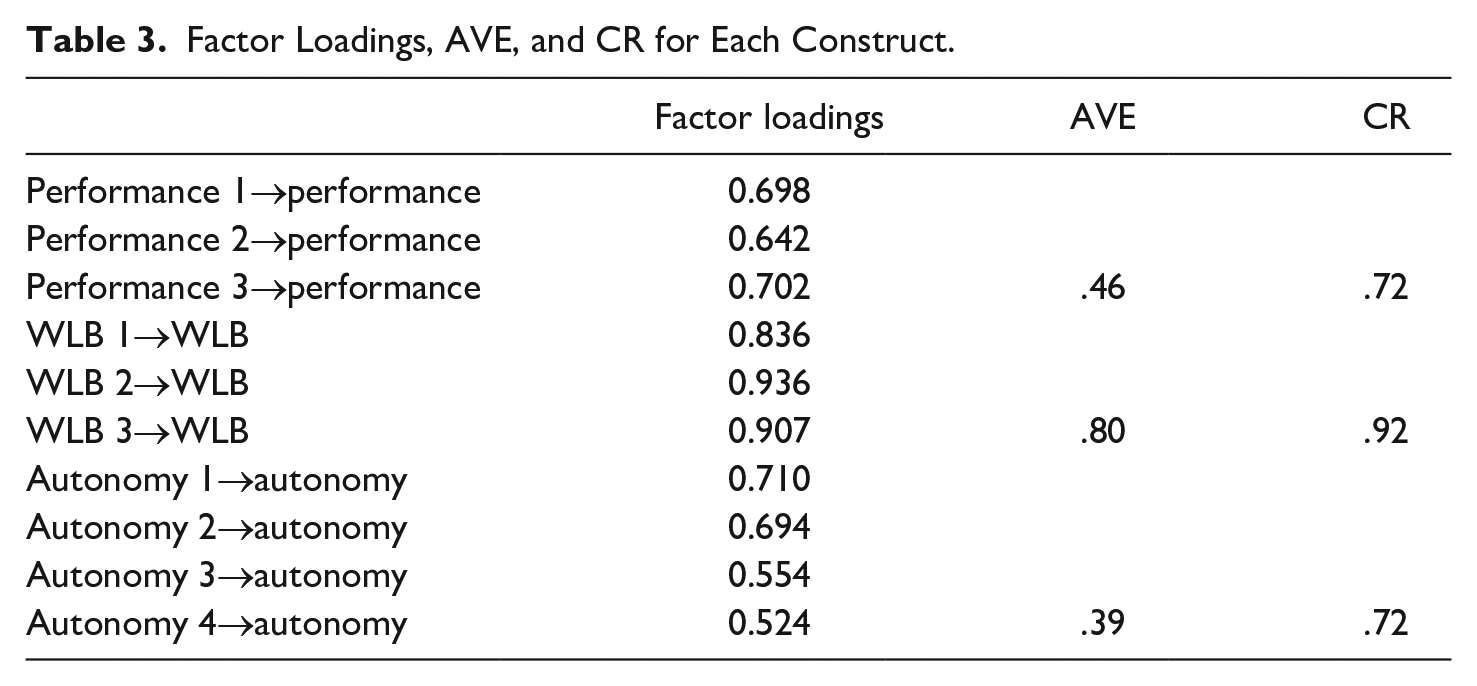
In addition, the Root Mean Square Error of Approximation (RMSEA) value of 0.075 also indicates that the model is a reasonable fit (Byrne, 2001). Each indicator significantly loaded onto the appropriate factor and all loadings were above 0.40 (range from 0.52 to 0.94). These results verify the posited relationships among the indicators and constructs, thus showing evidence for the convergent validity of the constructs. To further assess the convergent and discriminant validity of our constructs, we calculated the Average Variance Extracted (AVE) for each construct, which is a stricter measure. All standardized factor loadings are presented in Table 3. Following Fornell and Larcker (1981), we show that the AVE of work-life balance satisfaction (WLB) is above .5 and therefore demonstrates satisfactory convergent validity. Unfortunately, the AVE of perceived performance is just below the threshold and autonomy is also lower than .5. However, according to Fornell and Larcker (1981) we can accept an AVE of .4 if the composite reliability (CR) is higher than .6. In that case, the convergent validity is still adequate. In our study, the CR of all constructs is well above .7, indicating that the construct validity can be regarded as adequate. Hair et al. (2019) advise to subsequently check the variance inflation factor (VIF) to see if multicollinearity is an issue. In this study, VIF scores are well below 3 for all constructs, showing that multicollinearity does not seem to be an issue. Furthermore, the majority of the tests, such as the Cronbach Alphas and the fit sizes mentioned above, do indicate a satisfactory measurement model. We also assessed the discriminant validity of our constructs by calculating the squared correlation coefficients between all constructs, and these coefficients do not exceed the AVE, providing evidence of discriminant validity (Fornell & Larcker, 1981).
Factor Loadings, AVE, and CR for Each Construct.
The Structural Equation Model
In the second step, we added the control variables and the different causal paths between the variables to test the hypotheses. This resulted in a structural model. Since both hypotheses include mediation effects, we employed a bootstrapping method (Hayes, 2009). In its simplest form, this method estimates the parameters of a model and their standard errors from the sample alone, without reference to any theoretical sampling distribution. In our study, we created 1,000 samples (with replacement) from the available observed sample. Using these samples, we can establish a robust estimate of the expected value and the variability of statistics (Hox, 2002).
Hypothesis 1 stated that the use of teleworking is positively associated with perceived performance, through perceived autonomy. To test the first hypothesis, we calculated the direct effects (teleworking – perceived performance) as well as the indirect effects (via autonomy) using a model without work-life balance satisfaction. The model fit of this structural model indicated a reasonable fit: GFI = 0.95, TLI = 0.81, CFI = 0.86, and RMSEA = 0.061. Significant associations were found for the path from working from home to performance through autonomy. However, there was no significant association between working elsewhere and performance through autonomy. Hence, we can partly confirm H1 (β = .032, p < .001 for working from home).
Hypothesis 2 stated that the use of teleworking is positively associated with perceived performance, through perceived autonomy and work-life balance satisfaction. To test the second hypothesis, we drew the overall model in AMOS, including work-life balance satisfaction. Adding work-life balance satisfaction to the structural model produced a good fit: GFI = 0.95, TLI = 0.92, CFI = 0.94, and RMSEA = 0.050. Mediation analysis showed that the path from the use of teleworking to performance via autonomy and work-life balance satisfaction is indeed significant for working from home (β = .031 p < .001). We can therefore partly confirm H2 since the association with working elsewhere was not significant. Hence, the results show that the overall indirect effect from working from home to performance is 0.031 (p < .001). Within the significant path, we found two underlying indirect effects. First, autonomy mediates the relationship between working from home and work-life balance satisfaction (β = .033, p < .003) and second, work-life balance satisfaction mediates the relationship between autonomy and perceived performance (β = .115, p < .004). The indirect effects are presented in the box below Figure 2. Figure 2 also shows the strength of the direct effects. The squared multiple correlations are between brackets, showing that 27.4% of perceived performance is explained by the variables in the analysis.
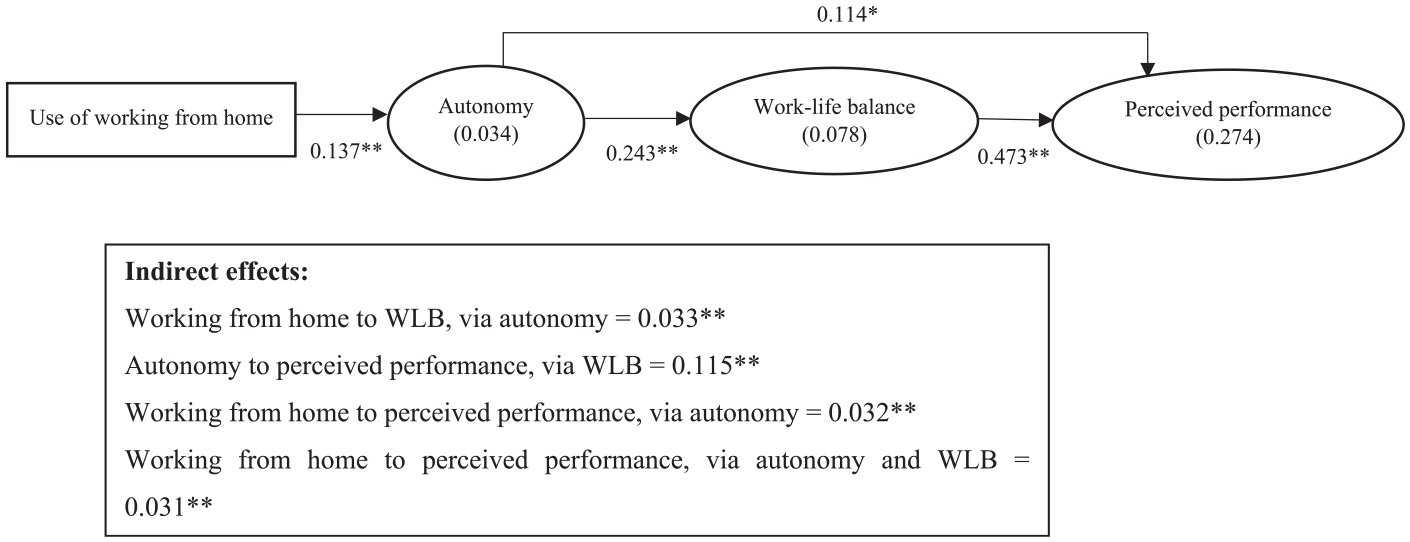
Empirical model of relationships among variables.
With respect to our control variables, we found that men and employees with a higher educational level perceive more autonomy (β = .098, p < .01 and β = .112, p < .01 respectively). Results also showed that men are in general more satisfied with their work-life balance (β = .090, p < .01), and that employees who provide informal care are less satisfied (β = −.072, p < .05). Finally, gender, informal care, and educational level are indirectly associated with perceived performance (β = .065, p < .01; β = −.034, p < .05; and β = .026, p < .05, respectively).
Discussion
In this article, we examined how the use of teleworking in the pre-COVID-19 context related to the perceived performance of employees working in a large public sector organization. In doing so, we took variation in location into account by distinguishing between working from home and working elsewhere. In response to the call for more research into mediating factors, we examined the mediating role of autonomy and work-life balance satisfaction. We used a two-step approach in AMOS to test our hypotheses. Results indicate that the path from employees working from home to perceived performance via autonomy is significant. This is also true for the path in which work-life balance satisfaction is added to the model. Since there were only significant associations for working from home and not for working elsewhere, both hypotheses were partially supported.
COR theory is helpful in explaining the relationship between working from home and performance, meaning that better performance is more likely to occur when employees gain resources that help them to meet their work demands. It is possible that we did not find significant associations for working elsewhere because employees do so less voluntarily, for example, when attending scheduled meetings and appointments that are tied to a certain site, such as a central location or a client’s office. In those situations, working elsewhere does not enhance feelings of autonomy concerning place of work or work times (Eurofound and ILO, 2017). Furthermore, working elsewhere still implies traveling (commuting time) to the work location in question. This may explain why we did not find a relationship between working elsewhere and work-life balance satisfaction. The different findings for working elsewhere and working from home emphasize the relevance of taking the location of teleworking into account when investigating the outcomes of flexible working arrangements.
The results of this study indicate a relationship between the use of working from home and perceived performance via autonomy and work-life balance satisfaction. Furthermore, since the second model, which included both autonomy and work-life balance satisfaction, produced better fit measures than the first, which had only autonomy as a mediator, our study highlights the importance, alongside autonomy, of work-life balance satisfaction in the relationship between the use of teleworking and perceived performance. Autonomy can help employees to organize their work effectively (e.g., by aligning work hours to their peak time) and to determine their own working methods. Autonomy can also give employees the freedom to align their work with demands in other life domains. Our study shows that autonomy is particularly beneficial when it does indeed lead to more work-life balance satisfaction. Consequently, and in line with previous research (e.g., Adnan Bataineh, 2019; Johari et al., 2018), it highlights the relevance of a satisfactory balance between work and personal life for employee performance.
This study reveals that teleworking and more specifically working from home may be helpful in achieving a satisfying work-life balance. Work-life balance refers to the overall appraisal of combining work and family roles in relation to one’s own expectations and life priorities (Valcour, 2007; Wayne et al., 2017). However, working from home may also lead to boundaries becoming blurred across life domains and consequently to work-family conflict or negative spillover (Eurofound & ILO, 2017; Van der Lippe & Lippényi, 2018). Previous research, for example, showed that employees working from home are more likely to work beyond contractual hours (e.g., in the evenings and on weekends) compared to those working mainly at their regular office (Eurofound & ILO, 2017). At the same time, responsibilities in the life domain, such as childcare, can interfere with work activities. This may more easily result in a spillover of thoughts and emotions from one domain to another and vice versa (Clark, 2000). Employees must also learn to optimize the way they combine work and personal life in relation to when and where they work in order to foster beneficial outcomes (Eurofound and ILO, 2017). Work-life balance satisfaction is affected by negative and positive spillover between life domains (Wayne et al., 2017). To explore work-life balance satisfaction in greater depth, then, the role of boundary management and spillover (i.e., work-family conflict and enrichment) must be considered. Working from home gives employees the autonomy they need to find an optimal balance between work and personal life, based on their needs and preferences, but it also requires a boundary management strategy (Kossek & Lautsch, 2012).
Our findings also highlight that teleworking has beneficial outcomes if it leads to other resources, that is, autonomy and work-life balance satisfaction. To foster beneficial outcomes, supervisors need to grant employees autonomy and control over the time and place of work. Previous research has shown that supervisors play an important role in enhancing both autonomy and work-life balance satisfaction among their employees (see, e.g., Den Dulk et al., 2016; Hammer et al., 2009). To foster feelings of autonomy among employees, supervisors can, for example, take on a more facilitating role as opposed to more traditional forms of leadership. In addition, supervisory support for employees that focuses on work-life issues can help them to create a more satisfying work-life balance (e.g., Hammer et al., 2009).
Research has further shown that family-supportive work environments that pay attention to work-life balance can improve employee performance (Bloom & Van Reenen, 2006). Policymakers and management are advised to carefully consider the way in which they implement teleworking policies. Our study shows that teleworking is positively associated with performance, through perceived autonomy and work-life balance satisfaction, making it important to ensure that policies meant to foster teleworking are also perceived as such, and that these policies devote explicit attention to such matters as autonomy and work-life balance satisfaction. Now that the COVID-19 outbreak is forcing employees in many public and other organizations to work almost entirely from home, it has become even more important to consider both autonomy and work-life balance, not only to ensure individual performance but also to enhance employee well-being (Zheng et al., 2015).
In light of the pandemic, it is also important to note that extensive use of teleworking could result in feelings of professional and social isolation (De Vries et al., 2019; Gajendran & Harrison, 2007), which could lead to a loss of resources, such as social and career support. Moreover, the literature points out that high levels of autonomy can result in negative outcomes. The autonomy paradox states that employees who experience a high degree of autonomy often intensify their work practices and find it difficult to disconnect from work. Consequently, work continuously spills into non-working hours and employees may feel they are controlled by their work (Putnam et al., 2014), especially in demanding organizational contexts. This would imply that the mediation mechanism we found in this study is less likely to occur in a high-performance context or in a context where employees are forced to work from home entirely. It is therefore important for future research to examine the role of contextual factors (moderators), such as organizational culture and supervisory support, which can enhance or limit the mechanism that we found.
This study also reveals that men are in general more satisfied with their work-life balance than women. This may indicate an ongoing imbalance in the division of domestic labor, with women still performing most of the household chores and care duties (Feeney & Stritch, 2019; Tower & Alkadry, 2008). Our results also indicate that informal care is negatively associated with work-life balance satisfaction. In view of the aging workforce and the aging population in general, it is important for organizations to have policies in place that help employees deal with informal care responsibilities.
Limitations
First, our data is cross-sectional, which means that we are unable to establish evidence of a causal relationship between teleworking and performance. We can only provide evidence for a relationship between the variables in this study. Longitudinal data is needed to understand the causal and long-term effects of teleworking, autonomy, and work-life balance satisfaction. Second, in this article we use a generic measure of performance. This offers the possibility to compare the findings of this study with findings in other organizations, both in the public and the private sector. Moreover, by using a generic measure across future studies, we can identify additional variables, such as contextual factors, that may explain the varying consequences of teleworking for performance that have been established in previous research, rather than that this is attributed to differences in measurements. However, for government organizations, we recommend to also study the link between teleworking and public dimensions of performance, such as responsiveness and integrity (see, example.g., Han & Robertson, 2021) in future research.
Third, our information about child-care responsibilities was limited to whether respondents had children living at home. This may explain why we did not find any significant associations in relation to child-care in this study. It could, however, be important to distinguish between children of different ages. Younger children may, for example, demand more time and attention than older ones.
Fourth, this study was conducted in a large government organization under very specific circumstances. The organization in question can be characterized as a people processing organization and does not have a high-performance culture that prescribes an ideal worker, but instead is rather family friendly. In people processing organizations jobs may be more suitable for teleworking compared to work conducted in people changing organizations, such as education and health care (Borst, 2018). Hence, the nature of the job can be an important moderator (Boell et al., 2016). Moreover, previous research has shown the significance of the organizational context and a supportive organizational culture for the outcomes of work-life policies, such as working from home (Den Dulk et al., 2018; Kossek et al., 2010; Van der Lippe & Lippényi, 2018). Future comparative research across organizational contexts should investigate whether this specific context is a crucial one in which teleworking policies lead to enhanced autonomy and work-life balance satisfaction.
Future research should also focus on the consequences of working from home due to the COVID-19 outbreak. Unlike the conditions in our study, the measures taken to restrict the spread of the virus have made working from home mandatory rather than voluntary for employees in non-essential occupations, making further research into this topic all the more urgent (Carnevale & Hatak, 2020; Rudolph et al., 2020). Concerns may arise that teleworking in such an extensive manner will jeopardize the quality of public services (Charbonneau & Doberstein, 2020). It is highly relevant to examine whether levels of performance, not only on the individual level, but also on the organizational level can uphold the standards. The impact of COVID-19 on society may require new capabilities all together to adjust to the new normal (Roberts, 2020). This not only applies to governance at the organizational level, but also to individual capabilities of employees to keep up their performance and well-being, while working from home more extensively than ever before.
Footnotes
Declaration of Conflicting Interests
The author(s) declared no potential conflicts of interest with respect to the research, authorship, and/or publication of this article.
Funding
The author(s) received no financial support for the research, authorship, and/or publication of this article.
