



Abstract
During the COVID-19 pandemic, public servants in many countries were required to work from home. In this study, we explore Dutch public servants’ experiences of mandatory homeworking by conducting a template analysis. Based on an in-depth examination of 985 written accounts, we inductively expand an a priori template derived from the Job Demands-Resources (JD-R) framework, to understand and analyze public servants’ experiences of this new situation. We found homeworking in general had positive effects on public servants’ individual performance and health-related well-being but a predominantly negative impact on happiness well-being. Furthermore, we found that the impact of homeworking on the job demands and job resources seems to depend on the specific clusters of these job demands and resources. Our findings are translated into propositions that extend the JD-R framework.
Introduction
“Having to work at home has very positive effects. I have more energy at the end of the day because I’m no longer with my colleagues for the whole day. I can concentrate fully when I’m at home.”
“I noticed that I am far less productive than on a ‘normal’ working day at the office. I have two small children at home, and so there are a lot of distractions. So for me, homeworking during COVID-19 really is hell.”
The words of two of the anonymous respondents in our survey.
Although it was not unusual for public servants to work at home on a voluntary basis prior to 2020 (e.g., Caillier, 2012, 2013; de Vries et al., 2019; Mahler, 2012), working at the office was the norm for most until March 2020. The COVID-19 pandemic changed that drastically. To curb the spread of the virus, employees—including many public servants—were required to work from home full-time in many countries (Schuster et al., 2020). This situation provided a unique, urgent research momentum. Large-scale homeworking is acclaimed to be the new normal (Van Doninck et al., 2023), but it is also met with skepticism by those who have doubts about its effects for performance and wellbeing.
Hence, this new trend calls for a careful examination to assess both its advantages and disadvantages. Moreover, with hindsight, the homeworking literature never gave a complete picture of the advantages and disadvantages of homeworking. Previously, it was only possible to investigate the effects of homeworking for public servants who (voluntary) chose to work from home. Due to large-scale mandatory homeworking because of COVID-19 regulations, it is possible to investigate the effects of homeworking for employees who did not choose for homeworking themselves, resulting in a more complete picture.
Using the Job Demands-Resources framework (JD-R framework), various public administration scholars have started to investigate the mechanisms through which mandatory homeworking affects employee outcomes including performance, health-related well-being (e.g., burn-out), and happiness well-being (e.g., work engagement) (e.g., Giauque et al., 2022; van der Meer et al., 2022; Van Doninck et al., 2023, and Barboza-Wilkes et al. (2022). Interestingly, these studies all focus on only one specific dimension of the JD-R framework: job demands and job resources. However, as we also know from the literature on voluntary homeworking in both the public and private sector, homeworking influences the employees themselves, as well as their private life (Beauregard et al., 2019; de Vries et al., 2019).
Indeed, the JD-R framework enables the integration of those so-called personal and home demands and resources besides job demands and resources (Schaufeli & Taris, 2014; Ten Brummelhuis & Bakker, 2012). Thus far, nevertheless, possible changes in home and personal demands and resources, and in turn, in well-being and performance, remain underexplored in the JD-R literature in general, let alone in the literature on homeworking. Scholars have therefore appealed for more research into home and personal demands and resources besides job demands and resources in relation to homeworking among public servants (Barboza-Wilkes et al., 2022; Giauque et al., 2022).
The call for research on the consequences of mandatory homeworking on home and personal demands and resources of public servants is understandable given the specific context of their work. Public servants need to ensure the continuity of public service delivery while working from home, which might have dramatic negative effects on their personal life (Barboza-Wilkes et al., 2022). Also, it has been argued that their Public Service Motivation (PSM)—a personal resource—might be negatively influenced because public servants were restricted to remote citizen interaction which, in turn, might limit feelings of their contribution to public service delivery and consequently their well-being (Schuster et al., 2020).
In addition, as the examples above show, the influence on possible resources and demands and in turn on well-being and performance might also depend on boundary conditions such as demographic (i.e., household composition) and sectoral factors (i.e., amount of contact with citizens). Indeed, these factors are normally included as control variables but in homeworking research, these might be of significant importance in the relations between homeworking and the experiences of demands, resources, and in turn well-being and performance (Barboza-Wilkes et al., 2022).
Based on the two literature gaps discussed above, the goal of this study is to gain a more complete picture on the effects of homeworking on public servants’ experienced job, home, and personal demands and resources, as well as their happiness well-being, health-related well-being, and individual performance. We create this picture based upon the systematic exploration of the written accounts of 985 public servants who were forced to homework in the initial phase of the COVID-19 pandemic in 2020. Based on the picture, propositions are developed that can form the basis for future quantitative empirical research that extends the JD-R framework to better understand the effects of homeworking for public servants.
Given the exploratory nature of our study, we adopted the iterative coding principles of template analysis (King & Brooks, 2017). The JD-R framework was used as an a priori template of themes (King & Brooks, 2017), drawing on the categorization developed by Schaufeli and Taris (2014) and Ten Brummelhuis and Bakker (2012), differentiating between job/personal/home demands and resources. The template was then expanded and adjusted based on an inductive coding of the written responses, following the flexible procedural steps of template analysis (King & Brooks, 2017).
This article is structured as follows. In the theoretical section, we summarize the broader literature on homeworking, discuss the current literature using the JD-R framework as a theoretical lens, and address the need to consider boundary conditions to understand public servants’ experiences. Next, in the methods section, we explain our research methodology and describe the context of the research. In the results section, we develop our propositions. Finally, the discussion section reflects on the limitations of our research, provides suggestions for future research, and ends with some practical lessons regarding the creation of sustainable (home)working conditions for public servants.
Theory
A JD-R Perspective on the Homeworking Literature
Telecommuting or teleworking “occurs when employees perform all or a substantial part of their work physically separated from the location of their employer, using IT for operation and communication” (Baruch, 2001, p. 114). Homeworking, in the current context, is defined as teleworking at home (Sullivan, 2003). Previously, public administration scholars have studied the effects of voluntary homeworking on various outcomes for public servants including happiness well-being (e.g., work engagement), health-related well-being (e.g., emotional exhaustion), and individual performance (e.g., in-role performance) (de Vries et al., 2019; Giauque et al., 2022). Since the COVID-19 pandemic, this literature is also extended to the study of perceived outcomes among public servants of mandatory homeworking (e.g., Giauque et al., 2022; van der Meer et al., 2022).
To study these outcomes, scholars tend to use the JD-R framework (Bakker & Demerouti, 2017; Demerouti et al., 2001) as a theoretical model (e.g., Barboza-Wilkes et al., 2022; Giauque et al., 2022; van der Meer et al., 2022; Van Doninck et al., 2023). According to the JD-R framework, working environments can be modeled using two different categories: job demands (e.g., workload, task ambiguity, and role conflict) and job resources (e.g., supervisory support, job autonomy, and appreciation from co-workers). Job demands are defined as “those physical, social, or organizational aspects of the job that require sustained physical or mental effort and are therefore associated with certain physiological and psychological costs” (Demerouti et al., 2001, p. 501). In contrast, job resources are defined as “those physical, social, or organizational aspects of the job that may: (a) be functional in achieving work goals, and/or (b) reduce job demands and the associated physiological and psychological costs, and/or (c) stimulate personal growth and development” (Demerouti et al., 2001, p. 501). Consequently, job demands result in an impairment cycle, leading to lower health and well-being and, in turn, to worse performance. By contrast, job resources result in a motivational process, leading to better health and well-being, and, in turn, better performance (Bakker & Demerouti, 2017).
Although homeworking in the period of voluntary homeworking was sometimes assumed to be a job resource in itself—that is, a privilege for the happy few—public administration scholars nowadays frame it as a precursor that, in turn, may affect both demands and resources and, in turn, health-related and happiness-related well-being as well as individual performance (Giauque et al., 2022). Interestingly though, while the public administration literature on mandatory homeworking that uses the JD-R framework is growing, the literature has a blind spot for other factors than the job (Barboza-Wilkes et al., 2022; Giauque et al., 2022; Van Doninck et al., 2023). Mandatory homeworking, though, is likely to have much more far-reaching consequences for public servants than mere changes in job demands and resources. It is also likely to influence both home and personal demands and resources (Barboza-Wilkes et al., 2022; Giauque et al., 2022). In this study, we develop a more complete homeworking framework by extending the literature by exploring possible effects for home demands and resources as well as personal demands and resources.
Job, Home, and Personal Demands and Resources
Although research on the effects of mandatory homeworking on job demands and resources among public servants is scarce, Giauque et al. (2022) show mandatory homeworking leads to a reduction in several job resources, including supervisor support, social support from colleagues, teamwork, and task diversity. At the same time, they found that job autonomy (including, personal initiative and organizational freedom) and work-life balance increased because of mandatory homeworking. These changes in job resources led, in turn, to lower health-related well-being (i.e., emotional exhaustion), but also to lower individual performance and no changes in happiness well-being (i.e., work engagement), health-related well-being (e.g., emotional exhaustion), and individual performance (Giauque et al., 2022).
Although these changes in resources probably also apply to private sector employees, Schuster et al. (2020) suggest that the specific job demands that characterize the work of public servants may also increase. Schuster et al. (2020) argue public servants often need to interact with citizens through online and remote interactions due to mandatory homeworking. Consequently, Barboza-Wilkes et al. (2022) show that public servants experienced more citizen aggression like verbal abuse through phone calls while these public servants felt less institutional protection. Moreover, van der Meer et al. (2022) argue that red tape delays responsiveness which might even be more delayed due to homeworking because of additional communication challenges, increasing negative experiences with red tape. Thus, public servants may face specific challenges in their job demands compared to private sector employees, which makes “simply” translating knowledge about homeworking from the private to the public sector problematic (Knies et al., 2018).
As well as job demands and resources, homeworking may also influence public servants’ home demands and resources. Home demands and home resources are defined as private life factors that may require energy (e.g., care for children) or provide energy (e.g., partner support), respectively (Hakanen et al., 2008, 2011). Although Giauque et al. (2022) reported in the context of mandatory homeworking that the work-life balance of public servants, in general, improves with more homeworking, Barboza-Wilkes et al. (2022) argue the exact opposite. The reason why these studies might show conflicting results is that there are many demands as well as resources that need to be weighted and evaluated when talking about the total work-life balance. Indeed, as Barboza-Wilkes et al. (2022) already show, public servants experienced that some home demands increased, such as homeschooling of children and other parenting duties. These home demands decreased well-being (Barboza-Wilkes et al., 2022). At the same time, scholars also show that time normally spent commuting can be used to increase home resources such as devoting attention to family, engaging in leisure activities, and doing household tasks (Biron & van Veldhoven, 2016). Consequently, homeworking can also improve well-being (e.g., Boell et al., 2016; Morgan, 2004). Therefore, it is necessary to look further than just work-life balance in general and analyze more in-depth what kind of home demands and resources are developed because of homeworking.
Last, homeworking may also influence personal demands and resources. Personal resources are “. . . psychological characteristics or aspects of the self that are generally associated with resiliency and that refer to the ability to control and impact one’s environment successfully” (Schaufeli & Taris, 2014, p. 49). Personal demands (such as perfectionism and emotional instability) are “. . . the requirements that individuals set for their own performance and behavior that force them to invest effort in their work which are inherently associated with physical and psychological costs” (Bakker & Demerouti, 2017, p. 279). However, so far, no literature has studied the changes in these personal demands and resources of public servants due to mandatory homeworking (Giauque et al., 2022). At the same time though, Barboza-Wilkes et al. (2022) show that public servants experienced an increase in their levels of irritation and frustration from their citizen interaction and felt a lowering motivation to support the public, as they were not reciprocally supported themselves. This may indicate a reduction of public servants’ personal resource PSM. From existing literature, we know PSM normally increases public servants’ happiness well-being (e.g., work engagement), health-related well-being (e.g., emotional exhaustion), and individual performance (Borst et al., 2019). It is therefore interesting to see whether (changes in) PSM but also other personal resources and demands are reduced due to mandatory homeworking.
The Importance of Boundary Conditions: Demographic and Sectoral Factors
As Giauque et al. (2022) show, although various job demands and resources are experienced by all public servants due to mandatory homeworking, there are also various demands and resources that are experienced very differently between public servants depending on demographic and sectoral factors. Indeed, these factors are often called control variables or boundary conditions in most JD-R studies because it is fairly known that they influence outcomes but are not of central interest to scholars. Regarding demographic factors, the focus is often on age, gender, educational level, ethnicity, family status, and type of contract. Regarding sectoral factors, the focus is often on for example amount of citizen contact, policy development or implementation, and governmental layer (e.g., local, central, regional).
Although these boundary conditions are often taken for granted, in the context of the relations between homeworking and experienced demands and resources these are actually very important. Regarding the importance of demographic factors, Barboza-Wilkes et al. (2022) give many examples of the way family status influenced the consequences of homeworking for several home demands/resources and job demands/resources. One striking citation is (Barboza-Wilkes et al., 2022): “The living situation of public employees and their family dynamics created heightened emotional demands that consumed emotional resources necessary for their work on the job. We see unique exhaustion dynamics for those with caretaking responsibilities (both childcare and elder care) as well as unique isolation dynamics for those who live alone without a social outlet.” Regarding the importance of sectoral factors, Barboza-Wilkes et al. (2022) also showed that public servants who worked in an environment with frequent citizen contact experienced more abusive phone calls from citizens, while public servants with little citizen contact missed commitment and connection.
Summary
To summarize, the literature on homeworking from a JD-R perspective suggests that public servants face specific challenges and changes in their demands and resources due to mandatory homeworking. These changes in demands and resources can impact health-related well-being, happiness well-being, and individual performance. Additionally, demographic and sectoral factors might play a crucial role in shaping the experiences of public servants in relation to homeworking, highlighting the importance of considering these boundary conditions in understanding the outcomes. However, the current literature has not fully investigated the comprehensive picture encompassing all aspects related to the effects of mandatory homeworking on public servants. Hence, this exploratory, qualitative, study contributes to the literature in two ways. First, this contribution extends the usage of the JD-R framework in the context of mandatory homeworking by not only studying its possible consequences for job demands and resources, but also home and personal demands and resources. Second, this contribution sheds light on the possible role of boundary conditions in the relation between homeworking and the experienced job/home/personal demands-resources by studying the role of demographic and sectoral factors.
Method
Research Context
On February 27, 2020, the first confirmed case of COVID-19 in the Netherlands was reported. Several weeks later, on March 12, the Dutch government announced the first set of containment measures, including encouraging people to work from home full-time. While most Dutch public servants were used to part-time homeworking—48.1% of Dutch public sector employees and even 87.2% of Dutch policy advisors reported working from home on at least an incidental basis in 2019 (Statistics Netherlands, 2020)—the request to work from home full-time necessitated some major organizational and personal adjustments. On March 15, the Netherlands went into lockdown: homeworking was made mandatory, except for key workers (e.g., frontline employees in healthcare and education); public events were prohibited and places where people were unable to socially distance were closed; childcare facilities, primary, and secondary schools were closed, although the first two remained open only as a last resort for parents who were key workers. Because of the closure of these facilities and because family visits were discouraged—minimizing the amount of social support available—parents were required to look after, entertain, and teach their children even during working hours. As the first wave of COVID-19 leveled off in the spring of 2020, the government (temporarily) lifted the restrictions outlined above, but even then, homeworking remained the norm.
Sample
Our sample consisted of mailing list subscribers of Binnenlands Bestuur, which is a fortnightly magazine for Dutch public servants—the title loosely translates as Domestic Governance. Data were collected between May 28 and June 11, 2020. In total, 3,307 respondents started the survey from the approximately 50,000 mailing list subscribers, of whom 2,344 completed it.
To investigate public servants’ experiences of mandatory homeworking, we invited the respondents to share their thoughts and feelings using the following open-ended prompt: “You may have had other specific positive or negative experiences of (the changes to) your work and work-life balance during these times of COVID-19. We invite you to share your experiences with us.” The prompt was embedded in a broader survey aimed to explore broadly how public servants experienced work and work-life during COVID-19, hence the use of other. Furthermore, we did not use the phrase homeworking in the prompt because we believed that some respondents might be working from various locations. Lastly, we asked explicitly about possible changes in respondents’ work-life balance to encourage respondents to share experiences of any spillover effects (i.e., if the new working conditions had affected their private life).
To be fully transparent, we note that the survey started with closed-end questions about (1) demographic and sectoral background characteristics; (2) (changes in) work and work locations; (3) five job demands (i.e., task complexity, task conflict; task ambiguity, work pressure, work disruptions); (4) one job resource (i.e., social support); (5) job performance; and (6) work-life conflict. While analyzing the data, we discovered the qualitative data (i.e., open-ended answers to the prompt) provided important new insights for the JDR-framework which, in turn, resulted in this article. Because respondents mentioned a wide array of job demands and resources (albeit many more resources than demands) as well as home and personal demands and resources and boundary conditions, we believe—in hindsight—that the closed-ended survey questions triggered respondents thinking and stimulated them to share their thoughts in the open-ended question.
In total, 1,185 respondents responded to our open-ended prompt. After an initial screening of their responses, we removed 153 respondents who had provided irrelevant answers, were retired, or had indicated that they did not work as a public servant. Based on the demographic data provided, we then removed 32 more respondents who indicated they worked outside government, six retired respondents, one respondent who had not worked since mid-March, and nine respondents who were working at the office full-time. Our study is therefore based on 985 survey responses. Nearly all respondents (96%) indicated that prior to mid-March 2020, they had worked less than 60% of their working hours at home. Since the lockdown, the majority (90%) worked at least 80% of their working hours at home. Written accounts included an average of 58.40 words (SD = 43.33, min = 4; max = 338) and 3.37 sentences (SD = 2.37, min = 1; max = 17).
Our sample included data from 598 females (61%), 384 males (39%), and three respondents who selected the “neutral/other” gender option, which means that females are overrepresented in our survey since 49% of Dutch public servants are female. On average, the respondents were 53 years old (SD = 8.98), which is slightly older than the average age for public servants, which is about 48 years (e.g., A&O Fonds Gemeenten, 2019; Ministry of Domestic Affairs, 2017). Eight hundred five respondents (82%) had a partner; 175 respondents (18%) lived with children younger than 13 years old; 183 respondents (19%) lived with children between 13 and 18 years old; and 191 respondents (19%) shared their household with other relatives—likely adult children, because Dutch people seldom share their household with relatives other than their own children (Yerkes et al., 2020).
Although the sample included respondents from a wide range of government bodies, most of the respondents worked for subnational government organizations, often municipalities (n = 774; 78.58%), but also for regionally operating organizations: inter-municipal bodies (n = 54; 5.48%); provinces (n = 48; 4.87%), waterboards (n = 26; 2.64%); or other regionally operating organizations (n = 5; 0.51%). The remaining 78 respondents worked for national government (n = 66; 6.70%) or semi-autonomous agencies (n = 12; 5.48%) that operate either at the national or subnational level. While 26 respondents (2.64%) indicated their job asked for skills at a vocational level, most respondents indicated that their job either required skills at the level of an applied science degree (n = 510; 51.78%) or academic degree (n = 499; 45.58%). In total, 150 respondents (15.23%) supervised other employees; managing between 1 and 10 people (n = 65), 11 and 50 people (n = 62), or more than 50 people (n = 23); and 179 respondents (18.17%) indicated they were employed as key workers, as defined by the national government.
We furthermore asked respondents to indicate the domain in which they worked, using the standard categories applied by Binnenlands Bestuur. Most respondents stated they worked in the social domain (n = 241; 24.47%) or the physical domain (n = 253; 25.69%). Other respondents indicated that they worked in organizational support functions (n = 124; 5.99%), ICT (n = 59; 5.99%), or citizen affairs (n = 23; 2.34%). Two hundred eighty-five respondents believed that none of these predefined categories matched their domain and ticked the “other, namely . . .” option. A manual coding of the answers provided to this question showed that most of these respondents actually could be regarded as working in organizational support units: “financial affairs” (n = 42; 4.26%); “HRM” (n = 31; 3.15%); and “juridical affairs” (n = 28; 2.84%) were the most frequently added domains.
Lastly, by far, most of the respondents had a permanent contract that was either signed before (n = 914; 92.79%) or after mid-March (n = 15; 1.52%). The other respondents either had a temporary contract (n = 47; 4.77%) or indicated that they were self-employed (n = 6; 0.61%) or seconded (n = 2; 0.20%). One respondent did not provide contract details.
Data Coding
Four of the authors of this article were involved in coding all 985 written responses using ATLAS.ti 8 (ATLAS.ti Scientific Software Development GmbH, 2020) in several rounds. The JD-R framework was used as an a priori template of themes (King & Brooks, 2017), drawing on the categorization developed by Schaufeli and Taris (2014), and Ten Brummelhuis and Bakker (2012), differentiating between job/personal/home demands-resources. The template was then expanded and adjusted based on an inductive coding of the written responses, following the flexible procedural steps of template analysis (King & Brooks, 2017). For example, it became apparent that job resources and job demands could be clustered based on their content and relations with homeworking (e.g., material resources like information technology [IT] appliances and office appliances were negatively affected, social job resources like supervisor support and colleague support were negatively affected, and task-related resources like autonomy and task variety were positively affected).
In the first round, the first author coded 10% of the texts and inductively developed the code book. Holistic codes regarding the general experiences of homeworking were added, as well as affective components for each code to indicate the direction of change (e.g., positive, negative, increase, and decrease). In the second round, the fourth author coded another 10% of the responses using the preliminary code book, resulting in a slightly refined code book. In the third round, the sixth author coded the remaining 80% of the responses using the updated code book. Based on a preliminary analysis of the coding results, the first and sixth author decided to combine, redefine, or delete certain codes. In the fourth round, the sixth author double-checked the coding of all the responses, resulting in some minor adjustments to the codes assigned. Richer descriptions were also added to the codes developed. In a joint session, all authors engaged in axial and selective coding (Saldaña, 2009), discussing how well the codes that had been derived inductively fitted the deductive template of the JD-R framework. They also reviewed the categorization of the different outcome variables. It was at that point decided to classify the outcomes of homeworking using the clustering of outcomes that is used in both the JD-R framework (Schaufeli & Taris, 2014) and the HRM perspective (Peccei & Van De Voorde, 2019). Indeed, in both the JD-R framework and HRM perspective, a distinction is made in on the one hand performance and on the other hand two types of well-being indicators: health-related well-being (e.g., burnout), and happiness related well-being (e.g., work engagement).
To investigate inter-coder reliability, the fifth author, who was previously not involved in the coding process, first coded a random sample of 10% of the written accounts. We achieved an inter-coder reliability of about 50%. Analysis of the coding differences showed that while 20% of the coding differences were due to differences in interpretation; about 30% of the differences could be attributed to differences in text segments coded; and about 50% of the differences could be attributed to the use of “affiliated” codes (e.g., “social cohesions at work” and “absence of coworkers”; “social contacts” and “informal social interactions”). Based on this analysis, we discussed which text segments to code and decided to combine certain codes. Finally, the fifth author coded another random sample of 10% of the written accounts. Inter-coder reliability was now 90%, where differences were due to differences in interpretation. We decided to stick to the interpretation (coding) of the fifth round because of the mutual agreement achieved in that round.
Results
General Findings
After around 3 months of strict lockdown, around half of the 985 respondents had an extremely negative (n = 58) or (predominantly) negative (n = 440) experience of mandatory homeworking. By contrast, about one-third of them were either (predominantly) positive (n = 229) or extremely positive (n = 74) about the situation. The remaining respondents expressed a view that was balanced between the positive and negative aspects (n = 147) or only made neutral remarks (n = 32). Table 1 provides two examples of each of these categories of responses.
Examples of Respondents’ Experiences of Mandatory Homeworking.
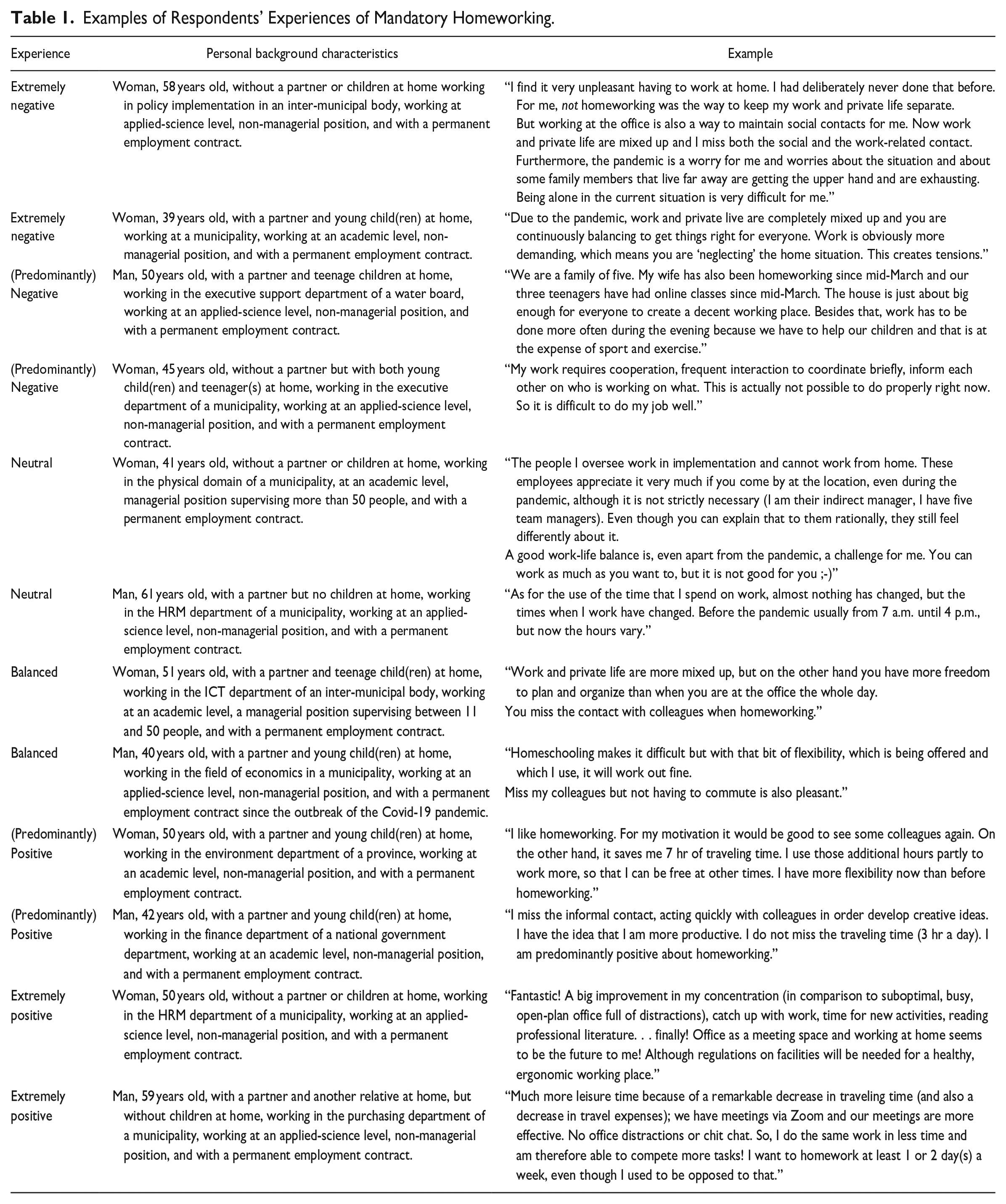
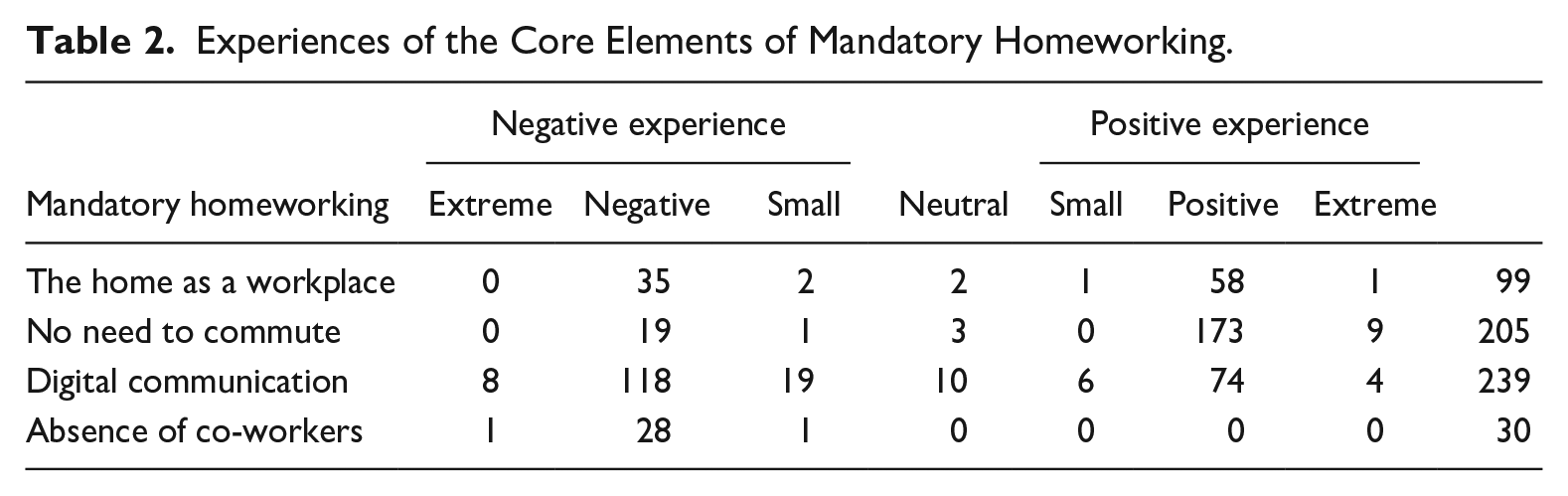
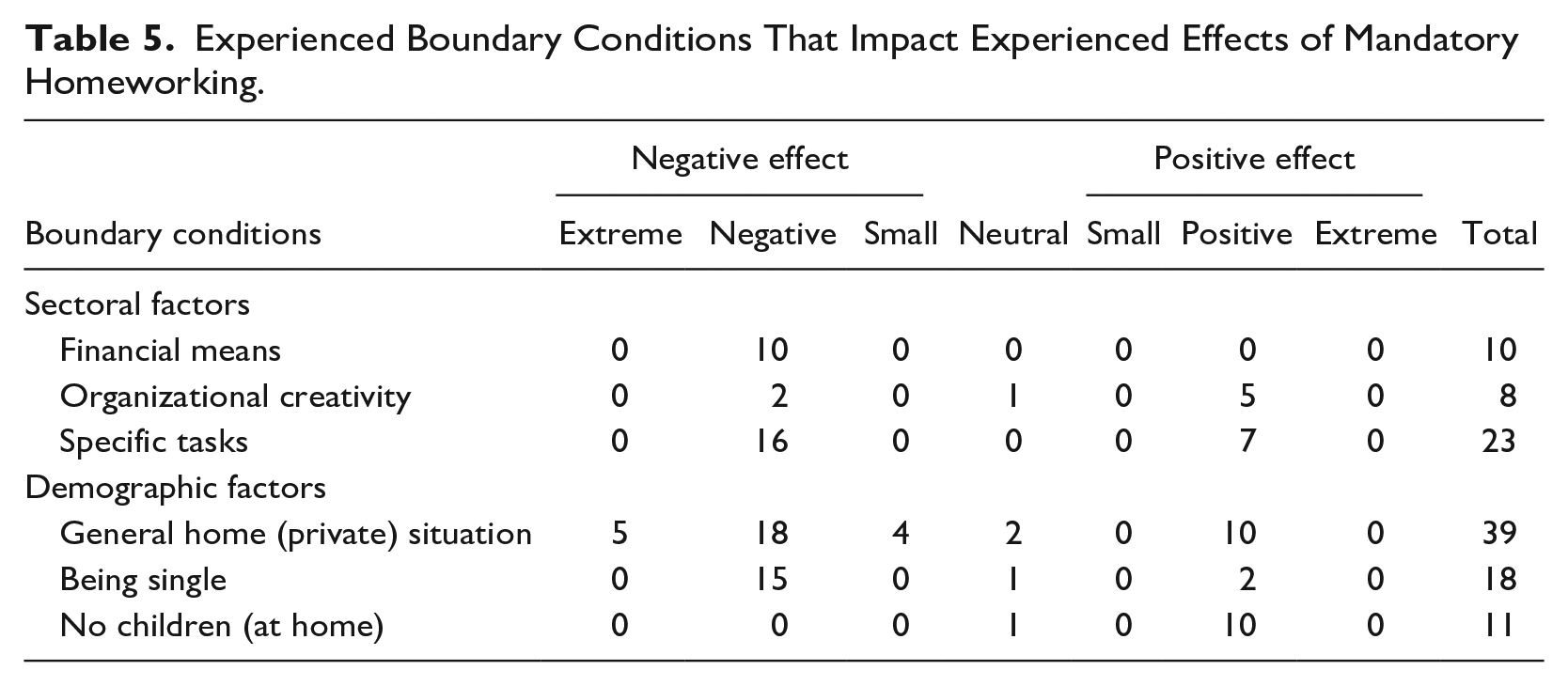
Public servants explained why they viewed their new working conditions in a particular way—that is, as (extremely) negative, balanced, or (extremely) positive referring in their responses to specific elements of mandatory homeworking (see Table 2); to certain (changes) in job demands and resources, home demands and resources, or personal resources (see Table 3) (note that personal demands were not mentioned); to specific outcomes they had experienced (see Table 4); and/or—in a relatively small proportion of written accounts—to specific boundary conditions (see Table 5).
Experiences of the Core Elements of Mandatory Homeworking.
Experienced Changes in Demands and Resources Associated With Mandatory Homeworking.
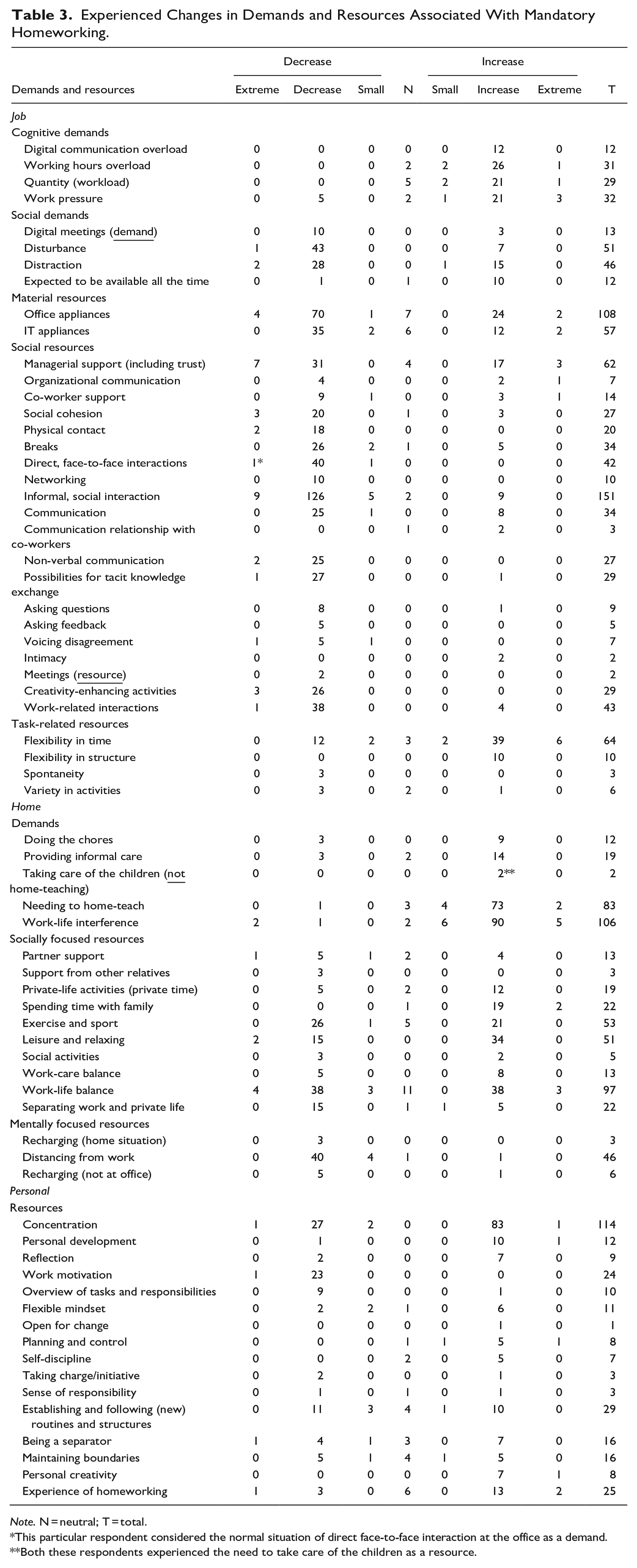
Note. N = neutral; T = total.
This particular respondent considered the normal situation of direct face-to-face interaction at the office as a demand.
Both these respondents experienced the need to take care of the children as a resource.
Experienced Outcomes of Mandatory Homeworking.
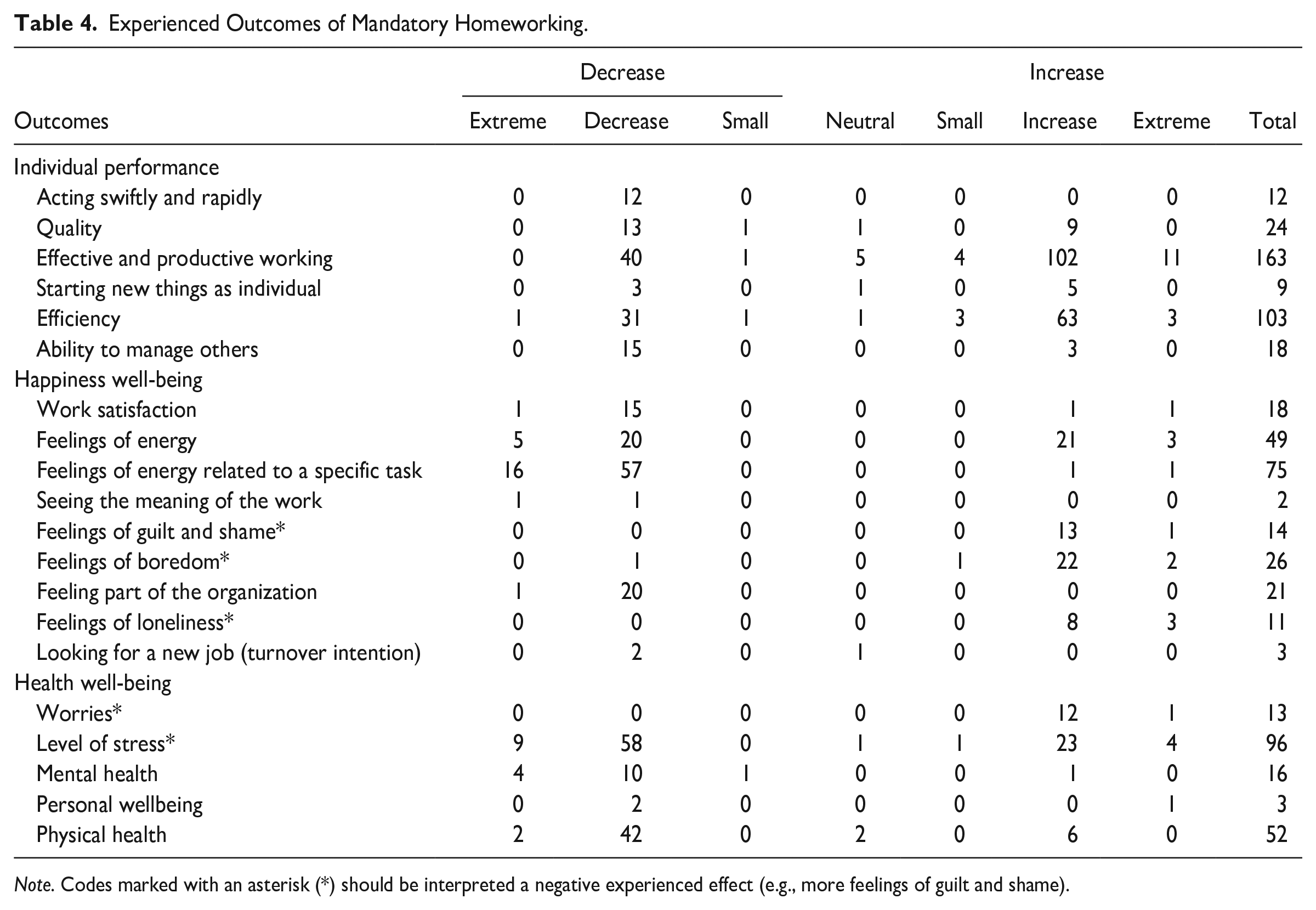
Note. Codes marked with an asterisk (*) should be interpreted a negative experienced effect (e.g., more feelings of guilt and shame).
Experienced Boundary Conditions That Impact Experienced Effects of Mandatory Homeworking.
In the following subsections, we develop propositions that extend the JD-R framework. Based on the results shown in the tables combined with the theoretical discussion, we aim to extend the Job-Personal-Home Demands-Resources framework shown in Figure 1. We first present three general propositions and next present specific propositions that emphasize particular elements of the JDR-framework.
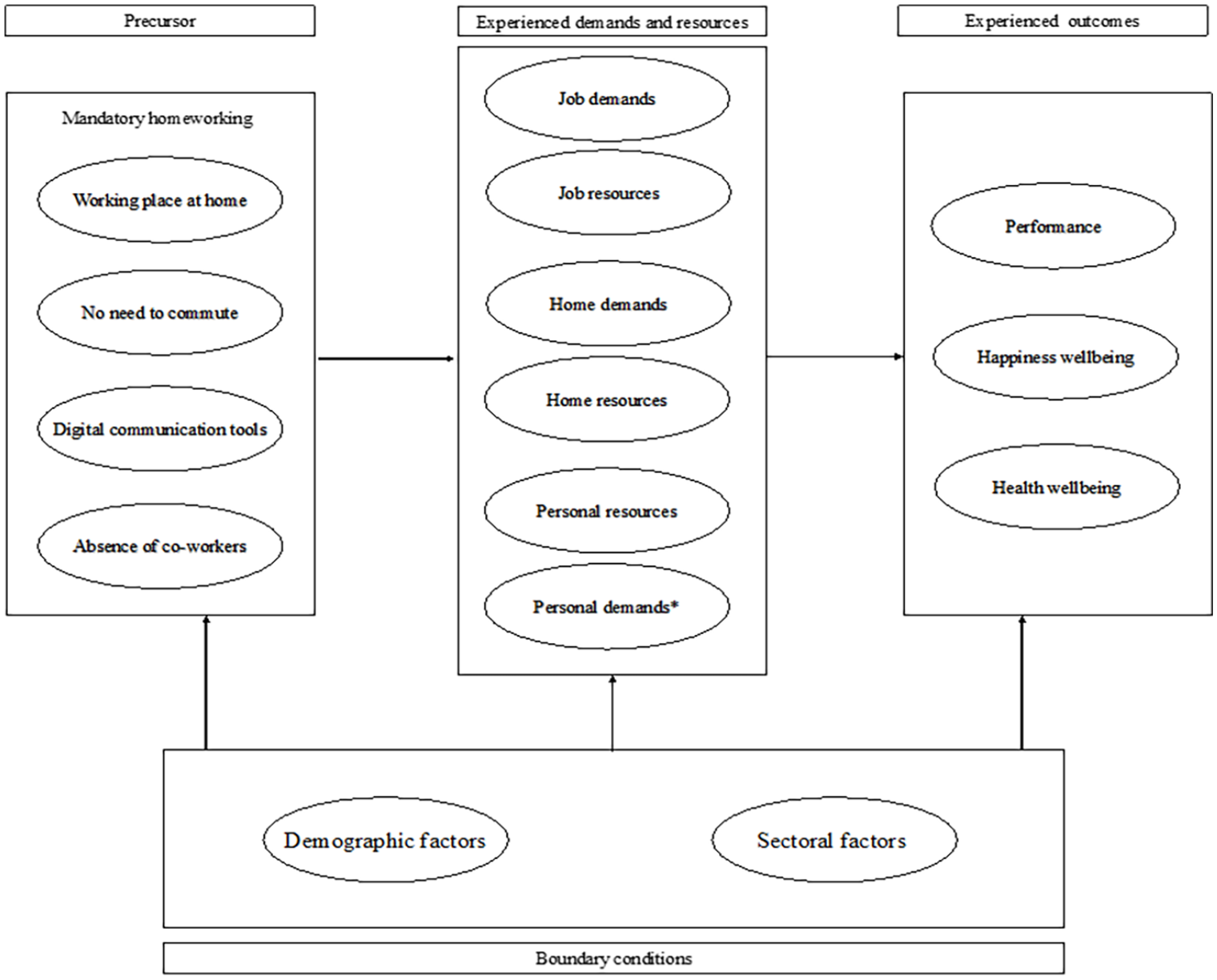
Conceptual model of the experienced effects of mandatory homeworking on performance and wellbeing.
Homeworking and Its Direct Relations With Well-Being and Performance
As Table 4 shows, experienced outcomes of mandatory homeworking diverged. Yet we observe that homeworking had a general positive effect on public servants’ individual performance. Specifically, public servants express an increase in effective and productive working (n = 117). Several respondents stated that they were able to “work quietly, getting more work done” and that “digital meetings are more structured and effective.” Meanwhile, happiness well-being decreased while health-related well-being increased. Indeed, happiness well-being indicators such as feelings of energy to conduct specific tasks (n = 73) and feelings of being part of their organization (n = 21) decreased while feelings of boredom increased (n = 25). Moreover, indicators of health-related well-being predominantly decreased including higher levels of stress (n = 67) and worsened physical health (n = 44), which means lower health-related well-being. For example, one respondent stated that “after several months, it wears me down and I start to get physical complaints from sitting behind a laptop for hours.”
Based on the observed trends in the data, we develop the following proposition:
Proposition 1: Homeworking has in general a positive impact on public servants’ individual performance and health-related well-being, but a negative impact on happiness well-being.
Homeworking and Its Direct Relations With Job Demands
As shown in Table 3, respondents generally experienced an increase in cognitive job demands; specifically, they experienced an increase in working hours overload (n = 29), quantitative workload (n = 24), and work pressure (n = 25). Additional analyzes showed that the reasons for these increases in cognitive demands are, amongst others, the temptation to work continuously because the number of emails and meetings increased (n = 11), and finding it harder to distance from work (n = 11). In contrast to cognitive demands, respondents generally experienced a decrease in social demands including meetings (n = 10), disturbance (n = 44), and distraction (n = 30). Thus, whereas generally speaking, the absence of co-workers had a negative effect on public servants’ resources (cf., proposition 1b), the absence of co-workers also seems to have a negative effect (and is thus positive) for public servants’ job demands.
Based on the observed trends in the data, we develop the following proposition:
Proposition 2: Homeworking has in general a positive impact on public servants’ cognitive job demands and a negative impact on their social job demands.
Homeworking and Its Direct Relations With Job Resources
In contrast to job demands, respondents generally experienced a decrease in their job resources due to mandatory homeworking, specifically public servants experienced a decrease in material job resources—that is, office appliances (n = 75) and IT-appliances (n = 37)—and social job resources, including social contacts with colleagues (N = 107), face-to-face interactions (N = 42), and managerial support (N = 39). The decrease in these resources can be linked to the absence of co-workers and the need to use digital communication tools. Several respondents indicated that they “missed direct contact with co-workers” and that digital communication “is not a substitute for face-to-face interaction.” Interestingly, while social resources decreased in general, several respondents experienced an increase in job resources. Specifically, 20 respondents experienced more managerial support in the context of mandatory homeworking, mostly because they experienced “trust during this period of home working.” Furthermore, respondents experienced an increase in task-related resources such as flexibility in time and structure (i.e., autonomy) (n = 47 and n = 10, respectively) more often than they experienced a decrease (n = 14 and n = 0, respectively). Several respondents indicated that they were “completely free to structure their workday.” These experienced increases can be linked to having the workplace at home.
Based on the observed trends in the data, we develop the following propositions:
Proposition 3a: Homeworking has in general a negative impact on public servants’ job resources.
Proposition 3b: In particular the material job resources and social job resources of public servants are negatively impacted due to homeworking.
Proposition 3c: Despite a negative impact of job resources due to homeworking, task-related resources might be positively impacted by homeworking.
Homeworking and Its Direct Relations With Home Demands
Respondents only mentioned five home demands in their written accounts. In general, the experienced home demands seem to increase due to mandatory homeworking, which can be linked to having the workplace at home. Specifically, the general interference of work in private life (n = 101) and the necessity to home-teach their children (n = 79) increased. One respondent experienced “enormous pressure because of the need to home teach, while work continues.” There are only a very few respondents who experienced the opposite effect.
Based on the observed trends in the data, we develop the following propositions:
Proposition 4a: Homeworking has in general a negative impact on public servants’ home demands.
Proposition 4b: While homeworking has in general a negative impact on public servants’ home demands, specifically the experienced work-life interference increases.
Homeworking and Its Direct Relations With Home Resources
The effects of mandatory homeworking on home resources are generally ambivalent. For example, the number of respondents who experienced a better work-life balance (n = 41) is almost equal to the number of respondents who experienced a worse one (N = 45). For example, one respondent indicated that “new routines have led to life being better in balance,” while another respondent stated that “the balance between working at home and private activities is completely lost.” Also, while it might be expected that exercise and sport would have increased due to homeworking, it turns out that 27 respondents experienced a decrease while 21 respondents experienced an increase.
Meanwhile, some trends can be observed in the data. For example, the mentally focused home resources decreased: a majority experienced a decrease in the possibility to distance oneself from work (n = 44) and to recharge (n = 8). In contrast, social focused home resources seem to increase: a dominant majority experienced an increase in the time spent with family (n = 21), leisure and relaxation (n = 34) and private life activities (n = 12). Both effects can be linked to having the workplace at home. On the one hand, the office is only a few steps away, making it challenging to leave the workplace behind at the end of the day. On the other hand, your house and family are also only a few steps away, providing more opportunities for non-work-related activities.
Based on the observed trends in the data, we develop the following proposition:
Proposition 5: Homeworking has in general a negative impact on public servants’ mentally focused home resources, while homeworking has in general a positive impact on socially focused home resources.
Homeworking and Its Direct Relations With Personal Resources
Table 3 shows that respondents mentioned a large variety of changes in their personal resources due to mandatory homeworking. In general, respondents experienced an increase in their personal resources. Yet, this observation is based on a rather large amount of mentioned resources but with rather low frequencies for each individual resource. The only one that really stands out are the increases in concentration (n = 84). In contrast, it should be mentioned that respondents who mentioned work motivation as a personal resource, unambiguously experienced a decrease (n = 24). Several respondents stated that the loss of direct interactions “makes it hard to stay motivated.” Expectedly, for these respondents, face-to-face conversations and physical presence provides engagement and a sense of connection.
Based on the observed trends in the data, we develop the following propositions:
Proposition 6a: Homeworking has in general a positive impact on public servants’ personal resources.
Proposition 6b: The experienced concentration by public servants is increased by homeworking.
Proposition 6c: Despite a general positive impact of homeworking on experienced personal resources, work motivation of public servants is negatively impacted.
Homeworking and Its Indirect Relations Through Demands and Resources on Performance and Well-Being
Although the results so far showed the direct results of homeworking, we can also dive a bit deeper into respondents’ experiences and find experiences with particular components of homeworking in indirect relations through various demands and resources on individual performance and well-being. As shown in Table 2, we can distil four components of homeworking that impact demands and resources, and in turn, individual performance and well-being: (1) the home as a workplace; (2) no need to commute; (3) digital communication; and (4) the absence of co-workers. The reason we refer to digital communication as one of our four components rather than “IT for operations and communication” (Baruch, 2001, p. 114) is that the respondents considered IT applications to be a job resource for effective homeworking rather than a precursor. To put it more broadly, nowadays, IT systems are an integral part of working, whereas digital meetings are more relevant to mandatory homeworking in particular.
First, the experienced consequences of the home as a working place were mixed. Regarding their individual performance, additional analyses of the data showed that they made positive remarks about what we understood to mean the quantity of the work—including more effective and productive working hours (n = 87) and more efficiency (n = 16). Respondents who made negative remarks about their performance at home complained mainly about the lowering of several resources and the increase of several demands, including the inability to concentrate (n = 26), experiencing more disturbances (n = 7), and distractions (n = 15).
Second, digital communication, the second dimension of homeworking, predominantly increased public servants’ individual performance through the increase of several resources. Specifically, 41 respondents mentioned increased “efficiency” as a positive individual performance outcome of digital meetings, because meetings tended to be more to the point and therefore shorter. On the other hand, several respondents (n = 12) experienced a decrease in individual performance because of the use of digital conference tools. These respondents felt less able to provide adequate services to citizens and other actors because they were required to use digital tools. Besides the effects on individual performance, respondents frequently mentioned the exhausting, and thus negative, effect of digital meetings (n = 45) in relation to their health-related well-being. For example, one respondent mentioned: “Digital meetings are exhausting and if I have three or more in one day, I need more sleep.”
Third, the absence of co-workers, predominantly impacted public servants’ individual performance negatively, in particular through a decrease in job resources, such as opportunities for knowledge exchange (n = 28), engaging in dialog (n = 13), give and receive feedback (n = 45), ask questions and give answers (n = 7), and also the impossibility of “acting swift and rapidly” when homeworking (n = 12). Moreover, additional analyses of the data showed that the absence of co-workers affected respondents’ well-being—for instance, in terms of their work satisfaction (n = 11), work motivation (n = 16), boredom (n = 19), and feeling part of the organization (n = 21)—reminding us that co-workers play a substantial role in shaping the work environment, adding variety to and distraction from otherwise monotonous tasks, acting as a source of inspiration, and fostering a sense of belonging.
Last, whereas opinions on the three other elements of homeworking diverged, most respondents were (extremely) positive about the fourth dimension, the fact they no longer had to travel to work (no need to commute) (n = 182), as it positively impacted their resources and in turn performance and well-being. Various respondents (n = 24) indicated they were more productive during the day. For example, one respondent stated that “since commuting time has almost completely disappeared, there’s more time to spend on work.” Considering effects on public servants’ well-being, the elimination of commuting time had a positive effect on their experienced stress levels (n = 26). Several respondents noted they were happy that they “no longer needed to rush in the morning” or no longer “had to deal with traffic jams.” As well as being more relaxed, 49 respondents stated the time they saved resulted in more time for home resources such as sports and leisure activities, as well as more (quality) time to spend with their partner and/or children.
Based on the observed trends in the data, we develop the following general propositions:
Proposition 7a: Having your workplace at home and the need to use digital communication tools have a mixed impact on public servants’ resources and demands, which in turn impacts individual performance and well-being.
Proposition 7b: The absence of co-workers generally has a negative impact on public servants’ resources, which in turn has a negative impact on individual performance and well-being.
Proposition 7c: The absence of traveling time generally has a positive impact on public servants’ resources, which in turn has a positive impact on individual performance and well-being.
Boundary Conditions
Considering the boundary conditioned mentioned by the respondents, we distinguish between the effects of sectoral factors and demographic background factors. As shown in Table 5, regarding sector-related factors, the task at hand is the most frequently mentioned factor. Specifically, some respondents (n = 7) stated that homeworking had a positive direct effect on their performance because they gained more concentration (and being at home they were not disturbed by their co-workers). Meanwhile, other respondents (n = 16) remarked that their job required frequent interaction with others, which was next to impossible in the context of mandatory homeworking. For example, one respondent noted that being unable to look people in the eye made it difficult to tell if they were telling the truth. Ten respondents commented that they were able to perform well because they had no small children at home. Conversely, we saw in the data that public servants with small children at home expressed challenges in maintaining their performance, not only because they had to home-teach but also because of disturbances caused by the children.
With respect to demographic factors, several respondents indicated their feelings of happiness and health-related well-being were negatively impacted by being single and thus not having any social support at home (n = 15). Furthermore, respondents indicated various home situations that had a negative impact (n = 27). For example, one respondent stated that “working with more than one person in a room is difficult.”
Based on the observed trends in the data, we develop the following general propositions:
Proposition 8a: Regarding sectoral factors, having a job that requires frequent interactions with co-workers and external stakeholders has a negative effect on public servants’ experiences with the consequences of homeworking with experienced individual performance.
Proposition 8b: Regarding demographic factors, being single has a positive direct impact on public servants’ experienced performance because of homeworking but a negative impact on their health and happiness-related well-being.
Proposition 8c: Regarding demographic factors, having young children at home and having a lack of a positive general home situation, has a negative direct impact on public servants’ experienced happiness and health-related well-being because of homeworking.
Discussion
The goal of this study was to gain a more complete picture on the effects of homeworking on public servants’ experienced job, home, and personal demands and resources, and, in turn, their happiness well-being, health-related well-being, and individual performance. Historically, the literature on teleworking has focused on public servants who chose themselves to work (part-time) from home. Consequently, these studies were always somewhat biased because they were written from the perspective of a selective group of employees who are basically already satisfied with homeworking; otherwise, they would not have opted for it. By applying the JD-R framework to the experiences with mandatory homeworking of a large sample of Dutch public servants, we wanted to gain a more complete picture of the consequences of teleworking. In general, we can conclude the relationship between homeworking and its outcomes is complex, but at the same time also with fairly clear patterns. Based on this conclusion, four sub conclusions can be drawn.
First, in general, it can be concluded that homeworking has a predominantly positive impact on public servants’ individual performance, and health-related well-being but a predominantly negative impact on happiness well-being. Especially the findings regarding health-related well-being and individual performance are in line with other recent homeworking literature on public servants that shows that the more hours worked from home, the higher the performance and health-related well-being (regarding performance see Kwon & Kim-Goh, 2022; Metselaar et al., 2023, regarding health-related well-being see Giauque et al., 2022). Interestingly though, Giauque et al. (2022) at the same time found a dip in public servants’ performance. This might have to do with the way in which performance is operationalized in these other, quantitative studies. In this study we also found that particular performance indicators decreased instead of increased, for example the ability to act swiftly and rapidly and the ability to manage others. Therefore, we recommend quantitative follow-up research on the effects of homeworking to consider a broad range of performance elements as found in this study.
Second, the impact of homeworking on the job demands and job resources seems to depend on the specific clusters of these job demands and resources. Regarding job demands, homeworking predominantly increased cognitive job demands (i.e., work pressure, workload and working hours), but decreased social job demands (i.e., meetings and disturbances). Employees have more difficulty to distance from work, which increases the amount they work; moreover, employees are disturbed less by colleagues and meetings are often more to the point, which explains why social demands decreased. This is also in line with the recent teleworking literature among public servants although they often test only loose indicators of these clusters (e.g., Metselaar et al., 2023). Regarding job resources, homeworking decreased material job resources and social job resources (i.e., colleague and supervisor support) of public servants but increases task-related resources (i.e., autonomy). Due to homeworking, employees experienced less access to colleagues and managers, while at the same time they needed to be more self-reliant. Again, other teleworking studies among public servants only test loose indicators of these clusters, but the found patterns seem to be similar (e.g., Giauque et al., 2022).
Third, the impact of homeworking on the personal resources is in general positive, while the impact on personal demands is still unclear. Regarding personal resources, for example, concentration is in general improved due to homeworking. However, at the same time work motivation of public servants, in general, decreased. It seems public servants can focus better from home, but at the same time lose their connection with the organization. Barboza-Wilkes et al. (2022) showed this in their study as well as they argued that public servants might lose citizen contact and the shared mission and vision of the organization. Consequently, they might lose a bit of their PSM. Regarding personal demands, these were not mentioned by respondents. This is not that unexpected as these are fairly negative personality traits that might feel uncomfortable to share. At the same time, there are several instances in the data which seem to point at signs of the personal demand workaholism, as several public servants mention they cannot distance themselves from their laptop and feel the urge to be available all the time.
Fourth, similar to job demands/resources, the impact of homeworking on the home demands and home resources seem to depend on the specific clusters of these home demands and resources as well. Regarding home demands, especially work-life interference increased due to homeworking, as found in other studies among public servants (Giauque et al., 2022). Regarding home resources, homeworking predominantly decreased mentally focused home resources (i.e., distance from work) but predominantly increased socially focused home resources (i.e., time spent with family). Although these results are not unexpected, this study empirically confirms these untested expectations.
Theoretical Implications
With these conclusions, we make several contributions to the teleworking literature and the JD-R framework in public administration. First, in contrast to the large group of teleworking studies (see for various literature reviews, de Vries et al., 2019), this study paints a completer and more balanced picture of how public servants experience homeworking because we use a sample of employees that also consists of employees who are not that experienced in working from home. We herewith overcome the earlier mentioned bias in teleworking studies that predominantly focus on employees who voluntarily choose for homeworking and are inherently already less critical about homeworking in the first place. This is especially important in the light of the development of homeworking policies and downscaling of office spaces at governmental offices in the Netherlands, making homeworking more common.
Second, this study expands the focus of existing homeworking literature by fully using the JD-R framework. Indeed, in contrast to other homeworking literature, this study not only focuses on the effects of homeworking on the level of job demands/resources (see Barboza-Wilkes et al., 2022; Giauque et al., 2022; van der Meer et al., 2022; Van Doninck et al., 2023), but also include the effects on personal demands/personal resources and home demands/resources. Especially in the context of homeworking, we show that it is just as important to take into account the home demands/resources as job demands/resources.
Third, within these levels of job/personal/home demands-resources, we also bring more clarity in the effects of all kinds of demands and resources. In the homeworking literature in general, and in the homeworking literature in public administration in particular, the consequences of homeworking on the experiences of public servants with many loose resources and demands are studied such as colleague support, supervisor support, autonomy, ambiguity, task variety, workload, social cohesion, work-life balance and communication (de Vries et al., 2019; Giauque et al., 2022; Metselaar et al., 2023; van der Meer et al., 2022). However, in line with the work of scholars that also tried to cluster different types of resources and demands (Bakker & Demerouti, 2007; Borst et al., 2019), we showed that some clustering is also helpful in the teleworking literature to gain a clearer picture of possible trends in the outcomes of teleworking. In this study, we showed that within every level of demands/resources, it is indeed possible to cluster different types of resources demands that show similar trends. For example, the large group of job resources can be clustered in material resources, social job resources, and task-related resources, especially because the individual demands in every cluster show a similar trend. Through this clustering, we were able to get a better picture of the outcomes of homeworking and develop propositions. Future research is needed to empirically test these propositions, for instance by using quantitative, experimental, and longitudinal research designs.
Practical Implications
In addition to these theoretical implications, we can also deduce several practical implications. First, the conclusions show some fairly strong decreases in material and social resources. Within public organizations, HR departments, IT-managers and line managers need to make sure public servants receive good material resources such as office appliances and IT appliances to do their work. Moreover, to overcome a decrease in social resources such as colleague and supervisory support, line-managers could demonstrate exemplary behavior, including trust and empathy toward team members and adopt a relationship-oriented leadership style, by focusing on objectives instead of how the work needs to be done (de Vries et al., 2019; Giauque et al., 2022). Second, the conclusions show some fairly strong increases in cognitive job demands (i.e., work pressure, workload and working hours). This is in line with the often heard trend of workplace tele-pressure by immediately responding to e-mails and the urge to show to others that they are available. This often has to do with the personality of public servants and Doberstein and Charbonneau (2022) also recently showed that managers need to take into account the psychological characteristics of public servants before they transfer everyone to teleworking on a permanent basis. Third, work-life interference seems to be the hardest general home demand. Especially among households with children it seems harder to find the right balance. We therefore recommend implementing HRM policies to support public servants in their home situation. For example, providing paid care leave allows employees to take time off to care for their family members without compromising their financial stability. reducing stress and enhancing work-life balance (Feeney & Stritch, 2019).
Limitations
Despite the contributions to theory and practice, inevitably, there are several limitations of this study that should be considered. A first limitation is the exploratory prompt. The prompt we used in this study was embedded in a larger survey in which we asked several questions about personal characteristics and working conditions, which could be answered on a Likert scale. On the one hand, one could argue these survey questions had a priming effect. On the other hand, these questions were designed to make our respondents reflect and comment on their experiences, so it may have resulted in richer and more thoughtful responses than would otherwise have been provided. At the same time, due to the open-ended exploratory prompt, the respondents were not specifically asked to provide more information about the influence of their demographic background nor the influence of sectoral factors (such as red tape, PSM, interactions with citizens, and related emotional demands). Consequently, the peculiarities of the boundary conditions and specific public administration related demands and resources are underexposed.
A second limitation is the representativeness of our sample. Our sample contained a broad variety of public servants, but there were only a handful of employees with lower levels of education, starters, and employees on temporary contracts, thus undermining the external validity of our research. At the same time, these sample characteristics are in general, in line with the average public servant in the Netherlands, who is 48 years of age and has a permanent contract.
A final limitation is the fact that we could not determine possible interactions between home demands/resources, job demands/resources, and personal/demands resources. Although this was also not the aim of this study, from the JD-R model we know that all kinds of coping, buffering and spill-over mechanisms might play a role between demands and resources (Schaufeli & Taris, 2014; Ten Brummelhuis & Bakker, 2012).
Future Research Suggestions
These limitations do hint at possible future research directions. First, besides testing the propositions posed in the results section, it might be interesting to also study the influence of demographic characteristics and sector specific characteristics in the study of homeworking. As the results and other scholars show, demographic background characteristics such as family composition and sectoral characteristics such as the amount of contacts with citizens might moderate the relations between homeworking and resources/demands (Barboza-Wilkes et al., 2022; Giauque et al., 2022). As the exploratory nature of this study did not particularly ask about these factors, this might be an interesting research endeavor for the future. Moreover, scholars also show that particular sector specific demands and resources such as PSM and red tape might be influenced by homeworking which in turn influences performance and well-being (Schuster et al., 2020; van der Meer et al., 2022). These particular effects might be interesting to study as well.
Second, future research might study how job/personal/home demands-resources as a consequence of homeworking might interacting in their impact on well-being and performance. As many JD-R studies in public administration show, job and personal resources might for example be helpful for public servants to cope with job demands (e.g., Borst et al., 2019). It might therefore, for example, be interesting to study how an increase in concentration helps in coping with the additional experienced workload due to homeworking. Moreover, Ten Brummelhuis and Bakker (2012) show that experienced job demands might spill-over in home demands, or home resources might spill-over in coping with job demands. It might therefore be interesting to study how partner support helps public servants to deal with decreased social support by colleagues due to homeworking. In other words, this study is only the beginning of many possible future research avenues.
Conclusion
The acclaimed trend of large-scale homeworking in the public sector calls for a careful examination to assess both its advantages and disadvantages. This study therefore aimed to provide a holistic picture of the effects of homeworking on public servants’ demands and resources and, in turn, on their performance and well-being.
By applying the JD-R framework to responses of a large sample of 985 Dutch public servants during the COVID-19 pandemic, using template analysis, this qualitative study provided several key insights. First, mandatory homeworking had a predominantly positive impact on individual performance and health-related well-being but a predominantly negative impact on happiness well-being. Second, the impact on job demands and resources seemed to vary across specific clusters, with an increase in cognitive demands and a decrease in social demands. Regarding resources, material and social resources decreased, while task-related resources increased. Third, socially focused home resources increased but mentally focused home resources decreased. Fourth, mandatory homeworking generally had a positive impact on personal resources but decreased work motivation. Lastly, sectoral factors and demographic background factors provide important boundary conditions that impact demands and resources. Our findings are translated into propositions that extend the JD-R framework.
The study contributes to the literature by addressing biases in previous (quantitative) JD-R studies and expanding the focus to include personal and home demands and resources as well as boundary conditions. Practical implications include the need for adequate material and social resources in public organizations, consideration of psychological characteristics in implementing homeworking, and support for work-life balance. This study suggests the need for future research on demographic and sector-specific factors, as well as the interactions between different demands and resources to better understand the effects of large-scale homeworking for public servants and their organizations.
Footnotes
Acknowledgements
We thank the editorial team of Binnenlands Bestuur—in particular Hans Bekkers—for their research assistance. Moreover, we thank the anonymous reviewers and the editor for their thoughtful comments and suggestions.
Declaration of Conflicting Interests
The author(s) declared no potential conflicts of interest with respect to the research, authorship, and/or publication of this article.
Funding
The author(s) received no financial support for the research, authorship, and/or publication of this article.
