




Abstract
The critical efforts of essential workers during the COVID-19 crisis might have important implications for how individuals view government, nonprofit, and for-profit sector workers and their pay. This article explores views of employees’ pay considering three rationales (anticipated judgment, motivation for work, and competency in that work) that might lead to a lower valuation of work in the public and nonprofit sectors (i.e., lower pay rationales), particularly among those who work in the for-profit sector. However, highlighting a concrete way that public and non-profit employees serve the public, such as providing services during COVID-19, might mitigate this negative effect by showing their commitment to public service in an intuitive way. Our survey experiment provides evidence that activating the competency or motivation rationales lowers the likelihood that nonprofit employees are viewed as underpaid among those who work in the for-profit sector when a concrete example of public service is not provided. However, we also find some evidence that an example of public service can help to counteract these effects.
Keywords
Introduction
The COVID-19 crisis created considerable hardships for frontline workers in all sectors of the economy. Many faced significant risks to continue their work and serve the public. Their dedication in spite of the risks has led to numerous calls to increase pay for essential workers during the pandemic (see Allen, 2020; Kinder & Stateler, 2021). Some essential workers did receive pay increases, at least for a period of time. As many as 90 million U.S. workers could be classified as essential workers (Tomer & Kane, 2020), and half of U.S. workers in low-wage occupations could be considered essential (Kinder & Stateler, 2021). Recent evidence shows public support for a higher minimum wage increased during the pandemic (Kinder, 2020); perhaps this increased support might extend to better wages for those in public service who risked so much during the pandemic.
The dedication of essential workers and their service to the public might have important implications for how individuals view public, nonprofit, and for-profit sector workers and their pay. Mass attitudes toward the pay of public, nonprofit, and for-profit employees are important because these views can shape general support for specific pay policies (e.g., the Equal Pay Act, the Salary Transparency Act, or COVID-19 hazard pay policies). Furthermore, positive views toward public service employees and the compensation they should receive can improve employee morale and, ultimately, help to recruit and retain qualified employees. Extensive research has examined how pay (or monetary incentives generally) affects public employees’ motivation, satisfaction, and performance (see Bellé, 2015; Kellough & Lu, 1993; Park et al., 2016), and work has also explored trends in public sector pay (see Lewis et al., 2018; Reese, 2019). Relatively little research, however, examines how the public views the pay of public, nonprofit, and for-profit employees. 1
This study aims to contribute to the literature by addressing questions about views of compensation across the sectors. Specifically, we explore how indivduals judge the pay of public, nonprofit, and for-profit employees and how a concrete example of public service affects views of pay. To do so, we examine views toward pay across the sectors and how essential work during the COVID-19 crisis affects these views. Building from research exploring the values of public and nonprofit employees and how these values are reflected in popular opinion of public and nonprofit employees, we offer three potential motivating rationales that might lead to undervaluing the work of those in the public and nonprofit sectors. The first rationale is fear of judgment or do-gooder derogation, which is “the putting down of morally motivated others” (Minson & Monin, 2012, p. 200). The second rationale is a view of public service as its own reward (public-minded motivation), and the third rationale is expected lower levels of competency in the public and nonprofit sectors. We suggest that among those who work in the for-profit sector, activating these rationales will negatively affect how individuals view the pay of public and nonprofit employees, making them less likely to rate public and nonprofit employees as underpaid. Yet we also expect that highlighting a concrete way public and nonprofit employees serve the public will work to counteract the negative effects of these rationales on views toward pay among those who work in the for-profit sector. Specifically, we expect that information about actual service to society during the COVID-19 crisis will attenuate these negative effects.
We test these expectations using a survey experiment. Our results provide some evidence that, among for-profit employees, views toward the pay of nonprofit employees, though not public employees, are negatively affected by activating the lower pay rationales. Specifically, activating the competency or motivation rationales lowers the likelihood that nonprofit employees are viewed as underpaid among those who work in the for-profit sector when a concrete example of public service is not provided. We also find some evidence that these effects can be counteracted, at least to some extent, through exposure to a salient example of public service.
This article contributes to the literature on individuals’ perceptions of the public, nonprofit, and for-profit sectors. Existing studies on this subject have primarily focused on how individuals respond to organizational ownership and judge performance rather than looking at employees within each sector. Views of governmental agencies, however, are not necessarily the same as the views of public employees or their pay. In particular, this study advances our understanding of how individuals view employees’ pay across public, nonprofit, and for-profit sectors by theorizing about the role of three different rationales (do-gooder derogation, public-minded motivation, and expected competency) in shaping views toward pay. This effort can contribute to research connecting motivation to pay and studies considering pay levels and trends in pay across the different sectors. Additionally, we examine how salient cases of public service, like service during the COVID-19 pandemic, shape the effect of the rationales for devaluing work in the public and nonprofit sectors on views of pay. By considering whether pandemic service mitigates the negative effect of the lower pay rationales, we offer a more comprehensive assessment of views toward pay, exploring the counteracting effect of salient public service.
Perceptions of Public and Nonprofit Employees and Their Values
A large body of research investigates work motivation due to its fundamental importance in all types of organizations (see Pinder, 2008). Work motivation can be defined as “a person’s desire to work hard and work well—to the arousal, direction, and persistence of effort in work settings” (Rainey, 2014, p. 263). Work motivation derives from intrinsic and extrinsic sources (Grant, 2008; Ryan & Deci, 2008). Intrinsic motives are internal psychological rewards derived from the work itself (i.e., a sense of accomplishment), while extrinsic motives indicate external tangible rewards that come from outside forces (i.e., salary, promotion).
Considerable research also explores the differences in the work motivations and values of employees across the sectors, comparing public, nonprofit, and for-profit sector employees (e.g., Bullock et al., 2015; Lee & Wilkins, 2011). As public, nonprofit, and for-profit organizations have different goals, managerial tools, and institutional environments, a common theme in the literature is that public and private employees have different work motivations and work-related values and attitudes (Rainey, 2014). In general, research suggests that public sector employees are less extrinsically motivated (Crewson, 1997), show higher levels of altruistic and public-minded motives (Bullock et al., 2015; Dur & Zoutenbier, 2014), have stronger perceptions of the social impact of their jobs (Bullock et al., 2015), and volunteer more than their private sector counterparts (Ertas, 2014; Houston, 2006; Piatak, 2015). By contrast, for-profit sector employees tend to care more about extrinsic rewards and place greater importance on high income from their work (Bullock et al., 2015; Crewson, 1997; Houston, 2000). Additionally, public service motivation (PSM) has been considered as a unique driver of individuals to serve the public (Perry, 1996; Perry & Wise, 1990; for a review, see Ritz et al., 2016). Government employees are generally found to exhibit higher levels of PSM and general prosocial motives than their private sector counterparts (e.g., Buelens & Van Den Broeck, 2007; Houston, 2000; Kjeldsen & Jacobsen, 2013; Mergel et al., 2021).
Although differences exist between government and nonprofit employees (see Lee & Wilkins, 2011), nonprofit workers are generally found to more closely resemble public employees than for-profit employees in their levels of public service motivation and other work-related values (De Cooman et al., 2011; Lyons et al., 2006; Park & Word, 2012; Taylor, 2010; Word & Carpenter, 2013). The volunteering behavior of nonprofit employees is also more comparable to that of public employees than for-profit employees (Houston, 2006; Piatak, 2015). Moreover, scholars have highlighted the role of PSM in pursuing careers in the nonprofit sector, suggesting that PSM is not an inherently government-specific concept (Bright, 2016; Clerkin & Coggburn, 2012). Among those serving on nonprofit boards, those whose primary sector of employment is the public or nonprofit sector have higher levels of PSM compared to those from the for-profit sector (Ward & Miller-Stevens, 2021). Some research even suggests that PSM is a better predictor of preferences for careers in the nonprofit sector than in the government sector (Bright, 2016). Some argue that the salience of nonprofits’ public service missions appeals to individuals with high levels of PSM more than the opportunities available in governments; thus, individuals with high levels of PSM are more likely to pursue careers in the nonprofit sector (Bright, 2016).
Prior research finds social rewards are perceived as more prevalent among nonprofit employees compared with government and for-profit employees (Stater & Stater, 2019); nonprofit workers tend to place more emphasis on the intrinsic aspects of work compared to for-profit counterparts (Light, 2002; Narcy, 2011). Nonprofit workers are also more willing to donate their labor and accept lower pay in exchange for their intrinsic satisfaction, such as fulfillment in serving others (Park & Word, 2012). Research even suggests that nonprofit workers accept earning less than they would in the for-profit and public sectors (Narcy, 2011), and perceptions of pay inequity do not necessarily lower their commitment to the nonprofit sector. McGinnis Johnson and Ng (2016), for example, find that pay comparisons with other workers (both within and across sectors) do not increase employees’ intention to leave the nonprofit sector. This idea is related to the “donative labor hypothesis,” which suggests that truly motivated nonprofit employees voluntarily accept lower wages than they deserve (or they would earn in the for-profit sector) because it is considered as “donating part of their labor” to produce public goods (Kim & Charbonneau, 2020; Leete, 2006; Lee & Wilkins, 2011; Park & Word, 2012; Preston, 1989). Yet there have been concerns about the donative labor narrative as it justifies the lower wages in the nonprofit sector, making it difficult to attract professionalized workers. One logic behind the narrative suggests that the social expectations for sacrifice from nonprofit employees normalize low-paying practices, thereby placing constraints on nonprofits’ ability/willingness to compensate their workers at higher levels (see Kim & Charbonneau, 2020).
Of particular importance for this research, work has shown that individuals acknowledge the public service aspect of public and nonprofit professions and associate positive, public-minded attributes to them. In recent work, Willems (2020) surveyed U.S. adults, asking them to associate words with different professions. The words most associated with public servants were caring, helpful, and dedicated. In 2014, a majority (63%) of U.S. adults responded that they thought that government administrators were very or somewhat committed to serving the people (General Social Survey, 2014; also see Houston & Harding, 2013). 2 Similarly, for nonprofits, around 75% of U.S. adults reported they have a lot/some trust in people who work at non-governmental or nonprofit organizations (Wellcome, 2018).
These statistics, of course, do not suggest that individuals always prefer the public and/or nonprofit sector for service delivery. Many Americans prefer market mechanisms over government intervention, with 43% reporting that government regulation of business usually does more harm than good (Pew Research Center, 2022). Furthermore, some research finds evidence that individuals perceive the public and nonprofit organizations as less competent and effective than their for-profit counterparts (see Aaker et al., 2010; Hvidman, 2019; Hvidman & Andersen, 2016; Marvel, 2016; Schlesinger et al., 2004; van Den Bekerom et al., 2021). This finding, however, is not universal (see Meier & An, 2020; Meier et al., 2019, 2022; Witesman et al., 2022).
Another notable finding from the literature is that individuals do not appear to view the for-profit sector and its employees with the same public-minded frame. Lin-Hi et al. (2015), for example, find that positive performance on corporate social responsibility has no effect on the perceived trustworthiness of nonprofits but a positive effect on that of for-profits, while negative performance on corporate social responsibility has a negative effect on each. This result suggests that positive performance does not influence perceptions of nonprofits because they are assumed to have high performance here, while for-profits are not. Similarly, looking at employees in particular for-profit businesses, characteristics connected to public service are not readily attributed to private sector employees. In the analysis by Willems (2020), while there is variation, some typical “for-profit” professions (e.g., lawyer and salesperson) are less likely to be associated with positive words and often have more negative associations. For example, individuals often associate banker, lawyer, and salesperson with money, greedy, or pushy (Willems, 2020). It is worth noting that the negative associations become more explicit for some for-profit workers when compared with public employees (Willems, 2020).
Views Towards Pay in the Public, Nonprofit, and For-Profit Sectors
Given that the work values of public and nonprofit employees are generally more public service oriented than that of their for-profit counterparts and that the public image of these employees often reflects these values, this might have implications for the extent to which the public endorses rewarding their work. Specifically, we develop three potential rationales related to how the public, particularly those working in the for-profit sector, might view the pay of public and nonprofit employees: (1) do-gooder derogation, (2) views of public service as its own reward, and (3) expected lower levels of competency in the public and nonprofit sectors. We expect that activating these rationales might have an effect on views of pay among those who work in the for-profit sector. 3
Do-gooder Derogation
Using the theoretical logic related to do-gooder derogation or the rejection of moral deviance, we first suggest that views of public and nonprofit employee pay might be affected by the public-minded motivations associated with these sectors and the threat of judgment (see Gauss, 2015). As developed by Minson and Monin (2012), the logic behind do-gooder derogation suggests that when faced with anticipated moral reproach, individuals feel threatened and put down those they perceive as negatively judging them (also see Monin, 2007; Monin et al., 2008). This is likely to occur when those perceived to be judging others have made a choice that is viewed as deviating from typical behavior, particularly if others think that this departure is based on a moral rationale. In their study of vegetarians, Minson and Monin (2012) find non-vegetarians perceive vegetarians more negatively after thinking about how they would be viewed by vegetarians, providing evidence of backlash due to anticipated moral reproach (also see Cramwinckel et al., 2013).
Scholars have explored negative reactions to morally motivated others in a number of areas (Cramwinckel et al., 2015). Research shows that those exhibiting ethical purchasing behavior are judged negatively by others (Zane et al., 2016). Similarly, those who behave altruistically are judged harshly, particularly when these behaviors depart from social norms (Kawamura & Kusumi, 2020), and high levels of ethical leadership can decrease organizational citizenship behavior, which is linked to feeling morally reproached (Stouten et al., 2013). In our context, a recent Pew Research Center survey highlights that public-minded service is not the norm in work motivations, with 40% of respondents valuing flexibility the most, 17% valuing a high-paying job, 9% valuing making a meaningful contribution to society, and 8% valuing helping others, with a higher proportion of for-profit employees valuing high-pay the most compared to public and nonprofit employees, a higher proportion of public and nonprofit employees valuing contributing to society the most compared to for-profit employees, and a higher proportion of nonprofit employees valuing helping others the most compared to public and for-profit employees (Pew Research Center, 2017). Building upon this vein of prior research, we suggest individuals who work in the public and nonprofit sectors may be viewed as morally motivated, and thus, face backlash from those who might fear that they are negatively judged by these employees (i.e., for-profit employees), leading to lower levels of suggested pay.
Do-gooder derogation, however, should not exist for those working in the for-profit sector. These employees are generally not perceived as making a morally-motivated choice that is viewed as deviating from the norm. The majority of the U.S. workforce works in the for-profit sector (McKeever & Gaddy 2016). As noted above, research generally suggests that for-profit sector employees tend to focus more on extrinsic rewards and prioritize pay (Bullock et al., 2015; Crewson, 1997; Houston, 2000; Perry & Hondeghem, 2008). Thus, we do not expect that for-profit employees would face backlash from those who might fear that they are negatively judged on a moral level by these employees.
Public Service as its Own Reward
Views on public and nonprofit employee pay may also be affected by calling attention to their work motivations. Individuals might think that employees have sorted into the sector most aligned with their own incentive mechanisms, thus supporting the idea that they are not driven to the same extent by pay or may not expect high levels of pay; therefore, it is less important to pay them well. The idea of sector sorting is closely related to the attraction-selection-attrition theory (i.e., individuals select into organizations that fit their values and characteristics) and the literature on person-organization fit, which highlights the important link between employee values and organization choices. These perspectives support sector self-selection (or sector sorting)—individuals fit themselves into sectors that they think will satisfy their important values and needs (Wright & Christensen, 2010), and individuals’ value preferences are primarily attached to the sector they are in (Van der Wal et al., 2008). Consistent with this literature, public and nonprofit sector employees have been found to place a higher value on serving the public whereas for-profit sector employees tend to place a higher value on financial rewards (Lyons et al., 2006; Van der Wal et al., 2008; Ward & Miller-Stevens, 2021; Wright & Christensen, 2010). Although, some of these expounded values in the public sector could be a coping mechanism associated with lower availability of extrinsic rewards (Kroll & Porumbescu, 2019). Furthermore, research finds that a desire to serve society is positively associated with staying in the public sector, whereas a desire to serve the end-users and wanting a higher salary are related to switching to the private sector (Hansen, 2014).
If a career choice reflects personal value preferences (i.e., public and nonprofit employees choose their professions because public and nonprofit organizations offer values and opportunities that satisfy their intrinsic needs), people might consider low pay a result of individual choices and value preferences. Put differently, when for-profit employees think about work motivations in the public and nonprofit sectors, they might think that if there is lower pay in these sectors, then it is not an issue because public and nonprofit employees do their jobs for their personal fulfillment as much as for money. Furthermore, they might think that low pay would not drive public and nonprofit workers away because money is not a strong motivator for these employees. This idea is closely linked to arguments surrounding the donative labor hypothesis (Kim & Charbonneau, 2020; Lee & Wilkins, 2011).
In contrast, a larger proportion of for-profit workers prioritize financial motives and choose their professions to satisfy extrinsic needs. Because of the general perception that for-profit workers earn more money and place a higher value on salary (Hansen, 2014), people may find that public-minded motivation is not very relevant to the for-profit context. In sum, we expect that calling to mind work motivations will lower the suggested pay for employees in the public and nonprofit sectors but not in the for-profit sector, particularly among those who work in the for-profit sector. 3
Expected Lower Levels of Competency
The views of employee pay might also be affected by expected levels of competency. If individuals consider employees in the for-profit sector as more competent than public and nonprofit employees, they might be more likely to think that for-profit employees deserve higher salaries. Put differently, expected lower levels of competency in the public and nonprofit sectors may help to justify low pay in these sectors. 4 Although there are mixed findings in this research area, this view is in line with research suggesting an anti-public sector bias that views the public sector as less effective and less efficient (see Hvidman, 2019; Hvidman & Andersen, 2016; Marvel, 2016; van Den Bekerom et al., 2021). Similarly, some studies, though the findings are again mixed, suggest that nonprofit organizations are perceived as less competent than their for-profit counterparts (Aaker et al., 2010; Drevs et al., 2014; Schlesinger et al., 2004; Seemann et al., 2014) or find that when sector is a selection criteria, individuals select for-profits over nonprofits (Ben-Ner et al., 2018). 5
The work pointing to an anti-public sector bias also indicates that this bias is conditional on negative views of the public sector. Hvidman (2019), for example, shows that the effect of sector on views of performance is conditional on negative beliefs about the public sector (also see van Den Bekerom et al., 2021). Sector of employment is associated with biases in favor of one’s own sector, with public employees showing biases toward public organizations (Jakobsen & Petersen, 2022). We expect this to be the case for for-profit sector employees as well. Thus, following from this line of work, we expect that calling attention to competency will lower the suggested pay for employees in the public and nonprofit sectors (not the for-profit sector) among those who work in the for-profit sector.
These are three potential motivating rationales for lower pay in the public and nonprofit sectors that we consider. We expect that activating any of these rationales might have a negative effect on views of public and nonprofit sector pay among those who work in the for-profit sector (H1). Looking at them separately, we also hypothesize that activating the judgment (H2), motivation (H3), or competency (H4) rationales could lead for-profit employees to judge the pay of public and nonprofit employees negatively. 6
H1. Lower Pay Rationale Hypothesis:
Among for-profit employees, activating a rationale for lower pay in the public and nonprofit sectors will lead individuals to be less likely to view public and nonprofit employees as underpaid.
H2. Judgment Rationale Hypothesis:
Among for-profit employees, activating the judgment rationale for lower pay in the public and nonprofit sectors will lead individuals to be less likely to view public and nonprofit employees as underpaid.
H3. Motivation Rationale Hypothesis:
Among for-profit employees, activating the motivation rationale for lower pay in the public and nonprofit sectors will lead individuals to be less likely to view public and nonprofit employees as underpaid.
H4. Competency Rationale Hypothesis:
Among for-profit employees, activating the competency rationale for lower pay in the public and nonprofit sectors will lead individuals to be less likely to view public and nonprofit employees as underpaid.
The COVID-19 Crisis and Views of Pay
Existing literature suggests the rationales for lower pay in the public and nonprofit sectors (i.e., judgment, motivation, or competency) can lead to potential negative views of government and nonprofit workers’ pay. However, it may be possible to overcome the rationales leading to negative views of pay (see Howe & Monin, 2017, for an example specific to moral judgment). In this vein, we consider whether the effects of the rationales for lower pay in the public and nonprofit sectors exist when individuals are confronted with a concrete example of how these employees are serving the public. The sacrifices that employees from all sectors have made during the COVID-19 pandemic present a salient, readily understood example of how these employees are contributing to society. The image of public service in public and nonprofit sectors can be in public and nonprofit sectors can be given substance, calling forth the real value provided. Thus, we expect that the lower valuation of the work of government and nonprofits employees might be counteracted when their service during the COVID-19 pandemic is highlighted.
Regarding the judgment rationale, we suggest that workers who devoted themselves to providing critical services during the COVID-19 pandemic might be less likely to face backlash from for-profit employees who might fear that they are negatively judged by these workers. Individuals who may otherwise feel judged by public and nonprofit employees may instead feel grateful for the essential workers and worry less about how they might be viewed by these employees. Similarly, individuals might be less likely to suggest lower pay for public and nonprofit employees when thinking of their motivation if their COVID-19 service is mentioned because they might more fully appreciate the risks these employees have taken and the sacrifices made in order to serve others. This may lead them to think those essential workers deserve recognition and personal fulfillment but also decent pay and benefits.
Additionally, the effect of expected lower levels of competency may be minimized in the context of COVID-19. In a crisis like COVID-19 or in light of other concrete examples of public service, the value added to society in addition to the work-related stress may matter more than perceived competencies. COVID-19 essential workers tended to receive lower wages on average despite the sacrifices they made, raising concerns about the gap between the value that essential workers bring to society and the low wages they earn in return (see Kinder & Stateler, 2021). Thus, individuals’ harsh evaluations of public or nonprofit employees and the pay they deserve could be decreased. In sum, providing information about services provided during the pandemic may help to counteract the activation of the lower pay rationales among those who work in the for-profit sector by reminding them about the concrete ways in which public and nonprofit employees serve the public.
H5. Public Service Example Hypothesis:
Among for-profit employees, activating the rationales for lower pay in the public and nonprofit sectors will have a diminished effect on views of pay for public and nonprofit employees when the employees provided services during the COVID-19 pandemic.
Data and Methods
Research Design
We conduct a survey experiment to test our hypotheses. The experimental design has high internal validity, allowing for causal inferences. Our experiment was conducted between November 3 and 4, 2021. At that point, more than 749,000 COVID-19 related deaths were reported (Centers for Disease Control and Prevention, 2021).
Our design combines a simple before or after activation with a conjoint experimental design. The conjoint design allows us to obtain a more comprehensive picture of how individuals view employee pay (Hainmueller & Hopkins, 2015; Hainmueller et al., 2014). In our case, a conjoint experiment has the strength of allowing us to randomly vary multiple attributes of organizations/employees to see how different values of these attributes influence views of employees’ pay. Our experiment asks participants to read the information provided and evaluate employee pay. 7
Figure 1 presents a flowchart of our survey experiment. Before viewing the conjoint experimental scenario, we first ask respondents about their employment and sector of employment. We provide respondents with a definition of each sector to help ensure everyone had the same understanding of the sectors. 8 Next, we randomly assign respondents to one of six groups—one before and after the conjoint task for each of the three rationale activation groups (judgment, motivation, and competency). 9 All respondents assigned to one of the three activation after groups are combined in our control group. The judgment rationale activation asks questions about participants’ perceptions of the morality of employees who work in the government, nonprofit, or for-profit sector (the sector was randomly assigned) and the moral opinion they think employees who work in the government, nonprofit, or for-profit sector have about them. The motivation rationale activation asks participants to think about what motivates employees in government, nonprofit, or for-profit sectors—salary, job security, social value, or other. Lastly, the competency rationale activation asks participants to rate the competence of employees in the government, nonprofit, or for-profit sectors. The randomly assigned sector asked about in the questions matches the sector presented in the conjoint scenario. The Supplemental Appendix A shows the exact wording of the activations. Respondents were asked any activation questions they did not see before the conjoint task after the manipulation check question, which was either all of them (control groups) or the two that they had not been asked before (if in one of the treatment groups).
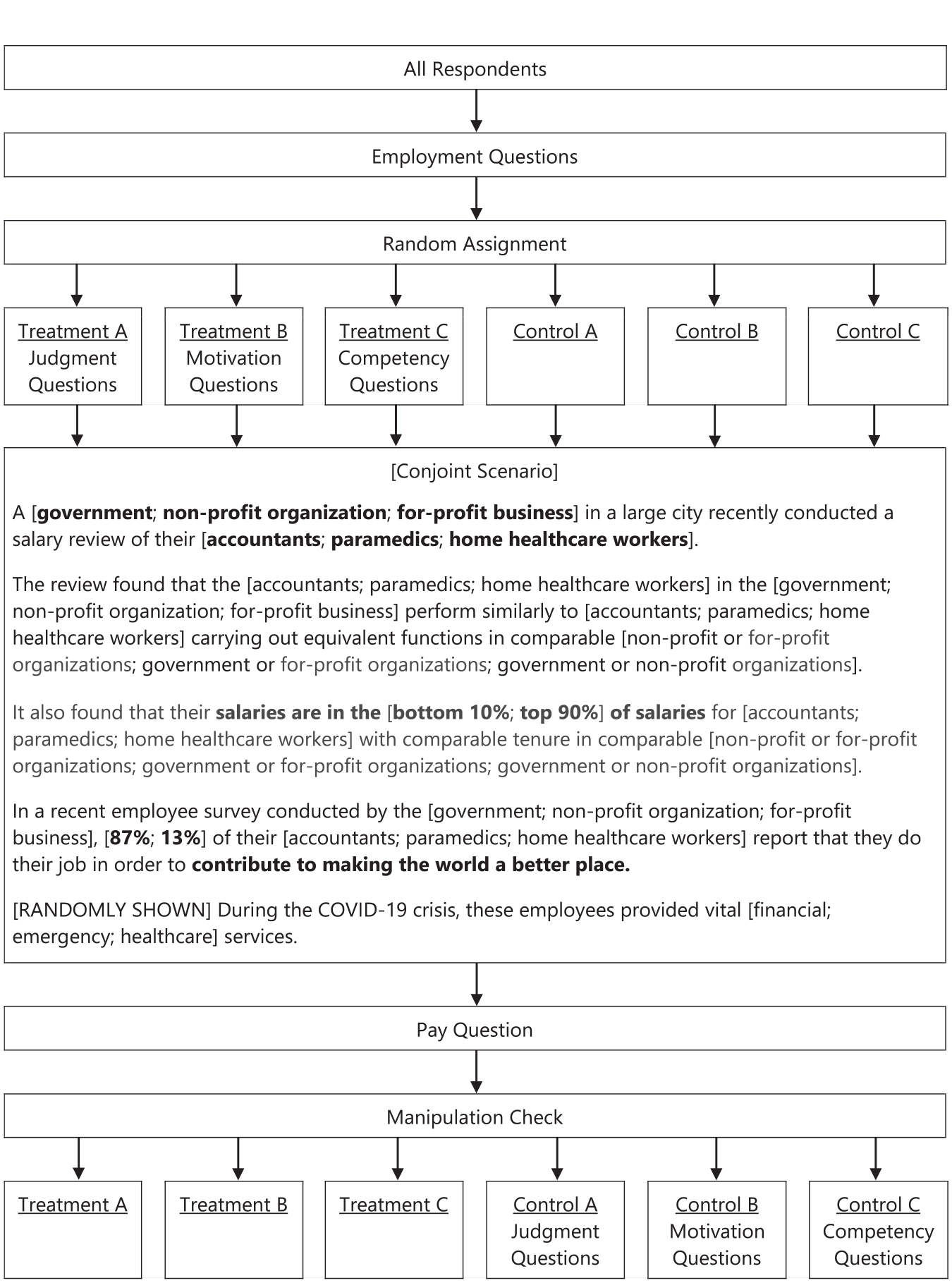
Flowchart of survey experiment.
Next, each respondent was presented with a conjoint scenario that has multiple varying attributes. The scenario describes a pay review in an organization. The list of randomized attributes includes (1) the employment sector (which matches the sector in the rationale activation questions they are asked), (2) profession, (3) salary level, (4) percentage who do their job in order to contribute to society, and (5) whether they offered critical services during the COVID-19 pandemic. Figure 1 shows the full list of attributes included in our experiment as well as the possible values associated with each attribute. We randomly assign the value of each attribute (with the value remaining constant if it appears more than once).
After seeing the conjoint scenario and clicking next, the outcome variable appeared below the scenario. To capture participants’ perceptions of pay, we asked: “Do you think the [profession] in the [sector] you just read about are underpaid, overpaid, or paid the right amount?” We create our dependent variable using this pay perception response, capturing whether a respondent perceives that the employees are underpaid or not. We create an underpaid dummy variable with “underpaid” (1) and “overpaid” or “paid the right amount” (0). 10 In our sample, 49% of respondents report that the employees in their conjoint task are underpaid.
Sample
For the survey, we recruited 1,579 adults in the United States through Lucid Theorem. Lucid provides a convenience sample that is based on national benchmarks for age, gender, race and ethnicity, and region. Lucid takes a number of steps to try to promote data quality, including blocking bots and screening participants with attention-checker and open-ended questions. 11
While some researchers have raised concerns about the data quality of online convenience samples, recent research shows that online convenience samples can produce experimental results comparable to those using other samples, including representative ones (see Berinsky et al., 2012; Coppock, 2019; Coppock et al., 2018; Coppock & McClellan, 2019; Jeong et al., 2019; Mullinix et al., 2015). The survey was designed and administered through Qualtrics.
Given our hypotheses, we focus on comparing respondents who work in the for-profit sector (43% of all respondents; 64% of those employed or likely soon to be) to all other respondents. 12 For for-profit employees, we focus on those who are currently working or will likely work again soon in the for-profit sector (i.e., employed, laid off, or unemployed); all other respondents are in the not for-profit employee category. Table 1 presents demographic and background characteristics by the groups. The percentage and number in each group are presented. The groups are well balanced; the χ2 tests across the experimental groups are not statistically significant for any of the characteristics.
Demographic and Background Characteristics by Groups.
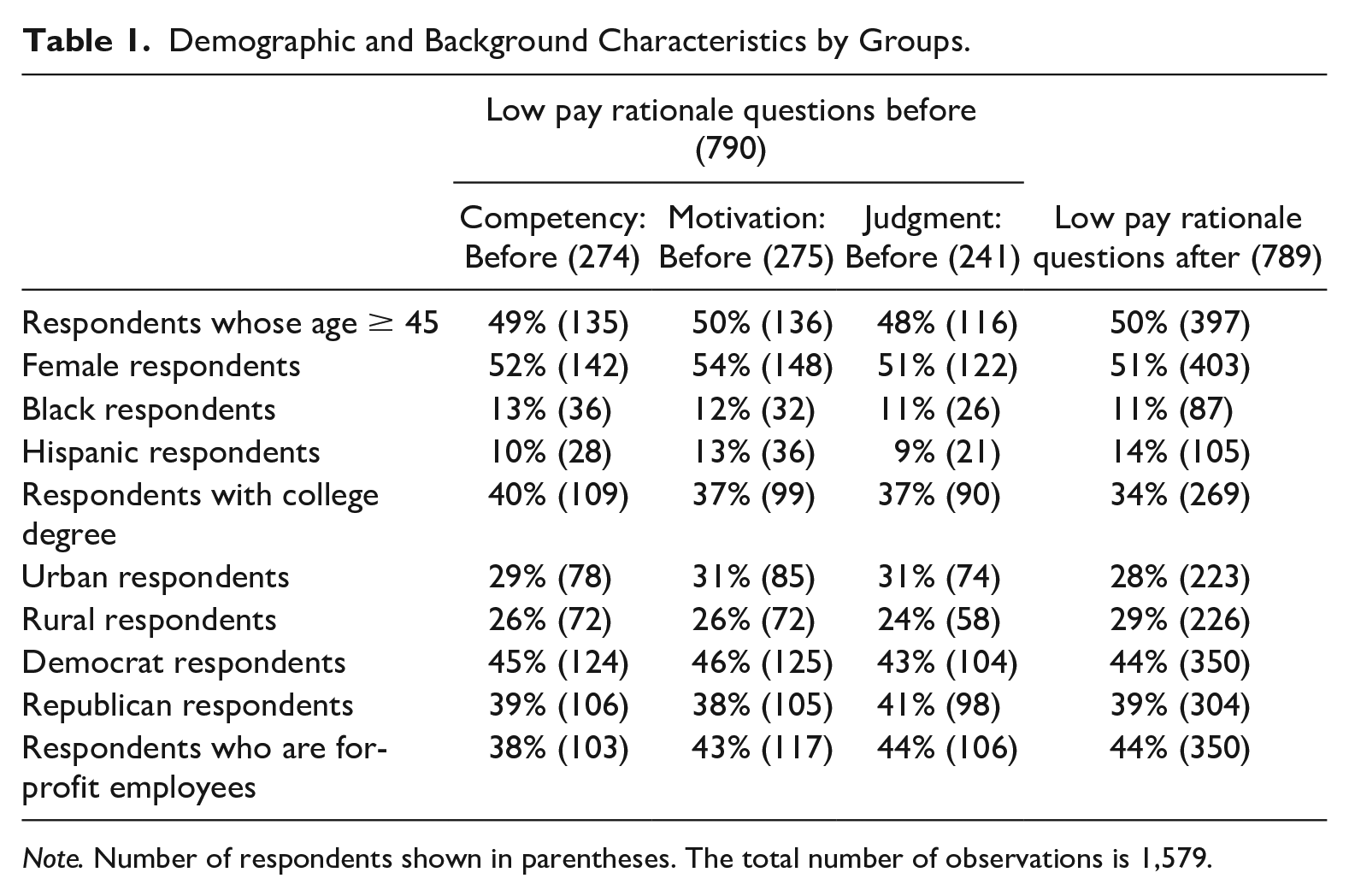
Note. Number of respondents shown in parentheses. The total number of observations is 1,579.
Results
Rationales Related to Pay
We estimate linear models with variables for all of the attributes in the conjoint scenario. We present the differences in the predicted probabilities of viewing employees in the conjoint vignette as underpaid between those exposed to the activations before the conjoint scenario versus after. 13 The full linear models from which the probabilities are estimated are presented in the Supplemental Appendix B. Given that any of the lower pay rationale activations might affect views of pay, we first present the treatment groups (i.e., the groups for which any one of the activations was before the conjoint scenario) together in Figure 2, testing H1. To limit the number of graphs presented, we focus on the difference in the predicted probabilities for our underpaid outcome variable between our treatment (activation before) and control (activation after) groups among those who work in the for-profit sector and those who do not. We can also look at the predicted probabilities (instead of the differences) in the after group to get a sense of the probability each sector was rated as underpaid, which is often slightly lower in the government sector compared to the other two (presented in the Supplemental Appendix C).
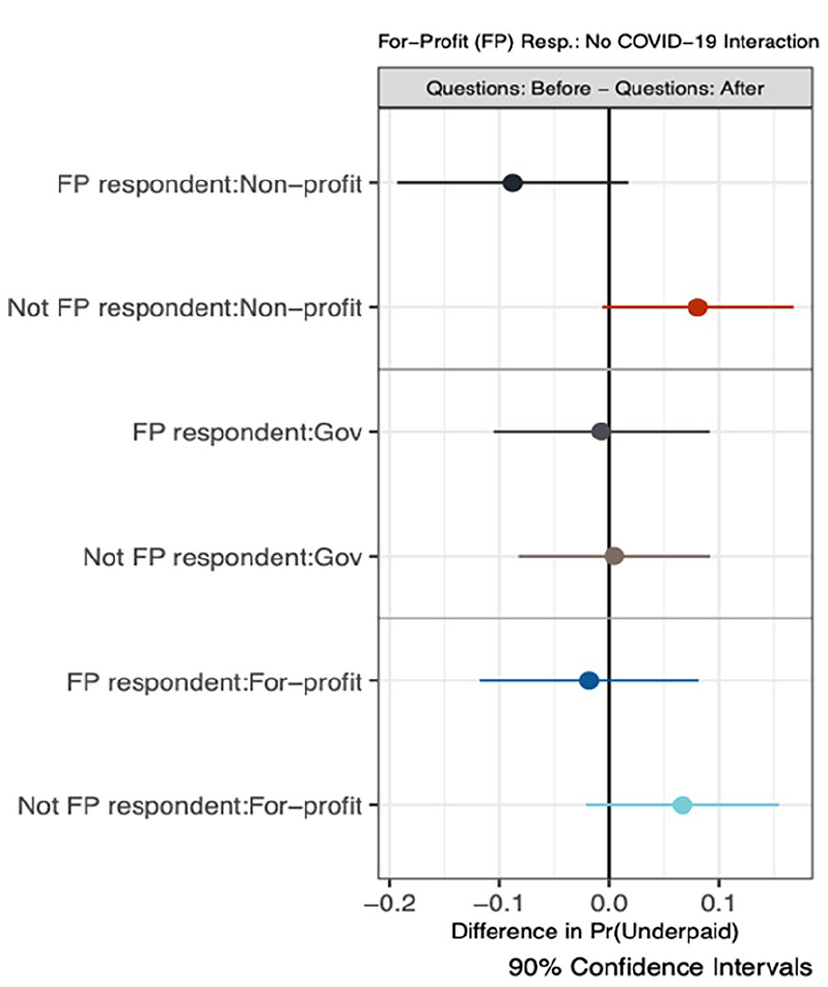
Differences in predicted probability of viewing employees as underpaid: any lower pay rationale activation-before versus after.
As illustrated in Figure 2, for respondents working in the for-profit sector, the group that is activated with the lower pay rationale questions before the conjoint task is associated with a lower probability of rating nonprofit employees as underpaid compared to those who were asked the activation questions after responding to the outcome question, though the difference is not statistically significant. We also do not see any effects for government employees. Thus, we do not find support for H1.
To explore the influence of the different lower pay rationales, we present the effects of the activation of the different rationales separately in Figure 3. Figure 3 shows the effect of the different rationales comparing those who received the activation before the conjoint scenario to those who received it after among respondents who work in the for-profit sector and those who do not. As noted above, the models include the other attributes, including the mention of COVID-19 service or not, as covariates. Looking at the left panel in Figure 3, we see the effects of the competency rationale activation for views of nonprofit employees’ pay among respondents who work in the for-profit sector. Among for-profit sector respondents, the predicted probability of viewing the nonprofit employees in the conjoint scenario as underpaid is 0.30 in the competency activation before group and 0.51 in the after group (0.21 difference, p ≤ .05). We do not see a similar effect for government employees. Thus, we find evidence in support of H4 for nonprofit employees but not for government employees. The other rationales—judgment and motivation—do not have a significant effect on views of pay among for-profit respondents (the middle and right panels in Figure 3); thus, we do not find support for H2 or H3.
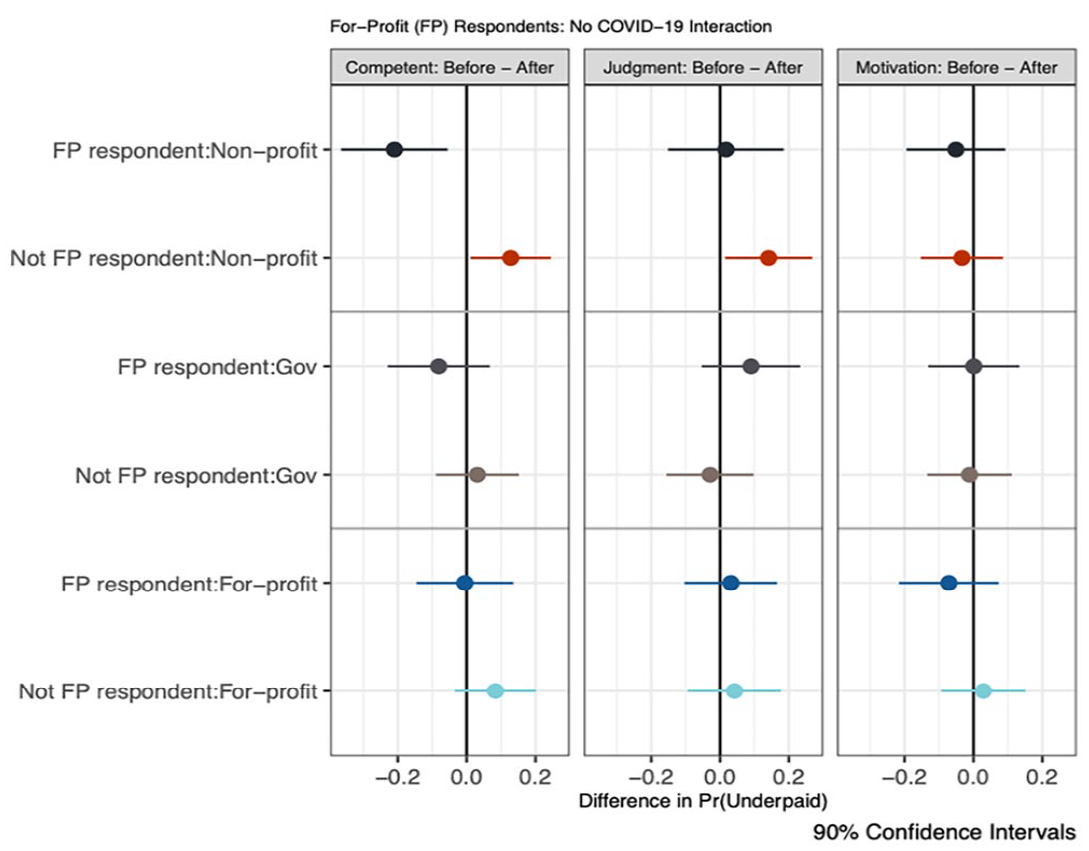
Differences in predicted probability of viewing employees as underpaid: lower pay rationale activation (presented separately) - before versus after.
Interestingly, in Figure 3, the effect of the competency and judgment activations is positive for respondents not working in the for-profit sector, meaning that these respondents are more likely to rate nonprofit employees as underpaid when being exposed to the activations before the conjoint scenario. Among these respondents (left panel), the probability of viewing nonprofit employees as underpaid is 0.59 in the competency activation before group and 0.47 in the activation after group (0.12 difference, p ≤ .10). In the middle panel in Figure 3, respondents not working in the for-profit sector have a probability of viewing nonprofit employees as underpaid of 0.61 in the judgment activation before group and 0.47 in the activation after group (0.14 difference, p ≤ .10).
Rationales Related to Pay and COVID-19 Services
We also hypothesized that noting service during the COVID-19 pandemic would mitigate the negative effect of the lower pay rationales on views of public and nonprofit pay among respondents who work in the for-profit sector (H5). To test this hypothesis, we look at the effect of sector in the conjoint scenario among respondents who work in the for-profit sector who were presented with COVID-19 information or not. Figure 4 presents the predicted probabilities of viewing the employees as underpaid comparing whether respondents had any of the lower pay rationales activated before or after the conjoint scenario (similar to Figure 2). In Figure 5, we present the rationales separately (similar to Figure 3). It is important to note that the number of groups doubles when we add the COVID-19 interaction; thus, the results presented in Figure 5 should be interpreted with a note of caution, given the smaller number of observations in each cell.
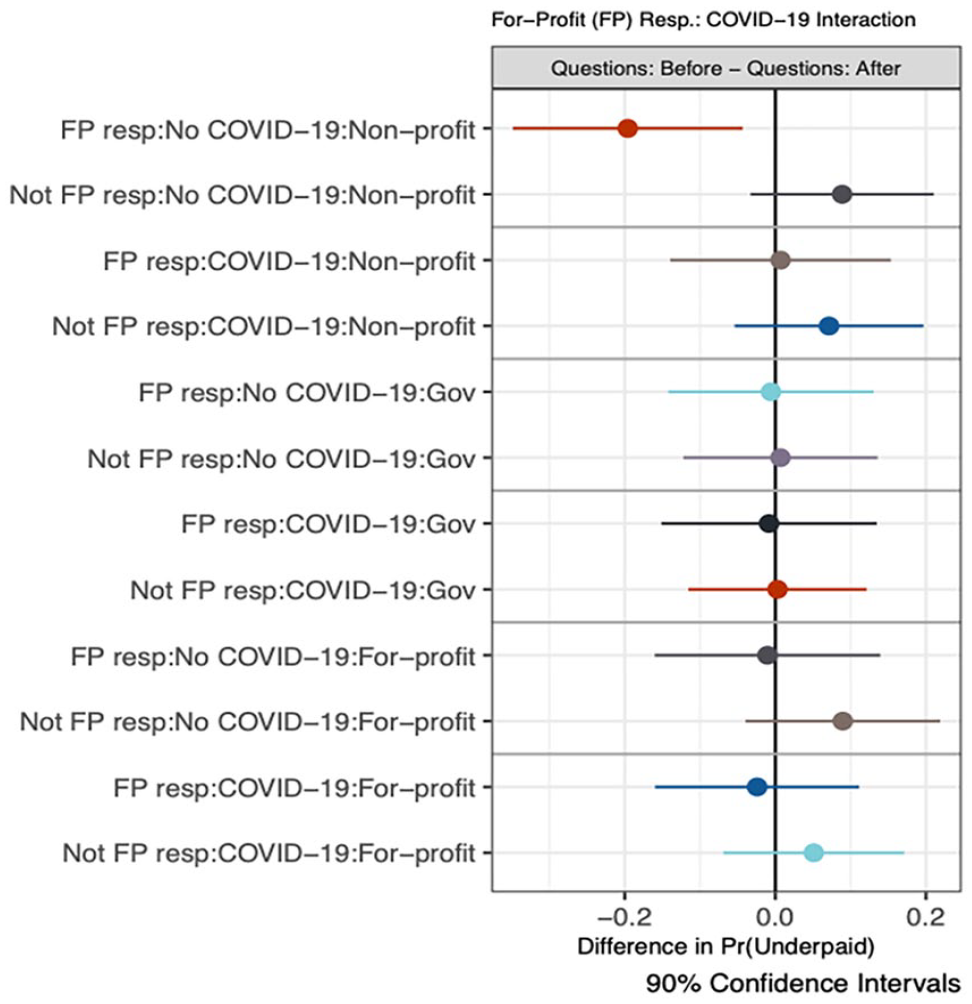
Differences in predicted probability of viewing employees as underpaid: COVID-19 services and lower pay rationale activation - before versus after.
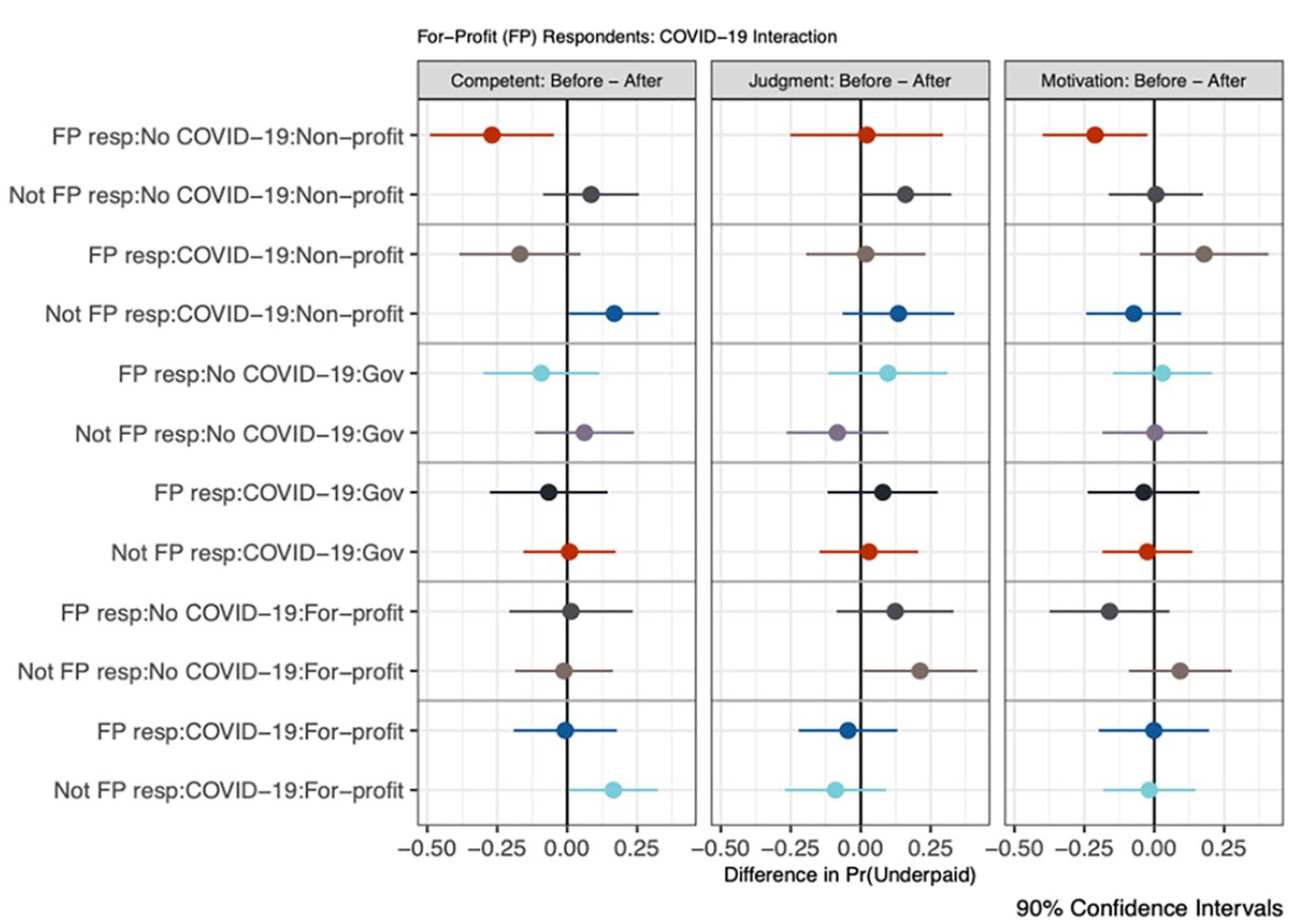
Differences in predicted probability of viewing employees as underpaid: COVID-19 services and lower pay rationale activation (presented separately) - before versus after.
The results in Figure 4 show suggestive evidence in support of H5 for nonprofit employees, but again, not government employees. Among respondents working in the for-profit sector, activation of a lower pay rationale before the conjoint scenario is associated with being less likely to select “underpaid” for nonprofit employees when services during COVID-19 are not mentioned (0.36 [before] to 0.56 [after], difference = 0.20, p ≤ .05). This effect is not significant when COVID-19 is mentioned. However, the difference between the differences when comparing the responses of for-profit respondents in the COVID-19 treatment to those who are not (the first and third rows of Figure 4) is not quite significant (p = .11).
Figure 5 tells a similar story, allowing for consideration of the rationales separately. For the competency rationale and the motivation rationale (the left and right panels), when COVID-19 is not mentioned, respondents who work in the for-profit sector are less likely to report that nonprofit employees are underpaid when the rationales were activated before the conjoint scenario. For the competency rationale, among for-profit respondents when COVID-19 service is not mentioned, the probability of responding “underpaid” is 0.29 with the activation before and 0.56 with it after (difference = 0.27, p ≤ .05). This effect is not significant when COVID-19 service is mentioned. However, the difference between the differences when comparing the responses of for-profit respondents in the COVID-19 treatment to those who are not (the first and third rows of the left panel of Figure 5) is not significant.
For the motivation rationale, among for-profit respondents when COVID-19 service is not mentioned, the probability of viewing nonprofit employees as underpaid is 0.35 with the activation before and 0.56 with it after (difference = 0.21, p ≤ .10). Again, this effect is not significant when COVID-19 service is mentioned. The difference between the differences when comparing the responses of for-profit respondents in the COVID-19 treatment to those who are not (the first and third rows of the right panel of Figure 5) is significant (p ≤ .05). As before, there are also no significant effects when government employees are the focus of the conjoint scenario.
Discussion and Conclusion
This article examines how individuals view the pay of employees in the public, nonprofit, and for-profit sectors and whether providing services during the COVID-19 pandemic changes these views. We develop three potential rationales that might affect views of public and nonprofit sector pay among individuals who work in the for-profit sector. We hypothesized that activating these rationales would lead individuals who work in the for-profit sector to negatively view the pay of public and nonprofit employees (i.e., respondents would be less likely to view them as underpaid) but that highlighting the employees’ role during the pandemic would mitigate this negative effect. Our results provide some evidence that for-profit employees are less likely to view nonprofit employees as underpaid when activating the lower pay rationales linked to competency and motivation when COVID-19 service is not mentioned. However, we also find some support for the expectation that the negative effects on nonprofit pay among for-profit respondents are mitigated by highlighting the service of nonprofit employees during the pandemic. While we see some of the expected effects when for-profit sector respondents are evaluating the pay of nonprofit employees, we do not see these effects when they evaluate the pay of government employees.
This research offers important implications for public and nonprofit personnel management research and practice. First, among the three rationales for lower pay in the public and nonprofit sectors, the competency rationale for nonprofit employees appears to have the most consistent effect in shaping views on pay. Individuals who work in the for-profit sector are less likely to view nonprofit employees as underpaid when they think about expected levels of competency in the nonprofit sector. This suggests that activating thoughts about competency might help to justify lower levels of pay in the nonprofit sector among for-profit employees. Moreover, if individuals think pay levels are lower in the nonprofit sector, this might feed into views about lower levels of competency, at least for those who link success more to individual factors (hard work) as opposed to societal factors, which is more prevalent in the for-profit sector (see Bullock et al. 2014). This might ultimately lead them to be less likely to view nonprofit employees as underpaid when competency is salient. However, to make any firm suggestions about the potency of each rationale, we need a more analysis.
Second, the different results for public and nonprofit employees are worth highlighting. While our experiment shows that the lower pay rationales, particularly competency and motivation, might generate negative perceptions toward the pay of employees in the nonprofit sector, we do not see such a pattern in the public sector. Instead, views of public employees’ pay are fairly consistent across the activation treatment and control groups, and these employees are often less likely to be viewed as underpaid in the conrol group. As such, there appear to be different drivers that affect views toward pay in the public and nonprofit sectors. This result aligns with the work of Meier et al. (2022) and others, pointing out the importance of considering nonprofit and public sectors separately in studies of mass attitudes.
This article points to a few considerations for practitioners. Although more research is needed, this work suggests that when making appeals to the general public about nonprofit work, highlighting public service values and competency might have a negative effect, at least among some individuals. However, when making appeals to those in the public or nonprofit sectors, highlighting these values and competency could potentially enhance support for employees and the organization. It is important to understand when a discussion of public-minded service and competency might be valued and when it might create an unwanted effect.
Additionally, our research presents some evidence that highlighting concrete ways that employees serve the public may counteract the negative effect of rationales for lower pay in the nonprofit sector among for-profit employees. Thus, if emphasizing public service values and proficiency, it might be helpful, when possible, to present salient, easily digestible examples of the critical work being done simultaneously.
There are a number of avenues for future research that could be considered. Our manipulation could be viewed as fairly mild—simply asking respondents questions related to the rationales. We did this in order to see if even this light activation, which might be more akin to interactions that might activate these views in the real world, had any effect on views of pay. Future work could design more intense manipulations to further the investigation of these effects. Additionally, our findings come from the U.S., where a strong nonprofit sector exists and the private sector is more prevalent than the public sector. Whether our findings could be generalized to other countries, for example, ones without a strong nonprofit sector, is an open question. Thinking about cultural differences, people in individualistic cultures may evaluate others’ public-oriented motivations differently from those who live in collectivist cultures. More research would be needed in order to understand individuals’ views of public and nonprofit sector pay in other institutional and cultural contexts.
Supplemental Material
sj-pdf-1-rop-10.1177_0734371X231162028 – Supplemental material for Doing Good Work in a Crisis: Views of Pay and the COVID-19 Pandemic in the Public, Nonprofit, and For-Profit Sectors
Supplemental material, sj-pdf-1-rop-10.1177_0734371X231162028 for Doing Good Work in a Crisis: Views of Pay and the COVID-19 Pandemic in the Public, Nonprofit, and For-Profit Sectors by Susan M. Miller and Miyeon Song in Review of Public Personnel Administration
Footnotes
Declaration of Conflicting Interests
The author(s) declared no potential conflicts of interest with respect to the research, authorship, and/or publication of this article.
Funding
The author(s) received no financial support for the research, authorship, and/or publication of this article.

Supplemental Material
Supplemental material for this article is available online.
Notes
Author Biographies
References
Supplementary Material
Please find the following supplemental material available below.
For Open Access articles published under a Creative Commons License, all supplemental material carries the same license as the article it is associated with.
For non-Open Access articles published, all supplemental material carries a non-exclusive license, and permission requests for re-use of supplemental material or any part of supplemental material shall be sent directly to the copyright owner as specified in the copyright notice associated with the article.
