




Abstract
Are employees less satisfied with supervisor support when their expectations are disconfirmed? In this study, we examine this question for both predictive expectations (what will happen) and normative expectations (what should happen). Results from two preregistered experiments suggest that expectation-disconfirmation does not affect satisfaction with supervisor support. Instead, we find that expectation-disconfirmation as perceived by participants affects satisfaction with supervisor support. We conclude that even though supervisor support seems to be the most important predictor of satisfaction, perceived disconfirmation of expectations also influences employees’ satisfaction with supervisor support.
Introduction
For many things in life, the expectations we have shape our satisfaction with certain products, services, or people (Oliver, 1980). Likewise, it can be expected that employees’ expectations of the support they receive from their supervisor may shape their satisfaction thereof (Penning de Vries et al., 2020). The present study aims to examine whether employees’ satisfaction with public frontline supervisors’ support is affected by their expectations. Supervisor support refers to “the degree to which supervisors value employees’ contributions and care about their wellbeing” (Rhoades & Eisenberger, 2002, p. 700). This type of supervisory behavior is relevant to study in public organizations, since public frontline supervisors generally have limited monetary resources to incentivize employees and therefore must rely more on encouragements such as supportive behavior to shape employee actions (Favero et al., 2016; Jensen et al., 2019). However, in the public management and human resource management (HRM) literature, less attention is paid to frontline supervisors, particularly their responsibility for motivating and supporting employees (Boselie et al., 2021; Knies et al., 2018). Considering that processes of decentralization have led to an increased degree of personnel responsibilities for frontline supervisors in public organizations (Bainbridge, 2015; Boselie et al., 2021; Brewer, 2005), studying frontline supervisors’ support for employees is increasingly relevant in a public sector context.
In a qualitative study among public supervisors and employees, Penning de Vries et al. (2020) develop the proposition that expectations of supervisor support influence employees’ perceptions thereof. Based on their study, the authors call for more research empirically testing this proposition. Moreover, since studies from the public management literature illustrate that expectations influence citizen satisfaction (Mok et al., 2017), we expect that studying expectations of supervisor support may increase our understanding of what influences satisfaction with supervisor support.
When it comes to expectations, a distinction can be made between predictive (what will happen) and normative expectations (what should happen) (Boulding et al., 1993; James, 2009, 2011). Even though research has suggested this to be an important distinction (Hjortskov, 2020a; James, 2011; Meirovich et al., 2020) and scholars increasingly study both types of expectations (Favero & Kim, 2021; Hjortskov, 2020b), Mok et al. (2017) state few studies have investigated both types of expectations in one study. Since expectations have not been examined as predictors of satisfaction with supervisor support, we include both types of expectations. This is particularly relevant for supervisor support, as most employees will have some sort of experience with supervisors (Penning de Vries et al., 2020), and therefore it is likely that employees do not only have an expectation of the support they will receive (predictive expectations), but also about the support they should receive (normative expectations) by their supervisor. Moreover, because satisfaction with supervisor support is personal (Knies et al., 2020), it is likely that both types of expectations shape satisfaction with supervisor support. Our central research question is: to what extent does (1) disconfirmation of predictive expectations and (2) disconfirmation of normative expectations affect employees’ satisfaction with supervisor support?
With our study, we make the following contributions to the literature. First, even though the management of human capital has been considered one of the most important aspects of public management (O’Toole & Meier, 2009), it has gained generally less attention in a public sector context than other aspects of public management (Favero et al., 2016). Also, less attention is paid to frontline supervisors than public managers on a higher level (Knies et al., 2018). Because frontline managers are gaining a more important role in public organizations and are increasingly charged with the supervisory responsibilities (Brewster et al., 2015), it is relevant to examine supportive leadership by supervisors in public organizations more extensively. Second, we test the effect of expectation-disconfirmation not on a service by an institute (i.e., government) but on a “service” by a specific person (i.e., supportive leadership by the frontline supervisor). By building upon earlier studies and extending this knowledge by including a different dependent variable, we contribute to the development of the expectation-disconfirmation theory in the context of public management (Mok et al., 2017). Third, scholars increasingly emphasize the relevance of investigating employees’ perceptions of public management, because these are more strongly related to outcomes than managers’ reports (Favero et al., 2016; Jacobsen & Bøgh Andersen, 2015; Løkke & Krøtel, 2020; Marvel, 2017; Penning de Vries, 2021; Song & Meier, 2020). This study contributes to a deeper understanding of employees’ perceptions by studying what influences perceptions of supervisory support, in particular satisfaction with supervisor support. Finally, satisfaction with supervisor support can be considered a facet of general employee satisfaction, which refers to “how an individual feels about his or her job and various aspects of it” (Rainey, 2014, p. 320). Generally, employee satisfaction is an important outcome for public organizations, since it can be considered a precondition for adequate public service delivery (Cantarelli et al., 2016). Therefore, it is highly relevant to increase our understanding of employee satisfaction in a public sector context.
This study begins with developing hypothesis based on the literature on supervisor support (Eisenberger et al., 2002) and expectation-disconfirmation theory (Oliver, 1980). Our hypotheses are tested using two preregistered studies: a 2 × 2 factorial vignette experiment and a vignette survey that were developed based on interviews.
Theory and Hypotheses
Supervisor Support
Understanding supervisor support as the degree to which supervisors value employees’ contributions and care about their wellbeing, perceived organizational support (POS) theory has drawn on social exchange theory (Blau, 1964) to argue that perceived supervisor support encourages employees to put more effort in the work they do, because they want to reciprocate the organization’s support to the employee (Eisenberger et al., 1986; Rhoades & Eisenberger, 2002). This notion has been corroborated by empirical research that illustrates perceived supervisor support is related to several outcomes including employee wellbeing (Charoensukmongkol et al., 2016), extra-role behavior (Knies & Leisink, 2014), increased organizational commitment, and employee retention (Arici, 2018; Eisenberger et al., 2002; Maertz et al., 2007).
Knies et al. (2020) propose two focal points of supervisor support: supportive behavior focused on stimulating employees’ commitment, and supportive behavior focused on enhancing employees’ career development. These two focal points come forward from the distinction made in the leadership literature between supportive and developmental leadership (Rafferty & Griffin, 2006). The first focal point is aimed at supporting employees in their daily activities, for instance by informing about the employee’s wellbeing. The second focal point is aimed at supporting the employee in his/her professional development, for instance by having regular talks about career or training opportunities (Knies et al., 2020). In this study, we adopt these two focus points as dimensions of supervisor support.
For the concept of supervisor support, several bodies of knowledge have stressed the importance of perceived supervisor support: POS theory (Eisenberger et al., 2002), HRM literature (Purcell & Hutchinson, 2007; Wright & Nishii, 2013), and public leadership literature (Jacobsen & Bøgh Andersen, 2015). These suggest that employees’ perceptions are the most important predictor for employee attitudes and performance. There are different ways of conceptualizing and operationalizing perceptions (Beijer et al., 2021; Beurden et al., 2021; Wang et al., 2020). A distinction can be made between descriptive and evaluative perceptions (Beijer et al., 2021). The former refers to employees’ description of the factual support supervisors provide to employees, whereas the latter entails an affectively laden assessment of the supervisors’ support. In this study, we are interested in employees’ satisfaction with supervisor support, which can be considered an evaluative perception of supervisor support. In the HRM literature, employees’ satisfaction with HR practices is often considered an indication for successful implementation of HR practices (Bondarouk et al., 2016; Khilji & Wang, 2006; Nishii et al., 2008). Khilji and Wang (2006) even go as far as stating that employees’ satisfaction with HRM is “the missing linchpin” between HRM as designed and implemented and performance. As such, we argue it is relevant to study employees’ satisfaction with supervisor support as the dependent variable in this study. Next, we turn to expectation-disconfirmation theory to explain satisfaction with supervisor support.
Expectation-Disconfirmation Theory
Expectation disconfirmation (E-D) theory has been used to explain individuals’ satisfaction with performance (Ilgen, 1971), products (Oliver, 1980), or jobs (Smith et al., 1969). Recently, the theory has become popular among public administration scholars interested in citizen satisfaction with governmental services (Andersen & Hjortskov, 2016; James, 2009; Petrovsky et al., 2017; Van Ryzin, 2004, 2013). The basic premise of E-D theory is that individuals have expectations of certain products or services, and their satisfaction with these products or services depends on whether these products or services are performed in line with their expectations (Van Ryzin, 2004). The basic E-D model (Figure 1) contains several relationships that are important to consider when looking into expectation-disconfirmation. One of these relationships concerns the direct relationship between performance and satisfaction (F). This relationship is an intuitive one, in which performance (for instance, the quality of a certain product or service) is directly related to satisfaction (Van Ryzin, 2013). Applied to supervisor support: the supervisor’s performance when it comes to supporting employees has a direct effect on employees’ satisfaction with supervisor support. Another—slightly less intuitive—relationship concerns the direct relationship between expectations and satisfaction (E). Applied to supervisor support: employees’ expectations of supervisor support may directly affect their satisfaction with supervisor support. That is, when individuals lack objective performance information on which to base their evaluation, they turn to their expectations to fill in these information gaps and develop their evaluation of performance. An alternative explanation concerns the notion that individuals may “assimilate” their evaluation toward their expectations in order to reduce dissonance (Van Ryzin, 2004, p. 437). Finally, there is an effect of disconfirmation on satisfaction (C). This disconfirmation is developed through the interaction between performance (A) and expectations (B). In this study, we are interested in the effect of disconfirmation of expectation on satisfaction with supervisor support (relationship “C”). We elaborate on different types of expectations and their relationship with the satisfaction with supervisor support.
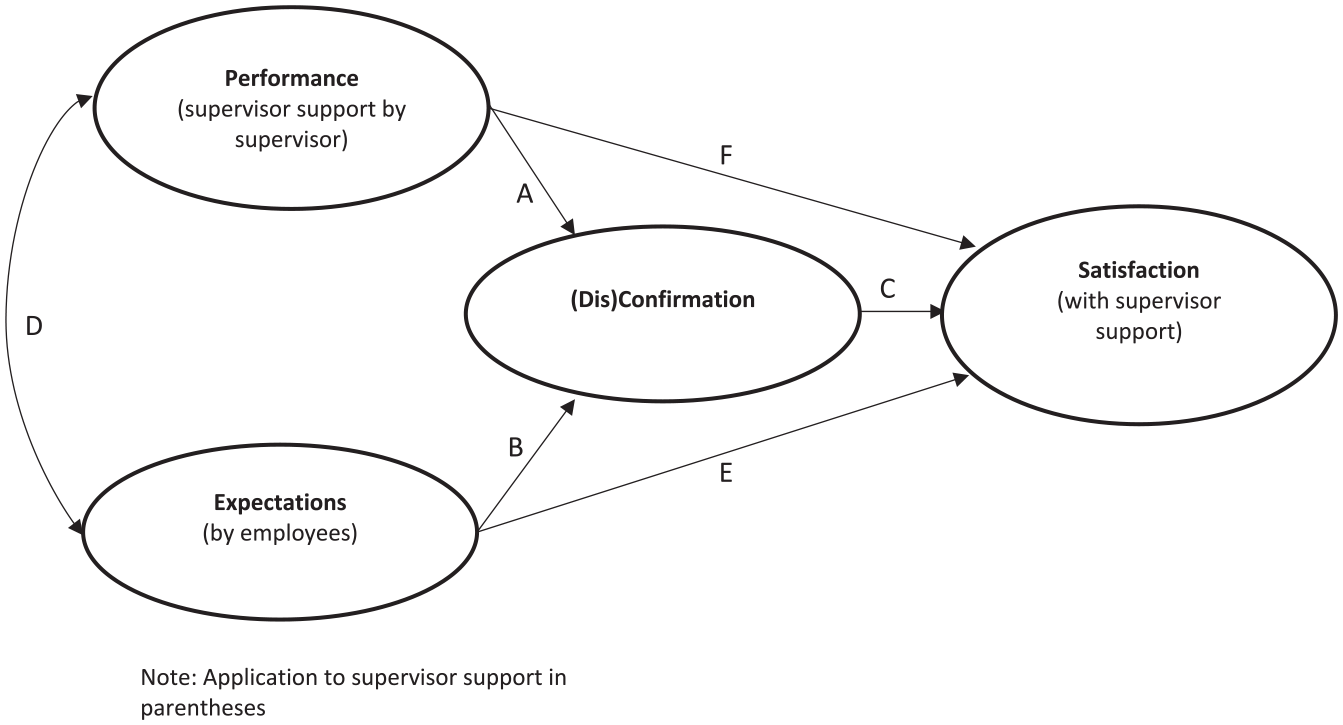
Expectation-disconfirmation model (based on Van Ryzin, 2013).
As stated by James (2009), expectations can be defined as “judgements of what individuals or groups think either will or should happen under particular circumstances” (p. 109). In this definition, there are two types of expectations: expectations about what will happen (predictive 1 expectations) and expectations about what should happen (normative expectations) (Boulding et al., 1993; Hjortskov, 2019, 2020a; James, 2011; Meirovich & Little, 2013; Meirovich et al., 2020). Whereas normative expectations are more generic (i.e., they concern expectations about supervisor support in general), predictive expectations refer to a more specific situation (i.e., they concern expectations about the behavior of a specific supervisor) (Meirovich & Little, 2013). Applied to supervisor support, normative expectations refer to how employees think supervisors should support employees in the work they do in general. Predictive expectations refer to how employees expect a specific supervisor will support them in the work they do. Predictive expectations are, more so than normative expectations, related to information about the performance of the product or service the expectation is about (James, 2011; Petrovsky et al., 2017). By contrast, normative expectations are related to ideals (Petrovsky et al., 2017) and moreover more institutionally embedded (Meirovich & Little, 2013) than predictive expectations. Normative expectations are—by contrast to predictive expectations—less likely to be influenced by prior performance (James, 2011) and are generally more stable over time (Petrovsky et al., 2017).
Hypotheses
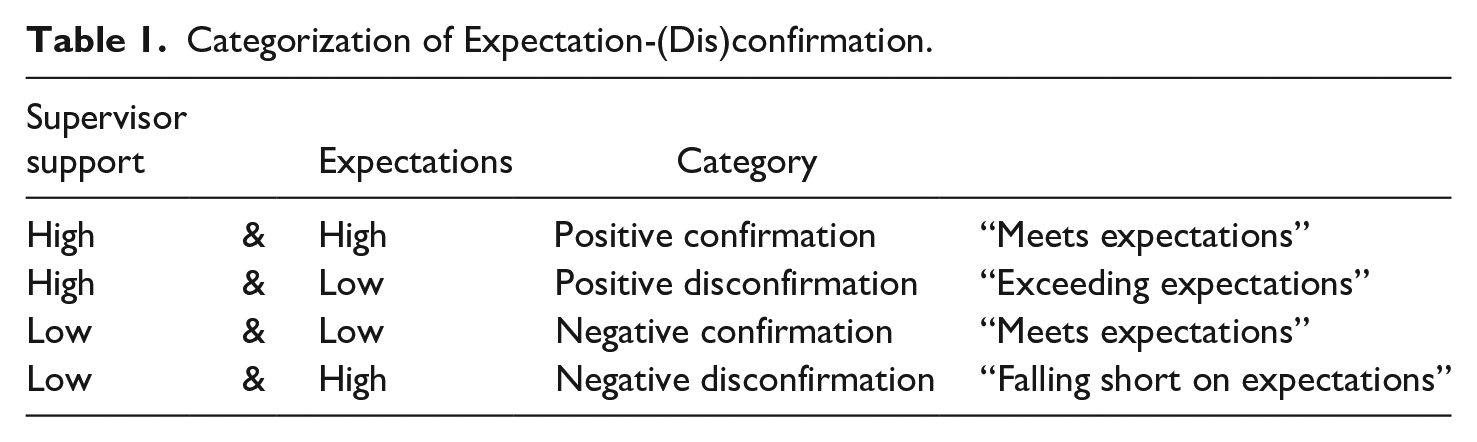
According to the expectation-disconfirmation theory, both confirmation and disconfirmation are a product of expectations and performance (Van Ryzin, 2004). Disconfirmation occurs when perceived performance is either higher (positive disconfirmation) or lower (negative disconfirmation) than expected. In Table 1, a clarification of the different categories for confirmation is presented.
Categorization of Expectation-(Dis)confirmation.
For both normative and predictive expectations, the effect of disconfirmation can be explained by the notion that expectations serve as a frame of reference (Andersen & Hjortskov, 2016; Van Ryzin, 2013) or as a standard against which a certain situation is evaluated (Meirovich & Little, 2013). When individuals are faced with evaluating performance of a certain type of service, they are likely to refer the perceived behavior to some kind of reference point (Festinger, 1954). From this point of view, individuals will use their expectations as a type of anchor based on which they determine how they evaluate a certain behavior (Andersen & Hjortskov, 2016). To give a simple example, if an employee expects a supervisor to ask her about her work at least once a week, and the supervisor ends up asking the employee only once every 2 weeks, this employee will probably evaluate the supervisor’s support more negatively because the support turns out to be less than the reference point. On the contrary, when the employee expects a supervisor to ask how she is doing once a month, and the supervisor ends up asking the employee how she is doing every 2 weeks, the employee will likely evaluate the supervisors’ support more positively because the supervisory support turns out to be more than is expected. Thus, positive disconfirmation is likely to lead to higher levels of satisfaction, whereas negative disconfirmation will lead to lower levels of satisfaction.
Though there are less studies investigating the impact of normative expectations on services, some evidence suggests normative expectations are negatively related to satisfaction with services (James, 2011). This indicates that the higher the normative expectations, the less satisfied (in James’ study) citizens are with their government services. Furthermore, studies have suggested that—like with predictive expectations—positive disconfirmation of normative expectations (exceeding expectations) increased satisfaction, whereas negative disconfirmation (falling short of expectations) was less likely to lead to satisfaction (compared to confirmation of expectations) (James, 2009; Poister & Thomas, 2011). All in all, we hypothesize the following:
H1: Positive disconfirmation of predictive (H1a) and normative (H1b) expectations (exceeding expectations) will lead to higher satisfaction with supervisor support compared to positive confirmation.
H2: Negative disconfirmation of predictive (H2a) and normative (H2b) expectations (falling short of expectations) will lead to lower satisfaction with supervisor support, compared to negative confirmation.
As aforementioned, the application of the ED-M framework has primarily focused on the relationship between citizens and their government (Mok et al., 2017). To apply it in HRM, the nature of the relationship between employees and their supervisor is different in several respects. The most distinctive element is that employees and supervisors are likely to have more frequent and more direct interactions than citizen with their government. This may have an impact on the relationship between expectations and satisfaction, particularly for predictive expectations. Because employees have more frequent interactions with a supervisor, employees are better able to predict their supervisor’s performance in terms of supervisor support. As such, disconfirmation of predictive expectations may occur less often. This may be more so for predictive expectations than for normative expectations, because normative expectations are related to supervisor support in general, rather than predictive expectations that are focused on supervisor support in a specific situation (Meirovich & Little, 2013). However, this does not mean that the mechanism which causes expectation-disconfirmation to affect satisfaction will function differently. In other words, expectation-disconfirmation may occur less frequently for supervisor support compared to government services (particularly for predictive expectations); however we do not expect this to change the relationship between expectation-disconfirmation and satisfaction with supervisor support.
Methods
Data and Participants
Our hypotheses were tested based on two empirical studies: a 2 × 2 factorial vignette experiment and a vignette survey 2 embedded into two surveys. The surveys were sent to samples that are retrieved from Prolific Academic (www.prolific.ac), which is an online crowdsourcing platform that can be used to collect data from human subjects for research. Participants received a small reward for their participation in certain online surveys or experiments. An obvious benefit of this method of recruitment is that it allows the researcher to preselect the sample based on certain (demographic) variables (Grimmelikhuijsen & Porumbescu, 2017). However, some concern has been raised about the quality of data collected through other online crowd-sourcing platforms, such as Mechanical Turk (MTurk) or Crowdflower (CF). In particular, the lack of naivety of participants is a growing cause for concern. A recent study comparing several crowdsourcing platforms in terms of naivety and dishonesty found participants from Prolific Academic are less dishonest and more naïve than the more commonly used MTurk (Palan & Schitter, 2018; Peer et al., 2017). In addition, the quality of the data from Prolific was highest compared to MTurk and CF.
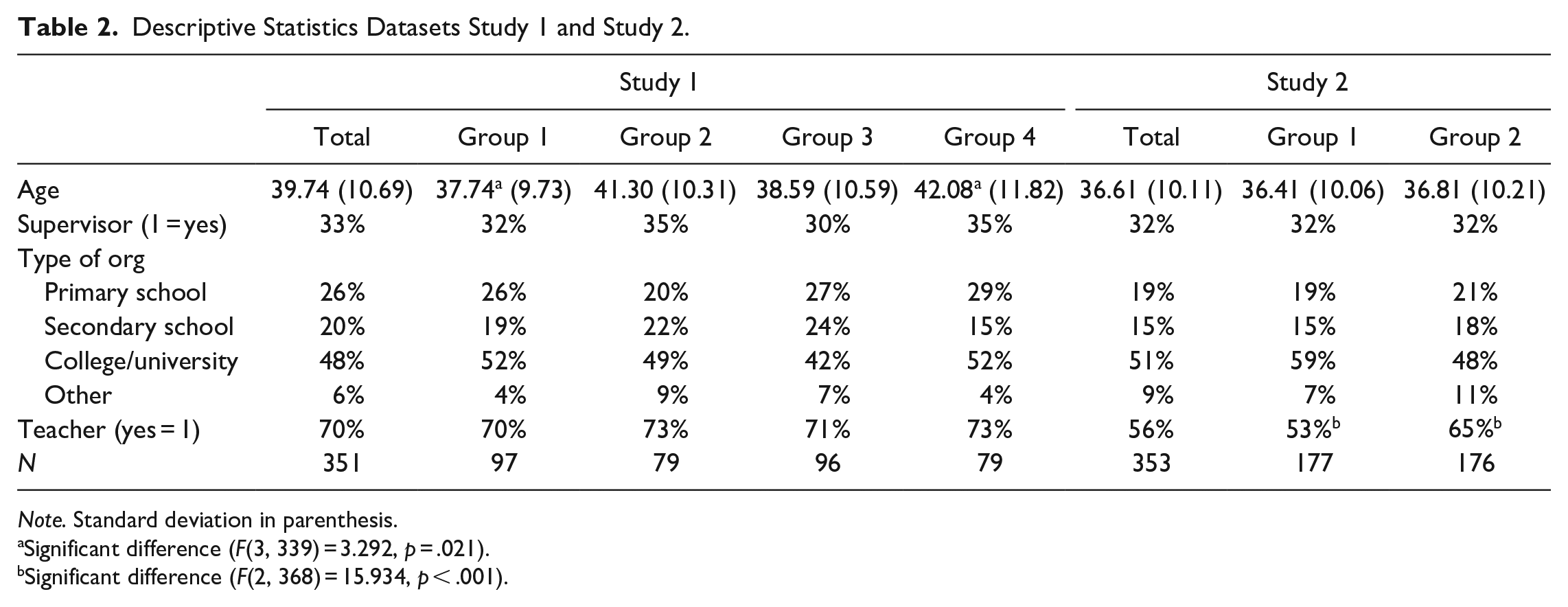
In Prolific Academic, we selected a sample of participants working in the educational sector. More specifically, we targeted employees in public primary, secondary, and higher education (e.g., colleges, universities). Participants from all different kinds of nationalities of all continents were included in the study. The predominant country of residence was the United Kingdom (study 1 N = 218, study 2 N = 245), followed by the United States (study 1 N = 66, study 2 N = 73). For all other countries of residence, our datasets included 10 participants or less. To keep our vignettes as realistic as possible, it was necessary to take a certain work context into account. By making sure our vignettes are designed in such a way that they represent the work context of our participants, we increase ecological validity of our experiment (Morton & Williams, 2010). Participants who did not consent with participation in the study or had missing values on all the variables were excluded from the datasets. In study 1, one participant was excluded from the dataset and in study 2, 23 participants were excluded from the dataset. All in all, we ended up with two datasets (study 1 N = 351, study 2 N = 353). The demographic characteristics of both datasets are presented in Table 2.
Descriptive Statistics Datasets Study 1 and Study 2.
Note. Standard deviation in parenthesis.
Significant difference (F(3, 339) = 3.292, p = .021).
Significant difference (F(2, 368) = 15.934, p < .001).
In the dataset for study 1, most of our respondents are working in a university or a college, followed by primary school, secondary school, and other. There are no statistically significant differences between the experimental groups when it comes to type of school. Most of the participants in our dataset are working as a teacher (70.1%). Taking a closer look at the open-ended questions about what other jobs they are working as, we see positions like researchers, librarians, and support staff commonly mentioned. The average age is 39.74 (S.D. = 10.69). We find a small significant difference between the experimental groups when it comes to age (F(3, 339) = 3.293, p = .021). About one third of our participants are working as a supervisor themselves. No significant differences between groups are found. Like study 1, most of the participants from study 2 are working in a university or a college, followed by primary school, secondary school, and other. There are no statistically significant differences between the experimental groups when it comes to type of school. Most of the participants in our dataset are working as a teacher (59.7%). The average age is 39.86 (S.D. = 9.56). About one third of our participants are working as a supervisor themselves. No significant differences between groups are found.
Our datasets thus consist of both teachers and non-teachers working in different types of educational organizations. We do not expect this to affect our results for several reasons. First, the vignettes were developed in such a way that they are not only recognizable for teachers, but for all employees working in a school. Second, the majority of respondents, whether they work as a teacher or not, has a supervisor themselves (for instance senior manager in charge of supervisor support to employees who are themselves supervisors). As such, we expect this group to also be able to empathize with the vignette. Moreover, since we are not interested in satisfaction with supervisor support as such, but rather the difference between employees whose expectations are either confirmed or disconfirmed, the fact that the sample entails a variety of employees working in schools does not affect the results. Finally, for study 1, the distribution of non-teachers is equal over the experimental groups. As such, we do not expect this to influence the relationship we are interested in. For study 2, experimental group 2 has more teachers than experimental group 1. We conducted an analysis in which we controlled for this, which did not lead to any significant changes in the results.
Experimental Design
Study 1 allows us to test the effects of disconfirmation of predictive expectations (H1a and H2a). For the design of this study, we follow earlier 2 × 2 factorial experimental designs (Grimmelikhuijsen & Porumbescu, 2017; Van Ryzin, 2013). Since we are also interested in normative expectations (H1b and H2b) and these are generally much harder to manipulate in an experiment, we decided to adopt a vignette survey to test the relationship between disconfirmation of normative expectations and satisfaction with supervisor support. This resulted in two studies that are similar, except for the phase in which expectations are either manipulated (in the case of predictive expectations) or measured (in the case of normative expectations). This allows us to make causal claims for predictive expectation-disconfirmation (in study 1). For normative expectation-disconfirmation, we are limited to making correlational claims. A schematic overview of the survey flows is presented in Figure 2. Since both studies were non-interventional (surveys), no approval from the ethical committee was required. All participants provided informed consent before taking part of the study.
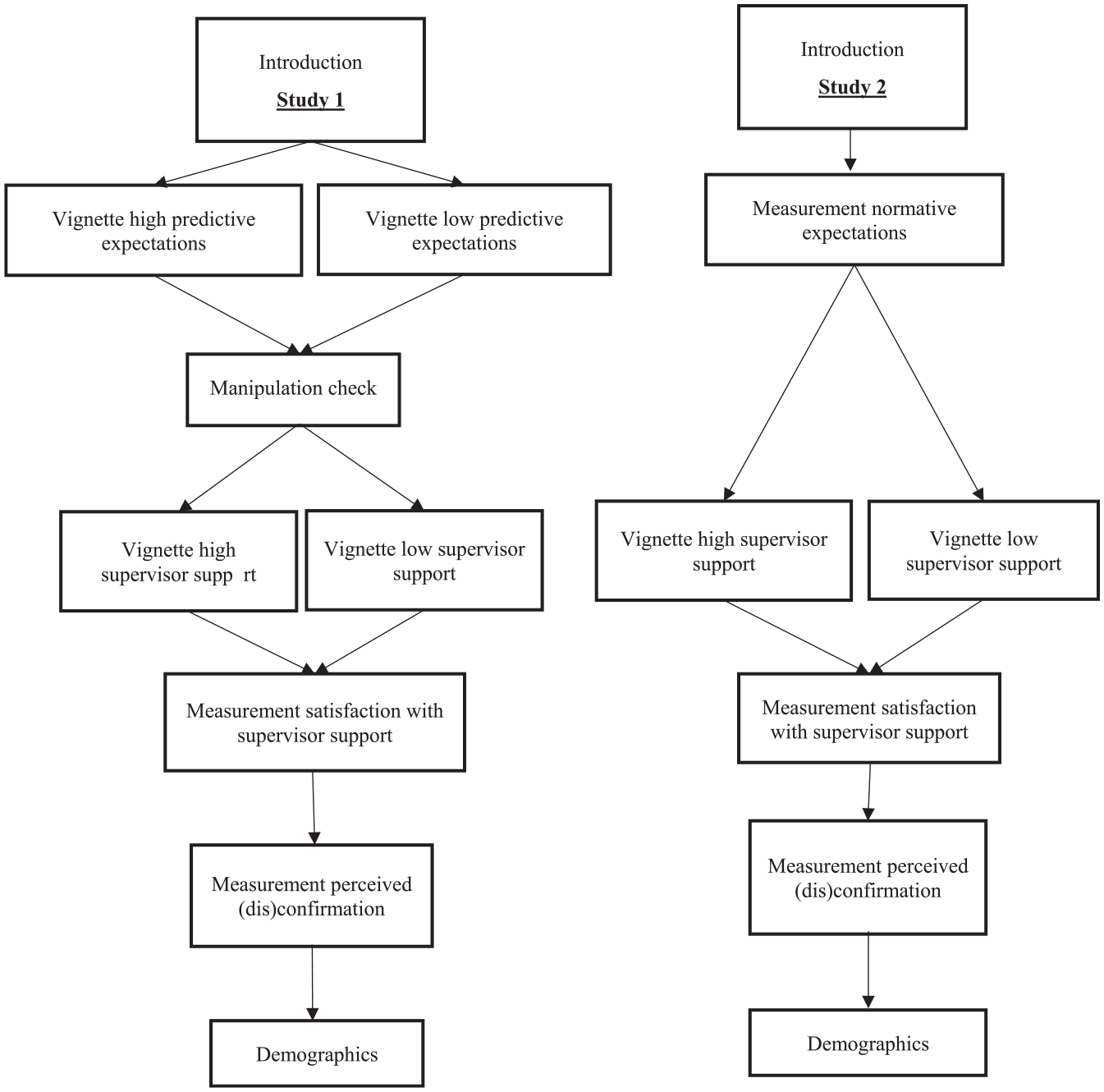
Survey flow.
Study 1
In the first phase, participants were presented with an introductory text in which they were given instructions for the survey. In the second phase, the expectations were manipulated. Participants were presented with a job description of a supervisor for a hypothetical school, which entails an overview of the tasks a supervisor should do when it comes to supporting employees. One experimental group was presented with a vignette in which high expectations were described, and the other experimental group was presented with a vignette in which low expectations were described. This was followed by a manipulation check, in which participants were asked about their expectations regarding the support the supervisor in the vignette will provide to teachers. In the third phase, participants were presented with a hypothetical scenario describing either high or low levels of supportive leadership behavior by the supervisor. This resulted in four experimental groups (Figure 3). The first group consists of participants that have been presented with a high expectations vignette and a high supervisor support scenario. This group represents the positive confirmation group. The second group consists of participants that have been presented with the low expectations vignette, followed by a high supervisor support scenario. This group represents positive disconfirmation. The third group consists of participants that have been presented with a high expectations vignette, and a low supervisor support scenario. This group represents the negative disconfirmation group. A fourth group consists of participants that have been presented with a low expectations vignette, and a low supervisor support scenario. This group represents negative confirmation. Subsequently, participants were asked to evaluate the supportive leadership by the hypothetical supervisor presented in the vignette and how satisfied they would be with this supervisor’s support. Lastly, perceived (dis)confirmation was measured by asking participants whether their expectations were exceeded, met, or fallen short of. The survey ended with several demographics to assess whether randomization was successful.

Experimental groups study 1.
Study 2
The phases in study 2 were similar to the phases in study 1. First, participants were presented with and introductory text with instructions for the study. Second, the normative expectations were measured using predefined survey questions. Subsequently, participants were presented with either a high supervisor support vignette or a low supervisor support vignette (the same vignettes as were used in study 1). After this, participants were asked to what extent they would be satisfied with the support provided by the supervisor in the vignette. Like study 1, we measured perceived disconfirmation by asking whether participants’ normative expectations were exceeded, met, or fallen short of by the supervisor in the vignette. The survey ended with the measurement of several demographics.
Operationalization
The vignettes are presented in Figures 4 and 5. The survey items are presented in Appendix 1. All survey items are measured on a five-point Likert scale, unless mentioned otherwise.
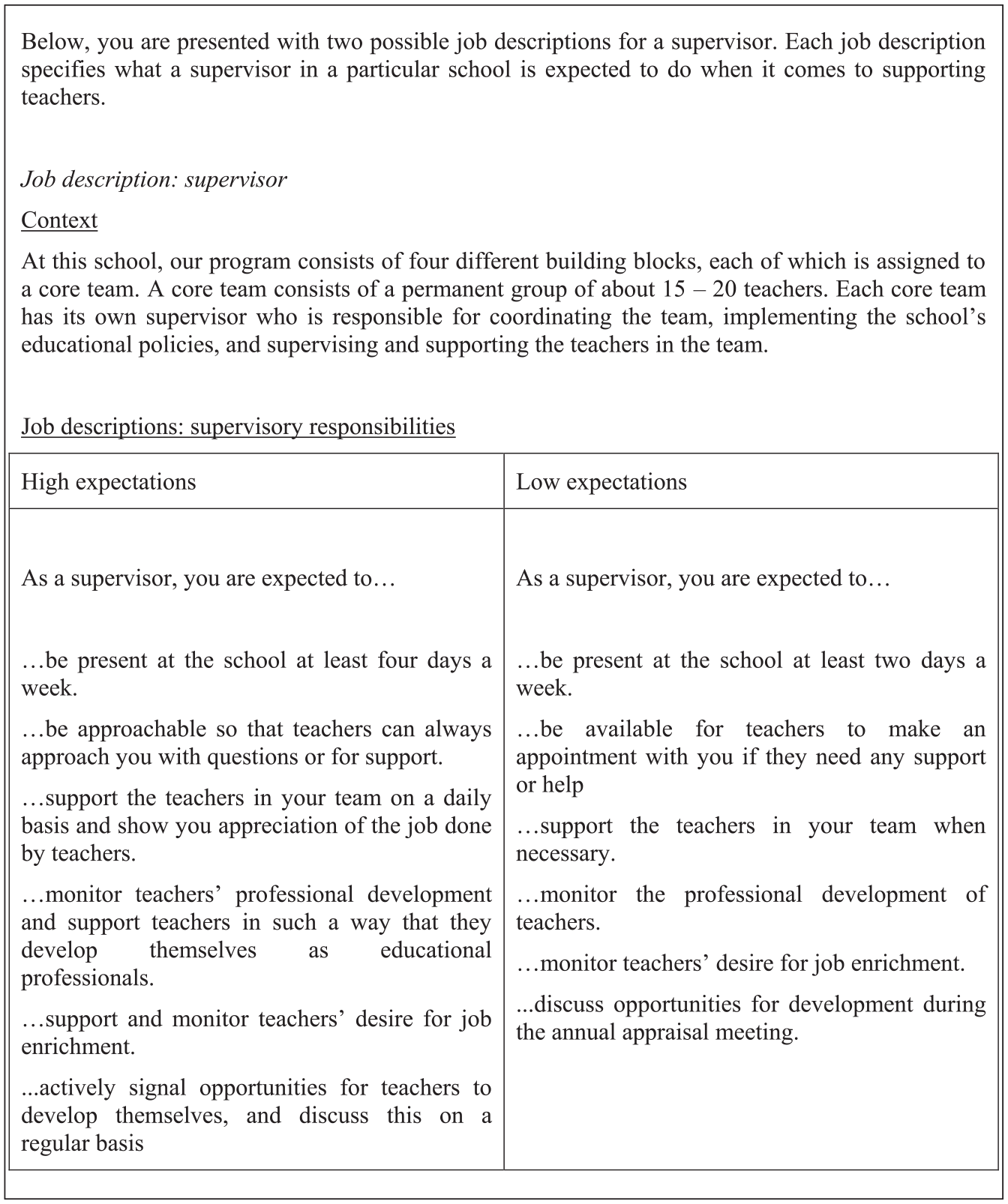
Vignettes predictive expectations of supervisor support.

Vignette supervisor support (study 1 and 2).
Supervisor support
We base our operationalization of predictive and normative expectations of supervisor support and supervisor support by supervisors on two sources of information. First, we use the conceptualization and operationalization of supervisor support by Knies et al. (2020). As described in the theoretical section, they distinguish between two dimensions of supervisor support: support for commitment and support for development. These dimensions are the starting point for our operationalization of expectations of supervisor support, supervisor support by supervisors, and satisfaction with supervisor support. Second, the operationalization is informed by several interviews conducted with teachers and supervisors in secondary schools. In these interviews, teachers were asked to describe the support from their supervisor. What stood out in the interviews is that support for daily commitment is inherently intertwined with supervisors being present in the organization to support teachers. One teacher for instance indicates:
She [supervisor] is present [at the school] five days a week. I think that is a very important factor. I have noticed supervisors that are only present two or three days a week, which makes me think “well, that is basically your primary task.” In that case [when someone is present 5 days], you can always go to your supervisor if you need support.
Because being present in the organization is strongly related to employees feeling supported, and because this element is easily manipulated, this is the primary element we manipulated in the vignettes.
Furthermore, when speaking about support for development, teachers observed that a supportive supervisor not only listens to suggestions by teachers, but also proactively notices opportunities for development for teachers. This is in line with the following statement by one of the respondents:
When it comes to [support for development], she really is supportive. But she is also active in the sense that when she notices an opportunity, she will tell me. Like ‘hey, I noticed this, isn’t this something for you?’
This is also in line with the conceptualization by Knies et al. (2020). Therefore, whether a supervisor only discusses professional development during the appraisal interview or whether a supervisor is also proactively engaged in the professional development of teachers is a central element in the vignettes.
Manipulation of predictive expectations
In the vignettes manipulating predictive expectations, a job description of a supervisor in a school is presented to participants (Figure 4). In the low expectations vignette, a lower level of supervisor support is described than in the high expectations vignette. For instance, in the low expectations vignette, the job description entails that the supervisor will be present 2 days a week, whereas in the high expectations vignette, the job description entails that the supervisor is present 4 days a week. In the high expectations vignette, the job description mentions that supervisors are approachable for teachers and support them on a daily basis, whereas the low expectations vignette states that supervisors should be available if teachers want to make appointments and that they support teachers when necessary. Another example is that in the low expectations vignette, the job description entails that a supervisor will monitor development and discuss opportunities for development during an annual meeting. In the high expectations vignette, the job description entails that supervisors will support teachers to develop them as educational professionals and actively look for opportunities for teachers to develop themselves.
Manipulation of supervisor support
In line with the manipulation of predictive expectations of supervisor support, the vignette of performance of supervisor support (Figure 5) entails the two dimensions of supervisor support. First, a short description of a teacher who is facing certain difficulties in their work is presented. Subsequently, a situation is described in which the supervisor supports this teacher (high supervisor support) or a situation in which the supervisor does not support this teacher (low supervisor support). For instance, in the high supervisor support vignette, a supervisor talks to the teacher on a regular basis and quickly organized a meeting when a teacher is dealing with a stressful situation. In the low supervisor support vignette, the supervisor does not talk regularly with the teacher, and schedules a meeting after 2 weeks. This is in line with the interviews with teachers, in which availability of the supervisor was an important aspect of supervisor support.
Normative expectations
Normative expectations of supervisor support are measured by asking participants how much supervisors should be doing when it comes to supporting employees. More specifically, participants are asked to what extent they agree with the following statement: “Generally, I think a supervisor at this school should be paying a great deal of attention towards supporting teachers in the work they do.”
Perceived disconfirmation of predictive and normative expectations
As a robustness check, we also included a measure for perceived disconfirmation of predictive (in study 1) and normative (in study 2) expectations of supervisor support. For the operationalization of perceived disconfirmation, we adopted a measure from Poister and Thomas (2011) and applied it to supervisor support. This resulted in the following item for study 1: “Would you say the supervisory support provided by supervisor Robin meets, exceeds, or falls short of your expectations based on the job description that was presented?” and the following item for study 2: “Would you say the supervisory support provided by supervisor Robin meets, exceeds, or fall short on your expectations of supervisor support?.”
Satisfaction with supervisor support
For the satisfaction with supervisory support, we ask participants how satisfied they will be with the supervisory support by the hypothetical supervisor in the vignettes. More specifically, we ask participants to indicate to what extent they agree with the following statement: “Based on the scenario, I would be satisfied with the supervisory support provided by Robin.”
Analytical Strategy
The data was analyzed in two steps. For study 1, a one-way ANOVA was used to test whether there were significant differences between the experimental groups, followed by Bonferroni post-hoc analysis, which is a multi-comparison procedure used to assess the differences between specific groups (Castañeda et al., 1993). Two-way factorial ANOVA was used to assess whether there is an interaction between supervisor support and expectations of supervisor support. For study 2, linear regression was used to assess whether supervisor support, normative expectation, and an interaction thereof was related to satisfaction with supervisor support. For study 1 and 2, one-way ANOVA was used to test whether perceived disconfirmation of expectations (predictive in study 1, normative in study 2) was related to satisfaction with supervisor support. Finally, even though the vignettes were designed in such a way that they match the work context of employees working in primary, secondary, and higher education and employees who are a supervisor themselves and employees who are not a supervisor themselves, we conducted some additional analysis for these groups specifically. The results are included in the Supplemental Material and discussed briefly in the results section.
Results: Study 1
The manipulation in the vignettes 3 generally worked. However, the no significant differences were found between the negative confirmation and the negative disconfirmation group were found. One-way ANOVA illustrated that there were significant differences in satisfaction with supervisor support between the experimental groups positive confirmation (M = 4.51, S.D. = 0.752), positive disconfirmation (M = 4.35, S.D. = 1.075), negative confirmation (M = 1.75, S.D. = 0.834), and negative disconfirmation (M = 1.78, S.D. = 1.058) (F(3, 247) = 243,808, p < .001) (Table 3). Bonferroni post-hoc analysis illustrated no significant differences between positive confirmation and positive disconfirmation, or between negative confirmation and negative disconfirmation. Two-way factorial ANOVA indicated that supervisor support had a direct effect on satisfaction with supervisor support (F(1, 347) = 717.870, p < .001, eta-squared = .003). However, no significant direct effect of expectations was found (F(1, 347) = .872, p = .351, eta-squared = .003). In addition, no interaction effect between supervisor support and expectations was found (F(1, 347) = .340, p = .560, eta-squared = .001). These results suggest supervisor support influences satisfaction, but that expectations and expectation-disconfirmation do not affect satisfaction. Based on these results, we must reject H1a and H2a.
Post Hoc Group Comparison Study 1: Manipulated Disconfirmation.
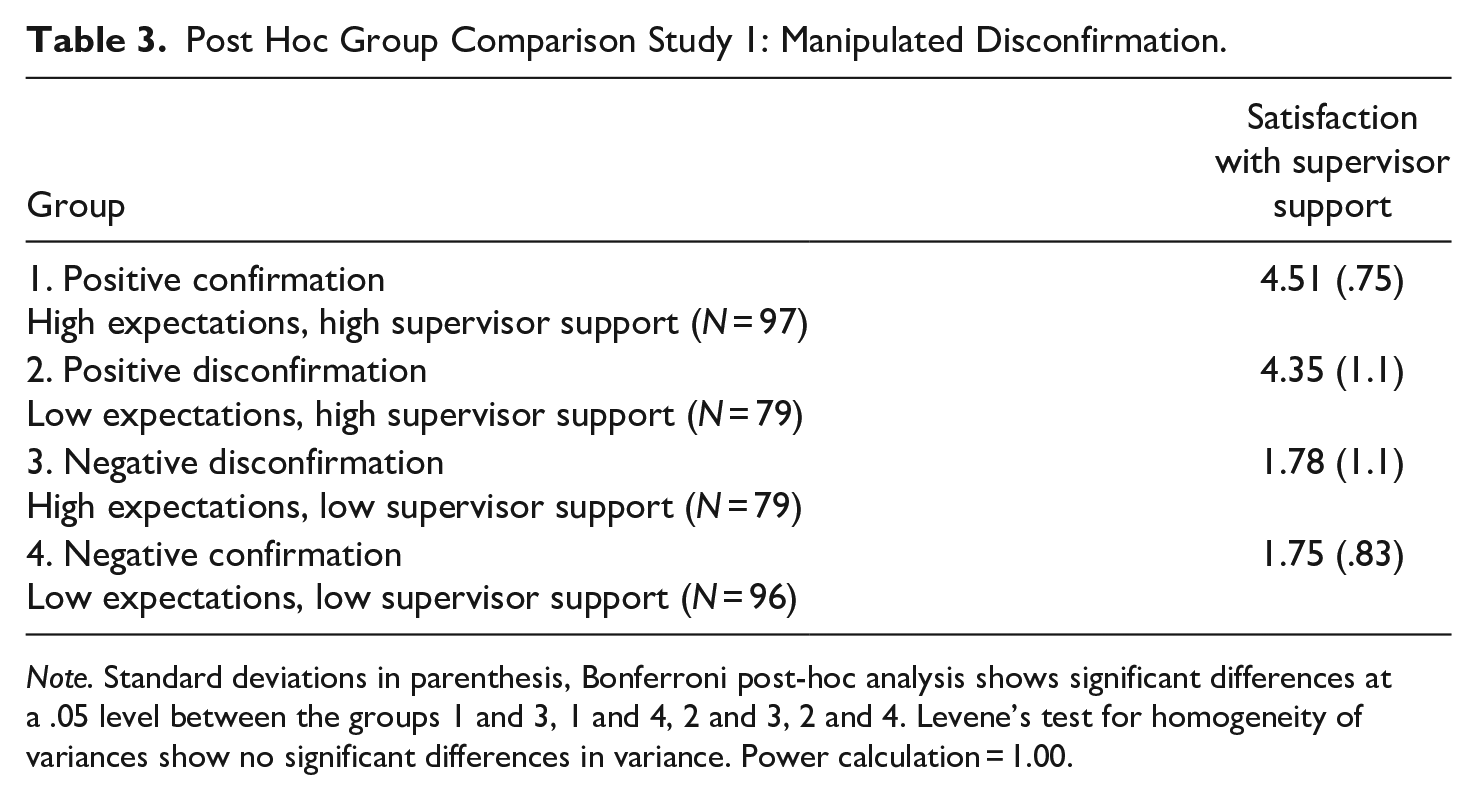
Note. Standard deviations in parenthesis, Bonferroni post-hoc analysis shows significant differences at a .05 level between the groups 1 and 3, 1 and 4, 2 and 3, 2 and 4. Levene’s test for homogeneity of variances show no significant differences in variance. Power calculation = 1.00.
As a robustness check, we assessed whether the self-perceived measure for expectation-disconfirmation was related to satisfaction with supervisor support. Contrary to the main results of study 1, these results are correlational instead of causal. First of all, we found significant differences in satisfaction of supervisor support between participants that indicate that expectations were met (M = 4.34; S.D. = 0.855), exceeded (M = 4.49; S.D. = 0.993), and fallen short of (M = 1.68; S.D. = 0.879) (F(2, 348) = 402,380, p < .001) (Table 4). Bonferroni post-hoc analysis indicated no significant difference between self-perceived confirmation and self-perceived positive disconfirmation. However, significant differences were found between self-perceived confirmation and self-perceived negative disconfirmation (∆M = −2.657, p < .001). These results refute H1a but support H2a.
Post Hoc Group Comparison Study 1: Self-Perceived Disconfirmation.
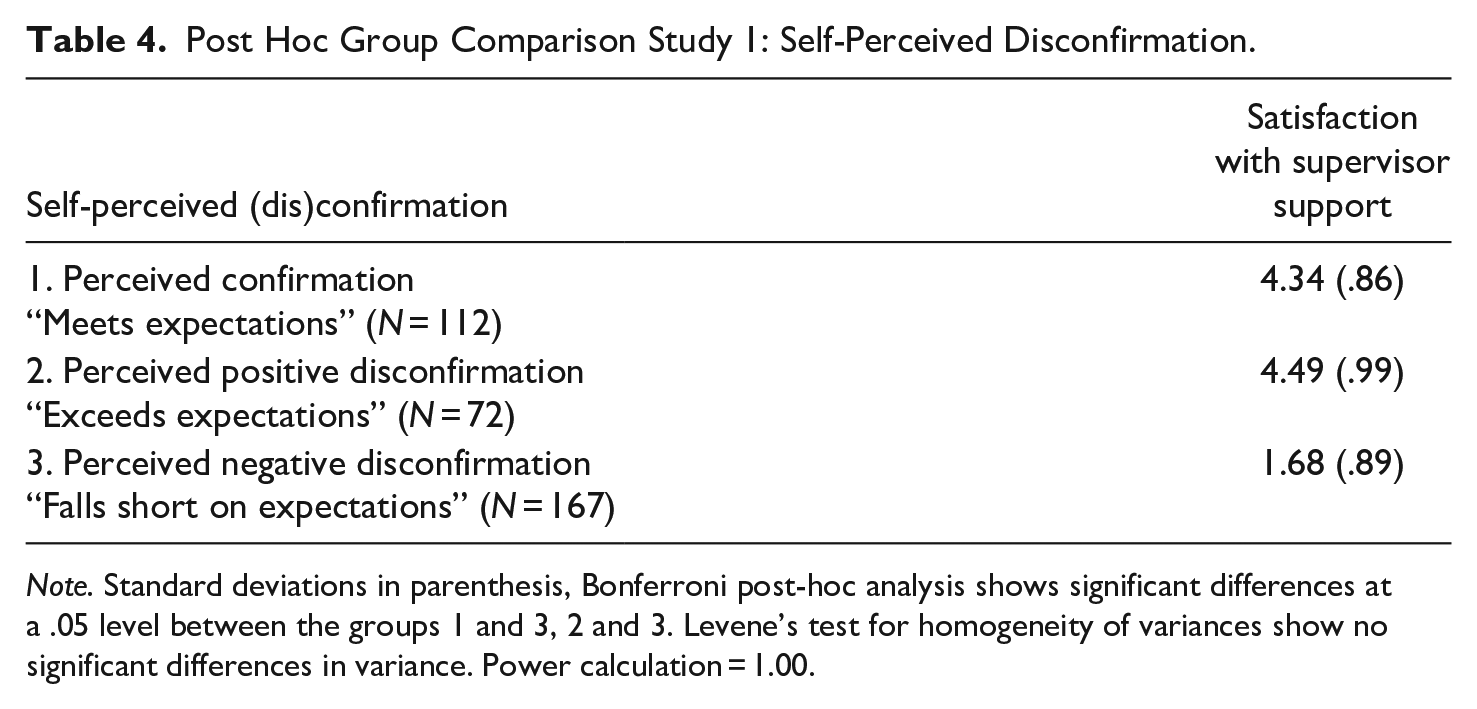
Note. Standard deviations in parenthesis, Bonferroni post-hoc analysis shows significant differences at a .05 level between the groups 1 and 3, 2 and 3. Levene’s test for homogeneity of variances show no significant differences in variance. Power calculation = 1.00.
Results: Study 2
The manipulation 4 for this study worked. Linear regression analysis indicated a significant effect of supervisor support on satisfaction with supervisor support (ß = .692, p < .001) (Table 5). This suggests high levels of supervisor support indeed lead to higher levels of satisfaction with supervisor support. However, no direct relationship between normative expectations of satisfaction with supervisor support was found. In addition, we did not find a significant interaction effect of supervisor support and normative expectations on satisfaction with supervisor support (ß = .119, p = .452). Based on these results, we must reject H1b and H2b.
Linear Regression, DV: Satisfaction With Supervisor Support.
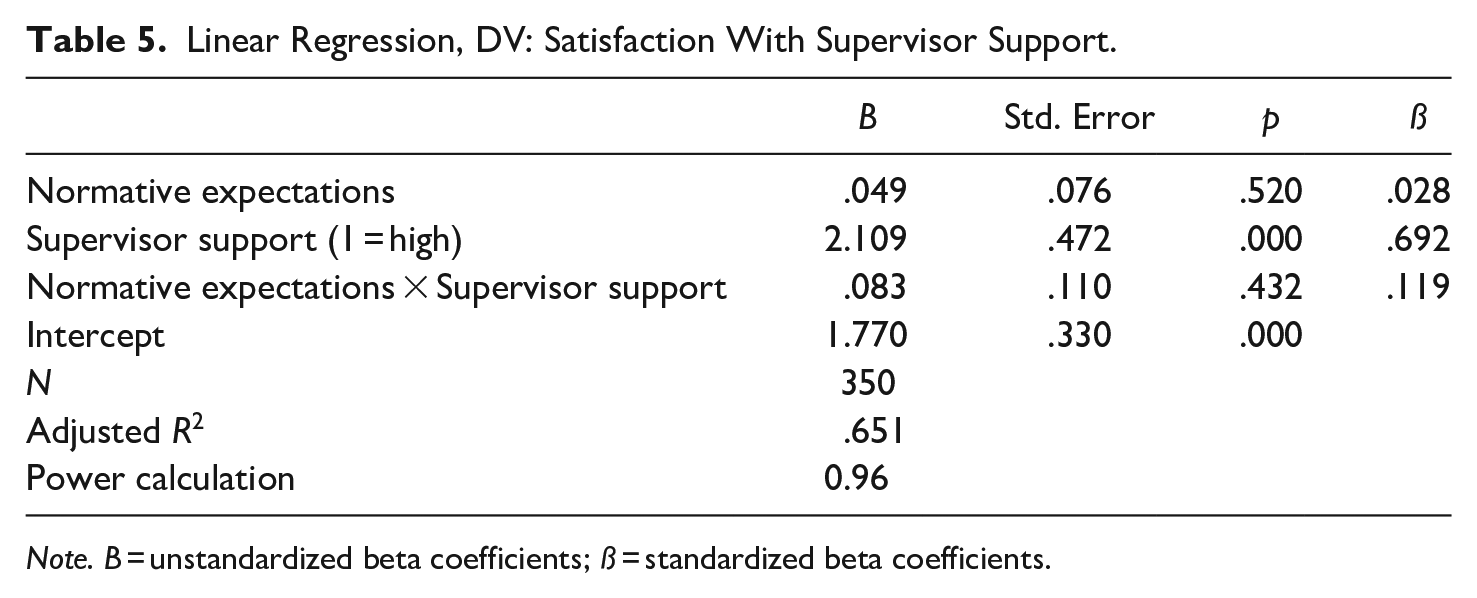
Note. B = unstandardized beta coefficients; ß = standardized beta coefficients.
Furthermore, as a robustness check, we examined whether the self-perceived measure of expectation-disconfirmation of normative expectations was related to satisfaction with supervisor support. One-way ANOVA indicated there are significant differences between participants that indicate that expectations are met (M = 4.32, S.D. = 0.76), expectations are exceeded (M = 4.64, S.D. = 0.72) and expectations are fallen short of (M = 1.83, S.D. = 0.72) (F(2, 347 = 467.312, p < .001) (Table 6). Post-hoc group comparison indicated there were significant differences between self-perceived negative disconfirmation and self-perceived confirmation (∆M = −2.490, p < .001), and self-perceived positive disconfirmation (∆M = −2.811, p < .001). In addition, a significant difference between perceived positive disconfirmation and perceived confirmation is found (∆M = −.321, p = .028), indicating that when expectations are exceeded, satisfaction with supervisor support will be higher than when expectations are met. These results support H1b and H2b. An overview of all the results can be found in Table 7.
Post Hoc Group Comparison Study 2: Self-Perceived Disconfirmation.
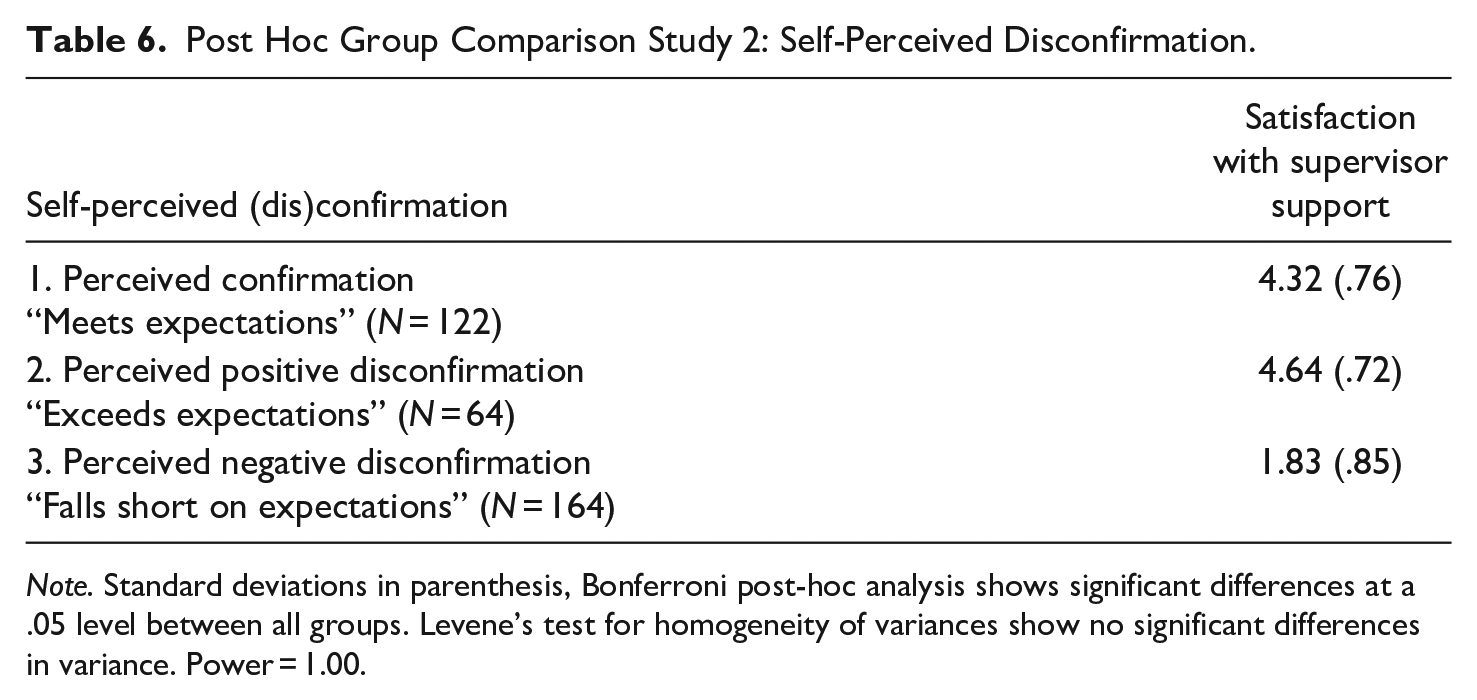
Note. Standard deviations in parenthesis, Bonferroni post-hoc analysis shows significant differences at a .05 level between all groups. Levene’s test for homogeneity of variances show no significant differences in variance. Power = 1.00.
Overview of Results.
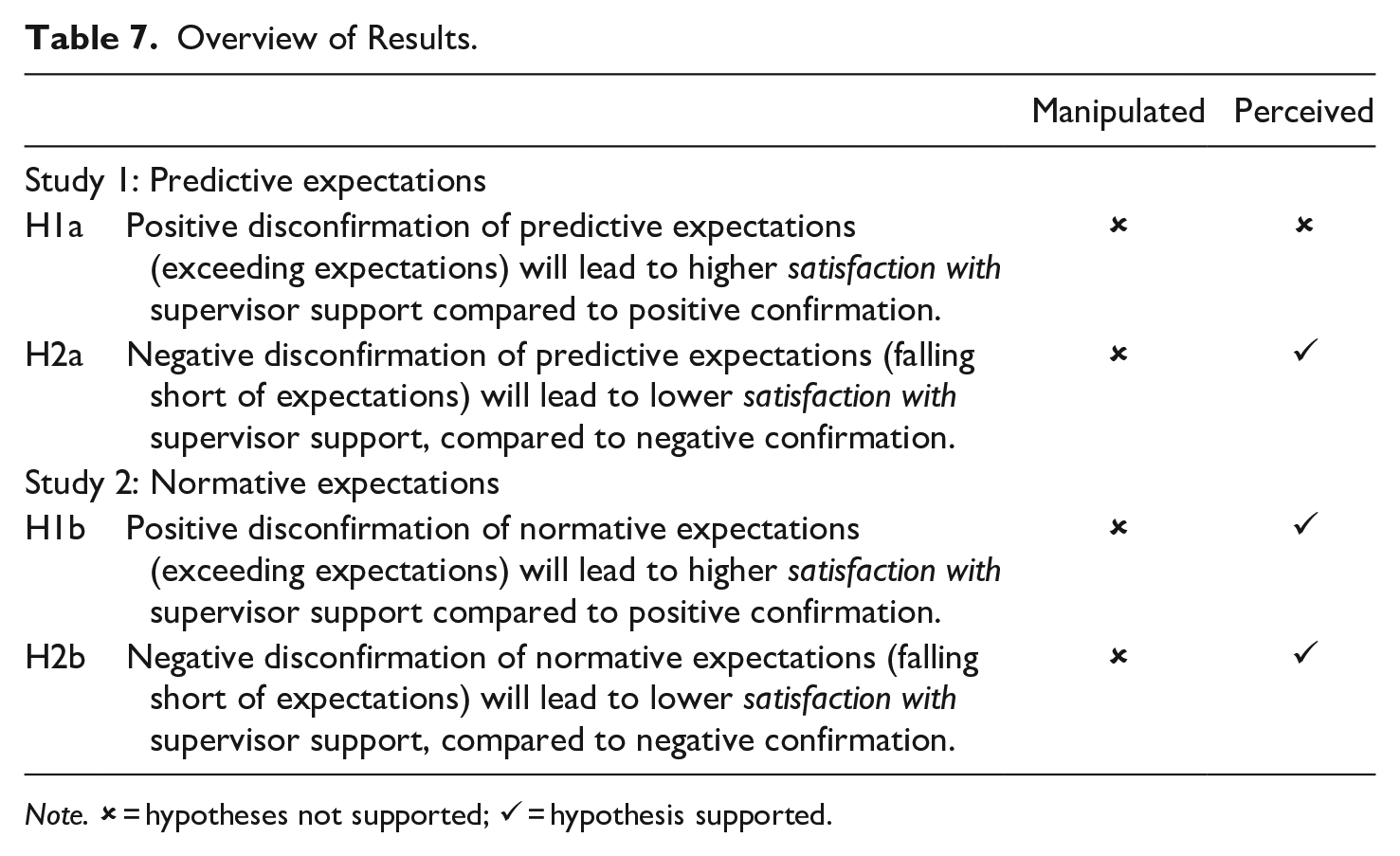
Note. ✘ = hypotheses not supported; ✓ = hypothesis supported.
Robustness Check Per Subgroup
To assess the robustness of the results, we reran the analyses for the subgroups “primary and secondary education,” “college/university education and other,” “non supervisor,” and “supervisor.” An elaborate overview of these results can be found in Supplemental Material. We find that for study 1, the results of all the subgroup analyses are similar to the main results. Based on these findings, we can conclude that these findings are robust. For study 2, most results of the subgroup analyses were similar to the main results. We find that, contrary to the main findings, the effect of supervisor support is not significant for the group “supervisor.” In other words, supervisor support did not significantly lead to higher levels of satisfaction with supervisor support for participants who are supervisors themselves. Also, contrary to the main results, the difference between positive perceived disconfirmation and confirmation was not significant the subgroup “primary and secondary” education. The other findings were similar.
Discussion
To sum up, the findings from our studies suggest that, for both predictive and normative expectations, disconfirmation of expectations does not affect employees’ satisfaction with supervisor support. Instead, the actual support supervisors provide primarily determines satisfaction with supervisor support. These findings are in line with previous research that indicates that performance has a strong direct effect on citizen’s satisfaction with government services (Grimmelikhuijsen & Porumbescu, 2017; Van Ryzin, 2013), but that disconfirmation does not directly influence satisfaction. Thus, one of Van Ryzin’s (2013) conclusions also applies to supervisor support: “performance alone appears to be main causal driver for satisfaction” (p. 610).
Interestingly, our research indicates that perceived disconfirmation is related to satisfaction with supervisor support. More specifically, we find perceived negative disconfirmation (falling short of expectations) is related to lower levels of satisfaction for both predictive and normative expectations. Perceived positive disconfirmation is only positively related to satisfaction for normative expectations. Juxtaposing the findings from these two studies, we could carefully conclude that for normative expectations, exceeding these expectations has a stronger impact on satisfaction than for predictive expectations. This could be explained by the fact that normative expectations are more related to ideals of what supervisor support should be like in general and are therefore more determinative for individuals’ satisfaction with supervisor support than predictive expectations (James, 2011). However, because we base this on the comparison of results from two different datasets, we must be cautious with drawing too firm conclusions about the comparison of predictive and normative expectations. We recommend future research to further investigate predictive and normative expectations by including these in one study so that a comparison in their effects on satisfaction can be made.
Second, in the ED-M literature, there is a debate about the measurement of expectation-disconfirmation (Mok et al., 2017; Van Ryzin, 2006). In addition to an experimental vignette approach (see for instance Grimmelikhuijsen & Porumbescu, 2017; Van Ryzin, 2013) and a perceived measure of expectation-disconfirmation (see for instance Poister & Thomas, 2011; Van Ryzin, 2006), one can also use a subtractive measure (see for instance Petrovsky et al., 2017; Van Ryzin, 2006). Earlier research has suggested that the ED-M model is sensitive to the way expectation-disconfirmation is measured (e.g., Van Ryzin, 2006). In this study, expectation-disconfirmation is operationalized as a binary construct: expectations are either confirmed or not. However, it is plausible that expectations can be confirmed to a certain extent and therefore confirmation-disconfirmation is a continuous variable. Our approach could potentially explain our null results. For instance, it could be that expectations must be disconfirmed to a large extent to influence satisfaction. Another possibility is that when supervisor support is a lot higher than expectations, employees feel micromanaged and therefore will lead to lower levels of satisfaction. We therefore recommend future research to further investigate the possibility of a curvilinear relationship between expectation-confirmation and satisfaction with supervisor support.
Third, we turn to the distinction between actual and perceived practices (Wright & Nishii, 2013) to explain our finding that disconfirmation as manipulated in our experiments did not affect satisfaction, but perceived disconfirmation did. The distinction is based on the notion that the way HR practices are perceived by employees is often different from actual HR practices, and that employees’ perceptions are a stronger predictor for outcomes than actual HR practices (Wang et al., 2020). After all, it is employees’ interpretation of a certain situation that will have consequences for their behavior. This “actual-perceived distinction” may explain why we do not find an effect of actual disconfirmation (as manipulated in the experiment), but we do find an effect of perceived disconfirmation. In the end, it is not unlikely that employees’ perceptions of whether their expectations are confirmed or disconfirmed determines their satisfaction with supervisor support. This raises the question, what influences perceived disconfirmation, other than actual performance and expectations of supervisor support?
A possible answer can be found in the meaning individuals attach to the word “disconfirmation.” A study by Hjortskov (2020a) shows that there is a rather high degree of variance in the way the word “expectations” as interpreted by individuals. Another explanation could be related to previous experiences respondents have with supervisors. Penning de Vries et al. (2020) suggest that experiences with previous supervisors may influence individuals’ expectations of supervisor support. At first sight, this aligns with earlier research indicating that previous performance shapes citizens’ expectations with government services (Hjortskov, 2019; James, 2011). However, the difference here is that employees’ experiences with other supervisors than their current supervisor might shape their expectations for their current supervisor. Moreover, considering that the relationship an employee has with their supervisor is likely to be more proximal than the relationship a citizen has with their municipality, the influence of experiences with the previous supervisor might be an important predictor for perceived disconfirmation of expectations. Furthermore, this may be even more so for predictive expectations since these are more related to specific situations, whereas normative expectations are more institutionally embedded and related to ideals (as discussed in the theory section). Therefore, previous experiences may affect expectations about what will happen in terms of supervisor support more than expectations of what should happen.
This brings us to the first limitation of our study. It is likely that most participants in our study have experience with a supervisor being either supportive or not. These previous experiences could have influenced expectations with supervisor support, thereby influencing the manipulation for predictive expectations. However, we did not measure participants’ previous experiences, and therefore we were not able to rule out the possibility of a confounding effect from experience with their current supervisor. Another limitation of this study, particularly study 1, is related to our manipulation of predictive expectations. The relationship between our manipulation of expectation-disconfirmation and our manipulation check was significant, but weak. It could thus be that our manipulations with regards to predictive expectations were not strong enough. Furthermore, even though predictive expectations are more situational than normative expectations, it could be that the manipulation of predictive expectations takes more time and effort than participants reading a job description for the supervisor. A third limitation is related to study 2. Instead of manipulating normative expectations, we measured these. The reason for this is that we expected normative expectations to be difficult to manipulate because they are more institutionally embedded and related to ideals compared to predictive expectations. Consequentially, we are not able to make strong causal claims about the effect of normative expectations on satisfaction with supervisor support. The same goes for the measurement of perceived disconfirmation of expectations.
Finally, there are some limitations with regards to the vignettes that should be considered. While experimental vignette approach provides several advantages in terms of internal and external validity, an inevitable limitation of is hypothetical nature (Aguinis & Bradley, 2014). After all, regardless of our efforts to design the vignettes as realistically as possible (by using both theory and interviews as input for our vignettes), they are not real-life situations. As such, the possibility that participants would have different levels of satisfaction with supervisor support in real life situations should be taken into consideration. Furthermore, in our efforts to manipulate supervisor support, the differences between the vignette representing high supervisor support and the vignette representing low supervisor support became large. This large difference could explain the strong direct relationship between supervisor support and satisfaction with supervisor support.
Conclusion
All in all, we conclude that disconfirmation of predictive and normative expectations does not influence satisfaction with supervisor support. Satisfaction with supervisor support is, above all, influenced by supervisor support. This does not mean the idea of expectations influencing satisfaction with supervisor support should be forgotten, as we find that perceived disconfirmation does influence satisfaction with supervisor support. As such, with this study we provide an important first step in our understanding of how expectations play a role in satisfaction with supervisor support.
Supplemental Material
sj-docx-1-rop-10.1177_0734371X211065348 – Supplemental material for “I Expected More From You”: The Effect of Expectation-Disconfirmation on Employees’ Satisfaction With Supervisory Support
Supplemental material, sj-docx-1-rop-10.1177_0734371X211065348 for “I Expected More From You”: The Effect of Expectation-Disconfirmation on Employees’ Satisfaction With Supervisory Support by Julia Penning de Vries and Eva Knies in Review of Public Personnel Administration
Footnotes
Appendix
Declaration of Conflicting Interests
The author(s) declared no potential conflicts of interest with respect to the research, authorship, and/or publication of this article.
Funding
The author(s) received no financial support for the research, authorship, and/or publication of this article.

Supplemental Material
Supplemental material for this article is available online.
Notes
Author Biographies
References
Supplementary Material
Please find the following supplemental material available below.
For Open Access articles published under a Creative Commons License, all supplemental material carries the same license as the article it is associated with.
For non-Open Access articles published, all supplemental material carries a non-exclusive license, and permission requests for re-use of supplemental material or any part of supplemental material shall be sent directly to the copyright owner as specified in the copyright notice associated with the article.
