



Abstract
This paper aims to find out what processes contribute to horizontal (between employees) and vertical (between employees and their supervisor) shared perceptions of supervisor support by public frontline supervisors. Informed by a multilevel qualitative study among supervisors and teachers in public secondary schools, we develop theoretical propositions regarding these processes. We propose that employees’ expectations based on experiences with previous supervisors can decrease horizontal shared perceptions. Subsequently, a contingent or consistent approach to supporting employees contribute to the development of horizontal and vertical shared perceptions, depending on the legitimacy attributed by employees to the reason behind this approach. Over time, supervisor support experienced by employees at meaningful work-life events contributes to the emergence of horizontal and vertical shared perceptions. This research shows that instead of merely looking for correlates of shared perceptions, scrutinizing the processes that contribute to horizontal and vertical shared perceptions increases our understanding of this complex phenomenon.
Keywords
Introduction
New public management oriented reforms have led to the devolution of managerial authority and the human resource (HR) function in public organizations (Brown, 2004; Podger, 2017; Tessema et al., 2009). Public frontline supervisors have increasingly been charged with managing employees (Brewster et al., 2015; Meyer & Hammerschmid, 2010; Perry & Kulik, 2008). This includes supporting employees in the work they do (Knies & Leisink 2014a). However, only few public management and human resource management (HRM) scholars have studied the role of frontline managers in managing and supporting personnel (Knies et al., 2018). This is unfortunate, since supervisor support is particularly relevant as a motivating mechanism in a public sector context where managers generally have less monetary resources to incentivize and reward employees (Favero et al., 2016). More research is needed to understand supervisor support, considering the critical role it has in managing human resources in public organizations. Therefore, the present study focuses on public frontline managers’ supervisor support.
Like with many other leadership and managerial behaviors (Bergner et al., 2016; Lee & Carpenter, 2018), employees’ perceptions of supervisor support are generally less positive than supervisors’ perceptions (Knies, 2012). This is considered undesirable, since leaders who overrate or underrate their behavior are generally less effective than leaders that have similar perceptions to their followers (Yammarino & Atwater, 1997). Also, employees themselves differ in their perceptions of their supervisor’s support. Whereas some employees perceive high levels of support from their supervisor, others perceive less support by the same supervisor (Knies, 2012; Sanders et al., 2011). Variation in perceptions of supervisor support does not necessarily have to be a bad thing, as this can result from the supervisor taking certain individual circumstances into account through idiosyncratic deals (Rousseau et al., 2006). However, variation can potentially create feelings of injustice or unfairness (Collins, 2017). Fair treatment of employees has been known to contribute to employees’ trust in their organization and supervisor (Cho & Sai, 2013; Quratulain et al., 2019). This is particularly relevant in a public sector context, where HRM has traditionally been highly standardized due to the importance attached to equal treatment of employees (Boyne et al., 1999; Brown, 2004). So, as more HR responsibility is decentralized to frontline supervisors, it is important to understand how these supervisors support their frontline employees and how perceptions of this support come to be shared or unshared.
Therefore, this article focuses on both vertical shared perceptions and horizontal shared perceptions: shared perceptions between supervisors and employees and shared perceptions between employees that have the same supervisor respectively. A number of studies has looked into antecedents of shared perceptions (for overviews, see Fleenor et al., 2010; Fulmer & Ostroff, 2016). This has resulted in the insight that demographic similarity/homogeneity and supervisor characteristics are correlated with shared perceptions (e.g., Bergner et al., 2016). However, there remains a lacuna when it comes to how shared perceptions come about and what processes contribute to the emergence of these shared perceptions. Considering the importance of employees feeling supported by their supervisor (Kurtessis et al., 2017), knowing why some employees perceive the same supervisor as being less supportive than others (including the supervisor him/herself) is highly relevant for HRM theory and practice. Therefore, the central question in this article is: What processes contribute to the emergence of horizontal and vertical shared perceptions of supervisor support?
In this study, we take a novel approach to investigating shared perceptions, thereby contributing to existing literature. Prior studies have examined horizontal and vertical shared perceptions separately (for an overview of horizontal shared perceptions, see Fulmer & Ostroff, 2016, and for an overview of vertical shared perceptions, see Fleenor et al., 2010), but no study has combined these types of shared perceptions. By doing this, we are able to capture new configurations arising from horizontal and vertical shared perceptions at the team level. Furthermore, contrary to prior studies, we approach horizontal and vertical shared perceptions as dynamic phenomena. We do this by scrutinizing the processes contributing to the emergence of horizontal and vertical shared perceptions dynamically, instead of merely testing correlates of shared perceptions. Lastly, our theoretical propositions about these perceptions are developed based on a multilevel qualitative study, in which supervisors and employees are interviewed about the supervisor’s support, combined with theoretical insights from existing literature. This contrasts with most studies on this topic that take a quantitative approach to the issue of shared perceptions through a comparison of ratings on pre-defined measurement scales. Moreover, the qualitative approach adopted in this study enables us to examine the processes through which perceptions are generated, considering how both supervisors and employees make sense of circumstances relevant for the perceptions they develop at any point in time.
This article is structured as followed. First, we explore supervisor support, horizontal and vertical shared perceptions on a conceptual level. Subsequently, we outline our empirical study followed by the presentation of our findings. Our findings consist of two parts. First, we discuss how employees and supervisors describe supervisor support and establish whether there are horizontal and vertical shared or unshared perceptions in our data. This illustrates how different configurations appear empirically and orientates the search for processes that contribute to the emergence of shared perceptions. Second, we develop theoretical propositions about the processes that contribute to shared perceptions based on our empirical data and theoretical insights. We conclude by reflecting on the implications for theory and practice and by making several recommendations for future research.
Literature Review
Supervisor Support
Supervisor support is defined as “the degree to which supervisors value their [=employees’] contributions and care about their well-being” (Rhoades & Eisenberger, 2002, p. 700). Even though supervisors are in many cases charged with a variety of responsibilities, providing support to their employees is considered a fundamental aspect of supervisory work (Collins, 2017). Knies and colleagues (2017) state that supervisor support can be “understood as a manager demonstrating supportive behavior through specific acts that aim to help employees at work” (p. 8). More specifically, they argue supervisor support can be aimed at either increasing employees’ personal commitment (for instance by informing employees how they are doing in their work, asking if they need assistance), or aimed at supporting employees’ career development (for instance by noticing and sharing opportunities for development). Previous studies have indicated that perceptions of supervisor support are related to several outcomes, including increased levels of perceived organizational support (Kurtessis et al., 2017), decreased turnover intention (Eisenberger et al., 2002) and increased extra-role behavior (Knies & Leisink, 2014b). Because outcomes are dependent on how supervisor support is perceived, it is important to understand how employees’ perceptions of supervisor support develop.
So what about horizontal and vertical shared perceptions of supervisor support? Research from human resource management, organization theory, and leadership studies inform us about these two forms of shared perceptions and the processes through which perceptions develop. In the leadership literature, vertical shared perceptions are often referred to as self-other agreement and typically defined as “the degree of agreement or congruence between a leader’s self-ratings and the rating of others, usually coworkers such as superiors, peers, and subordinates” (Fleenor et al., 2010, p. 1048). According to this definition, self-other agreement occurs when the leader’s perceptions of his/her leadership is similar to others in the organization, including subordinates. Because in this study we are interested in supervisor support directed towards employees, we focus on the extent to which supervisors’ perceptions of their support are similar to their subordinates’. We use the term vertical shared perceptions to indicate the extent to which frontline supervisors and their employees have similar perceptions of the supervisor’s support to employees 1 . A recent meta-analysis about self-other agreement of leadership indicates that leaders’ perceptions of their leadership are predominantly more positive than employees’ perceptions (Lee & Carpenter, 2018). This can be considered undesirable, since empirical studies have indicated that leaders who have similar perceptions as their employees about their leadership are most effective (Fleenor et al., 2010; Vogel & Kroll, 2019; Yammarino & Atwater, 1997).
In the organization theory literature, horizontal shared perceptions are often referred to as climate strength, which refers to the variability in perceptions or consensus within a particular unit (Schneider et al., 2013, p. 367). The notion of climate strength is based on the concept of situational strength (Mischel, 1973). In strong situations, Mischel states, people have similar perceptions of aspects of the work environment, which creates an environment in which they know what attitudes and behaviors are expected and rewarded. Bowen and Ostroff (2004) have adopted this notion and applied it to HRM. They argue that because employees will know what is expected of them, shared perceptions of HRM will positively affect employees’ attitudes and behaviors (Bowen & Ostroff, 2004). In this study, we use the notion of climate strength to define horizontal shared perceptions of supervisor support. Because horizontal shared perceptions refer to the extent to which employees that have the same supervisor have similar perceptions of their supervisor’s support 2 .
Bringing Horizontal and Vertical Shared Perceptions Together
In order to get the full understanding of supervisor support, it is critical to bring together both horizontal and vertical shared perceptions to capture the overall picture of how this support is understood (Figure 1). Situations in which there are shared perceptions are generally considered “strong,” aligned situations. In such situations, employees know what is expected of them and at the same time, supervisors do not over- or underestimate themselves. When the perceptions are shared, but negative towards the supervisor, it would still be a strong, aligned situation, but far from desirable. Therefore, we distinguish between strong, aligned positive situations (situation 1) and strong, aligned negative situations (situation 2).
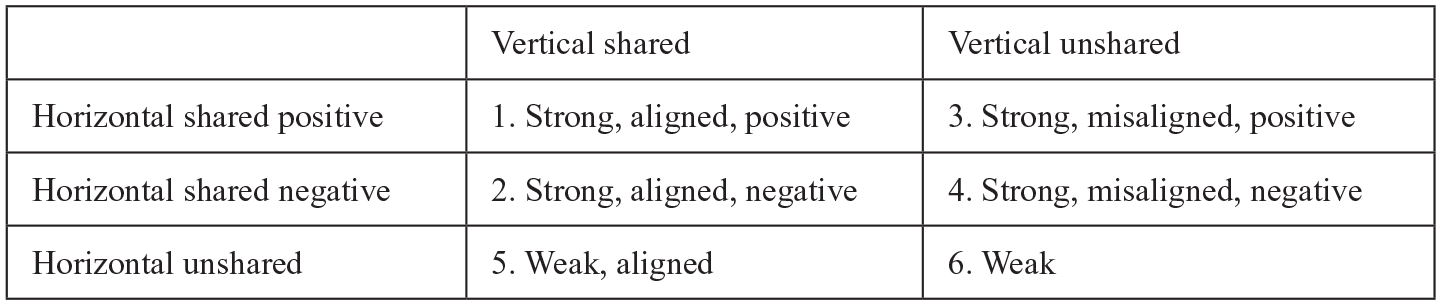
Categorization for horizontal and vertical shared perceptions.
Second, there are situations in which there are horizontal shared perceptions but no vertical shared perceptions. In other words, situations that are strong, but misaligned. Again, we distinguish between strong, misaligned, positive situations (situation 3) and strong, misaligned, negative situations (situation 4). Strong, misaligned, positive situations are situations in which employees have shared, positive perceptions about the supervisor’s support, but the supervisor himself/herself has a negative perception. In strong, misaligned, negative situations, employees have shared, negative perceptions about the supervisor’s support, whereas the supervisor has a positive perception.
Lastly, there are situations in which employees have different perceptions of the supervisor’s support, and the supervisor recognizes that his/her employees have different perceptions of his/her supervisor support. In these situations, there are horizontal unshared, but vertical shared perceptions (situation 5). Furthermore, there are situations in which there are no shared perceptions, which—according to the literature—are weak, unaligned situations (Mischel, 1973). In these situations, employees and the supervisor all have different perceptions of their supervisor’s support (situation 6). The distinction between situation 5 and 6 is a relevant one to make, due to the implications for employees. Whereas situation 5 is characterized by a supervisor being aware that their support to employees is perceived differently among the employees supervised, situation 6 is characterized by a supervisor who is unaware of this. When a supervisor is conscious of these differences in perceptions, it could well be that they are tailoring support to the employees’ individual needs. However, when the supervisor is unaware of these differences, it could well be that the supervisor is not supporting their employees according to their needs.
Figure 1 depicts six situations that can arise when horizontal and vertical shared perceptions are combined, and when the level of positivity of perceptions is taken into account. By combining these three aspects, a comprehensive framework for shared perceptions comes forward, which orientates our study of which processes contribute to horizontal and vertical shared perceptions.
Method
In this article, we draw on the understandings of supervisors and teachers in secondary schools in the Netherlands about the emergence of a configuration of horizontal and vertical perceptions in their team as well as on theoretical insights to develop theoretical propositions on perceptions of supervisor support. Our multilevel qualitative design entails our units of analysis (respondents) nested within a higher-level unit (teams). In Figure 2, a schematic depiction of the design is presented (for a similar approach, see Andersen et al., 2018). The reason for adopting this design is threefold. First, because we are interested in higher level phenomena (shared perceptions) that are derived from individual level phenomena (individual perceptions), it is appropriate to adopt a multilevel empirical structure. Second, because we aim to examine how these perceptions emerge and through what processes, a qualitative approach is suitable because it allows us to capture the dynamic nature of these processes. Third, this design enables us to compare multiple teams. This comparison is particularly appropriate to “deepen understanding and explanation” (Miles & Huberman, 1994, p. 173) of certain phenomena, which is the aim of this study.
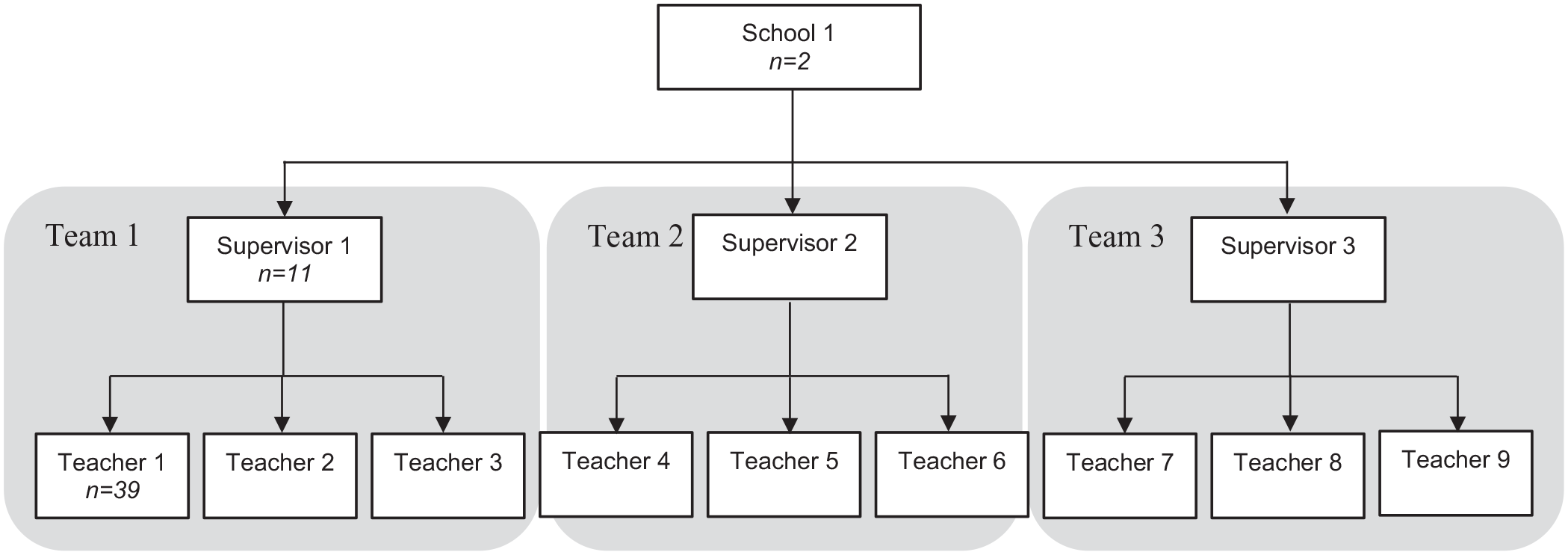
Multilevel design.
Research Context
The Netherlands is a European country with approximately 17.3 million inhabitants. In secondary schools in the Netherlands, students from the age of 12 until 18 are educated. Until the age of 18, students are legally obliged to go to school. Predominantly, secondary schools, including the two schools in our study, are legally private bodies but fully funded by government. Supervisors and teachers are semi-public servants 3 . Staff in secondary schools are predominantly organized in teacher teams that are supervised by a team leader (supervisor). Whereas the school principal has responsibilities regarding management activities such as financial management, general school policies, and school performance, supervisors are increasingly charged with supervisory responsibilities over a group of teachers, which includes the support of teachers.
Selection of Cases and Respondents and Interview Procedure
Two schools were selected using a most different case selection strategy (Seawright & Gerring, 2008). More specifically, the selected schools varied in terms of overall sentiment (positive vs. negative) towards frontline supervisors. This selection was based on conversations with the school boards and the schools’ annual employee satisfaction survey. The schools were similar in terms of student population (approximately 1,600 students). Within these schools, all teams were included in the analysis. The teachers who were interviewed were selected and approached after consultation with supervisors in order to avoid voluntary response bias. In order to minimize the risk of selection bias by supervisors, the central topic of the study was not specifically stated, but it was mentioned that the interviews would be about supervisor support in general. Furthermore, supervisors were explicitly asked to come up with a selection of teachers that varied in terms of age, gender, tenure, and work engagement. Semi-structured interviews were conducted with teachers (n = 39) and their immediate supervisors (n = 11). Each supervisor in our study has the responsibility over a team of teachers, and of each team a minimum of three teachers were interviewed (for an overview of respondents, refer to supplementary material 2). In total, five of the team leaders who were interviewed were female, and six were male. For teachers, 19 respondents were male and 20 were female. This is in line with the general teacher population in the Netherlands, which consists of 53% male and 47% female teachers (Central Bureau of Statistics, 2019). For all teams, both female and male team members were interviewed. The teachers we interviewed had an average tenure (years working as a teacher) of 10.9 (S.D. = 8.2). The average tenure for supervisors (years working as a supervisor) we interviewed was 5.2 (S.D. = 3.1). All supervisors interviewed had worked as teachers before they became a supervisor. A detailed overview of the respondents can be found in the supplementary material 2.
On average, the interviews lasted 1 hour and took place in a private space (i.e., an office or an empty classroom) in the respondent’s school. The topic lists (supplementary material 1) used for our semi-structured interviews were guided by the literature, while leaving sufficient room for respondents to bring in topics that were relevant according to them. First and foremost, the central concepts of this study were included: supervisor support and horizontal and vertical shared perceptions. Second, topics regarding the characteristics of the supervisor, the team, and relational characteristics were included in order to get a grasp of the everyday work environment. The interview strategy was as follows. In all interviews, respondents were asked about their frontline supervisor’s support in general. Subsequently, respondents were asked about their perceptions of the extent to which there are vertical and horizontal shared perceptions in their team, and the circumstances associated with this. Lastly, respondents were asked to describe their work environment and their team. Confidentiality and anonymity were guaranteed, in order minimize the risk of social desirability.
Analytical Approach
We adopted a thematic analytical approach to analyze our interviews, which is a method for identifying, analyzing, and reporting patterns in qualitative interviews (Braun & Clarke, 2006). While maintaining qualitative rigor in the analysis, it allows for a flexible way of dealing with theory in the analysis. This approach matches this study, because our central constructs (shared perceptions) are theoretically driven, and we aim to come up with theoretical propositions regarding the development of these constructs. Therefore, we are actively searching for horizontal and vertical shared perceptions in the interviews (theoretically driven), but take a more grounded approach (Charmaz, 2006) in finding the processes that contribute to the emergence of shared perceptions. Braun & Clarke’s (2006) recommended phases of analysis were used as guidelines for our analytical approach. All phases of analysis were continuously discussed among all researchers involved.
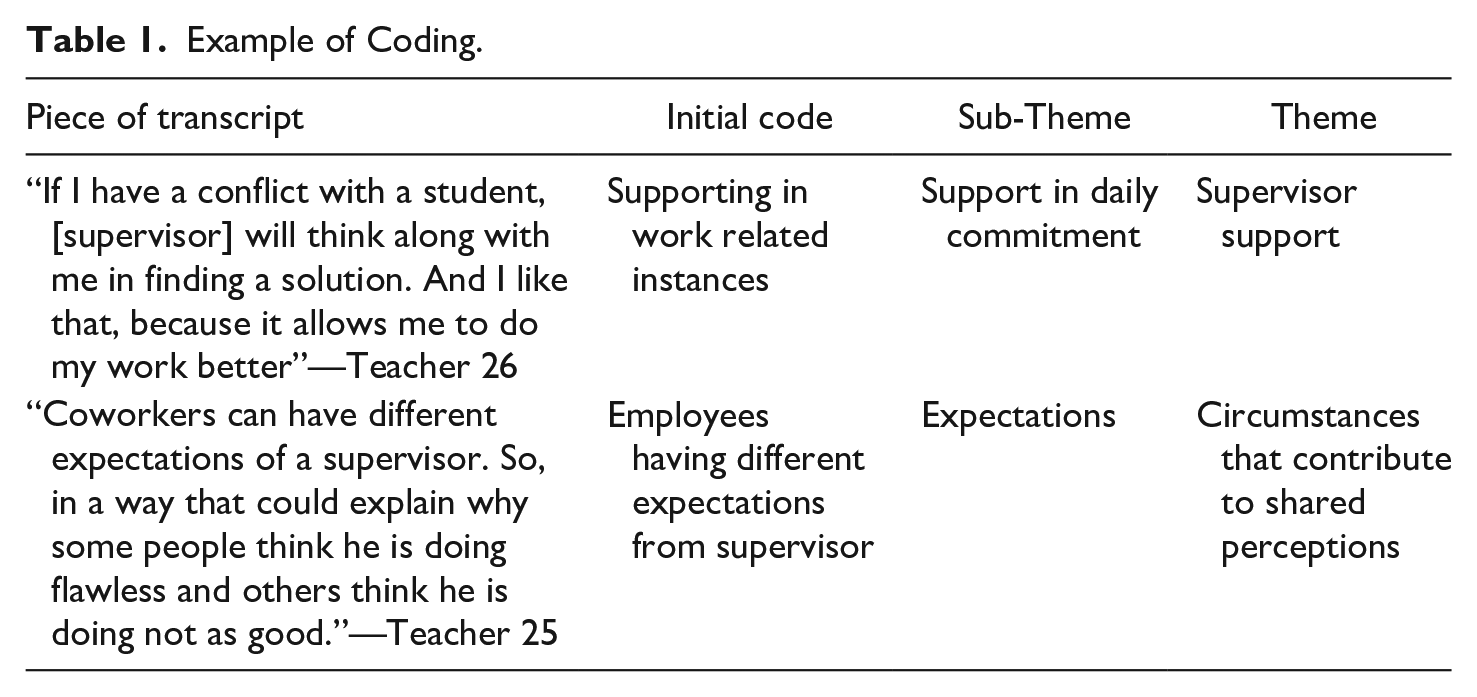
First, all interviews were recorded and transcribed verbatim. Subsequently, the interviews of the supervisors were matched with the interviews of the teachers, resulting in eleven “team clusters” of interviews. Second, initial codes were identified throughout the entire set of interviews in order to establish the relevant topics in relation to our research question. In this phase, a deductive approach was applied in order to establish whether there are horizontal and/or vertical shared perceptions in the teams. The coding process for how shared perceptions come about was grounded in the understandings of the interviewees themselves. Examples of initial codes are “experience with previous supervisors,” “meaningful incidents,” and “support during work stress.” Third, the initial codes were sorted into subthemes, which were later sorted into themes. For instance, the code “Employees having different expectations from supervisor” was categorized into the subtheme expectations, and this subtheme coded into the theme circumstances contributing to shared perceptions (Table 1). Finally, the codes were analyzed in relation to the central research question.
Example of Coding.
All in all, this resulted in two findings sections. In the first section, we discuss how the employees in our study describe supervisor support. Subsequently, for all teams included in the study, we identified whether there are horizontal and/or vertical shared perceptions (Figure 3). We do this to illustrate how these different situations empirically occur in our qualitative data. Also, this facilitates us in developing the theoretical propositions. In the second section, our theoretical propositions are developed based on both empirical findings and theory. This section is structured in such a way that first the empirical findings are presented, after which theoretical insights are used to interpret the empirical findings and develop propositions.
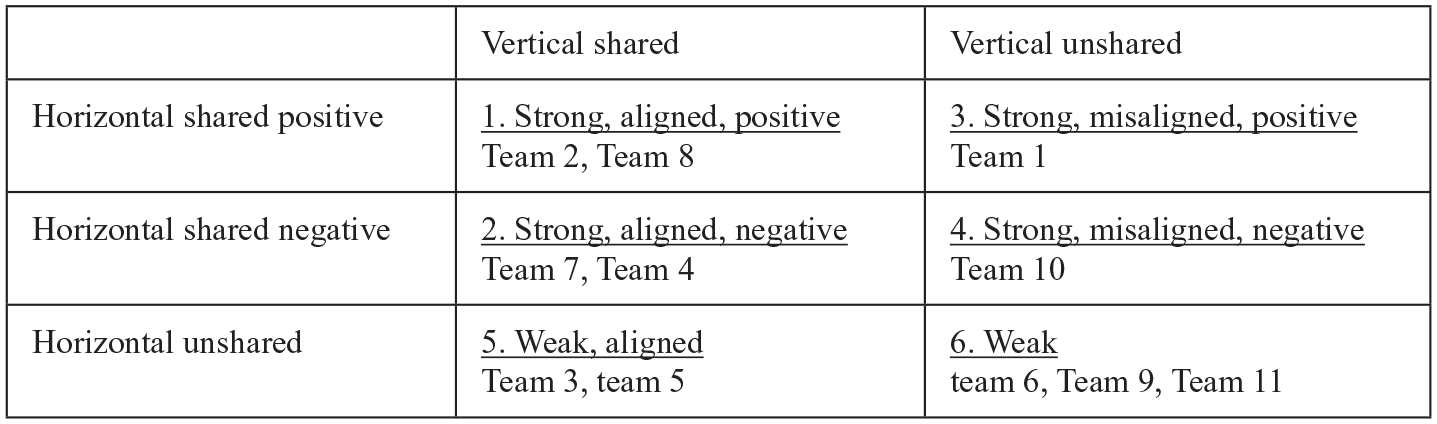
Placement of teams in categories for horizontal and vertical shared perceptions.
Findings Part 1: Horizontal and Vertical Shared Perceptions of Supervisor Support
Individual Descriptions of Supervisor Support
When employees were asked about the support they receive from their supervisor, they refer to support they receive as they deal with daily issues in their work. This could be help dealing with conflicts in the classroom. An illustrative example is given by teacher 12, who describes a situation in which she had a conflict with a student and help from her supervisor was an indicator of supervisor support. In assessing the nature of supervisor support, teachers describe the approachability of their supervisor as an important element, such as in situations when dealing with high workload/work stress or difficulties related to teaching or their training and development. Teacher 12 for instance mentions: “He [supervisor 3] is really supportive in the work me and my team members do. It feels really easy to approach him for things.” Further, we find employees perceive support for development as part of supervisor support. Teacher 30, for instance, mentions the supervisor asking how she would like to develop herself in the coming years as an element of supervisor support. This implies that the extent to which supervisors discuss and stimulate employees to develop themselves professionally is mentioned as one aspect of supervisor support. Thus, from the perspective of employees, supervisor support consists of supervisors’ help with task-related and relations-oriented issues, in which the level of approachability of the supervisor is emphasized as an important aspect of supervisor support for employees.
From the perspective of supervisors, similar aspects of supervisor support come forward. The supervisors often refer to support when employees are dealing with difficult situations at work or in their work-life balance. In these situations, supervisors indicate they talk to their employees both formally and informally to support them. Supervisor 3 for instance indicates: “I try to listen really well and ask questions to find out what really causes the problem.” Moreover, supervisors also indicate supporting employees in their development is part of supporting employees, primarily by discussing teachers’ professional development.
In sum, teachers and supervisors in our study mention both elements of support for commitment and support for development, described as two central elements of supervisor support (Knies et al., 2017). The descriptions of supervisor support given by our respondents contain both task-related and relations-oriented elements. That is, the supportive behavior that is described is relation-oriented as it aims to develop and support employees, thereby maintaining positive relationships between the supervisor and the employee (Lee & Carpenter, 2018; Yukl, 2012). Furthermore, supervisor support also involves task-oriented support because it concerns how employees complete and deal with aspects related to their work. These descriptions of supervisor support suggest that employees’ and supervisors’ understanding of what supervisor support entails is rather similar.
Shared Perceptions of Supervisor Support
In four of the teams studied, we found consistency between teachers’ and supervisors’ perceptions. For instance, supervisor 2 and teacher 8 are both positive about supervisor 2’s support. The other teachers of team 2 who were interviewed had similar responses when asked about supervisor 2’s supervisor support, suggesting team 2 has a strong, aligned, positive situation (situation 1). By contrast, supervisor 7 and teacher 25 both acknowledge supervisor 7’s shortcomings when it comes to supervisor support—a perception shared by the other interviewees of the team. Thus, this suggests team 7 is characterized by a strong, aligned, negative situation (situation 2).
In team 1 and team 10, perceptions of supervisor support are horizontally shared, but vertically unshared. Supervisor 1 suggests she is insecure about her supervisor support (“Well it feels like, in that sense I am just inexperienced.”- supervisor 1). However, the interviewees of team 1 are highly positive about the supervisor’s support (“I think that [supervisor 1] is really the best people manager of all supervisors in this school.”- teacher 3) and her professionality is stressed by her employees several times. Because in team 1, employees have shared, positive perceptions of supervisor support, while the supervisor’s perception is more negative, this team represents a strong, misaligned, positive situation (situation 3). We also found teams in which the supervisor’s perception was more positive than the employees’ perceptions. Supervisor 10 suggests he is confident about his coaching abilities (“I really belief in my own responsibility, I coach a lot.”—supervisor 10). By contrast, by stating that many employees in the team “are struggling with supervisor 10,” teacher 34 suggests there are shared negative perceptions about their supervisor’s support. Based on this, team 10 represents a strong, misaligned, negative situation (situation 4).
Furthermore, our interviews suggest a weak, aligned situation (situation 5) occurs in teams 3 and 5. For instance, in team 5, the supervisor provides different levels of support to different employees depending on the situation (“For instance, I give some teachers more autonomy than others.”- supervisor 5). Because employees are confronted with different levels of support, it can be expected that this results in a situation in which employees have different perceptions. This is in line with the statements of teachers 18 and 19. Whereas teacher 18 indicates their supervisor is “the best of the entire organization,” teacher 19 is more reserved and mentions that “the supervisor is good in some things, but less in others.” This leads to a situation in which employees have different perceptions of the supervisor’s support, but the supervisor shares perceptions with each employee in the team because she recognizes she supports teachers in different ways. As such, a weak, aligned situation occurs (situation 5).
Finally, in some teams, a weak, misaligned situation occurs in which perceptions are horizontally and vertically unshared. Supervisor 6 points out he interacts sufficiently with all the members of his team. While teacher 21’s perceptions are in line with this, teacher 22 contradicts this by describing supervisor 6 as his “distant supervisor.” This case illustrates a weak situation, in which the perceptions of supervisor support differ among employees. Based on our interviews, we categorize teams 6, 9, and 11 as weak situations (situation 6). In figure 3, an overview of the teams placed in the categories for horizontal and vertical shared perceptions is presented.
Findings Part 2: Propositions
Expectations of Supervisor Support
During our interviews, respondents indicated that before employees have their first interaction with a supervisor, they have expectations about supervisor support that play a role in developing their individual perceptions of their supervisor’s support.
Coworkers can have different expectations of a supervisor. So, in a way that could explain why some people think he [the supervisor] is doing flawless while others think he is not doing such a good job. – Teacher 24
As this statement suggests, variation in employees’ expectations of supervisor support explains why employees end up having different perceptions of supervisor support, even though they have the same supervisor. This is not only recognized by teachers, but also by supervisors. When supervisor 9 is asked about her employees’ perceptions of her supportive behavior she indicates: “the expectations do not always match.” With this, she refers to the expectations her teachers have and the support she provides to her teachers. Thus, our interviews suggest employees’ expectations affect their perceptions of supervisor support.
Expectations about supervisor support are often based on experiences with previous supervisors, in such a way that earlier experiences may lead to certain expectations. Therefore, experiences and expectations are often related but are not one and the same thing. For instance, the teachers in team 7 had negative experiences with their previous supervisor (“She [previous supervisor] was really a disaster”—teacher 28). Because of these negative experiences, the teachers in team 7 assumed that when supervisor 7 became their supervisor, he would be another poor supervisor.
I remember the first meeting that he [supervisor 7] entered the room and was immediately verbally smashed to the ground by two older colleagues [teachers]. He hadn’t done anything at that moment, he was just “blank.” And that was his starting point. – Teacher 28
In this example, supervisor 7 was new in the organization and also in the team. Before the supervisor had done anything, several teachers acted towards him based on a prior negative expectation. Thus, the negative experiences teachers in team 7 had with the previous supervisor led to expectations about their new supervisor. On the other hand, positive experiences with previous supervisors can also have implications for employees’ expectations. In team 3 for instance, a teacher indicates: He [supervisor 3] had the disadvantage that there was a supervisor before him that was really loved (appreciated) within this school, and she is still in this school of course. What she did right - and what is almost impossible to match - is that she was really focused on all members of the team. – Teacher 10
Teacher 10 mentions the positive experiences teachers have had with the previous supervisor are a “disadvantage” for supervisor 3, since it would be hard for him to live up to these previous experiences and the resulting expectations which affect teachers’ perceptions of his supervisor support.
Thus, our interviews suggest when employees have high expectations of supervisor support, teachers’ perceptions of the new supervisor will likely be more negative because the supervisor is not able to live up to these standards (example in team 3). On the other hand, when employees have negative expectations based on experiences with a previous supervisor, they will start with negative perceptions of the new supervisor, because employees expect that the new supervisor will be the same (example in team 7). As such, the process of shared perceptions starts with experiences with the previous supervisor. These experiences lead to certain expectations, and these expectations in turn contribute to employees’ perceptions of supervisor support.
Our empirical findings related to expectations resonate with the expectation-disconfirmation theory (Oliver, 1980). This theory originates from consumer research, but has also been applied by public administration scholars to explain citizens’ satisfaction with governmental services (Mok et al., 2017; Van Ryzin, 2004). The theory maintains that individuals’ expectations of products or services affects their satisfaction with these. When these expectations are disconfirmed by individuals’ actual experience, the satisfaction will decrease. When we relate our empirical findings to this framework, we find the origin of expectations and the consequences are part of a process, which starts before the first interaction with the supervisor has taken place. Experiences with previous supervisors set—at least partly—expectations for supervisor support. Based on our interviews and the expectation-disconfirmation theory, we propose that when employees’ expectations of supervisor support vary, their perceptions of supervisor support will also vary. As a result of this, a situation in which there are horizontal shared perceptions is less likely to emerge. In other words, a weak situation is more likely to occur.
Our empirical findings suggest when employees have high expectations of supervisor support, it can be difficult for new supervisors to live up to these expectations. This finding relates to a mechanism often used in expectation-disconfirmation theory, which entails that individuals use their expectations as a reference point to determine the quality of a certain product or service (Andersen & Hjortskov, 2016; Meirovich & Little, 2013).
Following proposition 1a, high expectations of supervisor support, which are partly based on experiences with previous supervisors, form a standard against which employees evaluate their supervisor’s support. Even though this mechanism can theoretically go both ways (high expectations create a high standard, low expectations create a low standard), our interviews seem to suggest this mechanism only works when employees have high expectations of supervisor support. Our interviews suggest negative experiences with their previous supervisor may lead to negative expectations about supervisor support and these negative expectations may negatively influence their perceptions of the new supervisor’s support. This pattern seems to conform to confirmation bias, which refers to individuals’ tendency to “seek or interpret evidence in ways that are partial to existing beliefs, expectations or a hypothesis in hand” (Nickerson, 1998, p. 175). Thus, the relationship between expectations and perceptions of supervisor support does not seem to be linear. Both high and low expectations seem to shape perceptions negatively. This does not suggest all employees end up with negative perceptions. Rather, in situations where individuals have expectations that are neither high nor low but instead are neutral, individual’s perception of the supervisor’s support would not be negatively affected by these expectations. We therefore propose a non-linear process, where both high and low expectations will shape individuals’ perceptions of supervisor support, but expectations that are neither high nor low do not.
Even though it did not come forward in our interview study, based on expectation-disconfirmation theory (Oliver, 1980), it could be expected that the extent to which employees’ expectations shape their perceptions of supervisor support is dependent on the level of supervisor support they receive from their supervisor. For instance, when employees have high expectations of supervisor support, and their supervisor provides high levels of support, their perceptions might not be as strongly affected as when their supervisor would provide low levels of support. The same holds when employees have low expectations of supervisor support, and their supervisor provides low levels of support.
All in all, the process of how employees’ expectations shape perceptions of supervisor support is a complex one, in which previous experiences with supervisors inform the development of expectations, and in which either high or low expectations generally shape perceptions negatively whereas moderate expectations will not negatively affect perceptions of supervisor support. This process is one which occurs on the individual level of the employee. In addition, processes on the level of the supervisor also shape shared perceptions of supervisor support. These will be addressed in the following section.
Contingent or Consistent Approach to Supervisor Support
Thus far, the implicit assumption has been that supervisors support employees consistently, which is characterized by supervisors giving all employees the same amount of support. However, we find that while some supervisors do, others take a more contingent approach to supporting teachers, which is characterized by supervisors providing different levels of supervisor support to different employees. As supervisor 3 mentions: “For instance there is one specific group of people studying next to their work. Sometimes, I will dismiss them from meetings to work on their studies.” This quote illustrates a contingent approach to providing support, because the support this supervisor provides is dependent on the employee’s situation. Contrary to this, other supervisors provide the same level of support to all employees. Supervisor 1 for instance mentions: “Sometimes, at the end of the week, I check very consciously: ‘Did I talk to that person? Did I talk to this person?’” thereby indicating she strives to provide the same level of support to each employee under her supervision.
When a supervisor provides support contingently, horizontal unshared perceptions are likely to increase because employees have different experiences with supervisor support, resulting in different perceptions of supervisor support. For instance, teacher 11 indicates: For instance for me, it might work out really nice, that the supervisor is differentiating. Therefore, I am positive about this [differentiation]. But if you get the feeling this doesn’t work out for you, you might find it unfair. – Teacher 11
Teacher 11’s statement suggests that whether employees are positive or negative about the supervisor’s support depends on how this differentiation works out for them.
Furthermore, supervisors can intentionally differentiate between employees, recognizing that some employees require more support than others (“I do have an idea about who needs more attention than others, and so I spend more time on them than on others.”—Supervisor 8). However, a contingent approach can also be unintended. That is to say, supervisors can provide support in different ways without a deliberate reason, or because of an unconsidered reason such as time constraints (“R: I do try to see all the people in my team, but it’s just. . . I: . . .you have a large team? R: Yes, that’s right!—Supervisor 3”). When supervisors’ contingent approach to supervisor support is unintended, it is likely to result in the emergence of horizontal and vertical unshared perceptions (situation 6). In that case, supervisors are not aware that they are supporting their employees differently. Because there are unshared perceptions among employees, a situation results in which there are vertical and horizontal unshared perceptions. However, if the supervisor’s contingent approach is intended and the supervisor is aware of the related differences in employees’ respective perceptions, it might result in a weak, aligned situation (situation 5). This is because supervisors know they are differentiating, and therefore their perception aligns with the horizontal unshared perceptions among employees.
The legitimacy of a supervisor’s reason for a contingent approach to supervisor support, influences whether employees’ perceptions of supervisor support will be positive or negative. Teacher 16 for instance mentions: I think it is very important to support new teachers. I think it is a crucial thing for education. And well, if one person needs more support than the other, you should accept that. There is nothing wrong with that. – Teacher 16
This quote illustrates that when this contingent approach is intended and motivated by reasons considered legitimate by employees, it might not lead to horizontal unshared perceptions of supervisor support.
Thus, a contingent approach to supporting employees can lead to three different outcomes: horizontal unshared and vertical shared perceptions (situation 5), horizontal and vertical unshared perceptions (situation 6), or horizontal and vertical shared perceptions (situation 1). If a contingent approach to supporting employees is intended by the supervisor, situation 5 is most likely to occur. On the contrary, if the contingent approach is unintended by the supervisor, situation 6 is most likely to occur. Finally, if a contingent approach is intended and with a legitimate reason, situation 1 is most likely to occur.
A precondition for a contingent approach to influence perceptions of supervisor support is that employees are able to observe what support the supervisor provides to other employees in the team. Teacher 20 for instance mentions: “I don’t really know, to be honest. Because there are a lot of team members that I do not see often.” Thus, in order for employees’ perceptions of supervisor support to be affected by the supervisor’s approach, employees must have an idea about what support the supervisor provides to their coworkers. When there is a lot of interaction between employees in a team, employees are more likely to observe differences (or similarities) in the way support is provided.
The argument that different levels of supervisor support lead to different employee perceptions of supervisor support has similarities to a social information processing perspective (Salancik & Pfeffer, 1978). From this perspective, individuals adapt their attitudes and beliefs based on the reality of their social environment. Their social environment thus provides information about certain phenomena, which shapes individuals’ understanding of a specific aspect of the social environment. Applied to supervisor support, this means the individuals’ perceptions of supervisor support are—at least partly—determined by the information available about this. As such, when employees are confronted with different levels of supervisor support, they also have different information about supervisor support. Therefore, a contingent approach to supervisor support will likely lead to horizontal unshared perceptions of supervisor support.
Furthermore, when the supervisor is intentionally adopting a contingent approach, she may be (at least partly) confronted with the same information about her supervisor support as her employees. For instance, when a supervisor is aware she is supporting John more than she is supporting Sarah, a situation may occur in which there are horizontal unshared (John and Sarah have different perceptions), but vertical shared perceptions of supervisor support (John and Sarah’s perceptions are similar to their supervisor’s). In other words, a weak, aligned situation may occur.
Furthermore, our empirical research shows that the perceived reason for a contingent approach will determine whether this contingent approach leads to unshared perceptions. According to attribution theory, people’s reaction to certain behavior is influenced by the perceived cause of that type of behavior (Kelley & Michela, 1980). In other words, employees’ perceptions of the reason why the supervisor behaved in a certain way can explain their reaction to this behavior. If we relate our findings to this attribution framework, employees’ attribution of the reason for a contingent or consistent approach to supervisor support determines employees’ perceptions. If this contingent approach is adopted because of a legitimate reason in the eyes of employees (in our example, providing the best possible education), perceptions of employees receiving less support will not be affected negatively and therefore this will not lead to horizontal unshared perceptions.
Finally, our empirical analysis suggests interaction among employees is a precondition for whether a contingent approach affects perceptions of supervisor support. This finding also resonates with social information processing theory (Salancik & Pfeffer, 1978). In order for employees to be affected by a contingent approach, they need to have some sort of information about how the supervisor provides support to coworkers. For instance, when an employee never interacts with coworkers, he or she will not know how much support his/her coworkers receive. Then, the impact of a contingent or consistent approach to people management will not contribute to his/her perception of supervisor support. All in all, interaction among employees is thus a precondition for the process in which a contingent or consistent approach to supervisor support contributes to horizontal and vertical shared perceptions.
Meaningful Events
Over time employees encounter situations they consider meaningful that affect their perception of supervisor support.
[Respondent describes a situation in which she asked for support, but this was neglected]. That makes me so angry. I put myself in a vulnerable position by asking for help. And it was handled so carelessly. [. . .]. My perception about the supervision in this school is not really positive. – Teacher 36
As the statement by teacher 36 implies, one specific event that occurred between the employee and the supervisor affects the general perception the employee has of the supervisor negatively. By contrast, employees can also have a positive experience of a certain incident affecting their general perception in a positive way. Teacher 14 illustrates this by speaking positively of his supervisor because of the support provided when his wife fell ill. These incidents can affect employees’ individual perceptions, and therefore result in horizontal unshared perceptions of supervisor support.
Conclusion and Discussion
Based on a multilevel qualitative study and theoretical insights from existing literature, we have developed several propositions around three processes contributing to horizontal and vertical shared perceptions. Even though these processes operate separately, their juxtaposition suggests changes in their relative importance for the emergence of horizontal and vertical shared perceptions over time. First, we proposed that expectations of supervisor support are—at least partly—shaped by previous experiences with supervisors. This implies this process functions in an early stage of the development of shared perceptions. The contingent or consistent approach to supervisor support will likely play a role in a later phase, since it takes some time for such an approach to take place. Lastly, meaningful events can happen any moment in time, but since these are more likely to occur as time goes by, it is also likely that the role of meaningful events will become more important as time proceeds. We, therefore, conclude these processes all contribute to the emergence of horizontal or vertical shared perceptions, but their relative importance differs over time.
With the present study, we make several contributions to the literature. First, this study highlights that perceptions of supervisor support and the level of sharedness thereof are dynamic and change over time. Most studies on the issue of shared perceptions make use of cross-sectional, quantitative data (Fleenor et al., 2010), which depicts a snapshot of shared perceptions and their correlates. By adopting a qualitative approach, we were able to get some insights related to a longer time perspective on situations (i.e., experiences with previous supervisors, meaningful events) and develop propositions about how these processes influence the emergence of perceptions of supervisor support over time. Future research is needed to empirically test these propositions, for instance by using experimental or longitudinal research designs.
Second, even though we have focused on a particular aspect of leadership, our study provides some relevant implications for the generic leadership literature as well because the propositions we have developed may also be applicable to other types of leadership behaviors. For instance, our proposition that meaningful events shape perceptions of supervisor support can be applied to leaders’ transformational leadership, when an employee once experienced an event in which he/she was truly inspired by the leader, his/her general perceptions of the leaders’ transformational leadership might overall be positively affected. Also, in our propositions we take the interaction between supervisors and employees into account (particularly proposition 1 and 3). Thereby, we respond to Bergner and colleagues’ (2016) call for future research to focus more on the interaction between leader and follower when investigating the emergence of shared perceptions between leaders and employees.
Third, we propose both high expectations and low expectations lead to negative perceptions of supervisor support. At first, this might sound counterintuitive. However, when we examine our interviews and combine this with existing theories, we suggest there are two different mechanisms at play for both high and low expectations: expectations as a reference point and expectations as prediction. These findings are not similar to, but in line with several empirical findings suggesting that low expectations lead to lower levels of satisfaction than high expectations (Grimmelikhuijsen & Porumbescu, 2017; Van Ryzin, 2013). Based on this, we suggest that in a situation of “neutral” (neither high nor low) expectations of supervisor support, employees’ perceptions of supervisor support should be the highest. However, we have no data explicitly corroborating this. We recommend future research to further assess the role of “neutral” expectations of supervisor support.
Finally, in search of better understanding employees’ perceptions of HRM and how these perceptions are developed, scholars have called for more qualitative research related to this topic (Hewett et al., 2018; Wang et al., 2020), rather than “uncritically borrow(ing) measurements items developed in different empirical contexts” (Wang et al., 2020, p. 155). Our multilevel qualitative approach allowed us to get a better understanding of the support supervisors provide to each employee and employees’ interpretations thereof, which would not have been possible when uniform operationalizations of supervisor support were used, as is done in quantitative research methods. As such, we were able to develop propositions not only about the process through which a contingent or consistent approach leads to shared perceptions, but also how employees’ interpretations of the reason behind a contingent or consistent approach to supervisor support contributes to this process. Thus, we contribute to HRM research about understanding perceptions by generating new propositions about the processes through which perceptions are developed. Further research could build upon these propositions, by further developing these propositions and by testing these using quantitative research methods.
In addition to the theoretical implications, we provide several recommendations for organizations, supervisors, and employees. First, our results point to the relevance of facilitating conversations about supervisor support among supervisors and employees. Organizations can do this by organizing such a conversation whenever a supervisor or employee joins the organization. In this conversation, expectations regarding supervisor support can be discussed. This way, expectations of supervisor support can be aligned before perceptions are developed by employees. Second, our results indicate it is important to avoid a situation in which a contingent approach to supporting employees leads to unshared perceptions. From the organizational justice literature we know that a fair treatment contributes to employees’ trust in the organization and their supervisor (Collins, 2017). Therefore, in order to avoid a situation in which employees feel treated unfairly, supervisors are advised to take into consideration that the reason employees attribute to different levels of support has implications for their perceptions of supervisor support. As such, we recommend supervisors to communicate why they differentiate in order to avoid a situation in which employees feel disadvantaged while in fact there is a legitimate reason for this differentiation. This might be even more important in a public sector context, where fair treatment of employees has traditionally been an important HRM principle (Boyne et al., 1999; Brown, 2004). Lastly, our findings point to the importance of employees speaking up and expressing their perceptions of supervisor support. This is important when their perceptions are positive and negative. In both cases, it can be highly useful for supervisors to know how the support they provide is perceived by employees, so they know what supportive behaviors they should adjust or continue. Future research is recommended to look into ways in which organizations can facilitate these conversations and what circumstances contribute to the effectiveness of these conversations.
Inevitably, there are some limitations of this study that should be considered. The first limitation refers to the selection of participants in our study. In order to rule out the possibility of voluntary response bias, we selected employees for interviews, instead of asking employees to sign up for an interview. Because we did not know all the employees in the teams, this selection was made in consultation with the supervisors. Even though we did not explicitly mention our research question and asked supervisors for a selection of employees varying in terms of age, gender, and work engagement, we cannot rule out the possibility that there was some extent of selection bias by supervisors. Finally, our propositions all have an element of causality. However, our data does not allow us to statistically establish causal relationships. Therefore, we recommend future research to test our propositions using longitudinal or experimental research designs. Moreover, our qualitative design did not allow us to statistically examine or control for factors that are generally known to contribute to self-other agreement, including demographic similarity or personality traits (Fleenor et al., 2010; Fulmer & Ostroff, 2016).
The increasingly important role of frontline supervisors in public organizations in supporting employees requires a better understanding of how this support is perceived and how these perceptions emerge. After all, supervisors might think they are supporting their employees, but when this is perceived differently by employees, this support will not have the intended impact on employee wellbeing and performance. Furthermore, decentralization of the HR responsibilities to frontline supervisors is likely to lead to more differences in support, since supporting employees becomes the responsibility of many supervisors instead of one HR department. Considering the fact that fair treatment of employees has traditionally been an important HRM principle in public organizations (Boyne et al., 1999; Brown, 2004), it is important to examine whether perceptions of the extent to which employees feel supported by their supervisors are shared. This research enhances our understanding of the complex phenomenon of horizontal and vertical shared perceptions of public frontline supervisors’ support to the employees they supervise.
Supplemental Material
Supplementary_file_R1 – Supplemental material for Shared Perceptions of Supervisor Support: What Processes Make Supervisors and Employees See Eye to Eye?
Supplemental material, Supplementary_file_R1 for Shared Perceptions of Supervisor Support: What Processes Make Supervisors and Employees See Eye to Eye? by Julia Penning de Vries, Eva Knies and Peter Leisink in Review of Public Personnel Administration
Footnotes
Declaration of Conflicting Interests
The author(s) declared no potential conflicts of interest with respect to the research, authorship, and/or publication of this article.
Funding
The author(s) received no financial support for the research, authorship, and/or publication of this article.

Supplemental Material
Supplemental material for this article is available online.
Notes
Author Biographies
References
Supplementary Material
Please find the following supplemental material available below.
For Open Access articles published under a Creative Commons License, all supplemental material carries the same license as the article it is associated with.
For non-Open Access articles published, all supplemental material carries a non-exclusive license, and permission requests for re-use of supplemental material or any part of supplemental material shall be sent directly to the copyright owner as specified in the copyright notice associated with the article.
