




Abstract
Eager to learn from private sector trends, practitioners in (semi)public organizations across the world have recently turned their eyes to the concept of work engagement to improve employee performance. Studies in the private sector show that work engagement is a more robust predictor of performance than, for example, satisfaction. The goal of this study is to find out whether the effects of work engagement on attitudinal, behavioral, and performance outcomes within the semipublic and public sector are also as high as expected and whether these relationships differ between the public, semipublic, and private sector. The results of the cross-sectoral meta-analysis of 130 studies showed that the most noticeable significant sectoral differences can be found in the mean work engagement and the effects of work engagement on the level of attitudinal outcomes (job satisfaction and commitment) and behavioral outcomes (workaholism and turnover intention).
Introduction
Eager to learn from private sector trends, practitioners in public and semipublic organizations across the world have recently turned their eyes to the concept of work engagement to improve employee performance (e.g., Cotton, 2012; Jansen, van den Brink, & Kole, 2010; Kernaghan, 2011; Lavigna, 2013). Work engagement is a positive psychological concept defined as “[ . . . ] a positive, fulfilling, work-related state of mind that is characterized by vigor, dedication, and absorption” (Schaufeli, Salanova, González-Romá, & Bakker, 2002, p. 74). Since studies in the private sector show that work engagement is the most robust predictor of performance outcomes (e.g., Christian, Garza, & Slaughter, 2011), it has become a very important factor for scholars and practitioners in the field of Human Resource Management (HRM; Albrecht, Bakker, Gruman, Macey, & Saks, 2015). However, public HRM research on work engagement in general and on the relationship with performance outcomes in particular has been quite limited (Borst, Kruyen, & Lako, 2017; Kernaghan, 2011; Vigoda-Gadot, Eldor, & Schohat, 2013).
Nevertheless, in recent times it is expected of public and semipublic employees in many countries to perform better with fewer resources, facing an increasingly critical public opinion and emotionally demanding environments (Liu, Yang, & Yu, 2015; Tummers, Kruyen, Vijverberg, & Voesenek, 2015; Uggadan & Park, 2017). Due to these more stringent conditions nowadays, several scholars question whether it is still enough to focus on common well-being factors such as satisfaction and commitment to reach high performance as these factors are indicative of being calm, content, and relaxed (Tummers, Steijn, Nevicka, & Heerema, 2018; Uggadan & Park, 2017). As a result, satisfied and committed employees might not reach their full potential but instead become passive without much initiative (Schaufeli & Bakker, 2010; Tummers et al., 2018). However, instead, it is argued that “public and semipublic managers need their employees to be proactive and dedicated, and feel energetic in their work to reach high performance—i.e., these organizations need engaged workers” (Borst, 2018, p. 287). That is, it is expected that work engagement is positively related to good service provision, the improvement of client satisfaction, and quality of service (Vigoda-Gadot et al., 2013). Work engagement is therefore potentially the answer to the main challenge in the public and semipublic sector today, namely, performance enhancement (Vigoda-Gadot et al., 2013).
Numerous scholars, however, have contested whether work engagement demonstrates similar beneficial effects in the public and semipublic sector in comparison with the private sector (Akingbola & Van den Berg, 2019; Bailey, Madden, Alfes, & Fletcher, 2017; Noesgaard & Hansen, 2018). In particular, empirical studies have highlighted characteristics specific to the public and semipublic sector that are likely to result in possible deviant effects of work engagement on employee outcomes, including red tape, frequent changes of political leadership, and the divergent motivations to work as a public servant (Borst, 2018; Lavigna, 2013; Perry & Vandenabeele, 2015). Thus, the question arises as to what degree the positive effects of work engagement in the private sector can be generalized to the public and semipublic sector.
Hence, the goal of this study is to systematically analyze whether the effects of work engagement on several employee outcomes differ across the public, semipublic, and private sector using a meta-analytical approach. In line with recent research, we classify manufacturing and service organizations with a for-profit motive as private organizations, core government organizations as public organizations, and hybrid organizations containing both private and public elements (such as educational and health care organizations as well as semiautonomous agencies) as semipublic organizations (Allen et al., 2011; Anderson, 2012; Blom, Kruyen, Van der Heijden, & Van Thiel, 2018).
As Albrecht et al. (2015) show, many outcomes of work engagement can be distinguished that can be categorized as attitudinal (e.g., organizational commitment and job satisfaction), behavioral (e.g., turnover-intention, work–life conflict, and workaholism), and performance outcomes (in-role performance and extra-role performance). Given these outcome categories, we conducted a cross-sectorial meta-analysis to answer the following questions: To what extent do the relations between work engagement and attitudinal, behavioral, and performance outcomes differ across the public, semipublic, and private sector?
To compare the effects of work engagement across sectors, the Job Demands-Resources (JD-R) theory of work engagement is used. The JD-R theory was developed to study both the antecedents and the consequences of work engagement. According to this theory, job characteristics can be framed as either job demands or job resources. Job demands are factors that cost energy to deal with, whereas job resources are factors that help individuals to deal with these demands (Bakker & Demerouti, 2007). While the largest advantages of the JD-R theory are its all-inclusiveness and flexible applicability (Bakker & Demerouti, 2014), two of its biggest critiques are, respectively, (a) its inability to explain why various kinds of job demands and job resources lead to various outcomes (Schaufeli & Taris, 2014) and (b) the limited attention for contextual differences (Bakker, Demerouti, & Sanz-Vergel, 2014; Bickerton, Miner, Dowson, & Griffin, 2015; Gorgievski, Moriano, & Bakker, 2014). To overcome the first critique, the use of the JD-R model is extended by the Social Exchange Theory (SET) and the Conservation of Resources (COR) theory. To overcome the second critique, these three theories are related to public administration theories.
The remainder of this article is structured as follows. Based on a review of the relevant literature, in the “Theory” section we introduce our conceptual model of work engagement and its outcomes. We present the research method applied within this meta-analysis in the “Method” section. Subsequently, in the “Results” section, we analyze the empirical articles found in peer-reviewed journals which studied the relationship between work engagement and outcomes. Finally, we conclude in the “Discussion” section with recommendations for further (public sector) engagement research.
Theory
Work Engagement and Its Outcomes Defined
Over the years, two traditions in the study of work-related well-being have been developed—hedonic and eudaimonic work-related well-being (Ryan & Deci, 2001). Hedonic well-being refers to happiness, pleasure, and enjoyment whereas eudaimonic well-being refers to purpose, meaningfulness, and psychological well-being (Diener, Scollon, & Lucas, 2009; McGregor & Little, 1998; Ryan & Deci, 2001). From Waterman’s (1993) work we can learn that hedonia is rather superficial and mostly focused on enjoyment, whereas eudaimonia is a more holistic and deeper state which occurs when people experience feelings of personal expressiveness and self-realization.
To make this distinction between hedonic and eudaimonic work-related well-being practically applicable, occupational psychologists developed a taxonomy of work-related well-being—the circumplex model of occupational well-being (Schaufeli, 2013). The circumplex model exists of a two dimensional space made up by satisfaction–dissatisfaction on one hand and pleasure–displeasure on other hand. It is argued that within these two dimensions, four different states of work-related well-being can be positioned: burnout, work engagement, workaholism, and job satisfaction. While a state of job satisfaction mostly feeds into the hedonic work-related well-being of an employee, a state of work engagement feeds into the eudaimonic work-related well-being of an employee (Fisher, 2014; Tummers et al., 2018).
These hedonic aspects of work-related well-being, including job satisfaction and organizational commitment, connote pleasure and at the same time satiation, contentedness, and calmness (Schaufeli, 2013; Tummers et al., 2018). Hedonic aspects of work-related well-being are in other words passive employee attitudes (Tummers et al., 2018). In contrast, eudaimonic indicators of work-related well-being—that is, work engagement—also connote pleasure but, in contrast with hedonic work-related well-being, also high activation—including enthusiasm, excitement, and energy (Schaufeli, 2013; Tummers et al., 2018).
Within the public administration literature, attention is mostly given to hedonic well-being (Tummers et al., 2018). Cantarelli, Belardinelli, and Belle (2016) show, for example, that the first study in a public administration journal about the hedonic indicator job satisfaction dates back to 1969. In contrast, the first study in a public administration journal about the eudaimonic indicator “work engagement” dates back to 2013 (Vigoda-Gadot et al., 2013).
Work engagement was introduced within the realm of positive psychology by Kahn (1990, p. 694), emphasizing that in an engaged state “ [ . . . ] people employ and express themselves physically, cognitively, emotionally and mentally during role performances.” At a later stage, Schaufeli et al. (2002, p. 74) defined work engagement as a “[ . . . ] positive, fulfilling, work-related state of mind that is characterized by vigor, dedication, and absorption.” In other words, the study of work engagement has developed into roughly two main research streams.
The operationalization of vigor, dedication, and absorption in the Utrecht Work Engagement Scale (UWES) largely overlaps with Kahn’s dimensions of, respectively, the physical, emotional, and cognitive component (Bakker & Demerouti, 2007). Vigor is characterized by having high levels of energy and mental resilience while working; dedication is characterized by feeling a sense of significance, enthusiasm, pride, and inspiration toward one’s work; and absorption is characterized by being fully engrossed in one’s work (Schaufeli et al., 2002). These definitions imply that work engagement is especially aimed at the meaningfulness and purposefulness (eudaimonia) of the work to the person (particularly the dedication dimension) instead of merely at the happiness (hedonia) about work. Relatedly, these definitions imply that work engagement is an active energetic attitude instead of a passive and calm attitude such as the hedonic job satisfaction and organizational commitment.
Although satisfaction and organizational commitment are rather passive attitudes compared with work engagement, they are still seen as important attitudinal outcomes of public service and they are often compared with work engagement (Kernaghan, 2011). Conceptually, job satisfaction is an attitude which is defined as a positive (or negative) evaluative judgment an employee makes about his or her job or job situation (Weiss, 2002). Organizational commitment is also an attitude characterized by an emotional attachment to one’s organization (Meyer & Allen, 1991). Scholars argue that employees who experience high levels of work engagement are physically healthier, experience more satisfaction of their psychological needs, and also experience more hedonic well-being such as job satisfaction and organizational commitment, compared with employees with low levels of work engagement (Borst, 2018).
Next to the expected positive correlates with attitudinal outcomes, work engagement is also expected to be positively correlated with in-role and extra-role performance (Christian et al., 2011). In-role performance is defined as the achievement of officially required outcomes and behaviors that directly serve the goals of the organization, whereas extra-role performance is defined as discretionary behavior on the part of an employee who is believed to directly promote the effective functioning of an organization, without necessarily directly influencing a person’s target productivity (Bakker, 2011). Engaged employees are expected to approach the tasks associated with their work with a sense of self-investment, energy, and passion, which should translate into higher levels of in-role and extra-role performance.
While it is fairly certain that work engagement is positively correlated with attitudinal and performance outcomes, this direction is much less certain in case of behavioral outcomes including workaholism, work–life conflict, and turnover intention. Scholars have shown that employees might become so engaged in their work that they take work home (Bakker, Shimazu, Demerouti, Shimada, & Kawakami, 2013). This might lead to workaholism and work–life conflicts. However, most researchers argue workaholism and work engagement are different psychological states (Van Beek, Taris, & Schaufeli, 2011). Workaholism results in negative outcomes and work engagement in positive outcomes. Still, workaholics are by definition hard workers who are unable to disengage from their work and think about it continually (Van Beek et al., 2011). While a negative correlation between work engagement and these behavioral outcomes could be expected, it might as well be the case that work engagement positively correlates with workaholism and work–life conflict (for contrasting results see e.g., van Beek et al., 2011; Schaufeli, Shimazu, & Taris, 2009).
In addition, on one hand, scholars argue work engagement has a positive effect on turnover intention (Caesens et al., 2016). Engaged employees are likely to consider their organization not to reciprocate equally the high efforts they put toward their work and therefore start to look for another job (Caesens et al., 2016). On the other hand, many scholars also argue high work engagement has a negative relation with turnover intention (Halbesleben, 2010). In sum, arguments about the direction of the behavioral correlates with work engagement can go either way. In addition, while the correlates between work engagement and its attitudinal and performance outcomes are more straightforward, the variability in these correlates between studies is still large (Christian et al., 2011). It is argued that this variability can be partly explained by the characteristics of sectorial contexts. This contextualization takes place in the following section.
Contextualizing the Impact of Work Engagement by Means of the JD-R Theory
Together with the development of the work engagement construct, the study of its antecedents and outcomes is organized based on the JD-R model (Bakker & Demerouti, 2007). According to the JD-R theory, all these job demands and job resources affect work engagement and subsequently several employee outcomes. Building on SET, the JD-R theory posits two ways how this might play out. First, according to the motivational process, if employees receive the job resources to do their job, they will feel the obligation to reciprocate with positive work attitudes and behaviors. Second, according to the health impairment process, if employees mostly perceive high job demands and poor job resources, they will reciprocate with more negative work attitudes, behaviors, and performance (Schaufeli & Taris, 2014).
Interestingly, while work engagement is presented in the abovementioned two processes as a mediator between job resources and demands on one hand and attitudinal, behavioral, and performance outcomes on the other hand, various studies have conceptualized work engagement as an energetic resource in and of itself (e.g., Gorgievski & Hobfoll, 2008; Kane-Frieder, Hochwarter, & Ferris, 2014; Shantz, Alfes, & Latham, 2016). These studies show that work engagement is a work-related energy resource that is interchangeable with other work resources (Shantz et al., 2016).
This idea of the interchangeability of work engagement and other job resources follows from theoretical frameworks that have been used to substantiate possible interaction effects between job demands, job resources, and outcomes in addition of just the direct effects as described above. The most known framework is the COR theory. According to this theory, employees strive to maintain and accumulate job resources but if these diminish, employees can replace these resources with other resources. In line with this interaction effect, another proposed interaction effect is the so-called coping effect. This effect states that job demands can moderate the impact of job resources (i.e., work engagement) on work outcomes. Specifically, the more job demands employees experience, the higher the motivational potential of job resources on employee outcomes because they can help goal accomplishment (Bakker & Demerouti, 2007; Bakker et al., 2007). However, whether this mechanism actually takes place depends partly on the properties of the job demands. There is growing consensus in the JD-R literature that some job demands are solely hindering and inherently negative, while others can be hindering but also challenging and inherently possibly positive (e.g., Lepine, Podsakoff, & Lepine, 2005).
Whether job demands are seen as either hindering or challenging moderators between work engagement and work outcomes depends on so-called boundary conditions (Kane-Frieder et al., 2014). Although research to date has established the importance of boundary conditions in the work engagement–outcomes relationship, little research has examined relevant ones despite widespread appeals do to so (Kane-Frieder et al., 2014; Parker & Griffin, 2011; Shantz et al., 2016). We suggest that sectoral differences are a main boundary condition that is capable in explaining the diverse effects of work engagement on employee outcomes. More specifically, based on the extant literature, we argue differences in the impact of work engagement on attitudinal, behavioral, and performance outcomes stem from the variety and perception of various moderating job demands formalization and red tape, political control, and goal ambiguity ingrained in the public and semipublic sector (Borst, 2018; Lavigna, 2013). We specifically focus on job demands on the organizational level, as this study is specifically interested in the explanation of variety in work engagement and outcomes between organizations (via sectors) and not so much within organizations. More low-level psychological and social demands are therefore discarded. Using the private sector as the baseline, in the next section, we elaborate on how this variety is likely to result in differences in the effects of work engagement on attitudinal, behavioral, and performance outcomes across the three distinguished sectors.
Boundary Conditions Ingrained in Public and SemiPublic Sector Characteristics Affecting the Impact of Work Engagement
Formalization and red tape
A first organization-level job demand often mentioned as a distinguishing characteristic of the public and semipublic sector compared with the private sector is the rate of formalization of organizational structures and organizational procedures. Due to the public scrutiny and inherent accountability of public organizations, the public sector is known for its high levels of formalization, administrative routines, and hierarchical control. For example, this high formalization distorts several personnel policies (Blom et al., 2018). Due to the formalization, public managers experience difficulties in empowering employees (Fernandez & Moldogaziev, 2011), which might prevent employees to engage in discretionary and innovative behavior. In addition, due to high formalization, strict regulation on rewards and performance incentives such as large pay raises and bonuses make it difficult to reward public servants (Lavigna, 2013; Weibel, Rost, & Osterloh, 2010). The public sector cannot reciprocate equally the high efforts highly engaged public servants put in their work, which may impede them in going “the extra mile” (i.e., extra-role performance; Lavigna, 2013).
An excess of this formalization is the organization-level job demand red tape. Red tape is often mentioned as a distinguishing characteristic of the public and semipublic sector compared with the private sector, which refers to rules and procedures that entail a compliance burden but lack efficacy for the rules’ functional object (Bozeman & Feeney, 2011). While scholars often argue that formalization and—in its most excessive form—red tape can be framed as a hindering demands for public servants (Bozeman & Feeney, 2011; DeHart-Davis & Pandey, 2005), Borst et al. (2017) recently show that especially public servants are more socialized in these bureaucratic processes and as a result might even experience red tape as challenging instead of just hindering their work. These public servants try to find a way to deal with these burdensome rules through the usage of job resources causing these resources to increase in their motivational effects. Formalization and red tape can therefore possibly increase the effect of work engagement on positive employee outcomes due to its stimulating potential.
In contrast to the public sector, the discussion about the challenging or hindering properties of formalization and red tape on the work engagement–outcomes relationship in the semipublic sector is much more straightforward. As mentioned before, the extant literature describes the semipublic sector as hybrid organizations containing both private and public elements (such as educational and health care organizations as well as semiautonomous agencies). These organizations are most often highly specialized and placed at a “distance” of the classical public sector to offer a specific public service (Hall, Miller, & Millar, 2015; Nordstrand Berg & Pinheiro, 2016; Verhoest, Thiel, van Bouckaert, & Laegrid, 2012). These semipublic employees need relatively high autonomy and professional self-regulation to serve their clients, patients, or children/students (Nordstrand Berg & Pinheiro, 2016). Employees in semipublic organizations are in other words far less trained (socialized) to deal with burdensome rules than public employees and inherently will experience red tape as a hindering demand in the work engagement–employee outcomes relation (Borst, 2018). This might also explain why, despite its “distance” to the classical public sector, the perceived red tape by semipublic employees is significantly higher than by public employees.
Political versus market control
In relation with the abovementioned discussion about “distance to the public sector,” a second organization-level job demand distinguishing the public and semipublic sector from the private sector is the amount of political control. In the absence of economic accountability, political accountability often involves the implementation of extensive governmental control (Pandey & Wright, 2006). However, as a consequence, engaged public employees often find themselves in the eye of a hurricane of external stakeholders (e.g., political control and media attention), which can be large barriers to perform their tasks (Lavigna, 2013). Andrews, Boyne, and Walker (2011) argue that as public organizations are disproportionately subject to political control instead of market control, public employees lose track of the efficiency, consumer responsiveness, and effectiveness. The high turnover rates of politically elected top executives can put public servants in difficult situations by forcing them to implement conflicting goals (Lavigna, 2013; Pandey & Wright, 2006). However, Borst (2018) shows that public employees are especially attracted to the participation in the process of policy formulation and being part of the political power (cf. Taylor, 2007). In other words, political control might also be perceived as a challenging demand by public servants, increasing the relationship between work engagement and employee outcomes.
In contrast to the public sector, unambiguous empirical research on political control in semipublic organizations is limited. One of the most important reasons is that a variety exists in the rate of political control of semipublic organizations (Hall et al., 2015). Despite this possible variety, researchers agree that these semipublic organizations are all still extremely vulnerable to policy and legislation changes. Furthermore, their own authority remains limited due to their (partly) financial dependence and requirements to meet certain standards and targets (Andrews et al., 2011; Hall et al., 2015). The rate of political control will therefore be less in the semipublic sector than in the public sector, but still highly present. Whether this political control is perceived as hindering or challenging by semipublic employees is, however, less ambiguous. In contrast with public employees, semipublic employees are barely attracted to policy formulation and political power (Borst, 2018). Analogously to the hindering effects of red tape, semipublic employees need relatively high autonomy and professional self-regulation to serve their clients, patients, or children/students (Nordstrand Berg & Pinheiro, 2016). Political control will in other words hinder the relation between these employees’ work engagement and outcomes.
Goal ambiguity
To extend the line of reasoning about the already mentioned conflicting goals in the public sector, organizational goal ambiguity is a third organization-level job demand. As Blom et al. (2018, p. 4) stated, “Within the public sector, organizational goals are considered to be less tangible, harder to measure, more diverse, and often more conflicting compared with ones in the private sector” (cf. Rainey & Jung, 2010). As a consequence, goal ambiguity, defined as “the extent to which an organizational goal or set of goals allows leeway for interpretation, when the organizational goal represents the desired future state of the organization,” is higher in the public sector than in the private sector (Chun & Rainey, 2005, p. 2). Pandey and Wright (2006) show this goal ambiguity distracts attention of public employees and do not provide clear guidelines on searching for alternative solutions. As a result, goal ambiguity leads to an increase in information deficiency about job processes and salient outcomes—that is, public servants experience role ambiguity (Pandey & Wright, 2006). This line of reasoning shows that the relationship between work engagement and employee outcomes can be hindered by goal ambiguity. Goal ambiguity is after all the most important determinant of role ambiguity which, in turn, has been confirmed to be one of the most important hindering job demands in the JD-R model of work engagement (Schaufeli & Taris, 2014).
In contrast to the public sector, empirical research on goal ambiguity in the semipublic sector is limited. However, it is often argued that the goal ambiguity is lower in semipublic organizations than in public organizations (see e.g., Blom et al., 2018). As stated, the goal ambiguity is high in public organizations due to the high number of different tasks they carry out. In contrast, semipublic organizations are often placed at a distance of public organizations to carry out a specific service. Semipublic organizations are in other words most often single purpose organizations (Blom et al., 2018). As a result, these semipublic organizations are expected to have less organizational goal ambiguity than public organizations (Jung, 2011). Role ambiguity might therefore be expected to be a less hindering demand moderating the relation between work engagement and employee outcomes.
Summary and expectation
In sum, the discussion above shows that variation across sectors might exist in the relationships between work engagement and its attitudinal, behavioral, and performance outcomes due to three organizational demands: formalization & red tape, political control, and goal ambiguity. This variation depends on two related mechanisms: (a) the rate of job demands and (b) its hindering or challenging properties dependable on sector. With respect to the first two demands (formalization & red tape and political control), it is argued that the rate of these demands is higher within the public and semipublic sector than in the private sector, but that these demands have challenging properties within the public sector while hindering properties in the semipublic sector. With respect to the last demand (goal ambiguity), it is argued that the rate of this demand is the highest within the public, followed by, respectively, the semipublic sector and the private sector. Due to these mechanisms it could be expected that sectoral variation can be found in the relationships between work engagement and its attitudinal, behavioral, and performance outcomes.
Method
To test the expectation, this study systematically collected and analyzed peer-reviewed published studies that analyzed the outcomes of work engagement. A meta-analysis combines quantitative findings from a number of different studies into a single study to assess what is known about a particular subject (Borenstein, Hedses, Higgins, & Rohstein, 2009). The following sections provide more details about the procedure followed within this cross-sectoral meta-analysis.
Data Collection
Data collection in meta-analyses involves searching through the relevant databases to find the studies that are applicable to the subject under study. Figure 1 shows the process of data collection in this study.
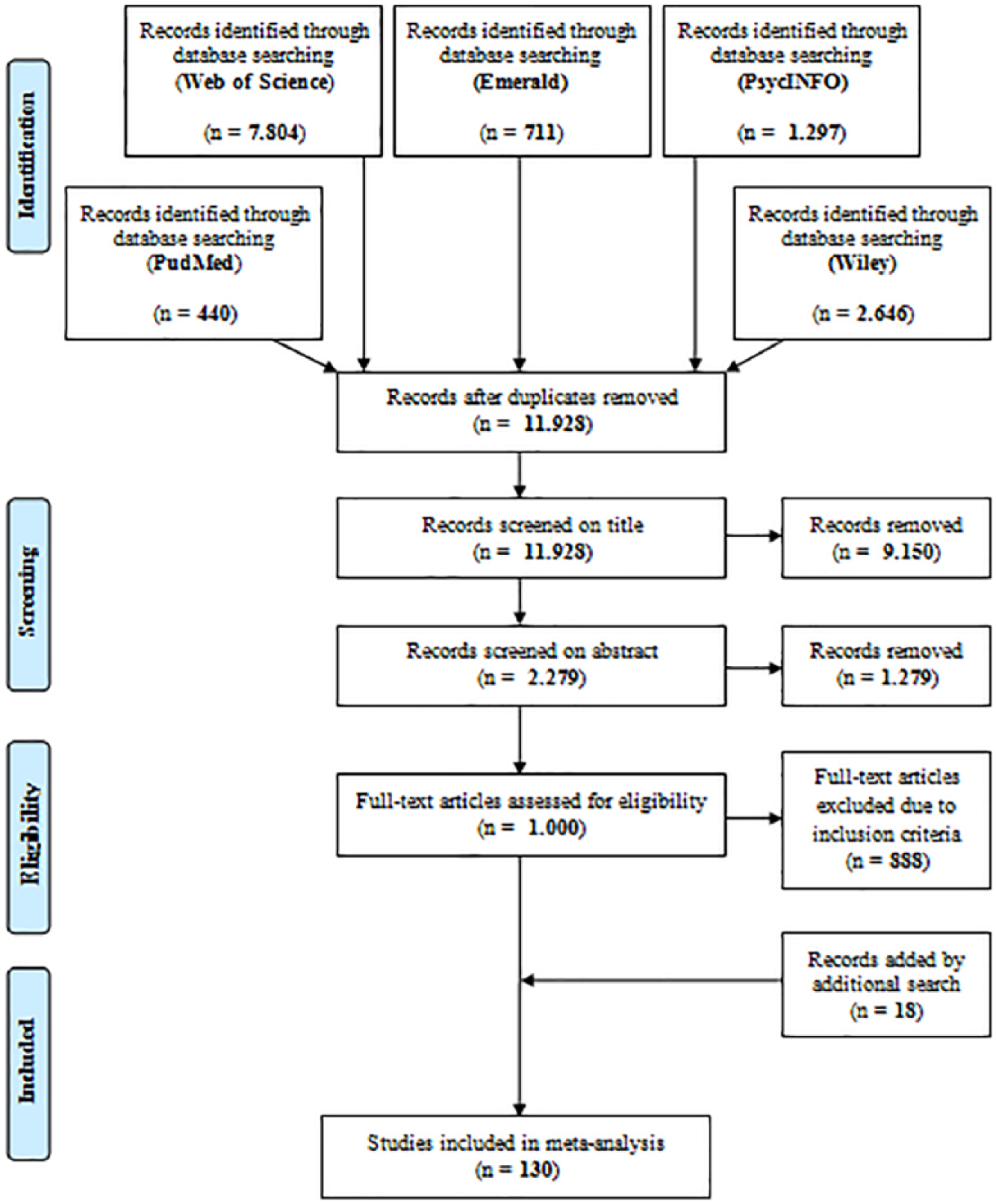
Prisma diagram illustrating the systematic literature review.
Literature Search
In January and February 2016, we systematically searched PubMed, Web of Science, Emerald, PsycINFO, and Wiley using the keywords “work engagement,” “employee engagement,” “job engagement,” “staff engagement,” “UWES,” and “Utrecht Work Engagement Scale.” In total, 11,928 studies were identified, which we integrated into the reference program Endnote. Although work engagement was introduced in 1990 by Kahn, the year of publication is in several cases not registered properly in the databases. All years were therefore considered as potentially relevant in our data collection. After the identification phase, we started the screening and selection phases.
In the screening and selection phase, we abided by five exclusion/inclusion criteria. First, we only included papers that use completely measured work engagement constructs with all three dimensions of the UWES. Several researchers recently dropped the absorption dimension of the UWES (Bakker, Albrecht, & Leiter, 2011). Removing this dimension is problematic since it diminishes its convergent and discriminant validity relative to other constructs such as organizational commitment (Saks & Gruman, 2014).
Second, we included papers that has an acceptable outcome variable of interest–typically these are studies that have dependent variables in regression analyses, which are influenced by work engagement. Third, we only included studies that analyzed the relationship between work engagement and its outcomes at an individual level. Some studies, for example, analyze the outcomes at the organizational level. These studies are excluded. Fourth, studies were excluded that did not provide the required information to analyze the relationships between work engagement and its attitudinal, behavioral, and performance outcomes (correlation coefficients, standard deviations, and sample sizes). The majority of meta-analyses compute the synthetic effect size using raw data based on zero-order bivariate correlation coefficients and its related standard deviation (Borenstein et al., 2009). The use of other forms of raw data such as regression coefficients is highly problematic, because the individual relations are corrected for other variables in the model (e.g., Borenstein et al., 2009; Schmidt & Hunter, 2014). Only studies that present a bivariate correlation table were therefore included. Important to state is that during this selection phase, it became clear that too little studies analyzed the job demands mentioned in the theoretical chapter to analyze these as additional moderators. However, these job demands are ingrained within sectors so the sector can provide a good proxy for these demands. Finally, for the purpose of this article, we also limited the analyses to papers written in English and which are peer-reviewed.
Due to the application of these selection criteria, we ended up with a preliminary sample of 112 eligible studies. Several authors of potentially relevant studies did not report specific information about the sectorial background of their respondents or the required statistics for conducting our analyses. We emailed 84 authors of whom 44 replied and 20 provided additional information. Based on the information provided by the authors, 12 additional articles were included in our sample. We then cross-checked the references listed in the studies included in our database, which yielded an additional six eligible studies. These six studies were not found in the initial search since the authors of these studies used, for example, other terms for the operationalization of work engagement (such as motivation). In total, thus, 130 studies were therefore included in further analyses (see Supplemental Appendix 1 on https://osf.io/76m29/ for an overview of all included studies).
Meta-Analytic Procedure
Variable coding
After identifying the studies, features about the study and each effect were coded. A coding sheet was developed by the first author and checked by the second author. The discussion about the coding scheme led to minor adjustments. As the coding of the main variables in this study was based on existing operationalizations, the coding procedure was rather straightforward (no abstraction in terms). It was therefore decided that the first author coded all 130 studies and the second and third author blindly and independently coded only 15 randomly chosen studies. The coding by the second and third author indeed showed no coding discrepancies, and thus, no problems occurred in the intercoder reliability.
First, several work engagement constructs are developed throughout the last two decades (Bailey et al., 2017). As mentioned in the theoretical section, The UWES was found to be the most widely adopted work engagement measure followed by other measures based on Kahn’s (1990) model of employee engagement (e.g., Harter, Schmidt, & Hayes, 2002; May, Gilson, & Harter, 2004; Rich, Lepine, & Crawford, 2010; Saks, 2006). Engagement scales based on Kahn’s model are applied in very few cases (Saks & Gruman, 2014) which made it impossible to include these scales. 1
Second, we coded core government organizations (including central, regional, and local government organizations) as public organizations, manufacturing and service organizations with a for-profit motive as private organizations, and hybrid organizations containing both private and public elements (including educational and health care organizations as well as semiautonomous agencies) as semipublic organizations. This classification of sector is not only theoretically the most accepted one (i.e., Bozeman & Bretschneider, 1994), but also the most empirically applied one (e.g., Allen et al., 2011; Anderson, 2012; Andrews et al., 2011; Blom et al., 2018; Lyons, Duxbury, & Higgins, 2006) which fits with the theoretical arguments made in our theoretical discussion.
Third, performance, behavioral, and attitudinal outcomes of work engagement were distinguished in this study. As mentioned before, this study adopts the widely adopted categorization of performance outcomes in in-role and extra-role performance (Bakker, 2011). Examples of in-role performance are task performance and job performance and examples of extra-role performance are organizational citizenship behavior and innovative work behavior.
Furthermore, work–life conflict and turnover intention are self-explanatory behavioral outcomes. In addition, we included all measures of workaholism that reflected the consensual conceptualization in the meta-analysis of Clark, Michel, Zhdanova, Pui, and Baltes (2016) about workaholism. The most often used scale is the Dutch Work Addiction Scale, which exists of two components–working excessively and working compulsively. The attitudinal outcome organizational commitment was operationalized based on all measures of commitment that reflected the conceptualizations of the study of Meyer and Allen (1991), and job satisfaction is also self-explanatory.
Mixed-effects models
The primary statistical technique used in this meta-analysis was mixed-effects modeling. A mixed-effects model assumes that the studies included in the meta-analysis are a random selection from a larger population of studies. This form of modeling takes sampling error into account and the variation in effect sizes due to variation in the effects across studies. In addition, mixed-effects modeling is specifically developed to take moderators into account. As we include sector as a moderator and have studies that we do not assume to be identical in their characteristics, mixed-effects modeling is especially applicable.
To calculate the meta-analytic effect sizes, the Pearson correlation coefficients of all the included studies were collected. We compared the effect sizes on the level of complete work engagement scales. In cases where studies presented the Pearson correlation coefficients of the three dimensions separately, we calculated composites. All items of the UWES and alternative scales are scored on a 7-point rating scale. Some studies used a deviating scale of a 5- or 6-point rating scale. To make the studies comparable, the means and standard deviations were converted into 7-point rating scales by applying the linear transformation procedure. After the conversion, the means and standard deviations were calculated for both the studies applying an alternative scale and studies applying the UWES.
After computing the composite scores of the dimensions work engagement, the mixed-effects models were run using the Metafor package for the statistical program R to synthesize the results (Viechtbauer, 2010). As is standard practice when comparing subgroups in a meta-analysis (Borenstein et al., 2009, p. 168), first the correlations for every subgroup (public, semipublic, and private sector) were estimated separately. Second, we tested the moderating influence of the categorical variable “sector” on the overall data set by performing Z tests (subgroup analyses), which automatically corrects for the variation in sampling sizes across studies. If the Z test is equal to or larger than 1.96, the difference is significant (p ≤ .05)
The last step involved the checking for publication bias, shown in the preference of journals to favor the publication of studies showing statistical significant results, which, in turn, could bias the meta-analytical findings (Stanley, 2008). Publication bias was assessed for every effect size by means of the Egger’s test of the intercept (Egger, Smith, Schneider, & Minder, 1997). If publication bias was found, Duval and Tweedies’ (2000) trim-fill analysis was applied to estimate the number of missing studies due to the suppression of the most extreme results on one side of the funnel plot.
Results
Preliminary Analysis
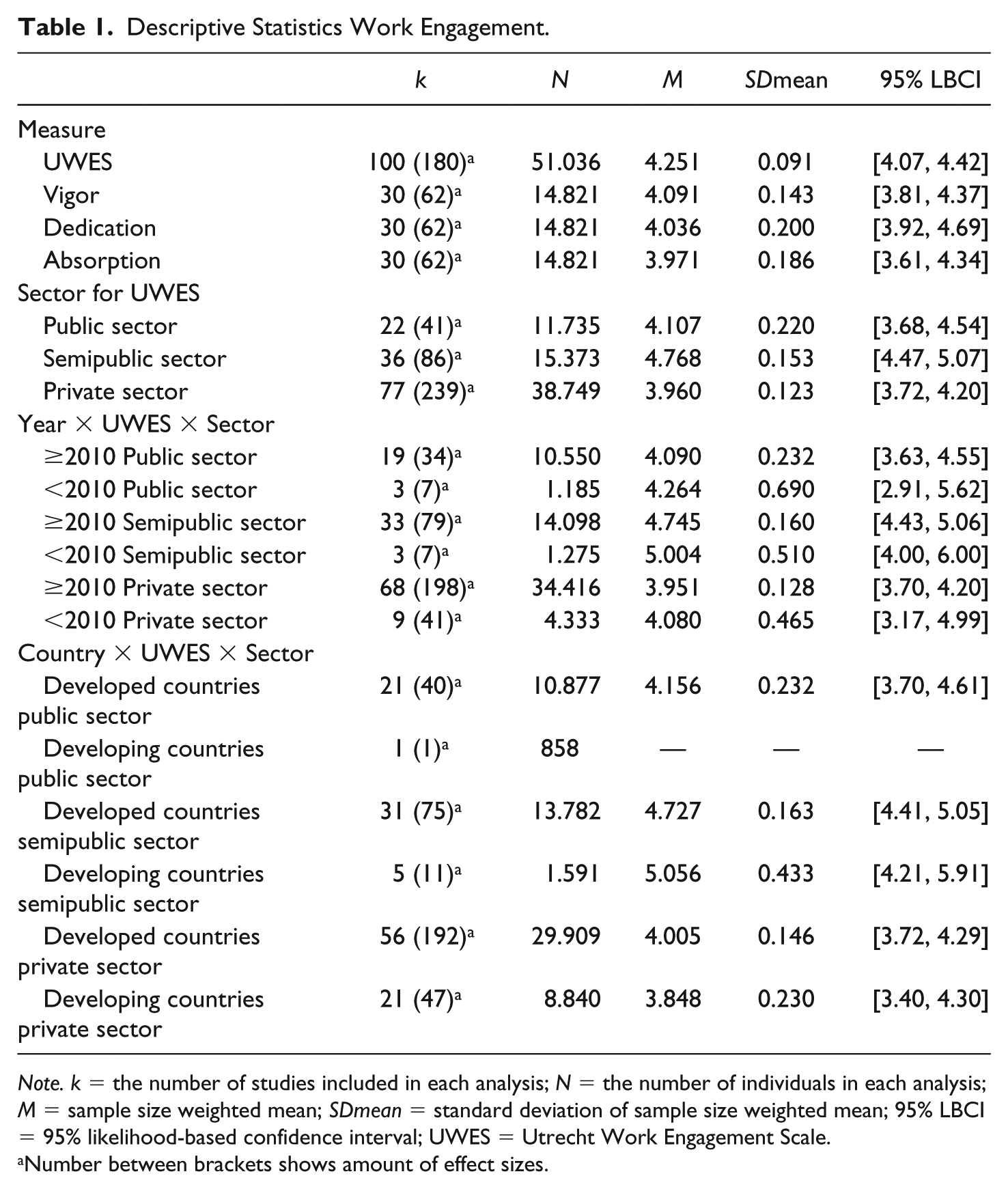
Our sample exists of 366 effect sizes in 130 studies. Table 1 presents the preliminary descriptive analysis.
Descriptive Statistics Work Engagement.
Note. k = the number of studies included in each analysis; N = the number of individuals in each analysis; M = sample size weighted mean; SDmean = standard deviation of sample size weighted mean; 95% LBCI = 95% likelihood-based confidence interval; UWES = Utrecht Work Engagement Scale.
Number between brackets shows amount of effect sizes.
Of the 130 studies, 100 studies used a composite UWES measure, while 30 studies analyzed the three dimensions separately. 22 studies (18.4%) measured work engagement in the public sector, 36 (25.7%) studies in the semipublic sector, and 77 studies (55.9%) in the private sector. Five of these studies applied the UWES to two samples of different sectors.
The bulk of the studies (88.9%) were conducted between 2010 and 2015. Respectively, 86.4% of the public sector studies, 91.7% of the semipublic sector studies, and 88.3% of the private sector studies were published in these last 5 years. Furthermore, workforces of 35 countries are represented in the studies. Of the 57 studies analyzing a sample from the public and/or semipublic sector, 51 were conducted in developed countries, five were conducted in developing countries, and one was conducted in both a developing and a developed country.
At the level of effect sizes, 50 effect sizes came from studies conducted in the public sector, 91 from the semipublic sector, and 253 from the private sector. In addition, 180 effect sizes used a composite measure of UWES, while 95 effect sizes measured vigor, 95 effect sizes measured dedication, and 95 effect sizes measured absorption. Twenty-eight effect sizes used a composite measure of an alternative scale.
The most interesting finding relates to the differences in the mean work engagement between sectors. The results show that the mean work engagement in the semipublic sector (M = 4.768) is significantly higher than the mean work engagement in the public sector (M = 4.107) and private sector (M = 3.960), respectively (p = .038 and p = .001, respectively).
Mixed-Effects Models
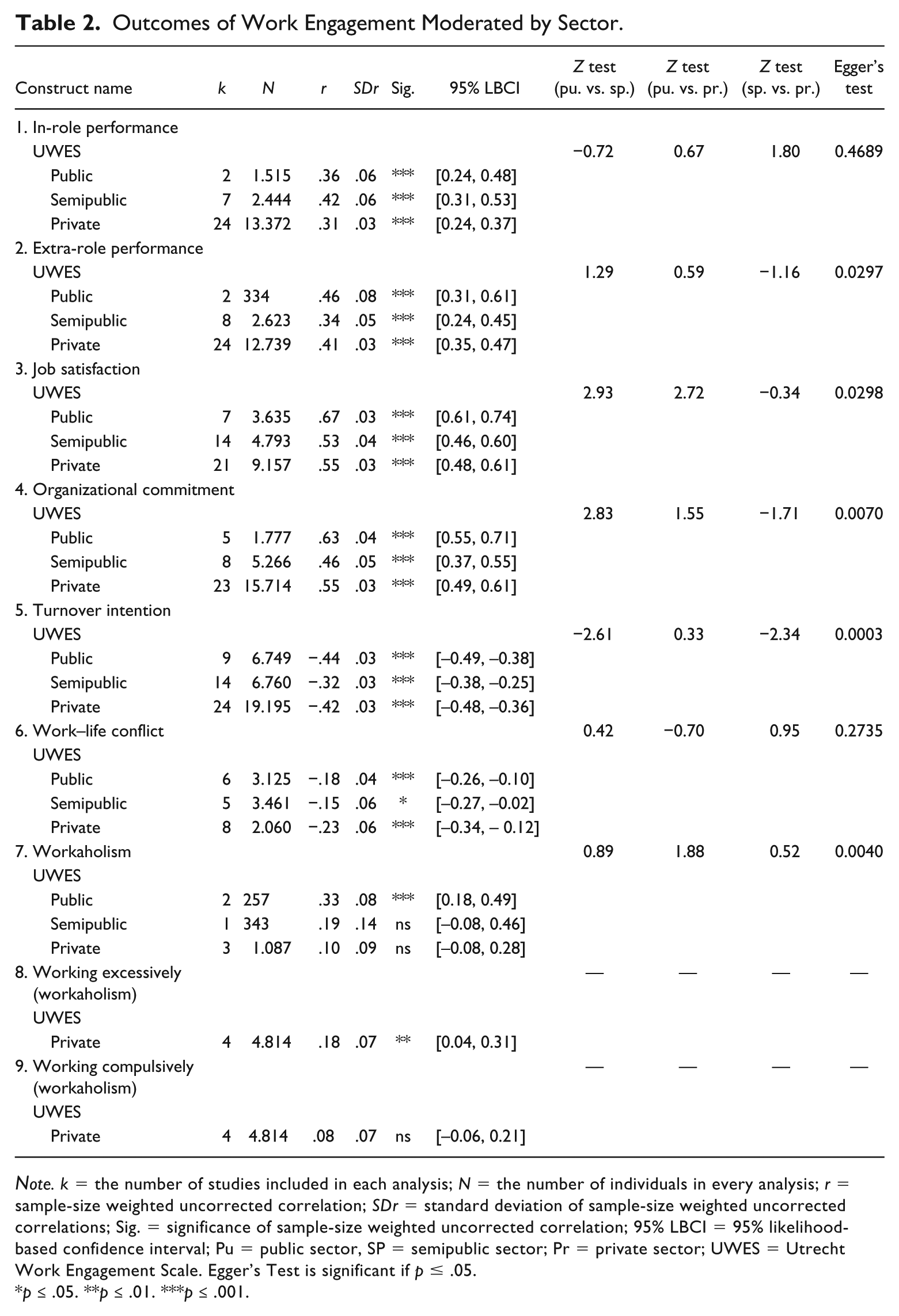
To investigate sectoral differences, separate bivariate models of the relationship between work engagement and its outcomes for each sector were calculated. Table 2 presents the models.
Outcomes of Work Engagement Moderated by Sector.
Note. k = the number of studies included in each analysis; N = the number of individuals in every analysis; r = sample-size weighted uncorrected correlation; SDr = standard deviation of sample-size weighted uncorrected correlations; Sig. = significance of sample-size weighted uncorrected correlation; 95% LBCI = 95% likelihood-based confidence interval; Pu = public sector, SP = semipublic sector; Pr = private sector; UWES = Utrecht Work Engagement Scale. Egger’s Test is significant if p ≤ .05.
p ≤ .05. **p ≤ .01. ***p ≤ .001.
As Table 2 shows, public sector studies analyzing the relationship between work engagement and performance outcomes are relatively underrepresented. However, the limited number of studies does show that work engagement is an important indicator of the in-role and extra-role performance of public and semipublic employees. Furthermore, Table 2 shows that the most noticeable significant sectoral differences can be found on the level of attitudinal outcomes (job satisfaction and commitment) and behavioral outcomes (workaholism and turnover intention).
Work engagement has a significantly higher positive relation with job satisfaction within the public sector (r = .67, 95% likelihood-based confidence interval [LBCI] = [.61, .74]) compared with the semipublic and private sector (r = .53, 95% LBCI = [.46, .60], p = .003 and r = .55, 95% LBCI = [.48, .61], p = .007, respectively). The confidence intervals of the public sector compared with the semipublic and private sector do not overlap. Work engagement also has a significantly higher positive relation with organizational commitment in the public sector (r = .63, 95% LBCI = [.55, .71]) compared with the semipublic sector (r = .46, 95% LBCI = [.37, .55], p = .005).
At the level of behavioral outcomes, no significant sectoral differences were found in the negative relationship between work engagement and work–life conflict. However, although the effect of work engagement on work–life conflict does not differ between sectors, the effect of work engagement on turnover intention and workaholism does show difference between sectors. Work engagement has a significantly higher negative relation with turnover intention within the public sector (r = −.44, 95% LBCI = [–.49, –.38]) and private sector (r = −.42, 95% LBCI = [–.48, –.36]) than within the semipublic sector (r = −.32, 95% LBCI = [–.38, –.25], p = .009, and p = .01, respectively). In the case of workaholism, only within the public sector a significant positive relation with work engagement is found (r = .33, 95% LBCI = [.18, .49], p = .000). This relationship is in contrast not significant within the private and semipublic sector (r = .10, 95% LBCI = [–.08, .28], p = .257 and r = .19, 95% LBCI = [–.08, .46], p = .170). As Table 2 shows, the confidence intervals of the relationships between work engagement and workaholism in the private and semipublic sector contain zero. It is in other words uncertain whether the relationship between work engagement and workaholism in the private and semipublic sector is either positive or negative.
In the last column of Table 2, the Egger’s test of publication bias shows various significant biases. A publication bias seems to be present in case of extra-role performance, job satisfaction, organizational commitment, turnover intention, and workaholism. The additional trim-fill analysis estimates that nine additional correlations need to be imputed on the right hand side of the funnel plot of extra-role performance to correct the symmetry. In case of workaholism, one additional correlation needs to be imputed on the left hand side to make the funnel plot more symmetric. The trim-fill analyses of the remaining variables are more ambiguous. Interestingly, by studying the funnel and forest plots, the studies which provide for more asymmetry are from various sectors. It can therefore be concluded that although there might be a publication bias, this does not depend on the sector investigated.
Discussion
This meta-analysis compared the effects of work engagement on its attitudinal, behavioral, and performance outcomes. Until today, the psychological construct work engagement received little attention within semipublic and public sector research. We argue that work engagement is an important addition to current public administration and public HRM research both theoretically and practically.
Theoretically, we extend public administration and public HRM theories by adding the eudaimonic well-being construct work engagement to the more often studied hedonic attitudes of public servants including commitment and satisfaction (Borst, 2018; Tummers et al., 2018). Inherently, with the introduction of the psychological concept work engagement, its related psychological theories including the JD-R theory and COR theory are also integrated in the existing public HRM literature. Practically, public and semipublic personnel managers need measures that indicate the rate of energy and proactivity of (semi)public servants (reflected in work engagement) next to measures that merely indicate the calmness and contentedness of these employees (reflected in satisfaction and commitment). Work engagement is such a factor which is expected to be the most robust determinant of employee performance (just as it is in the private sector), and is positively related to good service provision, the improvement of client satisfaction, and quality of service (Vigoda-Gadot et al., 2013). By studying the effects of work engagement, we can therefore suggest to public and semipublic personnel managers whether it is indeed a robust indicator of performance and inherently something which need to be stimulated.
Our findings do indicate that differences are noticeable in the correlations between work engagement on the level of attitudinal outcomes (job satisfaction and commitment) and behavioral outcomes (workaholism and turnover intention) as well as in the mean work engagement itself. Unfortunately, the relationships between work engagement and performance outcomes are less certain due to the limited studies analyzing these relationships within the public sector. However, as expected work engagement is a very important predictor of the in-role and extra-role performance of public and semipublic employees.
According to the JD-R theory in combination with COR theory, the effects of work engagement could either be hindered or challenged by job demands. We assumed that organizational-level job demands typically ingrained in the public and, to a lesser extent, the semipublic sector (i.e., formalization & red tape, political control, and goal ambiguity) could increase or decrease the effect on performance, attitudinal, and behavioral outcomes. In other words, two mechanisms could provide for variability in the relationship between work engagement and outcomes across sectors: (a) the rate of job demands and (b) its hindering or challenging properties dependable on sector.
The results show that engaged public servants are significantly more satisfied with their job than semipublic and private employees and more committed to the organization than semipublic employees. These findings may indicate that the abovementioned job demands are seen by public servants as challenging job demands in line with the findings of Borst et al. (2017). It would also explain why workaholism is only positively correlated with work engagement in the public sector. Due to the additional challenges of the abovementioned job demands, engaged employees try to find additional ways to deal with these challenges which lead to excessive and compulsive behavior. In addition, it would also explain why engaged semipublic employees experience the lowest negative correlation with turnover intention as these employees experience the abovementioned demands most often as hindering instead of challenging. Furthermore, as the rate of these job demands experienced by private sector employees is the lowest, it could also explain why the correlation is significantly more negative in the private sector than in the semipublic sector.
A final, unexpected yet important, result mentioned above is the relatively much higher mean work engagement of semipublic employees relative to public and private employees. An alternative explanation using the JD-R theory in combination with the COR theory can explain this result. While this study mostly focused on job demands and job resources of the JD-R and COR theories, the JD-R theory recently also introduced personal resources which can be defined as the psychological characteristics or aspects of the self that are generally associated with resilience and refer to the ability to control and impact one’s environment successfully (Bakker, 2015). While several studies introduced work engagement predominantly as a job resources (Gorgievski & Hobfoll, 2008; Kane-Frieder et al., 2014; Shantz et al., 2016), this conceptualization shows that work engagement could also be framed as a personal resource. It is an energetic resource of the self that reflects the meaningfulness and purposefulness felt by employees.
When work engagement is framed as a personal resource reflecting meaningfulness and purposefulness, it makes sense that the work engagement of semipublic employees is much higher than the work engagement of private and public employees. Lyons et al. (2006) demonstrate that the semipublic sector including among others teachers and health care personnel value the purposefulness of their job even more than public employees, who value it more than private employees. A reason might be that especially these types of semipublic employees often see their profession as a real calling (Hakanen, Bakker, & Schaufeli, 2006). In other words, semipublic personnel (i.e., educational personnel and health care personnel) might see their work as a calling to educate children/students and heal citizens (Borst & Lako, 2017) and inherently find their job intrinsically meaningful and purposeful (important aspects of work engagement). As these two groups of organizations are overrepresented in semipublic sector research related to work engagement, it could explain why work engagement is the highest among semipublic employees.
In addition to our main results, this meta-analysis shows two interesting findings. First, more than 90% of the studies in this meta-analysis are published in the last 5 years. The growth of attention for work engagement demonstrates the embeddedness in this topical debate. Second, the type of journals in which the selected studies are published reflects the lack of attention for the JD-R theory of work engagement in public administration. Although 44% of the studies used samples of public and/or semipublic organizations, barely any study is published in public administration journals (cf. Borst et al., 2017). However, the results present enough reason to contextualize the JD-R theory in public administration, especially, since work engagement is the highest in semipublic organizations but also because the variability between public sectors are visible as well as the important influence of work engagement on attitudinal, behavioral, and performance outcomes.
Relatedly, we can give confirmation to public personnel managers that work engagement is a very important measure of employee well-being as it leads to high job satisfaction, high commitment, low turnover intention, and high performance. The focus on this energetic, proactive resource of (semi)public is especially important due the recent pressures to perform better with fewer resources, an increasing critical public opinion, and increasing emotionally demanding environments. It is not for nothing that among others, the U.S. congress exerts pressure on public organizations to increase employee engagement (Byrne, Hayes, & Holcombe, 2017). Public personnel managers could therefore aim on the improvement of the (perceived) meaningfulness of the jobs (reflected in work engagement) by analyzing the other job demands, job resources, and personal resources mentioned by the JD-R theory used in this study. Other public administration studies show, for example, that the personal resource public service motivation (PSM) can play an important part in the stimulation of work engagement (i.e., Bakker, 2015; Borst, 2018; Noesgaard & Hansen, 2018). In addition, these studies also show that work engagement can be stimulated by the enactment of job resources such as the assignment of interesting and challenging work that provides (semi)public employees with opportunities to use various skills, autonomy/job craftment, and performance feedback (Albrecht et al., 2015). However, public personnel managers, especially within the public sector, should be aware of the possible darkside of work engagement, namely workaholism. Public HR- and line managers should therefore keep trying to preserve the balance between demands and resources as also suggested by the JD-R theory.
Although this cross-sectoral meta-analysis provides interesting results and suggestions, such meta-analyses, as does this one, also have their limitations. First, only a few studies analyzed the relationship between work engagement and performance outcomes within the public sector and semipublic sector. In contrast, many studies analyzed this relationship in the private sector. Despite the recent attention from (semi)public organizations to improve the performance of public servants, the scientific public management research is still limited. This has partly to do with the nature of the work engagement research. Work engagement is developed within the realm of psychology and psychologists are less interested in the context of a working population than public administration scholars. Many scholars therefore have employees from several sectors in their studies which they are not able to split into public, semipublic, and private sector samples. Some first results show that work engagement indeed has a positive effect on the performances of public servants but future research might specifically focus on the question whether it leads to typical objective public sector performance measures including good service provision, the improvement of client satisfaction, and quality of service. The usage of these objective measures also overcomes the problem of the same rater source. Most studies use the same rater source which could lead to common method bias. This leads to overestimating the correlation between work engagement and individual performance.
Second, this study only uses the UWES to measure work engagement. A stream of researchers started to criticize this scale due to various reasons including the limited theoretical body and discriminant validity of some of its indicators (Macey & Schneider, 2008; Saks & Gruman, 2014). This criticism stimulated them to develop alternative work engagement scales. Although this study developed more theoretical support by placing it in larger psychological research streams of well-being, future research might take these other scales and inherent dimension and scaling into account. Unfortunately, these scales have received little empirical attention so far and were accordingly not included in this study.
Third, although we argue that variability in typical job demands ingrained in the public and semipublic sector may lead to differences across sectors, we were not able to empirically test for these moderation effects. However, Blom et al. (2018) also used such crude measures of sector to analyze the effects of HRM practices on performance across the same sectoral division as applied in this study. We affirm the proposed suggestion that future research should therefore aim at the inclusion of psychometrically sound measures to investigate possible moderation effects of sector differences between work engagement and its outcomes. This research would also be relevant in general because it can further validate the COR theory and JD-R theory in the public sector context.
Finally, we were also unable to include other possible moderating effects of personal- and job resources including PSM. Similar to work engagement, PSM is also a construct which is focused on the measurement of feelings of meaningfulness and significance (eudaimonia) of employees. Bakker (2015) argues, for example, that work engagement and public service motives as incentives might work in tandem to produce important organizational outcomes. The JD-R theory indeed suggests that personal resources might also moderate the relation between work engagement and employee outcomes. Furthermore, there were too few studies in every sectoral subgroup to control for additional factors such as country characteristics. Bailey et al. (2017) argue in their literature review that analyzing sector and country differences are the most interesting future research endeavors in work engagement research. Although we studied the first research endeavor, no reliable second-order moderation analyses could be carried out to study the second endeavor as well. Especially due to the small number of studies with effect sizes in the public-sector context (e.g., two studies for in-role and extra-role performance, respectively), but also even in case of relations with more studies (e.g., the relationship between work engagement and job satisfaction within the public sector only exists of Anglo-Saxon countries). At the same time, these findings are an opportunity for future research. The overall view of all work engagement studies in this study shows that research into work engagement is mainly carried out in the developed countries and far less in developing countries. We encourage researchers to study the work engagement–outcomes relationships in developing countries (Middle-Eastern, African, Southern-Asian) so we can determine whether the presumed effects persist in different countries.
In sum, this meta-analysis should therefore primarily be seen as a first comprehensive overview of the work engagement processes in different sectoral contexts which are of interest to analyze, but future research is necessary to deepen out these processes. Especially, because our study shows that sectoral context plays an important role in several of the relationships between work engagement and employee outcomes.
Supplemental Material
Appendix_1_Meta_Outcomes – Supplemental material for The Attitudinal, Behavioral, and Performance Outcomes of Work Engagement: A Comparative Meta-Analysis Across the Public, Semipublic, and Private Sector
Supplemental material, Appendix_1_Meta_Outcomes for The Attitudinal, Behavioral, and Performance Outcomes of Work Engagement: A Comparative Meta-Analysis Across the Public, Semipublic, and Private Sector by Rick T. Borst, Peter M. Kruyen, Christiaan J. Lako and Michiel S. de Vries in Review of Public Personnel Administration
Footnotes
Declaration of Conflicting Interests
The author(s) declared no potential conflicts of interest with respect to the research, authorship, and/or publication of this article.
Funding
The author(s) received no financial support for the research, authorship, and/or publication of this article.

Supplemental Material
Supplemental material for this article is available online.
Notes
Author Biographies
References
Supplementary Material
Please find the following supplemental material available below.
For Open Access articles published under a Creative Commons License, all supplemental material carries the same license as the article it is associated with.
For non-Open Access articles published, all supplemental material carries a non-exclusive license, and permission requests for re-use of supplemental material or any part of supplemental material shall be sent directly to the copyright owner as specified in the copyright notice associated with the article.
