




Abstract
For a long time, public and semipublic organizations have borrowed Human Resource Management (HRM) practices from the private sector to enhance employee performance. Numerous scholars argue, however, that business-like practices are less effective outside the private sector context because of sector-specific conditions. Based on the ability–motivation–opportunity model, we performed a three-level meta-analysis to investigate differences in effects of HRM practices on individual performance across sectors. Our study shows that significant differences exist between sectors, but the expectation that the effects of HRM practices are largest in the private sector and smallest in the public sector is not supported. More specifically, the differences between the public, semipublic, and private sector are not straightforward. In this respect, we encourage future scholars to further examine these differences.
Keywords
Practitioners in public and semipublic sector organizations are obsessed by the private sector for inspiration on how to enhance employee performance (Pollit & Bouckaert, 2011; Shim, 2001). In particular, the rise of the New Public Management ideology in the 1980s brought about a general feeling that adopting business-like practices stimulates organizational efficiency and effectiveness (Alford & Hughes, 2008). Logically, as business administration scholars have shown that the use of Human Resource Management (HRM) practices—like performance-based compensation and merit-based promotion—has a significant positive impact on business performance (Combs, Liu, Hall, & Ketchen, 2006; Delaney & Huselid, 1996; Jiang, Lepak, Hu, & Baer, 2012), HRM practices became ideal candidates for adoption in the public and semipublic sector as well (Gould-Williams, 2003; Truss, 2008).
Numerous scholars, however, have contested whether HRM practices demonstrate similar beneficial effects in the public and semipublic sector in comparison with the private sector (e.g., Brown, 2004; Burke, Noblet, & Cooper, 2013). In particular, empirical studies have highlighted characteristics specific to the public and semipublic sector that are likely to result in lower effects of HRM practices on individual performance, including relatively higher levels of goal ambiguity, the presence of stricter regulations compared with private sector organizations, and the specific work motivation of public sector workers (e.g., Brewer & Walker, 2013; Daley & Vasu, 2005). That is to say, what works for business environments does not necessarily have to do so for other types of working organizations.
The goal of this study is to systematically analyze whether the effects of HRM practices on individual performance differ across the public, semipublic, and private sector using a meta-analytical approach. In line with previous research, we classify manufacturing and service organizations with a for-profit motive as private organizations, core government organizations as public organizations, and hybrid organizations containing both private and public elements (such as semiautonomous agencies, hospitals, and universities) as semipublic organizations (e.g., Coursey & Rainey, 1990; Lan & Rainey, 1992; Wittmer, 1991). To compare the effects of HRM practices across these different types of sectors, we draw on the ability–motivation–opportunity (AMO) model of individual performance (Appelbaum, Bailey, Berg, & Kalleberg, 2000; Boxall & Macky, 2009). According to the AMO model, to enhance individual performance, HRM practices should be designed to stimulate an employee’s ability, motivation, and opportunity to perform.
Although a handful of studies has compared the impact of specific HRM practices between private and public sector organizations (Stavrou, Charalambous, & Spiliotis, 2007; Vanhala & Stavrou, 2013), a systematic cross-sectoral comparison of the effects of HRM practices has not been undertaken yet. In this respect, a meta-analysis is a powerful approach to aggregate mixed findings from previous studies to estimate a general effect. Moreover, meta-analyses are also able to generate results that go beyond the scope of a single study. In our study, the main objective is to add to the debate on the potential impact of contextual characteristics on the HRM–performance link (e.g., Boselie, 2010; Jiang et al., 2012; Paauwe, 2009; Teo & Rodwell, 2007; B. E. Wright, 2004). Also, this scholarly work is intended to provide evidence-based advice on how to enhance individual performance for management and HRM professionals in the public and semipublic sector who look for inspiration in the private sector.
This article is structured as follows. First, we present our hypotheses on the relationship between HRM practices and individual performance taking sectoral differences into consideration. Second, we describe the methodology, that is, the process of identification and selection of studies, the coding procedure, and the technical details of the meta-analysis. Third, we present the outcomes of our meta-analysis. Finally, we discuss the implications of our study and provide suggestions for future research.
Theory
AMO Model and Individual Performance
The AMO model focuses on the effects of HRM practices on performance at the individual level of analysis (Appelbaum et al., 2000; Boselie, Dietz, & Boon, 2005). Previous literature has defined individual performance in terms of behaviors and actions that have an impact on the organization’s goals and are under the control of the individual (Rotundo & Sackett, 2002; P. M. Wright, Gardner, & Moynihan, 2003). These behaviors can be either positive or negative and are often differentiated between in-role and extra-role performance. In-role performance—also referred to as task performance or job-specific task proficiency (see the review by Koopmans et al., 2011, for more specific information)—is defined as doing what one is hired to do. Extra-role performance—also referred to as contextual performance or organizational citizenship behavior (OCB; see Koopmans et al., 2011)—is defined as performance that goes beyond the call of duty for the good of the organization.
Building on social exchange theory, the AMO model posits that if employees have the ability, motivation, and opportunity to do their job, they will demonstrate increased effort, which, in turn, will result in a higher performance. Employees make inferences about the intentions of the organization by interpreting its practices (Boselie, 2010). Based on these inferences, employees will feel the obligation to reciprocate with positive work attitudes and behaviors. HRM practices that are aimed to enhance employees’ abilities, motivation, and opportunities are thought to be viewed as beneficial by these employees and provide them the incentives to perform (D. G. Allen, Shore, & Griffeth, 2003; R. Takeuchi, Lepak, Wang, & Takeuchi, 2007). The ability dimension is defined as employees having the skills, knowledge, and abilities to perform. Furthermore, the motivation dimension is defined as employees’ willingness and drive to perform. Finally, the opportunity dimension refers to employees having the responsibility, authority, and opportunity to solve problems and make decisions (Appelbaum et al., 2000).
Following the AMO model, HRM practices can be classified into ability-enhancing, motivation-enhancing, and opportunity-enhancing practices (Lepak, Liao, Chung, & Harden, 2006). Ability-enhancing HRM practices focus on increasing employee knowledge, skills, and abilities. Examples include sensitive selection and comprehensive training. Motivation-enhancing practices aim to increase employee motivation and include practices such as contingent rewards, performance management, and internal promotion opportunities. Opportunity-enhancing practices focus on employee participation and empowerment and typical examples are direct participation, job design, and team working.
Although previous research has demonstrated positive effects of all three types of HRM practices in the light of employee performance, differences in effects depending upon the type of HRM practices are to be expected (e.g., Boselie, 2010; Gardner, Wright, & Moynihan, 2011; Jiang et al., 2012; Messersmith, Patel, Lepak, & Gould-Williams, 2011; Mostafa & Gould-Williams, 2014). For instance, in her study of public sector employees in the Netherlands, Vermeeren (2013) found that ability-enhancing practices consistently showed a higher effect on job satisfaction in comparison with motivation- and opportunity-enhancing practices. Also, motivation-enhancing practices showed a lower effect on job satisfaction. These findings are in line with Boselie (2010), who found that motivation-enhancing practices have a weaker effect on affective commitment and OCB than ability-enhancing practices and opportunity-enhancing practices. Furthermore, opportunity-enhancing practices were stronger related to OCB than ability-enhancing practices.
Thus, research using the AMO model found significant effects of specific HRM practices on individual performance as well as variations between practices. Therefore, it is important to formulate hypotheses not only about the effect of HRM practices on individual performance in general but also for the three dimensions separately.
Public and Semipublic Sector Characteristics Affecting the Impact of HRM Practices
Based on the extant literature in this scholarly field, we argue that differences in effects of HRM practices on individual performance across sectors stem from the variety in organizational goal ambiguity, personnel constraints, and employee motivation (Brewer & Walker, 2013; Perry, Mesch, & Paarlberg, 2006; Rainey, 2009; Rainey & Jung, 2010). Using the private sector as the baseline, in the next section, we elaborate on how this variety is likely to result in differences in the effects of HRM practices on individual performance across the three distinguished sectors.
Organizational goal ambiguity
Organizational goal ambiguity is defined as “the extent to which an organizational goal or set of goals allows leeway for interpretation, when the organizational goal represents the desired future state of the organization” (Chun & Rainey, 2005, p. 2). Ambiguous goals lower the effect of HRM practices on individual performance (Fernandez & Moldogaziev, 2010). For example, previous research indicates that for training to be effective, training objectives should be aligned with organizational goals (Tannenbaum & Yukl, 1992). Within the public sector, organizational goals are considered to be less tangible, harder to measure, more diverse, and often more conflicting compared with ones in the private sector (Rainey & Jung, 2010). Consequently, it is harder to design effective training programs in public organizations. In a similar vein, it is more difficult to develop sound incentive schemes in the public sector (Perry et al., 2006). As extrinsic rewards are often linked to achieving concrete goals, higher goal ambiguity within public organizations complicates the reward process.
In contrast to the public sector, empirical research on goal ambiguity in the semipublic sector is limited. We argue that organizational goal ambiguity is lower in semipublic organizations in comparison with public sector ones. The relatively high level of organizational goal ambiguity in public organizations is linked to the higher number of tasks these organizations carry out. Instead, semipublic organizations are often single purpose organizations (Verhoest, Van Thiel, Bouckaert, & Laegreid, 2012) and, hence, are expected to have less organizational goal ambiguity (Jung, 2011). Building on the logic that organizational goal ambiguity lowers the effectiveness of HRM practices, we postulate that the effects of HRM practices are higher in the semipublic sector in comparison with the public sector yet lower than in the private sector.
Personnel constraints
Besides a higher degree of organizational goal ambiguity, personnel constraints have been found to be more prevalent in the public sector, which, in turn, are expected to attenuate the effects of HRM practices (Rainey & Chun, 2007). Political accountability, in the absence of markets as sources for incentives, often involves implementation of external governmental control by means of formal personnel constraints. As a result, the limited discretion of public managers to hire and discharge employees affects their ability to adopt certain HRM practices, such as (non)financial incentives, promotion opportunities, and employee exit management (Brewer & Walker, 2013; Weibel, Rost, & Osterloh, 2010). In other words, public sector managers have less power to manage their subordinates than their counterparts in the private sector do (Rainey, 2009). In a similar way, public managers experience difficulties in implementing HRM practices to empower employees,—that is, to provide them with the freedom and flexibility to act autonomously (Fernandez & Moldogaziev, 2010)—due to higher levels of formalization. In this respect, HRM practices such as participative decision making and employee involvement are expected to be less effective in the public sector.
Analogously to the lack of research on goal ambiguity, there is a serious gap of empirical research examining personnel constraints in the semipublic sector in comparison with other sectors. A few exceptions are the studies of Coursey and Rainey (1990) and Lan and Rainey (1992), who studied perceptions of personnel system constraints in public, semipublic, and private sector organizations. Both empirical studies show that public and semipublic organizations are comparable, yet not identical, on aspects of personnel rules and authority with private organizations. For example, semipublic organizations appear to be more similar to private organizations with respect to flexibility in hiring practices and perceptions of the presence of unnecessary rules. These results indicate that it is more likely for organizations to fully adopt HRM practices in the semipublic sector than in the public sector, herewith increasing their effectiveness.
Employee motivation
Scholars argue that public sector employees have distinct values, motives, and attitudes that may influence the effectiveness of HRM practices (Perry et al., 2006). In general, employees in the public sector are supposed to have a higher level of intrinsic and altruistic motivation than employees in the private sector (Rainey & Chun, 2007). In other words, the motives for employees to work in public sector organizations are generally based on their personal values or desire to serve a public cause instead of extrinsic reasons. HRM practices such as pay-for-performance rely heavily on monetary incentives to motivate employees and mainly focus on extrinsic motivation. This focus likely does not provide a good mechanism to motivate employees who are mostly intrinsically driven (Weibel et al., 2010).
There is a lack of research examining motivational differences in the public and semipublic sector. Semipublic organizations carry out public tasks but may operate under private sector conditions (Van Thiel, 2012). Therefore, it could be argued that both intrinsic and extrinsic motivational aspects are present in the semipublic sector (Wittmer, 1991). As a result, HRM practices aimed at extrinsic rewards are assumed to be more effective in the semipublic than the public sector.
Hypotheses
Given the fact that public organizations score relatively higher on the dimensions of organizational goal ambiguity, personnel constraints, and intrinsic motivation in comparison with private organizations, and semipublic organizations lie somewhat in between the two types of sectors as regards the scoring on these dimensions, we hypothesize the following:
Method
Search Strategy
To identify relevant effect sizes, we searched for useful empirical studies during November and December 2015. No limit was set on the year of appearance, because all studies were considered as potentially relevant. See Figure 1 for the flow chart of our study selection process.
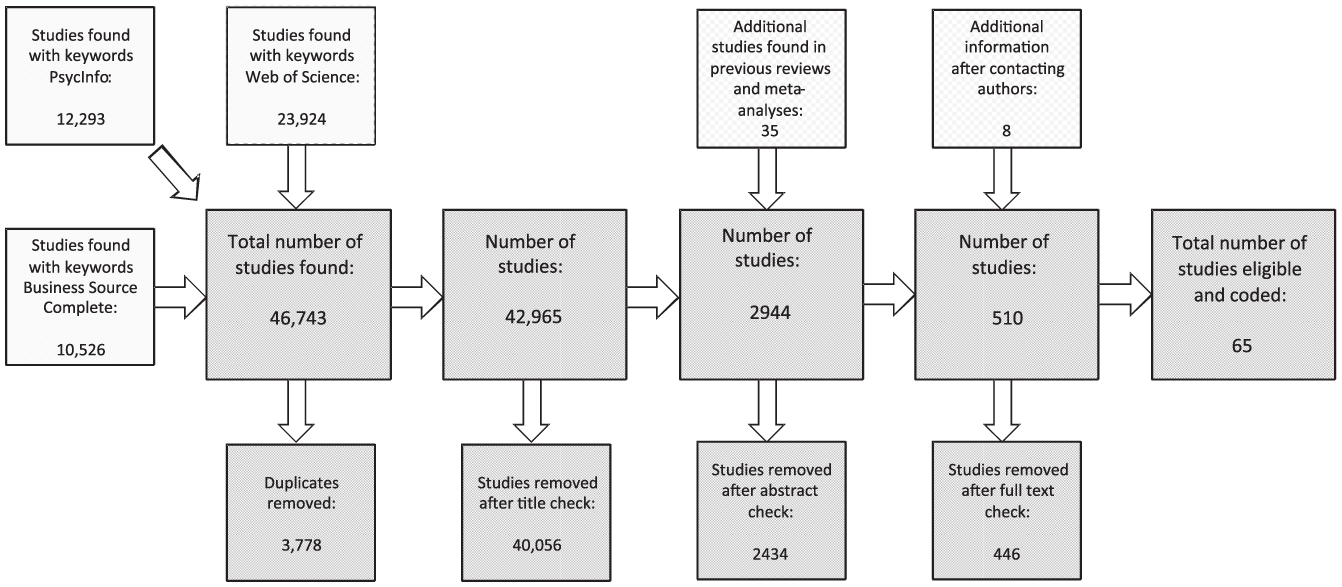
Identification of relevant studies.
We searched the Business Source Complete, PsycINFO, and Web of Science databases because of their complementary focus. Search strings were created by combining keywords for HRM practices with keywords for individual performance using the AND term. For HRM practices, keywords were “HRM,” “human resource,” “HR practice,” “HR policy,” “HPWP,” “high performance work practice,” “personnel practices,” and “personnel policies.” For individual performance, keywords to identify in-role performance were “task performance,” “in-role behavior,” and “effort,” whereas the keywords used to identify extra-role performance were “contextual performance,” “extra-role behavior,” “discretionary behavior,”“organizational citizenship behavior,” “helping behavior,” “knowledge-sharing behavior,” “creative behavior,” “innovative behavior,” and “proactive behavior.” Furthermore, the following general keywords for individual performance were used: “employee performance,” “individual performance,” “work performance,” “job performance,” and “employee behavior.” In total, 42,965 potentially useful studies were identified using these keywords.
In addition, we checked the reference lists of several reviews that focused on the link between HRM and individual performance (Boselie et al., 2005; Combs et al., 2006; Jiang et al., 2012; Kooij, Jansen, Dikkers, & De Lange, 2010; Rabl, Jayasinghe, Gerhart, & Kuhlmann, 2014; Subramony, 2009; Van De Voorde, Paauwe, & Van Veldhoven, 2012). Identification of possibly relevant studies in these reference lists was based on its title. This check of reference lists resulted in 35 additional studies. However, as the additional studies did not meet the inclusion criteria, none of these was eventually included in the meta-analysis.
Inclusion Criteria
Only studies that met the following six criteria were included in our meta-analysis. First, studies had to provide correlations for the relationship between individual HRM practices or AMO-based HRM practices, on one hand, and individual performance, on the other hand. We did not differentiate between studies using self-rated or other-rated measures as long as individual-level data were provided. Studies that focused on the relationship between HRM practices and organizational performance (e.g., M. R. Allen, Ericksen, & Collins, 2013) or on the effects of HRM practices on aggregated individual performance (e.g., Teo, Le Clerc, & Galang, 2011) were excluded. Next, only studies that examined the availability or use of HRM practices were included, excluding studies that examined, for example, preferences of HRM practices (e.g., Lee, Iijima, & Reade, 2011). Moreover, studies using intensity measures as well as yes/no measures of HRM practices were included. Third, only studies that provided organization-specific information needed to test our research hypotheses were included. Consequently, several studies were excluded because they combined different sectors in their analysis (e.g., Pare & Tremblay, 2007). Fourth, only studies that provided the necessary statistical information to perform our meta-analysis (i.e., correlation coefficients and sample sizes) were included. Fifth, in case a sample was used in multiple studies, only the study that provided the most information was included. If multiple studies provided the same information, the oldest study was seen as the “original” study, while subsequent studies were seen as “duplicates.” Therefore, only the oldest study was included. Finally, due to language barriers and, hence, possible misinterpretation of study findings, only studies that were published in English were included. In the end, 65 articles were selected and coded.
Coding Procedure
In addition to the main variables of interest, study characteristics were coded using a coding scheme developed by the first author (see Appendix A). The coding scheme was cross validated by the other three authors, who independently from one another coded one single study. After minor adjustments in the coding scheme, the first author coded all remaining studies. “Method” and “Results” sections of the different included studies were the primary sources of information during the coding process. In case crucial information was missing as indicated in the inclusion criteria, the corresponding author of the empirical work was contacted to obtain the required data. Of the 65 coded studies, eight studies were included after having requested and received additional information from the authors (Abstein, Heidenreich, & Spieth, 2014; Amayah, 2013; Gould-Williams, 2003; Gould-Williams & Mohamed, 2010; Knies & Leisink, 2014; Mostafa & Gould-Williams, 2014; Mostafa, Gould-Williams, & Bottomley, 2015; Wei, Han, & Hsu, 2010). From another 47 studies, we requested, but did not receive, crucial information. To assess the intercoder reliability, the second author independently coded 20 randomly selected studies. Only a few small differences were found, which were resolved after discussion between the two authors. For example, some studies provided slightly different sample sizes in the method part and in the correlation table, which lead to a difference between the two coders.
Operationalization of Variables
HRM practices according to AMO model
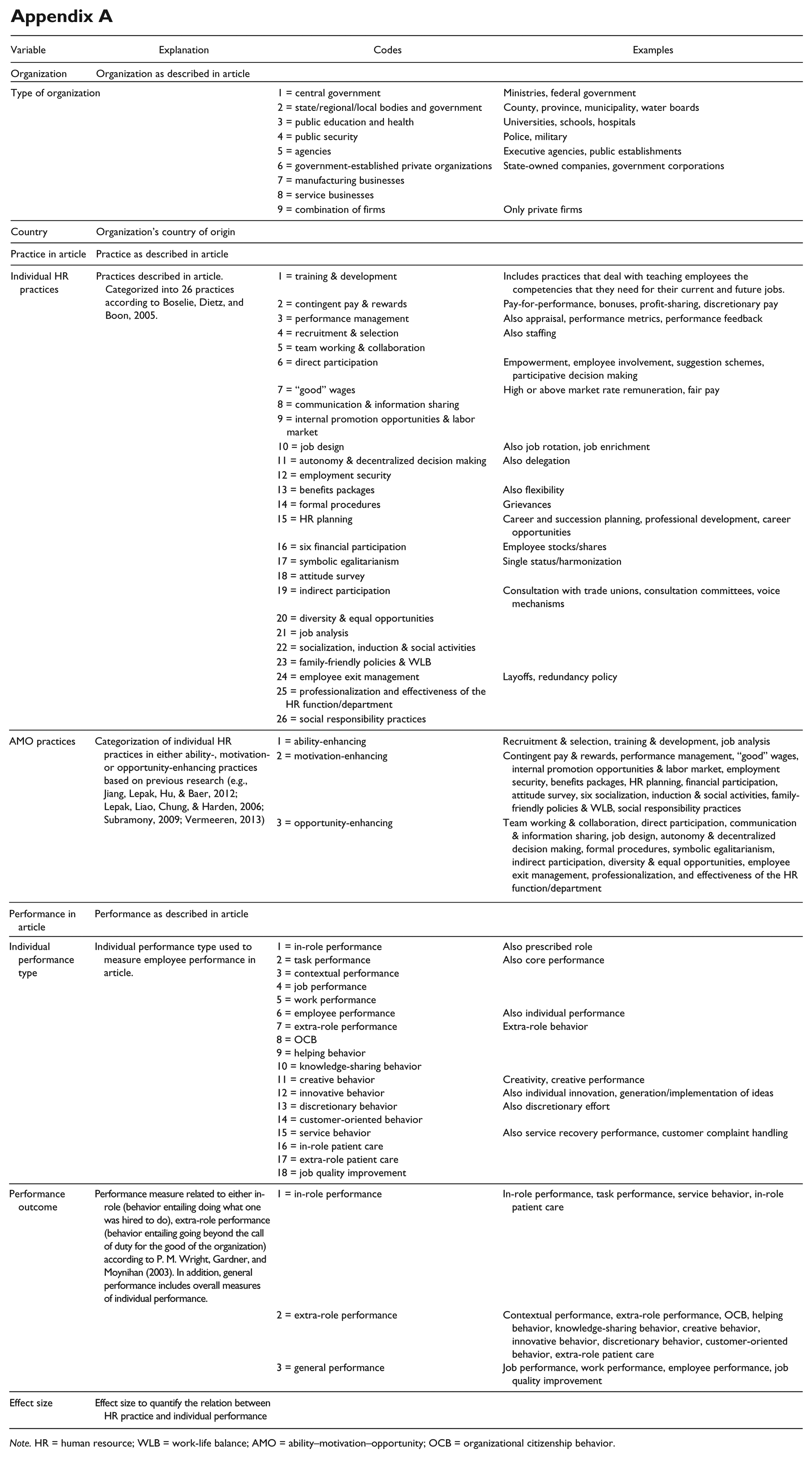
Using a two-step procedure, HRM practices were coded as either ability-, motivation- or opportunity-enhancing practices. In the first step, the practices were coded as one of the 26 distinguished types of individual HRM practices identified by Boselie et al. (2005). In the second step, these individual practices were coded according to the AMO model (e.g., Appelbaum et al., 2000; Jiang et al., 2012; Subramony, 2009; see specific information regarding our categorization in Appendix A). One study already provided the correlations between HRM practices and individual performance based on the AMO model (Boselie, 2010), and therefore this study was only coded in the second step.
Individual performance
As explained in the theoretical section, we adopted the widely used categorization of in-role and extra-role performance. In-role performance consisted of in-role behavior and task performance. Extra-role performance consisted of extra-role behavior, OCB, helping behavior, knowledge-sharing behavior, creative behavior, innovative behavior, and discretionary behavior. In addition, a large set of studies assessed individual/employee performance, work performance, and job performance. These types of performance all relate to the job or work as a whole and not to a specific task. Therefore, we added a third type of performance, which we coded as “general individual performance.”
Sector
To determine the appropriate sector code, we, first, coded organization type into one of eight categories (see Appendix A). Second, these types were coded into one of the three sectors (i.e., public sector, semipublic sector, and private sector). The public sector consisted of central government and state/regional/local governmental bodies. The semipublic sector consisted of education and health organizations, because no studies were found that examined other types of semipublic organizations. This classification is in line with previous research (Coursey & Rainey, 1990; Lan & Rainey, 1992). The private sector consisted of manufacturing and service businesses.
Geographical area
Findings from previous studies suggest that the effects of HRM practices in different sectors vary across countries, partly due to institutional and cultural differences (Rabl et al., 2014; Vanhala & Stavrou, 2013). We tried to account for these differences by controlling for the geographical area in which the data were collected. To create this variable, we coded whether the study was conducted in an Anglo-Saxon, European, Asian, or other geographical area.
Meta-Analytic Procedure
Our final dataset contained many interdependent effect sizes, as most studies investigated the effects of various overlapping HRM practices on individual performance. When ignoring inter-effect size dependencies in a meta-analysis, standard errors of the fixed effects and heterogeneity of the random effects are biased (Cheung, 2014). A common approach to deal with these dependencies is to calculate composites from effect sizes (Borenstein, Hedges, Higgins, & Rothstein, 2009). Although this approach removes the related errors, valuable information from individual effect sizes are lost due to the aggregation. In this study, a three-level meta-analytical approach was used to account for these dependencies without overestimating results (Cheung, 2014). In a three-level approach, sampling variation of each effect size is modeled as a Level 1 factor, variation within studies as a Level 2 factor, and variation between studies as a Level 3 factor (Van Den Noortgate, Lopez-Lopez, Marin-Martinez, & Sanchez-Meca, 2013).
To investigate potential differences between sectors, the following steps were taken. In the first step, meta-analytic correlations were calculated using a three-level meta-analysis approach, in which we controlled for geographical area. To calculate the meta-analytic correlations, three-level mixed effects models were fitted using the meta3 function of the metaSEM package in R (Cheung, 2015). Next, we checked several heterogeneity statistics. In a three-level meta-analysis, statistics for the amount of variation in Level 2 (
In the second step, meta-analytic correlations between HRM practices and individual performance outcomes for each sector were calculated by fitting three-level random effects models. Following Valentine, Pigott, and Rothstein (2010), who stated that using meta-analysis for as few as two effect sizes is more appropriate to aggregate findings than any other alternative, we calculated meta-analytic correlations if at least two effect sizes for each sector were available. These correlations were then used to create a correlation matrix for each sector. The averaged correlation matrices were used as input to conduct meta-analytic structural equation modeling (MASEM). Using weighted least squares (WLS) estimation, structural models were fitted on the averaged correlation matrices (Cheung, 2014). Models with regression paths from HRM practices to one individual performance outcome and correlations between the distinguished HRM practices were estimated for each sector. The harmonic mean was imputed as sample size, which gives less weight to large sample sizes resulting in more conservative estimates. In total, nine models were estimated. Regression estimates and likelihood-based confidence intervals (LCBIs) were checked to interpret the effects of HRM practices on performance. Because the estimated models were saturated, fit statistics could not be reported. Analyses were conducted using the WLS function of the metaSEM package in R (Cheung, 2015).
In the final step, to test the formulated hypotheses, multigroup analyses were conducted using the results from the WLS estimation (Jak, 2015). In these analyses, parameters are constrained to be equal across groups to test for differences between sectors. If the χ2 increases significantly when equality constraints across groups are added, the parameters are significantly different across groups. Each separate multigroup analysis compares the effects of HRM practices on one individual performance outcome between two sectors. Analyses were conducted using the OpenMx package in R (Neale et al., 2015).
Publication bias
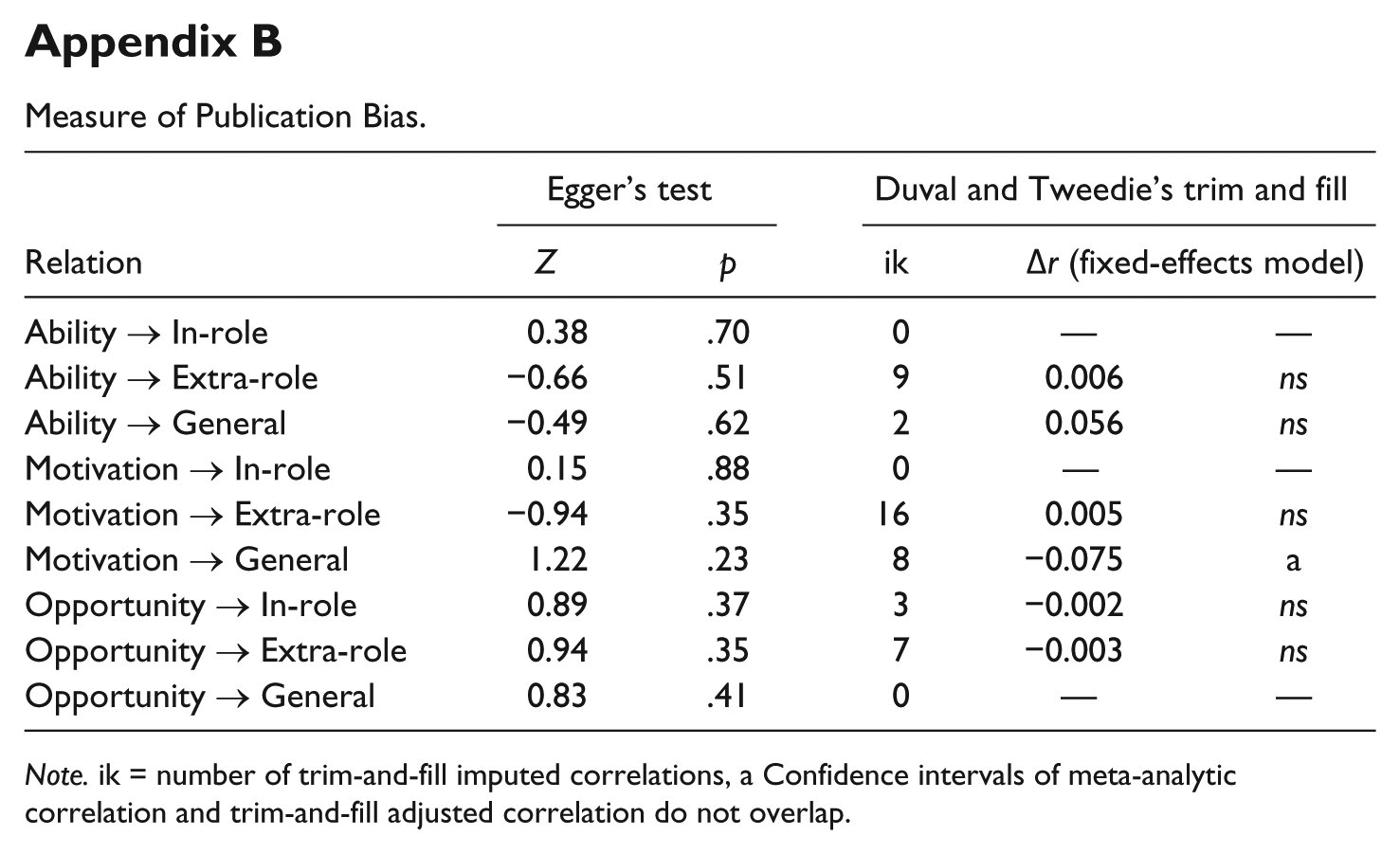
Due to a possibility that nonsignificant findings go unreported, meta-analyses could present a too optimistic view of the state of the literature (Kepes, Banks, McDaniel, & Whetzel, 2012). To assess this impact of publication bias on the effects of HRM practices on performance in general, we used Egger’s test of the intercept and Duval and Tweedie’s trim and fill method (Duval & Tweedie, 2000; Egger, Smith, Schneider, & Minder, 1997). The results of these tests, shown in Appendix B, indicate that substantial evidence for publication bias is not present. None of the intercepts estimated were significant, whereas the trim and fill analyses indicated that only the relationship between motivation-enhancing practices and general performance may be influenced by publication bias. However, as shown in the “Results” section, this relationship is not tested for sector differences and thus had no influence on our conclusions.
Results
Preliminary Analysis
Our final dataset contained 262 effect sizes from 66 samples in 64 articles (total N = 227,989). In particular, we incorporated 148 effect sizes from manufacturing and service firms, which we coded as private sector organizations; 59 effect sizes from core government organizations, which we coded as public sector organizations; and 55 effect sizes from educational and hospital organizations, which we coded as semipublic organizations. Table 1 shows the number of effect sizes, differentiated according to the three AMO dimensions. Unfortunately, too few effect sizes were available to estimate the effects of ability- and motivation-enhancing practices on in-role performance in the public sector. In a similar vein, we had an insufficient number of effect sizes to estimate the effects of opportunity-enhancing practices on general performance in the semipublic sector.
Effect Sizes Found in the Literature With Total Unique Sample Sizes in Parentheses.
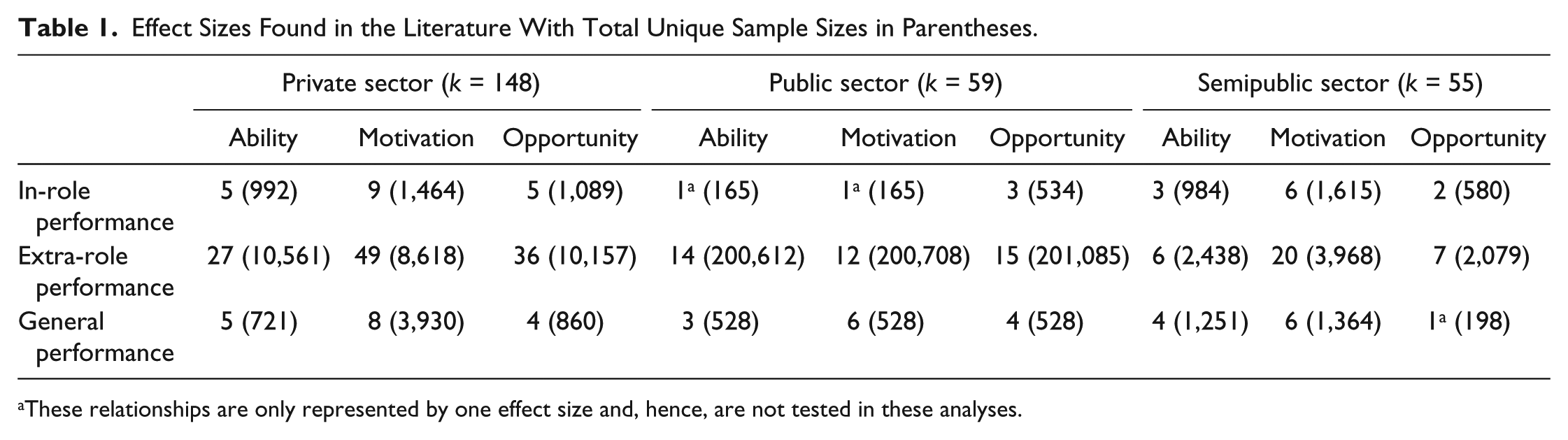
These relationships are only represented by one effect size and, hence, are not tested in these analyses.
Most of the articles in our sample were published in HRM-related journals (37%), followed by management journals (17%), psychology journals (10%), and public administration journals (10%). Most empirical studies were published after 2010 (60%). Regarding geographical area, we had 85 effect sizes from Anglo-Saxon countries, 42 effect sizes from European countries, 88 effect sizes from Asian countries, and 44 effect sizes from countries in other geographical areas, such as Africa and the Middle East.
Effects of HRM Practices on Performance Outcomes
In Table 2, meta-analytic correlations are presented between the HRM practices and individual performance outcomes. For all combinations, the results show a positively significant correlation. All Q statistics are significant (p < .01), whereas most
Meta-Analytic Correlations Between HRM Practices and Performance Outcomes a .
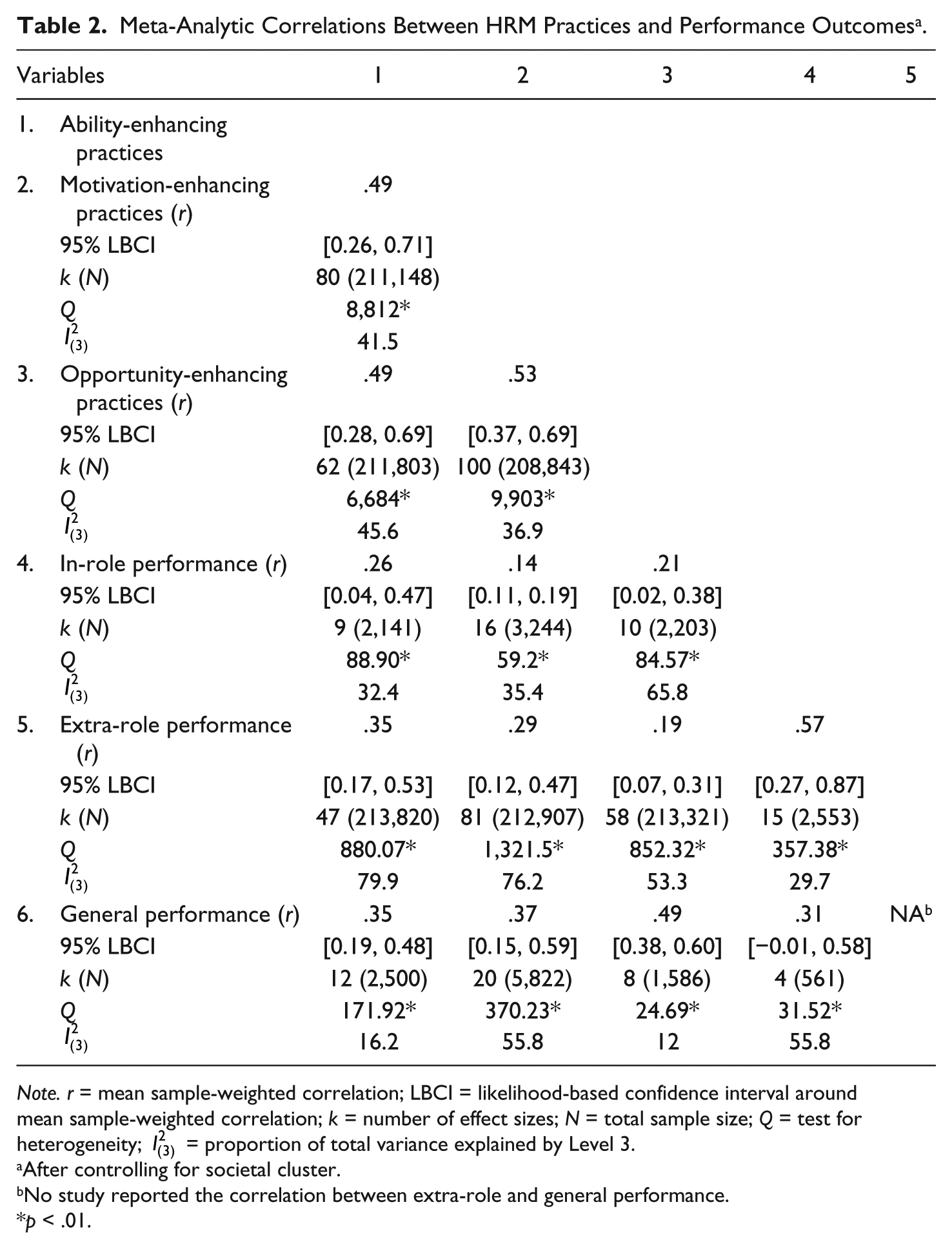
Note. r = mean sample-weighted correlation; LBCI = likelihood-based confidence interval around mean sample-weighted correlation; k = number of effect sizes; N = total sample size; Q = test for heterogeneity;
After controlling for societal cluster.
No study reported the correlation between extra-role and general performance.
p < .01.
Effects of HRM Practices on Performance Outcomes per Sector
To investigate the effects of HRM practices on individual performance in each sector, multiple MASEM models were tested. Figure 2 presents the results for the model with in-role performance as dependent variable and shows that ability-enhancing practices have a significant effect in both the semipublic (β = .10, 95% LBCI = [0.04, 0.17]) and the private sector (β = .33, 95% LBCI = [0.26, 0.39]). In contrast, no significant effect is found for motivation-enhancing practices in both the semipublic (β = .04, 95% LBCI = [−0.02, 0.10]) and the private sector (β = −.02, 95% LBCI = [−0.08, 0.04]). Finally, opportunity-enhancing practices appear to have a significant effect in the semipublic (β = .15, 95% LBCI = [0.09, 0.22]) and the private sector (β = .13, 95% LBCI = [0.07, 0.19]), while no significant effect is found in the public sector (β = .09, 95% LBCI = [−0.02, 0.19]).
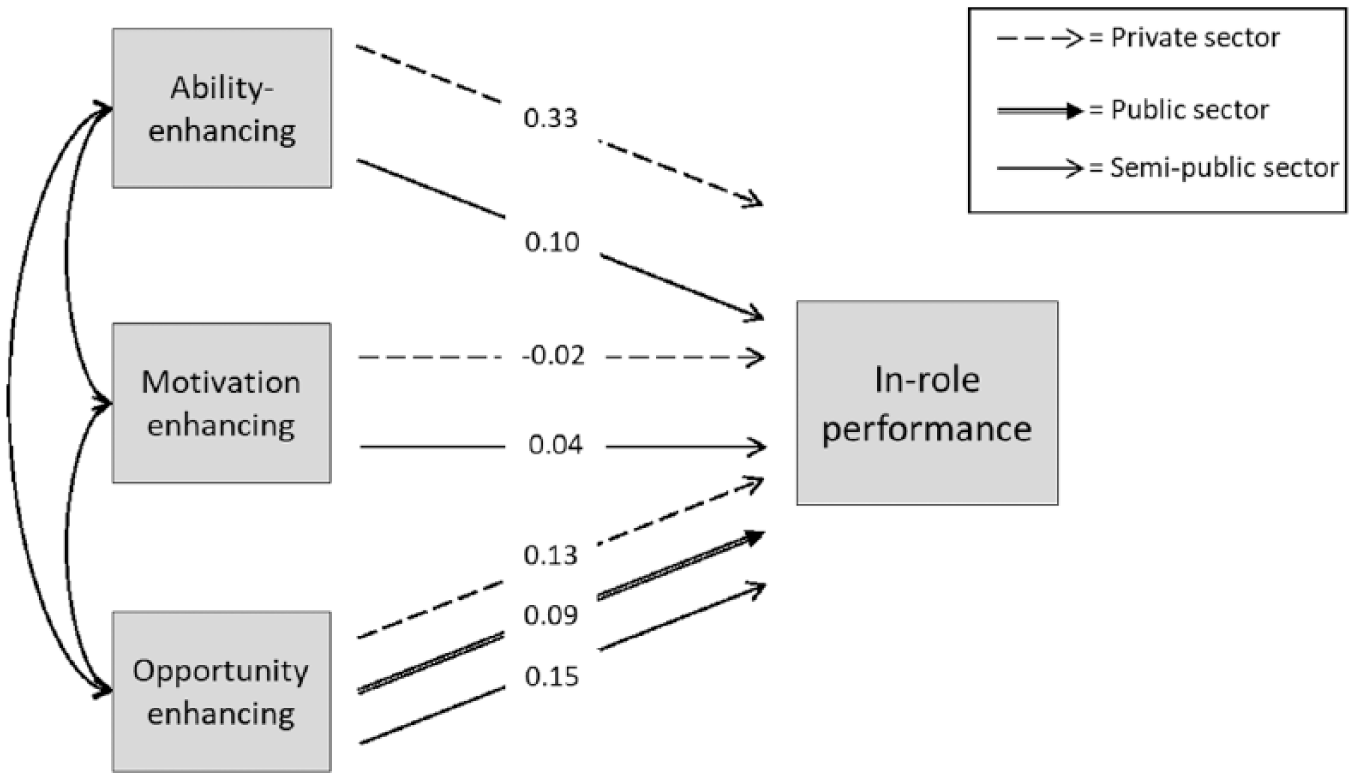
Effects of HRM practices on in-role performance.
Figure 3 shows that extra-role performance is significantly influenced by ability-enhancing practices in each sector. The effect is strongest in the semipublic sector (β = .17, 95% LBCI = [0.12, 0.21]), and comparable effects are found in the public (β = .13, 95% LBCI = [0.12, 0.13]) and the private sector (β = .10, 95% LBCI = [0.07, 0.13]). Similar results are found for opportunity-enhancing practices. Again, the effect appears to be strongest in the semipublic sector (β = .39, 95% LBCI = [0.34, 0.43]), and comparable effects are found in the public (β = .17, 95% LBCI = [0.16, 0.17]) and the private sector (β = .16, 95% LBCI = [0.13, 0.18]). Motivation-enhancing practices appear to have a significant and similar effect in both the public (β = .10, 95% LBCI = [0.09, 0.10]) and the private sector (β = .10, 95% LBCI = [0.07, 0.12]). In contrast, for motivation-enhancing practices, no significant effect is found in the semipublic sector (β = −.04, 95% LBCI = [−0.08, 0.01]).
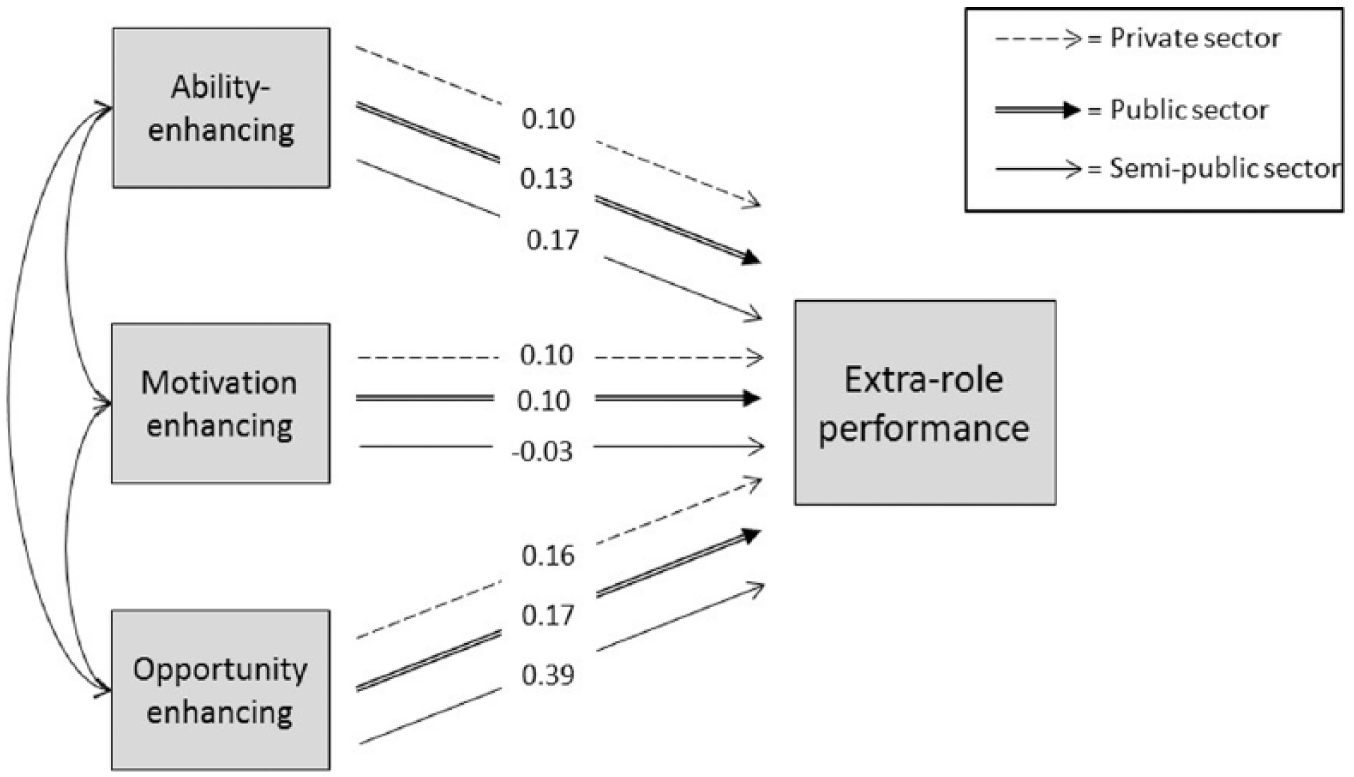
Effects of HRM practices on extra-role performance.
Finally, the model with general individual performance being the outcome variable is presented in Figure 4. In this model, only the effects of opportunity-enhancing practices are tested. For these practices, a significant effect is found in the private sector (β = .15, 95% LBCI = [0.10, 0.19]), while no significant effect is found in the public sector (β = .02, 95% LBCI = [−0.04, 0.08]).
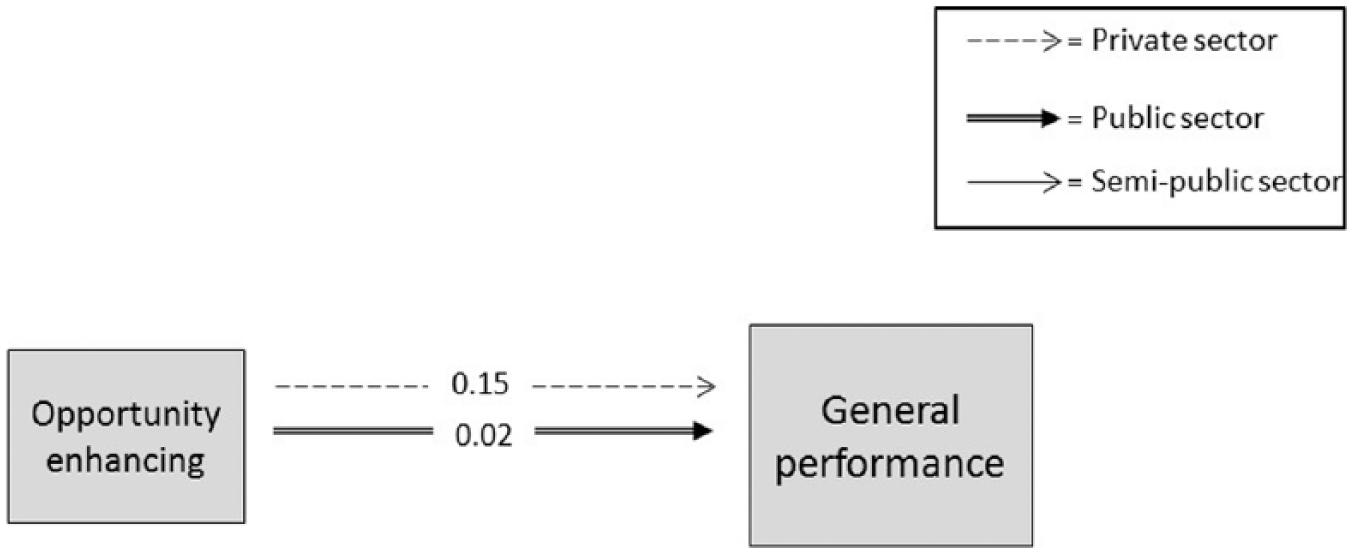
Effects of HRM practices on general performance.
Multigroup Analyses for Sectoral Differences
To test whether effects of HRM practices on individual performance differed between sectors, several multigroup analyses were conducted. First, to test Hypotheses 1a, 2a, and 3a, we compared the public and the semipublic sector. For ability-enhancing practices, no significant difference is found for extra-role performance. Therefore, Hypothesis 1a is rejected. For motivation-enhancing practices, contrary to Hypothesis 2a, a stronger effect is found for extra-role performance in the public sector, χ2(1) = 37.58, p < .001. Finally, opportunity-enhancing practices appear to have a stronger effect on extra-role performance in the semipublic sector, χ2(1) = 106.07, p < .001, but no significant difference is found for in-role performance. With these outcomes, Hypothesis 3a is partially supported.
Next, to test Hypotheses 1b, 2b, and 3b, we compared the semipublic and the private sector. For, ability-enhancing practices, a stronger effect is found for in-role performance in the private sector, χ2(1) = 31.87, p < .001, but no significant difference is found for extra-role performance. Therefore, Hypothesis 1b is partially supported. For motivation-enhancing practices, a stronger effect is found for extra-role performance in the private sector, χ2(1) = 9.32, p < .01, but no significant difference is found for in-role performance. Therefore, Hypothesis 2b is partially supported. Finally, opportunity-enhancing practices appear to have a stronger effect on extra-role performance in the semipublic sector, χ2(1) = 21.20, p < .001, but no significant difference is found for in-role performance. Therefore, Hypothesis 3b is rejected.
Finally, we also compared the public with the private sector. For ability-enhancing practices, a stronger effect is found for extra-role performance in the public sector, χ2(1) = 10.33, p < .01. For motivation-enhancing practices, no significant difference is found for extra-role performance. Finally, opportunity-enhancing practices appear to have a stronger effect on extra-role performance in the public sector, χ2(1) = 8.18, p < .01, and a stronger effect on general performance in the private sector, χ2(1) = 11.33, p < .001. It should be noted that, even though significant differences are found for extra-role performance, absolute differences between estimates are very small. This is likely due to the large sample sizes in the public sector.
Discussion
The goal of this meta-analysis was to compare effects of ability-, motivation-, and opportunity-enhancing HRM practices on individual performance across the public, semipublic, and private sectors. In line with recently published meta-analyses in public administration journals (Cantarelli, Belardinelli, & Belle, 2016; Gerrish, 2015; Harari, Herst, Parola, & Carmona, 2017; Homberg, McCarthy, & Tabvuma, 2015), our study adheres to Perry’s (2012) call for meta-analytic research to help “position public administration scholars to interact more meaningfully with scholars in management, political science and other disciplines” (p. 481). To the best of our knowledge, this scholarly work is the first to meta-analytically examine differences in effects of HRM practices on the employee level across three sectors, thereby contributing to debates on the importance of context for HRM (Paauwe, 2009; Vermeeren, 2013).
In contrast to what we expected, there seems to be only small differences between public and private sector organizations. We assumed that variety in goal ambiguity, personnel constraints, and employee motivation would lead to lower effects of HRM practices in the public sector (Brewer & Walker, 2013; Perry et al., 2006; Rainey & Jung, 2010). Except for a higher effect of opportunity-enhancing practices on general performance in the private sector, no substantive differences have been found. These findings may indicate that, in general, public and private sector employees are equally affected by ability-, motivation- or opportunity-enhancing practices. Perhaps the differences between sectors are not as big as expected, which corresponds to debates about the “blurring of the sectors” (Rainey & Chun, 2007). Moreover, although this does not imply that certain specific HRM practices cannot show differential effects, it could well be possible that contextual factors other than sector are relatively more important, such as industry, organizational size, or culture (Combs et al., 2006).
Our findings do indicate that differences are noticeable between semipublic organizations, on one hand, and public and private organizations, on the other hand. Most striking findings are the (relatively) strong effects of opportunity-enhancing practices and the (relatively) small effects of motivation-enhancing practices in semipublic organizations.
Employees in semipublic organizations found in our sample, more so in comparison with employees in public and private organizations, are viewed as public-service professionals with an initially high degree of specialized knowledge and skills and high intrinsic motivation (Deem, 2004; Farr-Wharton, Brunetto, & Shacklock, 2011; Lega & DePietro, 2005). For example, a surgeon and a high school teacher already possess much job-specific knowledge before entering the labor market, which make them able to perform their prescribed tasks adequately from the very start. However, to go beyond their prescribed tasks, professionals especially benefit from receiving autonomy and control in their work. Moreover, although the need to further develop their skills systematically at the workplace also exists (Van der Heijden, Gorgievski, & De Lange, 2016), professionals often engage in external networks to educate themselves. Given these characteristics of the semipublic sector in our sample, the strong effects of opportunity-enhancing practices are not odd. Although these practices are important in the public and private sector as well, they seem essential for HRM in the semipublic sector.
From the viewpoint of the public sector, the lower effect sizes compared with the semipublic sector could also be explained by the higher prevalence of personnel constraints, as public organizations have been found to perceive more red tape (Coursey & Rainey, 1990; Lan & Rainey, 1992). In particular, public managers face difficulties to grant their employees autonomy due to administrative burdens and the needs for political accountability (Fernandez & Moldogaziev, 2010). This, in turn, could have a negative impact on the effects of opportunity-enhancing practices.
The lower effects of motivation-enhancing practices on extra-role performance and of ability-enhancing practices on in-role performance in the semipublic sector can also be related to sector-specific characteristics. Motivation-enhancing practices typically aim at the extrinsic motivation of employees (Lepak et al., 2006), which does not fit well with the high intrinsic motivation of people working in health care and education (e.g., Cerasoli, Nicklin, & Ford, 2014; Schopman, Kalshoven, & Boon, 2017). As a result, these practices have little to no effect on their performance. Furthermore, their high initial expertise, as already discussed above, causes ability-enhancing practices to be relatively less important for in-role performance. After all, many employees already are capable to perform their prescribed tasks before entering the labor market. These findings indicate that the semipublic sector is different from the public and private sector in this regard, which has a discernable impact on the effects of HRM practices.
In addition to our main results, this meta-analysis shows two interesting findings. First, the publication year of the majority of the articles indicates that studying the association between HRM practices on individual performance is a relatively young topic. The growth of studies on this topic shows the increased attention for micro-level HRM research (Boselie, 2010) and demonstrates the embeddedness of our study in this topical debate. Second, the type of journals in which the selected studies are published reflects the lack of attention for HRM in the public administration literature. Although, approximately, 40% of the studies used samples from public or semipublic organizations, only a small fraction of the studies is actually published in public administration journals. This suggests that although arguments have been frequently posed that HRM in the public sector has its own complexities (Brown, 2004), up until now empirical research has not given much attention to these complexities.
For practitioners, our results show the importance of HRM for employee performance, although no simple answer exists to the question of how to specifically stimulate performance. In general, practitioners should consider sector-specific conditions before implementing HRM practices and adapt their policy to which type of performance they want to stimulate. Opportunity-enhancing practices appear particularly important to stimulate extra-role performance. Especially for managers in the semipublic sector, who are supervising employees who require a great deal of autonomy, our findings emphasize the need to invest in practices that provide ample opportunities to perform. In addition, these managers should be aware of implementing practices aimed to enhance motivation, as these practices have shown to be unimportant for employees in the semipublic sector. Our results also indicate that common practical implications exist for both public and private managers, as some shared best HRM practices came up from our study, especially for stimulating extra-role performance. Therefore, in designing the HRM system, these managers should take into account universal practices as well as sector-specific conditions.
Similar to primary studies, meta-analyses are not without limitations. First, as discussed earlier, we only identified studies conducted in semipublic organizations that operate in the area of education and health. Although education and health could certainly be categorized as semipublic organizations, the semipublic sector as a whole is broader than these types of organizations. That is to say, there are other typical semipublic organizations as well, such as state agencies, public establishments, and state-owned companies (Van Thiel, 2012). According to principles of New Public Management, these organizations vary in their degree of autonomy, which is also noticeable in the area of HRM (Verhoest et al., 2012). However, we did not identify any studies that examined these types of organizations. The lack of other semipublic organizations has consequences for the generalizability of our findings, which is limited to education and health organizations. We strongly recommend future research to investigate the HRM–performance link in various other semipublic organizations.
Second, the majority of the studies measured the use and availability of HRM practices and individual performance using the same rater source. This could lead to common method bias, which leads to overestimating the correlation between HRM practices and individual performance. Related to this issue is the cross-sectional design of most studies, which limits the conclusions on the causality between HRM practices and individual performance. Both limitations partly stem from the deficiency in the way we do survey research (Perry, 2012). Like Perry, we encourage future scholars to focus on experimental and longitudinal designs in addition to high-quality survey research.
Third, although being in line with previous literature in the field, our study used a relatively “crude” measure of sector. Although we argue that differences in organizational goal ambiguity, personnel constraints, and employee motivation may lead to differences across sectors, we were not able to empirically test for moderation effects. To be able to demonstrate how sector matters in the relationship between HRM and individual performance, future research should focus on including psychometrically sound measures to investigate possible moderation effects of these specific characteristics.
Finally, we did not incorporate other moderators, because this would result in relatively few studies in each subgroup. More specifically, incorporating additional moderators would make it impossible to test the models in each subgroup. More empirical work on other potential factors that could moderate the relationship between HRM practices and individual performance is needed. For example, previous research suggests that culture, organization size, industry type, and age moderate the relationship between HRM and different outcomes (Kooij et al., 2010; Rabl et al., 2014; Subramony, 2009). Furthermore, in line with social exchange theory, studies could include moderators reflecting the process of social exchange between individual employee and his or her employer, such as organizational commitment or perceived organizational support.
Therefore, building on this meta-analysis, which is the first to test differences in the effects of HRM practices on individual performance across sectors, we call for future research to examine cross-sector differences from other perspectives. Our study shows that sectoral context plays an important role in several of the relationships between HRM practices and individual performance.
Supplementary Material
Supplementary Material, Supplementary_material – One HRM Fits All? A Meta-Analysis of the Effects of HRM Practices in the Public, Semipublic, and Private Sector
Supplementary Material, Supplementary_material for One HRM Fits All? A Meta-Analysis of the Effects of HRM Practices in the Public, Semipublic, and Private Sector by R. Blom, P. M. Kruyen, B. I. J. M. Van der Heijden and S. Van Thie in Review of Public Personnel Administration
Footnotes
Appendix A
| Variable | Explanation | Codes | Examples |
|---|---|---|---|
| Organization | Organization as described in article | ||
| Type of organization | 1 = central government | Ministries, federal government | |
| 2 = state/regional/local bodies and government | County, province, municipality, water boards | ||
| 3 = public education and health | Universities, schools, hospitals | ||
| 4 = public security | Police, military | ||
| 5 = agencies | Executive agencies, public establishments | ||
| 6 = government-established private organizations | State-owned companies, government corporations | ||
| 7 = manufacturing businesses | |||
| 8 = service businesses | |||
| 9 = combination of firms | Only private firms | ||
| Country | Organization’s country of origin | ||
| Practice in article | Practice as described in article | ||
| Individual HR practices | Practices described in article. Categorized into 26 practices according to Boselie, Dietz, and Boon, 2005. | 1 = training & development | Includes practices that deal with teaching employees the competencies that they need for their current and future jobs. |
| 2 = contingent pay & rewards | Pay-for-performance, bonuses, profit-sharing, discretionary pay | ||
| 3 = performance management | Also appraisal, performance metrics, performance feedback | ||
| 4 = recruitment & selection | Also staffing | ||
| 5 = team working & collaboration | |||
| 6 = direct participation | Empowerment, employee involvement, suggestion schemes, participative decision making | ||
| 7 = “good” wages | High or above market rate remuneration, fair pay | ||
| 8 = communication & information sharing | |||
| 9 = internal promotion opportunities & labor market | |||
| 10 = job design | Also job rotation, job enrichment | ||
| Variable | Explanation | Codes | Examples |
| 11 = autonomy & decentralized decision making | Also delegation | ||
| 12 = employment security | |||
| 13 = benefits packages | Also flexibility | ||
| 14 = formal procedures | Grievances | ||
| 15 = HR planning | Career and succession planning, professional development, career opportunities | ||
| 16 = six financial participation | Employee stocks/shares | ||
| 17 = symbolic egalitarianism | Single status/harmonization | ||
| 18 = attitude survey | |||
| 19 = indirect participation | Consultation with trade unions, consultation committees, voice mechanisms | ||
| 20 = diversity & equal opportunities | |||
| 21 = job analysis | |||
| 22 = socialization, induction & social activities | |||
| 23 = family-friendly policies & WLB | |||
| 24 = employee exit management | Layoffs, redundancy policy | ||
| 25 = professionalization and effectiveness of the HR function/department | |||
| 26 = social responsibility practices | |||
| AMO practices | Categorization of individual HR practices in either ability-, motivation- or opportunity-enhancing practices based on previous research (e.g., Jiang, Lepak, Hu, & Baer, 2012; Lepak, Liao, Chung, & Harden, 2006; Subramony, 2009; Vermeeren, 2013) | 1 = ability-enhancing | Recruitment & selection, training & development, job analysis |
| 2 = motivation-enhancing | Contingent pay & rewards, performance management, “good” wages, internal promotion opportunities & labor market, employment security, benefits packages, HR planning, financial participation, attitude survey, six socialization, induction & social activities, family-friendly policies & WLB, social responsibility practices | ||
| 3 = opportunity-enhancing | Team working & collaboration, direct participation, communication & information sharing, job design, autonomy & decentralized decision making, formal procedures, symbolic egalitarianism, indirect participation, diversity & equal opportunities, employee exit management, professionalization, and effectiveness of the HR function/department | ||
| Variable | Explanation | Codes | Examples |
| Performance in article | Performance as described in article | ||
| Individual performance type | Individual performance type used to measure employee performance in article. | 1 = in-role performance | Also prescribed role |
| 2 = task performance | Also core performance | ||
| 3 = contextual performance | |||
| 4 = job performance | |||
| 5 = work performance | |||
| 6 = employee performance | Also individual performance | ||
| 7 = extra-role performance | Extra-role behavior | ||
| 8 = OCB | |||
| 9 = helping behavior | |||
| 10 = knowledge-sharing behavior | |||
| 11 = creative behavior | Creativity, creative performance | ||
| 12 = innovative behavior | Also individual innovation, generation/implementation of ideas | ||
| 13 = discretionary behavior | Also discretionary effort | ||
| 14 = customer-oriented behavior | |||
| 15 = service behavior | Also service recovery performance, customer complaint handling | ||
| 16 = in-role patient care | |||
| 17 = extra-role patient care | |||
| 18 = job quality improvement | |||
| Performance outcome | Performance measure related to either in-role (behavior entailing doing what one was hired to do), extra-role performance (behavior entailing going beyond the call of duty for the good of the organization) according to P. M. Wright, Gardner, and Moynihan (2003). In addition, general performance includes overall measures of individual performance. | 1 = in-role performance | In-role performance, task performance, service behavior, in-role patient care |
| Variable | Explanation | Codes | Examples |
| 2 = extra-role performance | Contextual performance, extra-role performance, OCB, helping behavior, knowledge-sharing behavior, creative behavior, innovative behavior, discretionary behavior, customer-oriented behavior, extra-role patient care | ||
| 3 = general performance | Job performance, work performance, employee performance, job quality improvement | ||
| Effect size | Effect size to quantify the relation between HR practice and individual performance | ||
Note. HR = human resource; WLB = work-life balance; AMO = ability–motivation–opportunity; OCB = organizational citizenship behavior.
Appendix B
Measure of Publication Bias.
| Relation | Egger’s test |
Duval and Tweedie’s trim and fill |
|||
|---|---|---|---|---|---|
| Z | p | ik | Δr (fixed-effects model) | ||
| Ability → In-role | 0.38 | .70 | 0 | — | — |
| Ability → Extra-role | −0.66 | .51 | 9 | 0.006 | ns |
| Ability → General | −0.49 | .62 | 2 | 0.056 | ns |
| Motivation → In-role | 0.15 | .88 | 0 | — | — |
| Motivation → Extra-role | −0.94 | .35 | 16 | 0.005 | ns |
| Motivation → General | 1.22 | .23 | 8 | −0.075 | a |
| Opportunity → In-role | 0.89 | .37 | 3 | −0.002 | ns |
| Opportunity → Extra-role | 0.94 | .35 | 7 | −0.003 | ns |
| Opportunity → General | 0.83 | .41 | 0 | — | — |
Note. ik = number of trim-and-fill imputed correlations, a Confidence intervals of meta-analytic correlation and trim-and-fill adjusted correlation do not overlap.
Declaration of Conflicting Interests
The author(s) declared no potential conflicts of interest with respect to the research, authorship, and/or publication of this article.
Funding
The author(s) received no financial support for the research, authorship, and/or publication of this article.

Author Biographies
References
Supplementary Material
Please find the following supplemental material available below.
For Open Access articles published under a Creative Commons License, all supplemental material carries the same license as the article it is associated with.
For non-Open Access articles published, all supplemental material carries a non-exclusive license, and permission requests for re-use of supplemental material or any part of supplemental material shall be sent directly to the copyright owner as specified in the copyright notice associated with the article.
