




Abstract
The present study aimed to develop and validate the short version of the Academic Self-Regulated Learning Questionnaire (ASLQ) in a sample of 432 Romanian university students. Confirmatory factor analysis (CFA) supported a three-factor model—forethought, performance control, and self-reflection—that aligns with the theoretical framework of self-regulated learning. The short version demonstrated good internal consistency, and subscale intercorrelations indicated strong internal structure. Convergent validity was assessed using the Academic Self-Regulation Scale (A-SRL-S) and the Motivated Strategies for Learning Questionnaire (MSLQ). The ASLQ subscales correlated significantly and positively with related subscales assessing Memory Strategy from the A-SRL-S, Self-Efficacy, and Cognitive Strategy Use from the MSLQ. Moreover, the total ASLQ score showed strong correlations with both A-SRL-S and MSLQ, supporting the convergent validity of the ASLQ short form. These findings suggest that the adapted short version of the ASLQ is a reliable and valid tool for assessing self-regulated learning among students.
Keywords
Introduction
In recent educational research, self-regulated learning (SRL) has received a status of a foundation of academic success and lifelong learning. It encompasses learners’ ability to manage their own cognitive, motivational, and behavioral processes, by setting goals, monitoring progress, and adjusting the process (Pintrich, 2000). Pintrich (2000) and Zimmerman (1989, 1998, 2002, 2008) emphasize that effective learning is not only a function of intelligence but is also significantly shaped by the strategies that learners use to control their own educational experiences.
Until now, most SRL scales developed in the literature have been primarily targeted at school-aged populations (Panadero, 2017). However, this study focuses specifically on university students, as they represent a distinct group with unique developmental and educational needs. First, students, as young adults, are typically at a developmental stage where personal values, attitudes, and learning habits are firmly established, making them potentially more resistant to behavioral or cognitive change (Hofer & Pintrich, 1997). This means that they should have by this age well-established practices of SRL. Second, while higher education learners are generally expected to be autonomous, self-directed, and capable of managing their own learning, research shows that they often benefit from structured guidance and clearly defined expectations (Bown et al., 2021; Nambiar & Alex, 2022). Third, SRL is crucial for university students because it equips them to manage the complexity of the new educational environment, leading to better academic performance, higher motivation, and essential lifelong learning skills that help them adapt to challenges and succeed in their future jobs (Malan et al., 2025). Therefore, assessing their self-regulatory strategies using a validated instrument is crucial for designing interventions that are developmentally appropriate and effective.
The Academic Self-Regulated Questionnaire (ASLQ) developed by Nambiar et al. (2022) captures the various processes in academic settings. It is used to assess student’s self-regulatory practices, giving valuable insights into how these specific behaviors correlate with their academic performance. Although the ASLQ represents a comprehensive and recently validated instrument, it is not the only available measure of SRL. Other widely used instruments include the Motivated Strategies for Learnings Questionnaire (MSLQ; Pintrich et al., 1991) and the Learning and Study Strategies Inventory (LASSI; Weinstein et al., 1987). The ASLQ was selected for the present study because it integrates contemporary conceptualizations of SRL processes and aligns closely with current academic learning contexts. Nevertheless, SRL instruments developed within a specific cultural and linguistic context cannot be assumed to function equivalently across all populations. To ensure construct validity, reliability, and conceptual equivalence, such measures require systematic cultural and linguistic adaptation. This is particularly important because SRL behaviors are expressed and interpreted in different ways, depending on many factors, such as educational system, cultural norms, or language use (Pintrich, 2000). Cultural adaptation therefore supports both the generalizability of findings across contexts and the accurate capture of culturally specific manifestations of SRL.
This study plans to fill the gap in the literature by following a rigorous process of development, translation, cultural adaptation, and validation of a short version of the ASLQ for Romanian university students. Short-form instruments can reduce participant fatigue, increase response accuracy and rate, and improve applicability in large-scale educational settings. As such, our first objective is to develop, translate, and culturally adapt the short version of the ASLQ for the Romanian academic environment. Another objective is to evaluate the psychometric properties of the adapted instrument, ensuring that this instrument reliably measures the particularities of SRL among Romanian students. The adaptation process included back-to-back translation. To ensure its validity, we conducted confirmatory factor analysis.
Adapting and validating the ASLQ for the Romanian students is an essential endeavor, with the primary objective of establishing its psychometric adequacy and cultural relevance within the Romanian educational context. Although Romanian education has undergone substantial reforms aimed at modernizing curricula and instructional practices, empirical research on student’s self-regulatory practices has received comparatively less systematic attention. Cultural adaptation is therefore intended to ensure linguistic equivalence, conceptual clarity, and measurement invariance, so that the instrument accurately captures SRL constructs as they are understood and enacted by Romanian students. By validating the factorial structure, reliability indices, and construct validity of the adapted version, this process enables precise and context-sensitive assessment of SRL. In turn, the validated ASLQ can serve as a reliable and culturally appropriate tool for educators, school counselors, researchers, and policymakers to inform evidence-based interventions and educational decision-making.
Theoretical Background
SRL involves an active and constructive process in which individuals continuously monitor, adjust, and regulate their cognitive processes, emotional-motivational resources, and behaviors to align with personal goals (Zimmerman & Schunk, 2001). This concept is framed as a multidimensional construct that highlights the learner’s proactive role and has been shown to positively impact academic outcomes (Abar & Loken, 2010; Efklides, 2011; Greene & Azevedo, 2010; Winne, 2010; Zimmerman, 2008). Zimmerman and Schunk (2001) further describe it as the generation of thoughts, feelings, and actions that systematically guide individuals toward achieving their objectives. Moreover, SRL encompasses strategic processes such as performance adjustment and self-monitoring (Labuhn et al., 2010). In educational settings, it is defined by the extent to which students actively engage in metacognitive, motivational, and behavioral practices during their learning process (Zimmerman, 1989).
SRL has been conceptualized through several theoretical models. Panadero (2017) identifies six primary frameworks developed by Boekaerts (1991), Pintrich (2000), Zimmerman (2002), Winne and Hadwin (1998, 2008), Efklides (2011), and Hadwin et al. (2011). Among these, the models proposed by Pintrich (2000) and Zimmerman (2002) are the most widely referenced and benefit from the strongest empirical support.
Zimmerman’s (2002) model outlines SRL in three phases: planning, performance control, and self-reflection. Initially, learners analyze the task, set objectives, and devise a preliminary plan, with underlying beliefs guiding the selection of learning strategies. In the performance control phase, they execute the task while monitoring progress and applying self-regulatory strategies to maintain cognitive engagement and motivation. The final phase, self-reflection, involves evaluating their performance by attributing outcomes to specific factors, thereby influencing their future approach to similar tasks (Zimmerman, 2000, 2002).
SRL encompasses a dynamic exchange of cognitive strategies, metacognitive processes, motivational factors, and behavioral components that collectively enable learners to manage and direct their own learning experiences (Pintrich, 2004; Zimmerman, 2000). Cognitive strategies, such as rehearsal, elaboration, and organization. support the process of learning content, whereas metacognitive strategies, including planning, monitoring, and evaluating, enable learners to regulate and adapt their cognitive efforts through the learning process. Metacognitive processes further empower students by fostering self-awareness and reflective thinking, which facilitate the identification of effective learning strategies and the modification of those that are less successful (Schunk & Zimmerman, 2012). Complementing these internal mechanisms, motivational factors, including self-efficacy, goal orientation, and the balance between intrinsic and extrinsic motivations, provide the essential drive for persistence and engagement in academic tasks. Finally, behavioral components, evident in time management and the strategic utilization of resources, translate cognitive and metacognitive insights into practical actions that optimize learning outcomes.
SRL has been consistently associated with a range of positive educational outcomes. Research shows that students who develop strong self-regulation skills tend to show greater curiosity, persistence in the face of challenges, deeper learning, and higher levels of self-esteem (Araka et al., 2020). These attributes are essential for sustained engagement and achievement across diverse educational contexts, including traditional classroom settings, digital learning environments, and higher education. Furthermore, SRL has been positively linked to academic performance, as it enables students to plan, monitor, and evaluate their learning processes more effectively (Sahranavard et al., 2018). Because educational systems differ substantially in instructional practices, assessment standards, and cultural expectations, examining SRL across diverse contexts is critical for determining the generalizability of theoretical models and empirical findings, as well as for identifying context-specific manifestations of regulatory processes. By fostering autonomy and strategic thinking, SRL not only enhances immediate academic outcomes but also contributes to students’ long-term development as independent, motivated learners.
Self-report instruments provide a pragmatic and widely used means to assess SRL by tapping into learners’ own perceptions of their cognitive, metacognitive, motivational, and behavioral strategies (Pintrich, 2004; Zimmerman, 2000). Because SRL involves internal processes, such as goal setting, self-monitoring, and motivational regulation, that are not always directly observable, self-report measures are particularly valuable for accessing these subjective dimensions of learning. Among these, the Academic Self-Regulated Learning Questionnaire (ASLQ) (Nambiar et al., 2022) has been adopted due to its comprehensive structure, which measures dimensions such as planning, monitoring, and evaluating learning processes, as well as the motivational drivers and concrete actions that support academic performance.
Despite their strengths, self-report questionnaires also present methodological challenges. Responses may be influenced by social desirability, limited introspective accuracy, or learners’ difficulty in accurately recalling and evaluating their own regulatory behaviors (Winne & Perry, 2000). Nevertheless, when carefully developed and psychometrically validated, self-report measures remain one of the most feasible and informative approaches for large-scale assessment of SRL, particularly in educational settings where observational or trace-based methods are impractical. Previous validation studies of the ASLQ across diverse educational settings have highlighted its robust factorial structure and practical utility, while also noting limitations in its cross-cultural sensitivity and linguistic adaptability (Broadbent & Poon, 2015). Consequently, adapting the ASLQ for Romanian students is imperative, not only to account for cultural and linguistic nuances but also to ensure measurement equivalence and validity across different contexts. This adaptation aims to preserve the instrument’s theoretical integrity while enhancing its applicability for accurately capturing the self-regulatory learning processes within the Romanian educational context.
Method
Participants
The participants in this study are 432 university students from different universities in Romania. These students were enrolled in a bachelor’s degree program and were aged 18 to 25 (M = 19.87; SD = 1.41). Most of the participants were female (76.4%). The sample included participants from various domain studies, such as psychology (42.12%), engineering (10.87%), economic, administrative and management sciences (10.41%), educational studies (9.02%), medicine (6.71%), law (4.86%), social studies (4.16%), humanities (3.47%), natural and exact sciences (2.08%), arts (2.08%), social and political sciences (1.62%), physical education (0.69%), and architecture (0.46%). All the participants were volunteers, and some of them were rewarded with credits after completing the scale.
Instruments
Academic Self-Regulated Learning Questionnaire (ASLQ)
The ASLQ was developed by Nambiar et al. (2022) to assess how students manage their own learning processes in academic settings. Each of the 36 items is measured on a five-point Likert scale (from 1—strongly disagree to 5—strongly agree). The scale addresses the three phases of SRL, so the scale is composed of three factors: forethought (10 items), performance control (19 items), and self-reflection (7 items). ASLQ has an excellent internal consistency, with a content validity index of 0.88, Cronbach’s Alpha of 0.90, and test-retest reliability of 0.96. However, the internal consistency across the three factors varies from 0.70 to 0.82. In the present study, the focus was on developing, adapting, and validating a short version of the ASLQ for Romanian university students. The short version originated from the original items following theoretical criteria based on the SRL model and statistical criteria from the confirmation factor analysis of the Romanian dataset.
Academic Self-Regulated Learning Scale (A-SRL-S)
Magno (2010) developed the A-SRL-S to measure self-regulation of college students within the context of their learning in higher education. Each of the items is measured on a four-point Likert scale (strongly agree, agree, disagree, and strongly disagree). The scale has seven factors: memory strategy (14 items), goal setting (5 items), self-evaluation (12 items), seeking assistance (8 items), environmental structuring (5 items), learning responsibility (5 items), and planning and organizing (5 items). There is evidence of convergent validity, as all seven factors were significantly and positively intercorrelated; importantly, the original validation study supported a distinct seven-factor structure of the A-SRL-S through confirmatory factor analysis (Magno, 2010), indicating that the factors represent related, but separated dimensions of SRL. High internal consistencies were attained for each factor (0.73 to 0.87).
Motivated Strategies for Learning Questionnaire (MSLQ)
The Motivated Strategies for Learning Questionnaire by Pintrich et al. (1991) is a self-report instrument designed to assess students’ motivational orientations and the learning strategies they use in academic settings. The 81-item questionnaire is composed of two sections: the motivational component (31 items) and the learning strategy section (50 items). All items are responded using a seven-point Likert scale (from 1—not at all true of me to 7—very true of me). The scale is valid, having a significant relationship with all the factors being assessed. Furthermore, the scale is reliable having a Cronbach’s Alpha value ranging from 0.52 to 0.93. To reduce respondent burden while capturing key motivational and SRL constructs, a short version of the MSLQ was used, as presented by Pintrich and De Groot (1990), with only 44 items. The short version selects items from the original scales to form broader dimensions, and validation studies report good to excellent internal consistency, with values such as 0.88 and 0.93 (Zurita Ortega et al., 2019; Morais et al., 2025) and convergent validity with the long form.
Procedure
The translation of the ASLQ followed a rigorous and systematic procedure to ensure linguistic and conceptual equivalence between the original and Romanian versions. Initially, the questionnaire was independently translated from English into Romanian by experts with linguistic competence in English and backgrounds in psychology. The translations were then compared and synthesized into a preliminary Romanian version through discussion and consensus. To check for accuracy and cultural relevance, a back-translation was performed by another expert who had no prior exposure to the original instrument. This back-translated version was reviewed against the original English questionnaire to identify and resolve any discrepancies.
As a recruitment strategy, we reached out to online communities through social media (Facebook) and the personal networks of the authors. The participants completed the questionnaires voluntarily and did not receive any incentives, with one university exception. Before completing the study, we provided them with informed consent, and we guaranteed confidentiality for this research. The questionnaire was administered in an online form, according to the universities’ internal regulations.
To develop the short Romanian version of the ASLQ, items using both theoretical and statistical criteria were selected. Conceptually, items were required to clearly reflect the three core dimensions of SRL: forethought, performance control, and self-reflection (Pintrich, 2000; Zimmerman, 2002). Statistically, the items with the highest standardized factor loadings in the initial confirmatory factor analysis of the Romanian dataset were selected. This dual-criteria approach ensured that the short version remained theoretically coherent while retaining the strongest-performing items.
Data Analysis
A confirmatory factor analysis (CFA) was conducted to provide factor validity of the ASLQ, using the R software (Team, 2013), specifically the lavaan package (Rosseel, 2012). To evaluate the model’s goodness of fit, following criteria and fit indices were used, including three absolute fit indices (Chi-square test; Root Mean Squared Error of Approximation (RMSEA), and Standardized Root Mean Square Residual (SRMR)) and two relative fit indices (Tucker Lewis Index (TLI); and Comparative Fit Index (CFI)). The fit of three models was compared: one factor, three correlated factors, and three non-correlated factors. For the ASLQ, there were three indicators considered factors (forethought, performance control, and self-reflection). A reliability analysis was conducted to determine the internal consistency of the scale, using SPSS. Descriptive statistics, inter-item correlations, and item-total correlations were also examined to evaluate the reliability and quality of the adapted short-version items.
Results
Results of the confirmatory factor analysis for the original structure

Despite multiple attempts to improve model fit, the original structure did not meet the necessary criteria for an adequate confirmatory factor model. Several model diagnostics were explored. Fit indices such as NFI, RFI, IFI, GFI, and AGFI consistently fell below the acceptable threshold of .90, remaining under .80 across multiple tested versions. Modification indices were also examined. However, the number of suggested modifications was large and their implementation yielded only minor improvements, with none of the models surpassing a CFI of 0.80. Additional checks confirmed that the data has a normal distribution, as skewness and kurtosis values were within acceptable limits (skewness between −1.3 and 0.6 and kurtosis between −1.2 and 1.3). Furthermore, all items demonstrated acceptable variance, with standard deviations ranging from .80 to 1.32. Only two items—item 4 (standardized loading = .142) and item 12 (standardized loading = .333)—had noticeably low factor loadings, and even after excluding them, model fit did not improve substantially. Taken together, these findings confirm that the original structure does not achieve adequate model fit in the present sample. As the development and validation of a refined, shorter version of the ASLQ constituted an a priori objective of the study, these results provided an empirical benchmark against which the psychometric performance of the shortened version could be evaluated.
Means and standard deviations for items of ASLQ short version
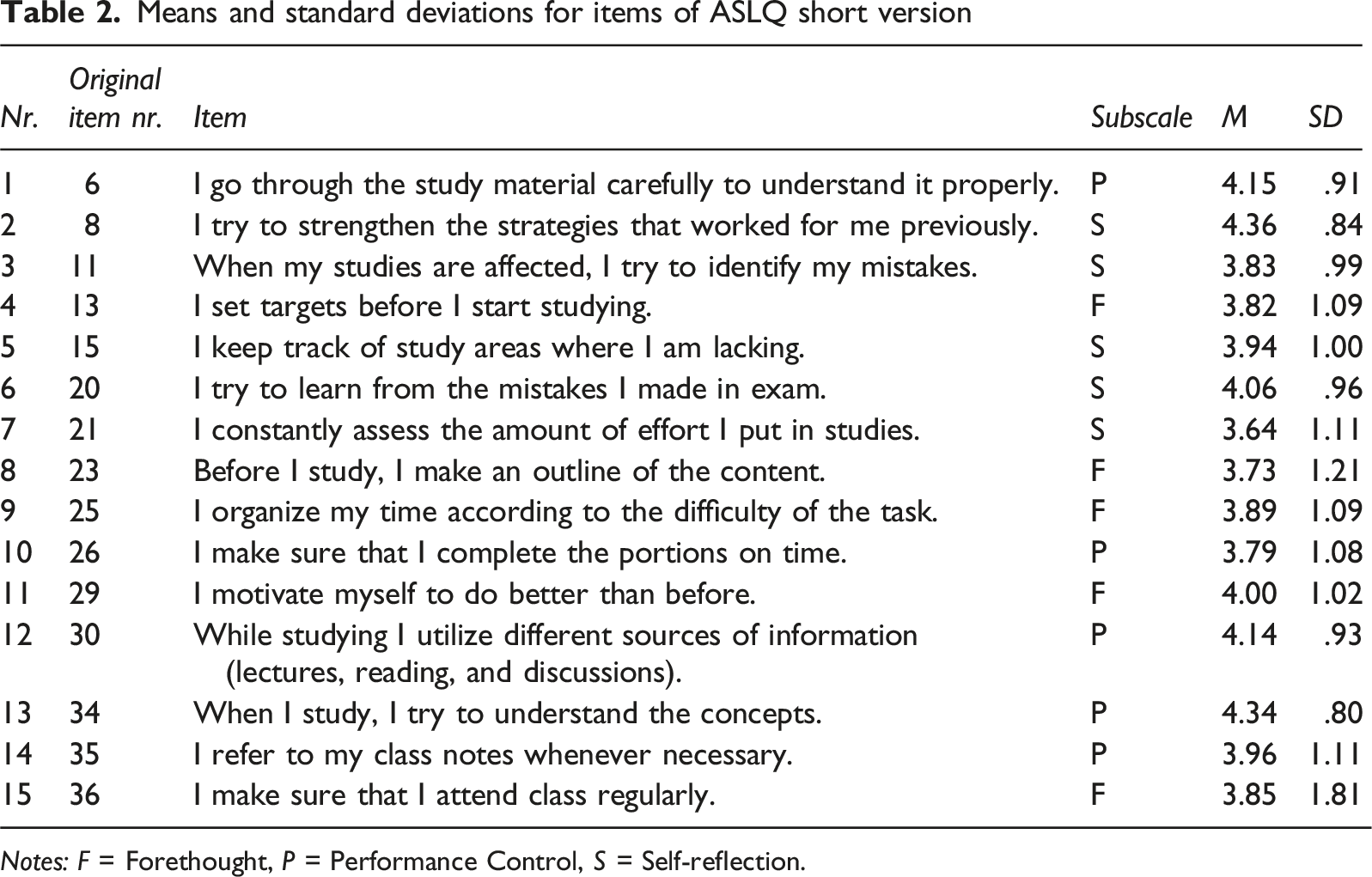
Notes: F = Forethought, P = Performance Control, S = Self-reflection.
Results of the confirmatory factor analysis for the short version of the ASLQ

Fit Indices for Gender Measurement Invariance Models of the ASLQ Short Version

During estimation, lavaan issued a warning that the covariance matrix of latent variables in the male group was “not positive definite.” Inspection of the latent variable covariances (using lavInspect (configural, “cov.lv”)) revealed that all covariances were positive and within a reasonable range, with forethought–performance control = .437, forethought–self-reflection = .304, and performance control–self-reflection = .369. Covariances in the female group were similarly moderate (.369–.411). Therefore, the warning was determined to be benign, likely due to the smaller male group size, and did not indicate a problem with model estimation.
Taken together, the short ASLQ demonstrated configural and metric invariance across gender, and the latent variable structure appears stable. Covariance patterns among the three factors were coherent in both male and female groups, supporting the structural validity of the scale across genders.
The internal consistency of the new scale was assessed using Cronbach’s alpha coefficients. The total scale demonstrated high internal consistency (α = .89). Subscale reliability was acceptable for the forethought subscale (α = .73), for the performance control subscale (α = .77), and for the self-reflection subscale (α = .75). Overall, the short version of the ASLQ exhibited satisfactory reliability for use in research contexts.
A Pearson correlation analysis was conducted to examine the relationships among the three subscales of the short version of the Academic Self-Regulated Learning Questionnaire (ASLQ): forethought, performance control, and elf-reflection. All subscales were significantly and positively correlated. Forethought was strongly correlated with Performance Control (r = .73, p < .01) and with Self-Reflection (r = .70, p < .01). Additionally, Performance Control was strongly correlated with Self-Reflection (r = .72, p < .01). These results indicate a high degree of coherence among the three SRL components, suggesting they reflect interrelated dimensions of the same underlying construct.
Correlation Matrix for each item of the short version of ASLQ
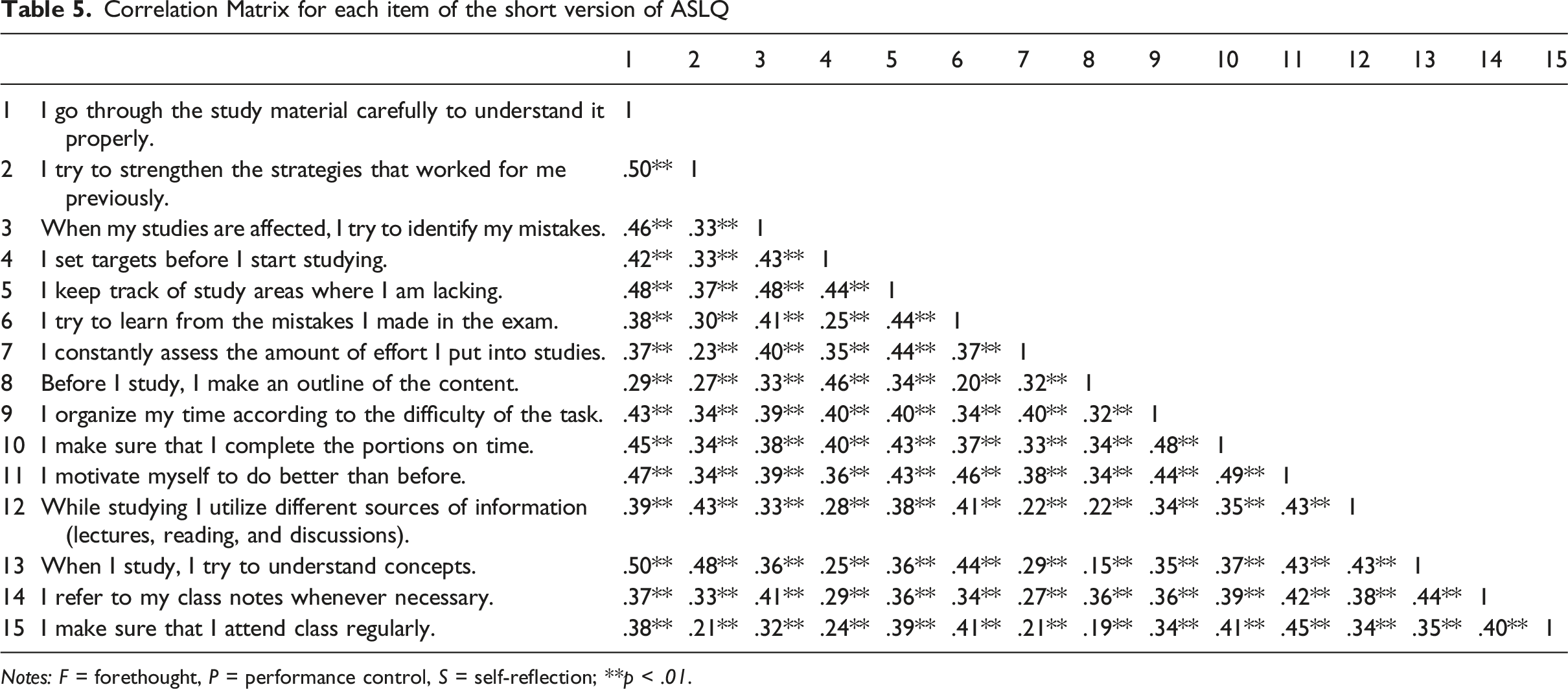
Notes: F = forethought, P = performance control, S = self-reflection; **p < .01.
To examine convergent validity at the global scale level, total scores for the ASLQ, A-SRL-S (Magno, 2010), and the MSLQ (Pintrich et al., 1991) were correlated. The ASLQ total score was strongly and positively correlated with both the A-SRL-S (r = .74, p < .01) and the MSLQ (r = .71, p < .01), indicating substantial overlap in the constructs measured. Additionally, the A-SRL-S and MSLQ were also significantly correlated (r = .64, p < .01). These results provide further support for the convergent validity of the ASLQ, as it demonstrates strong associations with two established measures of SRL and academic motivation.
Correlation Matrix for ASLQ, A-SRL-S, and MSLQ subscales
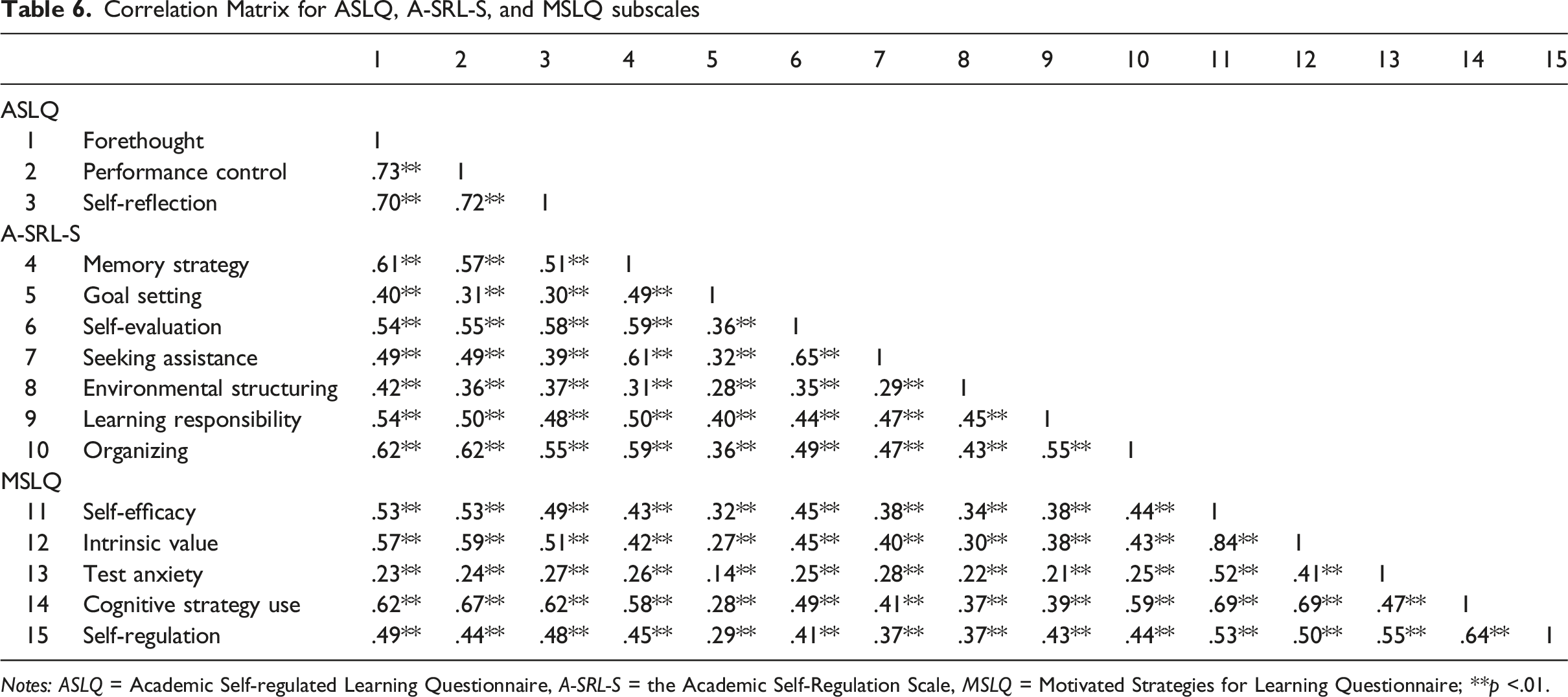
Notes: ASLQ = Academic Self-regulated Learning Questionnaire, A-SRL-S = the Academic Self-Regulation Scale, MSLQ = Motivated Strategies for Learning Questionnaire; **p <.01.
Discussion
The present study aimed to develop, adapt, and validate the short version of the ASLQ (Nambiar et al., 2022) to the Romanian university student population. The short-form reflects the original structure of the ASLQ, consisting of three dimensions: forethought, performance control, and self-reflection. Confirmatory factor analysis (CFA) supported this three-factor model, indicating satisfactory model fit and construct coherence. The three-factor model identified in this study aligns with the theoretical framework of SRL proposed by Zimmerman (2000) which conceptualizes learning as a cyclical process involving forethought, performance monitoring, and self-reflection. However, this alignment should be interpreted cautiously, as the items were selected to represent these three dimensions, which may have influenced the factor structure observed.
Furthermore, significant correlations were found between ASLQ and two other instruments: the A-SRL-S (Magno, 2010) and the MSLQ (Pintrich et al., 1991). The findings suggest that the short ASLQ is measuring a psychological construct consistent with well-established operationalizations of SRL concept. Significant correlations were also found between ASLQ subscales and related constructs from A-SRL-S and MSLQ, which provides strong evidence for convergent validity. The convergent validity findings reinforce the theoretical integrity of the scale: for instance, the Forethought subscale was strongly associated with A-SRL-S subdimensions such as Goal Setting and Memory Strategy, while the Performance Control subscale correlated highly with measures of Cognitive Strategy Use and Organizing. These patterns suggest that the adapted short version of the ASLQ effectively captures key cognitive and motivational components of SRL. All these results also indicate that reducing the number of items did not compromise the scale’s psychometric integrity; rather, it improved model fit and measurement clarity.
This study provides a validated short version of the ASLQ that can be used efficiently in both research and practice. Its short version makes it particularly suitable for classroom settings, evaluations and assessments, and large-scale studies where time constraints or participant fatigue may be a concern. Teachers, educators, psychologists, and counselors can use this scale to quickly assess students’ SRL, to identify specific areas that might require support and to develop and implement interventions targeted to their needs. In research areas, this instrument provides a valid, quick, and efficient way to measure key components of SRL, to get to know more about academic motivation, learning strategies, and other educational outcomes. Notably, this is the first adaptation of the ASLQ for the Romanian population, addressing the need for culturally appropriate instruments in SRL research.
Limitations
Despite the promising results, this study has several limitations. First, the predictive validity was not assessed, which means that the short version of the ASLQ was not tested in relation to academic outcomes such as grades or performance. While the scale has strong convergent validity with related constructs, future studies need to establish whether it can reliably predict indicators of academic self-regulation.
Second, the sample had mostly university students from a specific part of the country. This may limit the generalizability of the findings to broader student populations. Additional research should explore the scale’s applicability across different age groups, educational levels, and cultural settings.
Third, even though the reduced item version improved model fit, it might have excluded items that capture more nuanced aspects of SRL. As with any shortened instrument, it is important to acknowledge when interpreting the results that this is an assessment of the core aspects of SRL, not necessarily its full depth.
Lastly, the collected data consists of self-report measures, which are subject to biases. Future research should also include observational or behavioral measurements to provide a more comprehensive understanding of students’ SRL practices and strategies.
Conclusion
The present study aimed to adapt and validate the short version of the Academic Self-Regulated Learning Questionnaire (ASLQ) for Romanian university students. The short-form of the instrument preserved the original three-factor structure—forethought, performance control, and self-reflection—while significantly improving model fit.
One of the main advantages of this short version is its efficiency: it reduces the time and cognitive load required from respondents without compromising psychometric quality. This is particularly important in educational settings, where students are frequently asked to complete multiple assessments and where motivation and attention can vary. The shortened ASLQ allows for quick yet meaningful assessment of SRL, making it a valuable tool for both research and practice. A shorter version of an instrument can facilitate its integration into more complex research designs that involve the simultaneous use of multiple measures, thereby supporting more in-depth advances in knowledge (Wang et al., 2023; Ziegler et al., 2014). In addition, validating the measure enhances its applicability in cross-cultural research contexts.
For students, the use of this scale can contribute to greater awareness of their own learning processes and identify areas for improvement in study strategies, motivation, and self-monitoring. For researchers, it offers a theoretically grounded and empirically validated instrument that is suitable for use in large-scale studies, program evaluations, and longitudinal designs.
Furthermore, the Romanian short ASLQ can serve as a useful resource in university counseling centers, academic advising offices, and educational psychology services, where practitioners work to support students’ academic success and autonomy. It also holds potential for integration into university-level interventions targeting learning skills and academic motivation.
In conclusion, this validated short version of the ASLQ provides a practical, reliable, and culturally relevant tool for assessing SRL among Romanian university students, bridging the gap between research evidence and educational practice.
Supplemental Material
Supplemental Material - Measuring Academic Self-Regulated Learning in Romanian University Students: Adaptation and Validation of a Short Version of ASLQ
Supplemental Material for Measuring Academic Self-Regulated Learning in Romanian University Students: Adaptation and Validation of a Short Version of ASLQ by Anca Oprea, Irina Macsinga, Paul Sârbescu, and Mihai F. Predescu in Journal of Psychoeducational Assessment
Footnotes

Ethical Considerations
This study was conducted in accordance with the ethical standards of the Declaration of Helsinki and with institutional and national guidelines for research involving human participants. The study involved adult university students (aged 18–25 years) and used an anonymous, online survey with voluntary participation. According to the policies of West University of Timişoara and applicable national regulations, formal approval from an Ethics Committee was not required for this type of minimal-risk, anonymous research. All participants were informed about the purpose of the study, the voluntary nature of participation, and the confidentiality of their responses, and they provided informed consent prior to participation.
Consent to Participate
Informed consent to participate was obtained electronically from all participants prior to data collection. Participants were provided with information about the purpose of the study, the voluntary nature of participation, and the anonymity and confidentiality of their responses. Only participants who indicated their consent were able to proceed to the online survey.
Consent for Publication
Not applicable. This manuscript does not contain any individual-level identifiable data, images, or videos. All data were collected anonymously and are reported in aggregate form.
Funding
The authors received no financial support for the research, authorship, and/or publication of this article.
Declaration of Conflicting Interests
The authors declared no potential conflicts of interest with respect to the research, authorship, and/or publication of this article.
Data Availability Statement
The datasets generated and analyzed during the current study are not publicly available due to ethical considerations and participant confidentiality but are available from the corresponding author upon reasonable request.
Supplemental Material
Supplemental material for this article is available online.
References
Supplementary Material
Please find the following supplemental material available below.
For Open Access articles published under a Creative Commons License, all supplemental material carries the same license as the article it is associated with.
For non-Open Access articles published, all supplemental material carries a non-exclusive license, and permission requests for re-use of supplemental material or any part of supplemental material shall be sent directly to the copyright owner as specified in the copyright notice associated with the article.
