




Abstract
The Bullying Participant Behavior Questionnaire (BPBQ) is widely used to assess bullying roles in different populations. This study aimed to investigate the structure, construct validity, and reliability of a German version of the BPBQ in a sample of 250 German-speaking adolescents aged 10–16 years (M = 12.92; SD = 1.36; 51.6% female). A second goal was to develop a short version that retains key behaviors but enhances usability. Results indicated that the five oblique factors model fit the long version best, consistent with the original BPBQ and prior research. The short version demonstrated a better model fit, strong internal consistency, and did not require error correlations or modifications. The shorter format improves the questionnaire’s practicality while preserving its accuracy. This study underscores the importance of refining tools like the BPBQ to better capture bullying dynamics and highlights the advantages of a concise version for varying purposes.
Keywords
Introduction
Bullying is a multifaceted and dynamic phenomenon (Rose et al., 2015) that occurs in schools worldwide (Cosma et al., 2020; Eilts et al., 2022; Schütz et al., 2022). It is generally defined as aggressive behavior intended to harm others repeatedly over time, characterized by a perceived power imbalance between the bully and the victim (Olweus, 2013; Smith, 2016). The negative consequences of bullying, such as depression (Victim and Bully), academic difficulties (Victim and Bully), and delinquency (Bully), emphasize the importance of early detection and intervention of bullying (Moore et al., 2017; Zych et al., 2017). Owing to its social and dynamic nature, bullying often involves a range of participants beyond just the bully and the victim (Espelage & Swearer, 2003; Rodkin & Hodges, 2003; Thornberg, 2007). The social-ecological model posits that the entire school environment contributes to the persistence of bullying behaviors, involving every individual in some capacity, whether directly or indirectly (Swearer & Espelage, 2004, 2011). While research has traditionally concentrated on the roles of the bully and the victim (Bäker & Schütz-Wilke, 2023; Fischer et al., 2020; Jenkins et al., 2022), a broader perspective encompasses other roles such as assistants to the bully, reinforcers of the bully, defenders of the victim, and outsiders (Jenkins et al., 2022; Salmivalli et al., 1996). This comprehensive concept facilitates a deeper understanding of the various influences within schools and communities, underscoring the importance of examining the roles of all participants in bullying situations (Jenkins et al., 2022). To identify these roles, the Bullying Participant Behaviors Questionnaire (BPBQ), developed by Summers and Demaray (2008), can be used. The BPBQ has been extensively used in studies (e.g., Eilts & Bäker, 2024; Xie et al., 2023), has been psychometrically validated in both U.S. (e.g., Demaray et al., 2016) and Chinese samples (Qiu et al., 2021), and has demonstrated high validity and reliability in studies involving elementary school children (e.g., Jenkins et al., 2022) and middle school adolescents (e.g., Demaray et al., 2016; Jenkins & Canivez, 2021). However, studies analyzing the factor structure tested and identified different models and structures (e.g., five or four orthogonal or oblique factors, higher-order factor, and bifactor models, see Jenkins & Canivez, 2021; Jenkins et al., 2022; Qiu et al., 2021). To our knowledge, no research to date has yet examined the factor structure within a German sample. Thus, the primary aim of this study is to translate and evaluate the psychometric structure of the BPBQ in a community sample of German-speaking adolescents, contributing to the existing body of research on different factor structures across diverse samples and countries. Additionally, given the identification of different factor structures and the BPBQ’s length of 50 items, a secondary aim of this study is to develop and test a German short version of the BPBQ. A shorter version could facilitate more efficient screening for bullying behaviors in classroom settings, enabling quicker data-based interventions.
Theoretical Background
Bullying
Olweus (1993) defines bullying as a series of negative actions directed at a student repeatedly and over time. These actions can originate from another student or a group of students. Bullying manifests primarily in three forms: physical bullying (i.e., intentional infliction of injury such as pushing or hitting), verbal bullying (e.g., threats, mockery, teasing, or insults), and relational bullying (e.g., social exclusion or spreading rumors; Card & Little, 2006; Margraf & Pinquart, 2016). Olweus (1991, 1993) also emphasizes that bullying involves repetitive actions against an individual, but he acknowledges that a single severe incident can be classified as bullying under certain circumstances. A single severe incident can be classified as bullying if it meets the other key criteria (Imbalance of power: The aggressor holds more power, whether physical, social, or psychological, over the victim; Intent to cause harm: The incident is deliberate and aimed at causing distress or injury; Significant harm: The severity of the incident is so extreme that, despite being a one-time occurrence, it creates serious emotional, physical, or psychological damage to the victim). Salmivalli et al. (1996) identified different bullying roles which can be captured using the BPBQ, developed by Summers and Demaray (2008). The BPBQ comprises 50 self-report items aimed at identifying five specific roles in bullying contexts: (1) bully (those who consistently and intentionally exert aggression toward peers they overpower), (2) victim (the individual subjected to this aggression), (3) assistant to the bully (those who support the bully), (4) defender of the victim (those who support the victim), and (5) outsider (those who passively ignore or overlook the bullying).
Studies discuss the pros and cons of self-report versus third party assessments, such as teacher or peer nominations (Furlong et al., 2010). Self-reports better capture the student’s perspective and detect both overt and covert bullying (Furlong et al., 2010; Griffin & Gross, 2004), and are easier to implement compared to methods like behavioral observations (Thomas et al., 2015). Efficient measuring of bullying in schools is not only relevant for researchers but also for teachers, to identify problems in class and choose targeted interventions (Eilts et al., 2023).
Based on the 2022 Health Behaviour in School-aged Children study in Germany, 14% of 11-, 13-, and 15-year-olds reported experience with school bullying, showing a general decrease since 2009/10 but stability between 2017/18 and 2022 (Fischer & Bilz, 2024). Salmivalli et al. (1996) reported varying prevalence rates for different roles in bullying: 8.2% as bullies, 6.8% as assistants, 19.5% as reinforcers, 11.7% as victims, 17.3% as defenders, 23.7% as outsiders, and 12.8% without a clear role. The negative consequences of bullying affect not only the victims (e.g., PTSD, depression, and suicidal ideation; Moore et al., 2017) but also the bullies (e.g., externalizing behavior problems and academic difficulties; Schoeler et al., 2018), assistants or reinforcers (e.g., substance abuse; Quinn et al., 2016), and outsiders (e.g., depressive symptoms and emotional regulation issues; Camodeca & Nava, 2022; Midgett & Doumas, 2019). Additionally, positive effects are observed for defenders (e.g., increased empathy; Rizkyanti et al., 2021) offering opportunities for intervention approaches in school (Ruggieri et al., 2013).
Factor Structure of the Bullying Participant Behaviors Questionnaire
Originally developed as a five-dimensional measure, recent discussions opened the discourse to other factor structures regarding bullying. Aside from the “classical” roles of bully and victim, and the six roles identified by Salmivalli et al. (1996), literature also discusses pro-bullying and pro-victim roles (e.g., Jenkins & Canivez, 2021). These discussions thus lead to the examination of different factor structures in recent psychometric studies of the BPBQ (e.g., Jenkins & Canivez, 2021; Jenkins et al., 2022; Qiu et al., 2021). In total, the authors (e.g., Jenkins & Canivez, 2021; Jenkins et al., 2022; Qiu et al., 2021) tested 14 hypothesized models. These models were divided into two sets, with one set considering five group factors: bully, assistant, outsider, victim, and defender, and the other set considering four group factors: bully/assistant, outsider, victim, and defender. In exploring the factor structure, the central distinction among the models lies in how they conceptualize the relationships between the group factors.
Model 1 assumed five or four independent (orthogonal) factors, implying no correlation between them. In contrast, Model 2 allowed for correlations among the five or four factors, adopting an oblique approach that assumes potential interrelationships. Model 3 introduced a nuanced variation of the oblique model, clustering the factors into two correlated sets: one set comprising bully, assistant, and outsider (or a combined bully/assistant factor and outsider), and the other set consisting of victim and defender. Moving toward hierarchical structures, Model 4 extended the assumptions of Model 2 by proposing a higher-order model where a single general factor influenced the five or four group factors. Model 5 further refined Model 3 by introducing two higher-order dimensions: one termed Pro-Bully, which influences the bully, assistant, and outsider factors (or bully/assistant and outsider), and another termed Pro-Victim, influencing the victim and defender factors. Further extending these hierarchical approaches, Model 6 adopted a bifactor structure based on Model 4. This model retained a general factor but included additional specific group factors, tested with both five and four group factors. Finally, Model 7 paralleled Model 5 but took a bifactor approach with two general dimensions—Pro-Bully and Pro-Victim—in combination with specific group factors, also tested with five and four factors.
After comparing these models, the data generally supported the five-factor model (Jenkins et al., 2022; Qiu et al., 2021), which provided the clearest structure for understanding the relationships between the group factors. However, Jenkins and Canivez (2021) identified the two-general-factor model as the best-fitting model, indicating that the higher-order dimensions of Pro-Bully and Pro-Victim provided a more comprehensive explanation of the data. Thus, all identified models serve as the foundation for the current analysis.
Current Study
In the current study, we aim to explore the different models proposed by Jenkins and Canivez (2021) using a German translation of the BPBQ (Summers & Demaray, 2008). By applying these models to our dataset, we seek to validate and compare their applicability in the context of German-speaking populations. Furthermore, we will endeavor to develop a short version of the BPBQ that retains the essential components (according to Olweus, 1993 definition of bullying) of the full measure while offering a more concise tool for practical use in research and educational settings. This short version aims to provide an efficient yet comprehensive assessment of bullying roles and behaviors, making it accessible for broader application in schools.
Method
Participants and Procedure
The sample for this study comprised students from German secondary schools who were contacted via email and invited to participate. The schools were chosen at random from a list of schools in the relevant federal states. Once the schools agreed to participate, information letters were sent to both students and their parents, informing them about the study’s purpose, voluntary participation, procedures, and the measures taken to ensure data confidentiality. Participation required informed written consent from both the students and their parents, which was obtained through signed consent forms provided alongside the informational letters. A total of 252 adolescents provided consent to participate in the study; however, two chose not to take part after consent was obtained, resulting in a final sample of N = 250 German-speaking adolescents aged between 10 and 16 years (M = 12.92; SD = 1.36; 51.6% female).
Following the receipt of informed consent, data collection occurred during school hours in a controlled group setting. Students completed the paper-and-pencil questionnaire under the supervision of researchers or trained supervisors in a quiet classroom environment. This setup ensured that participants could ask for clarification if needed and that the integrity and confidentiality of their responses were maintained. The study received approval from the university’s ethics committee (Approval Number: Drs.Nr.EK/2020/047), which ensured that all procedures adhered to ethical standards for research involving human participants. Furthermore, the data protection authority provided the necessary approval, ensuring that data handling complied with privacy regulations.
Instrument
The BPBQ (Summers & Demaray, 2008) was used in this study. The BPBQ includes 50 items, with 10 items for each of the five roles: Bully (e.g., “I have made fun of another student”), Victim (e.g., “I have been ignored”), Assistant (e.g., “When someone was verbally threatening another student, I joined in”), Defender (e.g., “I defended someone who had things purposely taken from them”), and Outsider (e.g., “I ignored it when someone else pinched or poked another student”). This structure allows for a detailed assessment of each participant’s involvement in various bullying behaviors, providing a comprehensive understanding of their roles. The instructions of the questionnaire do not provide an explicit definition of bullying or label the roles at the beginning (Summers & Demaray, 2008). This is done to avoid priming the students (e.g., Kert et al., 2010; Vaillancourt et al., 2008; Vivolo-Kantor et al., 2014). Instead, it queries participants about situations that embody the essence of bullying and the corresponding roles. Participants were asked to rate their behavior over the past 30 days on a five-point scale, ranging from (0) never, (1) 1 to 2 times, (2) 3 to 4 times, (3) 5 to 6 times, to (4) 7 or more times. Therefore, higher scores reflect greater frequency of involvement in or experience with that particular role. Originally designed in English, the BPBQ was translated into German for this study using a back-translation method to ensure accuracy and cultural relevance. A fluent German speaker with proficiency in English conducted the initial translation. A second independent German speaker, proficient in English, then back-translated the items into English. Both translators compared the back-translation with the original questionnaire to identify discrepancies and refine the German version accordingly, ensuring conceptual equivalence.
Data Analysis
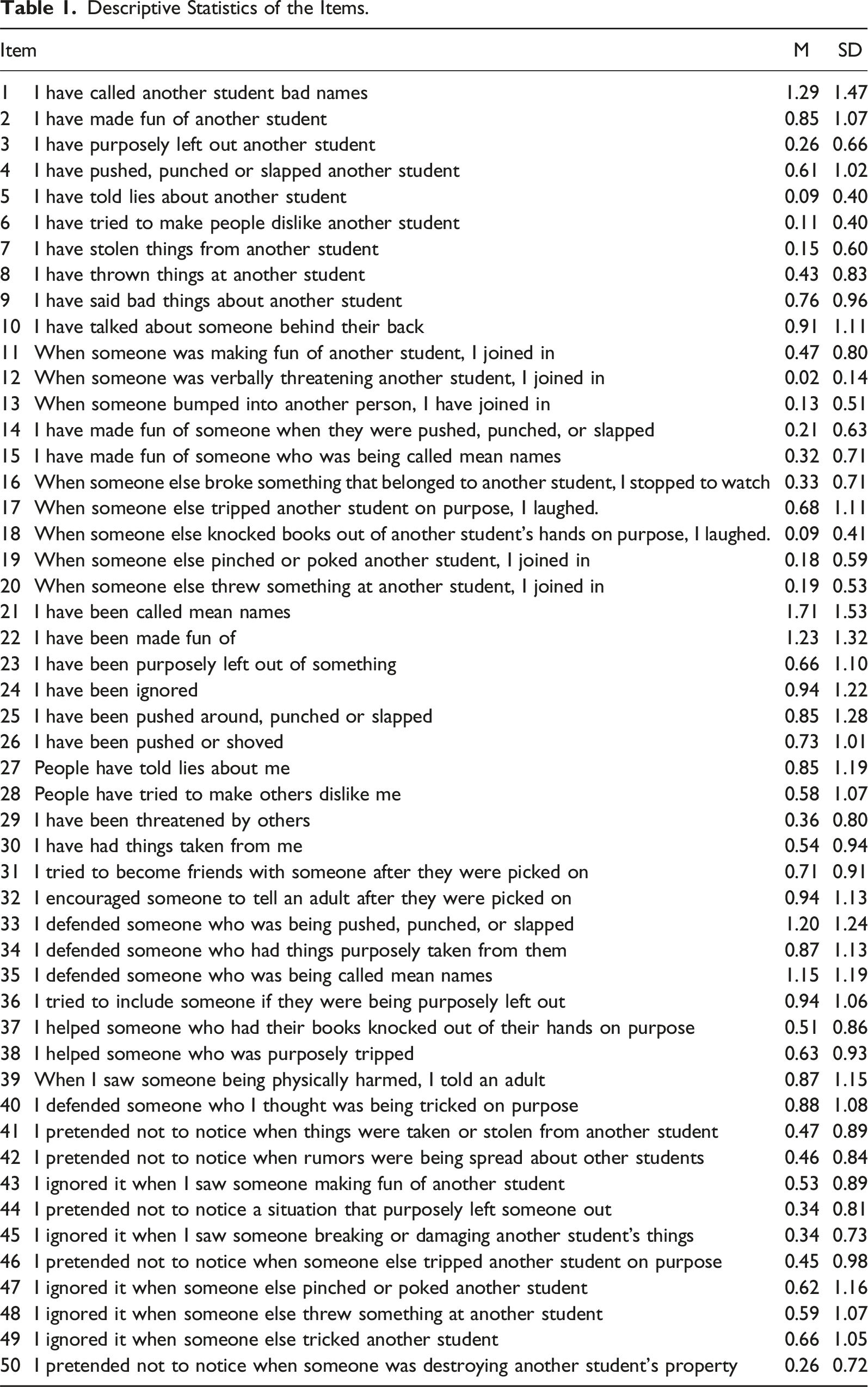
The aim of our study was to examine the factor structure of the BPBQ (Summers & Demaray, 2008) within a German sample of children using confirmatory factor analysis (CFA) in R (R Core Team, 2023; the R code is available at: https://osf.io/jxzub/). To achieve this, we tested various models informed by existing literature on the BPBQ. In total, 14 models outlined in the theoretical section were evaluated (e.g., Jenkins & Canivez, 2021; Jenkins et al., 2022; Qiu et al., 2021). The measured variables in this analysis range from 0 (never), 1 (1–2 times), 2 (3–4 times), 3 (5–6 times), to 4 (7 or more times). Given that the mean values of most items were below 1, indicating potential zero-inflation, we conducted an additional analysis comparing the observed proportion of zero responses to the expected proportion under a Poisson distribution. We included this step as an initial exploratory analysis to assess whether zero-inflation posed a systematic issue across the scale. The decision to compare the observed frequency of zero responses to an expected Poisson distribution was based on literature for evaluating potential deviations, such as zero-inflation, in ordinal or count data distributions (e.g., Feng et al., 2014; Min & Agresti, 2002). The results showed that while some items exhibited significant zero-inflation, this was not a systematic issue across the scale. Additionally, we have added a table to the supplemental material that presents the number of zero responses per item, providing a more detailed account of the zero-inflation patterns in the data (S1 Zero response). Since the BPBQ employs an ordinal Likert-type response format (0–4), we retained robust maximum likelihood estimation (MLM) as the most suitable method for our analysis, consistent with prior studies that have also used robust estimators (Jenkins & Canivez, 2021; Jenkins et al., 2022; Qiu et al., 2021). To address zero inflation, in addition to conducting confirmatory factor analyses (CFA), we also estimated a Two-Part Zero-Inflated CFA to account for the presence and absence of behaviors (Kim & Muthén, 2009). We tested the Two-Part Zero-Inflated CFA models using the weighted least square mean and variance adjusted (WLSMV) estimators. To keep consistency with previous research on the BPBQ, we report the results of both analyses.
The quality of these models was assessed using robust estimates of the Comparative Fit Index (CFI), Tucker–Lewis Index (TLI), root mean square error of approximation (RMSEA), and standardized root mean squared residual (SRMR). A good model fit was characterized by RMSEA and SRMR values below .08, and CFI and TLI values above .90 (Hu & Bentler, 1999). Chi-square values were also reported, although the sensitivity of the Chi-square statistic in larger samples (N >200) should be considered (Vandenberg, 2006). Effect coding was used in the final reported models of the CFA (Little, 2013). Missing data, which comprised 15.2% of cases with at least one missing item, was excluded from the analysis. Factor loadings were assessed according to Stevens (2002) and Hair et al. (2009). A power analysis using semPower (Moshagen & Bader, 2024) was conducted to determine the necessary sample size for performing a CFA with five correlated latent factors. The expected correlation between the factors was set to .30, with each factor being measured by 10 indicators. The average factor loading was assumed to be .40. The analysis was performed using an a-priori approach with a significance level (α) of .05 and a desired statistical power of .80. The results indicated that a minimum sample size of 201 participants was required to detect the expected effects with sufficient power.
The final model with the best fit, including error correlations with similar overlaps in content (e.g., Item 25: I have been pushed around, punched, or slapped, and Item 26: I have been pushed or shoved; Cole et al., 2007; Urban & Mayerl, 2014), was then analyzed to identify potential items for omission in creating a short version of the BPBQ. Additionally, the internal consistencies of the questionnaire items within the identified factors were determined using Cronbach’s alpha and McDonald’s Omega.
Results
Descriptive Results
Confirmatory Factor Analyses
Model-Fit Indices of CFA Models of the BPBQ With MLM Estimator.
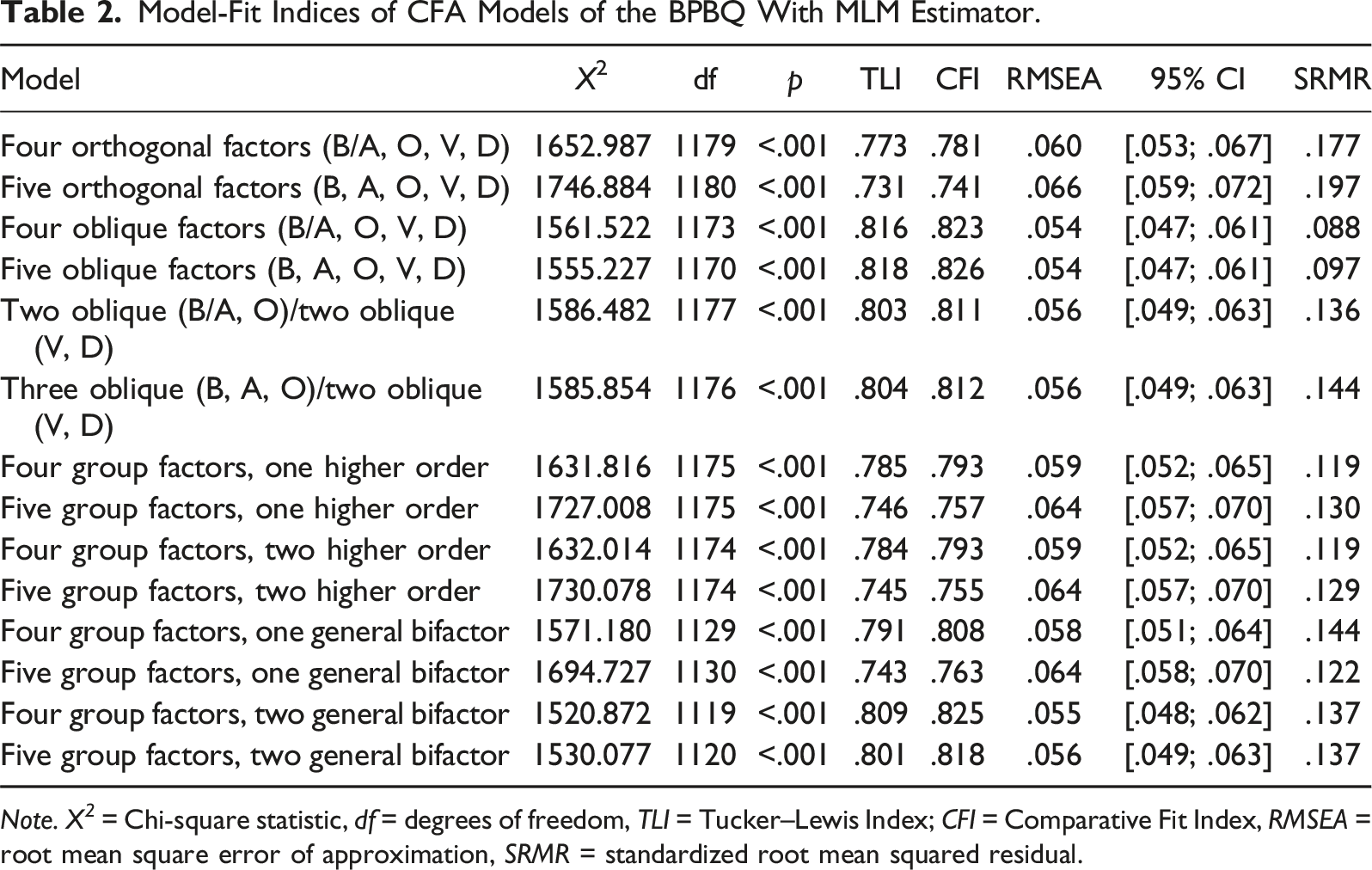
Note. X 2 = Chi-square statistic, df = degrees of freedom, TLI = Tucker–Lewis Index; CFI = Comparative Fit Index, RMSEA = root mean square error of approximation, SRMR = standardized root mean squared residual.
Model-Fit Indices of CFA Models of the BPBQ With WLSMV Estimator and With Two-Part-Modelling.
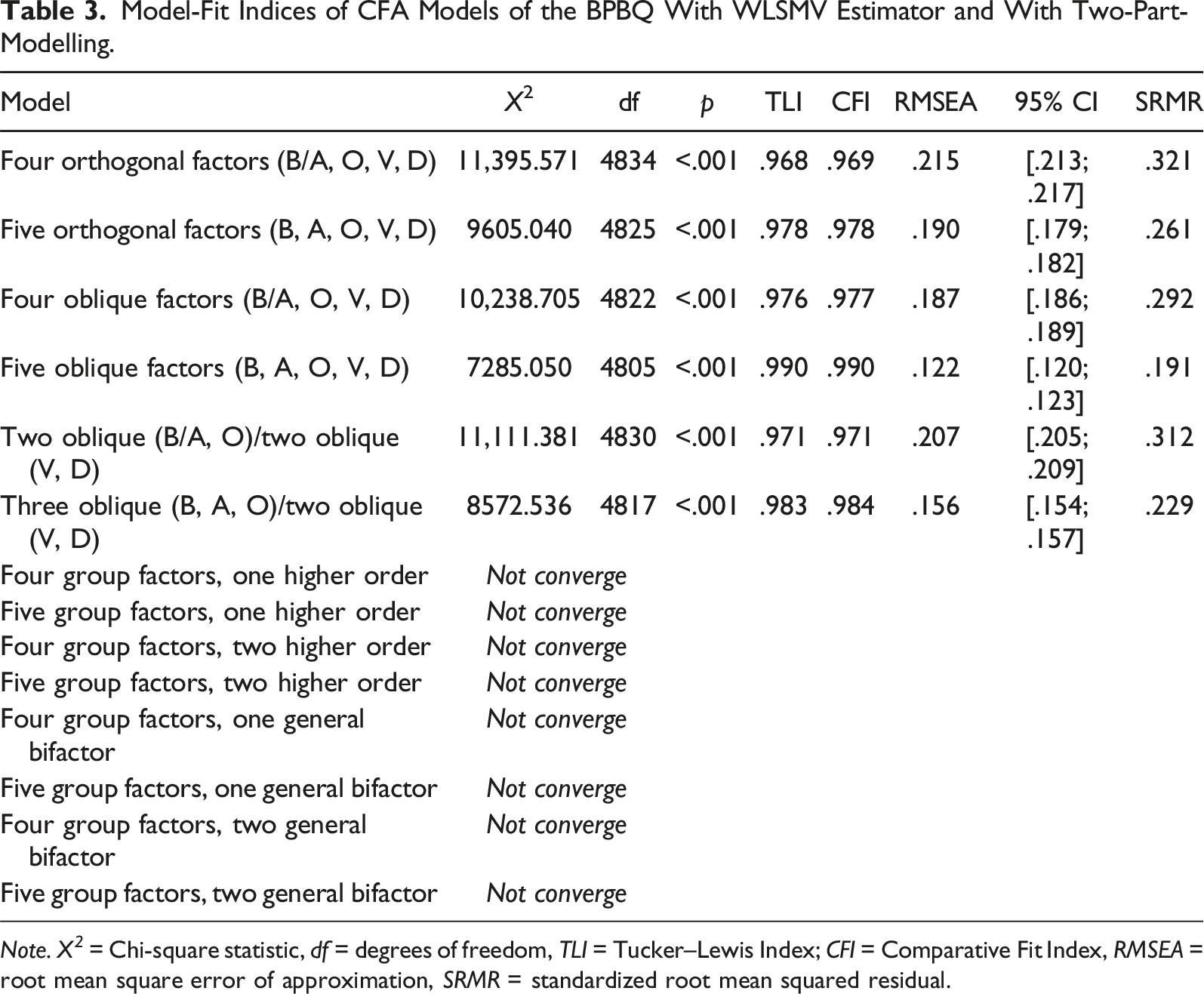
Note. X 2 = Chi-square statistic, df = degrees of freedom, TLI = Tucker–Lewis Index; CFI = Comparative Fit Index, RMSEA = root mean square error of approximation, SRMR = standardized root mean squared residual.
Modified Confirmatory Testing (Post-Hoc Analyses)
Post-hoc analyses were performed by calculating a modified CFA model. The five oblique factor model was chosen for this purpose as it showed one of the best fits in both analysis (CFA with MLM and Two-Part Zero-Inflated CFA with WLSMV) and was the model proposed by the authors of the BPBQ. To identify poorly discriminating items, item-total correlations across the BPBQ items were considered. Items with item-total correlations below .40 (Hair et al., 2009) were excluded in the subsequent confirmatory testing. The items deleted were Item 5 (Bully; λ = .327), Item 12 (Assistant; λ = .351), Item 16 (Assistant; λ = .235), and Item 18 (Assistant; λ = .344). However, this deletion did not significantly improve the model fit. Consequently, errors for items with overlapping content were allowed to correlate (Cole et al., 2007; Urban & Mayerl, 2014). The following error terms were correlated: 1 and 2, 3 and 6, 9 and 10, 4 and 8, 13 and 14, 11 and 15, 13 and 20, 21 and 22, 22 and 23, 23 and 24, 25 and 26, 27 and 28, 32 and 39, 33 and 39, 37 and 38, 31 and 40, 36 and 39, 42 and 43, 45 and 50, 43 and 49, and 47 and 48. Despite this, the error correlations did not improve the model fit to a satisfactory level. Therefore, modification indices were examined to identify further improvements. Changes were made iteratively until the model fit was deemed satisfactory, with suggested modifications incorporated only if they were theoretically justified. Correlations between error terms were allowed between the roles of the Bully and the Victim, given that the bully–victim role has been shown to exist. Additionally, correlations between the Bully and the Assistant were allowed due to their high correlation (Eilts et al., 2024). Specifically, based on these theoretical considerations, the following error term correlations were added: Items 1 and 21, 2 and 11, 4 and 25, 8 and 20, and 3 and 28. Although these additional correlations improved the model fit, it was still not satisfactory. As a final step, items with high cross-loadings were successively deleted, and the corresponding error term correlations were removed. The items deleted were Item 2 (Bully), which also loaded on the Victim scale; Item 14 (Assistant), which also loaded on the Outsider scale; and Item 31 (Defender), which also loaded on the Victim scale. The final model achieved a satisfactory fit with χ2 = 994.904; df = 828; p < .001; CFI = .923; TLI = .916; RMSEA = .041; SRMR = .071.
Results of the Short Version
Factor Loadings and Reliability of the Short Version (MLM Estimator).
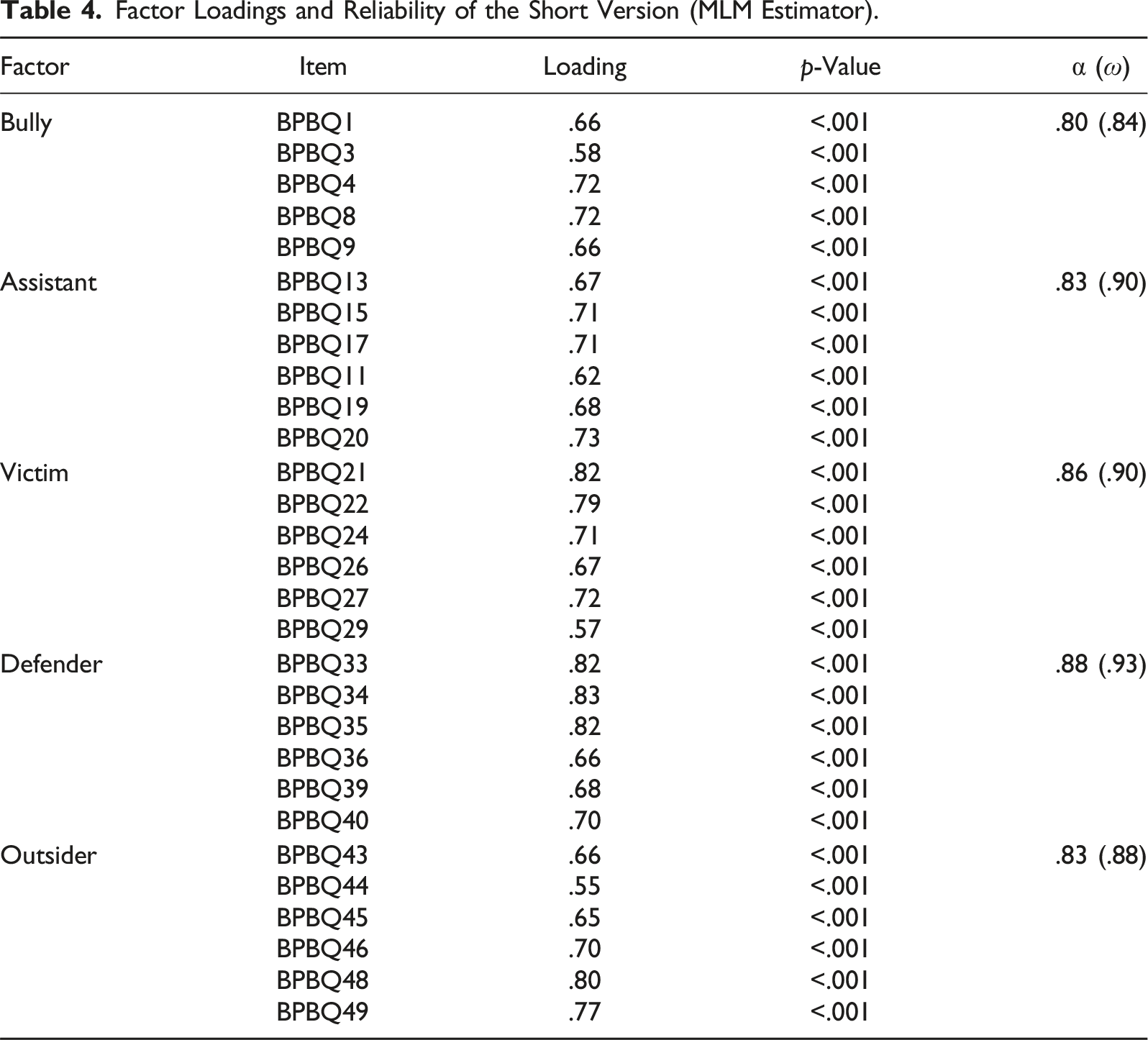
Factor Loadings for the Two-Part Zero-Inflated CFA.
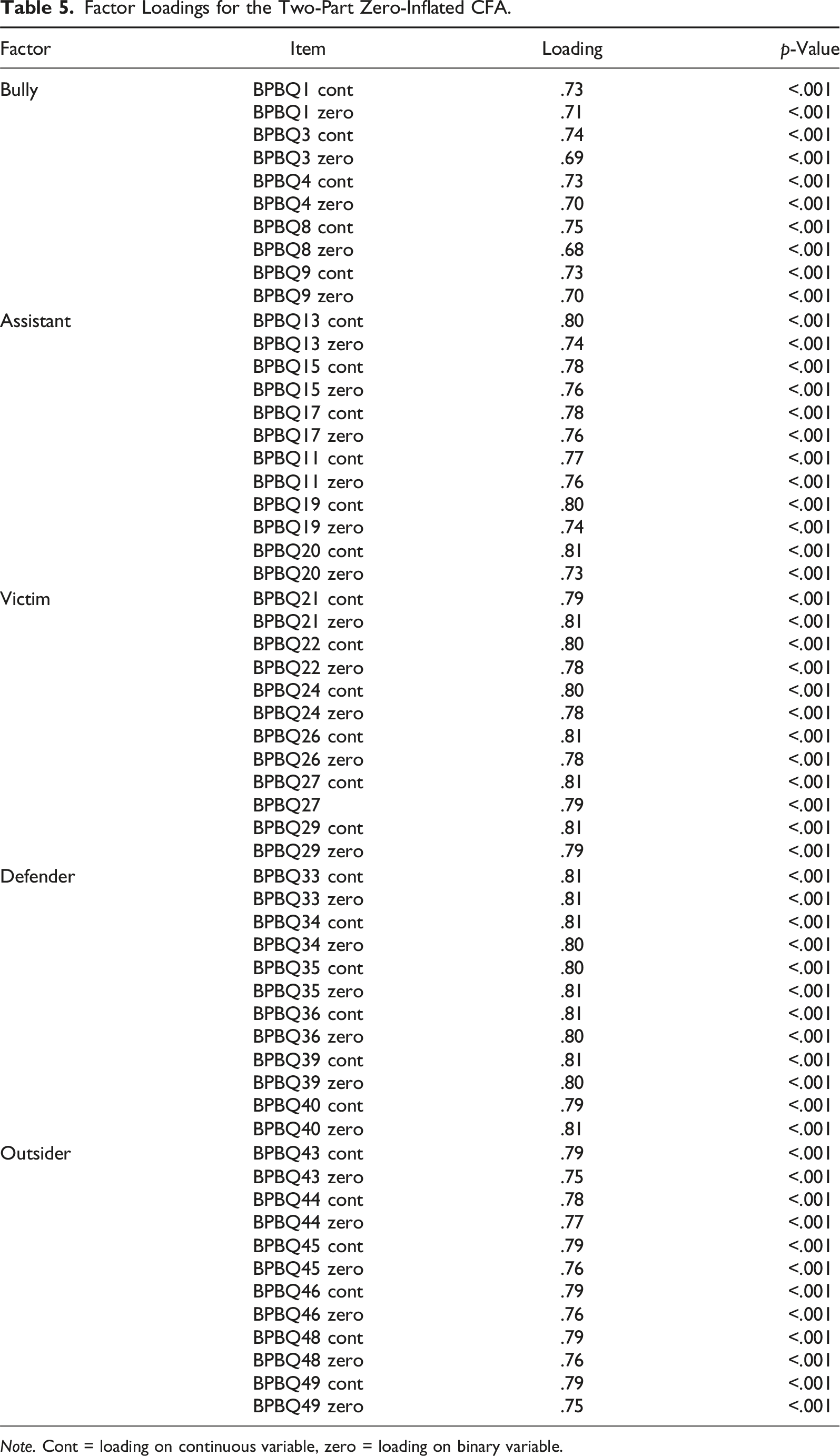
Note. Cont = loading on continuous variable, zero = loading on binary variable.
Discussion
The primary purpose of this study was to examine the factor structure of the BPBQ within a German sample. We explored the various factor structures proposed by Jenkins and Canivez (2021) and aimed to develop an economical short version of the BPBQ for use in schools and research settings.
In the following discussion, we first focus on the results of the factor structure analysis and critically evaluate these findings in light of previous research. We also provide implications for the use of the BPBQ in educational settings. This is followed by a discussion of the developed short version of the BPBQ, its potential benefits, and the next steps researchers should consider.
Factor Structure
On the basis of the model-fit indices, the five oblique factors model seems to be the model best fitting to the data without any additional modifications. This is the model that the authors originally intended for the questionnaire (Summers & Demaray, 2008) and this result is also in line with previous research (e.g., Jenkins & Nickerson, 2017; Salmivalli et al., 1996). Therefore, we would also recommend the use of the five distinct roles in further examinations of bullying in German-speaking samples. Our findings are only partly in line with the findings of Jenkins and Canivez (2021) and Jenkins et al. (2022) who also support the five oblique factors model but found a better model fit for the model with additional higher-order factors (pro-bully/pro-victim). This might be due to the use of a bullying definition prior to the questionnaire in these studies. However, the use of a bullying definition is not in line with the instructions for the BPBQ (Summers & Demaray, 2008) and can result in priming the students (Kert et al., 2010; Vaillancourt et al., 2008; Vivolo-Kantor et al., 2014).
To improve the model fit, four original items had to be deleted. These were one bully and three assistant items. This indicates that the role of the assistant does not seem to work as well in a German sample as it does in other samples. One possible explanation for the weaker differentiation of the assistant role in the German sample could be cultural differences in how bullying roles manifest (Scheithauer et al., 2016). In some contexts, bullying behaviors may be more structured, with clear participant roles, whereas in Germany, assistants might blend more into the bully or reinforcer roles. Additionally, the strong emphasis on inclusive education and cooperative learning environments in German schools may influence peer dynamics, potentially reducing the prevalence of clearly defined assistant behaviors. This is consistent with previous research suggesting a high overlap between bully and assistant roles (Jenkins & Canivez. 2021; Jenkins et al., 2022). The modification indices also show that there is a high correlation between the role of the bully and victim and the bully and assistant as these are the error terms that are recommended to be correlated. This is in line with Jenkins and Canivez (2021) who discussed that bullying roles are not exclusive, and adolescents can engage in multiple roles depending on the context. The high correlation between the bully and victims has also been demonstrated in other studies that report the presence of a bully-victim (e.g., Eilts et al., 2024; Vlachou et al., 2011). This is in line with the social-ecological model highlighting the social and dynamic nature of bullying (Swearer & Espelage, 2004, 2011; Thornberg, 2007). Therefore, a strength of the BPBQ is that it addresses the engagement of students in different roles. This also better represents the reality as students rarely occupy only one of the roles.
Teachers could use the BPBQ to inquire which students might occupy more than one role and in which situations this is the case. This could lead to improved data-based intervention strategies that the teachers can use. Additionally, teachers can infer who ignores bullying or who is assisting to see which intervention strategies could be useful for their class (Ruggieri et al., 2013). Nevertheless, this increases the complexity of factor analysis (Jenkins & Canivez, 2021). The Cronbach’s alpha values (ranging from .81 to .91) and MacDonald’s Omega (ranging from .87 to .93) also support the five-factor structure. The bully role has the lowest alpha value and the lowest factor loadings of all of the five roles. This might be due to the self-reporting nature of the instrument. The role of the defender shows the highest alpha value and the highest overall factor loadings of the five bullying roles. This is in line with previous research that also reports the highest alpha values for the defender role (e.g., Qiu et al., 2021).
Short Version
Additionally, we aimed to investigate whether developing a short version of the BPBQ would be feasible for more efficient use in future studies and schools. During the modification and shortening of the questionnaire, we focused on retaining the main behaviors described in the definition of bullying (Olweus, 1993), such as kicking and hitting for the bully role, and including the three forms of bullying (i.e., physical, verbal, and relational; Card & Little, 2006; Margraf & Pinquart, 2016). The short version demonstrates a better model fit than the original five oblique factors model and does not require error correlations or further modifications. Consistent with the final model of the CFA, the bully role has the lowest alpha value, while the defender role has the highest. The alpha values (ranging from .80 to .88) and McDonald’s omega (ranging from .84 to .93) for the short version indicate good reliability. The strength of the short version is economical and reliable application of the instrument in research and schools. Further studies should examine the factor structure of the short version. It should be evaluated in different national and international studies to see whether it is a reliable and economic instrument.
Limitations and Further Research
The instrument does not capture the sociometric dynamics of bullying. Teachers and researchers cannot infer the specific bully–victim relationships, making it impossible to determine whether victims exhibit bullying behaviors toward their own perpetrators. Such behavior would be considered aggressive rather than bullying, as it lacks the power imbalance characteristic of bullying (Smith, 2016). Another limitation is the variation in the use of the BPBQ. Jenkins and Canivez (2021) and Jenkins et al. (2022) provided a definition of bullying, which we did not, affecting the comparability of our results. Future studies should compare BPBQ results with and without a bullying definition to investigate any differences in bullying prevalence and check the measurement invariance. Additionally, as a self-report measure, the BPBQ does not capture classroom dynamics. Future research should include multiple informant perspectives to better understand bullying roles and reduce the likelihood of social desirability bias in students’ responses (Furlong et al., 2010). The lowest alpha values for the bully role also suggest that self-report measures might lead to a lower willingness to report perpetrator behavior.
Prior studies did not account for the high proportion of zero responses in the BPBQ, potentially leading to biased factor structures and inaccurate conclusions. The Two-Part Zero-Inflated CFA (ZICFA) addresses this limitation by distinguishing between the presence of a behavior (zero vs. nonzero responses) and its frequency, providing a more precise measurement. This approach improves model fit, reduces bias in factor loadings, and offers a more nuanced understanding of bullying dynamics, especially for less frequently endorsed roles. Future research should compare ZICFA to standard CFA in BPBQ validation studies.
For future research, the proposed short version should be psychometrically validated. It would also be valuable to examine cultural differences in bullying, such as those arising from differences in school environments (e.g., some countries do not use lockers, so students carry their books; e.g., see Items 18 and 37). Previous studies have also highlighted gender differences (e.g., Bäker et al., 2023; Eilts et al., 2022; Jenkins & Nickerson, 2017) and differences concerning students with disabilities (Eilts et al., 2022; Eilts & Koglin, 2022; Rose et al., 2011; Schütz et al., 2022). Additionally, there are diverse findings regarding age differences in bullying (Blake et al., 2012; Craig et al., 2009; Scheithauer et al., 2006; Swearer et al., 2012). Therefore, future studies should investigate the measurement invariance of the BPBQ across these subgroups.
Conclusion
In conclusion, the five oblique factors model best fits the data without additional modifications, aligning with the original intentions of the BPBQ authors (Summers & Demaray, 2008) and prior research (e.g., Jenkins & Nickerson, 2017; Salmivalli et al., 1996). This supports the use of five distinct roles in studying bullying in German-speaking samples. Since studies from other countries also support the five-factor solution (Jenkins et al., 2022; Qiu et al., 2021) the results seem to be generalizable for other countries as well. However, our findings diverge slightly from those of other studies, such as Jenkins and Canivez (2021) and Jenkins et al. (2022), which found a better fit with models incorporating additional higher-order factors. This discrepancy may be attributed to methodological differences, such as the inclusion of a bullying definition prior to administering the questionnaire. In contrast, our study adhered to the BPBQ’s original instructions, which could influence how respondents perceive and report their experiences.
Furthermore, Jenkins and Canivez (2021) and Jenkins et al. (2022) collected data from entire classes or schools, potentially providing a more comprehensive view of the bullying dynamics. Our study, however, only included a subset of students from each class. Given that bullying is a process that occurs within the classroom and involves various roles for each student (Salmivalli et al., 1996). To better capture the complexities of bullying, future research should aim to collect data from entire classes. By focusing on the factor structure of the questionnaire within a more representative sample, future studies can offer more nuanced insights into the prevalence and interplay of various bullying roles. This approach would likely enhance the development of more effective interventions and prevention strategies, tailored to the specific dynamics observed in real classroom settings.
The study also suggests that the role of the assistant may not function as effectively in a German context, evidenced by the need to remove certain items related to this role. High correlations between roles, such as bully and victim or bully and assistant, highlight the fluidity of these roles among adolescents, reinforcing the idea that students often engage in multiple roles depending on the situation. It could also be a question of the translation of the instrument. However, the results of Jenkins and Canivez (2021) also indicate a low discrimination between the role of the bully and the assistant for their sample. This complexity, while challenging for factor analysis, makes the BPBQ a valuable tool for teachers to understand and intervene in bullying dynamics in their classrooms.
The development of a short version of the BPBQ aimed at retaining key behaviors and bullying forms showed a better model fit than the original, with reliable alpha values, suggesting it as a viable option for more efficient use in future studies and educational settings.
Supplemental Material
Supplemental Material - Factor Analysis and Development of a Short Version of the Bullying Participant Behaviors Questionnaire (BPBQ) in a German Sample of Adolescents
Supplemental Material for Factor Analysis and Development of a Short Version of the Bullying Participant Behaviors Questionnaire (BPBQ) in a German Sample of Adolescents by Jule Eilts, Fabio Sticca, and Jessica Wilke in Journal of Psychoeducational Assessment
Footnotes
Declaration of Conflicting Interests
The author(s) declared no potential conflicts of interest with respect to the research, authorship, and/or publication of this article.
Funding
The author(s) received no financial support for the research, authorship, and/or publication of this article.
Ethical Statement

Data Availability Statement
The data that support the findings of this study are available from the corresponding author upon reasonable request.
Supplemental Material
Supplemental material for this article is available online.
References
Supplementary Material
Please find the following supplemental material available below.
For Open Access articles published under a Creative Commons License, all supplemental material carries the same license as the article it is associated with.
For non-Open Access articles published, all supplemental material carries a non-exclusive license, and permission requests for re-use of supplemental material or any part of supplemental material shall be sent directly to the copyright owner as specified in the copyright notice associated with the article.
