




Abstract
Converging lines of evidence suggest that a feeling of being cared for and cared about is a key element of the feeling of mattering to other people. In the current article, we summarized theoretical observations and the findings of research investigations that indicate that the feeling of being cared about is central to the mattering construct. We then evaluated the role of feeling cared for in an extended six-item General Mattering Scale (GMS-6). A sample of 276 university students completed the GMS-6 and self-report measures of depression and loneliness. Psychometric tests established that a six-item version has one factor and enhanced internal consistency. Correlational analyses confirmed that mattering is associated negatively with depression and loneliness. Hierarchical regression analyses indicated that the additional focus on feeling cared about predicts unique variance in depression and loneliness beyond the considerable amount of variance predicted by the original GMS. The lack of feeling cared as measured by the GMS-6 was established as especially relevant to loneliness. Our discussion focuses on key directions for future research and for the need for a greater emphasis on caring as part of mattering from a construct validity perspective.
Much depends on creating good measures with clear construct validity and content validity. Consider the mattering construct. Rosenberg and McCullough (1981) introduced this construct and showed the importance of individual differences in mattering to parents in predicting reduced distress among adolescents. Mattering reflects our need to feel like we are significant and have meaningful connections with other people. It is a feeling that reflects our subjective appraisals of how others people regard us. Rosenberg and McCullough (1981) focused initially on three elements: (1) the sense that other people depend on us; (2) the perception that other people regard us as important; and (3) the realization that other people are actively paying attention to us. They suggested that being a focus of attention is the most central mattering component. Rosenberg (1985) then added that mattering also includes the notion that other people would miss us if we were no longer around.
Rosenberg and McCullough (1981) showed that mattering was protective and predictive above and beyond the benefits of having high self-esteem. They also reflected on what it means to have a feeling of not mattering to one’s parents. Rosenberg and McCullough (1981) summarized their findings by concluding that, “The adolescent who feels he matters little to his parents is thus strikingly more likely to be depressed, anxious, and otherwise disturbed, however measured” (p. 171). Subsequent work has established that mattering is highly protective and linked with consequential outcomes involving the person, relationships, and society (see Flett, 2022).
Clearly, mattering represents a unique element of the self-concept. Ryan and Deci (2017) discussed its potential importance as part of their analysis of core psychological needs. They stated in terms of the need to connect with others that: “… one of the primary goals of behavior is the feeling of belonging and of being significant or mattering in the eyes of others. There is a basic need to feel responded to, respected, and important to others, and, conversely, to avoid rejection, insignificance, and disconnectedness, a fact that applies not just to humans but other primates as well (see de Waal, 2009)” (p. 96).
Unfortunately, despite the broad relevance of mattering as a psychosocial construct, initial interest in the study of mattering was limited and, as a result, there were few articles on mattering for the next 20 years. One barrier to progress was the lack of a good measure. Initially, Rosenberg and McCullough (1981) noted the lack of suitable measures in their original work and they emphasized that their results emerged despite having to rely on measures they characterized as “weak” (p. 169). This problem persisted for the next 20 years until Marshall (2001) developed a sound measure to assess mattering in parents and mattering in friends.
As for creating a global measure of mattering as a general feeling, Marcus and Rosenberg (1987) developed a face valid 5-item measure called the General Mattering Scale; however, this work was only presented at a conference and was not made available in the published literature. Unfortunately, the General Mattering Scale items did not appear in print until Deforge and Barclay (1997) listed the items in an article on levels of mattering among homeless men. The items appeared once again in a subsequent article that described an influential longitudinal study by Taylor and Turner (2001) on mattering and reduced vulnerability to depression.
Currently, as noted by Flett (2018), the General Mattering Scale is the most widely used measure of overall levels of mattering. This self-report questionnaire is the focus of the current article. It is now the case that there is extensive evidence that attests to the sound psychometric properties of this self-report scale. Several investigative teams have conducted psychometric analyses that show that the scale consists reliably of one factor with all five items loading on the measure (e.g., Davis et al., 2019; Giangrosso et al., 2022; Liu et al., 2023; Watson et al., 2022). This research has typically shown that individual differences in GMS scores predict key outcomes.
It is important with any measure to evaluate the fit between how the psychological construct is conceptualized at a theoretical level and what the scale items are actually measuring in terms of the words and themes represented. Cronbach and Meehl (1955) observed that there is a joint need to assess the validity of a construct and the tests created to assess the construct. Classic theorists and test construction experts such as Jackson (1970, 1971) have emphasized the overriding importance of psychological theory and needing to fully explicate a construct at a conceptual level as a vital first step in scale development.
An important consideration is whether a measure fully represents a construct. It is important to examine the fit between scale item content and theoretical views of the construct and consider the possibility that something might be missing from the measure.
This is the subject of the current article and our focus on the item content of the General Mattering Scale (GMS). Although there is consistent and strong support for the continuing and future use of the GMS, we have become convinced of the need to expand the scale to assess the feeling of mattering in terms of feeling cared about by other people. It is our contention that the sense of being cared about and perhaps cared for is one of the most central elements of the mattering construct and, regrettably, this element is lacking in the current five-item GMS. Thus, although brief, economical measures are preferred (see Burisch, 1984), we felt a slight expansion of the GMS to reflect a form of “caring connection” would yield significant dividends.
Rosenberg (1985) envisioned feeling cared about as central to the feeling of being important to another person. Perhaps his most impactful description of feeling important to another person is as follows: “To believe that the other person cares about what we want, think, and do, or is concerned with our fate, is to matter” (Rosenberg, 1985, p. 216). Mattering when framed in terms of knowing that others truly care about us contributes to feelings of closeness and connection to others. This closeness should provide someone with a sense of comfort and connection even when there is a lack of physical proximity to those people who provide the sense of being significant.
We feel that when seeking to measure relational mattering, some reference to feeling cared about is essential and must be reflected in scale items. Unfortunately, while some mattering measures include an item to assess mattering in terms of feeling cared about (e.g., Elliott et al., 2004; France & Finney, 2009), this focus is lacking at present from the General Mattering Scale. This emphasis is in keeping with Rosenberg’s description of the essence of mattering to others. Caring is also clearly reflected in qualitative accounts of themes that are central to the experience of mattering. For instance, themes about caring are featured prominently when professors describe how they convey to students that they matter (see Pychyl et al., 2022). Schlossberg (1989) also framed mattering as, “Do others care about us and make us feel we matter?” (p. 1). Elliott (2009) described mattering to family and the feeling of being home as a combination of attention, care, and reliance. Hamby et al. (2019) found in their qualitative work that, “Many youth, parents, and other caregiving adults talked about the importance of consistent expressions of care and importance” (p. 1672). Similarly, Mak and Marshall (2004) cited qualitative descriptions of mattering in romantic relationships rooted in the feeling of being validated when one partner knows that her or his partner does indeed care.
This emphasis on feeling cared about is also in keeping with the vast educational literature centered around the theme that one caring individual such as a teacher can have an enormous impact on a person (for a discussion, see Flett, 2018). The sense of being cared for is an element of positive school climates and caring school cultures (see Rivera-McCutchen, 2012); as such, it is understandable that there are strong, significant associations evident between feelings of mattering and high school students’ reports of positive school climates (see Vaillancourt et al., 2022). We believe that the notion of feeling cared about strikes at the heart of the feeling of mattering and being important to significant others. By the same token, when someone is low in general mattering, there is a propensity to feel like other people simply do not care and would not miss the person if this person was no longer around. Unfortunately, there are multiple case accounts that involve people in psychological pain lamenting that they are not only invisible to other people, they have also come to realize that no one cares about them (e.g., Deas et al., 2023; Hurst, 1999; Moore, 1997). When people wonder about whether they are valued, the question they consider is, “Does she/he care about me?” The student who feels cared about is more likely to be engaged in the learning process and eager to perform.
A focus on caring should also be relevant in terms of further ensuring that the GMS is measuring mattering with items that tap into a feeling state that is truly positive. The narcissistic person who has a need to matter that is based on a deep-seated need to get attention may be masterful at getting attention, but this likely does not include having the feeling of being important to others due to feeling cared for and cared about.
At present, the interest facet of mattering proposed by Rosenberg and McCullough (1981) is represented by the GMS item, “How important do you feel you are to other people?” The current article describes an extended assessment with a focus on perceived care assessed by the new item, “How much do other people show they care about you?” This scale item strikes us as more representative of having a feeling of mattering to others rooted in having affectionate and secure relationships with other people. It also more directly reflects how Rosenberg (1985) conceptualized what it means to feel important to someone.
Below, we report the results of analyses after the extended 6-item GMS was evaluated based on the responses of university student participants. Our analyses were conducted with the goal of finding meaningful ways to ascertain whether this additional item does indeed make a noteworthy difference in support of this revised conceptualization of the mattering construct. This work had a strong psychometric focus but was also substantive in terms of further considering the role of mattering in terms of potentially protecting university students from depression and loneliness. We included measures of depression and loneliness with the expectation that the extended measure would account for unique variance in depression and loneliness beyond the variance attributable to individual differences assessed by the original GMS. Our emphasis on these adjustment indices reflected the strong and consistent associations documented in past research on their links with mattering (see Flett, 2018, 2022).
Method
Participants and Procedure
The sample was comprised of 276 university students (187 women, 82 men, 3 non-binary people, and 4 who did not disclose their gender). Their mean age was 19.7 years (SD = 2.8). Most students (59.1%) were in their first year, with 27.5% in their second year, and 9.8% in their third year. Psychology was the most commonly reported intended major, which was listed by 46% of the students. Regarding the race of the participants, 29.7% reported “White or Caucasian,” 9.4% reported “Black Caribbean or African,” 12% reported “Arab or Middle Eastern,” 4% reported “Hispanic,” 8% reported “East Asian,” 22.8% reported “South Asian,” 6.2% reported “Mixed,” 6.5% reported “Other,” 0.4% reported “Unknown,” and 1.1% selected “Prefer not to answer.” Participants were recruited through the undergraduate research participant pool at a large Canadian university. Students received one credit towards their final grades in introductory psychology in exchange for their participation.
After participants provided their informed consent, they were administered the following series of self-report questionnaires in an online study in randomized order:
General Mattering Scale (GMS; Marcus & Rosenberg, 1987) This five-item scale assesses the degree to which individuals believe that they are important and valuable to others. (Marcus & Rosenberg, 1987) Items are rated on a scale ranging from 1 (Not at all) to 4 (A lot). Greater GMS scores indicate a greater level of mattering. Research has shown that this scale is unidimensional, with sufficient reliability and validity (see Flett, 2018; Taylor & Turner, 2001). Extensive psychometric information and an account of the history of this measure can be found in Flett (2018).
General Mattering Scale-6 (GMS-6) As noted above, the following item was added to the five-item GMS: “How much do other people show they care about you?” This additional item was included to measure the extent to which individuals feel demonstrably cared for by others. Other GMS items do not refer to people showing someone that she or he matters. The item was rated on the same scale as the original GMS. Appendix 1 contains the GMS-6. The new item appears now as the third item based on slight rearranging of the order of items.
Center for Epidemiological Studies-Depression Scale (CES-D; Radloff, 1977) This 20-item measure assesses the frequency of depressive symptoms over the past week (e.g., “I was bothered by things that usually don’t bother me”). Items are rated on a scale with 0 representing rarely or none of the time (less than one day) (Radloff, 1977) and 3 representing most or all of the time (5–7 days). Elevated CES-D scores indicate an elevated level of depressive symptoms. The psychometric properties of this scale have been well established (Radloff, 1977).
UCLA Loneliness Scale (Russell et al., 1980) This 20-item scale assesses levels of perceived loneliness (e.g., “How often do you feel isolated from others?”) (Russell et al., 1980). Items are rated on a scale that ranges from 1 (never) to 4 (always), with higher scores indicating a higher level of loneliness. This scale possesses good reliability and validity (Russell et al., 1980).
Results
Descriptive Statistics
Means, Standard Deviations, and Alphas for all Measures.
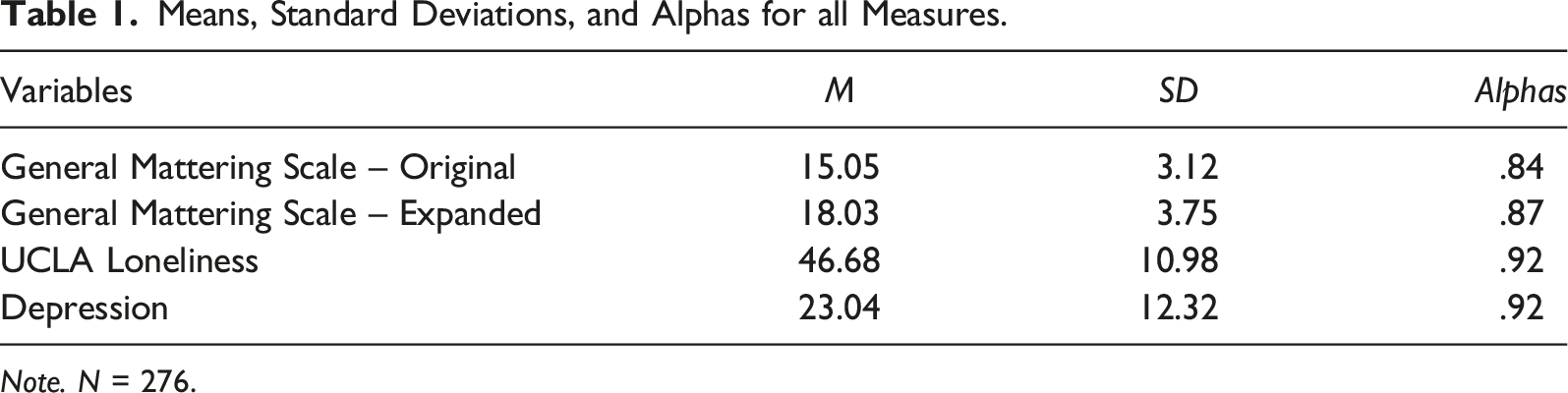
Note. N = 276.
Confirmatory Factor Analysis
Factor Loadings for the Items of the General Mattering Scale-Expanded (GMS-6) and the Original General Mattering Scale (GMS).
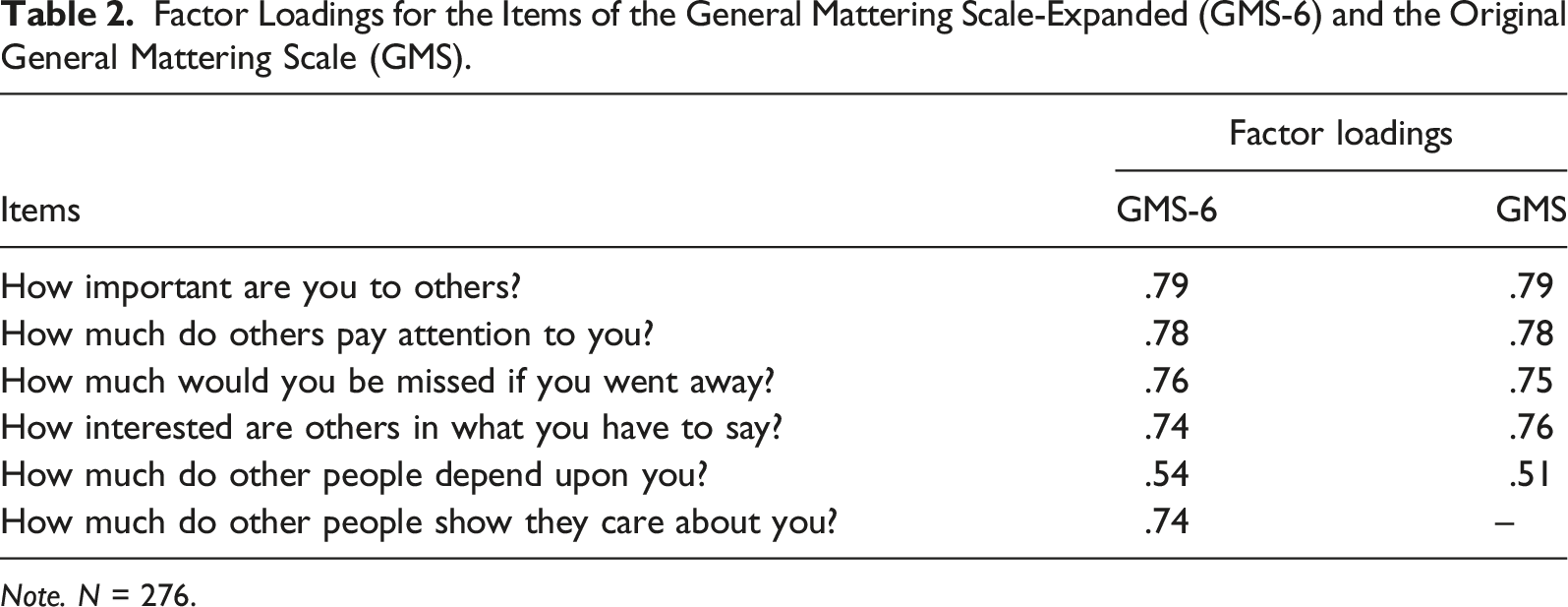
Note. N = 276.
Correlational Analyses
Correlations Among New General Mattering Scale (GMS-6), New GMS-6 Item, Original General Mattering Scale (GMS), UCLA Loneliness, and Depression.
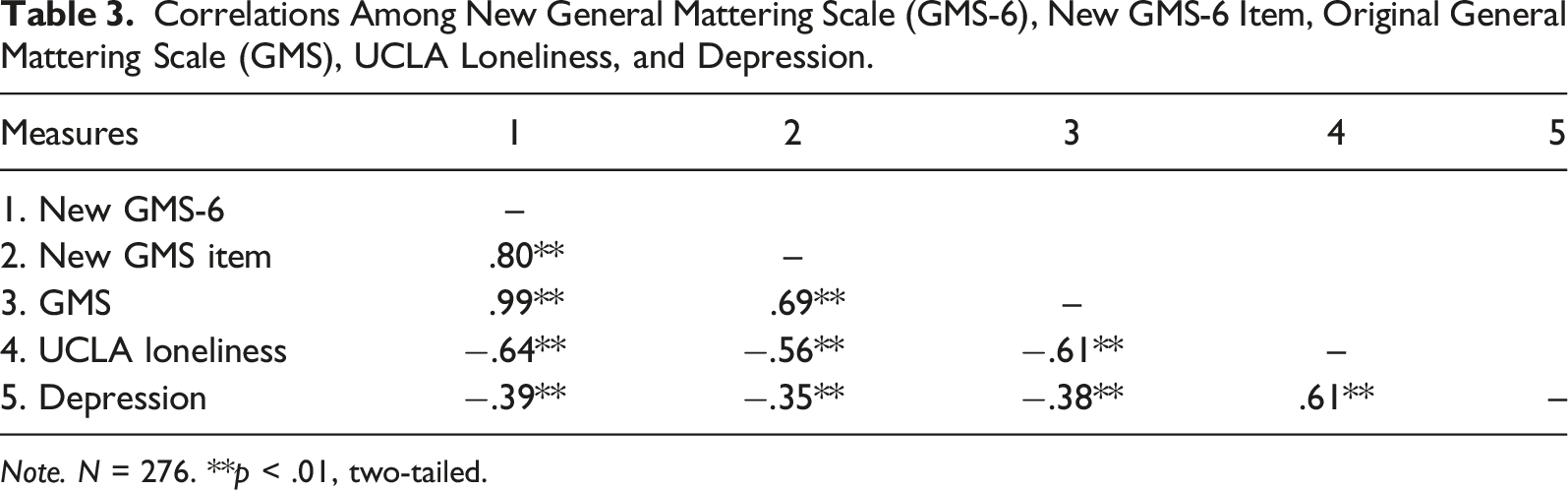
Note. N = 276. **p < .01, two-tailed.
Regression Analyses
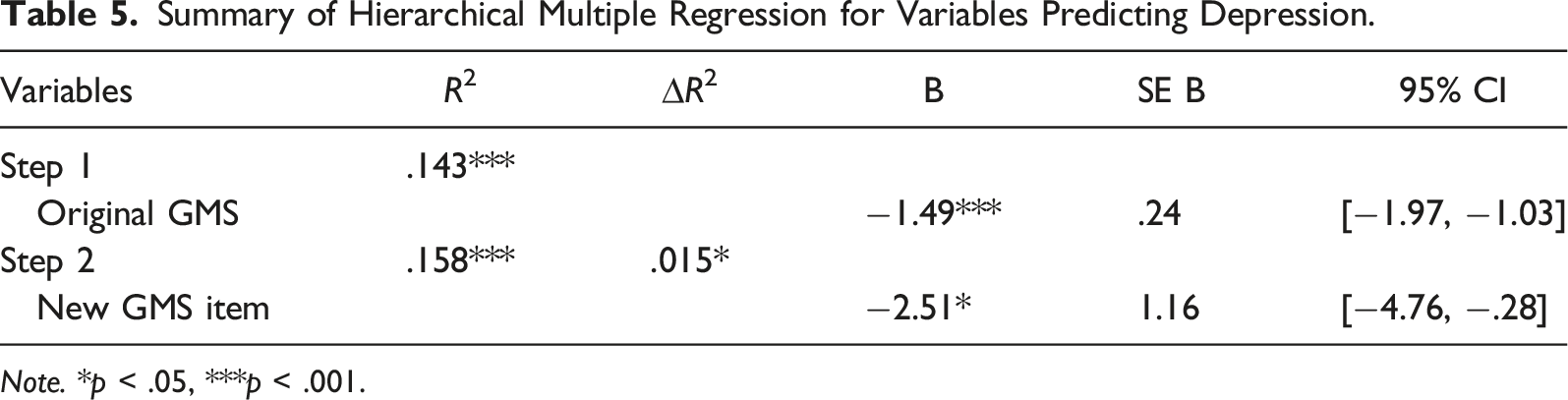
Two hierarchical multiple regression analyses were conducted to evaluate whether the feeling of being cared about as reflected in the new GMS item would predict loneliness and depression over and above the original GMS. Before performing these regression analyses, we screened for normality of the outcome variables (i.e., loneliness and depression). The distribution for loneliness did not differ from normal; however, the distribution for depression did differ from normal. Therefore, we used the robust bootstrapping procedure when performing the regression involving depression because it does not impose the normality assumption (see Uraibi et al., 2009). We generated 5000 bootstrap samples to provide estimates, standard errors, and 95% bias-corrected confidence intervals.
Summary of Hierarchical Multiple Regression for Variables Predicting Loneliness.
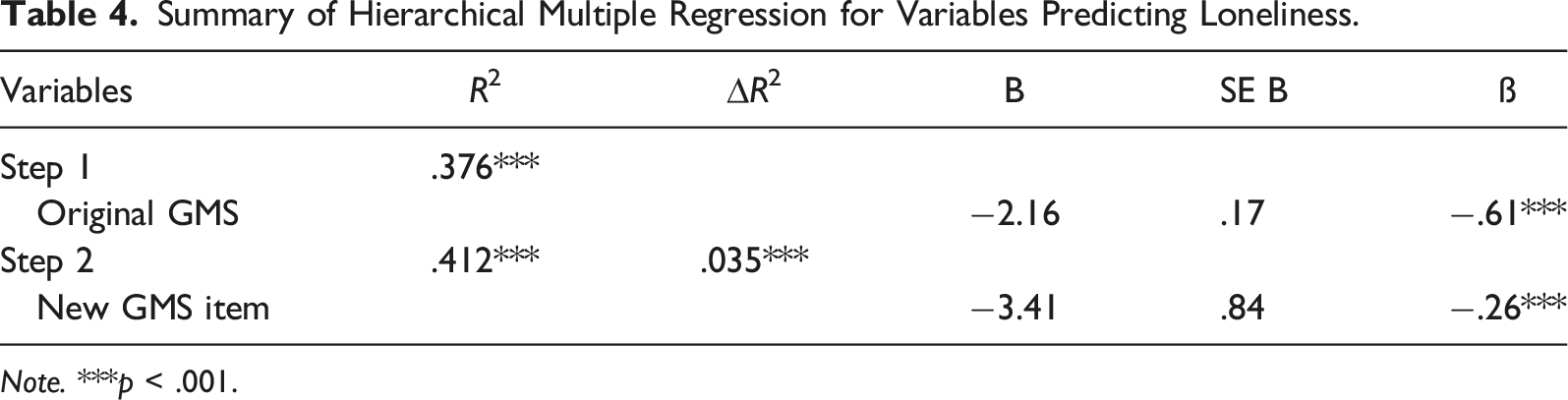
Note. ***p < .001.
Summary of Hierarchical Multiple Regression for Variables Predicting Depression.
Note. *p < .05, ***p < .001.
Discussion
The current study evaluated a slightly extended six-item version of the General Mattering Scale with an additional item tapping the feeling of being cared about. This item was added to capture to a greater extent the affect inherent in being seen as important to significant others and to better reflect the feeling of what it means to feel truly valued by others. It reflects our view that the feeling of being cared about is present when mattering is experienced in strong relationships where there is mutual mattering and a deep sense of connection. As noted earlier, the emphasis on mattering as caring is also in keeping with classic descriptions of the nature of mattering to others alluded to earlier from theorists and the feeling of not mattering is often framed in terms of other people not caring about someone.
Our analyses of responses to the extended GMS showed that all six items loaded significantly on a single factor and the confirmatory factor analysis yielded a good fit. The internal consistency of this six-item version was .87. The GMS-6 was estimated to have a higher internal consistency than the alpha of .84 associated with the five-item version. It is true that according to Cronbach’s (1951) formula that the act of making a scale longer in length should increase the alpha, but this will only be the case if the item or items added are similar to the existing items in terms of response patterns.
On the surface, it might seem at the descriptive level that the one item added to the GMS does not matter all that much. However, a closer look established that the standard deviation was considerably greater with the six-item version versus the five-item version, signifying that only some respondents with a high level of mattering on the original version also felt a sense of being cared about by people who have shown them they care.
While we feel that the extended measure is clearly warranted from a conceptually driven view and construct validity perspective, the key empirical test for the six-item version in the current work was substantive rather than psychometric. That is, what evidence was there that the additional item focused on mattering as caring made a difference in terms of predicting key outcomes? Measures of depression and loneliness were also included in this study and as was established in numerous other studies (e.g., Flett et al., 2022; McComb et al., 2020; Taylor & Turner, 2001), mattering was associated significantly with less depression and less loneliness. The link with less loneliness was particularly robust. As expected, these associations were evident with the five-item GMS and the GMS-6. More importantly, we showed that the new item tapping mattering as perceived caring predicted a statistically significant amount of unique variance in depression and loneliness over and above the variance attributable to the five-item GMS. The feeling of being cared about was especially impactful in terms of predicting significant unique variance in loneliness. This finding is remarkable given that the single item measure of mattering as caring is linked so strongly with scores on the original GMS.
A similar pattern emerged when we conducted regression analyses with the GMS-6 entered as a predictor only after already including the original GMAS in the equation. However, this approach is less desirable due to the concerns about multicollinearity of predictors.
Our focus on mattering and caring suggests that a salient aspect of the feeling of mattering among university students is their sense of being cared about. Ideally, this is part of their lives, but also a feeling that emanates from important settings while they are at college or university. Students need to feel like they belong but they also need a sense that they are cared about as a person. Future research on positive school climates should further establish how environmental influences can contribute to a sense of mattering rooted in feeling cared about by significant others.
The emphasis on mattering as caring also has clear relevance in understanding vulnerability to loneliness and depression. For instance, regarding the feeling of loneliness, it has been proposed by experts in the treatment of suicidal people that a key goal in therapy is to establish a feeling of being cared about because the client will then have a perspective of not being alone and no longer feeling alone (see Cutcliffe & Stevenson, 2007). There are countless references to people describing their lived experience with loneliness as feelings of not being cared about (see Arbuckle, 2018; Jefferson et al., 2023; Peplau, 1985). Moreover, new empirical work suggests that low or nonexistent perceived regard and care from others is central to the experience of loneliness (Lemay et al., 2024). Loneliness rooted in the perception of not being cared about by anyone seems like a type of loneliness that should be linked with intense emotional upset and associated health problems. When considering the double jeopardy of feeling alone and unimportant, the sense of not being cared about by anyone is a mattering-related theme that unites loneliness with abject feelings of insignificance.
There are multiple implications that follow from demonstrating and acknowledging that a feeling of being cared about is an aspect of the mattering construct. It is our hope that the current work and subsequent use of the GMS-6 will be a catalyst for greater attention focused on the role of feelings of being cared about. This seems like a very important theme when it comes to assessing suicide risk. Some initial research has linked mattering with lower levels of suicide ideation in university students (see Etherson et al., 2022, 2024). Feelings of mattering that include the feeling of truly being cared about by other people should be especially protective. The feeling of being cared about and valued adds to a personal sense of being someone who is worth caring about.
The current work addressed the assessment of general levels of mattering with the feeling of mattering to others being evaluated at a global or a general level. One relevant issue is the degree to which an item such as the one we added to the GMS should also be added to extend domain-specific measures of mattering to others. For instance, when assessing a measure such as the five-item mattering to others subscale of the Work Mattering Scale by Jung and Heppner (2017), should mattering at work include the feeling of being cared about by others in the work setting? We believe so. The current five items that tap mattering at work are all clearly relevant and reflect aspects of the mattering construct in the job context, but the Work Mattering Scale does not capture the sense of being a worker who is cared about. It also seems important to examine domain-specific measures that are designed to assess feelings of mattering among students. Measures of mattering in high school or at college and university could be extended by adding items that tap the feeling of being cared about and cared for in these contexts. It is not difficult to imagine this aspect of mattering being quite important in terms of whether a student is able to develop a strong sense of attachment to her or his school, college, or university.
There are several additional directions for future research. First, and foremost, the psychometric properties of the GMS-6 need to be evaluated in people of various ages from various cultures. It also seems imperative to examine the relevance of feeling cared about as part of mattering in qualitative research that can further evaluate its relevance. Another fruitful line of inquiry will be to consider the extent to which students who feel like they matter have contact with caring teachers and instructors, but also there is an emphasis on caring reflected in the leadership of schools, colleges, and universities (see Louis et al., 2016).
In summary, in the current article, we tested and demonstrated the usefulness of adding an item to the General Mattering Scale that tapped the feeling of importance that comes from feeling cared about by other people. Our focus here reflected the relational nature of mattering to others. This additional item contributed to an expanded measure that made a difference in terms of yielding a broad spread of scores in our sample of university students and that predicted unique variance in levels of loneliness and depression. We believe this additional item is justified given that mattering should be particularly salient and powerful when it is a feeling arises from a strong sense of having a caring connection with other people.
The current article was couched in terms of the question “Can one item make a difference?” We believe the answer here is an unequivocal “yes” but it must be reiterated that adding an item should not be a capricious decision. When it has been determined that an item merits being added to scale content, it should ideally be the case that that there is a key feature of the psychological construct that is not yet being measured. Items that have face validity, content validity, and especially construct validity should substantially enhance most measures and by extension, also enhance the research that follows based on the use of these revised measures.
Footnotes
Declaration of Conflicting Interests
The author(s) declared no potential conflicts of interest with respect to the research, authorship, and/or publication of this article.
Funding
The author(s) disclosed receipt of the following financial support for the research, authorship, and/or publication of this article: Gordon Flett is supported by a Tier 1 Canada Research Chair in Personality & Health.
