




Abstract
In the current introductory article, we discuss the importance of balancing the variable-centered research in the perfectionism field with a person-focused approach. We examine the utility of a person-centered approach in assessment, research, and theory and the need to revisit overlooked themes central to understanding people who are extreme perfectionists. Our analysis focuses on addressing the core unaddressed issue of why perfectionists as unique individuals absolutely need to be perfect. We describe measures to assess individual differences in this need to be perfect and themes reflecting the need to be perfect that require investigation. The papers in this third special issue on perfectionism are then introduced and considered as examples of the merits of a broad approach that goes beyond trait perfectionism to also include perfectionistic self-presentation and the cognitive experience of perfectionism. We conclude by examining how certain variable-centered studies described in the current special issue yield insights about perfectionists as people when individuals are considered from a person-focused perspective.
Introduction
An influential scholar in the perfectionism field once described us in the following manner: “I like to focus on variables. But you are different. You focus on people.” In our estimation, this scholar has usually been right about some things and wrong about other things, but his observation about us was “on the nose.” A focus on persons rather than variables has guided our work for decades. To us, perfectionism is about the people and the overarching goal is to help those who may suffer as a result of their perfectionism. Much is to be learned by considering the individual perfectionist and how this person has handled and reacted to challenging moments in her or his life.
When it comes to perfectionists, one size does not fit all. This has been illustrated on many occasions; just when it seems like all variations of perfectionism and people deemed to be perfectionists have been identified, along comes a unique, complex perfectionist who defies description and explanation. The existence of this person is a beacon to us that signals the need to revisit how perfectionism is conceptualized and measured.
The scholar mentioned above is far from alone. Most research investigations in the voluminous perfectionism field involve a variable-centered approach; the prototypical study examines how trait perfectionism dimensions assessed via questionnaires in a large sample of participants relate to other variables assessed via self-reports. This approach is on display in the current special issue and is one that has yielded myriad advances. However, the extensive information emerging from variable-centered research in any one study runs the risk of furthering a somewhat narrow view of perfectionism. Clearly, it is important to keep in mind how perfectionism was assessed when variable-centered research with limited measures is used to make general statements about “perfectionists.” Consider, for instance, the different routes and pathways to being deemed a maladaptive perfectionist (MP). One person might be a MP due to high score on socially perfectionism. A second person is a MP due to a high discrepancy score. Finally, a third person is a MP due to an excessive level of concern with making mistakes. Ideally, whenever possible, the determination of whether someone at the individual level has problematic perfectionism should be made after this person has been assessed on multiple measures that combine and converge to more fully capture her or his essence.
We know from person-centered research that it is both possible and meaningful to identify distinct clusters of perfectionists within a sample, in keeping with the “one size does not fit all” theme. For instance, Molnar and associates (2020) established in a previous special issue that clusters can be identified; some people are high on self-oriented, other-oriented, and socially prescribed perfectionism. They differ from other people who are high solely on socially prescribed perfectionism (see Molnar et al., 2020). It is evident from this research that we must account conceptually for why only some people internalize the external pressures to be perfect. But even when reflecting on a cluster of perfectionists, it is vital to not lose sight of the heterogeneity and variability that exists within the cluster; even when people have several similarities in common, everyone has a personal story to tell about themselves.
The Comprehensive Model of Perfectionistic Behavior (CMOPB) guides our work (see Hewitt et al., 2017). It reflects what we have come to witness and understand about perfectionists viewed through a person-focused lens. This model began with a trait dimensions component, but it also has a self-presentational component and a cognitive component. The emphasis on self-presentation reflects our realization that some people need to be perfect, but they also need to seem perfect in terms of how they present themselves in public (see Hewitt et al., 2003). The self-presentational style addresses how perfectionism is expressed. It includes a narcissistic form of perfectionistic self-promotion but also a defensive emphasis on not revealing imperfections (i.e., nondisplay) and not discussing imperfections (i.e., nondisclosure). When we consider perfectionism at the person level, it is useful to keep in mind that most people who demand perfection from themselves also tend to have substantially elevated levels of perfectionistic self-presentation. These individuals are people who are not only sensitive to failure and needing to be perfect, they also will be distressed if their public image reflects being flawed rather than flawless.
The cognitive element in the CMOPB represents aspects of the internal experience of perfectionists. This component originally included an exclusive focus on the frequency of automatic thoughts reflecting the need to be perfect (Flett et al., 1998) as assessed by the Perfectionism Cognitions Inventory (PCI). Recently, it has been expanded to include ruminations about mistakes (Flett et al., 2020a) and the self-recriminations experienced by people who must be perfect (see Hewitt et al., 2024). If viewed more broadly, the cognitive element could also include the dysfunctional attitudes and irrational beliefs that characterize perfectionists (see Brown & Beck, 2002; Ellis, 2002). This cognitive component reminds us to consider at the person level what exactly is going on inside the individual perfectionist.
The CMOPB is referred to as a comprehensive model, but the term “comprehensive” does not signify that we believe this framework captures all important aspects of perfectionism. Rather, it is simply our way of indicating that the construct goes well beyond trait perfectionism. At an assessment level, this means there is need for an expanded approach if the goal is to fully measure perfectionism.
The Need to Assess the Need to Be Perfect
When it comes to assessing and conceptualizing perfectionism in order to better understand people who are perfectionists, what is still lacking? Are we missing something essential? Could it be that the various ways of conceptualizing trait perfectionism as multidimensional have gotten in the way of truly understanding perfectionists as people? In our estimation, the most glaring omission strikes at the heart of what must be prioritized if we are to ever fully understand why someone is highly perfectionistic. That is, why does this person need be perfect? Why isn’t “good enough” good enough? What happens to make some people believe they need to be perfect? The need to be perfect is clearly on display in certain clinical cases involving people with considerable dysfunction (for examples, see Cheek et al., 2018; Hewitt et al., 2017).
At present, the field is lacking a programmatic research focus on the overarching need to be perfect and its antecedents and consequences. What distinguishes people defined by this extreme need versus people without this need? In a sense, we have collectively failed to live up to the intellectual legacy of one of our most influential theorists. Here, we are referring to Karen Horney. The need for perfection and unassailability was a central part of Horney’s seminal examination of neurotic trends. For instance, in Self-Analysis, one of her many classic books, Karen Horney (1942) postulated that many neurotic people are defined by a need to be perfect that can be in personal awareness to some degree but the person governed by this need “… is never aware of the extent he is in the grips of these strivings, to what extent they determine his life. Still less is he aware of the reasons why they have such power over him” (pp. 38–39). Horney (1942) went on to list the features and correlates of the neurotic need for perfection, including a relentless driving for perfection, ruminations and self-recriminations, a dread of finding flaws and making mistakes, and a dread of being criticized and reproached by others (also see Horney, 1950). Horney (1942) stated that it is reasonable to strive to perfect “… our gifts and human faculties” (p. 57), but the neurotic need to be or seem entirely perfect is without special value because it suggests little room for improvement. Most notably, according to Horney (1942), change is frightening to people who need to be or seem perfect.
Other authors have weighed in on how a need to be perfect contributes to living a very challenging life. Weisinger and Lobsenz (1981) proposed that a need to be perfect places people in “a self-destructive double bind” (p. 237). The double bind here refers to striving that results in either abject failure or positive accomplishments that provide no satisfaction and gives the person “no glow.” Asher Pacht (1984) concluded that needing to be perfect dooms people to “a life of unhappiness unless, in some ways, the learned patterns of behavior can be unlearned” (p. 387). An experiment by Hoffman et al., (2012) yielded findings at odds with the notion that needing to be perfect is adaptive. They concluded that “Perfectionists thus emerge from these findings not as simply misguided idealists but rather as highly motivated persons (a.k.a. tortured souls) who experience powerful impulses that frequently clash with their other goals and values. They certainly seemed to lack the highly self-controlled person’s knack for avoiding problematic desires” (pp. 1331–1332). We regard this description as a reflection of what typically happens when needing to be perfect has become obligatory, excessive, and out of control.
The person with this need is someone who craves perfection in ways that amount to a compulsion; it is imperative to these people that they achieve perfection and if they ever achieve it, somehow they must then sustain it. We view the need to be perfect in most instances as ultimately problematic and as a need that, “… represents a rigid and fundamentally maladaptive approach to life” (Cheek et al., 2018, p. 459).
This need can stem from several factors, but it likely reflects an urgency to compensate for some less-than-ideal aspect of the self or a life that is falling short. It appears when people have this attribute, the need to be perfect is itself driven by a need to be accepted by others and by oneself. This need to be accepted is seldom met. Bruch (1988) proposed in adolescent girls with eating disorders that it reflects the need for approval and control. It may also be the case that people who need to be perfect perceive that if they attain perfection, then they will feel better, both in terms of mood states and in terms of their feelings about the self. Clearly, if someone is unhappy, they experience a disquiet that signifies the need is not being satisfied.
Some valuable insights about this need to be perfect were gleaned from a recent qualitative study of perfectionists led by Danielle Molnar (see Molnar et al., 2023). Adolescent participants in this investigation seemed to have clear-eyed views of their shared need to be perfect. This need was described as a consuming drive that undermines self-worth. As such, it was viewed as internally driven in ways that can become a burden. Molnar et al. (2023) reported that some young people experienced this need with exceptional intensity. This was reflected in comments such as “I need to be perfect or I will physically shut down and start crying,” and “I need to be perfect or else the world’s gonna end” (p. 325). These comments are quite foreboding given that no one is perfect. These extreme personal statements signify that some young people have an exceptional need to be perfect. The key questions that follow are “Who most needs to be perfect” and “What current and past experiences and contextual factors have intensified this need?”
Albert Ellis also focused on an intense need to be perfect as central to dysfunctional perfectionism. Ellis (2002) claimed it is the extreme importance attached to being perfect that is especially irrational, especially when it reaches the point that the person feels compelled such that she or he must be perfect. This person does not simply want to be perfect. Rather, she or he absolutely must be perfect.
Items Assessing Perfectionism Motivation and the Need to Be Perfect.
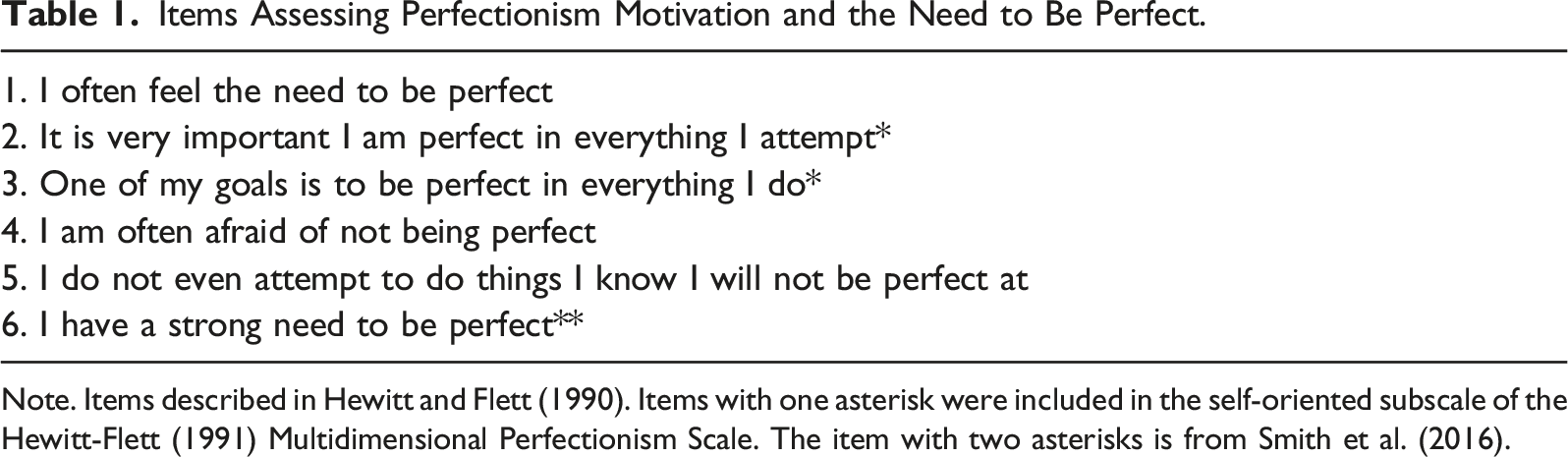
Note. Items described in Hewitt and Flett (1990). Items with one asterisk were included in the self-oriented subscale of the Hewitt-Flett (1991) Multidimensional Perfectionism Scale. The item with two asterisks is from Smith et al. (2016).
This current commentary can be regarded as our clarion call to researchers to create a contemporary measure of the need to be perfect. There is also a need for a related scale that taps perceptions of being imperfect falling short of satisfying this need to be perfect. There is likely to be considerable psychological pain that comes with acknowledging to oneself that the need to be perfect is not being met and may, in fact, signify falling considerably short in ways that diminish the self. This too should be measured. When such measures are created and programmatic research is conducted, it is our expectation that the need to be perfect will strongly merit inclusion on any respectable list of core psychological needs. It is our sense that if considered among the psychological needs listed by Henry Murray (1938) in his seminal work, research on the need to be perfect will uniquely reveal what happens to someone when they are defined by a core unmet need that is never fully satisfied over their life course.
Once such measures are developed, fundamental issues can be evaluated. For instance, to what extent does the need to be perfect reflect rigidity? Does the need to be perfect persist over time? Do people really need to be perfect in everything? What do people fear and expect to happen if they abandon their need to be perfect? To what extent is the need to be perfect impacted by success? Given that it can be a narcissistic need (see Smith et al., 2018), is it useful to distinguish the neurotic versus narcissistic need to be perfect? Ideally, going forward, research and theory on the need to be perfect as a core need will be seen as foundational in understanding perfectionists.
Until a sound measure of the need to be perfect is developed, how can it be measured at present? Some or all of the items in Table 1 can be used. Our initial list of five items has been supplemented with a highly face valid item from the Big Three Perfectionism Scale (see Smith et al., 2016). This prototypical item is “I have a strong need to be perfect.”
Note that two items in Table 1 from Hewitt and Flett (1990) are less face valid. We included these items to tap the fears and avoidance tendencies of people who need to be perfect yet remain cognizant of the possibility that their overarching need to be perfect may not be realized.
Parenthetically, our original research with five-item measure showed in a sample of 150 university students that the need to be perfect predicted unique variance in depression and self-criticism. The items on this subscale had adequate internal consistency of .87. Validity was indicated by a significant correlation between scores on this scale and overall agreement with 10 adjectives with perfectionistic content (e.g., exact, persevering, determined) (see Hewitt & Flett, 1990).
Given the contemporary penchant for many investigators to prefer using exceedingly brief scales, a two-item measure of the need to be perfect may suffice in certain instances. Clearly, the two items with the most face validity are “I often feel the need to be perfect” and “I have a strong need to be perfect.”
Another relevant item that is highly face valid is reverse-scored and is found as item #12 on the Multidimensional Perfectionism Scale (MPS) self-oriented subscale (see Hewitt & Flett, 1991). This item is “I seldom feel the need to be perfect.” This MPS item serves as a reminder that it is also very useful to consider what attributes and characteristics accompany not needing to be perfect. Our closer examination of responses to this one item and associated correlates in various samples of undergraduates enabled us to paint a portrait of students who are doing quite well. Our supplementary analyses indicated that students who indicate they reject the need to be perfect tend to be high in authenticity and mindfulness and low in narcissistic vulnerability and in feeling like an imposter.
Another suitable alternative when seeking to assess the need to be perfect is to select items from the Perfectionism Cognitions Inventory (PCI; see Flett et al., 1998) that reflect this need and the personal sense of not fulfilling this need. We stated originally when describing the PCI that “The link with self-oriented perfectionism reflects the content of the PCI, which focuses primarily on self-relevant cognitions involving the need to be perfect” (p. 1374).
PCI Items Tapping the Need to Be Perfect.
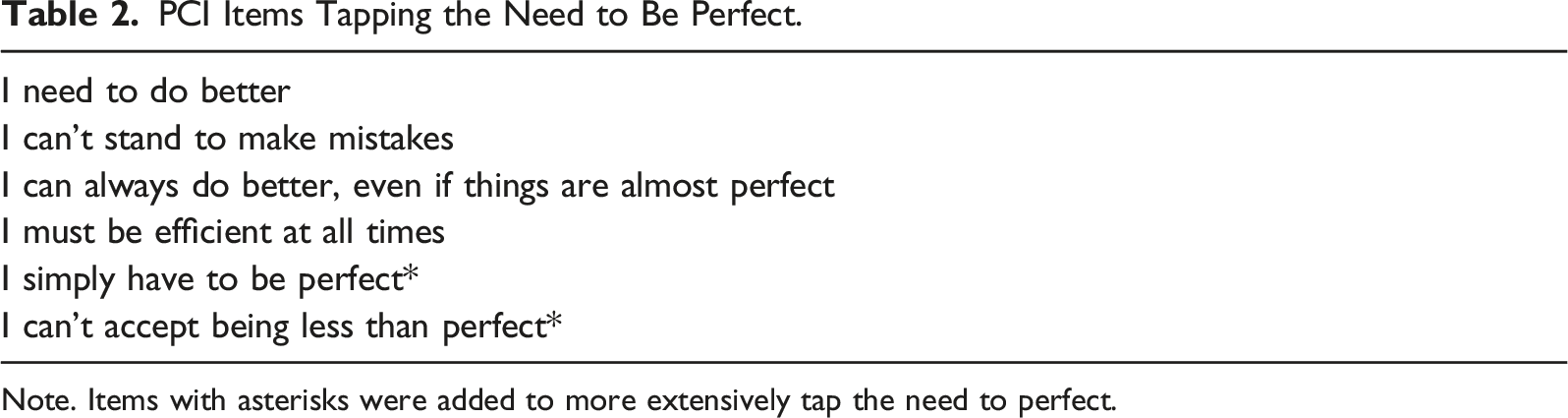
Note. Items with asterisks were added to more extensively tap the need to perfect.
We have focused above on assessing the need to be perfect. However, more generally, when faced with assessing individuals and the various ways they experience and express perfectionism, it is our hope that it becomes a matter of routine practice to include multiple measures of perfectionism in any assessment battery designed to identify meaningful individual differences among people. Perfectionism is especially important to include in individual assessments when a young person is suspected of being at risk (emotionally, socially, or academically) because they are under too much pressure to be perfect and/or they are avoidant and disengaged due to the shame or possible shame of not being perfect and being seen as a failure (for a related discussion, see Flett & Hewitt, 2022). Unfortunately, in far too many applied settings when a person is assessed, perfectionism is not assessed at all, or it is assessed in an exceptionally cursory manner with a measure that narrowly assesses individual differences in perfectionism. It is not really justified to arrive at conclusions about the broad construct of perfectionism or a person’s pattern of perfectionism based on using limited measures. More importantly, if someone is suffering due to his or her perfectionism, it is imperative to fully assess the nature and degree of their perfectionism.
Articles in the Third Special Issue on Perfectionism
We now turn to describing the articles in this special issue before returning to our emphasis on person-centered assessment. The current special issue is the third in a series on perfectionism in the Journal of Psychoeducational Assessment. These special issues have appeared every 4 years, beginning in 2016, in an Olympic-like pattern. One consistent emphasis across these special issues has been the introduction of new measures. The first special issue in 2016 was titled “Advances in the Assessment of Perfectionism.” This special issue introduced the brief version of the Frost Multidimensional Perfectionism Scale (Burgess et al., 2016), the Child-Adolescent Perfectionism Scale (Flett et al., 2016), the Big Three Perfectionism Scale (Smith et al., 2016), and the Perfectionism Performance Scale for Sport (Hill et al., 2016).
The second special issue appeared in 2020. It was titled “Further Advances in the Assessment of Perfectionism.” Each special issue, including the one in 2020, addresses numerous themes involving substantive and measurement issues, and once again it was the case that new measures were introduced. Hill and Donachie (2020) unveiled the Perfectionism Cognitions Inventory-10. Bento and associates (2020) described the short Child-Adolescent Perfectionism Scale. In addition, Feher and associates (2020) reported on the short form of the Big Three Perfectionism Scale. The Mistake Rumination Scale (Flett et al., 2020a; , 2020b; Nepon et al., 2024) was also introduced to assess individual differences in obsessive thinking about actual mistakes. In addition, the Self-Generated Stress Scale (Flett et al., 2020a) was unveiled. We created it to assess to perfectionists’ self-perceptions of how much stress they create for themselves and other people. As expected, we found that scores on the Self-Generated Stress Scale were linked with trait perfectionism, cognitive perfectionism, and perfectionistic self-presentation.
Now, 4 years later, this third special issue is upon us. As noted below, the current special issue introduces one new measure that taps worry about mistakes, and another measure that taps a key cognitive correlate of perfectionism—social comparison rumination. Mostly, however, assessment issues are incorporated in work that tests core substantive issues. Overall, this work continues to illustrate how assessment and conceptualization are often inextricably linked.
The first two papers in the special issue show why we need to consider the assessment of perfectionism from domain-specific perspective or in terms of specific people in specific interpersonal contexts. First, Hill and associates (2024) report how multiple measures of sports-specific perfectionism measures yield support for a two-factor model with two broad overarching factors that reflect the distinction between perfectionistic strivings and perfectionistic concerns. Three unique aspects of this work merit comment beyond establishing the distinction between strivings versus concerns in sports. Most notably, Hill and colleagues (2024) suggested that a valid way of conceptualizing these two factors is that they tap internalized pressure to strive for perfection versus being overly concerned with the implications of imperfection. This is a very insightful way of thinking about central themes found in perfectionism scales as well as perfectionists. Internalized pressure is akin to feeling controlled with an obligation to meet standards, but it is from within the person. Second, other-oriented perfectionism did not fit this framework, as noted by the authors. Clearly, demanding that others are perfect is a unique element. Third, a measure of negative reactions to imperfection loaded on both factors, in keeping with Flett and Hewitt’s (2016) observation that maladaptive forms of perfectionistic reactivity are broadly applicable to perfectionism dimensions. This notion of perfectionistic reactivity reflects the premise that perfectionistic vulnerability is largely rooted in how perfectionists react and respond in problematic ways when faced with failures, mistakes, or flaws.
The second paper by Kim and colleagues (2024) demonstrates that it is both feasible and important to consider person-specific forms of perfectionism. Other work has demonstrated how thinking about different people in our lives (e.g., mothers, fathers, and closest peers) can elicit distinct patterns of perfectionistic automatic thoughts (see Lakey & Tanner, 2013). Kim and associates (2024) created a friend-specific measure of socially prescribed perfectionism (i.e., my friend expects me to be perfect). This longitudinal research involved four periods of data collection over a four-month period. Results indicated that friend-imposed socially prescribed perfectionism was associated with depression, problematic drinking, and greater interpersonal conflict. Clearly, if a person who is a friend actually does try to impose perfectionistic expectations on a friend, it is understandable if the target person becomes more isolated, avoidant, and socially disconnected.
The third paper is an extension of previous cross-sectional research that illustrated how perfectionistic university students tend to be characterized by self-image goals that reflect an ego-involved self-focus (see Nepon et al., 2016). We revisited this topic in a longitudinal study led by Taryn Nepon. This research established that trait perfectionism and perfectionistic self-presentation were associated longitudinally with the constant pursuit of self-image goals that, in turn, were related to adjustment problems. Temporal stability was also found in terms of the pursuit of self-image goals. Moreover, analyses showed that trait perfectionism, perfectionistic self-presentation, and self-image goals were associated with loneliness and poorer mental health and physical health in university students.
The next three papers focus on aspects of cognition. Barabadi and associates (2024) examine the roles of mistake rumination and worry about mistakes in language learning and communication apprehension in a large sample of adolescents from Iran. As noted earlier, this work introduces a new measure of worry about mistakes but also evaluates the psychometric properties of the Mistake Rumination Scale and the brief Child-Adolescent Perfectionism Scale. This work at a substantive level illustrates the need to distinguish between distal predictors (i.e., trait perfectionism) and more proximal predictors (i.e., worry about mistakes) when seeking to predict individual differences in state-like indicators such as communication anxiety. The distinction between distal and proximal influences is also useful in understanding how people deal with a need to be perfect. The overarching message of this article is the need to consider that various ways in which perfectionism and excessive evaluative concerns can impact and undermine the learning process.
Next, Flett and associates (2024) introduce a new measure of social comparison rumination in university students. Evidence is presented which shows that meaningful individual differences exist in social comparison rumination and perfectionistic students are particularly prone to social comparison rumination. Social comparison rumination was associated with self-oriented perfectionism, socially prescribed perfectionism, and the frequent experience of perfectionistic automatic thoughts. This work suggests uniquely that the negative impact of destructive social comparisons can persist long after the social comparison has first taken place, especially for perfectionistic students with insecurities based in an orientation toward social comparison information. The potential costs of this cognitive tendency are suggested by the links that social comparison rumination has with measures of distress and burnout. The tendency for perfectionists to ruminate about social comparison suggests the possibility that perfectionists consumed with comparison may be in a mode of chronic evaluation of self and others. This constant preoccupation will highlight not living up to expectations and failing to be better or even keeping up with peers and associates. It is painful for perfectionists to be falling short of the standard setters who they compare with and ruminate about.
The next paper by Yosopov and associates (2024) focuses on perfectionism and procrastination and failure sensitivity from a cognitive perspective. 1 This work extends earlier work which suggests that it is at the cognitive level where being a perfectionistic procrastinator is particularly problematic. The link between perfectionistic automatic thoughts and procrastination-related automatic thoughts is a representation of how the self-doubt and insecurities of perfectionists are experienced at the cognitive level. This work supports the conclusion of Flett et al. (2004) about the need to address the cognitive tendencies and cognitive processes that define students who are procrastinating perfectionists. It also shows why a focus on cognition is needed as a supplement to focusing on trait perfectionism. The current work by Yosopov and colleagues also uniquely demonstrates that perfectionistic and procrastination-related automatic thoughts tend to be linked through their associations with fear of failure and the overgeneralizing of failure in ways that fit a defensive and ego-focused emphasis on the self and the self-image. This fits with evidence on social comparison rumination in Flett et al. (2024) linking both types of automatic thoughts with ruminating about social comparison information.
The last two papers return our focus to the interpersonal side of perfectionism. First, Etherson and colleagues (2024) illustrate the associations among perfectionism, feelings of not mattering to others, and suicide ideation in longitudinal research with university students and community adults. This research also yielded evidence attesting to the applicability of the perfectionism social disconnection model (PSDM) and the existential model of perfectionism by showing how they both pertain to suicide ideation. A key element of this work is showing that the vulnerabilities of perfectionists include feelings of not mattering and not being able to accept the past. These represent core elements of vulnerability closely aligned with why some people need to be perfect. Regarding these sense of not mattering, Hewitt et al. (2024) showed in related research that perfectionism is linked with extreme thoughts of not mattering involving themes such as not mattering to anyone and not being cared about by anyone. When this sense of not mattering is so absolute, people defined by it may feel that no one would miss them if they were gone. If so, it is no wonder that vulnerable perfectionists experience suicide ideation (for a related commentary, see Flett & Hewitt, 2024).
Clearly, problems in accepting the past can be an intense and chronic source of distress. Perhaps an inability to accept the past fuels the need to be perfect as a way of compensating for rough starts to life. Difficulties accepting the past do seem to persist. Etherson et al. (2024) reported high temporal stability of this variable from Time 1 to Time 3 (r = .82). The need for interventions to target difficulties in accepting the past is suggested by the strong correlation of r = .55 between Time 1 scores on not accepting the past and the Time 3 level of suicide ideation.
The final paper by Chen and associates (2024) is also highly relevant to the PSDM. This final paper is unique in various respects. First, it includes data from three distinct subsamples; it shows that mean levels of perfectionism and perfectionistic self-presentation did not vary substantially when comparing the responses of undergraduate students, medical students, and law students, but surprisingly, the medical students actually had lower perfectionism. However, when it comes to associations with facets of perfectionism, elevated socially prescribed perfectionism and perfectionistic self-presentation were problematic for all types of students. This research also showed that interpersonal perfectionism was associated negatively with loneliness and various social provisions involved in receiving social support as outlined by Weiss (1973). Overall, this research provides considerable support for predictions derived from the PSDM.
When considering all of the papers in this special issue, as was acknowledged earlier, it is once again evident that the variable-centered approach to research continues to prevail. Each article was based on a variable-centered approach. Still, it is useful to reflect on these results from a person-focused perspective. For instance, an other-oriented perfectionist included in the Hill et al. (2024) sample does not fit the obtained framework and, as mentioned earlier, the authors did indeed note that their two-factor framework excluded other-oriented perfectionism. This points to the need for follow-up investigation of other-oriented perfectionism as a distinct orientation in sports contexts.
The need to consider perfectionistic people seems especially important when reflecting on the implications of the findings from the Etherson et al. (2024) investigation. What does it mean at the person level when greater suicide ideation is associated with anti-mattering, difficulty accepting the past, and socially prescribed perfectionism? Clearly, some perfectionists have an exceptional level of risk due to having multiple co-occurring vulnerabilities and we should be quite concerned about their well-being. In this instance, someone struggling to live up to imposed pressures to be perfect is likely contending with a pervasive feeling of not mattering to others and having a past and a life that has made them feel like a failure who is far from perfect. The general need for a person-focused perspective in perfectionism and suicide was outlined in a previous review paper (see Flett et al., 2014). Here, we presented the case that perfectionism is under-appreciated as a risk factor in suicide because perfectionism is seen in isolation; it is seldom emphasized that the perfectionists in psychological pain also tend to be high in hopelessness. Moreover, they typically do not seek help because they hide behind a front shaped by perfectionistic self-presentation. The current work now suggests additionally that some of these people will also have strong feelings of not mattering to others. These associated vulnerabilities are important to assess but also must be directly addressed in counseling and treatment. Ideally, interventions can be guided by a focus on instilling a sense of mattering not only to others but also mattering to oneself. The sense of mattering can begin with it becoming a key element in building the alliance between the therapist and the client (for a discussion, see Flett, 2018).
In closing, it is our hope that this third special issue and our commentary will serve as a catalyst for additional future developments in the field of perfectionism as a whole and especially in terms of the assessment and understanding of perfectionists and their need to be perfect. Ideally, these advances will be increasingly rooted in efforts to address and conceptualize perfectionism according to a broad approach that increasingly includes and prioritizes person-focused initiatives.
Footnotes
Declaration of Conflicting Interests
The author(s) declared no potential conflicts of interest with respect to the research, authorship, and/or publication of this article.
Funding
The author(s) received no financial support for the research, authorship, and/or publication of this article.
