




Abstract
Perfectionism is a multidimensional personality trait with two higher-order dimensions; perfectionistic strivings and perfectionistic concerns. The purpose of the present study was to explore and evaluate the two-factor model for the first time using three instruments developed to measure perfectionism in sport. In doing so, we (i) assessed the fit of two-factor models when including and excluding various contentious subscales (other-oriented perfectionism, parental pressure, coach pressure, organisation, and negative reactions to imperfection) and (ii) compared two-factor models to alternative one-factor (or unidimensional) models. Participants were recruited from community and university sports clubs in the UK (N = 527; M age = 18.07 years, SD = 0.49) and completed the Sport-Multidimensional Perfectionism Scale-2, the Multidimensional Inventory of Perfectionism in Sport, and the Performance Perfectionism Scale-Sport. Support was found for the two-factor model, with superior fit displayed each time the aforementioned subscales were excluded and, in all cases, when compared to a unidimensional model. The findings suggest that the two-factor model is an adequate representation of the underlying structure of instruments designed to measure perfectionism in sport with better fit and conceptual clarity offered by more parsimonious models.
Introduction
Interest in perfectionism in sport psychology has grown over the last decade. Broadly defined, perfectionism is a combination of unrealistically high standards and overly critical evaluations (Frost et al., 1990). Researchers have found dimensions of perfectionism indicative of these two broad features to be related to an array of outcomes that span motivation, performance, and wellbeing (Hill et al., 2018). This work has also revealed perfectionism to be complex. Some dimensions of perfectionism appear related to adaptive outcomes, some are more ambiguous, whereas others are related to maladaptive outcomes. In addition, dimensions of perfectionism have been found to interact and, in doing so, display comparatively more adaptive, maladaptive, and neutral effects depending on the degree to which various dimensions of perfectionism are evident (e.g., Lizmore et al., 2019).
As with all psychological constructs, operationalisation of perfectionism is a key focus for researchers. Some of the most important work of this kind has assessed the psychometric properties of instruments designed to measure perfectionism and identify the similarities between these instruments. One of the aims of psychometric work is to assure ourselves that existing instruments are valid and reliable, and can be used to observe the effects of perfectionism. A further aim of such work is to uncover any common underlying structure of different instruments. In this way, researchers assess the convergent validity of different measures and provide evidence of their construct validity. However, most of this type of research has taken place outside of sport psychology. In the present study, we address this limitation by testing the prevailing model of perfectionism – the two-factor model – using instruments designed to measure perfectionism in sport.
Measuring Perfectionism in Sport
One of the first instruments to be developed and used to measure perfectionism in sport was the Sport-Multidimensional Perfectionism Scale (Dunn et al., 2002; Dunn et al., 2006). This was followed later by the Sport-Multidimensional Perfectionism Scale −2 (S-MPS-2; Gotwals & Dunn, 2009). The S-MPS-2 includes five subscales measuring personal standards, concerns about mistakes, doubts about action, need for organisation, coach pressure, and parental pressure. It is based on an instrument developed outside of sport by Frost et al. (1990; F-MPS) with Dunn and colleagues carefully adapting the items to make them relevant for sport. These adaptations include combining separate expectations and criticism subscales to create ‘pressure’ subscales, the addition of the coach as a source of pressure, and not just parents, and the conceptualisation of the need for organisation as the use of routines rather than compulsive behaviours. The validity and reliability of the instrument has been assessed multiple times and has provided good evidence of its psychometric properties. Of note, on some occasions, confirmatory factor analysis has suggested scope to improve factorial structure (e.g. Crocker et al., 2018; Gotwals & Dunn, 2009; Gotwals et al., 2010). However, exploratory and exploratory-confirmatory analyses are typically supportive (e.g. Crocker et al., 2018; Gotwals & Dunn, 2009).
Another instrument developed specifically for use in sport is the Multidimensional Inventory of Perfectionism in Sport (MIPS; Stoeber et al., 2006). The original German version of the MIPS has nine subscales. Subsequent research using the English translation instrument has typically used only four subscales: striving for perfection during competition or training and negative reactions to imperfection during competition or training (e.g. Stoeber & Becker, 2008; Stoeber et al., 2007; Stoeber et al., 2008). The other subscales (pressure from coaches, pressure from teammates, pressure from parents, pressure on teammates, and negative reactions to nonperfection of teammates) are less widely known and used in research. The instrument is based on a several multidimensional models of perfectionism including the S-MPS-2. In regards to its psychometric properties, the MIPS has received less direct scrutiny than the S-MPS-2. However, removal of some of its items based on factor loadings has been reported in research (Stoeber et al., 2007). There is also evidence of satisfactory factorial validity of the instrument when using four of the subscales (striving for perfection, negative reactions to imperfection, pressure from coaches, and pressure from parents) that includes comparison against an alternative one-factor (or unidimensional) structure (Madigan, 2016).
The latest sport-specific measure of perfectionism to be developed is the Performance Perfectionism Scale-Sport (PPS-S; Hill et al., 2016). The PPS-S has three subscales measuring self-oriented performance perfectionism, other-oriented performance perfectionism, and socially prescribed performance perfectionism. Like the S-MPS-2, the PPS-S is based on an instrument developed outside of sport, this time by Hewitt and Flett (1991; HF-MPS). The main difference between the HF-MPS and the PPS-S is that the PPS-S focuses on perfectionistic demands on athletic performance. The demands can be self-imposed (self-oriented), imposed on others (other-oriented), and perceived to be imposed by others (socially prescribed). Unlike Dunn et al.’s S-MPS-2, in which ‘others’ refers to specific others like the coach or parents, the PPS-S contains perceived demands (or pressure) from ‘generalised others’ and captures a sense that people, in general, expect perfect performance. In comparison to the S-MPS-2 and MIPS, the instrument has been used much less in research (e.g. Olsson et al., 2021). However, the initial validation of the instrument provided strong support for its factorial validity, particularly when using exploratory-confirmatory analyses.
Two-Factor Model of Perfectionism
In keeping with the broad definition of perfectionism provided by Frost et al. (1990), there is evidence that two higher-order factors may underpin instruments designed to measure perfectionism. Frost et al. (1993) was the first to uncover evidence of this underlying structure. Using exploratory factor analysis, they found that subscales of the F-MPS and HF-MPS loaded in a discernible manner (>.50) on at least one of two dimensions (labelled ‘positive strivings’ or ‘maladaptive evaluative concerns’). Personal standards, organisation, self-oriented perfectionism, and other-oriented perfectionism loaded on one dimension, whereas concerns over mistakes, doubts about action, parental expectations, parental criticism, and socially prescribed perfectionism loaded on the other. Further evidence for this structure was later provided by Bieling et al. (2004) who tested the two-factor structure of the F-MPS and HF-MPS this time using confirmatory factor analysis. In this instance, the two-factor model provided a better fit than a unidimensional model and a model that included subscales loading only on their own instrument. Cox et al. (2002) also provided support for a similar higher-order model using confirmatory factor analysis but, in this case, only when using shortened versions of the H-MPS and F-MPS and omitting other-oriented perfectionism and parental expectations from the analysis.
The two higher-order dimensions are now typically labelled personal standards perfectionism and evaluative concerns perfectionism or perfectionistic strivings (PS) and perfectionistic concerns (PC). The two-factor model has become popular among researchers examining the effects of perfectionism and a useful way of integrating findings when different instruments have been used. In doing so, researchers have also demonstrated that, at least to some degree, subscales that are indicative of the same higher-order dimension of perfectionism tend to have similar relationships with outcome variables (‘functional homogeneity’; Gaudreau & Thompson, 2010). Subscales of PC are typically problematic, whereas subscales of PS are typically more ambiguous. This has been found in a range of meta-analyses including in sport (Hill, Mallinson-Howard et al., 2018). As such, evidence suggests that the two-factor model may be a useful heuristic for researchers and practitioners when seeking to summarise and aggregate the effects of perfectionism.
Factor Structures and Manifest Indicators
With the increasing reliance on the two-factor model to guide and inform perfectionism research in mind, we sought to test this factor structure in sport in the current study. No study has formally assessed the two-factor model using the three major instruments described above, which is perhaps surprising given the model’s prominence in perfectionism research. There is some similar work of this kind. However, so far, work in sport has been limited to examining the two-factor model in measurement models or structural models that include other variables (e.g. Stoeber et al., 2009). In addition, existing tests of the two-factor model have also included only two of the three instruments (e.g. Jowett et al., 2013) or non-sport measures in athlete samples (e.g. Gaudreau & Antl, 2008). The closest tests of the two-factor model in sport to date were provided by Dunn et al. (2016) who assessed it three times – twice using the S-MPS-2 and once using the S-MPS-2 and MIPS. Thus, evidence of the two-factor model for sports measures is lacking, and existing research has yet to match the robust tests outside of sports.
In testing the two-factor model, we are also interested in exploring a number of important conceptual and measurement issues. The first is whether other-oriented perfectionism should be included or excluded. As described by Hewitt and Flett (1991), other-oriented perfectionism involves unrealistic standards for significant others, an emphasis on other people being perfect, and stringent evaluations of others' performance. On the one hand, other-oriented perfectionism was included in two of three previous tests of the two-factor model outside of sport and findings were supportive of its inclusion. Specifically, in previous exploratory factor analyses, it loaded meaningfully on PS (Frost et al., 1993) and, when tested using confirmatory factor analysis, was part of an adequately fitting model (Bieling et al., 2004). However, on the other hand, goodness-of-fit indices suggest room for improvement when other-oriented perfectionism is included in the two-factor model (Bieling et al., 2004) and comparable or better fit when it is excluded (Cox et al., 2002). Several researchers have also raised concerns about its inclusion in the model on conceptual grounds and highlighted how it appears to be an especially distinct dimension of perfectionism (e.g. Stoeber, 2013).
In a similar way, another important issue we explore is the inclusion and exclusion of parental pressure and coach pressure. These subscales were developed to mirror parental influences on the development of perfectionism discussed by Frost et al. (1990). However, the inclusion of etiological factors on measures of perfectionism could be considered problematic on a number of grounds, including whether the current presence or absence of these factors tells us anything about their previous presence or absence. There have also been recent calls to cease studying these particular dimensions as core features of perfectionism and instead include them as part of assessing perfectionistic social environments (Hill & Grugan, 2019). Recent evidence for the validity of a measure of ‘perfectionistic climate’ in sport that includes coach criticism and coach expectations supports this call and locates these sources of coach pressure alongside perceptions of other perfectionistic behaviours by coaches (Grugan et al., 2021). If these subscales are to be located elsewhere, there would need to be evidence that the two-factor model is adequate or superior when they are excluded.
The inclusion of organisation also warrants evaluation. Organization emerged twice in exploratory analyses of Frost et al. (1990) when developing the F-MPS. However, it displayed the weakest inter-correlation with other subscales and a total perfectionism score, and was also the only subscale to be uncorrelated with a Burn’s (1980) Perfectionism Scale (an early unidimensional measure of perfectionism). On this basis, Frost et al. (1990) excluded organisation from computing overall perfectionism scores and argued that ‘it does not appear to be a core component of perfectionism’ (p. 465). It was, though, included by Frost et al. (1993) when testing the two-factor model and then by others (Bieling et al., 2004; Cox et al., 2002). In sport measures, organisation was excluded in the S-MPS but later added to the S-MPS-2 by Gotwals and Dunn (2009). However, there seems to be differences between the original concept of organisation (as ‘an overemphasis on precision, order, and organization’, Frost et al., 1990, p. 451) and the current one in sport (‘tendencies or desires to establish and implement plans or routines that dictate…behaviour prior to and during competition’ Gotwals & Dunn, 2009, p. 74). This issue was recently discussed by Dunn (2023) who argued that while the S-MPS-2 version of organisation is an important subdimension of PS, it is likely measuring something distinct (the label ‘competitive planning and routines’ was suggested).
One final issue we are interested in is how the two-factor model compares to an alternative unidimensional model. Although a competing unidimensional model has been examined in previous research outside of sport (e.g. Bieling et al., 2004), again, it has not been tested inside sport or with instruments other than the F-MPS and HF-MPS. The impetus for testing a unidimensional model is also provided by researchers who have developed unidimensional instruments to measure perfectionism in sport and other contexts (e.g. Fairburn et al., 2003). Of note in this regard is work by Anshel et al. (2009) who used items from multiple multidimensional instruments to create the first unidimensional instrument for perfectionism in sport (Sport Perfectionism Scale). More recently, unidimensional instruments designed to measure perfectionism have also begun to reappear in other work both inside of sport (e.g. Hill et al., 2019) and outside of sport (Gaudreau et al., 2022). As the validity of unidimensional measurement of perfectionism is contested (e.g. Hewitt et al., 2003; Shafran et al., 2003), its consideration as an alternative model is a worthwhile focus of any test of the two-factor model.
Present Study
The purpose of the current study was to test the two-factor model of perfectionism using three instruments developed to measure perfectionism in sport. In keeping with previous research, we assessed the two-factor model with the inclusion and exclusion of other-oriented perfectionism, parental pressure and coach pressure, and organisation, and compared the two-factor models to alternative unidimensional models.
Methods
Participants and Procedure
Participants were 527 adolescent and adult athletes in the UK (M age = 18.07 years, SD = 2.95; males = 328, females = 197, missing = 2) recruited from community and university sports clubs. The major sports represented in the sample were rugby (n = 150) and football (n = 138), followed by athletics (n = 39), field hockey (n = 28) and swimming (n = 25). On average, participants reported that they had participated in the sport for 8.31 years (SD = 4.14). The data screening procedures described in the results section resulted in a final sample of 509 participants (M age = 18.10 years, SD = 2.94; males = 315, females = 192, missing = 2) with an average of 8.31 years (SD = 4.18) participation.
Participants completed paper-and-pencil questionnaires in various settings including at training and competitions, as well as independently at home. Completed questionnaires were collected from participants in these settings or later returned to the research team by the participant in subsequent weeks. The project was conducted following ethical approval from York St John University. The study was not preregistered and data is not publicly available (permission was not sought to make the data publically available via ethical approval or informed consent process). Data is available on responsible request. Code for the preliminary and primary analyses is publicly available via institutional repository (Hill et al., 2023).
Instruments
Sport-Multidimensional Perfectionism Scale-2 (S-MPS-2)
The S-MPS-2 includes 42 items and 6 subscales. The subscales are personal standards (PS; 7 items, e.g. ‘I have extremely high goals for myself in my sport’), concern over mistakes (COM; 8 items, e.g. ‘If I fail in competition, I feel like a failure in person’), perceived parental pressure (PPP; 9 items, e.g. ‘My parents want me to be better than all other players who play my sport’), perceived coach pressure (PCP; 6 items, e.g. ‘My coach expects excellence from me at all times: both in training and competition’), doubts about action (DAA; 6 items, e.g. ‘I rarely feel that I have trained enough in preparation for a competition’), and organisation (ORG; 6 items, e.g. ‘I set plans that highlight the strategies I want to use when I compete’). Response to the items is on a 5-point Likert scale (1 = strongly disagree to 5 = strongly agree). Evidence for the validity and reliability of the scores of this instrument has been provided in a number of studies (e.g. Crocker et al., 2018; Dunn et al., 2006; Gotwals & Dunn, 2009).
Multidimensional Inventory of Perfectionism in Sport (MIPS)
The MIPS includes 10 items and two subscales that assess striving for perfection (SP; 5-items, e.g. ‘I strive to be as perfect as possible’) and negative reactions to imperfection (NRI; 5 items, e.g. ‘I feel extremely stressed if everything does not go perfectly’). Responses to the items are on a 5-point Likert scale (1 = strongly disagree to 5 = strongly agree). Direct evidence for the validity and reliability of the scores of this instrument is provided by Madigan (2016) but the instrument has been used extensively in sport research and has also been supportive of its use (e.g. Stoeber et al., 2007; Stoeber et al., 2008; Stoll et al., 2008).
Performance Perfectionism Scale-Sport (PPS-S)
The PPS-S includes 12 items and three subscales. The subscales are self-oriented performance perfectionism (SOPP; 4 items, e.g. ‘I put pressure on myself to perform perfectly’), other-oriented performance perfectionism (OOPP; 4 items, e.g. ‘I criticize people if they do not perform perfectly’), and socially prescribed performance perfectionism (SPPP; 4 items, e.g. ‘People always expect my performances to be perfect’.). Responses to the items are on a 7-point Likert scale (1 = strongly disagree to 7 = strongly agree). Direct evidence for the validity and reliability of the scores of this instrument is provided by Hill et al. (2016) with recent studies also supportive of its use (e.g., Olsson et al., 2021; Waleriańczyk et al., 2022).
Results
Preliminary Analyses
Descriptive Statistics, Reliabilities and Correlations.
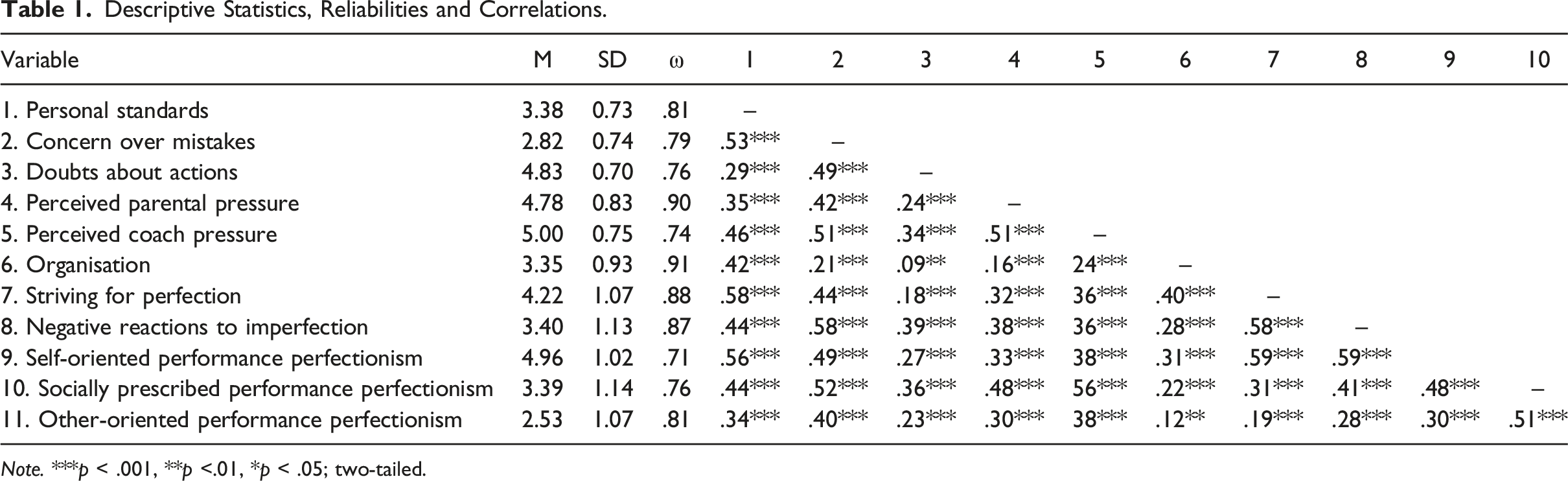
Note. ***p < .001, **p <.01, *p < .05; two-tailed.
Primary Analyses
To address our aims, we (1) assessed the fit of the two-factor model (including and excluding other-oriented perfectionism, parental pressure and coach pressure, and organisation), (2) compared them to the unidimensional model, and (3) compared them to each other. The two-factor model included subscales from the S-MPS-2, MIPS, and PPS-S loading on one of two factors (‘PS’ or ‘PC’): personal standards, organisation, striving for perfection, self-oriented performance perfectionism, and other-oriented performance perfectionism were stipulated to load on PS, whereas concern over mistakes, parental pressure, coach pressure, doubts about action, negative reactions to imperfection, and socially prescribed performance perfectionism were stipulated to load on PC. For the unidimensional model, all subscales were stipulated to load on one factor (‘Perfectionism’). For the various two-factor models, the model was stipulated as above but omitted subscales particular from the model (e.g., other-oriented performance perfectionism).
We used confirmatory factor analysis (CFA) and exploratory structural equation modelling (ESEM) to assess model fit and compare models. For both CFA and ESEM, we used robust maximum likelihood estimation (RML) and, for ESEM, included an oblique target rotation. CFA does not permit cross-loading of items on latent factors which can be unrealistic and problematic when dealing with multidimensional instruments (see Asparouhov & Muthén, 2009; Marsh et al., 2009; Marsh et al., 2014). However, ESEM combines exploratory and confirmatory analyses to stipulate a main target (e.g. PS or PC) and allow cross-loadings, while also providing goodness-of-fit indices and standard errors for parameter estimates to assess fit (Asparouhov & Muthén, 2009). The goodness-of-fit indices we used in both CFA and ESEM were chi-square, comparative fit index (CFI), Tucker–Lewis index (TLI), standard root mean square residual (SRMR), root mean square error of approximation (RMSEA), Akaike information criterion (AIC), and Bayesian information criterion (BIC). General recommendations were used to gauge adequate fit; CFI ≥.90, TLI ≥.90, SRMR ≤.08, and RMSEA ≤.08, with lower AIC and BIC indicative of better fit when comparing models (see Marsh et al., 2014). Factor loadings (λ) were assessed for all models and considered meaningful when ≥.30 (Morin et al., 2020). Satorra–Bentler chi-square difference tests were also used to inform comparison of models. 1 Primary analyses were undertaken in Mplus (version 8.1; Muthén & Muthén, 2017) and RStudio (version 2023.03; RStudio Team, 2023).
Two-Factor Model of Perfectionism
Excluding Other-oriented Perfectionism
Assessment of Model Fit for Alternative Structures.
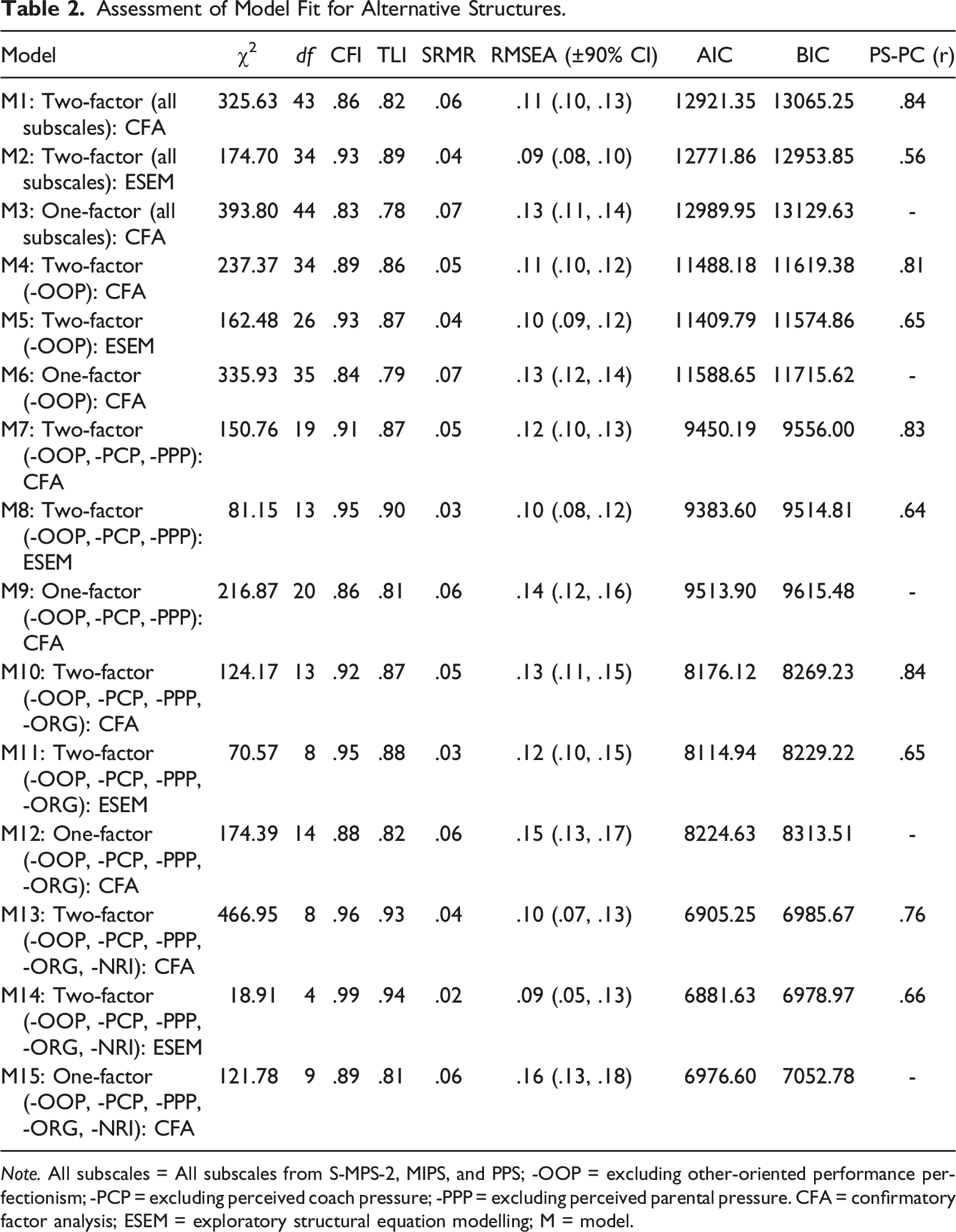
Note. All subscales = All subscales from S-MPS-2, MIPS, and PPS; -OOP = excluding other-oriented performance perfectionism; -PCP = excluding perceived coach pressure; -PPP = excluding perceived parental pressure. CFA = confirmatory factor analysis; ESEM = exploratory structural equation modelling; M = model.
Factor Loadings for Models Including all Subscales.
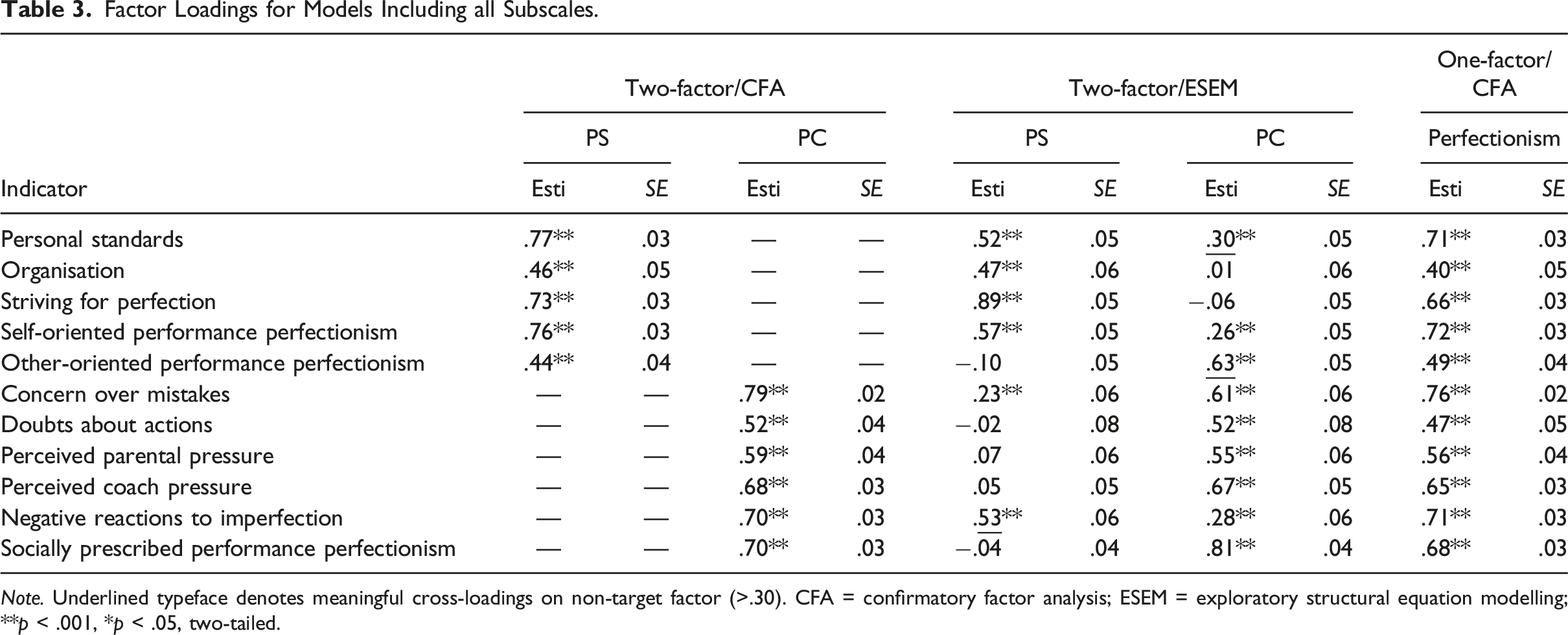
Note. Underlined typeface denotes meaningful cross-loadings on non-target factor (>.30). CFA = confirmatory factor analysis; ESEM = exploratory structural equation modelling; **p < .001, *p < .05, two-tailed.
Factor Loadings for Models Excluding Other-Oriented Perfectionism.
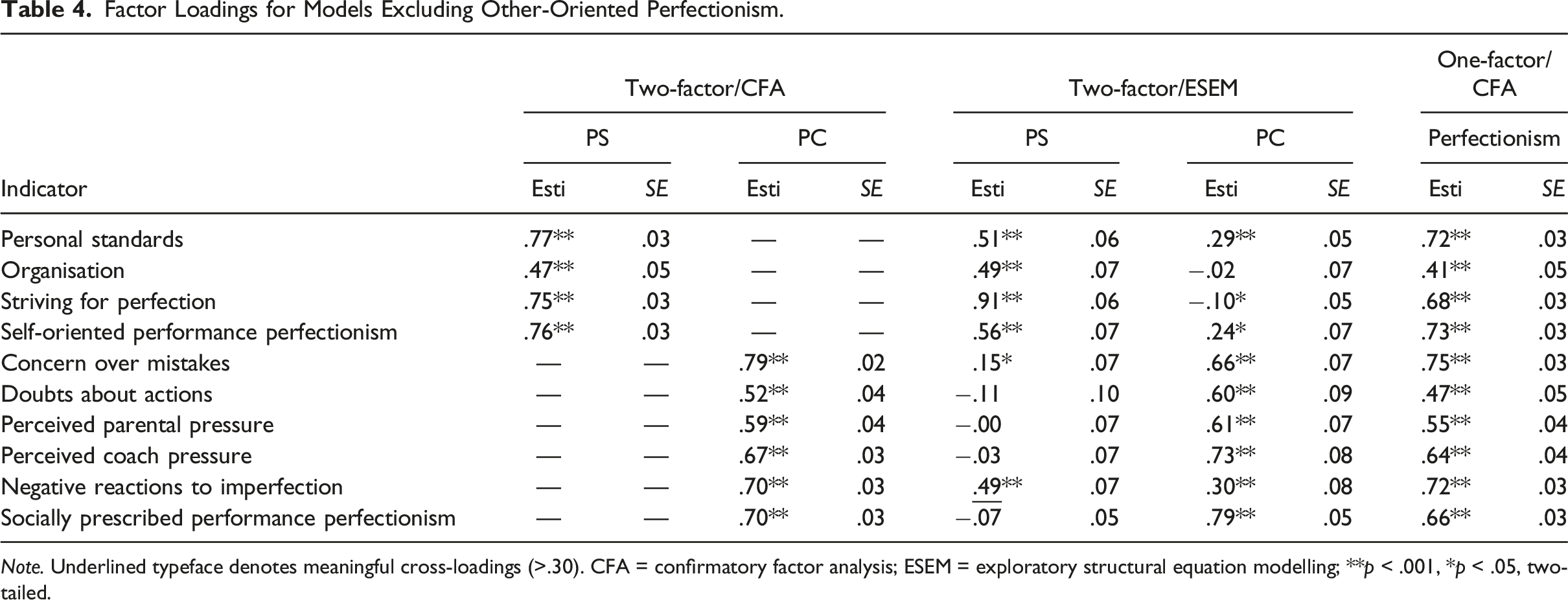
Note. Underlined typeface denotes meaningful cross-loadings (>.30). CFA = confirmatory factor analysis; ESEM = exploratory structural equation modelling; **p < .001, *p < .05, two-tailed.
In comparing the two-factor models, there was little discernible difference in regards to goodness-of-fit indices. However, AIC and BIC were smaller for the model that excluded other-oriented which signals better fit. In addition, chi-square difference tests indicated an improvement in fit for the model that excluded other-oriented perfectionism (Table 8). It is also notable that factor loadings provided a more consistent and interpretable factor structure for the model that excluded other-oriented perfectionism with fewer cross-loadings and all subscales loading meaningfully on target factors. This includes other-oriented perfectionism loading meaningfully on PC rather than PS. Consequently, the two-factor model that excluded other-oriented performance perfectionism was considered superior to the two-factor model that included it.
Excluding Parental and Coach Pressure
Factor Loadings for Models Excluding Other-Oriented Perfectionism, Perceived Parental Pressure, and Perceived Coach Pressure.
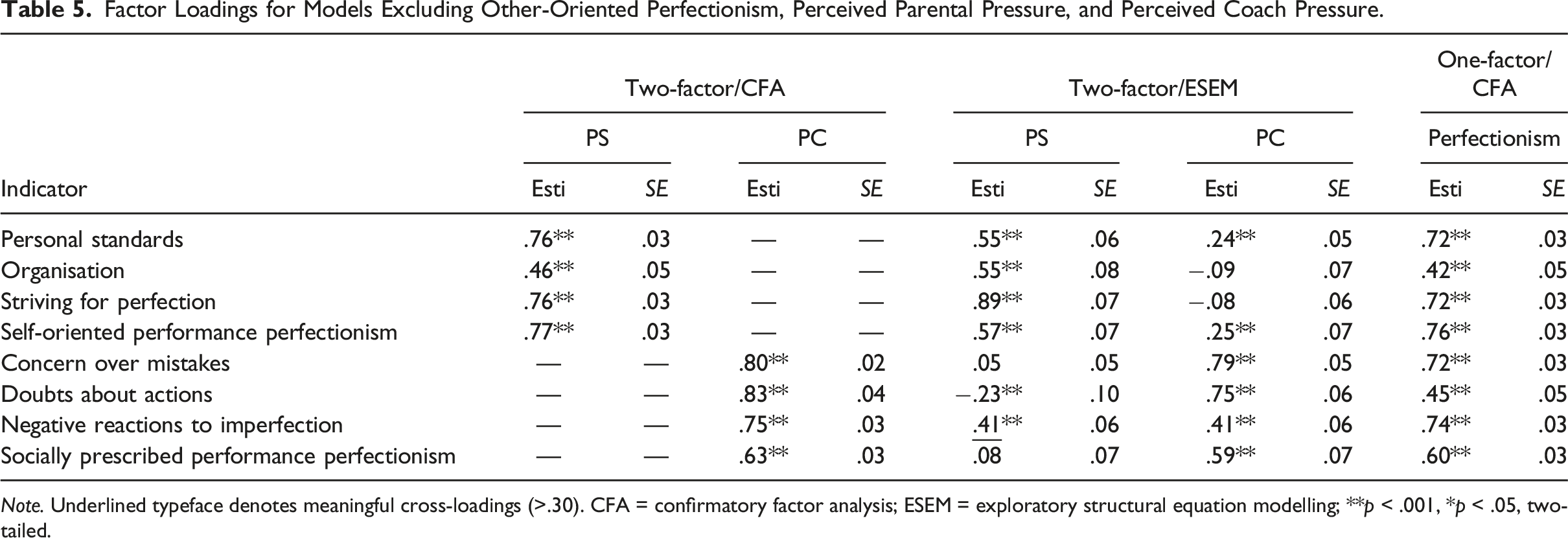
Note. Underlined typeface denotes meaningful cross-loadings (>.30). CFA = confirmatory factor analysis; ESEM = exploratory structural equation modelling; **p < .001, *p < .05, two-tailed.
Excluding Organisation
Factor Loadings for Models Excluding Other-Oriented Perfectionism, Perceived Parental Pressure, Perceived Coach Pressure, and Organisation.
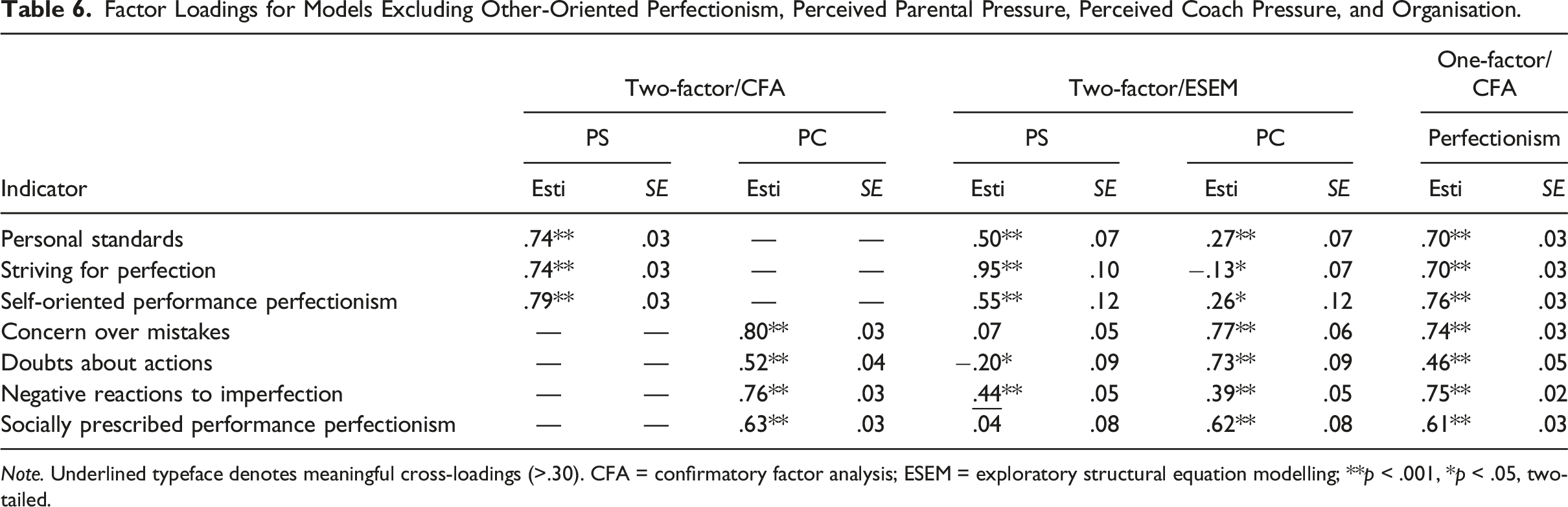
Note. Underlined typeface denotes meaningful cross-loadings (>.30). CFA = confirmatory factor analysis; ESEM = exploratory structural equation modelling; **p < .001, *p < .05, two-tailed.
Excluding Negative Reactions to Imperfection
Factor Loadings for Models Excluding Other-Oriented Perfectionism, Perceived Parental Pressure and Perceived Coach Pressure, Organisation, and Negative Reactions to Mistakes.
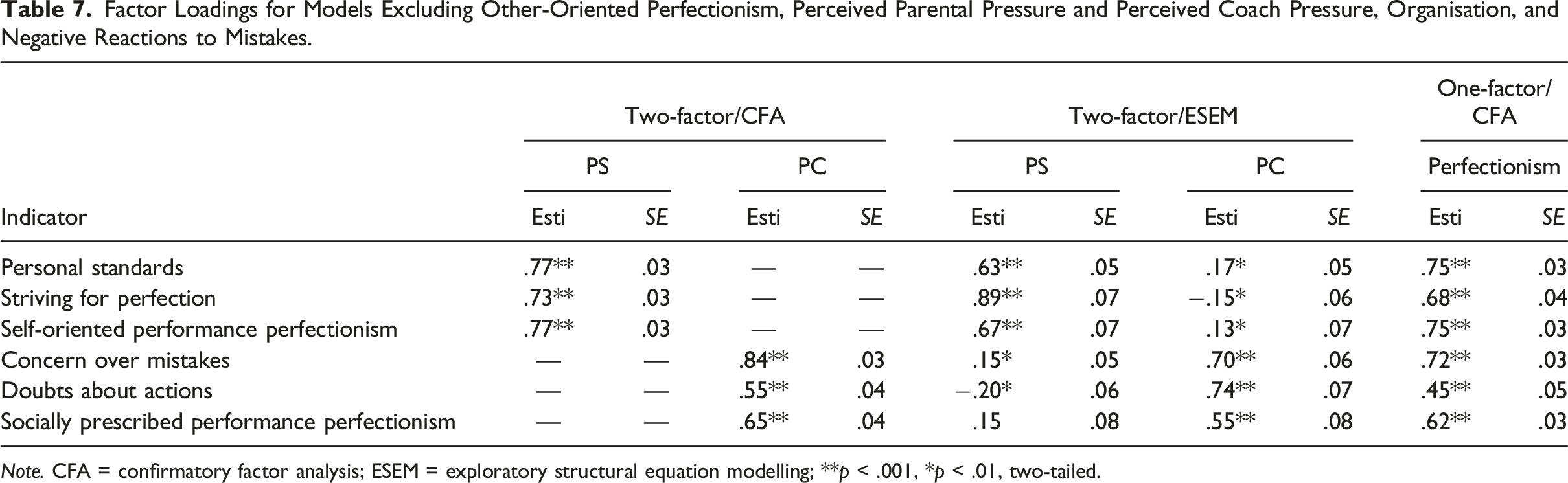
Note. CFA = confirmatory factor analysis; ESEM = exploratory structural equation modelling; **p < .001, *p < .01, two-tailed.
Comparison of Models Using Satorra–Bentler Chi-Square Difference Tests.
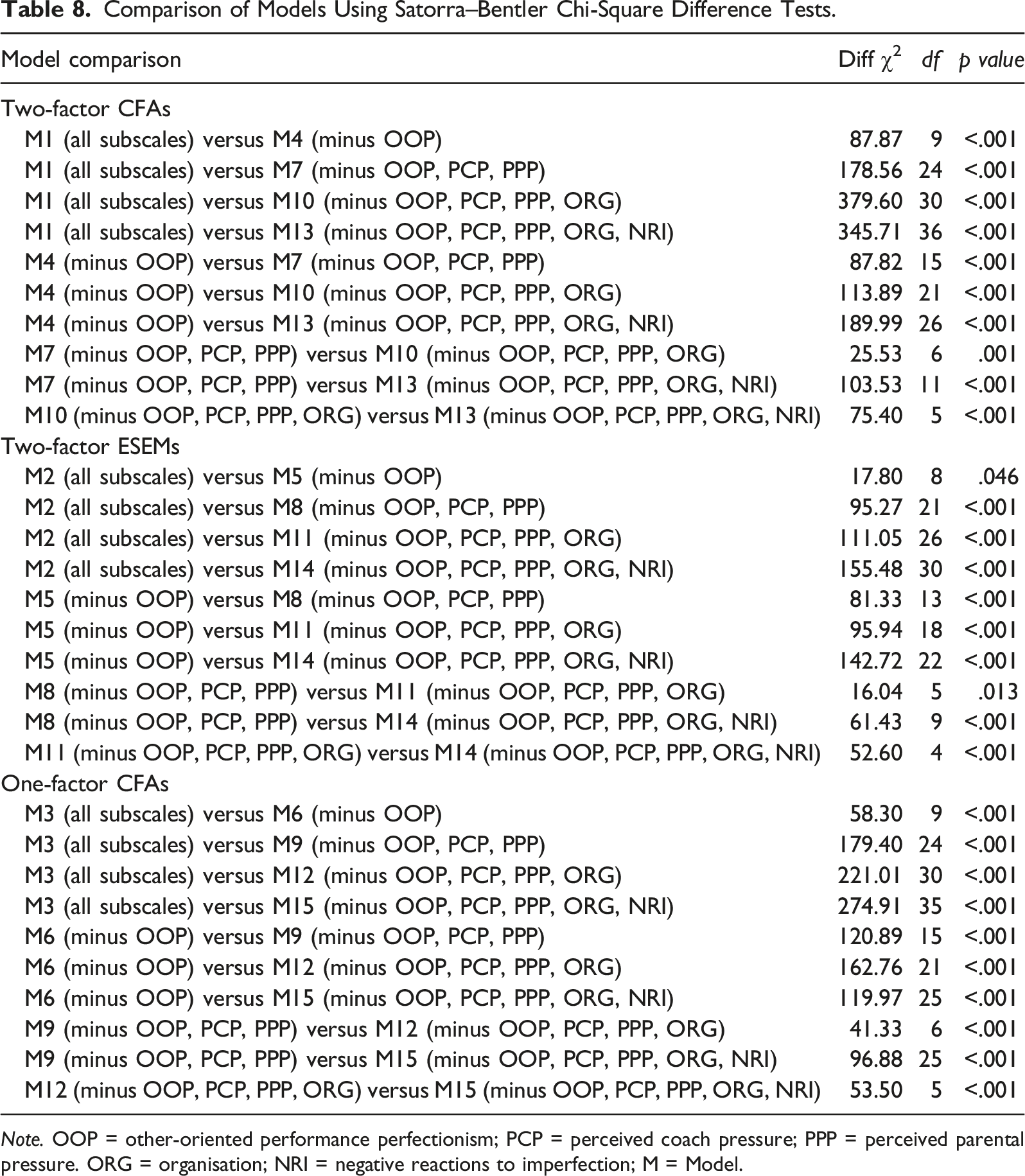
Note. OOP = other-oriented performance perfectionism; PCP = perceived coach pressure; PPP = perceived parental pressure. ORG = organisation; NRI = negative reactions to imperfection; M = Model.
Versus Unidimensional Models
All five unidimensional models provided goodness-of-fit indices indicative of inadequate fit (Table 2). All factors loading were meaningful and statistically significant (Tables 3 – 7). When these five models were compared to their two-factor model counterparts in terms of fit, it was evident that the two-factor models were superior. This was the case when using CFA, but especially evident when using ESEM (Table 8).
Discussion
With an increasing reliance on the two-factor model of perfectionism to guide and organise research in sport as a backdrop, the purpose of the current study was to test the two-factor model of perfectionism using three instruments developed to measure perfectionism in sport. In doing so, we compared two-factor models that included different subscales and compared the two-factor models to alternative unidimensional models.
Two-Factor Model of Perfectionism in Sport
The study provides support for the two-factor model of perfectionism in sport. In doing so, it replicates studies providing similar tests of the model outside of sport. One important note, though, is that support for the two-factor model was more typically found in the ESEM rather than CFA. Given the multidimensional structure of perfectionism and how exploratory-confirmatory analyses are best suited to evaluating these models (Marsh et al., 2009), we do not consider this to be problematic. We have seen, for example, instances in perfectionism research where factor structures fail to replicate when using confirmatory analyses even when based on multiple exploratory analyses (e.g. Dunn et al., 2006). Such findings suggest that restricting cross-loadings to zero, as in CFA, is potentially a model misspecification and that ESEM is necessary (Marsh et al., 2009). For this reason, researchers have begun to use ESEM alongside CFA when examining perfectionism instruments (e.g. Crocker et al., 2018). We support this approach and encourage others to do the same when examining multidimensional perfectionism instruments.
Our first key finding is that the two-factor model better represents the underlying structure of perfectionism instruments when it does not include other-oriented perfectionism. Some of the other tests of the two-factor model have found support for its inclusion (e.g. Bieling et al., 2004; Frost et al., 1993). However, while model fit was comparable, when other-oriented perfectionism was included, the coherency of the factor structure was affected. Notably, other-oriented perfectionism loaded on PC, rather than PS. As such, we advise that it is best excluded from the two-factor model, as others have done (e.g. Cox et al., 2002). However, we should be clear that its exclusion does not indicate that other-oriented perfectionism is not part of multidimensional perfectionism or that it is less important than other dimensions. Rather, it seems that other-oriented perfectionism – demanding perfect performance from others – is not a clear indicator of either factor in the two-factor model. One alternative possibility, for example, is that it is instead part of a different higher-order perfectionism factor (e.g. ‘narcissistic perfectionism’; Smith et al., 2016). Examining if this is the case in sport would be a useful focus of future research.
It may also be the case that excluding other-oriented perfectionism from the two-factor model is specific to sport. In developing the PPS-S, one observation was that other-oriented performance perfectionism appeared distinctive from general other-oriented perfectionism. This was evident in the pattern of correlations and regressions that included the PPS-S and S-MPS-2. However, general other-oriented perfectionism tends to be closely related to personal standards (e.g. Cox et al., 2002; Frost et al., 1993), other-oriented performance perfectionism was more closely related to concern over mistakes and perceived pressures. In explaining these findings, we suggested that other-oriented performance perfectionism may have a stronger focus on denigration associated with imperfect performance than other-oriented perfectionism, and be less focused on standards and expectations (Hill et al., 2016). The findings here regarding other-oriented performance perfectionism appear to further substantiate this idea.
In exploring whether parental pressure and coach pressure should be included in the model, we also found evidence that these subscales might also best be omitted from the two-factor model. The superior fitting models excluded these subscales. This finding supports recent suggestions that these types of subscales may be best considered measures of the degree to which the social environment is experienced as perfectionistic – that is the social cues that arise from the behaviours of specific others that lead people to believe perfection or perfect performance is necessary (Hill & Grugan. 2019). The merits and pitfalls of including these dimensions as measures of perfectionism or markers of the social environment will no doubt be debated. Differentiating between internal and external sources of perfectionistic pressure is difficult partly because it involves attempting to disentangle where the self- and the ‘objective’ other starts and ends. However, there is evidence in this study that more parsimonious and better fitting models may exclude these particular subscales. Like with other-oriented perfectionism, though, this does not mean that these dimensions are not an important part of a broader multidimensional approach to studying perfectionism. These dimensions may still be important for research, assessment, and practice purposes, for example, to better understand previous and current sources of perfectionistic pressure that may be contributing to any difficulties athletes are experiencing (see Fleming et al., 2023).
We are less convinced that organisation will offer the same utility outside of the two-factor model, at least as it is currently conceptualised and measured in sport. We are particularly sceptical of whether a focus on planning and performance routines might discriminate between perfectionistic and non-perfectionistic behaviours in a domain where such routines are common and are often introduced by practitioners to support athletes. From our analyses, organisation typically had some of the lower factor loadings in the models and its exclusion was associated with better overall fit. In comparing our findings with Dunn et al. (2016), they are not dissimilar. In their work, organisation loaded to much lower degree than striving for perfection and personal standards on PS in the analyses that included both the S-MPS-2 and the MIPS. In addition, in their analyses that included just the S-MPS-2, there is evidence that the personal standards subscale is a perfect indicator of PS (factor loadings of 1.00) so organisation may not even need to be measured. Given its chequered history, we believe organisation to be on the periphery of perfectionism and an unlikely candidate for one of its core features.
There was one notable instance of persistent cross-loading. Negative reactions to imperfection loaded on both PS and PC in all models, and on three occasions, the loading was higher on the non-target factor of PS. We therefore decided to also assess a two-factor model without it and obtained the best fitting CFA and ESEM models. The instrument on which this subscale is included, MIPS, has been used multiple times as part of a two-factor model, mainly combined with S-MPS-2. However, factor structures of these models have not been routinely reported, so it is difficult to ascertain if this is evident in other samples, an aberration, or the result of including all three sports instruments rather than two. In Dunn et al. (2016), the subscale loaded as expected on PC supporting its inclusion. Here, there is a case to remove the subscale. Doing so might better position it as a marker of perfectionistic reactivity and something equally characteristic of both PS and PC (see Flett & Hewitt, 2016). However, we note that: (a) the stricter test of factor structure (CFA) supported its inclusion on PC, (b) it may provide conceptual coverage of the perfectionism construct not included in other measures, and (c) there is a stronger theoretical basis for its inclusion than the subscales we have excluded. With these issues and the findings of Dunn et al. in mind, further examination of the place of negative reactions to imperfection in the two-factor model is warranted before we would advocate for its exclusion.
Notwithstanding this issue, the constitutes and meaning of the two factors are broadly similar to those in previous studies. At a conceptual level, we consider this structure to be reflective of communality indicative of internalised pressure to strive for perfection, on one hand, and being overly concerned with the implications of imperfection, on the other hand. The terms ‘maladaptive evaluative concerns’ and ‘maladaptive perfectionism’ with ‘positive striving’ and ‘adaptive perfectionism’ have been used to label the two factors in previous research. However, we consider these labels to be undesirable. As discussed by others, this is because these terms lead to tautological arguments and presuppose the effects of two factors (Gaudreau & Thompson, 2010). We consider the labels perfectionistic strivings and perfectionistic concerns to be preferable as they avoid these problems and more adequately convey the content of the factors at conceptual and measurement levels. We therefore recommend researchers and practitioners use these labels for the two-factor model of perfectionism in sport.
Issues regarding individual constitutes aside, overall, our findings clearly signalled that the two-factor model of perfectionism is a better representation of the underlying structure of the instruments than a unidimensional model. In this regard, the study replicates Bieling et al. (2004) who found the same. Here we confirm that this extends to when MIPS is included in the model and when the model is tested in sport. With unidimensional measures beginning to appear in sport, our findings are a timely reminder of the validity of the multidimensional conceptualisation and measurement of perfectionism. Key to including any unidimensional measures in sport will be evidence that the instruments are in fact unidimensional. In this regard, we highlight that, following closer scrutiny, evidence has emerged that some instruments purported to be unidimensional measures are multidimensional (e.g. Dickie et al., 2012). In reviewing the content of some of the unidimensional instruments in sport, we believe this may also be the case for these instruments, too (see Hill et al., 2019). It would be valuable to explore the factor structures of these instruments to determine whether this is indeed the case.
We close the paper by discussing two issues. The first is the degree to which the two-factor model can be considered to represent or replace other models. It is worthwhile noting in this regard that although subscales of perfectionism may load on one factor, this is not to say there will not be differences between these subscales in their effects or differences in effects on the higher-order factor. Indeed, emerging evidence suggests differences with research finding that the instrument used to measure perfectionism can be a moderating factor for many outcomes (e.g. Hill et al., 2020). Rather, the convergence on two factors simply signals that subscales indicative of PS tend to be more similar to each other than to subscales indicative of PC (even when on the same instrument). The notion of functional homogeneity – that subscales indicative of PS and PC will tend to have similar outcomes – captures this idea. However, we should not expect subscales and higher-order factors to always have the same outcomes, nor does the validity of the two-factor model depend on this being the case, in our view.
The second issue is a cautionary note on surrogation. Surrogation is a term used by Choi et al., 2012 and occurs when instruments created to measure a particular construct replace the construct itself. In other words, surrogation is the tendency to conflate measurement tools with abstract constructs. Similar issues are regularly discussed in terms of constructs (perfectionism) and operational definitions (measures). We believe the two-factor model is a valuable heuristic for researchers and practitioners. However, there is already evidence of surrogation in its use in that PS and PC are often defined solely based on the constitute measures (something many of us have been prone to do). Doing so fails to consider the conceptual meaning of the shared features and variance that provides the basis for the higher-order dimensions. We have tried to avoid doing so here by signalling what we believe the two factors represent conceptually and in simple terms. If the two-factor model is to provide more than an organising heuristic, it will need to be given greater theoretical grounding and be more strongly tethered to existing models of perfectionism in the future.
Conclusion
The study provided the first test of the two-factor model of perfectionism using three instruments designed to measure perfectionism in sport. Findings confirmed that a two-factor model adequately represents the underlying structure of these instruments. This is increasingly the case as the model is more parsimonious when subscales such as other-oriented perfectionism, coach pressure parental pressure, and organisation are omitted. We also found the first evidence that negative reactions to imperfection may load on both PS and PC and so could possibly be omitted and repurposed as a measure of perfectionistic reactivity. In all cases, regardless, the two-factor model was preferable to unidimensional model. Overall, the findings support the validity of the two-factor model and multidimensional measurement of perfectionism in sport.
Footnotes
Declaration of Conflicting Interests
The author(s) declared no potential conflicts of interest with respect to the research, authorship, and/or publication of this article.
Funding
The author(s) received no financial support for the research, authorship, and/or publication of this article.
