




Abstract
Friendships are important for the mental well-being of emerging adults. Socially prescribed perfectionism, where individuals feel pressured to be perfect by others, can be destructive, leading to conflict with others, depressive symptoms, and problematic drinking. However, its impact on friendships is not well-explored. This study examined 174 emerging adult friendship dyads using a 4-wave, 4-month dyadic design. Data were analyzed using longitudinal actor–partner interdependence models. Using a novel friend-specific measure of socially prescribed perfectionism, we found that an individual’s perceived expectation to be perfect from a friend was positively associated with increased conflict between friends, as well as with higher levels of depressive symptoms and problematic drinking in the individual. Findings lend credence to longstanding theoretical accounts and case histories suggesting socially prescribed perfectionism leads to harmful individual and relational outcomes and extends them to the specific context of friendships.
Close relationships are vital to our well-being (Baumeister & Leary, 1995). However, some people are characterized by personality traits that impede their ability to participate in and benefit from stable, positive, and satisfying relationships. Perfectionism is one such trait that can contribute to relationship dysfunction, negative emotions, and maladaptive coping both in the individual who holds those beliefs and in their social contacts (Flett et al., 1997; Hewitt et al., 2006, 2018). Theory and evidence suggest perfectionism is best conceptualized as a multidimensional construct with three overlapping trait dimensions that distinguish between the target and source of perfectionistic expectations (Hewitt & Flett, 1991): self-oriented perfectionism (i.e., requiring perfection of oneself), other-oriented perfectionism (i.e., requiring perfection of other people), and socially prescribed perfectionism (i.e., perceiving that others require perfection of the self). Though all perfectionism dimensions are destructive (Smith, Sherry, Ge, et al., 2021), socially prescribed perfectionism is generally the most consistent predictor of adverse outcomes (Flett et al., 2022). Moreover, relative to self-oriented and other-oriented perfectionism, socially prescribed perfectionism is more robustly associated with interpersonal conflict (Mushquash & Sherry, 2012), depressive symptoms (Smith et al., 2016), and problematic drinking (Bardone-Cone et al., 2012). Hence, though we acknowledge that all trait perfectionism dimensions are important, socially prescribed perfectionism is the focus of the present study.
Depressive symptoms are a major public health concern enmeshed within personality traits and interpersonal problems (Hammen, 2005; Millon, 2002; Whiteford et al., 2013). The perfectionism social disconnection model (Hewitt et al., 2006) provides a context for understanding the characterological and the interpersonal context in which depression occurs. According to this model, people higher in socially prescribed perfectionism perpetuate conflict and erode closeness in their relationships, thereby contributing to depressive symptoms (see Smith et al., 2020 for a review). An extension of this model includes maladaptive coping strategies (Kim et al., 2023; Mushquash & Sherry, 2012) and posits that when people higher in socially prescribed perfectionism experience various negative emotions, such as depressive affect, they engage in higher rates of self-defeating behaviors such as problematic drinking (Mackinnon et al., 2019, 2022).
Friendships are among the most central and influential relationships during emerging adulthood (Arnett, 2005; Barry et al., 2016). Emerging adults with elevated socially prescribed perfectionism might experience more relational and psychological distress because of a perceived failure to live up to their friends’ expectations (Hewitt et al., 2020; Mackinnon et al., 2014). However, surprisingly few studies have examined the influences of socially prescribed perfectionism within the context of close friendships in university, and none have done so using rigorous methods that consider the attributes and outcomes of both members of the dyad over time. In the present study, we addressed this by testing the internal reliability and concurrent and predictive validity of a new friend-specific measure of socially prescribed perfectionism in relation to conflict perpetration (i.e., critical, hostile, and/or rejecting behaviors directed toward the friend), depressive symptoms, and problematic drinking in undergraduate emerging adult friendship dyads using a 4-wave, 4-month longitudinal dyadic design.
Advancing Research on Friend-Specific Socially Prescribed Perfectionism
Perfectionism research typically assumes that socially prescribed perfectionism involves a generalized perception of others expecting perfection (Flett et al., 2022). The handful of studies on domain-specific socially prescribed perfectionism (i.e., within specific relationships) has focused on romantic partnerships (e.g., Mackinnon et al., 2012, 2017; Stoeber, 2012). For example, Mackinnon et al. (2012) developed a romantic partner–specific measure of socially prescribed perfectionism, which, when combined with other dysfunctional beliefs about relationships, prospectively predicted dyadic conflict and depressive symptoms. While the literature on socially prescribed perfectionism has emphasized perceived expectations of others in general (e.g., Smith et al., 2017) or specifically from romantic partners (e.g., Mackinnon et al., 2012), there is a noticeable gap concerning how socially prescribed perfectionism affects close friendships. Given the importance of friendships to emerging adults’ well-being (e.g., Flett, 2022; Flett et al., 2019) and evidence suggesting that people with higher socially prescribed perfectionism tend to experience lower levels of friendship intimacy (Mackinnon et al., 2014), there is a need for research evaluating the internal reliability, concurrent validity, and predictive validity of a friendship-specific measure of socially prescribed perfectionism.
However, a rigorous, comprehensive test of a friendship-specific measure of socially prescribed perfectionism would necessitate studying dyads to examine social influences. For instance, if an individual believes their friend expects them to be perfect, they might become frustrated and behave in critical, hostile, and rejecting ways toward the friend. At the same time, the friend might also respond similarly toward the individual due to the individual’s negative view of their relationship. Additionally, a comprehensive test of a friendship-specific measure of socially prescribed perfectionism requires a longitudinal design to properly decompose effects into time-averaged (between-subjects) and time-specific (within-subjects) components. And yet, though cross-sectional research implicates socially prescribed perfectionism with decreased friendship quality (Mallinson et al., 2014) and has produced autobiographical narratives suggesting socially prescribed perfectionism is related to friendship conflict and depressive affect (Mackinnon et al., 2014), there is a paucity of research combining dyadic data and longitudinal designs in the friendship context.
Present Study
Against this background, we developed a novel friend-specific measure of socially prescribed perfectionism and tested whether it was related to conflict perpetration, depressive symptoms, and problematic drinking in an undergraduate sample of emerging adult friendship dyads using a longitudinal, 4-wave, 4-month dyadic design.
Dyadic research extensively uses the actor–partner interdependence model (APIM) because it controls for the interdependence of dyads (Kenny et al., 2020), while estimating the effects of one’s predictor on one’s own outcome (actor effect) and of a partner’s predictor on one’s outcome (partner effect). We used the L-APIM (Gistelinck & Loeys, 2019), a longitudinal extension of the APIM within a structural equation modelling framework. The actor and partner effects of the predictor in the model over time can be partitioned into two components: time-averaged (A)—the average effect of the predictor on the outcome over timepoints, and time-specific (S)—the effect of how a change in the predictor score relative to the average at a particular timepoint influences the outcome (Gistelinck & Loeys, 2019).
We hypothesized:
H1) An individual’s average friend-specific socially prescribed perfectionism would be positively related to (a) that same individual’s own conflict perpetration toward that friend, (b) that same individual’s own depressive symptoms, and (c) that same individual’s own problematic drinking (i.e., Actor effects-A). As an extension of H1, we proposed the following three exploratory research questions:
RQ1) Does a friend’s average friend-specific socially prescribed perfectionism affect (a) the individual’s conflict perpetration toward that friend, (b) the individual’s depressive symptoms, and/or (c) the individual’s problematic drinking (i.e., Partner effects-A)?
RQ2) Does an individual’s increase in friend-specific socially prescribed perfectionism at a particular timepoint (as compared to his/her average friend-specific socially prescribed perfectionism) affect (a) that same individual’s conflict perpetration toward that friend, (b) that same individual’s depressive symptoms, and/or (c) that same individual’s problematic drinking (i.e., Actor effects-S)?
RQ3) Does a friend’s increase in friend-specific socially prescribed perfectionism at a particular timepoint (as compared to the friend’s average friend-specific socially prescribed perfectionism) affect (a) the individual’s conflict perpetration toward that friend, (b) the individual’s depressive symptoms, and/or (c) the individual’s problematic drinking (i.e., Partner effects-S)?
Method
Participants
Data were drawn from a 4-wave, 4-month longitudinal dyadic study on close friendship dyads published elsewhere (Kehayes et al., 2021; Kim et al., 2022; Mackinnon et al., 2022; Nogueira-Arjona et al., 2019). Eligible participants were same-sex, non-romantic friendship dyads. For reasons related to the larger study on friendship influences on drinking (Kehayes et al., 2021), the dyads were required to be friends who drank together and had known each other less than a year, and both friends had to have consumed at least 12 alcoholic beverages in the past year to maximize the opportunities for social learning of drinking behavior. At least one friend was a first-year undergraduate. Both friends were between 18 and 25 years old, and both had home internet access. Participants were recruited using an undergraduate psychology subject pool, online ads, flyers, and in-class announcements.
The sample consisted of 174 same-sex friendship dyads (66.1% female dyads). Participants averaged 18.66 years of age (SD = 1.17). Most were university students (84.8%), White (79.3%), and reported experiencing at least one problematic drinking symptom in the past month at Wave 1 (85.1%). Also, at Wave 1, dyads reported being friends on average for 4.05 months (SD = 2.21) and having face-to-face contact on 19.75 days/month (SD = 7.60). 1 A substantial minority reported living together as roommates (21.0%) for an average of 2.88 months (SD = 1.56).
The two friends arrived together at the lab for the Wave 1 assessment and completed self-report questionnaires. After the completion of Wave 1, participants were emailed every 30 days for Waves 2–4 and asked to complete the same questionnaires online. If participants missed a questionnaire, they were emailed a make-up survey every day for up to seven days. We modified the make-up survey so that the measures referred to the same 30-day period as the survey originally emailed for that wave. After the seven days, participants were sent three additional reminders until the end of the 30-day period. Participants were compensated $10.00 or one class credit at Wave 1 and again for each longitudinal follow-up that was completed within a week of the original survey being sent. Participants were compensated $5.00 or a ½ class credit if they completed the survey 8–30 days after it was originally sent.
On average, participants completed surveys every 30.44 days (SD = 2.95) and completed 3.49 (SD = 0.93) out of four waves. Retention was high: 70.7% of individuals completed all four waves (all participants completed Wave 1; 89.9% completed Wave 2, 85.3% completed Wave 3, and 73.6% completed Wave 4). Three dyads at Wave 3 and two additional dyads at Wave 4 reported that their friendship had ended. Data collected after the friendship ended was treated as missing. For the main analyses, data from participants who reported abstaining from alcohol over the past month did not complete the problem drinking index for that wave due to skip logic, so problem drinking data were treated as missing for abstainers; 0.6% of participants abstained from alcohol at Wave 1, 4.0% at Wave 2, 7.2% at Wave 3, and 11.2% at Wave 4.
Measures
All measures used a 30-day timeframe. Items were averaged for a total score, except for problematic drinking items, which were dichotomized and summed. All measures that referred to a friend inquired about the friend who was participating with the respondent in the study.
Socially Prescribed Perfectionism
To develop our novel friend-specific socially prescribed perfectionism measure, we incorporated themes found in the 5-item Socially Prescribed Perfectionism Scale (Hewitt et al., 2008), tailoring them to be friendship specific. Participants responded to items (e.g., “The better I do, the better my friend expects me to do”; “My friend expects me to be perfect; “My friend expects nothing less than perfection from me”) 2 using a 7-point scale from 1 (strongly disagree) to 7 (strongly agree). Research that modified the 5-item Socially Prescribed Perfectionism Scale to be romantic partner–specific (Mackinnon et al., 2012, 2017) found moderate correlations with the original 15-item socially prescribed perfectionism measure (Hewitt & Flett, 1991), acceptable internal reliability (α’s = .73 to .78), and good criterion validity.
Conflict Perpetration
We measured conflict perpetration using the 7-item Partner-Specific Rejecting Behaviors Scale (Murray et al., 2003). Participants rated the degree to which they behaved in ways that were critical (e.g., “I insulted my friend), hostile (e.g., “I snapped or yelled at my friend”), and rejecting toward their friend (e.g., “I ignored or did not pay attention to my friend”). Item ratings were made on a scale from 1 (strongly disagree) to 9 (strongly agree). Research has demonstrated adequate internal reliability, test–retest reliability, and criterion validity for this measure when used with romantic partners (Lambe et al., 2015; Mackinnon et al., 2012).
Depressive Symptoms
General depressive symptoms were measured using a subscale from Watson et al.’s (1995) Mood and Anxiety Symptom Questionnaire (MASQ). The MASQ subscales have good internal reliability (αs ≥ .85) and demonstrate convergent validity with both the Beck Depression Inventory and the Profile of Mood States (Watson et al., 1995). We used a 12-item subscale that assesses the general aspects of depression, referred to as the “general distress depressive symptoms” subscale (MASQ-GDD; e.g., “felt like crying”; “felt worthless”). The MASQ-GDD has shown good internal reliability and moderate-to-strong correlations with stress and self-critical perfectionism measures (Mandel et al., 2015). Items were rated on a 5-point scale from 1 (not at all) to 5 (extremely).
Problematic Drinking
The Rutgers Alcohol Problem Index (RAPI) was used as an index of problematic drinking (White & Labouvie, 1989). The RAPI is a 23-item measure reporting on risky drinking behaviors and adverse consequences due to drinking, designed for use with youth and emerging adults (e.g., “Went to work or school high or drunk”; “Neglected your responsibilities”). Participants rated items for their frequency on a scale from 0 (never) to 4 (more than 10 times). The RAPI has high internal reliability, test–retest reliability, and strong correlations with alcohol use levels (Grant et al., 2007; Neal et al., 2006). As recommended by Martens et al. (2007), the individual RAPI items were dichotomized (i.e., 1 = presence, 0 = absence of problematic drinking) and then summed into a single value (possible range 0–23) for analysis. The dichotomized RAPI possesses a unidimensional factor structure and has high internal reliability (Lambe et al., 2015).
Data Analysis
We used a longitudinal actor–partner interdependence model (L-APIM; Gistelinck & Loeys, 2019), allowing for a stringent test of the effect of friend-specific socially prescribed perfectionism on each outcome after controlling the non-independence of dyad members and timepoints. Models were fit using Gistelinck and Loeys’ (2019) application for L-APIM (https://fgisteli.shinyapps.io/Shiny_LDD). The predictor was grand-mean centered. Member-specific intercepts were not indicated for indistinguishability. Correlations were assumed between dyad members; and compound symmetry was specified for the random effect covariance and residual covariance structures. First-order autoregressive covariance structure was used to account for the correlation between timepoints. To correct for residual non-normality, we slightly modified the syntax produced by the online application using the lavaan package (Rosseel, 2012) in R (version 4.2.0), so that our models used maximum likelihood estimation with robust standard errors.
Results
Means, Standard Deviations, Cronbach’s Alpha, and Ranges of Study Variables.
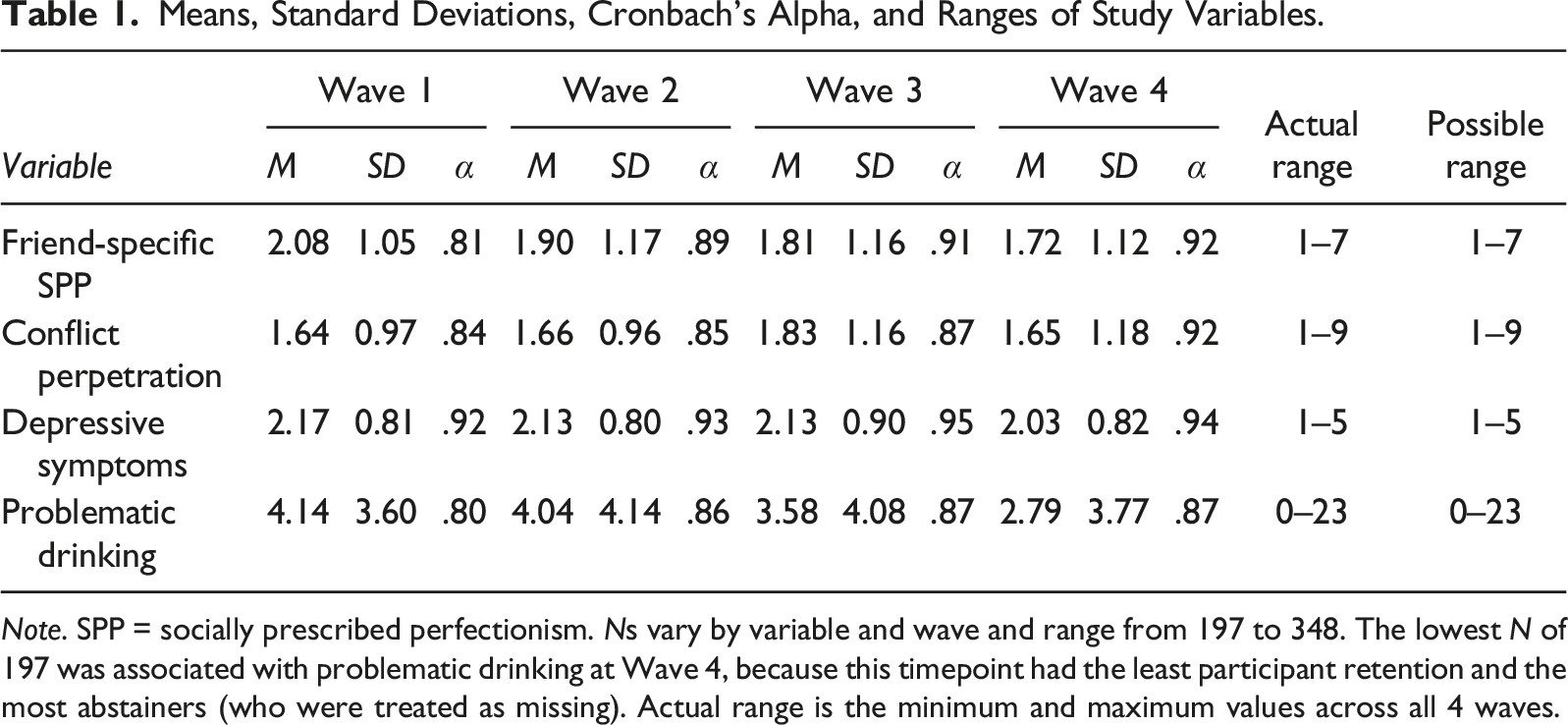
Note. SPP = socially prescribed perfectionism. Ns vary by variable and wave and range from 197 to 348. The lowest N of 197 was associated with problematic drinking at Wave 4, because this timepoint had the least participant retention and the most abstainers (who were treated as missing). Actual range is the minimum and maximum values across all 4 waves.
Parameter Estimates of Fixed Effects and Covariances of Friend-Specific Socially Prescribed Perfectionism as a Predictor in L-APIMs.
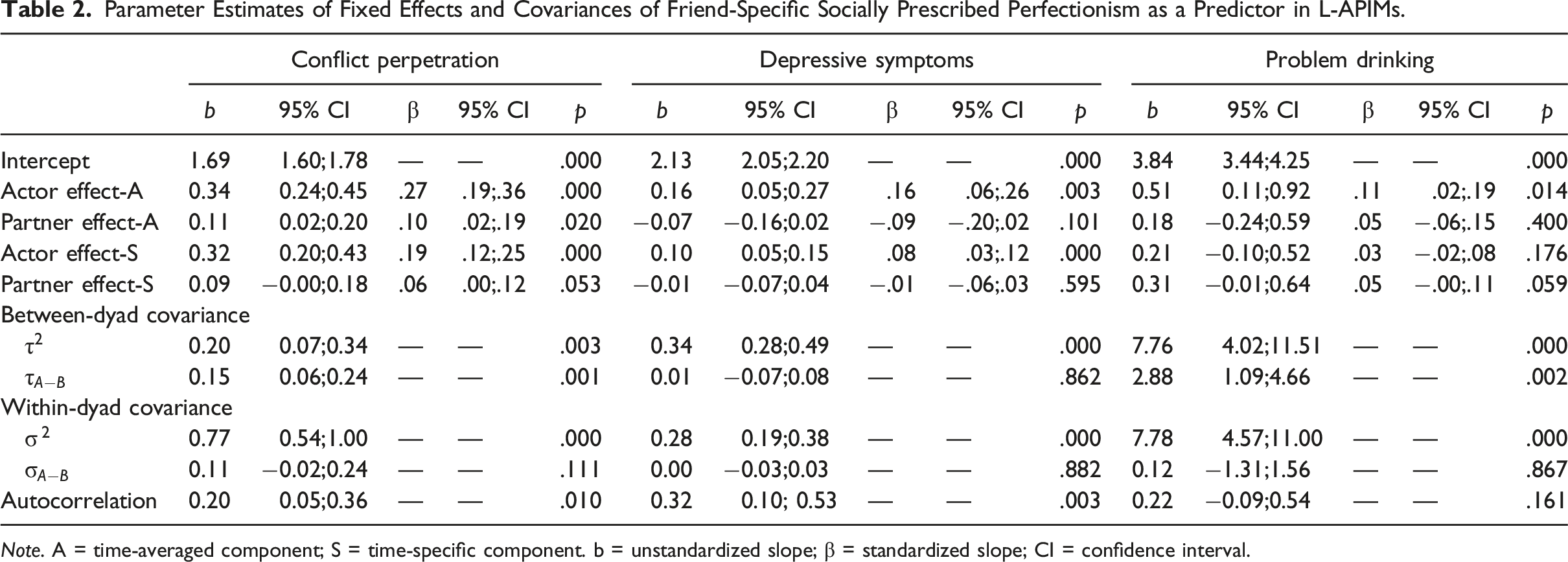
Note. A = time-averaged component; S = time-specific component. b = unstandardized slope; β = standardized slope; CI = confidence interval.
Table 2 also displays intercepts and covariance parameters. The intercepts 1.69, 2.13, and 3.84 reflect average conflict perpetration, depressive symptoms, and problem drinking severity, respectively, over all timepoints. Using
We also conducted two sets of sensitivity analyses. First, we examined whether the significant effect of friend-specific socially prescribed perfectionism on alcohol-related problems (Actor effect-A) replicated when data from those who abstained from drinking were scored as 0 (i.e., that they have no problematic drinking), rather than treated as missing. The results once again suggest that on average, individuals who reported more friend-specific socially prescribed perfectionism also reported more problematic drinking. Second, we log10 transformed our outcome variables to correct for residual non-normality rather than using robust standard errors. Log transformations limit the impact of multivariate outliers and produce residuals that are closer to a normal distribution when the problem is positive skewness, as in the present dataset. However, this comes at the cost of reduced interpretability of coefficients, which is why we elected to use robust standard errors in our main analyses. When we applied log10 transformations, the overall pattern of statistical significance and direction of effects reported in Table 2 did not change. However, we found significance for the Actor effect-S for problematic drinking after the transformation, p = .029 (RQ2), and the nearly significant effects in our main analyses reached significance (i.e., Partner effect-S for conflict perpetration, p = .022, and problematic drinking, p = .044; RQ3). This suggests that there is uncertainty around the p-value estimates of these effects, consistent with the confidence intervals including values close to 0. We were conservative in our approach and reported the nonsignificant p-value estimates that were found using robust standard errors in the main analyses.
Discussion
People have a basic need for stable and positive social relationships (Baumeister & Leary, 1995), with friendships holding special significance during emerging adulthood (Arnett, 2005; Barry et al., 2016). Recognizing the unique contribution of socially prescribed perfectionism compared to self-oriented and other-oriented perfectionism in predicting adverse outcomes (Flett et al., 2022), particularly in the context of friendships (Mackinnon et al., 2014), we tested the impact of friend-specific socially prescribed perfectionism, using a novel measure, on conflict perpetration, depressive symptoms, and problematic drinking within emerging adult friendship dyads. These dyads were characterized by their role as drinking buddies, frequent face-to-face interactions, and on average, low levels of conflict and perceived pressure to be perfect. Low levels of conflict and perceived pressure to be perfect would be expected in friendship dyads since friendships with high levels in either of these constructs would be unlikely to persist. Nonetheless, there is variability in the nature and quality of friendships, underscoring the importance of considering adverse outcomes when the relationship is marked by perceived pressures to be perfect.
The friend-specific socially prescribed perfectionism measure reflects a perceived pressure to be perfect from a friend rather than a perceived pressure to be perfect from others in general, thereby extending the use of the original socially prescribed perfectionism measure (Hewitt et al., 2008; Hewitt & Flett, 1991). Furthermore, most research in this area relies on cross-sectional, non-dyadic designs, which ignore the dynamic, interdependent nature of relationships (Kenny et al., 2020). In contrast, our study involves dyadic data collected at four waves, analyzed using the L-APIM (Gistelinck & Loeys, 2019).
We found support for H1, indicating that our novel friend-specific measure of socially prescribed perfectionism is positively associated with all three outcomes when averaged over time: (a) conflict perpetration toward their friend, (b) depressive symptoms, and (c) problematic drinking. In addressing our exploratory research questions, we found significant partner effects of friend-specific socially prescribed perfectionism on conflict perpetration averaged over time (RQ1). Additionally, we found significant actor effects, revealing that as friend-specific socially prescribed perfectionism increases in a given month relative to an individual’s personal average, that individual reports engaging in more conflictual behaviors toward the friend and experiences more depressive symptoms (RQ2).
Considered together, our results suggest individuals who perceive their friend as expecting perfection from them are more likely to behave in conflictual ways toward their friend and to elicit similar behaviors from their friend in return, possibly because conflictual behaviors are often reciprocated by their target (Mackinnon et al., 2012). These results align with the concept of perfectionistic reactivity—that individuals under pressure to be perfect have negative reactions to disappointing outcomes (Flett & Hewitt, 2016). Thus, it may be beneficial for individuals who are feeling pressured to be perfect by their friend to engage in self-control and adaptively disengage from maltreatment rather than reacting in conflictual ways.
Moreover, our study complements the vulnerability model of the perfectionism–depression link, where premorbid personality traits occur temporally prior to, and predict increases in, depressive symptoms (Smith, Sherry, Ray, et al., 2021). Specifically, disturbances in friendship dyads, characterized by perceived pressure to be perfect, have depressogenic consequences for the individual feeling pressured.
The findings also align with the perfectionism social disconnection model (Hewitt et al., 2006), suggesting that socially prescribed perfectionism leads to depression through negative social behaviors (Smith et al., 2018). Importantly, while existing research on the perfectionism social disconnection model emphasizes a lack of connection to others and difficulty forming meaningful relationships due to perfectionism, our study suggests that socially prescribed perfectionism may induce disconnection within existing friendships.
By demonstrating a positive association between friend-specific socially prescribed perfectionism and problematic drinking, we contribute to existing research that supports a positive association between perfectionism and problematic drinking (Bardone-Cone et al., 2012; Mackinnon et al., 2019; Rice & Van Arsdale, 2010). One mechanism by which perfectionistic individuals experience problematic drinking may be via drinking to cope. For example, perfectionistic individuals who are highly self-critical may use alcohol to temporarily escape from awareness of their flawed sense of self (Sherry et al., 2012). Likewise, individuals who believe their friend always requires perfection of them might drink to escape intense evaluative concerns. Our sensitivity analyses suggest potential significant actor and partner S-effects for problematic drinking, implying that short-term increases in peer pressures to be perfect in both the individual and their friend may predict increases in problematic drinking in the individual. However, given the uncertainty of the estimates, we recommend replication with larger samples before reaching firm conclusions about these effects.
Strengths, Limitations, and Future Directions
Our study has several strengths. For example, we had a relatively high retention rate, with all observations utilized in the L-APIM (Gistelinck & Loeys, 2019). We also used validated measures of conflictual behaviors, psychological distress, and maladaptive coping, which are all relevant to the perfectionism social disconnection model (Hewitt et al., 2006). Nonetheless, our study also has limitations. Due to the secondary analysis nature of our current study, we used drinking buddies as our friendship dyads. As such, our results may not extend to other types of friendships. Moreover, our sample was mostly young White undergraduates, which limits generalizability. Additionally, data was collected every 30 days, indicating relatively short follow-up periods. Future research can involve studying the longer-term consequences of friend-specific socially prescribed perfectionism. Finally, we asked individuals to report on their friend’s perfectionistic demands toward them. It may be that one’s perceptions of their friend are based on truth (e.g., a demanding friend), or it may reflect a maladaptive, inaccurate perception of one’s social world (Smith et al., 2017). The degree to which such beliefs are accurate or exaggerated versions of reality could be studied to determine whether it is the veridical perfectionistic demands that friends place on an individual, and/or the individual’s beliefs about the demands placed on them by the friend, that contribute to these maladaptive outcomes (Smith et al., 2017).
We treated all outcomes as relatively equal, as the current L-APIM application does not allow for tests of mediation (Gistelinck & Loeys, 2019). However, the perfectionism social disconnection model suggests relational conflict precedes emotional and behavioral outcomes, including depression and problem drinking (Hewitt et al., 2018). Future work could examine these processes as they unfold over time in chained mediational models (e.g., Chinneck et al., 2018). Furthermore, we posited that problematic drinking was driven by drinking to cope. Future studies can directly test this assumption through mediation analyses (i.e., friend-specific socially prescribed perfectionism leading to drinking to cope and drinking to cope leading, in turn, to problematic drinking). Additionally, we measured conflict perpetration as a series of conflict behaviors enacted toward one’s friend, but future work could look at both individuals’ perspectives on the same events by examining both conflict perpetration and conflict victimization (Basso et al., 2023). Finally, some studies report nonsignificant associations between perfectionism and heavy episodic drinking (Flett et al., 2008; Kim et al., 2023; Mackinnon et al., 2011). Potentially, individuals high in socially prescribed perfectionism are at increased risk for alcohol-related problems, even if they do not consume alcohol more heavily than others. Future studies should test this possibility and whether socially prescribed perfectionism contributes to heavy episodic drinking in the friendship context.
Conclusion
Theoretical models and empirical studies suggest socially prescribed perfectionism commonly precedes negative outcomes, like depression (Flett et al., 1997; Hewitt et al., 2006, 2018; Smith et al., 2016). Using rigorous longitudinal and dyadic methods, we found socially prescribed perfectionism involving perceived expectations of perfection from a specific friend was positively associated with conflict perpetration toward and from that friend, own depressive symptoms, and own problematic drinking. These results are thus quite promising for the utility of our new measure of friend-specific socially prescribed perfectionism. Researchers are encouraged to further study friend-specific socially prescribed perfectionism to examine its incremental validity in predicting individual and relational outcomes in the friendship context beyond the generalized perception that others exert pressure to be perfect (Flett et al., 2022).
Footnotes
Declaration of conflicting interests
The author(s) declared no potential conflicts of interest with respect to the research, authorship, and/or publication of this article.
Funding
The author(s) disclosed receipt of the following financial support for the research, authorship, and/or publication of this article: This study was funded by an Insight Grant from the Social Sciences and Humanities Research Council of Canada awarded to SHS and SBS (Grant # 435-2015-1798). AJK is supported by a Canada Graduate Scholarship (Doctoral) from the Social Sciences and Humanities Research Council of Canada. SHS is supported through a CIHR Tier 1 Canada Research Chair in Addictions and Mental Health. The funders had no role in study design, data collection and analysis, preparation of the manuscript, or decision to submit the paper for publication. There are no conflicts of interest to report.
