




Abstract
This study involved examining the psychometric properties of the Tripartite Occupational Well-Being Scale (TOWBS) among a sample of 502 Australian teachers. The TOWBS (12 items) comprises three factors of subjective vitality, behavioral engagement, and professional growth. The TOWBS – Short (3 items) assesses a broad factor of occupational well-being. Results confirmed the reliability, factor structure, and longitudinal measurement invariance of the scale scores for both scales. In addition, the two forms of the scale functioned similarly across different teacher characteristics, and the well-being factors were demonstrated to be associated with four external correlates in plausible ways (workplace buoyancy, psychological detachment, somatic burden, emotional exhaustion). Combined, findings offer support for the scale as an assessment of teacher well-being. Implications for research and practice are discussed.
Introduction
Teacher burnout and attrition are persistent issues in many educational systems (Australian Government, 2022; UK Department for Education, 2018). These trends have led to growing interest in understanding teacher well-being, which is important for teachers’ psychological functioning at work (Granziera et al., 2022), as well as students’ positive social, emotional, and academic outcomes (Maricuțoiu et al., 2023). To continue to advance this growing field, there is a need for robust instruments to assess well-being among teachers. The focus of the present study is on a recently developed measure, the Tripartite Occupational Well-Being Scale (TOWBS; Collie, 2020a), which assesses three factors of work-related well-being: subjective vitality, behavioral engagement, and professional growth. Although preliminary work has been promising (Collie, 2023a; Collie & Martin, 2023), the present study seeks to provide more comprehensive evidence of validity for the scale scores among a sample of teachers incorporating two timepoints assessed four weeks apart. Additionally, a short-form of the scale, the TOWBS – Short (Collie, 2020b), was also examined.
Occupational Well-Being
The literature includes several accepted definitions of general well-being (Huppert & So, 2013; Ryan & Fredricks, 1997; Ryff et al., 1995), along with various models of occupational well-being (Van Horn et al., 2004; Viac & Fraser, 2020). Many of these models are broad in nature comprising numerous factors. Although there is rightly a place for comprehensive models, there is also a need for more concise approaches that provide a robust, but succinct understanding of occupational well-being. The aim of the present study was to examine one such concise scale.
Occupational well-being is broadly defined as “a combination of feeling good and functioning effectively” (Huppert & So, 2013, p. 838) at work. A well-known example operationalizing that definition is Spreitzer et al.’s (2005) approach, which involves a two-factor model comprising vitality and learning at work. Vitality, an affective dimension, refers to a sense of aliveness at work. Learning at work, a cognitive dimension, refers to a sense of regularly learning new skills or knowledge. Together, these two dimensions map onto Huppert and So’s definition as they traverse feeling good and functioning effectively—specifically with reference to one’s current job. The TOWBS and TOWBS – Short (introduced next) draw from but also extend Spreitzer et al.’s work to assess three factors that capture well-being in one’s current job and well-being relevant to one’s profession.
The Tripartite Occupational Well-Being Scale
The TOWBS assesses three dimensions of well-being with 12 items (Collie, 2020a). Two of the dimensions are similar to those captured by Spreitzer et al. (2005), whereas the third dimension is novel and is supported by other research on well-being. The first dimension, subjective vitality, is defined as having energy for and feeling excitement relating to one’s job (Collie, 2023a; see also Ryan & Frederick, 1997). This factor represents an affective dimension, taps into “feeling good,” and maps closely onto vitality as specified in Spreitzer et al.’s model.
The second dimension, behavioral engagement, refers to individuals’ efforts to be well-prepared, productive, and effective at work (Collie, 2023a). This factor represents a behavioral dimension and taps into “functioning effectively” at one’s current job. Behavioral engagement is not captured in Spreitzer et al.’s (2005) model; however, it does feature in several general well-being scales (Su et al., 2014) and other occupational well-being models (Bakker & Demerouti, 2017)—highlighting its salience.
The third dimension, professional growth, involves investment through reflection and planning to build capacity for one’s professional development (Collie, 2023a). This factor represents a cognitive dimension and taps into “functioning effectively” in relation to one’s profession. This factor is similar to the learning at work factor in Spreitzer et al.’s model; however, professional growth is more agentic in that it refers to teachers’ active investment in their development, and is not tied to one’s current job, but rather the profession more broadly.
Together, the TOWBS factors traverse affective, behavioral, and cognitive dimensions of well-being. Subjective vitality and behavioral engagement pertain to one’s current job, whereas professional growth concerns one’s profession more broadly. Incorporating aspects of one’s job and profession is critical. For example, an employee could be undertaking high levels of professional growth, while simultaneously not experiencing vitality or being particularly engaged in their current job (e.g., if they are skill building for a different job).
The TOWBS – Short (Collie, 2020b) is a 3-item scale that encapsulates the three dimensions into a broader construct of occupational well-being. Whereas the TOWBS is useful for gaining understanding about specific well-being dimensions, the TOWBS – Short is relevant for studies seeking to capture overarching well-being. Initial examinations of the TOWBS have been promising among Australian teachers (examined in English like this study). For example, prior research has demonstrated measurement invariance of scale scores across three participant subgroups (age, teaching experience, and educational qualification) and over time (Collie, 2023a; Collie & Martin, 2023). In addition, cross-sectional analyses showed the TOWBS factors were negatively associated with turnover intentions as expected (Collie, 2023a). However, more comprehensive examinations of the TOWBS are needed—particularly across other participant subgroups and related to external correlates assessed at a different timepoint. In addition, prior research has yet to test the TOWBS – Short.
Teacher and Job Characteristics of Relevance to the Well-Being Factors
Four teacher characteristics (gender, age, educational qualification, teaching experience) and five job characteristics (teaching load, full-time status, school level, school location, school socio-economic status [SES]) were examined. These characteristics have been associated with various well-being (and cognate) constructs. For example, female and more experienced teachers have been shown to report greater well-being (Collie, 2023a; Klusmann et al., 2023). Associations between the characteristics and the scale factors were tested, and the psychometric properties of the scale scores were compared across participant subgroups.
External Correlates Relevant to Teacher Well-Being
There are a range of variables cognate to occupational well-being. Four such variables were examined in the present study. Workplace buoyancy reflects the ability to effectively navigate experiences of challenge and adversity that are part of everyday work (e.g., competing deadlines and high workloads; Martin & Marsh, 2008). Psychological detachment refers to employees’ efforts to refrain from job-related activities and thoughts during time off the job, such as on the weekend (Sonnentag & Fritz, 2007). Somatic burden refers to individuals’ experiences of physical complaints, such as headaches or trouble sleeping (Gierk et al., 2014). Somatic burden is a common characteristic of many medical and mental health conditions, and is linked with a lower quality of life (Gierk et al., 2014). Emotional exhaustion refers to feelings of being depleted emotionally and physically, and is considered the core dimension of burnout (Maslach et al., 2001).
The four external correlates were chosen because they are relevant to teachers’ psychological functioning at work, and have been examined more extensively in the literature Bartholomew et al., 2014; Granziera et al., 2022; Martin & Marsh, 2008; Türktorun et al., 2020). Whereas workplace buoyancy and psychological detachment represent positive occupational experiences related to greater well-being (Martin & Marsh, 2008; Sonnentag & Fritz, 2015), the reverse is true for somatic burden and emotional exhaustion (Gierk et al., 2014; Granziera et al., 2022).
The TOWBS factors were generally expected to be positively associated with workplace buoyancy and psychological detachment, and negatively associated with somatic burden and emotional exhaustion. However, some nuance to these associations was anticipated. For example, behavioral engagement and psychological detachment may be negatively related given prior research showing that heightened engagement can make it harder for teachers to switch off from work (Türktorun et al., 2020). Additionally, it may be that behavioral engagement and professional growth are unassociated with somatic burden and emotional exhaustion because some teachers who are functioning effectively in this regard (high engagement, high professional growth) may be experiencing lower somatic burden and emotional exhaustion, whereas others may be overextending themselves and thus experiencing higher somatic burden and emotional exhaustion (Klusmann et al., 2008). The present study involved examining these associations and providing evidence of the nomological network of constructs related to occupational well-being.
Study Overview
This study investigated the TOWBS (Collie, 2020a) and TOWBS – Short (Collie, 2020b). Analyses tested for evidence of internal validity (i.e., evidence based on internal structure; AERA et al., 2014) and evidence of external validity (i.e., evidence based on response processes and relations with other variables; AERA et al., 2014). The scales were administered at two timepoints within the same school term: in week three (Time 1; T1) and again in week seven (Time 2; T2). Background characteristics assessed at T1 and external correlates assessed at T2 are also examined. For evidence of internal validity, analyses were run to provide descriptive statistics, reliability of the scale scores, measurement support for the factor structure, and longitudinal measurement invariance. Following this, evidence of external validity was tested by investigating links between the scale scores and background characteristics, and by comparing the psychometric properties of the scale scores across major participant subgroups. Finally, associations between the scale factors and four external correlates were examined.
Method
Sample and Procedure
This study comprised data from 502 teachers working in primary schools (58%), secondary schools (37%), or at both levels (5%) across all Australian states and territories. Respondents identified as female (87%), male (13%), or used another term (<1%). This gender breakdown is comparable to the Australian teaching population (82% of primary school teachers are female, 61% of secondary school teachers are female; Australian Bureau of Statistics [ABS], 2022). The average age of teachers was 34 (SD = 9) years, and they had on average 10 (SD = 8) years of teaching experience. The majority of participants had a bachelor’s degree (63%) or postgraduate degree (36%; the remainder had a certificate or diploma; 1%). Most respondents (92%) spoke only English at home. Participants indicated they worked in government (72%), systemic Catholic (14%), or non-government/independent schools (14%), which broadly aligns with the Australian teaching population where 63% work in government, 19% work in systemic Catholic, and 17% work in independent schools (ABS, 2022). Participants reported working at schools in inner city (10%), suburban (74%), rural (16%), or remote (<1%) locations, and indicated their school’s socio-economic status (SES) was low (17%), below average (17%), average (42%), above average (20%), or high (5%).
Data are shared with a larger project (Collie, 2023b) and were collected between May and June, 2022. This timeframe occurred within Term 2, which is one 10-week term of four terms in the Australian school year. Teachers completed online surveys in week three (T1) and week seven (T2) of the term. This timeframe was during the COVID-19 pandemic, but most teachers were not impacted by COVID-19 restrictions (teaching as usual; 95%). A small group of teachers were hybrid teaching (4%) or remote teaching (<1%).
Recruitment was managed via Qualtrics and their market research panel partners. The study invitation was distributed via email or app to people who had previously communicated interest in participating in Australian school-focused research. Respondents accessed the T1 online survey, provided their consent, and answered screening questions confirming they were teachers in Australian schools. Respondents who cleared the screening and completed the survey, but who did so very quickly (<1/3 median time), responded identically across most of the survey (>80% of items), or responded alike to two oppositely worded item pairs 1 were omitted from the final sample. The T1 response rate was 94%. The T1 participants were reinvited to participate at T2. Random ID assignment enabled data matching over time. The T2 sample size was 366, representing an attrition rate of 27% between waves. Participants were compensated for their time by way of cash or vouchers (roughly equivalent to minimum wage). Institutional Review Board ethics approval was received for the study.
Measures
Unless stated differently below, teachers responded to all items on a scale from 1 (Strongly disagree) to 7 (Strongly agree).
TOWBS and TOWBS – Short
The TOWBS (Collie, 2020a) assesses subjective vitality (4 items; e.g., “I feel excited to start work each day”), behavioral engagement (4 items; e.g., “I complete my work tasks to a high standard”), and professional growth (4 items; e.g., “In my job, I regularly reflect on how I can grow my professional skills”). The TOWBS – Short (Collie, 2020b) has 3 items that broadly capture subjective vitality (“I feel excited and energized by the work I do”), behavioral engagement (“I am well-prepared and engaged at work each day”), and professional growth (“At work, I make plans for developing my professional skills and knowledge”) under one factor of well-being. Prior research has yielded preliminary evidence of measurement invariance (over time and by subgroup), expected correlations, and adequate reliability for the scale scores of the TOWBS (Collie, 2023a; Collie & Martin, 2023). The current study yields additional evidence for the TOWBS, as well as the first evidence validity for the TOWBS – Short.
Background Characteristics
Gender was scored 0 (male teachers) or 1 (female teachers). Age and teaching experiences were continuous variables measured in years. Educational qualification was scored as 0 (bachelor’s degree) or 1 (postgraduate degree). Teaching load measured the percentage of time spent teaching or planning for teaching and was scored 1 (1%–25%), 2 (26%–50%), 3 (51%–75%), or 4 (76%–100%). Full-time status was scored 0 (part-time work) or 1 (full-time work). School location was scored 0 (rural/remote location) or 1 (suburban/urban location). School level was scored 1 (primary school) or 2 (secondary school or both primary and secondary school). School SES was scored 1 (low), 2 (below average), 3 (average), 4 (above average), or 5 (high).
External Correlates
Workplace buoyancy was assessed with Martin and Marsh’s (2008) 4-item scale (e.g., “I don’t let work stress get on top of me”). Psychological detachment was assessed with Sonnentag and Fritz’s (2007) 4-item scale (e.g., “On the weekend, I forget about work”). Somatic burden was assessed with Gierk et al.’s (2014) 8-item scale of common physical symptoms (e.g., “Stomach or bowel problems, “Back pain”). Participants rated the prevalence of the symptoms over the past seven days from 0 (not at all) to 4 (very much). Sum scores of the eight items were classified as thresholds: 0 to 3 (minimal somatic burden; 14% of sample), 4 to 7 (low; 25%), 8 to 11 (medium; 26%), 12 to 15 (high; 16%), and ≥15 (very high; 19%; Gierk et al., 2014). These thresholds were then scored from 1 (no or minimal somatic burden) to 5 (very high somatic burden). Emotional exhaustion was assessed with Maslach and Jackson’s (1981) 4-item scale (e.g., “I feel emotionally drained from my work”). For all external correlates, prior research has established evidence of validity for the scale scores among similar populations, including appropriate factor loadings, anticipated relation with correlates, and measurement invariance across key subgroups (e.g., Gierk et al., 2014; Klassen et al., 2012; Martin & Marsh, 2008; Sonnentag & Fritz, 2007).
Data Analysis
Analyses involved confirmatory factor analysis (CFA) and multigroup CFA using Mplus 8.9 (Muthén & Muthén, 2023). Robust maximum likelihood (MLR) was the estimator, along with full information maximum likelihood to handle missing data (<1% within-timepoint). To check between-timepoint missing data, T1 well-being factors were compared by T2 attrition status using t-tests, and all were non-significant. Additionally, none of the background characteristics were associated with missingness at T2 (Enders, 2022). Model fit was assessed with the root-mean-square error of approximation (RMSEA) and the comparative fit index (CFI). RMSEA values ≤.08 and CFI values ≥.90 indicate adequate fit (Hu & Bentler, 1999). In all models involving T1 and T2 well-being factors, residual variances were covaried for matched items.
Evidence of Internal Validity
Means and standard deviations were calculated for each variable. Following this, CFAs were run separately for the TOWBS and TOWBS – Short incorporating both T1 and T2 scores (all involving latent specification). Correlations were obtained and omega coefficients were calculated from these CFAs. Next, longitudinal measurement invariance was tested using multigroup CFA to ascertain whether the psychometric properties of the scale scores were the same at the two timepoints. Three progressively more restrictive models were run: configural (all parameters freely estimated across timepoints), metric (factor loadings constrained across timepoints), and scalar invariance (intercepts also constrained across timepoints). Changes in RMSEA of ≤.015 (Chen, 2007) and changes in CFI of ≤ −.01 (Cheung & Rensvold, 2002) between consecutive models were interpreted as evidence of measurement invariance.
Evidence of External Validity
CFAs were run to ascertain the extent to which the TOWBS and TOWBS – Short were significantly associated with the nine background characteristics. The background characteristics were entered with loading set to @1 and residual set to @0. The well-being factors were entered as latent factors.
Next, multigroup CFA was used to test measurement invariance in the T1 well-being factors across all background characteristics, except for gender and school location as these did not have large enough sample sizes within the subgroups to allow for multigroup CFA (see Limitations). These tests were only run for the TOWBS (given model saturation with the 3-item TOWBS – Short). The same three models (configural, metric, and scalar) were run and the same cut-offs were employed (i.e., ΔRMSEA ≤ .015, ΔCFI ≤ −.01).
Associations with the T2 external correlates were examined via CFAs for each form of the scale at T1 and T2. Any correlations that were significant at one timepoint but not the other were compared to ascertain whether the correlation coefficients were significantly different. Wald tests with “model test” in Mplus were used. In these CFAs, all factors were entered with latent specification, except for somatic burden. As per prior research (Gierk et al., 2014), somatic burden was entered as an error-adjusted threshold score with the loading constrained to @1 and residual constrained to σ2 * (1- ω), where σ2 is the variance and ω is the reliability of the factor (Brown, 2006). Reliability was calculated in a preliminary congeneric CFA (χ2 [20] = 79.44, p < .001, RMSEA = .077, CFI = .93).
Results
Evidence of Internal Validity
Reliability and Descriptive Statistics.
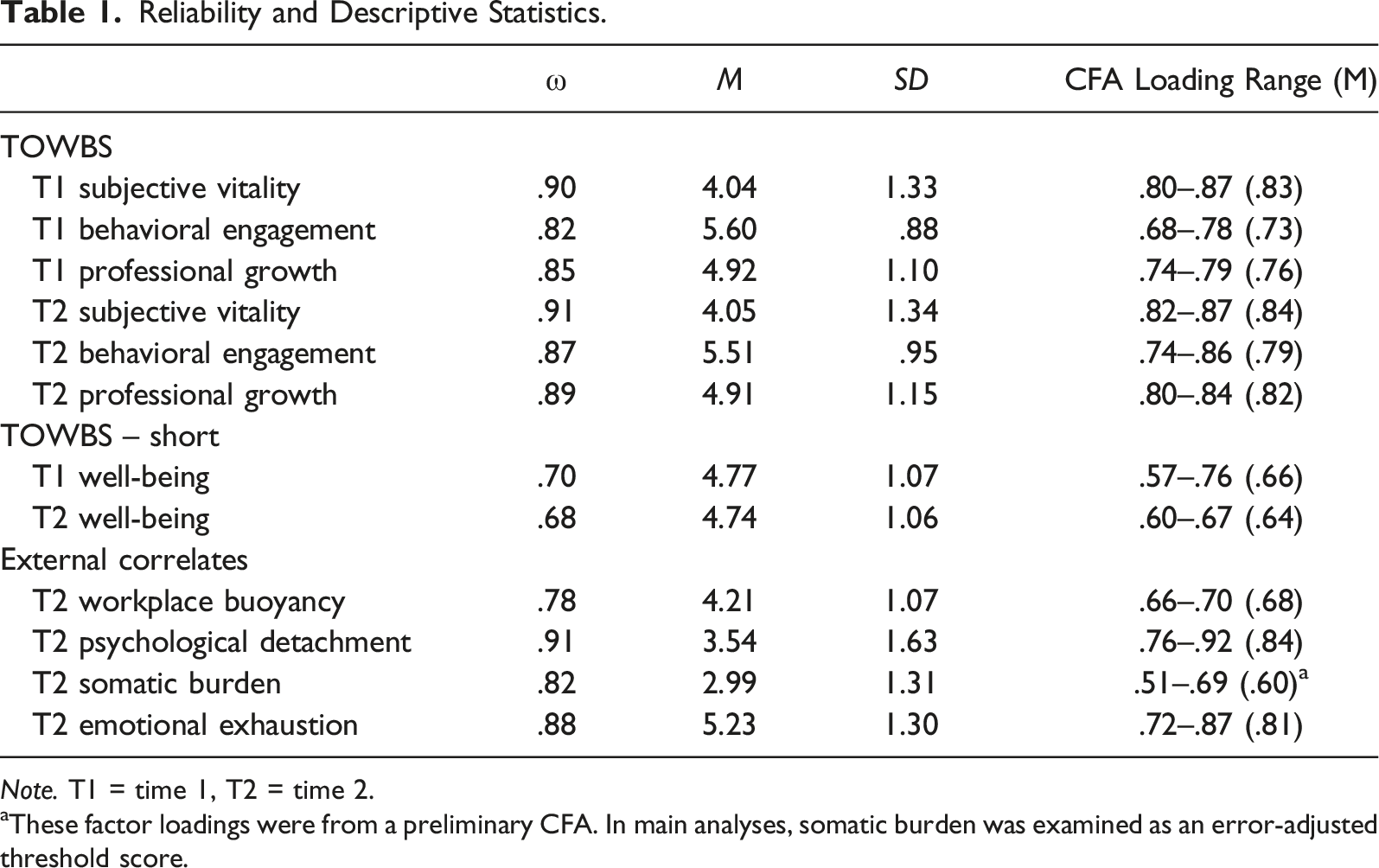
Note. T1 = time 1, T2 = time 2.
aThese factor loadings were from a preliminary CFA. In main analyses, somatic burden was examined as an error-adjusted threshold score.
Correlations Among TOWBS Factors at T1 and T2.
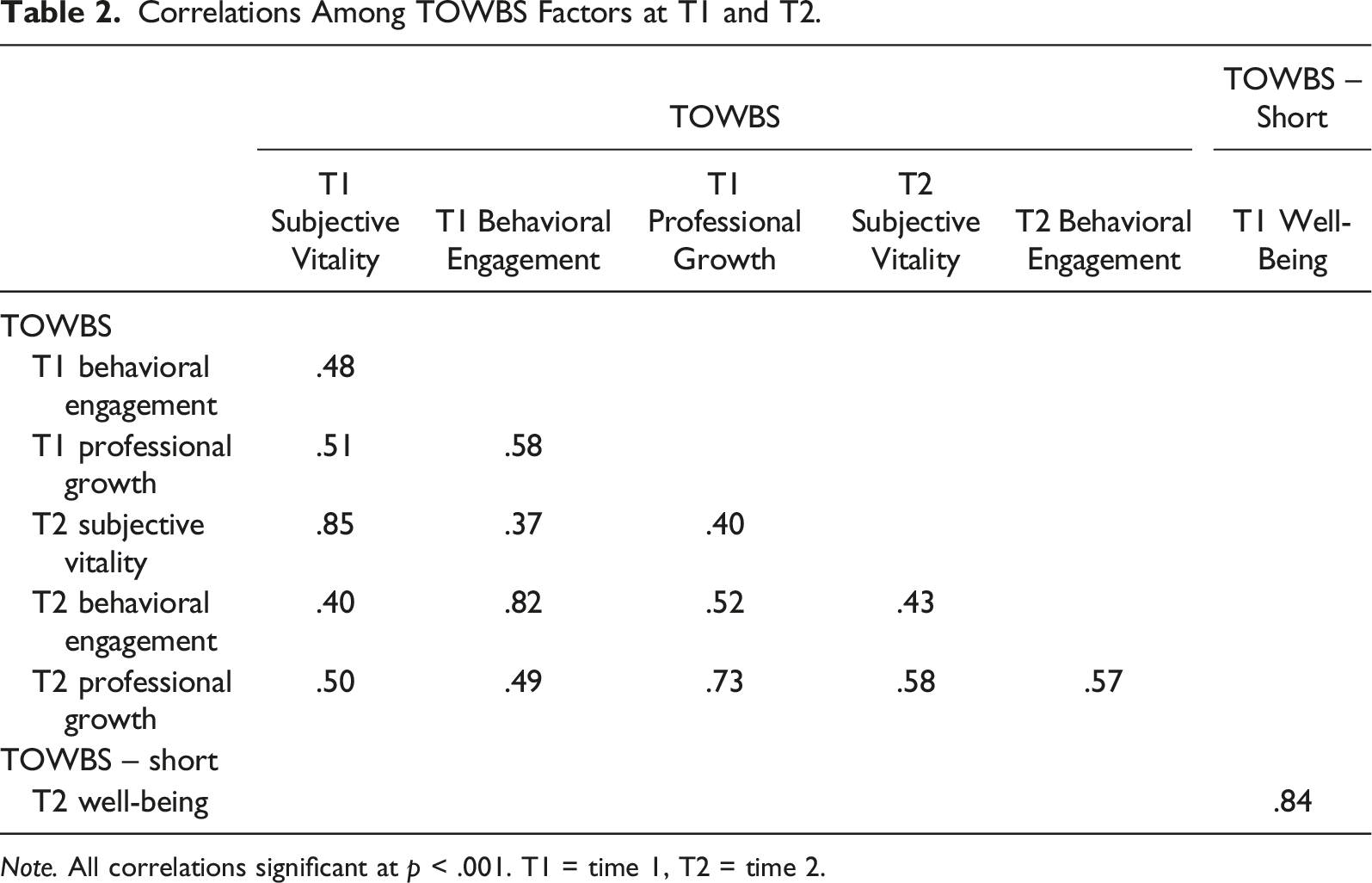
Note. All correlations significant at p < .001. T1 = time 1, T2 = time 2.
The CFA involving the T1 and T2 TOWBS – Short yielded adequate fit: χ2 (5) = 4.10, p = .54, RMSEA = .001, CFI = .99. The factor loadings ranged from .57 to .76 (M = .66) at T1 and from .60 to .67 (M = .64) at T2. The correlation between well-being at T1 and T2 was r = .84 (p < .001; see Table 2).
Measurement Invariance Longitudinally and Across T1 Subgroups.
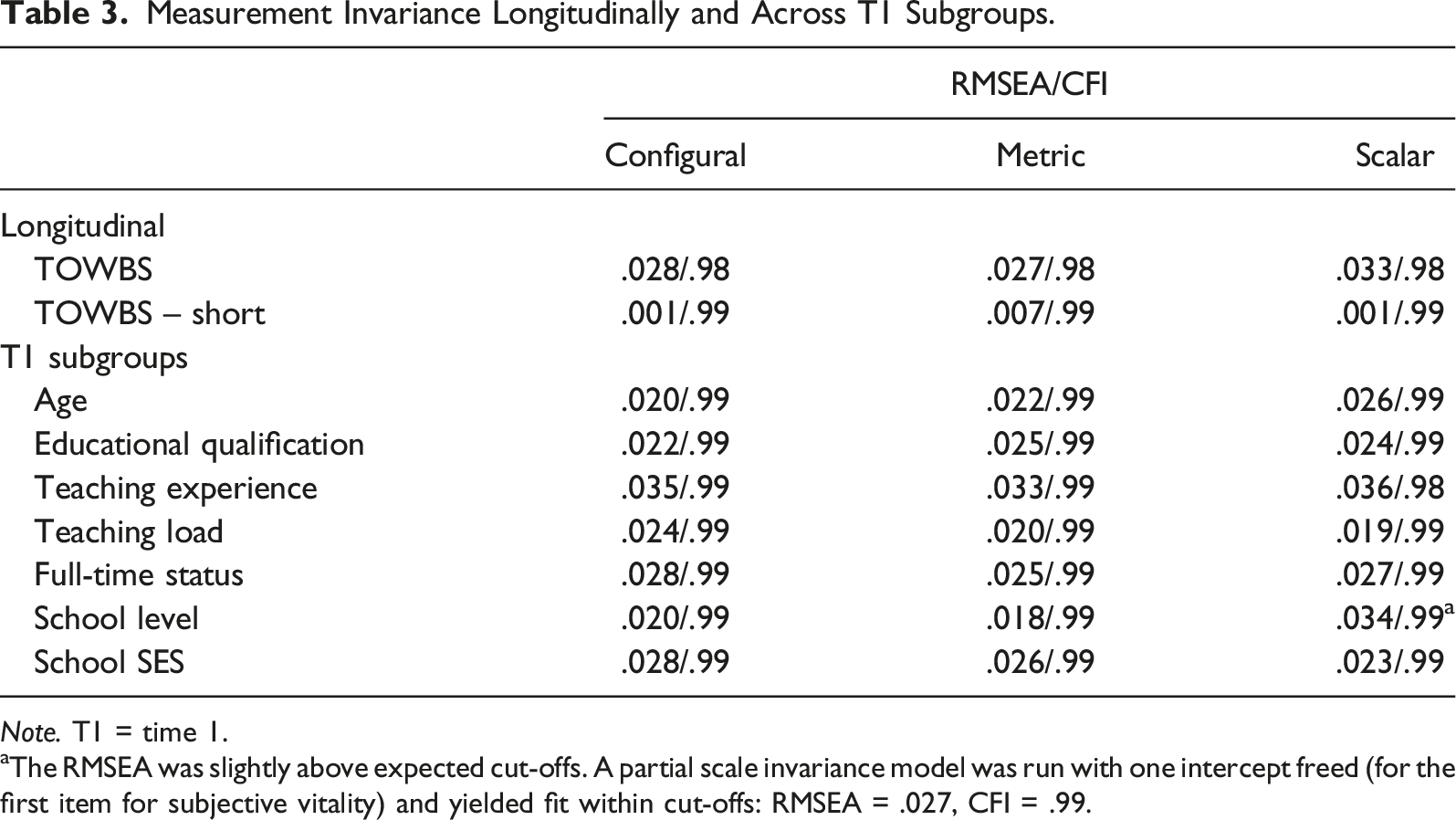
Note. T1 = time 1.
aThe RMSEA was slightly above expected cut-offs. A partial scale invariance model was run with one intercept freed (for the first item for subjective vitality) and yielded fit within cut-offs: RMSEA = .027, CFI = .99.
Evidence of External Validity
Correlations Involving Well-Being Factors and Background Characteristics.
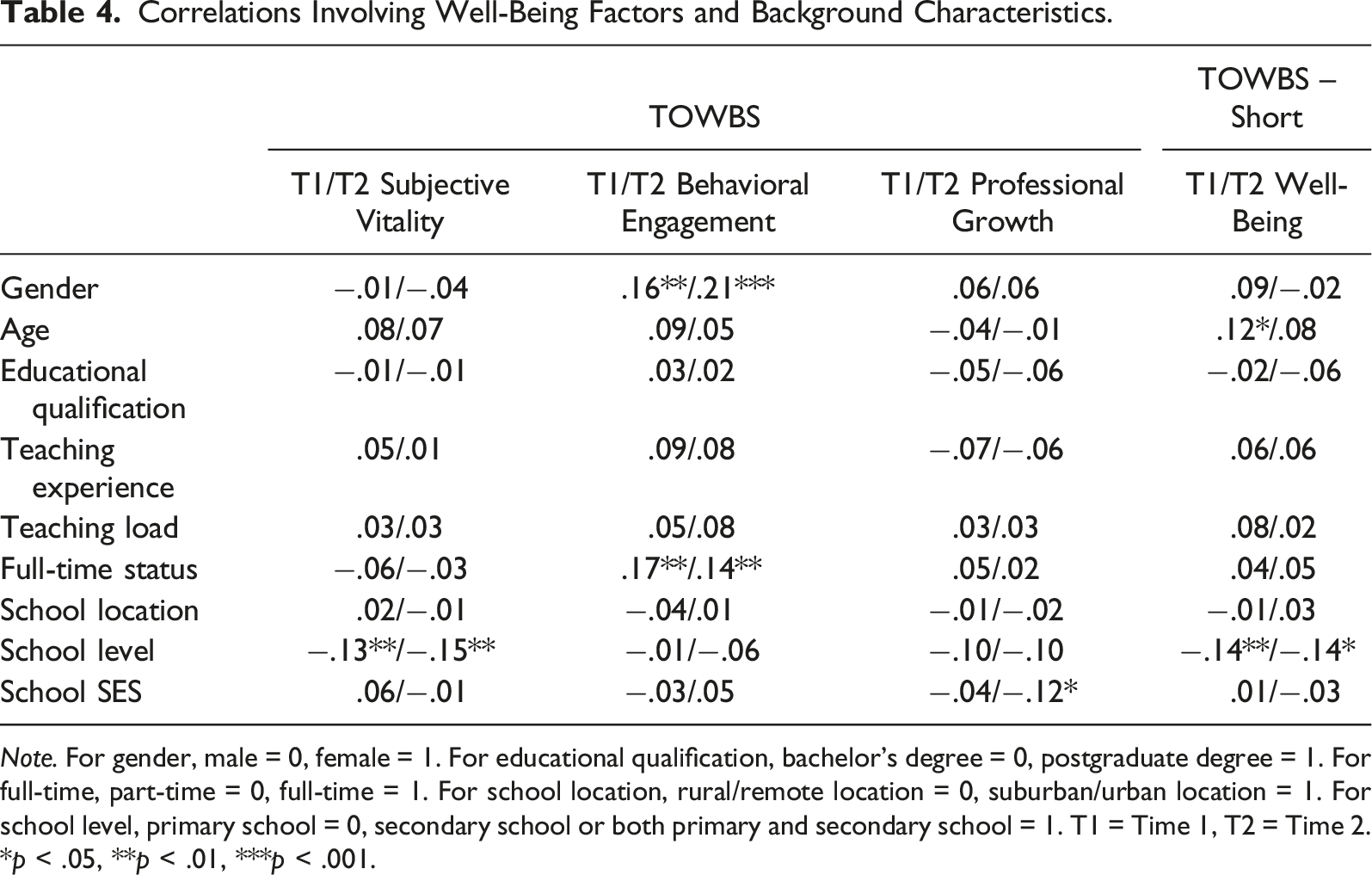
Note. For gender, male = 0, female = 1. For educational qualification, bachelor’s degree = 0, postgraduate degree = 1. For full-time, part-time = 0, full-time = 1. For school location, rural/remote location = 0, suburban/urban location = 1. For school level, primary school = 0, secondary school or both primary and secondary school = 1. T1 = Time 1, T2 = Time 2.
*p < .05, **p < .01, ***p < .001.
Table 3 displays results of the measurement invariance tests by different subgroups for the TOWBS. The RMSEA for the scalar model involving school level was slightly beyond cut-offs (ΔRMSEA = .016); however, partial scalar invariance was met after freeing one intercept across groups. All other models were within cut-offs (i.e., ΔRMSEA ≤ .015, ΔCFI ≤ −.01) demonstrating (partial) invariance in intercepts and loadings across participant subgroups.
Correlations Involving Well-Being Factors and External Correlates.
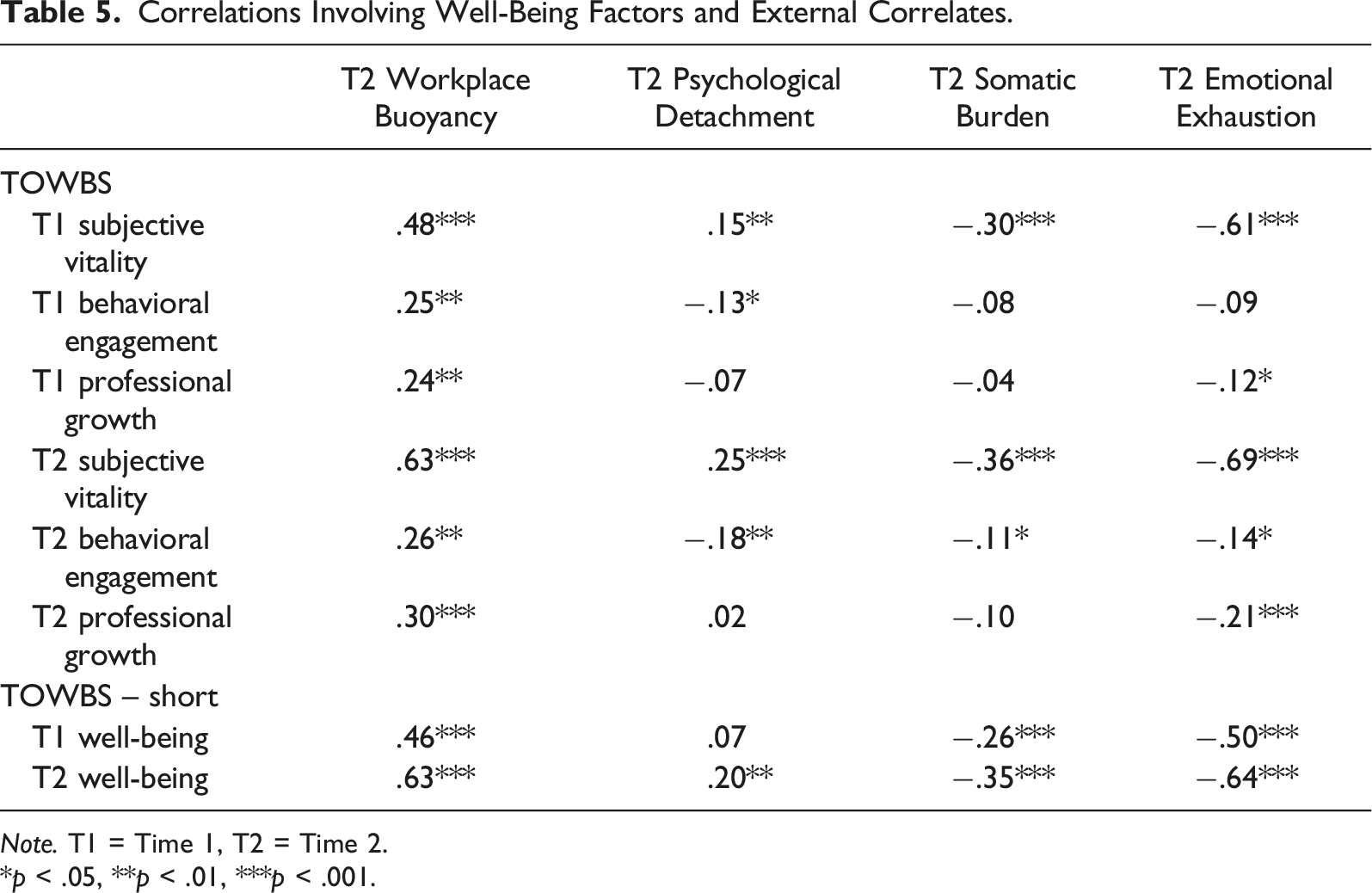
Note. T1 = Time 1, T2 = Time 2.
*p < .05, **p < .01, ***p < .001.
The CFA involving the TOWBS – Short yielded adequate fit: χ2 (135) = 319.60, p < .001, RMSEA = .052, CFI = .94. Correlations are shown in Table 5. Absolute values of the correlations ranged from .07 to .64, revealing that well-being (T1 and T2) was associated with greater workplace buoyancy, lower somatic burden, and lower emotional exhaustion. The findings for psychological detachment were mixed. T1 well-being was not significantly associated with psychological detachment, whereas T2 well-being was positively associated with psychological detachment. A Wald test indicated the difference in correlation strength was significant: Wald (1) = 4.28, p = .04. These results involving the TOWBS – Short mirror those of the TOWBS, except for psychological detachment, which had a positive correlation with the T2 TOWBS – Short factor and mixed results with the TOWBS factors.
Discussion
Factors in the TOWBS
This study comprised analyses aimed at yielding evidence of validity for the scores of the TOWBS and TOWBS – Short. Findings demonstrated evidence of sound factor structure and reliability for both forms of the scale. In addition, the psychometric properties (i.e., loadings and intercepts) of the scales were (partially) invariant across time. For the TOWBS, the moderate strength of the factor correlations indicates that the subscales are tapping into related, but distinct dimensions of occupational well-being. The TOWBS – Short assesses a broader construct of well-being encapsulating the three dimensions.
Well-Being and Background Characteristics
Findings showed that reports of well-being were generally similar across the background characteristics with only a handful of differences. For the TOWBS and advancing knowledge from prior work (Collie, 2023a; Klusmann et al., 2023), teachers in primary schools reported greater T1 and T2 subjective vitality, female teachers and full-time teachers reported greater T1 and T2 behavioral engagement, and teachers at lower SES schools reported greater T2 professional growth. For the TOWBS – Short, older teachers (T1) and primary school teachers (T1 and T2) reported greater well-being. Alongside those results, the psychometric properties (i.e., loadings and intercepts) of the instrument were also similar across subgroups. Moving forward, it will be important to test measurement invariance across other background characteristics and among different samples. Nonetheless, these findings do suggest that efforts to promote the factors may focus on teachers broadly, rather than differentiating for specific subgroups.
Links With the External Correlates
Analyses involving the external correlates yield understanding about the two scales in relation to constructs more extensively examined in the literature. As expected, and aligned with prior research (e.g., Sonnentag & Fritz, 2007), subjective vitality (T1 and T2) was associated with all outcomes: positively for workplace buoyancy and psychological detachment, and negatively for somatic burden and emotional exhaustion. This extends prior research with the TOWBS that linked vitality with lower turnover intentions (Collie, 2023a). Behavioral engagement (T1 and T2) was associated with greater workplace buoyancy (corroborating Martin & Marsh, 2008), but lower psychological detachment. This latter finding is understandable given prior research showing psychological detachment is more difficult when individuals are highly involved in their work (Türktorun et al., 2020). Broadly aligned with prior research (Granziera et al., 2022; Martin & Marsh, 2008) and extending Collie (2023a), professional growth (T1 and T2) was associated with greater workplace buoyancy and lower emotional exhaustion. The TOWBS – Short was associated with greater workplace buoyancy (T1 and T2) and psychological detachment (T2), and lower somatic burden (T1 and T2) and emotional exhaustion (T1 and T2).
Together, these findings were broadly as expected, and the differing associations with the correlates suggest that the TOWBS factors do tap into distinct experiences at work. For example, behavioral engagement was not meaningfully associated with somatic burden or emotional exhaustion. As noted earlier, this finding may have occurred because behavioral engagement can be healthy and adaptive for some teachers, but involve overextending for other teachers (Klusmann et al., 2008)—thus, leading to an inconsistent association with the two correlates. Future research examining other cognate variables and using other approaches (including qualitative and mixture modeling designs) will be important for advancing understanding.
Limitations, Future Directions, and Conclusions
The current study has several limitations that should be considered. Data were collected at two timepoints across one school term. This provides valuable information about a timeframe that much planning and teaching is organized around. However, research examining longer breaks between measurement is needed for further extending understanding of the scales. Second, the recruitment method invited teachers from across Australia, which meant that it was not possible to account for potential nesting of teachers in schools. This is an issue to address in future research using different recruitment methods. Third, although the sample was broadly aligned with the gender breakdown of the Australian teaching population (ABS, 2022), it was predominantly female. Research involving a greater proportion of male teachers is now needed. Relatedly, measurement invariance by gender and school location was not possible with the sample size, highlighting the need for such tests in future. Finally, this study examined correlations between well-being and four external correlates. In future, it will be important to ascertain whether there are different profiles of well-being and also associations with different outcomes (e.g., extra-role behavior). Notwithstanding these limitations, the results hold implications for practice. School leaders could potentially use the scale to identify how teachers are faring within a school. The TOWBS may be helpful for determining the specific focus for intervention (e.g., on behavioral engagement), whereas the TOWBS – Short is relevant for understanding a broader construct of well-being. Together, the current study helps to bring attention to the crucial issue of teacher well-being. Moreover, the results provide support for the TOWBS and TOWBS – Short as robust measures of teacher well-being.
Footnotes
Declaration of Conflicting Interests
The author(s) declared no potential conflicts of interest with respect to the research, authorship, and/or publication of this article.
Funding
The author(s) disclosed receipt of the following financial support for the research, authorship, and/or publication of this article: RJC would like to thank the Australian Research Council for funding this research (DE200100436).
