




Abstract
We summarize qualitative research conducted on the mattering construct and then describe a qualitative investigation focused on mattering as a key aspect of the relational factors which influence the learning and development of students. Semi-structured interviews were conducted with 12 professors recognized for their teaching excellence. Specifically, we assessed professors’ attitudes towards student perceptions of mattering and awareness of mattering in terms of their own self-reported beliefs, attitudes, and teaching practices that convey to students that they matter. Thematic analysis confirmed that almost all the award-winning professors interviewed recognized students’ need to matter and found effective ways to convey to students that they matter. These professors tended to be more similar than different in their approaches and attitudes. Key themes included the need for professors to show students they care about them as students and as people, seeing and treating students as individuals who are collaborators in the learning process, and the need to avoid anti-mattering micro-practices that can result in students becoming disengaged and disillusioned. We discuss these findings in terms of how an explicit focus on mattering promotion is warranted as a central attribute of effective teaching and learning, how the current findings enhance understanding of the mattering construct and how it should be assessed.
The construct validity of any individual difference measure is a reflection of the extent to which the construct is informed by theory with a clear and comprehensive awareness of the construct’s nomological network (e.g., Cronbach & Meehl, 1955; Jackson, 1970; Loevinger, 1957; Wiggins, 2003). Unfortunately, it is common that measurement scales are developed and items are created quantitatively before scale developers have undertaken extensive efforts to more fully explicate and understand the construct under consideration from a qualitative perspective.
The current research examines the mattering construct from a qualitative perspective. Qualitative research is important in its own right, but it also can play a vital role in illuminating psychological constructs. To this end, we begin by providing a description of mattering and a brief overview of previous qualitative research on the mattering construct. We then outline the context of our unique qualitative study.
How is this study unique? We focus on a theme outlined in Flett (2018), where the question was posed, “How can you create a feeling of mattering in someone else?” (p. 35). Flett (2018) proposed that mattering is conveyed in various ways that reflect caring about someone and investing in them and their well-being. This notion was evaluated in the current research by evaluating what award-winning professors say and do to express to students that they are invested in their learning and development, and that they care about them. The overarching premise of this work is that college and university instructors and professors who are recognized for their teaching effectiveness value their students, and they have found ways to convey this message through their teaching practices and interactions with their students. We began this project with the expectation that this focus would also illuminate key elements of the mattering construct and point to themes that can inform the creation of measures to assess mattering in a relational context.
What is Mattering?
Rosenberg and McCullough (1981) introduced the concept of mattering as an extension of Morris Rosenberg’s (1965) influential work on self-esteem. Mattering reflects the feeling of being significant and important to other people. They posited that mattering is both a feeling and a motive. That is, people need to feel like they are significant to others and a failure to satisfy this need can have a profound negative impact on them.
Rosenberg and McCullough (1981) proposed that the mattering construct has three core elements: (a) the sense that other people depend on us; (b) the perception that other people regard us as important; and (c) the realization that other people are actively paying attention to us. The notion that other people come to depend on us was one catalyst for Prilleltensky’s (2020) analysis of mattering as having value to others (i.e., being significant to others) and also giving value to others (i.e., providing significance to others). These components were incorporated into a self-report measure of perceived mattering to others called the Mattering Index (see Elliott et al., 2004). This measure has three subscales: (a) awareness (i.e., others paying attention to the self); (b) importance (i.e., others investing in and valuing a person); and (c) reliance (i.e., becoming a valued resource relied upon by others).
Rosenberg (1985) added a fourth component known as ego extension. Ego extension reflects the belief that a person has that he or she matters because similar emotions and reactions are generated among the people to whom they are closely connected (see Rosenberg, 1985; Rosenberg & McCullough, 1981).
Two other elements of mattering have been noted. First, after conducting interviews with older adults about how they conceptualized and experienced feelings of mattering, Schlossberg (1989) posited that mattering also involves the feeling of being appreciated. Second, and more recently, Flett (2018) emphasized that mattering involves a feeling of being important and recognized as an individual in a way that is keeping with people’s need for uniqueness and a distinct identity. Taken together, these various elements are key aspects of the construct definition theoretically, and they have also been found in extant qualitative research that has explored the mattering construct.
Qualitative Research on Mattering
Several qualitative studies have now been conducted on mattering to others. It is interesting to note from the outset that mattering is often linked with self-esteem. Overall, there has been almost no qualitative studies of self-esteem, but as we indicate below, there have been several qualitative investigations of mattering. As would be expected, past investigations have focused on whether research participants felt like they mattered to other people and how that was experienced. In contrast, the current study focused on people who may or may not make other people feel like they matter to them.
Qualitative research focused on mattering in specific relational contexts, in keeping with the development of the Mattering to Others Questionnaire (Marshall, 2001), had its emphasis on mattering to specific people in one’s life. As an example, initial qualitative research conducted with young adults focused on mattering in dating relationships (Mak & Marshall, 2004). This study with 173 university students in romantic relationships asked participants to respond to open-ended items related to four themes: (a) how they know they matter to the partner; (b) what is it that makes them feel like they matter; (c) what is it that makes them feel like they matter the most; and (d) what makes them feel like they matter less to the partner. Overall, eight conceptual categories emerged from the responses. Several categories reflected being the source of attention, but feelings of mattering were also derived from verbal messages of mattering and caring, as well as mattering in the form of physical attention or prolonged physical presence. Another theme that emerged was “cognizant.” That is, participants expressed awareness that the partner held a positive cognitive representation of them (i.e., thinking of them). Interestingly, Mak & Marshall (2004) noted that similar themes emerged for male versus female participants.
As a follow-up, Marshall & Lambert (2006) also conducted a qualitative analysis, but the focus here was on the reports provided by parents of their sense of mattering to their children. Cross-case qualitative data were obtained from 57 parents (30 mothers and 17 fathers). It was determined that feelings of mattering among parents emerged from interactions with their children and the amount of attention received from their children. Parental mattering was linked closely with parents being depended on by their children. Interestingly, parents provided responses highlighting how mattering is malleable rather than fixed. This study of parents also confirmed that their own sense of mattering depended, in part, on being noticed by their children and receiving open displays of affection. They emphasized being confided in when children found themselves needing comfort and advice. Finally, another key finding noted by the authors was the reciprocal nature of mattering in parent-child dyads.
Other qualitative studies based on open-ended responses have been conducted in educational contexts with a focus on either students (high school and post-secondary school students) or people employed in the education system. And, although some of these studies did not have an initial emphasis on mattering, a mattering versus marginalization category emerged nonetheless through an analysis of the open-ended responses (e.g., Huerta & Fishman, 2014; Rosati et al., 2019). Our focus, however, is on qualitative investigations that specifically focus on mattering from the beginning of the study. For instance, Tucker et al. (2010) conducted a study with nine academically successful African American high school students who were selected for having a grade of C+ or higher and no record of being disciplined. These students were asked questions about the degree to which students felt they mattered to others at their school and how they experienced mattering to others. Nine questions were posed to individuals, and 11 questions were asked when the students formed a group. The results revealed that feelings of mattering were traced to there being clear and high expectations held for them. Most students also mentioned feeling protected and nurtured at school. They also had a sense of voice in that their opinions were valued, but they were also valued as individuals. Students also emphasized the importance of the personal attention and interest they received, even if these interactions were brief.
Vetro (2021) reported a qualitative study with data gathered from 11 student volunteers during the pandemic. The interviews focused on the possible link between a sense of mattering among first-generation students and their persistence at college. All of the participants agreed that attention from professors and having their importance conveyed to the students was central to their sense of mattering, with some noting the importance of professors really listening to them. Moreover, this attention and interest helped propel them on to higher performance.
Other qualitative research has focused on the experience of mattering among school counselors. Curry & Bickmore (2012) examined the reported experiences of seven school counselors. The experience of mattering was revealed in relation to interactions with administrators, students, and other educational stakeholders such as teachers. A key element of mattering through interaction with administrators was having a say in how the counseling services were provided. Interactions with students were particularly important, with three elements identified as vital to feelings of mattering: (a) being relied upon and depended on; (b) playing a role in student success; and (c) direct expressions of appreciation from students. Teachers also played a role in counselors’ feelings of mattering by noticing their work with students and its impact. Curry & Bickmore (2012) concluded that this reflected the attention and interest facets of mattering as described by Rosenberg & McCullough (1981). The other key element of this qualitative study is that a category emerged that reflected feelings of not mattering and marginalization. This category emphasized unmet needs to mattering due to such factors as lack of mentorship, poor professional development, and administrative leaders having no time to meet with the counselors. This was deemed to reflect an absence of mattering in terms of the interest and attention dimensions.
Other research has been conducted on feelings of mattering among physical education teachers. This work by Gaudreault et al. (2016) was inspired by constant concerns among physical education teachers that their role in the school and in the student’s lives is not valued by their colleagues. Analyses of interview data confirmed that feelings of mattering emerge from meaningful relationships, but feelings of mattering can also reflect structural elements of the school such as the physical location and quality of the gymnasium. An important element of this work is that mattering or not mattering can be derived from the presence or absence of quality resources tied to a person’s sense of identity and role.
Finally, research by Karpiak (1997) is particularly relevant for our purposes because it focused on professors. This research was a qualitative study of 20 associate professors (15 men, 5 women) between the ages of 41–59 years old. A remarkable element of this study is that it highlighted the fact that several professors recognized that they belonged at the university, but they felt unimportant and insignificant. Job-related demoralization stemmed from an apparent lack of appreciation and recognition from never-seen administrators described as being “ghostlike.” In addition, feelings of not mattering also stemmed from being left out of decisions or having their advice ignored. Remarkably, there were almost no positive expressions of mattering voiced by these professors. Unfortunately, this study lacked an important perspective when considering faculty feelings of mattering because there was no apparent focus on interactions and experiences with students.
Taken together, these qualitative investigations support the conceptualization of mattering outlined by Rosenberg & McCullough (1981). The two elements that have received the most support are mattering in terms of being a focus of attention and mattering in terms of interest in the individual. These studies also illustrate various ways that mattering as being valued was expressed and experienced. Various investigations also emphasized the tendencies that resulted in feelings of being marginalized and not mattering to others.
The Current Study
The current study makes an important contribution as an extension of this existing literature as we focused on the role of professors as generators of feelings of mattering among students. In addition, an important contrast to the professors included in previous work (e.g., Karpiak, 1997) was that our sample of professors clearly felt recognized, at least at some level, because we recruited professors who had won teaching awards either on campus or at a regional or national level. In a very real sense, they knew that their teaching mattered.
In recruiting this rather elite group of faculty members, our hope was that it would yield an in-depth and detailed description of award-winning professors’ perspectives on this topic. Although qualitative findings do not necessarily generalize to the population, particularly when a specific sample like this is used, this approach does provide a detailed perspective of how exceptional educators perceive and approach student mattering within the context of university. In this regard, a sample of professors recognized by students for most effectively fostering learning can be seen as key informants about what role, if any, mattering plays in the educational process. Our main research goal with this group was to gain insights about mattering from the professor’s perspective and gain a better appreciation of mattering as both having value to others and giving value to others in keeping with this key distinction emphasized by Prilleltensky (2020).
Below, we describe the approach that was used and the insights that emerged through qualitative investigation. We note from the outset that the material presented represents only a portion of this project in two respects. First, we report on only three elements of several themes that professors were interviewed about. Second, another component of this research, which involved parallel interview-based studies, focused on students and their experiences with mattering in the university context. Unfortunately, the details of this work are beyond the scope of this single article; nevertheless it served to inform our discussion of the results.
Methods
Participants
The study was conducted with 12 participants (five women, seven men). We have intentionally limited our reporting of demographic information to protect anonymity. Our participants included faculty across various formal ranks with three instructors, eight professors and one lab coordinator. All participants had been teaching in their respective roles for as long as they had been employed at the university. The participants’ teaching experience ranged from 10 to 32 years, with a mean of 17.6 years. The courses that were taught by participants were varied, including: linguistics and language studies, engineering, biology, chemistry, cognitive science, psychology, history, neuroscience, and sociology. What they had in common was having been recognized with a teaching award including within their own faculty, at the university level, regionally or nationally.
Procedure
The initial selection of possible candidates was made by accessing the university teaching awards website to compile a short list of prospective participants. Key factors in participant recruitment included diversity of academic department, gender and experience. Initially, the inclusion criteria were restricted to faculty formally in tenure-track professor roles (i.e., assistant, associate, and full); however, based on the interest and availability of participants, we expanded our criteria to include individuals teaching at the instructor rank who had been recognized for demonstrating teaching excellence. That said, in our writing, we refer to all participants as “professors” for ease of communication and because this is common among undergraduate students who are often unaware of formal rank distinctions. Recruitment was conducted through an e-mailed invitation to participate in the study by the third author, although a large majority of the candidates were first notified informally about the nature of the study by the first author.
The study procedure and interview protocol were approved by the university ethics committee. All interviews took place in the respective professors’ offices, typically during office hours. The interviews varied in length from about 44 to 116 minutes, with a mean of 75 minutes.
Participants initially read an informed consent form and confidentiality agreement, and they were reminded that the study would be audio-recorded. Once consent to participate and to be recorded were obtained, participants were asked to provide a gender-neutral pseudonym that they wanted to be identified by, and then the semi-structured interview was conducted. Upon completion of the interviews, participants read and signed the debriefing form. No monetary compensation was provided; however, participants were offered the choice of a complimentary book out of a selection of teaching books provided by the first author as a token of appreciation for their participation.
Measures
Interview Questions
Semi-structured interview questions were designed around the main components of mattering identified in the literature: attention, importance, and dependence. For example, participants were asked about what they did to show their students that they were aware of them or were paying attention to them, how they knew students felt important to them, and if they felt that their students depended on them, at least to a certain extent. The interviews addressed specific questions related to mattering, but were open-ended enough with “probe” follow-up questions to capture the participants’ perspectives on issues and topics not initially included.
Interviews commenced with questions related to the participants’ teaching experience and awards in order to build some initial rapport, and this was followed by a short introduction to the concept of mattering. The main interview questions were divided into two sections: 1) a main section concerning students’ feelings of mattering, and 2) a secondary section with complementary questions designed to obtain a more complete understanding of the participants’ perspective with respect to the importance of mattering at the university in relation to teaching and learning.
The main section of the interview included questions regarding making a distinction between the student as a person mattering or the students’ learning mattering, as well as questions pertaining to what these professors did in terms of teaching practice, how they knew students felt that they mattered, and when they tried to make their students feel like they matter, if they did at all. There were also questions that focused on what occurs when students are made to feel like they don’t matter. The secondary section examined more peripheral topics that are the subject of another article.
Data Analysis
Qualitative approaches are diverse in their methods, and the choice of method depends heavily on the context of one’s research (see Boyatzis, 1998). We used a method broadly based on Braun & Clarke’s (2006) six-phase approach to guide the thematic analysis of the interviews. This approach is designed to yield a careful, thoughtful, and systematic analysis of the data. This six-step process involves (a) familiarization with the data; (b) generating initial low level codes; (c) searching for themes; (d) reviewing themes; (e) defining and naming themes; and (f) producing the report. Using this approach, once all of the manual codes and a synopsis of the responses were completed, these codes were reviewed, recorded, and added into a comprehensive document. The next stage emphasized searching for themes. Coding at this higher level involved grouping the information in the document into themes that are the focus of our results. Ultimately, profiles for each participant were developed, either by summarizing their answers into more general points where possible, or by including smaller sections of more expressive quotes expressed in the participants’ own words.
Results
Broad themes and specific examples that emerged from the interviews are listed below. First, however, we felt it important to characterize our sample as a whole in terms of their views and emphasis on mattering. Overall, we found that 11 of the 12 professors readily agreed that mattering is important and that they tried to make students feel like they matter. The one professor who had a different viewpoint was less relationship-focused and instead was someone who tries to convey to students that the work is important and their learning is important. It is important to note that this participant was adamantly focused on this less personal approach. It was the learning that mattered, albeit learning that is intimately tied to the person.
In light of their extensive responses and specific examples, it was evident that mattering was clearly a relevant schema for nearly all of our participants. Moreover, based on our review of the transcriptions, half of our participants specifically had mattering as a part of the “lens” through which they saw and interacted with other people in general, including their students.
Overall, most participants did indicate that making students feel like they matter was important both in terms of the student as a person as well as their learning, although there were exceptions. Most professors thought that there was no distinction between the person and the learning mattering; that is, they viewed these two elements as inseparable. The majority mentioned the idea of connecting with, getting to know, or making students feel like they matter in order to help them learn. For example, one respondent expressed that in order for the learning process to work, you must convey that the student matters as a person and that mattering was something “you’ve got to be doing [it] all the time.” Many also acknowledged that the learning, the students’ and the professors’ mutual interest, is what brings them and the students together.
Behaviors and Acts that Promote Mattering Among Students
Ways that professors instill feelings of mattering.
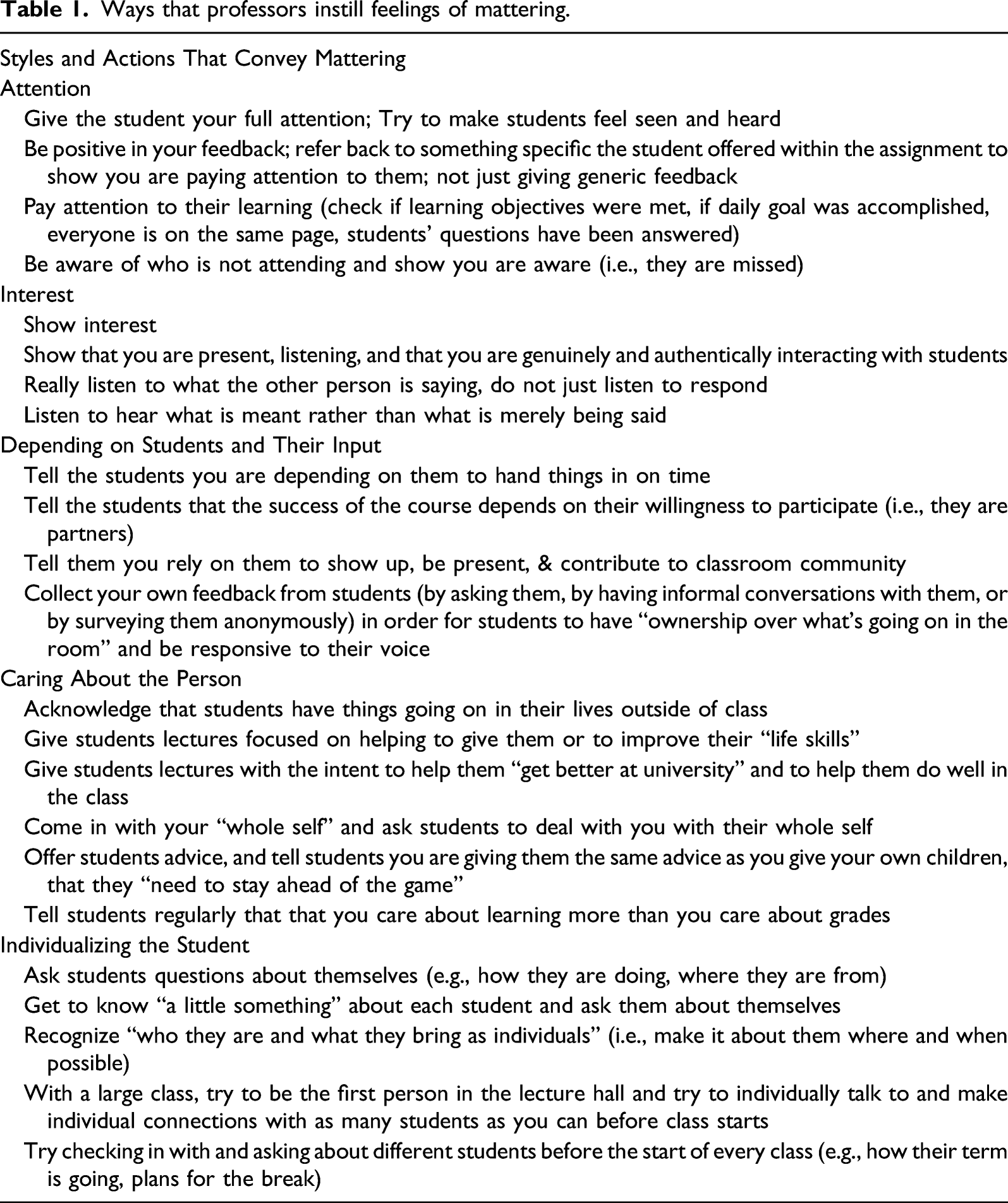
The themes that emerged and that are reflected in Table 1 were relevant to all three main elements of the mattering construct. Attention and interest were most evident. It was emphasized that attention is shown through indications of really listening to students and being authentic and genuine. Some non-obvious ways of showing that the professor is paying attention were expressed. Examples here include paying attention by gauging whether the learning objectives are being met and referring to something specific offered by a student as part of an assignment.
In addition, there were various responses that reflected the third component of deriving a feeling of mattering through being depended upon. That is, there was an emphasis on the professor-student relationship and the notion of reciprocity and mutual exchange as would be the case when a course is truly interactive.
Two additional themes listed in Table 1—caring about the person and individualizing the student—have clear implications for points of emphasis in the mattering construct when examined within the teaching context. Multiple references were made to the need for students to know that professors are invested in them as people and that they care about them. This emphasis sometimes involved going beyond the course material and the syllabus to address broader themes about how to thrive and be successful at university in general, but also in life. Professors also valued finding ways to make students feel like an individual and not like “a number,” or a person who is insignificant.
Professor behaviors that promote feelings of not mattering.
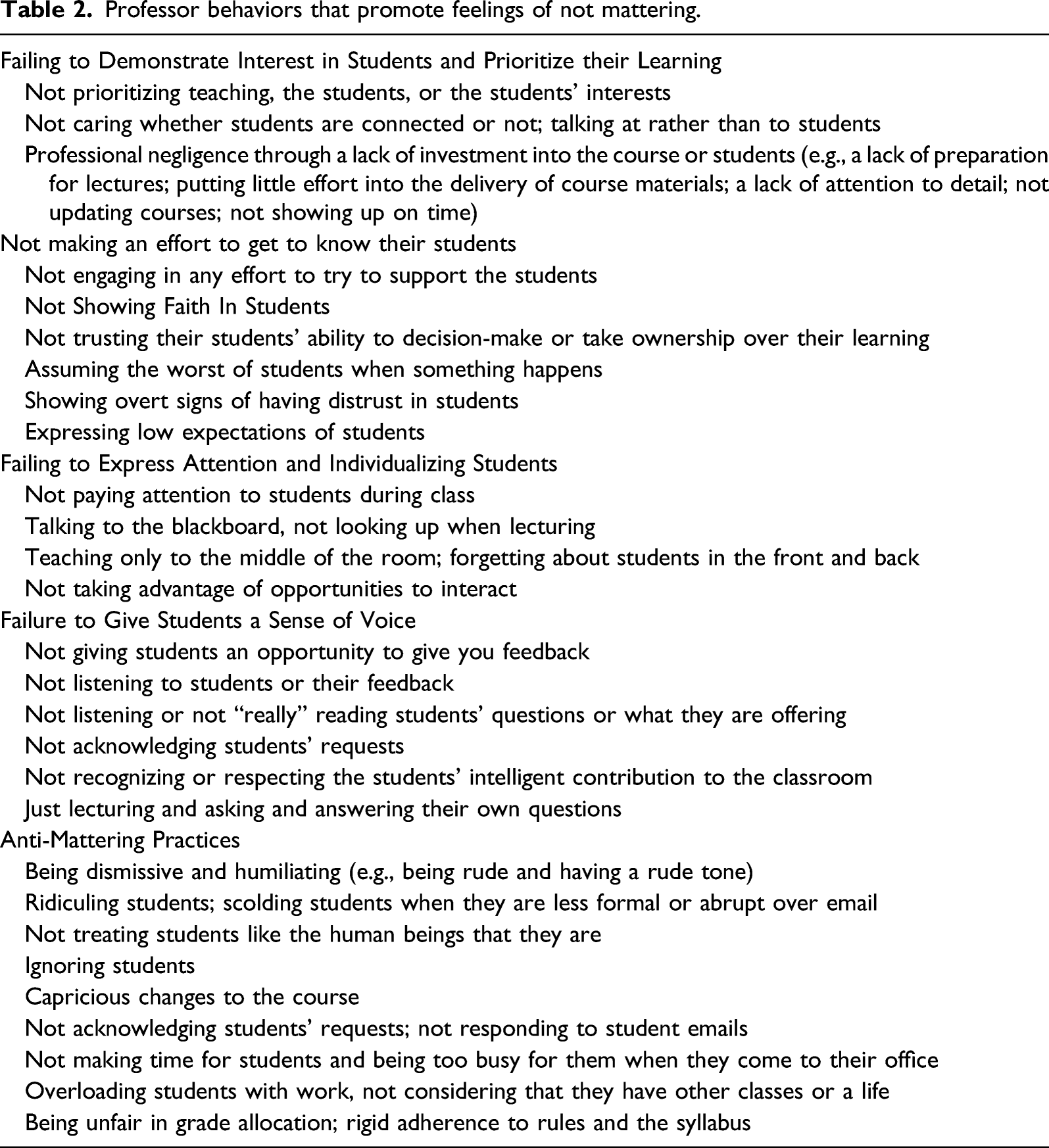
A tendency to minimize the student was reflected in themes built around not showing faith in students and denying them a voice. The failure to express faith is in keeping with the notion that feelings of mattering depend, at least in part, on having a relationship with someone who sees someone’s qualities and potential in ways that seem to reflect the growth mindset approach and orientation described by Dweck (2008). Thus it is not surprising that students who experience professors who radiate a fixed mindset belief are less engaged and have negative psychological experiences (see LaCosse et al., 2021), as would be the case in an “anti-mattering” context.
As for the importance of voice, the tendency to deny students a sense of voice came in many forms, including being unidirectional and not providing students with an opportunity to ask questions or speak, but also by simply failing to listen responsively to students. The fourth category combined a lack of paying attention along with not seeing students as individuals. The final category—anti-mattering practices—is troubling in the sense that it reflects the kinds of tendencies described in research on maltreatment. Examples here ranged from ignoring the students and being neglectful in preparation, to being unfair and inconsiderate, but even being willing to be dismissive or to humiliate students.
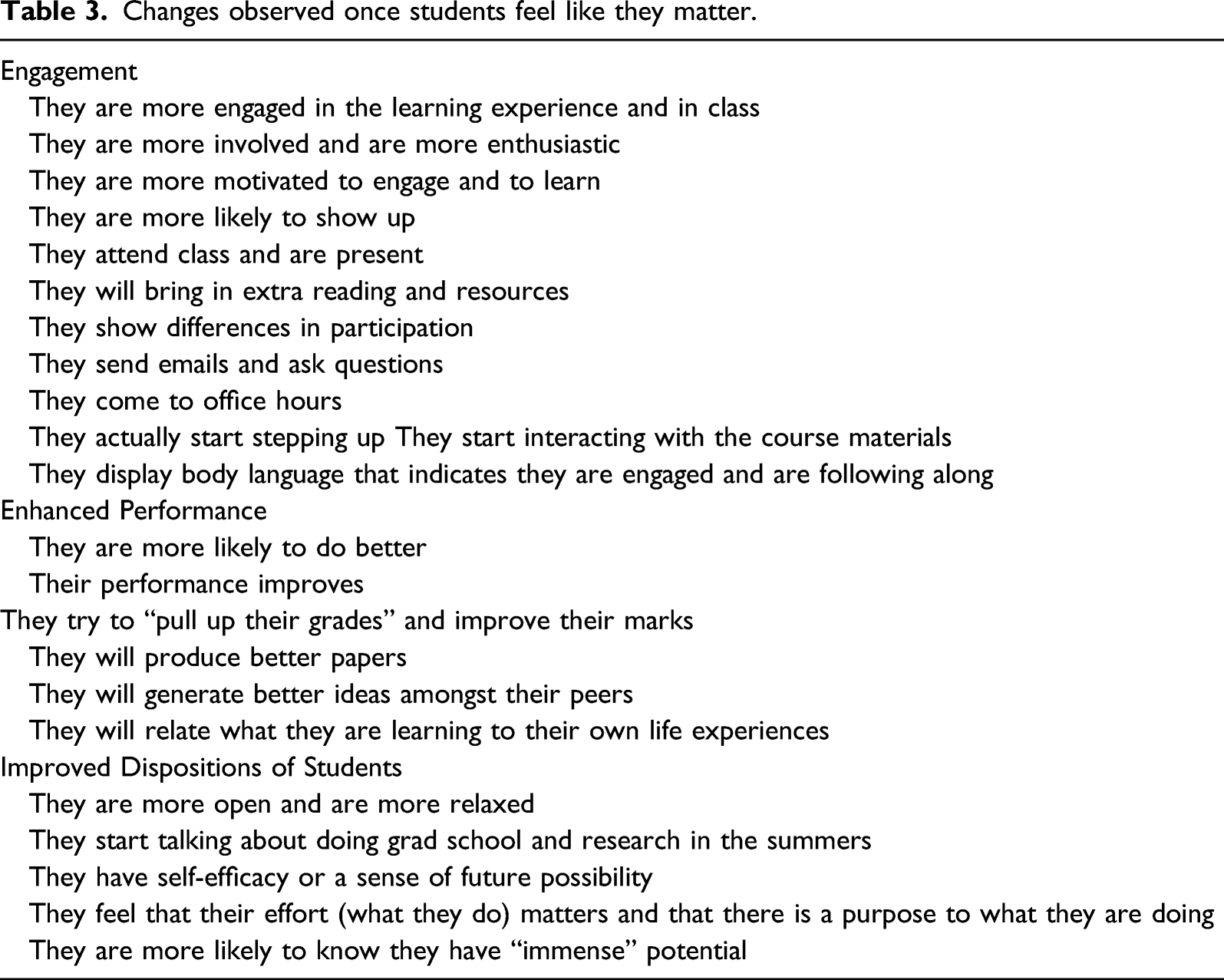
Changes observed once students feel like they matter.
Discussion
The current qualitative study involved interviews with award-winning professors in order to evaluate their awareness of mattering and how it is reflected in their approach to students and their learning. This project is unique in that it does not focus directly on the people who are experiencing mattering but instead focuses on the views of professors in a position to affect how much students feel like they matter or do not matter. Not surprisingly, overall our results reflected our initial premise that professors with a demonstrated and recognized history of teaching effectiveness and excellence have an orientation toward students that emphasizes a relational approach and value the extent to which students know with certainty that they matter to their professor.
Parenthetically, regarding the distinction between mattering and other psychosocial constructs, the responses provided by the professors were specific to mattering. That is, it was evident in terms of their practices and views that the mattering construct can be clearly differentiated from potentially related constructs such as belongingness or general relatedness.
Our analysis of the interview transcripts clearly showed that almost all of the professors interviewed had an understanding of the nature of mattering and engaged in practices that reflected mattering. Moreover, 6 of the 12 participants spoke explicitly to a focus on mattering that reflected a teaching and learning mattering-schema that underscored and guided their approach. That said, some caution is in order in terms of our interpretations because it could be suggested that our participants were primed by our initial description of the mattering concept as part of our explanation of the purpose of this investigation. However, the depth of their accounts and details provided by these professors suggests that their responses were not simply a reflection of their desire to be cooperative participants, but a reflection of truly held beliefs central to their teaching practice and how they define themselves. It was clear that mattering mattered to them as educators.
In terms of what professors do in their classrooms or office hours and their behavior that conveys to the students that they do indeed matter, some broad themes emerged. Most notably, the interaction style and teaching style of these professors provided clear indications to the students that professors were interested in them and attentive to them in ways that fit two of the three initial components of mattering identified by Rosenberg & McCullough (1981). There were fewer utterances relevant to the third component (i.e., having someone come to depend on you), yet a few of our participants did indicate that they conveyed to students that they were “partners” in the learning process and what they would learn depended on their engagement as partners in learning.
The second broad theme identified in Table 1 reflects the importance of conveying to the students that the professor cares not only about their learning, but also about them as people. These award-winning professors mentioned that they went well beyond the course content they were teaching and conveyed to students that they matter to them in terms of their future well-being and path in life. The views expressed by these professors were very much in line with the personal account and advice provided recently by one award-winning professor (see Schmidt, 2021) as well as descriptions in the broader educational literature of educators who fill the role of being “the one caring adult” who provides encouragement and shows a faith in the individual student in ways that can transform the student. Our results are also very much in keeping with findings from an interview study of six exemplary mathematics professors. In this case, Weston & McAlpine (1998) found that nine categories emerged from their interview study with the most salient category that emerged being the importance placed on caring and concern for students.
While this mattering-focused approach is difficult when the professor is teaching a large class, certain practices were still mentioned that conveyed to students that they were being seen as individuals. For example, as noted in Table 1, one participant noted the importance of being the first person in the lecture hall and conversing with individual students as much as possible as they enter in order to forge at least a bit of an individual connection. This notion of an individualized emphasis was described by Flett (2018) as either an element or amplifier of feelings of mattering. It is also in keeping with an account in Flett (2018) of a professor, from the same university as our participants, who created a sense of students as individuals who are worth knowing by asking students to email her at the start of the course and essentially share something about themselves. In essence, this personalizes learning when it could easily seem entirely impersonal. Attachments and feelings of mattering can be built even through brief meaningful moments (e.g., Charles & Alexander, 2014).
This mattering-focused approach towards students has key implications for the quality of teaching and instruction, and it fits with previous accounts of exemplary teaching styles (see Bain, 2004; McKeachie, 2002; Noddings, 1984, 1992; Pranjić, 2021; Thayer & Bacon, 1996a, 1996b). Indeed, McKeachie (2002) emphasized the importance of knowing students as individuals as part of his observation that, “The teaching methods one uses may be less important than aspects of teaching that cut across methods” (p. 302). Similarly, Noddings (1984) observed that, “Caring teachers communicate to their students while they teach, ‘I am still interested in you.’ All of this is of variable importance and significance, but you still matter more” (p. 20). This emphasis on mattering as caring fits well with mattering as involving a reciprocal relationship. Miller and Mills (2019) aptly summarized the student’s view on this relationship with professors as “If they don’t care, I don’t care” (p. 78).
Similar to how Flett (2018) argues that we all need to matter and how this sense of mattering is vital at school, bell hooks (2018) points out that we all need love. hooks writes about how we need to talk about love in the classroom and about how she loves her students, not romantically, but as humans. However, hooks acknowledges that this concept of love in the classroom is almost an avoided concept in teaching. Yet despite this apparent reluctance to speak of love, the centrality of care and love is evident in past educational research. For example, Weston & McAlpine (1998) found that the category of caring they identified through their interviews of mathematics professors included a combined theme summarized as “care for, respect, love students.” And, similarly, our interviewees frequently spoke about loving their time with students or how they loved getting to know them. Although some seemed reluctant to use this language of mattering or love explicitly in terms of their relations with their students, it became clear when they spoke about their teaching and about their students’ learning that it was all about mattering. It is possible that this reluctance to speak of relational concepts such as love or mattering is related to a fear of being “too close” as hooks has noted, or the fear of being “too personal” that participants also spoke about. Importantly, hooks (2018) wrote that this fear and the favor of objectivism arise from an inability to establish boundaries. This difficulty of establishing boundaries is highly relevant given that participants frequently mentioned their own difficulty in “walking the boundary line” with students in multiple ways (for example, between being their therapist and professor).
The professors in the current study and the professors in Bain’s (2004) work, which explored “what the best college teachers do,” expressed comparable themes that reflected the elements of mattering. In fact, one of the most powerful themes noted from the interviews in relation to promoting student mattering was the professors’ rejection of power and authority in order to create opportunities, giving students trust and control. This rejection of power and authority also speaks to the agreement noted between bell hooks’ (2018) and one of the participants who said that this “gatekeeper” or “objectivist” view arises from fear; a fear which Palmer (1998) knows can permeate classrooms, stifling teaching and learning. It is interesting for us to note that students made to feel like they do not matter and first-year students more generally were described by the participating professors as “fearful.” However, as one of the participants also noted, trust dispels fear. Additionally, the high expectations the professors in the study held of their students, in combination with the trust and support they gave them, typically from the start of the term, served to establish a safe learning environment and a strong teacher-student relationship, thus fostering a sense of mattering. Echoing Flett (2018), it seemed clear that these professors understood the centrality of mattering to effective teaching.
These teaching beliefs and classroom behaviors also have key implications for the mattering construct. Most notably, our results suggest that in terms of the mattering construct, there needs to be even greater emphasis in the definition and measurement of mattering on a sense of being cared about and for. Certainly a close reading of Rosenberg & McCullough (1981) reveals that the notion of mattering as being cared about is a theme they identified, including through their discussion of having a feeling of mattering in terms of being important. However, our results suggest that this mattering component should be amended slightly to reflect a greater emphasis on importance and being cared about. Schlossberg (1989) reaches a similar conclusion it seems, succinctly stating this as, “Do others care about us and make us feel important?” (p. 5).
The notion of mattering as caring has not been a great focus in the assessment of mattering, with the exception of a few items in the Mattering Index (see Elliott et al., 2004), and in the measure of university mattering based on the Mattering Index (see France & Finney, 2010). Unfortunately, the five items that comprise the General Mattering Scale by Marcus & Rosenberg (1987) do not refer specifically to the feeling of mattering in terms of being cared about by others.
The other main component of this project we wish to highlight are the accounts of professors when asked to describe the student who has been instilled with a sense of mattering. Collectively, the specific themes that emerged represent an image of the type of student that most teachers wish to have in their classrooms. Students with a sense of mattering were described as highly engaged in their learning, and this typically had an anticipated payoff in terms of much better performance in the course. This fits with general evidence of how students who feel a sense of relatedness in school are engaged and do perform better than students without this sense of relatedness (for a summary, see Flett, 2018). However, just as important as course achievement, it should also be emphasized that the professors interviewed also conveyed that this sense of mattering was reflected in the broader dispositions of students in terms of openness and optimism.
In contrast, when asked to indicate what tendencies and actions of professors might convey to students that they do not matter, our participants provided an extensive list of practices. As the summary in Table 2 makes clear, award-winning professors recognize what teaching behaviors they need to avoid in order not to disengage students or indicate that they do not matter. The themes identified here ranged from anti-mattering micro-practices that convey a lack of interest or awareness of students’ needs and perspectives, to overt actions that reflect maltreatment in the form of neglect and emotionally abusive tendencies. Other themes not already highlighted include actions that convey a lack of faith in students as people and as learners as well as not giving students an opportunity to have a sense of voice in their own learning. In essence, our award-winning professor participants provided several examples of how not to be an effective professor by making students feel that they simply do not matter.
Overall, the results of our study indicate that professors have a key role to play in promoting a sense of mattering in their students and that this sense of mattering is an important, if not essential, component of a safe and effective learning environment. Clearly, analyses of the role of mattering at colleges and universities in building mental health such as the analysis provided by Flett et al. (2019) should place a stronger emphasis on the messages of mattering that could and should be conveyed to students in their classrooms.
Limitations of the Current Study and Future Research
Of course, no study is without its limitations, particularly studies with smaller, selective samples as we had. Although our purpose was to explore the mattering construct from the perspective of faculty recognized for their teaching excellence, this obviously limits the generalizability of the results, as does the nature of our sample with limited cultural and ethnic diversity. What it means to matter in an educational setting, although a fundamentally human notion, must be understood within different cultural contexts. Future studies are required to explore how context and culture influence the expression of mattering in teaching and learning.
It would be illuminating to conduct a follow-up study with professors who have not received teaching awards. Perhaps it is easier to be attuned to mattering and reflect on it after having been recognized for teacher efforts through teaching awards that may well indicate that teaching does in fact matter. Here we are reminded of Karpiak’s (1997) study of mid-career professors who expressed their own sense of not mattering along with cynicism and demoralization, because their efforts had not been recognized and were not valued. In fact, these professors recounted several factors in their own daily academic environments that more closely resembled the notion of anti-mattering and feeling marginalized. Whether these professors would similarly identify their students’ needs for mattering would be a very interesting focus of future research.
Additionally, although our participants were very open with the interviewer, their answers also may have been influenced by some of the characteristics of the interviewer. For example, participants may have restrained from full disclosure or answered in a socially desirable manner due to the fact that the interviewer was herself a student and the conversations were recorded. We certainly are left wondering about this potential limitation and its possible effects, because it was clear that some participants were very conscious of being recorded as they were speaking so openly about their teaching beliefs and practices.
Finally, it should be underscored that we did not examine how professors make students feel that they matter; rather, we examined how they believe they do this and the strategies and practices they use in order to do so. As many of the participants themselves noted in the interviews, the only valid measure that truly confirms that they do in fact make students feel like they and their learning matters is by asking the students themselves. Fortunately, we did conduct two other qualitative studies using students as participants, and the results of these studies confirm the professors’ conclusions that their caring and attention make a difference as they believed they did. Students felt like they mattered to their professors who engaged in the classroom practices we summarized above. However, a detailed account of these results is beyond the scope of this paper.
Conclusion
The results of our qualitative study conducted with 12 award-winning professors yielded strong support for the construct validity of the mattering construct and the need for an emphasis on mattering promotion in the classroom. This research also yielded responses suggesting the need for a greater emphasis on feeling cared for and about as part of the mattering construct. The results of this project also illuminated the practices that are implicated in the promotion of mattering versus creating an environment marked by anti-mattering practices that can make students feel insignificant and unimportant. It also seemed evident that being a professor who values students is very much a part of the identity of these faculty members who have been recognized for teaching excellence. Although we did not measure the professors’ level of mattering in general or related to their teaching role, the need to consider mattering from a dyadic perspective is also clearly evident.
We conclude by addressing two overarching topics. First, how does this research inform what is known about the mattering construct? Our results yielded evidence that confirmed the presence of the main components of mattering introduced by Rosenberg & McCullough (1981), but there were insights derived from this work that qualify their view of the mattering construct. Most notably, the emphasis on mattering as caring was evident across our interviews and this close link between feelings of mattering and caring merits extensive follow-up research. The importance of the individual was also emphasized in ways that are keeping with accounts of feeling important to someone who sees something about the student that other people seem to have missed. There was also strong support for the notion of an anti-mattering component that is the antithesis of mattering. Finally, there was an extensive focus on mattering from a behavioral perspective in terms of what we learned about specific actions and micro-practices that amplify the sense of being someone who matters to the professor. Behavioral research with objective measures is clearly needed to gain further insight into mattering from a behavioral perspective.
Second, it became increasingly evident throughout this project that there is a separate research literature on caring teachers and how it is their caring orientation makes them so effective (e.g., Groccia et al., 2018; Meyers, 2009; Walker & Gleaves, 2016). This literature has developed in parallel with the research literature on mattering with little attempt at integration, and, to our knowledge, mattering and caring have not been described as inter-connected until now. This lack of a shared focus seems even more surprising given that it is possible to locate explicit statements from investigators who study caring such as, “Good teachers and their teaching matter” (Walker & Gleaves, 2016, p. 55). Given that exposure to caring individuals is central to the mattering construct, it would behoove researchers in the mattering field to closely examine past work on caring educators. Similarly, we argue that it is incumbent on researchers who study the relational side of teaching to more fully consider the growing literature on mattering to other people.
Footnotes
Author Notes
Gordon Flett is supported by a Canada Research Chair in Personality and Health.
Declaration of Conflicting Interests
The author(s) declared no potential conflicts of interest with respect to the research, authorship, and/or publication of this article.
Funding
The author(s) received no financial support for the research, authorship, and/or publication of this article.
