




Abstract
While the importance of having self-esteem is widely recognized and has been studied extensively, another core component of the self-concept has been relatively neglected—a sense of mattering to other people. In the current article, it is argued that mattering is an entirely unique and complex psychological construct with great public appeal and applied significance. The various ways of assessing mattering are reviewed and evidence is summarized, indicating that mattering is a vital construct in that deficits in mattering are linked with consequential outcomes at the individual level (i.e., depression and suicidal tendencies), the relationship level (i.e., relationship discord and dissolution), and the societal level (i.e., delinquency and violence). Contemporary research is described which shows that mattering typically predicts unique variance in key outcomes beyond other predictor variables. Mattering is discussed as double-edged in that mattering is highly protective but feelings of not mattering are deleterious, especially among people who have been marginalized and mistreated. The article concludes with an extended discussion of key directions for future research and an overview of the articles in this special issue. It is argued that a complete view of the self and personal identity will only emerge after we significantly expand the scope of inquiry on the psychology of mattering.
“I’m invisible. I don’t matter a shred to anyone.” (Sinead O’Connor, posted on Facebook, November 2015)
The powerful statement from Sinead O’Connor illustrates the impact of mattering versus not mattering. Mattering is the personal sense of feeling significant and valued by other people. The person who feels like he or she matters is someone who feels important, visible, and heard while the person who feels like he or she does not matter to others feels unimportant, invisible, and unheard. Mattering is a vital construct and a key psychological resource that is central to the human condition; indeed, the individual person who lives his or her life devoid of a sense of mattering to others will lack the basic sense of personal significance, human connectedness, and social acceptance required to thrive and flourish. In contrast, the person who feels a persistent sense of mattering unconditionally to significant others will have a key inner resource that fuels positive responses to life challenges. That is, a clear sense of mattering can buffer various life stressors.
The current article was written with three primary purposes in mind. First, of course, it serves as an introduction for readers not only to the mattering construct but also an introduction to the special issue. Second, mattering and its influence are described in ways that fit with the conclusion that mattering is unique and unlike any other psychological construct. Third, the current article advances the theme that “mattering matters” in that whether a person feels like he or she matters is a central element of how people view and define themselves and how they feel about their lives. Moreover, for many people, a pervasive sense of not mattering to other people is a specific form of vulnerability that has unique risks and costs associated with it.
An extended definition and description of mattering is provided below. As noted above, mattering is essentially the feeling of being valued and having personal significance to others. The person who has a sense of mattering to others is someone who feels valued and cared for, if not cherished. This person is clearly distinguished from the person who feels insignificant to other people; in extreme forms, this person can feel devoid of worth in the eyes of other people.
Pearlin and LeBlanc (2001) observed that, “mattering is one of those rare constructs that immediately resonates with intuitive sense” (p. 286) and they lamented the fact that this important element of the self-concept has been so overlooked. Unfortunately, 20 years later, it is still the case that mattering has been relatively neglected in the research community despite observations that a greater focus on mattering and its promotion “… has the power to transform and enhance individual lives as well as the quality of our key institutions” (Flett, 2018b, p. 7). Overall, there has been a relative paucity of theory and programmatic research on mattering, and, at present, there is no comprehensive, contemporary review article on the psychology of mattering. Accordingly, a comprehensive review is provided in the current article and evidence is marshalled to support the conclusion that mattering is associated with consequential outcomes. It should also become apparent throughout this introductory article that the mattering construct is complex and rich with potential, but vital research remains to be conducted, even after due consideration is given to the new research investigations introduced in this special issue.
Truths About Mattering and Its Positive Aspects
This lack of systematic inquiry thus far is particularly perplexing given the many positive aspects of mattering. What are these positive aspects? First, as we will see below,
The power of mattering is evident in many ways. It is powerful from a person-centered perspective when it transforms the lives of individual people. And, it is powerful from a variable-centered perspective because, as is illustrated below, mattering consistently predicts unique variance in key outcomes when pitted against other variables, as illustrated by studies summarized below. Most notably, Rosenberg and McCullough (1981) concluded that mattering is a motive that “… exercises a powerful influence on our actions” (p. 165).
Second,
Third,
Fourth,
Fifth,
Sixth,
Seventh,
Finally,
In light of these observations, this introductory article reflects several goals. First, it addresses the need for a contemporary summary and review of what we have learned so far about the mattering construct. Second, an overarching goal of this article is to promote additional inquiry on the mattering construct. Programmatic research is needed to address some key voids. Key directions for further inquiry are identified throughout the current article. A third goal of this article is to illustrate the importance and relevance of mattering and the various ways in which mattering is protective; the applied significance of mattering is described in terms of its links with consequential outcomes. It will be established that there are obviously many life contexts in which mattering matters. Finally, of course, the articles that comprise the special issue are introduced through an emphasis on their unique contributions to our current state of understanding and knowledge of the mattering construct.
Mattering in the Real World
This article begins by considering some indications that mattering matters in people’s lives. What are some of these “real world” indicators? First, mattering is recognized distinctly as a significant element of positive youth development. Indeed, a key criterion in evaluating the adequacy of developmental settings is whether youths are provided with meaningful opportunities to matter. The National Research Council in the US listed support for mattering and efficacy as essential in developing youth-based empowerment and they issued a call for youth to have genuine opportunities to make a contribution to their communities and thereby develop a sense of mattering (National Research Council and Institute of Medicine, 2002). This recommendation is rooted in influential research showing that one of the most important protective resources in promoting resilience among potentially vulnerable children and adolescents is having close contact and meaningful involvement with at least one caring adult (Masten et al., 1990; Werner & Smith, 1982). Young people with a strong sense of mattering should be interpersonally resilient and able to withstand interpersonally-based adversities (see Flett et al., 2015).
Second, the extent to which children are treated as if they matter has been established as a key guiding principle in evaluating and assessing the effectiveness of public policy—whether people matter has become a leading metric used to determine the extent to which key initiatives are successful. One example of an initiative focused on the “You matter” theme is the “My Brother’s Keeper Alliance” announced by President Obama and the Black Lives Matter movement. Previously, a 2003 governmental green paper in England gained momentum and became the basis for a wide-ranging policy and evaluation guideline called Every Child Matters: Change for Children. This initiative was introduced and endorsed by Prime Minister Tony Blair and his government as part of the Children Act 2004 (see Her Majesty’s Government, 2004). The theme that every child matters has been endorsed as a value and a key public policy principle by social services and school systems not only in Great Britain, but also around the world. For instance, in Canada, the promotion of mattering is a key part of the mental health programs and school climate issues of various school boards in Ontario. In addition, the theme that every child matters is central to Orange Shirt Day in Canada and our New National Day for Truth and Reconciliation. The people of Canada have benefitted from the remarkable “We Matter” campaign introduced in 2016 by Tunchai Redvers and her brother Kelvin Redvers from the Northwest Territories. Their mission is to let Indigenous youth know that they matter and that support is available to help them cope with challenges and feelings of distress. The “We Matter” online platform allows people to share their video messages and stories of hope and provide a forum for conversations about suicide and mental health and how people have overcome despair and demoralization.
Third, a sense of mattering is seen as central to the concept of “community.” The relevance of mattering in community psychology has been discussed eloquently by Prilleltensky (2020). The influential definition and theory of a sense of community advanced by McMillan and Chavis (1986) has a clear emphasis on mattering to others. They describe four elements with one element being identified as “influence,” which is “… a sense of mattering, or making a difference to a group and the role of group mattering to its members” (p. 9). A recent analysis led to the conclusion that, “The influence dimension of the sense of community is the most vital for mental health” (Walton, 2018, p. 6).
Finally, according to some accounts, seeing oneself as someone who matters or who does not matter can become an issue of life or death for certain people. Several case accounts implicate feelings of not mattering in suicide attempts and deaths due to suicide (e.g., Addington & Mancuso, 2009; Nolle et al., 2012) and going beyond these cases and anecdotal reports, there is some initial research that links low mattering with suicidality (Elliott et al., 2005; Joiner et al., 2009; Milner et al., 2016), including suicidal behaviors (Holden et al., 2018). New research links mattering at school with less suicide ideation among American Indian and Alaskan native youth (Edwards et al., 2020).
Given these findings, it is not surprising that a growing number of suicide intervention programs are focusing on the mattering theme as a form of knowledge implementation. For instance, suicide prevention programs in the US have a strategy developed in 2012 called the National Suicide Prevention Lifeline. This impressive initiative is centered on the theme “You Matter.” Representative examples include the state suicide prevention plan of Vermont and the suicide prevention plan that has been developed and implemented by the organization Military Spouses of Strength (see www.milspouseofstrength.org/you-matter.html). Other programs exist at many universities and high schools. The theme “You Matter” has been an emphasis in prevention programs around the world, and this has been extended to anti-bullying programs. Explicit in these programs is the notion that people are most at-risk and are capable of engaging in a range of societally destructive and self-destructive acts when they have developed a sense that they don’t matter and perhaps they never will matter.
Fortunately, developing a sense of mattering can be highly protective in reducing suicidal tendencies (for a discussion, see Milner et al., 2016) and research is now beginning to explore the role of mattering in suicide prevention applications (see Barnett et al., 2020). One impetus for such efforts is a comprehensive survey of over 30,000 adolescents that found that perceived mattering in one’s community is a key protective asset that mitigates planning for suicide (see Murphey et al., 2004). Detailed analyses of surveys conducted over several years in Anchorage Alaska have yielded evidence showing that community mattering is linked with less suicidal ideation and hopelessness (see Heath et al., 2015).
Given these indications, new important developments should emerge if the psychology field as a whole embraces the mattering concept. Ideally, going forward, scales tapping mattering will be included routinely in investigations in which it makes sense to assess some component of the self-image, including self-esteem.
When considering the scope of the mattering construct, it is important to remain cognizant of the fact that individual differences in mattering connect personality and social psychology with key issues and themes in applied psychology, community psychology, developmental psychology, family psychology, health psychology, school psychology, sports psychology, and industrial-organizational psychology. The broad field of applied psychology would be advanced considerably by programmatic research on mattering in keeping with “the real world relevance” of mattering; for instance, mattering merits more attention in terms of its role in job processes and outcomes for workers and adaptation to retirement for those people who are no longer working. Similarly, self-perceptions of not mattering should be a core theme among unemployed people who have staked their self-worth on having a job that makes them feel significant. As for school psychology, it has been argued that mattering is central to the concept of the mentally healthy school, and mental health promotion programs should be built on this foundation (see Flett, 2018a). Moreover, elevated mattering predicts achievement outcomes (see Flett, 2018b).
The concept of mattering is now described in more detail along with various ways of assessing and evaluating individual differences in mattering. Evidence that mattering is associated with consequential outcomes is then summarized along with evidence of its incremental validity and predictive utility when considered along with other key predictor variables. The article concludes with a discussion of key directions for future research and the lessons to be learned from the new research on mattering found in this special issue.
Defining and Conceptualizing Mattering
Rosenberg and McCullough (1981) are credited with formally introducing the concept of mattering over three decades ago as an extension of Morris Rosenberg’s (1965) seminal work on self-esteem. Mattering reflects our need to feel like we are significant and have meaningful connections with other people. Rosenberg and McCullough (1981) identified three components: (1) the sense that other people depend on us; (2) the perception that other people regard us as important; and (3) the realization that other people are actively paying attention to us. They suggested that being a focus of attention is the most central mattering component. Rosenberg (1985) expanded on this conceptualization by suggesting that mattering also includes the notion that other people would miss us if we were no longer around.
Ego extension is another component. Ego extension in this context is the belief that a person has that he or she matters because similar emotions and reactions are generated among the people they are closely connected with (see Rosenberg, 1985; Rosenberg & McCullough, 1981). France and Finney (2009) reported analyses showing that ego extension is a discernible factor within the mattering construct along with the other components hypothesized by Rosenberg and McCullough (1981).
Finally, Schlossberg (1989) identified an additional element of mattering—feeling appreciated by someone—after she conducted interviews focused on what it means to matter to other people. It was also noted in her widely cited paper that some people (e.g., caregivers) feel trapped by having lives in which other people have come to appreciate them too much and they are uncomfortable with how much they matter and the pressure and responsibility inherent in being depended on to such a degree. The plight of these caregivers who experience pressure because they matter too much underscores the need to examine contextual factors that impact the value and meaning of mattering.
More generally, Schlossberg (1989) contrasted the sense of mattering with the feeling of being marginalized and not valued. She emphasized the need for adult learners to feel a sense of mattering as part of feeling attached to an inclusive community. A sense of mattering is important among people who have been the target of unfair treatment and inappropriate stereotypes. Indeed, some scholars have noted the salience of feelings of mattering versus not mattering among people who are members of minorities and who may have to bear negative stereotypes, such as people with disabilities or people living with HIV (see Matera, Meringolo, et al., 2020). Lower levels of mattering are found among people with mental health concerns who feel stigmatized (Conrad-Garrisi & Pernice-Duca, 2013; Shannon et al., 2020) and gay men who have internalized this stigma and associated stereotypes (see Wight et al., 2015).
Pearlin and LeBlanc (2001) emphasized the reciprocal nature of mattering; they noted that mattering is a process that involves being both a donor and a recipient of feelings of mattering. This key observation underscores the need to consider mattering from a transactional perspective. Some support for this view has been obtained. A qualitative analysis of reports provided by parents of their sense of mattering to their children emphasized being engaged actively in the role in ways that meet each child’s needs and taking the time to share considerable time and space as part of the process of being with children (Marshall & Lambert, 2006). These parents reported that their own sense of mattering depended, in part, on being noticed by their children and receiving open displays of affection. This research illustrates the need to consider mattering from a complex, dynamic perspective involving dyadic processes.
Contemporary Conceptualizations
Recent conceptual advances highlight the complexities inherent in the mattering construct. For instance, in line with the notion of reciprocal mattering, Prilleltensky (2020) defined mattering as both having value to others, and giving value to others. This emphasis on mattering through promoting the welfare of other people is important for multiple reasons, but especially because it adds an element of agency to the mattering construct. Feelings of mattering can be self-determined and generated by dedicating time and energy to the well-being of other people.
Another recent development is the view that feelings of not mattering tap a negative orientation called “anti-mattering” that is distinguishable, conceptually and empirically, from the positive orientation described eloquently by Rosenberg and McCullough (1981). Research on anti-mattering by Flett and associates (2022) introduced in this special issue parallels other research on constructs such as optimism versus pessimism by showing that feelings of not mattering are not simply the inverse of feelings of mattering. The Anti-Mattering Scale has items such as “To what extent have you been made to feel like you are invisible?” and “How often have you been treated in a way that makes you feel like you are insignificant?” This measure has incremental validity but its defining feature is that it taps into the strong affective component of the construct that becomes activated when people are made to feel unimportant.
The fear of not mattering is another new conceptual element of the mattering construct. This component of the construct was outlined in Casale and Flett (2020). At present, we are working on the development of a new measure of the fear of not mattering. Initial work has confirmed that there are meaningful individual differences in the fear of not mattering and this fear is associated with greater loneliness (Besser, Flett, Nepon et al., 2020).
Distinguishing Mattering at a Conceptual Level
It is important when defining a concept to be clear about what it is but also what it is not and mattering is no exception. Descriptions of mattering typically emphasize that it has some similarity to certain constructs but it should still be regarded as distinct. What constructs overlap with mattering and what empirical evidence is there that mattering is unique and distinct? Elliott (2009) observed that mattering overlaps with constructs such as a need to belong, social support, and self-esteem, but mattering has unique elements. For instance, at a conceptual level, belongingness involves being accepted and fitting in while mattering reflects social significance, and in many instances, being depended on. Mattering reflects a sense of importance and significance rather than sense of fit, though both concepts incorporate an emphasis on being accepted. These distinguishing features are reflected in a well-developed model of organizational membership as a multidimensional construct with three distinct psychological attachment components that make people more or less involved—belongingness, mattering, and need fulfillment (see Masterson & Stamper, 2003; Stamper et al., 2009).
The Mattering Construct and Its Nomological Network
Research and theory is clearly needed on the nomological network of the mattering construct and how it relates to other components of the self. Contemporary personality research within the past decade has shown that mattering is associated positively with general self-compassion (Joeng & Turner, 2015; Raque-Bogdan et al., 2011), social self-compassion (Rose & Kocovski, 2020), and self-efficacy (Gruber et al., 2009). Mattering should also be associated positively with unconditional self-acceptance, and this association was found in a sample of 408 university students from South Korea (Choi & Hong, 2020). However, it was surprisingly not found in a sample of children from China (Flett, Su, et al., 2016).
As for constructs associated with psychological vulnerability, mattering is also associated negatively with trait self-criticism and trait dependency (Besser, Flett, Nepon, & Zeigler-Hill, 2020; Flett et al., 2021; Joeng & Turner, 2015) and self-critical rumination (Rose & Kocovski, 2020). Other research on multidimensional perfectionism has established that mattering is linked negatively with the highly maladaptive orientation of socially prescribed perfectionism (i.e., perceiving that others demand perfection from oneself), and mattering is a mediator of the association between socially prescribed perfectionism and depression (Cha, 2016; Flett et al., 2012) and the link between socially prescribed perfectionism and social anxiety (Choi & Hong, 2020). These findings are noteworthy in at least two key respects. First, it is suggested here that one implication of the link between socially prescribed perfectionism and feelings of not mattering is that some people likely have a form of conditional mattering that comes in the form “I matter only if I meet certain expectations.” Perceptions of conditional mattering merit programmatic investigation in future research. Second, these correlations with perfectionism, self-criticism, and dependency are important to keep in mind from a person-focused perspective; the person rendered vulnerable due to a feeling of not mattering is also a candidate for also being high in dependency, self-criticism, and perfectionism. This emphasis on a person-oriented approach is revisited later in this article.
How should the need to matter and levels of mattering relate to broad personality schemes? Unfortunately, one glaring limitation is the paucity of research on how mattering relates to the big traits that comprise the five-factor personality model and other personality frameworks such as the interpersonal circumplex and the dark triad. If mattering is indeed protective, it should be linked to some degree with low neuroticism and elevated extraversion and agreeableness. At present, only three investigations have provided relevant data. Flett, Goldstein, et al. (2016) had 232 university students complete the General Mattering Scale and the Ten-Item Personality Inventory (Gosling et al., 2003) along with measures of loneliness and social phobia. This work confirmed associations with lower neuroticism and higher extraversion. This research also found that mattering was associated with reduced loneliness and social phobia after taking neuroticism and extraversion into account.
Besser, Flett, and Zeigler-Hill (2020) examined the five-factor model correlates of a brief two-item measure of mattering as part of a broader study on adaptability to the pandemic. It was found in a sample of 1206 college students from Israel that mattering had small positive associations with extraversion, openness, and agreeableness and a small negative association with neuroticism (r’s ranging from .10 to 17).
Finally, evidence cited in this special issue by Flett and associates (2022) also links mattering with lower levels of neuroticism and higher levels of extraversion. The modest magnitude of the correlations found in this research attests to the likelihood that mattering predicts significant variance in outcome variables beyond the Big Five.
While these results are revealing, it is evident that the association that mattering has with the elements of broad personality models must be re-examined with more extensive measures of the five-factor model and in more diverse samples. Other frameworks also need to be considered. For instance, a focus on the interpersonal circumplex would illuminate the interpersonal styles and interpersonal problems linked with the mattering construct.
The next segment of this article further illustrates the breadth and scope of the mattering construct by describing numerous ways of assessing levels of mattering. It will be seen that while mattering can be assessed at a general level, it is also useful to consider “domain-specific” forms of mattering involving specific relationships and life roles.
The Assessment of Mattering
An overview of the measures used to assess mattering is provided in this section. The research findings that have emerged are, in part, a by-product of how mattering has been measured; it is particularly important to remain cognizant of whether the measurement focus is on mattering in general versus mattering in a specific context; how mattering is conceptualized and assessed varies substantially across studies in ways that have influenced and shaped the findings that emerged.
A key caveat about the measures described below is that they measure levels of perceived mattering. They do not measure other potentially important ways of representing the mattering construct. Two types of measures are lacking at present and their absences has limited conceptual advances. First, there is no published measure of the need to matter. Instruments tapping the need to matter are beginning to be developed (see Hopkins, 2021) as part of an expanded focus on a motivational perspective.
Second, there has been no attempt thus far to assess how important it is for someone to have a feeling of mattering to others. It stands to reason that there should be strong and salient individual differences among people in terms of just how much mattering itself matters. A working assumption here is that most people will attach some importance to mattering to others, but certain people will place an exceptional degree of importance on mattering to others; indeed, for some people, this can become all-consuming and irrational in ways that put them at risk, and perhaps other people as well. By extension, it should prove to be the case that those people who attach great importance to mattering will be hypersensitive to social feedback and cues in their environment that signify that they do or do not matter to others. These people should have a type of rejection sensitivity and generalized interpersonal sensitivity akin to the orientation described by Boyce and Parker (1989). This orientation should be expressed in various ways, including a hypersensitivity to perceived criticism.
Levels and Sources of Mattering.
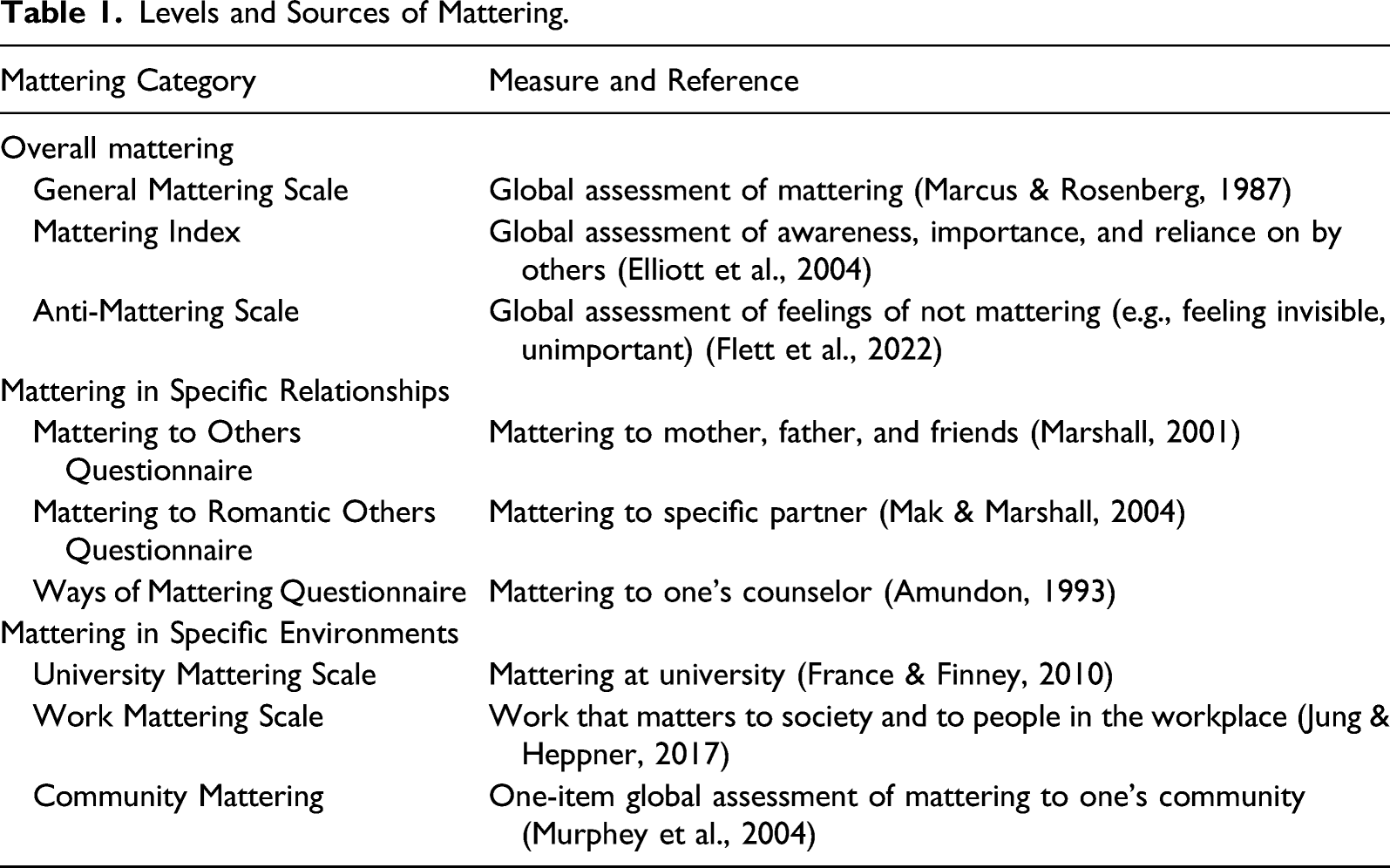
Several studies evaluate mattering from a global perspective that involves a general appraisal of mattering with instruments such as the General Mattering Scale and the Mattering Index developed by Elliott et al. (2004). The General Mattering Scale by Marcus and Rosenberg (1987) is a brief five-item measure that yields a single summary score. It is the most widely used measure despite never being published. The Mattering Index by Elliott et al. (2004) provides an overall score, but it also taps the three facets of how much others are aware of the individual, the extent to which the person is seen as important or significant, and the extent to which mattering derives from other people depending on them.
Other researchers have focused on mattering to specific people such as parents or friends. Marshall (2001) developed the Mattering to Others Questionnaire to assess mattering to specific people (e.g., mother, father, friend). Another measure developed by Schenck et al. (2009) has seven-item measures that assess mattering to mothers versus mattering to fathers. These items were worded to reflect the mattering themes described by Rosenberg and McCullough (1981). The usefulness of distinguishing among mattering to one’s mother, father, and friends is shown by research findings that clearly indicate that mattering to parents versus mattering to friends is far from equivalent. For instance, mattering to friends, relative to mattering to parents, has a much stronger association with social self-esteem (see Marshall, 2001) and a recent study yielded a complex pattern of findings that clearly differed for mattering to friends versus mattering to mothers and fathers (Marshall & Tilton-Weaver, 2019). Other results indicate that there is a positive correlation between mattering to mothers and mattering to fathers, but this association can be lower than .50 (e.g., Cookston et al., 2012), so there is merit in assessing mattering to each parent. A focus on mattering to grandparents would be a logical extension of these measures, along with a focus on the extent to which grandparents feel like they matter (for a discussion, see Pinson et al., 1996). The modifiability of these measures has been established. For instance, Marshall’s measure has been amended to assess the extent to which young people feel like they matter to their mentors (see Karcher et al., 2005). This research established that mentors with higher self-efficacy had mentees with higher levels of mattering.
Mattering also can be evaluated in terms of mattering to a romantic partner (see Table 1) and here it is clear that mattering is key for interpersonal relationships. This fits with a definition of mattering as “… the psychological tendency to evaluate the self as significant to specific other people” (Marshall, 2001, p. 174). These person-specific mattering measures can usually be easily adapted to refer to other specific people (e.g., mattering to one’s boss). Mattering to individual counselors or therapists can be assessed with the Ways of Mattering Questionnaire (see Amundon, 1993).
Finally, it is also possible and meaningful to evaluate mattering in specific situational contexts and the roles associated with these life contexts. This focus on mattering in distinct life domains was first suggested by Schlossberg (1989)—mattering can be looked at in the home, at work, and in the community. Her main emphasis was on developing a sense of mattering for students in colleges and universities. Schlossberg et al. (1989) argued that institutions that are able to create a sense of mattering are more successful because they have created a place where students are highly motivated to learn and there will be a high degree of retention due to the students’ institutional loyalty. Measures that examine mattering in specific contexts are now briefly described.
Various scales have been developed to assess the extent to which college and university students feel like they matter at school (see France & Finney, 2010; Tovar et al., 2009). France and Finney (2010) created their measure by adapting items from the Elliott et al. (2004) measure for the university context. They found that their measure had only modest correlations with the original measure of general mattering, thus supporting the use of context-specific measures. Recent research highlights the importance of mattering while making the university transition as well as the need to separately assess mattering versus belonging at colleges and universities (see Cole et al., 2020). Not surprisingly, consistent with Schlossberg et al. (1989), this research indicates that students tend to adapt better and thrive at post-secondary institutions that make them feel important because people are paying attention to their needs and to what they have to say (for an extended analysis, see Flett et al., 2019). Moreover, at an individual level, individual students should thrive and flourish to the extent that their faculty supervisors convey a sense of mattering.
Jobs are more rewarding when someone is certain of mattering in the workplace. Extensive research on mattering in the workplace has not been conducted thus far, but it is possible to find specific examples of the benefits of mattering at work (e.g., counselors feeling like they matter) (see Curry & Bickmore, 2012), and mattering in general is associated with greater job satisfaction (Connolly & Myers, 2003). Interviews conducted with nursing home social workers identified role-related mattering as one of four main themes that emerged via qualitative analyses, and mattering was seen as central to personal and professional identity (Lee et al., 2016). These findings and other results are very much in keeping with the contention that mattering is central to organizational health (see Reece et al., 2021).
The development of a 10-item inventory assessing mattering at work should prove to be a catalyst for additional investigation (see Jung & Heppner, 2017). This well-designed measure provides a total score and subscales that assess conducting work that matters to society in general and mattering to specific people at work. Initial research has established that work mattering is highly correlated with the meaningfulness of work, work satisfaction, life satisfaction, organizational commitment, and less intention of work withdrawal (see Jung & Heppner, 2017). Other new data suggest that mattering at work is linked with less burnout and higher engagement among nurses (Haizlip et al., 2020), and this fits with the emphasis on mattering as a potentially vital resource for frontline medical workers coping with the ongoing strain of the pandemic (see Flett & Zangeneh, 2020).
Brief measures have also been used to assess the extent to which someone feels like they matter in the community. Several studies have administered as part of a broader survey (i.e., the Youth Risk Behavior Survey) a face valid one-item global assessment of mattering to the community. There can be little doubt that feeling significant and important in one’s community is an important way of fulfilling the need to connect with others. Unfortunately, the results from many jurisdictions that have used the Youth Risk Behavior Survey suggest that, at best, only about half of the young people being surveyed tend to feel like they matter to some extent in their community (for a summary, see Flett, 2018b) and feelings of not mattering in one’s community among young people are associated with depression and poor academic performance (Edwards & Neal, 2017).
Importantly, a promising new measure introduced by Scarpa et al. (2021a) taps multiple domains (e.g., community, work, interpersonal). This measure reflects the emphasis of mattering in terms of having value to others and giving value to others emphasized by Prilleltensky’s description of the mattering construct (see Prilleltensky, 2020; Prilleltensky & Prilleltensky, 2021). Analyses of responses to this measure focused on community mattering established that higher levels of community mattering were reported by people who were employed and had higher socioeconomic status (Scarpa et al., 2021b). Also, respondents tended to report greater community mattering in terms of giving value than having value.
Multiple Mattering Measures: Implications and Issues
Given the many different ways of assessing mattering, it important to begin to conceptually and empirically consider how the various elements of mattering are structurally related. Clearly, the time has come for empirical research at a variable-centered level that evaluates a general model that sees overall mattering as having a hierarchical structure dominated by a higher order construct that is comprised of more specific lower-level mattering domains. This type of model is plausible given what is known generally from past research about the structure of self-esteem and the structure of the self-concept (see Fleming & Courtney, 1984; Marsh & Shavelson, 1985).
New insights into mattering will be obtained to the extent that researchers increasingly use multiple mattering measures in their investigations. It should be the case that depending on the outcome variable being predicted, both general and specific mattering measures should be significant unique predictors.
A consideration of multiple mattering domains is also needed when examining mattering from a person-focused approach. Consideration of multiple mattering measures will also enable researchers to explore a person’s “mattering profile” across measures and explore issues such as the tendencies and levels of functioning among people who feel they matter in one specific context but perhaps less so in another specific context (e.g., mattering at home but not at work and vice versa). Presumably, people with deficits in mattering across multiple domains will have greater levels of risk than people who matter in some elements of their lives.
Mattering: Why It Matters in Consequential Ways
One of the most important questions for the mattering construct is, “To what extent does mattering predict unique variance in key outcomes when considered along with other predictor variables?” That is, does it matter in empirical research? A brief summary is now provided.
The Predictive Utility (Incremental Validity) of Mattering.
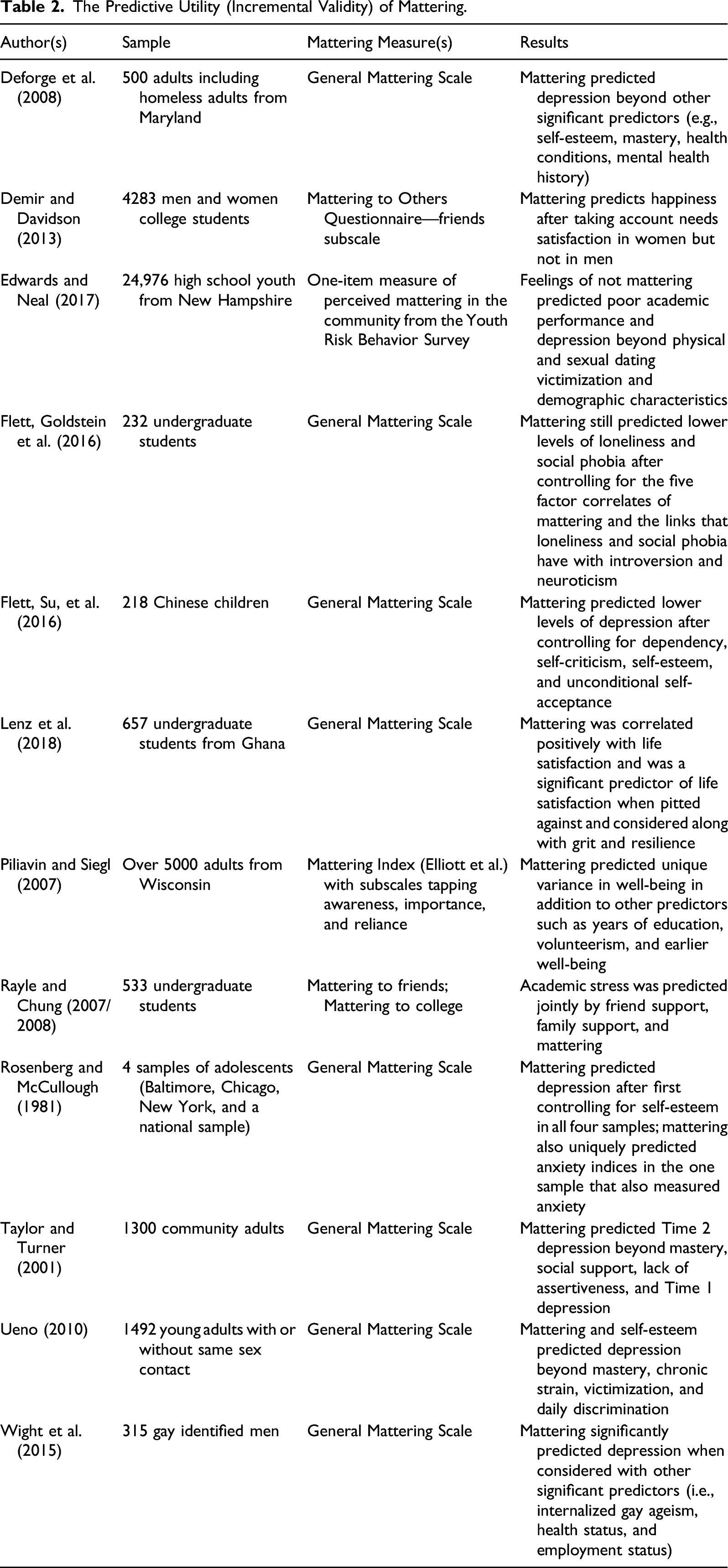
Most studies that illustrate the unique predictive ability of mattering focus on its association with reduced levels of depression. For instance, a study of 500 adults that included a substantial proportion of homeless adults showed that when predicting depression, mattering was a significant unique predictor of depression despite the significant variance already accounted for by self-esteem, mastery, number of health conditions, past diagnosis of mental illness, and history of homelessness (see Deforge et al., 2008). Similarly, a study of predictors of depression among young adults with or without same sex contact showed that both mattering and self-esteem were associated uniquely with depressive symptoms when examined simultaneously in a regression analysis that pitted these predictors among other significant predictors (i.e., daily discrimination, life stress, mastery, and family support) (see Ueno, 2010). Dixon and Kurpius (2008) also reported that mattering and self-esteem were significant unique predictors of depression in students when considered along with stress, which was also a unique predictor.
The predictive utility of mattering is evident when predicting other key indices. For instance, it can be seen in Table 2 that mattering is a unique predictor of outcomes such as academic performance, academic stress, life satisfaction, and happiness.
Another related question is, “What evidence is there that mattering predicts consequential outcomes?” Ozer and Benet-Martinez (2006) focused on various types of consequential outcomes when they established that “personality matters.” They described a framework to show that individual difference factors relate to key “consequential outcomes” at three different levels: (1) the individual; (2) interpersonal relationships; and (3) society. Personality outcomes of consequence at the individual level include happiness, physical health, and psychological health. Personality also relates to a wide range of interpersonal relationships, including family relationships, peer relationships, and dating and marital relationships. Basic compatibility or incompatibility is linked, in part, with personality differences between people. Finally, at the societal level, personality can have an impact on proactive and prosocial community involvement versus an antagonistic and callous orientation that could fuel antisocial and criminal activities. The relevance of mattering in these three domains is now considered.
Mattering at the Individual Level
The research conducted thus far on mattering has occurred primarily at the individual level. Research described earlier showed that low mattering is associated with depression. Other research at the individual level indicates that mattering is associated negatively with anxiety and depression (Dixon et al., 2009; Flett, 2019; Flett et al., 2012; Flett & Nepon, 2020). Research with early adolescents in stepfamilies indicates that a sense of not mattering to one’s mother, stepfather, and non-residential father is not surprisingly associated with internalizing problems involving anxiety and depression as well as externalizing problems (Schenck et al., 2009). New data from a study of religious orientation indicate further that mattering is associated with less depression among women and men, but mattering mediates the link between various religious indicators (i.e., worship attendance, attachment to God, holding an image of God as judging) and depression among women but not among men (see Bonhas & Upenieks, 2021).
Arguably, mattering is powerful and protective through its association with adaptive coping and effective problem-solving in keeping with the contention that mattering is a vital source of resilience and adaptability. Initial research here has shown that mattering is associated with academic resilience (see Flett, 2019; Flett et al., 2014). Meanwhile, in terms of coping with maltreatment, Love and Robinson Karpius (2020) established that mattering to friends moderated the association between a history of childhood sexual abuse (CSA) and problem-focused coping; that is, higher problem-focused coping was reported by CSA survivors with higher levels of mattering to friends.
Flett (2018b) has observed that mattering at the individual level deserves more focus in the positive psychology movement. This observation is supported by research showing that mattering is also predictive of positive adjustment outcomes; elevated mattering is associated with well-being across a wide range of indices, including general indicators of wellness (Gibson & Myers, 2006; Myers & Bechtel, 2004; Rayle & Myers, 2004) and happiness (Demir & Davidson, 2013). France and Finney (2009) reported that mattering was associated robustly with three components of Ryff’s (1989) multidimensional well-being framework—purpose in life, self-acceptance, and positive relationships with others (also see Thoits, 2012). Other data suggest that in women university students, reduced mattering predicts unique variance in happiness beyond the strong association that exists between need satisfaction and happiness (Demir & Davidson, 2013). Data from the Wisconsin Longitudinal Study also show that mattering is associated with psychological well-being. Evidence suggests that mattering is a robust predictor of unique variance in psychological well-being and it mediates the link between volunteering and greater well-being (see Piliavin & Siegl, 2007). A more recent investigation suggests that mattering mediates the association between self-esteem and well-being in life (Matera, Bosco, et al., 2020).
Mattering also seems to be a vital yet neglected variable in retirement planning and adjustment to retirement (see Froidevaux et al., 2016). This research with retired workers or workers contemplating retirement established that mattering was associated positively with life satisfaction. Moreover, mattering acted as a mediator of the link between social support and positive affect. Froidevaux et al. (2016) concluded that practitioners looking to improve the subjective well-being of retirees should prioritize the extent to which people feel like they matter.
There is no denying that physical health status is a consequential outcome. Evidence from cross-sectional research suggests that mattering plays a protective role in self-reported health symptoms (e.g., Raque-Bogdan et al., 2011; Thoits, 2012) and is associated with higher levels of health-related quality of life among youth and emerging adults (Hamby et al., 2019; Hamby et al., 2020). The most impressive research thus far is a study showing that among people of varying ages, age is associated with increased allostatic load and this association is substantially greater among adults with low or moderate levels of mattering (Taylor et al., 2019). These data suggest that a sense of not mattering plays an increasing role in poor physical health outcomes among older adults. Other recent findings with a sample of women diagnosed with breast cancer indicate that women with elevated scores on the General Mattering Scale have a higher self-reported quality of life (Davis et al., 2019).
Given that there is a robust association between feelings of not mattering and indices of loneliness and social isolation (Flett et al., 2016a; Francis, 2022; MacDonald et al., 2020; McComb et al., 2020), and there are strong empirical links among loneliness, health problems, and early mortality (see Luo et al., 2012), it is posited here that deficits in mattering can play a vital role in underscoring or amplifying the association between loneliness and physical illness. McComb and associates (2020) have described the combination of feeling alone and unimportant or insignificant as a “double jeopardy.” Perhaps earlier mortality is not simply a reflection of social isolation and the feelings that accompany social isolation; a related key consideration is feeling insignificant and perceiving no one cares. Quite simply, isolated people who feel like they don’t matter will not engage in self-care and will lack key resources that buffer stress. Perhaps individual differences in mattering can help explain why women tend to live longer than men; typically, relative to men, women often have higher overall reported levels of general mattering (see Taylor & Turner, 2001).
The importance of mattering is further indicated by qualitative data from a study of low income mothers who were separated physically from family members and had to relocate away from New Orleans due to Hurricane Katrina. Morris and Deterding (2016) found that a reduced sense of mattering due to being displaced and not being in a position to be able to provide support to family members such as mothers and grandmothers was a source of stress and distress underscoring post-traumatic stress symptoms.
Finally, other work at the individual level points to the role of not mattering in vulnerability to dropping out of school (Lemon & Watson, 2011) and reducing the risk of truancy (Baskerville, 2021). Similarly, qualitative research with academically successful African American high school students attests to the highly protective role of mattering and being encouraged to succeed (see Tucker et al., 2010). Also, mattering predicts acculturation among minority students (Rayle & Myers, 2004).
Mattering at the Relationship Level
There can be little doubt that any relationship, romantic or otherwise, is in serious jeopardy when someone in the relationship has come to the realization, veridical or not, that he or she does not matter to the other person in the relationship. Thus, it is not surprising that lower levels of mattering are associated with relationship problems. Qualitative and quantitative research conducted with young adults established that mattering in relationships is associated with relationship quality and relationship satisfaction (Mak & Marshall, 2004) and levels of mattering tend to be higher in married versus divorced people (Milner et al., 2016). Mattering is linked robustly with self-reports of love and friendship (Myers & Bechtel, 2004). Further investigation of friendship relationships suggests that mattering is robustly associated with satisfying the fundamental need for connection and competence; moreover, mattering seems to underscore the association between friendship and happiness due to the role that mattering plays in satisfying these core psychological needs (Demir & Davidson, 2013).
Other evidence mentioned above suggests an association between reduced mattering to friends and engagement in relational aggression (Weber & Robinson Kurpuis, 2011). A new investigation based on survey data from almost 25,000 high school youth from New Hampshire links physical and sexual violence in dating situations with feelings of not mattering in one’s community (Edwards & Neal, 2017). Other research with youth also links feelings of not mattering with a reported history of interpersonal victimization (see Hamby et al., 2020) while acknowledging the role of mattering at school in reducing the likelihood of being a victim (Edwards et al., 2020).
There is a clear need for programmatic investigation incorporating a dyadic perspective to address the paucity of research on the experience of mattering in couples. One key exception is a line of investigation showing that the degree to which wives feel that they matter to their husbands is a correlate of more positive perceptions of the division of labor (see Kawamura & Brown, 2010; Lachance-Grzela, 2012; LaChance-Grzela, McGee & Ross-Plourde, 2021). Another broad study conducted with adults from Toronto showed that lower levels of mattering were associated with a host of predictor variables including have a strained relationship with one’s partner, work-home conflict, and parental role strain (see Schieman & Taylor, 2001). Other new data suggest that in couples from India, feelings of mattering are associated robustly with reported levels of marital satisfaction (Sebastian, 2018).
Mattering at the Societal Level
Finally, at the societal level, it is important to note from the outset that Rosenberg and McCullough (1981) focused on mattering due to their deep conviction that mattering is of great societal importance. They summarized initial evidence showing that adolescents with higher levels of mattering, relative to those low in mattering, were less likely to engage in antisocial behavior. Marshall (2004) obtained a similar finding in adolescents; that is, adolescents with relatively low levels of perceived mattering to parents and friends had elevated levels of reported antisocial misconduct (e.g., buying or selling stolen goods) during the previous month. Marshall (2004) conducted a second study with a larger sample of adolescents and again found that low levels of perceived mattering to parents and friends was associated with a measure of misconduct comprised of aggressive acts (e.g., starting a fight, damaging public property).
These data clearly suggest that a lack of restraint and willingness to engage in socially undesirable behavior can be rooted in negative perceptions of mattering. Elliott (2009) expanded on this theme by documenting the role of feelings of not mattering as a catalyst for the destructive behavior exhibited by Timothy McVeigh and Seung-Hoi Cho. These converging lines of evidence are noteworthy from a societal perspective and for further understanding of the mattering construct, but they also point to a unique approach to “dark psychology” and “dark personality” represented by formulations such as the dark triad or the dark quad by considering the notion of “dark mattering.” Additional evidence presented below, accords with the proposed presence of a type of “malevolent mattering” characterized by a tendency to engage in acts with the goal of feeling more important and valued, albeit through destructive, oppositional, antisocial, and potentially self-destructive acts. Research on the roots of this “malevolent mattering” is bound to be illuminating about mattering but also illuminating about the roots of dark tendencies.
In most instances, people will engage in positive acts and actions to satisfy the social self-seeking impulse, but others will engage in socially unacceptable behavior. Indeed, one viable explanation for terrorism is that it is fueled by a quest for personal significance (see Kruglanski & Orehek, 2011; Kruglanski et al., 2013).
What additional evidence fits with the notion of “dark mattering”? Research with a measure of community connectedness with some items tapping mattering indicated that deficits in mattering were found among violent delinquent youth, relative to non-violent youth (Crooks et al., 2007). Another investigation assessed mattering and deviance from a qualitative perspective. Lewis (2017) reported that a central theme among young offenders is that they had an abiding sense of having failed when it comes to mattering to others and their need to matter was magnified by family being absent from the young offenders’ lives. These studies have informed a recent analysis of violence proneness among London youth (Billingham & Irwin-Rogers, 2021).
The societal impact of mattering is also suggested by evidence lining mattering with adaptive beliefs and less violence toward family members (Elliott et al., 2011). It is also in keeping with data suggesting that feelings of not mattering in the community are associated with greater likelihood of girls having a history of involvement in mutually violent dating relationships (Chiodo et al., 2012).
The societal significance of mattering can be expressed in various ways. For instance, Schlossberg (1989) has argued compellingly for the role of mattering in building a thriving community, and, as was noted earlier, the opportunity for developing mattering in the community is seen as central in positive youth development, but it should also be relevant to other community members (e.g., new immigrants). The role of mattering in community engagement was shown by the results of an investigation indicating that mattering is closely interconnected with volunteerism and its many benefits (Piliavin & Siegl, 2007). Not surprisingly, projecting a sense of mattering is seen as being at the center of the just community approach in moral education (see Power, 2004). It is at the community and societal levels where the potential protective aspects of mattering are potentially great yet quite under-recognized at present.
We have seen thus far that the mattering construct is complex and that mattering is associated with consequential outcomes of potentially vital importance. The final segment of this article begins with a discussion of key directions for future research.
Key Issues and Directions for Future Research
As indicated above, topics for future research are proposed below. First, however, some general observations and suggestions are provided with the goal of enhancing the quality of research being conducted on the mattering construct.
First, and foremost, research on mattering has relied almost exclusively on self-reports, with only a few noteworthy exceptions (e.g., Suh et al., 2016), and there is a clear need to incorporate informant reports from various sources (e.g., parents, counselors, and therapists). This emphasis on informants can extend to key outcome variables; a new study linking mattering among children with parental and teacher reports of internalizing and externalizing symptoms is an important extension of the literature (see Velez et al., 2020). Informant reports seem essential given that feelings of mattering are subjective; one related topic is understanding how and why people inflate or deflate how much they actually matter to other people
Second, there has been no attempt thus far to examine the daily life experiences and social interactions of people who feel like they do or do not matter to other people. Basic information is needed on how individual differences in mattering relate to what people say and do. Indeed, the behavioral elements of mattering still have to be documented.
Third, little is known about fluctuations in mattering over time. A life course approach to mattering is needed in order to illuminate a key topic in this field—the impact of a loss in mattering. Unfortunately, some people lose their sense of mattering for various reasons. Mattering can be lost following an unforeseen outcome or when a key life role no longer applies (e.g., job loss, retirement). Fazio (2009) has discussed the aging process and how experiences such as retirement can involve identity changes that include a loss of mattering. Mattering can decline after losing someone, and to at least some extent, this decline could be due to no longer being depended on. The loss of mattering was illustrated in some important research showing that the death of a dependent relative (a spouse or parent with dementia) among caregivers resulted in a loss of mattering, a loss of self, and depression. Analyses indicated that the greater the reported loss of mattering, the greater the level of depression 1 year later (Pearlin & LeBlanc, 2001). Loss of mattering was greater among people with higher role overload. Schieman and Taylor (2001) have advocated for research on adaptive versus maladaptive responses to loss of mattering, but this topic has yet to be explored.
Some other directions for future research are now outlined below. The first emphasis is on the need for developmental research. Collectively, relatively little is known thus far about the developmental influences that shape and impact feelings of mattering versus not mattering.
Mattering From a Developmental Perspective
In recent years, some key findings have illuminated the developmental influences that contribute to mattering, but programmatic research on its antecedents is clearly needed. For instance, given the evidence described above that links mattering with attachment styles, mattering and attachment experiences need to be examined from a lifespan perspective beginning in early childhood. Other findings highlight the need to also consider developmental experiences and key changes over time that impact levels of mattering and the need to matter (e.g., Fabricius & Suh, 2017; Suh et al., 2016). For instance, an informative multi-wave study examined levels of mattering over a three to four year period in children with parents who were experiencing marital problems (Stevenson et al., 2014). The overall pattern of results suggested that children in conflict-ridden families were sensitive to the amount of time spent with parents; in this instance, spillover from marital problems reported by fathers predicted reduced mattering at the next time point. Reduced interactions with parents at Time 2 predicted changes in levels of perceived mattering at Time 3 for boys and girls. More generally, feelings of mattering to parents are linked with perceptions of being accepted by one’s parents (Cookston et al., 2012).
Research in our laboratory has evaluated the role of a history of maltreatment in keeping with initial theoretical suggestions that lack of parental responsiveness bordering on neglect accounts for low levels of mattering in some young people (see Rosenberg & McCullough, 1981). Initial data indicate that emerging adults with a reported history of emotional abuse and emotional neglect during childhood tend to have lower levels of mattering (see Flett et al., 2016). Further research is needed to examine the degree to which adverse early life experiences including maltreatment combine with other challenging circumstances (e.g., homelessness, placement in foster homes, experiencing discrimination) to impact levels of mattering. Here, it seems reasonable to test a model that see feelings of not mattering as more extreme among people who have experienced multiple stressors and traumas with an interpersonal basis.
Mattering in Physical Health Outcomes and Responses to Illness
The association between mattering and reduced stress and the recent evidence linking low mattering with allostatic load (Taylor et al., 2019) points to the need for programmatic research on mattering as a protective health factor. People who feel like they matter should be more likely to engage in protective health-behavior and self-care. Research also needs to explore the role of feelings of not mattering in the development of health problems, and the potential role of mattering in recovery from illness. As one illustration of the potential importance of mattering, in their study of people with HIV/AIDS, Schmitz and Crystal (2000) concluded that a sense of mattering could have been the key cognitive mediator of the benefits of social support among their participants due to evidence they gathered suggesting the importance of being important to another person. Similarly, Turner (2010) posited an extended stress process model in order to understand widespread health disparities, and mattering was included in this model as a key protective resource. Turner (2010) emphasized mattering as a potential mediator of link between physical health outcomes and the stress exposure that follows from the social characteristics that foster health inequities. This very viable hypothesis remains to be tested.
Mattering and health need to be evaluated in longitudinal research that goes beyond self-reports to include objective measures of stress and health status. It is likely that there is a reciprocal association between mattering and health. Researchers studying mattering and aging have shown that mattering is associated with better self-reported health, but better health also enables older people to seek out mattering opportunities (see Fazio, 2009).
Related research should explore the role of mattering as antithetical to engaging in risky behavior. Self-destructive and impulsive acts are less likely to the extent that people have internalized the message that they matter to other people. Initial research has found modest links between deficits in mattering and binge drinking (see Edwards & Neal, 2017).
Mattering versus Not Mattering at a Collective Level
Finally, mattering has been conceptualized almost exclusively thus far in terms of the feelings and self-views of the individual, but there is much to be gained by considering mattering versus being marginalized from a group perspective (i.e., “we matter” vs. “we don’t matter”) and being discriminated against. It seems that many group protests are fueled and underscored by a pervasive sense of not mattering and being marginalized in ways that heightens sensitivity to feelings of mattering versus not mattering. It is surprising that the mattering construct has not received greater consideration from this broader perspective given Fromm’s (1941, 1964) sage observations about how society can promote feelings of insignificance among individuals. Indeed, one of the surest ways to generate widespread conflict and protest is for people in powerful leadership positions to enact policies and measures that convey to people comprising large segments of society that they simply do not matter and people don’t care about their collective concerns.
Accordingly, conceptual views of the mattering construct need to be expanded to include individual differences in levels of mattering rooted in a person’s group affiliations and sense of mattering in society. Some initial research with rural adolescents suggests that a focus on societal mattering is both viable and relevant (see Schmidt et al., 2020); however, societal mattering was defined in this research as mattering at school and in the community, rather than in society in general. Clearly, however, in general, people who jointly perceive low interpersonal mattering and low societal mattering should have amplified levels of distress and demoralization.
Mattering Matters: Lessons Learned from the Articles in the Special Issue
This article is the introductory article in this special issue of the Journal of Psychoeducational Assessment. To my knowledge, this is the first special issue published anywhere that is focused on mattering. The opportunity provided by the journal’s editor, Don Saklofske, and his associate editors of the journal is greatly appreciated.
Collectively, the papers in this special issue reflect several themes outlined throughout this article. It is typical when introducing papers to provide a description and analysis of what each paper adds uniquely to the literature. However, the unique contribution of each article is clearly outlined in these articles, so this does need not be reiterated here. Instead, in keeping with the broader perspective adopted in this introductory review article, on behalf of aspiring researchers, I will focus on some broader lessons that can be intuited from these articles.
Lesson 1—Advances Depend on How a Construct is Measured
Rosenberg (1985) made a key observation that merits being revisited. Specifically, he lamented that firm conclusions about mattering could not be made because there were no good measures of mattering at the time. The clear message was that conceptual advances and new insights rest on having sound measures. Although the assessment of mattering has advanced considerably, to some extent, an element of Rosenberg’s commentary still applies decades later. That is, there is an inextricable link between the understanding of mattering and how it is measured. If a key element of the construct has not yet been tapped (e.g., the need to matter), understanding is limited. Several measures were developed after Rosenberg’s observation (see Table 1), so the situation has improved. Still, the close ties between measurement and construct validity must be kept in mind. This lesson is reflected in two papers in the special issue.
First, Somers and associates (2022) undertook psychometric analyses on data from a sample of adolescents from Michigan and this work resulted in two brief mattering subscales derived from the Mattering Index (see Elliott et al., 2004). Both brief factors were then evaluated in terms of their correlations with a host of measures and several unique findings emerged. Most notably, this research demonstrated that mattering derived from giving to others has special benefits for adolescents. These benefits include better academic performance and engagement in learning and education (see Somers et al., 2022). Clearly, workaholic adolescents with little life balance would do well to invest themselves in the betterment of others and society as a whole by engaging in other-directed activities that enhance their own sense of mattering. This work illustrates the need for a greater focus on the component of the mattering construct that involves giving value to others.
Second, Flett and associates (2022) described the development and applications of the newly developed Anti-Mattering Scale. This five-item inventory parallels the General Mattering Scale. This work has clear implications for the mattering construct; extensive evidence was presented which indicated that mattering and anti-mattering are not simply endpoints of the same continuum. Anti-mattering uniquely predicted a range of negative outcomes and it was associated strongly with deficits in core psychological needs. It can be concluded from this work that mattering and anti-mattering are clearly quite distinct in terms of their associated emotions and motivational orientations.
This work on anti-mattering is troubling in the sense that it underscores just how destructive it can be when any person receives feedback suggesting they are insignificant and don’t matter to other people. Clearly, any negative social interaction will be magnified in its impact to the extent that the target perceives and comes to believe the message “I don't matter.” It is proposed here that experiences of being victimized such as bullying, for instance, will be much worse and feel much more personal if the target has a generalized sense of not mattering to others. The feeling of not mattering can be exacerbated by the act of being bullied itself, or it can come from the non-response or lack of concern expressed by people who are aware of the bullying and are in a position to stop it from continuing or being repeated, but they do not act. Feelings of not mattering should also amplify reactions to bullying and be reflected more intense experiences of loneliness, shame, and other negative emotions so often felt by bullied children and adolescents. So, for instance, the person with intense feelings of not mattering and subjected to humiliating negative social interactions may experience unbearable levels of loneliness and psychological pain.
Lesson 2—Advances Depend Jointly on Qualitative and Quantitative Research
The article by Pychyl and colleagues (2022) is a unique paper in this special issue because it examines mattering from a qualitative perspective. This paper summarizes past qualitative research and then applies a qualitative lens to mattering based on the responses of 12 award-winning professors. This work reflects a second valuable lesson—that is, research that utilizes various methodologies, including qualitative methods, can play a vital role in illuminating a construct and yielding new insights. This project by Pychyl and associates confirmed Rosenberg and McCullough’s (1981) description of the various elements or facets of mattering, but it also led to the realization that there needs to be more emphasis on mattering that is rooted in a sense that other people care about us. Feelings of being cared for and cared about have been mentioned briefly within the context of the importance facet of the mattering construct (see Rosenberg, 1985; Rosenberg & McCullough, 1981). Pychyl and associates (2022) make the case for a more explicit emphasis on care and caring in future interpretations of the mattering construct. This qualitative work also identified numerous ways of possibly expressing and experiencing anti-mattering in educational settings. Descriptions were also obtained of students who feel like they matter and these descriptions are quite close to how most people envision the ideal student.
Lesson 3—Longitudinal Research, Relative to Cross-Sectional Research, Typically Yields Unique Insights
The vast majority of work conducted thus far in the mattering field has utilized cross-sectional designs without much emphasis on examining mattering and key outcomes over a period of time. The need for additional longitudinal research is supported by some unique findings that have emerged from initial research. For instance, a 3-year longitudinal study of developmental trajectories found that levels of mattering to mother declined significantly with age among adolescents, but there was no significant change in mattering to one’s father or friends (Marshall et al., 2010).
Two papers in this special issue with a longitudinal focus yielded findings that substantially qualify what is known about the association between mattering and depression. There are now enough cross-sectional studies to be able to conduct a meta-analysis on mattering and depression. Unfortunately, longitudinal investigations have been “few and far between” after Taylor and Turner (2001) reported the first longitudinal study ever in the mattering field. Their remarkable study of 1300 community residents from Toronto set a high standard for longitudinal research on mattering. Participants were measured at baseline and again 12 months later. They completed the General Mattering Scale and measures of mastery, social support, and depression. Factor analyses of item responses established that mattering and social support were distinguishable factors. Also, men and women differed in that the correlations between mattering and social support were much stronger among men. Most notably, the main finding was that mattering was deemed protective in terms of being associated with less depression for women, but it was not protective longitudinally for men.
Two new longitudinal studies in this special issue are unique in that they both included the General Mattering Scale and the Anti-Mattering Scale and they both had multiple waves of assessment. The first study by Etherson et al. (2022) had community adult participants complete the General Mattering Scale, the Anti-Mattering Scale, and a depression measure at three timepoints (i.e., baseline, 3 weeks, and 6 weeks). Subtle but important differences were found between mattering and anti-mattering in their temporal associations with depression. Most notably, evidence of a complication model was found with depression predicting subsequent levels of anti-mattering. The overall pattern of findings highlights the need to assess the complex interplay of mattering, anti-mattering, and depression and conduct future research that continues to assess the directionality issue.
The second study by Krygsman et al. (2022) is a revealing investigation that examines mattering and depression over the longest time interval reported thus far. Overall, 452 emerging adults were assessed annually on levels of mattering, anti-mattering, and depression across 4 years of development in young adulthood. Initial analyses found that anti-mattering positively predicted subsequent depression symptoms and depression symptoms predicted subsequent levels of anti-mattering. The evidence seemed to support what Krygsman et al. (2022) deemed to be a symptom-driven model of depression and mattering. Valuable test-retest data were also obtained.
Collectively, the results of these two studies provide some key answers and new insights, but they also raise some key questions. Most notably, given these complex associations across time, perhaps it is time to ask two inter-related questions. First, is there a state component to mattering? Second, should mattering be conceptualized and evaluated from a trait-state perspective? Future research is almost certain to establish via multiple assessments that mattering has a relatively stable trait component and a state component that fluctuates as a result of life experiences.
Lesson 4—The Temporal Context of Assessments Matters and it Illuminates Complex Constructs
It was noted earlier that mattering is a construct that is relevant in myriad ways throughout the pandemic. Two studies in the special issue are vivid illustrations of the contemporary significance of mattering in this global health crisis. These studies represent examples of how the temporal element reveals things about a personality construct that might otherwise not be apparent. First, the study conducted by Giangrasso and colleagues (2022) with Italian university students was conducted at the peak of the COVID-19 crisis in Italy. Overall levels of psychological distress were remarkably high and levels of life satisfaction were remarkably low among the participants, in keeping with global reports of how this global health pandemic has led to much lower life satisfaction. How low was the mean level of life satisfaction in this sample? Scores on the Satisfaction with Life Scale developed by Diener et al. (1985) are typically skewed in the positive direction; that is, the majority of people have a substantial degree of life satisfaction. In contrast, the Giangrasso et al. (2022) study found a level of life satisfaction suggesting that the modal person in this sample from Italy was neither satisfied nor dissatisfied.
Giangrasso et al. (2022) reported that mattering was associated significantly with lower levels of life satisfaction and higher levels of stress and distress. Moreover, statistical analyses suggested that stress mediates the link between feelings of not mattering and lower life satisfaction. Further analyses established uniquely that low mattering is associated with deficits in emotional regulation, in keeping with the notion that mattering is a resource linked with better coping, resilience, and adaptability. Overall, this research indicates that mattering is exceptionally relevant when people are experiencing life conditions that are strongly undermining their enjoyment of life.
The second study by Vaillancourt and associates (2022) examined levels of mattering in over 6500 elementary and high school students from Canada. Students varied in terms of whether they were experiencing in-person learning, online learning, or some combination of these types of learning. This research clearly established the lowest levels of mattering were found among students who learned solely online during the pandemic. Mattering was assessed in this study with the General Mattering Scale (GMS). The other major finding came from descriptive analyses. That is, scores were deflated relative to available norms for the GMS (see Flett, 2018b). In fact, the overall level of mattering among students who learned online is the lowest mean GMS score ever reported in the published literature! These findings are foreboding and troubling in several respects, especially given the consistent negative association between mattering and distress. The results reported by Vaillancourt and associates (2022) attest to the mental health challenges being faced by students in general, but especially those students who have experienced significant disruptions, and they are no longer actually going to school and interacting with people who value seeing them and interacting with them.
Lesson 5—Variable-Centered Research is Best Viewed Through a Person-Focused Lens
The final lesson reflects the distinction between variable-centered versus person-focused research. Most studies in this special issue are an accurate reflection of the mattering field in that the focus has been almost exclusively on variable-centered research. However, the ultimate goal even when the emphasis is on variable-centered research is to understand people and hopefully generate knowledge that can improve the quality of their individual lives.
The original work by Morris Rosenberg made its mark, in part, because of Rosenberg’s facility in couching what was learned from research in terms of the implications for the individual adolescent. Specifically, Rosenberg and McCullough (1981) concluded that, “… the adolescent who feels he matter little to his parents has lower self-esteem, is more depressed and unhappy, is more anxious and experiences other negative affective states, and is more likely to be delinquent” (p. 179).
Unfortunately, when the four new articles in the special issue with a focus on adolescents are considered, the story seems to get substantially worse for the adolescent with a sense of mattering little to others. Collectively, when the focus is on feelings of not mattering, the adolescent with a low level of mattering fits G. Stanley Hall’s (1904) classic description of the adolescence period as one of “storm and stress.” The findings of Vaillancourt and associates (2022) have already been described. The work of Watson and colleagues (2022) is remarkable for two reasons. First, it was conducted prior to the pandemic with a nationally representative sample of adolescents from the United States. This study provided valuable psychometric data. It also yielded findings suggesting that the adolescent with low mattering is anxious and depressed, feels little connection to school, and this adolescent could be a candidate for addiction to social media. The tendency for low perceived mattering to have even a modest link with social media addiction is noteworthy and potentially quite important from a societal perspective given how excessive exposure to social media, including Facebook, has been linked with psychological distress among adolescents (Keles et al., 2020).
The correlates of the Anti-Mattering Scale among high school students add to this troubling image (see Flett et al., 2022). The adolescent with a diminished sense of mattering is likely to have an insecure attachment style, low well-being and self-efficacy, and depressive vulnerabilities involving self-criticism and dependency. Meanwhile, results reported by Somers and associates (2022) suggest that the typical adolescent with a low level of mattering could have a high level of loneliness and low hope. This adolescent will be less engaged academically and may have deficits in self-control and self-regulation.
Fortunately, in contrast to the perfect storm that likely follows the adolescent with low mattering, the adolescent with a robust sense of mattering should typically find it bright and sunny and far from bleak. And, as noted earlier, mattering is a highly protective resource that can help “chase the clouds away” for adolescents who are resilient and capable of adapting to challenging new situations. These contrasting depictions should be enough to convince parents, educators, and community members that any attempt to promote mattering in children and adolescents is well worth it.
Summary
This review article and introduction to mattering began with the contention that mattering is a psychological construct and a way of life that merits much more investigation and mattering has unique features that distinguish it from other constructs. A summary overview of existing empirical evidence showed that individual differences in mattering are associated with consequential outcomes at the individual, relationship, and societal levels and individual differences in mattering clearly matter in that they account for unique variance beyond the variance attributable to other predictors. The many different ways that mattering has been measured were also illustrated.
Collectively, the evidence suggests that whether or not people feel like they matter is a core and unique component of the self-concept. Moreover, the person who both feels and knows that she or he matters is likely someone who is happier, healthier, and more interconnected with other people. Most importantly, a firm sense of mattering should be a source of resilience that buffers stress in general, but especially the stress and distress emanating from negative social interactions. Given these considerations, as alluded to above, a strong case can be made for the promotion of mattering as a key element of prevention programs designed to boost resilience. Indeed, in a recent article, we have outlined ways to promote mattering to enhance well-being among university students (see Flett et al., 2019) and mattering is seen as vital in helping high school students adjust to the transition to college and university (see Cole et al., 2020). Evidence summarized in this article accords with the contention that mattering should be a central part in the foundation of mentally healthy schools (Flett, 2018a).
Mattering has become a growing focus in contemporary society and recent developments represent some of the best illustrations of why mattering is important in people’s lives. Proactive interventions that are proven to be effective should be even more effective and meaningful to the extent that they provide an enhanced sense of mattering. Public health initiatives that incorporate the mattering construct have great potential and these initiatives could conceivably have life altering benefits for some people. While psychology is a discipline that relies on empirical evidence, as it should, narrative accounts of the power of mattering are also important and should help to further illuminate the profound relevance of mattering as a key element of people’s lives.
Footnotes
Declaration of Conflicting Interests
The author(s) declared no potential conflicts of interest with respect to the research, authorship, and/or publication of this article.
Funding
The author(s) received no financial support for the research, authorship, and/or publication of this article.
