




Abstract
The Grit Scale measures perseverance of effort and consistency of interest. The objective of this study is to validate the Czech adaptation of the Short Grit Scale using a sample of N = 302 Czech university students. The analysis of item characteristics and factor structure revealed good results. To investigate convergent and discriminant validity, learning approaches and the Big Five personality traits were used. Latent correlations with the Big Five personality traits and the facets of conscientiousness revealed the expected relationships for grit and the facet perseverance of effort in particular. All in all, the results indicate the validity of the Czech version of the Grit Scale.
Introduction
Grit has been claimed to predict achievement in challenging domains over and beyond measures of talent; grit refers to trait-level perseverance and consistency of interest (Duckworth, Peterson, Matthews, & Kelly, 2007). This noncognitive factor from the conscientiousness domain is an important prerequisite for educational and vocational success, as several studies have claimed (Credé, Tynan, & Harms, 2017) and has been included in far-reaching policy-making decisions (UK Department of Education, 2014; U.S. Department of Education, 2013).
With this research, we aim to validate an adaptation of the Short Grit Scale in the Czech language. We used the Short Grit Scale due to its wide dissemination and its better psychometric properties (Duckworth & Quinn, 2009) and because the application of the shorter version is more economical. We tested the psychometric properties of the scale, investigated relationships with the Big Five, and investigated if learning approaches are associated with differing grit values. We hypothesized that grit and its facets would correlate strongly with conscientiousness and the facet productiveness in particular (Schmidt, Lechner, & Danner, 2020; Schmidt, Nagy, Fleckenstein, Möller, & Retelsdorf, 2018). Grit is perceived as a trait in the conscientiousness domain that emphasizes consistency of interest; we would argue that students higher in grit would be more inclined to work for themselves than students who have no inherent interest in the contents of their studies (Entwistle, Tait, & McCune, 2010). Thus, we hypothesized that deep learners have a higher grit score than those who take a strategic or surface approach to learning.
Method
Sample
The sample consisted of N = 302 university students from three universities in Prague, the Czech Republic. Their average age was M = 21.56 years (SD = 2.30), and 64.9% were women.
Measures
Grit-S
Means, SDs, and Item Selectivities for the Grit Scale.
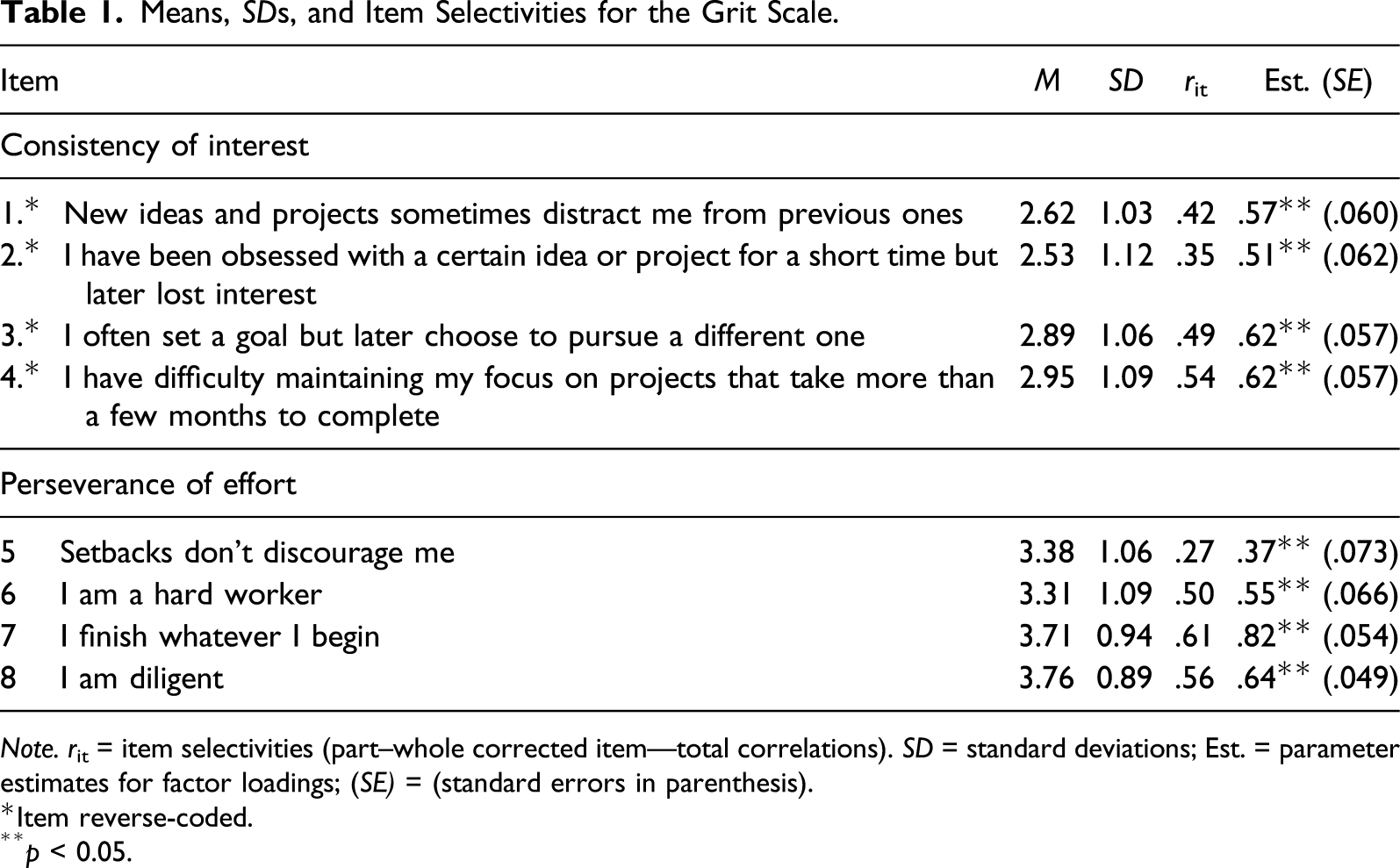
Note. rit = item selectivities (part–whole corrected item—total correlations). SD = standard deviations; Est. = parameter estimates for factor loadings; (SE) = (standard errors in parenthesis).
*Item reverse-coded.
**p < 0.05.
Big Five
We used the Czech version of the Big Five Inventory 2 (BFI-2) (Hřebíčková et al., 2020) to assess the Big Five personality traits, with 12 items each (extraversion: α = .80; agreeableness: α = .79; conscientiousness: α = .86; emotional stability/neuroticism: α = .88; and openness to experience: α = .81). The same response format was used. The BFI-2 assesses conscientiousness using three facets: organization (preference for order and structure); productiveness (work ethic and diligence while pursuing goals); and responsibility (commitment to fulfilling duties and obligations).
Learning Approach
Following the Approaches and Study Skills Inventory for Students (ASSIST; Entwistle et al., 2010), we assessed the learning approaches using a single-item measure with three options: surface approach: “I want to pass all the exams and get a title with as little effort as possible”; strategic approach: “I want to get the best grades and I put a lot of energy into learning, but I only focus on what I will need to know for the exam”; deep approach: “I learn for myself, not for grades or a title.“ The students were asked to choose the option that describes them best.
Statistical Analyses
To test the measurement model of the scale, we applied a CFA. In-line with Hu and Bentler (1999), Tucker Lewis Index (TLI) and Comparative Fit Index (CFI) values greater than .90 are interpreted to reflect an acceptable fit. Root Mean Square Error of Approximation (RMSEA) values lower than .05, .06, or .08 and Standardized Root Mean Square Residual (SRMR) values lower than .08 or .10 are interpreted to reflect a close or a reasonable fit. All CFA models were estimated using Mplus, Version 8.1 (Muthén & Muthén, 1998–2012), using the maximum likelihood estimation with robust standard errors (MLR).
Results
Means, SDs, and item selectivities (part-whole corrected item-total correlations) are provided in Table 1. The scale showed good to excellent item selectivities. Cronbach’s αs for the Grit-S and two of the subscales (consistency of interest and perseverance of effort) were .77, .68, and .72, respectively.
The CFA for the two-dimensional higher order model proposed by Duckworth and Quinn (2009) did not fit the data sufficiently well: χ2(19) = 72.91, CFI = .89, TLI = .84, RMSEA = .10, and SRMR = .06. Similar to the approach by Schmidt, Fleckenstein, Retelsdorf, Eskreis-Winkler, & Möller (2017), we allowed the correlation between item residuals of two items (Item 6 and Item 8). The modified model showed a good fit to the data: χ2(18) = 48.43, CFI = .94, TLI = .91, RMSEA = .08, and SRMR = .05. All manifest variables loaded significantly (p < .001) and all bar one loaded substantially (λ ≥ .37) on the first-order factors. The assumption of partial strict measurement invariance across gender was supported as well 1 .
External Criteria
Latent Correlations between Grit and its Facets and the BFI-2.
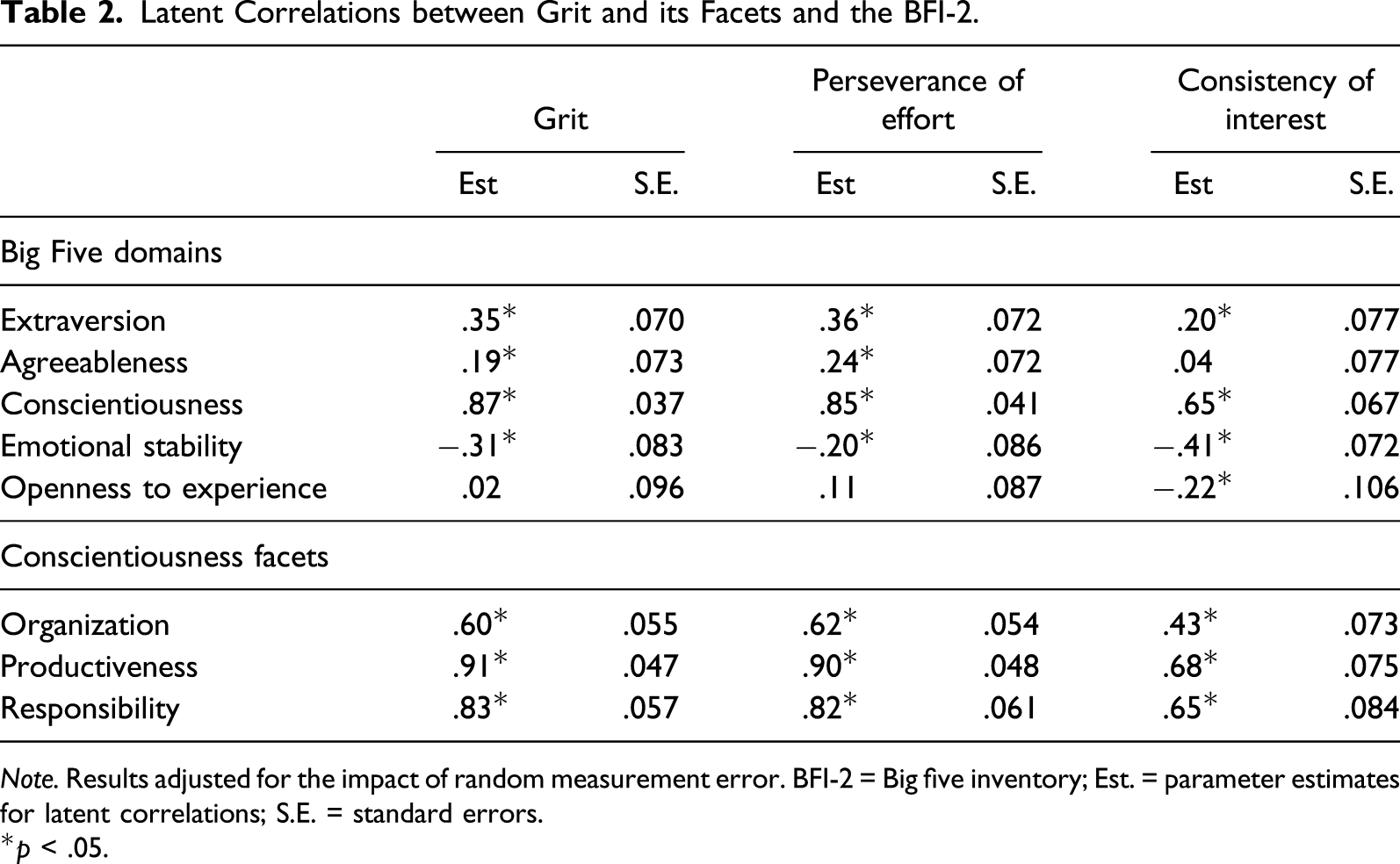
Note. Results adjusted for the impact of random measurement error. BFI-2 = Big five inventory; Est. = parameter estimates for latent correlations; S.E. = standard errors.
*p < .05.
Finally, we investigated differences in grit depending on the students’ approaches to learning, using the observed mean scores. As expected, self-identified deep learners showed the highest grit scores (Mdeep = 3.32, SDdeep = 0.64, Mstrategic = 3.23, SDstrategic = 0.59, Msurface = 2.98, and SDsurface = 0.59). A one-way between-subjects ANOVA to test for differences in grit revealed a significant effect of learning style: F(2,297) = 9.65, p < .001. Post hoc comparisons using the Bonferroni correction indicated that only the mean grit score of self-identified deep learners differed significantly from the mean score of surface learners (ΔM = 0.34, SD = .11, p < .001). On the facet level, the results for the perseverance of effort facet were similar: F(2,297) = 6.99, p < .001. Again, the Bonferroni-adjusted post hoc test revealed that only the self-identified deep learners differed significantly from the surface learners (ΔM = 0.47, SD = .09, p < .001). For the consistency of interest facet, no significant differences were found for the three learning styles: F(2,297) = 2.63, p = .07.
Discussion
With the present study we aimed to validate the Czech adaptation of the Short Grit Scale (Duckworth & Quinn, 2009). The results show satisfactory to excellent psychometric properties for the scale. Our findings regarding the association between grit and the Big Five trait conscientiousness and its facets are consistent with earlier research. Thus, the findings again pay heed to the notion that grit can best be seen as a facet in the conscientiousness domain. Finally, the results with regard to learning styles are partly in-line with our expectations because strategic learners show higher grit and perseverance of effort scores than surface learners.
Similar to earlier research, the fit of the CFA was unsatisfactory in the initial model. The introduction of a correlation between item residuals was necessary, similar to the study by Schmidt et al. (2017). This might be due to semantic differences between the term diligent and its Czech translation. While diligent is defined as steady, earnest, and energetic effort, the meaning of the Czech translation is narrower and may be more appropriately translated as “hardworking.” In addition, we found a low factor loading of λ < .40 for one item, similar to the findings by Duckworth and Quinn (2009). The fact that these shortcomings arose in earlier research indicates that a revision of the scale could be a fruitful approach for future research. Conversely, due to the great interest in the grit construct, we would argue that the use of the scale as originally intended is useful to either, to an extent, deflate the hype around the construct or to gain further knowledge to improve the scale and thereby the theoretical basis of the construct. However, to do so, a validated scale is essential.
Limitations
Three methodological limitations should be considered. First, a single-item question for the learning approach may not be particularly reliable, and the results should be interpreted with this shortcoming in mind. Second, to identify the final model, it was necessary to apply restrictions to the model, rendering it a de facto correlated first-order factor model. Thus, the higher order nature of the grit construct cannot be satisfactorily tested with a CFA (for a discussion, see Credé et al., 2017). Finally, the sample we used consisted of university students only, limiting its representativeness. However, the results are in-line with recent research on the validity of the scale, allowing us to be optimistic with regard to more heterogeneous samples.
Footnotes
Declaration of Conflicting Interests
The author(s) declared no potential conflicts of interest with respect to the research, authorship, and/or publication of this article.
Funding
The author(s) received no financial support for the research, authorship, and/or publication of this article.
