



Abstract
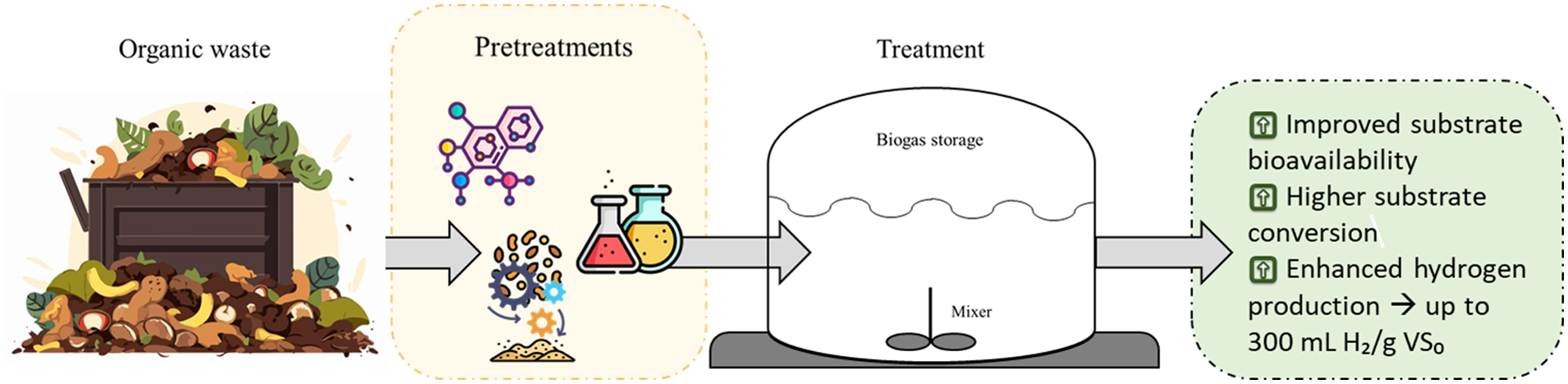
The management of organic waste represents a major environmental challenge due to its moisture, biodegradability and greenhouse gas potential, but offers opportunities for renewable energy. Rich in biodegradable compounds like carbohydrates, proteins and lipids, organic waste is suitable for biological conversion, including anaerobic digestion and dark fermentation (DF), enabling biohydrogen (bioH2) production. Pretreatment of organic waste is a key strategy to enhance substrate biodegradability and improve hydrogen yields in DF. This review provides a comprehensive assessment of chemical, physical, biological and integrated pretreatment methods applied to organic waste, summarizing recent advancements and evaluating their effectiveness in maximizing bioH2 production. The Preferred Reporting Items for Systematic Reviews and Meta-Analyses (PRISMA) methodology was applied to ensure transparent selection of peer-reviewed studies on organic waste pretreatment for hydrogen generation. A comparative analysis has been carried out on the selected studies to highlight the impact of operational parameters and pretreatment strategies on hydrogen production processes, aiming to evaluate their influence on specific hydrogen production, helping to identify current trends and providing a useful reference for assessing process efficiency. Evidence from our comparative analysis identifies thermal pretreatments as the most effective for food waste, reaching a hydrogen yield over 300 mL H2/g VS0. Finally, this review outlines emerging perspectives on the optimization of pretreatment strategies aimed at enhancing biohydrogen production. Overall, the findings provide a valuable reference and decision-support framework for researchers, engineers and stakeholders working to advance sustainable hydrogen production from organic waste within the circular economy and energy transition contexts.
Keywords
Get full access to this article
View all access options for this article.