



Abstract
Over the past decades, medical waste management (MWM) has evolved into a paramount global challenge, intertwining environmental sustainability and public health dimensions. This manuscript traces the paradigm shift from the foundational Basel Convention of 1989 to the significant sway of World Health Organization publications on contemporary debates. Utilizing a mixed approach strategy that blended qualitative and quantitative techniques, the research employed extensive literature review, co-citation and co-word analysis methodologies to ascertain the direction of contemporary trends in MWM. Within the scope of the research findings, current strategies reveal noticeable gaps, especially those that lack sound policy structures, comprehensive insights and effective operational frameworks. Co-citation evaluations spotlight predominant themes in academic references. Foremost among them are the socioeconomic factor, environmental significance, medical waste (MW) stabilization and sustainable society, sequenced by cluster magnitude. Co-word analysis unveils that, despite the long-standing presence of incineration plants, pyrolysis has, since 2016, prioritized environmental considerations. The recycling ethos peaked in 2014, but the sustainability paradigm burgeoned in 2020, with the ‘circular economy’ gaining momentum in 2021. Emerging trend analysis underscores the mounting significance of circular waste technologies and sustainability as indispensable solutions. Results demonstrate MW advancements and highlight emerging trends shaping the future of the field. The research concludes by accentuating the necessity of global collaborative efforts, integrating cutting-edge technologies and infusing sustainability and circularity tenets into societal frameworks to navigate MWM’s intricate landscape. Future research trajectories, including wastewater governance, novel mobile waste disposal strategies and a cyclic waste classification paradigm, are proposed.
Introduction
Medical waste (MW) has gained significant attention following the pandemic, attributed to the surge in disposable item usage, with global estimations nearing 100 million tonnes annually (Van Boerdonk et al., 2021). An illustration of this scale is found in Voudrias (2018) who reported an annual production of 5.9 million tonnes of MW in the USA alone. Unlike general household waste, MW poses a greater environmental threat (Wang et al., 2020) and manifests in a myriad of forms, each with its unique complexity and toxicity (Kenny and Priyadarshini, 2021). Synthesizing various research findings reveals that 15–20% of MW is deemed hazardous, whereas the remainder is non-hazardous (Adu et al., 2020; Birchard, 2002). Interestingly, non-hazardous waste elements such as packaging, food remnants and disposable towels, which constitute 80–85% of MW, predominantly originate from administrative processes (Das et al., 2021; Oyekale and Oyekale, 2017; Xin, 2015).
This study endeavours to comprehensively explore the domain of medical waste management (MWM), focusing on its intellectual foundations and prospective outlook. Given the study’s objective and its mixed-method approach, the following research questions are posited:
What seminal references underpin the intellectual foundations of the MWM domain?
Which topics have gained traction over time in the MWM literature, and what might be anticipated for the future?
In the realm of environmental and public health management, the effective handling of MW stands as a critical yet complex challenge, necessitating multidimensional scrutiny. This article introduces a novel analytical perspective to the discourse on MWM, employing a fusion of co-citation and co-word analysis to unravel the cognitive structure and evolving trends within this crucial domain. The necessity for such an investigation stem from the escalating volume of MW and its potential environmental and health impacts, which have been further amplified by global health crises like the COVID-19 pandemic. Traditional approaches in literature have predominantly focused on either the technological aspects of waste management or policy-driven perspectives, often overlooking the interconnectedness of these factors. Our study fills this gap by providing a comprehensive overview that not only traces the historical trajectory of MWM research but also pinpoints emergent trends and paradigms that could shape future strategies. By synthesizing data from both co-citation and co-word analyses, the study offers a unique, multifaceted view of the field, highlighting key research clusters, technological advancements and policy implications. Furthermore, this integrative approach either contributes to a deeper understanding of the MWM literature or lays the groundwork for future research and practical applications in this increasingly vital area of environmental health.
The structure of this article is delineated as follows: the second section offers a comprehensive review of the MWM literature. The methodology is expounded upon in the third section, with the fourth section detailing the analysis and its resultant findings. The final section weaves together the discussion and conclusion, spotlighting future research avenues and acknowledging study limitations.
Review of MWM literature
The global healthcare landscape faces challenges due to burgeoning populations and emerging threats like the COVID-19 pandemic. These challenges have resulted in an unprecedented surge in MW (Kargar et al., 2020; Kenny and Priyadarshini, 2021). The pandemic significantly strained waste management infrastructures, leading to a 5–7-fold increase in waste outputs, from laboratory disposables to virus-contaminated Personel Protect Equipment (PPE) (Singh et al., 2020; You et al., 2020). Mishandling such waste can further spread diseases, highlighting the urgent need for robust and adaptable waste management frameworks (Mol and Caldas, 2020; Rahayu et al., 2021).
In the healthcare sector, there are various terminologies for waste – like biomedical and clinical waste. These terms, often used interchangeably, lack consistent definitions, signalling a need for standardization (Ciplak and Barton, 2012). Based on the WHO’s definition, MW comprises waste from diagnosis, treatment or immunization across healthcare settings (Windfeld and Brooks, 2015). It includes drug residues, pathogenic materials and radioactive substances, distinguished from general administrative waste (Sofik and Rahman, 2021).
The WHO, alongside the Institute for Global Environmental Strategies, has categorized hazardous MWs into seven classes, each with unique disposal challenges. These are infectious, sharps, pathological, pharmaceutical, genotoxic, chemical and radioactive wastes (Al-Khatib and Sato, 2009; Borowy, 2020; Bucătaru et al., 2021; Chartier et al., 2014). Specialized storage and disposal methods are vital for each category due to their distinct hazards (Pieper et al., 2017; World Health Organization, 2007). Thus, addressing MWM intricacies is essential for global public health and environmental sustainability.
Integrating a circular system approach can revolutionize MW streams, emphasizing waste reduction as paramount. This approach accentuates reduction, reuse, recycling, energy recovery, material recuperation and sanitary landfilling (Voudrias, 2018). Reducing waste transportation minimizes both environmental impacts and costs (Backman and Skoog, 2020).
Historically, conventions like the Basel, Stockholm and Minamata have set benchmarks for MWM, with a focus on harmful chemical emissions and waste treatment optimization (Borowy, 2020; Maalouf and Maalouf, 2021). Additionally, global targets, like the 2030 goal for healthcare facilities to adopt essential Water, Sanitation and Hygiene (WASH) services, underscore the importance of robust MWM (WHO and UNICEF, 2015).
WHO’s ‘Blue Book’ offers comprehensive guidelines on the subject. Following these standards, while considering local capacities, ensures safe and environmentally conscious practices.
Mismanagement of MW can endanger public health and the environment. Determining the location of landfill sites in urban planning in terms of public health and environmental values can be achieved by efficient integration and analysis of thematic maps and image data (Oyedele et al., 2022). Comprehensive frameworks encompassing technical, socio-economic and political facets are vital. Overlooking any stage, from collection to disposal, can have environmental repercussions, with MW contributing to issues like greenhouse gas emissions (Eckelman and Sherman, 2016).
Effective management relies on clear distinctions between medical and municipal waste. Modern tools like artificial intelligence hold potential for transformative changes in waste sorting and recovery (Backman and Skoog, 2020). Moreover, colour-coded collection systems in healthcare can mitigate costs, as only a small fraction is typically infectious waste. Efficient classification and disposal decrease overall waste volume and expenses. Proper storage conditions, especially for infectious diseases, are essential for safe disposal (Ferreira and Teixeira, 2010; Maalouf and Maalouf, 2021; Peng et al., 2020).
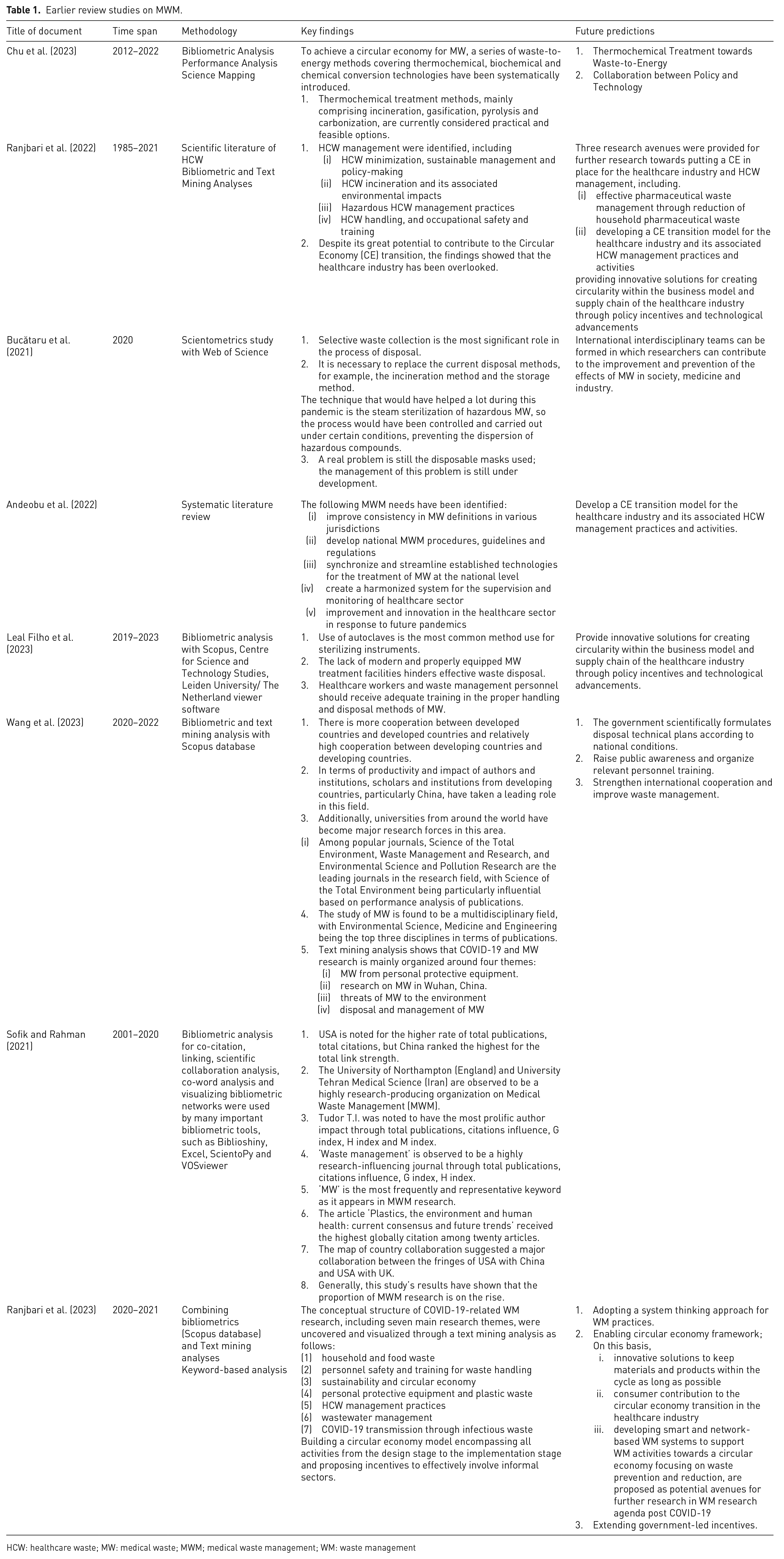
Safe transport of MW is also critical, necessitating separation, routine disinfection of vehicles and strategic timing (Babaee Tirkolaee and Aydın, 2021; Peng et al., 2020; Pieper et al., 2017). Many pharmaceutical companies producing drugs should evaluate reverse logistics in terms of circularity, and circular models can be applied for this purpose (Makaleng and Lambert, 2021). Accurate record-keeping shapes effective strategies, and data insights drive optimized waste management practices (Çetinkaya et al., 2020). In the supply of medical materials, those produced with biodegradable plastics with suitable mixtures similar to polyvinyl alcohol (PVA)/starch/lignin mixtures can be preferred within the scope of circularity (Ratnawati et al., 2022). Lastly, education and training for healthcare professionals are imperative, as many remain uninformed about MWM (Alshemari et al., 2020; Odonkor and Mahami, 2020). To facilitate a comparative analysis with prior analogous studies, we have delineated bibliometric studies and review articles pertaining to MWM from 2018 to 2023 in Table 1.
Earlier review studies on MWM.
HCW: healthcare waste; MW: medical waste; MWM; medical waste management; WM: waste management
Table 1 provides a synthesis of recent review-focused literature in the MWM field, revealing key trends and methodological approaches from several pivotal studies. A recurring theme is the transition towards a circular economy, with studies like Chu et al. (2023) systematically introducing waste-to-energy methods such as thermochemical, biochemical and chemical conversion technologies. These methods, particularly incineration, gasification, pyrolysis and carbonization, are recognized as feasible for current waste valorization efforts. The literature underscores a shift in focus from traditional disposal to sustainable management practices. Ranjbari et al. (2022) delved into healthcare waste (HCW) management, highlighting the need for minimization, sustainable policy-making and the significant environmental impacts of incineration. Bucătaru et al. (2021) echoed the necessity for changing disposal methods, emphasizing selective waste collection and the potential of steam sterilization, especially highlighted during the COVID-19 pandemic for controlling the spread of hazardous compounds.
The need for improved definitions, guidelines and training is another area of consensus. Andeobu et al. (2022) and Leal Filho et al. (2023) identified the critical need for consistent MW definitions and national management procedures. They also stressed the importance of training for healthcare workers and waste management personnel, a sentiment echoed by other studies that point to training as vital for proper waste handling.
Wang et al. (2023) noted the increasing cooperation in MWM research between developed and developing countries, with a marked rise in scholarly output from institutions in China. This global collaboration is further reinforced by the study of Sofik and Rahman (2021), which observes key research outputs and collaborations, particularly between the USA, China and the UK. The multidisciplinary nature of MWM research is evident in the diversity of themes covered. From the handling of personal protective equipment and the environmental threats posed by MW to the study of waste management during the COVID-19 pandemic, the literature reflects a field that intersects with environmental science, medicine and engineering.
Future predictions from these studies advocate for the development of models to support the CE transition in the healthcare industry, the improvement of pharmaceutical waste management and the innovation within the healthcare sector’s business models and supply chains. Ranjbari et al. (2023) specifically proposed a system-thinking approach for waste management practices, encouraging a circular economy framework that focuses on waste prevention and reduction, involving consumers and informal sectors in the transition process and developing smart, network-based systems to support these activities.
In conclusion, a review of the literature reveals escalating challenges in MWM, exacerbated by health crises like the COVID-19 pandemic. It is evident that a holistic approach, combining technological solutions, rigorous international standards adherence and education is essential for sustainable MWM. Furthermore, it can be asserted that there is an academic consensus on the urgency of redefining MW practices within a circular economy framework. The collective findings point towards the integration of policy and technology, the implementation of innovative waste-to-energy methods and the fostering of global collaboration to navigate the challenges and potentials within MWM research.
Methodology
The study employs an integrated mixed-methods framework, harmoniously merging qualitative and quantitative research modalities. The qualitative dimension is elucidated through an extensive literature review, while the quantitative facet leverages co-word and co-citation analyses. It is well-known that a systematic review, constituting the initial phase of our methodology, is a rigorously structured research approach that meticulously compiles and synthesizes literature, transforming it into a more accessible format (Oh and Lee, 2020). Distinct from conventional reviews, systematic reviews are invaluable for their focused examination of specific topics and for providing comprehensive assessments of particular questions through a replicable and transparent process (O’Hagan et al., 2018). The multifaceted methodology applied in this study is demonstrated in Figure 1.
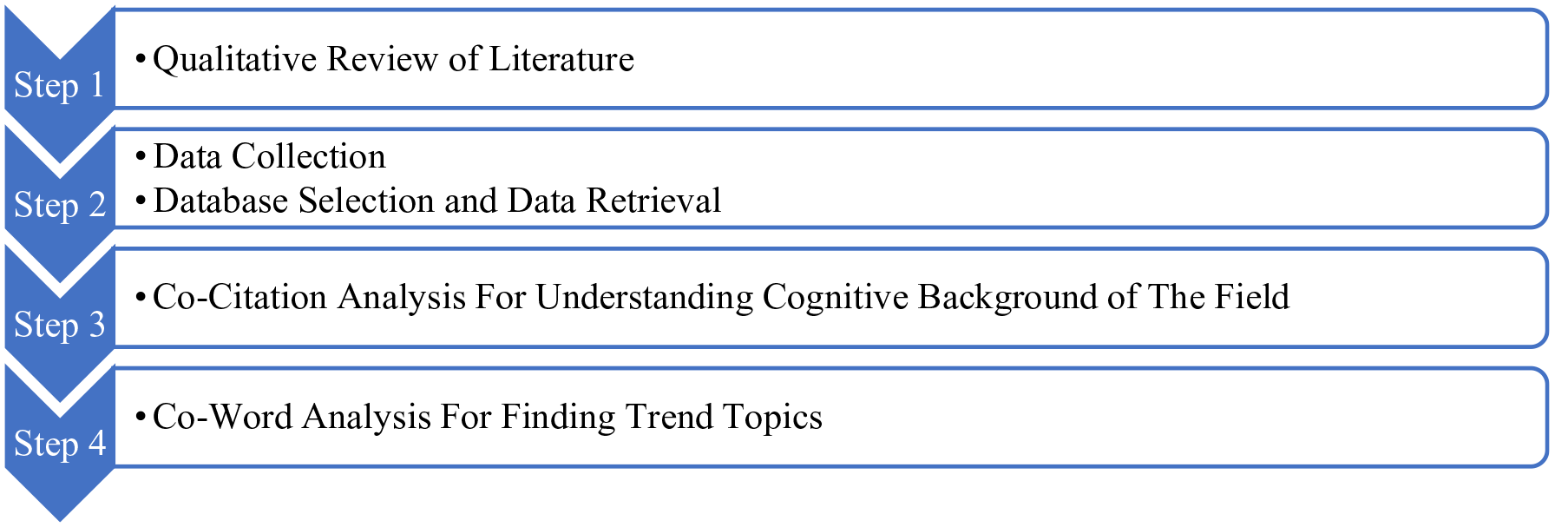
Flowchart of research methodology.
In our research process, as depicted in Figure 1, we commenced with a qualitative review of the literature. This initial phase was crucial in establishing a foundational understanding and shaping the direction of our study. Following this, we proceeded to the second step, encompassing data collection, database selection and data retrieval.
The selection of a suitable database is a pivotal aspect of data collection. A plethora of scientific databases exist, including PUBMED/MEDLINE, Web of Knowledge (WoK), SCOPUS, Microsoft Academic, Dimensions, Google Scholar, among others. For this study, we opted for WoK due to its integrated citation-data metadata and its capacity to accommodate the download of over 1000 articles, a feature not feasible in SCOPUS. This decision was influenced by WoK’s reputation for providing superior and reliable metadata, an essential feature for comprehensive data collection. Comparative studies, such as those conducted by Mongeon and Paul-Hus (2016), suggest that while both SCOPUS and Web of Science have their unique strengths, the choice often depends on individual research needs and preferences, particularly regarding the database’s comprehensiveness.
With the database selected, our focus shifted to bibliometric analysis, a methodical approach involving the statistical analysis of scientific texts. Employing techniques such as co-word and co-citation relationship analyses, bibliometrics is a powerful tool for addressing research questions and tracing the evolution of articles within our dataset (Cainelli et al., 2015; Franceschini et al., 2015; Rojas-Sánchez et al., 2023). Bibliometric analysis facilitates a thorough examination of research literature by applying statistical and mathematical methods to studies within knowledge domains (Wang et al., 2023). Compared to experience-based methods, bibliometrics allows for the large-scale collection and analysis of technical data, providing more objective analytical outcomes. This enhances the ability of researchers to explore scientific and technical texts for identifying specific patterns and trends (Huang et al., 2020).
For co-citation analysis, which is third step, the study harnesses the power of Document Citation Analysis (DCA). DCA stands tall as a renowned method within the bibliometric analysis umbrella. The realm of bibliometrics, defined by Pritchard (1969) and elaborated by Hou et al. (2018), serves as a quantitative lens to assess bibliographical data, using citation analysis as a beacon to unveil intricate patterns of knowledge evolution and dynamic shifts. Through the lens of DCA, the research strives to meticulously unravel the intellectual progression by probing into the intricate web of reference interconnections, as illustrated by Small (1973).
Underpinning the very essence of citation analysis is a foundational principle works that attract frequent citations inherently wield a profound influence within their field. This phenomenon serves as a mirror, reflecting the cognitive orientations and deliberations of authors (Small, 1974, 1977). More specifically, co-citation analysis emerges as a potent tool, capable of graphically representing the cognitive contours and landscapes of specific research arenas (Small and Garfield, 1985; Surwase et al., 2012).
The equation represented in this equation
To bring these co-citation networks to life, the study employs CiteSpace. This sophisticated tool is adept at visualizing and dissecting co-citation patterns and trends (Chen et al., 2010). CiteSpace encompasses a multi-step process, commencing with data aggregation and culminating in the generation of visually appealing cluster labels. This tool’s brilliance lies in its capacity to spotlight critical nodes, potential harbingers of transformative moments in the evolution of the research domain. Following this clustering exercise, the study integrates burst analysis, a technique pioneered by Kleinberg (2002). This analysis is invaluable, spotlighting dominant references across diverse time frames, subsequently assessing their enduring relevance. Burst detection, at its core, discerns specific intervals where a metric showcases statistical prominence, juxtaposed against the overarching dataset. Within this research context, it serves as a beacon, illuminating the relative significance and durability of distinct references.
For the last step to find trend topics, the Bibliometrix package within the R programming language has been used. The Bibliometrix package in R complemented our study with its comprehensive bibliometric analysis features, enabling us to conduct in-depth quantitative assessments and offering a nuanced exploration of the literature. R’s versatility and its extensive package ecosystem allowed us to customize our analysis to suit the specific needs of our research, thereby providing a high degree of precision and adaptability in our methodological approach.
Analysis and findings
The initial phase of our methodology is qualitative review of the MWM literature. Then in second step, the analysis is applied for understanding the cognitive background of MWM. Within WoK, the search terms employed encompassed ‘medical waste’, ‘hospital waste’ and ‘healthcare waste’, scanning across all fields to extract relevant data. This yielded a total of 2156 publications, which were subsequently downloaded in both plain text and a comprehensive format inclusive of cited references.
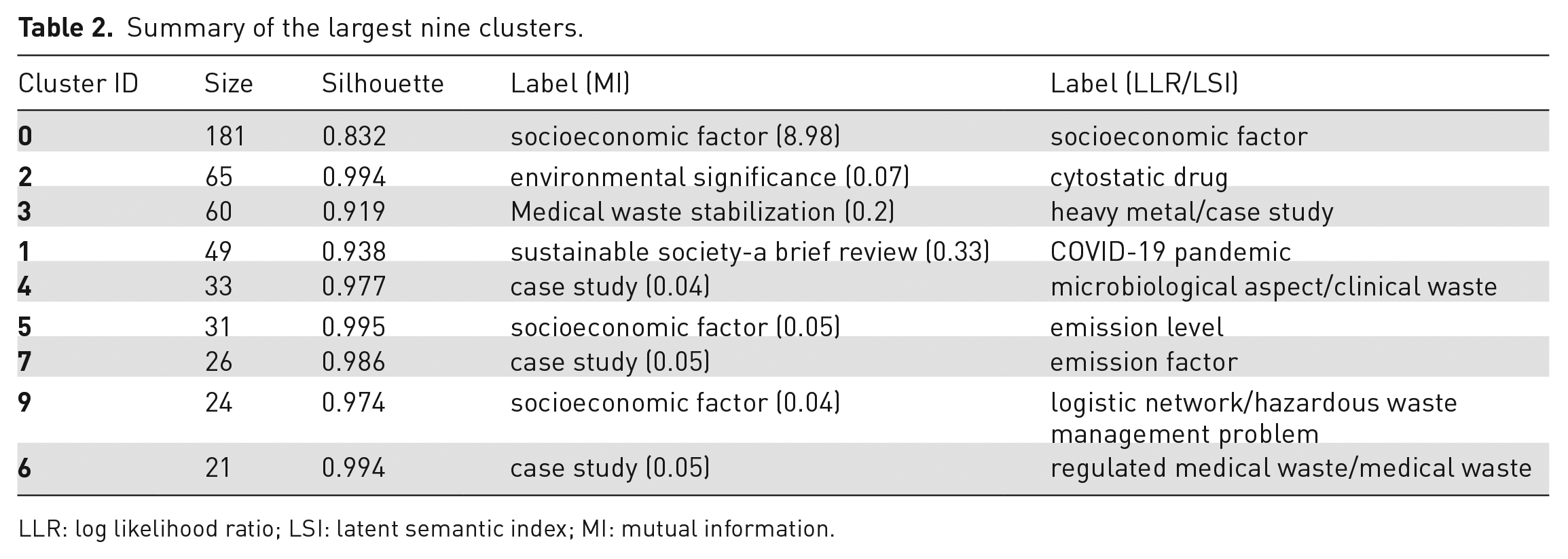
After the data retrieval, co-citation analysis is applied using CiteSpace, a complimentary Java-based software. The resultant network was segmented into 24 distinct co-citation clusters. A synopsis of the predominant nine clusters is presented in Table 2.
Summary of the largest nine clusters.
LLR: log likelihood ratio; LSI: latent semantic index; MI: mutual information.
When Table 2 has been examined, it can be seen that Cluster #0 has emerged as the largest, boasting 181 members and a silhouette value of 0.832. Labelled ‘socioeconomic factor’ based on the mutual information (MI) label extraction methodology, it predominantly originates from the year 2009. This infers that MWM has transitioned from being merely technical to a socio-technical issue. The cluster’s key contribution comes from Caniato et al. (2015), who emphasized the pivotal roles of efficient regulation and precise waste category definitions at the national forefront.
Cluster #2 is the second largest, comprising 65 members and a silhouette value of 0.994. It carries labels like ‘cytostatic drug’ (from LLR and LSI) and ‘environmental significance’ (from MI). Mišík et al. (2016) highlights the limited impact of common cytostatic drugs on higher plant fertility across both aquatic and terrestrial ecosystems. Yet, the study underscores the significance of eradicating these drugs from polluted wastewaters.
Cluster #3 is the third in line, having 60 members with a silhouette value of 0.919. Diverse labels such as ‘heavy metal’ (LLR), ‘case study’ (LSI) and ‘medical waste stabilization’ (MI) are attributed to it. A noteworthy contribution from this cluster is from Bakkali et al. (2013), revealing that hospital incinerator ashes, mainly in Rabat, Morocco, consist predominantly of chemicals, including substantial heavy metal concentrations. Their limited solubility, however, ensures minimal groundwater contamination.
Cluster #1, the fourth largest, contains 49 members and a silhouette value of 0.938. It is labelled as ‘COVID-19 pandemic’ (from both LLR and LSI) and ‘sustainable society – a brief review’ (from MI). A critical review by Liang et al. (2021) underscores the profound implications of the COVID-19 pandemic on medical and municipal solid waste. Emphasizing China’s integrated waste disposal approach, this review calls for more in-depth research on waste characteristics, overall environmental impacts, resource consumption and long-term effects.
Cluster #4, with 33 members and a silhouette value of 0.977, is labelled as ‘microbiological aspect’ (LLR), ‘clinical waste’ (LSI) and ‘case study’ (MI). A significant contribution from Phillips (1999) critiques the accuracy of soil-filling without decontamination and underscores the need for alternative incineration methods.
Cluster #5 comprises 31 members with a silhouette value of 0.995. Its labels are ‘emission level’ (from both LLR and LSI) and ‘socioeconomic factor’ (from MI). An insightful study by Zhu et al. (2008) establishes that dioxin levels in China closely mirror those in moderately contaminated samples from developed nations.
Cluster #7 encompasses 26 members and a silhouette value of 0.986, being labelled as ‘emission factor’ by both LLR and LSI. Key findings from Alvim-Ferraz and Afonso (2003) highlight the significant influence of incineration conditions on MW emissions, calling for effective methodologies to ensure incineration safety.
Cluster #9, the eighth largest, has 24 members and a silhouette value of 0.974. This cluster, represented by ‘logistic network’ (LLR), ‘hazardous waste management problem’ (LSI) and ‘socioeconomic factor’ (MI), benefits from Nikzamir et al. (2020). The study proposes a comprehensive logistic model for hospital waste management while emphasizing the integration of social and environmental challenges with economic ones.
Finally, Cluster #6 consists of 21 members and a silhouette value of 0.994, labelled as ‘regulated medical waste’ (LLR) and ‘medical waste’ (LSI). A pivotal work by Rutala and Mayhall’s (1992) summarizes the potential hazards of MW disposal and underscores its significance from a public health perspective.
Through co-citation analysis, we delineate the evolutionary shifts within the realm of MW, pinpointing changing perspectives over time. Synthesizing these findings, some key observations emerge:
The foundational article in this field is the WHO publication by Prüss et al. (1999), serving as a seminal resource for researchers and a guideline for both international and regional administrators, especially in developing nations. The study of Windfield and Brooks (2015), another pivotal work, underscores the necessity to refine the classification of MWs deemed infectious. Although incineration is the dominant disposal method, a hybrid of in-situ incineration and microwave technologies emerges as the most cost-efficient. There is a recognized need for comprehensive databases on the entire MWM lifecycle. Notably, even with available data, certain countries fall short of adhering to MW regulations, underscoring the need for more robust planning and governance. Furthermore, the criticality of trained personnel in MWM and the emphasis on continuous education is apparent.
To gauge the temporal influence of these articles, we employed burst analysis. Unsurprisingly, the top-scoring article is Prüss et al. (1999). Following closely is Askarian et al. (2004). Notably, Shinee et al.’s (2008) work, although not as widely cited, brings to light the disparities in MWM in Mongolia, suggesting a comprehensive national strategy. Yu et al.’s (2020) contribution zeroes in on the importance of strategically locating temporary incinerators, especially during crises like the COVID-19 pandemic. Cheng et al. (2009) revealed that medical centres are the primary contributors to infectious waste in Taiwan, suggesting a need for waste reduction initiatives and greater emphasis on recycling. Hossain et al. (2011) advocated for the sustained use of recycling-reuse programmes, post-sterilization at the initial collection point, using supercritical liquid carbon dioxide (SF-CO2) sterilization technology. Saadat et al. (2020) discussed the global implications of the COVID-19 pandemic, noting environmental impacts, the importance of protecting vulnerable populations and the uncertainty surrounding testing data.
In summary, from the high-burst articles, it is evident that MWM has undergone significant transformations since 1999, with an increased emphasis on reverse logistics, data analytics, statistical modelling and heightened environmental consciousness. The third phase of our research involved a co-word analysis to discern trending topics. For this purpose, we employed the ‘bibliometrix’ package from R programming. The primary focus of this analysis was the keywords provided by the authors, as depicted in Figure 2.
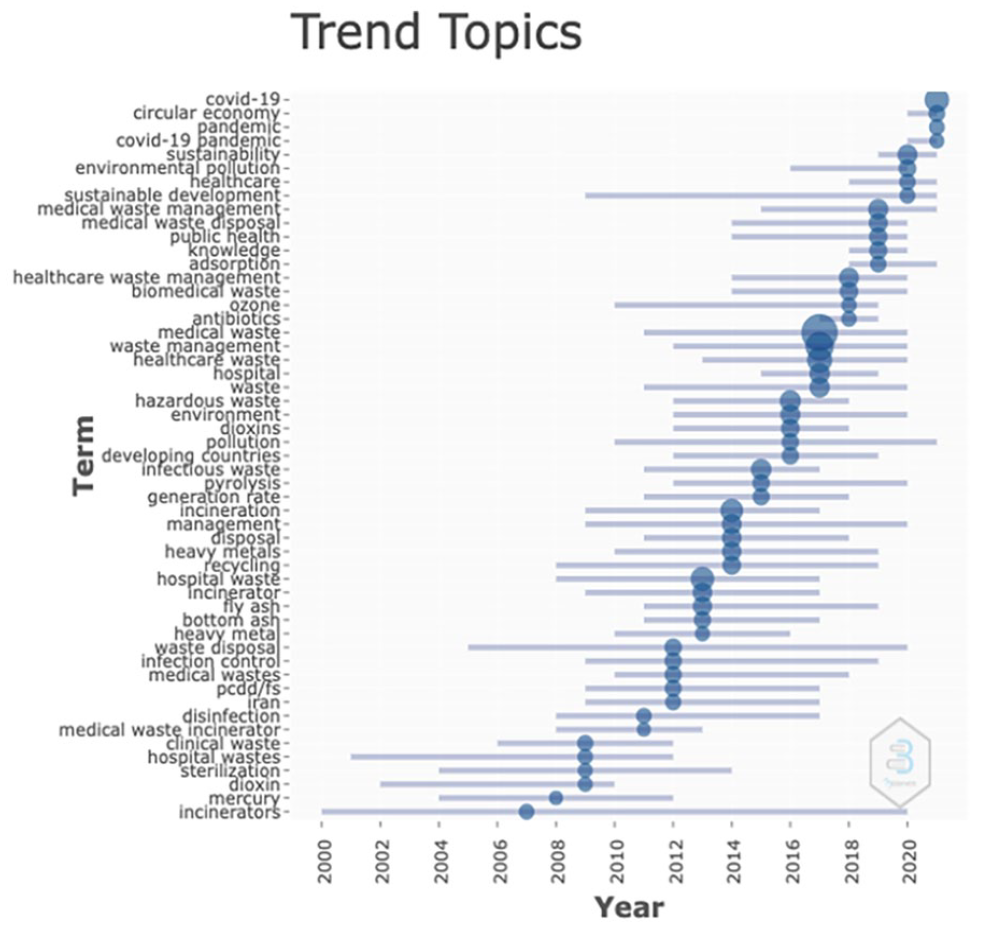
Trend topics.
From Figure 2, we gather that incinerators and incineration, which have been long-standing disposal methodologies in the literature, peaked in mentions during 2007, 2011, 2013 and 2014. Hospital waste was a consistent topic from 2001 to 2017, with notable spikes in 2009 and 2013. During the period of 2002–2014, themes of sterilization and mercury proliferated, especially in 2009. Discussions surrounding MW incinerators were dominant from 2008 to 2013. Simultaneously, disinfection was a recurrent theme from 2008 to 2017, peaking in 2011. Dioxin featured prominently from 2002 to 2018, with a particular surge between 2009 and 2016.
By-products of incinerators, such as fly ash, floor ash and heavy metals, gained traction between 2011 and 2019, especially in 2013. Furthermore, the concept of recycling became more pronounced in the literature from 2008 to 2019, peaking in 2014. The overarching theme of ‘management’ emerged strongly in 2014 and remained a focus until 2020. Subcategories, such as waste management, HCW management and MWM evolved in alignment with this broader perspective. Although the terminology varied over the years, there was a distinct shift towards ‘medical waste management’, a topic that has been under active research for nearly two decades.
Starting in 2016, environmental considerations began to gain prominence. Pyrolysis, an eco-friendly waste treatment method, became prevalent from 2012 to 2020, with a notable rise in 2015. The concept of sustainability, which is deeply linked to environmental preservation and sustainable development, emerged in 2009 and witnessed an exponential growth by 2020, culminating in a peak in 2020. Complementing the theme of sustainability is the emerging ‘circular economy’ concept, which appeared in 2021. Given its trajectory and growing significance, we anticipate that its importance will further amplify as we move into 2021 and beyond.
In our detailed exploration of MWM literature, it is evident that the field has evolved responsively to societal, environmental and technological shifts. The transition from technical discussions to those emphasizing socio-technical aspects, particularly the socioeconomic facets, showcases its adaptive nature. Significantly, the recent emphasis on sustainability, highlighted by the emergent concept of the ‘circular economy’ in 2021, underscores a transformative shift. This focus on the circular economy, where resources are reused and repurposed, dovetails with the holistic approach now favoured in MWM. As we anticipate further research in this direction, the alignment of MWM with sustainability objectives becomes a critical area of future discourse.
Discussion
Our analysis of MW literature offers vital insights into its evolution and current focal areas. Starting with the Basel convention in 1989, interest in MWM surged, leading to the WHO’s standard MWM book in 1999. This foundational work remains a pivotal reference for researchers and professionals alike. In the subsequent decades, scholarly attention has centred on categorizing MWs, with the WHO identifying seven primary types.
A cluster identified with a focus on ‘socioeconomic factors’ around the early 2000s may reflect a shift from purely technical considerations of MWM in earlier periods to a more integrated approach considering economic and social implications. Similarly, the transition to paradigms emphasizing sustainability and circular economy in more recent years can be delineated, highlighting how emerging trends and research focus areas align with or depart from previous paradigms.
Co-citation analysis paints a vivid tapestry of the conceptual roots underpinning MWM. Each cluster unveiled serves as a historical marker, tracing the evolution of thought and scholarly endeavours. Cluster #0 stands as the beacon, shining light on how MWM has grown to encompass socioeconomic implications. This transformation, elegantly chronicled by Caniato et al. (2015), positions regulatory frameworks and waste categorization at the forefront of discussions. Subsequent clusters each harbour unique tales of their own. Cluster identified with a focus on ‘socioeconomic factors’ around the early 2000s may reflect a shift from purely technical considerations of MWM in earlier periods to a more integrated approach considering economic and social implications. Cluster #2 dives into the ecological impact of cytostatic drugs, cautioning against their unchecked dispersal in our water systems. Meanwhile, Cluster #3 delves into bottom ashes from MW incinerators that are polluted with heavy metals, highlighting the need for effective sorting and reducing the risk of heavy metals leaching into groundwater. As we journey through to Cluster #4, healthcare facilities producing clinical waste must adhere to disposal regulations, exploring alternatives like gasification and steam sterilization to meet emission standards. Clusters #5 through #9 range from the complexity of microbial interactions and combustion emissions to the organization of logistic networks for efficient waste disposal, where low incineration rate can contribute to the control of dioxin emissions.
In accordance with findings, it may be asserted that a paradigmatic shift becomes apparent, as evidenced by the co-citation and co-word analyses. This shift is not merely a transition in methodologies or technologies but represents a profound evolution in the conceptual understanding and approach to MWM over the last few decades. Our analysis highlights that the field initially focused heavily on direct, technical solutions, primarily centred around incineration methods. This is evident in the early clusters, where the emphasis was on immediate disposal methods and their technical efficiency. However, as the field matured, a significant shift towards socio-technical considerations emerged. Cluster #0, emerging as the largest and dating predominantly from 2009, underscores this shift, indicating an increasing awareness of the socioeconomic factors intertwined with MWM. This paradigm shift from a purely technical to a socio-technical perspective aligns with global trends towards more integrated and holistic environmental management strategies.
Furthermore, the advent of the COVID-19 pandemic has catalysed another shift, as revealed in Cluster #1, where the focus on the pandemic’s impact on medical and municipal solid waste brings to light the urgent need for flexible, adaptive waste management strategies that can respond to sudden, large-scale public health crises. The importance of sustainable practices and circular economy approaches, particularly noted in recent years, marks a new era in MWM, prioritizing environmental preservation alongside efficient waste handling.
The paradigmatic shift is also reflected in the methodologies employed for waste management, moving from traditional incineration to more innovative and environmentally conscious methods such as gasification, steam sterilization and microwave technologies. The increasing role of data analytics, reverse logistics and statistical modelling, as noted in the high-burst articles, illustrates a move towards more sophisticated, data-driven approaches.
Indeed, these clusters converge to tell a grand narrative, one that elucidates the multifaceted nature of MWM. Drawing from diverse thematic avenues, from environmental and health implications to logistical and socioeconomic considerations, it is evident that addressing this pressing challenge requires a holistic and interdisciplinary approach. It is not just about waste; it is about intertwining lives, ecosystems and the socioeconomic structures that underpin our global community.
The discussion of our findings in relation to the recent literature captured in literature review unfolds a narrative of convergence and divergence in the realm of MWM. Our study corroborates the emerging trend towards a circular economy, aligning with Chu et al. (2023), who advocate for waste-to-energy methods as a means of realizing this transition. We extend this dialogue by exploring the nuances of implementing these methods, particularly the roles of gasification and steam sterilization, which our findings suggest are not only viable but necessary for modernizing MWM practices.
Contrasting with the literature, our study places greater emphasis on the potential of steam sterilization. This alternative, heralded for its environmental friendliness, stands out as a counterpoint to the predominant focus on thermochemical methods such as incineration and pyrolysis noted by Chu et al. (2023) and others. The implications of our findings suggest that while traditional methods are recognized as practical, the pursuit of less conventional technologies may offer untapped benefits, particularly in reducing the environmental footprint of waste treatment.
In the vein of Ranjbari et al. (2022), our study also emphasizes the importance of policy in steering the direction of MWM. However, our analysis provides a critical assessment of the gap between policy formulation and implementation, underlining the need for actionable strategies that can effectively bridge this divide. The findings from Bucătaru et al. (2021) regarding selective waste collection resonate with our study, yet we delve deeper into the complexities of operationalizing such practices within existing healthcare systems.
The consensus on the need for improved MW definitions, guidelines and training, as highlighted by Andeobu et al. (2022) and Leal Filho et al. (2023), is firmly supported by our research. We contribute to this discourse by proposing a framework for continuous education and capacity-building programmes that are adaptive to the evolving landscapes of MWM and public health emergencies.
Our findings also reflect the trend of increasing international collaboration identified by Wang et al. (2023) and Sofik and Rahman (2021). We argue that such collaborations should not only be sustained but also strategically expanded to foster knowledge exchange and harmonization of MWM practices across borders. Our study further explores the implications of such global partnerships, suggesting that they can serve as catalysts for unified international policies and shared technological advancements.
The multidisciplinary nature of MWM is a theme that our study and the broader literature agree upon. We expand upon this by advocating for an interdisciplinary approach to research and practice, suggesting that solutions to MWM challenges can benefit from integrating insights from environmental science, public health and engineering.
Looking to the future, our study aligns with the predictions that call for the development of circular economy models within the healthcare industry, as articulated by Ranjbari et al. (2023). We extend this vision by discussing the critical role of innovation in business models and supply chains, echoing the need for a systemic approach to MWM that goes beyond waste treatment to include prevention, reduction and resource recovery.
In conclusion, our study not only reinforces the established consensus on the need for sustainable MWM practices but also provides a unique perspective on the path forward. It underscores the urgency of integrating innovative technologies, robust policies and global collaboration to redefine MWM within a circular economy framework. Our research contributes to a more comprehensive understanding of the field’s present state and potential future, charting a course towards a more sustainable and health-conscious society.
Rutala and Mayhall’s (1992) work underscores the urgent need for public education on MW’s environmental and public health implications, advocating for a more qualified and trained workforce in this domain. Among the hazardous wastes, genotoxic chemicals, especially anticancer drugs, stand out for their environmental persistence and potential harm. Studies emphasize the importance of efficiently removing these from wastewater, considering the health, environmental and economic implications.
The debate over disposal methodologies, primarily incineration, has garnered significant attention. Although incineration is widely used, its environmental impact, especially the release of heavy metals, necessitates more efficient monitoring and separation systems. The search for alternative, sustainable disposal techniques is vital, with the circular economy providing a promising framework. Innovations like microwave technologies, along with a re-evaluation of waste categorization, are crucial to this shift.
The COVID-19 pandemic dramatically spotlighted the vulnerabilities in our MWM systems, intensifying waste production by 5–7 times. This surge revealed a pressing need for more sustainable and circular approaches, especially concerning product life cycles in the healthcare sector. Strategic focus areas, such as reverse logistics, digital data tracking and statistical modelling, are emerging as vital components of a more robust, sustainable system. Notably, recycling, an indicator of circularity and sustainability, has seen increased attention since 2008. As the field continues to adapt, especially post-pandemic, the circular economy’s tenets are poised to guide future research and practices in MWM.
Conclusion
MWM has emerged as a crucial issue that demands immediate attention from every nation worldwide. Based on our findings and discussions, there is a distinct gap in strategies focusing on waste management, underscored by the absence of robust policies, adequate knowledge, public awareness, stringent regulations, proper legislation, dedicated funding, education, comprehensive data and their effective implementation. The gravity of the issue necessitates a two-pronged approach: advancing technological solutions and integrating circular and sustainable management methodologies. Current research trends advocate for precautions like circular waste technologies, complemented by sustainable practices, to address the crisis. Efficient information systems can play a pivotal role in streamlining waste storage, transportation and disposal processes. Recognizing the scale of the challenge, allocating dedicated budgets for MWM becomes imperative. Collaborative efforts involving global entities, such as WHO, NGOs and other international stakeholders, can spearhead a cohesive and progressive strategy. Embracing innovative circular technologies can significantly mitigate the associated environmental and economic repercussions. Yet, true change will only manifest when these sustainable principles are universally adopted and ingrained in societal norms.
Our investigation predominantly focused on the scholarly literature pertaining to MWM, deploying advanced methodologies such as co-citation analysis to decipher the cognitive foundations of MWM. This was synergized with co-word analysis and the examination of emergent trends. Notably, the clusters derived from co-citation analysis exhibited congruence with the trend topics discerned from co-word analysis. We abstained from an exhaustive exploration of the nuanced dynamics of MWM technologies and circulatory approaches. Our primary source of literature was articles catalogued in the Web of Science, augmented by select international reports.
Future research endeavours should aim to harmonize terminologies concerning MW definitions, especially focusing on classifying hazardous MWs within a cyclical framework. Furthermore, it is paramount to probe into wastewater management for healthcare entities, foster mobile waste disposal innovations and engineer circular, sustainable disposal solutions. The data lifecycle, from waste generation to disposal, needs comprehensive analytical studies. There is a pressing need to address cyclical and sustainability challenges, transcending boundaries of developed and developing nations. It is essential to understand the socioeconomic and behavioural dynamics influencing MWM, identify policy gaps and tailor solutions suited to the unique challenges of economically constrained regions. An expanded repository of scientific data can provide a fertile ground for subsequent research endeavours, fostering the creation of circular and sustainable methodologies for MWM.
Our study makes a pivotal contribution to the field of MWM by introducing an integrative approach that synthesizes co-citation and co-word analyses. This comprehensive methodology transcends traditional research boundaries, offering a richer, multidimensional understanding of the field. The scientific value of our paper lies in its ability to reveal the interconnected nature of various aspects of MWM, ranging from policy implications to technological advancements. By mapping the evolution of the domain and identifying key thematic clusters and emerging trends, our research provides valuable insights that can guide future policymaking, technological development and academic inquiry. Moreover, our findings serve as a foundational resource for stakeholders in the healthcare and environmental management sectors, seeking to develop more effective and sustainable MWM strategies.
The applicability of our study extends beyond theoretical implications, offering practical insights for the implementation of more efficient and sustainable MWM systems. Our analysis identifies key areas where policy and technology intersect, suggesting avenues for enhanced collaboration and innovation. For instance, the increasing focus on circular economy principles and sustainable practices, as revealed by our research, can inform the development of waste management policies that prioritize environmental sustainability and resource optimization. These findings can aid policymakers, healthcare administrators and environmental managers in adapting to the evolving landscape of MWM, ensuring that strategies are both scientifically sound and pragmatically viable.
Although our study provides comprehensive insights, it is not without limitations. The primary reliance on Web of Science indexed articles and select international reports may exclude relevant literature from other databases or grey literature sources. Future research could expand the scope of literature reviewed to include these sources, potentially uncovering additional dimensions of the MWM discourse. Additionally, our study opens avenues for future research in specific areas such as the impact of emerging technologies like artificial intelligence in waste sorting and management, the role of public policy in fostering sustainable waste management practices and the development of innovative waste treatment and disposal methods. Exploring these areas can further enhance our understanding of MWM and contribute to the development of more robust, holistic and sustainable solutions.
Footnotes
Author’s note
Serhat Burmaoglu is also affiliated to Kyrgyz-Turkish Manas University Bishkek/Kyrgyzstan.
Declaration of conflicting interests
The authors declared no potential conflicts of interest with respect to the research, authorship, and/or publication of this article.
Funding
The authors received no financial support for the research, authorship, and/or publication of this article.
