




Abstract
Iron ore tailings (IOTs) need to be properly managed to mitigate the environmental, social, and economic impacts of mining activities. To cope with this issue, we use data envelopment analysis (DEA) to evaluate alternatives for using IOT in the construction sector. The classical and weight restriction output-oriented DEA models were used in this analysis. The results show that the ranking of alternatives depends on the aspect being evaluated. Concrete block is the most environmentally friendly alternative when analysing both models. For both social and economic aspects, ceramics produced better results in the classical model, whereas Portland cement showed better outcomes in the weight restriction model. In this sense, the results suggest great potential for the use of IOT in the construction sector, enabling the reduction of risks and social and environmental impacts of tailings dams.
Keywords
Introduction
The mining industry is an essential supplier of raw materials for many industrial sectors besides being of great economic value to many countries’ economies. Moreover, the socioeconomic and infrastructure changes in recent years, associated with the urbanization process in emerging countries and the strengthening of world economies, have driven the increase in demand for minerals. However, the production of residues during the mining process is inevitable. In this sense, many efforts to improve sustainability and reduce the impact of mining activities are being implemented.
The volumes of tailings grow in the same proportion as the mining production (Kinnunen et al., 2017), leading to problems of environmental liabilities. In Brazil, the disposal of iron ore tailings (IOTs) in mining companies is often carried out in dams (IBRAM, 2020). However, many of these dams began to face structural risks due to the increase in the scale of operation (Burritt and Christ, 2018; Franks et al., 2011). As a result of poor management and monitoring practices, two major dam collapses occurred in Brazil in 2015 and 2019. Both disasters led to the release of millions of tons of IOT into rivers causing significant impacts on properties and ecosystems and several victims.
Therefore, without proper disposal, residues cause environmental, economic and social impacts, which motivated the development of studies to find possible alternatives for reusing these materials. In the construction sector, the reuse alternatives include the production of construction materials, such as mortars (Carrasco et al., 2017; Fontes et al., 2016; Peixoto et al., 2016; ), concrete (Liu et al., 2012; Peixoto et al., 2016; Sabat et al., 2015), concrete blocks (Carrasco et al., 2013; Peixoto et al., 2016), pavers (Mantilla et al., 2017; Peixoto et al., 2016; Sant’ana Filho et al., 2017), road infrastructure (Bastos et al., 2016; Peixoto et al., 2016), ceramics (Das et al., 2000), ecological brick (Chen et al., 2011; Yang et al., 2014) and Portland cement (Huang et al., 2013).
These studies show great technical potential for the rehabilitation of IOT in the construction sector. However, besides the technical aspects, there is a lack of studies attesting economic, environmental or social gain of the reuse of IOT (Dino et al., 2018). In this sense, Araújo et al. (2020) analysed the economic feasibility of the reverse logistic flow of IOT reuse in road infrastructure by sizing the necessary resources using Discrete Event Simulation, and Vilaça et al. (2022) defined criticality indices to assess the use of IOT as a raw material in the paving, ceramic, cement and concrete industries. Recently, Cheng et al. (2022) developed a new approach based on ensemble machine learning models to predict the strength activity index of IOTs.
Beyond the importance of IOT reuse in terms of circular economy practices, Lamb (2023) and Leal Filho et al. (2022) pointed out that the world is facing a global sand crisis. Sand is one of the world’s most consumed natural resources and is essential to many industries, including construction (Leal Filho et al., 2022). In this sense, analysing alternatives to replace sand as a raw material, as in our work, is crucial given the environmental impact of sand extraction and potential scenarios of sand scarcity and price increase.
Indeed, it is imperative to develop a sustainability analysis to determine which alternative for IOT reuse is the most sustainable in terms of economic, social and environmental dimensions. In this sense, a sustainability analysis using the data envelopment analysis (DEA) methodology is the most appropriate strategy. DEA is a methodology used to differentiate the technical efficient decision-making units (DMUs) from the inefficient ones in multiple-input and multiple-output analysis (Charnes et al., 1978) without any need for a parametric specification (Thompson et al., 1990). Shortly, in our study, DEA models are used to measure the sustainability of alternatives for the use of IOT in the construction sector using variables that represent environmental, social and economic aspects.
The literature on DEA offers many applications concerning service operations, banks, health care, universities, airports, electrical energy and gas distribution systems, agriculture and farms, power plants, transportation and education. The applications that have had the highest publication recently are energy, environment and finance (Emrouznejad and Yang, 2018). Reviewing works include Emrouznejad and Yang (2018), Liu et al. (2013) and the website of www.DEAzone.com.
In this scenario, this article proposes to use the DEA methodology to compare the reuse alternatives of IOT in the production of construction materials for the construction sector. This work also seeks to carry out a sustainability analysis of the alternatives for using tailings in order to contribute to the sustainable development of mining activity.
Summing up, two are the main contributions of the present work. Firstly, to the best of our knowledge, this is the first attempt to compare alternative uses of IOT in the construction sector using the DEA models considering sustainability aspects (social, economic and environmental). Secondly, the ranking of construction alternatives may support decisions in choosing the best use of tailings and policy formulation in the mining sector to promote sustainable development.
This article is organized as follows. Firstly, in section ‘Materials and methods’, the DEA methodology and the data used in this study are presented. Section ‘Results and discussion’ summarizes the results and some discussions. Finally, section ‘Conclusion’ presents the conclusions and directions for future research.
Materials and methods
Data envelopment analysis
The DEA is a nonparametric method of assessing the efficiency among a group of economic activities, called DMUs, using mathematical programming (Cooper et al., 2007). DEA is a technique based on linear programming with the ability to identify the possible efficiency frontier of a group of DMUs, in addition to comparing the resources used and the results obtained by each DMU evaluated (Altoé et al., 2017). According to Charnes et al. (1978), given a set of inputs that produce outputs, the production function defines an optimum relationship for producing the maximal amount of output from the given inputs. Thus, the DEA production function is the efficiency frontier based on empirical data (inputs and outputs).
These DMUs exhibit different degrees of efficiency in transforming inputs into outputs, which is what DEA must assess. The aim is to identify DMUs performing efficiently belonging to the efficiency frontier and which DMUs do not operate efficiently. These last are candidates for appropriate adjustments in their input or output mix to attain efficiency (Lozano et al., 2002).
Overall, DEA has been used to analyse the relative efficiency of productive units when monetary measures cannot be used (Liu et al., 2013; Thompson et al.,1990). Therefore, the inputs’ conversion into monetary units and net present values is unnecessary.
The models presented by Charnes et al. (1978) (CCR model) and Banker et al. (1984) (BCC model) are the classic models of the DEA methodology. Such models can be formulated in two ways: one emphasizing the reduction of inputs and the other the increase in outputs; in other words, both models can be oriented to inputs or outputs, depending on the management objectives.
Equations (1)–(5) show the primal modelling, and equations (6)–(10) the dual formulation of the BCC model oriented to outputs. In an output orientation, the focus shifts from input resource minimization, and the objective is to maximize output production while not exceeding the given resource levels.

subject to





subject to




In these models, xik is the amount of input i from DMU k , yjk is the amount of output j from DMU k , xik, and yjk are positive and k is the number of DMUs. In the primal formulation, the objective function (1) is equal to the inverse of the efficiency (h0 = 1/Eff 0 ). Therefore, in output orientation, this value should be maximized. The λ k allows an analysis of possible benchmarks for each DMU, that is, the reference group. Boussofiane et al. (1991) stated that a target (λ k ) equal to zero means that the corresponding DMU is not a benchmark for the DMU analysed, and the greater the target, the greater the importance of the corresponding DMU as a reference to an inefficient DMU. In the dual formulation, the objective function (6) is equal to efficiency (h0), and vi and uj are the weights to be determined in the solution of the problem. The variable v* is known as the scale factor, and it can assume three types of returns to scale: increasing return, decreasing return and constant return. For a more detailed discussion of the DEA model and applications, see Lins et al. (2012), Liu et al. (2013), Ratkovic et al. (2012), Cooper et al. (2007) and Lozano et al. (2002).
The mathematical structure of DEA models allows, in many cases, a DMU to be considered efficient by assigning null or unacceptable weights to variables due to the unrestricted flexibility of weights allocation. In DEA models, the weights represent a relative value system for each evaluated DMU, which provides the best possible measure for the analysed DMU and results in viable values for the other DMUs.
To cope with it, Wong and Beasley (1990) proposed a methodology to restrict the weights of inputs and outputs based on the proportion in which each input and output is related to the alternative. Thus, limits [

The assurance region method also limits weight variations to a given region (Thompson et al.,1990). In equation (12), vi, vi+1 are the weights and ε is an infinitesimal number that guarantees weights are not null.

Data
This article evaluates the possible alternatives for the use of IOT in the construction sector, according to the social, economic and environmental aspects of sustainable development. The steps of the DEA methodology are shown in Figure 1.
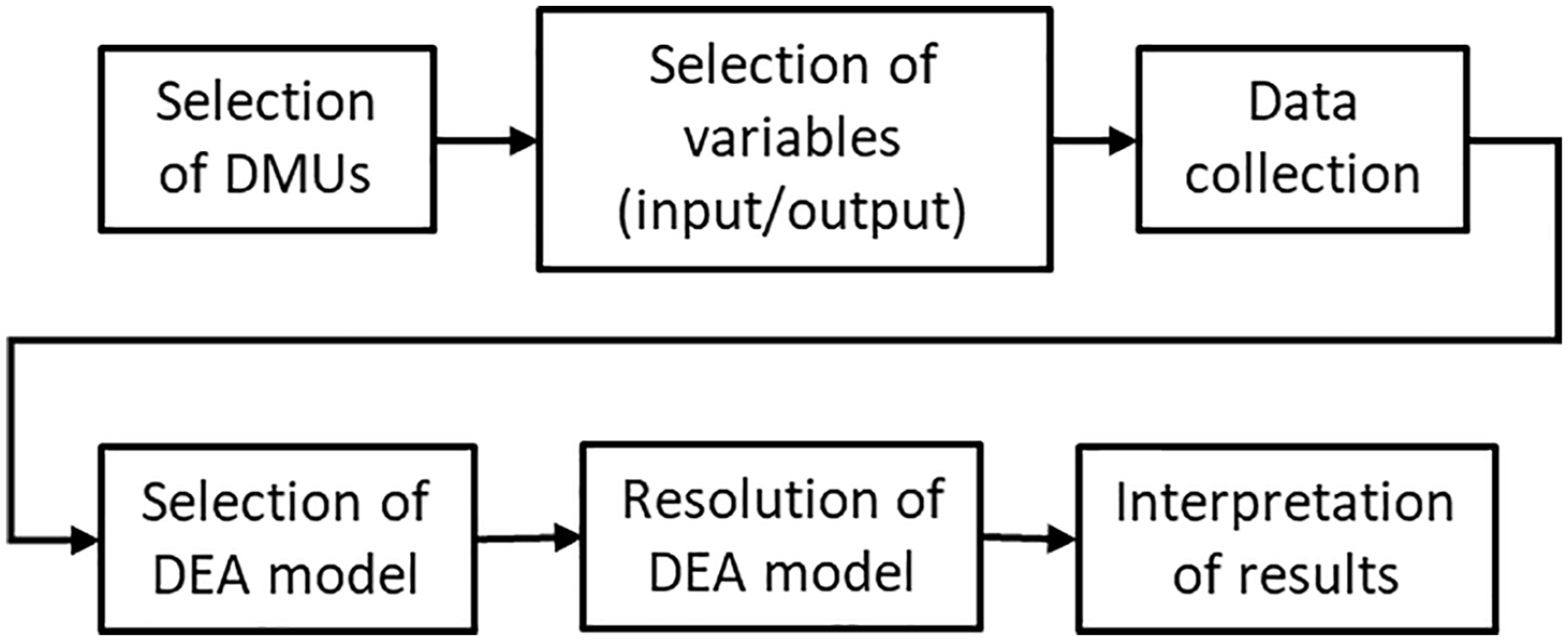
Schematic representation of the proposed methodology.
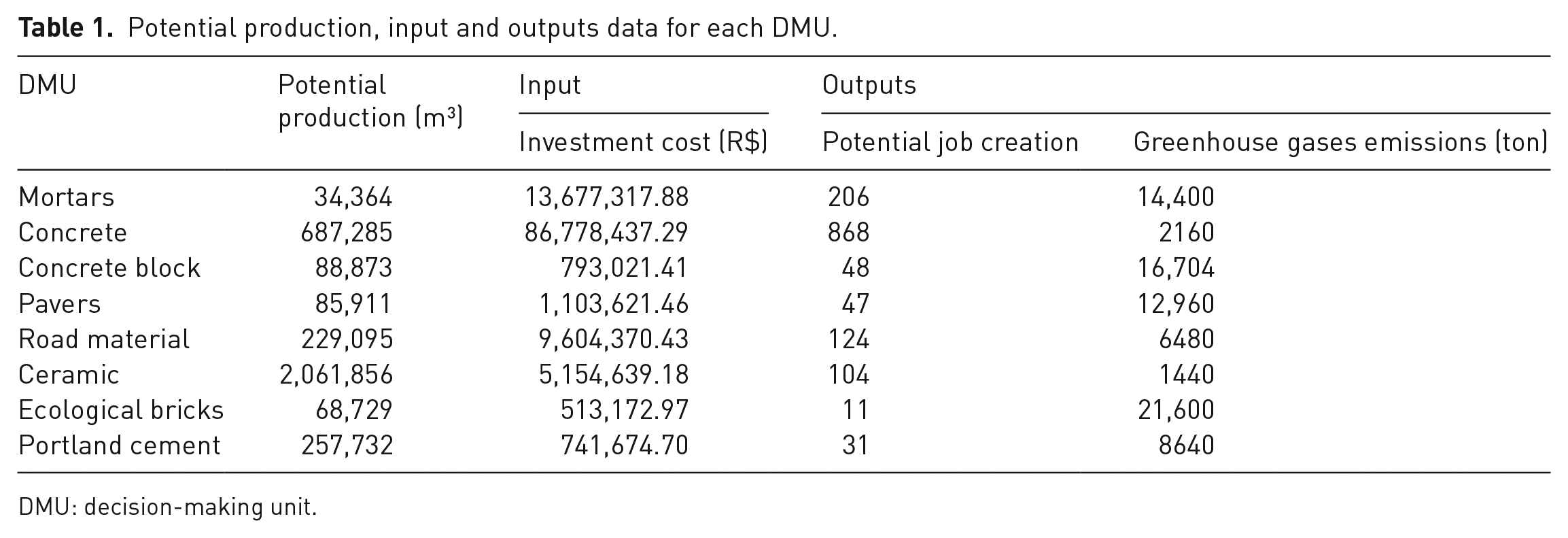
The selection of DMUs used in this research was based on the analysis of studies found in the literature that addressed alternatives for the use of IOT in the construction sector (see, e.g., Bastos et al., 2016; Fontes et al., 2016, 2019; Huang et al., 2013; Peixoto et al., 2016; Sant’ana Filho et al., 2017). These studies ensure the feasibility of using iron tailings in the replacement of natural sand and identify important information such as the chemical composition of each alternative. The DMUs analysed in this work are shown in the first column of Table 1, and their performance will be evaluated below.
Potential production, input and outputs data for each DMU.
DMU: decision-making unit.
It is worth mentioning that this study does not intend to evaluate the technical feasibility of using IOTs as an aggregate of construction materials. The technical aspects are discussed in detail in the literature (see, e.g., Bastos et al., 2016; Fontes et al., 2016; Huang et al., 2013; Peixoto et al., 2016; Sant’ana Filho et al., 2017; Silva et al., 2014). It is also evident that the tailings obtained in different regions can behave differently influencing their use and it should be considered in the technical analysis. Moreover, we evaluate alternatives that use tailings from dams and from the end of the production process, as well as tailings taken between stages of the production process.
The selection of variables (inputs and outputs) was based on the pillars of sustainability, considering environmental, social and economic aspects. Thus, based on the studies of Costa et al. (2013), Lins et al. (2012) and Oliveira et al. (2008), who analysed sustainable alternatives through the DEA, the variables Investment Cost (economic dimension), Job Creation Potential (social dimension) and Greenhouse Gas Emissions (environmental dimension) were chosen to be used in this work. The variable Investment Cost was classified as input to the model and the variables Potential Job Creation and Greenhouse Gas Emissions as outputs.
The operational dimension was also analysed in this research through the variable Potential Production. However, this variable was used (as will be shown later in this section) to calculate the input (Investment Cost) and output (Potential Job Creation and Greenhouse Gases Emissions) variables.
The first step in data collection was to define the amount of tailings used to compare the alternatives. The amount of tailings used in this study was 400,000 tonnes, an amount reached by most of the country’s mining companies. This amount of tailings consists of approximately 103,092 m³ based on the specific mass obtained by Peixoto et al. (2016) in the tests with IOTs from tailing dams. The Potential Production for each alternative (Table 1) is obtained using this volume of tailings and the composition of each construction material, known here as DMU.
Using the Potential Production data, it was possible to obtain the input (Investment Cost) and output (Potential Job Creation and Greenhouse Gases Emissions) variables (Table 1).
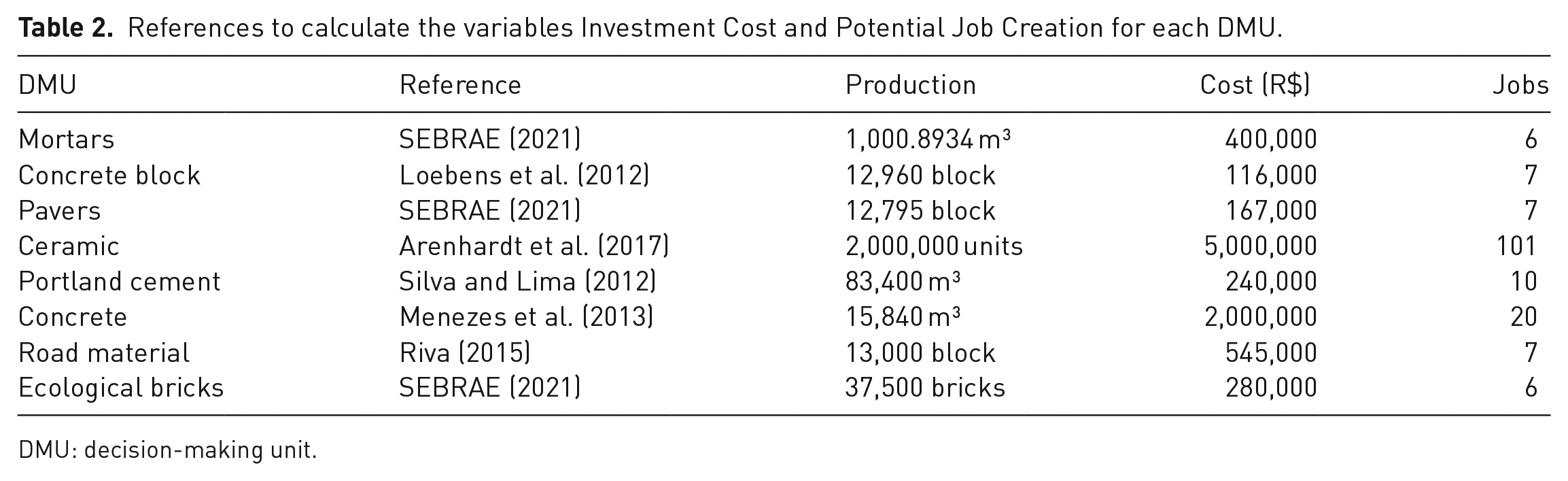
Concerning the variables Investment Cost and Potential Job Creation, previous studies were used to obtain the production, investment cost and number of jobs for each alternative. This information is presented in Table 2. We use the most reliable and updated data found in the literature for each alternative. The different units of production do not affect the analysis since this production is converted based on the volume of tailings and composition of each construction material.
References to calculate the variables Investment Cost and Potential Job Creation for each DMU.
DMU: decision-making unit.
The Investment Cost and Potential Job Creation are obtained assuming the proportionality of these variables with the Cost and Jobs, respectively, and the Potential Production for each DMU. Note that the costs of production, investment and jobs were assumed to be linearly proportional, which does not necessarily occur in practical applications.
In turn, the variable Greenhouse Gases Emissions represent the amount of CO2 not emitted due to the replacement of natural sand with IOT. This emission reduction (

Results and discussion
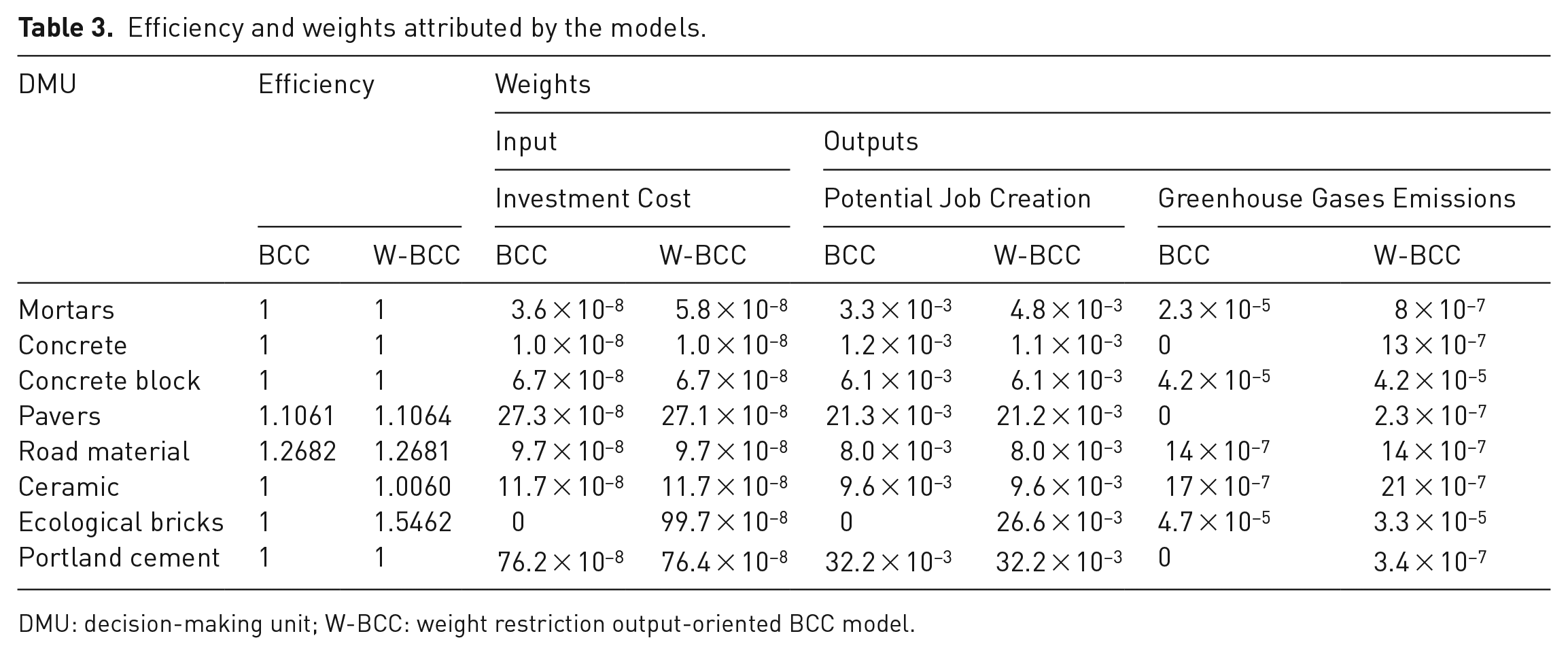
Table 3 presents the results of the classical model (BCC) and weight restriction output-oriented BCC model (W-BCC). The purpose of using the W-BCC model was to limit the weight values to meet the objectives of this study. Hence, the results show the importance of using the W-BCC model since it ensures that variables with null weights in the classical BCC model are included in the analysis.
Efficiency and weights attributed by the models.
DMU: decision-making unit; W-BCC: weight restriction output-oriented BCC model.
In the classical model, six alternatives reached maximum efficiency, and four alternatives achieved this efficiency using the W-BCC. Ceramic was efficient in the BCC model and a benchmark for the inefficient alternatives (Road material and Pavers). On the other hand, in the W-BCC model, the results show a decrease in the efficiency of Ceramic and Ecological bricks alternatives when restricting the weights of variables.
The Ecological bricks in the W-BCC model presented the highest inefficiency value. The inefficiency value in output-oriented models represents the percentage that outputs must be increased to the DMU reach the maximum efficiency. Namely, in this case, it is necessary to increase the output values by 54.62% for this DMU (Ecological bricks) to become efficient.
Analysing the weights in the classical BCC model, four alternatives presented null weights associated with at least one of the variables under analysis, which amounts to disregarding these variables in the model. The only null weights for variables Investment cost and Potential Job Creation were found in the DMU Ecological bricks, that is, only the Greenhouse Gases Emissions variable was regarded in the analysis of this alternative. The Greenhouse Gases Emissions variable has the greatest number of null values in the BCC model and was disregarded in the analysis of three alternatives (Concrete, Pavers and Portland cement).
Also, the Potential Job Creation variable assumes the highest weights in both models (BCC and W-BCC), suggesting that this variable is the most important in the analysis of these alternatives. The weights of most variables do not present significant changes by adding the weight restrictions, except the ones with null values in the BCC model.
Table 4 shows the ordering of the DMUs according to (1) efficiency and (2) weight of variables Greenhouse Gases Emissions, Potential Job Creation and Investment Cost, in this order. This ordering is chosen since this study prioritizes the environmental dimension. Indeed, DMUs with weights greater than zero in all variables are ranked first. Moreover, the DMUs with null weights in any of the variables will be ranked in the following positions considering the number of null weights and the variable weights in the established order.
Ordering of DMUs (BCC and W-BCC models).
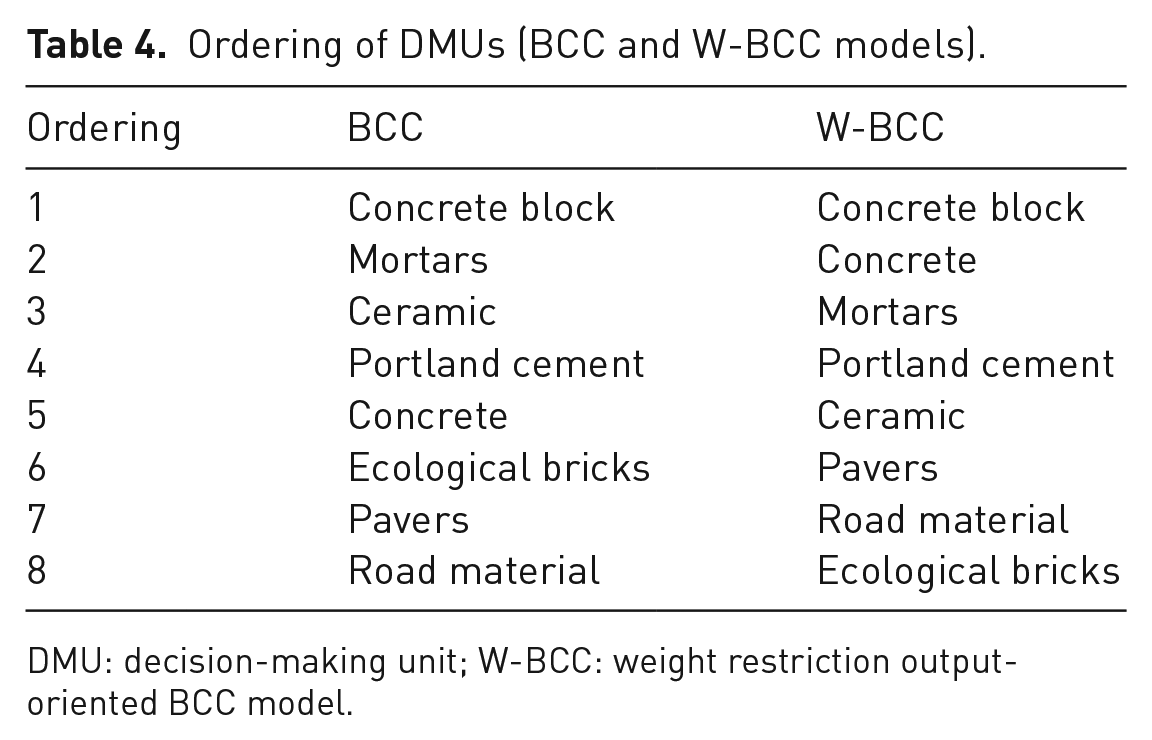
DMU: decision-making unit; W-BCC: weight restriction output-oriented BCC model.
According to Table 4, the ordering of the DMUs using the W-BCC model showed changes in the positions of the DMUs, despite the best position being still occupied by the Concrete block.
It is worth noting that applying the same ranking methodology using other variables’ order might be used to prioritize other dimensions since the ranking is based on the weights of variables. In this way, concerning the social and economic aspects, the best DMU is Ceramic in the BCC model, whereas for the W-BCC model, Portland cement showed the best result.
Finally, our results address circular economy principles by integrating the mining and construction sectors and incentivizing the use of IOT, a waste from the mining process, as a raw material in the construction sector. In addition, we explore alternatives to replacing the IOT with sand, which also faces challenges in extraction. Our findings are of particular importance in light of the increase in mining activities and the negative environmental impacts associated with both ore and sand mining.
Conclusions
The present work conducted a comparative analysis of alternative uses of IOT in the construction sector using the DEA models and considering sustainability aspects (social, economic and environmental). In this analysis, the variables Investment Cost, Potential Job Creation and Greenhouse Gases Emissions were used in both BCC and W-BCC models.
The analysis showed that Concrete block, Mortar, Ceramic, Portland cement, Concrete and Ecological bricks presented the best results considering the BCC model. Conversely, the alternatives Concrete block, Concrete, Mortars and Portland cement showed the best results for the W-BCC model. The Ceramic was considered efficient in the BCC model and a benchmark for the inefficient Road material and Pavers. The Ecological bricks in the W-BCC model presented the highest inefficiency value.
Some DMUs presented zero weighting associated with at least one of the variables under analysis, thus these variables were disregarded in the model (in the BCC model). The Potential Job Creation variable presented the greatest weight in both models (BCC and W-BCC). The Investment Cost variable did not show significant changes in both models and the Greenhouse Gases Emissions variable, which had the greatest amount of null values (BCC model), became representative in the W-BCC model.
Concrete Block is the main alternative (for both models BCC and W-BCC), considering the environmental aspect as the most important. According to social and economic dimensions, among all analysed DMUs, the best DMUs were Ceramic and Portland cement in BCC and W-BCC models, respectively.
In conclusion, this analysis resulted in the definition of the best alternatives for using IOTs based on sustainable aspects. Results encourage the large-scale reuse of IOT in Brazil and worldwide. The environmental and social implications include the reduction of IOT stored in dams and the reduction of accident risk involved in these structures. We also highlight the decrease in dam management and monitoring expenses as economic implications. In addition, replacing IOT with sand as a raw material in the construction sector contributes to reducing the environmental impact of sand extraction and mitigates the effects of the sand crisis. Besides knowing that the reuse of IOT as a raw material could reduce the use of materials in different economic sectors, contributing to the principles of circular economy, it is imperative to evaluate the composition of the IOT and its suitability as a substitute.
In future research, we intend to extend this analysis to consider other tailings (steel slag, demolition waste and industrial residues) since this research evaluates only IOTs. We also suggest research initiatives on alternative use of IOT in other sectors, increasing and improving residue use.
Footnotes
Acknowledgements
The authors would like to thank CNPq, CAPES and FAPEMIG in Brazil for their financial support.
Declaration of conflicting interests
The authors declared no potential conflicts of interest with respect to the research, authorship, and/or publication of this article.
Funding
The authors received no financial support for the research, authorship, and/or publication of this article.
