Abstract
The waste hierarchy (WH) has been a dogma in the waste management community over the last half-century.
The idea of a WH was first discussed in connection with hazardous waste management; it was mentioned in scientific literature from around 1970, and the gist was that one could exchange harmful substances with less harmful ones, thus lowering the burden on waste management. The concept later became perceived as a grading system, advocating resource efficiency as a driver for the development of waste management.
However, there are several reasons to question the usefulness of the WH as a guide for the development of waste management today.
To begin with, it ignores the collection of waste, which is undoubtedly a major aspect of waste management enabling any reasonable acting in the sense of a material custodian in the first place. Then the highest level of the WH, waste avoidance, is not even within the mandate of waste management at all.
The mandate of waste management is to protect human health and the environment by collecting, treating and disposing of waste. Given the boundary conditions of different situations and the properties of different waste streams, there will be different approaches that best serve the aim of waste management. Using the WH as a blueprint can lead to suboptimal solutions, with regard to resource effectiveness, human health and environmental quality.
The mentioned shortcomings can be problematic enough if one looks for guidance, but those are minor issues compared to the main problem with the WH: Its socio-centricity.
Following the WH, and the related vision of the circular economy, it seems that all relevant mass transfers occur within society. By this line of thought, it is forgotten that waste will be generated and dispersed at any stage where material or energy is used, from raw material extraction to landfill mining. Some of the generated waste will be dispersed directly as it is formed, for example, the carbon dioxide that goes into the atmosphere, whereas some will be dispersed at a later stage and some will remain for longer times in landfills, as illustrated in Figure 1. A society without the transfer of matter back to the environment would eventually be buried in waste.
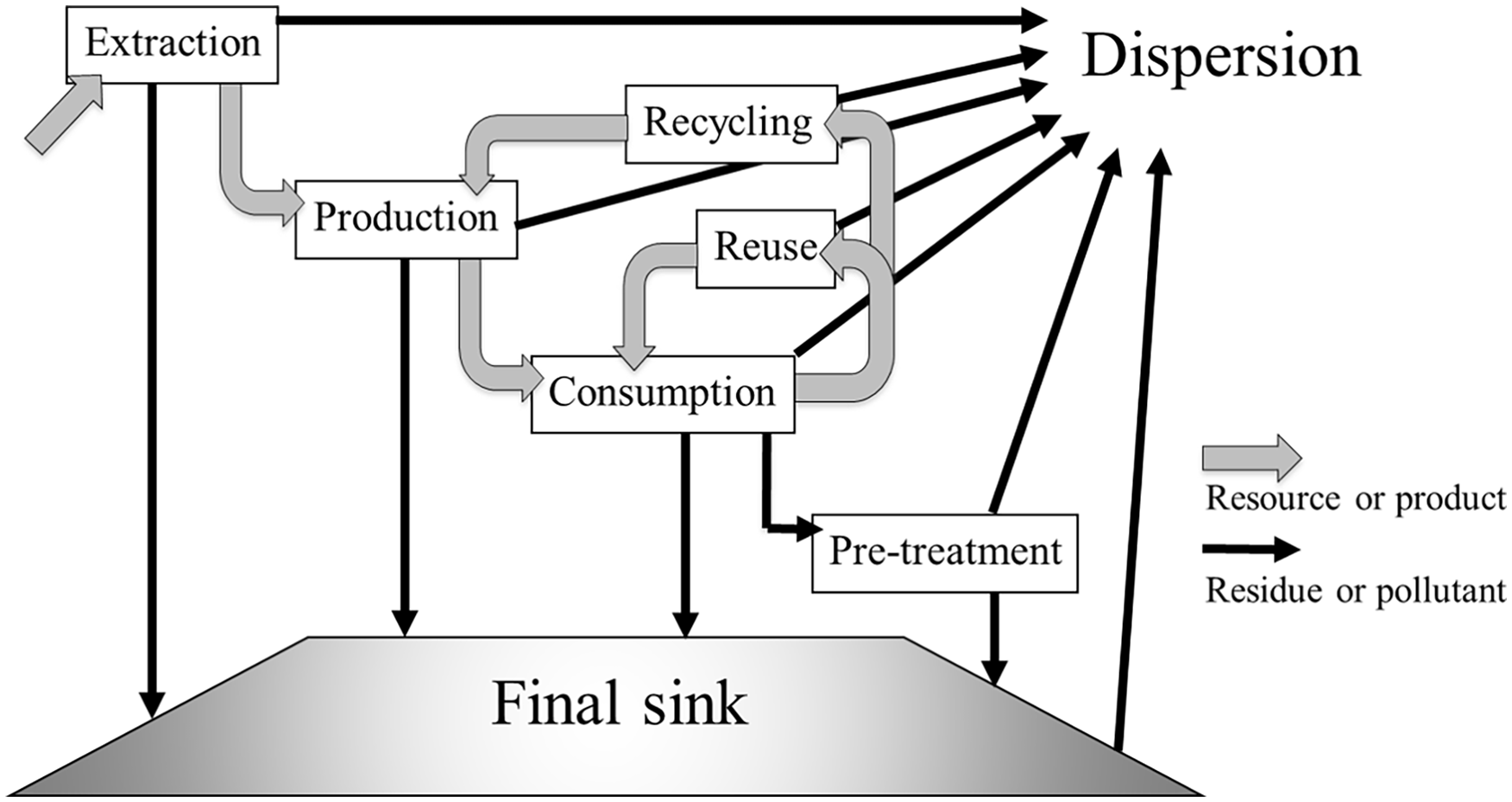
Waste flows in society.
Waste management needs to develop perspectives and concepts that consider all short- and long-term impacts it may have. Perhaps a good starting point would be to recognise that the transfer of matter from society to nature is an essential part of waste management, and we need to develop strategies on how to accomplish this in a manner that preserves environmental quality while protecting human health. To find such solutions, we need to focus more on the understanding of how the form and dose of different wastes will affect recipients and develop technologies to apply this knowledge. In this direction, there is great potential for waste management to contribute uniquely and substantially to the development of environmental sustainability. Ideally, the material output from society could help to restore and improve the biodiversity and productivity of recipients, and in other cases, the balance could be established for tolerable loads. If we maintain our socio-centric view on material flows, as in the WH, we will probably miss this opportunity.