




Abstract
Food waste is one of the main obstacles to transitioning to sustainable and circular food systems. Food waste-reducing platforms (FWRPs) have emerged as low-cost alternatives by donating or commercializing surpluses and non-commercial food. However, as a recent phenomenon, little is known about their actual contribution to the fight against food waste. This study aims to employ a systematic review of the literature to understand the main issues of FWRPs. Our results indicate that technology plays multiple roles in FWRPs: enabling the sharing of surpluses by connecting supply and demand, monitoring and generating data on waste, among others. However, technology is insufficient for food recovery. FWRPs’ business models must be aligned with the sustainability concept, encompassing environmental, economic and social benefits. Innovators must design and prototype solutions to address these various intended functions. This study points out many barriers to implementing these digital platforms, such as delivering multiple benefits for heterogeneous actors. Other barriers involve building trust and changing the behaviour of actors concerning their food habits. The scarcity of empirical studies has limited a better understanding of FWRPs and their actual ability to tackle food waste on a large scale. Despite the limitations found in the literature, digital platforms are an interesting solution to food waste management by promoting food waste prevention and reduction strategies at the source.
Keywords
Introduction
One of the main challenges of the current food systems is waste generation. Inefficiencies in food systems can be perceived through the unsustainable use of natural resources and large amounts of food loss and waste (Chaboud and Daviron, 2017; FAO, 2019; Messner et al., 2021; Willett et al., 2019). In this sense, promoting sustainable development in food systems is impossible without addressing waste management (Foley et al., 2011). Alarming data indicate that food waste is a severe problem for the economy, society and environment (Gustavsson et al., 2011; Papargyropoulou et al., 2014; Parfitt et al., 2010; United Nations Environment Programme, 2021). According to United Nations Environment Programme (2021), about 931 million tonnes of food waste (from retail to consumption level) were generated in 2019, 61% of which came from households, 26% from food services and 13% from the retail sector (United Nations Environment Programme, 2021). Food loss and waste are responsible for provoking 8–10% of global greenhouse gas emissions (Mbow et al., 2019). The costs of food loss and waste reached US$ 1 trillion per year at 2012 prices (United Nations Environment Programme, 2021).
Food waste is considered a paradoxical problem (‘wicked problem’) (Richards et al., 2021). Large quantities of food are wasted while millions of people still live under food insecurity (Chaboud and Daviron, 2017; FAO, 2019, 2021; Papargyropoulou et al., 2014, 2022). Food and Agriculture Organization (FAO, 2021) estimates that between 720 and 811 million people faced hunger in 2020, with around 118 million more people in 2020 than in 2019 due to the COVID-19 pandemic. Feeding the global population, predicted to reach 9.7 billion people in 2050, will demand agriculture to increase production by 40–50%, exerting more pressure on natural resources and exacerbating environmental impacts (FAO, 2017; Willett et al., 2019). Moving food systems towards sustainability is crucial to viable the required increase in the food supply (Richards and Hamilton, 2018). For this, some priorities are imposed, such as significant reductions in food loss and waste and better resource-use efficiency (FAO, 2021; United Nations Environment Programme, 2011).
The urgency to minimize environmental impacts caused by food waste has opened up a series of opportunities for digital technologies (ReFED, 2016; UNEP DTU Partnership and United Nations Environment Programme, 2021). Recently, the digital revolution has changed the logic of the production and consumption of a large number of products and services worldwide (Bonina et al., 2021; Gawer, 2021). Under the pressure of the current environmental crisis and digitalization, many economic sectors have been forced to undergo a profound transformation in their processes (Liu et al., 2019; Samoggia et al., 2021). Digital technologies can be introduced at every stage of the food system (from ‘farm to fork’) (FAO, 2020; World Bank Group, 2019). These technologies can offer a broad spectrum of tools and data to enhance the monitoring and evaluation of food system outcomes.
Among these solutions are food-sharing platforms or food waste-reducing platforms (FWRPs). They emerge as low-cost alternatives among the most diversified food waste reduction solutions (Cane and Parra, 2020). These platforms connect people or organizations who want to sell or donate surplus, unsold or non-commercial (non-aesthetic) food to people or other organizations (producers, supermarkets, restaurants, among others). According to Mazzucchelli et al. (2021), FWRPs can encompass both applications (apps) and/or websites to interact with a wide range of actors from supply and demand, including volunteers and operational staff, companies, non-governmental organizations (NGO), citizens, other stakeholders.
FWRPs also collaborate in the transition from linear to circular supply chains (Ciulli et al., 2020) by reducing surpluses from the diverse stages of the food supply chains and making the recovery process more efficient through surplus redistribution (Mattila et al., 2020; Michelini et al., 2018; UNEP DTU Partnership and United Nations Environment, 2021). These enterprises act as intermediaries connecting multiple actors in food value chains (Ciulli et al., 2020; Mullick et al., 2021).
Nevertheless, FWRPs face multiple challenges. Most FWRPs are still immature, with their business models development characterized by early-stage experimentation. Often, these initiatives do not have all competencies and technical backgrounds regarding the implementation of these new technologies, requiring partnerships and collaboration with technology providers and other actors inside and outside the food system (Ciccullo et al., 2021). Garrone et al. (2014) state that food recovery is often constrained by operational and economic issues, such as logistics and high costs. Another challenge is stimulating actors to reconsider their waste generation, whether families, individuals or organizations. Many food system actors recognize and feel responsible for throwing food in the trash, but they cannot explain why (Ganglbauer et al., 2015). In this context, it is necessary to understand the behaviour of producers and consumers and encourage them to adopt more appropriate food waste management practices (Cane and Parra, 2020). Therefore, these initiatives can face multiple implementation barriers which should be better understood.
Despite the proliferation of FWRPs, little is known about the barriers and challenges regarding their adoption and implementation processes. Empirical studies are scarce (Harvey et al., 2020), with insufficient knowledge about the determinant factors for their success (Mazzucchelli et al., 2021). Most studies explore specific cases, lacking a systemic view of these platforms. There is a lack of studies aiming to discuss how green and digital technologies contribute to minimizing food waste (Morone et al., 2018; UNEP DTU Partnership and United Nations Environment, 2021). As a recent phenomenon, it is necessary to understand in depth how these solutions are inserted in the fight against food waste (Cane and Parra, 2020).
Given this context, this study proposes employing a systematic review of the literature to understand the main issues of digital platforms aiming to tackle food waste. Our contribution is to present the state of the art of these solutions by addressing the following main objectives: (a) identifying the role of technology and other relevant factors to the success of FWRPs; (b) exploring how FWRPs address environmental, social and economic issues related to food waste, and (c) uncovering possible gaps and future opportunities for a better understanding of this phenomenon. This study contributes to the existing literature by providing a deeper understanding of FWRPs.
This paper is structured as follows. Section ‘Materials and methods’ presents the steps to proceed with the systematic literature review (SLR). Section ‘Results and discussion’ unfolds the main results obtained through the literature, and the final section brings the conclusions and limitations of the study.
Materials and methods
An SLR was employed to achieve the research objectives. SLR is a method based on a research strategy to identify the most relevant literature topics related to the question to be investigated (Briner and Denyer, 2012; Hernandes et al., 2012). This method identifies which discussions are the most pertinent about the topic of interest from the literature. However, SLR is not limited to summarizing the literature, thus providing new visions and conclusions. Furthermore, this method allows identifying gaps in the literature that configure opportunities for future studies on the specific topic. Systematic reviews aim to minimize bias using pre-defined research questions and methods documented in a research protocol. SLRs are designed to be methodical, explicit and reproducible (Higgins and Green, 2008; Lasserson et al., 2022; Mulrow, 1994; Sampaio and Mancini, 2007).
However, a systematic review requires attention to how the information is organized to achieve the expected results. Therefore, the SLR steps must be defined in advance to conduct the research correctly (Denyer and Tranfield, 2009; Higgins and Green, 2008). The first step is elaborating a research protocol and contextualizing the problem to be addressed in the study. At this stage, the research questions, objectives and search databases are defined (Denyer and Tranfield, 2009; Tranfield et al., 2003). The following steps comprise collecting and processing data according to selection and exclusion criteria and applying the filters chosen previously. In the next step, data selection is proceeded with using or not a software and, finally, the data analysis with interpretation and dissemination of results (Zupic and Carter, 2015).
In this study, the researchers adopted the open-access software StArt (State of the Art) developed by the Laboratory of Research in Software Engineering of the Federal University of São Carlos. Using the software StArt is possible to organize the documents found in the databases from the search filters (search strings) and apply the selection and exclusion criteria (selection of documents considered pertinent to run the study).
StArt supports all phases of systematic review, including the planning and execution of research. StArt allows the process of extracting bibliographic information and organizing documents from research bases. For example, StArt organizes the documents, including screening and classifying the most relevant documents. Throughout the screening process, the software lists all documents selected and accepted by the researchers. StArt also checks the information of each document (data extraction form, inclusion and exclusion criteria, quality criteria, comments) (Fabbri et al., 2016).
Data collection
The Web of Science and Scopus were chosen for data collection since these databases cover food waste issues, comprising sources from different topics (innovation, business model, sustainability). In addition, they are recognized by an extensive amount of indexed journals. Data collection took place in October 2021.
In the search process, eight search strings 1 were proposed through the combination of the following keywords: ‘food sharing apps’, ‘food waste’, ‘food sharing platforms’, ‘food waste platforms’, ‘food digital platforms’. The search resulted in 270 documents: 136 from Scopus and 134 from Web of Science. Only articles in English were selected for the study. The following document types were considered: articles, book chapters and conference papers. Beyond articles and book chapters, we included conference papers in this study due to the scarcity of literature about FWRPs since they are a recent phenomenon.
Data selection
In all, 270 documents from the data collection phase were saved in BibTex format and imported into the Start tool to run the selection phase. To ensure the consistency of the study, inclusion and exclusion criteria were proposed: (1) inclusion: types of documents, such as articles, book chapters and conference papers; full-text access; studies written in English; studies associating the use of platforms to food waste reduction (2) exclusion: documents other than articles, book chapters and conference papers; studies not completed and written in a language other than English and studies not associated with the use of platforms with food waste reduction.
Data analysis
After removing 51 duplicated documents, 219 remained in the database, as shown in Figure 1. From screening the title and abstract, we excluded 180 documents. In all, 39 archives were considered for the extraction process of StArt and read in full. At this phase, we rejected 21 studies that were not relevant to the research or did not meet the inclusion criteria, remaining only 18 documents. Most of the discarded articles did not address the use of digital platforms for food waste reduction.
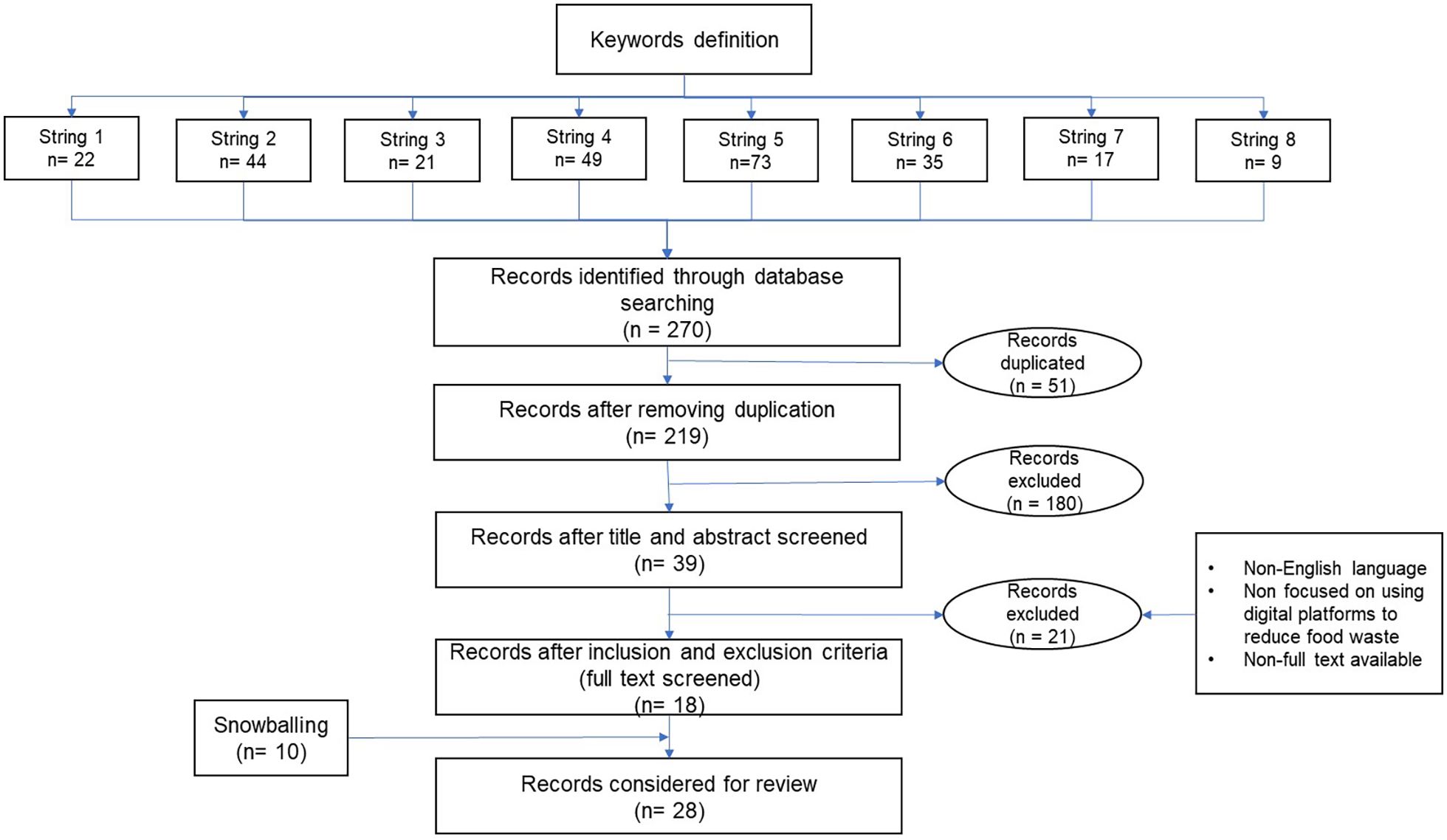
Flow diagram of the systematic review.
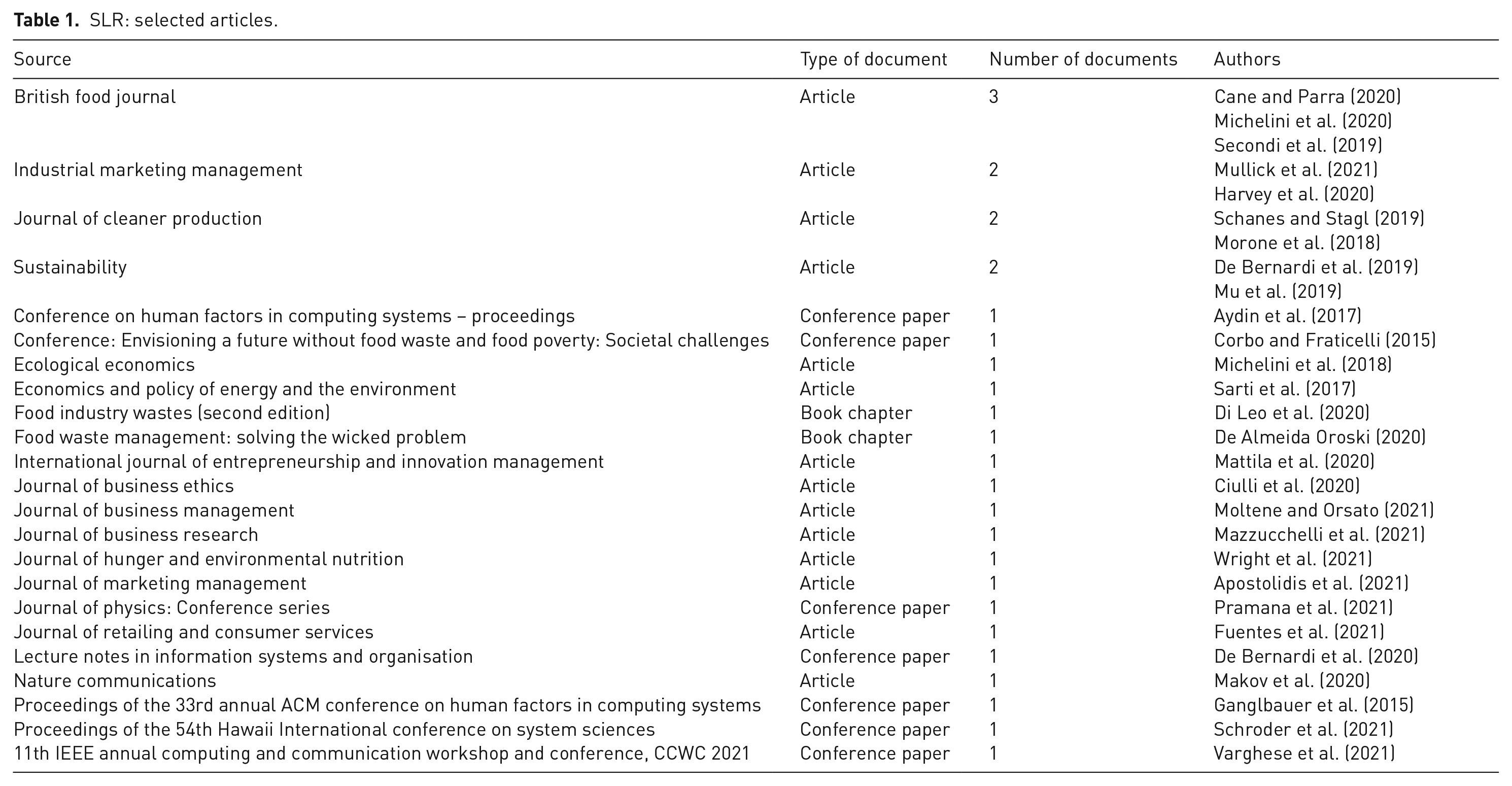
In addition, the authors performed a manual search to verify that important documents were not considered in the previous search process. Other studies were added to complement the research. The snowballing technique was adopted, following Wasserman and Faust (1994). In total 10 documents were added at this step since they met the inclusion criteria. Figure 1 shows the detailed flowchart of the systematic review, and Table 1 provides a list of 28 documents considered for systematic review. These articles were published between the years 2015 and 2021, indicating FWRPs as a recent phenomenon.
SLR: selected articles.
Results and discussion
Based on the systematic review of literature, we analysed 28 documents identifying six main issues around FWRP: (1) FWRP as a sharing economy practice; (2) Beyond the technological perspective: FWRP as business model innovation; (3) FWRP as sustainable business models (SBMs): delivering more than economic benefits; (4) Features and prototypes: designing functionalities to deliver multiple value propositions; (5) Types of FWRPs; and (6) Main barriers and challenges faced by FWRP.
FWRP as a sharing economy practice
The emergence of new economic models justifies the flourishment of FWRPs, such as the sharing economy (Michelini et al., 2018, 2020; Morone et al., 2018; Schanes and Stagl, 2019) and the alternative food networks characterized mainly by short food supply chains (SFSC) (De Bernardi et al., 2019, 2020). Most authors (e.g. Michelini et al., 2018; Morone et al., 2018) adopt a broader perspective for the sharing economy, encompassing multiple activities facilitated by digital platforms, enabling people and/or organizations to share goods, resources and knowledge from multiple transactions, comprising those aimed at for-profit generation as well.
According to Harvey et al. (2020), new food-sharing practices have grown significantly through different models, highlighting the donation and selling of food surpluses and non-aesthetic food through digital platforms. Digital platforms enable and optimize food recovery based on sharing practices for human consumption (Di Leo et al., 2020). Cane and Parra (2020) believe the increase in new food consumption practices explains a higher adherence to digital platforms. These solutions maintain these resources more time into food systems avoiding waste generation. Food recovery for human consumption is the preferred option in the food waste management hierarchy, preventing food from becoming waste (Cane and Parra, 2020).
In their study, Michelini et al. (2018) discuss the multiple definitions of sharing economy, underlining how these platforms induce social connections fostering networks among multiple stakeholders. However, the authors understand that the emergence of these networks requires miscellaneous efforts from FWRPs. In their paper, De Bernardi et al. (2019) draw attention to SFSC and their effects on people’s behaviour changes and ideas co-creation process. The discussion is grounded in building networks and understanding the relationships among heterogeneous actors based on knowledge-sharing practices.
Mazzucchelli et al. (2021) shed light on the role of consumers in food-sharing initiatives, depicting how these actors interact, build and support solid relationships for value co-creation. Ciulli et al. (2020) point out the need to change food system actors’ perception of food surpluses and waste generation. For this reason, the role of platforms encompasses functionalities such as educating people and organizations (increasing awareness about food waste and its impacts) and promoting individual and collective behavioural changes (Ciulli et al., 2020).
In the food supply chains, actors are, in general, disconnected. Food system actors are unaware of the processes occurring in other value chain stages and their respective environmental impacts (e.g. waste generation). For Ciulli et al. (2020), FWRPs fill this gap by proposing connections among food system actors. For the authors, the Circular Economy concept appears as an opportunity to encourage new production and consumption practices. Formerly considered environmental problems, waste flows can now be reinserted into value chains, reconceptualizing them as valuable resources.
According to the literature, FWRPs emerge from a landscape that spurs new food consumption practices. However, despite platforms being a way to leverage new consumption practices, it is necessary to understand consumers’ behavioural responses and their propensity to adopt these new tools.
Beyond the technological perspective: FWRP as business model innovation
Digital platforms appear in an environment marked by growth and appreciation of digital technologies in various sectors and activities of our modern life (Mazzucchelli et al., 2021; Michelini et al., 2018). Digitalization has been promoting relevant advances both in the production and commercialization of products and services (Schroder et al., 2021). In this context, technology exerts a central role in FWRPs with multiple and diversified functionalities such as (1) reducing waste based on food surplus recovery (e.g. Michelini et al., 2018); (2) connecting donors and recipients by increasing the effectiveness of sharing and circular practices and shortening food supply chains (Ciulli et al., 2020; Corbo and Fraticelli, 2015; Mazzucchelli et al., 2021; Michelini et al., 2018; Moltene and Orsato, 2021); (3) transforming consumers’ food consumption and waste practices (Aydin et al., 2017; Harvey et 2020; Mazzucchelli et al., 2021); (4) reducing food insecurity, allowing the donation or selling of quality food at affordable prices (Apostolidis et al., 2021; Corbo and Fraticelli, 2015; Harvey et al., 2020); (4) enhancing visibility to donation process (Ciulli et al., 2020; Di Leo et al., 2020; Varghese et al., 2021); (5) allowing new entrants into food systems (Ciulli et al., 2020); (6) fostering valorization opportunities of surpluses and non-aesthetic foods (Ciulli et al., 2020); and (7) measuring food waste turning this problem more visible for food system actors and society (Ciulli et al., 2020; Mattila et al., 2020).
For Ciulli et al. (2020) and Di Leo et al. (2020), FWRPs exploit various opportunities based on digital technologies by creating business models around rescuing food waste from landfills. In this sense, some authors (e.g. De Almeida Oroski, 2020; Di Leo et al., 2020; Mattila et al., 2020; Michelini et al., 2018; Sarti et al., 2017; Secondi et al., 2019) consider FWRPs more than technological innovations underlying their business models. For these authors, the business model concept refers to a logic that portrays how an enterprise creates, delivers and captures value. De Almeida Oroski (2020) follows the business model definition from Teece (2010): a business model describes the design or architecture of the value creation, delivery and capture mechanisms involved.
Mattila et al. (2020) also understand that a digital platform’s success depends intrinsically on the adopted business model. Even so, while important, the technology is insufficient to guarantee the success of platforms in food recovery. FWRPs primarily need to be good administrators, optimize the use of scarce resources (Mazzucchelli et al., 2021) and establish partnerships to access assets out of their direct control (Schroder et al., 2021). According to Mazzucchelli et al. (2021) and Michelini et al. (2020), FWRPs innovators should design business models to conciliate their value propositions with operational and financial constraints. The articles cited above demonstrate that the literature about FWRPs and their implementation has not been narrowed by a technological vision, incorporating the business model concept. Several authors see the business model as essential to enable the use of technology, as stated by the business model theory (e.g. Chesbrough, 2010).
Some articles focus on exploring case studies and identifying different digital platform types (e.g. Cane and Parra, 2020; De Almeida Oroski, 2020; Michelini et al., 2018; Sarti et al., 2017), which leads to the consequences over the business model’s choices. Decisions about: what to offer (value proposition), to whom (beneficiaries), how (structuring resources and competencies, partnerships) and revenue generation models (value capture) permeate the business model design and are strongly related to the type of platform, which will be discussed further in Section ‘Types of FWRPs’. Most authors signalled tensions intrinsic to the business model decisions, albeit few studies explored in depth how they occur empirically. Despite the business model literature (e.g. Sosna et al., 2010; Teece, 2010) indicating that experimentation and learning are likely to be required along the innovation process, the literature on FWRPs does not focus on business model adjustments along the experimentation and learning time. As a recent phenomenon, we understand that business models often change and must be adapted to external conditions that are not always favourable for these innovations. Hence, more efforts should be applied to comprehend the business model innovation process around FWRPs.
FWRP as SBMs: Delivering more than economic benefits
Some of the studies (Mattila et al., 2020; Mazzucchelli et al., 2021; Michelini et al., 2018, 2020; Mu et al., 2019; Secondi et al., 2019; Schroder et al., 2021) understand FWRPs as examples of SBMs. Mu et al. (2019) state that digital platforms act as instruments to boost sustainability transitions based on sustainable food practices. FWRPs are characterized as SBMs by their multiple value propositions (economic, social and environmental benefits). For instance, Michelini et al. (2018) and Mazzucchelli et al. (2021) argue that the insurgency of digital technologies accelerates the sharing economy and, vice-versa, by generating multiple benefits in the direction of sustainability.
Mattila et al. (2020) and Schroder et al. (2021) adopted the SBM concept to explore how FWRPs can contribute to sustainability in food systems. An SBM must incorporate a triple bottom line approach, considering economic, social and environmental benefits in their value propositions to a wide range of stakeholders (Bocken et al., 2014; Boons and Lüdeke-Freund, 2013). Boons and Lüdeke-Freund (2013) argue that SBMs must re-evaluate the maximization of products or services performance to prioritize social and environmental benefits. The insertion of the SBM concept in FWRPs’ discussion indicates that the authors realized the need to link the business models’ development with the sustainability requirements, in line with the sustainable innovations literature (e.g. Laasch, 2018; Boons and Lüdeke-Freund, 2013).
In their study, Mattila et al. (2020) investigated two cases, Waste Master and ResQ Club, to identify how these platforms meet sustainability requirements. Under the economic dimension, these platforms allow their partners (food sellers) to acquire new customers, reduce waste treatment costs and create new business opportunities by selling their surpluses. The environmental dimension includes the most efficient use of resources and the lowest emission of greenhouse gases by reducing the amount of organic waste in sanitary landfills. Mattila et al. (2020) also highlight that digital platforms transform food waste from an invisible problem to visible data allowing food system actors to estimate food waste magnitude and choose more adequate waste management strategies.
Under the social dimension, FWRPs theoretically allow lower-income consumers to access good quality food at reduced prices. The studies of Wright et al. (2021) and Apostolidis et al. (2021) evaluated how food recovery can benefit vulnerable populations such as those at the bottom of the pyramid with more propensity to be exposed to food insecurity. However, these studies confirmed that these solutions only alleviate hunger since these people have access to the Internet, an important obstacle in low-income countries. Cane and Parra (2020) highlighted the relevance of a social commitment, arguing that an FWRP only makes sense if the social promise is fulfilled and prioritized in their business models.
Despite most articles highlighting the potential benefits of FWRPs, we perceived some gaps in the literature about the actual capacity of FWRPs in addressing multiple value propositions to a wide range of stakeholders. Mattila et al. (2020) use the SBM approach to unpack the multiple value propositions FWRPs can offer. However, their study does not explore tensions derived from different stakeholders and their interests. In general, the literature seems to undervalue the difference among the actors and their motivations to engage in food-sharing practices. Apostodolis et al. (2021) recommend an in-depth understanding of consumers’ perceptions of the value proposed by FWRPs. The perception of people about FWRP can vary according to multiple aspects (income levels, cultural aspects, geographical context, among others).
In this sense, Michelini et al. (2020) proposed filling this gap, exploring the miscellaneous impacts of food-sharing platforms and the tensions arising from attempting to reconcile multiple value propositions. The authors signalled that multiple value propositions often create internal constraints such as greater organizational complexity and a growing need for resources and operational costs. Therefore, balancing the offering of multiple value propositions and decisions about business model components is essential to FWRPs’ survival.
Another gap in the literature is measuring the actual impacts derived from FWRP activities. None of the studies investigated whether platforms succeeded or failed in contributing positively to environmental impacts. Although the studies of Michelini et al. (2020) and Makov et al. (2020) recognize the social and economic benefits the sharing economy can give rise to, they point out the need for future studies to measure the actual environmental impacts of FWRPs. For the authors, quantitative studies are still scarce since most of the literature is based on a qualitative approach. So far, the published studies have been concerned with describing the platforms’ business models, not exploring how innovators structured business models under the sustainability paradigm. There is also little discussion about the capacity of these instruments to recover food and effectively contribute to reducing food insecurity and minimizing food waste on a large scale.
Features and prototypes: Designing functionalities to deliver multiple value propositions
Some papers explored how innovators designed and prototyped FWRPs considering various functionalities. These few studies investigated the empirical cases of FWRPs to scrutinize their development process.
Pramana et al. (2021) analysed the ‘Re-Food’ platform, a social business created in Lisbon, Portugal, to identify the essential steps for prototyping an application based on critical customer needs. The first step is to map the problems the platform expects to solve, followed by prototyping and testing the business model adherence (how the product fits the market requirements, promotes customer acquisition and generates revenues). Varghese et al. (2021) based their research on the Indian application ‘SeVa’, identifying essential steps for creating a functional platform: mapping stakeholders’ interests and customer needs to influence the conceptual design. For the authors, an application must develop features that provide extensive knowledge about the food to be sold or donated (e.g. food safety aspects) to increase people’s engagement.
Aydin et al. (2017) explored the development of the ‘Save the Kiwi’, a platform whose proposal offers tools to encourage more sustainable food consumption habits. The authors argue that the FWRPs’ features must contribute to attracting and engaging users and stimulate them to plan better food acquisition to avoid waste. They developed persuasion techniques through the application’s interface to allow users to understand their current food habits and nurture behavioural changes. Nevertheless, the authors recognize the need to investigate the users’ behaviour through long-term studies. Mapping the leading causes of food waste, Ganglbauer et al. (2015) structured a case study about the German app ‘The Food Waste Diary’. The authors discuss how FWRPs capture daily routines (behaviours, habits, emotions and patterns), influencing food consumption and waste generation attitudes.
According to Moltene and Orsato (2021), data protection in payment transactions is considered critical for potential adopters. The authors explored the perceptions of Brazilian users of Ecofood, a platform that sells surplus and unsold food from food services such as bars and restaurants at reduced prices. Their results reinforce that FWRPs face more resistance to being adopted in contexts where these solutions are unknown. Based on multiple case studies, Ciulli et al. (2020) identified essential functionalities FWRPs must enhance beyond connecting food supply and demand sides. These functionalities provide more data security in transactions and foster better communication among the actors to avoid misinformation and possible future conflicts.
Finally, as Fuentes et al. (2021) pointed out, developers must design these tools to work as a ‘catalyser’ of new food consumption practices, taking into account users’ reality in the foreground. The authors emphasize that developers must advance in the design of an application and its respective script (‘zooming out’). Prototyping the design of a new application is critical to providing the intended functionalities to heterogeneous stakeholders and improving the user experience. More empirical studies are required to unfold the decision process regarding functionalities and the prototyping phase of FWRPs, bringing lessons learned from established FWRPs.
Types of FWRPs
Some of the selected documents propose archetypes to differentiate FWRPs under several aspects: value propositions (food recovery or food prevention by educating people or optimizing operational processes), types of transaction (donation or selling), value capture model (for-profit or non-profit generation), key activities (food recovery management, logistics and transport, among others), types of actors involved (private companies or NGOs, citizens, workers or volunteers, others) and stage at the value chain (agriculture, processing, retail, food service, consumption), among others. Based on the cases explored by the articles, it is possible to affirm that there is a broad range of digital platform types and strategies for creating and delivering value in food waste reduction.
Michelini et al. (2018) classified the platforms according to their intended purposes, transaction types and subsequent sharing models. Analyzing 52 food-sharing platforms, the authors identified three patterns: (1) sharing for money are business-to-consumer for-profit platforms that commercialize surpluses and non-standard products; (2) sharing for charity is a non-profit model when food is collected from food donors (e.g. supermarkets or food service) and distributed to charities (food banks and NGOs); (3) sharing for the community are non-profit platforms which enable food exchange and sharing between citizens.
Among the most diversified types of FWRPs are those aiming to change food consumption habits through educating people. These platforms encourage food planning by individuals or families, educating consumers about good practices to avoid surpluses and waste (Cane and Parra, 2020; Mazzucchelli et al., 2021; Schroder et al., 2021). These platforms teach their users better shopping and storing practices and the integral use of food (e.g. reframing how people classify inedible parts such as fruits and vegetable peels).
For Ciulli et al. (2020), FWRPs can be differentiated in terms of functionalities they address to minimize food circularity barriers. The authors identified six roles platforms could perform in food recovery to bridge circularity holes (missing linkages between waste generators and potential receivers): connecting, informing, protecting, mobilizing, integrating and measuring. The authors also intertwined how platforms play these roles and their challenges in enabling those functionalities. In short, platforms can act differently according to the intended functionalities.
Schroder et al. (2021) categorized platforms into three types based on the functions performed and positions in the value chain. According to Corbo and Fraticelli (2015), FWRPs can be classified based on types of transactions, actors involved and mediators between food supply and demand. De Almeida Oroski (2020) proposed the segmentation of platforms depending on the main business model components: (a) value proposition (food prevention or food recovery), (b) value creation (platforms that only intermediate supply and demand and platforms that provide other services such as transport and the whole management of the food recovery); and (c) value capture (for-profit or non-profit orientation). Sarti et al. (2017) also divided FWRPs into archetypes categorizing the platforms according to the value capture model (for-profit or non-profit), types of transactions, actors involved and strategies for reducing food waste.
In general, most of the studies were concerned with describing different types of FWRPs, with few scrutinizing the relation of FWRPs types and consequences in their business model structuring process. Decisions about value propositions affect the functionalities and activities developed by platforms. However, this dynamic is still undervalued by the studies.
Main barriers and challenges faced by FWRPs
Despite the literature pointing out multiple benefits FWRPs can give rise to, several barriers and challenges limit their actual performance. Almost all documents addressed barriers and challenges innovators must overcome, from FWRPs setting up to obstacles intrinsic to their operational phase. The solutions cited by the literature are also identified as follows.
Those studies signalized that developing a relationship based on trust between the platforms and their potential users is a critical barrier to FWRPs adoption (Harvey et al., 2020; Mazzucchelli et al., 2021; Moltene and Orsato, 2021). Apostolidis et al. (2021) believe that stimulating trust is essential to overcoming social and cultural barriers to consuming food through food-sharing platforms. The social stigma faced by potential users, mainly low-income users at the bottom of the pyramid, inhibits the adoption of food-sharing apps. According to Secondi et al. (2019), increasing consumer awareness of food waste consequences is an excellent strategy to trigger behavioural changes. For Mullick et al. (2021), the solution is to improve the consumer experience by promoting interactivity and digital compatibility through adapting FWRPs design to customer preferences. Moreover, the adoption of FWRPs can be encouraged by proposing extra and differentiated services.
In their article, Mazzucchelli et al. (2021) depicted some of the critical aspects responsible for the success of FWRPs. They argue that indispensable factors for users’ decisions concerning the adoption of FWRPs involve: changing consumer’s behaviour (as cited by Cane and Parra, 2020; Ganglbauer et al., 2015; and Mullick et al., 2021) by stimulating the engagement of the users and the community (‘the feeling of being part of’) and promoting a better knowledge about the platform technology (‘to be user-friendly’). Morone et al. (2018) and Schanes and Stagl (2019) also investigated barriers to FWRPs adoption: lack of consumers’ collaborative behaviour and low perception of economic, social and environmental benefits. These studies reveal a strong linkage between consumers’ consciousness about their environmental, social and economic responsibilities and a behavioural response.
Exploring the Karma application case at its early-stage development, Fuentes et al. (2021) identified that the application failed due to some design problems, impairing its performance during the field test. The authors showed that a significant challenge is reconsidering consumers’ deep-rooted food habits. The distance between intention and practice must be considered to stimulate users’ adoption. Harvey et al. (2020) explored the OLIO platform, and they noticed that low reciprocity among the actors narrows the effectiveness of the network established between donors and recipients. Harvey et al. (2020) suggest that innovators must adapt the technology to boost exchange and reciprocity. Pramana et al. (2021) also agree that investing in technology adjustments to improve the user’s interface is required to overcome a set of difficulties before launching a digital platform.
As discussed in Section ‘FWRP as sustainable business models: Delivering more than economic benefits’, another challenge of FWRPs, often cited by the literature, is balancing economic, social and environmental benefits in multiple value propositions. FWRPs must attend to multiple stakeholders’ interests (Michelini et al., 2020). Mattila et al. (2020) state that these tensions occur mainly in operational activities when the key activities are not aligned to other business model components (value proposition and value capture), stressing FWRP’s business model viability. Decisions about which activities to perform are critical to ensure economic sustainability.
The lack of regulation in some countries regarding the safety of shared foods appears as a relevant barrier to FWRPs adoption (Sarti et al., 2017). In general, food donors or sellers are self-responsible for food safety control. However, FWRPs often require new partners to implement food safety protocols before authorizing them to use the platform to sell or donate food. On the other hand, consumers may feel insecure and often stigmatized about the misconception of the quality of food transacted by platforms (stigma associated with the idea that food surplus is leftover) (Apostolidis et al., 2021; Moltene and Orsato, 2021). Therefore, the authors recommend implementing traceability mechanisms to permit users to accomplish the food recovery process with higher transparency (Ciulli et al., 2020; Mullick et al., 2021; Sarti et al., 2017).
According to Ciulli et al. (2020), one of the main barriers to promoting circularity in food systems and minimizing waste generation is the lack of information among the food system actors. For instance, the authors cited the difficulties in promoting the application’s interface with the operational and informational systems of food donors and sellers such as supermarkets.
Lastly, the barriers mentioned above reveal that FWRPs entrepreneurs must be concerned about several aspects beyond the technological perspective. As cited before, due to the limited number of empirical studies, there is a lack of more detailed observation about barriers and challenges faced by innovators intrinsic to the implementation phase of these technologies. Hence, we suggest more case studies on platforms be carried out in different geographical and cultural contexts to observe peculiarities regarding adopting and implementing these solutions against food waste. Table 2 shows the six main topics the literature addresses about FWRPs.
Main topics addressed by the literature about FWRPs.
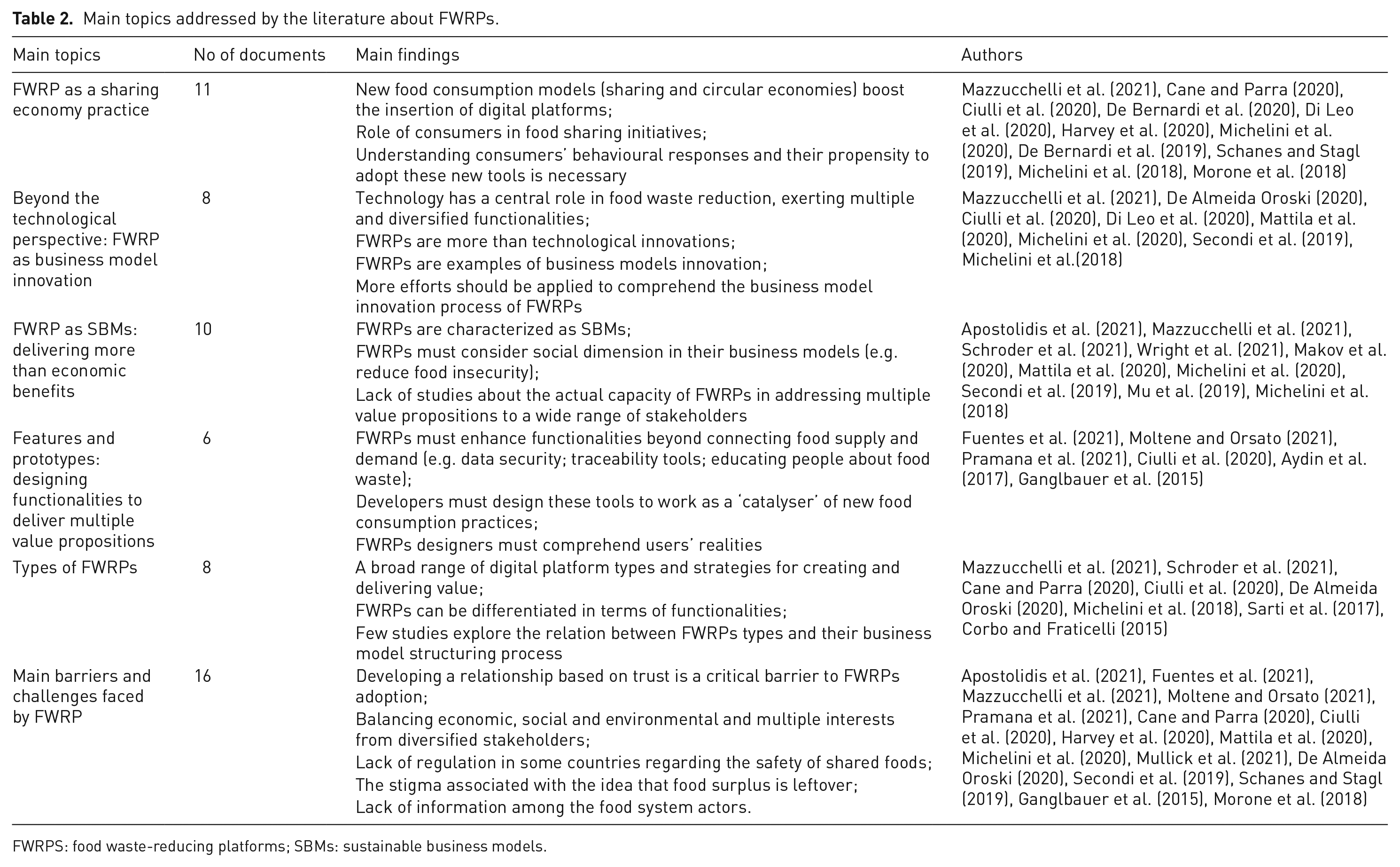
FWRPS: food waste-reducing platforms; SBMs: sustainable business models.
Conclusions
This systematic review sheds light on critical issues related to FWRPs, bringing meaningful insights. This review confirms the crucial role of technology in enabling digital platforms for food waste management. Digital technologies support various functions, extrapolating the connection between food supply and demand, encompassing measuring and monitoring food waste, educating and raising awareness about food waste consequences among the food system actors. In this sense, FWRPs are more than mere digital marketplaces. The studies understand FWRPs as a means to promote new economic models such as sharing and circular economies.
Multiple factors beyond the technology appear as relevant for the success of these initiatives. FWRP cannot be narrowed to technological innovation approach to tackling food waste. For entrepreneurs, creating sustainable and circular business models are crucial to encompass multiple functionalities and address sustainability requirements. For consumers, FWRPs represent new ways to access food, impacting their food practices.
Implementing FWRPs requires building SBMs that provide economic, social and environmental benefits. FWRPs go beyond tackling food waste to minimize environmental and economic impacts. Most studies agree that these solutions must concern the delivery of social benefits by reducing food insecurity. In general, FWRPs collaborate towards sustainability by minimizing (1) environmental impacts (waste reduction), (2) social impacts (reducing food insecurity by increasing food affordability to people under social vulnerability, and (3) economic impacts (diverting edible food from organic waste streams to donation or secondary markets). FWRPs exemplify that waste management often involves a social dimension in decisions about the best option.
Nevertheless, there is still a gap in the literature regarding the actual capacity of these initiatives to deliver multiple value propositions and the consequences on their competitiveness and long-term survival. Most studies focus on describing the business models of these initiatives and do not focus on understanding the dynamics around the adaptation process and the choices they undergo to balance the delivery of multiple value propositions with limited resources. Few examples in the literature discuss how FWRPs access complementary competences and assets to deliver their intended value propositions. The literature misses unpacking how FWRPs balance the social value proposition with economic goals. A lack of empirical studies impairs in-depth observation of how these initiatives operate and how their respective business models are structured and adapted to avoid resulting tensions.
Furthermore, there are few studies to understand people’s behavioural responses in the face of new consumption practices such as food sharing through digital platforms. Despite most studies suggesting the adoption of FWRPs depends on individuals’ and organizations’ awareness of their social and environmental responsibilities, it is still unclear how to transform intention into practice through changing food habits.
This systematic review revealed that despite the rapid proliferation of digital platforms in the fight against food waste worldwide, more effort is still needed to understand in depth how these technologies actually work, exploring the main barriers and challenges to their adoption and implementation and the actual effects they exert on the reduction of food waste at large scales.
This study was the first attempt to systematically gather the results from the existing literature on the topic and identify critical factors highlighted by existing research and possible opportunities for future studies. One of the main limitations of the study is the low number of publications. It was not possible to discuss regional differences that could affect the adoption and performance of these solutions in a comparative analysis. Hence, we recommend that researchers explore more case studies of digital platforms against food waste to enrich the analysis of the role of technology and its relationship with the proposed SBMs. Furthermore, we suggest that longitudinal studies must be carried out to understand how these initiatives adapt themselves to different social, economic, cultural and political conditions.
Footnotes
Declaration of conflicting interests
The authors declared no potential conflicts of interest with respect to the research, authorship, and/or publication of this article.
Funding
The authors received no financial support for the research, authorship, and/or publication of this article.
