




Abstract
A circular economy (CE) aims to reduce waste and encourages keeping products, components, and materials circulating in the economy. Furthermore, following the European waste hierarchy, preparing for re-use (PfR) is regarded as a better waste management option than recycling. Nevertheless, too many products with a reuse potential end up as waste. This includes residuals from products that have no major value and are therefore not demanded by the current system. As a result, products are prematurely recycled. This contradicts both the priority order of the waste hierarchy and the principles of a CE. This article investigates the potential of and constraints to reusing products that are disposed of at municipal recycling stations. It aims to improve our understanding of these issues and offers possible solutions that could enable municipal waste companies to transition from waste to resource management and reach the upper levels of the waste hierarchy, preparing waste for re-use. Interviews with relevant stakeholders, desk studies and knowledge obtained from participating in waste conferences over the past 3 years are all used to analyze PfR practice at five municipal waste management companies in Denmark. Pioneers with respect to circularity in the waste sector, which have been experimenting with and initiating PfR schemes concerning a range of products, including building materials, furniture, white goods and bicycles, are considered because they support the inner cycles of the CE. However, results reveal that the current transition consists of complex processes connected to an ambivalent legal framework and struggles over access and rights to resources. Further, a more coherent conceptual understanding of PfR is needed as the current understanding has a too narrow focus on restoring product value rather than coupling PfR processes to the market. Thus, challenges to achieving higher PfR rates seem to go beyond engaging in strategic partnerships, creating financial incentives and setting separate targets for PfR. Consequently, a more holistic investigation appears to be necessary to deepen our understanding of processes of resource management and use and the contestation that exists over these. Furthermore, a wider mapping of the actors operating in the tension area of PfR, including their willingness to cooperate and negotiate a zone of agreement, could prove beneficial to practitioners and policy developers alike.
Introduction
Challenges related to waste management is one of the drivers in a circular economy (CE) (Ghisellini et al., 2016), and waste is perceived as a resource (Ellen MacArthur Foundation, 2015). The European Waste Framework Directive (WFD) (Directive 2008/98/EC), later amended by Directive 2018/851, sets the frame conditions for waste management planning in the European Union (EU) (2008, 2018). The central principle is the ‘waste hierarchy’, formulated in Article 4, which shall ‘apply as a priority order in waste prevention and management legislation and policy’ (European Union, 2018). The first option is (a) ‘prevention’, followed by (b) ‘preparing for re-use’ (PfR), (c) ‘material recycling’, (d) ‘recovery’ and finally (e) ‘disposal’. When applying the waste hierarchy, Member States shall take measures to encourage the options that deliver the best overall environmental outcome (2008/98/EC). Once products have become waste, PfR is – in most cases – the preferred waste management option over recycling, as reuse is often environmentally preferable to material recycling and the manufacturing of new products. PfR is defined in the WFD as ‘checking, cleaning, or repairing and recovery operations by which products or components of products that have become waste are prepared so that they can be reused without any other pre-processing’ (2008/98/EC). Nevertheless, waste management has moved steadily upwards in the waste hierarchy (Milios and Dalhammar, 2020; Williams, 2015), contradicting the downward prescription formulated in the WFD. Moreover, the waste hierarchy lacks clarity in terms of overlap between measures (Gharfalgar et al., 2015). In the case of Denmark, the overall focus within municipalities is on the challenge of implementing separate collections and increasing the amount of collected waste fractions for recycling rather than on PfR. This was the clear result of a review of the waste plans of the 28 municipalities in the capital region of Denmark (Remmen, 2019).
The amendments of Directive 2018/851 were an element of the circular action plan communicated by the Commission in 2015. The aims of these amendments were for waste management to be ‘transform[ed] into sustainable material management’ and ‘promote[ing] the principles of the circular economy (CE) focusing on the whole life cycle of products in a way that preserves resources and closes the loop’ (Consideration 1). These statements indicate that measures for prevention and PfR should be expanded. On the other hand, the amendments also increased ambitions concerning collection rates for separated waste for recycling and expanded the numbers of waste fractions for separate collection in households (e.g. textiles from 2025). In other words, the amendments in 2018 indicated the beginning of a transition from traditional waste management (where most attention is paid to the bottom of the waste hierarchy) upwards, by increasing separate collections of more waste streams for ‘real’ recycling and by giving more attention to PfR and CE. The Directive encourages repair activities through the notion of ‘reuse and repair networks’, both as non-waste in Article 9 and as waste in Article 11 (European Union, 2018). Therefore, PfR can be considered a ‘new’ focus area and thus the core focus of this article. Nevertheless, only a few case studies in the existing scientific literature have investigated the potential for PfR in recycling centres (Milios and Dalhammar, 2020).
In this contribution, we investigate PfR at municipal recycling stations in Denmark, building on previous research on PfR (Hultén et al., 2018; Ljunggren Söderman et al., 2011; Messmann et al., 2019; Milios and Dalhammar, 2020; Zacho et al., 2018a).
Our analysis aims to assess the experimental development of PfR by progressive, pioneering waste management companies in Denmark, including access rights and legal framework conditions. This will enable a better understanding of the possibilities for and constraints to PfR playing a larger role in future waste management for the CE, as suggested by Zacho et al. (2018a) and the revised EU framework directive.
Background: The transition from recycling towards PfR
CE and the inner cycles
CE entails a resource cycle understanding, proposing five circular strategies: narrow, slow, close, regenerate and inform material and energy flows (Konietzko et al., 2020). The two circular strategies most directly related to the scope of this article are: ‘slowing’ strategies (inner cycles), which pertain to product life extension and increased utilization of products by extending their use (e.g. PfR activities); and ‘closing’ strategies (outer cycle), which entail material recycling (Bocken et al., 2016). Based on environmental and economic benefits, a key principle in CE is that loops principally decrease from the inner cycles of reuse and repair to the outer cycle of recycling (Ellen MacArthur Foundation, 2012; Kirchherr et al., 2017; Stahel, 2010). This corresponds to the descending principles of the waste hierarchy. Thus, the time that resources are spent in the inner cycles should be maximized (Korhonen et al., 2018).
Reuse brings benefits of an environmental, social and economic character (Milios and Dalhammar, 2020). Since 2009, interest has been increasing in reuse-related issues of waste electrical and electronic equipment (WEEE) (Pérez-Belis et al., 2015) due to their environmental benefits (Bakker et al., 2014; Coughlan and Fitzpatrick, 2020; Deng et al., 2011; Hampus et al., 2019; Prakash et al., 2016; Zacho et al., 2018a), which can increase where collection takes place at the closest possible location to the user (Casey et al., 2019). Reuse can bring about social and economic growth (O’Connell et al., 2013), including local job creation, training opportunities for unemployed and disadvantaged people, and providing reused products for those of low income (Gusmerotti et al., 2019). Furthermore, reuse operations are often environmentally preferable over material recycling and the manufacturing of new products. For example, Ljunggren Söderman et al. (2011) have measured the environmental impact of reusing products rather than discharging them for recycling or incineration, their results confirming that the most significant environmental benefit of reuse is due to the replacement of new production.
However, implementing slowing rather than closing strategies can prove a challenge for companies, as PfR processes are more labour-intensive than those of material recycling (Messmann et al., 2019), require additional coordination efforts (Hansen and Revellio, 2020) and involve market demands that can act as bottlenecks (Rizzi et al., 2020). Furthermore, legislative barriers and a lack of financial incentives can limit reuse (Kissling et al., 2013. Thus, ‘even a small target is necessary to encourage PfR’ (RREUSE, 2012; Seyring et al., 2015: 73). Another significant difference is the point of departure from traditional linear waste management, where waste should be managed ‘safely and cheaply’, to reuse and resources, which are kept in the system for ‘as long as possible’ (Williams, 2015: 241), demanding a change of mindset.
Potentials in waste in the waste system and how to exploit these through PfR
Waste is perceived as a resource in CE (Ellen MacArthur Foundation, 2015), but only a few scientific scholars have conducted case studies on the subject of assessing the potential for PfR of EOL products, disposed at recycling stations (Milios and Dalhammar, 2020; Zacho et al., 2018a). One study has analyzed the theoretical potential of PfR of bulky waste in Germany (Messmann et al., 2019), a second has used a Danish case study of municipal PfR and recycling of waste (Zacho et al., 2018a) and a third has investigated the potential of PfR of EOL products at private recycling centres in Sweden (Milios and Dalhammar, 2020).
In the case of Germany, Messmann et al. (2019) conducted a case study investigating the potential of PfR at collection points in the state of Bavaria. Their aim was to quantify the theoretical potential of PfR of WEEE, used furniture and used leisure goods. Their results revealed that 13–16% of used furniture, leisure goods and WEEE products could immediately be prepared for re-use (Messmann et al., 2019), indicating significant potential for reusing EOL bulky waste. A further 13–29% could be unlocked through changes in, for example, the model of collection, storage and overall treatment of waste. For instance, 86% of damage caused to WEEE is attributed to a lack of sufficient weatherproof roofing.
Milios and Dalhammar (2020) investigated the PfR potential of EOL products disposed of at private recycling centres in Sweden. The aim of their study was to assess the type and the quality of waste in the waste streams of two sorting facilities at private operators in Sweden and to examine whether the waste could have been prepared for re-use instead of recycled. Their results revealed significant potentials to collect and PfR products that are currently being recycled, as about one-quarter of the total waste collected could be commercially or functionally reused. That was particularly true for the product groups of building materials, furniture and white goods (Milios and Dalhammar, 2020). However, the results also revealed that it was not economically viable for private recycling centres to repair and sell these products with the current set-up (Milios and Dalhammar, 2020).
Zacho et al. (2018a) assessed the size and the characteristics of the potential value to be captured from the resources embedded in waste (cardboard, plastic, waste, wood and items for reuse) at a municipal recycling stations in Denmark. A municipal reuse shop and a workshop in which PfR could be conducted were part of the set-up. The results revealed a limited economic value creation potential for waste collectors when collecting for recycling, and that PfR offered a greater potential, both in terms of local employment and economic prosperity. The sales of reusable items covered the costs of the labour and logistics required for sorting out and PfR processing, and employment included nine contracted full-time workers and six employees on the fringes of the labour market. For this reason, Zacho et al. (2018a) suggested that the management option ‘PfR’ plays a larger role in future waste management for a CE.
However, PfR rates remain low (Coughlan and Fitzpatrick, 2020), and too many products that can still be used end up as waste (Affaldskontoret, 2019; Dansk Affaldsforening, 2017a, 2017b; Hultén et al., 2018). As a result, there is a large ‘residual’ of reusable products at recycling stations, that are actually of good quality and could be used, but which have no major value and therefore are not in immediate demand by, for example, (non-profit) reuse shops, and which also cannot be sold by the private sector (Affaldskontoret, 2019: 5). Although designing out waste is an integral part of a CE concept, waste is persistent and waste management companies have a critical role to play in terms of returning waste to the highest value (Directive 2018/851). Therefore, this article focuses on constraints and possibilities for waste management companies to ‘transform’ and return products from the waste phase to the and the inner cycles of CE technical metabolism. Figure 1.
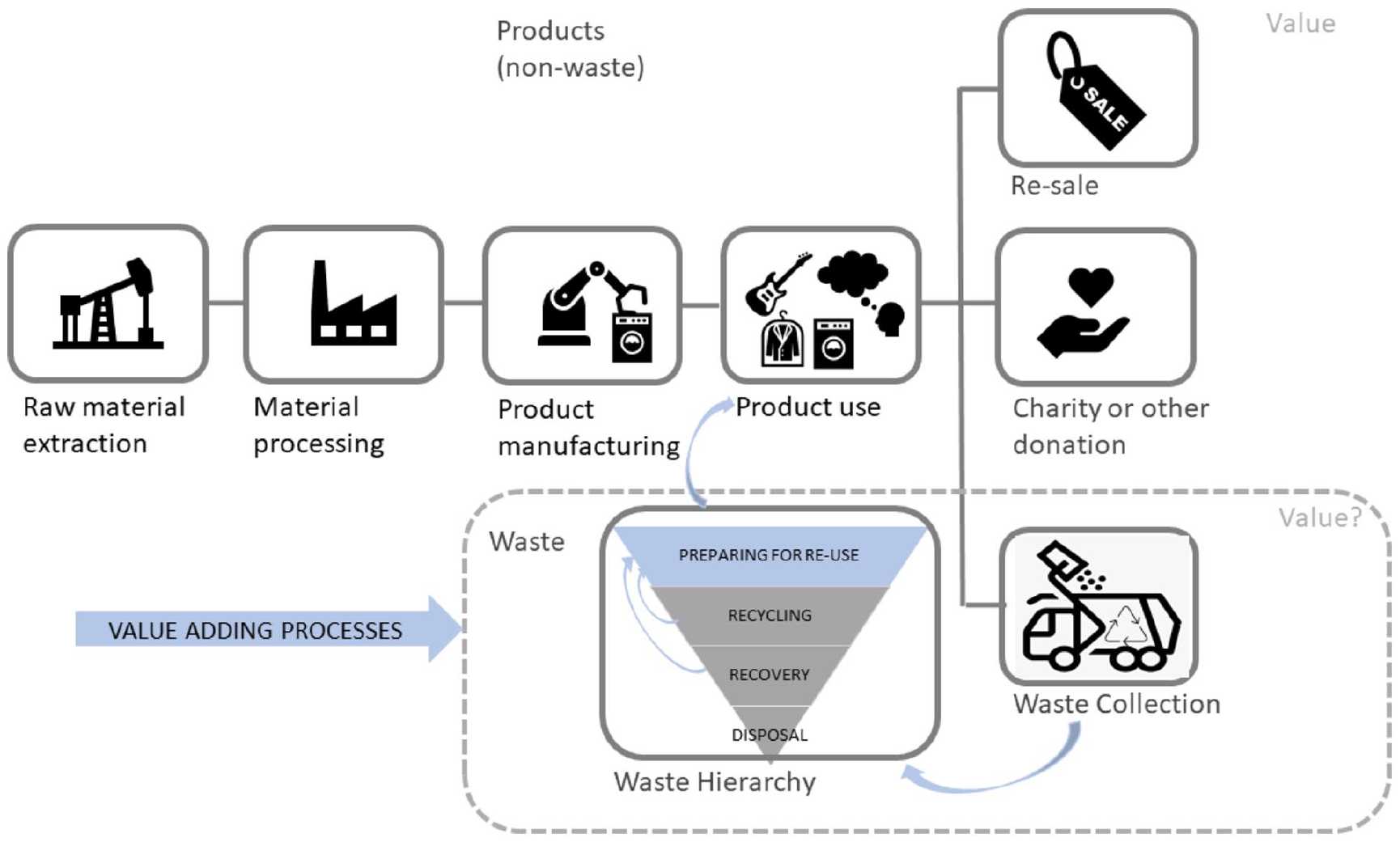
Preparing for re-use as a means to return products from the waste phase to the user. (Inspired by Boldoczki, 2021).
This research seeks to investigate and learn from the experimental development of PfR by pioneers with respect to circularity in the waste sector, which have been experimenting with and initiating PfR schemes concerning a range of products, including building materials, furniture, white goods and bicycles, which are considered because they support the inner cycles of the CE.
Based on the literature, this article aims to investigate different models for PfR activities that illustrates how PfR may expand and consist of different activities in the chain – from waste to use. The articles take point of departure in Dalhammar et al.’s (2021) visualization of PfR in a chain perspective. As can be seen from Figure 2, PfR is embedded in a chain that recreates the product functionality to enable a use in the market but without integrating the product’s value for use and market opportunities into the model.
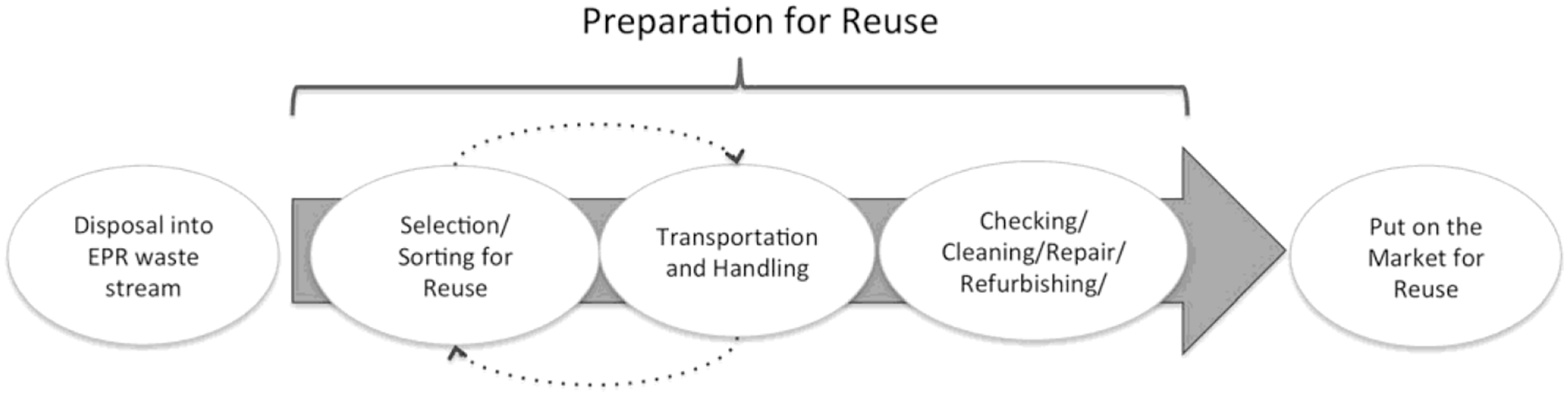
Elements included (and not included) in the preparing for re-use process (Dalhammar, 2021).
Therefore, we have sought to investigate different models that integrate PfR into a chain that includes use and market to understand how use becomes the focal point of PfR activities. Moreover, we have sought to investigate barriers that may hinder PfR practices from being expanded.
The article is outlined as follows: the section ‘Materials and methods’ presents the methodology, whereas sections ‘Results’ and ‘Discussion’ present the results and discuss these in relation to the concrete experiences as well as the existing literature. The section ‘conclusion’ presents the conclusion, limitation and suggested future research.
Materials and methods
This article is based on collaborative research, which is part of a larger study the EU project ‘Intelligent Energy and Resource Systems of the Future’ (FUTURE), spanning (Feb 2018–Aug 2021), which provided waste companies the opportunity to experiment and test new practices promoting CE and the inner cycles through PfR.
Two research questions set the frame for the empirical work:
RQ1: How are barriers and possible solutions regarding PfR reflected in the pioneers’ practices with respect to circularity in the waste sector?
RQ2: To what extent does the legal framework support a change from traditional waste management with a focus on the inner cycles of CE?
The empirical work for this article rests on selected case studies related to the project FUTURE, in which anthropologic-inspired field studies combined with desk studies were used to explore different types of PfR practices. In particular, solutions were examined in which waste products were prepared for re-use instead of recycled and assessed through traces of narratives, documents and activities that transformations had deposited through the development from idea to implementation and operation.
Case study
This article adopts a case study method to understand fundamental elements and issues characterizing the PfR practice. Case studies are instrumental in addressing ‘how’ and ‘why’ type questions, and when there is a need to analyze a complex phenomenon in-depth in its real-life context (Yin, 2003). Moreover, since case studies are rooted in actual practice, they can be further linked to action and thus help to change practice. The aim was to learn from pioneer waste management companies implementing or experiencing CE inspired solutions that support the inner cycles.
Case selection for this article is from the project FUTURE as experiences from these cases showed a tendency for some waste companies to break with existing (linear) solutions compared to others (henceforth, frontrunners). Moreover, companies can be regarded as frontrunner companies because they have an innovative reputation (Zwetsloot, 2001), particularly with respect to conducting PfR activities, as well as their tendency to think beyond and challenge the framework in which they operate. That included new ways of doing things and examples supporting the inner cycles of a CE compared to recycling. Extreme cases expose ideas not seen in average cases and thus allow us to gain new knowledge about PfR development in waste companies (Flyvbjerg, 2006). For this purpose, five municipal waste management companies were selected as extreme cases (Flyvbjerg, 2006; Neergaard, 2007), from which eight PfR schemes were analysed to illustrate the diversity of PfR solutions (see Table 1). Public-private partnerships (PPPs) involve collaboration between a government agency and a private sector company. PPP’s are a mechanism for governments to implement, e.g., public infrastructure and services, using the resources and expertise of the private sector.
Municipal waste management companies and selected schemes.
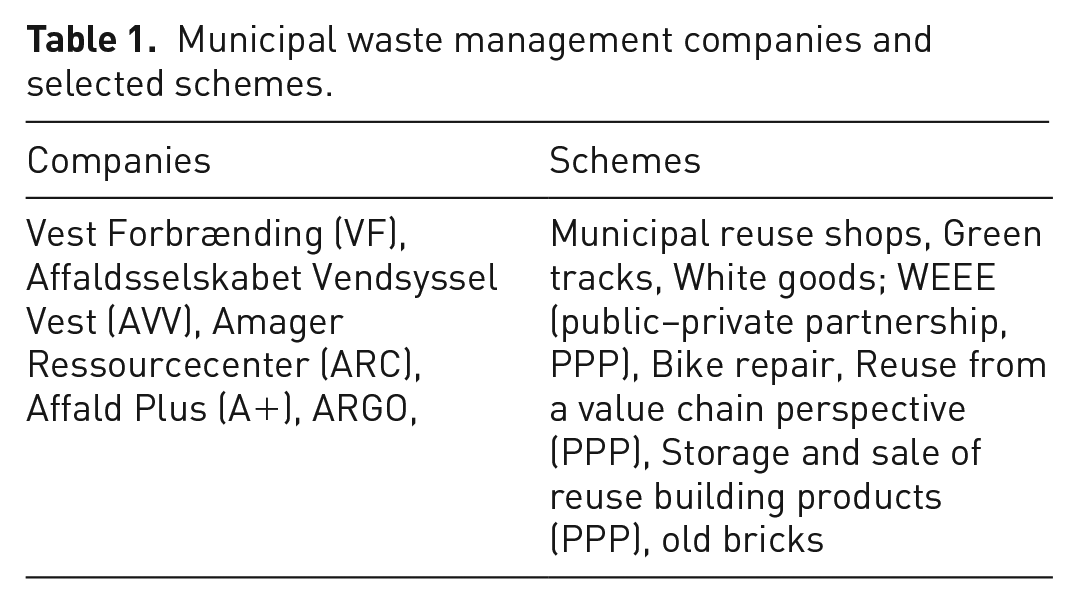
All companies are joint municipal waste management companies for which the same regulation applies, making cases comparable. Their activities include the operation of recycling stations, collection, transport, recovery, and disposal of waste from their municipalities.
Data
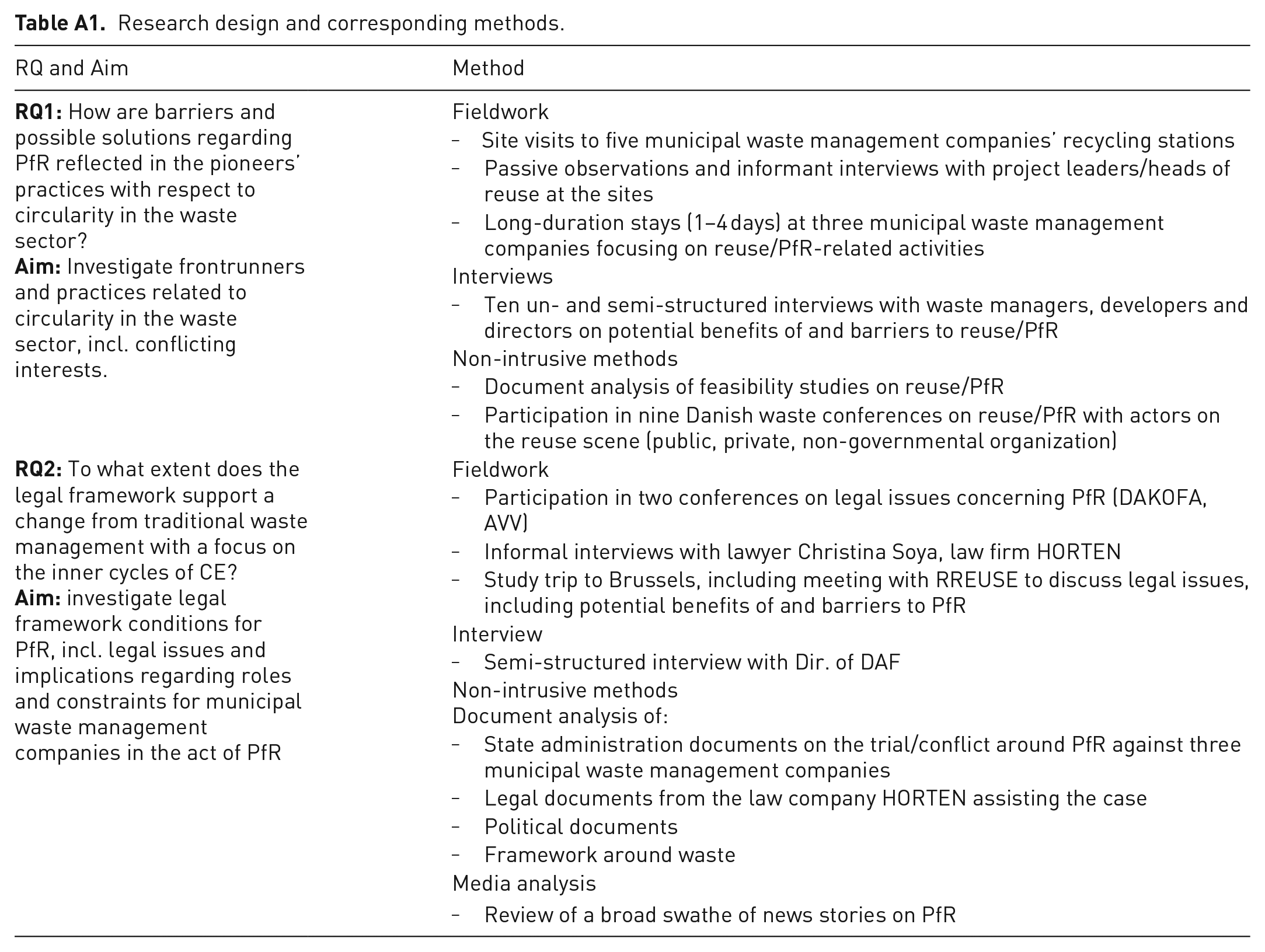
The data collection aimed to follow the development of PfR schemes in the five case companies by tracing their activities over three years and between actors. Documents and materials were collected not only through a literature and document search, but also through snowballing in connection with our interaction with the key stakeholders and field studies (Biernacki and Waldorf, 1981). Thus, a range of interviews, desk study research and site visits complemented the study. Unstructured- and semi-structured interviews were chosen due to their flexibility, allowing interviewees to disclose important yet unexpected information (Qu and Dumay, 2011). By applying mixed methods (Creswell and Plano Clark, 2011), we were able to combine a variety of interviews and non-intrusive methods (Brewer and Hunter, 2006) as well as compile a dedicated data archive (Larsen, 2014). Due to the strengths of each method, we could conduct analyses of practices and legal aspects from different angles, providing us with new insights (Frederiksen et al., 2014) and revealing appropriate practices, attitudes and perceptions on the topic as well as individual meanings and experiences. As an example, we also included the analysis to triangulate the knowledge obtained from the fieldwork, document studies of legal and state administrative documents, and a media analysis of a broad swathe of news stories. The complete list of applied methods corresponding to the article’s research questions is provided in Table A1, Appendix A. Moreover, a list of interviewees is presented in Table B1, Appendix B.
Results
In our study, we have followed the work of waste companies in meeting the CE’s objectives of developing and exploiting the potential for PfR, which sets the stage for some fundamental changes in the way waste(s) is included in the waste cycle. These initiatives are based on fundamental challenges in converting products that have been classified and handled as waste to a form in which they can be reused in the same way as they were initially intended. These challenge, which have been the subject of only a limited number of academic and practical studies, are promoted through initiatives in the waste regulations’ directives and guides on ‘Preparing for Re-use’. Initiatives not only play an essential role in exploiting the potential for reuse but also impose several limitations on exploiting the potential for reuse, which is linked to the understanding of ‘PfR’ that underlies the concept and more fundamentally the separation between product development and market development (see Theory section).
The ‘Results’ section consists of two parts in which we investigated: firstly, PfR practices. Secondly, the practical implications of legal framework conditions for PfR and the development of public waste companies’ activities and ‘room for manoeuvre’.
Results part I: PfR practices and value-adding processes among pioneers
By following waste companies’ experiments in developing solutions that promote the exploitation of PfR potentials, results reveal the emergence of a number of innovative solutions, which is discussed in the following.
These initiatives help promote opportunities for the development and exploitation of reuse potentials and contribute to developing our understanding of how PfR and market development should be seen as integrated processes if waste is to transform to reuse.
The results show that waste companies develop solutions alone, and as network-based solutions concerning specific challenges that PfR poses. Challenges relate to the technical, economic, organizational and institutional conditions that affect the product, its use and the market context.
Moreover, results reveal that the complexity of challenges and solutions presented here relate to both the innovative and the organizational complexity. The innovative complexity moves from incremental solutions, where minor changes occur within the existing mental, technical, organizational, market and institutional frameworks, to more radical changes where new ways of thinking are provided to one or more of the aforementioned frameworks. Organizational and institutional complexity can be understood as a more or less complex landscape of actors and institutions that requires interaction and cooperation across current and future stakeholders (Figure 3).
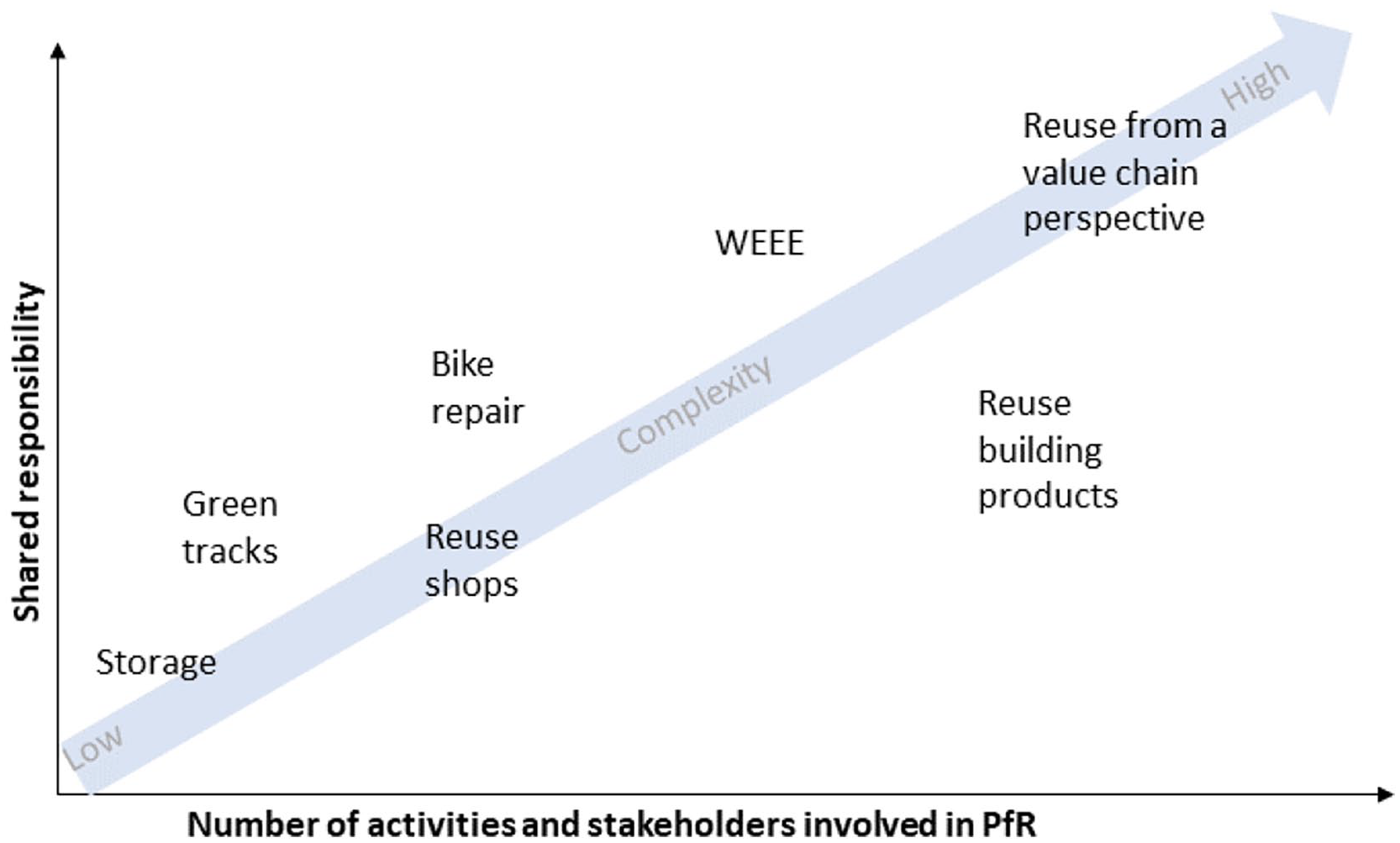
Solutions of varying organizational structures.
The review of the various experiments presented in the ‘Results’ section examines the following.
How to conduct PfR through incremental activities: which reuse processes and relevant actors are involved/required, with particular emphasis on the three dimensions: selection/sorting for PfR, transport and handling as well as checking, cleaning, repair and refurbishing.
How to upgrade PfR and create a market: which market formation processes and relevant actors exist, with particular emphasis on the interaction between actors, the framework for interaction and market processes.
How do experiments contribute to changing waste actors’ and the network’s practices towards reuse, business and the environment?
Incremental PfR activities
Municipal reuse shops: A gateway to the market
Municipal reuse shops are an old initiative that the waste company AVV launched 30 years ago as part of an employment programme (Interviewee #4). Waste reuse is considered a residual product ‘too good to throw away’ and as a means of creating social activities in the form of employment and availability of ‘cheap reused goods’ through in-store sales located on the recycling station. The items sold in the municipal reuse shops are derived from bulky waste, donations and items ‘saved’ from waste containers by staff at the recycling station.
The AVV shop was not originally a natural part of ‘preparing for re-use’. No special activities were associated with taking residuals out of the waste stream but instead bringing products that had the original functionality on the market (Interviewee #4).
Thus, the concept is considered a means of bringing the product to market rather than a market-creating activity. One could also argue that the shop acts as a gateway to the market, a self-organized mechanism that will automatically ensure reuse.
The shop plays a limited direct role in PfR and market formation. The shop, however, is becoming increasingly important due to a large increase in turnover and employment, which is linked to changing consumption patterns and to, more dynamic profiling of reuse and its value in local communities. As an example, AVV annually sells 1000 tons of items that have been prepared for re-use in its store and employs 15 people, 9 of whom are contracted full-time employees, whereas the other 6 are workers on the fringes of the labour market, employed on special conditions.
Those elements influence how PfR is included in the company’s practices. Thus, the company becomes aware of the business value of reuse, which helps to motivate increased sorting and control (PfR) and increased marketing activities, including online action of valuable products, the development of collaboration with charity shops concerning donation of clothing, as well as an increasingly better understanding of usability – and not just reuse.
Green tracks optimizing potentials for PfR
‘Green tracks’ focus on the optimization potentials that lies in the first part of PfR by involving citizens and employees in sorting the usable waste. These are commonly situated at the entrance of the recycling station, where citizens are guided to sort reusable items, which are then prepared for re-use (checked, cleaned and/or lightly repaired) and sold in one of the shops (Interviewees #2, 3, 4, 5, 10).
Thus, green tracks function as an incremental improvement of PfR. The focus is primarily on optimizing the dominant practice of keeping the usable products separate from the heterogeneous mix waste streams, ensuring a more significant amount of reusable products of better quality – with minimum effort. In addition, the focus is on maintaining the quality of the waste and avoiding it deteriorating in the process.
Green tracks do not directly affect market formation but support the waste company’s ability to deliver waste as reused products to a ‘waiting market’. Moreover, green tracks function to motivate and support the delivery of reused products.
Green tracks primarily optimize the waste company’s resource consumption (work and cost) for reuse and helps support the internal anchoring and organization of PfR as part of practices at the recycling stations and within the organization. Experiments with green track separation reduced the amount that went to incineration and increased clothes for reuse by 300%; in one case (Interviewee #2) and elsewhere, 24% more were collected for reuse (Interviewee #5). In addition to increasing efficiency, it reduces the cost by allowing citizens to sort and make reuse more visible to both citizens and employees, which has a learning effect on the groups mentioned and their behaviour. In addition, ‘Green tracks’ contribute to a change of mindset.
Upgrading of PfR and market creation
Preparing WEEE for re-use
WEEE challenge waste companies’ linear practices and competencies and provide new opportunities to develop and exploit PfR potentials. Challenges not only include requirements to ‘preparing for re-use’ activities concerning re-establishing waste as usable products but also challenge the idea of an existing market.
PfR of WEEE products entails the development of PfR activities to include all three elements: sorting, handling and repair, which require the development of the product’s usability and competence.
In this case, the concept of usability is extended to include the product’s material functionality and the functionalities that make the product usable for the user in use-situation access to service, spare parts, certifications and standards. The intangible parts are essential for the product to be experienced as attractive. The new activities mean that the company must explore new opportunities for partners and employees to develop the right capabilities that can ensure the product’s usefulness.
Market formation plays a crucial role in the marketing and reuse of the product. Therefore, the physical functionalities are not sufficient for the product to become available on the market. Market availability depends on the product having a character that makes its use-value sufficient for customers to buy it. The immaterial parts of the product, such as guarantees, insurances and certifications, play a crucial role. These elements help support the buyer’s belief that the product is usable. A complete set-up consisting of distribution and service systems that can guarantee a product quality that is competitive with existing product and service systems must be created around the product.
For example, a prerequisite for collecting a sufficient number of good-quality appliances for reuse is to develop a collection method that complies with WEEE rules, does not destroy the reuse value of the products during transport and is cost-effective. For testing and refurbishing, AVV collaborated with a local one-person business, the local job centre and a collective scheme (Interviewees #4 and #5). Once the products have been tested and refurbished, they are put up for sale in AVV’s second-hand shop, alongside a product information sheet and the terms of trade. Products are also sold with a 6-month warranty followed by an additional 18-month ‘right of complaint’ (Interviewees #4 and #5).
Preparing WEEE for re-use is an innovation that challenges practices and capabilities in the company. It is, therefore, necessary to develop new capabilities in the form of new routines and competencies, recruit employees with these competencies and cooperate across markets and institutional frameworks to provide the business, market and institutional basis for the development of activities.
Bike repair
Bicycles hold great potential for reuse, as many bikes end up as recycling material, even though they could be prepared for re-use and sold. However, the existing structure of professional repair has hampered the waste companies’ exploitation of the PfR potential. This has led to a negotiation structure in which only the highest quality bicycles are attractive to the private operators, or bikes are sold as ‘scrap metal’ (price/kilo) (Interviewees #8 and #9). Interviews revealed that developing this reuse potential as a business area requires dialogue and collaborative PfR, market formation and legitimacy (Interviewee #4).
Preparing bikes for re-use requires a framework for the waste companies to participate in these activities, consisting of dialogue with stakeholders in the repair ecosystem (Interviewees #4 and #9). For example, dialogue makes it possible to create a division of labour in preparing activities that will upgrade bicycles to market and regulatory standards. In the case of AVV, the company is responsible for preparing activities that restore the functional characteristics of the bicycle, as repairing the bikes would be too costly and time-consuming for bike dealers, whereas dealers upgrade the bikes to the regulatory standards by applying reflectors and locks. Upgrading, the functional standard of the bicycle, requires that AVV has established a bicycle repair shop and hires employees who can handle these activities in cooperation with the other employees (Interviewee #4).
Market availability requires cooperation that enables services, guarantees and insurances to be obtained, allowing bicycles to be sold in a market. Activities require cooperation with local dealers and repairers of bicycles and other stakeholders, such as insurance companies and authorities. Cooperation impacts the institutional framework for delivering PfR in this area. It requires approval for a municipally owned waste company to enter the market, which also requires that the price of bicycles prepared for re-use reflects the market price.
The waste company’s development of PfR potential is thus an innovation that breaks with the existent linear waste practices.
Institutional innovation, which change the municipal waste management practice, made possible through dialogue-based practices with the local bicycle ecosystem’s stakeholders, opens up the possibility of exploitation without entering private market domains.
However, these measures place demands on the capacity of waste companies to be institutional entrepreneurs and the development of cooperation and repair capabilities.
Upgrading PfR to market creation and industrial use
Development of supplier systems for the reuse of bulk wood
Large volumes of waste wood, for example, stemming from construction and demolition, pose an environmental and reuse challenge concerning PfR, market formation and business development (Interviewees #2, #9 and #10). Wood is not only bulk material with a large volume and many reuse options, but also a material that, as a waste, has a low value and where the industrial requirements place requirements for availability of the material on the market and particular specifications and qualities (Interviewees #2, #8, #9 and #10).
The PfR activities include all three dimensions concerning preparing activities, emphasizing sorting and storage. The challenge is that wood waste comes in many different types, qualities and sizes mixed, and it can therefore be work intensive and costly to separate, sort and store, not least given the low-value content that most wood has. Intangible activities, such as administrative systems, are also labour and cost-demanding.
These challenges place demands on the development of market and business networks, which is why waste companies such as Affald Plus have taken the initiative to build up local business networks to help create a framework for, wood to be part of one or more business cycles (see Figure 4).
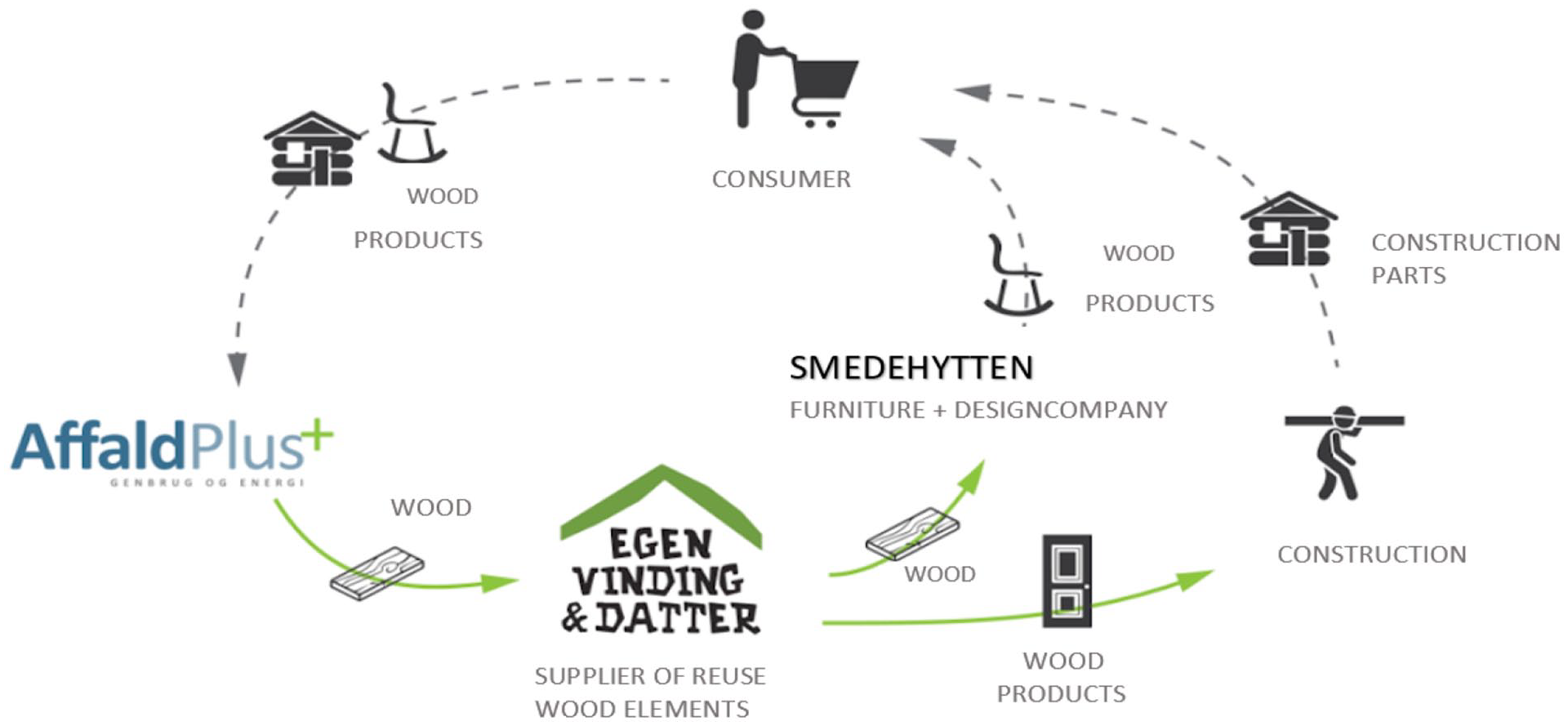
Potential local wood value chain (illustration based on Niras, 2017).
In these local cycles, industrial producers play a key role in the way the wood is reused. The waste company is, in this case, an intermediary between waste collection and industrial flows, governed by companies whose business base is built on wood reuse, emphasizing inner circles. The major obstacle proved to be meeting the private sector’s demand, guaranteeing flexible access to resource flows (Interviewees #2 and #3). However, supplies (waste) fluctuate over time. Thus, to accommodate demand, a storage space was needed, both to build up volume until the products are demanded by collaborators and to protect these products/materials from being damaged by rain (Interviewees #2, #3 and #9). In addition, this set-up requires an online registration and communication system to communicate the types and amounts of products available to the private sector actors. On this basis, a market system linked to investment in a warehouse building can act as a marketplace for players seeking reused materials but requires significant investments (Interviewees #2 and #3).
Reused bricks
The municipal waste companies see PfR of building materials such as old bricks as a significant challenge for promoting circular principles of reusing locally (Interviewees #2, #4 and #9). Usually, construction waste such as old bricks are crushed and used as noise barriers or as substrates for field roads, i.e., backfilling - not reused (Moalem & Kerndrup, 2022). However, the waste company AVV sees it as a critical task to contribute to local, sustainable development by preparing construction waste into reuse and has therefore established a company that clean old bricks (Interviewee #4). The business idea is based on a patent developed by the company ‘Gamle Mursten’, [Old Bricks] making it possible to recreate functional bricks by separating, sorting and cleaning old bricks at an industrial plant. ‘Old Bricks’ has spent 15 years building documentation and knowledge that makes brick reuse commercially possible. To provide the necessary technology, knowledge and experience that lies outside the municipal waste companies’ technology and business competencies, the company started a collaboration with ‘Old Bricks’ as co-owner and renamed ‘Genbrugssten’ [Reuse Bricks] (Interviewee #4).
The starting point for this preparing of waste for re-use is an investment in patented technology, access to knowledge and competence to build the necessary prerequisites and relationships for using reused brick. The latter access is crucial for AVV to see business opportunities in the project.
The reuse of functional bricks is within the traditional technical focus in PfR. However, the reuse potential is utilized in interaction with market players and research and development institutions, as functionality alone does not live up to market requirements. An industrial market requires documentation for several properties for reused building materials. Requirements include documentation of quality and environmental certification, including Environmental Product Declaration (EPD), which means that products meet stakeholders’ construction demands: builders, architects, financing, insurance and authorities. Requirements that have taken ‘Old Bricks’ 15 years to live up to through the development of experiments, tests and dialogues with construction stakeholders in collaboration with research, development and consulting institutions.
Especially, the knowledge-intensive documentation of technical and environmental properties has been crucial for reused bricks to gain access to the market. On the one hand, market access has been crucial for utilizing the reuse potentials. On the other hand, market access also limits how significant a potential could be due to asymmetric competition in existing markets with new products.
‘ReuseBricks’ seeks to solve this dilemma by transforming the reuse history from a cost to an income. The scientific documentation is combined with cultural and aesthetic documentation and stories, making it possible to make reused bricks unique by connecting them with specific buildings, events and places, making them attractive to specific market segments and uses. It requires collaboration with actors throughout the construction chain. Architects can use the bricks’s unique cultural and aesthetic value to create value. The builder can create value in construction and residents to experience and maintain cultural/local values.
For the PfR activities, value is created through collaboration with actors in the entire construction ecosystem, which extends beyond actors in the construction waste chain and its markets. Counselling and knowledge institutions play a central role in enabling potentials to be unfolded by creating unique markets and needs.
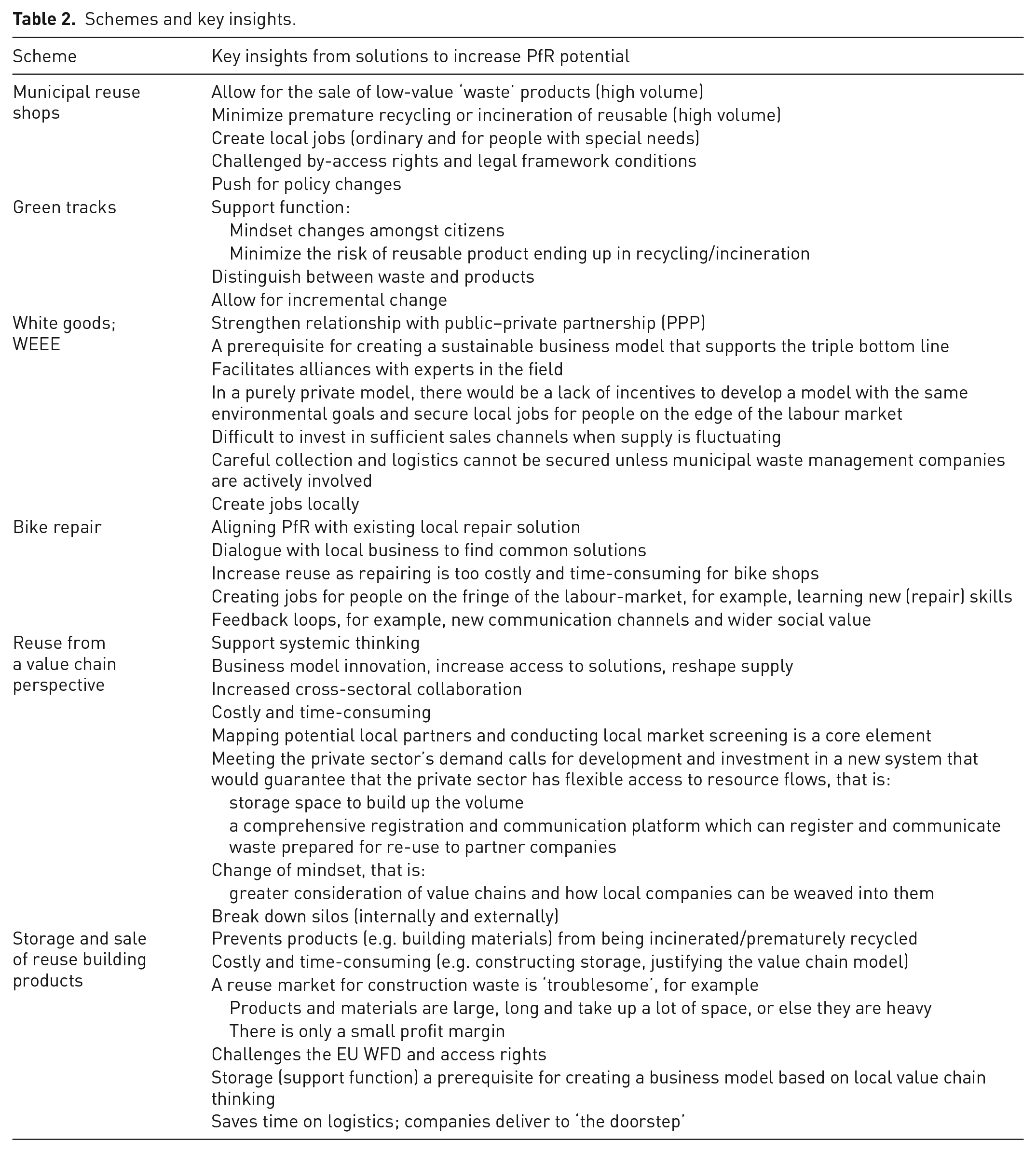
Thus, the frontrunners related to circularity in the waste sector have brought about innovative changes, adopting new reuse approaches. Although some solutions are achieved by developing activities under the regulatory ‘radar’ while others are developed to challenge legal framework conditions, examples have provided the inspiration for various solutions. A range of key insights obtained from different types of solutions is presented in Table 2.
Schemes and key insights.
Summary
The increasing demands for a transformation to circularity have encouraged waste companies to initiate experimental initiatives that open up for rethinking both content and relationships in the PfR concept.
PfR, in the traditional form, focuses on recovering products and implicitly assumes that there is a market for this (See Model 1 in Figure 5). The market mechanism is considered to work if the product’s functionality corresponds to the original product. PfR activities in this segment often consist of ‘sorting’ and ‘selection’, as ‘repair’ gives costs and therefore must be financed, which happens through sales. However, results show that the investigated PfR activities expand from ‘PfR in the original form’. The lines below, figures 6–8, illustrate this expansion of the concept. Further, the eclipses illustrate how the waste companies’ ownership relationship differs in the four PfR models (See Model 1–4 in Figures 5–8).
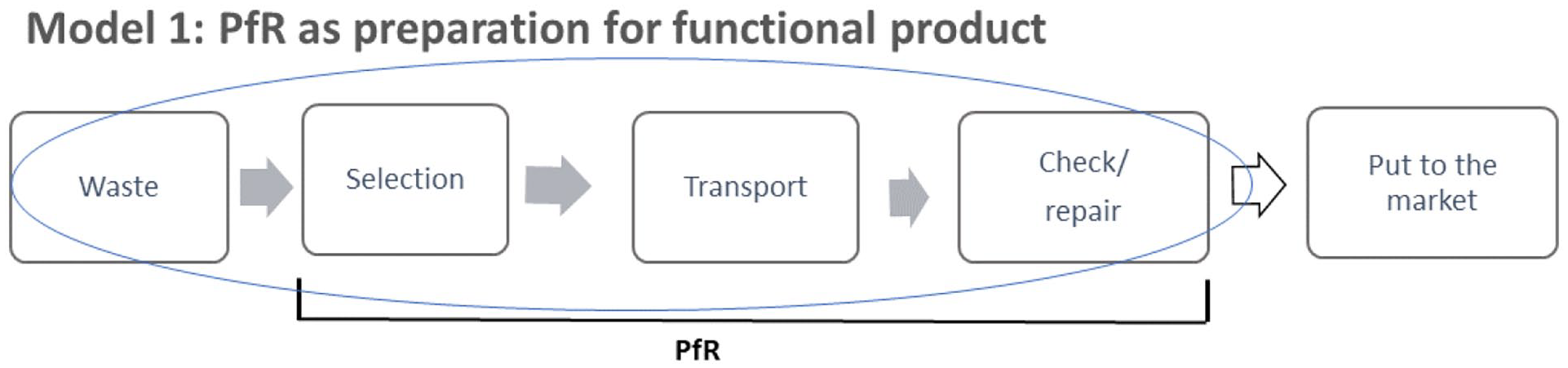
PfR in the original form.
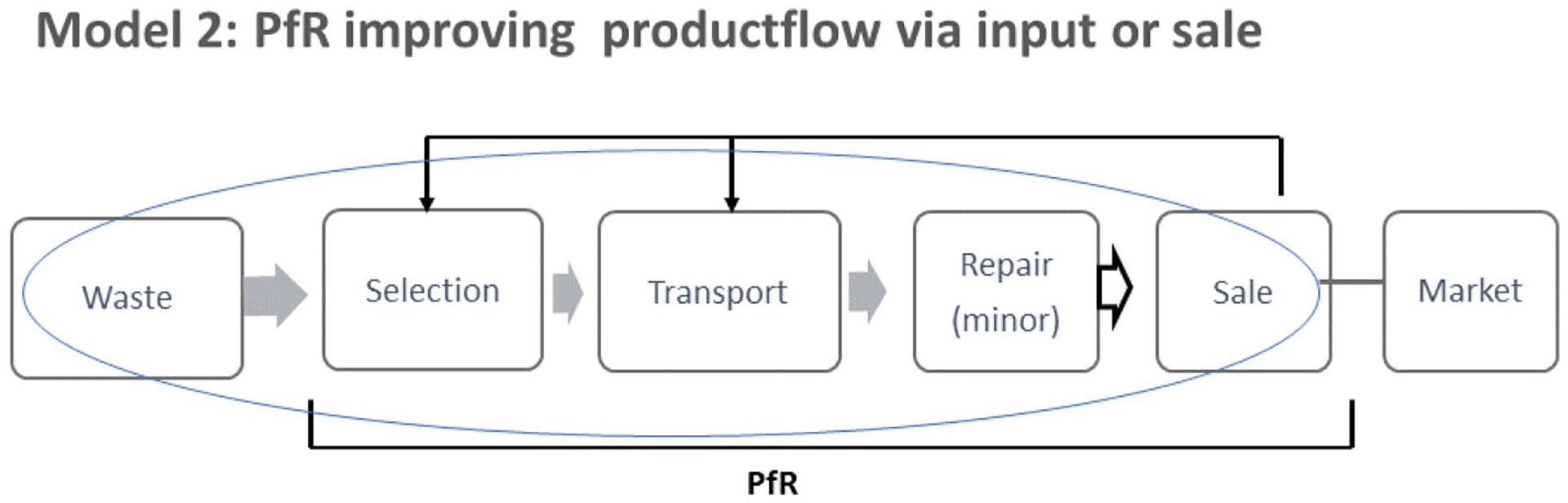
PfR extended to include sale activities.
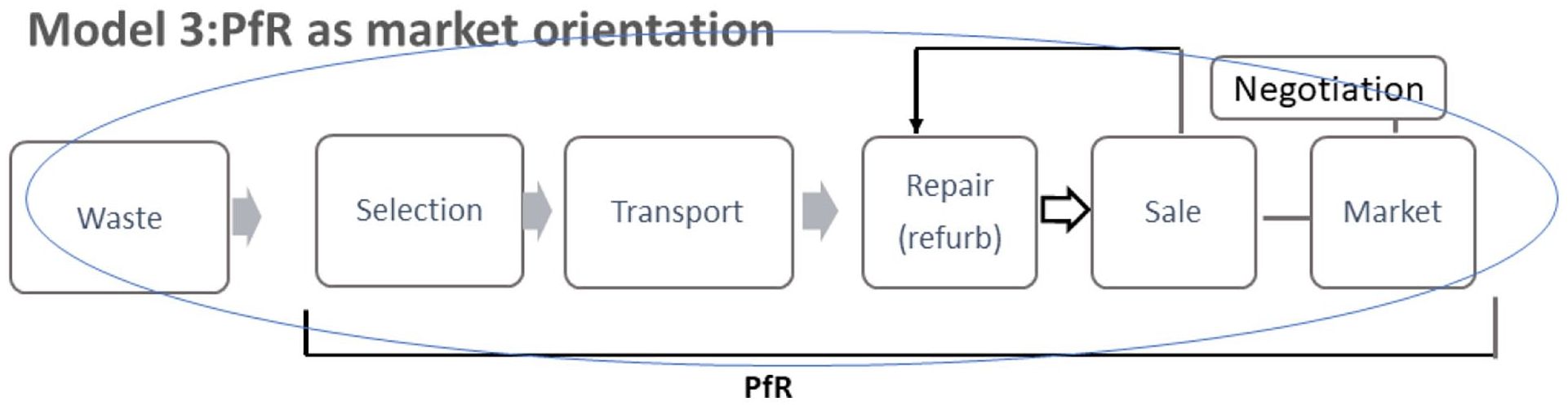
PfR activities extended to include sales and market activities.
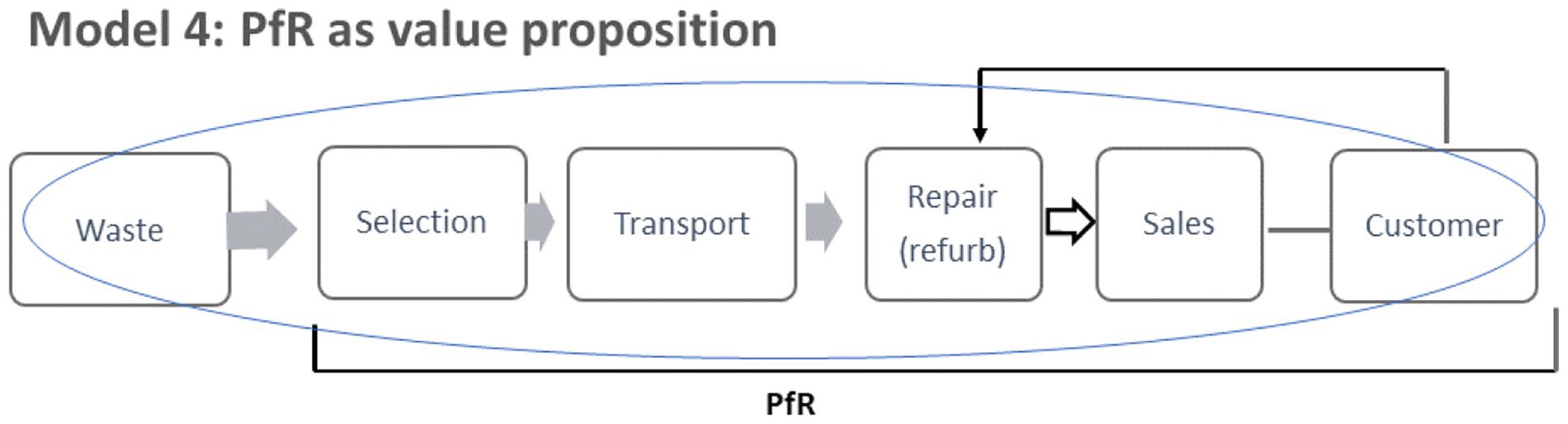
PfR activities extended to include market formation and costumer requirements.
The first types of initiatives aimed to develop practices based on the companies’ linear waste practices. Focus is primarily on optimizing the handling of incoming waste in its original form through ‘Green track’ and bringing products to the market by opening for sale through ‘second-hand shops and auctions’.
Thus, PfR focuses on preserving and restoring the product’s original value. Emphasis is on the PfR activities sorting and selection. However, it may also include a limited range of minor ‘repair’ activities prior to sale.
The value in these activities thus lies in making the reuse potential visible, contributing to a mindset change, not only for visitors at the recycling station but also for employees and the company (see Model 2 in Figure 6).
The second type of PfR consisted of several initiatives to promote reuse by focusing on product restoration through repair activities for sale in own stores (white goods and bicycles). Repair activities developed from lighter repair activities, which ensured the functional properties of the products to include services related to sales, such as warranty, service and insurance. Sales and thereby access to the market was made possible through negotiations with local business organizations.
The functional upgrade required the waste companies’ ‘repair competence and facilities’, which required investments in facilities, employment of qualified employees, and the development of new business and collaboration models that went beyond the traditional forms of business models (see Model 3 in Figure 7).
The third type of PfR activity, bringing reusables into the market, posed significant challenges for waste companies, with the market formation and customer requirements coming to the fore. PfR operations were no longer just a matter of establishing a product whose properties had been upgraded to newer use requirements. It also required that products were designed for the socio-technical context a market constituted, there was a stable relationship between supply and demand, and an adaptation to the socio-technical and regulatory requirements from stakeholders (reused bricks).
Market creation becomes crucial for reuse, and the market is thus crucial for the way reuse is prepared. The preparation is primarily preparing for a market that plays back on the entire chain. Thus, the PfR is based on the requirements for the development of the market. This requires upgrading repair to refurbishing and upgrading the supply-chain relations (see Model 4 in Figure 8).
Results part II: Practical implications of legal framework conditions for PfR and the development of public waste companies’ activities and ‘room for manoeuvre’
Under the revised EU WFD, all member states will have to recycle and PfR at least 65% of municipal waste, by 2035 (European Union 2018/851). This includes implementing CE business models that encourage extended use of products, components and materials.
In Denmark, municipal councils are in charge of handling waste, as stipulated in the Environmental Protection Act (LBK nr 1218 af 25/11/2019, §45, Art. 1). Municipal waste management must take place in accordance with the EU’s waste hierarchy, where PfR is the priority, as stated in the Danish Waste Order (BEK nr 2159 of 09/12/2020, §13). Thus, there are new insights to be gained from the CE concept, but it also puts pressure on the waste sector, governed by the waste hierarchy.
However, according to the Danish National Board of Appeal [Ankestyrelsen], a municipality can only carry out an activity to the extent that there is a municipal interest in the activity (Ankestyrelsen, 2017). Moreover, it is generally assumed that municipalities cannot conduct trade or financial activities without legal authority. The background for this is the consideration of avoiding distortions of competition with the private sector (Ankestyrelsen, 2017). However, the ban on municipalities conducting trade has been modified in several ways (Ankestyrelsen, 2017). Moreover, according to the municipal power of attorney rules, municipalities and municipal communities have access to make certain dispositions without actual legal authority (Ankestyrelsen, 2017). Thus, the municipality has a general obligation to prepare waste for re-use. However, there are no exhaustive rules on how exactly this should be done (Ankestyrelsen, 2017). Moreover, items that are handed over for direct reuse are not regulated by the Danish Environmental Protection Agency’s rules, as they have not become waste (Ankestyrelsen, 2017). This has led to some disputes between actors’ access rights and to defining waste/nonwaste, which will be discussed in the following paragraph.
Our document analysis of registry data revealed that, in 2015, three municipal waste management companies were accused of acting in violation of the legislation by receiving items from citizens, preparing them for re-use and reselling them (Ankestyrelsen, 2017). Trial documents from the state administration indicated that the representative Confederation of Danish Industry (DI) sent a complaint to the Danish Appeals Board questioning whether municipal waste management companies can be allowed to set up reuse shops. Furthermore, it claimed that municipalities have ‘no legal authority to sell items delivered at the recycling station and disputed whether ‘products sold in the shops [were] in fact, waste’ (Ankestyrelsen, 2017). The accused companies acted differently from the accusations. As an example, AVV stated that at the time of the case, some waste management companies took a stand: We are not doing any activity [that] can be interpreted as an illegal act from our side; [this includes] VF, the largest municipal waste management company in Denmark.
Following this statement, VF sought juridical assistance on the legal matter from two different law firms, one of which was supportive whereas the other was not, leaving the company in a ‘legal grey zone’. During the trial, the media presented a negative picture, stating that it was ‘not OK’ for municipal waste companies to run second-hand shops and that municipal waste management companies ‘stole’ usable materials from charities. Our media analysis provided further insights into some of those controversies. One example of a local news story had the heading, ‘Put an end to the public task theft’, in which the DI’s marketing manager commented on the establishment of municipal reuse shops as follows: What we see here is an example of public task theft. Unfortunately, in many cases, we see that the municipalities intervene and offer services that undermine business and industry. . .The problem is that it is getting a lot harder for charitable institutions to make money. (Århus Stiftstidende, 2016)
As a result, VF closed its largest and most successful reuse shops. However, AVV stated: Although it was a stressful time, not least for the 15 employees at the second-hand store [who listened] to the radio accusations using words like ‘it is forbidden’, ‘cheating’, ‘task theft’, we chose to continue. But, we chose to stay in the grey zone for two years until the decision came from the Appeals Board, because we believed that what we did was in line with the waste hierarchy.
The decision of the Danish Appeals Board stated that municipal waste management companies may prepare waste for re-use if products are sold at market price (Ankestyrelsen, 2017). From a legal perspective, however, lawyer Henriette Soya argued that the answer received from the Board was not sufficiently clear and left room for interpretation by both parties. For example, how does one define when something becomes waste? Moreover, how does this relate to PfR and waste prevention?
From a legal perspective, Soja stated: This is a good question, because is an item ‘discarded’ if a citizen places it in a special reuse container at the recycling station or is it not waste already when the citizen delivers it to the recycling station or as bulky waste?
Therefore, municipal waste management companies were left to operate in a legislative ‘grey zone’, compelling them to navigate a ‘not clearly defined’ framework (Soya, personal communication). As VF claimed: It is not allowed without ‘bending some rules’. However, we acknowledge that others do it. Take, for instance, A+. They are innovative and great at coming up with new ideas and solutions whenever they, in legal terms, ‘hit the wall’. . .The legal framework promotes neither prevention nor PfR and therefore should be challenged.
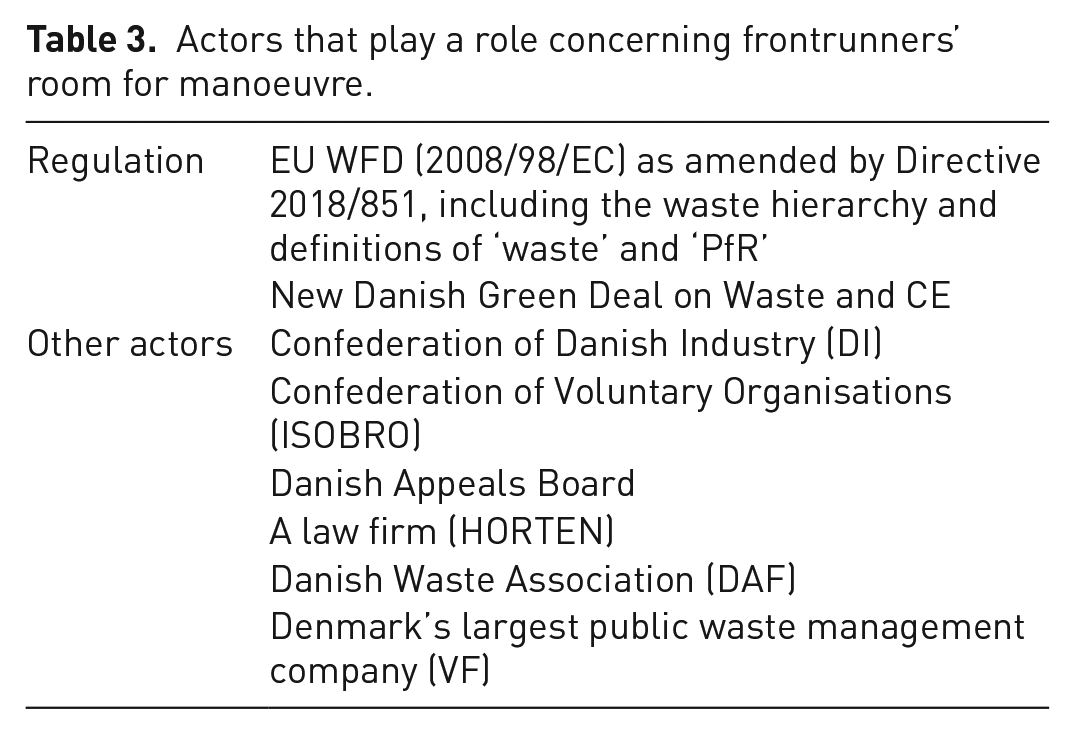
Court documents and consultation responses revealed that the case opened a procedural conflict over waste products involving a range of actors. An overview of actors playing a role concerning progressive waste companies’ room for manoeuvre is provided in Table 3.
Actors that play a role concerning frontrunners’ room for manoeuvre.
Interviews revealed that the decision, combined with the negative press, made most companies distance themselves from conducting PfR, but some waste management companies saw the decision as a window of opportunity to experiment or expand existing PfR schemes and challenge the legal framework, reflected in the schemes presented in Figure 3.
However, in June 2020, a new climate plan for a green waste sector and CE for Denmark was reached by a broad political agreement and included visions for reuse: The objects [reusable at recycling stations] must first be available for private actors, including voluntary organizations and citizens. Objects not wanted by these players, the municipalities may sell in municipal second-hand shops or to socio-economic enterprises” (Regeringen, 2020: 13–14)
Consultation responses revealed that the agreement met critique by the Danish Waste Association (DAF) and progressive waste management companies because they fear the agreement will cause a negative environmental impact (Energistyrelse, 2021, AVV, 2020). Moreover, the government’s law draft for the reorganization of the waste sector goes beyond what a parliamentary majority agreed with the Climate Plan for the green waste sector and CE from June 2020 (Regeringen, 2020). This is at least the main message in the Danish Waste Association’s consultation response (DAF, 2022a, 2022b). For example, although the climate plan explicitly states that the municipalities are obliged to offer compulsory tender requirements on recyclable household waste only, the compulsory tender requirement in the law draft is extended to PfR. Thus, the law draft ‘over-implements the climate agreement’, including more bans regarding PfR, than agreed politically (DAF, 2022a: 1). This narrowed room for manoeuvre, combined with uncertainty, is considered a barrier to PfR.
Discussion
The analysis shows that there is limited knowledge and research within the specific challenges that the transition to a CE poses to the PfR of products that have ended up as waste. The limited knowledge and research point to the following:
Waste holding an essential potential for reuse, exploited only to a limited degree, which is both an environmental and economic challenge (Messmann et al., 2019; Milios and Dalhammar, 2020).
The organization of the waste sectors collection, management and treatment methods plays a vital role in exploiting these potentials (Milios and Dalhammar, 2020).
This article contributes with examples of how waste can be redefined as products and transformed into reuse based on the products collected, handled and processed by municipal waste companies.
Over some years, we have followed waste companies’ experimental approach to solving the challenges of PfR (Moalem, 2022). The experiments show challenges in understanding and practising PfR. The process seems more complex, innovative and interactive than what is laid out in the dominant understanding of PfR (Moalem, 2022; Moalem and Kerndrup, 2022). This also implies methods and opportunities that municipal waste companies hold to solve the innovative challenges inherent in transforming waste into products that have usability and value for future users.
Against this background, we discuss the following:
The basic paradigms underlying the recovery of waste for reuse consisting of an assessment of the key concept of ‘PfR’. Despite guidelines for restoring product functionality, the concept imposes several limitations in restoring the product’s usability and its market.
The opportunities that municipal waste companies hold to redeem the reuse potentials of waste in interaction with stakeholders.
The challenges posed by the current initiatives on the conversion of waste, including the transition towards CE in Denmark.
The basic paradigms behind the transformation of waste into reuse
The EU amendments of Directive 2018/851, which were an element of the circular action plan communicated by the Commission in 2015, are crucial to the ongoing transformation of waste paradigms and actions (see ‘Introduction’ section for additions). Specifically, it is expressed in the definition that reuse concerns the restoring of a product to its original form. Moreover, the concept of ‘PfR’ concerns the activities ensuring that waste is transformed into functionally reusable products through various activities (Dalhammar et al., 2022; Kemi, 2021; Messmann et al., 2019; Milios and Dalhammar, 2020; see Figure 2).
As described in the ‘Results’ section, PfR activities are normally limited to those that can maintain and restore the functional characteristics of the original product. This, however, reflects a limited understanding of the importance of ‘usability’ related to the concept, including the ability to recover product value to the user. More fundamentally, the framework needed to recreate a valuable product and put it back into service, requires the establishment of relations and interactions with stakeholders.
Our study on waste companies’ work to reuse waste shows that through their experimental activities, they have understood the importance of ‘usability’ to recreate a product by relying on the use and market situation. Thus, the case of white goods shows how the product and intangible aspects are taken into account when the product’s value is restored (quality, aesthetics, service, insurance, certification and job creation). As a result, market relations and ‘value proposition’ are developed in which the intangible parts play an essential role in establishing distribution, service and repair activities.
Cooperation also plays a decisive role in market creation, such as in the case of bike repair. The example of reused bricks shows that within the B2B market, intangible parts of the product are essential to have value for the users in the construction chain and for the development of market segments.
Our study of waste companies’ experiments with PfR thus helps to critically examine some of the basic concepts and methods used to promote reuse. This implies that products must contain use-value and channels established to allow interaction and market exchange (Moalem and Kerndrup, 2022).
Another challenge to the basic requirements for PfR is a framework condition, where the experience of the white goods indicates that a selection of white goods is based on their energy label in order to avoid preparing products for re-use with poor environmantal performance (Boldoczki et al., 2020; Messmann et al., 2019, Milios and Dalhammar, 2020). This is initiated on the company’s initiative and points to the importance of developing criteria that make it possible to differentiate products for reuse based on environmental criteria. Here, the energy-label served as a guideline for the waste company so that only ‘A’ branded or better white goods were reused.
Several reports, including Kemi’s (2021): Regulatory for remanufacturing, Delgado et al. (2009): End of waste criteria, The European commission (2015): Study on WEEE recovery targets and articles of Dalhammar et al. (2022) and Milios and Dalhammar (2020), support our empirical analyses of how PfR is not reduced to only the product-oriented PfR activities but also include activities up and down the value chain. Despite the many empirical facts, these are not used to develop a more coherent conceptual understanding of PfR.
Waste companies’ role in developing potentials for PfR
The work of waste companies experiments with new solutions is central to developing potentials for reuse, not only restoring the products physically but also by restoring the value through a focus on what makes the product experience as having value for the user and at the same time differentiating the product from other products (Christensen, 2021; Milios and Dalhammar, 2020, Zacho et al., 2018a, 2018b).
Developing new productive capabilities has been necessary to restore and upgrade waste products. For example, the repair of white goods and bicycles has made it necessary to develop specific functions and competencies, competencies developed in the company and in collaboration with external actors, such as in the white goods example where there is a collaboration with an independent entrepreneur employed part-time in the waste company. This can also be achieved by developing new business companies, such as in case of reused bricks, which started in collaboration with another company and became an independent company supported by two funds.
The creation of the market are essential prerequisites for successfully reusing the recreated products. In the PfR concept, the market is taken for granted, which may be linked to the assumption that a market exists. This may be why the potential for PfR is only unfolded to a limited extent or not resolved. However, the assumption that there is a market contains several pitfalls. Firstly, there is not necessarily a market for products prepared for reuse. Secondly, the current market offers only limited opportunities, as products are classified and percieved as being of low quality. Thirdly, a market based on the product’s unique qualities is created.
There is no market because the recreated product does not meet users’ existing needs. Therefore a market has to be created by adding value to the transformation process.
The existing market is path-dependent, e.g., based on products that, over time, developed process and product innovations, qualities, prices, and usability. Therefore reused products are often classified and perceived as secondary products with lower design, performance, and quality. Therefore, they are often sold as products aimed at specific social groups that are market segments. The white goods example is an example of the product being given less value and thus a lower price, making the product attractive to social groups who find it difficult to pay the average market price. It is often highlighted as a quality but, in many cases, can be seen as an inability to incorporate other values into the product. (It may therefore be essential to consider that social washing, in some cases, shifts the focus from environmental internalization to social internalization.)
Reused products can have a unique character based on the value inherent in the reused products history, internalization of environmental/climate effects and aesthetic dimensions. Reused bricks is an example of how to manage to internalize the history, culture, environment and aesthetics of the value proposition, which allows the product to be differentiated from other bricks. The value can be captured by the company selling the reused bricks by taking a higher price (Moalem and Kerndrup, 2022).
The analysis shows that municipal waste companies can play an essential role in developing and exploiting the potential for reuse. However, those waste companies are challenged by the market policy conditions they are subject to. As public companies, there is a narrow framework for how they can be involved in the development and exploitation of PfR potential. Thus, proactive waste companies are constantly struggling to make their PfR activities legitimate, opening up conflicts whenever they try new initiatives. This discourages many waste companies from considering new PfR activities in the tension between public and private. At the same time, the entrepreneurial companies try to rise to the challenge, despite requiring many resources to get it legitimized. For example, AVV managed to begin the PfR of white goods and bike repair because the waste company views PfR as essential to the mission of waste companies: to minimize the environmental effects of waste. For this reason, AVV has invested a great deal of effort in building alliances across sectors, companies and stakeholders, as well as investing resources in building up the necessary legal expertise for these political and legal conflicts to test and circumvent.
An essential driver of the waste companies studied is that they see the environment as crucial to their mission, which impacts the importance they attach to the environment in developing business models and partnerships. For white goods, this is reflected in the apparent prioritization of only white goods with energy class A or better that were prepared for re-use and opt-out of products that require excessive transport distances.
The waste companies’ challenges in the form of a cross-pressure between the requirements for R and the minimal room for manoeuvre set by the public regulation are also seen in several analyses by Dalhammer et al. (2022; Kemi, 2021; Milios and Dalhammar, 2020, Zacho et al., 2018a). The analyses show how the cross-pressure limits opportunities to utilize the vast potentials and thus limit the environmental consequences of waste. Therefore, there is a need to improve the framework for reusing waste and develop the capabilities of companies and partnerships.
The policy framework conditions for exploiting PfR potential
The analysis shows that the policy framework conditions play a crucial role in exploiting the potential of PfR and the actors involved. We have previously mentioned the central importance that reuse has in the EU’s CE policy as a critical element of plans to meet environmental and climate objectives. However, municipal waste companies have had narrow frame conditions to develop and exploit PfR potential, due to interpretation of legislation and the narrow possibilities that the public waste companies have concerning cooperation and competition in markets.
Despite these limitations, individual waste companies have developed initiatives that contribute to a better understanding of how PfR potentials can be developed and how to achieve reuse through innovation, collaboration and partnerships. However, these experiences seem to be reflected only to a limited extent in the latest waste and CE action plans (Regeringen, 2020), which call for a rethink of regulation and organization in this area.
The analyses show that once products are discharged and collected, reuse is much more complicated than for products that have not passed the waste threshold. Moreover, transitioning from recycling towards PfR includes establishing effective legal frameworks (Williams, 2015).
However, due to the unclear legal framework and definition of waste, actors are unaware of who has the right to explore present reuse potential and who is responsible for this to happen. This issue has led to a legal debate concerning municipal waste management companies that engage in, for example, reuse shops, raising questions like, ‘Are the products sold in the shops in fact waste?’ However, waste is a generic concept, defined differently by authorities (Pires et al., 2019). From a legal perspective, Luciano Butti (2012: 1621) has pointed to this same challenge, stating, ‘One of the most distinctive features of waste is that it creates legal problems at both its “birth” and “death”’. He also points to the first problem by asking, ‘When does waste come into being?’ and furthermore, ‘the apparently simple definition of the concept of waste, seems to be ‘impossible’ to outline in regulatory terms’ (Butti, 2012: 1621), highlighting the unfortunate linkage between this ambiguity and the EU waste hierarchy. As a result, companies conducting PfR seek to legalize their actions either verbally e.g. ‘I define everything that comes inside my fence [recycling station] as waste’ or by establishing green tracks to define ‘non-waste’. This indicates that entrepreneurial waste companies want to work with PfR, but they feel the framework is too narrow and that they will be penalized if they do so. On the other hand, the grey zone is also a window of opportunity and the possibility of interpretation that makes companies try new approaches in the search for finding new solutions.
The broad political agreement is an example of how waste is conceived, including PfR, as a process decoupled from the market. However, this contradicts our results that point to the importance of getting ‘user’ and ‘usability’ coupled more strongly to PfR, which means increased awareness of the systemic contexts and ‘couplings’ rather than decouplings.
Summing up the discussion
PfR schemes may support incremental change as well as the transition from recycling towards reuse. Schemes increase the number of reusable items and in turn create jobs and valuable knowledge for different EU Member States, regardless of where they are in the sustainable waste management transition process. Directing waste practices away from recycling implies a range of challenges, including the development of partnerships. In Denmark, the case companies have made innovative changes, conducting experiments focusing on PfR rather than recycling. These companies are characterized by their tendency to collaborate, network and work across systems, enabling them to gain insights into innovation within current practices. As Gray and Stites (2013) argue, working across systems is a particularly important action for unlocking sustainability.
Conclusion
The development of the circular paradigm and its integration in the EU waste action plans have put pressure on the waste system, including pressure on waste-generating activities in production and consumption and how the waste treatment is institutionalized.
The development of the circular paradigm and its demands for transformation of production and consumption has been the subject of increasing research and practical measures to reduce waste and close the waste streams by integrating the various ‘cycles’ into companies’ business models. However, research and practices regarding the transformation and integration of waste systems into the circular economy are limited. That include value creation processes for reusables that have exceeded the waste limit and the role of waste management companies in that matter. – cf. ‘Materials and methods’ section. The primary knowledge and method of promoting the inner cycles have been defined primarily through the EU’s work on developing principles and guidelines for circular waste strategies.
Therefore, this article took a point of departure from the concepts of ‘PfR’, developed by the EU for promoting the potential for reuse and the limited research on this, to examine how the paradigm shift has initiated experimental activities in the most innovative municipal Danish waste companies. Interviews with relevant stakeholders, deskstudies, and knowledge obtained from participating in waste conferences were used to analyse PfR practices at five municipal waste management companies in Denmark.
Results identify challenges and limitations in the understanding and concepts for how waste can be prepared for re-use. This includes what the waste companies’ experimentation with waste transformation into reuse can contribute with knowledge and learning and the challenges it poses to developing an institutional and regulatory set-up.
Concerning the paradigm shift and methods of transforming waste into reuse, our studies show that the current understanding of ‘PfR’ has too narrow a focus on restoring the product functionality to ensure that the restored products are reused. Therefore, there is a need for ‘PfR’ to focus on value for the user and not just the product, combined with initiatives that make it possible to create a market that brings the product and user into dialogue. The importance of market creation and sustainability is a growing issue in research into entrepreneurship and marketing studies. Thus, there is a need to develop a dynamic and systemic PfR concept covering the entire journey from idea to value for the user.
Concerning municipal waste companies, the study shows that it is vital to develop the business aspects of PfR so that the value of reuse is clarified and developed. PfR should not be understood in a narrow monetary perspective but developed to include unique benefits in product and use situations. Empirical examples given in this article illustrate how values linked to reuse may also be articulated and staged in the dialogue between the waste companies, business networks and customers. The innovative nature of the transformation processes means combining individual and collective development of capabilities and competencies, in which networks and partnerships are ideal forms of organization.
The regulatory set-up has been central to the transition to a circular paradigm within the waste sector. On the one hand, the EU’s work on developing concepts for waste (zero waste) and PfR has been important for the steps taken within the waste sector, including a framework to experiment with new forms of transition at the company, network and sector level. However, on the other hand, the conceptualization of PfR creates stumbling stones, leaving little room for maneuvering. In addition, the national framework in Denmark is restrictive for waste companies to initiate and develop PfR. The EU and national actors face some critical choices in the coming years. In a Danish context, the struggles over waste as a resource have intensified, and a discussion is ongoing about the interaction between public and private actors.
Our analysis points to the importance of developing the regulatory framework, to support forms of organization that promote transformations that provide an environmental benefit for the effort.
Footnotes
Appendix A
Research design and corresponding methods.
| RQ and Aim | Method |
|---|---|
| Fieldwork | |
| ‒ Site visits to five municipal waste management companies’ recycling stations | |
| ‒ Passive observations and informant interviews with project leaders/heads of reuse at the sites | |
| ‒ Long-duration stays (1–4 days) at three municipal waste management companies focusing on reuse/PfR-related activities | |
| Interviews | |
| ‒ Ten un- and semi-structured interviews with waste managers, developers and directors on potential benefits of and barriers to reuse/PfR | |
| Non-intrusive methods | |
| ‒ Document analysis of feasibility studies on reuse/PfR | |
| ‒ Participation in nine Danish waste conferences on reuse/PfR with actors on the reuse scene (public, private, non-governmental organization) | |
| Fieldwork | |
| ‒ Participation in two conferences on legal issues concerning PfR (DAKOFA, AVV) | |
| ‒ Informal interviews with lawyer Christina Soya, law firm HORTEN | |
| ‒ Study trip to Brussels, including meeting with RREUSE to discuss legal issues, including potential benefits of and barriers to PfR | |
| Interview | |
| ‒ Semi-structured interview with Dir. of DAF | |
| Non-intrusive methods Document analysis of: |
|
| ‒ State administration documents on the trial/conflict around PfR against three municipal waste management companies | |
| ‒ Legal documents from the law company HORTEN assisting the case | |
| ‒ Political documents | |
| ‒ Framework around waste | |
| Media analysis | |
| ‒ Review of a broad swathe of news stories on PfR |
Appendix B
List of interviews.
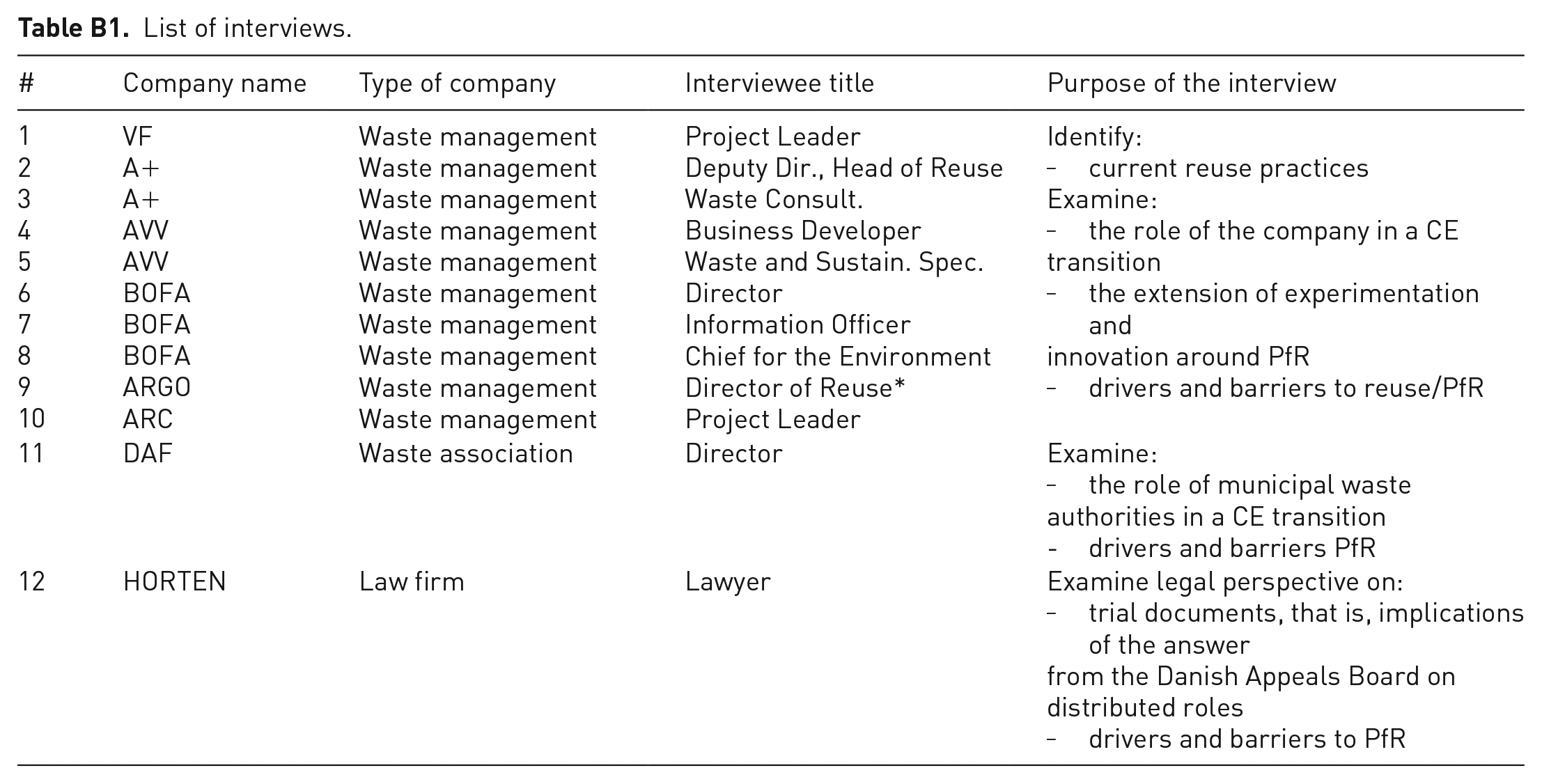
| # | Company name | Type of company | Interviewee title | Purpose of the interview |
|---|---|---|---|---|
| 1 2 3 4 5 6 7 8 9 10 |
VF A+ A+ AVV AVV BOFA BOFA BOFA ARGO ARC |
Waste management Waste management Waste management Waste management Waste management Waste management Waste management Waste management Waste management Waste management |
Project Leader Deputy Dir., Head of Reuse Waste Consult. Business Developer Waste and Sustain. Spec. Director Information Officer Chief for the Environment Director of Reuse* Project Leader |
Identify: ‒ current reuse practices Examine: ‒ the role of the company in a CE transition ‒ the extension of experimentation and innovation around PfR ‒ drivers and barriers to reuse/PfR |
| 11 | DAF | Waste association | Director | Examine: ‒ the role of municipal waste authorities in a CE transition - drivers and barriers PfR |
| 12 | HORTEN | Law firm | Lawyer | Examine legal perspective on: ‒ trial documents, that is, implications of the answer from the Danish Appeals Board on distributed roles ‒ drivers and barriers to PfR |
Acknowledgements
The authors wish to thank the project ‘FUTURE’ members and the companies involved. Further, we thank Carl Dalhammar and Henrik Riisgaard for their valuable comments and encouraging discussions on the topic of PfR.
Declaration of conflicting interests
The authors declared no potential conflicts of interest with respect to the research, authorship, and/or publication of this article.
Funding
The authors disclosed receipt of the following financial support for the research, authorship, and/or publication of this article: The research in this article is part of the project ‘Fremtidens Intelligente Energi-og Ressourcesystemer’ (FUTURE), funded by Interreg, The Capital Region of Denmark, and Region Zealand (Interreg ID: NYPS 20201560).
