



Abstract
Due to its high content of humic substances, compost from bio-waste improves the structure and fertility of soils serving also as a sink for CO2. But compost is also contaminated with numerous compounds, for example, plastics, glass particles, etc., mostly due to incorrect sorting by the waste producer, that is, households. The contamination even increases when covering areas of a high population density as is also evident from experience in Germany with a steadily increasing proportion of bio-waste. Only compost with high quality and minimum contamination is an acceptable fertilizer. A structured interview of experts investigated which measures or combinations of measures are best suitable to reduce the rate of misplaced materials in the organic waste. Only responsible persons were interviewed whose municipalities extensively collect separately bio-waste since years and have a low rate of unwanted materials. The questions focus on the identification of the misplacements according to their kind and quantity, the respective collection system, the regional statutes and their enforcement as well as the kind and extent of public awareness measures. The respective necessary measures are being discussed. This systemic approach can be transferred to other regions that intend to collect large quantities of bio-waste separately.
Keywords
Introduction
Compost from separately collected organic waste (also called bio(genic) waste) is used as a fertilizer due to its content of Nitrogen, Potassium, Magnesium, Calcium and Phosphor, which is partially available to plants. Therefore, supply of mineral fertilizers can be reduced. Compost improves the ability of soils to store water and nutrients and has a positive influence on soil structure. It also alters soil structure thus facilitating root growth and promoting soil biodiversity. The content of humic substances is of high importance, as this contributes to the stabilization and long-term fertility of the soil. Humic substances represent a sink for carbon, at least over several years and therefore play an important role in climate protection. The 4 per mille initiative was launched to complement the Paris Climate Agreement. It aims to store large amounts of carbon through humus formation in soils. Increasing soil carbon plays an important role not only for the reduction of greenhouse gas emissions, but also in addressing the challenge of food security and adaptation of food systems and people to climate change (Initiative 4 Pour 1000, 2018). Especially in the case of countries with high amount of food waste like China (Nelles et al., 2017) or regions with meagre arable soils (Don et al., 2018), there is an enormous potential for carbon sequestration.
On the other hand, composts act as a transport medium for contaminants to soils. Besides contaminants originating from food like pesticide residues, persistent organic pollutants and heavy metals (e.g. Mercury, Cadmium) (Bilitewski and Hardtle, 2013, chapter 4.4.1 and 5.3.6; Pfahl et al., 2002), the concentrations of which in European food have fallen considerably as a result of reduction of emissions and ban of hazardous chemicals, plastic materials are playing an increasingly important role (Bläsing and Amelung, 2018; Nizzetto et al., 2016). Macroplastic from households, which cannot be removed before the plant, is crushed during the fermentation or composting of bio-waste thus ending up in the product. The particles in compost applied to soils can be further broken down by physical effects, for example mechanical forces, radiation among others. According to a study covering about a dozen composting and digestion plants (Weithmann et al., 2018), the number of microplastic particles >1 mm (MPP) in composts varied in the range of 14 and 895 kg−1 compost (dry weight) with an unknown number of particles <1 mm. Based on common recommendations in composting practice, which range from 7 to 35 Mg compost ha−1, Braun et al. (2020) estimate that compost application to agricultural fields goes along with plastic loads of 84,000–1,610,000 plastic items ha−1 year−1 respectively, amounting to 0.34–47.53 kg plastic ha−1 year−1; similar assessments were performed for horticultural soils (Braun et al., 2020). As the amount of compost is increasing due to the growing amount of separately collected bio-waste, this source is given now more attention, especially since it is determined solely by the behaviour of waste producers.
Separate collection of waste fractions is the starting point in the process for resource recovery. In contrast to waste legislation, which aims for a high quantity of recovered material (e.g. European directives for waste from packaging, electric and electronic devices and end-of-life vehicles), the quality of the secondary raw material becomes relevant when it is used in products. When planning a sustainable recycling system, quality of the materials to be recovered is key (Velis and Brunner, 2016). Therefore, the minimization of impurities, misplaced products and contaminants in the complete process, that is, collection, sorting, pre-treatment, composting and/or fermentation process, post-treatment and usage scenarios, must be kept in mind. It is necessary to design the complete system aiming at holistic solutions for proper material recirculation (Rousta et al., 2017). Composting of mixed municipal was stopped in Europe about 30–40 years ago because of its enormous pollutant load. Since then, the separate collection of biogenic waste has been introduced by law. But it has also had to deal with pollutants from the beginning. In urban areas, contamination of compost by some heavy metals turned out to be higher than in suburban areas (Krogmann, 1999). In a thorough study of about 200 Spanish cities, Alvarez et al. (2008) demonstrated that bio-waste contained between 10% and 20% of ‘undesirable material’ in the mean with maximum levels up to 40%. They found that the amount of undesirable waste in the bio-waste fraction increased linearly as the population density increased. The percentage of misplaced materials decreased as gross disposable household income increased. Moreover, Alvarez et al. (2008) stated that undesirable waste in the bio-waste fraction is in a linear relationship to unemployment and to illiteracy. According to manifold experiences from Germany (Kranert et al., 2016), between 0.9% and 12% misplaced materials can be found in bio-waste, partially depending from the population density, which is a very important factor besides others to be taken into account in case of source-separated bio-waste. As stated by the European Environment Agency: ‘Implementing a separate bio-waste collection system is a sometimes lengthy and always complex process.’ (EEA, 2020)
Legal situation
Since 2008, the European Waste Framework Directive promotes (Art. 22a) the separate collection of bio-waste with the aim of composting or fermentation (EU, 2018). Composting is considered as a recovery operation (‘R 3’) for organic materials according to Annex II of the Directive. Germany strengthened the European requirements with the amendment of the waste law in 2012 introducing the comprehensive collection (§ 11 (1)) of bio-waste from households as of 1 Jan 2015. German States (‘Länder’) urge the cities and counties, which are responsible for municipal waste planning to furnish all households with bins for organic waste. Municipalities offer recycling yards as drop-off points for large amounts of waste from gardens besides kerbside collection. In 2017, German composting and fermentation plants processed 15.8 million Mg biogenic waste, of which 10.1 million Mg were from households and public parks (Umweltbundesamt, 2020). With the introduction of comprehensive bio-waste collection, ‘a significant increase of foreign substances such as plastics or mineral waste in bio-waste’, which could amount to 10–15 wt%, was observed (BVSE, 2016).
On the other hand, the protection of soils has been improved by the bio-waste ordinance (e.g. regulation of heavy metals in bio-waste) and the ordinance on fertilizers (‘Düngemittelverordnung’): It defines limits for dry compost (after sieving to 1 mm mesh size) of 0.4% for paper, cardboard, glass, metals and non-deformable plastics and 0.1% for other non-degradable plastics (foils and films). Besides this regulation, a quality assurance programme has been established for composts put on market. Producers of compost can get a quality mark (RAL, 2021), if their product meets a threshold limit for the number of ‘foreign particles’ (i.e. plastics, glass, etc.). Compost products without this quality label are not accepted neither by farmers nor consumers.
Germany is therefore confronted with high ambitions, namely on the one hand to collect more and more bio-waste under increasingly difficult conditions, and on the other hand to produce suitable composts on the basis of one of the strictest fertilizer legislation in the world.
Aim and scope
There are a lot of practical experiences with bio-waste collection aiming at a minimization of contaminants, but mostly focusing on specific local situations (Ferreux et al., 2019; Friege et al., 2016; Hoeß, 2017; Mehren, 2015). There is also a lack of statistical data, because only the amount of collected bio-waste is reported by the responsible authorities, but statistical data describing the quality are generally not published. The evaluation of the experiences of municipalities with particularly low contamination of bio-waste and at the same time also high population density is therefore of interest. This study investigated which source-related measures have proven most successful in practice in dealing with misdirected waste in the bio-waste bin. The primary aim is to identify ‘best practice’ approaches and to assess the extent to which they can be transferred to other local authorities in Europe. The focus is on public awareness, fee systems, collection schemes, on-site detection of misplaced waste and the character of the collection areas because these factors have the greatest influence on the amount of interfering substances in separately collected bio-waste.
Methods
The success of interventions is measured by performance indicators (‘best-practice’ indicators). Such indicators are based on empirical values that elicit the comparatively best results by means of failures and trials (Angermeier, 2017). In this case, success is defined as the reduction of foreign material in bio-waste in order to minimize treatment costs and keep environmental impacts as low as possible. The following ‘best-practice’ indicators were selected:
– Content of interfering substances preferably below 2% by weight
– Compulsory collection of biogenic waste or use of home-composting bins
– Implementation of regular public awareness activities on the subject of waste separation
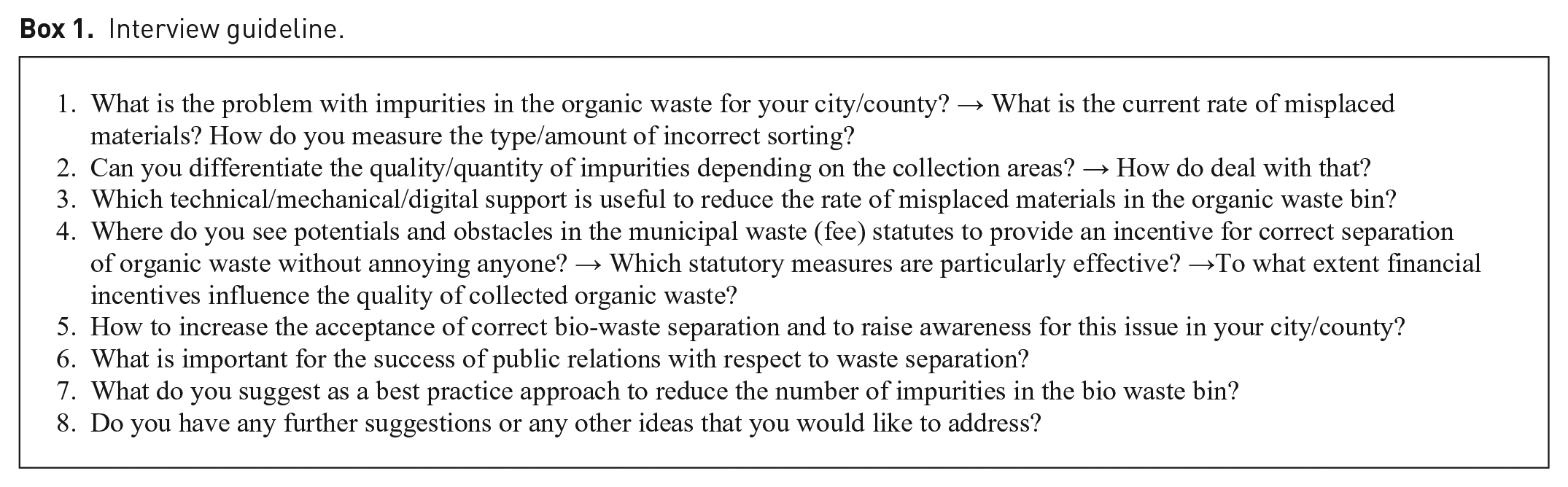
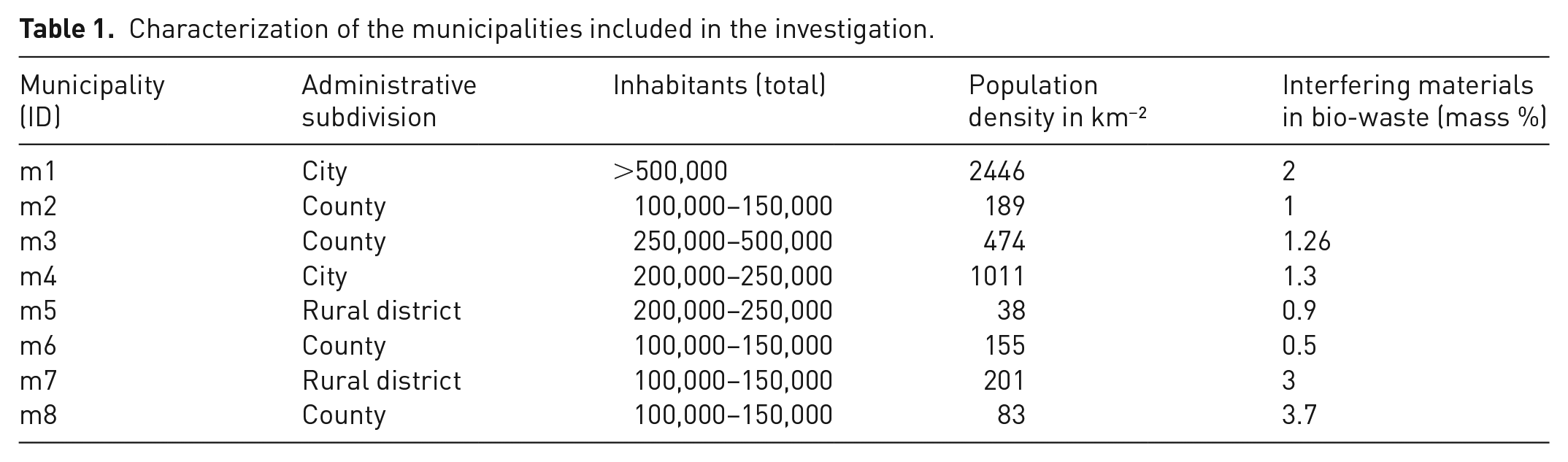
On the basis of these indicators, suitable cities and counties were identified. In all cases studied here, bio-waste is collected at curbside (door to door). To learn their approaches in detail, guided expert interviews were performed. An interview guideline (Box 1) was drawn up as a content-related orientation. Thus, comparable statements could be obtained; on the other hand, the partly narrative character of the guideline left space for the documentation of individual local conditions. For the interviews, only persons with many years of professional experience, several years of employment with the respective authority and responsibility for the area of bio-waste collection were selected. In Table 1, some information on the cities and counties chosen as ‘best practitioners’ are summarized.
Interview guideline.
Characterization of the municipalities included in the investigation.
In spring 2020, a total of 11 interviews were conducted and transcribed using the f4transcription software, dr. dresing & pehl GmbH, Marburg) in order to subsequently enable a comparative and comprehensible analysis of the interviews. For this purpose, main categories and subcategories were first formed deductively in order to be able to code the material systematically in several runs using f4analysis (same source) as well as to form further, inductive categories. All text passages were assigned to the appropriate categories (main and subcategories) in the final runs, which served as the basis for a summarizing data analysis embedded in the context of the work (Dresing and Pehl, 2018). The experts were assured that their names or those of the municipalities would not be published in order to be able to document also results that were not very favourable to the municipalities.
Results
Motivation for action: In all cases studied here, marketing difficulties of the compost products served as a trigger for measures to improve the quality of the bio-waste. After continuous implementation of these measures (ranging from several months to more than a year), the quantities of misplaced materials were reduced significantly in all cases, and in one of the municipalities by about 50%. The experts pointed out that the technical possibilities of pre- and post-sorting in the composting and digestion plants are generally not sufficient to compensate for a high contamination of bio-waste (see also Campos Rodrigues et al., 2020). Because even with the use of advanced sorting techniques, contaminations above the permissible quality standards still remain (e.g. see Carmo Precci Lopes et al., 2019), improving the quality of the input material is of paramount importance.
Analysis of bio-waste: All experts interviewed stated that the collected bio-waste is analyzed on a more or less regular basis to determine the nature of the interfering materials. This is done partly by visual analysis, partly in the laboratory after sophisticated sampling. In some cases, sampling was differentiated between areas with high and with low population density. Plastic bags, tablets, and foils were usually the most prominent interfering materials. Monitoring is also necessary to detect hot spots of contamination: In one area, a sudden decline in quality was observed in parallel with an increased arrival of migrants (see also Keramitsoglou and Tsagarakis, 2013).
Allocation of bio-waste containers to users: The garbage containers were generally equipped with radio-frequency identification (RFID) systems, so that the bins can be assigned to specific buildings or users. The experts considered this to be an initial measure to reduce anonymity. According to the experience of the experts, containers that can be used by a large number of people, for example underground containers, were more contaminated as compared to garbage bins for one or few households.
Waste statute and waste management fees: Under German law, the municipalities specify the legal requirements and charges for waste treatment, which are approved in the respective city council. The charges must cover costs of all waste management services, including public awareness activities. Citizens are obliged to separate bio-waste and other waste fractions from the residual waste. In many local statutes, incorrect filling of waste garbage cans (i.e. plastic packaging in the bio-waste bin) is classified as an offense against the rules. Residual waste bins are mostly far higher charged than bio-waste bins to motivate citizens for source separation. However, according to all experts too high differences in fees between organic and residual waste encourage incorrect sorting. Penalties in the case of violations of the separation requirements were considered to be effective. However, some of the experts perceived these as a necessary consequence only in the case of repetitive incorrect waste separation. Penalties mostly consist of an expensive separate disposal of the organic waste garbage can. Only one of the experts emphasized that penalties would tend to achieve the opposite. However, the penalties only affect the property owner, so polluters in larger housing estates cannot be targeted. In this case, intensive cooperation of the municipality with the homeowners is additionally required. The sanctions must be preceded by warnings: the experts recommended occasional visual inspections before collection. The result should be noted on the waste container, for example with a tag. Most municipalities use a traffic light system, for example red, yellow and green tags with appropriate indications.
Raising awareness: In the opinion of all experts, targeted, regular and repeated public relations work is indispensable (see also Ochs and Oechtering, 2018). According to the experts, certain groups of people should be targeted: because of their curiosity and willingness to learn, children can be addressed well on waste separation and confront their parents with the topic. In densely urbanized areas, representatives of housing companies should also be contacted to gain support in discussions with tenants. In all the local authorities surveyed, the target groups are approached via those media that are used most by the respective groups. The experts recommended many different information channels (e.g. radio, cinema advertising, press and social media) to integrate bio-waste separation into people’s everyday lives. This ‘cross-media’ approach was supported in half of the surveyed municipalities by participation in nation-wide information campaigns (Figure 1). According to one expert, public relations should be seen alongside the usual awareness raising as modern marketing that must form part of corporate communications.
Logo of “Wir für Bio” (we united for bio waste), a joint campaign of more than hundred German cities and municipally owned companies aiming at high quality bio waste (www.wirfuerbio.de).
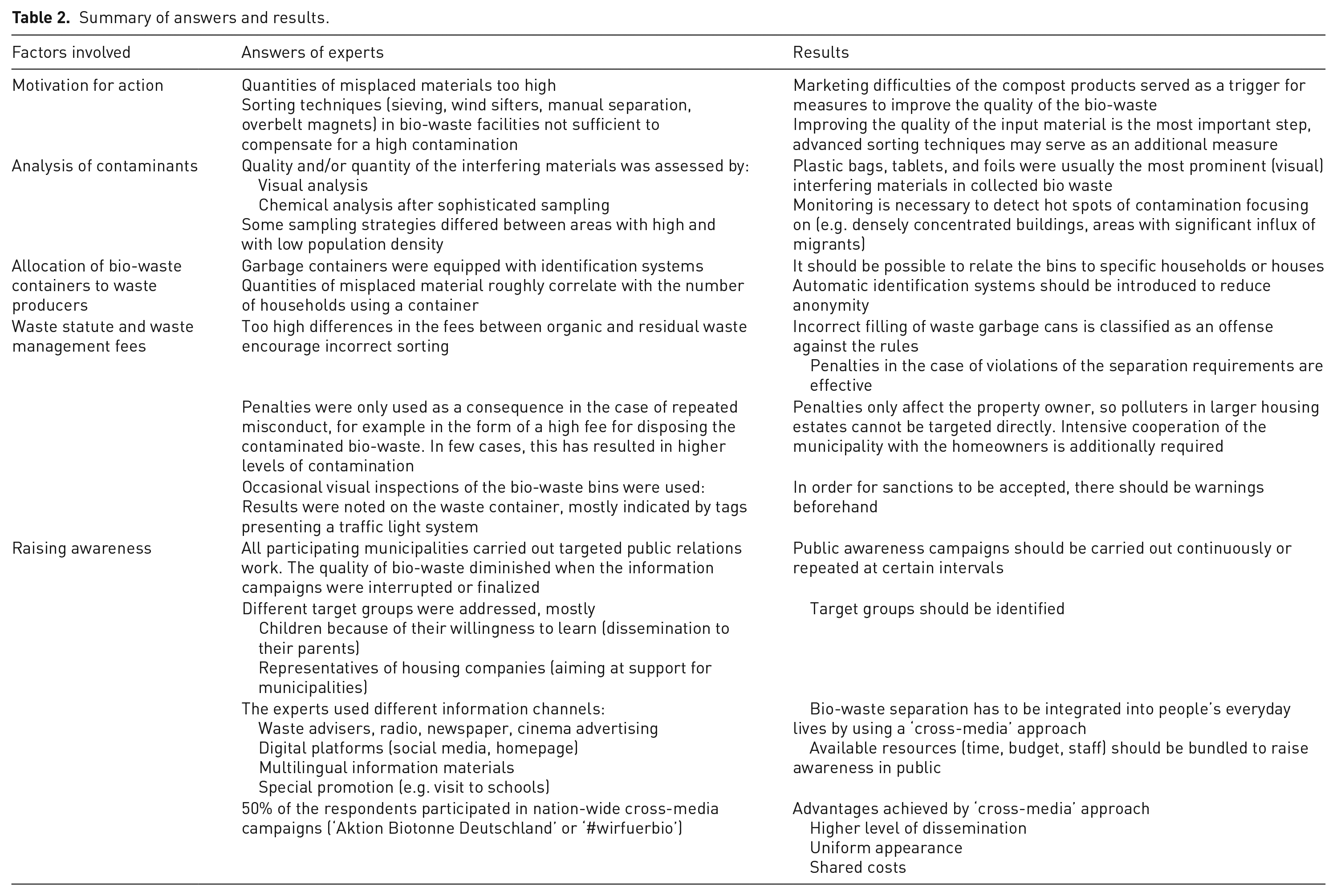
The results of the interviews and the recommendations of the experts are summed up in Table 2.
Summary of answers and results.
Some experts claimed further steps for the improvement of bio-waste and compost quality: Firstly, differentiation of the European waste catalogue for bio-waste from different origin, because waste from parks and gardening or from food industry is mostly less contaminated by plastic and glass particles as compared to kitchen waste. Bio-waste from mechanical–biological treatment (MBT) plants is even more contaminated because of its origin from residual waste. Secondly, an input-oriented threshold limit for contaminants, especially plastics, at least on a national basis was proposed to enforce the quality level of the material delivered to the bio-waste plants.
Discussion
The cooperation of citizens in separating their bio-waste correctly is a crucial prerequisite for a successful recycling scheme (Friege et al., 2016; Malamis et al., 2017). There is a high number of economic (Hage et al., 2009), social (Abbott et al., 2013; Oliphant et al., 2020), technical (Lange et al., 2014) and cultural (Bleicher 2018; Keramitsoglou and Tsagarakis, 2013; Saphores and Nixon, 2014) factors influencing the sorting behaviour of waste producers. The results published in the literature are by no means uniform, but in some cases contradict each other considerably.
In accordance with Hage et al. (2009), the results presented here demonstrate the importance of economics as a motivation for separation at source in general and also in the form of fines or extra-costs to fight contamination. As waste charges for separated fractions should be in relation to the waste owner’s opportunity costs for disposal (Friege, 2018), the economic incentive must be high enough to prompt the waste owner to do his sorting work and low enough to avoid motivation by abuse. In other words: It is necessary to target ‘individuals’ biased perception of recycling-related costs’ (Lange et al., 2014). In the case of Milan, with a collection rate of 92 inh−1 yr−1, controls and fines have also proven useful. In Milan, a crew of 30 operators is constantly monitoring the quality of all recyclable fractions before collection (Anonymous, 2018). Contamination by ‘non-compostable materials’ is reported to be 4.06%. (Degradable plastic bags are not included in this figure. These bags are frequently used in Italy, but strictly excluded in Germany.)
Door-to-door collection is convenient for the waste producers as compared to large containers or bring-banks in the streets and leads to higher amounts of separately collected fractions (Alvarez et al., 2008; Hage et al., 2009). At the same time, quality of door-to-door collected material is better (Alvarez et al., 2008; Ricci-Jürgensen, 2014). Both effects could be confirmed in this study. Awareness of households is raised by the successful use of bags indicating different qualities of bio-waste directly at the container. This effect can also be attributed to a subjective loss of anonymity and fear of neighbourhood gossip.
People’s attitudes towards recycling number among the most important factors for the recycling activities of households (Saphores and Nixon, 2014). Therefore, public information and awareness campaigns are of outstanding importance, though it is clear that information intervention is not the only factor to impact civil behaviour (Chen et al., 2018). The work presented here makes clear that continuous information using the media used by the specific target groups is key for successful awareness raising.
Though technical solutions and equipment can be transferred from one country to another, the answers to challenges for separate collection may differ considerably depending on the level of development and local or national frames. Therefore, the boundary conditions of the study presented here must be taken into account if it is intended to transfer the results to other regions. These include, above all, the legal possibilities of the municipalities as well as the levying of fees. Apart from these specific conditions, the basic recommendations can be transferred to other regions, that is
– sound and suitable economic instruments
– the implementation of control tours
– the most precise possible allocation of waste containers to households
– the information on the quality of bio-waste directly attached to the container
– a target group-specific information strategy
Conclusion
The results of the survey demonstrate the importance of a holistic view at the whole system from the citizens’ attitudes to the use of compost in agriculture. An optimization of technical parts of the system, for example collection logistics or details of the composting process, without a holistic approach towards the desired product is not enough. According to the opinion by many experts, the German Federal Government has just proposed the introduction of a contaminant threshold of 0.5 mass% for bio-waste facility inputs (BMU, 2020). However, this is highly controversial (e.g. see BVSE, 2021) because it does not apply to the material that is delivered to the plants, but to the material that is introduced into the composting process. This would not mean that households would be held responsible as polluters, but rather the operators of the plants. Despite successful approaches towards better bio-waste, the introduction of a compulsory collection covering also groups who are not willing to co-operate remains questionable. Policy should aim at high quality of the compost instead of a maximum of bio-waste, and this requires a clean feedstock. To reach this target, ‘compost-like’ outputs from MBTs or co-composting of bio-waste and diapers should not applied to soils any longer, even if the threshold limits for heavy metals are met. But these mixtures are important sources of microplastics, which end up in soil endangering organism and the food chain.
Footnotes
Acknowledgements
The survey was part of the master thesis performed by Yasmin Eger. We are indebted to all interview partners for their time and their valuable and transparent information. f4transcription software and f4analysis (all media equipment, e.g., audio recording, transcription devices, etc.) was provided by Leuphana University.
Declaration of conflicting interests
The authors declared no potential conflicts of interest with respect to the research, authorship, and/or publication of this article.
Funding
The authors received no financial support for the research, authorship, and/or publication of this article.
