




Abstract
How police leaders provide development opportunities, promote, and recognize achievements have discernible effects on employees’ commitment and police culture, which can be damaged through negative perceptions. This qualitative case study of one Canadian police organization explores sworn police officers’ (n = 17) understandings of informal relationships and its effects on officers and their organization. Semistructured interviews were conducted with officers who fell into two groups (leaders; n = 10 and nonleaders; n = 7), alongside four pre-interview orienting vignettes that identified potential scenarios related to informal relationships in policing. We found three primary themes: (1) rational reason—how officers perceive their organization to make fair decisions; (2) organization viewed as unsophisticated—the lack of appreciation for the strength of “weak ties” in career advancement processes; and (3) nepotism—the need for transparency about opportunities for all employees to develop. We conclude with practical organizational considerations.
Introduction
The current qualitative study takes up the longstanding belief that “it's who you know” that matters most in police cultures, meaning informal connections forged through work and personal connection are a driving factor advancing an officer in their policing career. As is the case with any institution, there are complex social, cultural, and organizational dynamics within policing services. Moreover, revealed in scholarship is how notions of power, influence, and social capital (Hathazy, 2012) may be wielded and leveraged by officers to gain promotion, transfer, recognition, career mobility, and other developmental opportunities (Reynolds & Hicks, 2014). In particular, decisions about who within the service can upskill, attend courses, earn recognition as well as receive opportunities, promotions, or simply the “good” jobs over the “bad” jobs—have been critiqued and interrogated in international policing studies (Atkinson et al., 2003; Nogalski et al., 2024). Sanders (2004) defined informal relationships as “relationships that exist outside the formal structure” (p. 137) of an organization, a concept which can capture the connections people form and have with each other beyond hierarchical reporting structures (i.e., chain of command), and how these personal affiliations and relationships may become a contested source of social capital in the workplace. The essence of these works being the idea that the influences on these decisions (what we suggest are resident within “informal relationships”) are often neither formal, just, fair, consistent, nor transparent (Atkinson et al., 2003; Nogalski et al., 2024).
In the current study, we focus on better understanding, theoretically and empirically, how relationships which exist between people in different positions of status and power in policing services may help or hinder career advancement. Specifically, this research is a case study of a large regional police service in Canada, that investigates how police officers (N = 17)—both leaders (n = 10) and nonleaders (n = 7)—interpret informal relationships among police officers within the service, and how these relationships are thought to affect both police culture and career advancement.
Theorizing Informal Relationships in Police Culture
Informal relationships refer to connections that are not dictated by the organization's formal structure (Sanders, 2004), relationships which are “informal or non-prescribed or non-instituted relations” (Kadushin, 2004, p. 23). Within the broader organizational literature, Boud (1999) found informal interactions have greater influence on an organization's development than formal relations (see also Balkundi & Kilduff, 2005; Burt, 1992). With the potential role informal relationships can play in a police officer's career advancement and the effects of informal relationships on police culture being understudied, Chan's (1996) work on police culture and Granovetter's (1973) theory of “weak ties”—which has been applied across many other workplace sectors, nursing, information technology, and media (Brooks, 2019; Jack, 2005)—are helpful resources to interpret the effects of informal relationships on work opportunities available to police through the perspectives of officers themselves, a phenomenon which has yet to be studied in depth.
Early and recent researchers studying police culture tend to arrive at similar conclusions, with the negative portrayal of police culture being a common finding. For example, in their textbook, Cartwright (2022) reduce representations of police culture as “negative, entrenched in cynicism, masochism, loyalty above all else, and an ‘us versus them’ mentality” (p. 152). Other scholars echoed this position (Reiner, 2010; Turner, 2023), while some researchers, such as Chan (1999), challenged this predominant view. Specifically, Chan (1999) critically assessed the more typical, hostile view of police culture from four perspectives. First, Chan (1999) questioned how/if (reductionist) definitions of police culture in the literature have failed to account for organizational differences both internally (leadership, employee demographics, and history) and jurisdictionally (community demographics, geography, and socioeconomically). Second, the idea police officers are considered to be “passive” participants within their culture, rather than active and agential agents of change in relation to cultural norms, was identified as a point of tension (Chan, 1999). Third, Chan (1999) critically reflected on policing studies’ “apparent insularity from the social, political, legal, and organisational context” (p. 112) and identified a need for the literature to develop and nuance definitions of police culture that incorporate dynamic, jurisdictional-specific social and political contexts. Fourth, Chan (1999) argued these three factors combined have resulted in static constructs of police culture that rendered them incapable of evolution, rather than leaving possible the potential for (and reality of) change.
A key empirical component of Chan's (1999) critique is the role individual officers play in adopting and strengthening, or not, the culture of their organization: “while culture may be powerful, it is nevertheless up to the individuals to accommodate or resist its influence” (p. 111). Chan's (1999) model applied Bourdieu's concepts of the “field” (social, political legal, and economic context) and “habitus” (cultural knowledge) to policing (Bourdieu & Wacquant, 1992) while adapting Sackmann's (1991) model of cultural knowledge. In doing so, Chan (1999) revealed how cultural knowledge can influence the strategy formulation and organizational processes needed to create cultural change. In other words, Chan (1996, 1999) imagined and reconceptualized police culture as adjustable and thus having the potential for change.
Informal relationships between people—in this case within a police service—may be further explained through an important aspect of Social Network Theory (SNT), particularly the concept of “weak ties” (Granovetter, 1973), which refer to relationships defined by infrequent, casual interactions that nonetheless carry significant value for organizations, individuals, and communities. Granovetter (1973) illuminated the value of “weak ties,” over “strong ties,” by means of a continuum that “measured time, emotional intensity, intimacy and repetition among connections” (Cote, 2019, p. 22). As informal relationships may supersede the formal relations dictated by organizational structure (Fronczak et al., 2022; Gee et al., 2017), these “weak ties” can have more influence on work outcomes than formal relationships (Granovetter, 1973). However, some scholars challenge Granovetter (1973), arguing weak ties may not be more influential. These scholars suggested variation occurs depending on circumstances and contexts within the organization (Wang et al., 2024). Nevertheless, over 40 years of research has produced ample evidence suggesting positive outcomes attributed to weak ties are associated with the creation of stronger access to information and enhanced interest in working collectively (Granovetter, 1973; Oh et al., 2004). Furthermore, there is support for the role informal relationships occupy for improved innovation and decision making (Granovetter, 1973; Oh et al., 2004).
How exactly informal relationships and power are mobilized and circulated within an organization (whether they can be activated successfully when making formal decisions), will necessarily shape an organization's culture and the practices that constitute and reinforce the culture (Neill, 2014). Simply said, if more formal forms of authority or governance lack power in organizations, and employees are subsequently able to leverage more freely informal relationships for, potentially, self-interest and career gain (or, at the very least, are perceived in such a manner), the effects on culture may be negative (i.e., create friction, tension, and more competition in the organization over career mobility). Given these informal relationships are linked to knowledge sharing throughout the organization, often from a higher authority to a lower (Huning et al., 2015), the levels of transparency they operate within can also affect culture; in this context, the awareness police leaders and those in subordinate positions have of informal relationships within policing organizations. To elaborate, Murray (2012) stressed the need for police leaders to recognize the value of informal relationships in shaping the workplace environment, which included concerns for job satisfaction and police legitimacy (Ledford, 2024). Roithmayr (2016) studied the role informal relationships play in influencing how excessive use of force is addressed in policing organizations and found use of force approaches adopted by police officers followed formal and informal paths; namely “the practice spreads through social learning along informal and formal social and professional networks in police organizations” (p. 434).
Overall, we stress how organizations (and the actors constating organizations) seeking to leverage informal relationships must be wary of potential challenges arising. For some employees, informal relationships that result in improved standing, recognition, and opportunities may cause those employees to become too focused on cultivating these connections versus completing their core job duties (Sanders et al., 2000). Importantly, Drew and Saunders (2019) found in their case study of an Australian police service that nearly “80% of male officers believed it was likely or very likely female officers would be promoted due to their gender rather than their skills and experience” (p. 487), thus creating negative cultural effects where any support strategies designed for female officers focusing on gender differences end up reinforcing stereotypes that women are simply “weaker” than their male colleagues (Haake, 2017). These attitudes were also found to discourage female officers from participating in the promotion process (Drew & Saunders, 2019). The need to appreciate the value of informal relationships and the possible constructive effect or damage caused is of necessity for organizational health (Kadushin, 2004; Neill, 2014; Sanders et al., 2000)—a phenomenon we seek to analyse in depth through the perspectives of a Canadian police service's officers.
Method
Study Design
Our research is primarily a qualitative, exploratory case study; in this context, this means the study approach focused on determining how (1) Service officers interpreted informal relationships between leaders and nonleaders within one hierarchical organizational structure and (2) what the social and cultural effects are of those relationships. Case studies examine “a contemporary phenomenon in its real world context” (Yin, 2014, p. 2), such as an organization, to understand the organization's unique trajectory. Case studies are a compelling method to explore issues and subjects where relationships are uncertain and understudied. In the current study, our focus is on the phenomenon “it's who you know” (i.e., informal relationships affecting opportunities at work) within the context/case of a large Canadian police service.
At the time of data collection starting September 12, 2022, the Service employed over 1,200 people, with under 1,000 being sworn members and was among the largest police service in Canada. The Service's rank structure has 10 distinct ranks (Chief, Deputy Chief, Superintendent, Inspector, Staff Sergeant, Sergeant and First-Class Constable, Second-Class Constable, Third-Class Constable, and Fourth-Class Constable). Reports commissioned by the Service, which included employee engagement surveys in 2010, 2014, 2018, 2020, and 2022, all tend to highlight some employees’ dissatisfaction with the working environment (especially over career advancement); independent reviews have echoed the engagement surveys’ findings. Together, these findings show change is still necessary within the Service to meet the organizational needs of police officers.
Participants
The study participants were divided into two distinct groups, leaders (sergeants, staff sergeants, and senior leaders—inspector, superintendent, deputy chief, and chief) and nonleaders (constables). Of the 19 volunteers who responded to the recruitment message, 17 completed interviews, with seven being nonleaders and 10 being leaders. Of the remaining two participants, one left the organization prior to an interview being scheduled and the other required personal leave during the period interviews were being conducted and, thus, was unable to participate. The participant cohort consisted of 69% self-identifying as men and 31% self-identifying as women. The potential benefit of strong representation of women in the sample is the amplification of their voice in response to the many barriers facing women in the policing profession, as indicated in some police literature (Drew & Saunders, 2019; Johns, 1979; Kringen, 2014; Todak & Brown, 2025).
The organization embodies characteristics of similar police organizations—a broad array of units (patrol, victim support, investigations, emergency response, etc.) and covers a larger geographic area (urban, suburban, and rural). The dynamics of service were reflected within the sample of participants. The average years of experience of the sample (over 21 years of service) and the mobility of sample (most moving occupational roles every three years or less) produced a sample that represented the breadth of occupational roles and working geography that was characteristic of the service (see Table 1). The breadth of experience within the sample provides a strong foundation for the study, both in terms of experience within the Service (the total experience of the sample was over 355 years) and the fact the sample had work experience in each function and geography within the service.
Detailed Participant Breakdown.
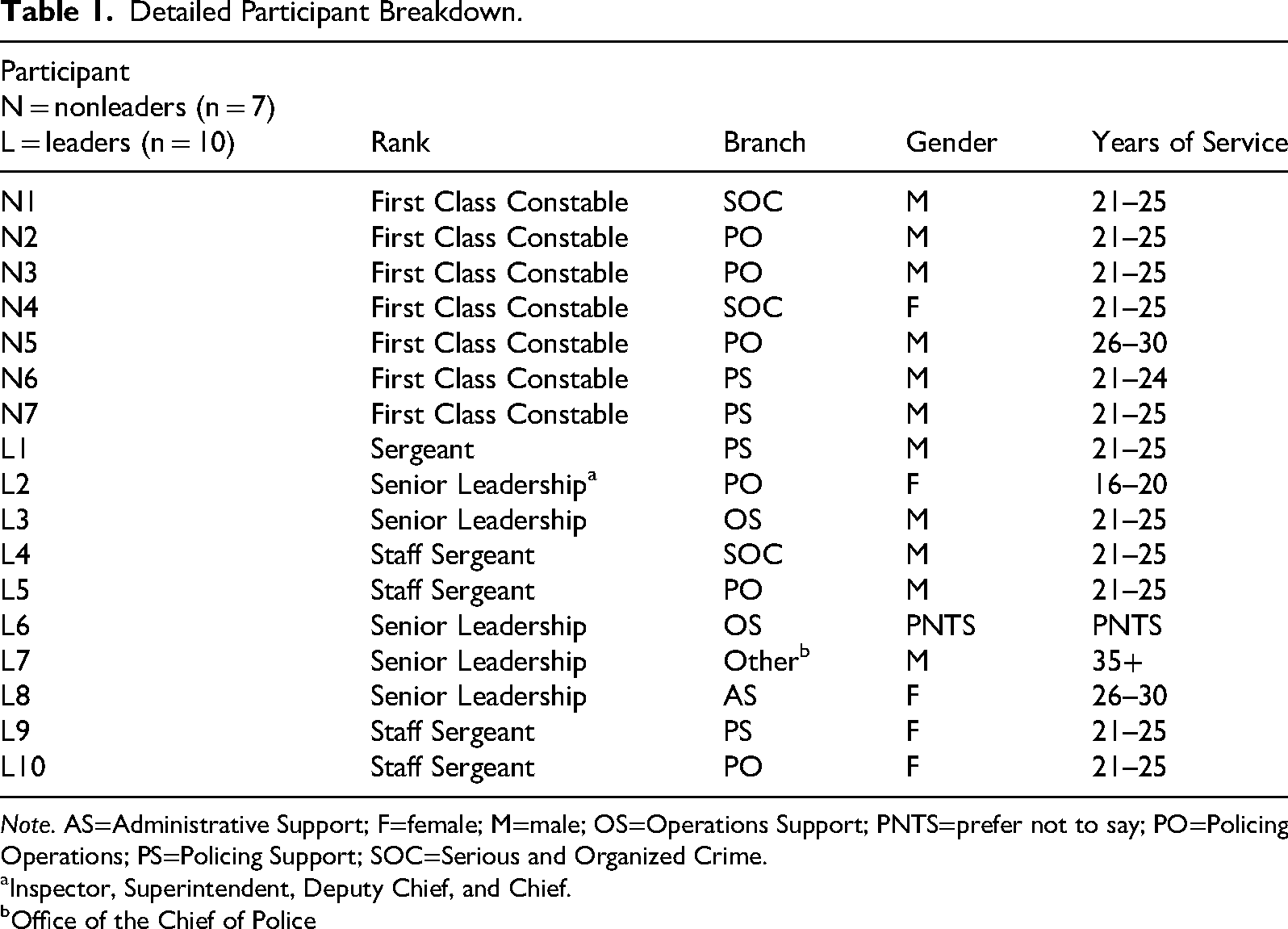
Note. AS=Administrative Support; F=female; M=male; OS=Operations Support; PNTS=prefer not to say; PO=Policing Operations; PS=Policing Support; SOC=Serious and Organized Crime.
Inspector, Superintendent, Deputy Chief, and Chief.
Office of the Chief of Police
Procedures and Researcher Positionality
Ethical approval was obtained from the Human Research Ethics Committee at Charles Sturt University (File #H20338). Given the Principal Investigator's executive leadership role, we ensured participants were clear the study and their role were not tied to the Service in any way and thus would have no impact on participants’ careers. To minimize these risks, the Principal Investigator designed the study to be removed from institutional pressures (i.e., members of the Service did not influence the design of the study) and ensured participants were aware their participation would have no positive or negative affect on their career or career opportunities, as outlined in the Informed Consent Form. Participants provided informed consent before the study commenced. Given the reality each participant provided feedback critical of the Service, the leadership, and related human resource processes, we believed participants were not using the interviews strategically or with filters or obstruction.
Yet, despite these best efforts to mitigate positionality risks, police culture has been argued by some to be toxic and particularly difficult and marginalizing for groups other than white men (Turner, 2023). In this vein, the Principal Investigator recognizes his privilege as a white man; thus, even if his personal compass has directed him toward working with, accommodating, and supporting people unlike him in presentation and identity (i.e., gender, race, sexuality, and so forth) through various efforts (e.g., supporting vulnerable and racialized youth through the development of youth employment programs, supporting victims of family violence, coaching and mentoring youth), these achievements do not right the ongoing realities and oppressions of Western societies, nor make up for active and historical inequities and exclusions.
The Principal Investigator further recognizes his status in a Canadian policing organization as a “civilian” command member will necessarily shape interpretations of these data—these “insider” challenges have been described in the extant methodological literature as being both advantageous and disadvantageous in many diverse research settings (e.g., see Johnston, 2019). That said, through ongoing reflection, the Principal Investigator leveraged his positionality in the research design to obstruct challenges and instead stay authentic to the study purpose. Capturing each participant's perspectives, while holding strong views of the topics discussed, required a conscious plan and consistent approaches to interviewing. This meant the Principal Investigator worked hard not to impose his perspectives on the data collection process, allowing each interview to unfold naturally from, largely, the perspectives of participants.
To recruit participants, the Service's Chief of Police authorized the study and approved the Research Department to message members using the organization's intranet. Although the Principal Investigator prepared a second followup recruitment email, they did not send the email because the number of officers who came forward to participate after the initial email invitation was sufficient to obtain a sample of participants that, collectively, could answer the project's research questions. To help differentiate their researcher status from their occupational role, the Principal Investigator offered a specific study email address as a contact point for members with questions, rather than their Service email address. The Participant Information Statement disclosed the Principal Investigator was undertaking the study in his personal capacity as a graduate student and no advantages or disadvantages would be experienced by participating or not participating. Said differently, participation (or not participating) would not affect any participant's relationship with the Service, the affiliation Association/Union, or the Principal Investigator's university. Interested participants were asked to propose a day and time for a one-on-one interview, which the Principal Investigator always tried to accommodate.
The Principal Investigator offered to hold the interviews in a location of participants’ choosing (some selected the local University, others preferred a coffee shop), and the Principal Investigator reinforced, before any interview, they were conducting the research in a private capacity with guaranteed confidentiality. The Principal Investigator conducted semistructured interviews alongside “orienting vignettes” to learn how participants interpreted informal relationships. To elaborate, prior to interview questions, all participants read hypothetical vignettes about selection, development, and recognition processes in police organizations. These vignettes served as a foundation to the conversations that followed during interviews, whereby participants were provided with the space and comfort needed to explain in more depth their responses and experiences related to the hypothetical vignettes and questions posed. The interview guide was designed to include: (1) prequestion hypothetical vignettes (allowing participants to consider applied scenarios from a more neutral perspective before conversations began); (2) a rating scale for each vignette (allowing for a comparison of participants’ perspectives); and (3) open-ended interview questions following each vignette (allowing participants to share lived experiences).
All vignettes were applicable across rank levels, so the participants were able to respond comfortably from their professional position. The vignettes were drafted with a focus on four central human resource processes that capture police officers’ attention: promotion, recognition, development, and transfer. Each process was the focus of one vignette, with themes around police cultural nuances (Chan, 1996) and weak ties in police organizations (Granovetter, 1973) permeating the hypothetical narratives shared in vignettes. A brief, summarized outline of each vignette is provided below:
Data Analysis
We adopted a realist orientation which guided our approach to data (the words of participants) as constituting a reality or truth whereby concerns for objectivity could be addressed and mitigated, irrespective of the limitations of generalizability that come with most forms of qualitative research (Bonino et al., 2014). With this in mind, the Principal Investigator conducted all 17 interviews in person and used a digital voice recorder to capture participants’ narratives and then transcription software to transcribe the recorded proceedings, verbatim. The Principal Investigator also took written notes during the interviews using a blank copy of the interview guidebook for each participant to highlight content contemporaneously, a form of memoing (Hesse-Biber et al., 2015). Following each interview, the Principal Investigator deidentified the data, assigning a unique participant number (P) in place of the name and noted if the participant was a leader by including L or N, the latter indicated a nonleader. We did not use pseudonyms to avoid names inferring implicit biases or assumptions of gender, race, or ethnicity. Each transcript was imported into QSR NVivo (Version 14.23.2) for coding. Although using QSR NVivo software to store and manage the data, the Principal Investigator conducted all coding manually, not using the software's auto code function, to ensure nuances were captured.
The distinct experiences recounted by the participants produced layers of meaning within the responses. Distilling these layers required a reflective, iterative approach to data analysis, which could be found through a thematic analysis approach that is epistemologically flexible and used across many scientific disciplines, as established by Braun and Clarke (2006). Using thematic analysis from an inductive perspective is a “ground up” approach that tries to avoid linking preconceived ideas and concepts, which could, ethically and empirically, restrict how themes were constructed. More specifically, this meant the Principal Investigator initially searched for meaning and patterns and tried to “get a sense of the whole” of the data. He immersed himself in the transcripts, reading the transcripts in their entirety for each participant to gain an appreciation of the content. Focusing on the first vignette, he then read responses for the vignette for the first five participants and created a draft codebook inclusive of every emergent theme. Next, he organized these themes to remove duplication, reduce redundancy, and clarify meanings. The draft codebook included the code, an explanation of the code, and an example of a quote demonstrating the code, to allow for consistent coding and interpretation. Then, codes were categorized into themes and subthemes. Next, he conducted a line-by-line coding of the same five transcripts including a review of the remaining three vignettes, reviewing each vignette across all five transcripts aligning content to the developed codes and adding codes where the data revealed new themes from the remaining three vignettes. Here, the Principal Investigator ensured similar excerpts were connected to the same codes, which allowed for further refinement of codes and for the expansion of codes.
The process resulted in a comprehensive codebook with mutually exclusive and comprehensive themes. Next, the codebook was reviewed as well as the same five transcripts by a trained tenured qualitative researcher for interrater reliability. Their focus was on the validity of the codes and the reliability of categorizations thematically, as well as the structure of the codebook in terms of the constitution of themes. The approach provided an opportunity to adjust and refine codes after discussion of differences in coding and operationalizations. Once the iterative process concluded using the first five transcripts, the Principal Investigator coded the data in its entirety starting with the first vignette across the remaining 12 transcripts and then repeated the process for the three remaining vignettes. After the process, the Principal Investigator connected related excerpts across the dataset for further insight into themes, which comprised the quotations/data shared in the current study.
Within this process, theme saturation was achieved. As explored by Saunders et al. (2018), of importance when discussing theme saturation is the adequacy of the sample in answering the research question(s). In exploring theme saturation, they identified four models, theoretical saturation, inductive theme saturation, priori theme saturation, and data saturation (Saunders et al., 2018). For this study, and fitting with the study methodology, inductive theme saturation—where focus is placed on the identification of new codes or themes—provided an evaluative means to identify when saturation had occurred. Applying this evaluative approach allowed for the identification of theme saturation after the twelfth interview. The final five interviews allowed for nuanced information to flow, but no new themes emerged at this point.
Results
The results are structured around three predominant themes: rational reason, organization viewed as unsophisticated, and nepotism. We discuss how these themes, which at times present conflicting views, temper claims around the influence of informal relationships in police services while also evidencing their reality and effects on workplace culture.
Rational Reason
In total, 82% of all participants (14 of 17) discussed the theme, Rational Reason, which presented in the data through clear reference to the participants’ willingness to accept leadership decisions as justifiable, despite not knowing the actual rationale behind each decision. Responses to vignette 1 were an outlier, with only one mention of this theme. Thus, the analysis of Rational Reason here is focused on participants’ interview responses to vignettes 2 to 4, exclusively.
Vignette 2: Participants identified several “rationalistic” reasons to explain the hypothetical leaders’ decision, decision-making processes, and the employee's ability to understand outcomes, including the complexity and variety of challenges leaders face when making promotional decisions (i.e., officers’ interpersonal dynamics, health, and workplace performance). For example, P8L explores how “…it [the vignette] doesn’t talk about the performance management, doesn’t talk about discipline, doesn’t talk about [lots of potential issues], so again, a lot of times people think they’re amazing [but they are not]”. In this excerpt, P8L fleshes out how many (oft unknown) factors may influence leaders’ choices and how police employees affected by these decisions may lack appreciation for their complexity—they cannot understand what they fail to know nor necessarily have the development (i.e., maturity) to fully appreciate these less visible factors. P8L alludes to a potentially misplaced belief in the skillsets of colleagues—“a lot of times people think they’re amazing”—which shows the variability in interpretations of others’ competences among some officers.
P9L shared other potential reasons regarding why Cst Taylor (vignette 2) was not successful in being selected for the course: “Taylor's work performance, Taylor's stats, Taylor's seniority on the shift, other courses that Taylor's already received in relation to the others on the shift who may be in line or have not received [the course]”. P9L's words revealed the reasons Taylor may have been unsuccessful and echoed a common and appreciative perspective shared by the participants—there are many influences and considerations factoring into leadership decision making—some of which frontline officers share awareness.
Participants also provided supportive “ideas” potentially justifying the approach by leadership, and a general sense the policing “business” was bigger than any individual perception, including identifying how performance or lack of performance can be a factor in decision-making processes. As P11L explained: “just because you express an interest doesn’t mean you’re entitled to it [the role, training, promotion, etc].” Many participants echoed P11L's position, including nonleaders, noting interest or desire does not guarantee award, and instead many influencing factors, which they respected, required consideration. In a sense, participants valued merit-based, “fairness” factors and often broke down these factors in their responses that, collectively, could weigh into decision-making processes by leadership, rather than generally echo the suspicions raised by the constable in the vignette.
A further reflection brought forward by participants was recognition employees are on a need-to-know basis, meaning in select cases, there is no need for an employee to know why a specific decision was made. These participants appreciated the need for internal confidentiality and privacy over some matters in the Police Service. P8L reflected on how frontline officers do not get prioritized for some courses as other units require some courses as a prerequisite to do that work (i.e., Criminal Investigative Branch). P8L also revealed how, often, the rationale for a decision made by leadership is not shared at large within the Police Service or to all affected individuals. The participant critically reflected on the effects of a lack of knowing and how these effects can be difficult for frontline (patrol) officers who are especially left in the knowledge void: The front lines don’t really get a front row [seat] for that [courses]. They have to wait to see if there's any openings and there might be someone that's been waiting longer. It's not about [who you know], it's not personal…it's usually about the spots that are available.
In this passage, P8L revealed patrol officers are often unaware of how access to courses (and other leadership decisions) is decided. Participants believed their lack of awareness is a primary reason driving why some officers, as the constable described in the vignette, may reach potentially erroneous conclusions, such as “it's personal.” Defensively, P8L posits how anyone's attempts to secure development opportunities may encounter issues related to availability, rather than personal reasons, and suggested the rationale could be related to “the spots that are available.”
When discussing potential leadership interference compromising objectivity in decision-making processes, several participants, both leaders and nonleaders, expressed a belief that aligned with P8L as they voiced other reasons/factors for decisions being reached, beyond leadership interference. For instance, P7L said: “[I] have never had anyone from the [Service's Executive location] try to interfere.” P15L too provided further support for this supportive/appreciative position; in this case, described their limitations in selecting employees to go on a course: “I [as the leader] can’t do it because we don’t have the staffing…but as to like, the connections on the [redacted—executive offices], it's been a while since I’ve kind of heard that.” P3N supported police leaders, when discussing leaders interfering in process. They said “You [referring to leaders] don’t have those options available to you anymore.” P3N felt leaders did not interfere because of the degree of oversight, policies, and transparency affixed to their position, which in practice seriously limited their capacity to inform outcomes. Whether leaders lack influence to affect processes because of the rigid oversight or lack the desire to interfere, our findings point to how the needs of other units may ultimately dictate decisions, as a number of participants outlined rationalistic reasons to dispel Cst Taylor's notion of leaders interfering.
Overall, participants largely felt processes in their Police Service designed to create fairness and objectivity in promotional (or other) decision-making processes prevented formal leadership interference, as well as police leaders’ frank disinterest in influencing some processes guiding how they make decisions on developmental opportunities. P9L explained: “It [the decision to send a constable on a course], to me, it's too small…for someone on the [redacted—executive offices] just to stick their nose in to.” Here, P9L provided a rationale to support leadership not trying to influence process outcomes because of a lack of desire to invest the energy in negligible or smaller concerns. Thus, a common tone was evidenced, suggesting participants (leaders and nonleaders) could find rationales to explain the leadership's actions displayed in the vignettes and were generally not supportive of the constable's proposition in vignette 2 of leadership interfering.
Vignette 3: P1N continued to critically explore the idea of leadership interference in advancement or promotional outcomes, echoing a position presented by P15L in relation to vignette 2. Specifically, P1N discussed how prior discipline (vignette 3 implied past discipline may limit support from leadership for the employee) does not appear to affect promotion or prompt leadership interference: “…there's lots of people that have a police act conviction [formal discipline] at some point in their career. And then they’ve gone on to be promoted, they’ve gone on to get jobs.” Providing counter evidence to the suspicions raised by Cst MacAroon in vignette 3, P1N shared their knowledge of employees previously disciplined who were nonetheless able to secure development opportunities and promotion, suggesting evidence for “forgiveness” for some within the Police Service (of course dependent on degree of indiscretion); thus, the idea suggestive of any previous discipline is a driving factor in leadership decisions and outcomes was dispelled by the participant.
Vignette 4: Participants continued to provide various examples of this theme in relation to their responses to vignette 4, including detailing challenging decision factors when dealing with employees and suggesting, sometimes, the best options require “unpopular choices.” P3N, in describing their understanding of leadership and the challenges with decision making, said: “… sometimes, if you’re in charge of a unit, you have to make the difficult decisions. That's why you’re getting paid the big bucks and you have to make the call.” Here, P3N identified choices are not “black and white” and there is a need for leaders to make both calculated and sometimes unpopular decisions.
In this vein, P5N felt reduced opportunities are sometimes necessary, based on officers’ need for accommodations: 1 think that's perhaps a very plausible thing that maybe earlier on in their career they experienced something or had some sort of a medical or mental health diagnosis where they’ve been managing and living with it, and they want to feel like a productive member of the workforce.
P5N's words suggest Cst Johnston [the hypothetical character in vignette 4] may have landed “plum” roles for legitimate medical reasons, which colleagues may not know about, nor need to know. P5N provided yet another reason to support leadership decisions that may limit opportunities for some colleagues to support other employees, given their unique medical circumstances. Related to employees granted new positions or other advantages for “unknown” reasons, P14N discussed how colleagues staying in a particular position for an extended period of time (i.e., there are time constraints for some job assignments) may also be due to appreciative or “legitimate” reasons based on merit: 1 think it, it comes down to, if people are rewarded by staying in a position and they’re performing at a high level, they’re passionate, and they’re doing their jobs well, I think a lot of people, within the Service are okay with seeing somebody staying in a position for a longer time.
Here, P14N suggested the decisions to leave members in specific roles because they are doing an excellent job and, as a result, better serving the community, is an effective approach. Furthermore, participants saw the approach as acceptable to “a lot” of employees, which was also suggested by P6L, who when asked about other possible rationales for the decision. They stated: “maybe there was just something else [another reason for the decision], very highly skilled … that was just too good to overlook.” P6L furthers the perspective of decisions as enabling employees to remain in roles. The idea being leaders link the role to the employee's skills and the workplace outcomes they achieve, which makes them stand out in relation to their colleagues, including when juxtaposed against negative cultural perceptions about individuals (e.g., “lazy”). Overall, participants provided numerous reasons for dismissing leadership interference in decision-making processes as was described in the vignettes, often related to participants’ lived experience in the Service.
Organization Viewed as Unsophisticated
In total, 76% of participants (13 of 17) provided input into the theme Organization Viewed as Unsophisticated, which refers to participants’ recognition of a lack mature systems, process, and people (i.e., immaturity) within the organization, specifically how leaders and systems sometimes problematically created the perception of inequities, ambiguity, or uncertainty, often resulting in felt frustrations. The theme included almost one-sixth of all mentions in the dataset. Leaders comprised most of the participants who provided comments in relation to this theme (61%; 8 of 13 participants were leaders).
Vignette 1: Participants, in relation to vignette 1, provided support for the theme by expressing how perceived inequitable decisions made in the organization and/or how leaders engage with staff may be the product of immaturity. P8L shared an example where they, upon reflection, took exception to their own approach with an organizational process, at the time, demonstrating a lack of sophistication on the part of the organization, including the people responsible within the space: We all agreed that putting this person forward, the person was going to most likely be disqualified, but we didn’t want it to be from our level. And because of where the individual had worked prior to…we thought it would look poorly upon us that we didn’t put the person forward knowing that the person wasn’t going to make it and the person did not make it.
In this quote, P8L allowed a decision to be shaped by connections and took comfort in how the “right” outcome would be resultant as the process progressed. They were willing to put an unqualified person forward and knew that, if an error, the error would be corrected later in the promotional process.
Sharing how leader connections can influence decisions P14N shared their interpretation when discussing how some decisions are perceived to occur. They stated: “So there is some kind of favouritism and comfort level and I think that's why we have some leaders seeking those people.” In searching for the reasons why leaders make the decisions they do, P14N suggested, in some cases, they simply “play favorites.” In addition, they suggested a leader's desire for comfort—with whoever leaders work with closely or distantly—though less sophisticated, is a vital consideration. Whether “passing the buck” or considering personal interests in making personnel decisions, support for the theme was evidenced by leaders and nonleaders.
Vignette 2: P2N provided examples of how discipline related to performance is managed within the Service. The participant suggested accountability processes in their organization were ineffectual to the extent they exacerbated (rather than addressed) problematic performance and questionable workplace behavior. P2N stated: I think in policing it's very tough to discipline somebody or move them [from a position] because of a disciplinary matter. You can discipline them and take hours off, make them work extra shifts, put a letter in their file, charge them, and they lose money, but actually transferring or firing somebody is near impossible.
P2N, echoing other participants, believed the lack of “real” accountability—that is, removing a person from a position or losing their job—in the organization fueled unsophisticated behaviors that fail to align with the organization's stated performance expectations nor are socially/culturally acceptable police behaviors, because these employees do not fear the possible punishments. The interpretation was evidenced by P10L who provided a simplistic understanding of why an employee would not be selected: “Maybe he's just not liked by the decision maker.” Connecting what may influence leaders “liking” employees, P10L reflected to provide more detail: So they play hockey together. They drink together, and, and there's people that don’t like, like me, <laugh=. I don’t hang out with them, but it's just human nature, right? If we hang out, ‘em, we’re friends, those are the people I’m gonna endorse to work with me, right? So that does happen.
Here, P10L explained why leaders and employees know each other, for instance, through social and sport connections, and identified how they, as a leader, do not feel they “fit” in spaces with employees. They uncomfortably (identified through the forced laugh) justified not connecting in these ways within the Service but then justify others doing so by suggesting it is “human nature” to connect in those ways, ones in which P10L felt left out. Thus, the participant provided a more basic rationale for supporting P2N's perspective and connects to the theme.
Vignette 3: Contrary to P2N's interpretation, in vignette 2, on the topic of an ineffective disciplinary process, P1N shared an interpretation of the speed of discipline (and appraisal) within their Service, which he believed spoke to the organization's sophistication: I can say that going even back to that time, like stepping through the door here [when the participant first started 20 years ago]. It's always been, if you screw up, they’ll deal with you quickly or, but if you do something really good, hopefully in a year, they might give you a piece of paper to hang on your wall.
The participant's words reveal an interpretation of the organization as quick to hold an officer accountable but slower to praise positive actions. P1N expressed concern regarding the effect of processes providing swift negative feedback and delayed positive feedback. They believed such practices were embedded in a deep-decades old Service culture and leaves employees to believe avoiding making mistakes is desired over doing good work.
Vignette 4: P6L expressed how the unsophisticated nature of the organization was demonstrated by leaders who avoided prioritized “maintaining the peace” over enforcing accountability practices, which the participant believed could create a more uncomfortable work environment. A root of the “motivation to avoid” was not wanting to endure the personal cost of being disliked or to be responsible for performance concerns. P6L stated: “they’re [the leaders] going be judged within that document or on their PMP [performance management process].” P6L explained how leaders may avoid dealing with problematic workplace behavior to avoid any personal repercussions from employees disliking them, or to avoid becoming obligated to justify their performance management approach through other organizational processes. Leaders perceived avoidance of dealing with problematic behavior in select cases as creating a sense injustice in the organization and ultimately maintains the status quo, which can hinder change and growth. Essentially, leaders were viewed by some participants as conflict avoidant and nonconfrontational.
Nepotism
The theme Nepotism constituted 26.2% of the mentions in the data (50 or 191). The theme captures how participants viewed colleagues who they believe advanced their careers via their close connections. In total, 82% of participants (14 of 17) had mentioned this theme. Vignettes one, two, and four provided the most poignant mentions and are thus the focus of this section of analysis.
Vignette 1: Some participants identified examples they connected to the theme by demonstrating how close connections were the only viable interpretation of an employee's career success. P6L was direct about an experience, they highlighted both how and why they felt Nepotism was a determining factor: I’m aware that the officer, similar to Constable Mitchell, was friends with various people in senior leadership and golfed, played hockey, just had outside of work relationships. Although in my opinion they wouldn’t be a candidate that I would want to see put forward in a promotion [process], they were still put forward. That's due to, in my belief, that's due to just the relationship they had with senior members.
P6L's knowledge of the colleague's work history and their informal connections unfolded a scenario they believed could only be explained by the relationship between the leaders and a colleague. P8L described a similar scenario, where a colleague they worked directly with, who was perceived as obnoxious and, although skilled, was not more skilled than anyone else on the team. They provided this following account: “And the person I’m saying was brash and loud, also drank with the supervisor outside of work. So that person was given a lot of favoritism…like the team leader or an acting role over other people.” The employee was given development opportunities over others solely due favoritism, according to P8L's interpretation.
The role of Nepotism in the organization did find a counter position from P1N. In discussing relationships of leaders in the organization, P1N stated: “So do they have alliances, allegiances? Sure. Everyone does.” Here, P1N does not deny nepotism exists and instead recognizes nepotism as part of human nature and thus the organization. Said simply, P1N felt everyone has relationships that may influence outcomes, and his comfort appeared connected, in part, by his sense of benefiting from past connections.
Vignette 2: Participants shared perspectives on how they have seen or believe people have advanced, despite not being easy colleagues with whom to work. P17L provided a succinct perspective based on her extensive experience: They [difficult colleagues] could actually be competent and despite their asshole approach still perform, they could be, somebody's friend and or, somebody could have a champion. If you have a champion that can help you, with whatever area you need to manoeuvre in [you can be successful].
P17L's words, rather directly, show how a colleague could have a poor approach but still move forward because of a friendship or “champion.” The participant seemed to accept the situation without being bothered or perhaps acquiesced to its inevitability. The same participant, however, provided the reverse position when exploring why some colleagues, despite being competent, are not selected. They stated “I have seen this scenario…stats are good, but he's missing the comradery piece or is not well liked…Folks don’t want to have them on their team. So [he] may produce …but… nobody wants ‘em around them.” P17L expressed a simple truth, from their perspective, that despite good performance, teamwork is necessary. Realistically, if people do not appreciate one's attitude or approach, they are likely to be unwelcomed. Here, not being connected and demonstrating unappealing behaviors was thought to deter career success.
Vignette 4: Provided as an example of this subtheme was how some colleagues “get ahead” despite their work track record. P15L explained how they witnessed an employee consistently be successful, notwithstanding some poor workplace behaviors: “I’d be like, they’re okay at what they do. Right. But they, they were known for leaving work early for doing personal business at work for, milking overtime, <laugh=, like all these things that I witnessed.” P15L acknowledged the employee was “okay at what they do” but the offsetting behaviors left the participant to believe the employee was able to operate as such because they were protected by leadership due to friendship.
The participant later provided a counter perspective to the position above in saying: “To the Service [employees], even though that person may be working hard and bringing forward great ideas and really adding to the service, it may just appear that they’re getting things because of who they know.” Here, P15L proffers a position indicting hardworking employees too may receive advantages because they deliver; however, others perceived the employee was rewarded due to nepotism. Continuing to explore the optics on nepotism, P17L shared why, they believe, knowing and using contacts is necessary to policing: “I have always said I’m as good as a police officer because of the relationships I have.” The participant admitted relationships are a key reason for why they are a good officer, thus opining knowing people can also help one develop.
Discussion
Our findings in the current study reveal how participants considered the “reality” of the vignettes in their organization while also applying their professional experiences as a source of related knowledge or, in some cases counter evidence to the positions taken regarding the hypothetical situations posed. Officers’ words further capture how informal relationships—what Mitchell (1969) called the “linkages between people”—play out within and shape how the Service is lived and experienced by the related officers. Much scholarship (Flache, 1996; Granovetter, 1973; Guo et al., 2022; Murray, 2012) tends to focus on understanding the positive value of informal relationships, for example leveraging weak ties (Granovetter, 1973) to bridge structural holes (Burt, 1992). There is an abundance of support and recognition in the organizational literature of what informal relationships can do to facilitate development and provide opportunities for employees to grow (Burt, 1992; Chiu et al., 2017; Flache, 1996; Granovetter, 1973; Horak et al., 2020). Drawing from this literature provides for context from which to assess the study, the positive and negative aspects of informal relationships.
Horak et al. (2020), looking at both the “dark (negative)” and “bright (positive)” sides of informal networks, examined how emerging markets (e.g., in Russia, China, and Korea) created related attributes despite the country's socioeconomic status, that is if the nation is generally low, middle, or high income. Horak et al. (2020), defining the bright and dark sides of informal networks said: “On the bright side, they facilitate team spirit, cooperation, and loyalty. On the dark side, they are prone to bribery, cronyism, and corruption” (p. 524). It is from this perspective the findings are affixed. Our data were no different than much of what has been found within existing literature, however somewhat slanted with a negative lens. This insight suggests some officers do receive opportunities based on their informal relationships with people with authority or in decision-making positions, while others are held back because they lack such relationships. Absent, with the exception of P17L, was the recognition of the potential of “weak ties” to strengthen development. We examine the findings looking through the lens of each theme and conclude with our views on how informal relationships as a whole can be used to improve culture and the environment for employees.
Stretching to Support Leadership Decisions by Finding Rational Reasons
Unexpected within these data was the support participants (both leader and nonleader participants) provided to the decisions made by leaders in the vignettes. It is within the theme Rational Reason that the bright side of informal relationships emerges in the study. Participants were willing to rationalize a leader's decision as justifiable, a hard choice, or showed support for the complexity of decision making (i.e., promotions) as difficult for those not “in the know” to fully comprehend. Yet, this positive view was countered in part by the dark side, as some participants felt leadership interference could have compromised leaders’ objectivity in making promotion or opportunity provision-related decisions. This “dark” view features more prominently in the last two findings of the Discussion section .
Why participants were willing to source reasons to support the decisions leaders made in vignettes finds several avenues of support in the literature. Cartwright's (2022) suggestions that police culture is affixed to “…loyalty above all else…” (p. 152), offers insight into why participants may have supported the decisions of leaders in the vignettes. Murray (2012) identified how valuable informal relationships were in policing especially in shaping the workplace environment. This perspective was furthered by the work of Ledford (2024) who found these relationships influence job satisfaction in policing. In these findings lies further motivation for participants to see the decision made in the vignettes as fair; participants understand the importance of informal relationships and the effect on their organizational culture. Given these factors, participant interests in viewing the organizational decisions made within the vignette as fair has merit.
Guo et al. (2022) explored the effects informal relationships in relation to discretionary boundary spanning in the workplace. More specifically, they argued boundary spanning can positively influence the development of future leaders; however, boundary spanning can also have negative effects on broad groups of employees depending on how these informal authorities/relationships materialize and become known and discussed, discursively (Guo et al., 2022). Although informal relationships were not, by and large, cited as reasons for decisions within the vignettes, participant experiences informed a varied perspective. Participants identified that closed informal networks still exist in the service and appear damaging to those who perceive themselves to be excluded, in some material or social way. For instance, suggestions of favoritism, to be discussed further in the finding How Nepotism can overshadow the positive side of informal relationships, and the importance of being in the “in-group” supports how the perception of favoritism in human resource practices, particularly when coupled with a lack of transparency, creates ambiguity for candidates and pushes participants to surmise that covert processes (promotion and selection for key positions) are determined by who people know (see also Ledeneva, 2018).
Despite these negative reflections, the positive potential of informal relationships and participants’ desire to see the vignettes assessed from an optimal view in terms of leadership decision making suggests a potential to change within the Service. Given the position of Chan (1996) on police cultures ability to “adjust” and the power of individual officers to “accommodate” or “resist” culture—the potential for positive change certainly exists.
The Effects of an Unsophisticated Organization
Participants’ interpretations of how leaders and organizational systems create a perception of inequities, or uncertainty, emerges as the service lacking sophistication. This interpretation was connected to how the organization shares information (or does not) around the perception of a lack of transparency in processes—both of which results in a jaundice view of the Service. The ambiguity about how decisions are made (related to promotion and selection) was cited by participants as the foundation of this view.
The effects of ambiguity connected to selection processes were investigated by Lemons and Jones (2001) who found, even after controlling for demographic differences, that the employee perceptions of fairness in promotions is a strong predictor of employee attitudes toward the organization. Although most participants in the current study support how hypothetical situations are less likely to occur at the service, the majority also provided experiential examples describing situations that contradicted their assessments of the hypothetical vignettes—many had lived the vignette from the view of the protagonist, more or less in the past, and could reflect on this substantially in the interview setting. These personal experiences seemed to stem from “not knowing” how decisions were made, “not knowing” why they (or others they knew) were not selected, or the perception that processes were influenced by leaders’ informal relationships.
The effect on participants was to reinforce beliefs like how informal relationships favor some and not others, despite the existence of programs and policies constructed to objectively restrict such informal influence. In other words, informal relationships permeated most participants’ perspectives because they are thought to exist and to favor some, with nuance, despite other competing experiences shared that also contradicted these beliefs (e.g., officers getting promoted or advancing despite past indiscretions). Without transparency on how and why the organizational decisions on promotion and selection are made, the veil of ambiguity continues to create an interpretation that the organization lacks sophistication. Without addressing the root cause of this interpretation that processes are not fair or transparent, this is bound to negatively impact employees and the culture (Atkinson et al., 2003; Nogalski et al., 2024).
How Nepotism can Overshadow the Positive Side of Informal Networks
Horak et al. (2020), on defining the bright and dark sides of informal networks said: “On the bright side, they [informal relationships] facilitate team spirit, cooperation, and loyalty. On the dark side, they [informal relationships] are prone to bribery, cronyism, and corruption” (p. 524). The definition can conjure varied reactions, with a bright side which provides some with a positive and helpful view; “team spirit, cooperation and loyalty” but not necessarily paradigm-shifting behaviors. The dark side, however, has a more “dynamic punch” and arguably triggers more substantial organizational effects, in this case “bribery, cronyism, and corruption,” which are harsh, direct, and dramatic forms of relations. The bright and dark side were evidenced across vignettes and where nepotism is the dark side for those observing but the bright side for those promoted.
Looking further into the dark side's effects and aligning closer to the current study, scholarship (Ledford, 2024; Murray, 2012) provides insights into how people view leveraged networks: “when people talk about others leveraging their networks, they often use words … which more often have a negative connotation” (Horak et al., 2020, p. 521). The position aligns with the current results, specifically where participants had a predominantly negative view of colleagues who were perceived to use their informal relationships and networks for promotion or other benefits.
While the two opposing sides of informal networks are linked to the findings of this study, the evidence points to a stronger alignment to the dark element of informal relationships and how informal relationships function within the service. Within the scholarship it has been suggested informal relationships tend to link higher and lower rank positions (Huning et al., 2015) and how these relationships are used, and perceived to be used, within an organization shapes an organization's culture (Neill, 2014). That is, when these relationships form, some employees are seen to have access to information unavailable to all employees—the effect of which can be negative on the culture. In the current study, although most participants were aware of or experienced informal relationships, they tended to reflect on these relations as being inherently vulnerable to favoritism or “unearned” advantage. For instance, only one participant explicitly discussed how their career was positively affected by the informal relations they had formed throughout their career with leadership and colleagues. They shared how these types of relationships elevate their skills, knowledge, and ability to perform.
The primary view (or suspicion) on informal relationships is how they can be mobilized to advance one's career over colleagues with less social capital. Officers in this study who felt this way often focused little on how informal relationships can potentially assist in the growth and development of employees and more on how the relationships allow some to circumvent process. Yet, our data show how informal relationships can compromise interpretations of the organization—almost to the point of a view of the Service as lacking professional sophistication. Decisions, for participants, should not be made based on connection—they should be procedurally just instead of being perceived to be rooted in favortism or nepotism.
The findings provide insight in how officers in this study demonstrated understanding for the challenging positions leaders face, how a lack of transparency in process can generate interpretations about the organization that are unflattering (unsophisticated organization), and this ambiguity amplifies the belief that informal relationships are overwhelming dark in their effect. Looking to the theoretical foundation of this study Chan and Granovetter provide the elements from which the considerations to address these findings can be built. Chan (1996, 1999) presents the conditions from which police culture can be improved because it is “adjustable” by leveraging the knowledge of the culture to influence the strategy and process that can cause cultural change. Placing greater emphasis on the potency of Granovetter's (1973) “weak ties” creates a leverage point for the service to address the dark side of informal relationship and advance the bright side by creating greater transparency and opening developmental opportunities.
Considerations
We expected there would be many discernible differences in interpretations between participant groups; namely, police leaders and nonleaders. As the results reveal, often little to sometimes moderate differences in interpretations of the vignettes existed, based on positionality. The interpretations of the two groups (i.e., leaders and nonleaders) often aligned when applying the subject of the vignettes to their own organization—most participants would offer the “benefit of the doubt” to their organization, offer alternative reasons that could appreciatively explain (better) the hypothetical circumstances, while still remaining critical at times of perceived unjust realities related to career mobility, acknowledgement, and advancement in Police Services. In essence, the study reveals how participants objectively (as is not surprising considering their vocation) considered the “reality” of the vignettes while also applying their professional experiences as a source of related knowledge or, in some cases, counter evidence. They further capture how informal relationships play out within and shape how the Service is lived and experienced by officers. The resultant considerations serve as an opportunity to address problematic areas and leverage potential opportunities, that Chan (1996, 1999) posited exists, and positively evolve the culture.
To assist in capturing this potential we offer two practical considerations; illuminate the positive potential of informal relationships and reduce ambiguity through transparency, thus improving the perceptions of fairness.
Illuminate the Positive Potential of Informal Relationships
The chasm between negative and positive perspectives on informal relationships produces an opportunity for the Service to reduce their destructive elements and enhance their potential positive contributions. By educating leaders on the challenges that can be created for the organization when leaders and nonleaders perceive unfairness (caused by the perceptions of who you know gets you ahead), some leaders may adjust their behaviors. Additionally, instituting policies that require leaders disclose close relations, declare potential biases, and subsequently be removed from processes where conflicts of interest exist, may reduce perceptions of unfairness. Furthermore, educating the Service on the important growth informal relationships can play in career growth is equally important. Ensuring the importance of weak ties and having diverse networks, mentors, and access to varied perspectives needs to be amplified by the Service. Educating employees on the role of networks and connections, dispelling the belief that strong ties are the key to development and opportunity, are all steps that can begin to better inform employees.
Relatedly, Todak and Brown (2025), in their recent study of women working on elite police speciality units, found women officers tended to emphasize the value of earning a good reputation as a patrol officer, developing unit-specific skills, and becoming adaptable to fit into a largely “all male” environment, before seeking advancement. In potentially developing a formal program that provides all interested employees access to education on the key elements to personal development (including “weak ties”), the current interpretations of who you know can begin to be addressed. While approaches to leadership may vary, transformational leadership approaches that empower and support especially frontline staff have been found to be effective for some public safety services to help their employees feel more cohesive as well as confident in high risk, high stress situations (Curral et al., 2023)—a context which defines much public safety work. More research is needed to determine which leadership styles and strategies would be most effective in this realm.
Reduce Ambiguity Through Transparency Improving the Perceptions of Fairness
A lack of clarity creates a perception that unfair practices are impenetrable in the Service's culture. Addressing this is essential to improving cultural and will require intentional and consistent efforts. Drawing on Miller (2004), we argue that clear governance (and revision) of processes, standards, policies, and procedures can begin to address those issues. This includes education for employees to ensure understanding of process, exposure, and training to ensure the “rules” are clear and can be applied by the individuals considering their personal career pathways. As Drew and Saunders (2019) argue: Officers need to be confident in their skills and experience, developed through training and development that have prepared them for promotions and have the personal motivation to be ready for and take on the challenge of the next rank. The need for the organisation to prepare their best officers for promotion opportunities is reinforced by the finding that officers are discouraged from promotion when they have difficulties in gaining experience through on-the-job development and training opportunities. (pp. 485–496)
This clarity can be achieved through clear governance, effective communication plans, and an ongoing auditing and reporting mechanism to confirm the efficacy, or not, of the efforts. In doing so, ambiguity from employees may be diminished. In essence, taking a “default to open” policy on all personnel-related processes is necessary, which means the essence of any decision made (not the specifics of an individual's case—which may be protect by legislation, policy, or better practice) would be shared to any employees that inquire, and thus, may heighten the level of transparency and reduce the social/cultural effects of ambiguity.
Limitations
The current study is not without limitations. First, we refrain from suggesting the findings are generalizable, as qualitative research, particularly when using interviews, is thought by some researchers not to be generalizable (Leung, 2015). Thus, the case of the Service may not be generalizable, but can nonetheless provide potential insight into police services more broadly and provide a starting point for further investigation. Second, collecting data during COVID-19 was always challenging, where the initial response rate would likely have been higher if there had not been a global pandemic. Third, ideally, an equal number of leader and nonleader participants would have been optimal; however, given the recruitment procedures this was not possible. Future work using a stratified proportional sample of leaders and nonleaders is warranted.
Conclusion
According to most participants, informal relationships, as they are interpreted at the case study police service, appeared to trump formal relations (and their actual job performances) in many circumstances. These relationships could hinder or help with promotion and opportunities depending on if one fell on the dark or bright side of the space. Yet, participants did show a disconnection between how they interpreted the vignettes, what they experienced to date in their careers, and their hopes for the future. The reality being the participants continued to have hope for the future, for their own opportunities, despite their experiences and interpretations—they understood and saw a dark side but remained hopeful for the emergence of the bright side of informal relationships. In essence, hope was the difference—without hope, turnover intention is likely higher, people may “check out” of their work, and the culture may suffer as a result. Thus, hope mediates employees’ interpretations of how “who you know” affect promotional and occupational opportunities among officers in a large Canadian police service. Removing ambiguity through transparency may improve those interpretations. Improvement may also be achieved through improving understanding and mobilizing the use of weak ties. Although less recognized, these ties require further study as they appear to have the potential for a stronger positive impact than what is presented and thought by officers. Ties do matter, weak or strong; both have an effect and both can be leveraged to improve police culture, for the good of employees and the communities they serve.
Footnotes

Ethical Considerations
This study was approved by the Human Research Ethics Committee at Charles Sturt University (File #H20338).
Author Contributions
SM was involved in the development of the research idea and conceptualization of the project. SM was responsible for data collection, input, and analysis. All authors contributed to data interpretation. All authors worked to produce the first draft of the manuscript and all other authors were involved in reviewing and editing subsequent drafts.
Funding
The authors received no financial support for the research, authorship, and/or publication of this article.
Declaration of Conflicting Interests
The authors declared no potential conflicts of interest with respect to the research, authorship, and/or publication of this article.
Data Availability
The qualitative data used in this study are not available for public distribution due to ethical considerations regarding participant confidentiality.