




Abstract
The present study explores the phenomenon of doxxing and, in particular, the use of doxxing as a form of harassment against police officers. This work relies on an analysis of in-depth interviews with 65 (n = 65) police officers from across Canada, each of whom has had experiences of policing politically contested events. Drawing on our data, we outline specific examples of the doxxing of police officers, before exploring the political and other impacts on both police agencies and individual officers. We conclude with a discussion of the need for police and policymakers to begin considering the need for potential changes to policy and practice in order to protect workers from off-duty harassment.
Introduction
“Cops need Doxxed . . . gloves need come off. . ..this bs” (cited in RCMP, 2022).
Over 3 weeks—from January to February 2022—Canadians witnessed an unusual series of politically motivated events: truck blockades at multiple United States (US)—Canada borders and the occupation of the downtown core of the nation’s capital, Ottawa, by heavy-duty trucks driven in convoys by protestors from across Canada. Coined the 2022 Freedom Convoy, this protest activity was ostensibly in response to provincial and federal COVID-19 vaccine and mask mandates; however, it quickly became obvious that the protests had been joined by individuals and groups supporting various largely anti-authoritarian causes.
After 3 weeks of the protests disrupting cross-border traffic, as well as wreaking havoc in the city of Ottawa, joint police taskforces comprised of police services from across Canada, organized and led by teams from the Royal Canadian Mounted Police (RCMP), the Ontario Provincial Police (OPP), and municipal agencies, began efforts to dismantle the protests. On February 19, 2022, as combined police services made significant inroads in removing protestors from the streets of Ottawa, a post went viral across Twitter/“X” showing what appeared to be surreptitiously taken photographs of police officers on break from protest duties (Figure 1). Two things make this post remarkable. The first is that it was the work of a sitting Member of the Provincial Parliament, Randy Hillier. The second is that it re-confirmed that one or more police officers were revealing personal information about their colleagues—not simply photos, but also, as Hillier’s posts revealed, group texts, names, and badge numbers—to pro-Convoy sympathizers for political, indeed ultimately anti-authoritarian, purposes.
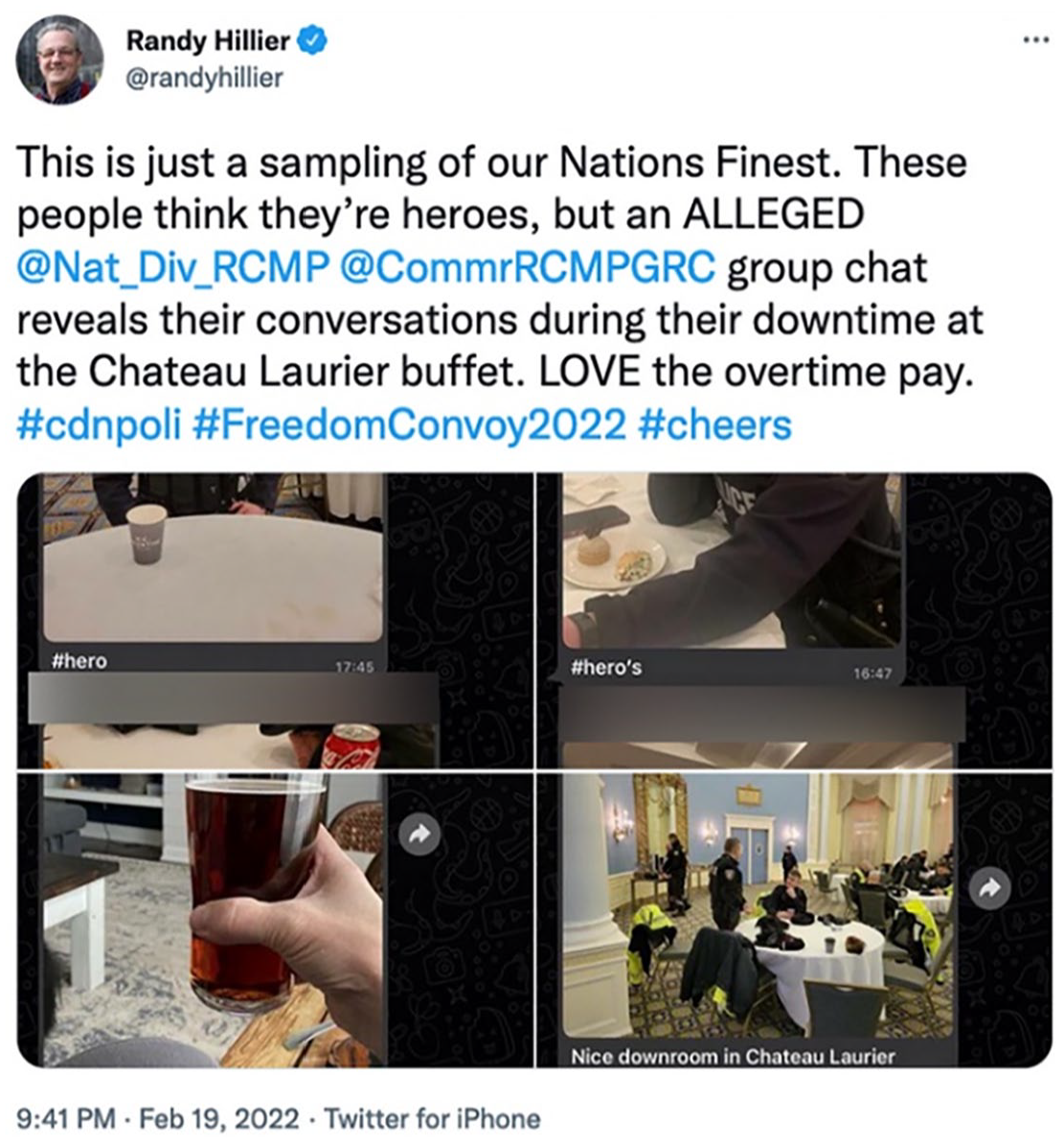
Hillier Twitter/“X” post of police officers revealing information about their colleagues to pro-convoy sympathizers.
For those unfamiliar with the term, “doxxing” or “doxing” is Internet-speak for the release of one’s personal information for the purpose of harassing, intimidating, threatening, and/or humiliating that individual (Douglas, 2016). Among the content that Hillier and his supporters released and shared were the names and, in some instances, the phone numbers and other contact information of individual officers working the protests (see Figure 2 1 ). What makes this doxxing is that the sharing of this information was done for the express purpose of adjuring supporters and the public to harass targeted individuals at their places of work and/or at their homes.
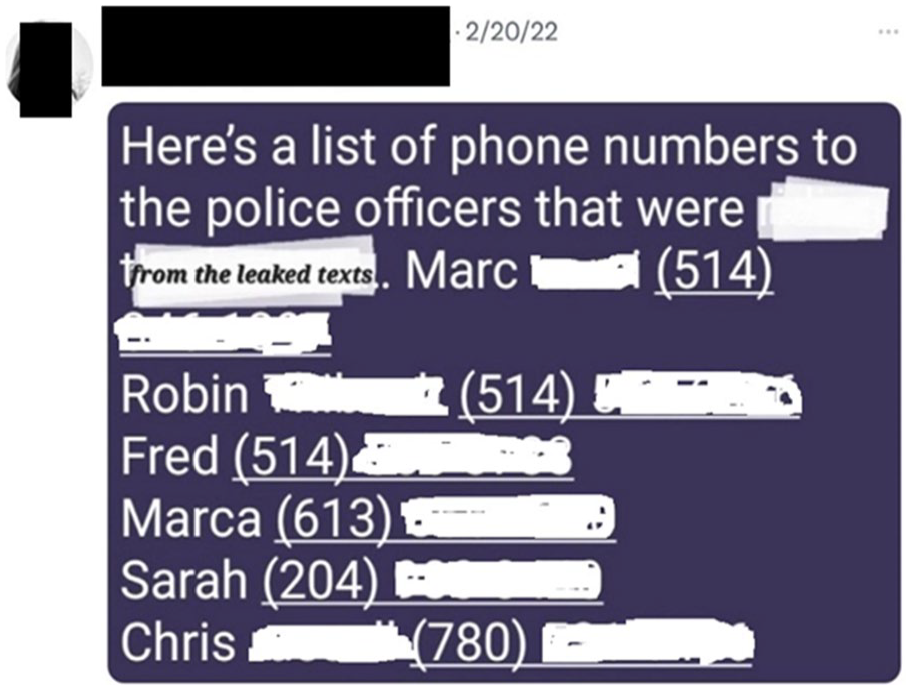
Leaked information of police working the protests.
The present study examines the doxxing of Canadian police officers by individuals linked to various right-wing political groups and causes—from 2022 Freedom Convoy protestors to anti-trans activists. Drawing on in-depth qualitative interviews with 65 (n = 65) public police officers from across Canada, we also explore the impacts of doxxing on police officers and the potential implications of this practice for the institution as a whole from their perspective and experiences. In the pages that follow, we first discuss the concept of doxxing, with reference to the relevant literature to show how releasing information about police officers has been employed as a tactic by political protestors and related groups from both the left and the right. We then explore officers’ experiences, beliefs, and knowledge of experiences of doxxing before presenting a case study involving a recent doxxing of a junior police officer by anti-trans activists. The discussion then turns to the actual and potential impacts of doxing on both the police institution as a whole, as well as individual police members and their families. Interview data from serving police officers assists in answering important questions about the effects of these practices on targeted agencies and police officers. Lastly, we review our main findings and consider the potential ramifications of this practice if left unchecked.
Doxing/Doxxing
As noted earlier, “doxxing” is internet slang for the practice of “dropping documents” on someone—that is, seeking and publicly releasing an individual’s personal information (Honan, 2014). The purpose of doxxing, or doxing, as is also commonly used (Cheung, 2021), is to “humiliate, threaten, intimidate, or punish the identified individual” (Douglas, 2016, p. 199). Douglas (2016) has identified three forms in which behavior can take:
As with many other social behaviors, motives for engaging in doxxing vary, as do outcomes. For some, particularly those within social movements, doxxing is viewed as a legitimate form of resistance, a political tool for fighting oppression (Trottier, 2020). Indeed, one writer has suggested that doxxing is seen by some activists as a “democratization of force” (Tenold, 2018, p. 2). For others, doxxing is a form of online harassment, one to which many criminologists and other academics have paid too little attention (Lee, 2022). Online harassment encompasses a broad range of abusive behaviors, including cyberbullying, non-consensual image sharing, threats, and hate speech (Schoenebeck et al., 2023). While general online harassment can be persistent and psychologically damaging, doxxing escalates the threat by putting an individual’s (and potentially their loved ones, as we discuss in this study) safety and privacy at immediate risk because of the release of personal information and because this dissemination of information is typically accompanied by some form of a call to action (Eckert & Metzger-Riftkin, 2020a, 2020b). This public exposure and rally to act inherent in doxxing can lead to online and physical consequences, such as stalking, identity theft, and even physical violence, making it a particularly severe form of digital abuse (Huey & Ferguson, 2024).
Expectedly, motives specifically for doxxing the police are also wide-ranging. In some instances, motives can fit legal definitions of terrorism (Ellis et al., 2024). For instance, Section 83.01 of the Canadian Criminal Code defines terrorism as an act committed “in whole or in part for a political, religious or ideological purpose, objective or cause” with the intention of intimidating and “. . .with regard to its security, including its economic security, or compelling a person, a government or a domestic or an international organization to do or to refrain from doing any act” (Department of Justice, 2021). One potential example is the neo-Nazis doxxing officers at the Cour D’Alene Police Department in Idaho for “equal retribution” and because “they deserve to be tortured and humiliated” for arresting 31 members of Patriot Front, the white supremacist group (Lamoureux, 2022). Beyond the general motives identified above, some motives for doxxing the police are, indeed, to coerce, intimidate, and threaten law enforcement and potentially deter officers from performing their duties effectively, as well as disrupt the personal lives of officers and erode officers’ sense of security on- and off-duty (Alexander, 2020; Berghel, 2023; Huey & Ferguson, 2024; Jones et al., 2021;). Other broader goals for doxxing the police relate to the destabilizing societal order, provoking a heavy-handed response from authorities, and rallying support for particular causes by portraying themselves as fighting against a tyrannical state (Alexander, 2020; Berghel, 2023; Huey & Ferguson, 2024; Jones et al., 2021). For instance, in one study, Berghel (2023) investigated “911 swatting” as a form of doxxing the police, wherein citizens make fraudulent 911 to cause police response teams to react and engage resources to a non-existent public threat. Berghel (2023) writes that “while it could be intended as a prank, it could also be intended as a legitimate act of terrorism” and, therefore, 911 swatting is “intuitively an act of primarily domestic terrorism directed against noncombatant targets for personal reasons.” Regardless of the motive, those who engage in doxxing clearly feel justified in their actions.
Of the various potential harms that police now face as part of the rise of more immoderate elements among anti-authoritarian individuals and groups, doxxing is one that has recently begun to receive some, albeit very limited, attention from scholars. In attempting to track down some of this literature, we were able to locate one example with a North American focus: Johnson’s (2022) doctoral dissertation on “Information Warfare during the George Floyd Protests.” Drawing on a dataset of some 1200 tweets related to the protests following the death of Mr. Floyd, Johnson (2022) identified several techniques used by Pro-Black Lives Matter protestors, one of which was doxxing of police as well as those viewed as Anti-BLM. According to Johnson (2022), a subset of Pro-BLM tweets contained “the details of an individual and call[ed] for their allies to harass, call, or punish the individual for their action against their ideology . . . these tweets often took the form of images of a police officer or of the license plates and details of the vehicles used by counter-protestors” (p. 45).
The bulk of the remaining academic articles we were able to locate on the doxxing of police officers were related to the protests of 2019 to 2020 in Hong Kong. Cheung (2021) reports that approximately 4,400 doxxing-related complaints have been filed with the Office of the Privacy Commissioner during this time, with 36% involving police officers or their families. Similarly, Lee (2022) cites 4,700 complaints to the Commissioner, with about 1,584 reports from police officers and/or police families. In analyzing online comments from doxxers or those who support the practice, Lee suggested this behavior is largely rationalized as a form of self-defence (Lee, 2022). In support of this categorization, Lee (2022) cites two examples from posters: The power between the police and civilians is imbalanced; the police exercise their power to its extremes, and there is no use for civilians to report them. That’s why we can only use doxxing as a warning to them that they cannot do whatever they want. If we don’t doxx you, how do we know whether you would disguise as protesters to film us? It’s better for us to play it on the safe side (p. 336).
In another study of doxxing during the Hong Kong protests, Li and Whitworth (2024) analyzed comments from Telegram, finding that “participants came up with practices that used the private data of police as a weapon to instigate the harassment of these individuals. Examples included putting the addresses and phone numbers of police officers on to flyers advertising the sale or rent of apartments, school enrollment and restaurant deals.” And again, police families were deemed legitimate targets for identification and subsequent harassment. These authors cite a post rationalizing such behavior: Extending punishment to their wives and children is not just about doxing per se, we want to create a scenario in which the police will be fearful of their children being bullied on campus, or having something ‘extra’ in their meals when eating in a restaurant (Li & Whitworth, 2024, p. 12).
In line with limited scholarship more broadly, at the time of writing, we could locate no empirical works specifically on the doxxing of police in Canada. To address this literature gap, this study looks at some examples of the doxxing of Canadian police officers from the policing perspective, from low-level efforts by grassroots anti-authoritarian groups on the left to the release of police officer’s names and phone numbers by libertarian right-wing individuals and groups during the 2022 Freedom Convoy protests.
Methods
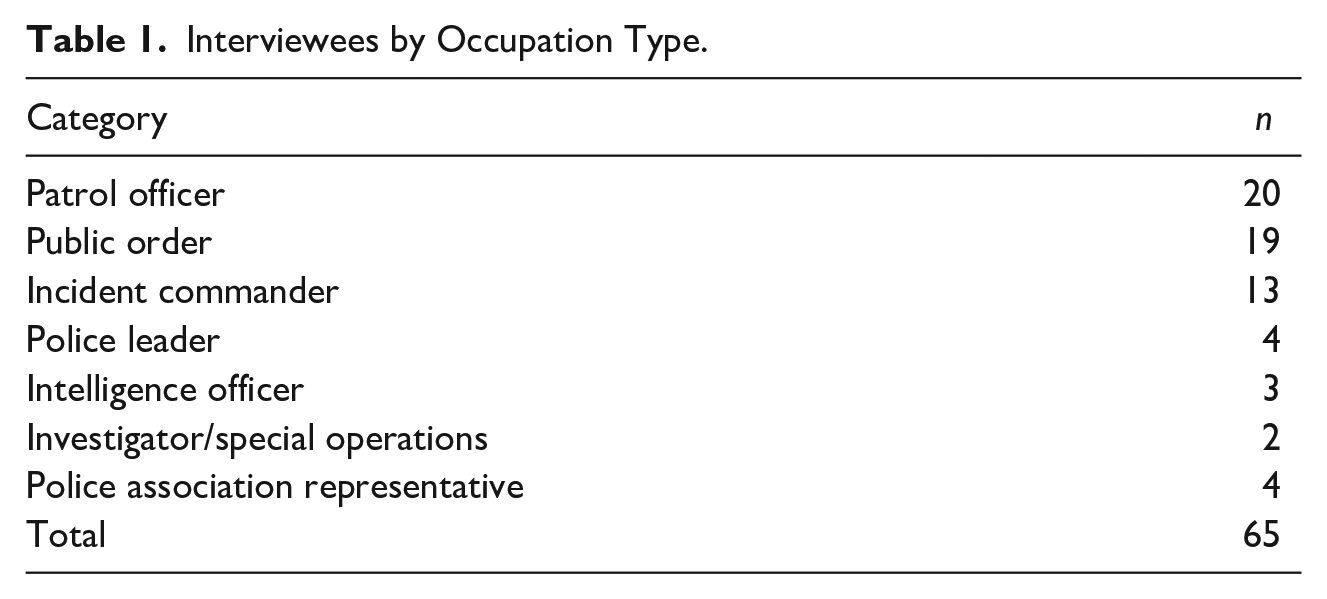
This paper draws on 65 (n = 65) in-depth qualitative interviews conducted with police personnel from across Canada who had direct experience of the 2022 Freedom Convoy protests staged in Ottawa and other cities and/or had been involved in similar politically charged events. Interviewees included police leaders, critical incident commanders, public order unit personnel, emergency response team members, and frontline officers (see Table 1 below). The data set consists of a non-probability sample. We employed two methods to secure interviewee participation. The first was to reach out to existing contacts within our policing research networks. The second strategy was to advertise the study and its objectives through social media platforms and have participants self-select. As geographical, occupational and other forms of diversity were important to us—in order to provide more diverse perspectives on events—we deliberately sought research participants in as many police services and related roles as possible, including reaching out to existing contacts in each of the 10 provinces. We were able to secure interviews with individuals from 22 (n = 22) different police services in six (n = 6) provinces. This includes members of municipal, regional, and provincial agencies. All interviews were conducted over the phone to reach officers across multiple provinces and lasted approximately 45 to 90 min.
Interviewees by Occupation Type.
Interviews were semi-structured and open-ended. To ensure some level of consistency across interviews, we used an informal interview guide comprised of a list of topic areas, including: information regarding a participant’s role and police experience; individuals’ thoughts, beliefs, and knowledge of the 2022 Freedom Convoy and related protests; how participants saw these events, including potential positive and negative impacts, and; what lessons they felt should be drawn from the policing of this event and other similarly contentious political issues. All interviews were audio-recorded with participants’ consent. Recordings were subsequently manually transcribed verbatim, and the transcripts were then sent to interviewees for review. This member checking of transcripts occurred for two primary reasons. First, to allow participants the opportunity to verify the accuracy of the information recorded and identify any discrepancies. And second, to provide participants the chance to clarify any of their points made or provide additional details to enrich the data. Participants responded with minor adjustments to 10 (n = 10) of the transcripts, such as in relation to spelling, street names, and acronyms. All interviewees subsequently approved of their transcripts before data analysis commenced. We also provided access to copies of all papers from this project to interviewees for the same reasons as another reliability check.
All components of this research were conducted in compliance with Canadian TriCouncil guidelines on the ethical conduct of research and with the approval of a university Research Ethics Board. Given the controversial nature of some of the events discussed here, one important consideration for us while conducting this work was to ensure the anonymity of participants. Any potentially and explicitly identifying information has thus been removed; for example, in some cases, we have changed a participant’s descriptive details to ensure they cannot be identified.
The data presented in this article is also supplemented by information gleaned from public policy documents, such as the report of the federal inquiry into the use of the Emergencies Act. Additional information was sought through federal Access to Information (ATI) requests. The RCMP (2022) security briefing on using ATI requests to identify RCMP members policing the Freedom Convoy protests, which is referenced here, was secured through one such request. Additional information, including screenshots of convoy protestor chat groups on Telegram and other sites, were kindly provided to us by the Anti-Racist Canada (ARC) Collective who conduct monitoring of far-right activity in Canada.
To analyze these data, the first author initially conducted an exploratory analysis of the interview data and relevant social media posts and film clips using open-focused coding. This inductive thematic analysis approach was undertaken to identify major themes and sub-themes (Braun & Clarke, 2006). For example, analysis of the theme of “doxxing” yielded the sub-theme of “social media,” as well as related themes centered on impacts on the police institution and individual officers. In line with the six-step process outlined by Braun and Clarke (2006), the first author then utilized a more focused coding approach that allowed for the further development, refinement and comparison of the initial major themes and sub-themes across the interviews. This led to the sorting and grouping of these themes into “overarching themes” (Braun & Clarke, 2006), which were then named and defined. Once the first author finalized and completed the coding, the third author reviewed this work and independently verified the coding to ensure the reliability of the codes and to have confidence in the research findings. At this point, the intention was for the first and third authors to review any coding disagreements and arrive at a consensus before finalizing the analysis; however, no conflicts emerged with respect to the themes and sub-themes identified. For this reason, no inter-rater reliability was required.
Results
“Oh, We Have A List”: A Brief History Of The Doxxing Of Police In Canada
The release of officers’ names during the Freedom Convoy protests of 2022 was not the first time police officers in Canada had been the target of doxxing attempts. Nor has the identification and release of police officers’ personal information for the purposes of harassment been a tactic employed exclusively by right-wing protestors and anti-authoritarian groups. In discussing this phenomenon, study participants from police services in British Columbia (BC) were quick to point out that this practice is not new to them. A veteran officer in Vancouver’s Lower Mainland observed that activist and anti-police groups in the city’s Downtown Eastside had been doxxing police officers for a number of years. As he explained, “It is more from sort of the left social activist kind of person or group, but yeah, they’ve been doing that for years here.” These groups, he said, have “taken to social media to try and identify the officers to target them, to get other people to target them.” Thus, in Vancouver, doxxing has “been an issue that’s been ongoing here for a while.” On Vancouver Island, doxxing of police officers has been associated with environmental protests. From 2020 to 2021, environmentalists set up one of the largest protests in Canadian history to prevent old-growth logging in an area known as Fairy Creek (Hunter, 2021). As is often the case, following a court injunction, police were tasked with clearing the blockade and arresting protestors who would not leave (Hunter, 2021). Supporters of the protest filed federal information requests seeking the badge numbers of officers so they could be identified. The purpose for filing these requests remains unknown, as the RCMP Commissioner decided to refuse the release of badge numbers and names. However, the police we interviewed on Vancouver Island believed protestors wanted the information released on social media to urge supporters to harass participating officers. “If they get your name,” one stated, “they just run it on social media.”
That police officers on Vancouver Island would be suspicious of requests for their badge numbers and names during a highly contentious event is not surprising. There were other examples of police doxxing experiences from which they could draw. The Chief of one major municipal service in BC was purportedly doxxed in response to the 2021 arrests of Indigenous protestors who were occupying the provincial minister of energy’s offices in response to a pipeline in northern BC (Kane, 2020). Multiple sources told us that his address was released on social media, presumably so that protestors could harass him directly at his home. Although we could not independently verify this story—it neither made local news nor was the offending post accessible—we heard the same story from a senior police leader several provinces over. “We knew it happened to him,” our interviewee stated before citing two further doxxing incidents involving police leaders in Manitoba and Ontario, which we were unable to confirm. 2
In other cities, notably in Calgary, participants reported that doxxing became an issue with the creation of COVID-19-related public health mandates. As with police activity in enforcing court injunctions, enforcing public health mandates became another controversial responsibility which brought police directly into conflict with those opposed. In the instant case, many of those who were opposed can be numbered among those supporting other right-wing anti-authoritarian causes. In Calgary, as one officer related, “Officers were very concerned about the intimidation factor of [mandate opponents] finding out where they lived because these guys were turning up at politicians’ homes.” This fear was not unreasonable. An intelligence officer in Alberta observed, “We had hundreds of officers within the service doxxed. They had a campaign trying to find our police officers on Facebook pages and everything else and try and find them online.”
The police leader who was doxxed in Ontario was one of the dozens of officers who had their names, phone numbers, and/or other personal information released in response to the Freedom Convoy protests of 2022. While the public first became aware that Freedom Convoy protestors were gathering personal information about officers deployed in Ottawa to deal with the protests with the release of information by MPP Hillier and others on February 20th, the RCMP and other police services had already recognized the fact that protestors were attempting to gather “intelligence” on officers. According to a RCMP (2022) security briefing, in early February 2022, someone filed a federal Access to Information request seeking the names and badge numbers of each RCMP officer involved in any enforcement activity relating to the convoy blockade of the Ambassador Bridge crossing. The request, which the Commissioner of the RCMP (2022) reviewed, was denied on the grounds that releasing this information “could create officer safety risks for both the officers and their family members”.
We learned that another strategy employed by Freedom Convoy protestors to acquire information was to approach officers and record their names on their name tags. An officer deployed to Ottawa, Ontario from another province advised that when his team first arrived, they were told, “‘Take your name tags off.’ We’ve been finding that people are going up to the line. They’re recording your name. They’re finding you and your family online.” Participants explained that officer fears about being doxxed increased in parallel with doxxing experiences.
Dismantling the truck blockades in Ottawa and at the border (notably the Windsor, Ontario, and Coutts, crossings) required police services to dispatch officers to cities outside their home jurisdiction. As several described, they were flown or driven in and then put up at hotels near where they would be deployed. The RCMP security brief to which we gained access revealed that Freedom Convoy protestors had supporters at local hotels willing to share officers’ personal information. The following comment made by a supporter of the 2022 protests was cited in the brief: Oh, we have a list. . .Police and RCMP also. You better believe it we do. Amazing what you can get from Hotels. We have people everywhere. You’ve seen Fight Club, right? Gather ad [sic] much intel as you can. No amount of info here is insignificant.. (cited in RCMP, 2022).
However, another tactic employed by 2022 Freedom Convoy protestors—and perhaps the most divisive and damaging to police of the information gathering strategies used—was to rely on protest supporters from within policing to supply confidential information about police colleagues. As seen in the Hilliard tweet above (see Figure 1), at least one police officer surreptitiously recorded images of their colleagues, individuals who could be identified using image search software. At least one or more officers leaked deployed colleagues’ names and phone numbers (see Figures 2 and 3).
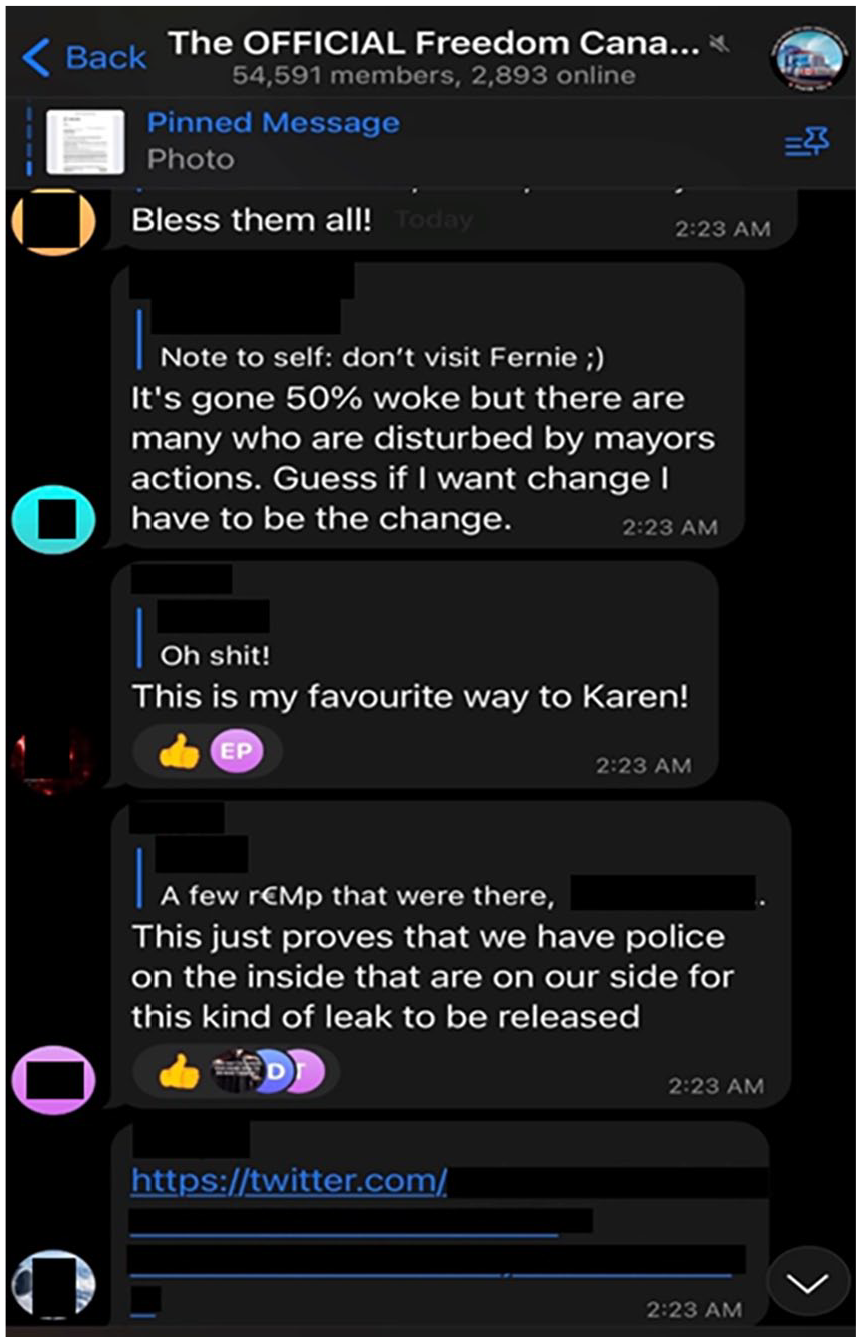
Conversation on police on the “inside” leaking information.
While it could reasonably be argued that police officers engaged in their public duties have no right to privacy, what makes doxxing a problematic practice is that the central point of releasing an individual’s personal information (“deanonymization”) is to wield it as a form of intimidation and/or as a tool of harassment (“targeting”). The logic behind such actions, simply put, is to render the transactional costs of policing protests and related events so high that police officers will refrain from volunteering 3 to take on this work. One police service within which we conducted interviews for this project advised that they had officers become reticent about engaging in public order work because of the harassment they had experienced. In relation to the 2022 Freedom Convoy protests, one of those who had been deployed from another city was told upon arrival that not only were police officers being doxxed but that supporters of the protest had “sent people to some of the cops’ homes,” overtly driving by and making their presence known to officers as a form of not-so-subtle intimidation. Another intentional harassment tactic utilized was to encourage supporters to file frivolous complaints against identified officers in order to “make their lives hell” (Figure 4). One of the officers we interviewed in Ottawa was the subject of some 50 of these types of complaints that were sent to the Office of the Independent Police Review Director for investigation by 2022 Freedom Convoy protest supporters.
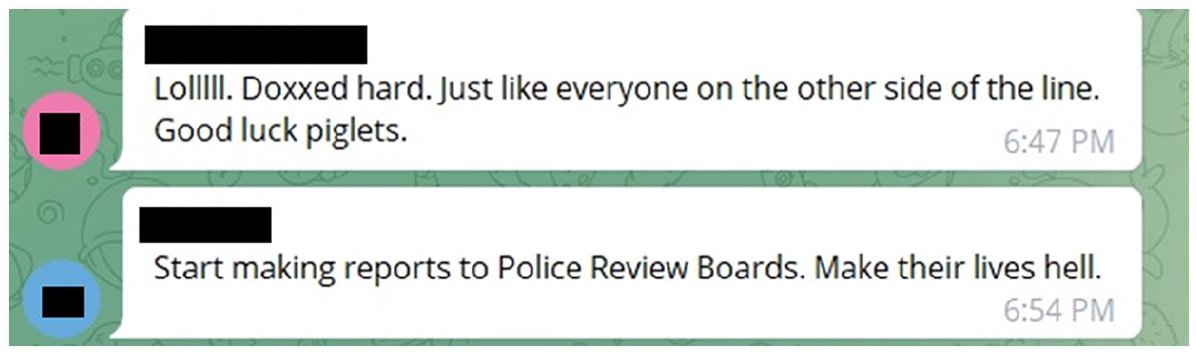
Intentional harassment tactic of filing complaints against identified officers.
“Do We Know Her Name?”: An Example of “Cop Doxxing”
On April 1, 2023, a rally was held in Vancouver’s Grandview Park to mark the occasion of International Transgender Day of Visibility. Not only did pro-Trans supporters show up, but so too did a handful of counter-protestors. Among the latter was Chris Elston, a well-known critic of gender-based medical interventions for children. Elston, also known as “Billboard Chris,” is known for staging events and public controversies in order to share his message concerning what he perceives to be the negative impacts of “gender ideology 4 ” on children. Elston, who filmed these interactions to share with his supporters on social media, was also simultaneously filmed by other counter-protestors. In one clip, Elston is being interviewed by someone when a Trans woman comes up to him and begins verbally attacking him and then is seen screaming in Elston’s face. In the next frame, Elson pushes her to back up. She then reaches over and grabs him by the throat. They appear to be scuffling. In another clip, police officers, who to this point have simply been standing by observing the event, push forward to break up the fight. One police officer, a young female, hangs back. She appears to be smiling.
In the immediate aftermath of this event, Elston posted a clip of the encounter, which received some 225,000 views. According to his version of events, Elston was physically assaulted while police stood by and did nothing: “Another angle of the assault on me today. Police did nothing. The investigating officer says I instigated, and she told me it was a mutual fight.” In that first clip, the police rushing forward to break up the violence is not shown. A third clip that made the rounds of social media features a counter-protestor querying the smiling female police officer about her views as to whether the attack on Elston was “deserved.” Baited into responding, she tries to tell the man filming her that Elston was seeking to provoke a response. The accompanying message attached to the clip reads: “I showed this officer footage of @BillboardChris getting physically assaulted 3 TIMES, and she says that HE incited violence by wearing his sign. . . Badge number 3081 of the VPD [Vancouver Police Department]. . .she wouldn’t tell me her name. . .” (DanDicksPFT, 2023). Throughout this clip, she is also smiling.
In total, three video clips were posted on social media to generate public attention. The common denominator in each of these is the presence of the smiling police officer. She is labeled as “the smirking female cop” (johndarts2020, 2023), “a disgrace” (loganfizzle, 2023), “a gutless imposter” (mcgovern_bob, 2023) and “a diversity hire” (jondonger1 2023), among others. Her demeanor draws the most opprobrium, with her behavior variously described as “laughing” (ColtonCoutre, 2023) and “smug, biased and incompetent” (joelong1999, 2023).
One common concern raised over and over among posts about this incident is the question of the smiling officer’s name. Her badge number, which is clearly visible on her work jacket, is noted, along with, in some cases, information on how to email complaints to the Vancouver Police Department. One poster states, “I suspect there will be a mountain of Access to Information Act 5 requests for this officer’s name and work performance folder” (_Heisenberg_, 2023). Some of those incensed by the officer’s demeanor and comments decide not to wait for the results of a freedom of information inquiry and start looking for clues to her identity online. They decide to doxx her. Further, they do so not just to de-anonymize and target her but also as a form of de-legitimating her as a police officer and, more especially, the police service for whom she works.
The doxxing begins almost immediately. By the next day, doxxers had come up with a name they associated with a Twitter/“X” account. The name and the Twitter/“X” handle are shared widely by Elson and his followers, along with a series of screenshots purportedly showing that the account holder has “liked” a series of posts concerning Trans inclusion. These screenshots are intended to make the case that the smiling officer is biased against Elson and his supporters. They also go through her friends list, hunting for evidence of friendships with members of the LGBTQ+ community. The results become “evidence” of a bias to be shared with leaders of the Vancouver Police and the city’s Mayor (see Figure 5).
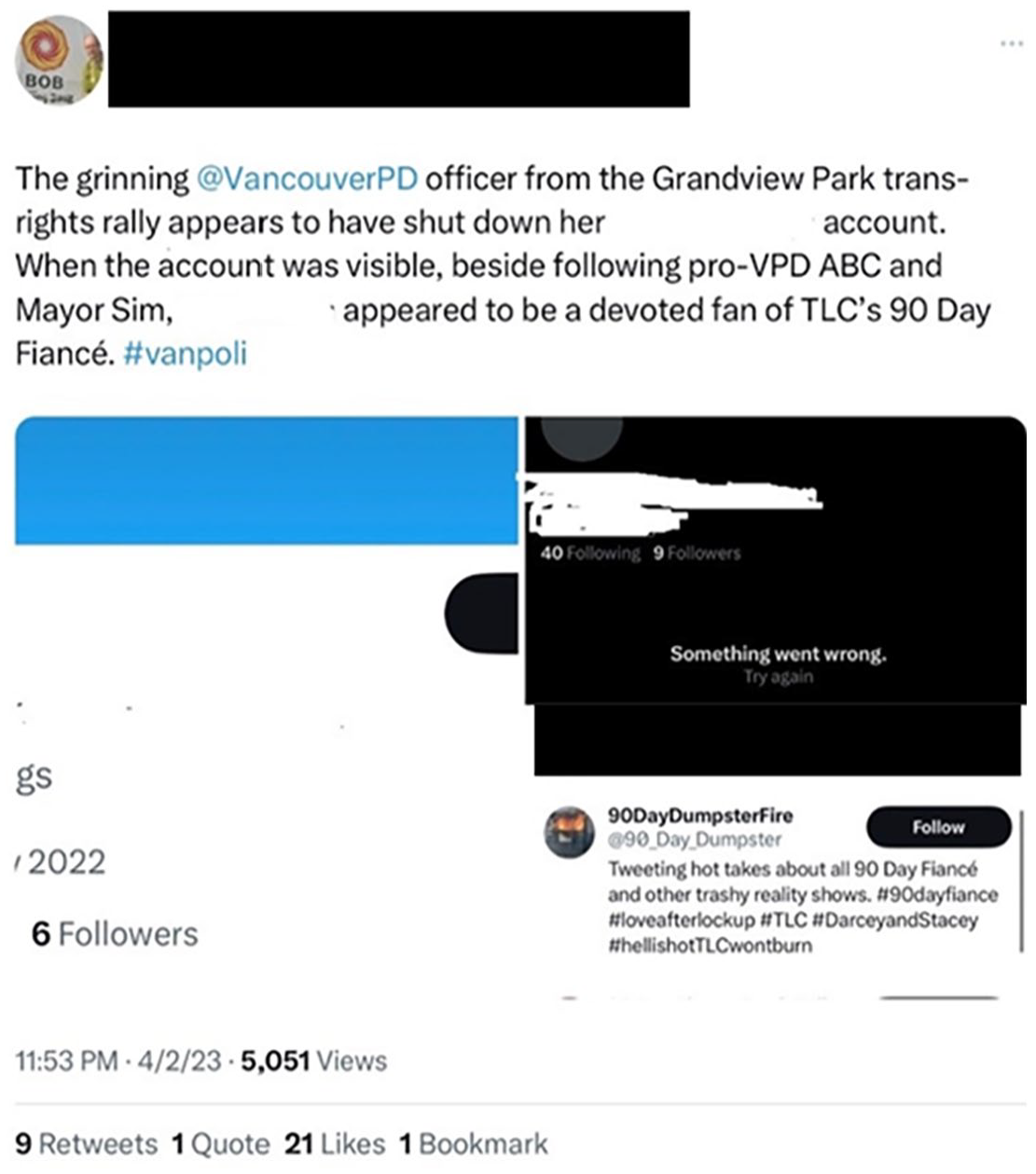
“Evidence” of bias regarding 90 day fiancé.
Within hours, the Twitter/“X” account was shut down. Doxxers also unearthed a news article from 2021 detailing a hearing in which a judge found the officer had engaged in discreditable conduct because of her inappropriate delivery of news of her son’s death to a mother, and this is widely shared across Twitter/“X.”
Doxxers also locate and share information on where the woman went to school post-graduation and find and share information from her Facebook page. Screenshots of the young woman, holding a cat and posing in front of a Chinese calendar, which someone describes as: “A photo in her FB pics . . . the calendar. Google translate says Zhu De . . . ‘one of China’s greatest military leaders and the founder of the Chinese communist army’” (@IndubioutablyTho, 2023). @Jules4u11 (2023) reaches a conclusion shared by several other posters: “Concerning. A commie on the police force? How does a Canadian, probably raised here, maybe even born here, value communism? Is the police force aware of this? Are they hiring indoctrinated commies? Is this the tip of the iceberg? So many questions. . .”
By April 3rd, 2023, a petition called upon the Vancouver Police to fire the woman. The officer is described as “smiling with glee,” and pictures of her smiling feature on the website. By July 5th, almost 20,000 people had signed the petition. On April 4th, the story is retold—from Elson’s point of view—on an episode of Tucker Carlson’s program on Fox News. However, another clip of the event is presented. In this one, they ask her a series of questions, and she smiles throughout the encounter. Carlson describes her as “the rosy-cheeked face of tyranny” before suggesting she could work at “the Citibank HR department” (Carlson, 2023). By April 5th, a webpage was dedicated to her on a site called Cowards of Canada (2023). The site links to a Twitter/“X” account and onto a TikTok post, which purportedly shows the woman involved in a Taser incident with “an unarmed man” (@DrPeopleKind, 2023). Here, she is described as “the epitome of a pig” (@DrPeopleKind, 2023). Other pages and social media threads about her populate the right-wing social media. Critics attack her looks, intelligence, abilities, and ethics while linking her behavior to various social issues to which anti-authoritarian groups typically take exception—from women in policing to vaccine mandates, from anti-LGBTQ+ causes to the “authoritarian regime” of Justin Trudeau. One recurring refrain among the comments is that police are corrupt. A sampling of comments from a thread on Patriots Win (2023) about this officer:
“Canadian police are useless”
RabidZoo: “[the police are the] biggest gang around. Highway robbery is just one of their specialties”
“Report [her] go ahead. She’ll be put on paid leave and make 120,000.00 / year for the next 10 years while they investigate her. Quit playing by YOUR rules. They are in a different game, altogether”
“Don’t worry. She’s black block she’s supporting her own.”
“Nope they are DOGS! ALL COPS ARE DOGS!”
“After seeing what they did to the truckers who just wanted their freedoms back, I’m going to say a lot more of this kind of stuff is going to happen to people in North Cuba.”
“Filing a complaint wouldn’t affect the rogue cop, but it WOULD make you a target of the rogue police. Our side is reduced to taking action from the shadows where we can’t be identified - which is exactly how these Leftist psychopaths took over.”
One of the officers we interviewed for this project had detailed knowledge of this event. This is how he described it: So, we had a—a sort of right of centre provocateur who was getting into the face of one of these transgendered people. And it’s like poke, poke, poke, poke on—all of the sudden, the other person hit back. And then they tried to portray themselves as a victim. Police officers on the scene saw all this. But unfortunately, again, it was, ‘oh, you’re not going to do anything because you’re an agent of the state. And you believe in corrupting young children,’ blah, blah, blah. And this police officer, unfortunately, wasn’t the highest flying in our organization. And she was vilified terribly on Twitter and it wasn’t a great situation for her.
The targeting of police officers as a result of policing contentious events shapes a much larger issue about doxxing, mainly the collateral consequences from calls for service where (in)action carries occupational and personal consequences. Put another way, the carrying out of, for example, public order mandates could result in officers losing their privacy and having themselves and/or their families subject to harassment. We examine these and other potential effects in the section immediately following.
Effects On The Police Institution/Individual Officers
In discussing some of the experiences of doxxing within policing above, we have briefly touched on some of the actual and potential negative impacts on both the institution of policing and on individual officers. In this section, we explore these issues in greater detail, beginning with some potentially damaging effects for the institution.
Beyond de-anonymization, the goals of doxxing include delegitimizing the target and/or altering the target’s behavior. These goals are accomplished through various forms of harassment, from trolling
6
a target or their children online to filing spurious complaints, from engaging in slow drive-bys in front of one’s house to threatening violence in direct messages, emails, or by phone. One of the concerns raised within the RCMP’s (2022) security briefing on doxxing was the possibility that doxing of tactical unit members would result in such activities, thus demoralizing members and requiring them to be pulled from active duty. From the report: Additionally, PIU noted serious online efforts to generate intelligence in relation to the members and their families . . . It is conceivable from this experience that were a significant number of members [sic] information to be shared from the Freedom Convoy 2022 Windsor Crossing, and members from the same tactical troop to be doxed, while units would need to be sidelined as a result while the situation is assessed and mitigation measures undertaken (RCMP, 2022).
As the authors of this report further suggest, doxxing of officers during volatile political or social events can create significant operational difficulties by leaving police efforts understaffed or staffed by less experienced officers.
Aside from weakening operational capabilities, another institutional issue raised in our interviews with police personnel was the potential for doxxing to impact police recruitment negatively. A veteran officer from one of the major municipal services noted, “We’ve had incidents where there’s been a consequence because individuals have been able to identify what kind of vehicle will the police officer be driving. And then from there, it’s not too hard to figure out where they live. Fortunately, I’m not talking about hundreds or thousands of incidents, but we’re seeing it happen more and more frequently, and we think there’s a real risk to that.” As a result, this police leader felt that increasing awareness that police officers and their families can face personal harassment as a result of doing their jobs would limit the ability of police services to recruit new members, particularly as recruits would be of a generation that had substantially “grown up online.”
That doxxing of officers might also pose a threat to the ability of police services to retain personnel is another issue worth considering. A constant refrain we heard across interviews was “I didn’t sign up for this” or “My family didn’t sign up for this,” meaning that individual officers did not “sign up” to experience being afraid of and facing personal harassment outside their working hours. Nevertheless, with doxxers de-anonymizing officers and urging their social media followers to target them for harassment, this is precisely what has been happening to officers, particularly those who are perceived as being on the wrong side of an anti-authoritarian cause. We see this most clearly in relation to the doxxing of officers as a result of themselves, or even other members of their service, participating in actions aimed at removing the Freedom Convoy blockades on streets and at borders. As the RCMP (2022) documented, doxxed members began receiving death threats: On 2022-02-19, screen captures attributed to a RCMP Musical Ride group chat were shared via social media, resulting in the unwanted release of members’ first/last names and personal cell phone numbers during the Freedom Convoy 2022 protests in Ottawa. This online ‘doxing’ immediately resulted in NCR-OCC fielding numerous death threats in relation to the members of the chat group. Members themselves contacted the NCR-OCC/POJ to advise that they feared for their safety and that of their families.
To be clear, however, experiences of harassment, including threats of violence, are not unique to those involved in the Freedom Convoy protests. Police who are involved in any contentious social or political issue today run the risk of not only being attacked personally on social media or through other avenues but also having people track down their partners or children. As a municipal police officer from British Columbia observed, “They attack the families, your kids.” This was particularly the case in Saskatchewan when officers were drawn into policing an ongoing labor dispute. A police officer from Regina noted that children of police officers were easily identified by strikers and pulled into what he termed “altercations.” The purpose of putting such pressure on police families is to cause officers to feel vulnerable and thus potentially back away from policing activities or from the profession itself. We asked a senior police leader about how these actions differ from the routine harassment police experience on the job, and he responded as follows, That is regular policing. What’s not regular policing though is what we heard was happening in Ottawa, which is they were getting names of members’ kids and kind of doing the straight on intimidation. “Hey, how’s June doing in school?” That kind of shit, right? Which apparently was happening. And we don’t care how seasoned of a police officer you are; that will rattle you.
A peace officer in Manitoba used a similar phrase to describe his reaction to seeing how much information someone could pull up about him from social media: “he knew more about me off Facebook . . . and that kind of freaked me out.” It is this intimidation factor that doxxers seek to achieve. And, if “the harassment, the intimidation part” is left unchecked, one police leader warned, “you’re going to see an erosion in the system.”
Discussion and Conclusions
The present study’s findings offer novel insights into Canadian police officers’ knowledge, perceptions, experiences, and fears of the doxxing of police. Doxxing is a terrorization technique in that it involves intimidation and harassment employed to silence, delegitimize, and/or control the behavior of one’s political or other foes. In the context described in the preceding pages, we see its use as a weapon intended to cow public officials—that is, to increase the personal and institutional transactional costs of specific policing (in)actions by targeting individual officers. As was noted in the preceding section, at an institutional level, those costs can limit the ability of police services to recruit and retain personnel. Although not directly referenced by our study participants, another likely negative outcome is fewer staff willing to volunteer for extra duties—such as public order work at protests and similar events—that might lead to being doxxed.
Whether one agrees with the tasks to which police officers have been assigned, targeting individuals for personal harassment should, in theory, be beyond the pale of acceptable forms of political or social protest. After all, several mechanisms are available to individuals with legitimate complaints to seek redress for real or perceived wrongs of police officers. In most provinces and territories in Canada, there are one or more avenues by which a complainant can request an investigation into police actions by an independent civilian body. That said, we also acknowledge that, in some instances, doxxing co-occurs with a phenomenon known as “paper terrorism.” The latter is a harassment strategy predominately used by anti-authoritarian individuals and groups, by which police officers and other public officials find themselves the subject of a variety of bogus legal, quasi-legal, and faux-legal claims in courts, tribunals, and other adjudicative bodies (Netolitzky & Warman, 2020; Perry et al., 2020). In the instant study, we provided an example of this use by referencing the case of an Ontario police leader, who became the target of followers of anti-authoritarian groups and lodged up to 50 complaints against him. Not only did the officer, in that instance, have to deal with a plethora of false allegations shared publicly across social media, but he also became the subject officer of complaints that take months to years to resolve. Being blanketed with false complaints is undoubtedly incredibly stressful for an officer who has lost control over his or her personal information. The misuse of police processes to harass, intimidate, and/or threaten officers requires subsequent empirical investigation to inhibit “paper terrorism.”
What concerns us, and should equally concern both police practitioners and public policymakers, is the potential normalization of this form of cyber-vigilantism (Trottier, 2020). At present, there are few tools available to combat doxxing and harassment of public officials. As we saw with the Ottawa 2022 Freedom Convoy protests and the doxxing that took place during this event—which resulted in no criminal charges to date—most police services, particularly during politically contentious events, are too strapped for resources to pursue such cases. Further, should police attempt to pursue harassment charges in doxxing cases involving their members, opponents would likely weaponize these cases, turning them into examples of greater persecution. We also note that not only do public officials rarely, if ever, speak out about this mode of harassment and its negative impacts on public discourse and public service, but this study and others (see, e.g., Huey & Ferguson, 2024) found that some politicians tacitly support and/or directly engage in this practice. More worrisome still is the fact that, to the extent that this issue is not on policymakers’ radars, means that little energy, resources, or attention will be expended in trying to regulate this destructive behavior. There thus seems to be a need to advance legal and policy frameworks to begin to address and combat the doxxing of police officers, as well as deter these actions and prevent anti-authoritarian individual extremists and groups from using officers’ personal information as a weapon. For example, given the potential linkages to extremism- and terrorism-related activity (e.g., anti-authoritarian causes), how can and should Canadian law be updated to address the dissemination of personal information with the intent to intimidate or harm police personnel?
The police leaders with whom we discussed this study recognized the significance of the doxxing problem and were concerned about its potential deleterious impacts on both the institution and individual officers. However, they seemed at a loss for how best to address the issue. One starting point we would suggest is improved education and training for officers on protecting their personal information. Relatedly, officers need training on how best to manage situations in which they might potentially face harassment of this type, as well as potentially on digital hygiene, using secure communication platforms, and scrubbing their personal information from publicly accessible databases. More senior and/or experienced police officers in this study felt that such training was particularly necessary for newer or more junior staff, who were likely to be much more active on social media. Additionally, as we saw with the example of the junior officer who was doxxed over her filmed remarks and actions at the Grandview rally, newer officers may also require training to deal with situations that are or might turn politically contentious. Combined, such training has the potential to help officers shield their personal information from being exploited by those intending to do harm, which is crucial in countering and preventing people and groups from using doxxing as a means to incite fear and disrupt law enforcement activities.
Another consideration that has been batted about within policing is the possibility of removing officer name tags from uniforms and having officers be identifiable only by their officer number. Given public concerns over being able to identify officers engaged in problematic behavior, removing name tags is a solution that should necessitate careful and extensive public consultation. We would also recommend research examining the impacts on public perceptions of police legitimacy should police change any identifying aspect of their uniforms. Taking this further, research understanding the motivations behind doxxing and its impact on law enforcement can ultimately inform better policy responses. There is thus a need for studies focusing on the intersection of cyber harassment, extremism/terrorism, and the vulnerabilities of police officers to lead to targeted interventions that address the specific threats posed by people and groups using doxxing as a tactic and to protect law enforcement officers and ensure their ability to maintain public order and safety in the face of such threats.
No study is without limitations, which is equally true of this one. This paper is based on an exploratory qualitative study with a limited sample drawn primarily through the authors’ pre-existing connections and social media contacts. Thus, some might argue that the sample is biased. To limit the possibility of bias in our sample, we posted advertisements on Twitter/“X” and LinkedIn to reach out to police officers with whom we did not have a prior connection. We also tried to limit bias by including a diversity of officers—diverse by rank, service, role, ethnicity, and gender—from across Canada. However, we were stymied in our efforts to include officers from Quebec, as many of those involved in the type of events in which we were interested speak French, and we do not. Future Canadian and other research should attempt to overcome these deficiencies.
Despite the limitations noted above, what our study does accomplish is to raise much-needed attention to a novel threat to police officers in their professional role as public officials. A common expression within policing—often in response to the ways in which police can be pulled into political or social issues in which they would rather not be involved—is “I didn’t sign up for this.” In relation to doxxing, no public employee or public official ever signs up to have their personal information, as well as information about their families, provided to strangers on the Internet.
Footnotes
Declaration of Conflicting Interests
The author(s) declared no potential conflicts of interest with respect to the research, authorship, and/or publication of this article.
Funding
The author(s) received no financial support for the research, authorship, and/or publication of this article.
